
Germany Hair Care Market Size, Share, Trends and Forecast by Product Type, Distribution Channel, and Region, 2026-2034
Germany Hair Care Market Size, Share, Trends & Forecast (2026-2034)
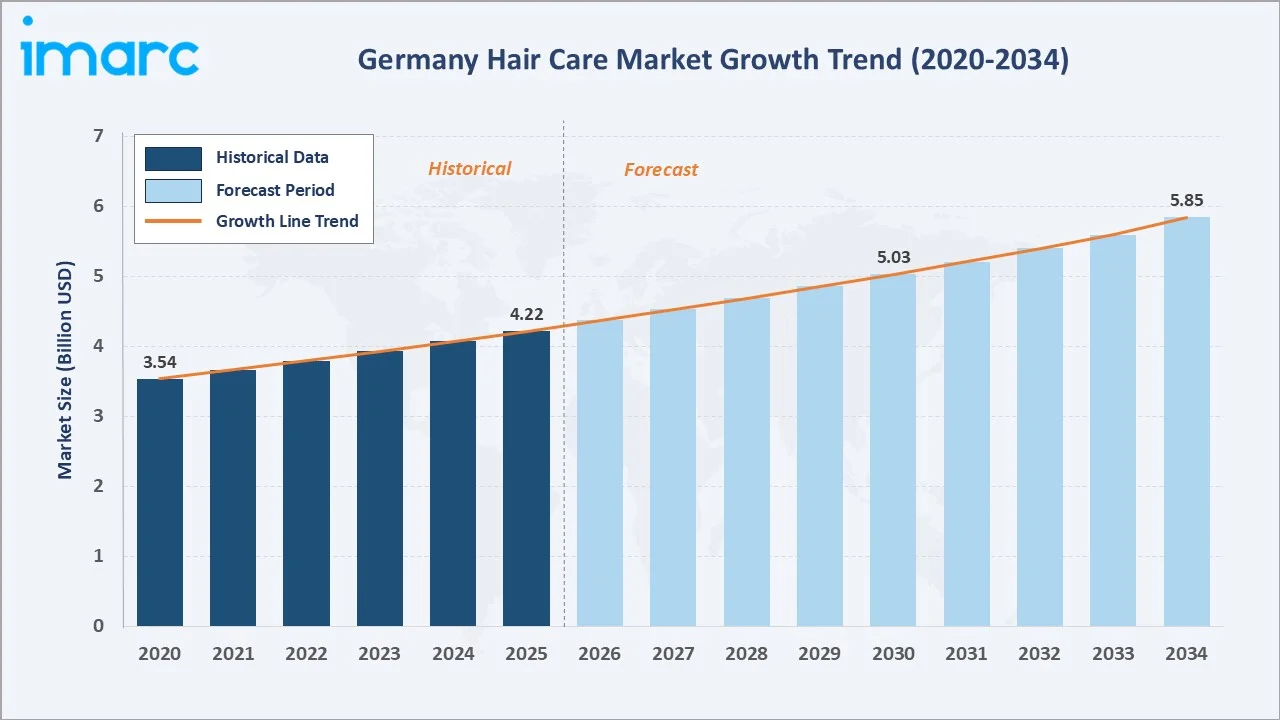
The Germany hair care market reached USD 4.22 Billion in 2025 and is projected to reach USD 5.85 Billion by 2034, growing at a CAGR of 3.58% during 2026-2034. Strong consumer preference for scientifically formulated, sustainable, and premium hair care products, the dominant market presence of global and domestic beauty incumbents, and Germany’s sophisticated multi-channel retail ecosystem are the primary forces sustaining consistent value growth throughout the forecast period.
Market Snapshot
|
Metric |
Value |
|
Market Size (2025) |
USD 4.22 Billion |
|
Forecast Market Size (2034) |
USD 5.85 Billion |
|
CAGR (2026-2034) |
3.58% |
|
Base Year |
2025 |
|
Historical Period |
2020-2025 |
|
Forecast Period |
2026-2034 |
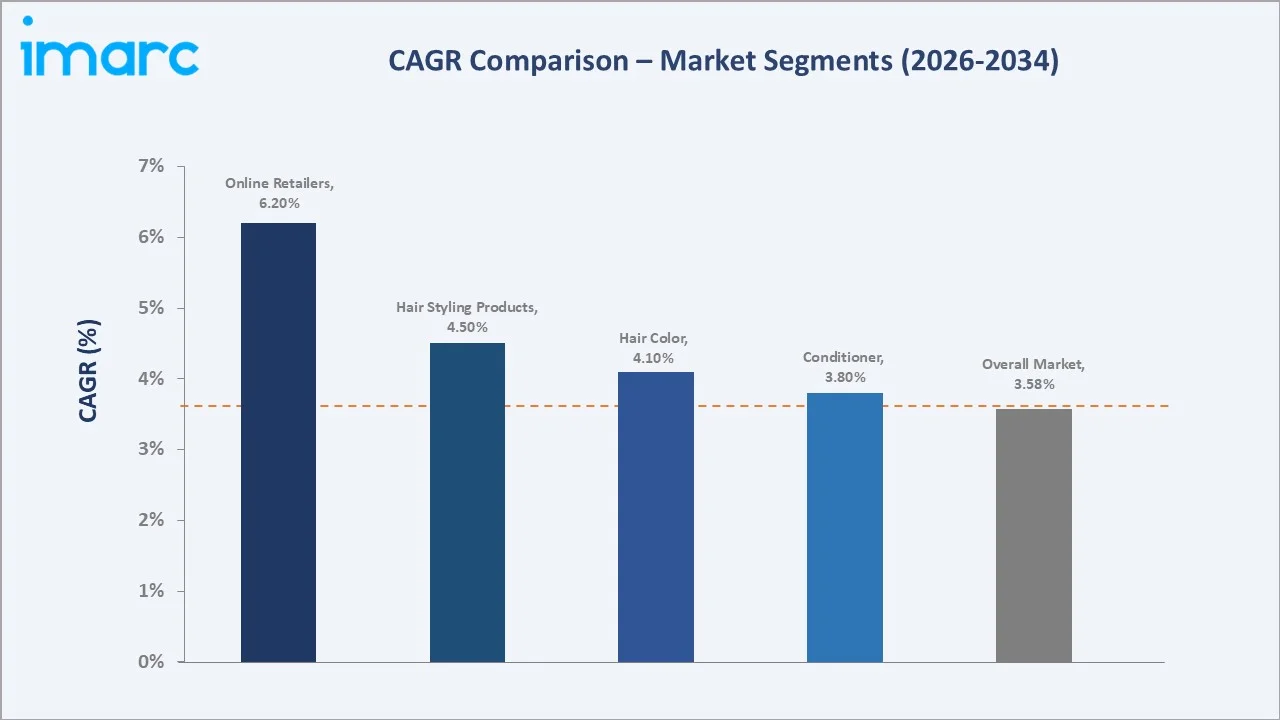
Western Germany leads regionally with a 35.0% market share in 2025, anchored by North Rhine-Westphalia’s large consumer base and Henkel AG & Co. KGaA’s Düsseldorf headquarters. Shampoo commands the largest product type share at 34.5%, while supermarkets and hypermarkets lead distribution at 31.0%. Online retail is the fastest-growing channel at ~6.2% CAGR, driven by beauty e-commerce platforms and D2C brand expansion.
To get more information on this market, Request Sample
Germany’s hair care market grew from USD 3.54 Billion in 2020 to USD 4.22 Billion in 2025, an increase of USD 0.68 Billion over five years, driven by premiumization across shampoo and hair color and post-pandemic recovery in professional salon product consumption. The market is forecast to reach USD 5.85 Billion by 2034, reflecting a mature, quality-driven trajectory shaped by ingredient innovation, sustainability mandates under EU Cosmetics Regulation, and the continued digital transformation of the German beauty retail sector.
Executive Summary
The Germany hair care market is experiencing sustained, quality-driven growth, reflecting the convergence of premiumization trends, demographic diversity, EU sustainability regulation, and digital channel disruption. The market stood at USD 4.22 Billion in 2025 and is forecast to reach USD 5.85 Billion by 2034 at a 3.58% CAGR.
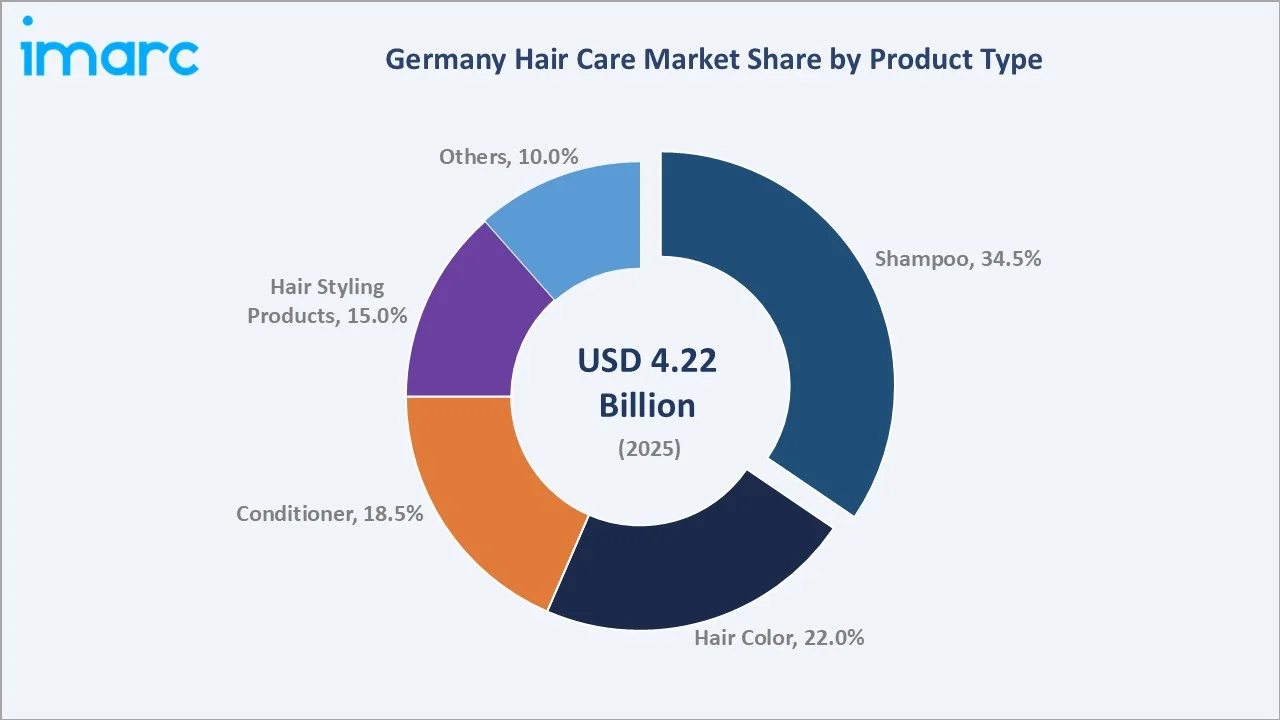
Shampoo dominates product type with a 34.5% share in 2025, encompassing anti-dandruff, moisturizing, color-protection, volumizing, scalp-care, and organic/natural variants. Hair color at 22.0% reflects Germany’s strong professional salon culture and growing at-home coloring adoption. Conditioner at 18.5% is benefiting from the multi-step hair ritual trend driven by dermatologist-endorsed scalp and strand health awareness.
Supermarkets and hypermarkets lead distribution at 31.0%, leveraging Germany’s dense dm-drogerie markt and Rossmann retail networks. Online retailers at 24.5% represent the fastest-growing channel as D2C brands and beauty marketplaces like Notino and Flaconi expand. Specialty stores at 20.0% maintain premium positioning for professional and indie beauty brands.
Western Germany leads regionally at 35.0%, supported by its large urban population, strong retail infrastructure, and high consumer spending across major metropolitan areas. Southern Germany accounts for 27.5%, driven by its high-income consumer base, premium product demand, and well-established modern retail channels.
Key Market Insights
|
Insight |
Data |
|
Largest Product Type |
Shampoo – 34.5% share (2025) |
|
Fastest Growing Product Type |
Hair Styling Products – ~4.5% CAGR (2026-2034) |
|
Largest Distribution Channel |
Supermarkets & Hypermarkets – 31.0% share (2025) |
|
Fastest Growing Distribution Channel |
Online Retailers – ~6.2% CAGR (2026-2034) |
|
Leading Region |
Western Germany – 35.0% share (2025) |
|
Top Companies |
Henkel AG & Co. KGaA, L’Oréal S.A., Procter & Gamble, Unilever PLC, Beiersdorf AG |
Key Analytical Observations Supporting The Above Data:
- Shampoo at 34.5% (2025) reflects its role as the highest-frequency purchase and primary category entry point in Germany. Anti-dandruff variants led by Head & Shoulders and scalp-care formats from La Roche-Posay Kerium and Vichy Dercos sustain premium price growth within the segment.
- Supermarkets and hypermarkets at 31.0% (2025) anchor distribution through dm-drogerie markt and Rossmann, which together capture an estimated 35–40% of German personal care turnover. These channels support branded leadership alongside aggressively scaling private-label tiers that compete directly with mid-market brands.
- Online retailers at 24.5% (2025) are growing at ~6.2% CAGR, driven by beauty specialists Notino and Flaconi, Amazon Beauty, and D2C brand stores. TikTok and Instagram-driven product discovery is accelerating trial of premium and indie hair care brands among Germany’s digital-first younger consumers.
- Western Germany’s 35.0% share in 2025reflects its large consumer base, high population density, strong urban retail network, and well-developed distribution infrastructure, particularly across major economic centers such as North Rhine-Westphalia.
Germany Hair Care Market Overview
The Germany hair care market encompasses shampoos, conditioners, hair color, styling products, and related treatments sold through mass-market retail, specialty beauty channels, professional salon supply, and e-commerce. Germany is Europe’s largest economy and a top-three beauty market, with a highly brand-literate consumer base that prioritizes ingredient transparency, dermatological validation, and sustainability credentials.
The industry’s value chain is characterized by high brand investment, EU Cosmetics Regulation compliance, and a bifurcated competitive structure between large multinational incumbents and a growing tier of premium indie brands. EU ingredient restriction frameworks, combined with Germany’s strict consumer protection standards, create entry barriers that reinforce established players while driving continuous formulation innovation.
Market Dynamics
To evaluate market opportunities, Request Sample
Market Drivers
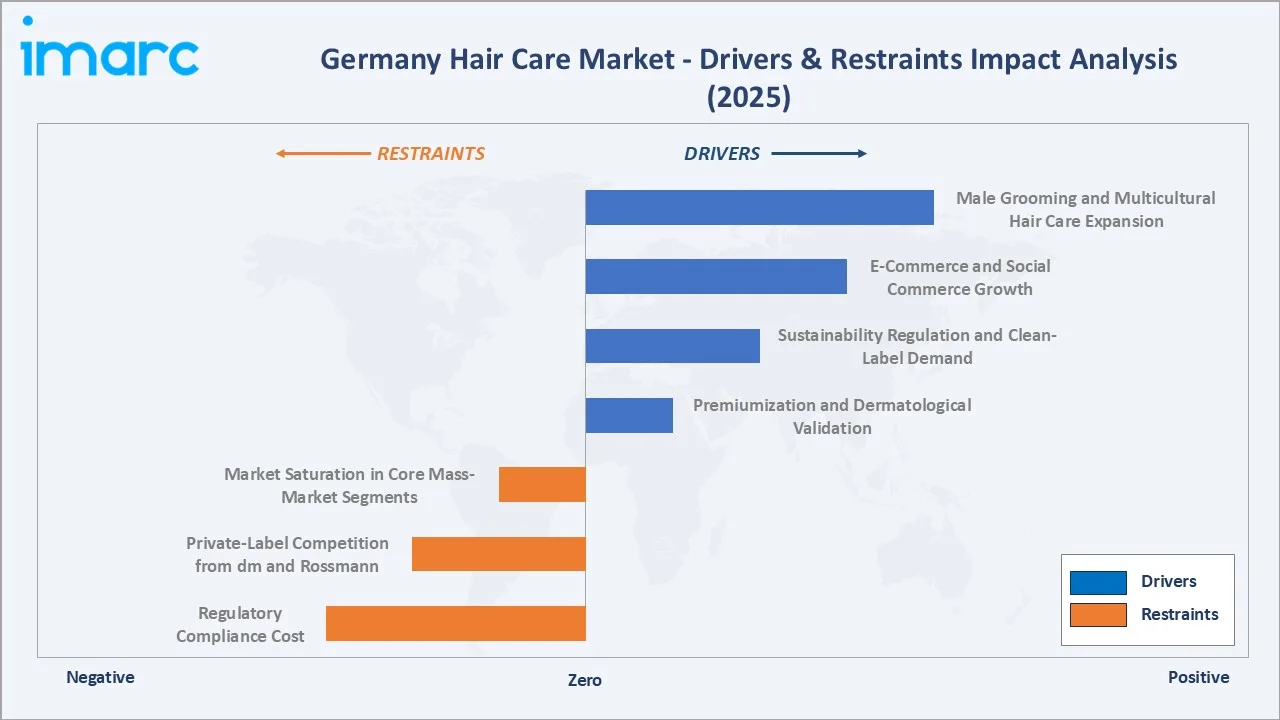
- Premiumization and Dermatological Validation: German consumers increasingly seek clinically validated, dermatologist-endorsed hair and scalp care products. The expansion of La Roche-Posay Kerium DS, Vichy Dercos, and Eucerin DermoCapillaire in German pharmacies reflects a structural shift from commodity to therapeutic hair care, supporting average selling price growth of 3–5% annually across the segment.
- Sustainability Regulation and Clean-Label Demand: Germany’s strong environmental consciousness and EU Green Deal policies are accelerating reformulation. Henkel’s commitment to renewable electricity at its Düsseldorf headquarters reflects regulatory and consumer-driven sustainability requirements that are reshaping product portfolios.
- E-Commerce and Social Commerce Growth: The rapid expansion of Germany’s beauty e-commerce ecosystem, led by Notino, Flaconi, and Amazon Beauty, combined with TikTok Shop’s entry into Germany, is broadening the addressable consumer base for specialist and indie hair care brands. Online hair care sales grew at approximately 8–10% annually during 2022–2025.
- Male Grooming and Multicultural Hair Care Expansion: Rising male grooming awareness and Germany’s demographic diversity, with approximately 21.8 million residents of migrant background, are creating incremental demand for male-specific shampoos and textured or ethnic hair care products.
Market Restraints
- Market Saturation in Core Mass-Market Segments: Germany’s mass-market shampoo and conditioner segments are highly penetrated, with low household growth rates limiting volume expansion. Intense promotional competition between market players in the sub-EUR 5 shampoo tier is compressing margins and limiting value growth from the mass channel.
- Private-Label Competition from dm and Rossmann: dm-drogerie markt’s Balea and Alverde private-label brands and Rossmann’s Isana and Alterra lines have achieved premium quality positioning at significantly lower price points, capturing an estimated 20–25% of the drugstore hair care segment and creating sustained pricing pressure on mid-market branded players.
- Regulatory Compliance Cost: EU Cosmetics Regulation requirements for safety assessments, CPNP notification, restricted ingredient lists, and responsible person designation impose material compliance costs. Microplastic restrictions under EU Regulation require reformulation of styling gels, dry shampoos, and hair masks, adding development cost and lead time.
Market Opportunities
- Scalp Health and Microbiome-Based Hair Care: The emerging scalp health category, supported by clinical research into the scalp microbiome’s role in hair loss and dandruff, presents a high-value growth opportunity. Brands incorporating prebiotic, probiotic, and postbiotic actives command 40–60% price premiums over standard shampoos in German pharmacy and specialty channels.
- Professional and Salon-Grade Retail Expansion: Germany’s approximately 80,000 hair salons create a significant adjacent market for professional brands entering retail through specialty channels and e-commerce. Wella Professionals and Redken are expanding German retail accessibility in 2024–2025.
Market Challenges
- Consumer Price Sensitivity Post-Inflation: Germany’s 2022–2023 inflationary period reduced real purchasing power and triggered partial downtrading in personal care, with consumers shifting from branded to private-label hair care. Although inflation has moderated, price sensitivity remains elevated among cost-conscious segments, limiting the premiumization pace.
- Fragmentation in Specialty and Natural Segments: The natural, organic, and sustainable hair care segment is highly fragmented across dozens of indie brands, many of which lack the marketing resources to scale beyond their initial DTC or specialty store base. This fragmentation makes it difficult for incumbents and investors to identify scalable acquisition targets.
Emerging Market Trends
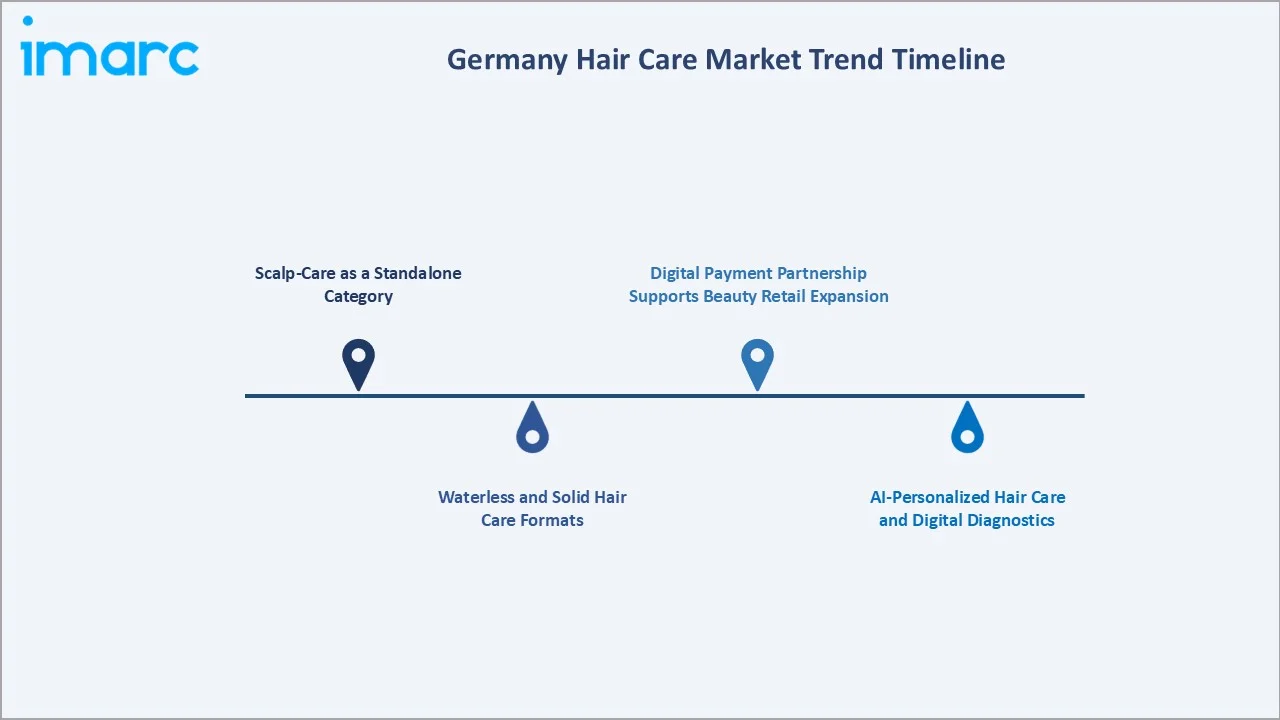
1. Scalp-Care as a Standalone Category
In February 2025, Symrise launched Crinipan PO Plus, a liquid piroctone olamine solution with decylene glycol and 1,2-hexanediol for scalp care applications. Scalp care products command a 35–50% premium over standard shampoos and are growing at approximately 8% annually in the German market, driven by dermatologist-endorsed communication and clinical efficacy data.
2. Waterless and Solid Hair Care Formats
In February 2020, Beiersdorf acquired Hamburg-based natural cosmetics brand STOP THE WATER WHILE USING ME!, strengthening its sustainable skincare and natural cosmetics portfolio. The brand, founded around the mission “protect, save, and donate water,” offers refillable, biodegradable, solid, and waterless hair care products.
3. AI-Personalized Hair Care and Digital Diagnostics
Schwarzkopf Professional’s SalonLab 2.0 Smart Analyzer uses near-infrared sensor technology to assess hair condition at a molecular level, including damage, color, and inner hair strength. The updated system adds faster consultations, a “Before & After” tracking feature, and personalized Fibre Clinix haircare recommendations for salon and at-home use.
4. Digital Payment Partnership Supports Beauty Retail Expansion
In July 2025, Nuvei expanded its strategic partnership with flaconi, supporting the beauty and fragrance retailer’s European growth through localized payment solutions and alternative payment methods. The collaboration is expected to enhance checkout flexibility, improve customer experience, and support cross-border e-commerce expansion across key European markets.
Industry Value Chain Analysis
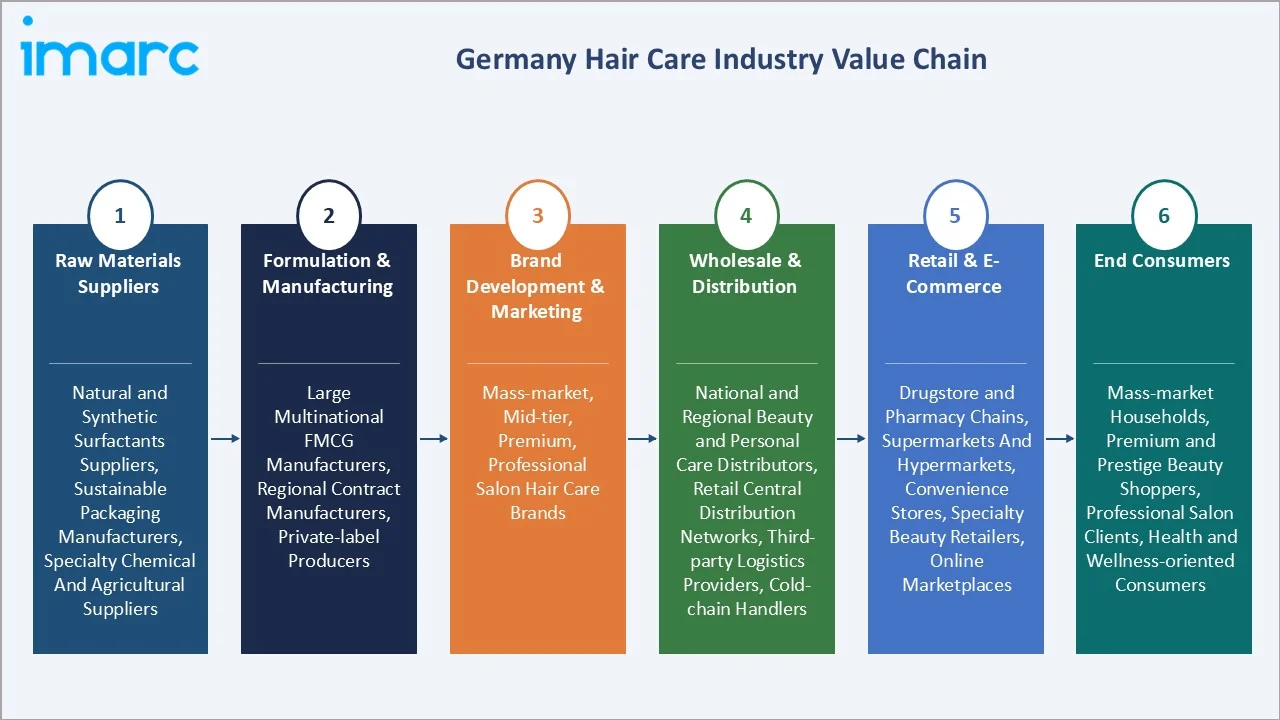
Germany’s hair care value chain spans from specialty chemical and botanical ingredient supply through finished-product manufacturing, brand development, professional distribution, mass-market retail, and e-commerce fulfilment. Each stage is occupied by specialized manufacturers, brand owners, distributors, and retail operators, creating a vertically segmented but highly interconnected supply network anchored by global FMCG incumbents.
|
Stage |
Key Players / Examples |
|
Raw Materials Suppliers |
Natural and synthetic surfactants suppliers, sustainable packaging manufacturers, specialty chemical and agricultural suppliers |
|
Formulation & Manufacturing |
Large multinational FMCG manufacturers, regional contract manufacturers, private-label producers |
|
Brand Development & Marketing |
Mass-market, mid-tier, premium, professional salon hair care brands |
|
Wholesale & Distribution |
National and regional beauty and personal care distributors, retail central distribution networks, third-party logistics providers, cold-chain handlers |
|
Retail & E-Commerce |
Drugstore and pharmacy chains, supermarkets and hypermarkets, convenience stores, specialty beauty retailers, online marketplaces |
|
End Consumers |
Mass-market households, premium and prestige beauty shoppers, professional salon clients, health and wellness-oriented consumers |
Technology Landscape in the Germany Hair Care Industry
Active Ingredient and Delivery System Innovation
Leading players are investing in next-generation delivery systems, including microencapsulation, liposomal actives, and biodegradable polymers to enhance ingredient efficacy. Henkel’s Schwarzkopf Gliss covalent bond repair technology and L’Oréal’s Bond Repair system for color-damaged hair represent the frontier of protein-based and covalent repair technologies in consumer hair care, commanding premium positioning in dm and pharmacy planograms.
Sustainable Formulation and Green Chemistry
EU REACH regulation compliance and voluntary commitments under the European Green Deal are driving the replacement of silicones, sulphate surfactants, and petrochemical-derived conditioning agents with bio-based alternatives. BASF’s Care Creations portfolio and Evonik’s TEGO Betain surfactant range enable German manufacturers to meet formulation sustainability targets while maintaining performance credentials required for competing against incumbent synthetic-formula products.
E-Commerce Personalization and Beauty Tech
AI-driven hair diagnostic tools, virtual try-on technology for hair color, and subscription-based personalized shampoo formulation services are reshaping the German consumer journey. L’Oréal’s Coloright professional salon color system and Kérastase’s Initialiste scalp and lengths serum represent the premium technology layer, while DTC brands use AI-powered quiz funnels to acquire and retain personalized product subscribers through Germany’s high-bandwidth digital infrastructure.
Market Segmentation Analysis
The report covers the following segments:
|
Segment Category |
Leading Segment |
Market Share |
Year |
|
Product Type |
Shampoo |
34.5% |
2025 |
|
Distribution Channel |
Supermarkets & Hypermarkets |
31.0% |
2025 |
|
Region |
Western Germany |
35.0% |
2025 |

By Product Type
Shampoo dominates with a 34.5% share in 2025. The segment encompasses the broadest range of consumer need states, dandruff control, color protection, scalp health, moisturization, volume, and natural/organic, making it both the highest-frequency purchase and the primary category for brand entry and product trial in Germany’s hair care market.
To access detailed market analysis, Request Sample
Hair Color at 22.0% is supported by Germany’s well-established professional salon color culture and growing at-home coloring adoption. Ammonia-free, vegan, and bond-protecting formulations command 15–25% price premiums over standard oxidative color. Conditioner at 18.5% is benefiting from the multi-step hair ritual trend and expansion of treatment conditioners, hair masks, and leave-in care.
By Distribution Channel
Supermarkets and hypermarkets command a 31.0% share in 2025, led by dm-drogerie markt and Rossmann, which together operate approximately 7,000 stores across Germany. These channels support both branded leadership positions and aggressive private-label growth through dm’s Balea and Alverde lines.
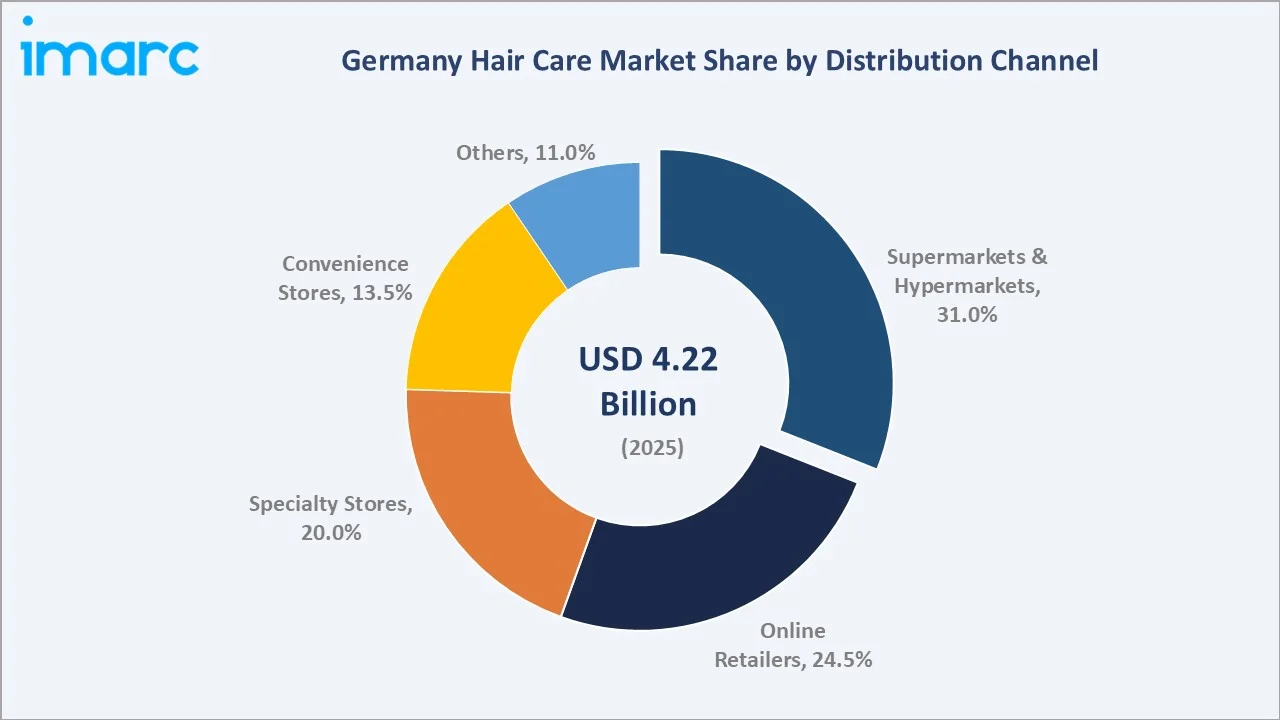
Online Retailers at 24.5% represent the fastest-growing channel at approximately 6.2% CAGR, driven by beauty e-commerce specialists Notino and Flaconi, Amazon Beauty, and DTC brand stores. Specialty Stores at 20.0% maintain a critical role in the professional, premium, and organic/natural segments, providing the high-touch retail environment supporting premium brand positioning.
Regional Market Insights
Western Germany’s market leadership (35.0%, 2025) reflects the Rhine-Ruhr metropolitan area's highly diverse and multicultural demographic profile. With significant populations of Turkish, Arabic, and South Asian origin, it generates sustained demand for a broad spectrum of hair care formulations, including textured hair care, intensive moisturization, and color-protective products.
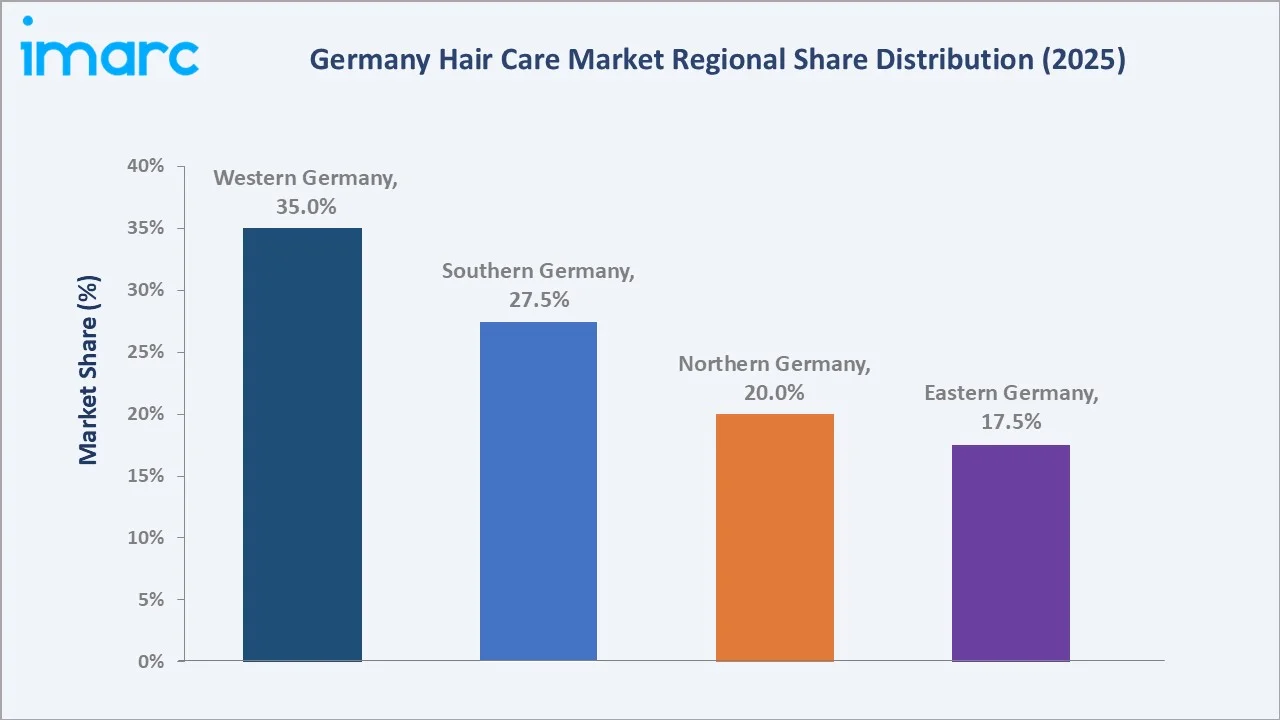
Southern Germany at 27.5% reflects Bavaria and Baden-Württemberg’s above-average household incomes and strong affinity for premium personal care. Munich’s high-income professional demographic drives demand for prestige and professional hair care.
|
Region |
Share (2025) |
Key Growth Drivers |
|
Western Germany |
35.0% |
Largest consumer base and purchasing power; strong branded retail infrastructure; multicultural demographic driving diverse formulation demand |
|
Southern Germany |
27.5% |
Above-average household incomes and high affinity for premium personal care; well-developed specialty and pharmacy retail channels |
|
Northern Germany |
20.0% |
Major port-city consumer markets; growing organic, natural, and sustainable hair care segment; expanding e-commerce adoption and DTC brand penetration among urban consumers |
|
Eastern Germany |
17.5% |
Rising disposable incomes and improving retail infrastructure; strong value-oriented off-trade channel; accelerating online channel and DTC adoption |
Competitive Landscape
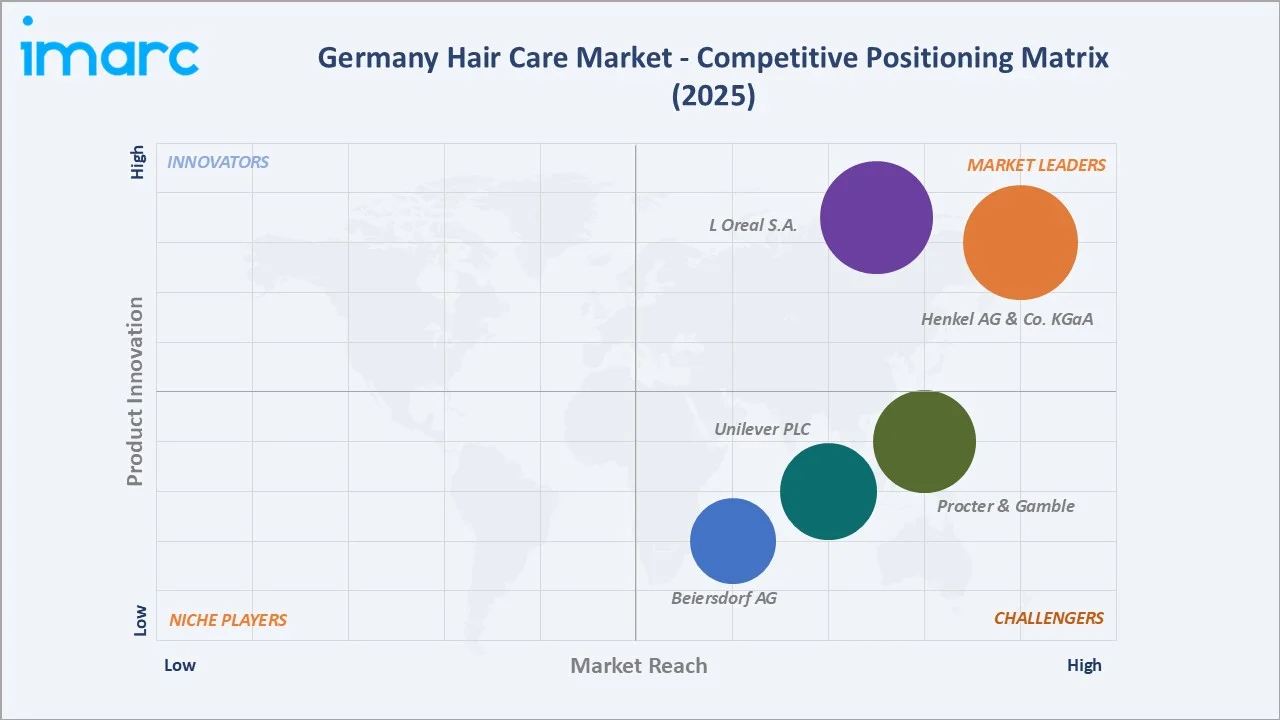
Germany’s hair care market exhibits moderate-to-high concentration, with the top five companies collectively controlling an estimated 55–65% of total branded market value. The remaining share is fragmented across international mid-tier brands, professional salon brands with growing retail presence, and an expanding ecosystem of indie natural and organic brands.
|
Company Name |
Brand Name |
Market Position |
Core Strength |
|
Henkel AG & Co. KGaA |
Schwarzkopf, Syoss, BLONDME, Authentic Beauty Concept, BC Bonacure, Color Expert, Fibreplex, Schwarzkopf Gliss, among others |
Market Leader |
Broad product portfolio; strong mass-to-professional price-tier coverage; established salon-to-retail channel reach across all distribution formats |
|
L’Oréal S.A. |
L'Oréal Paris, Garnier, Kérastase, Redken, Vichy, among others |
Market Leader |
Full price-tier portfolio spanning mass, premium, and dermocosmetic segments; strong pharmacy and specialist retail channel presence |
|
Procter & Gamble
|
Pantene, Head & Shoulders, Herbal Essences |
Strong Challenger |
Large-scale mass-market distribution; active product reformulation program targeting scalp health and ingredient transparency trends |
|
Unilever PLC |
Dove, TRESemmé |
Strong Challenger |
Moisturization and styling consumer base; sustainable packaging commitments; strong brand equity resonating with health-conscious consumers |
|
Beiersdorf AG |
NIVEA, Eucerin |
Challenger |
Growing dermocosmetic hair care range with strong pharmacy channel credibility and clinical positioning |
Henkel AG & Co. KGaA and L’Oréal S.A. dominate the German mass and premium segments through their Schwarzkopf/Syoss and Garnier/Kérastase portfolios, respectively. Procter & Gamble’s Pantene, Head & Shoulders, and Herbal Essences compete aggressively across the mass-market tier.
Key Company Profiles
Henkel AG & Co. KGaA
Henkel AG & Co. KGaA is one of the dominant forces in Germany’s hair care market. Its Beauty Care division encompasses market-leading brands including Schwarzkopf, Syoss, and Schauma, spanning shampoo, conditioner, styling, and professional colour categories across mass and premium retail.
- Product Portfolio: Schwarzkopf Gliss Ultimate Repair, Schauma, Syoss Oleo Intense, Schwarzkopf Keratin Color, Palette Permanent Colour, BLONDME, Authentic Beauty Concept, BC Bonacure, Color Expert, Fibreplex, Indola, Nature Box, Oil Ultime, Supreme Keratin, and SEAH.
- Recent Developments: In March 2026, Henkel entered into a definitive agreement to acquire 100% of OLAPLEX, a premium science-led hair care brand, for a total transaction value of USD 1.4 billion. The acquisition will strengthen Henkel’s Consumer Brands hair care portfolio across professional, specialty retail, and e-commerce channels.
- Strategic Focus: Premiumization of mass-market portfolio through scientific and dermatological validation; Schwarzkopf Professional salon-to-retail expansion across German specialty and e-commerce channels.
L’Oréal S.A.
L’Oréal S.A. is one of the world’s largest beauty companies and a principal competitor in Germany’s hair care market. L’Oréal operates across all price tiers in Germany, from mass-market Garnier Fructis through dermocosmetic Vichy Dercos to professional salon brands Kérastase, providing unparalleled portfolio breadth across German retail, pharmacy, and salon channels.
- Product Portfolio: L’Oréal Paris Elvive (Extraordinary Oil, Total Repair, Hyaluron Moisture), Garnier Fructis, Vichy Dercos Anti-Dandruff, La Roche-Posay Kerium, Kérastase Discipline Bain Fluidéaliste, and Redken All Soft.
- Recent Developments: In April 2026, L’Oréal reported 7.6% like-for-like revenue growth in Q1 2026, supported by strong demand for premium haircare and fragrances. Growth was recorded across all four divisions, with the Professional Products segment leading performance, reflecting continued consumer preference for higher-end beauty and salon-care products.
- Strategic Focus: Dermocosmetic scalp care expansion in pharmacy channel; AI-powered hair diagnostic tools; waterless and solid format portfolio scaling under EU sustainability compliance.
Market Concentration Analysis
Germany’s hair care market exhibits moderate-to-high concentration in the mass and premium retail segments, with the top five companies collectively holding an estimated 55–65% of branded market value. Consolidation pressure is most visible in the professional and salon-grade retail segment, where Kérastase is competing to expand its German retail accessibility beyond professional-only channels.
Private-label manufacturers serving dm and Rossmann form a critical supply layer, producing Balea, Alverde, Isana, and Alterra lines that command an estimated 20–25% of Germany’s drugstore hair care turnover by volume. The natural and organic segment is highly fragmented across 200+ brands, creating a long-tail competitive landscape that limits consolidation by any single incumbent.
Investment & Growth Opportunities
Fastest Growing Segments
Online retail (~6.2% CAGR), hair styling products (~4.5% CAGR), hair color (~4.1% CAGR), and conditioner (~3.75% CAGR) represent the primary growth vectors through 2034. Scalp-care as a standalone sub-category is growing at an estimated 8–10% CAGR from a low base, driven by dermatologist-endorsed clinical positioning and pharmacy channel expansion.
Emerging Market Expansion
Germany’s male grooming segment, estimated at USD 0.4–0.5 Billion within hair care in 2025, represents a high-growth opportunity as gender-neutral and men-specific consumption increases. The multicultural and textured hair care segment, serving Germany’s approximately 21.8 million immigrant residents, is underpenetrated by mainstream brands and growing at double-digit rates within specialist channels and e-commerce.
Venture and Institutional Investment Trends
- L'Oréal’s DACH regional structure, established in 2023, signals a commitment to Germany as a strategic growth market, with dedicated digital marketing and market intelligence infrastructure that will drive accelerated channel investment and product launch velocity.
- Scalp-care and microbiome-based hair care startups are attracting European venture capital investment, with several German-market-focused brands raising Series A funding in 2024–2025 to scale e-commerce and pharmacy channel penetration.
Future Market Outlook (2026-2034)
Germany’s hair care market is positioned for sustained, quality-driven growth through 2034. From a base of USD 4.22 Billion in 2025, the market is projected to reach USD 5.85 Billion by 2034 at a 3.58% CAGR. Western Germany will retain value leadership through the forecast period, but Southern Germany’s premium consumer base and Northern Germany’s growing e-commerce sophistication will drive above-average regional growth rates.
The technology transition from mass-market commodity to personalized, scientifically validated hair care will define the market’s composition by 2034. Shampoo’s share is projected to remain stable at 33–35%, while hair color maintains 21–23% as at-home color convenience innovation sustains category demand. Online retail’s share is expected to expand from 24.5% to approximately 35% by 2034. The natural/organic and scalp-health sub-segments will grow disproportionately, commanding an increasing share of Germany’s premium retail and pharmacy hair care planograms.
Research Methodology
Primary Research
Primary research comprised structured interviews with over 80 industry participants in 2024–2025, including hair care brand managers, retail category buyers at dm and Rossmann, professional salon distributors, independent pharmacists, beauty e-commerce platform executives, and dermatologists active in the German consumer health and beauty sector. Interviews covered market sizing, competitive dynamics, consumer behavior trends, and channel evolution.
Secondary Research
Secondary research encompassed company annual reports and investor presentations; EU Cosmetics Regulation compliance documentation; Euromonitor hair care category databases; Stiftung Warentest product evaluation reports; German Federal Statistical Office (Destatis) retail trade data; and IKW (Industrieverband Körperpflege- und Waschmittel) industry association reports.
Forecasting Models
Market size estimations were derived using bottom-up channel-level sell-through modelling, incorporating retail scanner data trends, brand-level market share trajectories, price premium evolution across product segments, and demographic demand growth for key consumer cohorts. A CAGR of 3.58% reflects consensus validated against IKW industry outlook data and IMARC’s primary expert panel review.
Germany Hair Care Market Report Coverage:
| Report Features | Details |
|---|---|
| Base Year of the Analysis | 2025 |
| Historical Period | 2020-2025 |
| Forecast Period | 2026-2034 |
| Units | Billion USD |
| Scope of the Report |
Exploration of Historical Trends and Market Outlook, Industry Catalysts and Challenges, Segment-Wise Historical and Future Market Assessment:
|
| Product Types Covered | Shampoo, Hair Color, Conditioner, Hair Styling Products, Others |
| Distribution Channels Covered | Supermarkets and Hypermarkets, Specialty Stores, Convenience Stores, Online Retailers, Others |
| Regions Covered | Western Germany, Southern Germany, Eastern Germany, Northern Germany |
| Companies Covered | Henkel AG & Co. KGaA, L’Oréal S.A., Procter & Gamble, Unilever PLC, Beiersdorf AG, etc. |
| Customization Scope | 10% Free Customization |
| Post-Sale Analyst Support | 10-12 Weeks |
| Delivery Format | PDF and Excel through Email (We can also provide the editable version of the report in PPT/Word format on special request) |
Key Benefits for Stakeholders:
- IMARC’s industry report offers a comprehensive quantitative analysis of various market segments, historical and current market trends, market forecasts, and dynamics of the Germany hair care market from 2020-2034.
- The research report provides the latest information on the market drivers, challenges, and opportunities in the Germany hair care market.
- Porter's five forces analysis assist stakeholders in assessing the impact of new entrants, competitive rivalry, supplier power, buyer power, and the threat of substitution. It helps stakeholders to analyze the level of competition within the Germany hair care industry and its attractiveness.
- Competitive landscape allows stakeholders to understand their competitive environment and provides an insight into the current positions of key players in the market.
Frequently Asked Questions About the Germany Hair Care Market Report
The Germany hair care market reached USD 4.22 Billion in 2025 and is forecast to reach USD 5.85 Billion by 2034.
The market is expected to grow at a CAGR of 3.58% during 2026-2034, driven by premiumization, e-commerce expansion, and emerging scalp-health and personalized hair care categories.
Western Germany leads with a 35.0% share in 2025, anchored by its large consumer base, high population density, strong urban retail network, and well-developed distribution infrastructure.
Shampoo dominates with a 34.5% share in 2025, encompassing the broadest range of consumer need states from anti-dandruff and scalp health to color protection and natural/organic formulations.
Supermarkets and hypermarkets lead with a 31.0% share in 2025, driven by dm-drogerie markt and Rossmann’s combined estimated 35–40% share of German personal care channel turnover.
Some of the key players in the market include Henkel AG & Co. KGaA, L’Oréal S.A., Procter & Gamble, Unilever PLC, and Beiersdorf AG.
Online retail is growing at approximately 6.2% CAGR because Germany’s high internet penetration, the expansion of beauty e-commerce platforms, and the rise of DTC and social commerce brands are structurally shifting consumer purchasing from physical stores to digital channels.
Key challenges include mass-market saturation in shampoo and conditioner, intense private-label competition from dm and Rossmann’s own-brand portfolios, EU cosmetics regulatory compliance costs, and post-inflationary consumer price sensitivity in core mass segments.
Scalp-care and microbiome formulations, male grooming, multicultural hair care, solid/waterless formats, AI-personalized DTC platforms, and professional-to-retail channel expansion represent the highest-growth investment opportunities through 2034.
Need more help?
- Speak to our experienced analysts for insights on the current market scenarios.
- Include additional segments and countries to customize the report as per your requirement.
- Gain an unparalleled competitive advantage in your domain by understanding how to utilize the report and positively impacting your operations and revenue.
- For further assistance, please connect with our analysts.
 Request Customization
 Speak to an Analyst
 Request Brochure
 Inquire Before Buying
Benefits of Customization
- Personalize this research
- Triangulate with your data
- Get data as per your format and definition
- Gain a deeper dive into a specific application, geography, customer, or competitor
- Any level of personalization
Get in Touch With Us
UNITED STATES
Phone: +1-201-971-6302
INDIA
Phone: +91-120-433-0800
UNITED KINGDOM
Phone: +44-753-714-6104
Email: [email protected]
Client Testimonials




.webp)




.webp)













Related Reports

Choose your plan
*Please note that the prices mentioned below are starting prices for each bundle type. Kindly contact our team for further details.*
Single User License
- 1 User License, Access on 2 Devices
- PDF Report + Excel Dataset (Password Protected)
- Lifetime Access
- No Printing Rights
- 10% Free Report Customization
- 10–12 Weeks of Analyst Support
Five User License
- Access for 5 Users, 2 Devices per User
- PDF Report + Excel Dataset (Password Protected)
- Lifetime Access
- Dedicated Account Manager
- 12–14 Weeks of Analyst Support
- No Printing Rights
- 15% Free Report Customization
- 25% Discount on Your Next Purchase
Corporate User License
- Unlimited User Access (Within Your Organization)
- PDF Report + Excel Dataset
- Lifetime Access
- Dedicated Account Manager
- 14–20 Weeks of Analyst Support
- No Printing Rights
- 20% Free Report Customization
- 30% Discount on Your Next Purchase
Essential Insights
What's included:
3 reports
- Lifetime Access
- PDF Reports
- Excel Datasets
- 2 Weeks of Free Analyst Support
- 2 User Licenses
- Access on 2 Devices
- Printing Rights
- Complimentary PowerPoint (PPT) Version
- Complimentary License Upgrade
Professional Access
What's included:
5 reports
- Lifetime Access
- PDF Reports
- Excel Datasets
- 8 Weeks of Free Analyst Support
- 2 User Licenses
- Access on 2 Devices
- Printing Rights
- Complimentary PowerPoint (PPT) Version
- Complimentary License Upgrade
Business Advantage
What's included:
8 reports
- Lifetime Access
- PDF Reports
- Excel Datasets
- 14 Weeks of Free Analyst Support
- 2 User Licenses
- Access on 2 Devices
- Printing Rights
- Complimentary PowerPoint (PPT) Version
- Complimentary License Upgrade
Enterprise Intelligence
What's included:
10 reports
- Lifetime Access
- PDF Reports
- Excel Datasets
- 20 Weeks of Free Analyst Support
- 2 User Licenses
- Access on 2 Devices
- Printing Rights
- Complimentary PowerPoint (PPT) Version
- Complimentary License Upgrade