
Hybrid Workplace Market Size, Share, Trends and Forecast by Component, Organization Size, Industry Vertical, and Region, 2026-2034
Hybrid Workplace Market Size and Share:
The global hybrid workplace market size was valued at USD 6.47 Billion in 2025. Looking forward, IMARC Group estimates the market to reach USD 22.83 Billion by 2034, exhibiting a CAGR of 15.02% from 2026-2034. North America currently dominates the market, holding a market share of 30% in 2025. The region benefits from a mature digital infrastructure ecosystem, widespread enterprise adoption of cloud-based collaboration tools, strong regulatory support for flexible work policies, and significant investments in next-generation workplace technologies by leading corporations, all contributing to the hybrid workplace market share.
The global hybrid workplace market is being driven by the accelerating shift toward flexible work arrangements across industries worldwide. Organizations are increasingly recognizing that hybrid models enhance employee productivity, improve talent retention, and reduce operational costs associated with maintaining traditional office spaces. The rising demand for seamless digital collaboration tools, including unified communication platforms, project management software, and virtual meeting solutions, is propelling market expansion. Additionally, the growing emphasis on employee well-being and work-life balance is encouraging enterprises to adopt hybrid workplace strategies that accommodate diverse workforce preferences. The rapid evolution of cloud computing infrastructure enables organizations to deploy scalable workplace solutions that support distributed teams across multiple geographies. Furthermore, the increasing integration of artificial intelligence and machine learning capabilities into workplace platforms is enhancing operational efficiency and driving the hybrid workplace market outlook across global enterprises.
The United States has emerged as a major region in the hybrid workplace market owing to many factors. The country’s robust technology ecosystem, coupled with a highly skilled workforce and strong corporate culture of innovation, provides a conducive environment for hybrid workplace adoption. Enterprises across sectors including technology, financial services, and healthcare are actively investing in collaborative platforms to support distributed workforces. According to a survey by Robert Half, approximately 88% of United States employers now offer at least some hybrid work options, with nearly a quarter of new job postings explicitly including hybrid arrangements. Government policies supporting workplace flexibility, the growing influence of Generation Z workers who prioritize flexible arrangements, and the expansion of co-working and flex-space infrastructure are further accelerating the hybrid workplace market growth in the United States.
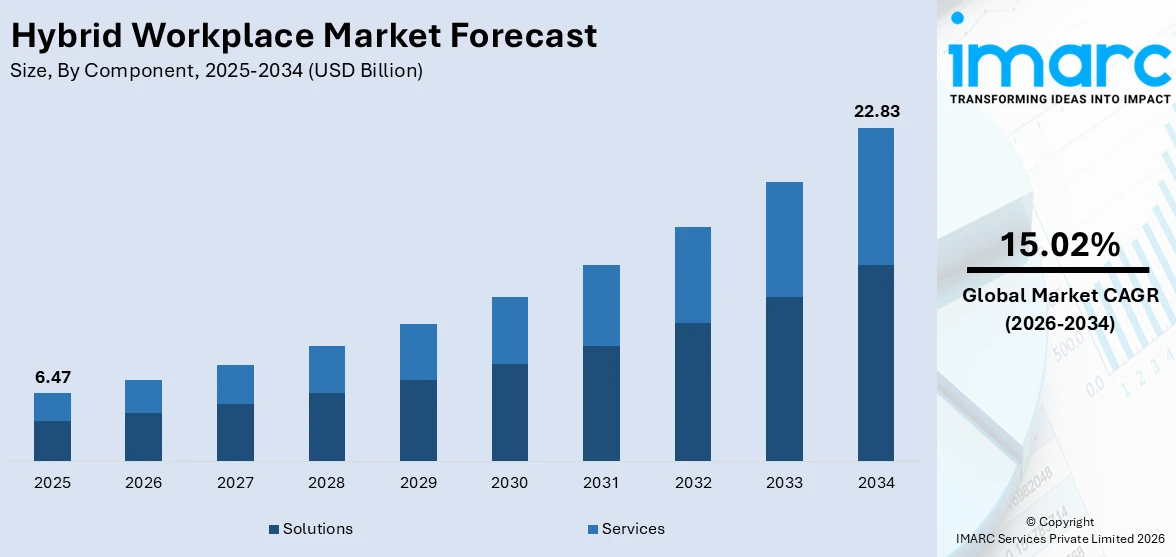
To get more information on this market Request Sample
Hybrid Workplace Market Trends:
Growing AI Integration in Workplaces
The increasing integration of artificial intelligence into hybrid workplace platforms is reshaping how organizations manage distributed teams and streamline daily operations. AI-powered tools are enabling intelligent meeting scheduling, automated task management, real-time language translation, and predictive analytics for workspace utilization. These capabilities allow businesses to optimize resource allocation and enhance employee experiences across remote and in-office settings. Smart office technologies leveraging AI are facilitating personalized workspace configurations, automated environmental controls, and intelligent visitor management systems. According to the Owl Labs 2025 State of Hybrid Work report, approximately 80% of employees surveyed in the United States reported using or experimenting with AI tools in their workplace. Organizations that invest in AI-enabled collaboration platforms gain competitive advantages through improved productivity, enhanced decision-making capabilities, and more efficient workflow automation across their hybrid operations.
Rise of Flexible Work Models
The standardization of flexible hybrid work models is fundamentally transforming organizational structures and workplace design strategies globally. Enterprises are moving beyond temporary pandemic-era arrangements to implement structured, long-term hybrid frameworks that balance in-office collaboration with remote productivity. The three-day office, two-day remote schedule has emerged as the dominant configuration, with organizations designing purposeful in-office experiences centered on collaboration rather than individual work. This shift is driving substantial investments in workspace redesign, desk-booking systems, and occupancy analytics platforms that support the hybrid workplace market forecast. Enterprise-level organizations are increasingly formalizing their hybrid policies, establishing clear attendance expectations, and redesigning physical office layouts to accommodate fluctuating occupancy patterns. The growing preference for flexible arrangements is compelling organizations to upgrade their technological infrastructure to ensure equitable experiences for all employees. Activity-based workspace designs that incorporate quiet zones, collaborative areas, and technology-enabled meeting rooms are replacing traditional fixed-desk configurations across corporate environments worldwide.
Increasing Technology Investment in Collaboration
The substantial increase in enterprise technology spending directed toward collaboration and communication infrastructure is creating significant opportunities within the hybrid workplace market trends. Organizations are prioritizing investments in unified communications platforms, video conferencing solutions, digital whiteboarding tools, and integrated workspace management systems to support seamless hybrid operations. The demand for interoperable platforms that function across multiple vendors and devices is driving innovation among technology providers. Cloud-based deployment models are gaining prominence as they offer scalability, lower upfront costs, and rapid implementation capabilities for organizations of varying sizes. Enterprises are increasingly seeking consolidated platforms that integrate messaging, video, file sharing, and project management into unified ecosystems rather than relying on fragmented point solutions. The growing emphasis on AI-powered collaboration features, including intelligent meeting summaries, automated transcription, and smart scheduling assistants, is further accelerating technology investment cycles. This surge in technology investment is fundamentally strengthening the infrastructure backbone supporting hybrid work environments worldwide.
Hybrid Workplace Industry Segmentation:
IMARC Group provides an analysis of the key trends in each segment of the global hybrid workplace market, along with forecast at the global, regional, and country levels from 2026-2034. The market has been categorized based on component, organization size, and industry vertical.

Analysis by Component:
- Solutions
- Services
Solution holds 60% of the market share. Solutions encompass a comprehensive range of software platforms and integrated tools designed to facilitate seamless collaboration, communication, and workspace management within hybrid environments. These include unified communication platforms, video conferencing systems, project management software, desk booking applications, and employee engagement tools that collectively enable organizations to manage distributed workforces effectively. The dominance of the solutions segment is driven by the growing need for scalable, cloud-based platforms that can accommodate fluctuating office attendance patterns and diverse work arrangements. Organizations are increasingly seeking consolidated digital ecosystems that unify messaging, video conferencing, file sharing, and task management within single interfaces to reduce operational complexity and improve user adoption. The integration of AI-powered features such as intelligent meeting summaries, automated scheduling assistants, and predictive workspace utilization analytics is further enhancing the value proposition of hybrid workplace solutions. Enterprises across industries continue to expand their digital toolkits, prioritizing platforms that deliver consistent user experiences across remote and in-office environments while supporting organizational scalability requirements.
Analysis by Organization Size:
- Small and Medium-sized Enterprises
- Large Enterprises
Large enterprises lead the market with a share of 55%. Large enterprises represent the dominant adopter segment within the hybrid workplace market due to their complex organizational structures, geographically distributed workforces, and substantial technology budgets. These organizations require comprehensive, enterprise-grade solutions that integrate seamlessly with existing IT infrastructure while supporting thousands of concurrent users across multiple locations and time zones. The need for robust security frameworks, compliance management tools, and advanced analytics capabilities further drives investment by large enterprises in sophisticated hybrid workplace platforms. Their ability to allocate dedicated resources toward digital transformation initiatives, including workforce training programs, change management strategies, and infrastructure modernization projects, positions them as early adopters of emerging technologies. Large enterprises are leading the adoption of AI-powered workplace automation and intelligent collaboration tools, leveraging their scale to negotiate favorable licensing arrangements and customize platforms to meet specific operational requirements. The growing complexity of managing multi-generational, globally dispersed teams further reinforces the need for integrated hybrid solutions within large organizational environments.
Analysis by Industry Vertical:
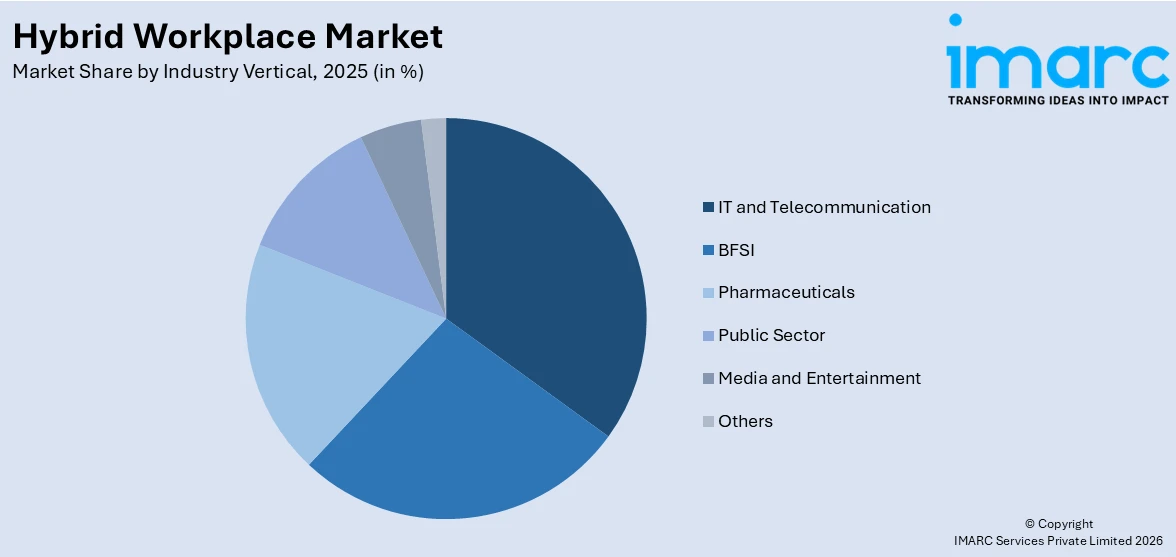
Access the comprehensive market breakdown Request Sample
- BFSI
- IT and Telecommunication
- Pharmaceuticals
- Public Sector
- Media and Entertainment
- Others
IT and telecommunication dominates the market, with a share of 24%. The IT and telecommunication sector represents the leading industry vertical in hybrid workplace adoption, driven by its inherently technology-oriented workforce, strong digital infrastructure, and organizational culture that embraces innovation and flexible working arrangements. Technology companies were among the earliest adopters of remote and hybrid work models, possessing the technical expertise and digital tools necessary to support distributed operations effectively. The sector's reliance on collaborative software development, cloud-based services, and digital communication platforms makes it a natural leader in deploying advanced hybrid workplace solutions. IT and telecommunication organizations benefit from internal capabilities that enable rapid deployment, integration, and optimization of hybrid workplace technologies without extensive reliance on external consulting or implementation support. The sector's competitive talent landscape further incentivizes the adoption of flexible work policies, as skilled technology professionals consistently prioritize workplace flexibility when evaluating employment opportunities. IT and telecommunication companies continue to pioneer innovative workspace strategies that serve as benchmarks for other industries seeking to implement effective hybrid models.
Regional Analysis:
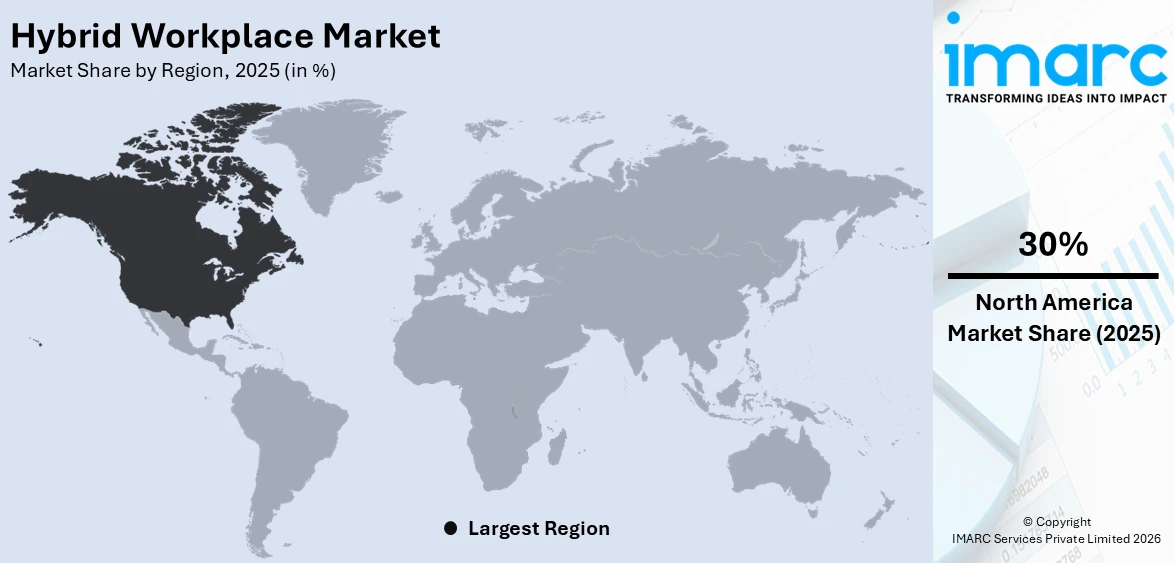
To get more information on the regional analysis of this market Request Sample
- North America
- United States
- Canada
- Asia-Pacific
- China
- Japan
- India
- South Korea
- Australia
- Indonesia
- Others
- Europe
- Germany
- France
- United Kingdom
- Italy
- Spain
- Russia
- Others
- Latin America
- Brazil
- Mexico
- Others
- Middle East and Africa
North America, accounting for 30% of the share, enjoys the leading position in the market. The superior technological infrastructure, large concentration of multinational technology companies, and corporate culture that has gradually welcomed flexible work arrangements are the foundations of North America's dominance. Widespread access to high-speed internet connectivity, developed cloud computing ecosystems, and a strong venture capital scene that fosters innovation in workplace technology are all advantages for the area. To maximize their hybrid operations, businesses around the area are making significant investments in integrated communication solutions, AI-powered workplace management tools, and next-generation collaboration platforms. Leading workplace technology companies with regional headquarters foster a competitive environment that speeds up product development cycles and encourages ongoing innovation in hybrid workplace solutions. Additionally, businesses now have scalable physical workspace options to go along with their digital hybrid strategy thanks to the expanding network of co-working spaces and flexible office infrastructure in major metropolitan and suburban locations. North America continues to hold the top spot in the worldwide hybrid workplace market thanks to the convergence of regulatory backing, technical preparedness, and changing worker expectations.
Key Regional Takeaways:
United States Hybrid Workplace Market Analysis
Because of its unmatched technological ecosystem, highly diversified economy, and progressive business policies that enable workplace flexibility, the United States leads the North American hybrid workplace industry. A solid basis for hybrid workplace innovation is provided by the nation's leadership in cloud computing, AI, and corporate software development. Leading technology centers in Silicon Valley, New York, Seattle, and Austin act as focal points for creating and implementing innovative hybrid workplace solutions, which in turn impact adoption trends around the world. Employers are being forced to preserve and increase hybrid arrangements due to the growing influence of millennial and Generation Z workers, who place a high value on flexibility and work-life balance. This trend is further supported by the competitive labor market, as businesses realize that providing flexible work arrangements is crucial to drawing and keeping top personnel in knowledge-intensive sectors. State-level laws promoting flexible work and the federal government's changing position on telework policies combine to produce a dynamic legislative framework that influences business hybrid strategy. Organizations of all sizes may now effectively implement scalable hybrid models thanks to the growth of co-working spaces and flexible office infrastructure in suburban and metropolitan locations, which is further encouraging the adoption of hybrid workplaces nationwide.
Europe Hybrid Workplace Market Analysis
With its robust digital infrastructure, progressive labor laws, and emphasis on work-life balance, Europe is a sizable and quickly developing market for hybrid workplace solutions. Flexible work arrangements are supported institutionally by the European Union's legal framework, which includes the Work-Life Balance Directive and new right-to-disconnect laws. This increases demand for supporting technologies. Northern European nations with developed digital ecosystems and forward-thinking employment laws, such as the Netherlands, Finland, and Denmark, are in the forefront of the continent's acceptance of hybrid labor. Because of its sophisticated digital collaboration infrastructure and broad organizational acceptability, the UK continues to have one of the highest rates of hybrid work adoption in Europe. Countries in Western Europe, such as Germany, France, and Spain, exhibit developed hybrid ecosystems backed by strong digital infrastructure and forward-thinking labor laws. The continent-wide transition to hybrid cars is being accelerated by the increased focus on sustainability and lowering carbon emissions associated with transportation. To improve employee engagement across remote teams and optimize hybrid workplace operations, businesses throughout Europe are spending more in desk-booking platforms, AI-powered collaboration tools, and smart office technologies.
Asia-Pacific Hybrid Workplace Market Analysis
With differing degrees of acceptance across various economies and cultural contexts, Asia-Pacific is a diversified and quickly expanding market for hybrid workplace solutions. The region offers significant prospects for the expansion of the hybrid workplace market due to its dynamic technological landscape, growing digital infrastructure, and sizable workforce. Due to government-led digital transformation programs and an expanding pool of skilled tech workers, nations like Australia, Singapore, and India are spearheading the adoption of hybrid workplaces in the area. The need for flexible work arrangements is rising in the major countries of the area due to the growing impact of younger, digitally native professionals joining the workforce. The region's significant investments in 5G connectivity, cloud computing infrastructure, and smart office technologies are laying a strong basis for the growth of hybrid workplaces in both established and growing economies. Additionally, enterprise-level adoption of cutting-edge collaboration and workspace management tools is being fueled by the growing popularity of technological hubs in places like Tokyo, Singapore, and Bengaluru.
Latin America Hybrid Workplace Market Analysis
Due to the region's rapid digital transformation and rising expenditures in cloud computing and mobile connectivity infrastructure, hybrid workplace solutions are becoming more and more popular in Latin America. The region's growing technological ecosystem and youthful, tech-savvy populace are fostering an environment that is conducive to the expansion of the hybrid workplace industry. For instance, according to the World Bank’s LAC Digital Development Unit in 2025, nine active digital transformation projects across the region are providing targeted funding for digital government systems, ecosystem development, and digital skills training programs. As companies look to recruit and keep qualified IT workers in competitive labor markets, countries like Brazil and Mexico are seeing a spike in enterprise usage of collaboration platforms and flexible workspace solutions.
Middle East and Africa Hybrid Workplace Market Analysis
With ambitious government-led digital transformation agendas and rising foreign direct investment in technological infrastructure, the Middle East and Africa region offers new prospects for hybrid workplace solutions. Countries in the Gulf Cooperation Council, especially Saudi Arabia and the United Arab Emirates, are spearheading adoption through national digital plans that give priority to contemporary workplace technologies and smart city efforts. For instance, Microsoft announced plans in 2025 to invest USD 50 billion in artificial intelligence and cloud infrastructure across the Global South, including significant allocations for Africa and the Middle East, by 2030 to close the digital adoption gap. The expanding telecommunications infrastructure across Sub-Saharan Africa and the growing availability of affordable cloud services are progressively enabling broader hybrid workplace adoption across the region.
Competitive Landscape:
Established technology conglomerates, specialized collaboration software providers, and up-and-coming startups offering niche solutions are all part of the highly competitive and dynamic global hybrid workplace industry. To increase their market positions, major players are pursuing strategies focused on ecosystem collaborations, strategic acquisitions, and product innovation. To stand out from the competition and meet changing organizational needs, businesses are progressively incorporating automation, machine learning, and artificial intelligence into their collaboration platforms. Initiatives for cross-platform interoperability exacerbate the competitive landscape since businesses require smooth integration across several vendor ecosystems. In order to take advantage of growth prospects in emerging areas, major players are also increasing their global footprint through regional data centers, customized product offerings, and strategic partnerships with regional technology partners.
The report provides a comprehensive analysis of the competitive landscape in the hybrid workplace market with detailed profiles of all major companies.
Hybrid Workplace Report Scope:
| Report Features | Details |
|---|---|
| Base Year of the Analysis | 2025 |
| Historical Period | 2020-2025 |
| Forecast Period | 2026-2034 |
| Units | Billion USD |
| Scope of the Report | Exploration of Historical Trends and Hybrid Workplace Market Outlook, Industry Catalysts and Challenges, Segment-Wise Historical and Future Market Assessment:
|
| Components Covered | Solutions, Services |
| Organization Sizes Covered | Small and Medium-sized Enterprises, Large Enterprises |
| Industry Verticals Covered | BFSI, IT and Telecommunication, Pharmaceuticals, Public Sector, Media and Entertainment, Others |
| Regions Covered | North America, Asia-Pacific, Europe, Latin America, Middle East and Africa |
| Countries Covered | United States, Canada, China, Japan, India, South Korea, Australia, Indonesia, Germany, France, United Kingdom, Italy, Spain, Russia, Brazil, Mexico |
| Customization Scope | 10% Free Customization |
| Post-Sale Analyst Support | 10-12 Weeks |
| Delivery Format | PDF and Excel through Email (We can also provide the editable version of the report in PPT/Word format on special request) |
Key Benefits for Stakeholders:
- IMARC’s report offers a comprehensive quantitative analysis of various market segments, historical and current market trends, market forecasts, and dynamics of the hybrid workplace market from 2020-2034.
- The research study provides the latest information on the market drivers, challenges, and opportunities in the global hybrid workplace market.
- The study maps the leading, as well as the fastest-growing, regional markets. It further enables stakeholders to identify the key country-level markets within each region.
- Porter’s Five Forces analysis assists stakeholders in assessing the impact of new entrants, competitive rivalry, supplier power, buyer power, and the threat of substitution. It helps stakeholders to analyze the level of competition within the hybrid workplace industry and its attractiveness.
- Competitive landscape allows stakeholders to understand their competitive environment and provides an insight into the current positions of key players in the market.
Frequently Asked Questions About the Hybrid Workplace Market Report
The hybrid workplace market was valued at USD 6.47 Billion in 2025.
The hybrid workplace market is projected to exhibit a CAGR of 15.02% during 2026-2034, reaching a value of USD 22.83 Billion by 2034.
The hybrid workplace market is primarily driven by the accelerating adoption of flexible work arrangements across global enterprises, the rising demand for cloud-based collaboration and communication platforms, increasing integration of AI-powered tools into workplace operations, growing emphasis on employee well-being and work-life balance, and significant enterprise investment in digital infrastructure to support distributed workforces.
North America currently dominates the hybrid workplace market, accounting for a share of 30%. The region benefits from a highly developed technology infrastructure, widespread enterprise adoption of cloud-based solutions, a strong ecosystem of leading collaboration technology vendors, and progressive corporate policies supporting flexible work arrangements.
Some of the major players in the hybrid workplace market include leading technology and collaboration platform providers whose detailed profiles are available in the full report.
Need more help?
- Speak to our experienced analysts for insights on the current market scenarios.
- Include additional segments and countries to customize the report as per your requirement.
- Gain an unparalleled competitive advantage in your domain by understanding how to utilize the report and positively impacting your operations and revenue.
- For further assistance, please connect with our analysts.
 Request Customization
 Speak to an Analyst
 Request Brochure
 Inquire Before Buying
Benefits of Customization
- Personalize this research
- Triangulate with your data
- Get data as per your format and definition
- Gain a deeper dive into a specific application, geography, customer, or competitor
- Any level of personalization
Get in Touch With Us
UNITED STATES
Phone: +1-201-971-6302
INDIA
Phone: +91-120-433-0800
UNITED KINGDOM
Phone: +44-753-714-6104
Email: [email protected]
Client Testimonials




.webp)




.webp)













Related Reports

Choose your plan
*Please note that the prices mentioned below are starting prices for each bundle type. Kindly contact our team for further details.*
Single User License
- 1 User License, Access on 2 Devices
- PDF Report + Excel Dataset (Password Protected)
- Lifetime Access
- No Printing Rights
- 10% Free Report Customization
- 10–12 Weeks of Analyst Support
Five User License
- Access for 5 Users, 2 Devices per User
- PDF Report + Excel Dataset (Password Protected)
- Lifetime Access
- Dedicated Account Manager
- 12–14 Weeks of Analyst Support
- No Printing Rights
- 15% Free Report Customization
- 25% Discount on Your Next Purchase
Corporate User License
- Unlimited User Access (Within Your Organization)
- PDF Report + Excel Dataset
- Lifetime Access
- Dedicated Account Manager
- 14–20 Weeks of Analyst Support
- No Printing Rights
- 20% Free Report Customization
- 30% Discount on Your Next Purchase
Essential Insights
What's included:
3 reports
- Lifetime Access
- PDF Reports
- Excel Datasets
- 2 Weeks of Free Analyst Support
- 2 User Licenses
- Access on 2 Devices
- Printing Rights
- Complimentary PowerPoint (PPT) Version
- Complimentary License Upgrade
Professional Access
What's included:
5 reports
- Lifetime Access
- PDF Reports
- Excel Datasets
- 8 Weeks of Free Analyst Support
- 2 User Licenses
- Access on 2 Devices
- Printing Rights
- Complimentary PowerPoint (PPT) Version
- Complimentary License Upgrade
Business Advantage
What's included:
8 reports
- Lifetime Access
- PDF Reports
- Excel Datasets
- 14 Weeks of Free Analyst Support
- 2 User Licenses
- Access on 2 Devices
- Printing Rights
- Complimentary PowerPoint (PPT) Version
- Complimentary License Upgrade
Enterprise Intelligence
What's included:
10 reports
- Lifetime Access
- PDF Reports
- Excel Datasets
- 20 Weeks of Free Analyst Support
- 2 User Licenses
- Access on 2 Devices
- Printing Rights
- Complimentary PowerPoint (PPT) Version
- Complimentary License Upgrade