
India Activewear Market Size, Share, Trends and Forecast by Product Type, Material Type, Pricing, Age Group, Distribution Channel, End User, and Region, 2026-2034
India Activewear Market Summary:
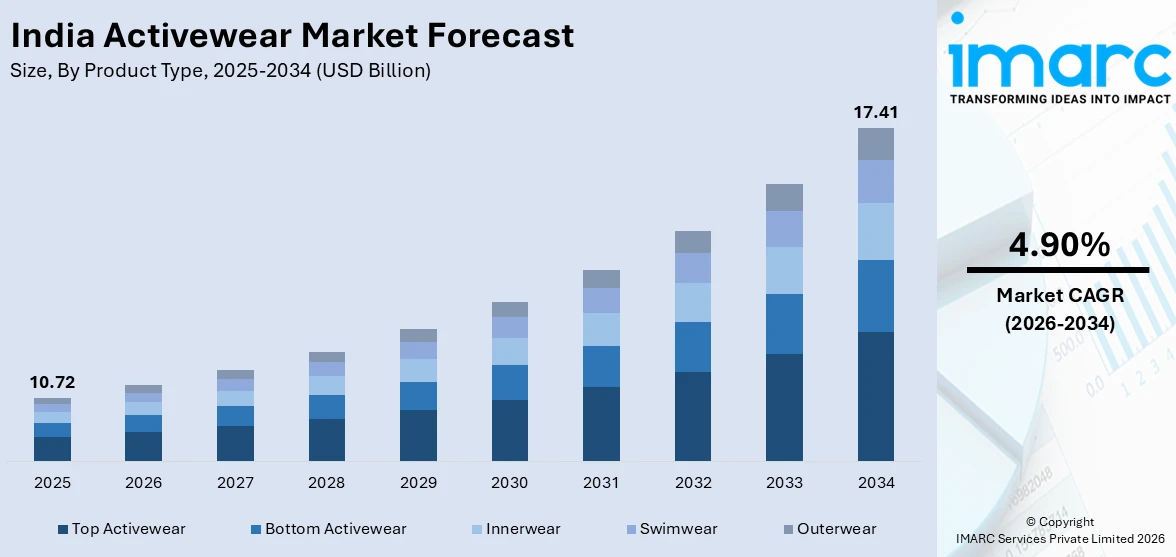
The India activewear market grew from USD 10.72 Billion in 2025 to USD 11.88 Billion in 2026 and is projected to reach USD 17.41 Billion by 2034, growing at a compound annual growth rate of 4.90% from 2026-2034.
The market is driven by rising health consciousness, expanding fitness culture, and growing athleisure adoption across urban and semi-urban populations. Increasing disposable incomes, proliferating fitness infrastructure, and the expanding reach of e-commerce platforms continue to broaden consumer access. Government wellness initiatives, a youthful demographic profile, and evolving fashion sensibilities further reinforce demand. These interconnected forces collectively sustain the growth trajectory and competitive momentum across the India activewear market share.
Key Takeaways and Insights:
- By Product Type: Top Activewear dominates the market with a share of 33.5% in 2025, driven by its cross-functional versatility, spanning athletic performance and everyday casual wear across diverse fitness categories and consumer demographics.
- By Material Type: Polyester leads the market with a share of 60.0% in 2025, owing to its moisture-wicking performance, durability, and cost-effectiveness that align well with Indian consumers' functional and value-driven purchasing priorities.
- By Pricing: Economy represents the largest segment with a market share of 68.0% in 2025, driven by widespread price sensitivity among Indian consumers and strong adoption across mass-market retail channels catering to varied income groups.
- By Age Group: 31–44 Years dominates the market with a share of 25.0% in 2025, owing to working professionals with established incomes, increasingly investing in activewear for fitness routines and athleisure lifestyles.
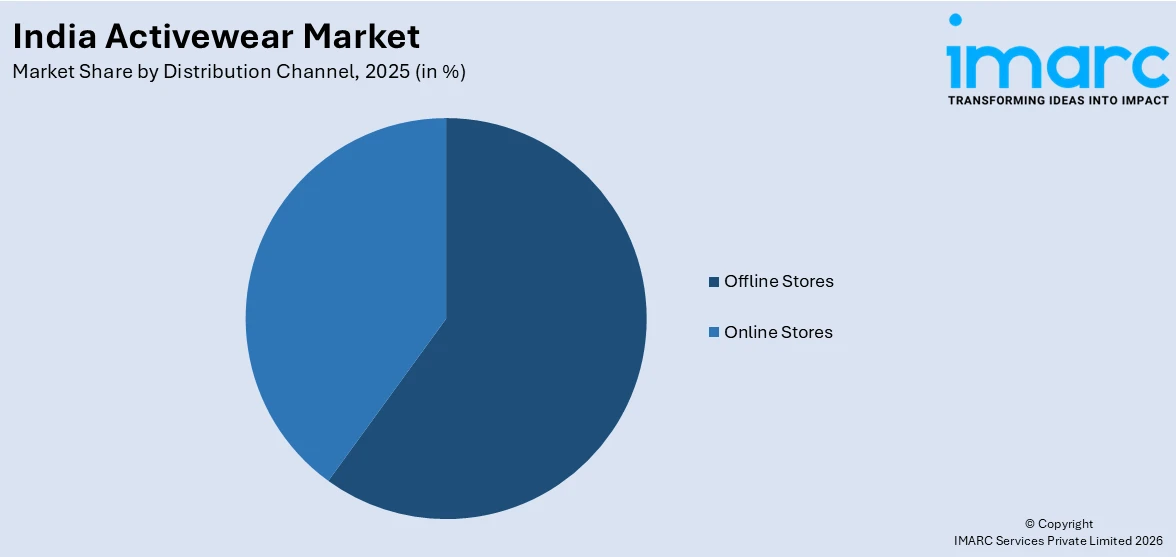
- By Distribution Channel: Offline Stores represents the largest segment with a market share of 59.0% in 2025, driven by consumers prioritize hands-on product evaluation, fit assessment, and immediate availability when purchasing activewear across India.
- By End User: Men dominate the market with a share of 35.0% in 2025, driven by higher participation in gym workouts, organized sports, and outdoor fitness activities nationwide.
- By Region: North India leads the largest segment with a market share of 32.0% in 2025, owing to urbanization, growing health consciousness, well-developed retail infrastructure, and strong consumer spending capacity in major metropolitan cities.
- Key Players: The India activewear market features domestic manufacturers, international sportswear labels, and fashion-oriented retailers competing across product innovation, pricing strategies, distribution reach, and sustainability-focused brand positioning to capture evolving consumer demand.
To get more information on this market Request Sample
The India activewear market is undergoing robust structural transformation driven by shifting consumer lifestyles, evolving fashion sensibilities, and a deepening culture of health and physical wellness. A growing and increasingly aspirational middle class is directing discretionary spending toward fitness participation and performance apparel, reflecting a broader evolution in how Indians prioritize health, appearance, and active living. The proliferation of organized fitness centers, yoga studios, and community sporting events has embedded activewear into the daily routines of a widening consumer base. The athleisure phenomenon where activewear transitions seamlessly between workout and social settings has extended demand well beyond traditional fitness enthusiasts. In October 2025, ASICS opened its first Company‑Owned Company‑Operated (COCO) store in India, marking its initial major retail expansion in the country, signalling growing investments by global activewear brands. Supportive government policies promoting sports development, combined with the penetrative power of digital commerce and social media-driven fitness culture, continue to reinforce the market's sustained forward momentum.
India Activewear Market Trends:
Accelerating Convergence of Activewear and Everyday Fashion
The distinction between activewear and casual fashion is progressively dissolving in India, as consumers increasingly seek garments that perform equally well during workouts and everyday social settings. This athleisure evolution is reshaping design priorities, with brands investing in aesthetically refined silhouettes that retain technical performance attributes such as stretch, breathability, and moisture management. In January 2026, Campus Activewear entered the athleisure apparel category, launching polo T-shirts, jackets, joggers, and caps for men and women across casual, travel, and workout occasions. Social media fitness culture, the normalization of comfortable dressing, and the influence of lifestyle content creators are amplifying this trend.
Growing Prioritization of Sustainable and High-Performance Fabrics
Environmental awareness is increasingly shaping material preferences within India's activewear market, as consumers seek apparel that balances ecological responsibility with superior functional performance. Brands are responding by integrating sustainable textile innovations—including fabrics derived from recycled and organic sources alongside advances in technical materials offering properties such as compression support, anti-odor treatment, and ultraviolet protection. In December 2025, Chennai‑born brand Sawsee Athleisure launched a sustainable all‑day activewear collection using performance‑driven bamboo fabrics and eco‑conscious production methods, reflecting rising consumer demand for responsible materials. This dual commitment to sustainability and performance is redefining product development priorities and influencing purchase decisions across consumer segments.
Rapid Expansion of Digital Commerce and Direct-to-Consumer Channels
E-commerce platforms and direct-to-consumer digital channels have fundamentally transformed how activewear is discovered, evaluated, and purchased across India. Consumers benefit from broader product assortments, transparent price comparisons, and convenient home delivery that physical retail cannot always replicate. Digital platforms enable brands to engage consumers through personalized recommendations, fitness content integration, and loyalty-driven experiences that strengthen ongoing relationships. In January 2026, fashion e‑commerce platform Myntra introduced a zero‑commission marketplace model under its “Myntra Rising Stars” programme to support emerging homegrown direct‑to‑consumer fashion, beauty, and lifestyle brands in scaling their national digital presence. Expanding smartphone accessibility and affordable internet connectivity are extending this shift into tier-two and tier-three cities, significantly broadening the addressable market.
Market Outlook 2026-2034:
The India activewear market is poised for sustained growth, supported by deepening health consciousness, rising disposable incomes, and expanding fitness culture across urban and semi-urban populations. Growing athleisure adoption, continued fabric technology advancements, and the proliferation of digital commerce channels are expected to broaden consumer reach and elevate average purchase values. Supportive government wellness initiatives, a young and aspirational demographic base, and increasing premiumization tendencies are anticipated to reinforce long-term demand, positioning the market for meaningful revenue expansion throughout the forecast period. The market generated a revenue of USD 10.72 Billion in 2025, which is expected to reach USD 11.88 Billion in 2026 and further grow to USD 17.41 Billion by 2034, at a compound annual growth rate of 4.90% during 2026-2034.
India Activewear Market Report Segmentation:
| Segment Category | Leading Segment | Market Share |
|---|---|---|
|
Product Type |
Top Activewear |
33.5% |
|
Material Type |
Polyester |
60.0% |
|
Pricing |
Economy |
68.0% |
|
Age Group |
31–44 Years |
25.0% |
|
Distribution Channel |
Offline Stores |
59.0% |
|
End User |
Men |
35.0% |
|
Region |
North India |
32.0% |
Product Type Insights:
- Top Activewear
- Bottom Activewear
- Innerwear
- Swimwear
- Outerwear
Top activewear dominates with a market share of 33.5% of the total India activewear market in 2025.
Top activewear, encompassing sports bras, performance shirts, tank tops, and compression tees, commands market leadership through its unmatched functional versatility and broad consumer appeal. These products serve diverse fitness activities including gym training, yoga, running, and recreational sports, while transitioning seamlessly into casual everyday wear. As per sources, Indian performance‑wear brand Aeractive launched a debut collection that includes sports bras, tanks and performance T‑shirts engineered for high‑intensity training, recovery, and daily movement, reflecting growing consumer demand for multifunctional tops that bridge fitness and lifestyle use.
The segment's dominance is further reinforced by evolving athleisure preferences, where consumers increasingly seek garments performing equally well during workouts and social settings. Top activewear products deliver this versatility through technical fabric innovations combining stretch, breathability, and moisture management with refined aesthetic designs. Growing fitness culture penetration, rising health consciousness, and the normalization of activewear in everyday wardrobes continue to sustain robust demand. These converging lifestyle and fashion forces collectively reinforce top activewear's leading position across the India activewear market.
Material Type Insights:
- Nylon
- Polyester
- Cotton
- Neoprene
- Polypropylene
- Spandex
Polyester leads with a share of 60.0% of the total India activewear market in 2025.
Polyester dominates the material segment through a compelling combination of functional performance and strong value proposition that resonates deeply with Indian consumers. Its moisture-wicking, quick-drying, and durable characteristics make it the preferred fabric for high-intensity athletic applications across gym training, running, and outdoor fitness activities. Structural resistance to shrinking and deformation during repeated washing extends product lifespan, delivering consistent value for price-conscious buyers. These attributes collectively position polyester as the foundational material across economy and mid-range activewear tiers throughout India.
Beyond performance, polyester's compatibility with advanced dyeing and printing techniques enables diverse aesthetic expressions, satisfying the style expectations of fashion-oriented consumers alongside functionally motivated buyers. Its relatively lower manufacturing cost compared to premium fabric alternatives allows brands to deliver performance-oriented activewear at accessible price points. This balance of functional superiority, design flexibility, and cost-effectiveness makes polyester the material of choice for manufacturers targeting India's broad and value-driven activewear consumer base across all major product and distribution categories.
Pricing Insights:
- Economy
- Premium
Economy exhibits a clear dominance with a 68.0% share of the total India activewear market in 2025.
The economy leads the India activewear market by addressing the fundamental affordability priorities of the country's vast and economically diverse consumer base. Price sensitivity remains a defining purchase criterion across mass-market demographics, particularly in tier-two and tier-three cities where discretionary spending capacity varies considerably. Economy-priced activewear reaches consumers through general trade retailers, supermarkets, and value-focused e-commerce platforms, delivering functional performance at accessible price points that have been instrumental in driving first-time activewear adoption across previously underserved population segments.
The segment's dominance reflects the broader democratization of activewear consumption, enabling fitness-conscious individuals across diverse income groups to participate in the growing health and wellness movement without significant financial barriers. Widespread availability through both offline and online mass-market channels ensures strong geographic penetration beyond urban centers. As affordability continues shaping purchase decisions for the majority of Indian consumers, the economy segment sustains its structural leadership, underpinning overall market volume and providing a stable foundation for long-term activewear market expansion.
Age Group Insights:
- 1–15 Years
- 16–30 Years
- 31–44 Years
- 45–64 Years
- More than 65 Years
31–44 years leads with a market share of 25.0% of the total India activewear market in 2025.
31–44 years dominates the age group segment by combining established financial capacity with strong and consistent investment in health-oriented lifestyles. Working professionals within this demographic increasingly allocate discretionary income toward activewear serving both structured fitness routines and versatile athleisure occasions. According to reports, women’s activewear D2C brand BlissClub reported FY25 revenue rising 51% to ₹131.5 crore, with losses cut 54.5%, highlighting strong purchasing power and activewear adoption among urban professionals. Their financial stability enables regular purchases spanning mid-range to premium price tiers, while heightened health awareness translates into a genuine commitment to maintaining active lifestyles.
Consumers in this cohort demonstrate stronger brand loyalty and preference for technically advanced performance fabrics compared to younger demographics, making them particularly attractive to brands pursuing sustainable customer relationships and repeat purchase behavior. Their professional responsibilities create demand for active wear transitioning seamlessly between workout settings and casual work-from-home or leisure environments. Growing awareness of preventive health benefits among this age group, combined with aspirational wellness values, continues reinforcing consistent activewear investment and sustaining this segment's leading revenue contribution throughout the India activewear market.
Distribution Channel Insights:
Access the comprehensive market breakdown Request Sample
- Online Stores
- Offline Stores
Offline stores exhibit with a market share of 59.0% of the total India activewear market in 2025.
Offline stores retain distribution leadership by addressing the tactile and experiential dimensions of activewear purchasing that digital channels cannot fully replicate. Consumers consistently prefer physically evaluating fabric quality, assessing fit accuracy, and testing comfort levels before committing to activewear purchases. In December 2025, homegrown activewear brand TechnoSport unveiled its largest flagship store in Hyderabad as part of an ongoing strategy to expand exclusive brand outlets nationwide and deepen consumer engagement through immersive retail experiences. Specialty sportswear retailers, multi-brand apparel stores, and department stores offer curated product assortments and expert in-store guidance that facilitate confident purchasing decisions.
The offline channel's leadership is further supported by the immediacy of product availability, eliminating delivery waiting periods and enabling consumers to address urgent activewear needs efficiently. In-store promotional activities, loyalty programs, and seasonal sale events drive purchase frequency and average transaction values. Trial room access allows consumers to assess sizing accuracy across brands, reducing purchase hesitation particularly for first-time buyers. These combined experiential, logistical, and promotional advantages sustain offline stores as the preferred activewear purchase channel for the majority of Indian consumers across urban and semi-urban markets.
End User Insights:
- Men
- Women
- Kids
Men lead with a market share of 35.0% of the total India activewear market in 2025.
Men constitute the leading end-user segment through consistent and high-frequency participation in organized sports, gym memberships, and outdoor fitness activities that generate reliable activewear demand across diverse product categories. Sport-specific activewear for running, gym training, cricket, football, and recreational outdoor pursuits drives regular purchasing behavior among male consumers across urban and semi-urban markets. The increasing mainstream acceptance of athleisure within male fashion culture has further broadened activewear demand beyond dedicated fitness occasions, extending purchasing relevance into everyday casual and professional settings throughout India's evolving consumer landscape.
Rising health consciousness among working-age male professionals is reinforcing consistent investment in performance-oriented activewear, contributing to stable and predictable revenue generation within this dominant segment. Men demonstrate willingness to invest in technically advanced fabrics and category-specific designs that enhance athletic performance and physical comfort during training. Growing fitness community engagement, media exposure to fitness lifestyles, and social normalization of regular exercise are collectively deepening male activewear adoption. These trends are sustaining the segment's leadership and creating sustained opportunities for product diversification and premium tier expansion across the India activewear market.
Regional Insights:
- North India
- South India
- East India
- West India
North India dominates with a market share of 32.0% of the total India activewear market in 2025.
North India leads the regional landscape through the convergence of dense urbanization, a large health-conscious consumer population, and well-developed retail infrastructure concentrated in major metropolitan areas. A significant urban working population with rising disposable incomes and growing fitness culture engagement generates consistent activewear demand across performance, athleisure, and recreational categories. Organized retail ecosystems—encompassing branded specialty stores, large-format malls, and active e-commerce fulfillment networks—ensure broad product availability and convenient consumer access across the region's leading cities and emerging urban centers.
The region's diverse and seasonally variable climate further sustains purchasing frequency, driving demand for activewear suited to varying environmental conditions throughout the year. Strong youth demographic representation, combined with high social media fitness culture penetration, accelerates athleisure trend adoption and premiumization tendencies among urban consumers. Active government initiatives promoting sports participation and community wellness events contribute additional demand drivers within the region. These structural, demographic, and cultural advantages collectively reinforce North India's sustained dominance and its role as the primary revenue-generating region across the India activewear market.

Market Dynamics:
Growth Drivers:
Why is the India Activewear Market Growing?
Rising Health and Fitness Consciousness Across Indian Society
A fundamental shift in health priorities is reshaping consumption patterns across India, as growing awareness of lifestyle-related risks motivates broader population segments to embrace regular physical activity. Increasing engagement with gym training, yoga, outdoor running, and recreational sports generates consistent demand for purpose-appropriate activewear. In March 2026, the Government of India’s Fit India Carnival 2.0, a nationwide fitness festival held in New Delhi — brought together diverse age groups for community fitness activities and wellness events, reinforcing a cultural shift toward daily physical activity. Healthcare communities, wellness media, and fitness-focused social networks are collectively normalizing active lifestyles, positioning activewear as an essential lifestyle investment.
Expanding Fitness Infrastructure and Organized Sports Development
The rapid proliferation of organized fitness centers, boutique studios, sports complexes, and community recreational facilities across India's urban and emerging markets is directly broadening the activewear consumer base. Growing investment in national sports programs, school athletics initiatives, and urban recreational development cultivates fitness habits from early stages, creating sustained long-term demand. In March 2025, the Government of Rajasthan announced plans to establish “open gyms” in 3,500 gram panchayats with over 5,000 residents to boost youth sports and physical activity, reflecting expanding fitness infrastructure beyond major cities. Residential and commercial developments increasingly integrating gymnasium and recreational amenities are embedding physical activity into everyday routines, reinforcing structural activewear demand beyond metropolitan centers and into India's expanding tier-two and tier-three city markets.
Increasing Disposable Incomes and Premiumization of Lifestyle Spending
Rising disposable incomes across India's expanding middle class are progressively elevating consumer willingness to invest in quality activewear beyond basic functional requirements. Growing financial confidence is encouraging premiumization tendencies, with consumers trading up toward mid-range and performance-oriented activewear categories offering superior fabric quality, design aesthetics, and brand credibility. Aspirational consumption patterns, particularly among urban working professionals and younger demographics, are driving higher average transaction values. This income-driven premiumization is creating meaningful growth opportunities across mid-range and premium activewear segments throughout India.
Market Restraints:
What Challenges the India Activewear Market is Facing?
Proliferation of Counterfeit and Substandard Imitation Products
The widespread availability of counterfeit activewear through informal retail channels and unregulated online marketplaces continues undermining market integrity. Inexpensive imitations divert consumer spending from authentic brands, eroding brand equity and compressing revenue potential for legitimate manufacturers. Inadequate intellectual property enforcement and persistent unorganized trade networks sustain this challenge, limiting premium brand penetration and constraining sustainable margin growth across the India activewear market.
Limited Awareness and Adoption in Non-Urban Markets
Activewear consumption remains heavily concentrated in urban centers, with penetration substantially lower across semi-urban and rural populations. Limited fitness culture exposure, insufficient organized retail infrastructure, and constrained disposable incomes restrict demand expansion beyond major cities. Cultural preferences for traditional attire and limited access to structured fitness facilities reduce awareness of specialized activewear, posing a structural restraint on achieving broader demographic and geographic market coverage across India.
Intense Competitive Pressure and Margin Compression
The India activewear market is subject to intense competitive dynamics, with domestic value brands, international sportswear labels, and fast-fashion players aggressively competing across overlapping price segments. Sustained downward pricing pressure, particularly within the economy tier, compresses manufacturer and retailer margins considerably. Low consumer switching costs and high promotional sensitivity complicate efforts to build durable brand loyalty, constraining profitability and demanding continuous investment in product innovation and marketing capabilities.
Competitive Landscape:
The India activewear market encompasses a layered competitive landscape where international sportswear specialists, domestic performance apparel manufacturers, fast-fashion retailers, and vertically integrated lifestyle brands compete across differentiated market positions. Competitive strategies span product performance innovation, design aesthetics, pricing architecture, omnichannel distribution breadth, and brand positioning. Premium international brands emphasize technically advanced performance fabrics and aspirational brand equity, while domestic players leverage value pricing, regional relevance, and distribution depth. Sustainable material adoption, digital commerce investment, and athleisure-oriented design capabilities are increasingly central competitive differentiators. The expansion of direct-to-consumer digital channels is progressively democratizing market entry, enabling emerging brands to challenge established players across India's evolving activewear landscape.
Recent Developments:
- In January 2026, Sachin Tendulkar‑backed sportswear and athleisure brand Ten X You launched on Myntra with 90+ products, targeting recreational and aspiring athletes. The brand emphasizes comfort, versatility, and daily usability, reflecting growing consumer adoption of performance-led activewear across India’s expanding digital and lifestyle-driven market.
India Activewear Market Report Coverage:
| Report Features | Details |
|---|---|
| Base Year of the Analysis | 2025 |
| Historical Period | 2020-2025 |
| Forecast Period | 2026-2034 |
| Units | Million USD |
| Scope of the Report | Exploration of Historical Trends and Market Outlook, Industry Catalysts and Challenges, Segment-Wise Historical and Future Market Assessment:
|
| Product Types Covered | Top Activewear, Bottom Activewear, Innerwear, Swimwear, Outerwear |
| Material Types Covered | Nylon, Polyester, Cotton, Neoprene, Polypropylene, Spandex |
| Pricings Covered | Economy, Premium |
| Age Groups Covered | 1–15 Years, 16–30 Years, 31–44 Years, 45–64 Years, More than 65 Years |
| Distribution Channels Covered | Online Stores, Offline Stores |
| End Users Covered | Men, Women, Kids |
| Regions Covered | North India, South India, East India, West India |
| Customization Scope | 10% Free Customization |
| Post-Sale Analyst Support | 10-12 Weeks |
| Delivery Format | PDF and Excel through Email (We can also provide the editable version of the report in PPT/Word format on special request) |
Frequently Asked Questions About the India Activewear Market Report
The India activewear market size increased from USD 10.72 Billion in 2025 to USD 11.88 Billion in 2026.
The India activewear market is expected to grow at a compound annual growth rate of 4.90% from 2026-2034 to reach USD 17.41 Billion by 2034.
Top activewear held the largest India activewear market share, driven by its functional versatility across diverse fitness activities and everyday casual wear. Its broad appeal across gender, age, and income demographics makes it the most consistently purchased activewear category throughout India.
Key factors driving the India activewear market include rising health and fitness consciousness, expanding fitness and sports infrastructure, growing athleisure fashion adoption, increasing disposable incomes, and the proliferating reach of digital commerce platforms across urban and semi-urban India.
Major challenges include the proliferation of counterfeit and imitation products undermining brand value, limited activewear awareness and penetration in non-urban markets, intense competitive pricing pressure compressing margins, and cultural preferences for traditional attire restricting adoption in rural demographics across India.
Need more help?
- Speak to our experienced analysts for insights on the current market scenarios.
- Include additional segments and countries to customize the report as per your requirement.
- Gain an unparalleled competitive advantage in your domain by understanding how to utilize the report and positively impacting your operations and revenue.
- For further assistance, please connect with our analysts.
 Request Customization
 Speak to an Analyst
 Request Brochure
 Inquire Before Buying
Benefits of Customization
- Personalize this research
- Triangulate with your data
- Get data as per your format and definition
- Gain a deeper dive into a specific application, geography, customer, or competitor
- Any level of personalization
Get in Touch With Us
UNITED STATES
Phone: +1-201-971-6302
INDIA
Phone: +91-120-433-0800
UNITED KINGDOM
Phone: +44-753-714-6104
Email: [email protected]
Client Testimonials




.webp)




.webp)













Related Reports

Choose your plan
*Please note that the prices mentioned below are starting prices for each bundle type. Kindly contact our team for further details.*
Single User License
- 1 User License, Access on 2 Devices
- PDF Report + Excel Dataset (Password Protected)
- Lifetime Access
- No Printing Rights
- 10% Free Report Customization
- 10–12 Weeks of Analyst Support
Five User License
- Access for 5 Users, 2 Devices per User
- PDF Report + Excel Dataset (Password Protected)
- Lifetime Access
- Dedicated Account Manager
- 12–14 Weeks of Analyst Support
- No Printing Rights
- 15% Free Report Customization
- 25% Discount on Your Next Purchase
Corporate User License
- Unlimited User Access (Within Your Organization)
- PDF Report + Excel Dataset
- Lifetime Access
- Dedicated Account Manager
- 14–20 Weeks of Analyst Support
- No Printing Rights
- 20% Free Report Customization
- 30% Discount on Your Next Purchase
Essential Insights
What's included:
3 reports
- Lifetime Access
- PDF Reports
- Excel Datasets
- 2 Weeks of Free Analyst Support
- 2 User Licenses
- Access on 2 Devices
- Printing Rights
- Complimentary PowerPoint (PPT) Version
- Complimentary License Upgrade
Professional Access
What's included:
5 reports
- Lifetime Access
- PDF Reports
- Excel Datasets
- 8 Weeks of Free Analyst Support
- 2 User Licenses
- Access on 2 Devices
- Printing Rights
- Complimentary PowerPoint (PPT) Version
- Complimentary License Upgrade
Business Advantage
What's included:
8 reports
- Lifetime Access
- PDF Reports
- Excel Datasets
- 14 Weeks of Free Analyst Support
- 2 User Licenses
- Access on 2 Devices
- Printing Rights
- Complimentary PowerPoint (PPT) Version
- Complimentary License Upgrade
Enterprise Intelligence
What's included:
10 reports
- Lifetime Access
- PDF Reports
- Excel Datasets
- 20 Weeks of Free Analyst Support
- 2 User Licenses
- Access on 2 Devices
- Printing Rights
- Complimentary PowerPoint (PPT) Version
- Complimentary License Upgrade