
India Agritech Market Size, Share, Trends and Forecast by Type, Application, and Region, 2026-2034
India Agritech Market Size, Share, Trends & Forecast (2026-2034)
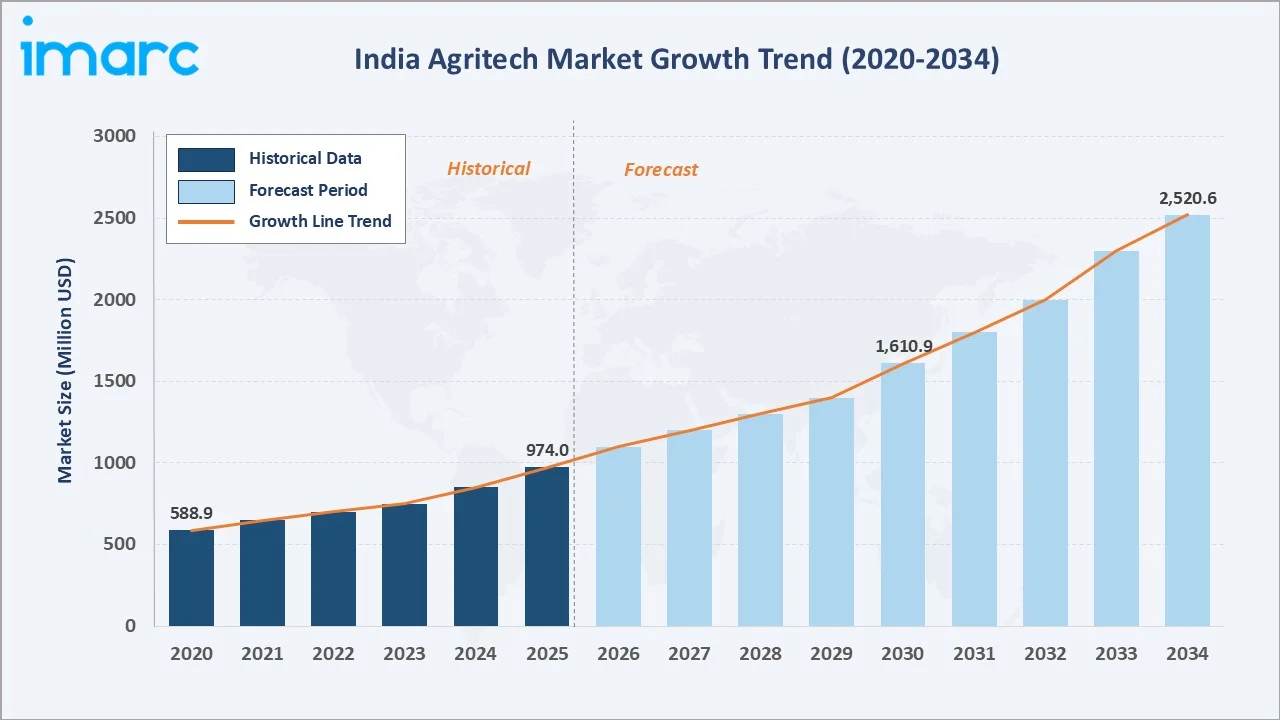
The India agritech market reached USD 974.0 Million in 2025 and is projected to reach USD 2,520.6 Million by 2034, exhibiting a robust CAGR of 10.59% during 2026-2034. Agriculture remains a critical pillar of India’s economy, supporting nearly half of the country’s population and contributing 17.7% of Gross Value Added (GVA) in FY 2023–24. Around 54.8% of India’s 328.7 million hectares was classified as agricultural land, while cropping intensity stood at 155.4% in 2021–22. The large agricultural workforce and extensive cultivated area create significant opportunities for precision farming, farm automation, digital advisory platforms, IoT-based monitoring, drones, and data-driven crop management. Big data and analytics lead the type at 28.6%, production and maintenance lead the application at 32.8%, and South India accounts for the largest regional share at 32.6%.
Market Snapshot
|
Metric |
Value |
|
Market Size (2025) |
USD 974.0 Million |
|
Forecast Market Size (2034) |
USD 2,520.6 Million |
|
CAGR (2026-2034) |
10.59% |
|
Base Year |
2025 |
|
Historical Period |
2020-2025 |
|
Forecast Period |
2026-2034 |
|
Dominant Type |
Big Data and Analytics – 28.6% (2025) |
|
Dominant Application |
Production and Maintenance – 32.8% (2025) |
|
Leading Region |
South India – 32.6% (2025) |
The India agritech market size 2025 projection from USD 588.9 Million in 2020 to USD 974.0 Million in 2025, driven by COVID-19’s acceleration of digital agriculture adoption, the PM-KISAN and e-platforms creating a government-backed digital farmer identity infrastructure, and a wave of agritech startups deploying AI-powered crop advisory, precision irrigation, and digital market linkage solutions to India’s farming households. The market is projected to reach USD 1,610.9 Million by 2030 and USD 2,520.6 Million by 2034.
To get more information on this market, Request Sample
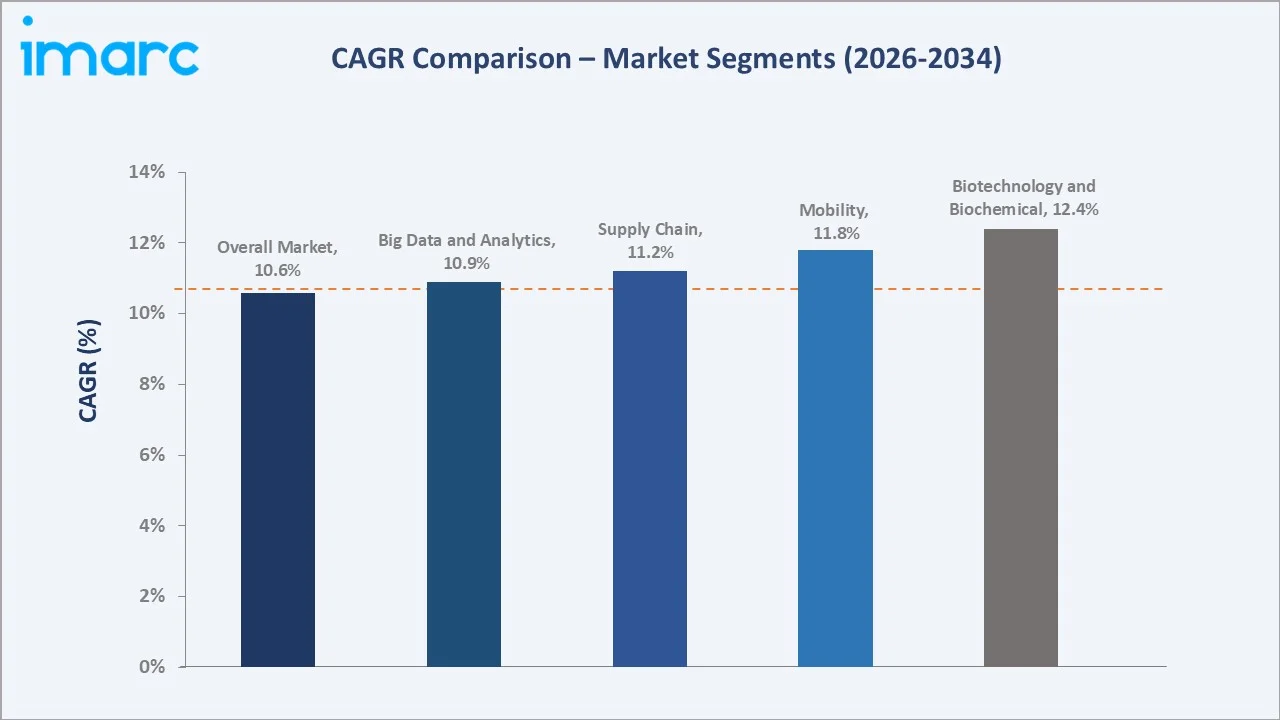
Biotechnology and biochemicals grow fastest at ~12.40% CAGR through precision fermentation, AI-designed seed genomics, and bioprotectant adoption. Mobility grows at ~11.80% CAGR through agricultural drone services, GPS-guided farm machinery, and rural logistics digitization. Supply chain application grows at ~11.20% CAGR through cold chain digitization and eNAM marketplace expansion. Big data and analytics grow at ~10.90% CAGR through satellite-based crop monitoring, weather intelligence, and yield prediction platforms.
Executive Summary
India agritech market represents one of the world’s most compelling agricultural technology investment opportunities, combining the planet’s largest smallholder farming population, a government-backed digital public infrastructure investment in the Digital Agriculture Mission, and a rapidly maturing technology application ecosystem where AI crop advisory, precision irrigation, and digital marketplace platforms are transitioning from pilot-stage experiments to commercially scaled operations serving millions of farmers.
Big data and analytics’ 28.6% market leadership reflects India’s agricultural sector’s fundamental data problem: with farmers operating across millions of hectares of cultivated land across India’s agroclimatic zones, traditional agricultural advisory and market intelligence systems cannot efficiently disaggregate data to individual farmer and plot level. Production and maintenance applications’ 32.8% dominance reflects the concentrated focus of India’s agritech investment on the core agricultural productivity challenge. South India’s 32.6% regional leadership reflects the region’s combination of progressive state governments with active agritech adoption policies, high-value crop cultivation creating strong return-on-investment for precision agriculture technologies, and the concentration of India’s premier agritech startups and research institutions in Bengaluru’s technology ecosystem.
Key Market Insights
|
Insight |
Data |
|
Dominant Type |
Big Data and Analytics – 28.6% share (2025) |
|
Dominant Application |
Production and Maintenance – 32.8% share (2025) |
|
Leading Region |
South India – 32.6% share (2025) |
|
Market Opportunity |
India’s agricultural credit market digital penetration; precision fermentation and GMO-equivalent biotech seed market; Export-oriented agritech for agricultural export target |
Key Analytical Observations:
- Big Data and Analytics at 28.6% (2025): India’s big data and analytics agritech segment encompasses satellite-based crop monitoring platforms, AI-driven weather and crop advisory systems, soil health analytics, market price intelligence tools, and predictive yield modeling technologies that collectively transform raw agricultural data into actionable farm management intelligence.
- Production and Maintenance Application at 32.8% (2025): India’s agritech production and maintenance application, encompassing precision agriculture platforms for planting optimization, AI-powered crop advisory for fertilizer and pesticide application, farm mechanization and equipment management, crop health monitoring, and post-harvest loss reduction technologies, leads application market share by reflecting the central challenge of Indian agriculture: producing more from the same land with fewer inputs while reducing the climate change-driven yield volatility that threatens farmer income security.
- South India at 32.6% (2025): South India leads due to its strong startup ecosystem, high adoption of digital farming solutions, and concentration of technology hubs in cities such as Bengaluru, Hyderabad, and Chennai. The region also benefits from progressive farmers, diversified crops, and growing use of precision agriculture, farm analytics, and agri-fintech platforms.
India Agritech Market Overview
The India agritech Market encompasses technology-driven solutions designed to improve productivity, efficiency, profitability, and sustainability across the agricultural value chain. It includes precision agriculture, farm management software, AI and data analytics, IoT sensors, drones, farm automation, digital marketplaces, and farming-as-a-service platforms. The market also covers agri-fintech, input marketplaces, supply-chain and traceability solutions, and post-harvest technologies, connecting farmers with inputs, finance, advisory services, and markets. Macroeconomic factors include the agriculture sector’s significant contribution to the economy, a large farming population, rising rural incomes, and increasing agricultural investment. Expanding digital infrastructure, smartphone and internet penetration, government support, agricultural credit, and technology startup funding are further encouraging agritech adoption.
Market Dynamics
To evaluate market opportunities, Request Sample
Market Drivers
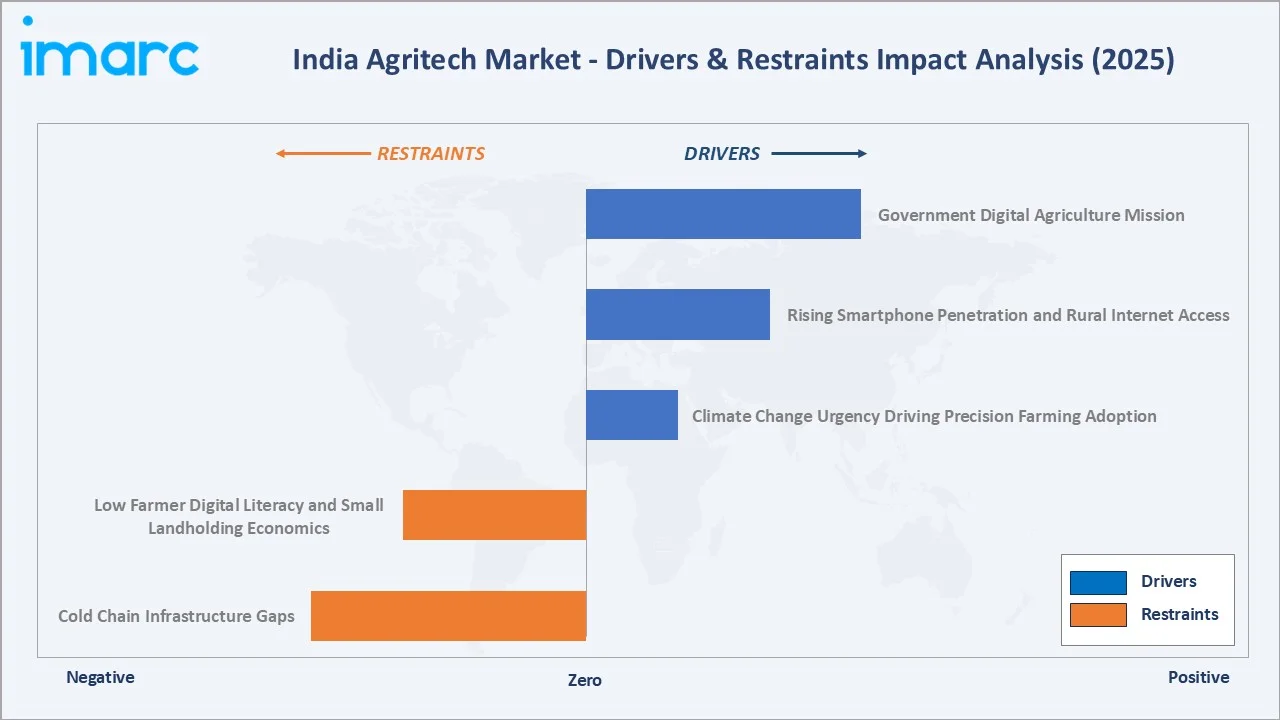
- Government Digital Agriculture Mission: To accelerate the digital transformation of India’s agriculture sector, the Union Cabinet Committee, chaired by Prime Minister Narendra Modi, approved the Digital Agriculture Mission in September 2024. The initiative has a total financial allocation of INR 2,817 Crore, including INR 1,940 Crore from the central government, to strengthen digital agriculture infrastructure and technology adoption across the country. Government investment is encouraging greater adoption of AI, remote sensing, digital advisory platforms, and precision farming solutions, creating opportunities for agritech companies to expand their services among Indian farmers.
- Rising Smartphone Penetration and Rural Internet Access: In rural India, about 96.8% of people aged 15–29 used a mobile phone at least once during the previous three months, compared with 97.6% in urban areas. Approximately 85.5% of Indian households owned at least one smartphone, while around 86.3% of households had access to the internet within their premises. India’s rural digital infrastructure has reached a critical threshold, enabling mass-market agritech deployment. This digital infrastructure democratization has reduced the farmer digital access barrier that was previously the primary constraint on agritech market penetration, enabling app-based crop advisory, digital input procurement, and mobile market linkage platforms to reach India’s previously offline farming population at the economics of digital distribution rather than expensive physical field agent networks.
- Climate Change Urgency Driving Precision Farming Adoption: Increasing climate variability, irregular rainfall, heat stress, droughts, and changing pest patterns are pushing Indian farmers toward precision farming technologies that improve resilience and resource efficiency. Tools such as IoT sensors, satellite imagery, drones, weather analytics, and AI-based advisory platforms help farmers monitor field conditions and optimize irrigation, fertilizer, and pesticide use. These solutions can reduce input waste and improve crop yields under uncertain climatic conditions. Growing pressure to conserve water and maintain productivity is therefore supporting expansion of the India agritech market.
Market Restraints
- Low Farmer Digital Literacy and Small Landholding Economics: Limited digital literacy and technical awareness among small and marginal farmers can restrict the adoption of advanced agritech solutions such as AI-based advisory tools, IoT systems, and farm management platforms. Small and fragmented landholdings also make it difficult for farmers to justify investments in drones, precision equipment, sensors, and automation technologies. High upfront costs and uncertain returns therefore slow the widespread commercialization of agritech solutions in India.
- Cold Chain Infrastructure Gaps: Limited and uneven cold storage, refrigerated transport, and temperature-controlled warehousing infrastructure can restrict the effectiveness of agritech solutions focused on post-harvest management and supply-chain optimization. Perishable produce may still face spoilage and quality losses despite improvements in farm-level productivity and digital traceability. These infrastructure gaps reduce the value realized from agritech investments and can slow adoption across the India agritech market.
Market Opportunities
- Farmer Producer Organization (FPO) Digitization: Under the Central Sector Scheme for Formation and Promotion of 10,000 Farmer Producer Organizations (FPOs), a total of 10,000 FPOs have been established across India. Of these, 1,175 FPOs consist entirely of women members, while women account for approximately 40% of total FPO shareholders, representing agritech’s most scalable farmer engagement channel, where a single agritech platform integration with one FPO effectively services farmers at the economics of a single institutional client rather than individual farmer acquisitions.
- Agricultural Export Technology and Traceability: Growing demand for quality assurance, food safety, and supply-chain transparency in international agricultural markets creates opportunities for agritech providers in India. Technologies such as blockchain, IoT sensors, QR-based tracking, digital certification, and farm-to-market traceability platforms can help exporters verify product origin and compliance. These solutions can improve buyer confidence, reduce supply-chain inefficiencies, and strengthen the competitiveness of Indian agricultural products in global markets.
Market Challenges
- Fragmented Agricultural Landholdings: India’s large number of small and marginal farms makes it difficult to achieve economies of scale for advanced agritech solutions. Technologies such as drones, autonomous machinery, precision equipment, and IoT systems may deliver limited financial returns when deployed on very small plots.
- Affordability and Uncertain Return on Investment: High upfront costs for sensors, drones, smart irrigation systems, farm machinery, and subscription-based platforms can discourage adoption among price-sensitive farmers. Seasonal income variability and uncertainty regarding productivity improvements can further delay investment decisions.
Emerging Market Trends
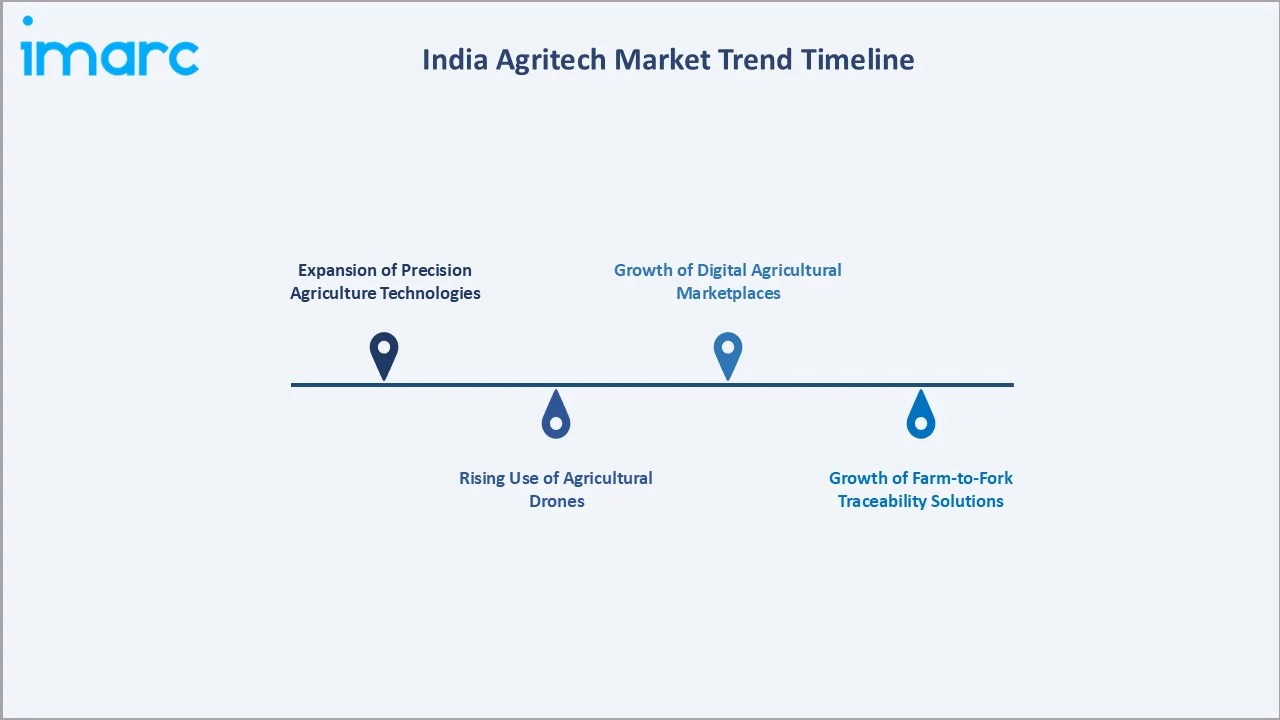
1. Expansion of Precision Agriculture Technologies
Indian farmers are increasingly exploring IoT sensors, GPS technologies, satellite imagery, soil monitoring, and variable-rate application systems to optimize farm operations. Precision technologies help monitor crop health, soil conditions, water requirements, and input usage. Growing concerns over water scarcity and input costs are strengthening their relevance. Service-based business models are also making these technologies more accessible to smaller farmers.
2. Rising Use of Agricultural Drones
Drones are gaining importance for crop monitoring, pesticide spraying, field mapping, and precision input application. In March 2026, EFT partnered with Bharat Skytech (BSPL) to introduce the co-branded EFT BHARAT initiative for domestic agricultural drone manufacturing. As part of the collaboration, EFT commenced Make in India production of its flagship E610P agricultural drone, with Bharat Skytech serving as the designated manufacturing and distribution partner for the Indian market. Agritech companies and rural entrepreneurs are increasingly developing specialized drone services for agricultural applications. Greater adoption is expected to improve operational efficiency and reduce labor-intensive farming activities.
3. Growth of Digital Agricultural Marketplaces
Digital platforms are increasingly connecting farmers directly with input suppliers, buyers, processors, retailers, and other agricultural stakeholders. These marketplaces can improve price transparency, expand market access, and simplify procurement of seeds, fertilizers, machinery, and other inputs. Integration with logistics, payments, and advisory services is creating broader agricultural ecosystems. FPOs are also emerging as important channels for aggregating farmers onto these platforms.
4. Growth of Farm-to-Fork Traceability Solutions
Agritech companies are expanding digital traceability, QR codes, blockchain-based records, and supply-chain monitoring technologies to track agricultural products from farms to consumers. Traceability is particularly important for exports, premium produce, organic products, and food safety compliance. In July 2026, NITI Aayog is working to reinforce India’s food safety ecosystem by proposing a nationwide farm-to-fork traceability system that would track food products from the production stage through retail. The system is intended to improve oversight of food quality across the supply chain, particularly by monitoring chemical residues, adulteration, and contamination. This trend is strengthening transparency and quality assurance.
Industry Value Chain Analysis
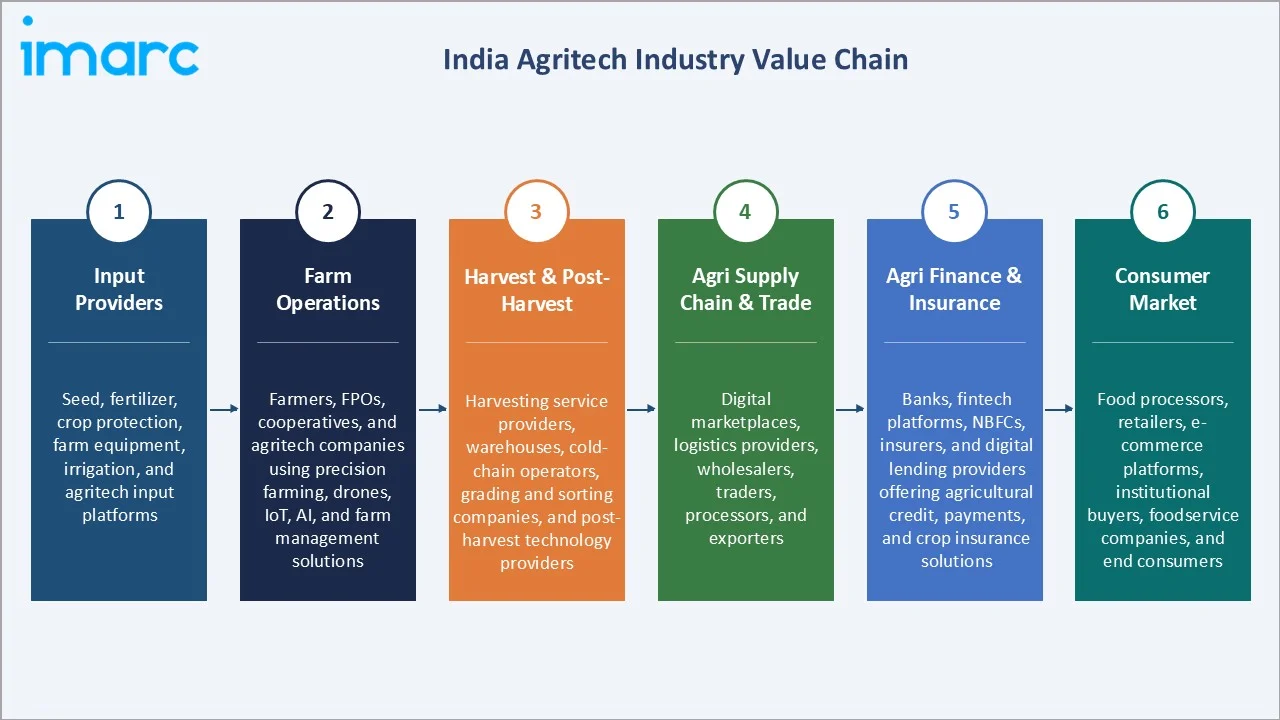
India agritech value chain integrates technology-enabled input supply, farm operations management, harvest and post-harvest processing, supply chain digitization, agricultural finance services, and consumer market linkage, creating an ecosystem where each value chain stage represents both a technology application opportunity and a potential agritech revenue stream.
|
Stage |
Key Participants |
|
Input Providers |
Seed, fertilizer, crop protection, farm equipment, irrigation, and agritech input platforms. |
|
Farm Operations |
Farmers, FPOs, cooperatives, and agritech companies using precision farming, drones, IoT, AI, and farm management solutions. |
|
Harvest & Post-Harvest |
Harvesting service providers, warehouses, cold-chain operators, grading and sorting companies, and post-harvest technology providers. |
|
Agri Supply Chain & Trade |
Digital marketplaces, logistics providers, wholesalers, traders, processors, and exporters. |
|
Agri Finance & Insurance |
Banks, fintech platforms, NBFCs, insurers, and digital lending providers offering agricultural credit, payments, and crop insurance solutions. |
|
Consumer Market |
Food processors, retailers, e-commerce platforms, institutional buyers, foodservice companies, and end consumers. |
Farm operations represent the most value-added stage in the India agritech market, as technologies such as AI, IoT, drones, precision agriculture, and farm management platforms directly improve productivity and resource efficiency. This stage also creates significant value through data-driven crop monitoring, input optimization, and automated farming practices.
Technology Landscape in the India Agritech Industry
Internet of Things (IoT) and Smart Sensors
IoT-enabled sensors support real-time monitoring of soil moisture, temperature, humidity, nutrient levels, and other field conditions. Connected devices help farmers optimize irrigation, fertilizer application, and crop management. Sensor networks can transmit farm-level information to centralized digital platforms. The technology supports precision agriculture while reducing resource wastage. Increasing rural connectivity is supporting wider deployment.
Precision Agriculture and Variable Rate Technology
Precision agriculture combines GPS, sensors, satellite imagery, analytics, and automated equipment to manage farm inputs more accurately. Variable rate technology enables site-specific application of seeds, fertilizers, pesticides, and water. These solutions can reduce input wastage while improving farm productivity. Precision technologies are particularly relevant for high-value and commercial farming. Adoption is gradually expanding through agritech service models.
Farm Management Software and Digital Platforms
Farm management platforms integrate crop planning, input management, weather information, advisory services, and operational records into digital systems. Mobile applications make these services accessible to farmers and agricultural organizations. Platforms can also connect farmers with suppliers, buyers, logistics providers, and financial institutions. Cloud-based solutions enable centralized data management and analytics. These platforms are strengthening the digital agriculture ecosystem.
Market Segmentation Analysis
The report covers the following segments:
|
Segment Category |
Leading Segment |
Market Share |
Year |
|
Type |
Big Data and Analytics |
28.6% |
2025 |
|
Application |
Production and Maintenance |
32.8% |
2025 |
|
Region |
South India |
32.6% |
2025 |

By Type
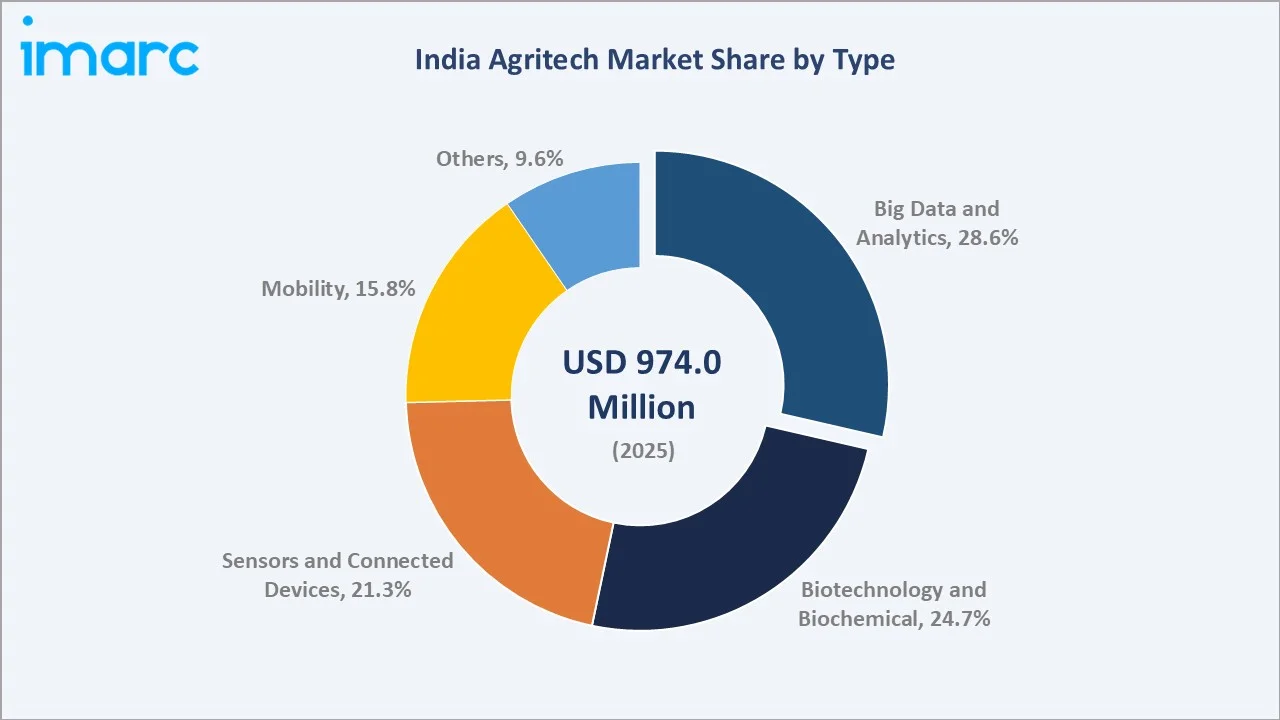
Big data and analytics lead at 28.6% (2025) through satellite crop monitoring, AI weather intelligence, and farm management analytics platforms serving enterprise and government agricultural decision-makers.
To access detailed market analysis, Request Sample
Biotechnology and biochemical at 24.7%, growing fastest at ~12.40% CAGR, through bio-input adoption and AI-driven molecular breeding. Sensors and connected devices at 21.3%, through IoT farm instrumentation. Mobility at 15.8%, growing at ~11.80% CAGR, through agricultural drones and GPS farm machinery and others at 9.6%.
By Application
Production and maintenance leads at 32.8% (2025) through AI crop advisory, precision nutrient management, and farm mechanization platforms addressing India’s core agricultural productivity gap.
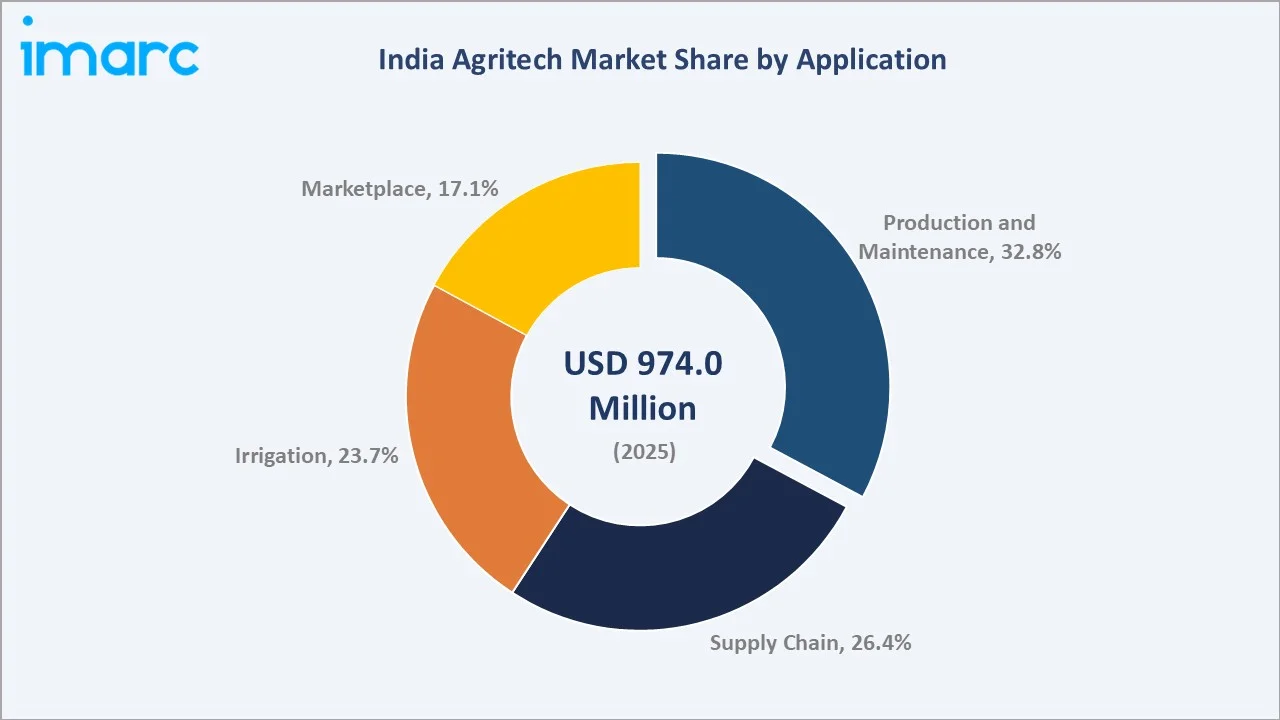
Supply chain at 26.4%, growing at ~11.20% CAGR, through fresh produce digital trading and cold chain technology. Irrigation at 23.7%, through precision water management and micro-irrigation IoT. Marketplace at 17.1% through eNAM and private digital agri-trading platforms.
Regional Market Insights
|
Region |
Share (2025) |
Key India Agritech Market Drivers & Characteristics |
|
South India |
32.6% |
Leads the market, supported by strong agritech startup activity, technology adoption, precision farming, and established digital infrastructure. |
|
West and Central India |
28.4% |
Benefits from large-scale commercial agriculture, expanding farm mechanization, digital marketplaces, and growing adoption of smart irrigation solutions. |
|
North India |
23.7% |
Driven by intensive agricultural production, farm mechanization, drone adoption, and increasing use of digital farm management solutions. |
|
East and Northeast India |
15.3% |
Emerging market supported by improving digital connectivity, government initiatives, FPO development, and gradual adoption of modern farming technologies. |
South India leads the market with a 32.6% share in 2025, supported by a strong startup ecosystem, higher digital adoption, and growing use of precision agriculture technologies. West and Central India account for 28.4%, driven by commercial farming, mechanization, digital marketplaces, and smart irrigation adoption.
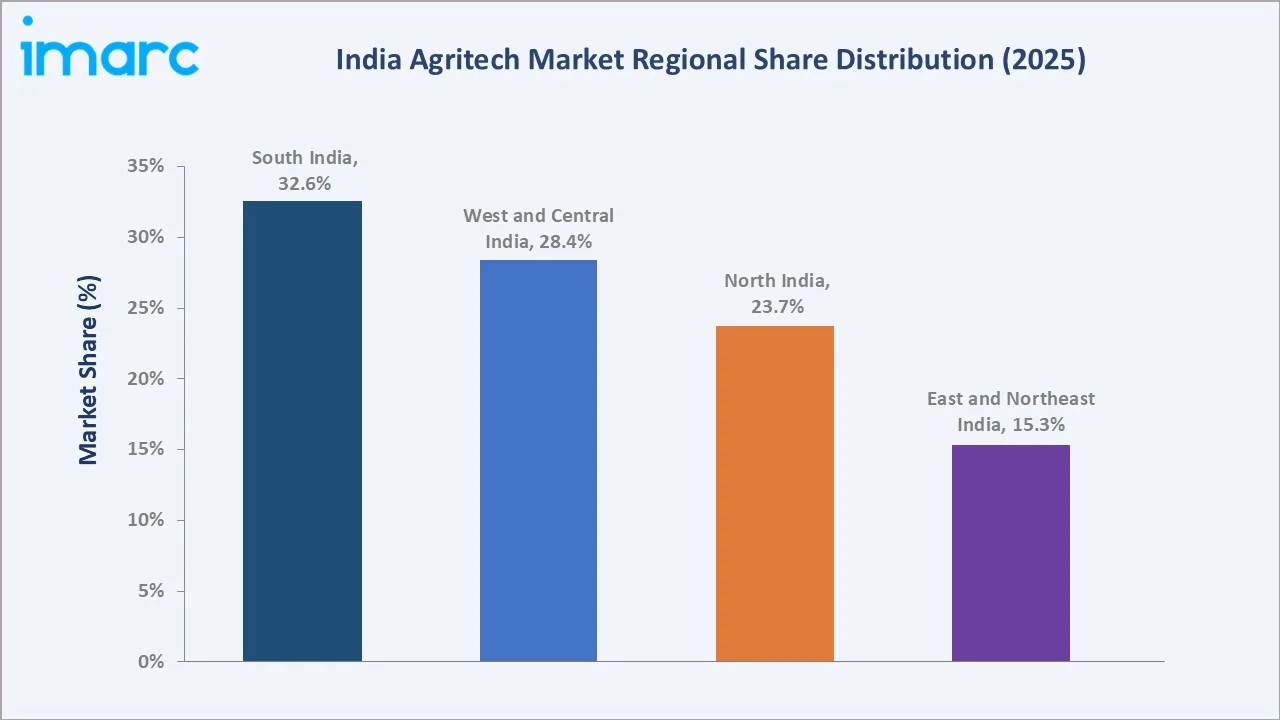
North India holds 23.7% of the market, benefiting from intensive crop production, expanding drone usage, and increasing deployment of farm management platforms. East and Northeast India represent 15.3%, with growth supported by improving connectivity, FPO development, and government-led agricultural modernization.
Competitive Landscape
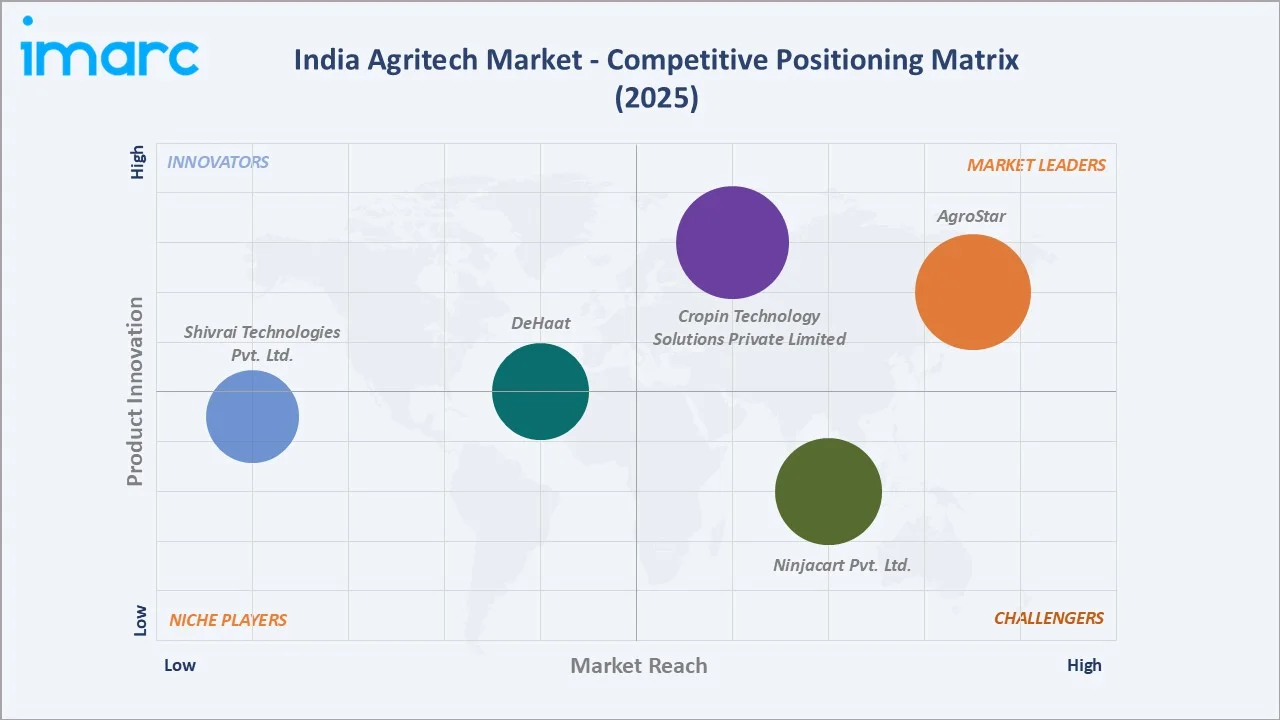
The India agritech market is moderately concentrated and startup-driven, with competition spanning farm inputs, precision agriculture, digital advisory, supply-chain platforms, agri-fintech, and automation solutions. Competition is increasingly centered on technology integration, farmer reach, scalable distribution networks, strategic partnerships, and development of integrated farm-to-market platforms.
|
Company |
Key Offerings |
Market Position |
Core Strength |
|
AgroStar |
Agri-Advisory platform, AgroStar Farmer App |
Market Leader |
AgroStar plays a pivotal role in India's agritech sector by providing an omnichannel platform. |
|
DeHaat |
DeHaat App |
Established Player |
DeHaat is one of India's largest and most comprehensive agritech platforms, providing end-to-end agricultural services to millions of farmers. |
|
Cropin Technology Solutions Private Limited |
Cropin Cloud, Cropin Grow App, Cropin Connect App, Cropin Trace App, OrbitAI |
Market Leader |
Cropin Technology Solutions Private Limited plays a transformative role in India's agritech sector by providing AI-powered, SaaS-based smart farming solutions. |
|
Ninjacart Pvt. Ltd. |
Ninja Kisan App, Ninja Mandi |
Challenger |
Ninjacart Pvt. Ltd. plays a transformative role in India’s agritech sector by digitizing the agricultural supply chain. |
|
Shivrai Technologies Pvt. Ltd. |
FarmERP Agribusiness Cloud, FarmGyan |
Established Player |
Shivrai Technologies Pvt. Ltd. plays a transformative role in the Indian agritech sector through its flagship, cloud-based ERP platform FarmERP. |
India agritech competitive landscape is evolving from a market of isolated point solutions toward integrated platforms as leading players recognize that farmer switching costs and data moats require breadth of service rather than depth of specialized functionality.
Key Company Profiles
AgroStar
AgroStar is an India-based agritech company, focused on improving farmer productivity, profitability, and sustainability through technology and agricultural services. The company provides an integrated ecosystem spanning farm advisory, agricultural inputs, omnichannel access, and market linkages. AgroStar reaches millions of farmers across Indian states and offers agricultural input products. Its technology-enabled advisory platform combines AI-based crop diagnostics, weather insights, digital agricultural knowledge, and personalized recommendations to support farm-level decision-making.
- Key Offerings: Agri-Advisory platform, AgroStar Farmer App.
- Strategic Focus: Focuses on building an integrated, technology-led agricultural ecosystem combining farm advisory, quality agri-inputs, omnichannel distribution, and market linkages. The company is strengthening its use of AI-powered crop diagnostics, personalized agronomy advisory, weather intelligence, and data-driven recommendations to improve farm productivity.
Cropin Technology Solutions Private Limited
Cropin Technology Solutions Private Limited is an India-founded agritech company, specializing in AI-powered agricultural intelligence and digital farming solutions. The company offers Cropin Cloud, an agriculture-focused industry cloud that helps agribusinesses, food companies, financial institutions, development agencies, and governments digitize and manage agricultural operations. The company combines AI, satellite imagery, IoT data, remote sensing, and predictive analytics to support crop monitoring, yield estimation, risk management, and farm productivity improvement. Its solutions also emphasize sustainable and climate-resilient agriculture through data-driven decision-making across the agricultural value chain.
- Key Offerings: Cropin Cloud, Cropin Grow App, Cropin Connect App, Cropin Trace App, OrbitAI.
- Strategic Focus: Focuses on AI-first digital transformation of agriculture, using digitization, data, and predictive intelligence to improve farm productivity and supply-chain resilience. Its strategy centers on expanding Cropin Cloud, integrating AI/ML, satellite imagery, IoT, and farm-level data to support crop monitoring, yield forecasting, traceability, and smarter decision-making.
Market Concentration Analysis
The India agritech market is moderately concentrated, with a large number of startups operating across precision farming, farm inputs, digital advisory, supply-chain management, agri-fintech, and market linkage solutions. A limited group of scaled platforms has established stronger positions, but no single company dominates the overall ecosystem. Competition remains highly regional due to differences in crop patterns, farmer requirements, infrastructure, and technology adoption. Farmer trust, last-mile distribution networks, access to agricultural data, and agronomic expertise act as important barriers to scale. The market is gradually shifting toward integrated platforms that combine advisory, inputs, financing, logistics, and market access. Strategic partnerships, funding activity, and consolidation are expected to gradually increase market concentration over the long term.
Investment & Growth Opportunities
Highest Growth Segments
Biotechnology and biochemical (~12.40% CAGR) and mobility (~11.80% CAGR) represent India’s agritech market’s highest-growth investment vectors through 2034, driven by the biological input revolution and agricultural drone service market expansion, respectively.
Investment Themes
- Agricultural Drone Services: Investment in agricultural drone services offers opportunities in crop monitoring, spraying, field mapping, and precision input applications. Growth is supported by rising farm mechanization, expanding drone-as-a-service models, and increasing adoption of data-driven farming practices.
- AgriFintech and Digital Agricultural Credit: Investment in agri-fintech can support digital lending, crop insurance, payment solutions, and alternative credit assessment for farmers. The theme is attractive due to the large underserved rural credit base, growing digital transactions, and increasing use of farm and transaction data for risk evaluation.
Future Market Outlook (2026-2034)
The India agritech market is projected to grow from USD 974.0 Million in 2025 to USD 2,520.6 Million by 2034, delivering a robust 10.59% CAGR that positions India as the world’s fastest-growing major agritech market by 2030, surpassing China and the USA in annual agritech market growth rate as India’s digital agriculture infrastructure buildout creates a market expansion supercycle anchored in both private commercial adoption and government-mandated digital transition. The anchor value of USD 1,610.9 Million in 2030 matches precisely the 2020-2025 growth rate and confirms the structural consistency of India’s agritech growth trajectory despite economic cycles and regulatory uncertainty.
First, the Digital Agriculture Mission’s government investment creates an irreversible infrastructure catalyst that will unlock private agritech market expansion far exceeding the direct government expenditure amount. Second, climate change is simultaneously the greatest threat to Indian agriculture and the most powerful demand driver for agritech solutions that deliver climate resilience outcomes. Third, India’s agricultural export ambition creates a premium agritech demand tier where export market access requirements mandate supply chain traceability, soil and water quality monitoring, and residue management agritech that commands higher per-unit revenue than domestic commodity market agritech services.
Research Methodology
Primary Research
Primary research comprised in-depth interviews with agritech company founders and senior management, government agriculture officials, Farmer Producer Organization CEO and management teams from Rajasthan, Maharashtra, and Tamil Nadu, agricultural input company digital strategy teams, venture capital investors specializing in agritech, and farmer user research groups across Gujarat, Andhra Pradesh, Bihar, and Maharashtra.
Secondary Research
Secondary research encompassed a comprehensive review of government publications, agricultural databases, industry reports, company annual reports, regulatory documents, trade associations, and credible news sources related to the India agritech market. The research focused on market trends, technology adoption, government initiatives, investment activity, competitive developments, and regional agricultural dynamics.
Forecasting Models
Forecasting models developed using historical India agritech market data (2020-2025), Digital Agriculture Mission budget and implementation timeline, AgriStack farmer registration trajectory aligned to government Phase 1-3 rollout plan, India agricultural credit market growth, agritech venture capital funding trajectory, rural connectivity expansion, drone service market growth, biological input market CAGR, and competitive market share evolution modeling using funded agritech company growth trajectory data.
India Agritech Market Report Coverage:
| Report Features | Details |
|---|---|
| Base Year of the Analysis | 2025 |
| Historical Period | 2020-2025 |
| Forecast Period | 2026-2034 |
| Units | Million USD |
| Scope of the Report |
Exploration of Historical Trends and Market Outlook, Industry Catalysts and Challenges, Segment-Wise Historical and Future Market Assessment:
|
| Types Covered | Biotechnology and Biochemical, Big Data and Analytics, Sensors and Connected Devices, Mobility, Others |
| Applications Covered | Irrigation, Production and Maintenance, Supply Chain, Marketplace |
| Regions Covered | North India, West and Central India, South India, East and Northeast India |
| Companies Covered | AgroStar, DeHaat, Cropin Technology Solutions Private Limited, Ninjacart Pvt. Ltd., Shivrai Technologies Pvt. Ltd., etc. |
| Customization Scope | 10% Free Customization |
| Post-Sale Analyst Support | 10-12 Weeks |
| Delivery Format | PDF and Excel through Email (We can also provide the editable version of the report in PPT/Word format on special request) |
Key Benefits for Stakeholders:
- IMARC’s industry report offers a comprehensive quantitative analysis of various market segments, historical and current market trends, market forecasts, and dynamics of the India agritech market from 2020-2034.
- The research report provides the latest information on the market drivers, challenges, and opportunities in the India agritech market.
- Porter's five forces analysis assist stakeholders in assessing the impact of new entrants, competitive rivalry, supplier power, buyer power, and the threat of substitution. It helps stakeholders to analyze the level of competition within the India agritech industry and its attractiveness.
- Competitive landscape allows stakeholders to understand their competitive environment and provides an insight into the current positions of key players in the market.
Frequently Asked Questions About the India Agritech Market Report
The India agritech market reached USD 974.0 Million in 2025, driven by rising adoption of precision agriculture, digital farm advisory, agricultural drones, AI-enabled solutions, and increasing investment in agri-fintech and farm-to-market platforms.
The market grows at a 10.59% CAGR, reaching USD 2,520.6 Million by 2034, supported by rapid agricultural digitalization, expanding precision farming adoption, and increasing investment in technology-driven farm solutions.
Big data and analytics lead at 28.6% (2025) through satellite crop monitoring, AI weather and crop advisory, and farm management analytics platforms serving enterprise agricultural companies and government agricultural programs at scale.
Production and maintenance leads at 32.8% (2025) through AI crop advisory, precision nutrient management, farm mechanization technology, and crop health monitoring platforms addressing India’s central agricultural productivity challenge.
South India leads at 32.6% through Bengaluru’s agritech startup ecosystem concentration, high-value horticultural agriculture providing superior ROI for precision agritech, and progressive state government agritech adoption policies.
Leading companies include AgroStar, DeHaat, Cropin Technology Solutions Private Limited, Ninjacart Pvt. Ltd., and Shivrai Technologies Pvt. Ltd., among others.
The market is projected to reach USD 1,610.9 Million by 2030, driven by increasing adoption of AI, IoT, agricultural drones, precision farming, digital advisory platforms, and technology-enabled agricultural financing solutions.
Top investment opportunities include agricultural drone services, AgriFintech digital credit, bio-input manufacturing and distribution, cold chain IoT and agri-logistics technology, and agricultural export traceability platforms.
Need more help?
- Speak to our experienced analysts for insights on the current market scenarios.
- Include additional segments and countries to customize the report as per your requirement.
- Gain an unparalleled competitive advantage in your domain by understanding how to utilize the report and positively impacting your operations and revenue.
- For further assistance, please connect with our analysts.
 Request Customization
 Speak to an Analyst
 Request Brochure
 Inquire Before Buying
Benefits of Customization
- Personalize this research
- Triangulate with your data
- Get data as per your format and definition
- Gain a deeper dive into a specific application, geography, customer, or competitor
- Any level of personalization
Get in Touch With Us
UNITED STATES
Phone: +1-201-971-6302
INDIA
Phone: +91-120-433-0800
UNITED KINGDOM
Phone: +44-753-714-6104
Email: [email protected]
Client Testimonials




.webp)




.webp)













Related Reports

Choose your plan
*Please note that the prices mentioned below are starting prices for each bundle type. Kindly contact our team for further details.*
Single User License
- 1 User License, Access on 2 Devices
- PDF Report + Excel Dataset (Password Protected)
- Lifetime Access
- No Printing Rights
- 10% Free Report Customization
- 10–12 Weeks of Analyst Support
Five User License
- Access for 5 Users, 2 Devices per User
- PDF Report + Excel Dataset (Password Protected)
- Lifetime Access
- Dedicated Account Manager
- 12–14 Weeks of Analyst Support
- No Printing Rights
- 15% Free Report Customization
- 25% Discount on Your Next Purchase
Corporate User License
- Unlimited User Access (Within Your Organization)
- PDF Report + Excel Dataset
- Lifetime Access
- Dedicated Account Manager
- 14–20 Weeks of Analyst Support
- No Printing Rights
- 20% Free Report Customization
- 30% Discount on Your Next Purchase
Essential Insights
What's included:
3 reports
- Lifetime Access
- PDF Reports
- Excel Datasets
- 2 Weeks of Free Analyst Support
- 2 User Licenses
- Access on 2 Devices
- Printing Rights
- Complimentary PowerPoint (PPT) Version
- Complimentary License Upgrade
Professional Access
What's included:
5 reports
- Lifetime Access
- PDF Reports
- Excel Datasets
- 8 Weeks of Free Analyst Support
- 2 User Licenses
- Access on 2 Devices
- Printing Rights
- Complimentary PowerPoint (PPT) Version
- Complimentary License Upgrade
Business Advantage
What's included:
8 reports
- Lifetime Access
- PDF Reports
- Excel Datasets
- 14 Weeks of Free Analyst Support
- 2 User Licenses
- Access on 2 Devices
- Printing Rights
- Complimentary PowerPoint (PPT) Version
- Complimentary License Upgrade
Enterprise Intelligence
What's included:
10 reports
- Lifetime Access
- PDF Reports
- Excel Datasets
- 20 Weeks of Free Analyst Support
- 2 User Licenses
- Access on 2 Devices
- Printing Rights
- Complimentary PowerPoint (PPT) Version
- Complimentary License Upgrade