
India API Management Market Size, Share, Trends and Forecast by Component, Deployment Type, Organization Size, Industry Vertical, and Region, 2026-2034
India API Management Market Size, Share, Trends & Forecast (2026-2034)
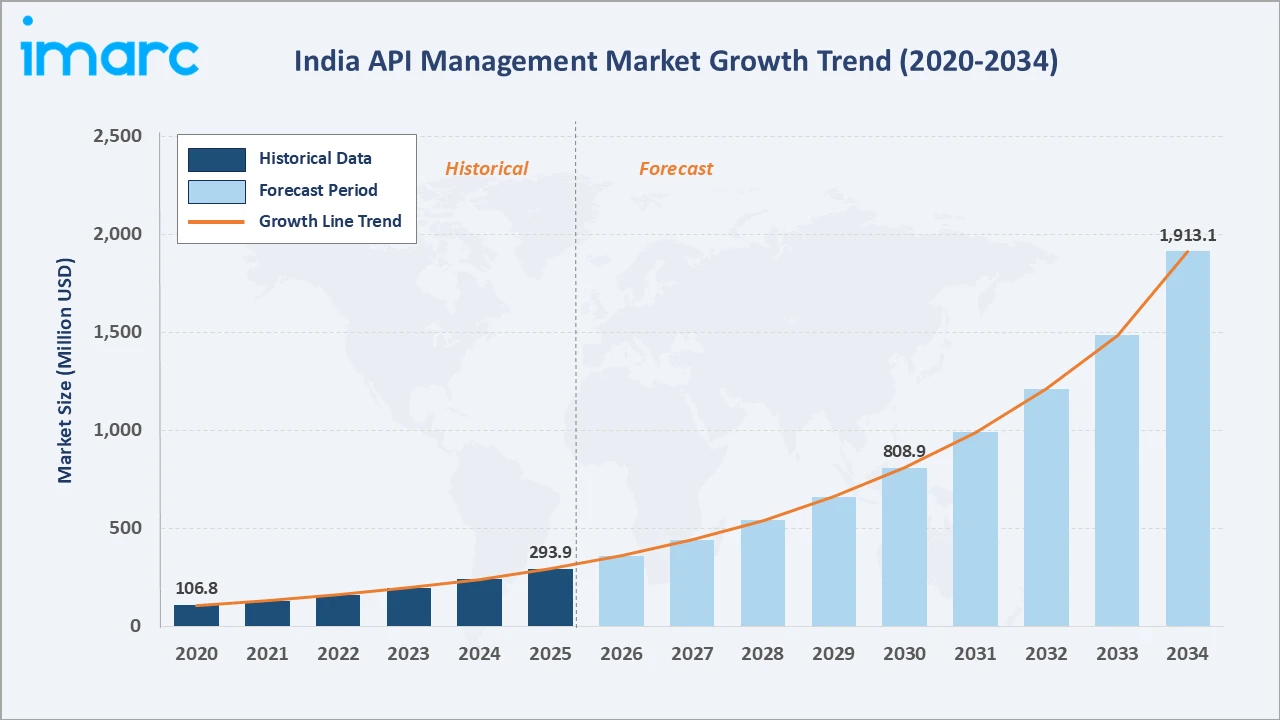
The India API management market reached USD 293.9 Million in 2025 and is projected to reach USD 1,913.1 Million by 2034, growing at a CAGR of 22.44% during 2026-2034. The market is driven by rapid digital transformation, proliferation of mobile applications, expanding cloud adoption, and India's growing fintech and BFSI ecosystem. The Solution segment dominates at 72.8%. Cloud-based deployment leads at 76.4%. South India commands 36.1% of the regional market share.
Market Snapshot
|
Metric |
Value |
|
Market Size (2025) |
USD 293.9 Million |
|
Forecast Market Size (2034) |
USD 1,913.1 Million |
|
CAGR (2026-2034) |
22.44% |
|
Base Year |
2025 |
|
Historical Period |
2034 |
|
Forecast Period |
2026-2034 |
|
Dominant Component |
Solution (72.8%, 2025) |
|
Dominant Deployment Type |
Cloud-based (76.4%, 2025) |
|
Leading Region |
South India (36.1%, 2025) |
The market expanded from USD 106.8 Million in 2020 to USD 293.9 Million in 2025, anchored at USD 808.9 Million in 2030 and forecast to reach USD 1,913.1 Million by 2034. India's rapid enterprise digitalization, UPI ecosystem expansion, and government digital platform investments created compounding API management demand, sustaining above-20% growth across the historical period.
To get more information on this market, Request Sample
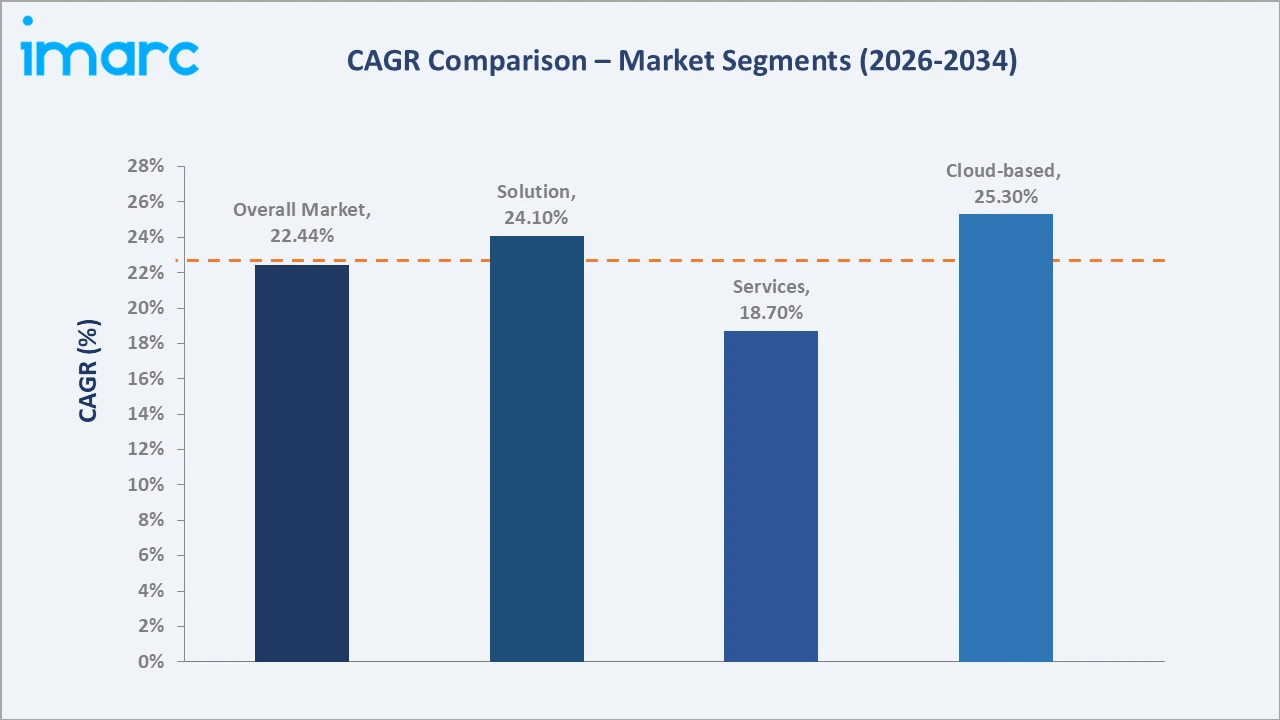
Cloud-based deployment grows fastest at ~25% CAGR as enterprises migrate to multi-cloud architectures and hyperscalers bundle API management within cloud programs. The Solution segment grows at ~24% CAGR as API platform, analytics, and security revenue compounds through enterprise digital transformation investment across BFSI, IT, and government verticals.
Executive Summary
The India API management market reached USD 293.9 Million in 2025, representing one of India's fastest-growing enterprise software segments driven by the country's accelerating digital transformation. APIs serve as the integration backbone enabling microservices architectures, cloud-native applications, digital banking, and government digital platforms. The market is projected to reach USD 1,913.1 Million by 2034.
The Solution segment at 72.8% dominates by capturing API platform, analytics, and security product revenue. Cloud-based deployment at 76.4% leads through enterprise SaaS adoption, multi-cloud strategy, and the government's cloud-first digital infrastructure policy. South India at 36.1% leads regionally through Bengaluru's technology concentration and enterprise IT platform spending.
Key Market Insights
|
Insight |
Data |
|
Dominant Component |
Solution – 72.8% share (2025) |
|
Dominant Deployment Type |
Cloud-based – 76.4% market share (2025) |
|
Leading Region |
South India – 36.1% market share (2025) |
|
Market Opportunity |
AI-native API gateways; RBI Open Banking APIs; DPDP Act compliance; UPI API ecosystem; Digital India API infrastructure |
Key Analytical Observations Supporting the Above Data:
- Solution at 72.8%: The Solution segment dominates as enterprises require centralized API lifecycle management, security governance, and developer portals for their expanding API ecosystems. The growth of UPI, Aadhaar-based APIs, and the Account Aggregator framework creates structural platform-level API management demand beyond individual enterprise procurement.
- Cloud-based at 76.4%: Cloud-based deployment reflects India's enterprise shift toward hyperscaler infrastructure, with AWS, Azure, and Google Cloud bundling API management within broader cloud migration programs adopted across IT, BFSI, and retail sectors.
- South India at 36.1%: South India leads through Bengaluru's role as India's API technology capital, home to the highest concentration of IT services firms, product startups, and hyperscaler India development centers driving API management platform procurement.
India API Management Market Overview
The India API management market encompasses the design, development, deployment, and governance of API lifecycle management platforms serving enterprises across BFSI, IT and Telecom, retail, government, and healthcare verticals. API management enables the creation, publication, documentation, security, and monitoring of application programming interfaces across diverse software environments.
The ecosystem integrates API gateway vendors, cloud platform providers, system integrators, enterprise software vendors, open-source communities, and regulatory bodies including RBI, MeitY, and CERT-In. Macroeconomic drivers include Digital India's USD 18 Billion cumulative investment, UPI's 18+ Billion monthly transactions, DPDP Act compliance requirements, and enterprise cloud migration programs shaping API platform demand.
Market Dynamics
To evaluate market opportunities, Request Sample
Market Drivers
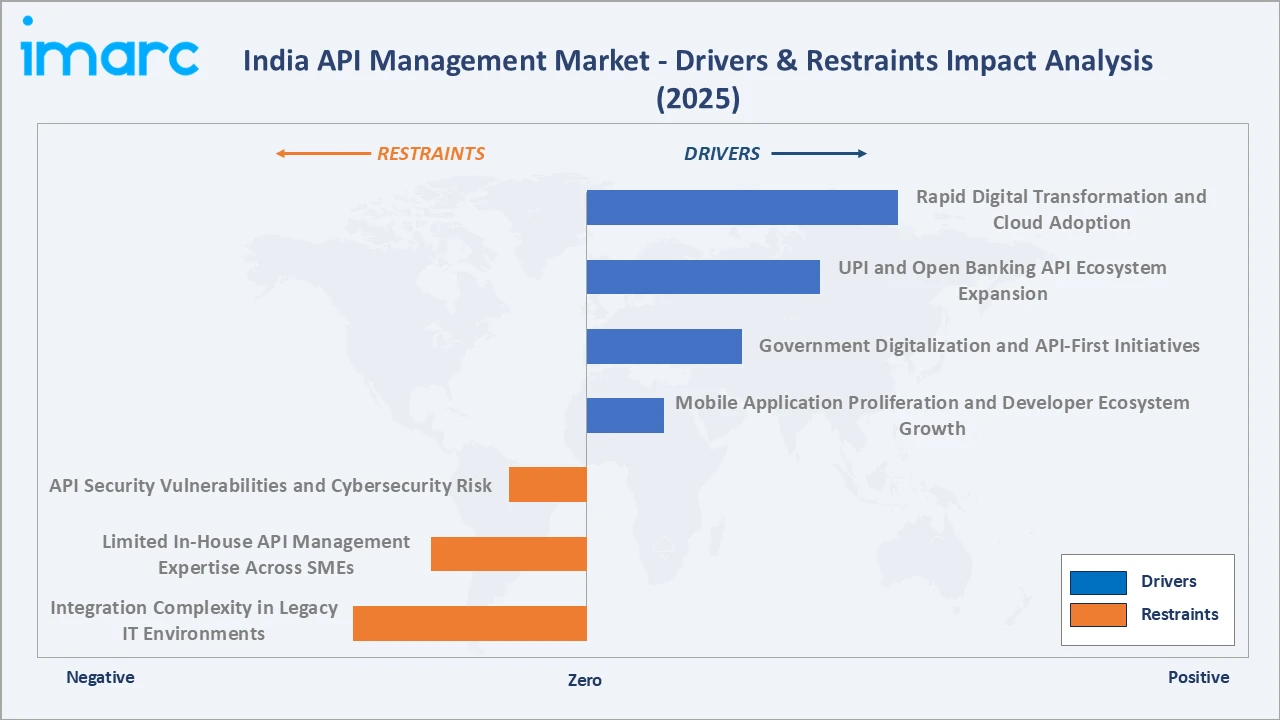
- Rapid Digital Transformation and Cloud Adoption: India's continued shift toward cloud-native architectures, microservices, and digital business models is driving demand for API management platforms. Growing cloud adoption across BFSI, IT services, e-commerce, and other sectors is increasing the number of APIs that enterprises need to secure, monitor, govern, and manage throughout their lifecycle. As organizations modernize legacy systems and expand digital services, API management is becoming an important component of enterprise IT infrastructure.
- UPI and Open Banking API Ecosystem Expansion: The rapid growth of digital payments and open banking in India is expanding the use of APIs across banks, fintech companies, payment aggregators, and financial technology platforms. Frameworks such as UPI and the RBI's Account Aggregator ecosystem facilitate secure data exchange and interoperability between financial institutions and third-party service providers. Similarly, open digital commerce initiatives are encouraging standardized API-based interactions, increasing the need for API governance, security, monitoring, and lifecycle management.
- Government Digitalization and API-First Initiatives: India's Digital India programs and the growing emphasis on interoperability across public digital infrastructure are supporting the adoption of API-based architectures. Platforms such as Aadhaar, DigiLocker, UMANG, and API Setu enable organizations to access and exchange digital services through standardized interfaces. As government agencies and connected enterprises expand their digital services, API management platforms are increasingly important for ensuring interoperability, security, access control, and efficient API governance.
- Mobile Application Proliferation and Developer Ecosystem Growth: The expansion of mobile internet usage and digital applications across e-commerce, food delivery, banking, entertainment, healthcare, and other sectors is generating increasing demand for APIs. India's growing developer ecosystem is also contributing to the rapid creation and integration of APIs across enterprise and consumer-facing applications. Platform businesses and startups increasingly rely on APIs to connect internal systems, third-party services, and external developers, strengthening demand for API management capabilities such as authentication, traffic management, monitoring, analytics, and lifecycle governance.
Market Restraints
- API Security Vulnerabilities and Cybersecurity Risk: The rapid proliferation of APIs is expanding India's enterprise attack surface, with API-targeted attacks increasing significantly across BFSI and e-commerce sectors. Organizations face challenges in securing APIs against injection attacks, unauthorized access, and data exfiltration, increasing implementation complexity. CERT-In's 2024-25 incident reports identified API misconfiguration as a leading cause of enterprise data breaches, raising compliance costs. Addressing API security requires specialized expertise that creates adoption barriers, particularly for mid-market organizations.
- Limited In-House API Management Expertise Across SMEs: Small and medium enterprises lack specialized API architecture and governance skills, constraining adoption of sophisticated API management platforms across India's large SME sector. Talent scarcity in API security, lifecycle management, and developer portal administration slows market penetration beyond large enterprise and IT sector buyers. The skills gap is particularly pronounced in manufacturing, logistics, and healthcare verticals where digital transformation is at an earlier stage. Training and certification program development has not kept pace with market demand growth.
- Integration Complexity in Legacy IT Environments: Many Indian enterprises in banking, manufacturing, and government operate legacy systems with limited API readiness, requiring significant integration investment before modern API management platforms can be deployed. Mainframe-era architectures in public sector banks and insurance companies require middleware adapters that increase implementation cost and timelines. Integration complexity creates multi-year platform deployment cycles, reducing the addressable market for rapid API management adoption. Vendor professional services costs for legacy integration compound total cost of ownership.
Market Opportunities
- AI-Native API Gateway and Intelligent API Analytics: Integration of AI into API management platforms enables predictive traffic management, anomaly detection, and automated API documentation generation. Indian enterprises adopting AI-driven development workflows are creating demand for intelligent API management capabilities that reduce manual governance overhead. Google Apigee's AI API management and Microsoft's AI-augmented Azure API Management are gaining traction in India's large enterprise segment. The convergence of LLM APIs with enterprise integration creates a new API governance category addressing AI model consumption management.
- DPDP Act Compliance-Driven API Governance Platform Adoption: India's Digital Personal Data Protection Act mandates API-level data governance, consent management, and audit trail capabilities across enterprises handling personal data. Compliance requirements are accelerating API management platform procurement across regulated BFSI, healthcare, and retail sectors with large personal data footprints. DPDP Act enforcement timelines are creating procurement urgency among enterprises that previously operated without formal API governance frameworks. Compliance-aligned API management platforms are positioned to capture mandated procurement across all regulated sectors.
Market Challenges
- Multi-Cloud API Consistency and Governance Across Distributed Architectures: Enterprises operating across AWS, Azure, and Google Cloud face API sprawl challenges where APIs proliferate without centralized visibility or governance control. Maintaining consistent security policies, versioning, and performance monitoring across multi-cloud environments increases operational complexity and platform requirements. Vendor-specific API gateway implementations from hyperscalers create lock-in risks that complicate enterprise API portability decisions. Unified multi-cloud API management requires additional tooling investment beyond the core platform cost.
- Price Competition from Open-Source API Gateway Solutions: Open-source platforms such as Kong Gateway, Apache APISIX, and WSO2 API Manager provide cost-free alternatives to commercial API management suites, pressuring commercial platform pricing. Their availability increases evaluation complexity for enterprise procurement teams and extends sales cycles for commercial platform vendors. Open-source alternatives have established significant adoption in Indian fintech and startup ecosystems where cost efficiency is prioritized. The sophistication gap between open-source and commercial platforms is narrowing as open-source communities accelerate feature development.
Emerging Market Trends
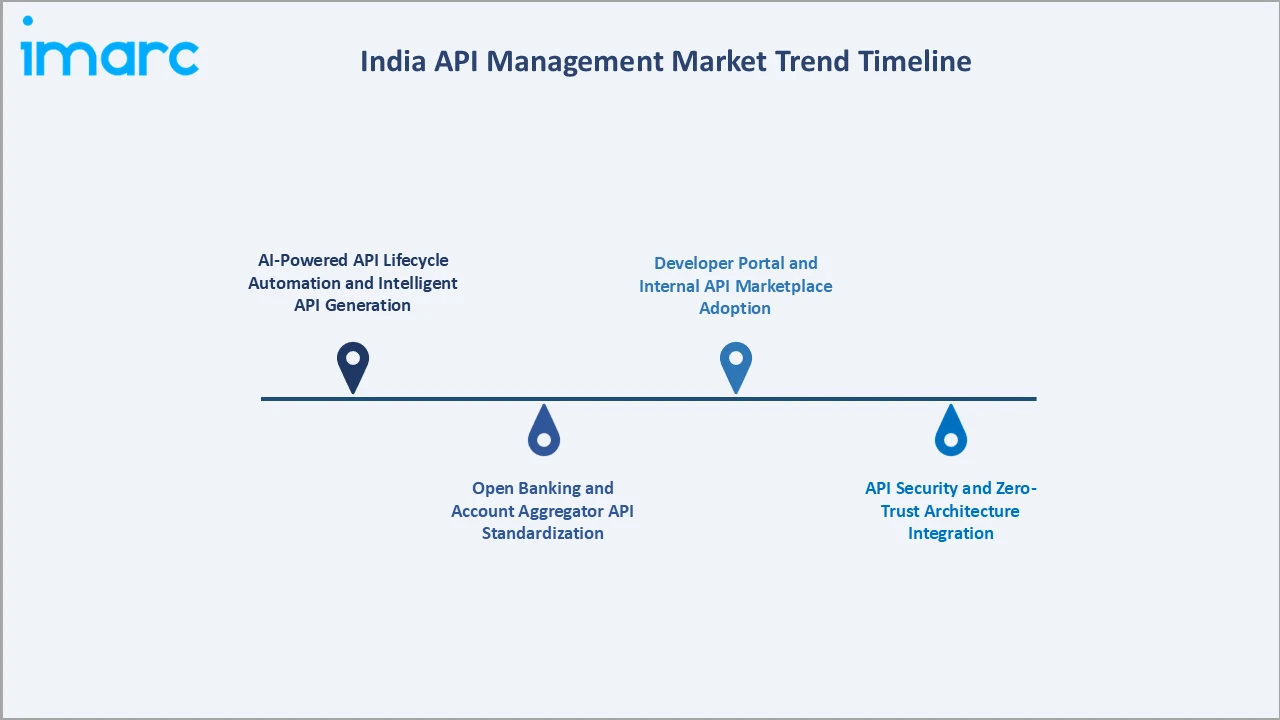
1. AI-Powered API Lifecycle Automation and Intelligent API Generation
AI integration into API management platforms is enabling automated API documentation, intelligent traffic routing, and real-time anomaly detection across enterprise deployments. Indian enterprises deploying large language model applications are demanding AI-native API governance tools for managing LLM API consumption, cost optimization, and security policy enforcement at scale.
2. Open Banking and Account Aggregator API Standardization
The RBI Account Aggregator framework and ONDC platform are establishing standardized financial API ecosystems requiring interoperable management platforms across 50+ licensed financial entities. API standardization is accelerating across banking, insurance, and wealth management sectors, creating institutional API management procurement demand that extends beyond individual enterprise buying decisions.
3. API Security and Zero-Trust Architecture Integration
India's CERT-In cybersecurity mandates and increasing API-targeted attacks are driving integration of zero-trust security frameworks into API management platforms across enterprise deployments. Enterprises are prioritizing OAuth 2.0, mutual TLS, and real-time threat detection as baseline API security requirements, elevating security tier evaluation criteria.
4. Developer Portal and Internal API Marketplace Adoption
Indian enterprises are establishing internal API marketplaces and self-service developer portals to promote API reuse, reduce integration duplication, and accelerate application development velocity. Platforms such as MuleSoft Anypoint Exchange and Apigee Developer Portal are gaining traction as enterprise API marketplace foundations across large IT services and BFSI organizations.
Industry Value Chain Analysis
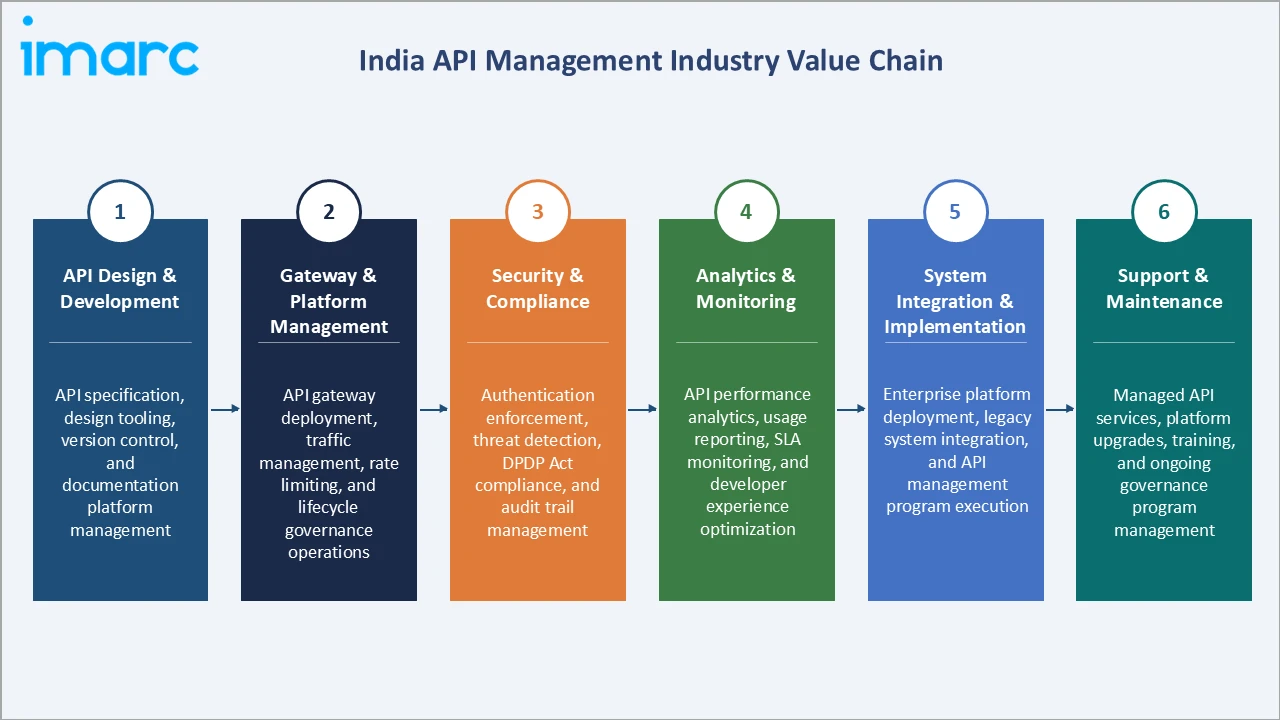
The India API management value chain integrates API design and development, gateway deployment and management, security enforcement, analytics and monitoring, system integration and implementation, and ongoing support and maintenance across hyperscaler, independent software vendor, and Indian IT services tiers.
|
Stage |
Key Activities |
|
API Design & Development |
API specification, design tooling, version control, and documentation platform management |
|
Gateway & Platform Management |
API gateway deployment, traffic management, rate limiting, and lifecycle governance operations |
|
Security & Compliance |
Authentication enforcement, threat detection, DPDP Act compliance, and audit trail management |
|
Analytics & Monitoring |
API performance analytics, usage reporting, SLA monitoring, and developer experience optimization |
|
System Integration & Implementation |
Enterprise platform deployment, legacy system integration, and API management program execution |
|
Support & Maintenance |
Managed API services, platform upgrades, training, and ongoing governance program management |
The gateway and platform management tier is the highest-revenue commercial stage, concentrating global hyperscaler and specialist ISV revenue. The system integration and implementation tier is India's largest participation layer, with Infosys, TCS, Wipro, and HCL Technologies delivering the majority of API management platform deployment programs.
Technology Landscape in the India API Management Industry
API Gateway Technology
API gateway technology provides centralized traffic management, authentication enforcement, rate limiting, and protocol transformation for enterprise API ecosystems. Modern gateways support REST, GraphQL, gRPC, and event-driven architectures, enabling enterprises to manage heterogeneous API environments from a unified control plane deployed across cloud, hybrid, and on-premises environments.
Cloud-Native and Microservices API Management
Cloud-native API management platforms integrate natively with Kubernetes, containerized microservices, and CI/CD pipelines, enabling infrastructure-as-code API governance across distributed architectures. Kong Gateway's Kubernetes-native deployment and Google Apigee's GKE integration gained significant adoption among Indian cloud-native enterprises, reducing API gateway deployment complexity while improving scalability and observability across containerized workloads.
AI-Augmented API Analytics and Security
Google Apigee Advanced API Security and Microsoft Defender for APIs introduced AI-powered anomaly detection and misconfiguration identification capabilities targeting enterprise deployments. These AI-augmented tools are enabling Indian enterprises to automate API threat detection and reduce security incident response time, with machine learning models identifying abnormal traffic patterns and unauthorized API access across complex multi-tenant environments in real time.
Market Segmentation Analysis
The report covers the following segments:
|
Segment Category |
Leading Segment |
Market Share |
Year |
|
Component |
Solution |
72.8% |
2025 |
|
Deployment Type |
Cloud-based |
76.4% |
2025 |
|
Organization Size |
🔒 |
🔒 |
2025 |
|
Industry Vertical |
🔒 |
🔒 |
2025 |
|
Region |
South India |
36.1% |
2025 |

By Component
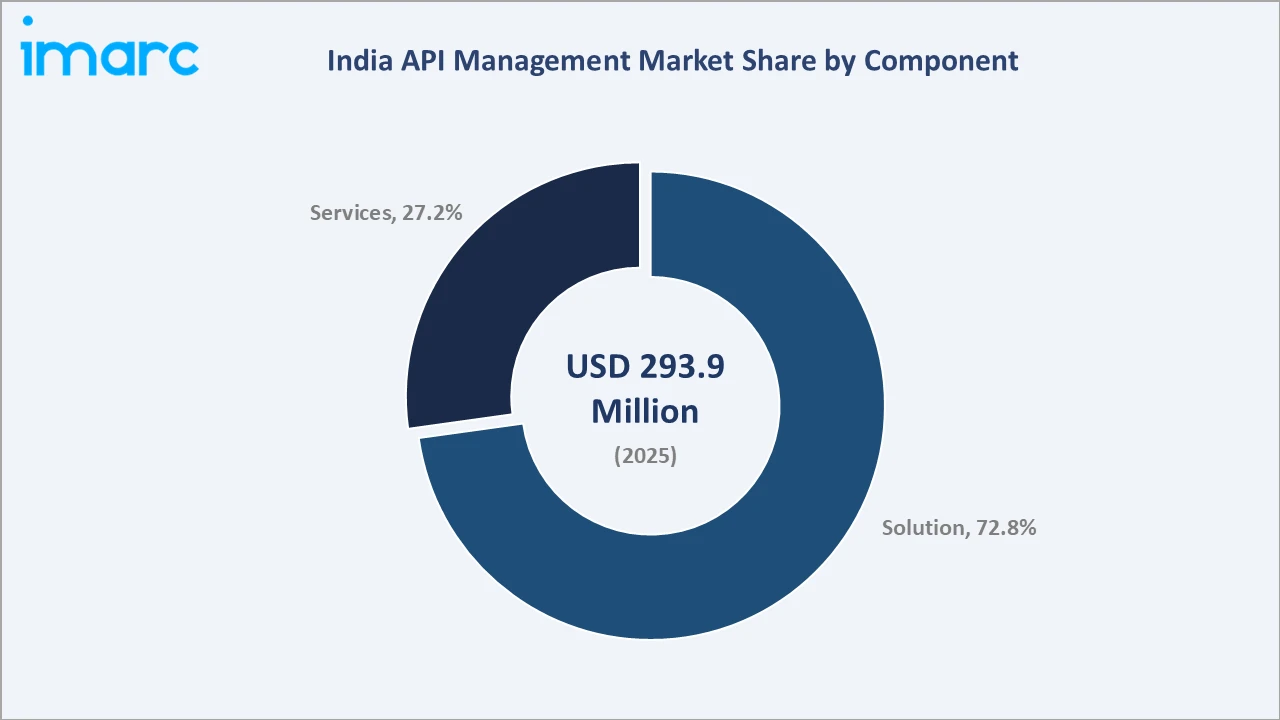
The Solution segment leads at 72.8% in 2025, encompassing API platform, API analytics, and API security product categories serving enterprise API governance and lifecycle management requirements across India's growing digital economy.
To access detailed market analysis, Request Sample
The Services segment at 27.2% captures integration and implementation, consulting, support and maintenance, and training revenue. Indian system integrators generate substantial services revenue through API management platform deployment programs across BFSI, IT, and government sector clients requiring customized implementation and ongoing governance program management.
By Deployment Type
Cloud-based deployment leads at 76.4%, driven by enterprise multi-cloud adoption, SaaS application proliferation, and hyperscaler bundling of API management within cloud migration programs across AWS, Azure, and Google Cloud ecosystems serving India's enterprise technology sector.
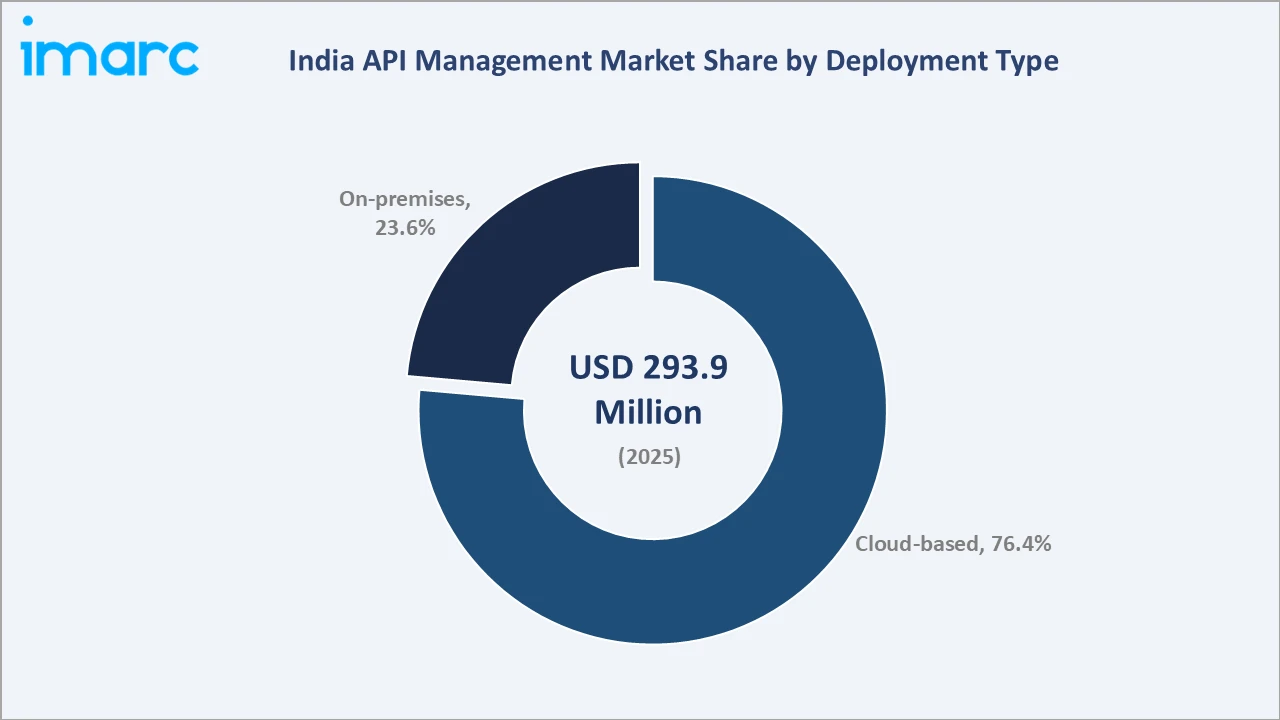
On-premises deployment at 23.6% persists across highly regulated banking, insurance, and government environments where data residency mandates and cybersecurity compliance requirements limit cloud API platform adoption. Hybrid deployment architectures are emerging as a transitional model enabling regulated enterprises to govern APIs across both on-premises and cloud environments.
Regional Market Insights
|
Region |
Share (2025) |
Key API Management Market Drivers & Characteristics |
|
South India |
36.1% |
Bengaluru technology ecosystem, IT services concentration, hyperscaler India hubs, and high density of product startups driving API platform demand |
|
West and Central India |
30.8% |
Mumbai BFSI cluster, fintech corridor API demand, Maharashtra government digital investments, and Pune IT services sector API adoption |
|
North India |
21.2% |
Delhi NCR enterprise technology hub, government API initiatives, MeitY digital platform programs, and Noida-Gurugram IT corridor adoption |
|
East and Northeast India |
11.9% |
Growing digital infrastructure investment, government e-services platforms, and enterprise technology adoption expanding from Kolkata into eastern manufacturing sectors |
South India, at 36.1%, leads through Bengaluru's concentration of IT services majors, hyperscaler development centers, and fintech enterprises driving API platform procurement. West and Central India, at 30.8%, reflects Mumbai's BFSI API demand from banks, insurers, and payment aggregators integrating RBI-mandated open banking APIs.
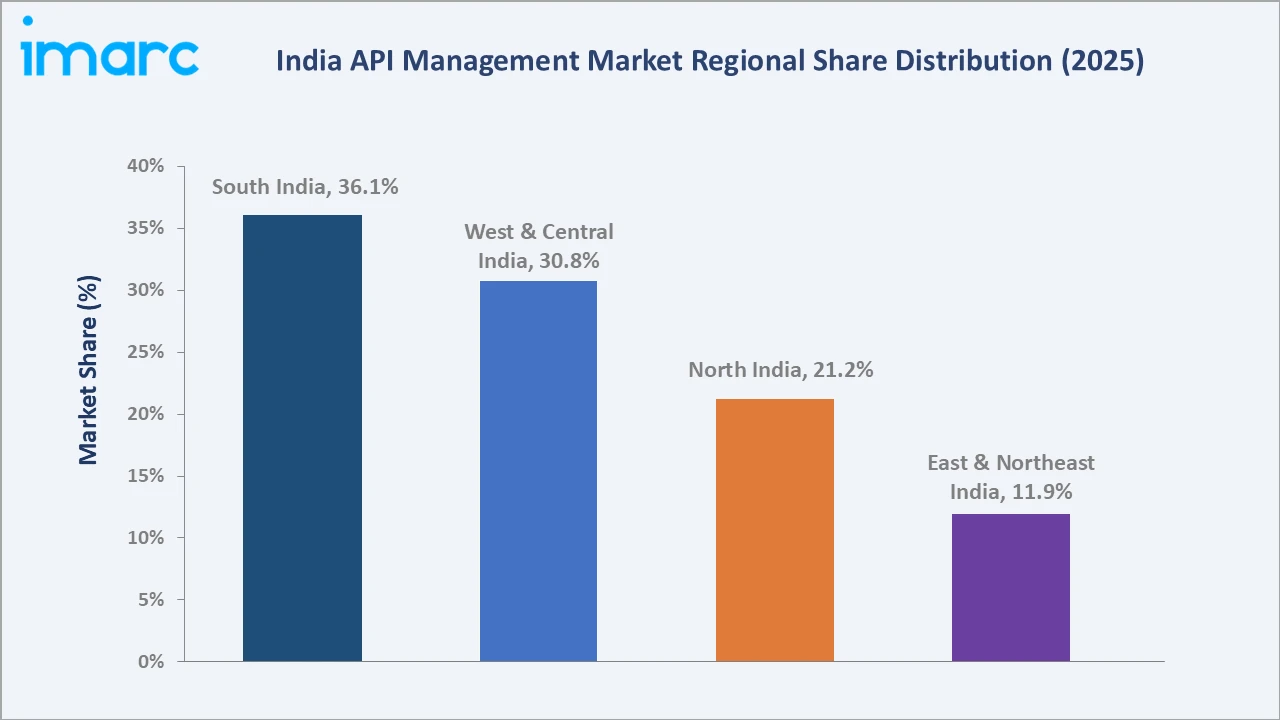
North India, at 21.2%, represents Delhi NCR's enterprise technology hub and government digital platform API demand from MeitY, NIC, and UIDAI API ecosystems. East and Northeast India, at 11.9%, is an emerging growth region as government e-governance programs and enterprise IT expansion create new API management platform demand.
Competitive Landscape
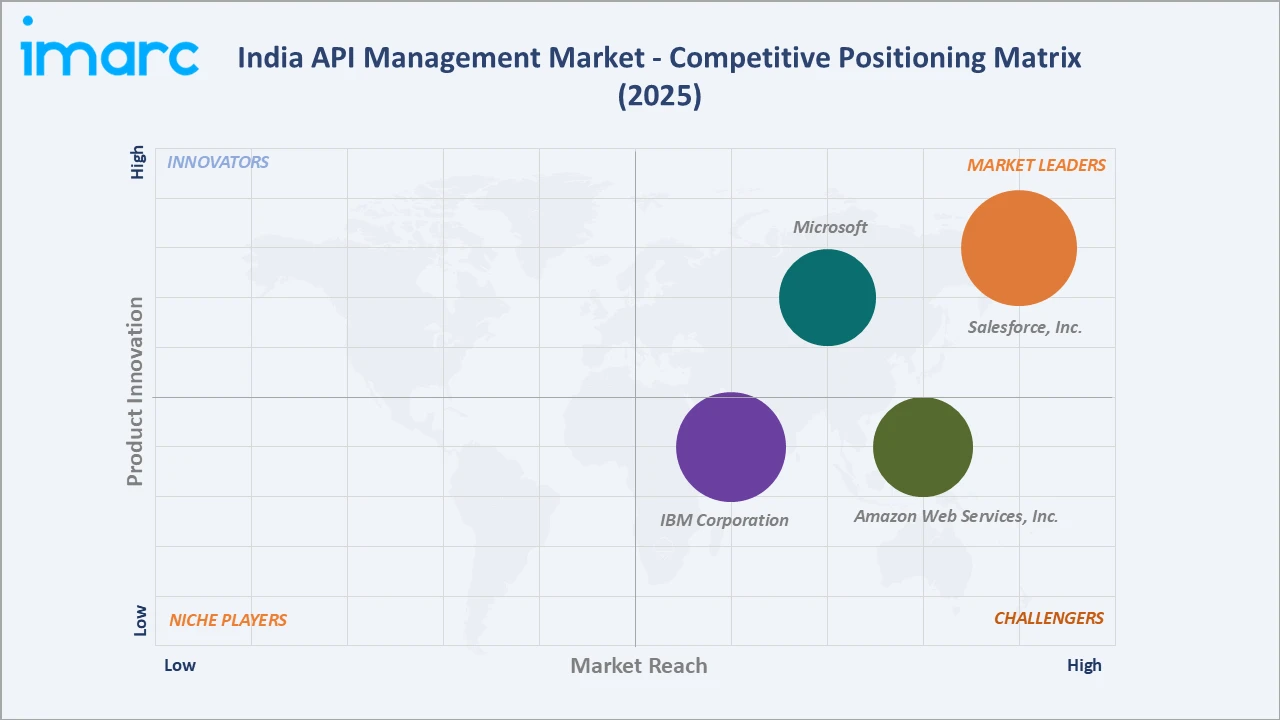
The India API management market competitive landscape is moderately fragmented with three distinct competitive tiers: global hyperscaler-integrated platforms, specialist ISV API management vendors, and Indian IT services companies providing managed API implementation services across enterprise verticals.
|
Company Name |
Key Products |
Market Position |
Core Strength |
|
Microsoft |
Azure API Management, Azure API Center, Microsoft Defender for APIs |
Market Leader |
Deep enterprise integration, hybrid connectivity, and Azure DevOps ecosystem API governance capabilities |
|
Salesforce, Inc. |
Anypoint Platform, MuleSoft API Manager, Anypoint Exchange |
Market Leader |
Largest API management revenue share globally; strong Indian enterprise and BFSI sector presence |
|
IBM Corporation |
IBM API Connect, IBM DataPower Gateway, IBM Cloud API Management |
Strong Challenger |
Enterprise security depth, mainframe integration capability, and regulated industry API governance strength |
|
Amazon Web Services, Inc. |
Amazon API Gateway, AWS AppSync |
Strong Challenger |
Native AWS ecosystem integration, serverless API management, and India cloud region proximity advantage |
Key players include Microsoft, Salesforce, Inc., IBM Corporation, Amazon Web Services, Inc., and others.
Key Company Profiles
Microsoft
Microsoft is a global technology company whose API management portfolio, anchored by Azure API Management and Azure API Center, serves Indian enterprises through its Azure cloud ecosystem and extensive partner network across BFSI, retail, healthcare, and government verticals.
- Key Products: Azure API Management, Azure API Center, Microsoft Defender for APIs, Azure API Gateway.
- Strategic Focus: Microsoft is building end-to-end API governance from design to decommissioning within the Azure platform, integrating API Center with Azure DevOps and GitHub Actions for developer workflow continuity. The company is expanding Defender for APIs across India's regulated financial services sector to address DPDP Act and CERT-In cybersecurity compliance requirements. Microsoft's India partner ecosystem of 10,000+ certified partners accelerate Azure API Management enterprise deployments across manufacturing, retail, and government sectors.
Salesforce, Inc.
Salesforce, Inc., operating through MuleSoft LLC, is a leading API management and integration platform provider whose Anypoint Platform serves Indian enterprises in BFSI, manufacturing, retail, and healthcare through its API-led connectivity framework and comprehensive internal API marketplace capabilities.
- Key Products: Anypoint Platform, MuleSoft API Manager, Anypoint Exchange, Anypoint Flex Gateway.
- Strategic Focus: MuleSoft is deepening Salesforce ecosystem integration to position Anypoint Platform as the preferred enterprise API management solution for Salesforce CRM customers across India. The company is expanding AI-native API automation to reduce manual governance overhead and accelerate developer productivity for Indian enterprise platform teams. MuleSoft is also growing its Indian enterprise presence through direct sales expansion and Salesforce's extensive India partner implementation network spanning banking, insurance, and retail sectors.
Market Concentration Analysis
The India API management market is moderately fragmented, with the key players collectively estimated to account for approximately 55-65% of enterprise API management platform revenue in 2025. Indian IT services firms account for a significant share of services revenue through API management implementation programs delivering substantial value-added services revenue above the platform tier.
Market concentration at the enterprise platform tier is expected to remain broadly stable through 2027, as hyperscaler bundling reinforces incumbent positions, while open-source alternatives and specialist ISVs including WSO2 and Kong maintain competitive presence in SME and cost-sensitive enterprise segments.
Investment & Growth Opportunities
Highest Growth Segments
Cloud-based API management (~25% CAGR), AI-native API governance platform (~35%+ CAGR), BFSI open banking API platform (~28% CAGR), government Digital India API infrastructure (~22% CAGR), and API security solutions aligned with DPDP Act compliance (~30%+ CAGR) represent the highest-growth investment vectors through 2034.
Emerging Investment Opportunities
India's ONDC open commerce network and Account Aggregator framework are creating structural API management demand across fintech, banking, and e-commerce sectors. API management platforms supporting standardized financial data APIs represent a high-growth institutional procurement opportunity beyond individual enterprise sales programs, with 50+ licensed entities requiring interoperable platform deployments.
Investment Themes
- DPDP Act compliance API governance platforms creating structural demand: India's Digital Personal Data Protection Act mandates API-level consent management, data minimization, and audit trails across all enterprises handling personal data at scale. Compliance-aligned API management platforms are positioned to capture mandated procurement across regulated sectors through 2027 enforcement timelines.
- India government API infrastructure investment through Digital India: MeitY's API Setu platform and National Data Governance Framework are creating government API management procurement programs that represent both direct institutional revenue and a market development catalyst for private sector enterprise API adoption across all regions.
Future Market Outlook (2026-2034)
The India API management market is projected to grow from USD 293.9 Million in 2025 to USD 1,913.1 Million by 2034, delivering a 22.44% CAGR over the forecast period. The market's anchor value of USD 808.9 Million in 2030 represents India's API management industry at its most transformative commercial inflection point, with cloud-native architectures achieving dominance across large enterprise segments.
Three structural forces define India API management market growth through 2034. Enterprise cloud migration multiplies API volumes across multi-cloud environments, creating compounding lifecycle management and governance demand that grows faster than underlying cloud spending. Regulatory API mandates from RBI, SEBI, IRDAI, and MeitY create institutionalized API management platform requirements across financial services and government sectors. India's technology startup and product ecosystem generates compounding developer-tier API management demand across SaaS, fintech, and health tech sectors with above-market growth trajectories.
Research Methodology
Primary Research
Primary research comprised structured interviews with 50+ industry stakeholders (2025), including enterprise API architects, cloud platform leads, BFSI digital transformation officers, government IT officials, open banking specialists, and API security practitioners across India's major technology and financial services hubs.
Secondary Research
Secondary research encompassed company annual reports; MeitY Digital India investment data; RBI Account Aggregator framework statistics; NPCI UPI transaction data; IMARC Group India digital economy reports; IDC India enterprise software market data; Gartner Magic Quadrant for API Management 2024; CERT-In cybersecurity incident reports; DPDP Act regulatory guidance documents. Over 55 secondary sources reviewed.
Forecasting Models
Market revenue forecasts developed using a bottom-up enterprise API management platform adoption model: (i) enterprise universe by sector and organization size tier; (ii) API management platform adoption rate by sector digital maturity index; (iii) average annual platform and professional services revenue per enterprise customer; (iv) regional allocation by technology concentration and digital infrastructure investment index.
India API Management Market Report Coverage:
| Report Features | Details |
|---|---|
| Base Year of the Analysis | 2025 |
| Historical Period | 2020-2025 |
| Forecast Period | 2026-2034 |
| Units | Million USD |
| Scope of the Report | Exploration of Historical and Forecast Trends, Industry Catalysts and Challenges, Segment-Wise Historical and Predictive Market Assessment:
|
| Components Covered |
|
| Deployment Types Covered | Cloud-based, On-premises |
| Organization Sizes Covered | Large Enterprises, Small and Medium-sized Enterprises |
| Industry Verticals Covered | BFSI, IT and Telecom, Retail and Consumer Goods, Travel and Transportation, Government, Media and Entertainment, Healthcare and Life Sciences, Manufacturing, Others |
| Regions Covered | North India, West and Central India, South India, East and Northeast India |
| Companies Covered | Microsoft, Salesforce, Inc., IBM Corporation, Amazon Web Services, Inc., etc. |
| Customization Scope | 10% Free Customization |
| Post-Sale Analyst Support | 10-12 Weeks |
| Delivery Format | PDF and Excel through Email (We can also provide the editable version of the report in PPT/Word format on special request) |
Key Benefits for Stakeholders:
- IMARC’s industry report offers a comprehensive quantitative analysis of various market segments, historical and current market trends, market forecasts, and dynamics of the India API management market from 2020-2034.
- The research report provides the latest information on the market drivers, challenges, and opportunities in the India API management market.
- Porter's five forces analysis assist stakeholders in assessing the impact of new entrants, competitive rivalry, supplier power, buyer power, and the threat of substitution. It helps stakeholders to analyze the level of competition within the India API management industry and its attractiveness.
- Competitive landscape allows stakeholders to understand their competitive environment and provides an insight into the current positions of key players in the market.
Frequently Asked Questions About the India API Management Report
The India API management market reached USD 293.9 Million in 2025, driven by the Solution segment dominant at 72.8%, cloud-based deployment leading at 76.4%, BFSI and IT sector API platform adoption, South India commanding 36.1% regional share through Bengaluru's technology ecosystem, and UPI API ecosystem expansion creating structural demand for enterprise-grade API management governance platforms.
The India API management market grows at 22.44% CAGR during 2026-2034, reaching USD 1,913.1 Million by 2034. This growth reflects enterprise cloud migration, open banking API ecosystem expansion, government digital platform investments, DPDP Act compliance-driven procurement, and AI-native API management platform adoption across India's rapidly expanding digital economy.
The Solution segment leads at 72.8%, capturing API gateway, API analytics, and API security platform revenue across enterprise, BFSI, and government verticals. The Services segment at 27.2% reflects integration, implementation, and consulting revenue from Indian IT services firms deploying API management platforms across large enterprise programs.
Cloud-based deployment leads at 76.4% through enterprise multi-cloud adoption and hyperscaler API management bundling within cloud migration programs. On-premises deployment at 23.6% persists in regulated banking and government environments requiring data residency compliance and high-security API gateway deployment with full infrastructure control.
South India leads at 36.1% through Bengaluru's technology sector concentration, IT services majors, and hyperscaler India development centers. West and Central India at 30.8% reflects Mumbai's BFSI API demand. North India at 21.2% captures Delhi NCR enterprise and government API management platform procurement.
Leading companies include Microsoft, Salesforce, Inc., IBM Corporation, Amazon Web Services, Inc., and others.
Need more help?
- Speak to our experienced analysts for insights on the current market scenarios.
- Include additional segments and countries to customize the report as per your requirement.
- Gain an unparalleled competitive advantage in your domain by understanding how to utilize the report and positively impacting your operations and revenue.
- For further assistance, please connect with our analysts.
 Request Customization
 Speak to an Analyst
 Request Brochure
 Inquire Before Buying
Benefits of Customization
- Personalize this research
- Triangulate with your data
- Get data as per your format and definition
- Gain a deeper dive into a specific application, geography, customer, or competitor
- Any level of personalization
Get in Touch With Us
UNITED STATES
Phone: +1-201-971-6302
INDIA
Phone: +91-120-433-0800
UNITED KINGDOM
Phone: +44-753-714-6104
Email: [email protected]
Client Testimonials




.webp)




.webp)













Related Reports

Choose your plan
*Please note that the prices mentioned below are starting prices for each bundle type. Kindly contact our team for further details.*
Single User License
- 1 User License, Access on 2 Devices
- PDF Report + Excel Dataset (Password Protected)
- Lifetime Access
- No Printing Rights
- 10% Free Report Customization
- 10–12 Weeks of Analyst Support
Five User License
- Access for 5 Users, 2 Devices per User
- PDF Report + Excel Dataset (Password Protected)
- Lifetime Access
- Dedicated Account Manager
- 12–14 Weeks of Analyst Support
- No Printing Rights
- 15% Free Report Customization
- 25% Discount on Your Next Purchase
Corporate User License
- Unlimited User Access (Within Your Organization)
- PDF Report + Excel Dataset
- Lifetime Access
- Dedicated Account Manager
- 14–20 Weeks of Analyst Support
- No Printing Rights
- 20% Free Report Customization
- 30% Discount on Your Next Purchase
Essential Insights
What's included:
3 reports
- Lifetime Access
- PDF Reports
- Excel Datasets
- 2 Weeks of Free Analyst Support
- 2 User Licenses
- Access on 2 Devices
- Printing Rights
- Complimentary PowerPoint (PPT) Version
- Complimentary License Upgrade
Professional Access
What's included:
5 reports
- Lifetime Access
- PDF Reports
- Excel Datasets
- 8 Weeks of Free Analyst Support
- 2 User Licenses
- Access on 2 Devices
- Printing Rights
- Complimentary PowerPoint (PPT) Version
- Complimentary License Upgrade
Business Advantage
What's included:
8 reports
- Lifetime Access
- PDF Reports
- Excel Datasets
- 14 Weeks of Free Analyst Support
- 2 User Licenses
- Access on 2 Devices
- Printing Rights
- Complimentary PowerPoint (PPT) Version
- Complimentary License Upgrade
Enterprise Intelligence
What's included:
10 reports
- Lifetime Access
- PDF Reports
- Excel Datasets
- 20 Weeks of Free Analyst Support
- 2 User Licenses
- Access on 2 Devices
- Printing Rights
- Complimentary PowerPoint (PPT) Version
- Complimentary License Upgrade