
India Broadband Services Market Size, Share, Trends and Forecast by Connection, End Use, and Region, 2026-2034
India Broadband Services Market Size, Share, Trends & Forecast (2026-2034)
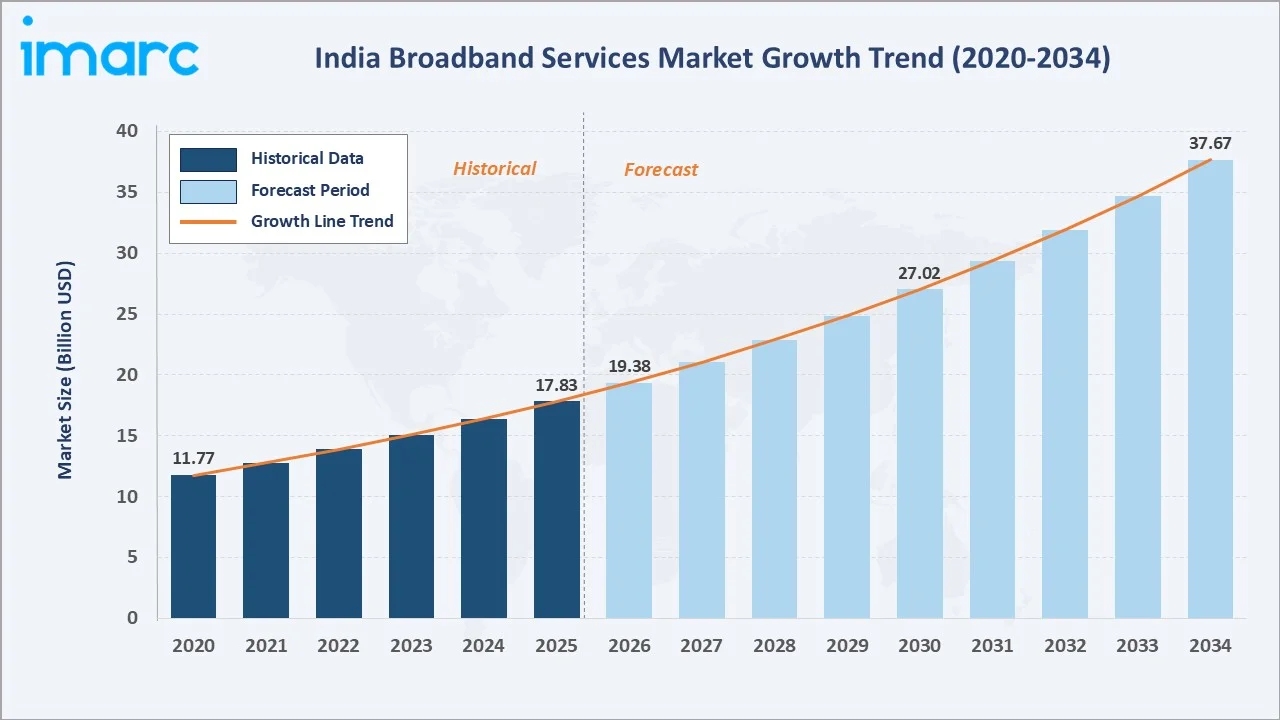
The India broadband services market grew from USD 17.83 Billion in 2025 to USD 19.38 Billion in 2026 and is projected to reach USD 37.67 Billion by 2034, growing at a CAGR of 8.66% during 2026-2034. India’s broadband subscriber base increased from 995.63 million in September 2025 to 999.81 million in October 2025, representing a monthly growth rate of 0.42%, driven by disruptive FTTH rollout, rural connectivity push, and 5G fixed wireless access expansion across urban and semi-urban geographies. Fiber optic dominates connection type at 49.6%, household leads end use at 74.2%, and West India commands the largest regional share at 30.6%.
Market Snapshot
|
Metric |
Value |
|
Base Year Market Size (2025) |
USD 17.83 Billion |
|
Market Size (2026) |
USD 19.38 Billion |
|
Forecast Market Size (2034) |
USD 37.67 Billion |
|
CAGR (2026-2034) |
8.66% |
|
Base Year |
2025 |
|
Historical Period |
2020-2025 |
|
Forecast Period |
2026-2034 |
|
Dominant Connection |
Fiber Optic (49.6%, 2025) |
|
Dominant End Use |
Household (74.2%, 2025) |
|
Leading Region |
West India (30.6%, 2025) |
The India broadband services market grew from USD 11.77 Billion in 2020 to USD 17.83 Billion by 2025 and is estimated to reach USD 19.38 Billion in 2026. The market is projected to reach USD 27.02 Billion by 2030 and USD 37.67 Billion by 2034.
To get more information on this market, Request Sample
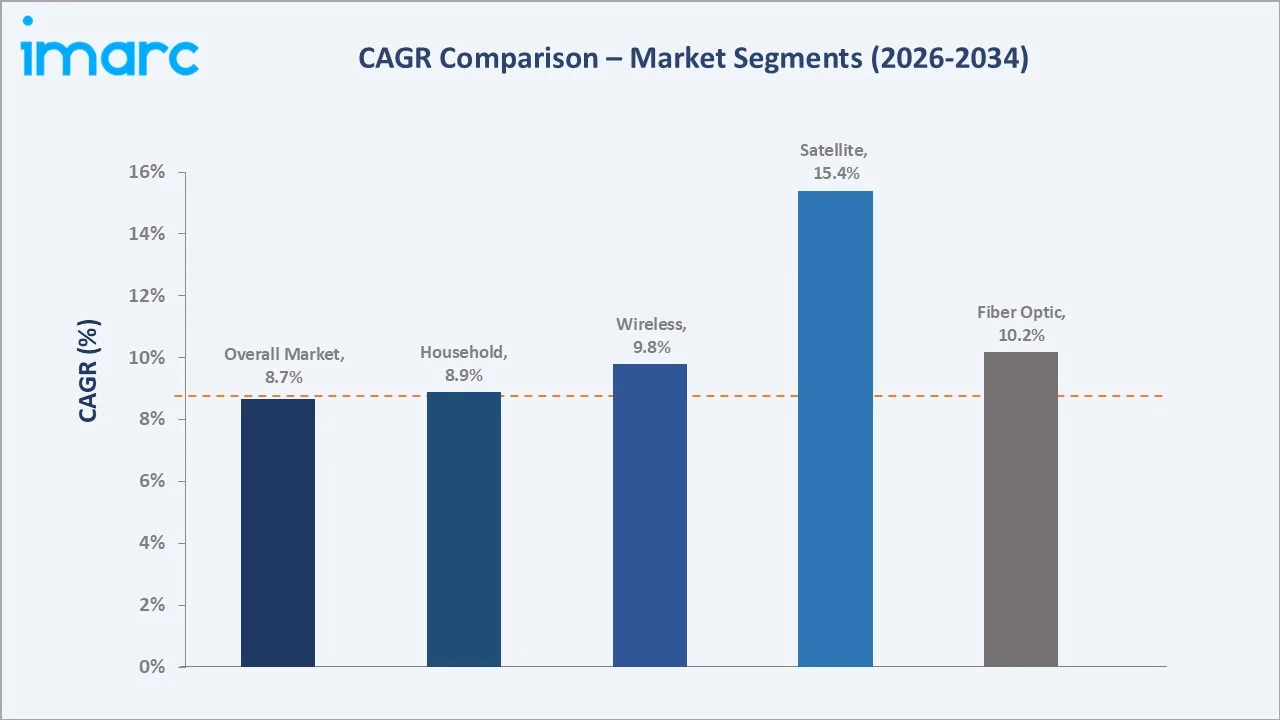
Fiber optic connections grow at ~10.2% CAGR through accelerating FTTH deployments. Satellite broadband expands at ~15.4% CAGR as the fastest-growing segment through rural connectivity rollouts. Household end-use grows at ~8.9% CAGR through digital entertainment and remote work adoption.
Executive Summary
The India broadband services market is experiencing one of its fastest expansion phases, anchored by transformative government connectivity programs, competitive operator investment in fiber infrastructure, and the structural shift toward data-intensive digital lifestyles. Fiber optic leads at 49.6% of connections as FTTH becomes the preferred last-mile technology. Household end use leads at 74.2% through OTT video streaming, online gaming, and digital education. West India holds 30.6% of market share, anchored by Mumbai and Pune's enterprise digital infrastructure.
Key Market Insights
|
Insight |
Data |
|
Dominant Connection |
Fiber Optic - 49.6% share (2025) |
|
Dominant End Use |
Household - 74.2% share (2025) |
|
Leading Region |
West India - 30.6% (2025) |
|
Key Market Opportunity |
India's rural broadband gap, covering underconnected citizens represents an addressable market through satellite broadband and Wi-Fi hotspot deployments |
Key Analytical Observations Supporting the Above Data:
- Fiber Optic at 49.6%: FTTH/B has become the dominant broadband technology as Jio Fiber deployed home connections. India's National Broadband Mission targets an increase from 63.55 Mbps in November 2024 to a minimum of 100 Mbps by 2030, with fiber optic's superior speed-to-cost ratio versus wireless alternatives making it the clear technology choice for urban and semi-urban deployment.
- Household at 74.2%: OTT video consumption combined with remote work and digital education adoption post-COVID has transformed household broadband from an optional utility to essential household infrastructure. Average household broadband data consumption is driving demand for higher-speed unlimited plans.
- West India at 30.6%: Mumbai's status as India's financial capital, Pune's IT hub concentration, and Gujarat's rapidly digitizing SME base collectively generate India's highest broadband ARPU and enterprise data consumption, sustaining West India's market value leadership despite having a smaller population than North India.
India Broadband Services Market Overview
The India broadband services market encompasses fixed broadband (fiber optic, cable, DSL), mobile broadband (4G/5G wireless), and satellite broadband services delivered to residential households, enterprises, SMEs, government bodies, and educational institutions across India's states and union territories. India’s broadband internet subscriber base grew by 1.18%, rising from 995.63 million at the end of September 2025 to 1,007.35 million by the end of December 2025, indicating substantial headroom for subscriber and revenue growth through the forecast period.
Market Dynamics
To evaluate market opportunities, Request Sample
Market Drivers
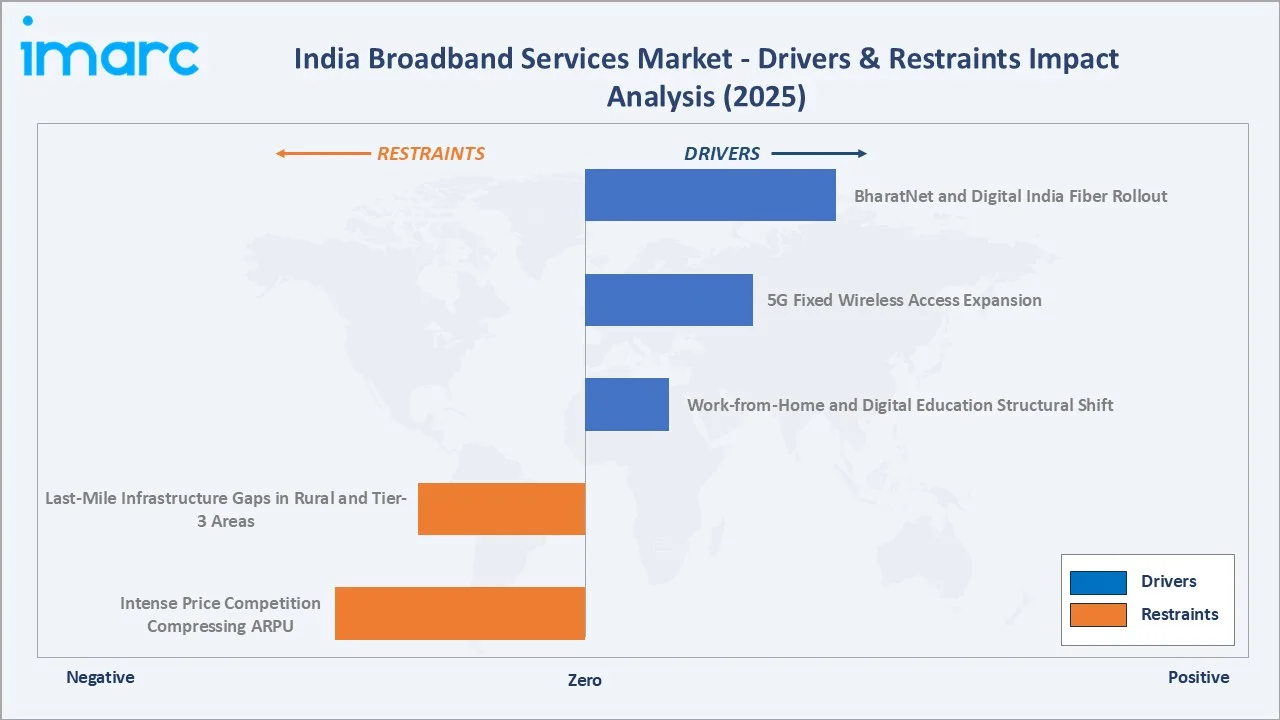
- BharatNet and Digital India Fiber Rollout: The government's BharatNet Phase III program connecting gram panchayats with an optical fiber backbone, supported by INR 1.39 Trillion investment, is creating the rural broadband infrastructure foundation for last-mile ISPs to deliver affordable connectivity to India's unconnected villages. BharatNet's dark fiber network is enabling hundreds of local ISPs to offer broadband in areas where private investment was previously unviable.
- 5G Fixed Wireless Access Expansion: India’s wireless subscriber base increased from 1,250.56 million in November 2025 to 1,258.77 million by the end of December 2025, enabling 5G Fixed Wireless Access (FWA) as a compelling home broadband alternative. Jio AirFiber and Airtel's FWA offerings deliver 100+ Mbps to homes without fiber trenching, expanding broadband reach into high-rise apartments and suburban areas where FTTH deployment economics are challenging.
- Work-from-Home and Digital Education Structural Shift: Post-COVID structural demand for home broadband has transformed household broadband from discretionary to essential utility, reducing churn and increasing willingness-to-pay for premium high-speed plans.
Market Restraints
- Last-Mile Infrastructure Gaps in Rural and Tier-3 Areas: Despite BharatNet's backbone rollout, last-mile connectivity from gram panchayat fiber termination points to individual homes remains underdeveloped due to right-of-way challenges, local ISP capacity constraints, and difficult terrain in northeastern states and hilly regions. Bridging this last-mile gap requires sustained public-private partnership investment beyond current program timelines.
- Intense Price Competition Compressing ARPU: Jio's entry-level broadband plans have compressed average revenue per user (ARPU) across the industry, creating financial stress for smaller ISPs and limiting capex available for rural expansion. India's broadband ARPU of approximately USD 4-6 per month remains among the world's lowest, creating monetization challenges for infrastructure-intensive fiber deployments.
Market Opportunities
- Enterprise and SME Digital Transformation Services: India's MSMEs contribute about 31.1% to India’s GDP, undergoing digital transformation require SD-WAN managed connectivity, multi-site leased line replacements, and cloud connectivity solutions that command 3-5x the ARPU of residential services. Operators with enterprise-grade SLA-backed connectivity portfolios can capture high-value commercial accounts.
- Smart City and Government Connectivity Programs: Smart city connectivity mandates across 100 Smart Cities Mission locations, government office broadband upgrades, and public safety network requirements are creating large government contract opportunities for broadband operators with enterprise-grade networks and managed service capabilities.
Market Challenges
- Right-of-Way Challenges for Fiber Deployment: Municipal and state authorities' inconsistent right-of-way (RoW) approval processes, high RoW fees, and coordination challenges between telecom operators, power utilities, and local bodies significantly delay and increase the cost of fiber rollout across India's urban and semi-urban areas, slowing FTTH penetration below its technical potential.
- Spectrum Availability and 5G Monetization Uncertainty: While 5G infrastructure supports FWA broadband, operators' uncertainty about 5G investment monetization timelines - given India's low ARPU environment - creates capital allocation challenges for simultaneous fiber and 5G FWA expansion, potentially slowing broadband quality improvement in underserved areas.
Emerging Market Trends
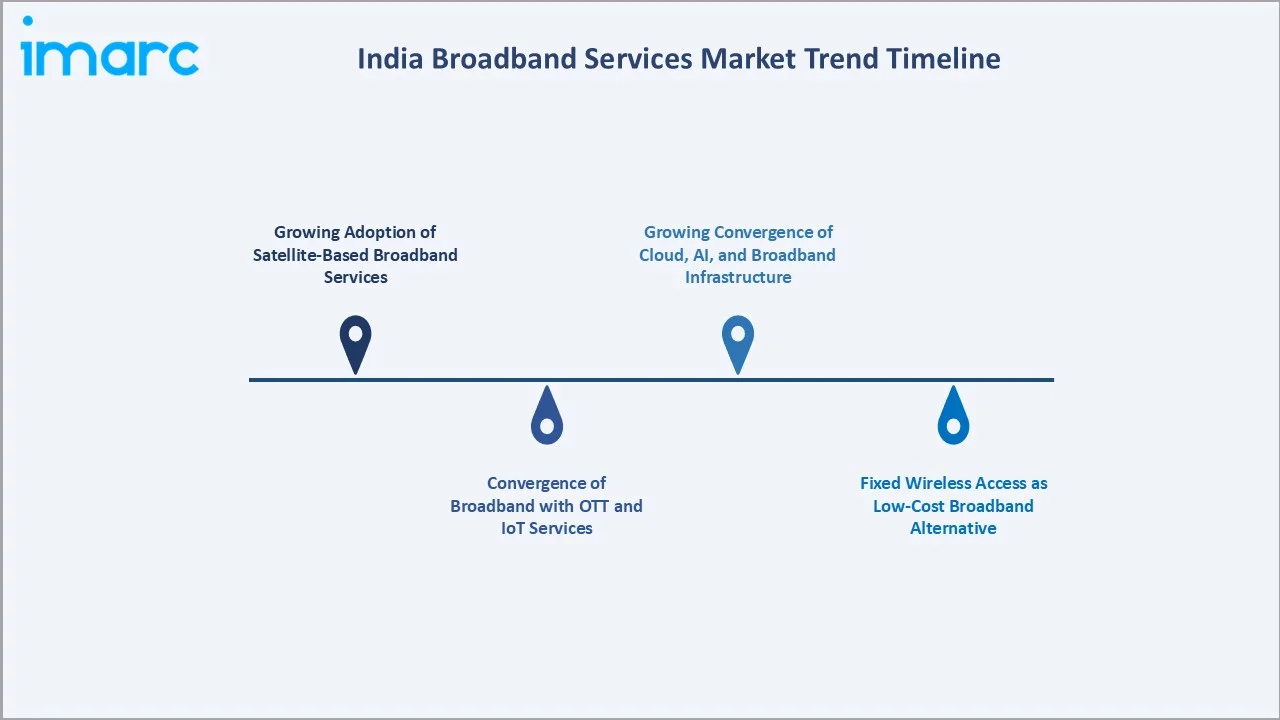
1. Growing Adoption of Satellite-Based Broadband Services
India’s broadband services market is witnessing increasing momentum toward satellite connectivity as regulatory developments facilitate commercial service launches. In September 2026, the Digital Communication Commission (DCC) approved several TRAI recommendations concerning satellite spectrum allocation, paving the way for Eutelsat OneWeb, Starlink, and Jio Satellite to introduce satellite-based broadband services in India.
2. Convergence of Broadband with OTT and IoT Services
India's broadband operators are rapidly evolving from pure connectivity providers to integrated digital service platforms. JioFiber's bundled OTT subscription model, Airtel's Wynk Music and Xstream Premium, and BSNL's digital content partnerships are creating converged broadband-plus-content offerings that increase ARPU by 30-50% versus standalone connectivity plans, improving customer retention and competitive differentiation.
3. Growing Convergence of Cloud, AI, and Broadband Infrastructure
India’s broadband services market is increasingly integrating connectivity with cloud and AI infrastructure to support data-intensive digital services. In July 2026, Amazon expanded its presence in India by scaling up ultra-fast e-commerce delivery while increasing investments in AI and cloud infrastructure. The company also initiated the commercial rollout of its Leo satellite broadband service following progress in deploying its satellite constellation, positioning the offering to compete with established satellite internet providers such as SpaceX’s Starlink.
4. Fixed Wireless Access as Low-Cost Broadband Alternative
5G-enabled FWA through Jio AirFiber and Airtel FWA is emerging as the fastest-deploying broadband technology, requiring no trenching and offering installation within hours versus weeks for fiber. FWA is proving particularly effective for high-density residential towers and suburban areas within 5G coverage, with high speeds meeting the needs of Indian household broadband use cases at competitive pricing.
Industry Value Chain Analysis
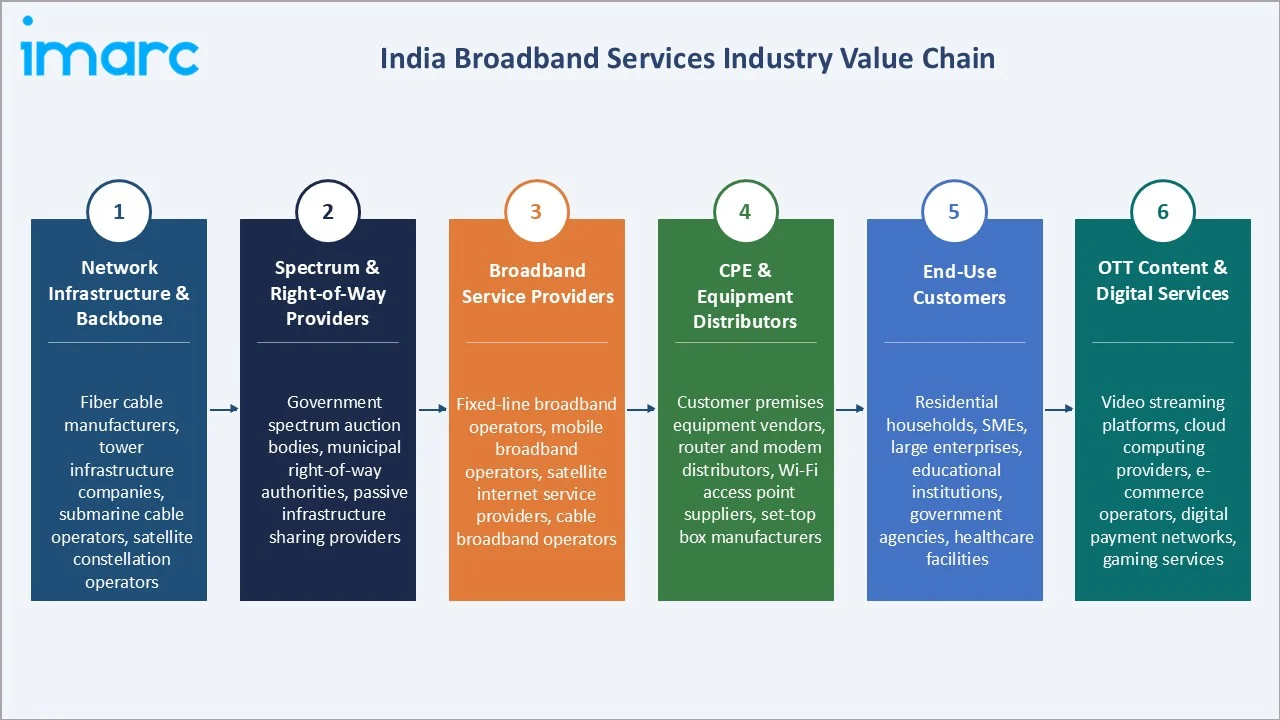
The India broadband services value chain spans network infrastructure and backbone, spectrum and right-of-way provisioning, broadband service delivery, customer premises equipment distribution, end-user consumption, and over-the-top content and digital services that monetize the connectivity platform.
|
Stage |
Key Players |
|
Network Infrastructure & Backbone |
Fiber cable manufacturers, tower infrastructure companies, submarine cable operators, satellite constellation operators. |
|
Spectrum & Right-of-Way Providers |
Government spectrum auction bodies, municipal right-of-way authorities, passive infrastructure sharing providers. |
|
Broadband Service Providers |
Fixed-line broadband operators, mobile broadband operators, satellite internet service providers, cable broadband operators. |
|
CPE & Equipment Distributors |
Customer premises equipment vendors, router and modem distributors, Wi-Fi access point suppliers, set-top box manufacturers. |
|
End-Use Customers |
Residential households, SMEs, large enterprises, educational institutions, government agencies, healthcare facilities. |
|
OTT Content & Digital Services |
Video streaming platforms, cloud computing providers, e-commerce operators, digital payment networks, gaming services. |
The broadband service provider stage represents the primary value-addition and customer-facing layer, where operators differentiate through speed tiers, reliability SLAs, bundled digital services, and customer experience quality. India's broadband value chain is increasingly vertical, creating integrated value capture that compresses standalone operator margins.
Technology Landscape in the India Broadband Services Industry
FTTH/B Passive Optical Network (PON) Technology Evolution
FTTH/B Passive Optical Network (PON) deliver higher-speed, reliable fiber broadband directly to homes and businesses. The transition from GPON toward next-generation technologies such as XGS-PON enables multi-gigabit symmetrical connectivity and greater network capacity. This evolution supports rising bandwidth requirements from cloud services, video streaming, remote work, and other data-intensive applications across India.
5G Fixed Wireless Access (FWA) and Millimeter Wave Technology
5G Fixed Wireless Access (FWA) enables high-speed broadband connectivity to homes and businesses using wireless 5G networks, reducing dependence on last-mile fiber infrastructure. Millimeter wave (mmWave) technology provides high bandwidth and supports ultra-fast data transmission in densely populated areas. Together, these technologies can accelerate broadband deployment, enhance network capacity, and support growing data consumption across India.
Low Earth Orbit (LEO) Satellite Broadband Technology
Low Earth Orbit (LEO) satellite broadband is emerging as a key technology for expanding high-speed internet connectivity across India, particularly in remote and underserved areas. LEO satellites operate closer to Earth than traditional geostationary satellites, enabling lower latency and improved network performance. Growing deployment of LEO constellations can complement fiber and mobile networks while improving nationwide broadband coverage and service availability.
Market Segmentation Analysis
The report covers the following segments:
|
Segment Category |
Leading Segment |
Market Share |
Year |
|
Connection |
Fiber Optic |
49.6% |
2025 |
|
End Use |
Household |
74.2% |
2025 |
|
Region |
West India |
30.6% |
2025 |

By Connection
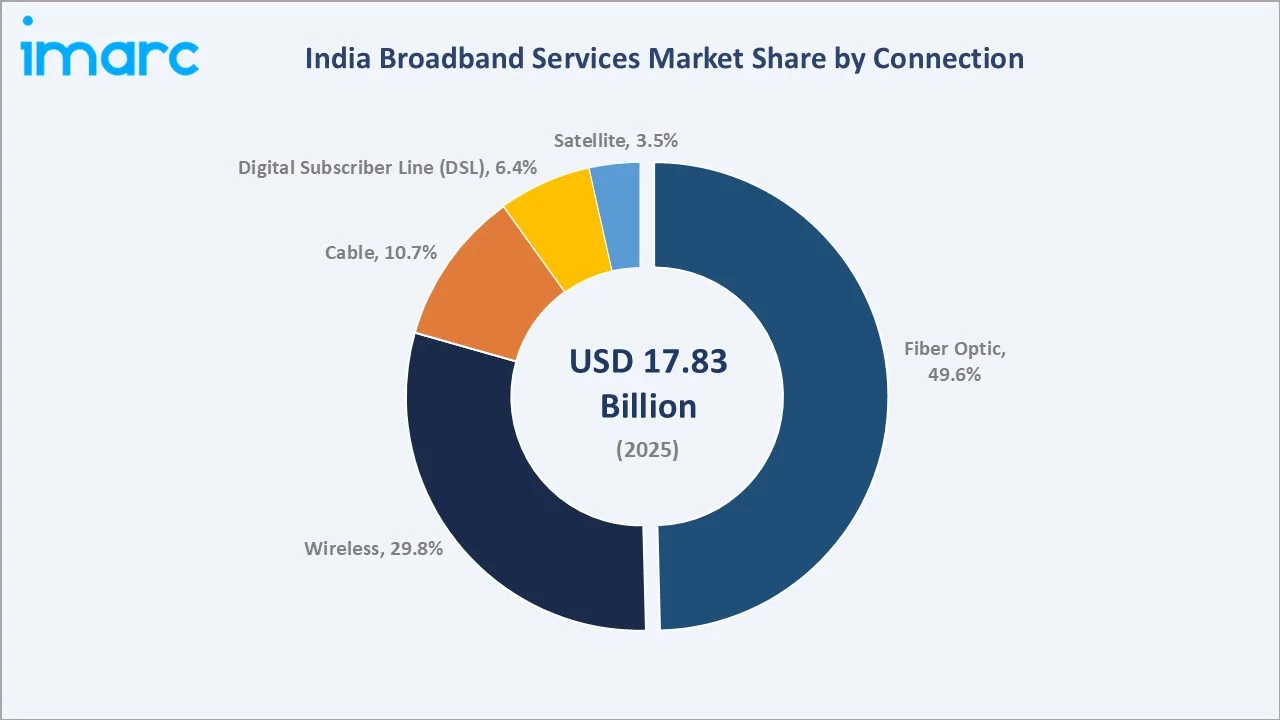
Fiber optic commands 49.6%, having surpassed wireless as the dominant technology for the first time, driven by Jio Fiber's subscriber base and Airtel Xstream Fiber's connections. FTTH's unlimited data plans at affordable prices, combined with high speeds, have made fiber the preferred choice for quality-conscious urban subscribers transitioning from mobile hotspot or DSL connections.
To access detailed market analysis, Request Sample
Wireless holds 29.8% and is growing through 5G FWA expansion. Cable at 10.7% is served by DOCSIS 3.1-upgraded MSOs. Digital Subscriber Line (DSL) at 6.4% is gradually declining as subscribers migrate to fiber. Satellite at 3.5% is growing at the fastest rate (~15.4% CAGR) through Starlink's commercial entry and OneWeb's enterprise expansion, with a high satellite connection count.
By End Use
Household end use dominates at 74.2% in 2025, reflecting India's household broadband subscriber potential and the structural shift toward home-based digital consumption. Indian household consumption is driven by 4K OTT streaming, video calling, online gaming, and digital education, creating a strong upgrade demand from 30 Mbps starter plans to 100-300 Mbps premium tiers.
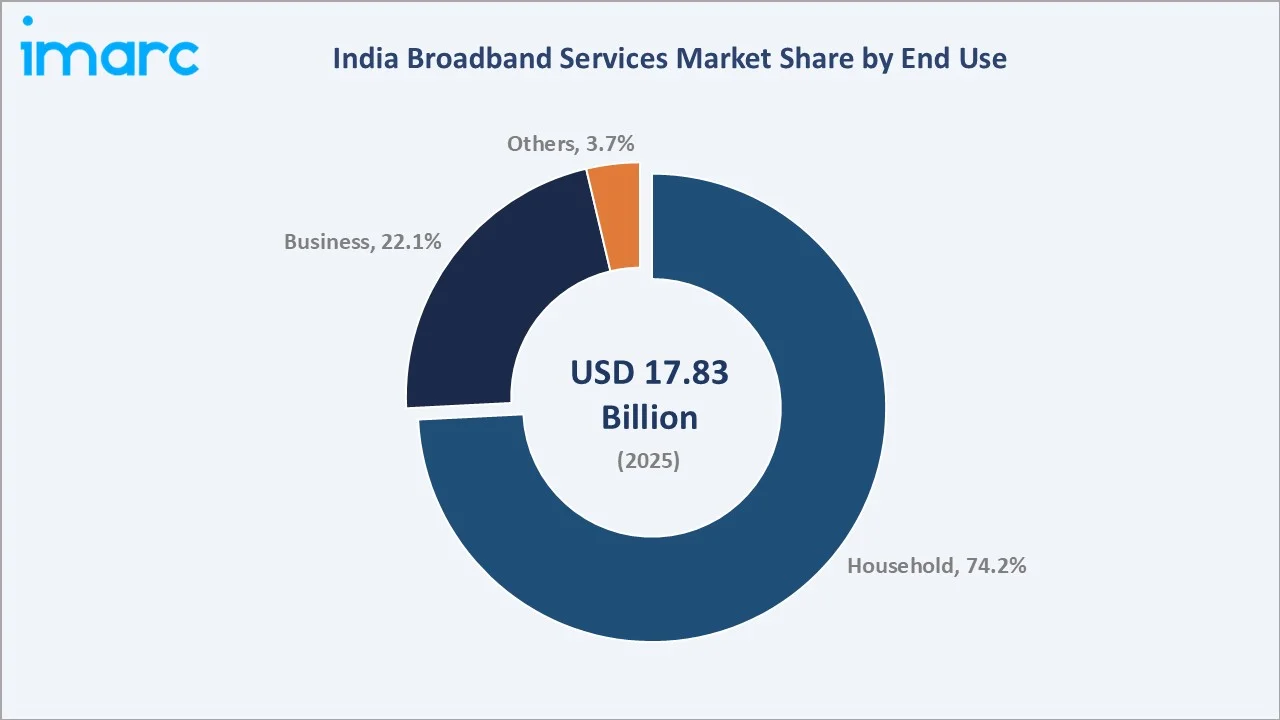
Business end use at 22.1% encompasses SME office broadband, enterprise leased lines, SD-WAN managed services, and data center connectivity, commanding significantly higher ARPU versus residential. The others category at 3.7% covers government connectivity and educational institution broadband.
Regional Market Insights
|
Region |
Share (2025) |
Key India Broadband Services Market Drivers & Characteristics |
|
West India |
30.6% |
Reflecting dense urban digital infrastructure, enterprise broadband demand, and strong FTTH penetration. |
|
South India |
28.4% |
Reflecting the tech ecosystem, corporate demand, IT export hubs, and deep fiber penetration. |
|
North India |
24.3% |
Reflecting a high-density urban broadband market, a massive household subscriber base, and strong enterprise broadband. |
|
East India |
16.7% |
Reflecting emerging digital connectivity growth and rising mobile broadband adoption driven by OTT consumption growth. |
West India's 30.6% share reflects enterprise broadband concentration, home to India's financial sector, media industry, and corporate headquarters, combined with IT sector density and rapidly digitizing SME manufacturing base. South India's 28.4% is driven by the IT workforce generating India's highest per-capita broadband ARPU.
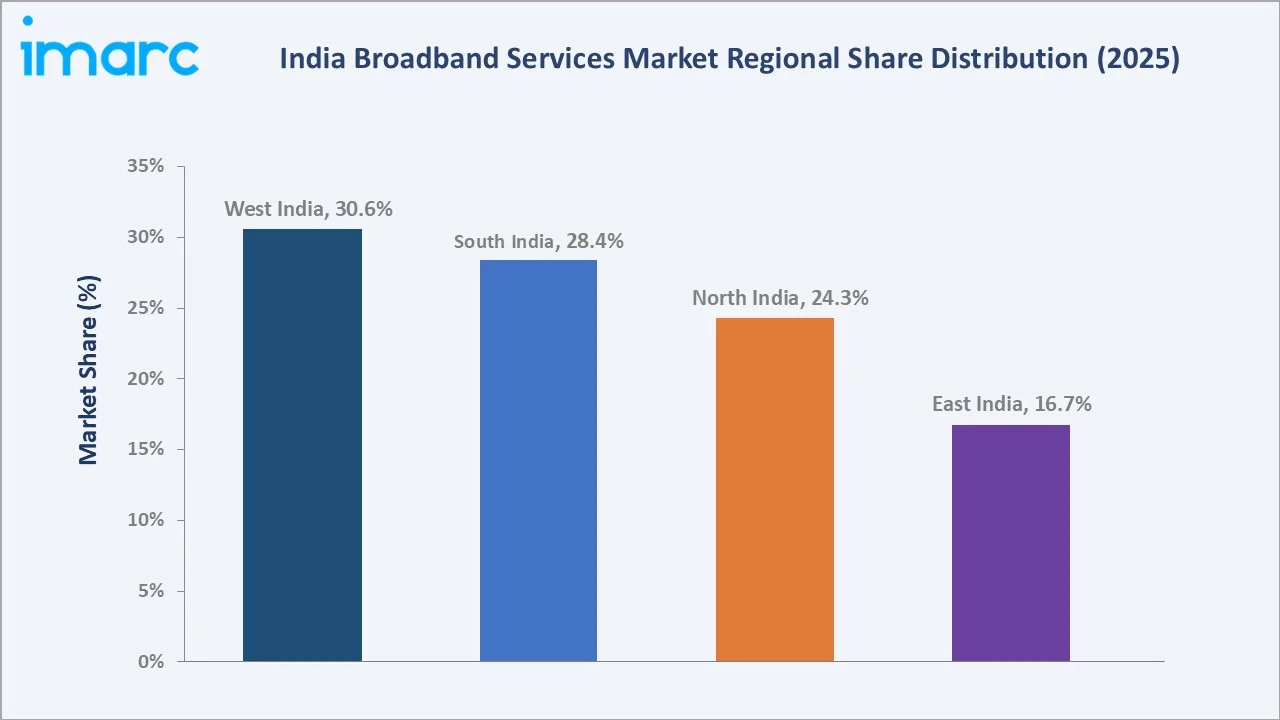
North India's 24.3% captures a massive enterprise and household subscriber base, growing digital inclusion, and the government capital's extensive connectivity requirements. East India at 16.7% is the highest growth potential region, with BharatNet connectivity expanding digital access in areas underserved by commercial operators, supported by the government's fund targeted at underserved areas.
Competitive Landscape
The India broadband services market is moderately concentrated, with telecom operators, fiber broadband providers, and emerging satellite broadband companies competing on network coverage, speed, pricing, and service quality. Market participants are increasingly investing in fiber expansion, 5G FWA, LEO satellite connectivity, and bundled digital services to strengthen their subscriber base and market presence.
|
Company |
Key Brands |
Market Position |
Core Strength |
|
Reliance Industries Limited |
JioFiber |
Market Leader |
Reliance Industries Limited, through its subsidiary Reliance Jio Infocomm Limited, acts as the leading driver of India's broadband and digital services ecosystem. |
|
Bharti Enterprises |
Airtel Xstream Fiber |
Market Leader |
Bharti Enterprises, through its flagship company Bharti Airtel, is a major provider of broadband services across India. |
|
Vodafone Idea Limited |
YOU Broadband |
Established Player |
Vodafone Idea Limited (operating as Vi) plays a major role in India's broadband and telecommunications sector through YOU Broadband. |
|
Tata Communications Limited |
IZO+ Enterprise Broadband |
Established Player |
Tata Communications Limited, guiding its strategic direction in India's enterprise broadband and telecommunications sector. |
|
Siti Networks Limited |
SITI Broadband |
Challenger |
Siti Networks Limited delivers high-speed internet and allied digital services by leveraging its extensive hybrid fiber-optic and coaxial cable television infrastructure across India. |
The competitive landscape is bifurcating between scale infrastructure players competing for mass-market subscribers and specialty operators targeting premium urban, enterprise, and remote connectivity segments. ARPU pressure from Jio's value pricing continues to compress margins for mid-tier operators, driving consolidation in the cable broadband segment.
Key Company Profiles
Reliance Industries Limited
Reliance Industries Limited is a diversified Indian conglomerate with a significant presence in the country’s telecommunications and digital services ecosystem through its subsidiaries. In the broadband services market, the company offers fixed and wireless connectivity solutions catering to residential and enterprise customers. Its extensive digital infrastructure and integrated service portfolio support its position in India’s expanding broadband landscape.
- Key Brands: JioFiber
- Strategic Focus: Expanding its broadband footprint through continued investments in fiber networks, 5G-based fixed wireless access, and digital infrastructure. The company also emphasizes integrated connectivity and digital service offerings to enhance customer reach and address rising demand for high-speed broadband across residential and enterprise segments.
Bharti Enterprises
Bharti Enterprises is a diversified Indian business group with a strong presence in the telecommunications and digital connectivity sector through its group companies. In the India broadband services market, its offerings span fixed-line broadband, fiber-based connectivity, and wireless services for residential and enterprise customers. Its extensive telecom infrastructure and broad customer reach support its presence in India’s evolving broadband ecosystem.
- Key Brands: Airtel Xstream Fiber
- Strategic Focus: Expanding high-speed broadband connectivity through fiber network deployment, advanced wireless technologies, and continued digital infrastructure investments. Its strategy also emphasizes improving network quality, widening service coverage, and integrating connectivity with digital solutions to address growing residential and enterprise broadband demand.
Market Concentration Analysis
The India broadband services market is moderately concentrated through its integrated fiber and FWA networks. The cable broadband segment is undergoing consolidation from coaxial to fiber, with several smaller cable operators exiting the market or partnering with larger players. Satellite broadband represents the most significant structural disruption to market concentration, as market players introduce global technology players without legacy Indian infrastructure, potentially capturing 5-10% of total connections by 2030.
Investment & Growth Opportunities
Highest Growth Segments
Satellite broadband (~15.4% CAGR), fiber optic FTTH (~10.2% CAGR), 5G fixed wireless access (~12% CAGR estimated), enterprise and SME managed broadband services (~12% CAGR), and rural broadband infrastructure under BharatNet represent the highest-return investment vectors in the India broadband services market through 2034.
Investment Themes
- Rural Last-Mile Broadband Infrastructure: BharatNet's optical fiber backbone creates a subsidized infrastructure layer that enables private ISPs to deploy last-mile connections commercially. Local ISPs investing in Wi-Fi hotspot networks, FTTH equipment from gram panchayat fiber termination points, and 5G FWA coverage in BharatNet-connected villages can capture India's underserved rural broadband subscribers.
- Data Center and Cloud Connectivity Infrastructure: India's data center capacity, with hyperscaler investments creating massive demand for high-capacity last-mile and metro fiber connectivity into colocation facilities. Dark fiber and wavelength service investments adjacent to data center clusters generate high-value wholesale revenue streams.
Future Market Outlook (2026-2034)
The India broadband services market is projected to grow from USD 17.83 Billion in 2025 to USD 19.38 Billion in 2026, reaching USD 37.67 Billion by 2034, exhibiting a CAGR of 8.66% during 2026-2034. The market is projected to reach an anchor value of USD 27.02 Billion by 2030, representing the mid-period milestone at which BharatNet Phase III connections achieve operational maturity, satellite broadband reaches commercial scale in rural markets, and India's high broadband subscriber base.
Three structural forces will define the India broadband services market through 2034. First, India's technology infrastructure investments are positioning India for a decade of quality upgrades from basic broadband to gigabit connectivity as subscriber density increases justify capex returns. Second, the democratization of broadband through satellite technology, 5G FWA, and public Wi-Fi is bringing India's final unconnected citizens into the broadband economy, creating a new wave of demand fundamentally different from urban subscriber upgrades. Third, the convergence of broadband with digital services, OTT content, cloud computing, IoT, digital payments, and e-governance is transforming broadband from a commodity pipe into an integrated digital platform, enabling operators to significantly improve monetization through bundled service ARPUs well above standalone connectivity pricing.
Research Methodology
Primary Research
Primary research comprised in-depth interviews with broadband operator executives, regulatory consultants, enterprise IT procurement managers, network engineers, and government BharatNet program officers. These discussions validated market size estimates, connection type demand dynamics, regional penetration patterns, and technology adoption trajectories for the 2026-2034 forecast period.
Secondary Research
Secondary research encompassed telecom subscription data reports, company annual reports, national broadband mission publications, IMARC Group proprietary technology and telecommunications databases, annual reports of key market participants, GSMA Intelligence data, and industry publications covering India's digital connectivity market developments through 2025.
Forecasting Models
Forecasting models incorporated historical subscriber and revenue growth correlations with GDP and digital service adoption, BharatNet deployment timelines, operator capex guidance and network expansion plans, satellite broadband hardware cost decline curves, 5G FWA rollout schedules, and macroeconomic indicators. Both bottom-up subscriber and ARPU modeling and top-down revenue projection approaches were cross-validated for forecast consistency across all segments and regions.
India Broadband Services Market Report Coverage:
| Report Features | Details |
|---|---|
| Base Year of the Analysis | 2025 |
| Historical Period | 2020-2025 |
| Forecast Period | 2026-2034 |
| Units | Billion USD |
| Scope of the Report |
Exploration of Historical Trends and Market Outlook, Industry Catalysts and Challenges, Segment-Wise Historical and Future Market Assessment:
|
| Connections Covered | Fiber Optic, Wireless, Satellite, Cable, Digital Subscriber Line (DSL) |
| End Uses Covered | Business, Household, Others |
| Regions Covered | North India, South India, East India, West India |
| Companies Covered | Reliance Industries Limited, Bharti Enterprises, Vodafone Idea Limited, Tata Communications Limited, Siti Networks Limited, etc. |
| Customization Scope | 10% Free Customization |
| Post-Sale Analyst Support | 10-12 Weeks |
| Delivery Format | PDF and Excel through Email (We can also provide the editable version of the report in PPT/Word format on special request) |
Key Benefits for Stakeholders:
- IMARC’s industry report offers a comprehensive quantitative analysis of various market segments, historical and current market trends, market forecasts, and dynamics of the India broadband services market from 2020-2034.
- The research report provides the latest information on the market drivers, challenges, and opportunities in the India broadband services market.
- Porter's five forces analysis assist stakeholders in assessing the impact of new entrants, competitive rivalry, supplier power, buyer power, and the threat of substitution. It helps stakeholders to analyze the level of competition within the India broadband services industry and its attractiveness.
- Competitive landscape allows stakeholders to understand their competitive environment and provides an insight into the current positions of key players in the market.
Frequently Asked Questions About the India Broadband Services Market Report
The India broadband services market reached USD 19.38 Billion in 2026, driven by Jio and Airtel FTTH expansion, 5G fixed wireless access rollout, BharatNet rural connectivity, and India's high broadband subscriber base.
The India broadband services market is projected to grow at a CAGR of 8.66% during 2026-2034, driven by rural broadband expansion, fiber optic FTTH adoption, satellite broadband entry, enterprise digital transformation, and continuous subscriber upgrades to higher-speed tiers.
The market is projected to reach USD 27.02 Billion by 2030, representing the mid-period milestone as BharatNet Phase III achieves rural connectivity, satellite broadband reaches commercial scale, and India's high broadband penetration.
Fiber optic leads with a 49.6% share in 2025, through JioFiber and Airtel Xstream Fiber FTTH subscribers, driven by unlimited data plans at affordable pricing with high speeds.
Household leads with a 74.2% share in 2025, driven by OTT video streaming, remote work, online gaming, and digital education driving household data consumption and making fixed broadband an essential household utility.
West India leads with a 30.6% share in 2025, anchored by enterprise broadband concentration, the IT sector, and digitizing SME base, generating India's highest broadband ARPU and enterprise data consumption per region.
Key players include Reliance Industries Limited, Bharti Enterprises, Vodafone Idea Limited, Tata Communications Limited, and Siti Networks Limited, among others.
The market is projected to reach USD 37.67 Billion by 2034, driven by gigabit broadband upgrades, satellite broadband rural expansion, enterprise SD-WAN growth, digital service convergence, and India's high broadband penetration.
Key opportunities include rural last-mile broadband under BharatNet, enterprise SD-WAN managed services growth, satellite broadband infrastructure for unconnected villages, data center fiber connectivity, and convergent OTT-broadband bundled service platform development.
Need more help?
- Speak to our experienced analysts for insights on the current market scenarios.
- Include additional segments and countries to customize the report as per your requirement.
- Gain an unparalleled competitive advantage in your domain by understanding how to utilize the report and positively impacting your operations and revenue.
- For further assistance, please connect with our analysts.
 Request Customization
 Speak to an Analyst
 Request Brochure
 Inquire Before Buying
Benefits of Customization
- Personalize this research
- Triangulate with your data
- Get data as per your format and definition
- Gain a deeper dive into a specific application, geography, customer, or competitor
- Any level of personalization
Get in Touch With Us
UNITED STATES
Phone: +1-201-971-6302
INDIA
Phone: +91-120-433-0800
UNITED KINGDOM
Phone: +44-753-714-6104
Email: [email protected]
Client Testimonials




.webp)




.webp)













Related Reports

Choose your plan
*Please note that the prices mentioned below are starting prices for each bundle type. Kindly contact our team for further details.*
Single User License
- 1 User License, Access on 2 Devices
- PDF Report + Excel Dataset (Password Protected)
- Lifetime Access
- No Printing Rights
- 10% Free Report Customization
- 10–12 Weeks of Analyst Support
Five User License
- Access for 5 Users, 2 Devices per User
- PDF Report + Excel Dataset (Password Protected)
- Lifetime Access
- Dedicated Account Manager
- 12–14 Weeks of Analyst Support
- No Printing Rights
- 15% Free Report Customization
- 25% Discount on Your Next Purchase
Corporate User License
- Unlimited User Access (Within Your Organization)
- PDF Report + Excel Dataset
- Lifetime Access
- Dedicated Account Manager
- 14–20 Weeks of Analyst Support
- No Printing Rights
- 20% Free Report Customization
- 30% Discount on Your Next Purchase
Essential Insights
What's included:
3 reports
- Lifetime Access
- PDF Reports
- Excel Datasets
- 2 Weeks of Free Analyst Support
- 2 User Licenses
- Access on 2 Devices
- Printing Rights
- Complimentary PowerPoint (PPT) Version
- Complimentary License Upgrade
Professional Access
What's included:
5 reports
- Lifetime Access
- PDF Reports
- Excel Datasets
- 8 Weeks of Free Analyst Support
- 2 User Licenses
- Access on 2 Devices
- Printing Rights
- Complimentary PowerPoint (PPT) Version
- Complimentary License Upgrade
Business Advantage
What's included:
8 reports
- Lifetime Access
- PDF Reports
- Excel Datasets
- 14 Weeks of Free Analyst Support
- 2 User Licenses
- Access on 2 Devices
- Printing Rights
- Complimentary PowerPoint (PPT) Version
- Complimentary License Upgrade
Enterprise Intelligence
What's included:
10 reports
- Lifetime Access
- PDF Reports
- Excel Datasets
- 20 Weeks of Free Analyst Support
- 2 User Licenses
- Access on 2 Devices
- Printing Rights
- Complimentary PowerPoint (PPT) Version
- Complimentary License Upgrade