
India Building Automation & Control Systems Market Size, Share, Trends and Forecast by Product, Communication Protocol, End User, and Region, 2026-2034
India Building Automation & Control Systems Market Summary:
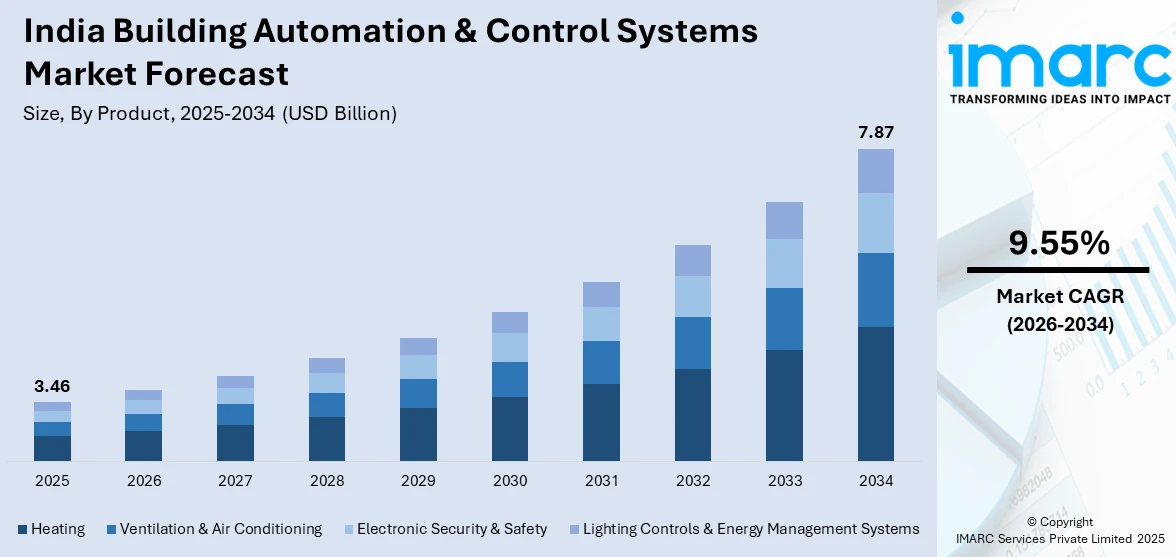
The India building automation & control systems market grew from USD 3.46 Billion in 2025 to USD 3.79 Billion in 2026 and is projected to reach USD 7.87 Billion by 2034, growing at a compound annual growth rate of 9.55% during 2026-2034.
Market growth is mainly propelled by India's rapid urban evolution and the government's bold Smart Cities Mission, which is fostering the extensive implementation of smart building infrastructure in urban areas. The merging of swift commercial real estate expansion, strict energy efficiency requirements per the Energy Conservation Building Code, and the rising incorporation of Internet of Things (IoT) technologies in building management systems is significantly altering the competitive environment. The growing understanding about operational cost efficiency and environmental sustainability among commercial building operators keeps generating significant opportunities for market players throughout India.
Key Takeaways and Insights:
- By Product: Heating, ventilation & air conditioning dominate the market with a share of 38% in 2025, due to India's extreme climatic conditions necessitating efficient climate control solutions and the growing emphasis on indoor air quality management in commercial and industrial facilities.
- By Communication Protocol: Wired leads the market with a share of 55% in 2025. This dominance is because of superior reliability, enhanced data security, and lower latency performance requirements in mission-critical building automation applications.
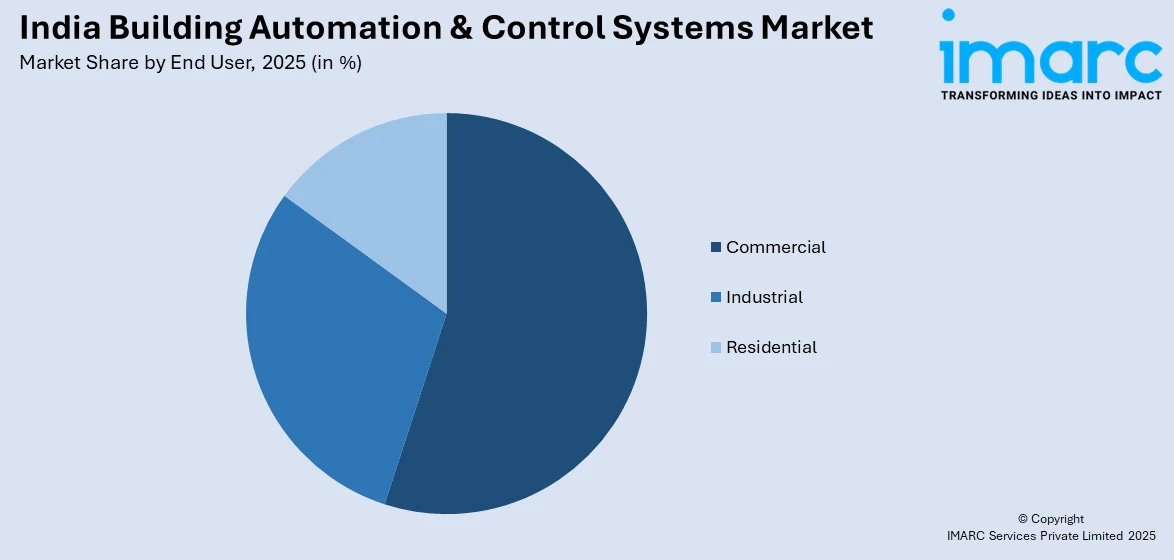
- By End User: Commercial represents the largest segment with a market share of 47% in 2025, owing to the unprecedented expansion of office spaces, shopping complexes, and hospitality establishments requiring sophisticated building management infrastructure.
- By Region: North India dominates the market with a share of 30% in 2025, driven by the concentration of commercial and industrial activities in the Delhi-National Capital Region corridor, substantial smart city development initiatives, and robust infrastructure investments.
- Key Players: The India building automation & control systems market exhibits moderate competitive intensity, with multinational technology corporations competing alongside domestic manufacturers across diverse application segments.
To get more information on this market Request Sample
The growth of the Indian building automation and control systems market is primarily driven by rapid urbanization and a national focus on creating energy-efficient, technologically advanced urban hubs. As modern enterprises increasingly prioritize operational cost-savings and environmental sustainability, the demand for integrated HVAC, lighting, and security automation is intensifying. A pivotal catalyst for this demand occurred in 2024, when the Union Cabinet approved 12 new industrial cities under the National Industrial Corridor Development Programme (NICDP) with a ₹28,602 crore investment. These smart cities are designed on a plug-and-play and walk-to-work model, mandating the integration of ICT-enabled utilities and sophisticated building management systems to support global manufacturing standards. This large-scale infrastructure push, combined with the rising adoption of IoT and AI, ensures that sophisticated automation solutions remain essential for managing the energy footprints and safety of India’s expanding commercial and industrial landscape.
India Building Automation & Control Systems Market Trends:
Rise of Smart Buildings
The implementation of integrated automation platforms is increasingly seen as a fundamental necessity for contemporary real estate projects, as developers aim to improve building efficiency and occupant security. These advanced systems enable a shift from reactive to proactive facility management through centralized control and real-time monitoring. In 2024, Indian start-up NHance.ai obtained $1.5 million in seed funding to expand its NHanceTwin platform, which leverages AI and machine learning (ML) to provide improved building performance and actionable insights. This shift towards digital-first infrastructure enhances operational resilience and fosters the long-term value increase of smart-enabled commercial and residential properties throughout India.
Technological Advancements in Automation
Technological advancements in wireless connectivity and control software are significantly accelerating the adoption of building automation across diverse India. Enhanced real-time monitoring and advanced analytics allow for more precise control and seamless integration, making these solutions scalable for various building sizes. A notable milestone in this evolution was the 2024 launch of ABB India’s wireless smart home solution, ABB-free@home®, which provided seamless integration with global platforms like Apple HomeKit and Amazon Alexa. By simplifying deployment and improving energy efficiency, such innovations are bridging the gap between high-end industrial automation and residential comfort. This trend not only promotes wider market acceptance but also aligns with India’s overarching sustainability and green building objectives.
Increasing Demand for Occupant Comfort and Safety
The growing prioritization of occupant well-being and environmental safety is fundamentally reshaping the Indian building automation landscape. Modern property owners are progressively adopting adaptive systems that regulate lighting, ventilation, and thermal comfort based on real-time occupancy data. This trend was clearly evidenced in 2025, when 75F unveiled its next-generation AI-powered HVAC and energy management solutions at ACREX India, showcasing wireless multi-sensors and the Saffron AI platform. By leveraging such cloud-based automation to create healthier indoor environments, developers can significantly enhance user experience while meeting stringent sustainability goals. As a result, the integration of these IoT-driven technologies is becoming a vital strategy for optimizing commercial and residential infrastructure.
Market Outlook 2026-2034:
The India building automation and control systems market shows strong growth potential over the forecast period, supported by rapid urbanization, rising construction activity, and stricter regulations promoting energy-efficient building operations. Increasing adoption of smart buildings across commercial, residential, and industrial segments is further drives the demand. The market generated a revenue of USD 3.46 Billion in 2025, which is expected to reach USD 3.79 Billion in 2026 and further grow to USD 7.87 Billion by 2034, at a compound annual growth rate of 9.55% during 2026-2034.
India Building Automation & Control Systems Market Report Segmentation:
|
Segment Category |
Leading Segment |
Market Share |
|
Product |
Heating, Ventilation & Air Conditioning |
38% |
|
Communication Protocol |
Wired |
55% |
|
End User |
Commercial |
47% |
|
Region |
North India |
30% |
Product Insights:
- Heating, Ventilation & Air Conditioning
- Electronic Security & Safety
- Lighting Controls & Energy Management Systems
Heating, ventilation & air conditioning dominate with a market share of 38% of the total India building automation & control systems market in 2025.
Heating, ventilation, and air conditioning leads the market because of its critical role in managing energy usage and indoor comfort across commercial and residential buildings. HVAC accounts for a significant share of total building energy use, encouraging developers and facility managers to adopt automated controls for temperature, airflow, and humidity. This growth is reflected through industry data by the IMARC Group, stating that the India HVAC will reach USD 45.42 Billion by 2033. The growing construction of offices, malls, hospitals, airports, and data centers is catalyzing the demand for intelligent HVAC solutions that help reduce operating costs while meeting stricter energy efficiency norms and sustainability targets.
Another factor supporting HVAC dominance is the rising focus on occupant health, comfort, and regulatory compliance. Automated HVAC enables real-time monitoring, predictive maintenance, and integration with sensors and IoT platforms, improving performance and reducing downtime. In India’s varied climate conditions, smart HVAC control helps optimize cooling and heating based on occupancy and external weather patterns. Additionally, government-led green building initiatives and rising adoption of certifications, such as LEED and IGBC, encourage the deployment of advanced HVAC automation, reinforcing its leading position within the market.
Communication Protocol Insights:
- Wired
- Wireless
Wired leads with a market share of 55% of the total India building automation & control systems market in 2025.
Wired exhibits a clear dominance in the market, driven by its high reliability, stable performance, and suitability for large-scale commercial and industrial buildings. This system offers consistent data transmission with minimal interference, making it ideal for critical applications, such as HVAC control, lighting management, fire safety, and security systems. In high-occupancy environments like airports, hospitals, IT parks, and manufacturing facilities, wired protocol ensures uninterrupted connectivity and precise control, which is essential for maintaining safety, efficiency, and compliance with building standards.
Another reason for the dominance of wired segment is its strong compatibility with legacy infrastructure and long operational lifespan. Many existing buildings in India are already equipped with wired networks, making upgrades to advanced automation systems more cost-effective than full wireless retrofits. Wired solution also provides better cybersecurity control, an important consideration for commercial buildings handling sensitive data. Additionally, developers and facility managers often prefer wired for mission-critical operations due to lower latency and predictable performance, reinforcing its continued preference in the Indian market.
End User Insights:
Access the comprehensive market breakdown Request Sample
- Commercial
- Industrial
- Residential
Commercial exhibits a clear dominance with a 47% share of the total India building automation & control systems market in 2025.
Commercial represents the largest segment due to the rapid expansion of office spaces, IT parks, retail complexes, hotels, and mixed-use developments across major urban centers. For instance, in 2025, Bhumika Group launched a ₹700 crore mixed-use development project, "The Icon," in Faridabad. The project combined luxury residential units, retail spaces, and hospitality services, spanning 5 acres with a projected sales value of ₹1,500 crore. The growing demand for energy efficiency, occupant comfort, and centralized monitoring in such projects is encouraging commercial property owners to adopt advanced automation solutions. Systems controlling HVAC, lighting, security, and access help reduce operational costs while meeting green building norms and sustainability targets.
Additionally, regulatory pressure and corporate sustainability commitments are accelerating adoption among commercial end users. Many large enterprises are aligning with energy conservation codes and green certifications, prompting investments in automated building management platforms. Smart automation also enhances tenant experience through improved indoor air quality, thermal comfort, and safety features, which is critical for attracting premium tenants. The growing use of data analytics for predictive maintenance and asset optimization in commercial properties further supports widespread deployment of building automation and control systems across India.
Regional Insights:
- North India
- South India
- East India
- West India
North India dominates with a market share of 30% of the total India building automation & control systems market in 2025.
North India holds the biggest market share owing to the presence of commercial complexes, IT centers, industrial zones, and extensive infrastructure initiatives in cities like Delhi NCR, Gurugram, Noida, Chandigarh, and Jaipur. Swift urban growth and increasing construction of innovative offices, airports, metro stations, and healthcare centers are boosting the need for sophisticated automation solutions. In 2025, Starlink rented its initial office in North India, situated in Delhi. The area also gains from increased uptake of sustainable building practices and energy efficiency norms, motivating developers to incorporate automated HVAC, lighting, and security systems.
Another key factor supporting North India’s leadership is strong government and private sector investment in smart city initiatives and modern commercial real estate. Several North Indian states actively promote intelligent infrastructure to improve energy management and operational efficiency. The presence of multinational corporations, technology firms, and premium real estate developers accelerates adoption of building management systems. Additionally, extreme seasonal temperature variations in the region increase reliance on automated climate control solutions, reinforcing sustained demand for building automation and control systems.

Market Dynamics:
Growth Drivers:
Why is the India Building Automation & Control Systems Market Growing?
Expansion of Commercial and Industrial Spaces
The increase in high-quality commercial and industrial real estate throughout India is a key element supporting the adoption of advanced building automation and control systems. To stay competitive, contemporary businesses are putting resources into facilities that guarantee operational efficiency while maximizing resource usage. A notable example of this trend is the 2026 declaration by Sumitomo Corporation about its collaboration with Hines and Mitsubishi Estate to create a 141,000-square-meter office complex in Mumbai. Situated in the esteemed BKC region, this initiative is crafted to fulfill strict international criteria for energy efficiency and digital infrastructure. These extensive developments require cohesive management systems to address intricate HVAC, lighting, and security needs, thereby emphasizing the essential role of automation in the changing urban environment of India.
Integration with Internet of Things (IoT)
The convergence of building automation systems with Internet of Things (IoT) technologies is a transformative driver, shifting infrastructure from static management to real-time, data-driven intelligence. By embedding connected sensors into lighting, HVAC, and security networks, facility managers can leverage granular insights into energy consumption and space utilization. Reflecting this massive technological shift, as per the IMARC Group, the India IoT market was valued at USD 1.50 Billion in 2025 and is projected to reach USD 3.62 Billion by 2034, highlighting the rapid expansion of the digital backbone required for smart ecosystems. This proliferation of connected devices allows for predictive maintenance and automated environmental adjustments, significantly reducing operational overhead. As a result, the rising affordability and interoperability of IoT protocols are accelerating the adoption of advanced control systems across India’s commercial and residential sectors.
Growth of Data Centers and IT Infrastructure
The expansion of data centers and IT infrastructure is driving the demand for advanced building automation and control systems. Highlighting this industrial growth, Adani Enterprises and Google partnered in 2025 to develop a $15 billion AI-driven data center hub in Visakhapatnam, a gigawatt-scale project integrating clean energy and subsea networks. Data centers require precise control over temperature, humidity, power distribution, and security to ensure uninterrupted operations. Automation systems help maintain optimal environmental conditions while reducing energy consumption and operational risks. As digitalization accelerates and demand for data storage and processing grows, investments in automation for mission-critical facilities are increasing.
Market Restraints:
What Challenges the India Building Automation & Control Systems Market is Facing?
High Initial Investment Requirements Limiting Adoption Among Cost-Sensitive Segments
The substantial capital expenditure required for comprehensive building automation system deployment represents a significant barrier constraining broader market penetration, particularly among small and medium-sized firms and residential developers operating with limited budgets. While lifecycle cost benefits, including energy savings and operational efficiency improvements justify long-term investments, the upfront financial commitment for hardware, software, installation, and system integration often exceeds budget allocations for building infrastructure.
Skilled Workforce Shortage Impeding System Integration and Maintenance
The shortage of qualified technical professionals capable of designing, integrating, and maintaining sophisticated building automation systems presents ongoing challenges for the market growth. Many small and mid-sized integrators serve the India market, yet only a minority possess deep expertise in AI, cybersecurity, or hybrid cloud integration, creating quality gaps that undermine system performance and delay technology adoption timelines.
Cybersecurity Vulnerabilities Creating Adoption Hesitancy
The increasing connectivity of building automation systems through IoT platforms and cloud-based management interfaces exposes critical building infrastructure to potential cybersecurity threats. Building owners and facility managers express growing concerns regarding unauthorized system access, data breaches, and operational disruptions that could compromise building safety and tenant security, creating hesitancy toward fully networked automation deployments.
Competitive Landscape:
The India building automation and control systems market exhibits moderate competitive intensity characterized by the presence of multinational technology corporations alongside domestic manufacturers and system integrators competing across diverse application segments and price points. Market dynamics reflect strategic positioning, ranging from premium, innovation-driven offerings emphasizing advanced AI capabilities and comprehensive building management platforms to value-oriented solutions targeting cost-conscious commercial and residential developers. The competitive landscape is increasingly shaped by technological differentiation through IoT integration, cloud-based management capabilities, and energy optimization algorithms, alongside strategic partnerships enabling comprehensive project delivery. Multinational players leverage global research capabilities and extensive product portfolios, while domestic participants capitalize on local market knowledge, competitive pricing, and responsive customer support infrastructure.
Recent Developments:
- April 2025: BuildTrack launched India’s first AI-driven smart automation hub in Mohali, housed at the MaxVal Tech Centre, one of the country’s advanced green buildings. The facility integrated AI, IoT, and Digital Twin technologies to support smart buildings, hands-on training, and sustainable urban development. It served as BuildTrack’s North India headquarters, creating skilled jobs and strengthening Punjab’s push toward intelligent, eco-friendly infrastructure.
- February 2025: Johnson Controls showcased next-generation cooling and smart building technologies at ACREX India 2025 in Bengaluru. The company unveiled advanced HVAC systems, including YORK chillers and the Metasys Critical Infrastructure Manager for data centers and commercial buildings. These innovations strengthened Johnson Controls’ portfolio of building automation solutions focused on energy efficiency, reliability, and sustainability.
India Building Automation & Control Systems Market Report Coverage:
| Report Features | Details |
|---|---|
| Base Year of the Analysis | 2025 |
| Historical Period | 2020-2025 |
| Forecast Period | 2026-2034 |
| Units | Billion USD |
| Scope of the Report |
Exploration of Historical Trends and Market Outlook, Industry Catalysts and Challenges, Segment-Wise Historical and Future Market Assessment:
|
| Products Covered | Heating, Ventilation & Air Conditioning, Electronic Security & Safety, Lighting Controls & Energy Management Systems |
| Communication Protocols Covered | Wired, Wireless |
| End Users Covered | Commercial, Industrial, Residential |
| Regions Covered | North India, South India, East India, West India |
| Customization Scope | 10% Free Customization |
| Post-Sale Analyst Support | 10-12 Weeks |
| Delivery Format | PDF and Excel through Email (We can also provide the editable version of the report in PPT/Word format on special request) |
Frequently Asked Questions About the India Building Automation & Control Systems Market Report
The India building automation & control systems market size increased from USD 3.46 Billion in 2025 to USD 3.79 Billion in 2026.
The India building automation & control systems market is expected to grow at a compound annual growth rate of 9.55% during 2026-2034 to reach USD 7.87 Billion by 2034.
Heating, ventilation & air conditioning dominates the market with 38% revenue share in 2025, driven by India's extreme climatic conditions and the growing emphasis on indoor air quality management.
Key factors driving the India building automation & control systems market include the growing prioritization of occupant well-being and environmental safety. In 2025, 75F unveiled its AI-powered HVAC solutions at ACREX India, showcasing IoT-driven technologies like multi-sensors and Saffron AI, which enable adaptive systems to enhance user experience and meet sustainability goals.
Major challenges include high initial investment requirements limiting adoption among cost-sensitive segments, shortage of skilled technical professionals for system integration and maintenance, cybersecurity vulnerabilities in networked building systems, and interoperability issues between diverse automation platforms and legacy infrastructure.
Need more help?
- Speak to our experienced analysts for insights on the current market scenarios.
- Include additional segments and countries to customize the report as per your requirement.
- Gain an unparalleled competitive advantage in your domain by understanding how to utilize the report and positively impacting your operations and revenue.
- For further assistance, please connect with our analysts.
 Request Customization
 Speak to an Analyst
 Request Brochure
 Inquire Before Buying
Benefits of Customization
- Personalize this research
- Triangulate with your data
- Get data as per your format and definition
- Gain a deeper dive into a specific application, geography, customer, or competitor
- Any level of personalization
Get in Touch With Us
UNITED STATES
Phone: +1-201-971-6302
INDIA
Phone: +91-120-433-0800
UNITED KINGDOM
Phone: +44-753-714-6104
Email: [email protected]
Client Testimonials




.webp)




.webp)













Related Reports

Choose your plan
*Please note that the prices mentioned below are starting prices for each bundle type. Kindly contact our team for further details.*
Single User License
- 1 User License, Access on 2 Devices
- PDF Report + Excel Dataset (Password Protected)
- Lifetime Access
- No Printing Rights
- 10% Free Report Customization
- 10–12 Weeks of Analyst Support
Five User License
- Access for 5 Users, 2 Devices per User
- PDF Report + Excel Dataset (Password Protected)
- Lifetime Access
- Dedicated Account Manager
- 12–14 Weeks of Analyst Support
- No Printing Rights
- 15% Free Report Customization
- 25% Discount on Your Next Purchase
Corporate User License
- Unlimited User Access (Within Your Organization)
- PDF Report + Excel Dataset
- Lifetime Access
- Dedicated Account Manager
- 14–20 Weeks of Analyst Support
- No Printing Rights
- 20% Free Report Customization
- 30% Discount on Your Next Purchase
Essential Insights
What's included:
3 reports
- Lifetime Access
- PDF Reports
- Excel Datasets
- 2 Weeks of Free Analyst Support
- 2 User Licenses
- Access on 2 Devices
- Printing Rights
- Complimentary PowerPoint (PPT) Version
- Complimentary License Upgrade
Professional Access
What's included:
5 reports
- Lifetime Access
- PDF Reports
- Excel Datasets
- 8 Weeks of Free Analyst Support
- 2 User Licenses
- Access on 2 Devices
- Printing Rights
- Complimentary PowerPoint (PPT) Version
- Complimentary License Upgrade
Business Advantage
What's included:
8 reports
- Lifetime Access
- PDF Reports
- Excel Datasets
- 14 Weeks of Free Analyst Support
- 2 User Licenses
- Access on 2 Devices
- Printing Rights
- Complimentary PowerPoint (PPT) Version
- Complimentary License Upgrade
Enterprise Intelligence
What's included:
10 reports
- Lifetime Access
- PDF Reports
- Excel Datasets
- 20 Weeks of Free Analyst Support
- 2 User Licenses
- Access on 2 Devices
- Printing Rights
- Complimentary PowerPoint (PPT) Version
- Complimentary License Upgrade