
India Building Information Modeling Market Size, Share, Trends and Forecast by Offering Type, Deployment Mode, Application, End Use Sector, End User, and Region, 2026-2034
India Building Information Modeling Market Summary:
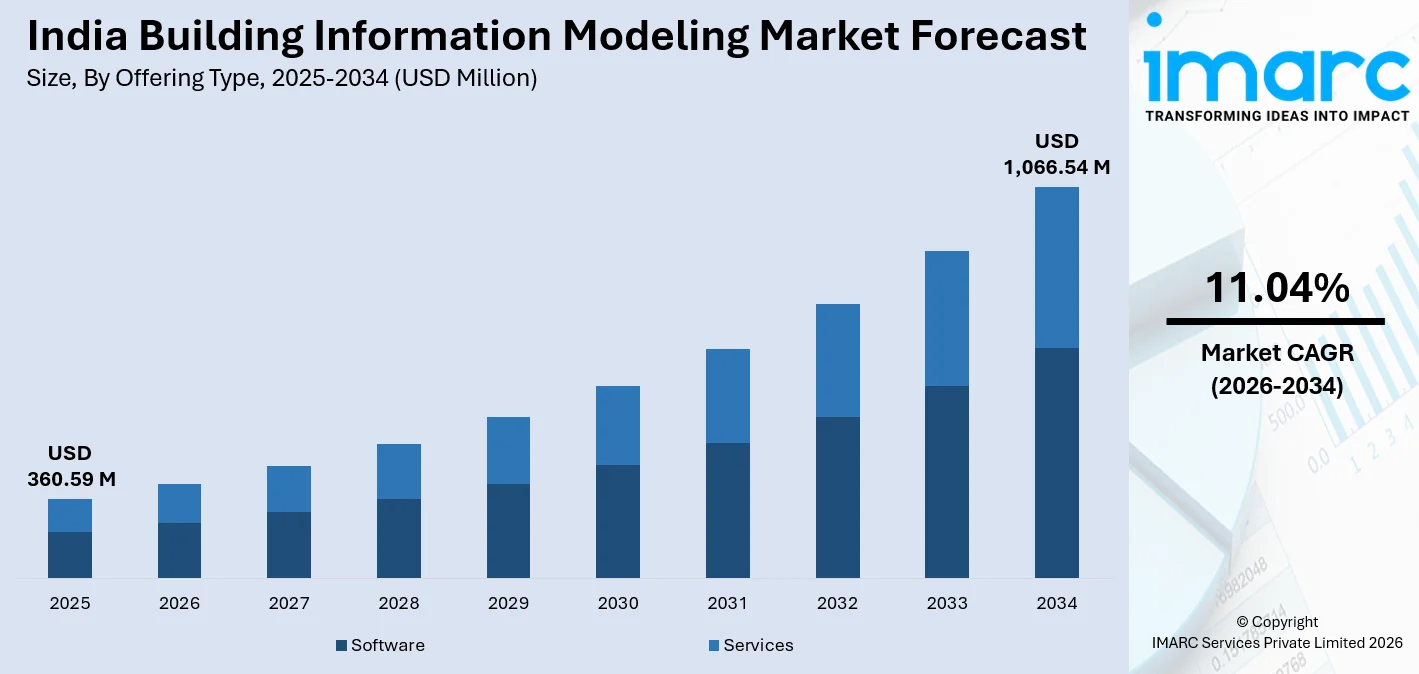
The India building information modeling market size was valued at USD 360.59 Million in 2025 and is projected to reach USD 1,066.54 Million by 2034, growing at a compound annual growth rate of 11.04% from 2026-2034.
The India building information modeling market is experiencing robust expansion, driven by the increasing adoption of digital construction technologies, growing urbanization, and a strong emphasis on improving project efficiency and collaboration. The push toward smart cities, infrastructure modernization, and sustainable building practices is encouraging widespread use of digital design tools. Rising demand for integrated construction solutions and cost-effective project management frameworks is reinforcing the India building information modeling market share.
Key Takeaways and Insights:
- By Offering Type: Software dominates the market with a share of 64.0% in 2025, driven by the widespread adoption of feature-rich design and modeling tools across architecture, engineering, and construction disciplines throughout India.
- By Deployment Mode: Cloud-based leads the market with a share of 55.0% in 2025, enabling flexible access, real-time collaboration, and scalable data management for construction teams across the country.
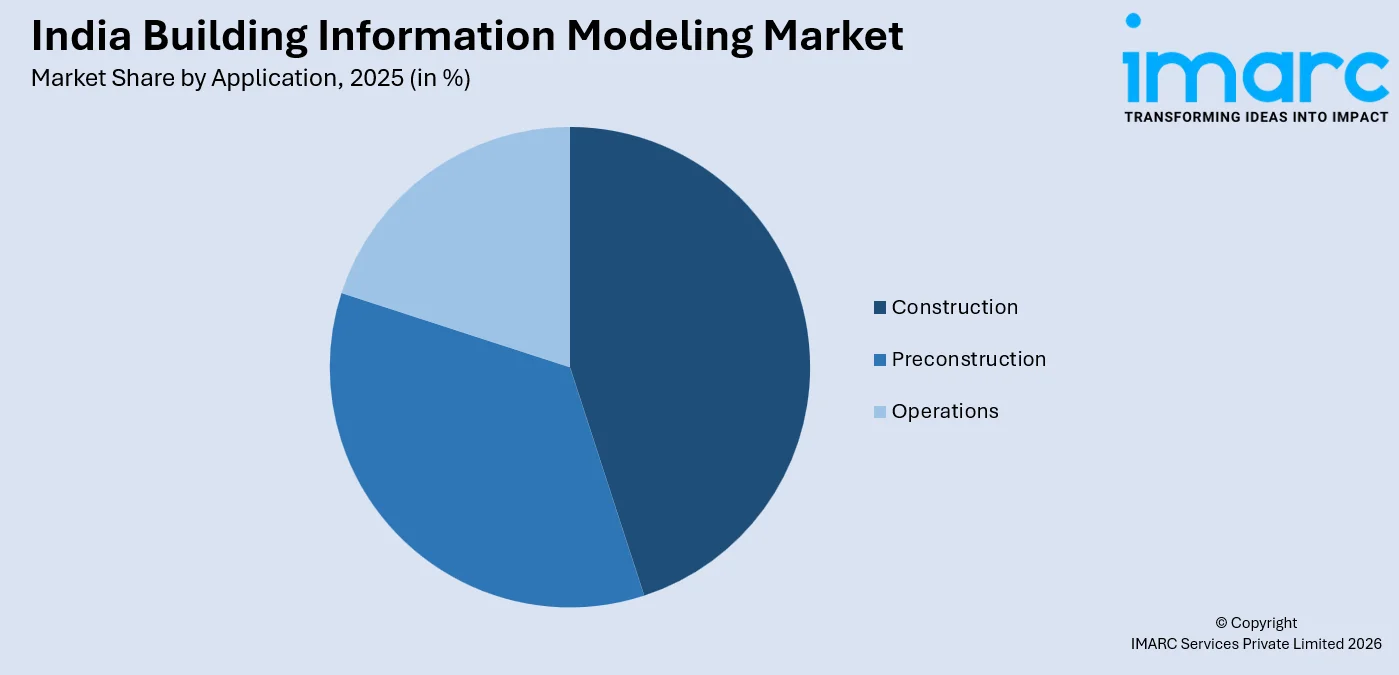
- By Application: Construction represents the largest segment with a market share of 44.5% in 2025, reflecting the critical role of BIM in streamlining on-site coordination, monitoring, and execution of complex building projects in India.
- By End Use Sector: Commercial dominates the market with a share of 35.0% in 2025, supported by the growing demand for sophisticated building management and design accuracy in offices, retail, and hospitality.
- By End User: Contractors and developers leads the market with a share of 40.5% in 2025, underscoring their reliance on BIM tools to optimize project scheduling, cost management, and construction workflows.
- By Region: North India dominates the market with a share of 30.0% in 2025, driven by concentrated construction activity, real estate growth, and smart city initiatives in major urban centers.
- Key Players: The India building information modeling market is highly competitive, with leading technology providers, software developers, and consulting firms expanding their offerings, forging strategic partnerships, and enhancing digital solutions to capture greater market share.
To get more information on this market Request Sample
The India building information modeling market is gaining significant momentum as the construction industry embraces digital transformation to address complex project demands. The government’s focus on expanding urban infrastructure, modernizing public facilities, and implementing smart city frameworks has created fertile ground for BIM adoption across diverse sectors. In June 2025, Autodesk launched an India-focused “BIM Package for Viksit Bharat,” integrating localized standards into Autodesk Revit and Civil 3D to support infrastructure projects aligned with national engineering and construction codes. Additionally, the growing complexity of modern architectural projects necessitates advanced coordination tools that enable architects, engineers, and contractors to collaborate effectively throughout the project lifecycle. The increasing availability of skilled professionals trained in BIM methodologies, combined with the transition toward sustainable and energy-efficient building practices, is further propelling market expansion. These converging factors are reshaping India’s construction landscape, positioning BIM as an essential component of future-ready project delivery.
India Building Information Modeling Market Trends:
Rising Adoption of Cloud-Based BIM Solutions
The shift toward cloud-based platforms is transforming how construction teams access, share, and manage building data across project sites. Cloud environments enable seamless coordination between geographically dispersed project stakeholders, reducing delays and improving decision-making. In November 2025, Autodesk announced a three-year partnership with Adani Group to deploy Autodesk Construction Cloud and BIM advisory services across Adani’s infrastructure projects, creating a centralized digital environment to unify project data and improve collaboration. By centralizing project information on secure cloud platforms, firms can facilitate continuous data access, enabling smoother workflows and faster approvals. This trend is significantly influencing India building information modeling market growth, driving demand for scalable, subscription-based digital construction tools.
Growing Integration of BIM with Sustainable Design
Building information modeling is increasingly being applied to support sustainable construction practices across India. Architects and engineers are leveraging BIM tools to simulate energy consumption, evaluate material efficiency, and optimize building orientation for improved environmental performance. In June 2025, Autodesk introduced an India-focused BIM suite aligned with national infrastructure standards to help architects and engineers improve design precision, reduce rework, and support sustainability goals in large infrastructure projects. The alignment of BIM capabilities with green building standards is reshaping design methodologies, encouraging project teams to incorporate eco-friendly considerations from the earliest stages of development. This integration reflects a broader commitment to responsible and future-focused construction.
Expansion of BIM in Infrastructure and Smart City Projects
India's expansive infrastructure development agenda is generating significant new opportunities for BIM adoption across transportation, utilities, and civic development projects. Government-led smart city initiatives and large-scale public works are progressively mandating digital design and coordination protocols, prompting contractors and design consultants to embed BIM more deeply within their standard operational workflows. As infrastructure projects continue to grow in scale and complexity, the demand for precise planning, clash detection, and robust lifecycle management capabilities continues to strengthen BIM's strategic importance across India's rapidly evolving construction landscape.
Market Outlook 2026-2034:
The India building information modeling market is expected to experience steady growth in the coming years, driven by rapid digital transformation across the construction sector and increasing investments in infrastructure development. Expanding adoption of advanced design and project management technologies is improving collaboration, planning accuracy, and operational efficiency. Supportive government initiatives promoting smart urban development and sustainable construction practices are further strengthening market prospects. Additionally, the growing focus on lifecycle management, cost optimization, and efficient resource utilization is encouraging wider adoption across architecture, engineering, and construction industries. The market generated a revenue of USD 360.59 Million in 2025 and is projected to reach a revenue of USD 1,066.54 Million by 2034, growing at a compound annual growth rate of 11.04% from 2026-2034.
India Building Information Modeling Market Report Segmentation:
| Segment Category | Leading Segment | Market Share |
|---|---|---|
|
Offering Type |
Software |
64.0% |
|
Deployment Mode |
Cloud-based |
55.0% |
|
Application |
Construction |
44.5% |
|
End Use Sector |
Commercial |
35.0% |
|
End User |
Contractors and Developers |
40.5% |
|
Region |
North India |
30.0% |
Offering Type Insights:
- Software
- Services
The software dominates with a market share of 64.0% of the total India building information modeling market in 2025.
Software solutions form the core of India’s building information modeling ecosystem, delivering the digital tools required for three-dimensional design, project simulation, clash detection, and detailed visualization. These platforms allow architects, engineers, and contractors to collaborate on unified digital models that store and manage project information throughout the construction lifecycle. By enabling accurate planning and coordination, BIM software supports efficient decision-making and improved design quality. Its capabilities are particularly valuable for large and technically complex projects across commercial developments, residential buildings, and public infrastructure.
The leading role of software in the market reflects the construction industry’s growing reliance on integrated digital platforms that streamline workflows and minimize manual errors. BIM solutions enhance transparency, enable better coordination between project stakeholders, and support more efficient planning and resource management. As India’s construction sector adopts more advanced technologies, demand for sophisticated software features continues to expand. Capabilities such as enhanced collaboration tools, compatibility with existing systems, and accessibility across multiple digital environments are strengthening the importance of software solutions across the industry.
Deployment Mode Insights:
- On-premises
- Cloud-based
The cloud-based leads with a share of 55.0% of the total India building information modeling market in 2025.
Cloud-based deployment has emerged as the leading operational model for building information modeling adoption in India, supported by its advantages in accessibility, scalability, and collaborative functionality. Project teams working across multiple locations can access and update shared digital models in real time, enabling smoother coordination and faster decision-making. This approach allows architects, engineers, and contractors to collaborate efficiently throughout the project lifecycle while maintaining centralized project data. As a result, cloud platforms are increasingly becoming the preferred environment for implementing BIM across diverse construction projects.
Another important factor driving the preference for cloud-based deployment is its lower infrastructure requirement compared with traditional on-premise systems. Organizations can access advanced BIM tools without investing heavily in dedicated hardware or complex server management. Cloud platforms also support automatic updates, ensuring that users benefit from the latest software features and security improvements. With expanding internet connectivity across urban and semi-urban regions in India, cloud deployment is becoming practical for a wider range of construction firms and project scales, reinforcing its strong position in the market.
Application Insights:
Access the comprehensive market breakdown Request Sample
- Preconstruction
- Construction
- Operations
The construction dominates with a market share of 44.5% of the total India building information modeling market in 2025.
The construction application segment represents the leading area of BIM adoption in India, reflecting the strong need for accurate coordination, real-time monitoring, and efficient resource management during the project execution phase. BIM tools allow construction teams to identify potential conflicts between structural, electrical, and mechanical systems before they occur on site, helping reduce costly rework and project delays. As commercial developments, residential projects, and public infrastructure initiatives become more complex, construction teams are increasingly relying on integrated BIM workflows.
The rising emphasis on digital project delivery across both public infrastructure initiatives and private sector developments is further strengthening BIM adoption during the construction phase. Contractors and developers are recognizing the operational advantages BIM provides in improving site coordination, tracking materials and resources, and maintaining quality standards. Enhanced visibility into project progress and collaboration among stakeholders supports better decision-making throughout the build process. As these benefits become more widely recognized across India’s construction ecosystem, BIM integration continues to expand within active project execution activities.
End Use Sector Insights:
- Commercial
- Residential
- Industrial
The commercial leads with a share of 35.0% of the total India building information modeling market in 2025.
Commercial construction represents a major area for building information modeling adoption in India, covering property types such as office complexes, retail spaces, hospitality establishments, and mixed-use developments. These projects require high levels of design accuracy, regulatory compliance, and effective lifecycle planning. BIM tools help manage complex mechanical, electrical, and plumbing systems while enabling coordinated collaboration among architects, engineers, and developers. As commercial real estate activity expands across major metropolitan areas, the use of BIM is increasingly becoming an industry expectation.
The prominence of the commercial segment also reflects the sector’s greater capacity to invest in advanced technologies and digital project management tools. Property developers and building owners are increasingly recognizing BIM’s role in improving operational efficiency, supporting long-term maintenance planning, and optimizing building performance. The technology also assists in meeting sustainability objectives and green building standards, which are gaining importance in modern commercial developments. These advantages are encouraging wider integration of BIM across India’s evolving commercial property landscape.
End User Insights:
- Architects and Engineers
- Contractors and Developers
- Others
The contractors and developers dominates with a market share of 40.5% of the total India building information modeling market in 2025.
Contractors and developers represent the most active end-user group in India’s building information modeling market because they manage and coordinate the core activities involved in project execution. BIM platforms help these professionals organize project schedules, coordinate subcontractor activities, monitor material procurement, and oversee quality control across construction sites. By providing a centralized digital model, BIM enables clearer communication among project stakeholders and supports more efficient planning and execution. As construction projects become increasingly complex, these tools help contractors maintain productivity and reduce operational risks.
The increasing involvement of developers in BIM adoption from the early planning stage is further strengthening its use throughout the entire project lifecycle. By integrating digital models from design to final construction, developers gain improved visibility into project timelines, design adjustments, and operational requirements. This approach supports better collaboration between architects, engineers, and construction teams. In a competitive construction environment, contractors and developers that effectively utilize BIM solutions benefit from improved cost control, stronger client communication, and more reliable project delivery outcomes.
Regional Insights:
- North India
- West and Central India
- South India
- East and Northeast India
North India exhibits a clear dominance with a 30.0% share of the total India building information modeling market in 2025.
North India holds a leading position in the country’s building information modeling market, supported by intense construction activity across major metropolitan regions and a strong pipeline of public infrastructure initiatives. Rapid expansion in commercial and residential real estate has increased the need for advanced digital design, planning, and coordination tools. Developers, architects, and engineering firms are increasingly adopting BIM solutions to manage complex projects more efficiently while improving collaboration across multiple stakeholders involved in construction.
The region’s prominence is also strengthened by large urban development programs and the continued growth of modern infrastructure projects across key cities in the National Capital Region and surrounding areas. Smart urban planning initiatives are encouraging the integration of digital construction technologies, including BIM frameworks, to support better project management and design accuracy. As a result, contractors, consultants, and developers across North India are increasingly incorporating BIM tools into their standard workflows, further strengthening the region’s position within the national market.

Market Dynamics:
Growth Drivers:
Why is the India Building Information Modeling Market Growing?
Accelerating Urbanization and Infrastructure Development
Rapid urban expansion across India is increasing the demand for advanced construction planning and management tools. As cities grow and new residential, commercial, and public infrastructure projects emerge, developers and construction firms require efficient methods to coordinate complex design and execution processes. In March 2025, Nemetschek Group partnered with Ovation Services to expand the use of BIM-based structural detailing and digital construction solutions in India by deploying its ALLPLAN SDS2 and BIM Construction suite to improve project accuracy and coordination. Building information modeling provides a shared digital environment where project stakeholders can collaborate, visualize outcomes, and identify potential design conflicts early. This capability improves coordination, reduces project errors, streamlines workflows, and supports more efficient delivery of large and complex developments.
Government Initiatives and Digital Construction Mandates
Support from public authorities is playing a major role in encouraging the adoption of building information modeling across India’s construction ecosystem. Government agencies increasingly recognize the benefits of digital construction practices in improving project transparency, coordination, and planning accuracy. In January 2024, the Ministry of Housing and Urban Affairs expanded its digital infrastructure push under the Smart Cities Mission, encouraging the use of advanced digital planning tools, including BIM and geospatial platforms, to improve urban project design, monitoring, and lifecycle management across participating cities. As a result, digital modeling approaches are gradually being incorporated into project guidelines and procurement frameworks. At the same time, training programs and professional development initiatives are strengthening digital skills within the construction workforce, helping expand the number of professionals capable of implementing BIM effectively.
Growing Demand for Cost Efficiency and Project Accuracy
The need to improve cost control and project accuracy is a key factor driving BIM adoption across India’s construction industry. Traditional construction methods often face challenges related to design conflicts, poor coordination, and inefficient planning. According to reports, the Ministry of Road Transport and Highways expanded the use of digital engineering technologies, including BIM and 3D design systems, for highway planning and execution to improve design accuracy, project monitoring, and cost efficiency in national infrastructure development. BIM helps address these issues by enabling project teams to visualize designs in detail and detect potential clashes before construction begins. This improves coordination among stakeholders, supports more reliable project planning, and reduces the likelihood of costly errors or delays, making BIM an increasingly valuable tool for contractors and developers.
Market Restraints:
What Challenges the India Building Information Modeling Market is Facing?
High Initial Investment and Implementation Costs
Deploying building information modeling requires significant upfront expenditure on software licenses, hardware infrastructure, staff training, and workflow integration. For smaller contractors, engineering firms, and regional developers, these initial costs can be prohibitive, particularly in the absence of immediate demonstrable return on investment. The financial barrier to entry continues to limit adoption among a large segment of India’s construction industry, where small and medium enterprises play a prominent and essential role.
Shortage of Skilled BIM Professionals
Effective BIM implementation depends on a workforce proficient in digital modeling tools, collaborative workflows, and data management standards. India currently faces a notable gap between the demand for qualified BIM practitioners and the available talent pool. Educational institutions and vocational training programs have yet to fully integrate comprehensive BIM curricula, resulting in a skills deficit that constrains broader adoption. This shortage prolongs project setup timelines and raises operational costs as firms compete for limited expertise.
Resistance to Change in Traditional Construction Practices
The Indian construction sector encompasses a large proportion of organizations with deeply entrenched traditional workflows and limited experience with digital tools. Transitioning to BIM-based processes requires organizational restructuring, new documentation standards, and a fundamental shift in project coordination culture. Resistance from long-established firms, combined with the complexity of managing the transition while maintaining ongoing project delivery, presents a significant barrier to broader adoption across the market.
Competitive Landscape:
The India building information modeling market features a dynamic competitive landscape shaped by global software providers, domestic technology firms, and specialized construction consulting companies. Market participants are continuously expanding their offerings to deliver integrated solutions covering design, project coordination, simulation, and facility management. Collaboration between technology developers and construction companies is becoming more common, enabling the development of solutions tailored to local project needs. Companies are also focusing on improving platform interoperability, cloud accessibility, and mobile functionality to enhance usability. As construction firms adopt more advanced digital practices, providers are increasingly emphasizing lifecycle management capabilities, advanced analytics, artificial intelligence integration, and stronger customer support services to strengthen their competitive positioning.
Recent Developments:
- In September 2025, Autodesk strengthened its India strategy by promoting its “Design and Make” platform, aimed at accelerating Building Information Modeling (BIM)-enabled infrastructure development. The initiative integrates AI capabilities, digital construction tools, and industry training programs to expand BIM adoption among engineering, architecture, and construction firms, supporting India’s growing digital infrastructure ecosystem.
India Building Information Modeling Market Report Coverage:
| Report Features | Details |
|---|---|
| Base Year of the Analysis | 2025 |
| Historical Period | 2020-2025 |
| Forecast Period | 2026-2034 |
| Units | Million USD |
| Scope of the Report | Exploration of Historical Trends and Market Outlook, Industry Catalysts and Challenges, Segment-Wise Historical and Future Market Assessment:
|
| Offering Types Covered | Software, Services |
| Deployment Modes Covered | On-premises, Cloud-based |
| Applications Covered | Preconstruction, Construction, Operations |
| End Use Sectors Covered | Commercial, Residential, Industrial |
| End Users Covered | Architects and Engineers, Contractors and Developers, Others |
| Regions Covered | North India, West and Central India, South India, East and Northeast India |
| Customization Scope | 10% Free Customization |
| Post-Sale Analyst Support | 10-12 Weeks |
| Delivery Format | PDF and Excel through Email (We can also provide the editable version of the report in PPT/Word format on special request) |
Frequently Asked Questions About the India Building Information Modeling Market Report
The India building information modeling market size was valued at USD 360.59 Million in 2025.
The India building information modeling market is expected to grow at a compound annual growth rate of 11.04% from 2026-2034 to reach USD 1,066.54 Million by 2034.
Software, holding the largest share of 64.0%, leads the market owing to the broad adoption of advanced digital design, simulation, and coordination tools across India’s architecture, engineering, and construction sectors.
Key factors driving the India building information modeling market include accelerating urbanization, growing infrastructure investment, government digital construction mandates, and rising demand for cost-efficient and accurate project delivery.
Major challenges include high initial implementation costs, a shortage of skilled BIM professionals, resistance to digital adoption among traditional construction firms, and limited awareness of BIM benefits among smaller contractors and developers.
Need more help?
- Speak to our experienced analysts for insights on the current market scenarios.
- Include additional segments and countries to customize the report as per your requirement.
- Gain an unparalleled competitive advantage in your domain by understanding how to utilize the report and positively impacting your operations and revenue.
- For further assistance, please connect with our analysts.
 Request Customization
 Speak to an Analyst
 Request Brochure
 Inquire Before Buying
Benefits of Customization
- Personalize this research
- Triangulate with your data
- Get data as per your format and definition
- Gain a deeper dive into a specific application, geography, customer, or competitor
- Any level of personalization
Get in Touch With Us
UNITED STATES
Phone: +1-201-971-6302
INDIA
Phone: +91-120-433-0800
UNITED KINGDOM
Phone: +44-753-714-6104
Email: [email protected]
Client Testimonials




.webp)




.webp)













Related Reports

Choose your plan
*Please note that the prices mentioned below are starting prices for each bundle type. Kindly contact our team for further details.*
Single User License
- 1 User License, Access on 2 Devices
- PDF Report + Excel Dataset (Password Protected)
- Lifetime Access
- No Printing Rights
- 10% Free Report Customization
- 10–12 Weeks of Analyst Support
Five User License
- Access for 5 Users, 2 Devices per User
- PDF Report + Excel Dataset (Password Protected)
- Lifetime Access
- Dedicated Account Manager
- 12–14 Weeks of Analyst Support
- No Printing Rights
- 15% Free Report Customization
- 25% Discount on Your Next Purchase
Corporate User License
- Unlimited User Access (Within Your Organization)
- PDF Report + Excel Dataset
- Lifetime Access
- Dedicated Account Manager
- 14–20 Weeks of Analyst Support
- No Printing Rights
- 20% Free Report Customization
- 30% Discount on Your Next Purchase
Essential Insights
What's included:
3 reports
- Lifetime Access
- PDF Reports
- Excel Datasets
- 2 Weeks of Free Analyst Support
- 2 User Licenses
- Access on 2 Devices
- Printing Rights
- Complimentary PowerPoint (PPT) Version
- Complimentary License Upgrade
Professional Access
What's included:
5 reports
- Lifetime Access
- PDF Reports
- Excel Datasets
- 8 Weeks of Free Analyst Support
- 2 User Licenses
- Access on 2 Devices
- Printing Rights
- Complimentary PowerPoint (PPT) Version
- Complimentary License Upgrade
Business Advantage
What's included:
8 reports
- Lifetime Access
- PDF Reports
- Excel Datasets
- 14 Weeks of Free Analyst Support
- 2 User Licenses
- Access on 2 Devices
- Printing Rights
- Complimentary PowerPoint (PPT) Version
- Complimentary License Upgrade
Enterprise Intelligence
What's included:
10 reports
- Lifetime Access
- PDF Reports
- Excel Datasets
- 20 Weeks of Free Analyst Support
- 2 User Licenses
- Access on 2 Devices
- Printing Rights
- Complimentary PowerPoint (PPT) Version
- Complimentary License Upgrade