
India Building Materials Market Size, Share, Trends and Forecast by Type, Application, and Region, 2026-2034
India Building Materials Market Size, Share, Trends & Forecast (2026-2034)
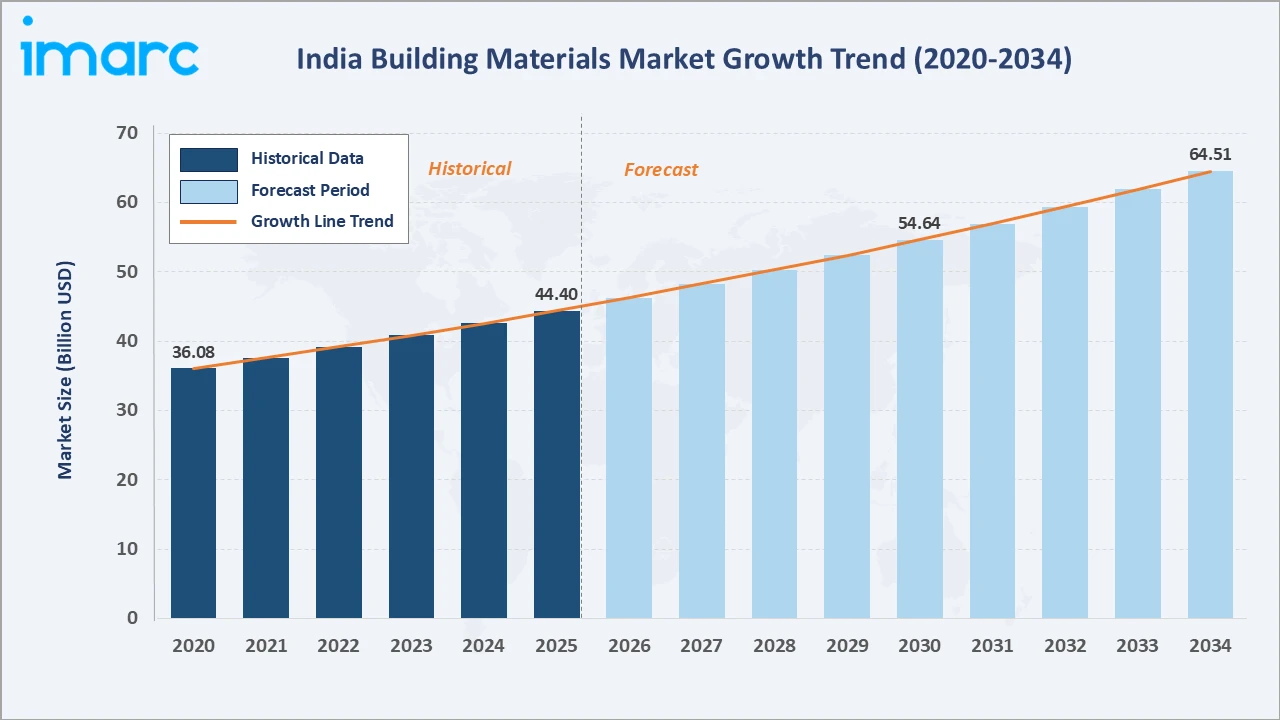
The India building materials market grew from USD 44.40 Billion in 2025 to USD 46.28 Billion in 2026 and is projected to reach USD 64.51 Billion by 2034, growing at a CAGR of 4.24% during 2026-2034. The market is driven by large-scale government infrastructure investment under the National Infrastructure Pipeline, the PMAY affordable housing scheme, and rapid urbanization across tier-1 and tier-2 cities. India allocated INR 11.11 Trillion toward infrastructure development in the Union Budget 2024-25, directly stimulating demand across cement, aggregates, bricks, and other construction materials. Cement leads at 38.7% by type, residential construction dominates at 52.8% by application, and North India commands the largest regional share at 31.8% in 2025.
Market Snapshot
|
Metric |
Value |
|
Base Year Market Size (2025) |
USD 44.40 Billion |
|
Market Size (2026) |
USD 46.28 Billion |
|
Forecast Market Size (2034) |
USD 64.51 Billion |
|
CAGR (2026-2034) |
4.24% |
|
Base Year |
2025 |
|
Historical Period |
2020-2025 |
|
Forecast Period |
2026-2034 |
|
Dominant Type |
Cement (38.7%, 2025) |
|
Dominant Application |
Residential (52.8%, 2025) |
|
Leading Region |
North India (31.8%, 2025) |
The India building materials market grew from USD 36.08 Billion in 2020 to USD 44.40 Billion in 2025, and further to USD 46.28 Billion in 2026, reflecting sustained construction activity across housing, infrastructure, and commercial real estate. The market is projected to reach USD 54.64 Billion by 2030 before reaching USD 64.51 Billion by 2034.
To get more information on this market, Request Sample
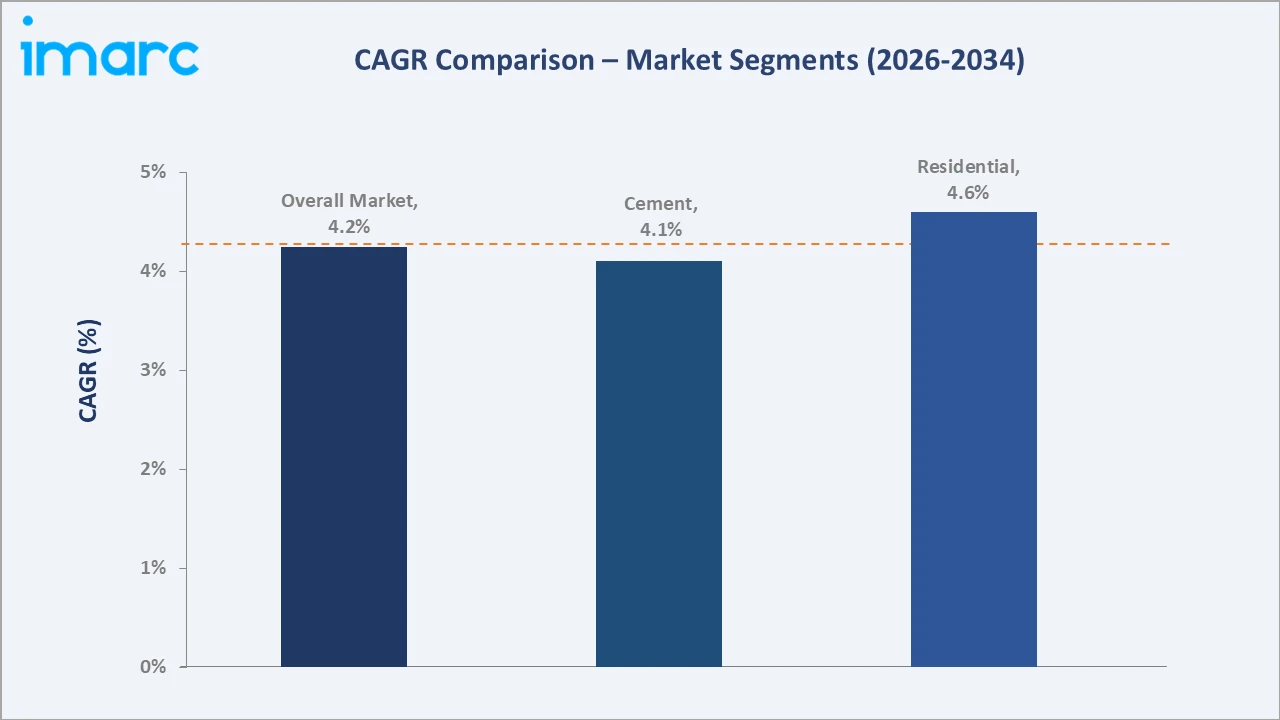
Residential construction grows at approximately 4.6% CAGR as affordable housing schemes and urbanization drive sustained housing demand across metro and tier-2 cities. Cement, at a 4.1% CAGR, benefits from infrastructure-driven volume demand across roads, bridges, and urban construction. The overall market CAGR of 4.24% reflects India stable and policy-supported construction sector growth.
Executive Summary
The India building materials market is on a consistent growth trajectory, underpinned by large-scale government infrastructure investment, a structural housing shortage driving demand, and accelerating commercial and industrial construction activity across major economic zones. The market has expanded steadily, supported by the post-COVID recovery of construction activity, increased budget allocations for infrastructure, and a strong pipeline of residential real estate projects across both metro cities and emerging urban centers.
Cement at 38.7%, reflecting the primacy of structural construction inputs in the market. Residential construction at 52.8% is the dominant application segment, driven by housing demand from a growing urban middle class and government-backed affordable housing programs. North India leads regionally at 31.8%, driven by dense urban construction activity in Delhi NCR and major infrastructure development corridors.
Key Market Insights
|
Insight |
Data |
|
Dominant Type |
Cement - 38.7% share (2025) |
|
Dominant Application |
Residential - 52.8% share (2025) |
|
Leading Region |
North India - 31.8% (2025) |
|
Key Market Opportunity |
Government NIP-driven infrastructure demand and PMAY affordable housing are creating sustained, policy-backed volume growth across all major material categories. |
Key Analytical Observations Supporting the Above Data:
- Cement at 38.7%: Cement dominates because it is the foundational structural input for nearly all construction categories, from residential housing to highways, bridges, dams, and commercial buildings.
- Residential at 52.8%: Residential construction leads because India faces a structural housing deficit estimated at 18.78 million units in urban areas, sustained by rapid urbanization that is adding approximately 25 million urban residents annually. Government scheme commitments and private developer activity together maintain high residential construction volumes across all regions.
- North India at 31.8%: North India regional leadership reflects the high construction activity concentration, driven by large-scale residential development, national highway construction, and major infrastructure projects including metro rail networks and industrial corridors that generate consistent demand for cement, aggregates, and other structural materials.
India Building Materials Market Overview
The India building materials market encompasses the production, distribution, and supply of all primary and secondary construction materials used across residential, commercial, industrial, and infrastructure construction projects in India. Core product categories include cement, aggregates (sand, gravel, crushed stone), fired clay and fly ash bricks, steel and structural metals, glass and glazing products, wood and engineered wood products, tiles and ceramics, and specialty construction chemicals.
The market serves a broad construction ecosystem spanning individual home builders, residential developers, government infrastructure agencies, commercial real estate developers, and industrial project owners. The industry ecosystem spans raw material extractors and processors, large-scale manufacturing plants, national and regional distributors, building material dealers and retailers, logistics operators, and end-user construction contractors.
Market Dynamics
To evaluate market opportunities, Request Sample
Market Drivers
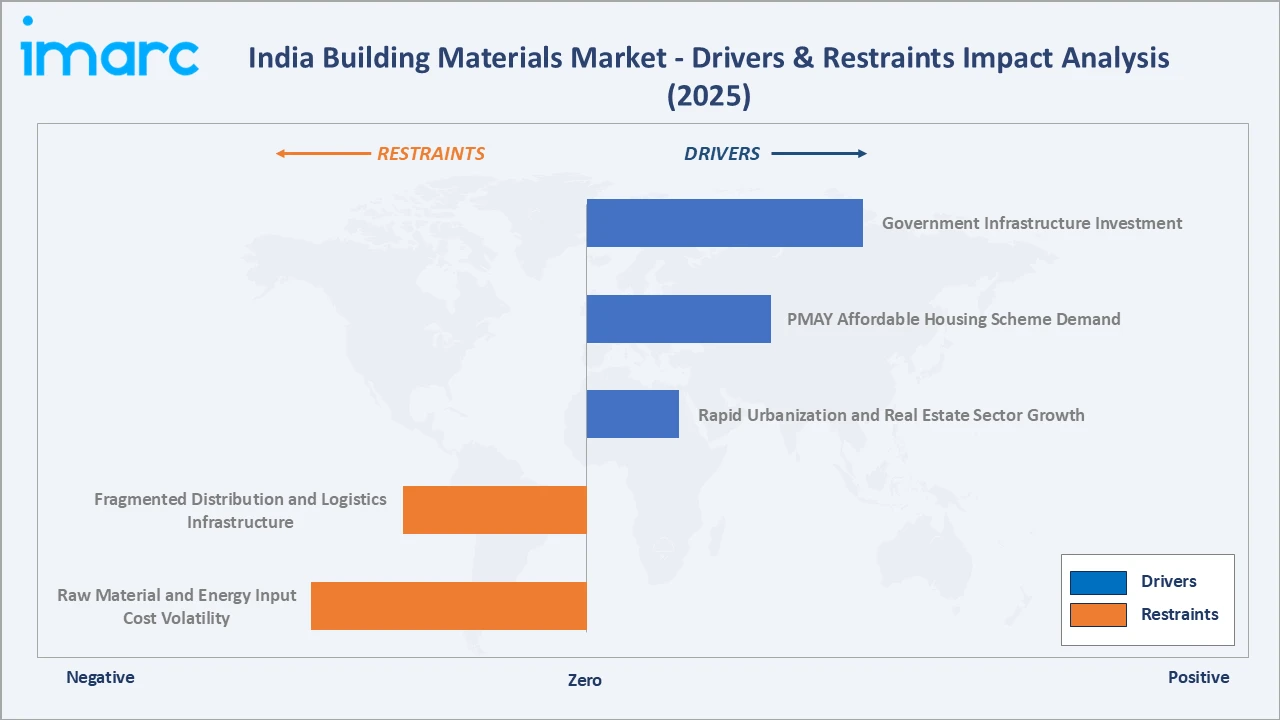
- Government Infrastructure Investment: India Union Budget 2024-25 allocated INR 11.11 Trillion for infrastructure capital expenditure, making it the largest-ever infrastructure allocation in the country history. This directly drives demand for cement, aggregates, steel, and structural building materials across road, rail, airport, port, and urban infrastructure projects under the National Infrastructure Pipeline.
- PMAY Affordable Housing Scheme Demand: Under Pradhan Mantri Awas Yojana – Urban (PMAY-U) and PMAY-U 2.0, more than 1.25 crore houses have been sanctioned across India, with over 1 crore homes completed and delivered to beneficiaries, with construction activity driving sustained cement, brick, and aggregate demand at mass-market price points. Government subsidy and loan guarantee mechanisms have maintained housing construction volumes even during broader economic slowdowns, providing a demand floor for essential building materials.
- Rapid Urbanization and Real Estate Sector Growth: By 2036, India’s urban population is projected to reach 600 million, representing 40% of the total population, while urban areas are expected to contribute nearly 70% of the country’s GDP, requiring significant investment in residential, commercial, and civic infrastructure. This structural demographic shift is generating sustained construction activity across both metro cities and emerging tier-2 urban centers, providing a broad geographic base of demand for building materials.
Market Restraints
- Raw Material and Energy Input Cost Volatility: Building material producers, particularly cement and brick manufacturers, face significant margin pressure from fluctuations in limestone, coal, and energy prices. Coal has seen significant price volatility that compresses manufacturer margins and limits the pace of capacity investment.
- Fragmented Distribution and Logistics Infrastructure: Outside major metro cities and industrial corridors, building material distribution relies on fragmented supply chains with poor cold-chain and warehouse infrastructure. This creates regional price disparities, supply gaps, and quality inconsistencies that limit effective market penetration for organized players in remote and tier-3 areas.
Market Opportunities
- Green Building Materials and Sustainable Construction: In July 2026, Renacon launched RENAFLEX Fiber Cement Boards from its INR 350 Crore green building materials facility in Naidupeta, strengthening its sustainable construction portfolio and expanding its presence in India’s building solutions market. This reflects growing investor and corporate focus on sustainable building material manufacturing aligned with Green Rating for Integrated Habitat Assessment standards.
- Prefabrication and Precast Concrete Adoption: Government initiatives, including PMAY technical guidelines promoting prefabricated housing construction and the Smart Cities Mission, are accelerating the adoption of precast concrete components, panels, and modular building systems. Prefabrication adoption reduces construction time and material waste, creating a differentiated high-value product segment for advanced building material manufacturers.
Market Challenges
- Pricing Pressure in Highly Competitive Cement Segment: Intense competition in India’s cement industry creates significant pricing pressure, limiting manufacturers’ ability to pass rising raw material, energy, and logistics costs on to customers. Frequent price competition can compress profit margins and affect overall profitability. This may also constrain investments in capacity expansion, advanced technologies, and sustainable building material solutions, thereby challenging broader market growth.
- Quality Standardization Across the Unorganized Sector: A significant portion of brick and aggregate supply still comes from unorganized, small-scale producers operating outside quality standards. This creates quality inconsistency in the supply chain that affects construction outcomes, particularly in residential projects served by non-organized distributors and contractors.
Emerging Market Trends
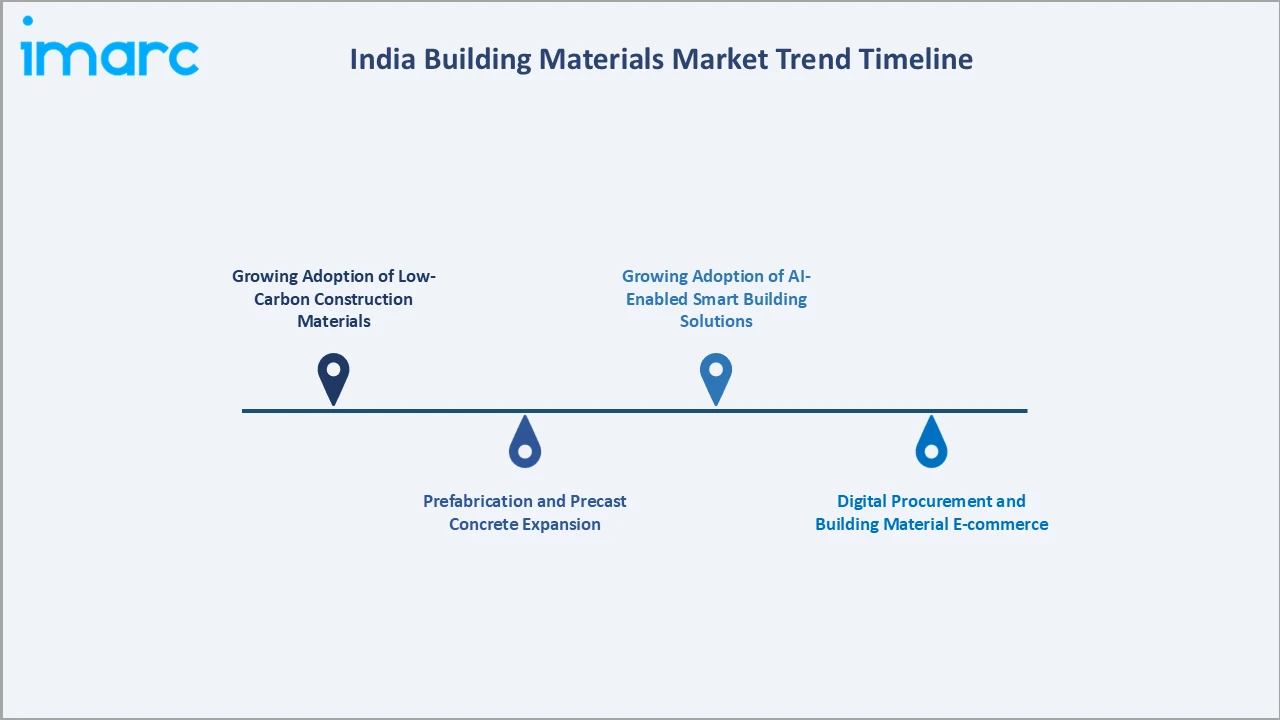
1. Growing Adoption of Low-Carbon Construction Materials
The Indian building materials market is witnessing increasing adoption of low-carbon and sustainable construction solutions as developers focus on reducing the environmental footprint of buildings. In August 2026, Godrej Properties launched the Habitat Matters initiative in partnership with Xynteo to promote low-carbon construction materials in India. The five-year program will test and validate innovative materials through live construction projects, supporting their broader commercial adoption across the sector. Growing real-world testing and commercialization of innovative materials are accelerating their integration into mainstream construction projects.
2. Prefabrication and Precast Concrete Expansion
Precast concrete components, including beams, columns, walls, slabs, and modular units, are gaining adoption across large residential and infrastructure projects, driven by labor shortage pressures, construction speed requirements, and improved quality outcomes versus cast-in-situ methods. Government-backed affordable housing projects under PMAY are increasingly specifying prefabricated construction technologies, creating consistent project volume for precast component suppliers and driving structural investment in precast manufacturing facilities across North and West India.
3. Growing Adoption of AI-Enabled Smart Building Solutions
India’s building materials and construction sector is increasingly integrating AI-driven building management and intelligent infrastructure technologies. In July 2026, Hitachi and Hitachi Lift India launched the BuilMirai Experience Center in Noida to showcase AI-enabled smart building solutions. The center highlights technologies designed to enhance energy efficiency, sustainability, operational visibility, occupant wellbeing, and overall building performance. These solutions are gaining traction as developers seek to improve energy efficiency, sustainability, occupant wellbeing, and real-time monitoring of building performance.
4. Digital Procurement and Building Material E-commerce
Digital building material procurement platforms and e-commerce channels are growing in importance as organized retail and technology-enabled distribution models improve price transparency and supply chain efficiency. Platforms enabling direct-from-manufacturer procurement for residential builders and small contractors are reducing intermediary costs and improving product quality assurance, driving gradual market formalization that favors organized building material brands with verifiable quality standards and consistent product availability.
Industry Value Chain Analysis
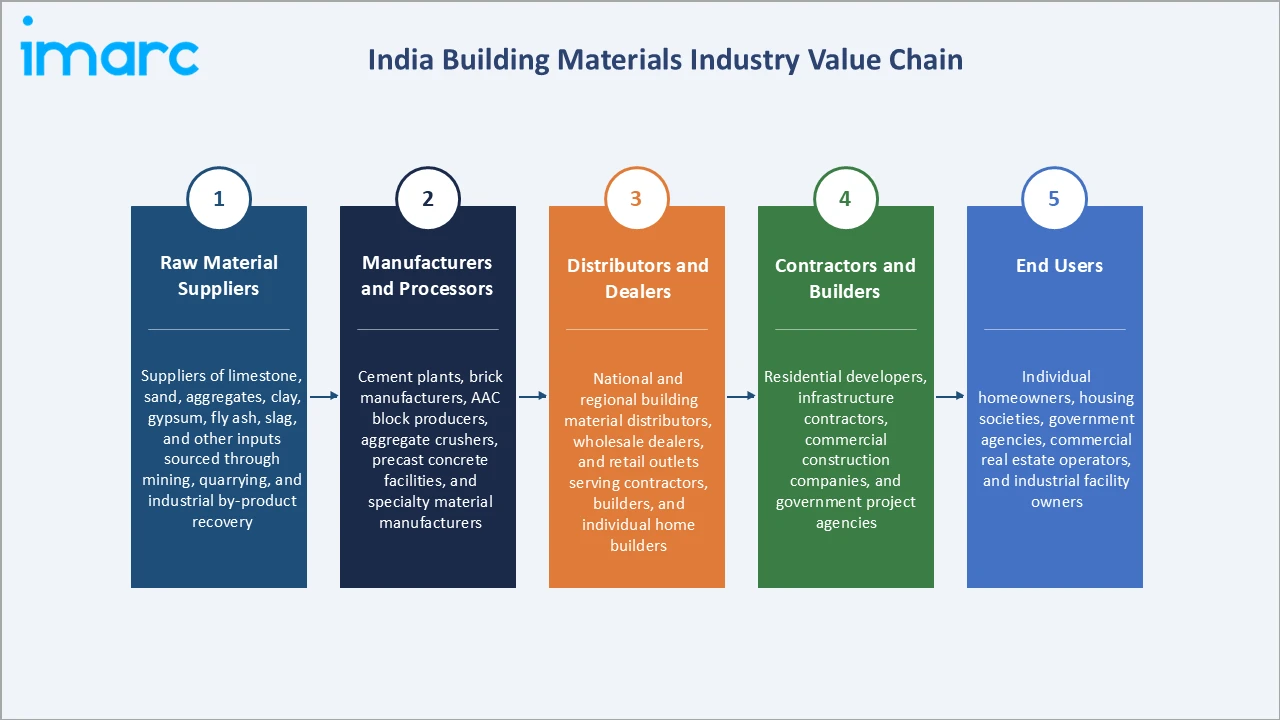
The India building materials value chain is structured across five integrated stages from raw material extraction through end-user construction. Each stage creates distinct value through processing, formulation, distribution, and application, with the highest value addition occurring at the manufacturing and brand differentiation stage where product quality, consistency, and technical performance create durable competitive advantages.
|
Stage |
Key Participants |
|
Raw Material Suppliers |
Suppliers of limestone, sand, aggregates, clay, gypsum, fly ash, slag, and other inputs sourced through mining, quarrying, and industrial by-product recovery. |
|
Manufacturers and Processors |
Cement plants, brick manufacturers, AAC block producers, aggregate crushers, precast concrete facilities, and specialty material manufacturers. |
|
Distributors and Dealers |
National and regional building material distributors, wholesale dealers, and retail outlets serving contractors, builders, and individual home builders. |
|
Contractors and Builders |
Residential developers, infrastructure contractors, commercial construction companies, and government project agencies. |
|
End Users |
Individual homeowners, housing societies, government agencies, commercial real estate operators, and industrial facility owners. |
The manufacturing stage holds the greatest strategic significance in the building materials value chain, as large-scale cement and aggregate producers benefit from economies of scale, captive raw material sources, and brand recognition that create durable competitive advantages. The distribution stage is progressively being formalized as digital procurement platforms and organized dealer networks displace fragmented traditional trade channels, improving supply chain efficiency and product quality consistency.
Technology Landscape in the India Building Materials Industry
Precast and Prefabricated Construction Systems
Advanced precast concrete production technology, including precision mold systems, automated reinforcement placement, and high-early-strength concrete formulations, is enabling precast component manufacturers to supply large residential and infrastructure projects with speed and quality that traditional cast-in-situ methods cannot match. PMAY technical guidelines now explicitly support prefabricated housing technologies, providing policy demand support for this manufacturing segment.
Autoclaved Aerated Concrete and Lightweight Materials
AAC block manufacturing capacity is expanding across India as builders seek lightweight, thermally efficient alternatives to conventional fired clay bricks. AAC blocks weigh approximately one-third of conventional bricks and offer superior thermal and acoustic insulation, reducing building HVAC load and improving occupant comfort.
Digital and Lean Manufacturing in Cement Production
Cement manufacturers are increasingly adopting digital technologies and lean manufacturing practices to improve operational efficiency and reduce production costs. AI, IoT sensors, predictive maintenance, and real-time process monitoring help optimize kiln performance, energy consumption, and equipment utilization. Lean practices minimize material waste, production downtime, and process inefficiencies. These technologies also support consistent product quality, lower emissions, and more sustainable cement production.
Market Segmentation Analysis
The report covers the following segments:
|
Segment Category |
Leading Segment |
Market Share |
Year |
|
Type |
Cement |
38.7% |
2025 |
|
Application |
Residential |
52.8% |
2025 |
|
Region |
North India |
31.8% |
2025 |

By Type
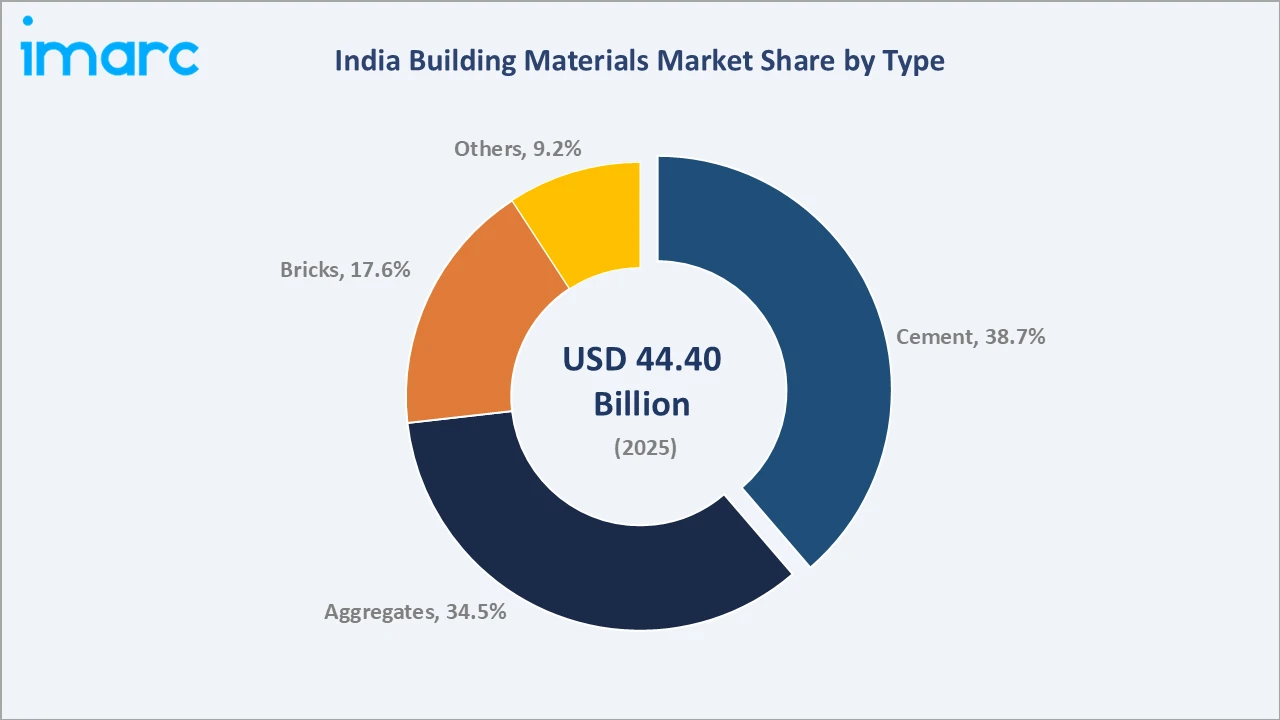
Cement leads at 38.7% in 2025, reflecting its foundational role as the primary structural binding material in virtually all construction categories. Aggregates at 34.5% are the second-largest material type category, encompassing crushed stone, sand, and gravel that serve as the bulk filler materials in concrete, asphalt, and earthwork construction.
To access detailed market analysis, Request Sample
Bricks at 17.6% serve the residential construction segment through traditional fired clay bricks and increasingly through fly ash bricks and AAC blocks that offer performance and environmental advantages. Others at 9.2% include glass, structural steel, wood products, tiles, and specialty construction materials.
By Application
Residential leads at 52.8% in 2025, underpinned by India structural housing deficit, government PMAY affordable housing commitments, and the sustained demand from a growing urban middle class seeking to own homes in metro and tier-2 cities. Residential construction generates consistent, geographically distributed demand for all major building material categories, including cement, aggregates, bricks, steel, glass, and finishing materials.
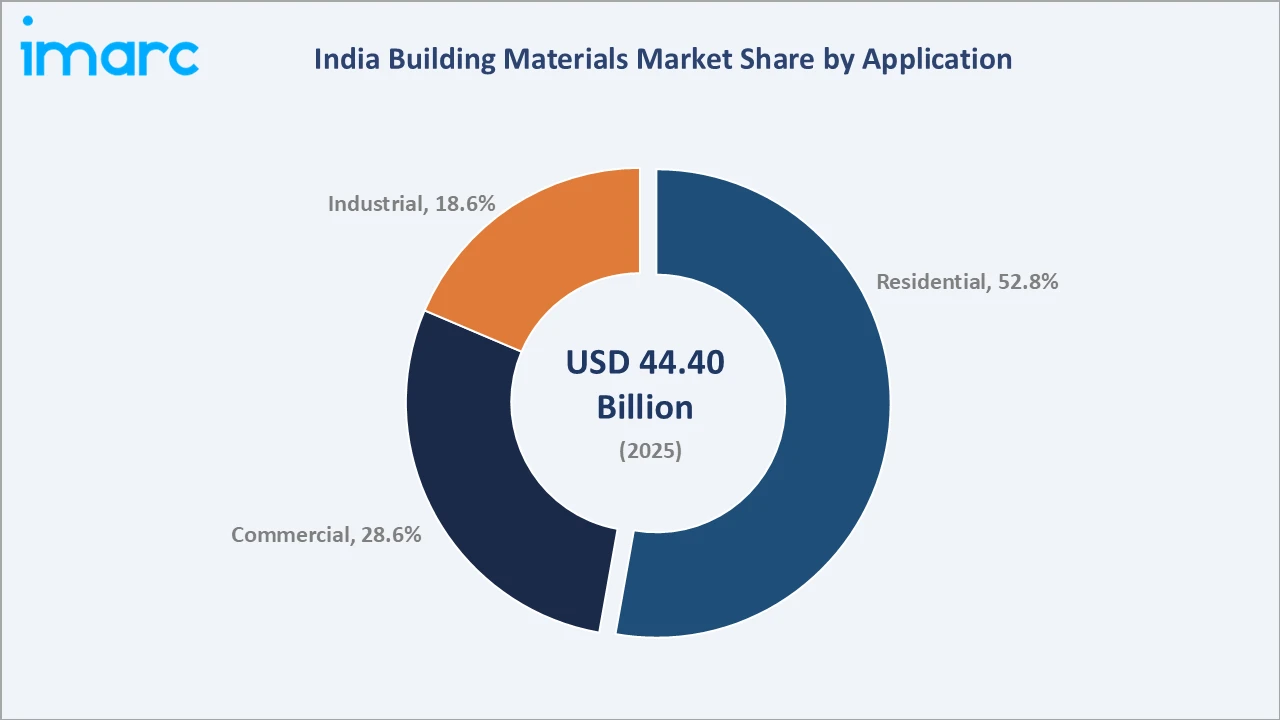
Commercial at 28.6% encompasses office, retail, hospitality, and mixed-use development driven by corporate occupier demand, organized retail expansion, and the recovery of hospitality and leisure real estate following the pandemic. Industrial at 18.6% is driven by manufacturing investment under PLI schemes, warehousing and logistics facility development, and data center construction that is expanding rapidly in major urban and peri-urban locations.
Regional Market Insights
|
Region |
Share (2025) |
Key India Building Materials Market Drivers & Characteristics |
|
North India |
31.8% |
Reflecting the high construction activity density, with significant residential development, major infrastructure projects including expressways and metro networks, and growing industrial and logistics construction. |
|
West India |
28.4% |
Reflecting real estate market scale anchored in industrial and port infrastructure development, and the Rajasthan limestone belt that supports major cement manufacturing operations. |
|
South India |
23.7% |
Reflecting commercial and residential construction activity, industrial zone development, and growing infrastructure investment across southern states. |
|
East India |
16.1% |
Reflecting urban construction activity, growing infrastructure investment, and emerging industrial construction demand as eastern India manufacturing zones develop. |
North India regional leadership at 31.8% reflects the high concentration of both residential and infrastructure construction activity across Delhi NCR and the Hindi heartland states. West India at 28.4% draws strength from real estate scale, industrial and residential growth, and industrial corridor development that collectively sustain high building material consumption across all categories.
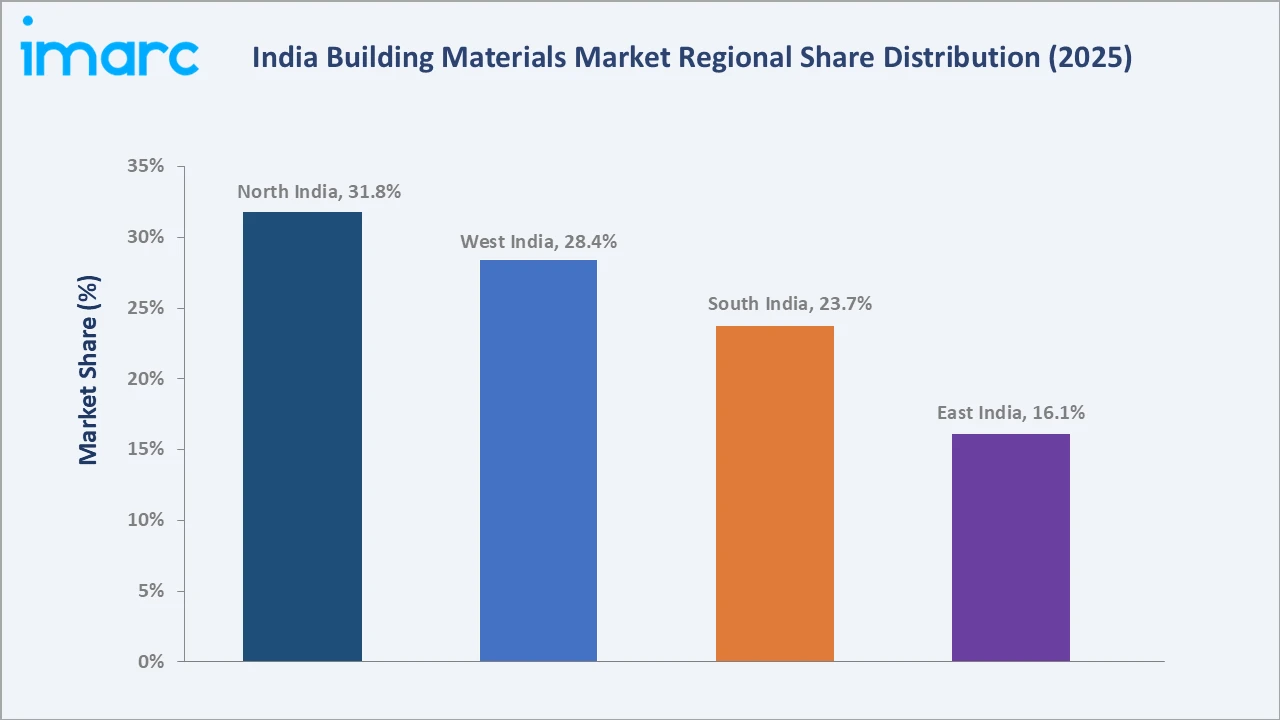
South India at 23.7% is anchored by technology-sector-driven commercial construction and residential demand in the major southern metros. East India at 16.1% is the smallest regional contributor but is experiencing growing momentum from NIP-allocated infrastructure projects and new industrial investments that are creating incremental building material demand.
Competitive Landscape
The India building materials market is moderately concentrated at the cement segment level. The broader building materials market, including aggregates, bricks, and specialty products, is more fragmented, with thousands of regional quarry operators, brick kiln owners, and specialty product manufacturers serving localized demand.
|
Company |
Key Offerings |
Market Position |
Core Strength |
|
Aditya Birla Group |
UltraTech Cement, UltraTech Weather Plus, Ready Mix Concrete, UltraTech Building Solutions |
Market Leader |
The Aditya Birla Group is a dominant force in India's building materials and construction ecosystem, anchored by market-leading manufacturing and digital procurement platforms. |
|
Tata Group |
Tata Tiscon Rebars, Tata Structura Steel Hollow Sections, TATA Wiron, Tiscon Superlinks |
Market Leader |
The Tata Group plays a foundational role in India's building materials and construction sector, primarily through material manufacturing, sustainable infrastructure solutions, and digital consumer platforms. |
|
JSW Group |
JSW Steel, JSW Paints, JSW Cement |
Established Player |
JSW Group drives India's building materials and construction sector through integrated manufacturing in steel, green cement, and paints |
|
SAIL |
SAIL TMT BARS, SAIL SeQR TMT Bars |
Innovator |
The Steel Authority of India Limited (SAIL) serves as a foundational pillar in India's building materials sector by supplying high-grade structural steel, TMT bars, and specialty products for nationwide construction. |
|
Adani Group |
Ambuja Cements, ACC Cement, ACC Ready to Mix Concrete, ACC Bricks and Blocks |
Established Player |
The Adani Group operates as India's second-largest cement and building materials producer through its subsidiaries, Ambuja Cements and ACC Limited. |
Competition in India cement market is intensifying as large players aggressively expand capacity through both organic greenfield investment and acquisitions of smaller regional producers. The capacity expansion race is reshaping competitive dynamics, while smaller specialized players focus on regional leadership positions and specific product niche differentiation in white cement, slag cement, and specialty building products to maintain competitive viability.
Key Company Profiles
Aditya Birla Group
Aditya Birla Group is a diversified multinational conglomerate with a significant presence in India’s building materials industry, primarily through its cement and related businesses. The group serves residential, commercial, and infrastructure construction markets with a broad portfolio of building solutions. Its extensive manufacturing footprint, distribution network, and established brand presence support its market reach across India. The group also emphasizes innovation, operational efficiency, and sustainable building solutions to address evolving construction industry requirements.
- Key Offerings: UltraTech Cement, UltraTech Weather Plus, Ready Mix Concrete, UltraTech Building Solutions.
- Strategic Focus: Expanding its building materials presence through capacity enhancement, product diversification, and operational efficiency. The group also emphasizes sustainable manufacturing, low-carbon solutions, digitalization, and distribution expansion to address evolving construction needs across India.
Adani Group
Adani Group is a diversified Indian conglomerate with a growing presence in the building materials industry, particularly across cement and related construction materials. The group serves residential, commercial, industrial, and infrastructure development markets through its extensive manufacturing and distribution network. Its integrated operations and logistics capabilities support efficient production and nationwide market reach. The group also emphasizes capacity expansion, operational efficiency, sustainability, and technology adoption across its building materials businesses.
- Key Offerings: Ambuja Cements, ACC Cement, ACC Ready to Mix Concrete, ACC Bricks and Blocks.
- Strategic Focus: Strengthening its building materials business through capacity expansion, operational integration, and an extensive distribution network. The group also emphasizes cost efficiency, sustainable manufacturing, digitalization, and low-carbon building solutions to address India’s growing construction and infrastructure demand.
Market Concentration Analysis
The India building materials market exhibits moderate to high concentration at the cement segment level, where the top five companies Aditya Birla Group, Tata Group, JSW Group, SAIL, and Adani Group collectively command approximately 59% of installed capacity and a similar proportion of organized sector sales revenue as of 2025. This concentration has increased progressively through a decade of consolidation, as larger players acquired smaller regional producers and built scale-based cost advantages that are difficult for mid-tier producers to match.
The broader building materials market, including aggregates, bricks, AAC blocks, and specialty products, is significantly more fragmented, with thousands of small and medium operators serving regional demand. Aggregates production in particular is geographically dispersed across quarry operations spread across all states, with no single company commanding meaningful national market share. This fragmentation creates ongoing opportunities for organized players and digital procurement platforms to improve supply chain efficiency.
Investment & Growth Opportunities
Highest Growth Segments
Residential construction at 52.8% represents the largest and most consistently growing demand segment, sustained by demographic urbanization and government housing scheme commitments that provide policy-backed demand visibility. Infrastructure construction, particularly roads, metro rail, airports, and urban utilities, offers the highest volume growth driven by NIP budget allocations. Green and blended building materials represent the highest-margin growth opportunity as sustainability requirements become standard in commercial and institutional project specifications.
Investment Themes
- Green and Sustainable Building Materials: Government Green Rating mandates, corporate sustainability commitments from large real estate developers, and consumer preference for healthier and more energy-efficient homes are creating growing demand for AAC blocks, fly ash bricks, low-carbon blended cement, and sustainable construction chemicals. Investment in these product categories offers superior margin profiles and long-term demand visibility.
- Digital Building Material Distribution Platforms: The fragmented traditional trade distribution model for building materials presents a large opportunity for digital procurement platforms, organized dealer networks, and direct-from-manufacturer logistics solutions to improve price transparency, reduce supply chain layers, and improve product quality assurance across the large and geographically dispersed India building materials distribution landscape.
Future Market Outlook (2026-2034)
The India building materials market grew from USD 44.40 Billion in 2025 to USD 46.28 Billion in 2026, reaching USD 64.51 Billion by 2034, exhibiting a CAGR of 4.24% during the forecast period. The market is expected to reach an intermediate milestone of approximately USD 54.64 Billion by 2030, as the largest infrastructure investment programs under the National Infrastructure Pipeline reach peak construction activity and the cumulative effect of PMAY housing scheme completions generates broad-based material demand across all regions.
Three structural forces will define India building materials market through 2034. First, sustained government infrastructure investment will provide a policy-backed demand floor that insulates the building materials market from cyclical private sector construction slowdowns. Second, India demographic urbanization trajectory will sustain residential construction activity at a scale that requires consistent multi-year investment in housing material production capacity. Third, the progressive adoption of green building standards, prefabrication technology, and advanced construction materials will gradually shift value toward higher-margin, technology-intensive product categories within the broader building materials market through 2034.
Research Methodology
Primary Research
Primary research comprised structured consultations with building material manufacturing executives, construction company procurement managers, government infrastructure project officials, building material distributor networks, and real estate developer representatives. These discussions validated market sizing estimates, assessed regional demand dynamics, identified regulatory drivers, and provided insights into competitive positioning and capacity investment planning across the India building materials sector.
Secondary Research
Secondary research drew on published government data including project databases, Union Budget allocations, PMAY scheme progress reports, Ministry of Mines production statistics, company annual reports and investor presentations, BIS standards documentation, and industry publications covering Indian construction and building materials sectors. Historical market data spanning 2020 through 2025 was cross-validated across primary and secondary sources.
Forecasting Models
Market forecasts were developed using bottom-up and top-down modeling approaches incorporating historical sector growth rates, infrastructure capital expenditure projections, housing demand models based on urbanization and income growth, private real estate investment cycle analysis, capacity expansion announcements by major producers, government policy continuity assumptions, and macroeconomic indicators including GDP growth, construction sector PMI trends, and cement consumption per capita benchmarks.
India Building Materials Market Report Coverage:
| Report Features | Details |
|---|---|
| Base Year of the Analysis | 2025 |
| Historical Period | 2020-2025 |
| Forecast Period | 2026-2034 |
| Units | Billion USD |
| Scope of the Report |
Exploration of Historical Trends and Market Outlook, Industry Catalysts and Challenges, Segment-Wise Historical and Future Market Assessment:
|
| Types Covered | Aggregates, Cement, Bricks, Others |
| Applications Covered | Residential, Commercial, Industrial |
| Regions Covered | North India, South India, East India, West India |
| Companies Covered | Aditya Birla Group, Tata Group, JSW Group, SAIL, Adani Group, etc. |
| Customization Scope | 10% Free Customization |
| Post-Sale Analyst Support | 10-12 Weeks |
| Delivery Format | PDF and Excel through Email (We can also provide the editable version of the report in PPT/Word format on special request) |
Key Benefits for Stakeholders:
- IMARC’s industry report offers a comprehensive quantitative analysis of various market segments, historical and current market trends, market forecasts, and dynamics of the India building materials market from 2020-2034.
- The research report provides the latest information on the market drivers, challenges, and opportunities in the India building materials market.
- Porter's five forces analysis assist stakeholders in assessing the impact of new entrants, competitive rivalry, supplier power, buyer power, and the threat of substitution. It helps stakeholders to analyze the level of competition within the India building materials industry and its attractiveness.
- Competitive landscape allows stakeholders to understand their competitive environment and provides an insight into the current positions of key players in the market.
Frequently Asked Questions About the India Building Materials Market Report
The India building materials market reached USD 46.28 Billion in 2026, driven by government infrastructure investment, PMAY affordable housing scheme activity, and growing commercial and industrial construction.
The market is projected to grow at a CAGR of 4.24% during 2026-2034, supported by sustained government infrastructure capital expenditure, residential housing demand, and progressive adoption of advanced and sustainable building material products.
The market is projected to reach approximately USD 54.64 Billion by 2030, driven by peak NIP infrastructure construction activity, PMAY housing scheme completions, and growing commercial and industrial construction across major economic zones.
Cement leads with a 38.7% share in 2025, reflecting its foundational role as the primary structural binding material across all construction categories, supported by India installed cement capacity and serving consistent domestic demand.
Cement leads with a 38.7% share in 2025, reflecting its foundational role as the primary structural binding material across all construction categories, supported by India installed cement capacity and serving consistent domestic demand.
North India leads with a 31.8% share in 2025, reflecting high construction activity density across residential, infrastructure, and industrial construction segments.
Key players include Aditya Birla Group, Tata Group, JSW Group, SAIL, and Adani Group, among others.
The market is projected to reach USD 64.51 Billion by 2034, driven by sustained infrastructure investment, residential housing demand growth, commercial real estate expansion, and increasing adoption of premium and sustainable building material products.
Need more help?
- Speak to our experienced analysts for insights on the current market scenarios.
- Include additional segments and countries to customize the report as per your requirement.
- Gain an unparalleled competitive advantage in your domain by understanding how to utilize the report and positively impacting your operations and revenue.
- For further assistance, please connect with our analysts.
 Request Customization
 Speak to an Analyst
 Request Brochure
 Inquire Before Buying
Benefits of Customization
- Personalize this research
- Triangulate with your data
- Get data as per your format and definition
- Gain a deeper dive into a specific application, geography, customer, or competitor
- Any level of personalization
Get in Touch With Us
UNITED STATES
Phone: +1-201-971-6302
INDIA
Phone: +91-120-433-0800
UNITED KINGDOM
Phone: +44-753-714-6104
Email: [email protected]
Client Testimonials






















Related Reports

Choose your plan
*Please note that the prices mentioned below are starting prices for each bundle type. Kindly contact our team for further details.*
Single User License
- 1 User License, Access on 2 Devices
- PDF Report + Excel Dataset (Password Protected)
- Lifetime Access
- No Printing Rights
- 10% Free Report Customization
- 10–12 Weeks of Analyst Support
Five User License
- Access for 5 Users, 2 Devices per User
- PDF Report + Excel Dataset (Password Protected)
- Lifetime Access
- Dedicated Account Manager
- 12–14 Weeks of Analyst Support
- No Printing Rights
- 15% Free Report Customization
- 25% Discount on Your Next Purchase
Corporate User License
- Unlimited User Access (Within Your Organization)
- PDF Report + Excel Dataset
- Lifetime Access
- Dedicated Account Manager
- 14–20 Weeks of Analyst Support
- No Printing Rights
- 20% Free Report Customization
- 30% Discount on Your Next Purchase
Essential Insights
What's included:
3 reports
- Lifetime Access
- PDF Reports
- Excel Datasets
- 2 Weeks of Free Analyst Support
- 2 User Licenses
- Access on 2 Devices
- Printing Rights
- Complimentary PowerPoint (PPT) Version
- Complimentary License Upgrade
Professional Access
What's included:
5 reports
- Lifetime Access
- PDF Reports
- Excel Datasets
- 8 Weeks of Free Analyst Support
- 2 User Licenses
- Access on 2 Devices
- Printing Rights
- Complimentary PowerPoint (PPT) Version
- Complimentary License Upgrade
Business Advantage
What's included:
8 reports
- Lifetime Access
- PDF Reports
- Excel Datasets
- 14 Weeks of Free Analyst Support
- 2 User Licenses
- Access on 2 Devices
- Printing Rights
- Complimentary PowerPoint (PPT) Version
- Complimentary License Upgrade
Enterprise Intelligence
What's included:
10 reports
- Lifetime Access
- PDF Reports
- Excel Datasets
- 20 Weeks of Free Analyst Support
- 2 User Licenses
- Access on 2 Devices
- Printing Rights
- Complimentary PowerPoint (PPT) Version
- Complimentary License Upgrade