
India Buy Now Pay Later Market Size, Share, Trends and Forecast by Channel, Enterprise Size, End Use, and Region, 2026-2034
India Buy Now Pay Later Market Size, Share, Trends & Forecast (2026-2034)
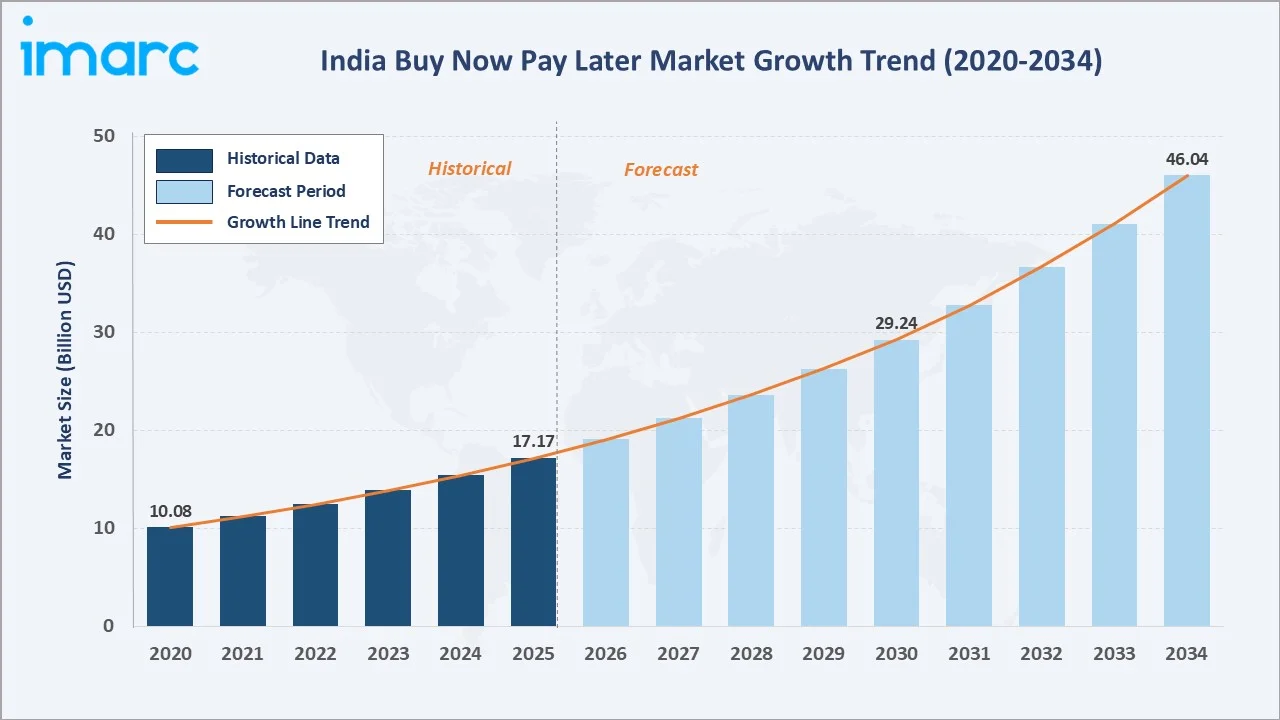
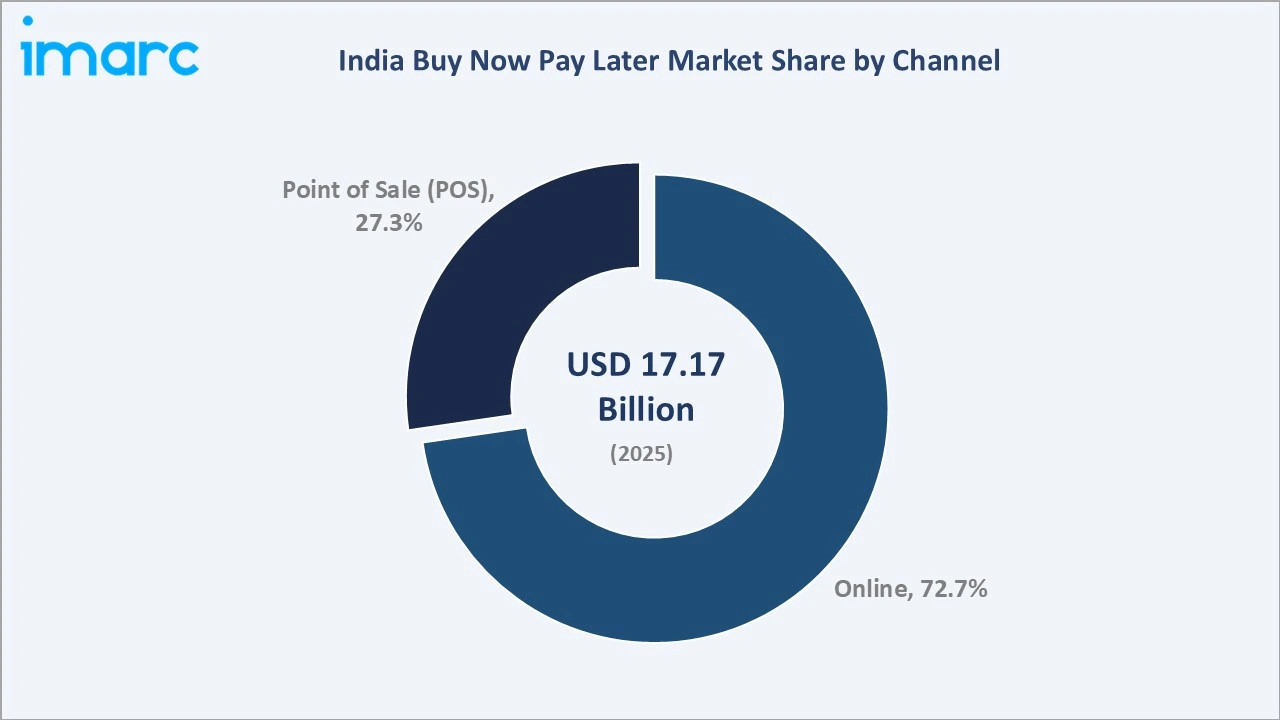
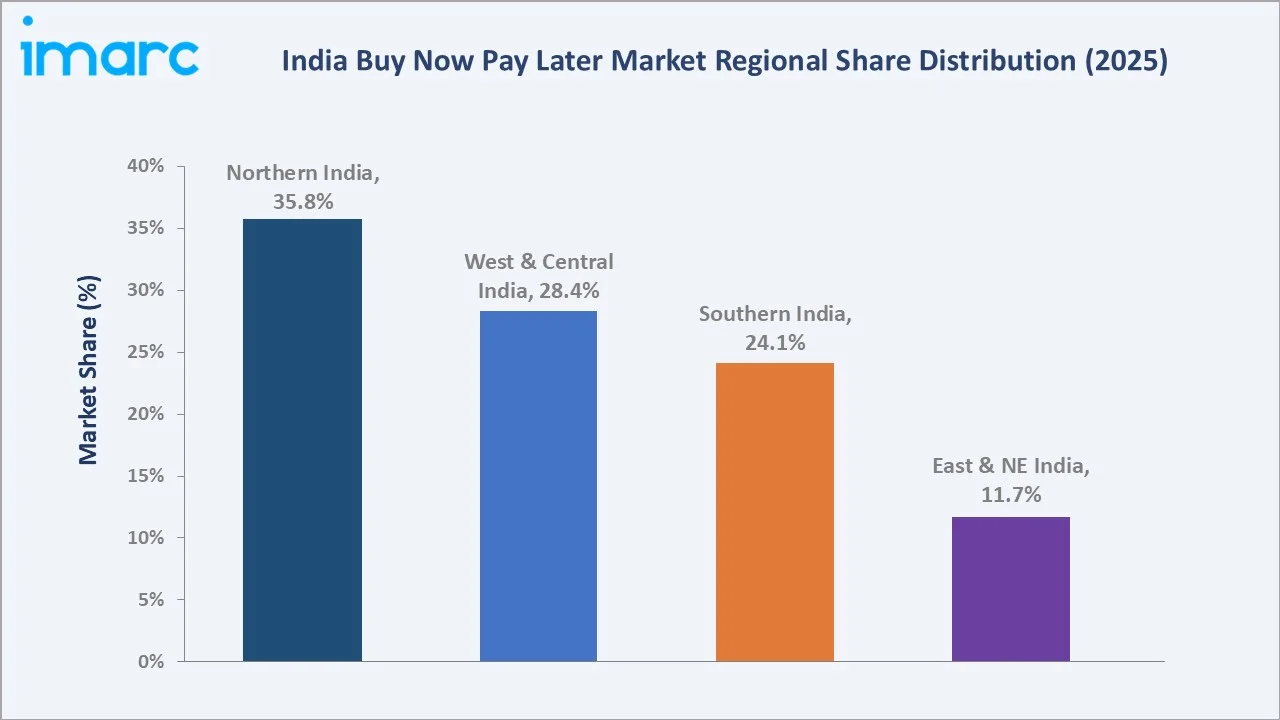
The India Buy Now Pay Later (BNPL) market grew from USD 17.17 Billion in 2025 to USD 19.10 Billion in 2026 and is projected to reach USD 46.04 Billion by 2034, growing at a CAGR of 11.24% during 2026-2034. Rising e-commerce adoption, growing financial inclusion, and AI-driven credit underwriting are accelerating BNPL deployment across online and point-of-sale channels. Online at 72.7% leads channel share; Large Enterprises at 62.6% dominate enterprise size; Northern India leads regionally at 35.8%.
Market Snapshot
|
Metric |
Value |
|
Base Year Market Size (2025) |
USD 17.17 Billion |
|
Market Size (2026) |
USD 19.10 Billion |
|
Forecast Market Size (2034) |
USD 46.04 Billion |
|
CAGR (2026-2034) |
11.24% |
|
Base Year |
2025 |
|
Historical Period |
2020-2025 |
|
Forecast Period |
2026-2034 |
|
Dominant Channel |
Online (72.7%, 2025) |
|
Dominant Enterprise Segment |
Large Enterprises (62.6%, 2025) |
|
Leading Region |
Northern India (35.8%, 2025) |
The India Buy Now Pay Later market size increased from USD 10.08 Billion in 2020 to USD 17.17 Billion in 2025 and is estimated to reach USD 19.10 Billion in 2026. The market is further expected to grow to USD 29.24 Billion by 2030 and USD 46.04 Billion by 2034. India's BNPL market uniquely combines mass-consumer deferred payment demand, a rapidly growing B2B segment, and a premium credit layer for India's expanding affluent urban population.
To get more information on this market, Request Sample
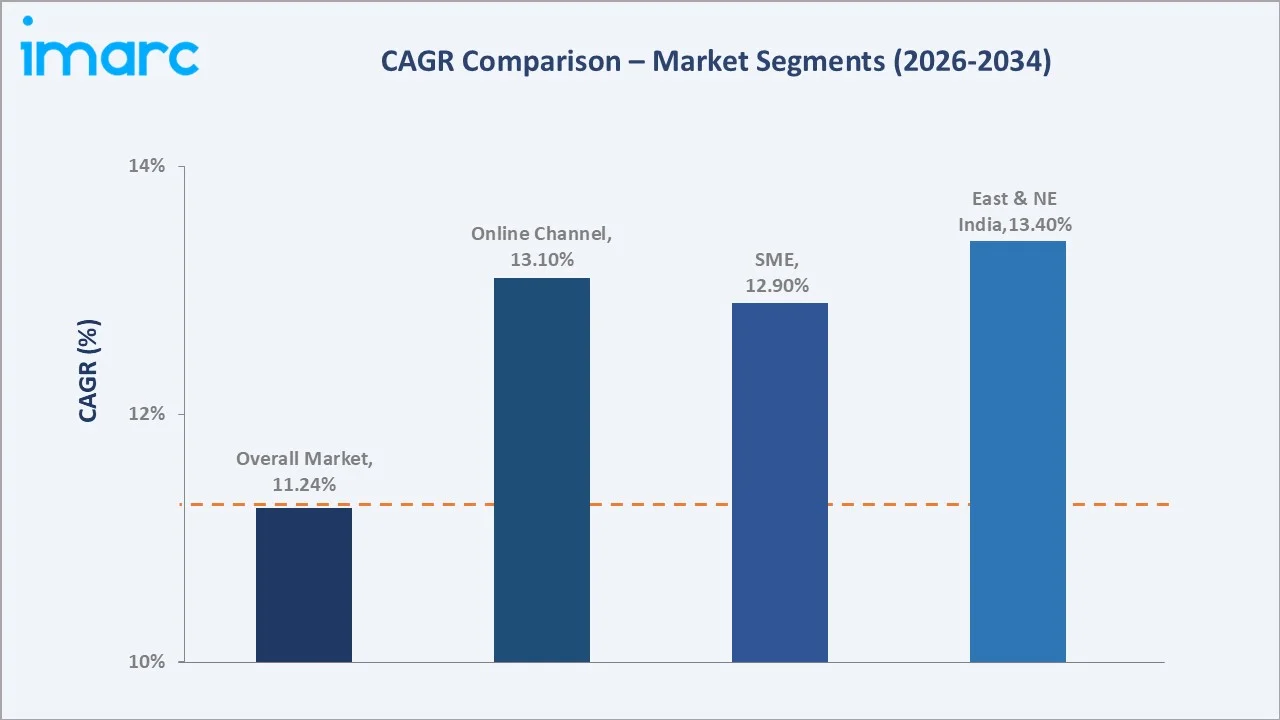
Online BNPL grows at 13.1% CAGR through deep e-commerce integrations. The SME segment grows fastest at 12.9% CAGR as B2B BNPL targets India's small business procurement market. East & Northeast India leads regional growth at 13.4% CAGR.
Executive Summary
The India BNPL market grew from USD 17.17 Billion in 2025 to USD 19.10 Billion in 2026, positioning India among Asia's largest and most commercially dynamic BNPL markets. The market is underpinned by India's expanding e-commerce ecosystem, a vast underbanked population creating first-time digital credit demand, and emerging B2B BNPL for SME supply chain financing. Online at 72.7% leads channel share; Large Enterprises at 62.6% dominate enterprise size; Northern India leads regionally at 35.8%. The market is projected to reach USD 46.04 Billion by 2034.
Key Market Insights
|
Insight |
Data |
|
Dominant Channel |
Online – 72.7% share (2025) |
|
Dominant Enterprise Size Segment |
Large Enterprises – 62.6% market share (2025) |
|
Leading Region |
Northern India – 35.8% share (2025) |
|
Market Opportunity |
B2B BNPL targeting USD 530 Billion SME credit gap; rural & Tier-II/III consumer expansion; RegTech compliance moats through 2034. |
Key Analytical Observations:
- Online at 72.7%: Dominant through India's surging e-commerce adoption with embedded BNPL integrations at checkout across fashion, electronics, travel, and grocery. Zero-interest EMI options and one-tap BNPL APIs create structural consumer preference for online over POS BNPL.
- Large Enterprises at 62.6%: Leads through high-value procurement financing, B2B supply chain credit requirements, and corporate treasury adoption. Enterprise BNPL spans manufacturing, distribution, healthcare, and IT services with recurring high-ticket transaction volumes.
- Northern India at 35.8%: Leads through Delhi-NCR's high urban consumer density, India's strongest corporate procurement market, and above-national digital payment adoption in both consumer and B2B BNPL.
India Buy Now Pay Later Market Overview
India's BNPL market sits at the intersection of the world's most populous country, a rapidly expanding digital payments infrastructure, and a financial inclusion mandate making BNPL the most commercially embedded digital credit product in the economy. The market structure is characterized by India's UPI-driven instant transaction infrastructure, which enables real-time credit underwriting at point of purchase and creates transactional behavioral data that BNPL lenders leverage for alternative scoring.
The BNPL ecosystem integrates domestic FinTechs, banking NBFCs, global payment platforms, and embedded finance providers. Macroeconomic factors include rising digital commerce adoption, India's growing millennial and Gen Z population with limited traditional credit access, and expanding SME formalization creating structured business credit demand. The Reserve Bank of India (RBI) continues to shape market conduct through digital lending guidelines, FLDG regulations, and prepaid payment instrument rules, ensuring sustainable long-term market development aligned with India's broader financial inclusion objectives.
Market Dynamics
To evaluate market opportunities, Request Sample
Market Drivers
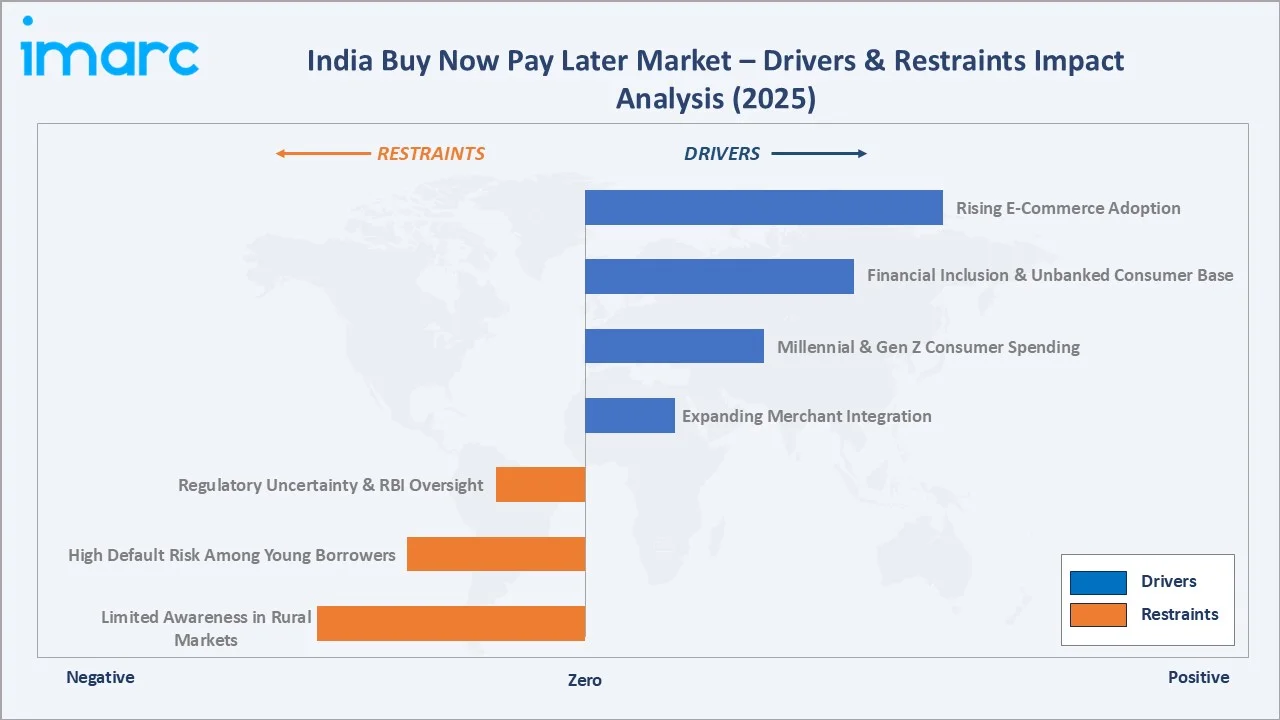
- Rising E-Commerce Adoption: The rapid expansion of India’s e-commerce sector is driving sustained demand for embedded BNPL at online checkout across product categories. Transactional data generated through digital commerce activity enables real-time credit underwriting for consumers in emerging urban and semi-urban markets previously excluded from formal credit access. As merchant ecosystems deepen their digital infrastructure, BNPL integration is becoming a standard component of checkout architecture rather than an optional financing overlay.
- Financial Inclusion & Unbanked Consumer Base: A large segment of India’s adult population lacks formal credit access, creating structural demand for alternative credit delivery mechanisms. BNPL platforms underwrite through non-traditional data sources enabling credit extension to first-time borrowers at scale aligned with financial inclusion objectives. The convergence of digital identity infrastructure and alternative credit scoring creates a pathway for BNPL platforms to serve segments that conventional credit products cannot reach economically.
- Millennial & Gen Z Consumer Spending: India’s large millennial and Gen Z population forms the core BNPL demographic, combining high digital payment adoption with a demonstrated preference for deferred payment over traditional credit products. Their familiarity with app-based financial services reduces the onboarding friction that constrains adoption among older demographic cohorts. This generational behavioral shift toward embedded, frictionless credit creates durable structural demand for BNPL products through the forecast period.
- Expanding Merchant Integration: Organized retail, e-commerce platforms, and B2B marketplaces are embedding BNPL as standard checkout infrastructure across consumer and enterprise purchasing channels. Merchants adopting BNPL report measurable improvement in average order values and reduced cart abandonment, reinforcing platform incentives to deepen BNPL integration. Growing merchant acceptance creates a positive network effect where expanded checkout coverage accelerates consumer adoption and transaction volume growth simultaneously.
Market Restraints
- Regulatory Uncertainty & RBI Oversight: Evolving RBI digital lending guidelines impose compliance architecture requirements that disproportionately burden smaller BNPL platforms and constrain product innovation across the sector. Regulatory uncertainty around prepaid payment instrument classification and co-lending partnership structures creates planning risk for platforms designing multi-year product roadmaps. Continuous regulatory evolution requires platforms to maintain adaptive compliance infrastructure as an ongoing operational capability rather than a one-time implementation effort.
- High Default Risk Among Young Borrowers: First-time borrowers from younger demographic cohorts tend to exhibit above-market default risk during economic stress periods due to income volatility and limited credit management experience. Platforms without robust credit decisioning and collection infrastructure face disproportionate credit loss exposure when macroeconomic conditions tighten. Building resilient underwriting models capable of distinguishing creditworthy thin-file borrowers from high-risk profiles remains a persistent technical and operational challenge for the sector.
- Limited Awareness in Rural Markets: Consumer awareness and digital literacy barriers limit BNPL adoption beyond existing e-commerce and smartphone penetration zones, creating a structural gap between addressable and accessible market opportunity. Sequential adoption prerequisites must be satisfied before BNPL onboarding becomes viable for new consumer segments. Platform investment in regional language interfaces and simplified onboarding flows is necessary to convert latent rural demand into active transaction volume.
Market Opportunities
- B2B BNPL for SME Supply Chain Financing: India’s large SME ecosystem faces a substantial structural credit gap in supply chain financing and working capital, creating addressable demand for purpose-built B2B BNPL products. GST-linked financial data enables automated creditworthiness assessment through verified transaction records, reducing underwriting costs and enabling scalable lending to formally documented small businesses. Platforms that establish early supply chain relationships and proprietary underwriting data assets in specific verticals gain defensible market positions with high switching costs.
- Rural & Tier-II/III Consumer Expansion: Expanding rural smartphone and internet penetration is progressively creating the digital infrastructure prerequisite for mass BNPL adoption in underserved geographic markets. First-mover platforms establishing local-language interfaces, regional merchant partnerships, and rural-calibrated credit models gain durable positioning ahead of competitors entering at later market maturity stages. Increasing formalization of rural economic activity and growing digital payment behavior among new internet users provide the behavioral foundation for BNPL onboarding at scale.
Market Challenges
- Regulatory Compliance Architecture: Platforms face ongoing investment in KYC infrastructure, credit bureau integration, and regulatory reporting systems that create fixed cost burdens independent of transaction volume scale. RBI restrictions on first-loss default guarantee structures have restructured bank-platform partnership economics, requiring NBFC licensing or business model redesign for platforms previously reliant on co-lending frameworks. Compliance cost per transaction remains elevated for subscale platforms, creating a structural profitability disadvantage relative to larger incumbents able to amortize compliance investment across higher transaction volumes.
- Customer Acquisition Cost Pressure: Competitive intensity across BNPL platforms has driven consumer acquisition costs to levels that strain unit economics, particularly for standalone platforms without an embedded distribution advantage. Merchant subsidy requirements and low consumer switching costs between BNPL providers compress net revenue per transaction, limiting the margin available to fund growth investment. Platforms achieving sustainable economics must develop proprietary engagement mechanisms that reduce dependence on performance marketing for volume growth.
Emerging Market Trends
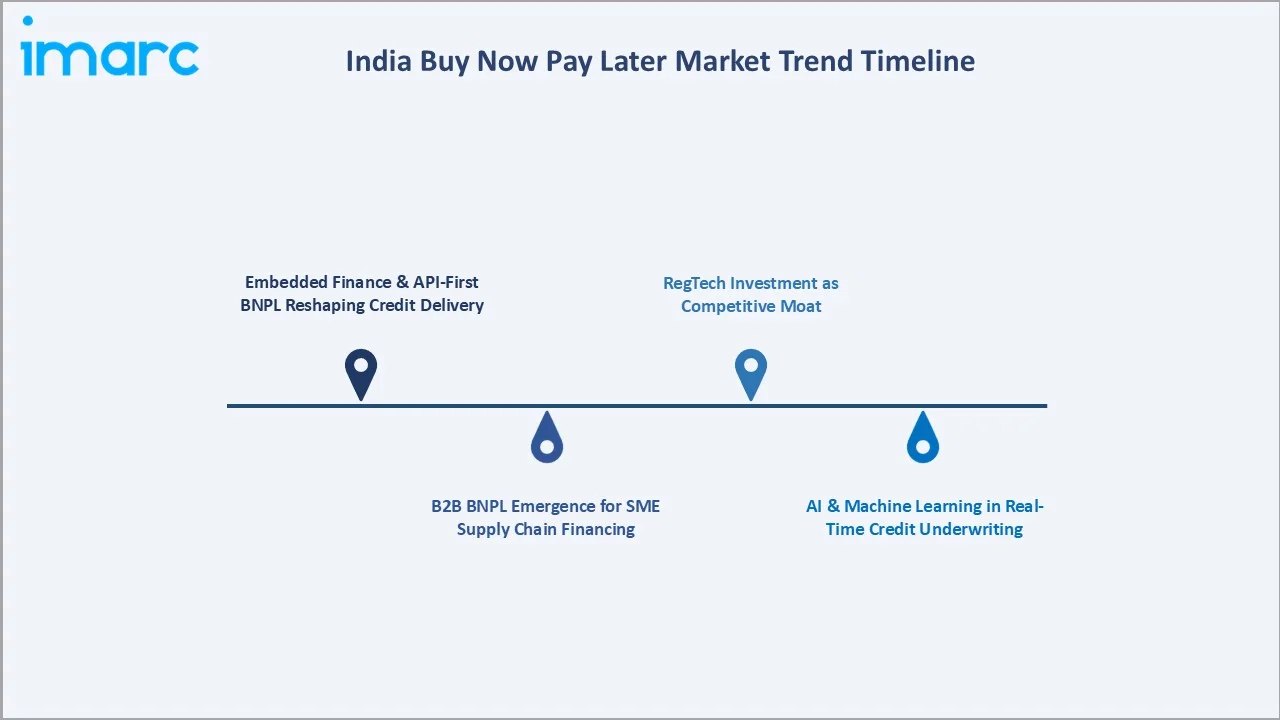
1. Embedded Finance & API-First BNPL Reshaping Credit Delivery
API-first platforms are enabling direct BNPL embedding within merchant apps, e-commerce checkout flows, and enterprise ERP systems. BNPL-as-a-Service providers offering pre-built, RBI-compliant credit origination allow non-financial platforms to offer branded BNPL products without proprietary credit infrastructure, expanding consumer touchpoints while reducing standalone platform acquisition cost disadvantage.
2. B2B BNPL Emergence for SME Supply Chain Financing
B2B BNPL platforms targeting India's 63 million SME ecosystem are creating a parallel enterprise credit market growing at above-consumer-BNPL rates. GST-linked transaction data enables automated SME creditworthiness assessment, and supply chain financing connecting enterprise buyers with SME vendor networks creates high-switching-cost marketplace positions with recurring transaction volume growth.
3. AI & Machine Learning in Real-Time Credit Underwriting
Proprietary ML models analyzing behavioral transaction data, spending patterns, and alternative credit indicators enable real-time credit decisioning under two seconds. Deep learning fraud detection reduces loss ratios, while generative AI for personalized credit offers and dynamic limit management creates efficiency frontiers in BNPL customer lifecycle management.
4. RegTech Investment as Competitive Moat
RBI's digital lending framework is transforming regulatory compliance from a cost center into a competitive moat. Platforms with automated KYC, real-time AML monitoring, and digital collection documentation reduce per-transaction compliance costs, creating structural operational advantages over competitors with manual compliance workflows.
Industry Value Chain Analysis
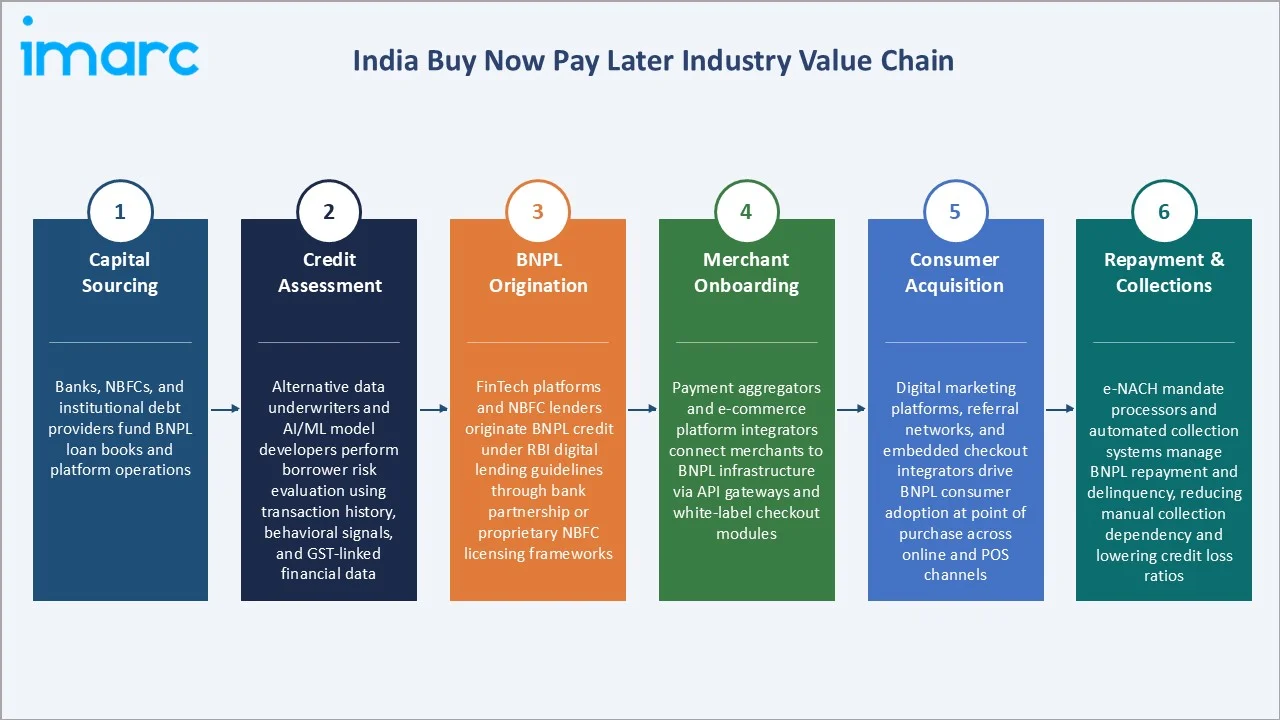
India's BNPL value chain is one of the most vertically integrated of any financial product category, encompassing capital sourcing, credit assessment, origination, merchant onboarding, consumer acquisition, and repayment collection. The commercial structure creates a unique market dynamic where FinTech platforms compete alongside licensed NBFCs across overlapping consumer and SME credit objectives.
|
Stage |
Key Participants |
| Capital Sourcing | Banks, NBFCs, and institutional debt providers fund BNPL loan books and platform operations |
| Credit Assessment | Alternative data underwriters and AI/ML model developers perform borrower risk evaluation using transaction history, behavioral signals, and GST-linked financial data |
| BNPL Origination | FinTech platforms and NBFC lenders originate BNPL credit under RBI digital lending guidelines through bank partnership or proprietary NBFC licensing frameworks |
| Merchant Onboarding | Payment aggregators and e-commerce platform integrators connect merchants to BNPL infrastructure via API gateways and white-label checkout modules |
| Consumer Acquisition | Digital marketing platforms, referral networks, and embedded checkout integrators drive BNPL consumer adoption at point of purchase across online and POS channels |
| Repayment & Collections | e-NACH mandate processors and automated collection systems manage BNPL repayment and delinquency, reducing manual collection dependency and lowering credit loss ratios |
Merchant onboarding and consumer acquisition are the most commercially consequential competitive battlegrounds, with BNPL platforms investing 15–30% of India revenue on digital marketing, merchant subsidies, and checkout integration to build network-effect advantages in acceptance and transaction volume.
Technology Landscape in the India BNPL Market
Digital Payments Infrastructure & Open Finance Stack
India's UPI ecosystem, Aadhaar-based eKYC, and Account Aggregator (AA) framework provide foundational technology infrastructure for seamless BNPL onboarding and real-time credit assessment. UPI generates behavioral data that lenders leverage for credit underwriting. The AA framework's consent-based financial data sharing allows access to bank statements, GST filings, and investment records, creating a regulated open finance infrastructure unmatched globally. e-NACH mandates enable automated repayment, significantly reducing collection costs.
AI & Machine Learning in Credit Decisioning
Proprietary ML models analyzing transaction data, spending patterns, and alternative credit indicators enable real-time credit decisions under two seconds while maintaining credit quality. Deep learning fraud detection monitoring device fingerprints, location signals, and transaction velocity reduces fraudulent application rates. Generative AI for personalized credit offers and dynamic limit management is creating new efficiency frontiers across the BNPL customer lifecycle.
Embedded Finance & API-First Architecture
API-first platforms enabling direct BNPL embedding within merchant apps, checkout flows, and enterprise ERPs eliminate consumer acquisition friction. BNPL-as-a-Service providers offer pre-built, RBI-compliant credit origination infrastructure allowing non-financial platforms to deploy branded BNPL products. Integration of AA financial data with merchant transaction signals creates 360-degree borrower profiles enabling accurate underwriting at lower cost.
Market Segmentation Analysis
The report covers the following segments:
|
Segment Category |
Leading Segment |
Market Share |
Year |
| Channel | Online |
72.7% |
2025 |
| Enterprise Size | Large Enterprises |
62.6% |
2025 |
| End Use | Retail | 72.7% | 2025 |
|
Region |
Northern India |
35.8% |
2025 |

By Channel
Online leads at 72.7% (2025), encompassing India's most commercially diverse BNPL deployment across fashion, electronics, travel, food delivery, and grocery. Deep integration with major marketplaces, one-tap BNPL activation, and zero-interest EMI options at checkout drive structural consumer preference for online over POS BNPL.
To access detailed market analysis, Request Sample
Point of Sale (POS) at 27.3% grows through organized retail BNPL integration in consumer electronics, furniture, and lifestyle retail. POS BNPL serves India's offline mass consumer market and reflects organized retail expansion and demand for accessible branded consumer financing at the point of purchase.
By Enterprise Size
Large Enterprises lead at 62.6% (2025) through structured B2B supply chain financing, corporate treasury working capital BNPL, and procurement credit across manufacturing, distribution, healthcare, and IT services verticals.
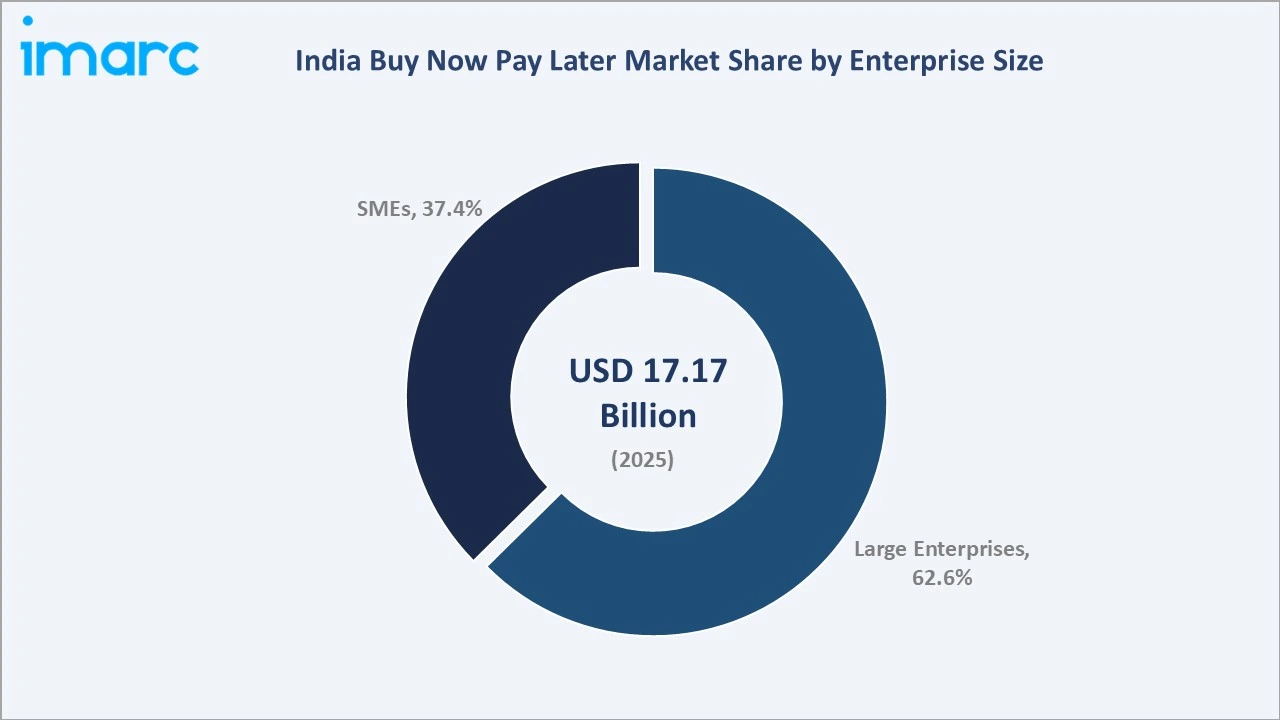
SMEs at 37.4% represent the highest-growth enterprise segment. B2B BNPL platforms with working capital and supply chain financing, enabled by GST-linked financial data that supports automated creditworthiness assessment at scale.
Regional Market Insights
|
Region |
Share (2025) |
Key India BNPL Market Drivers & Characteristics |
| Northern India |
35.8% |
High urban consumer density, strongest corporate procurement market, and above-national digital payment adoption driving both consumer and B2B BNPL leadership |
| West & Central India |
28.4% |
Mumbai's financial services ecosystem and Pune's tech-savvy consumer base supporting widespread online BNPL adoption and enterprise BNPL growth |
| Southern India |
24.1% |
IT sector consumer wealth creating premium BNPL demand; corporate procurement concentration and manufacturing supply chain B2B BNPL growth in major metro centers |
| East & NE India |
11.7% |
Rising digital payment adoption and expanding e-commerce penetration with the highest regional CAGR at 13.4% due to lower base effects and accelerating financial inclusion |
Northern India's 35.8% market leadership reflects Delhi-NCR's luxury retail density and India's highest-concentration corporate procurement market. West and Central India's 28.4% reflects Mumbai's HNI wealth concentration and Pune's premium e-commerce adoption. East & NE India's 11.7%, while smallest, grows fastest as digital financial inclusion accelerates from a lower penetration base.
Competitive Landscape
India's BNPL competitive landscape is the most commercially stratified of any Indian FinTech category. Competition spans pure-play FinTech BNPL platforms, banking-backed credit products, e-commerce-embedded BNPL, and B2B supply chain finance specialists. Consolidation is accelerating as regulatory compliance costs favor capitalized, banking-backed incumbents.
| Company | Key Offerings | Market Position | Core Strength |
|---|---|---|---|
| PayU | LazyPay BNPL | Market Leader | Broadest merchant network with partner integrations across e-commerce, travel, food, and utilities |
| DMI Finance | ZestMoney | Innovator | NBFC-licensed B2B and consumer BNPL with strong alternative data underwriting and SME credit infrastructure |
| Pine Labs | Pine Labs BNPL | Innovator | POS merchant network BNPL integration across organized retail creating offline BNPL deployment advantage |
Key players include PayU, DMI Finance, Pine Labs, and others.
Key Company Profiles
PayU
PayU is a leading global FinTech company Its India BNPL product, is embedded across various merchant partners spanning e-commerce, travel, food delivery, and utilities, serving India's urban digital consumer with instant checkout credit.
- Key Brands: LazyPay BNPL
- Strategic Focus: Deepening merchant integration in high-growth spending categories and expanding into Tier-II and Tier-III markets using AI-driven credit underwriting with UPI transaction data. B2B BNPL capabilities targeting SME working capital are also being expanded through existing merchant network relationships.
DMI Finance
DMI Finance is a technology-driven NBFC headquarters in New Delhi, offering consumer and SME lending through embedded finance partnerships. With a rapidly expanding digital credit footprint, DMI Finance has emerged as one of India’s prominent BNPL and personal loan providers.
- Key Brands: DMI Finance BNPL
- Strategic Focus: Deepening embedded finance partnerships with platform players across retail, healthcare, and education verticals to scale credit disbursals beyond metropolitan markets. DMI Finance leverages its hybrid underwriting engine combining traditional bureau data with alternative behavioural and transactional signals to extend BNPL access to thin-file and new-to-credit borrowers, with priority expansion into Tier-II and Tier-III cities through co-lending arrangements with scheduled commercial banks.
Market Concentration Analysis
The India BNPL market exhibits moderate-to-high concentration at the market leader tier, with the top three platforms collectively commanding an estimated 55–65% of consumer BNPL transaction volume. Market concentration in B2B BNPL is lower, reflecting the emerging nature of the segment and the presence of multiple specialized platforms targeting specific supply chain verticals without a single dominant player. The B2B segment's fragmentation creates an opportunity for well-capitalized platforms to establish early market leadership positions in a rapidly growing enterprise credit category.
The market's commercial evolution is characterized by the structural advantage of platform-embedded incumbents over standalone BNPL applications. Platforms with consumer touchpoints embedded in daily-use super-apps, e-commerce marketplaces, and payment wallets maintain structural acquisition cost advantages that standalone FinTech platforms cannot overcome through marketing investment alone.
Investment & Growth Opportunities
Highest Growth Segments
East & Northeast India (~13.4% CAGR), online BNPL channel (~13.1% CAGR), and SME-focused B2B BNPL (~12.9% CAGR) are India’s fastest-growing segments through 2034, supported by expanding internet penetration in underserved geographies, accelerating digital commerce adoption, and rising formal credit demand among small and mid-sized enterprises.
Emerging Investment Opportunities
Embedded B2B BNPL infrastructure credit gap represents the highest-value investment opportunity given current supply chain financing inefficiencies and limited formal credit access for micro and small enterprises. Domestic AI-driven credit underwriting platforms integrating alternative data — including GST filings, UPI transaction history, and utility payment records — offer defensible competitive moats and above-sector-average risk-adjusted returns for early-stage capital.
Investment Themes
- B2B BNPL Supply Chain Platforms: Embedded working capital solutions targeting India’s underserved SME segment, leveraging GST-linked transaction data and trade receivables as underwriting inputs, creating first-mover cost advantages across the B2B credit value chain as regulatory-mandated digital invoicing scales.
- RegTech & Compliance Infrastructure: Technology investment in RBI Digital Lending Guidelines compliance tooling, KYC automation, and FLDG monitoring systems, targeting the systemic compliance gap that currently increases operational costs for sub-scale BNPL platforms and creates consolidation pressure favouring well-capitalised incumbents with built-in regulatory infrastructure.
Future Market Outlook
The India BNPL market is projected to reach USD 19.10 Billion by 2026 and USD 46.04 Billion by 2034, with B2B BNPL normalization creating parallel enterprise demand alongside consumer BNPL, East & Northeast India accelerating above-national CAGR, and embedded finance infrastructure delivering BNPL access across India's digital economy at unprecedented geographic and demographic scale. Near-term catalysts include the Account Aggregator framework reaching full adoption scale, enabling consent-based financial data sharing that substantially reduces credit underwriting cost for BNPL platforms and unlocks previously unserved thin-file consumer segments.
Research Methodology
Primary Research
Primary research comprised structured interviews with BNPL platform executives, NBFC lending officers, merchant payment integration managers, and digital lending regulators. Consumer surveys across urban, semi-urban, and rural digital payment users in India's four major regions provided demand-side behavioral data. Expert consultations with RBI digital lending policy specialists provided regulatory framework context shaping growth trajectory through 2034.
Secondary Research
Secondary research incorporated RBI Annual Report data, SEBI digital lending disclosures, NPCI UPI transaction statistics, MeitY digital economy data, and published financial reports of publicly listed BNPL-adjacent companies. Industry association data from DLAI, Payment Council of India, and FACE supplemented regulatory data with operational benchmarks.
Forecasting Models
Market revenue forecasts used a consumer credit stratification model India's addressable digital consumer and SME population segmented by credit profile, BNPL adoption probability, and average transaction value per segment. A B2B credit multiplier and embedded finance penetration coefficient were applied to capture structural growth drivers across segments.
India Buy Now Pay Later Market Report Scope:
| Report Features | Details |
|---|---|
| Base Year of the Analysis | 2025 |
| Historical Period | 2020-2025 |
| Forecast Period | 2026-2034 |
| Units | Billion USD |
| Scope of the Report |
Exploration of Historical Trends and Market Outlook, Industry Catalysts and Challenges, Segment-Wise Historical and Future Market Assessment:
|
| Channels Covered | Online, Point of Sale (POS) |
| Enterprise Sizes Covered | Large Enterprises, Small and Medium-sized Enterprises |
| End Uses Covered | Consumer Electronics, Fashion and Garment, Healthcare, Leisure and Entertainment, Retail, Others |
| Regions Covered | North India, West and Central India, South India, East and Northeast India |
| Companies Covered | PayU, DMI Finance, Pine Labs, etc. |
| Customization Scope | 10% Free Customization |
| Post-Sale Analyst Support | 10-12 Weeks |
| Delivery Format | PDF and Excel through Email (We can also provide the editable version of the report in PPT/Word format on special request) |
Key Benefits for Stakeholders:
- IMARC’s report offers a comprehensive quantitative analysis of various market segments, historical and current market trends, market forecasts, and dynamics of the India buy now pay later market from 2020-2034.
- The India buy now pay later market research report provides the latest information on the market drivers, challenges, and opportunities in the regional market.
- The study maps the leading, as well as the fastest-growing, regional markets. It further enables stakeholders to identify the key markets within each region.
- Porter's five forces analysis assist stakeholders in assessing the impact of new entrants, competitive rivalry, supplier power, buyer power, and the threat of substitution. It helps stakeholders to analyze the level of competition within the India buy now pay later industry and its attractiveness.
- Competitive landscape allows stakeholders to understand their competitive environment and provides an insight into the current positions of key players in the market.
Frequently Asked Questions About the India Buy Now Pay Later Market Report
India Buy Now Pay Later market size is estimated at USD 19.10 Billion in 2026, driven by rapid e-commerce penetration, rising demand for short-tenure consumer credit among first-time borrowers, and accelerating digital payment adoption across urban and Tier-II markets.
India BNPL market grows at 11.24% CAGR during 2026-2034, reaching USD 46.04 Billion by 2034. Growth is sustained by e-commerce expansion, financial inclusion, B2B BNPL for SME financing, and embedded finance integration deepening BNPL's reach across India's digital economy.
Online channel leads at 72.7% through India's dominant e-commerce demand for embedded checkout financing, deep marketplace integration, one-tap BNPL activation, and zero-interest EMI options at checkout.
Large enterprises lead at 62.6% through high-value procurement financing and B2B supply chain credit across manufacturing, distribution, healthcare, and IT services verticals.
Northern India leads at 35.8% through Delhi-NCR's high urban consumer density, India's strongest corporate procurement market, and above-national digital payment adoption reinforcing leadership in consumer and B2B BNPL segments.
Leading companies include PayU, DMI Finance, Pine Labs, and others.
India BNPL market is projected to reach USD 29.24 Billion by 2030, with B2B BNPL normalization, East & Northeast India accelerating regional CAGR, and embedded finance infrastructure delivering BNPL access at unprecedented geographic and demographic scale.
Need more help?
- Speak to our experienced analysts for insights on the current market scenarios.
- Include additional segments and countries to customize the report as per your requirement.
- Gain an unparalleled competitive advantage in your domain by understanding how to utilize the report and positively impacting your operations and revenue.
- For further assistance, please connect with our analysts.
 Request Customization
 Speak to an Analyst
 Request Brochure
 Inquire Before Buying
Benefits of Customization
- Personalize this research
- Triangulate with your data
- Get data as per your format and definition
- Gain a deeper dive into a specific application, geography, customer, or competitor
- Any level of personalization
Get in Touch With Us
UNITED STATES
Phone: +1-201-971-6302
INDIA
Phone: +91-120-433-0800
UNITED KINGDOM
Phone: +44-753-714-6104
Email: [email protected]
Client Testimonials





















Related Reports

Choose your plan
*Please note that the prices mentioned below are starting prices for each bundle type. Kindly contact our team for further details.*
Single User License
- 1 User License, Access on 2 Devices
- PDF Report + Excel Dataset (Password Protected)
- Lifetime Access
- No Printing Rights
- 10% Free Report Customization
- 10–12 Weeks of Analyst Support
Five User License
- Access for 5 Users, 2 Devices per User
- PDF Report + Excel Dataset (Password Protected)
- Lifetime Access
- Dedicated Account Manager
- 12–14 Weeks of Analyst Support
- No Printing Rights
- 15% Free Report Customization
- 25% Discount on Your Next Purchase
Corporate User License
- Unlimited User Access (Within Your Organization)
- PDF Report + Excel Dataset
- Lifetime Access
- Dedicated Account Manager
- 14–20 Weeks of Analyst Support
- No Printing Rights
- 20% Free Report Customization
- 30% Discount on Your Next Purchase
Essential Insights
What's included:
3 reports
- Lifetime Access
- PDF Reports
- Excel Datasets
- 2 Weeks of Free Analyst Support
- 2 User Licenses
- Access on 2 Devices
- Printing Rights
- Complimentary PowerPoint (PPT) Version
- Complimentary License Upgrade
Professional Access
What's included:
5 reports
- Lifetime Access
- PDF Reports
- Excel Datasets
- 8 Weeks of Free Analyst Support
- 2 User Licenses
- Access on 2 Devices
- Printing Rights
- Complimentary PowerPoint (PPT) Version
- Complimentary License Upgrade
Business Advantage
What's included:
8 reports
- Lifetime Access
- PDF Reports
- Excel Datasets
- 14 Weeks of Free Analyst Support
- 2 User Licenses
- Access on 2 Devices
- Printing Rights
- Complimentary PowerPoint (PPT) Version
- Complimentary License Upgrade
Enterprise Intelligence
What's included:
10 reports
- Lifetime Access
- PDF Reports
- Excel Datasets
- 20 Weeks of Free Analyst Support
- 2 User Licenses
- Access on 2 Devices
- Printing Rights
- Complimentary PowerPoint (PPT) Version
- Complimentary License Upgrade