
India Catering Services Market Size, Share, Trends and Forecast by Service Type, End-User, and Region, 2026-2034
India Catering Services Market Size, Share, Trends & Forecast (2026-2034)
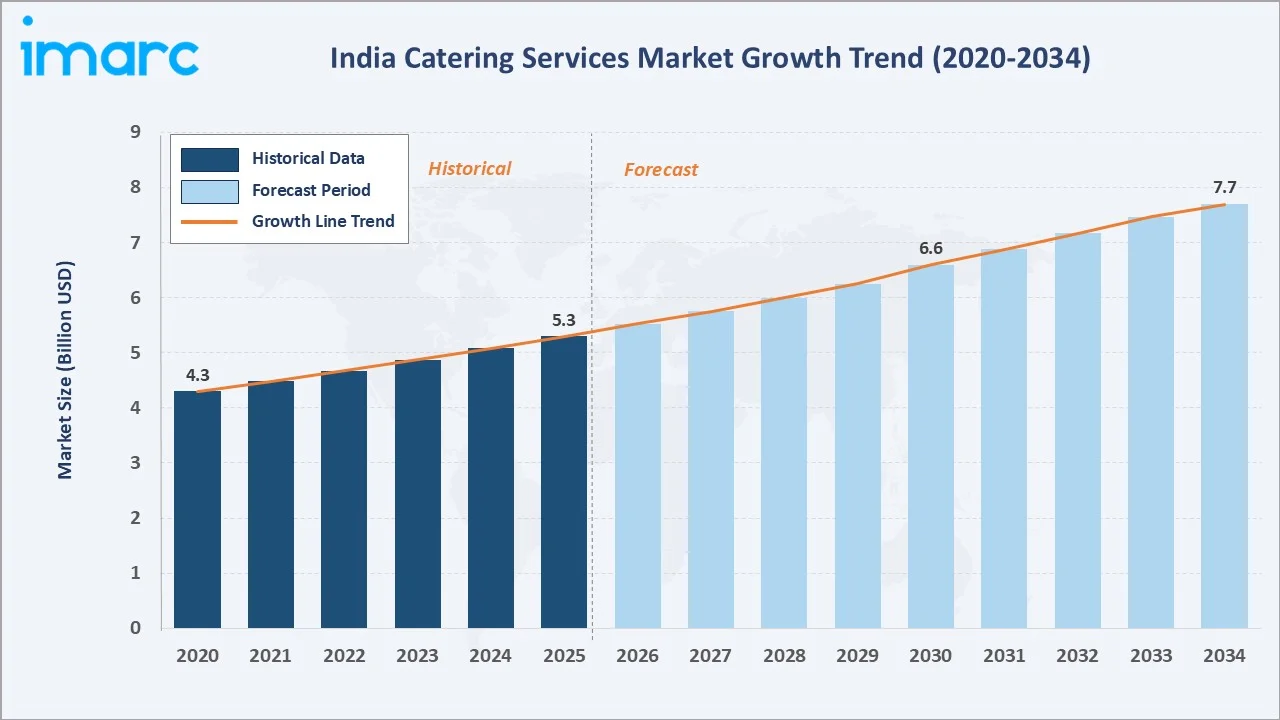
The India catering services market grew from USD 5.3 Billion in 2025 to USD 5.6 Billion in 2026 and is projected to reach USD 7.7 Billion by 2034, growing at a CAGR of 4.26% during 2026-2034. The market is driven by rising corporate outsourcing of canteen services, rapid industrial expansion, and growing awareness of workplace nutrition and employee wellbeing. India’s 46 lakh weddings between November 1 and December 14, 2025, are increasing demand for large-scale food preparation, customized menus, banquet catering, live food counters, and premium hospitality services. Contractual catering service leads service type at 68.7%. Industrial dominates end-user at 31.8%. West India leads regionally at 30.6%.
Market Snapshot
|
Metric |
Value |
|
Base Year Market Size (2025) |
USD 5.3 Billion |
| Market Size (2026) | USD 5.6 Billion |
|
Forecast Market Size (2034) |
USD 7.7 Billion |
|
CAGR (2026-2034) |
4.26% |
|
Base Year |
2025 |
|
Historical Period |
2020-2025 |
|
Forecast Period |
2026-2034 |
|
Dominant Service Type |
Contractual Catering Service (68.7%, 2025) |
|
Dominant End-User |
Industrial (31.8%, 2025) |
|
Leading Region |
West India (30.6%, 2025) |
The India catering services market has demonstrated steady growth, recovering from USD 4.3 Billion in 2020 to reach USD 5.3 Billion in 2025 and an estimated USD 5.6 Billion in 2026, reflecting post-COVID recovery, growing corporate outsourcing, and expanding institutional catering demand. The market is projected to reach USD 6.6 Billion by 2030 and further grow to USD 7.7 Billion by 2034, supported by India's manufacturing growth under Make in India, expanding aviation sector, and increasing adoption of technology-enabled canteen management.
To get more information on this market, Request Sample
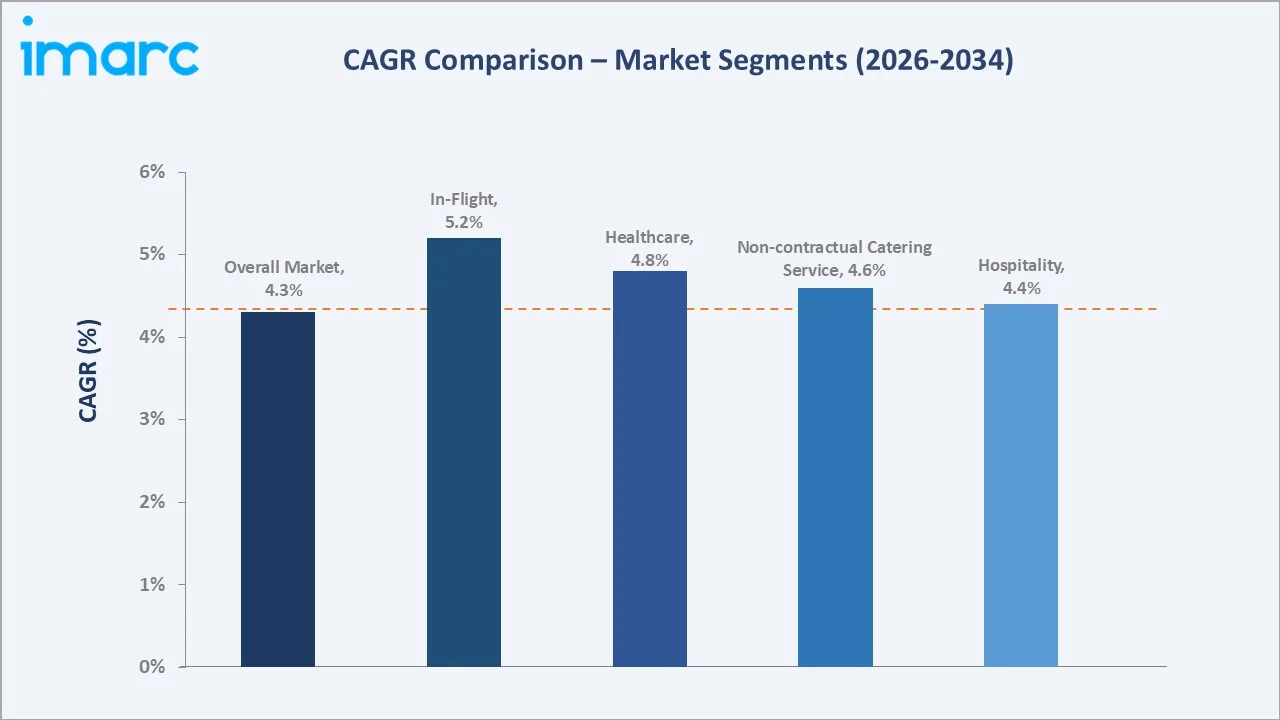
In-flight catering leads with a CAGR of ~5.2% through India's rapidly expanding aviation passenger traffic. Healthcare catering grows at ~4.8% CAGR through hospital network expansion and patient nutrition focus. Non-contractual catering grows at ~4.6% CAGR through events, weddings, and hospitality catering recovery.
Executibve Summary
The India catering services market is witnessing steady growth, supported by growing corporate sector expansion, rapid industrialization creating large-scale workforce feeding requirements, and increasing adoption of outsourced facility management services by enterprises seeking to focus on core operations. The formalization of India's catering sector is progressively shifting market share from unorganized local caterers to organized contractual service providers.
Contractual catering services lead at 68.7% through long-term enterprise outsourcing. Industrial leads end-user at 31.8% through workforce meal requirement mandates. West India leads regionally at 30.6% through its dense manufacturing and corporate base.
Key Market Insights
|
Insight |
Data |
|
Dominant Service Type |
Contractual Catering Service – 68.7% share (2025) |
|
Leading End-User |
Industrial – 31.8% market share (2025) |
|
Leading Region |
West India – 30.6% share (2025) |
|
Market Opportunity |
Aviation sector catering expansion; hospital dietary services; educational institution meal programs; corporate wellness-linked catering; smart canteen technology integration |
Key Analytical Observations Supporting the Above Data:
- Contractual Catering Service at 68.7%: Contractual catering dominates due to the strong preference among large industrial clients, corporates, and institutions for long-term, fixed-price outsourcing arrangements that provide predictable costs, regulatory compliance assurance, and operational stability.
- Industrial at 31.8%: Industrial end-users dominate as India's manufacturing sector, covering automobiles, textiles, pharmaceuticals, chemicals, and electronics, hosts the largest daily workforce meal requirements.
- West India at 30.6%: West India leads due to Maharashtra's status as India's largest industrial state, home to Mumbai's massive corporate services sector, Pune's manufacturing and IT hubs, and Gujarat's world-class industrial corridors. The region's high concentration of MNCs, large public sector enterprises, and SEZs creates significant contractual catering demand from well-capitalized clients who prefer international-standard organized catering operators.
India Catering Services Market Overview
The India catering services market encompasses commercial food preparation and service operations conducted for corporate, industrial, institutional, aviation, and event clients across contractual and non-contractual service arrangements. It includes canteen and cafeteria management for industrial and corporate facilities, in-flight catering for domestic and international airlines, institutional catering for hospitals and healthcare facilities, educational institution meal programs for schools and universities, hospitality catering for hotels and event venues, and event and social function catering services.
The market operates across long-term contractual outsourcing arrangements, where caterers manage complete facility operations including staffing, procurement, and compliance, and non-contractual event-based engagements. Growing regulatory requirements under food safety standards and IRCTC railway catering licensing frameworks are progressively formalizing India's historically fragmented catering sector.
Market Dynamics
To evaluate market opportunities, Request Sample
Market Drivers
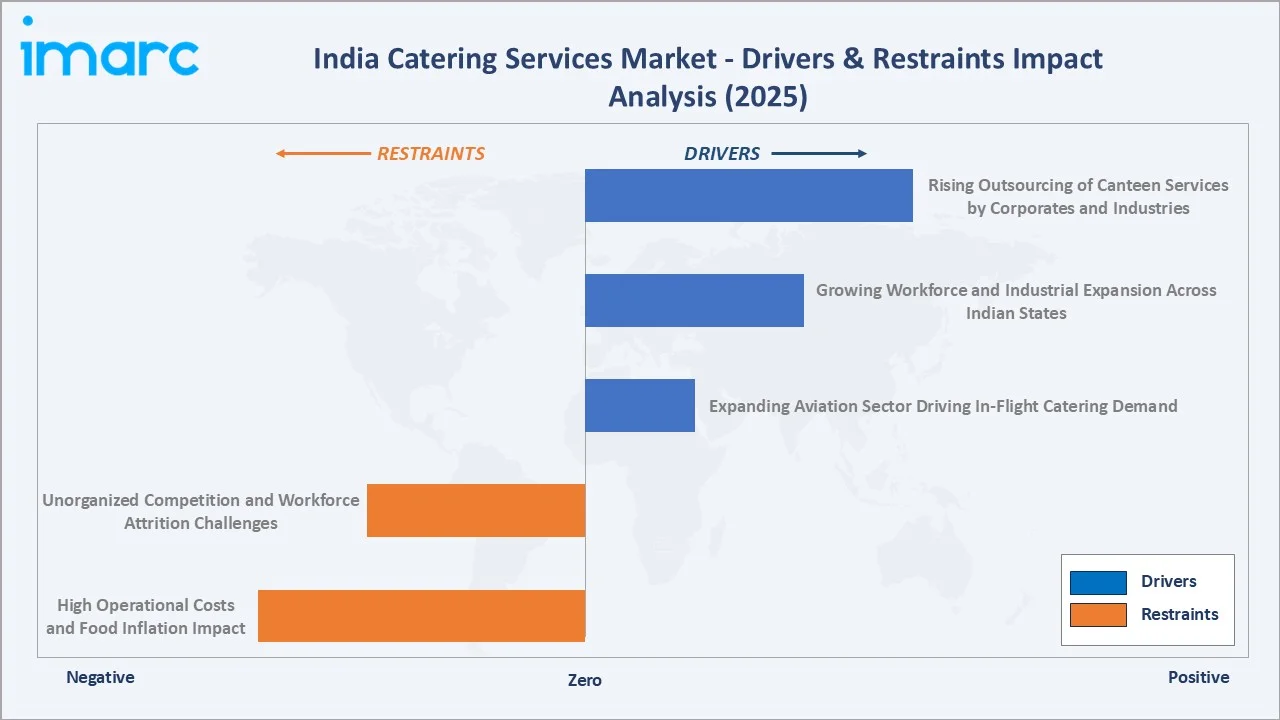
- Rising Outsourcing of Canteen Services by Corporates and Industries: India's growing corporate sector is increasingly outsourcing non-core functions including facility management, security, and canteen operations to specialized service providers. This trend is driven by the complexity of managing compliant, hygienic, and nutritious food service operations internally, particularly for multinational companies with global food safety and employee wellbeing standards.
- Growing Workforce and Industrial Expansion Across Indian States: India's manufacturing sector, accelerated by the Production Linked Incentive (PLI) scheme across 14 sectors, is creating large new industrial facilities requiring compliant canteen infrastructure. PLI-linked investments are driving expansion of automobile, electronics, pharmaceutical, and textile manufacturing facilities, each requiring contractual catering arrangements for workforces.
- Expanding Aviation Sector Driving In-Flight Catering Demand: By 2040, India’s air passenger traffic is projected to increase nearly six-fold to around 1.1 billion, while the country’s commercial aircraft fleet is expected to expand from 400 aircraft in 2014 to about 2,359 by March 2040. Employment supported by the aviation sector is also anticipated to reach approximately 25 million. The rapid expansion of India’s aviation sector, supported by rising passenger traffic and fleet growth, is increasing demand for in-flight meals, beverages, and customized catering services. Airlines are also emphasizing improved onboard experience and service quality, creating steady opportunities for specialized aviation catering providers.
Market Restraints
- High Operational Costs and Food Inflation Impact: Catering service economics are significantly impacted by food commodity price volatility; vegetable, dairy, and protein prices in India experienced inflation. Fixed-price contractual catering arrangements limit caterers' ability to pass through input cost increases, compressing margins during high-inflation periods. Energy costs for commercial kitchen operations and fuel for food distribution logistics further add to operational cost pressures.
- Unorganized Competition and Workforce Attrition Challenges: The India catering sector faces intense competition from unorganized local caterers who operate with significantly lower overhead, compliance, and labor cost structures than organized operators. This pricing pressure inhibits organized operators' ability to command premium contract pricing from cost-sensitive SME clients. Additionally, high attrition rates among canteen workers create significant recruitment and training cost burdens for large-scale contractual catering operators.
Market Opportunities
- Healthcare Dietary Services Expansion: India's rapidly expanding hospital network, with over 70,000 hospitals and aggressive capacity additions by chains, requires specialized dietary catering that integrates clinical nutrition protocols, therapeutic diet preparation, and patient meal service. Healthcare catering commands premium pricing relative to industrial catering due to specialized menu requirements, strict hygiene standards, and 24-hour service provisions, making it a high-margin growth opportunity for qualified operators.
- Smart Canteen Technology Integration: The integration of digital food ordering apps, biometric meal tracking, IoT kitchen monitoring, and AI-powered demand forecasting is transforming corporate canteen operations. Technology-enabled canteen management platforms that reduce food waste, improve meal planning accuracy, and provide employees with personalized nutrition insights are commanding premium contract pricing from corporate clients who value data-driven facility management. First-mover advantage in smart canteen technology creates competitive differentiation for organized operators.
Market Challenges
- Regulatory Compliance and Food Safety Certification Complexity: India's food safety regulations impose significant compliance requirements on catering operators regarding kitchen hygiene, food handler certification, ingredient traceability, and temperature control documentation. The regulatory burden of maintaining licenses, certifications, and state-level compliance across multiple client sites spread across different Indian states creates administrative complexity and cost that small and mid-size catering operators struggle to absorb consistently.
- GST Structure Complexity Affecting Catering Contract Economics: Catering services in India attract GST rates, creating significant contractual complexity. GST credit recovery on food-related inputs is restricted, increasing the effective tax cost of catering services for clients that cannot fully recover input tax credits. This complexity creates pricing negotiation friction between caterers and clients across different institutional categories.
Emerging Market Trends
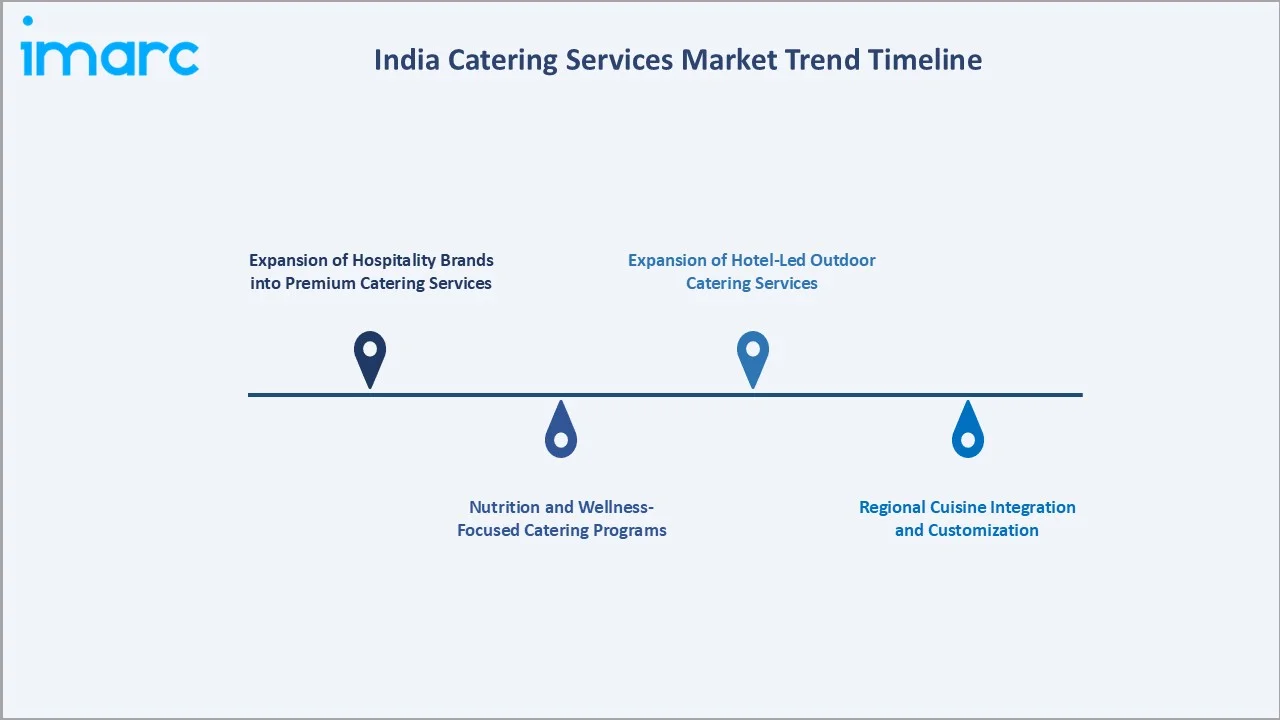
1. Expansion of Hospitality Brands into Premium Catering Services
Established hospitality companies are increasingly extending their expertise into standalone catering and event solutions, targeting weddings, corporate events, and private celebrations. In June 2026, Country Club Hospitality & Holidays Ltd. launched COUNTRY CATERERS, a premium catering and event solutions brand. The new offering extends the company’s hospitality, culinary, and event management capabilities beyond its existing clubs and resorts. This trend is widening the organized catering segment and increasing competition around premium menus, service quality, and integrated event experiences.
2. Nutrition and Wellness-Focused Catering Programs
Growing corporate awareness of the productivity and employee retention benefits of workplace nutrition is driving demand for nutritionist-curated menu programs, calorie and allergen labeling, regional cuisine balance, and chronic disease-sensitive dietary options. Corporate clients are increasingly evaluating catering operators on nutritional quality metrics alongside traditional price and operational factors. Caterers partnering with registered dietitians and embedding nutrition expertise in their menu development processes are capturing premium corporate contract pricing.
3. Expansion of Hotel-Led Outdoor Catering Services
Hotels are increasingly extending their food and hospitality capabilities beyond their properties through dedicated outdoor catering services. In April 2026, Holiday Inn Bengaluru Racecourse introduced CaterINN, a dedicated outdoor catering service that brings the hotel’s culinary and hospitality expertise to corporate events, private functions, and small- to large-scale social gatherings beyond its premises. This trend is strengthening the organized catering segment by addressing rising demand from corporate functions, private celebrations, and large social events.
4. Regional Cuisine Integration and Customization
The diversity of India's food culture, spanning North Indian, South Indian, Bengali, Gujarati, and coastal cuisine traditions, creates strong workforce demand for regional meal authenticity in institutional catering. Leading caterers are developing regional cuisine specialization capabilities, rotating regional meal programs, and customized offerings for plant-based and religious dietary requirements. Regional cuisine authenticity has become a key contract renewal factor as workforce survey data consistently reflects its importance.
Industry Value Chain Analysis
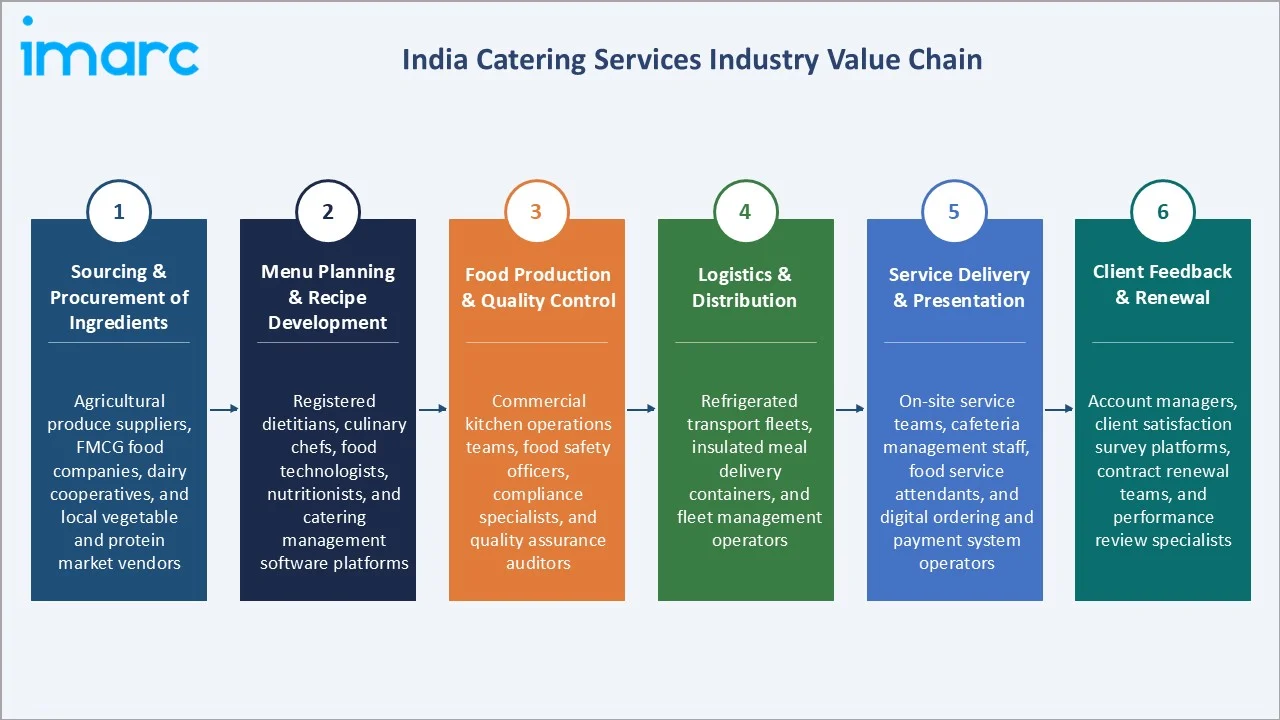
The India catering services market value chain integrates ingredient sourcing and procurement, menu planning and recipe development, food production and quality control, logistics and distribution to service sites, service delivery and presentation, and client feedback and contract renewal.
|
Stage |
Key Participants |
|
Sourcing & Procurement of Ingredients |
Agricultural produce suppliers, FMCG food companies, dairy cooperatives, and local vegetable and protein market vendors. |
|
Menu Planning & Recipe Development |
Registered dietitians, culinary chefs, food technologists, nutritionists, and catering management software platforms. |
|
Food Production & Quality Control |
Commercial kitchen operations teams, food safety officers, compliance specialists, and quality assurance auditors. |
|
Logistics & Distribution |
Refrigerated transport fleets, insulated meal delivery containers, and fleet management operators. |
|
Service Delivery & Presentation |
On-site service teams, cafeteria management staff, food service attendants, and digital ordering and payment system operators. |
|
Client Feedback & Renewal |
Account managers, client satisfaction survey platforms, contract renewal teams, and performance review specialists. |
Food production and quality control represent the most value-added stage in the India catering services value chain, as it directly determines food safety compliance, nutritional quality, taste consistency, and client satisfaction. This phase requires certified kitchen infrastructure, trained food safety personnel, and robust documentation systems that collectively determine a caterer's ability to retain long-term contractual clients and win competitive tender processes.
Technology Landscape in the India Catering Services Industry
Digital Canteen Management and Employee Ordering Platforms
App-based employee food ordering platforms are transforming corporate canteen operations by enabling pre-ordering, reducing queue times, providing nutritional information, and generating demand data that improves kitchen planning accuracy. Leading caterers have developed proprietary apps that integrate digital payment, employee feedback, and loyalty incentives. These platforms reduce food waste by aligning production with pre-order data and create employee engagement channels that support contract retention.
IoT Kitchen Monitoring and Food Safety Technology
IoT-enabled temperature monitoring sensors, automated documentation systems, and connected kitchen equipment are improving food safety compliance efficiency in large-scale catering operations. Continuous temperature logging for cold storage and hot holding eliminates the manual documentation burden while providing real-time alerts for temperature deviations. Smart kitchen equipment, including connected dishwashers with cycle validation recording and automated cooking equipment with programmable recipes, improves consistency and reduces food safety risk across multi-site catering operations.
Supply Chain and Procurement Technology
Integrated supply chain management platforms connecting caterer procurement teams with approved supplier networks are improving ingredient traceability, cost management, and quality assurance across India's catering sector. Digital procurement platforms provide real-time market price data, automated purchase order generation, and supplier performance tracking that enable caterers to optimize procurement costs under fixed-price contract structures. Agricultural produce sourcing platforms connecting caterers directly with farmer producer organizations are reducing supply chain intermediary costs.
Market Segmentation Analysis
The report covers the following segments:
|
Segment Category |
Leading Segment |
Market Share |
Year |
|
Service Type |
Contractual Catering Service |
68.7% |
2025 |
|
End-User |
Industrial |
31.8% |
2025 |
|
Region |
West India |
30.6% |
2025 |

By Service Type
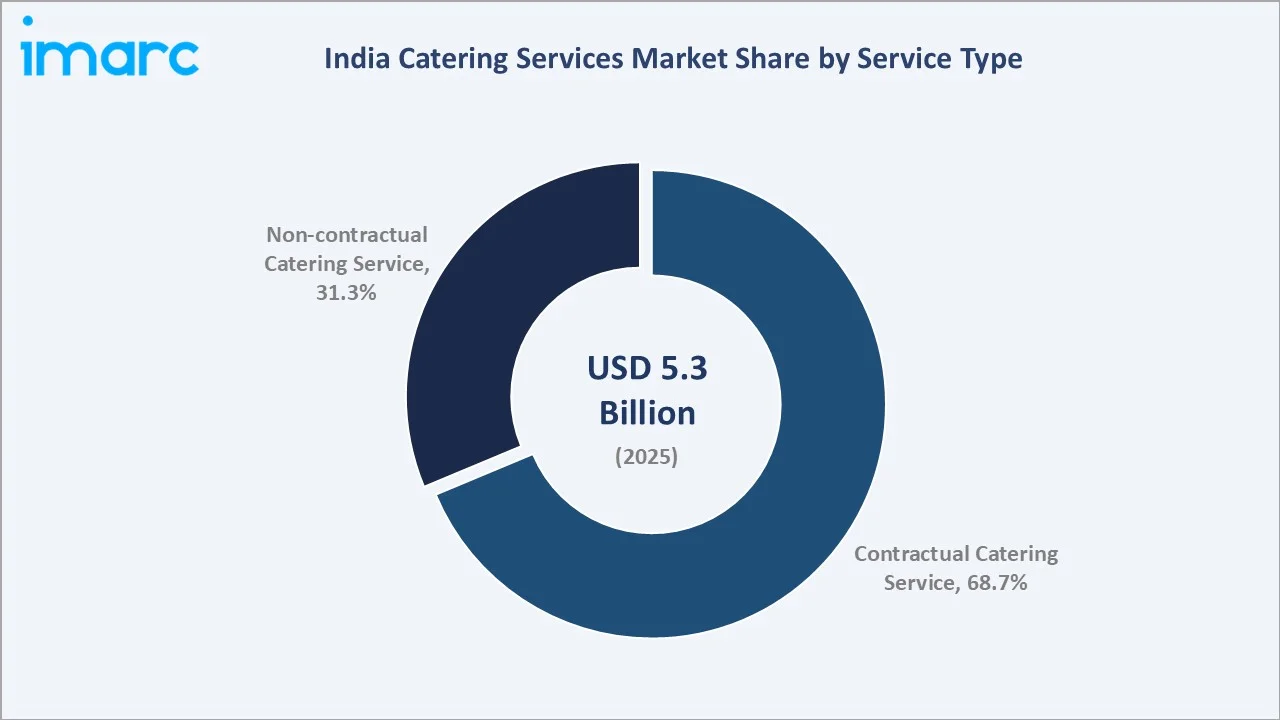
Contractual catering service leads at 68.7% (2025), reflecting the dominant model for institutional and corporate food service delivery in India. Long-term catering contracts, typically spanning 1-3 years with renewal options, provide revenue predictability for caterers and operational stability for clients.
To access detailed market analysis, Request Sample
Non-contractual catering service accounts for 31.3%, encompassing event catering for weddings, corporate events, social functions, and temporary project-site catering. The non-contractual segment commands higher per-head pricing than institutional contracts but carries greater revenue volatility and lower predictability.
By End-User
Industrial end-users dominate at 31.8% (2025), driven by the canteen provision mandating food service facilities for large manufacturing establishments and the concentrated, high-volume meal requirements of India's rapidly expanding industrial workforce across automobile, pharmaceutical, textile, and electronics manufacturing sectors.
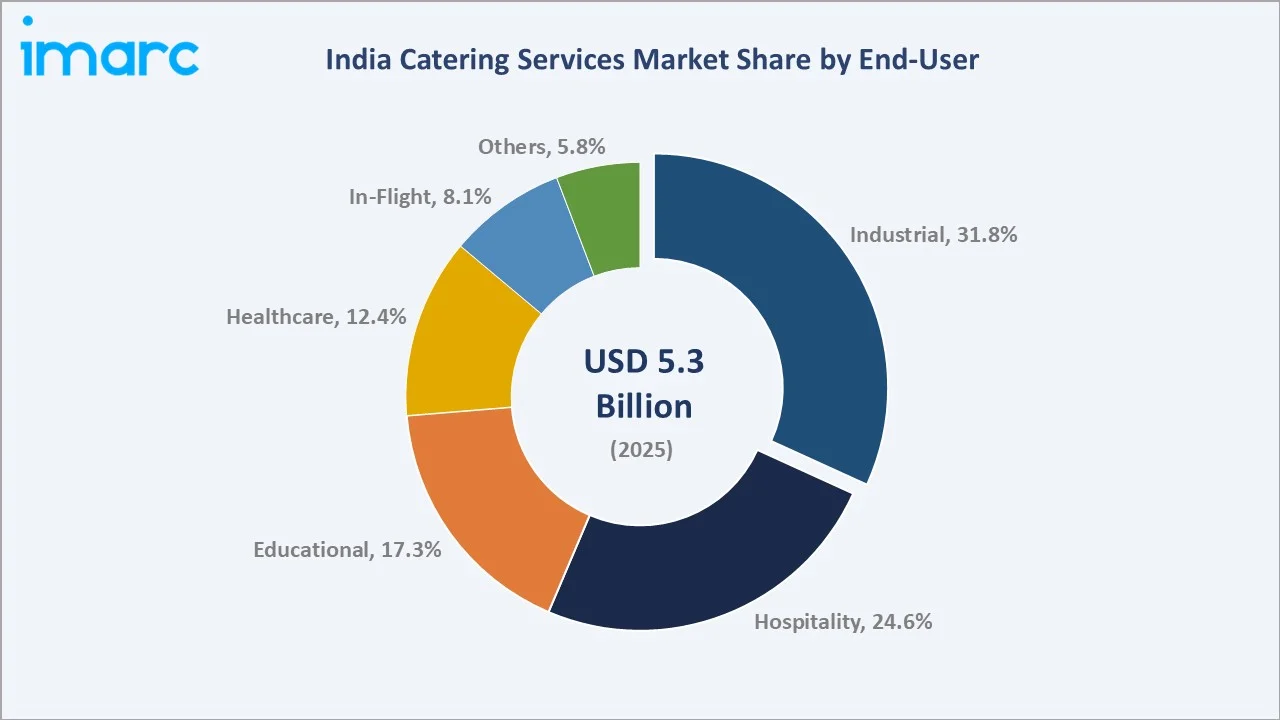
Hospitality holds 24.6%, including hotel catering, banquet, and event catering operations. Educational accounts for 17.3%, growing through school Midday Meal programs and university residential catering. Healthcare represents 12.4%. In-flight catering at 8.1% is the fastest-growing end-user segment. Others account for 5.8%.
Regional Market Insights
|
Region |
Share (2025) |
Key India Catering Services Market Drivers & Characteristics |
|
West India |
30.6% |
Largest market driven by Maharashtra's massive industrial and corporate sector, Mumbai's financial services concentration, and Pune's manufacturing and IT hubs. |
|
North India |
28.4% |
Strong market anchored by Delhi NCR's large corporate and government institutional catering demand, Punjab and Haryana's industrial belt, and expanding manufacturing sector. |
|
South India |
26.7% |
Growing rapidly through Bengaluru and Hyderabad's large IT and BFSI corporate campuses requiring premium employee catering, and Tamil Nadu's expanding manufacturing sector. |
|
East India |
14.3% |
Emerging market with growing industrial catering demand in West Bengal's manufacturing sector, Odisha's steel and mining industry, and expanding corporate presence in Kolkata. |
West India's 30.6% leadership reflects Maharashtra's dual strength in both industrial manufacturing catering and Mumbai's substantial corporate and financial services sector canteen market. North India's 28.4% is underpinned by Delhi NCR's concentration of MNC headquarters and government ministries, each requiring compliant institutional catering, combined with the large IRCTC railway catering contract base across North India's dense rail network.
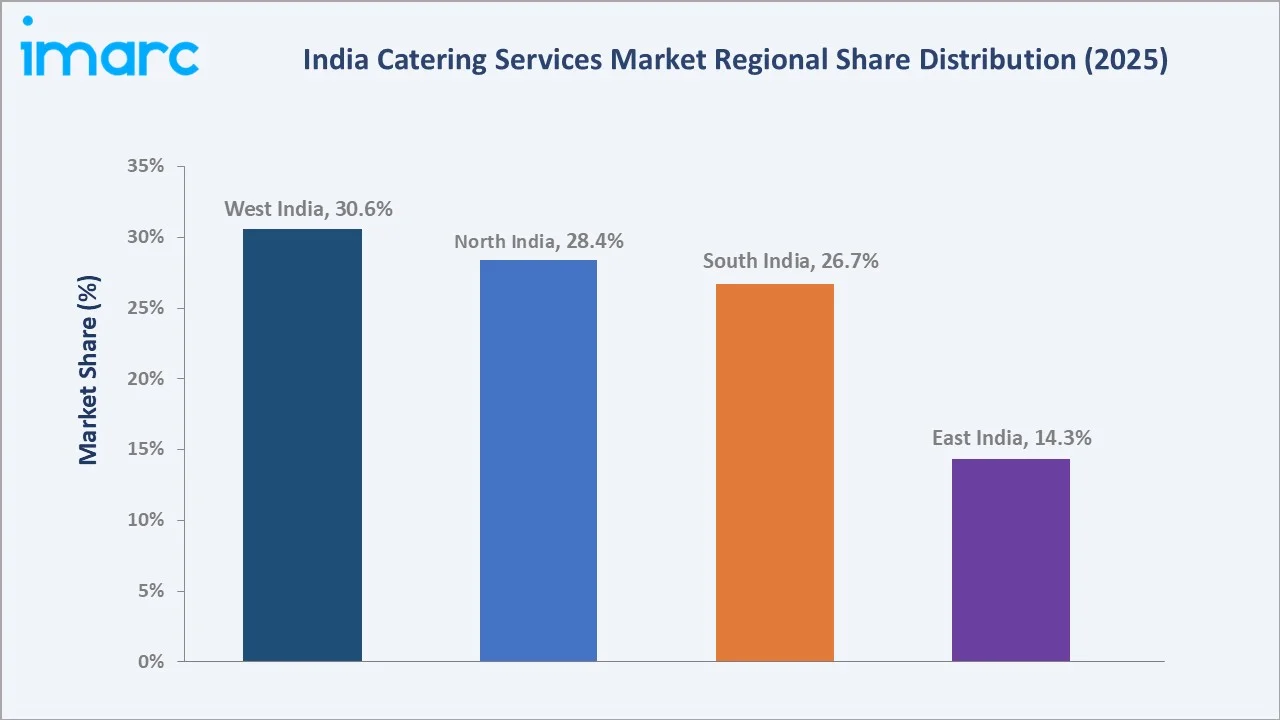
South India at 26.7% is growing at the fastest regional rate, driven by Bengaluru's IT sector expansion creating large campus catering requirements and Hyderabad's growing pharmaceutical and IT manufacturing base. East India at 14.3% represents the highest growth opportunity region, with Odisha and Jharkhand's expanding heavy industry requiring formal contractual catering as infrastructure quality expectations rise among the industrial workforces.
Competitive Landscape
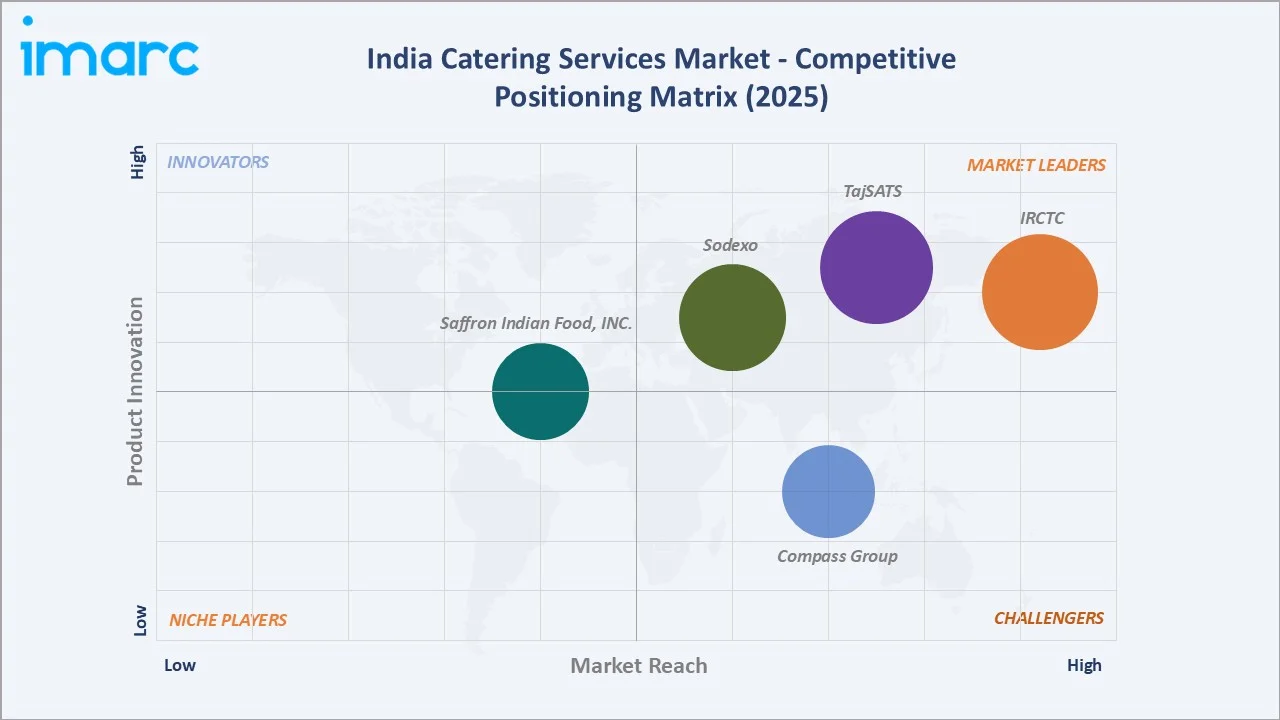
The India catering services market is moderately fragmented, with a mix of multinational organized operators, domestic organized catering companies, and a large unorganized local catering sector. Organized operators compete on food safety compliance credentials, nutritional quality, technology enablement, geographic coverage, and contract management quality. In-flight catering and healthcare dietary services represent specialized niches where regulatory and technical barriers limit competition to qualified, certified operators.
|
Company |
Key Offerings |
Market Position |
Core Strength |
|
Sodexo |
Catering for companies, hospitals, schools, universities |
Market Leader |
The company provides daily meals and dining experiences for offices, factories, and hospitals. |
|
TajSATS |
In-flight catering |
Market Leader |
TajSATS is India's market leader in in-flight catering and a major player in institutional food services. |
|
IRCTC |
IRCTC eCatering |
Market Leader |
It handles on-board train meals, operates station food plazas, and manages e-catering for passengers. |
|
Saffron Indian Food, INC. |
Saffron Group Catering |
Established Player |
Saffron Indian Food, INC. plays a prominent role in India's hospitality and catering sector. |
|
Compass Group |
Catering for Business, Education, Healthcare, Industry |
Challenger |
Operates across corporate offices, manufacturing plants, healthcare facilities, and educational institutions. |
Companies are also investing in certification upgrades, sustainable sourcing programs, digital canteen platforms, and healthcare and in-flight specialization to differentiate in India's competitive catering market. The market is expected to see further formalization through MNC operator expansion into Tier 2 industrial cities and increasing displacement of unorganized local caterers as client quality and compliance standards rise.
Key Company Profiles
Sodexo
Sodexo is one of the largest food services and facility management companies, with a substantial India operation serving across various client sites spanning corporate campuses, industrial facilities, healthcare institutions, and educational establishments. Sodexo India's integrated facility management proposition, combining catering with housekeeping, technical maintenance, and employee services, positions it as a preferred single-vendor partner for large MNC and corporate clients seeking comprehensive FM outsourcing.
- Key Offerings: Catering for companies, hospitals, schools, and universities.
- Strategic Focus: Digital canteen platform deployment across client base for improved employee engagement, healthcare and educational institution segment expansion, sustainability program embedding in client catering contracts, and tier 2 industrial city geographic expansion following client plant expansions.
TajSATS
TajSATS is India's premier in-flight catering company, established as a joint venture between The Indian Hotels Company Limited (IHCL) and SATS Limited. The company operates certified flight kitchens at major Indian airports, serving domestic and international airlines with airline-branded meal programs that reflect the Taj Group's culinary heritage and SATS's aviation catering operational expertise.
- Key Offerings: In-flight catering.
- Strategic Focus: New airport kitchen establishment under UDAN, premium international airline contract acquisition, cabin crew and ground service catering expansion, and sustainable packaging transition for aviation meal service.
Market Concentration Analysis
The India catering services market remains moderately fragmented, with organized operators. The market's large unorganized segment serves a significant portion of SME industrial and local institutional demand with competitive pricing but inconsistent quality and compliance standards. Consolidation is expected to accelerate as regulatory compliance requirements become more stringently enforced, MNC client quality standards exclude unorganized operators from competitive tenders, and in-flight catering's significant capital and certification barriers limit market entry to qualified operators. Organized caterers acquiring regional players, expanding into Tier 2 industrial city markets, and developing specialized healthcare and aviation catering capabilities are the primary consolidation pathways through 2034.
Investment & Growth Opportunities
Highest Growth Segments
In-flight catering (~5.2% CAGR through aviation expansion), healthcare dietary services (~4.8% CAGR through hospital network growth), non-contractual event catering (~4.6% CAGR through hospitality recovery), South India corporate campus market, and smart canteen technology-integrated contracts represent the highest-growth investment vectors in the India catering services market through 2034.
Investment Themes
- Healthcare dietary services specialization: India's hospital network expansion creates significant specialized dietary catering demand. Caterers investing in clinical nutrition expertise, therapeutic diet production capabilities, and hospital-grade infrastructure can capture premium contract pricing that exceeds standard industrial catering rates.
- Aviation catering kitchen infrastructure: India's planned 100 new airports under UDAN and fleet expansion require new certified flight kitchen infrastructure investment. Establishing catering kitchen capacity at secondary airports creates geographic monopoly-like market positions for in-flight catering at new routes with rapidly growing domestic passenger volumes.
- Smart canteen platform development: Proprietary digital canteen management platforms that deliver measurable employee satisfaction improvement, food waste reduction, and operational efficiency gains create strong client stickiness and contract renewal advantages. Investing in canteen technology capabilities that competitors cannot easily replicate is becoming a sustainable competitive moat for organized catering operators targeting premium corporate clients.
Future Market Outlook (2026-2034)
The India catering services market is projected to grow from USD 5.3 Billion in 2025 to USD 5.6 Billion in 2026, reaching USD 7.7 Billion by 2034, delivering a 4.26% CAGR over the forecast period through expanding corporate and industrial outsourcing, India's aviation sector growth driving in-flight catering demand, growing healthcare dietary services investment, and progressive formalization displacing unorganized catering operators. The market's anchor value of USD 6.6 Billion in 2030 represents India's catering services ecosystem at organized sector majority transition and smart canteen technology mainstream adoption across large corporate and industrial clients.
Three structural forces are expected to define the growth of the India catering services market through 2034. First, India's continued industrial expansion under the Production Linked Incentive scheme and ongoing manufacturing sector growth will sustain consistent demand for contractual industrial catering that represents the market's largest and most structurally secure revenue segment. Second, the progressive formalization of India's catering sector will accelerate displacement of unorganized operators by organized contractual caterers, expanding the addressable market for quality-certified service providers even as total market growth remains steady. Third, the rapid expansion of India's aviation sector combined with hospital network capacity additions and educational institution meal expansion will create growing specialized catering revenue streams that supplement core industrial and corporate catering, supporting the market's steady CAGR growth through 2034.
Research Methodology
Primary Research
Primary research comprised in-depth interviews with senior executives from organized catering service providers, institutional food service managers, regulatory specialists, aviation catering kitchen operators, and food service industry consultants. Discussions validated market size estimates, assessed contractual outsourcing trends, evaluated competitive dynamics, and provided insights into regulatory developments, technology investment priorities, and long-term growth opportunities across India's catering services market.
Secondary Research
Secondary research encompassed company financial disclosures, canteen compliance data, aviation passenger statistics, IRCTC annual reports, regulatory publications, and credible food service industry analyst reports. These sources supported market trend analysis, competitive positioning assessment, end-user segment data, and regional demand analysis across India's catering services sector.
Forecasting Models
Forecasting models were developed using historical market revenue data, industrial workforce growth projections, aviation passenger traffic forecasts, hospital bed addition programs, and macroeconomic indicators. Both top-down and bottom-up approaches were applied and validated through primary expert consultations. Regulatory compliance enforcement trajectory, aviation infrastructure expansion timelines, PLI scheme manufacturing employment projections, and organized sector penetration rate assumptions were incorporated to generate reliable forecasts through 2034.
India Catering Services Market Report Coverage:
| Report Features | Details |
|---|---|
| Base Year of the Analysis | 2025 |
| Historical Period | 2020-2025 |
| Forecast Period | 2026-2034 |
| Units | Billion USD |
| Scope of the Report |
Exploration of Historical Trends and Market Outlook, Industry Catalysts and Challenges, Segment-Wise Historical and Future Market Assessment:
|
| Service Types Covered | Contractual Catering Service, Non-contractual Catering Service |
| End-Users Covered | Industrial, Hospitality, Educational, Healthcare, In-Flight, Others |
| Regions Covered | North India, South India, East India, West India |
| Companies Covered | Sodexo, TajSATS, IRCTC, Saffron Indian Food, INC., Compass Group, etc. |
| Customization Scope | 10% Free Customization |
| Post-Sale Analyst Support | 10-12 Weeks |
| Delivery Format | PDF and Excel through Email (We can also provide the editable version of the report in PPT/Word format on special request) |
Key Benefits for Stakeholders:
- IMARC’s industry report offers a comprehensive quantitative analysis of various market segments, historical and current market trends, market forecasts, and dynamics of the India catering services market from 2020-2034.
- The research report provides the latest information on the market drivers, challenges, and opportunities in the India catering services market.
- Porter's five forces analysis assist stakeholders in assessing the impact of new entrants, competitive rivalry, supplier power, buyer power, and the threat of substitution. It helps stakeholders to analyze the level of competition within the India catering services industry and its attractiveness.
- Competitive landscape allows stakeholders to understand their competitive environment and provides an insight into the current positions of key players in the market.
Frequently Asked Questions About the India Catering Services Market Report
The India catering services market size is estimated at USD 5.6 Billion in 2026, driven by rising corporate outsourcing of canteen services, rapid industrial expansion, and growing awareness of workplace nutrition. Expanding aviation sector demand and healthcare dietary services investment are further supporting near-term market growth.
The India catering services market grows at 4.26% CAGR during 2026-2034, reaching USD 7.7 Billion by 2034. The CAGR reflects steady industrial and corporate catering demand, growing in-flight catering, progressive formalization of the sector, and expanding healthcare and educational institution catering programs.
Contractual catering services lead at 68.7% (2025), driven by canteen facilities for large manufacturing establishments and growing corporate preference for long-term outsourcing of food service operations to qualified organized caterers for operational stability and compliance assurance.
Industrial end-users dominate at 31.8% (2025), driven by mandatory canteen provisions for manufacturing establishments and India's rapidly expanding industrial workforce across PLI-linked sectors including automobiles, pharmaceuticals, electronics, and textiles requiring large-scale daily workforce meal services.
West India leads at 30.6% (2025), anchored by Maharashtra's large industrial and corporate sector, Mumbai's financial services concentration, Pune's manufacturing and IT hubs, and Gujarat's industrial corridors generating high contractual catering demand from enterprise clients.
Leading companies include Sodexo, TajSATS, IRCTC, Saffron Indian Food, INC., and Compass Group, among others.
The market is projected to reach approximately USD 6.6 Billion by 2030, driven by expanding industrial and corporate catering contracts, in-flight catering growth from aviation passenger traffic expansion, healthcare dietary services demand from hospital network additions, and progressive organized sector market share gains from unorganized competitors.
Priority investment opportunities include healthcare dietary services specialization serving India's expanding hospital sector, aviation catering kitchen infrastructure at new UDAN airports, smart canteen technology platform development creating client retention advantages, and Tier 2 industrial city market expansion following PLI scheme manufacturing facility development.
Need more help?
- Speak to our experienced analysts for insights on the current market scenarios.
- Include additional segments and countries to customize the report as per your requirement.
- Gain an unparalleled competitive advantage in your domain by understanding how to utilize the report and positively impacting your operations and revenue.
- For further assistance, please connect with our analysts.
 Request Customization
 Speak to an Analyst
 Request Brochure
 Inquire Before Buying
Benefits of Customization
- Personalize this research
- Triangulate with your data
- Get data as per your format and definition
- Gain a deeper dive into a specific application, geography, customer, or competitor
- Any level of personalization
Get in Touch With Us
UNITED STATES
Phone: +1-201-971-6302
INDIA
Phone: +91-120-433-0800
UNITED KINGDOM
Phone: +44-753-714-6104
Email: [email protected]
Client Testimonials




.webp)




.webp)













Related Reports

Choose your plan
*Please note that the prices mentioned below are starting prices for each bundle type. Kindly contact our team for further details.*
Single User License
- 1 User License, Access on 2 Devices
- PDF Report + Excel Dataset (Password Protected)
- Lifetime Access
- No Printing Rights
- 10% Free Report Customization
- 10–12 Weeks of Analyst Support
Five User License
- Access for 5 Users, 2 Devices per User
- PDF Report + Excel Dataset (Password Protected)
- Lifetime Access
- Dedicated Account Manager
- 12–14 Weeks of Analyst Support
- No Printing Rights
- 15% Free Report Customization
- 25% Discount on Your Next Purchase
Corporate User License
- Unlimited User Access (Within Your Organization)
- PDF Report + Excel Dataset
- Lifetime Access
- Dedicated Account Manager
- 14–20 Weeks of Analyst Support
- No Printing Rights
- 20% Free Report Customization
- 30% Discount on Your Next Purchase
Essential Insights
What's included:
3 reports
- Lifetime Access
- PDF Reports
- Excel Datasets
- 2 Weeks of Free Analyst Support
- 2 User Licenses
- Access on 2 Devices
- Printing Rights
- Complimentary PowerPoint (PPT) Version
- Complimentary License Upgrade
Professional Access
What's included:
5 reports
- Lifetime Access
- PDF Reports
- Excel Datasets
- 8 Weeks of Free Analyst Support
- 2 User Licenses
- Access on 2 Devices
- Printing Rights
- Complimentary PowerPoint (PPT) Version
- Complimentary License Upgrade
Business Advantage
What's included:
8 reports
- Lifetime Access
- PDF Reports
- Excel Datasets
- 14 Weeks of Free Analyst Support
- 2 User Licenses
- Access on 2 Devices
- Printing Rights
- Complimentary PowerPoint (PPT) Version
- Complimentary License Upgrade
Enterprise Intelligence
What's included:
10 reports
- Lifetime Access
- PDF Reports
- Excel Datasets
- 20 Weeks of Free Analyst Support
- 2 User Licenses
- Access on 2 Devices
- Printing Rights
- Complimentary PowerPoint (PPT) Version
- Complimentary License Upgrade