
India Ceiling Fan Market Size, Share, Trends and Forecast by Product Type, Fan Size, Distribution Channel, End Use, and Region, 2026-2034
India Ceiling Fan Market Summary:
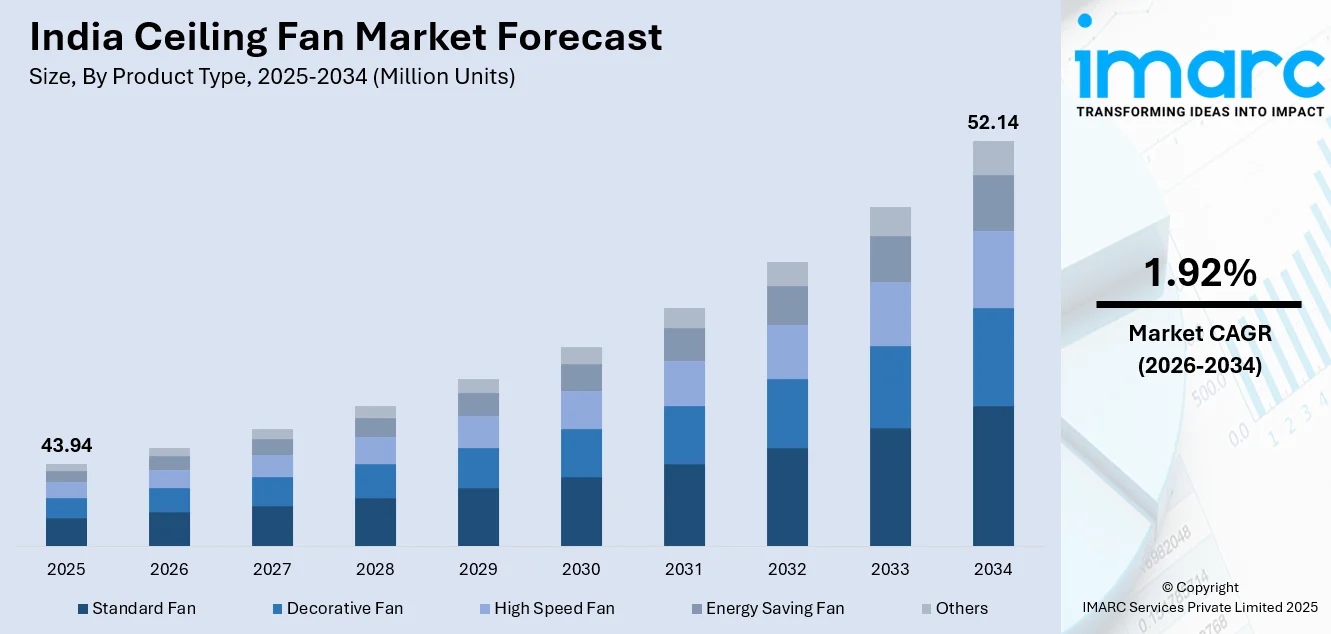
The India ceiling fan market size reached 43.94 Million Units in 2025 and is projected to reach 52.14 Million Units by 2034, growing at a compound annual growth rate of 1.92% from 2026-2034.
The Indian market thrives on the country's tropical climate and extended summer seasons, where ceiling fans serve as essential cooling appliances across residential, commercial, and industrial spaces. Apart from this, driven by rapid urban developments, diversifying construction activities, and government-led affordable housing initiatives, the market caters to diverse user segments seeking cost-effective air circulation solutions that complement or substitute air conditioning systems, thereby expanding the India ceiling fan market share.
Key Takeaways and Insights:
- By Product Type: Standard fan dominates the market with a share of 42% in 2025, driven by their cost-effectiveness, widespread availability, and reliable performance across urban and rural households where affordability and operational efficiency remain paramount purchase considerations for diverse income segments.
- By Fan Size: Medium leads the market with a share of 50% in 2025, owing to optimal balance between air delivery capacity and space compatibility, making them suitable for average-sized Indian rooms.
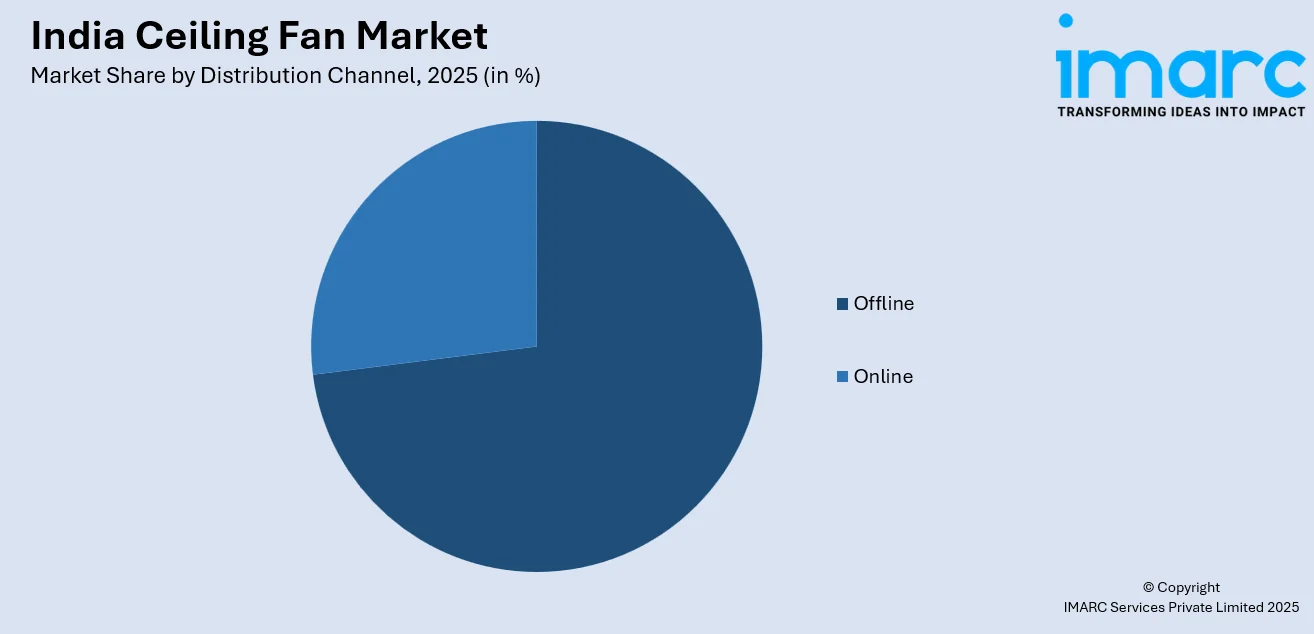
- By Distribution Channel: Offline represents the largest segment with a market share of 73% in 2025, driven by consumer preference for physical inspection before purchase, immediate product availability, and established trust in traditional retail networks across tier-2 and tier-3 cities where digital penetration remains limited.
- By End Use: Residential exhibits a clear dominance with a 60% market share in 2025, fueled by housing construction boom, replacement demand from existing households, and ceiling fans remaining indispensable appliances for comfortable living across all socioeconomic strata.
- By Region: North India leads the market with a share of 31% in 2025, attributed to population density, hot climatic conditions during summer months, robust construction activity in metropolitan areas, and higher purchasing power enabling both new installations and replacement demand.
- Key Players: The India ceiling fan market exhibits intense competitive dynamics with established domestic manufacturers and emerging technology-focused brands competing across price segments, differentiation strategies, and distribution networks, while leveraging design innovation and energy efficiency features to capture market share.
To get more information on this market Request Sample
The Indian ceiling fan sector is a dynamic and changing marketplace, where traditional styles of cooling appliances can coexist with modern day consumer's expectations for both appearance and aesthetic appeal and energy saving performance as well as smart technology applications in their homes. The ceiling fan market forms part of one of India's main product groups and therefore has a strong position as a crucial household product. Also, numerous government programs aimed at constructing affordable residential housing through places such as through the "Pradhan Mantri Awas Yojana", have helped accelerate growth of the ceiling fan market due to its continued popularity as a necessary piece of equipment in newly built homes. In recent years, many consumers have sought to replace old ceiling fan products due to their inability to produce sufficient airflow during summer months as compared to newer BLDC-model or decorative ceiling fan products available today. Urban expansion in tier-2 and tier-3 cities, coupled with rising rural electrification rates, continues to expand the addressable market base. In 2025, India’s urban infrastructure area, having witnessed investments totaling Rs 30 lakh crore in the last ten years, is projected to draw an extra Rs 10 lakh crore in the upcoming four years, stated the Union Housing and Urban Affairs Secretary. Manufacturers respond to diverse consumer preferences by offering segmented product portfolios ranging from basic standard fans for price-sensitive buyers to premium designer models with remote control, IoT connectivity, and enhanced air delivery systems for affluent households.
India Ceiling Fan Market Trends:
Accelerated Adoption of BLDC Motor Technology
The brushless DC motor technology is revolutionizing the Indian ceiling fan industry. The difference in energy consumption of these fans versus traditional induction motor ceiling fans is reduced by 50-60%. The Bureau of Energy Efficiency (BEE) rating system and subsidies for energy conservation programs from the government have helped create consumer awareness of the operational cost savings. The prices for brushless DC fans have decreased due to economies of scale and growth in local manufacturing, so the price gap between the brushless DC fan and a conventional fan that costs about Rs 1,500-2,000 has narrowed. As a result, consumers can increasingly afford these energy-efficient ceiling fans across all income levels. Kenstar is the market leader in the Indian air cooler market and will launch its new cooling product, "Kenstar BLDC Maxx", in 2025. This innovative cooling product is based on state-of-the-art brushless DC motor technology and will be part of Kenstar's new line of air coolers, providing consumers with superior energy efficiency, longer durability, and greater reliability than traditional air coolers from other manufacturers.
Smart Home Integration and IoT-Enabled Features
Smart ceiling fans equipped with IoT connectivity, mobile app controls, and voice assistant compatibility have gained significant traction as India's smartphone penetration approaches 1 billion users by 2026. Major manufacturers launched smart fan variants with Wi-Fi connectivity enabling remote speed control, scheduling functions, and automated climate response based on temperature sensors. The smart ceiling fan market in India is growing, driven by urban millennials and tech-savvy homeowners seeking convenience and automation in their living spaces through integrated home ecosystems. In 2025, Orient Electric Limited [BSE: 541301, NSE: ORIENTELEC], a member of the diversified USD 3 billion CKA Birla Group, has introduced its Next-Gen BLDC Ceiling Fan Collection, providing silent operation with intelligent voice control and available in striking, vivid colours, and finishes.
Premium Design Aesthetics and Decorative Variants
Consumer preferences have shifted toward ceiling fans as design elements rather than purely functional appliances, with decorative variants featuring designer blades, integrated LED lighting, and contemporary finishes gaining popularity in urban markets. Urban centers like Bengaluru and Chennai demonstrate growing demand for premium ceiling fans that complement interior design themes while offering enhanced performance. Manufacturers introduced models with matte black, metallic gold, and wooden texture finishes catering to affluent households willing to invest in aesthetically appealing cooling solutions that elevate overall home ambiance. In 2025, Voltas launched the Flo Series, an innovative line of energy-saving BLDC ceiling fans. Designed for enhanced airflow and contemporary style, the Flo Series signifies a new era in Voltas' dedication to offering intelligent and creative solutions for comfort and cooling in today's Indian households.
Market Outlook 2026-2034:
The India ceiling fan market is poised for sustained growth driven by structural factors including urbanization momentum, housing construction surge, and technology evolution toward energy-efficient solutions. Government policy support through affordable housing schemes and energy efficiency mandates creates favorable conditions for market expansion across residential and commercial segments. The market size was estimated at 43.94 Million Units in 2025 and is expected to reach 52.14 Million Units by 2034, reflecting a compound annual growth rate of 1.92% over the forecast period 2026-2034. User preferences continue evolving toward products offering superior energy performance, aesthetic appeal, and smart home compatibility, prompting manufacturers to invest in research and development for innovative offerings.
India Ceiling Fan Market Report Segmentation:
|
Segment Category |
Leading Segment |
Market Share |
|
Product Type |
Standard Fan |
42% |
|
Fan Size |
Medium |
50% |
|
Distribution Channel |
Offline |
73% |
|
End Use |
Residential |
60% |
|
Region |
North India |
31% |

Product Type Insights:
- Standard Fan
- Decorative Fan
- High Speed Fan
- Energy Saving Fan
- Others
Standard fan dominates with a market share of 42% of the total India ceiling fan market in 2025.
Standard fans maintain their leadership position in the India ceiling fan market due to their unmatched cost-effectiveness, operational reliability, and widespread availability across urban and rural distribution networks. These fans remain the preferred choice for millions of Indian households where affordability takes precedence over advanced features, with their simple design and proven performance making them suitable for everyday use under diverse climatic conditions. The segment benefits from established manufacturing ecosystems that enable competitive pricing while maintaining acceptable quality standards, allowing penetration across all socioeconomic segments including economically weaker sections and low-income groups.
Government-led affordable housing programs such as Pradhan Mantri Awas Yojana, which increased allocations targeting housing construction, directly translate into demand for standard ceiling fans as essential fixtures in new residential units. The segment's resilience stems from replacement cycles in existing households and first-time installations in newly electrified rural areas, where standard fans offer optimal balance between functionality and affordability. Manufacturers continue enhancing standard fan offerings with improved motor efficiency and aerodynamic blade designs that reduce electricity consumption without significantly increasing prices, ensuring the segment maintains relevance despite competition from premium and energy-saving variants.
Fan Size Insights:
- Small
- Medium
- Large
Medium leads with a share of 50% of the total India ceiling fan market in 2025.
Medium-sized ceiling fans dominate the market due to their suitability for average Indian room dimensions typically ranging from 120-200 square feet, which constitute the majority of residential spaces across urban apartments and independent houses. These fans strike an optimal balance between air delivery capacity and energy consumption while offering superior performance compared to smaller variants without the higher costs associated with large fans. The segment's leadership reflects practical consumer preferences for ceiling fans that adequately serve bedroom, living room, and dining area requirements without overwhelming smaller spaces or underperforming in moderately sized rooms.
Medium fans' versatility makes them the default choice for builders and developers who specify ceiling fan requirements for mass housing projects under government schemes and private real estate developments. The segment benefits from extensive product availability across price segments, from budget-friendly standard models to premium decorative variants, allowing consumers to select medium-sized fans that align with their aesthetic preferences and budget constraints. Manufacturers maintain comprehensive medium-sized fan portfolios with diverse designs, blade configurations, and performance specifications, ensuring the segment addresses both functionality requirements and style aspirations of contemporary Indian households seeking reliable cooling solutions.
Distribution Channel Insights:
Access the comprehensive market breakdown Request Sample
- Offline
- Online
Offline exhibits a clear dominance with a 73% share of the total India ceiling fan market in 2025.
Offline distribution channels maintain overwhelming market leadership due to consumer preferences for physical product inspection before purchase, particularly for ceiling fans where factors such as build quality, blade design, and aesthetic appeal influence buying decisions. Traditional retail networks encompassing electrical goods stores, appliance showrooms, and dedicated fan outlets offer immediate product availability, installation guidance, and after-sales service accessibility that resonate strongly with Indian consumers. The channel's dominance extends beyond urban centers into tier-2, tier-3, and rural markets where digital infrastructure limitations and lower internet penetration sustain reliance on conventional retail formats.
Established distribution ecosystems developed over decades provide manufacturers with extensive market reach through dealer networks, distributor partnerships, and direct retail relationships that enable product placement across diverse geographic markets. Offline channels facilitate consumer interactions with sales personnel who provide product recommendations, technical specifications explanations, and purchase financing options that build trust and facilitate conversion. The channel's strength lies in offering comprehensive shopping experiences that address Indian consumers' preference for tactile evaluation, price negotiation opportunities, and immediate gratification through instant product possession, factors that online platforms struggle to replicate despite growing e-commerce adoption.
End Use Insights:
- Residential
- Commercial
- Industrial
Residential leads with a share of 60% of the total India ceiling fan market in 2025.
Residential applications dominate the India ceiling fan market driven by fundamental factors including hot climatic conditions necessitating year-round cooling solutions, ceiling fans' affordability relative to air conditioning systems, and their ubiquitous presence across households spanning all income levels. Government initiatives promoting affordable housing construction under programs such as Pradhan Mantri Awas Yojana, which aims to build millions of houses for economically weaker sections and low-income groups, directly translate into ceiling fan demand as essential fixtures in new residential units. The segment benefits from both new installation demand driven by housing construction boom and replacement demand from existing households seeking to upgrade legacy fans with energy-efficient models or decorative variants.
Urban expansion and rising disposable incomes fuel demand for premium residential ceiling fans featuring enhanced aesthetics, BLDC motor technology, and smart home integration capabilities that cater to affluent consumers' aspirations for contemporary living spaces. Rural electrification initiatives expand the residential addressable market by connecting previously unelectrified households to power grids, creating first-time purchase opportunities for basic ceiling fans. The residential segment demonstrates remarkable stability with ceiling fans maintaining their position as the most essential home appliance after lighting, transcending temporary economic fluctuations due to their necessity for comfortable living. Replacement cycles typically ranging from 7-10 years ensure sustained demand independent of new construction activity, while the home improvement trend encourages households to invest in aesthetic upgrades through decorative fan installations that complement interior design themes.
Region Insights:
- North India
- West and Central India
- South India
- East India
North India exhibits a clear dominance with a 31% share of the total India ceiling fan market in 2025.
North India shows a strong lead in India’s ceiling fan market, accounting for around 31% of the total share. This dominance is largely driven by the region’s large urban population, higher household purchasing power, and extreme seasonal conditions. Summers in states like Delhi, Uttar Pradesh, Punjab, and Haryana are long and intense, which keeps demand consistently high for cooling appliances. Rapid construction activity in residential and commercial spaces has also boosted fan installations across both new and renovated buildings. In addition, North India has a higher penetration of branded electrical products, supported by strong distribution networks and a growing preference for energy-efficient and decorative ceiling fans.
The region’s leadership is also linked to lifestyle and infrastructure trends. Increasing electrification in semi-urban and rural areas has expanded the customer base beyond major cities. Government-led housing development programs and rising real estate investments are further encouraging demand for durable and modern ceiling fan models. North India also benefits from a strong presence of leading manufacturers and retailers, making product availability wider and pricing more competitive. With consumers increasingly seeking premium designs, smart controls, and BLDC technology, the region continues to attract both volume sales and higher-value purchases, reinforcing its role as the largest contributor to the national ceiling fan market.
Market Dynamics:
Growth Drivers:
Why is the India Ceiling Fan Market Growing?
Expanding Housing Construction and Urbanization Momentum
India's real estate and infrastructure sectors experience robust expansion driven by rapid urbanization, with millions of people migrating from rural areas to cities seeking employment opportunities and improved living standards. This demographic shift creates sustained demand for residential construction, with developers undertaking ambitious housing projects across metropolitan areas, tier-2 cities, and emerging urban centers. Government support through affordable housing schemes targeting economically weaker sections and low-income groups accelerates construction activity, with each new residential unit requiring ceiling fans as essential fixtures for comfortable living. Urban expansion beyond traditional city limits into peri-urban areas generates demand for both residential and commercial spaces, encompassing apartments, independent houses, offices, retail outlets, and educational institutions, all requiring ceiling fan installations. The construction boom extends to infrastructure development including hospitals, hotels, and industrial facilities where ceiling fans serve functional cooling requirements across diverse applications. IMARC Group predicts that the India real estate market is projected to attain USD 1,264.00 Billion by 2034.
Rising Consumer Awareness Toward Energy Efficiency
Growing awareness about electricity costs and environmental sustainability influences purchasing decisions toward energy-efficient cooling solutions that reduce operational expenses while minimizing carbon footprints. Government initiatives through the Bureau of Energy Efficiency promote star-rated appliances, educating consumers about the long-term cost benefits of energy-efficient ceiling fans over traditional models despite higher upfront prices. Rising electricity tariffs across Indian states incentivize households to seek power-saving alternatives, with BLDC motor fans offering consumption reductions enabling payback periods of less than one year through utility bill savings. Consumer education campaigns by manufacturers and government agencies highlight operational cost comparisons between conventional and energy-efficient fans, accelerating adoption among cost-conscious buyers. Middle-class households increasingly prioritize total ownership costs over initial purchase prices, recognizing that premium pricing for efficient models translates into substantial savings over product lifespans, driving premiumization trends within the ceiling fan market. In 2026, Kuhl introduced the Kuhl Fest B1 Fan produced and sold by KENT RO Systems Ltd, an innovative device that merges state-of-the-art BLDC (Brushless Direct Current) motor technology with an elegant design to provide unparalleled airflow while minimizing electricity usage. The new fan uses only 28 W at maximum speed, signifying an impressive 65% decrease in energy consumption compared to conventional ceiling fans.
Growing Adoption of Smart Home Technologies
The proliferation of smartphone penetration and affordable internet connectivity creates favorable conditions for smart home technology adoption, with ceiling fans increasingly featuring IoT capabilities and voice assistant integration. In 2025, In rural areas, approximately 96.8 percent of persons in the age group 15-29 years used mobile phones at least once during the last three months for making personal calls and/ or accessing the internet. The use of mobile phones is estimated at 97.6 percent in urban areas. People seek convenience through remote control functionality enabling fan speed adjustments, timer settings, and automated climate response through mobile applications or voice commands. Smart ceiling fans align with broader smart home ecosystems, allowing seamless integration with other connected devices for comprehensive home automation experiences. Young urban professionals and tech-savvy households demonstrate higher willingness to invest in smart ceiling fans that offer enhanced user experiences beyond traditional manual controls. Manufacturers respond to evolving consumer preferences by introducing affordable smart fan variants with competitive pricing strategies that reduce adoption barriers, democratizing access to connected home technologies previously limited to premium segments.
Market Restraints:
What Challenges the India Ceiling Fan Market is Facing?
Price Sensitivity and Competition from Unorganized Sector
The India ceiling fan market faces significant pricing pressures due to intense competition from unorganized manufacturers offering ultra-low-cost alternatives that appeal to extremely price-sensitive consumers. Unorganized sector players operate with minimal compliance costs, reduced quality standards, and limited after-sales service commitments, enabling aggressive pricing strategies that organized manufacturers struggle to match while maintaining profitability margins. Economic uncertainty and income constraints among large segments of the population sustain demand for budget ceiling fans where quality considerations take secondary importance to affordability. This pricing dynamic limits organized manufacturers' ability to drive premiumization initiatives and upgrade consumers to higher-value products with enhanced features, constraining overall market value growth despite volume expansion.
Limited Consumer Awareness in Rural Markets
Rural markets exhibit lower awareness levels regarding energy-efficient ceiling fan technologies and the long-term cost benefits of BLDC motors compared to conventional alternatives. Limited access to information channels and lower digital literacy impede manufacturers' marketing efforts to educate rural consumers about operational cost savings that justify higher upfront investments in premium products. Rural buyers prioritize immediate affordability over total ownership costs, creating resistance to adopting energy-efficient variants despite their superior performance and electricity savings. Traditional purchasing patterns favoring established brands and standard products create inertia against newer technologies, slowing market penetration of innovative offerings. This awareness gap constrains manufacturers' ability to expand premium product sales in rural markets, limiting overall market growth potential and premiumization opportunities.
Rising Raw Material Costs and Supply Chain Volatility
Fluctuations in raw material prices for copper, aluminum, steel, and rare earth magnets create cost pressures that squeeze manufacturer margins and complicate pricing strategies. Supply chain disruptions and material availability constraints periodically impact production schedules and delivery timelines, affecting manufacturer ability to fulfill demand during peak selling seasons. BLDC motor fans particularly face cost challenges due to dependency on rare earth magnets whose prices exhibit volatility influenced by global supply-demand dynamics and trade policies. Manufacturers struggle to absorb cost increases without passing them to consumers, risking demand erosion in price-sensitive markets when retail prices rise. Supply chain complexity involving multiple component sourcing locations creates vulnerability to logistical disruptions that impact production efficiency and inventory management.
Competitive Landscape:
The India ceiling fan market exhibits a consolidated competitive structure with established domestic manufacturers maintaining dominant positions through extensive distribution networks, brand recognition, and diverse product portfolios spanning multiple price segments. Market players compete intensely through product differentiation strategies emphasizing design innovation, energy efficiency features, and technological advancements such as BLDC motors and smart home connectivity. Competition extends across multiple dimensions including pricing strategies targeting different consumer segments, distribution channel expansion into underserved markets, and brand building through marketing campaigns leveraging celebrity endorsements and digital media. Manufacturers invest significantly in research and development to introduce innovative products addressing evolving consumer preferences for aesthetic appeal, energy savings, and smart features. The competitive landscape encompasses both established players with decades of market presence and emerging technology-focused brands disrupting traditional markets through energy-efficient offerings. Market participants leverage manufacturing scale advantages to optimize production costs while maintaining quality standards that build consumer trust. Distribution strategy remains a critical competitive factor, with successful brands developing extensive retail networks reaching tier-2, tier-3, and rural markets alongside strong urban presence. The competitive environment encourages continuous product innovation, aggressive pricing strategies, and customer-centric approaches to capture market share in a mature market with steady growth potential driven by replacement demand and new installations.
Recent Developments:
- In February 2025, The Bangalore Electricity Supply Company (Bescom) introduced its new low-energy BLDC ceiling fans as part of the DISCOM’s capacity-building program, which was held in partnership with Karnataka Renewable Energy Development Limited (KREDL) and the Bureau of Energy Efficiency (BEE).
India Ceiling Fan Market Report Scope:
| Report Features | Details |
|---|---|
| Base Year of the Analysis | 2025 |
| Historical Period | 2020-2025 |
| Forecast Period | 2026-2034 |
| Units | Million Units |
| Scope of the Report |
Exploration of Historical Trends and Market Outlook, Industry Catalysts and Challenges, Segment-Wise Historical and Future Market Assessment:
|
| Product Types Covered | Standard Fan, Decorative Fan, High Speed Fan, Energy Saving Fan, Others |
| Fan Sizes Covered | Small, Medium, Large |
| Distribution Channels Covered | Offline, Online |
| End Uses Covered | Residential, Commercial, Industrial |
| Regions Covered | North India, West and Central India, South India, East India |
| Customization Scope | 10% Free Customization |
| Post-Sale Analyst Support | 10-12 Weeks |
| Delivery Format | PDF and Excel through Email (We can also provide the editable version of the report in PPT/Word format on special request) |
Frequently Asked Questions About the India Ceiling Fan Market Report
The India ceiling fan market reached a volume of 43.94 Million Units in 2025.
The India ceiling fan market is expected to grow at a compound annual growth rate of 1.92% from 2026-2034 to reach 52.14 Million Units by 2034.
Standard fan dominated with a market share of 42% in 2025, driven by their cost-effectiveness, widespread availability, and reliable performance that makes them the preferred choice across urban and rural households where affordability remains the primary purchase consideration.
Key factors driving the India ceiling fan market include expanding housing construction and urbanization momentum, rising consumer awareness toward energy efficiency and operational cost savings, and growing adoption of smart home technologies with IoT connectivity and voice assistant integration capabilities.
Major challenges include intense price competition from unorganized sector manufacturers offering ultra-low-cost alternatives, limited consumer awareness in rural markets regarding energy-efficient technologies and their long-term cost benefits, and rising raw material costs creating margin pressures for organized manufacturers.
Need more help?
- Speak to our experienced analysts for insights on the current market scenarios.
- Include additional segments and countries to customize the report as per your requirement.
- Gain an unparalleled competitive advantage in your domain by understanding how to utilize the report and positively impacting your operations and revenue.
- For further assistance, please connect with our analysts.
 Request Customization
 Speak to an Analyst
 Request Brochure
 Inquire Before Buying
Benefits of Customization
- Personalize this research
- Triangulate with your data
- Get data as per your format and definition
- Gain a deeper dive into a specific application, geography, customer, or competitor
- Any level of personalization
Get in Touch With Us
UNITED STATES
Phone: +1-201-971-6302
INDIA
Phone: +91-120-433-0800
UNITED KINGDOM
Phone: +44-753-714-6104
Email: [email protected]
Client Testimonials




.webp)




.webp)













Related Reports

Choose your plan
*Please note that the prices mentioned below are starting prices for each bundle type. Kindly contact our team for further details.*
Single User License
- 1 User License, Access on 2 Devices
- PDF Report + Excel Dataset (Password Protected)
- Lifetime Access
- No Printing Rights
- 10% Free Report Customization
- 10–12 Weeks of Analyst Support
Five User License
- Access for 5 Users, 2 Devices per User
- PDF Report + Excel Dataset (Password Protected)
- Lifetime Access
- Dedicated Account Manager
- 12–14 Weeks of Analyst Support
- No Printing Rights
- 15% Free Report Customization
- 25% Discount on Your Next Purchase
Corporate User License
- Unlimited User Access (Within Your Organization)
- PDF Report + Excel Dataset
- Lifetime Access
- Dedicated Account Manager
- 14–20 Weeks of Analyst Support
- No Printing Rights
- 20% Free Report Customization
- 30% Discount on Your Next Purchase
Essential Insights
What's included:
3 reports
- Lifetime Access
- PDF Reports
- Excel Datasets
- 2 Weeks of Free Analyst Support
- 2 User Licenses
- Access on 2 Devices
- Printing Rights
- Complimentary PowerPoint (PPT) Version
- Complimentary License Upgrade
Professional Access
What's included:
5 reports
- Lifetime Access
- PDF Reports
- Excel Datasets
- 8 Weeks of Free Analyst Support
- 2 User Licenses
- Access on 2 Devices
- Printing Rights
- Complimentary PowerPoint (PPT) Version
- Complimentary License Upgrade
Business Advantage
What's included:
8 reports
- Lifetime Access
- PDF Reports
- Excel Datasets
- 14 Weeks of Free Analyst Support
- 2 User Licenses
- Access on 2 Devices
- Printing Rights
- Complimentary PowerPoint (PPT) Version
- Complimentary License Upgrade
Enterprise Intelligence
What's included:
10 reports
- Lifetime Access
- PDF Reports
- Excel Datasets
- 20 Weeks of Free Analyst Support
- 2 User Licenses
- Access on 2 Devices
- Printing Rights
- Complimentary PowerPoint (PPT) Version
- Complimentary License Upgrade