
India Coconut Water Market Size, Share, Trends and Forecast by Type, Flavor, Form, Packaging, Distribution Channel, and Region, 2026-2034
India Coconut Water Market Size, Share, Trends & Forecast (2026-2034)
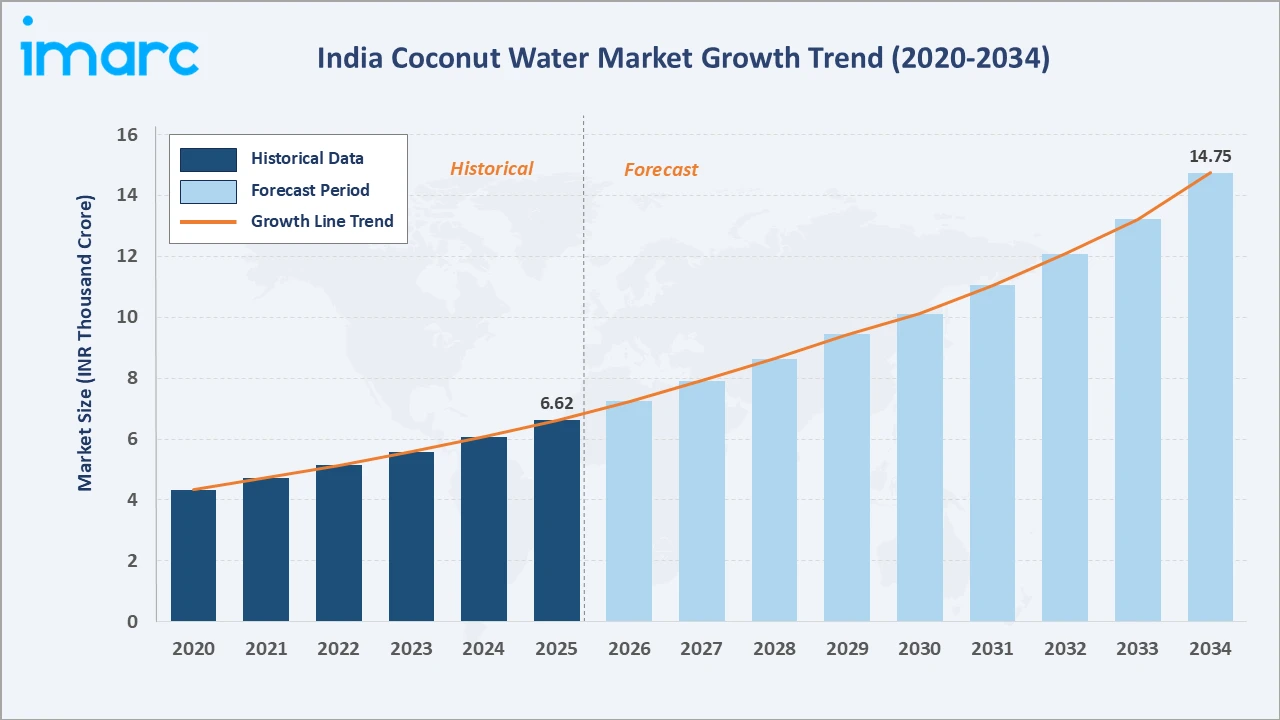
The India coconut water market grew from INR 6.62 Thousand Crore in 2025 to INR 7.21 Thousand Crore in 2026 and is projected to reach INR 14.75 Thousand Crore by 2034, growing at a CAGR of 8.84% during 2026-2034. India ranks first globally in coconut production and third in cultivation area, accounting for 31.24% and 17.90% of global totals, respectively. In 2024–25, the country produced 20,301.22 million nuts across 2.19 million hectares, with an average productivity of 9,249 nuts per hectare. The market is driven by rising health awareness, growing demand for natural hydration beverages, and rapid e-commerce expansion. Flavored variants hold 55.0% of the market share; Online retail stores account for 35.0% by distribution channel. South India leads regionally with 40.0% share, supported by high coconut cultivation and strong local consumption patterns.
Market Snapshot
| Metric | Value |
|---|---|
| Base Year Market Size (2025) | INR 6.62 Thousand Crore |
| Market Size (2026) | INR 7.21 Thousand Crore |
| Forecast Market Size (2034) | INR 14.75 Thousand Crore |
| CAGR (2026-2034) | 8.84% |
| Base Year | 2025 |
| Historical Period | 2020-2025 |
| Forecast Period | 2026-2034 |
| Dominant Flavor | Flavored (55.0%, 2025) |
| Leading Distribution Channel | Online Retail Stores (35.0%, 2025) |
| Leading Region | South India (40.0%, 2025) |
The India coconut water market grew from INR 4.34 Thousand Crore in 2020 to INR 6.62 Thousand Crore in 2025, and further to INR 7.21 Thousand Crore in 2026. The market is projected to reach INR 10.12 Thousand Crore by 2030 before accelerating to INR 14.75 Thousand Crore by 2034.
To get more information on this market, Request Sample
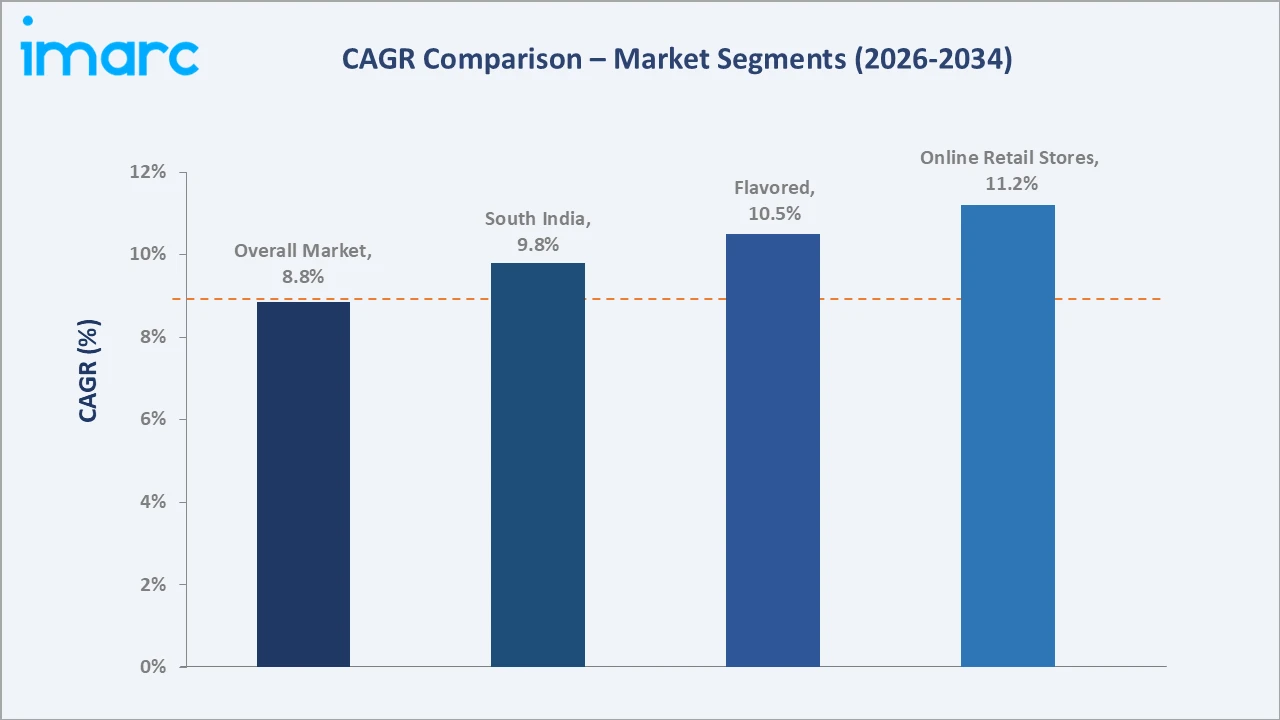
The CAGR comparison below highlights that the online retail distribution channel and flavored coconut water segment are expected to outpace the overall market growth rate of 8.84% during the forecast period of 2026-2034.
Executive Summary
The India coconut water market is on a robust growth trajectory, underpinned by accelerating health and wellness trends among urban and semi-urban consumers. Consumer preference for natural, electrolyte-rich beverages free of artificial additives is the primary structural growth driver, positioning coconut water favorably against conventional carbonated soft drinks.
Flavored coconut water commands 55.0% of the market in 2025, reflecting strong demand for taste innovation alongside health benefits. Online retail stores hold the largest distribution channel share at 35.0%, driven by the rapid expansion of quick-commerce platforms and direct-to-consumer brands. South India maintains regional dominance at 40.0% share owing to abundant raw material availability and deep-rooted consumption culture, while North India at 20.0% represents the fastest-growing opportunity market.
Key Market Insights
| Insight | Data |
|---|---|
| Dominant Flavor | Flavored - 55.0% share (2025) |
| Leading Distribution Channel | Online Retail Stores - 35.0% (2025) |
| Leading Region | South India - 40.0% (2025) |
| Key Market Opportunity | Premium functional coconut water and flavored variants in Tier-II cities |
Key Analytical Observations Supporting the Above Data:
- Flavored at 55.0%: Flavored coconut water leads because consumers increasingly seek taste-enhanced, functional beverages that combine health benefits with sensory appeal, driving innovation in mango, pineapple, and citrus variants across mass and premium segments.
- Online Retail at 35.0%: The digital distribution channel dominates as quick-commerce platforms reduce delivery times to under 30 minutes, making chilled coconut water an impulse purchase category with significant repeat buying behavior among millennial consumers.
- South India at 40.0%: Regional leadership reflects both the structural advantage of raw coconut availability across Kerala, Tamil Nadu, and Karnataka, and deeply embedded cultural consumption of fresh tender coconut among local populations, now transitioning to packaged formats.
India Coconut Water Market Overview
The India coconut water market encompasses the production, processing, packaging, and distribution of tender coconut water derived from the liquid endosperm of immature green coconuts. The product is characterized by its natural electrolyte content, including potassium, sodium, magnesium, and calcium, positioning it as a natural sports and hydration beverage.
The ecosystem spans coconut farming cooperatives and smallholder plantations, industrial-scale cold extraction facilities, aseptic packaging operations, organized logistics networks, and a broad retail landscape from kirana stores to modern supermarkets and e-commerce platforms. Key application areas include direct consumption, sports nutrition, foodservice, and use as a natural flavoring ingredient in premium cocktails and health smoothies.
Market Dynamics
To evaluate market opportunities, Request Sample
Market Drivers
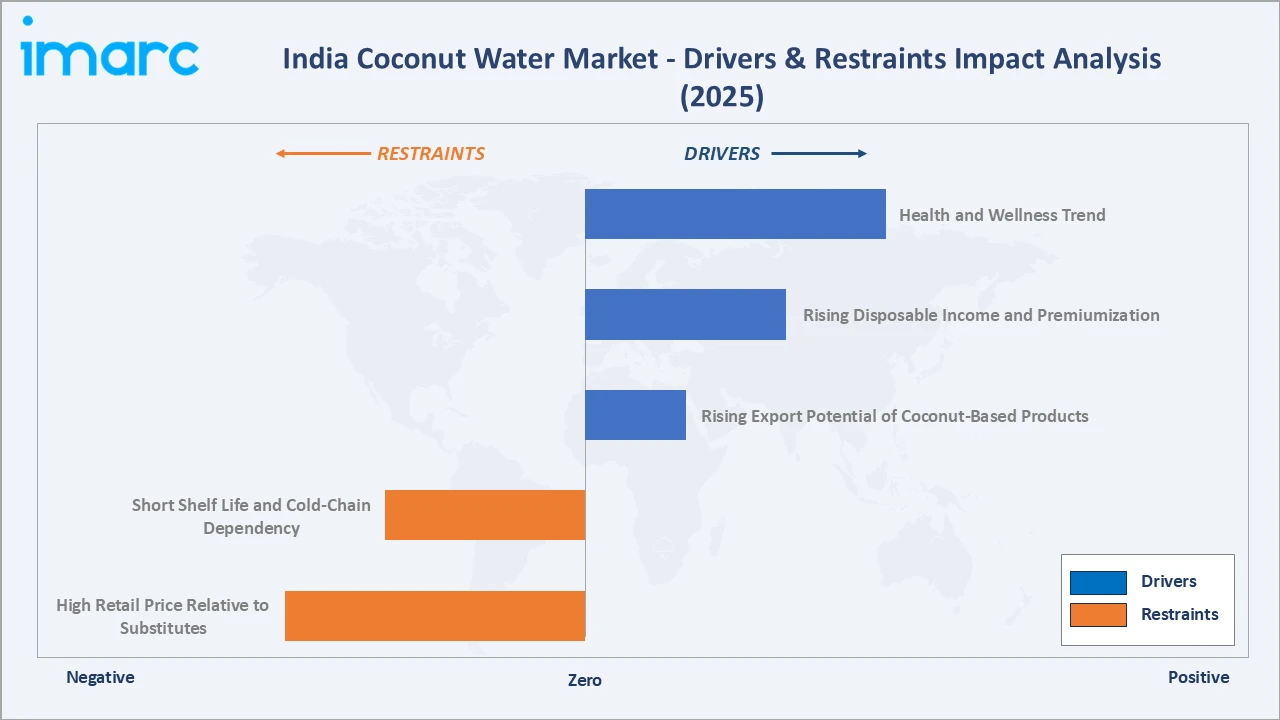
- Health and Wellness Trend: India's health beverage market is growing, with coconut water benefiting as consumers shift from carbonated drinks and processed juices toward natural, low-calorie alternatives rich in electrolytes and essential minerals.
- Rising Disposable Income and Premiumization: India's Gross National Disposable Income rose to INR 353.13 trillion in FY 2025–26, up from INR 324.52 trillion in FY 2024–25, enabling consumers to pay a premium for packaged natural beverages. This is driving adoption of value-added coconut water products.
- Rising Export Potential of Coconut-Based Products: India's coconut product exports increased by 62% to ₹7,038.35 crore (US$794.70 million) in FY 2025–26, compared with ₹4,349.03 crore in the previous fiscal year. This reflects growing international demand for coconut-based products and strengthening export opportunities. This is encouraging domestic processing and value addition, supporting the expansion of the coconut water industry through improved production capabilities and market reach.
Market Restraints
- Short Shelf Life and Cold-Chain Dependency: Natural coconut water has a limited shelf life under ambient conditions, requiring cold-chain infrastructure investment that increases operational costs and limits effective distribution reach into rural and semi-urban markets.
- High Retail Price Relative to Substitutes: Packaged coconut water products are priced at a significant premium over competing beverages such as carbonated soft drinks and fruit juices, creating a price sensitivity barrier among mass-market and rural consumer segments.
Market Opportunities
- Premiumization and Functional Ingredient Addition: Growing consumer interest in functional beverages presents an opportunity to develop value-added coconut water with added vitamins, probiotics, or adaptogens, targeting health-conscious urban consumers willing to pay a premium above standard coconut water products.
- Rural Market Penetration via Affordable SKUs: Introducing coconut water in smaller, low-priced packaging formats can make the product more accessible to rural consumers and price-sensitive households. Leveraging local retail networks, rural distribution channels, and cost-effective packaging can help manufacturers expand their consumer base, increase product penetration, and tap into underserved markets across India.
Market Challenges
- Seasonal Raw Material Supply Volatility: Coconut water availability is subject to seasonal and weather-related supply fluctuations, creating procurement cost volatility that compresses manufacturer margins and complicates forward pricing strategies.
- Quality Inconsistency and Consumer Trust: Maintaining consistent taste, nutritional profile, and food safety standards across a fragmented smallholder supplier base remains a significant operational challenge that affects brand credibility and repeat purchase intent.
Emerging Market Trends
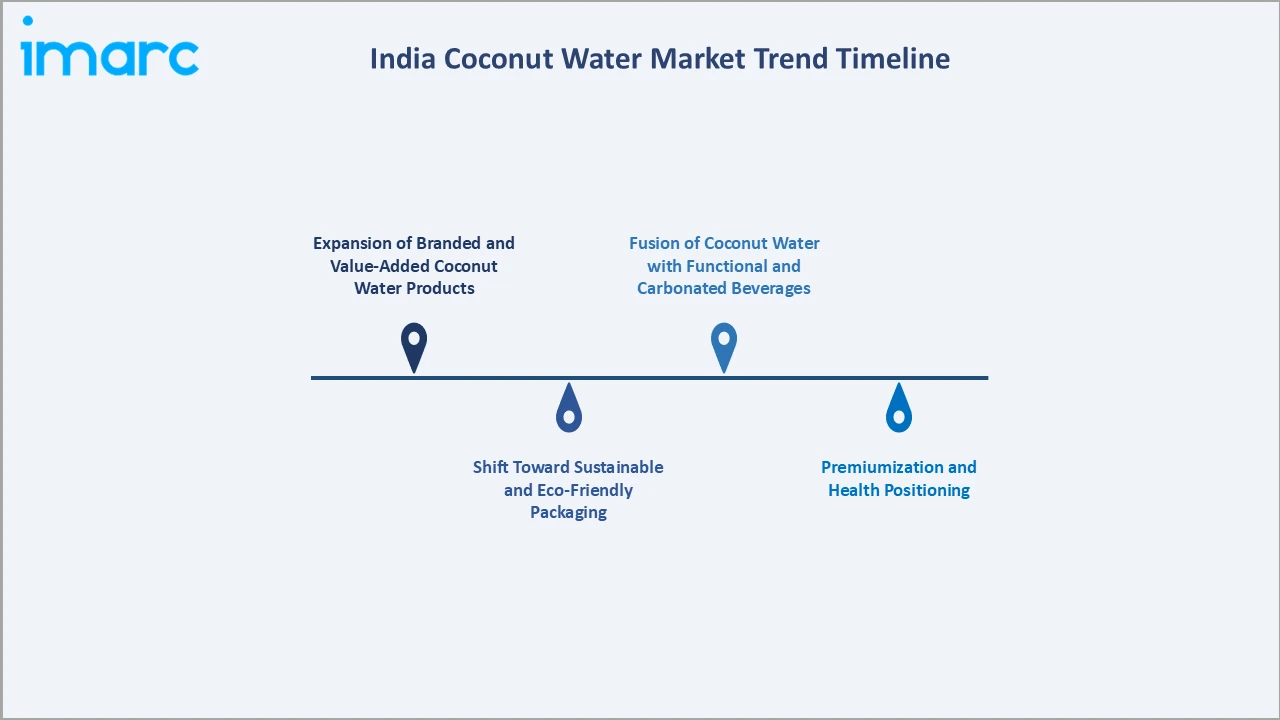
1. Expansion of Branded and Value-Added Coconut Water Products
Manufacturers are increasingly introducing sugar-free, natural beverages in convenient packaging formats to cater to health-conscious consumers and capitalize on the rising demand for healthier alternatives to carbonated and sugar-sweetened drinks. In September 2026, Kothari Industrial Corporation Limited entered the FMCG sector with the launch of ‘Chusip’ Coco Twist, a sugar-free natural tender coconut water beverage. The product is available in 200 ml packs priced at ₹50, with a 1-liter variant and additional fruit-based beverages planned for launch.
2. Shift Toward Sustainable and Eco-Friendly Packaging
Growing environmental consciousness among consumers is accelerating the transition from conventional plastic packaging to recyclable cartons, biodegradable formats, and reduced-plastic alternatives. This shift reflects evolving consumer preferences for responsible purchasing and is encouraging manufacturers to invest in sustainable packaging solutions across price tiers.
3. Fusion of Coconut Water with Functional and Carbonated Beverages
Manufacturers are increasingly experimenting with low-calorie, zero-added-sugar, and caffeine-free formulations to attract health-conscious consumers seeking a balance between indulgence and healthier refreshment. In July 2026, ITC launched B Natural Coconut Cola, a carbonated beverage combining cola flavor with coconut water, targeting consumers seeking healthier refreshment options. The drink contains no caffeine or added sugar and provides just 9 kcal per serving, reflecting the company's focus on wellness-oriented beverage innovation.
4. Premiumization and Health Positioning
A growing segment of health-conscious consumers is willing to pay a premium for minimally processed, cold-pressed, or organic coconut water with verified nutritional credentials. This premiumization trend is elevating the overall category value and encouraging investment in high-quality processing technologies that preserve the natural flavor and electrolyte profile of coconut water.
Industry Value Chain Analysis
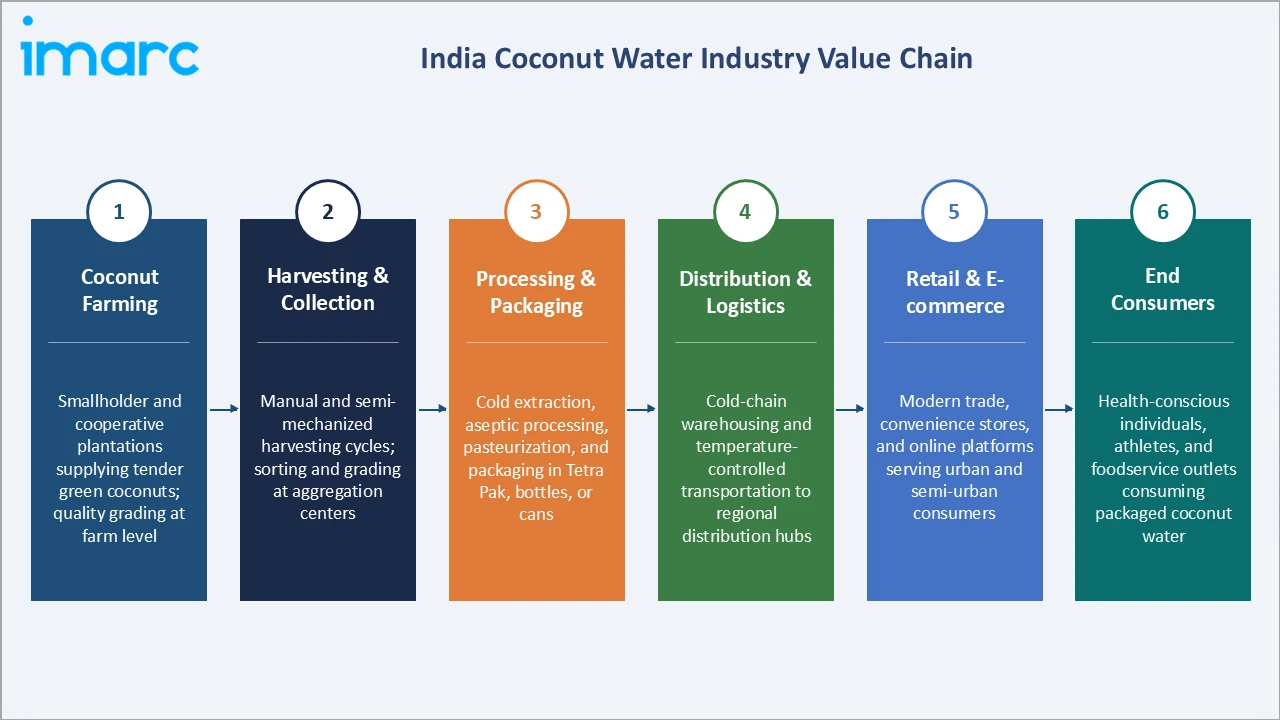
The India coconut water value chain is structured across six integrated stages, from raw coconut farming through end consumer delivery. Each stage adds value through quality management, processing technology, cold-chain logistics, and brand positioning. The chain is characterized by a large, fragmented upstream farming base that progressively consolidates through commercial processing and distribution networks.
| Stage | Key Characteristics |
|---|---|
| Coconut Farming | Smallholder and cooperative plantations supplying tender green coconuts; quality grading at farm level. |
| Harvesting & Collection | Manual and semi-mechanized harvesting cycles; sorting and grading at aggregation centers. |
| Processing & Packaging | Cold extraction, aseptic processing, pasteurization, and packaging in Tetra Pak, bottles, or cans. |
| Distribution & Logistics | Cold-chain warehousing and temperature-controlled transportation to regional distribution hubs. |
| Retail & E-commerce | Modern trade, convenience stores, and online platforms serving urban and semi-urban consumers. |
| End Consumers | Health-conscious individuals, athletes, and foodservice outlets consuming packaged coconut water. |
The processing and packaging stage holds the greatest strategic value in the coconut water value chain. Advanced aseptic processing technology extends shelf life from 3-5 days for fresh coconut water to 12-18 months for commercially packaged variants, enabling national and international market reach. Investment in high-pressure processing equipment and Tetra Pak filling lines is the critical differentiator between small local processors and scalable commercial brands.
Technology Landscape in the India Coconut Water Industry
Aseptic Processing and Extended Shelf-Life Technology
Advanced aseptic processing technologies, including high-pressure processing and ultra-high-temperature treatment, enable manufacturers to extend the shelf life of packaged coconut water while preserving natural electrolytes, flavor, and nutritional integrity, critical for national-scale distribution beyond metro-centric cold-chain infrastructure.
Smart Packaging and Cold-Chain Innovation
The adoption of intelligent packaging formats and temperature-controlled logistics infrastructure is improving freshness assurance and expanding the effective geographic reach of chilled coconut water products. Innovations in last-mile cold-chain delivery are reducing post-harvest losses and supporting consistent product quality across diverse retail and distribution formats.
Extraction Automation and Quality Standardization
Industrial-scale automated extraction and filling systems enable higher throughput while integrating real-time quality controls, including optical sorting, inline nutritional testing, and automated sealing, supporting consistent product quality and food safety compliance at commercial scale.
Digital Supply Chain and Traceability Technology
Digital procurement platforms are improving transparency and efficiency across the coconut water value chain, reducing intermediary costs and strengthening manufacturer-supplier linkages. Traceability technologies are being deployed to support clean-label and origin-verified positioning in premium market segments.
Market Segmentation Analysis
The report covers the following segments:
| Segment Category | Leading Segment | Market Share | Year |
|---|---|---|---|
| Type | 🔒 | 🔒 | 2025 |
| Flavor | Flavored | 55.0% | 2025 |
| Form | Coconut Water | 🔒 | 2025 |
| Packaging | Bottles | 🔒 | 2025 |
| Distribution Channel | Online Retail Stores | 35.0% | 2025 |
| Region | South India | 40.0% | 2025 |

By Flavor
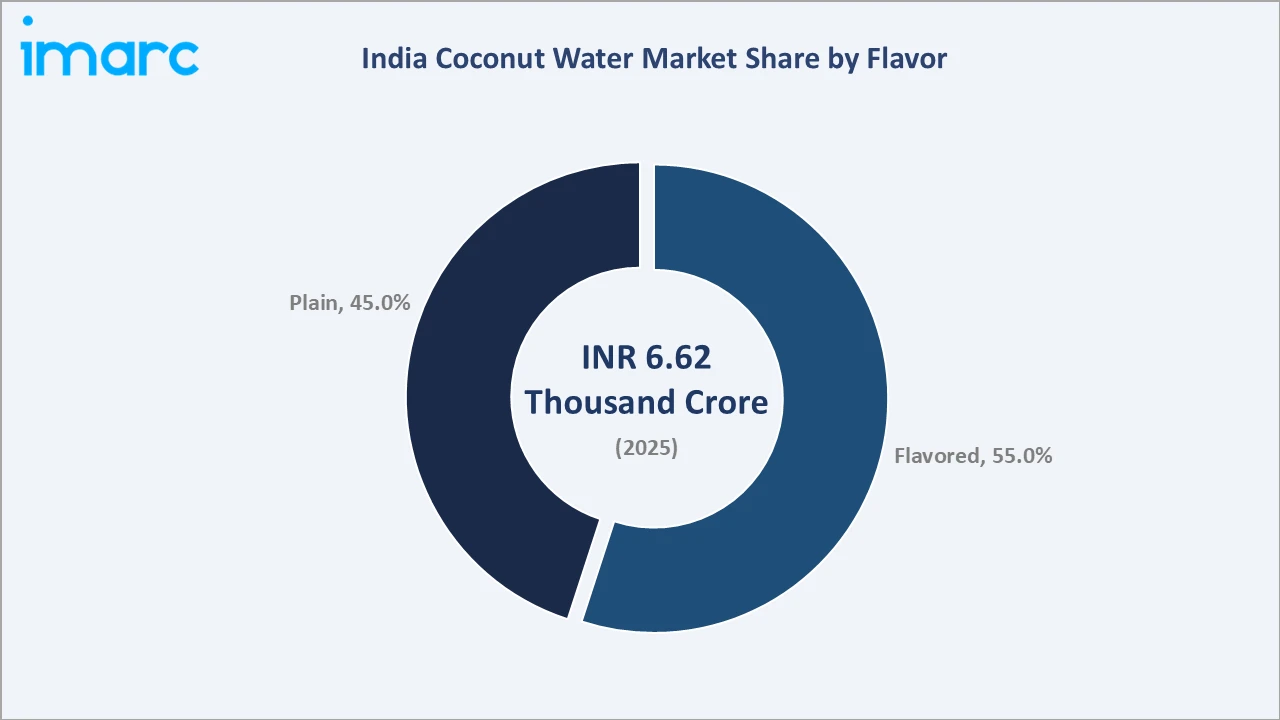
Flavored coconut water leads with 55.0% share in 2025, reflecting sustained consumer preference for taste variety alongside natural health benefits. Popular flavor profiles including mango, pineapple, litchi, and lime account for the majority of flavored segment volume. The flavored segment is projected to expand at a CAGR of approximately 10.5% during 2026-2034, driven by new product innovation targeting younger demographics aged 18-35 who seek functional yet enjoyable beverage options.
To access detailed market analysis, Request Sample
Plain coconut water holds 45.0% of the market in 2025, maintaining a loyal consumer base among health purists who prioritize the unaltered natural electrolyte profile. The plain segment is particularly strong in South India and among fitness enthusiasts and sports nutrition consumers who seek a clean-label ingredient without additives. As health awareness deepens in rural and semi-urban markets, the plain segment is expected to sustain steady growth, particularly through affordable price-tier products.
By Distribution Channel
Online retail stores command the largest distribution channel share at 35.0% in 2025, driven by the rapid expansion of quick-commerce and e-grocery platforms. The online channel offers temperature-controlled last-mile delivery, subscription purchasing options, and direct-to-consumer brand relationships. The channel is projected to grow at a CAGR of approximately 11.2% during 2026-2034, significantly outpacing overall market growth as internet penetration and smartphone adoption deepen in Tier-II cities.
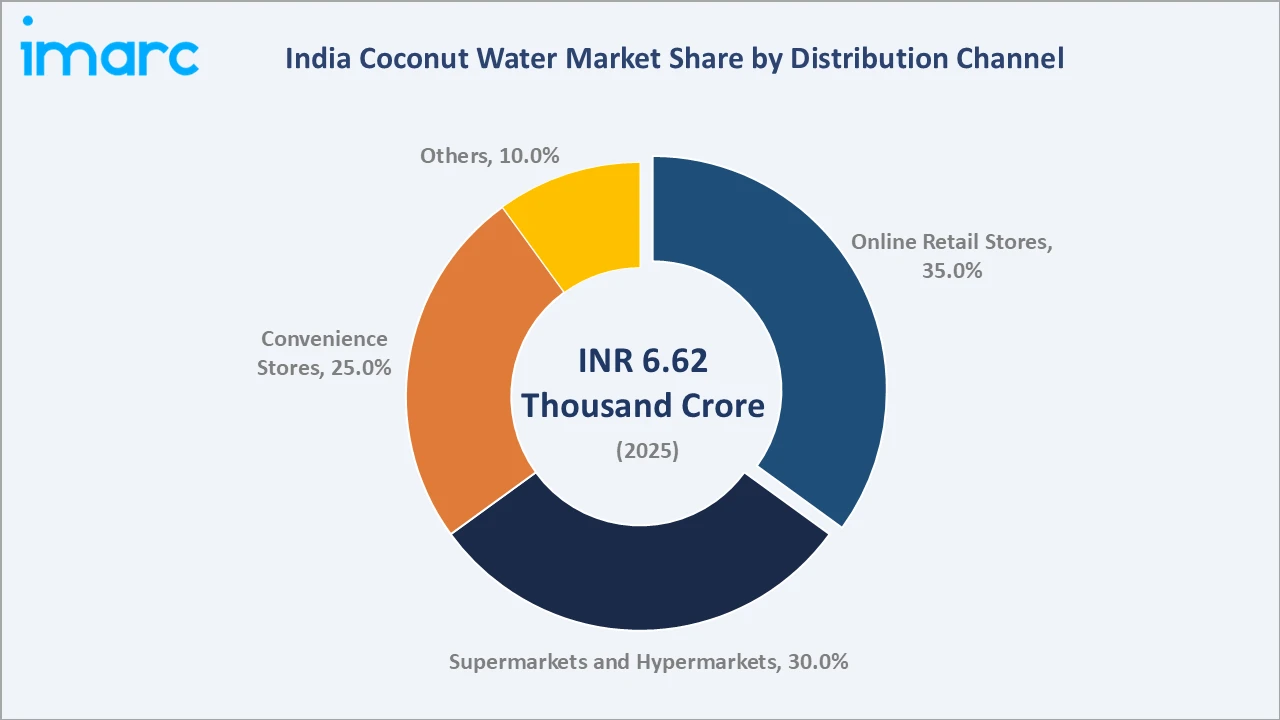
Supermarkets and hypermarkets hold 30.0% channel share in 2025, supported by dedicated health beverage aisles and in-store promotional activities that drive trial and awareness. Convenience stores account for 25.0% of the market, serving impulse purchase occasions in high-footfall locations. The remaining 10.0% encompasses foodservice, corporate canteens, gyms, and institutional channels, which are growing as fitness culture expands and corporate wellness programs increasingly include natural beverage options for employees.
Regional Market Insights
| Region | Share (2025) | Key Market Characteristics |
|---|---|---|
| South India | 40.0% | Highest coconut cultivation density, strong local consumption culture, well-established cold-chain networks, and high brand penetration across urban and rural markets. |
| West & Central India | 25.0% | Large urban consumer base in metropolitan areas, high disposable income, growing modern trade penetration, and rising health beverage adoption among working professionals. |
| North India | 20.0% | Fastest-growing region driven by rising health awareness, e-commerce expansion, and increasing availability of packaged coconut water through quick-commerce platforms. |
| East India | 15.0% | Emerging market with growing urban demand in major cities; relatively lower current penetration offering significant medium-term volume growth opportunity. |
South India at 40.0% is the undisputed market leader, anchored by Kerala's status as India's largest coconut-producing state and Tamil Nadu's and Karnataka's large urban consumer base. The region's structural advantage in raw material proximity reduces procurement and logistics costs for local manufacturers, enabling competitive retail pricing and strong brand presence.
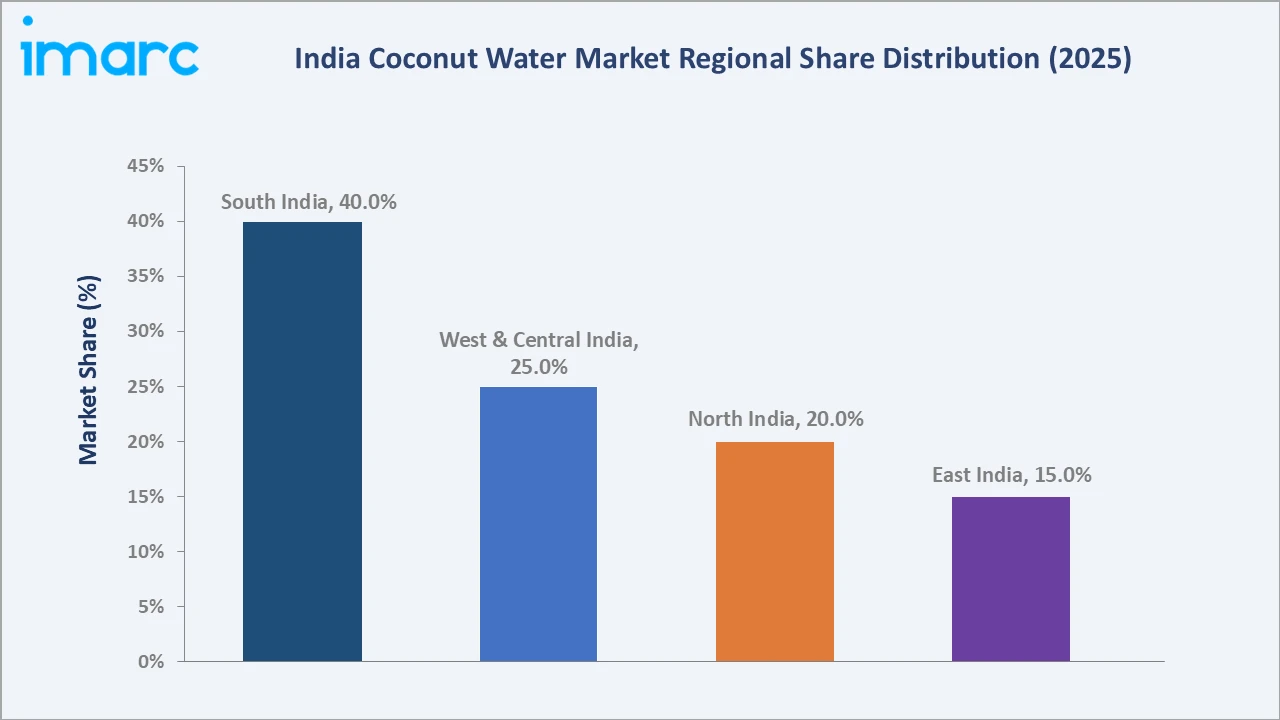
West and Central India at 25.0% is driven by affluent, health-conscious urban populations. The region's high modern trade penetration and strong quick-commerce adoption make it the primary testing ground for premium product launches. North India at 20.0% is the fastest-growing region, with Delhi NCR, Jaipur, and Lucknow showing accelerating adoption, while East India at 15.0% represents the most significant underpenetrated market with growing urban demand.
Competitive Landscape
The India coconut water market is moderately competitive, comprising diversified beverage corporations, health-focused startups, and regional players. Market leaders leverage distribution networks and brand equity, while emerging players compete through product innovation and direct-to-consumer digital strategies.
| Company | Key Brands | Market Position | Core Strength |
|---|---|---|---|
| Hector Beverages Private Limited | Paper Boat | Market Leader | Hector Beverages Private Limited, through the Paper Boat brand, plays a notable role in India’s packaged beverage market by offering ready-to-drink coconut water as part of its health-focused and traditional product lineup. |
| ITC LIMITED | BNatural | Established Player | ITC Limited plays a strategic role in India's coconut water and natural beverage market through its B Natural brand, bridging traditional hydration with modern packaged and carbonated segments. |
| Wingreens World | Raw Pressery | Challenger | Wingreens World operates as a major retail and brand platform in India's packaged beverage and healthy-food market, offering packaged coconut water primarily through its acquired clean-label juice brand, Raw Pressery. |
Competition is intensifying as new entrants from the broader health beverage segment enter the coconut water category, attracted by strong growth projections. Brand acquisitions, geographic expansion into Tier-II cities, and premium product line extensions are reshaping the competitive hierarchy.
Key Company Profiles
Hector Beverages Private Limited
Hector Beverages Private Limited pioneered India's packaged natural beverage category through its flagship Paper Boat brand. The company focuses exclusively on natural, ethnic, and functional beverages, positioning itself as a health- and nostalgia-driven alternative to mainstream carbonated drink brands.
- Key Brands: Paper Boat
- Strategic Focus: Building brand equity through emotional marketing, deepening e-commerce and quick-commerce partnerships, and expanding natural beverage portfolio to drive repeat purchase frequency among health-conscious urban consumers.
ITC LIMITED
ITC Limited is one of India's leading diversified conglomerates, with a strong presence in fast-moving consumer goods (FMCG), agri-business, packaging, and paperboards. The company offers a diverse portfolio of consumer brands, including BNatural, and leverages its extensive distribution network, product innovation capabilities, and strong market presence to cater to evolving consumer preferences. Its focus on quality, sustainability, and expanding its packaged food and beverage portfolio supports its position in India's consumer goods industry.
- Key Brands: BNatural
- Strategic Focus: Expanding its health-oriented beverage portfolio through product innovation, natural ingredients, and the introduction of differentiated offerings to cater to evolving consumer preferences.
Market Concentration Analysis
The India coconut water market exhibits moderate concentration at the organized branded segment level. Market leadership is determined primarily by brand equity, distribution reach, and product portfolio breadth. Competition centers on channel presence, marketing investment, and product innovation, with a small number of established players holding a disproportionate share of organized volume.
The broader market, encompassing unbranded fresh coconut water and small regional processors, remains highly fragmented. Consolidation is progressing as organized retail and digital commerce channels expand, consumer preference for hygienically packaged formats strengthens, and diversified beverage companies increase investment in the natural and functional beverage space.
Investment & Growth Opportunities
Highest Growth Segments
The online distribution channel at 35.0% is expanding at approximately 11.2% CAGR during 2026-2034, making it the fastest-growing channel. Flavored coconut water at 55.0% is the dominant product segment, driven by demand for taste innovation and functional ingredient enrichment.
Investment Themes
- Direct-to-Consumer Digital Platforms: Proprietary subscription-based D2C channels offer superior consumer lifetime value and margin advantages over third-party e-commerce, representing a high-return investment priority for both established and emerging brands.
- Export Market Development: India's cost-competitive production base positions the country to grow coconut water exports to Southeast Asia, the Middle East, and North America through investment in export-grade aseptic packaging and food safety certification.
Future Market Outlook (2026-2034)
The India coconut water market grew from INR 6.62 Thousand Crore in 2025 to INR 7.21 Thousand Crore in 2026, reaching INR 10.12 Thousand Crore by 2030 and projected to reach INR 14.75 Thousand Crore by 2034, growing at a CAGR of 8.84% during 2026-2034. This trajectory reflects a sustained structural shift in Indian consumer beverage preferences toward natural, minimally processed, and functional alternatives that support health and wellness goals.
Three structural forces will define the market through 2034. First, the health and wellness megatrend will convert an additional number of consumers from carbonated beverages to natural alternatives by 2034. Second, maturing quick-commerce infrastructure will expand consumption frequency and geographic reach well beyond current urban strongholds. Third, advances in aseptic processing, sustainable packaging, and functional ingredient integration will expand the product innovation frontier, enabling higher unit value realization.
Research Methodology
Primary Research
Primary research comprised structured consultations with coconut water manufacturing executives, FMCG distribution specialists, organized retail buyers, and consumer health and wellness experts, conducted across South, West, and North India, validating quantitative estimates and providing insight on emerging demand trends and competitive dynamics.
Secondary Research
Secondary research drew on published data from the Food Safety and Standards Authority of India (FSSAI), the National Horticulture Board, industry reports, company annual reports and investor presentations, trade publication databases, and proprietary market research archives on India's food and beverage sector.
Forecasting Models
Market forecasts were developed using combined bottom-up and top-down modeling incorporating historical growth rates from 2020-2025, segment-level demand drivers, channel penetration trajectories, macroeconomic indicators, and expert-validated assumptions on category penetration and competitive dynamics through 2034.
Report Coverage:
| Report Features | Details |
|---|---|
| Base Year of the Analysis | 2025 |
| Historical Period | 2020-2025 |
| Forecast Period | 2026-2034 |
| Units | INR Thousand Crore |
| Scope of the Report | Exploration of Historical Trends and Market Outlook, Industry Catalysts and Challenges, Segment-Wise Historical and Future Market Assessment:
|
| Types Covered | Sweetened, Unsweetened |
| Flavors Covered | Plain, Flavored |
| Forms Covered | Coconut Water, Coconut Water Powder |
| Packagings Covered | Carton, Bottles, Others |
| Distribution Channels Covered | Supermarkets and Hypermarkets, Convenience Stores, Online Retail Stores, Others |
| Regions Covered | North India, West and Central India, East India, South India |
| Companies Covered | Hector Beverages Private Limited, ITC LIMITED, Wingreens World, etc. |
| Customization Scope | 10% Free Customization |
| Post-Sale Analyst Support | 10-12 Weeks |
| Delivery Format | PDF and Excel through Email (We can also provide the editable version of the report in PPT/Word format on special request) |
Frequently Asked Questions About the India Coconut Water Market Report
The India coconut water market reached INR 7.21 Thousand Crore in 2026, driven by rising health awareness, natural beverage adoption, and rapid e-commerce channel expansion.
The market is projected to grow at a CAGR of 8.84% during 2026-2034, supported by health-conscious consumer trends, e-commerce growth, and ongoing product innovation.
The market is projected to reach INR 14.75 Thousand Crore by 2034, driven by deepening health trend adoption, flavored product growth, and geographic expansion into Tier-II markets.
Flavored coconut water leads with a 55.0% share in 2025, reflecting consumer demand for taste variety and functional ingredient-enriched natural beverage options.
Online retail stores lead with a 35.0% share in 2025, driven by quick-commerce platform expansion enabling rapid, chilled delivery and strong impulse purchase behavior.
South India leads with a 40.0% share in 2025, reflecting high coconut cultivation intensity, strong local consumption culture, and well-established brand penetration.
Key players include Hector Beverages Private Limited, ITC LIMITED, and Wingreens World, among others.
Key investment areas include HPP processing infrastructure, D2C digital platforms, cold-chain logistics expansion, flavored product innovation, and export market development in Southeast Asia and the Middle East.
Need more help?
- Speak to our experienced analysts for insights on the current market scenarios.
- Include additional segments and countries to customize the report as per your requirement.
- Gain an unparalleled competitive advantage in your domain by understanding how to utilize the report and positively impacting your operations and revenue.
- For further assistance, please connect with our analysts.
 Request Customization
 Speak to an Analyst
 Request Brochure
 Inquire Before Buying
Benefits of Customization
- Personalize this research
- Triangulate with your data
- Get data as per your format and definition
- Gain a deeper dive into a specific application, geography, customer, or competitor
- Any level of personalization
Get in Touch With Us
UNITED STATES
Phone: +1-201-971-6302
INDIA
Phone: +91-120-433-0800
UNITED KINGDOM
Phone: +44-753-714-6104
Email: [email protected]
Client Testimonials




















Related Reports

Choose your plan
*Please note that the prices mentioned below are starting prices for each bundle type. Kindly contact our team for further details.*
Single User License
- 1 User License, Access on 2 Devices
- PDF Report + Excel Dataset (Password Protected)
- Lifetime Access
- No Printing Rights
- 10% Free Report Customization
- 10–12 Weeks of Analyst Support
Five User License
- Access for 5 Users, 2 Devices per User
- PDF Report + Excel Dataset (Password Protected)
- Lifetime Access
- Dedicated Account Manager
- 12–14 Weeks of Analyst Support
- No Printing Rights
- 15% Free Report Customization
- 25% Discount on Your Next Purchase
Corporate User License
- Unlimited User Access (Within Your Organization)
- PDF Report + Excel Dataset
- Lifetime Access
- Dedicated Account Manager
- 14–20 Weeks of Analyst Support
- No Printing Rights
- 20% Free Report Customization
- 30% Discount on Your Next Purchase
Essential Insights
What's included:
3 reports
- Lifetime Access
- PDF Reports
- Excel Datasets
- 2 Weeks of Free Analyst Support
- 2 User Licenses
- Access on 2 Devices
- Printing Rights
- Complimentary PowerPoint (PPT) Version
- Complimentary License Upgrade
Professional Access
What's included:
5 reports
- Lifetime Access
- PDF Reports
- Excel Datasets
- 8 Weeks of Free Analyst Support
- 2 User Licenses
- Access on 2 Devices
- Printing Rights
- Complimentary PowerPoint (PPT) Version
- Complimentary License Upgrade
Business Advantage
What's included:
8 reports
- Lifetime Access
- PDF Reports
- Excel Datasets
- 14 Weeks of Free Analyst Support
- 2 User Licenses
- Access on 2 Devices
- Printing Rights
- Complimentary PowerPoint (PPT) Version
- Complimentary License Upgrade
Enterprise Intelligence
What's included:
10 reports
- Lifetime Access
- PDF Reports
- Excel Datasets
- 20 Weeks of Free Analyst Support
- 2 User Licenses
- Access on 2 Devices
- Printing Rights
- Complimentary PowerPoint (PPT) Version
- Complimentary License Upgrade