
India Credit Card Market Size, Share, Trends and Forecast by Type, Service Providing Company, Credit Score, Credit Limit, Card Type, Benefits and Region, 2026-2034
India Credit Card Market Size & Forecast 2026-2034
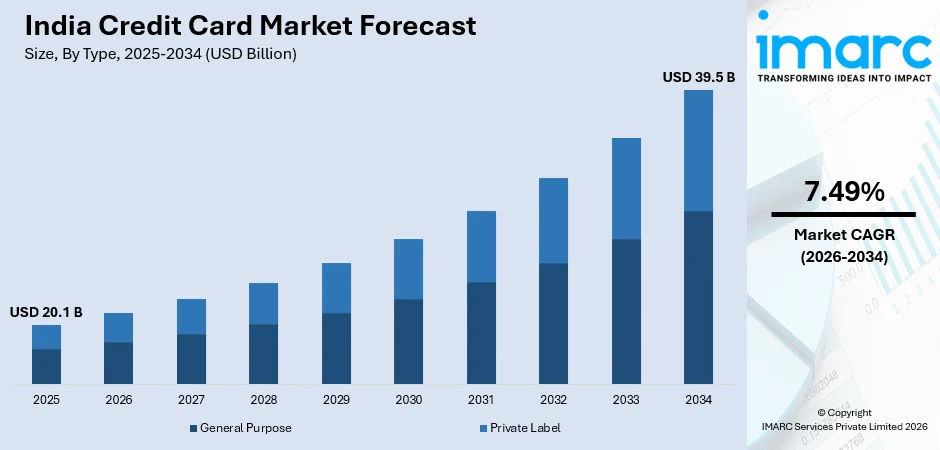
India credit card market size stood at USD 20.1 Billion in 2025, and it is projected to reach USD 39.5 Billion by 2034, with a compound annual growth rate (CAGR) of 7.49% during 2026-2034. The credit card market in India is witnessing robust growth, fueled by the rapid adoption of digital payments, the increasing popularity of fintech-driven co-branded credit cards, and the expansion of credit availability in Tier-II and Tier-III towns. Monthly transactions involving credit cards stood at 496 million in September 2025, indicating rising consumer demand. Reward-based products, no-cost EMI plans, and UPI-enabled credit cards are behavioral influencers that contribute to the India credit card market share.
To get more information on this market Request Sample
India Credit Card Industry Analysis: Key Insights
- General purpose cards accounted for 88.7% of the India credit card market in 2025 due to mass-market adoption driven by digital onboarding, co-branded partnerships, and broad merchant acceptance firmly anchors this segment.
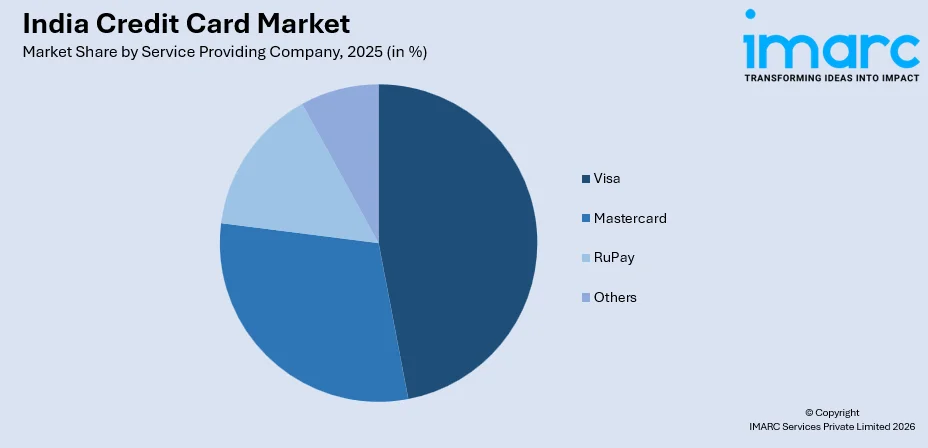
- Visa commanded a 43.5% share in 2025 due to globally trusted infrastructure, widespread merchant acceptance, and strong co-branded card alliances with HDFC Bank and ICICI Bank reinforce its market lead.
- The 701-850 credit score band dominated at 51.2% in 2025 with prime borrowers in this tier exhibiting low delinquency and high spending capacity, making them the industry's most commercially attractive cardholders.
- The 51k-2L credit limit tier held 46.4% in 2025 as this mid-range band aligns with the income profile of India's expanding salaried middle class, making it the structural backbone of card issuance.
- Platinum cards led card type with 38.0% in 2025 as this holds a sweet spot between premium benefits and affordable annual fees, capturing aspirational middle-class consumers who seek travel perks and lifestyle rewards.
- Cashback held a commanding 60.0% share in benefits in 2025 because in a price-sensitive market, cashback cards offer the most transparent and immediately tangible value, far outpacing points-based alternatives.
- West India led regionally at 32.0% in 2025, and this is the highest concentration across all four regions, anchored by Mumbai's financial services density, Ahmedabad's e-commerce adoption, and Maharashtra's mature organized retail ecosystem.
India Credit Card Market Trends and Dynamic 2026:
Market Trends
UPI-Credit Integration Transforming Transaction Volumes
India’s credit card market is witnessing a structural change with the integration of UPI and credit card systems. RuPay credit cards, which can be integrated with PhonePe, Paytm, and Google Pay, allow for transactions at millions of merchants who use QR-based payment systems, previously only accessible for debit card transactions. By late 2025, UPI-based credit card transactions accounted for around 40% of total credit card transactions by volume, extending the scope of credit beyond traditional POS systems into semi-urban and rural merchant networks across India.
Accelerating Demand for Co-Branded Cards Linked to Rewards
India’s credit card market is witnessing accelerating demand for co-brand cards, including those tied to e-commerce, travel, and lifestyle. SBI Card and PhonePe, in July 2025, introduced PhonePe SBI Card in two variants, PURPLE and SELECT BLACK, enabling up to 10% value back on PhonePe transactions. The cards operate across RuPay and VISA. The launch is a part of a larger structural shift in integrating credit into digital payment systems for seamless usage.
Geographic Expansion into Tier II and Tier III Cities
The Indian credit card market is witnessing expansion beyond its traditional Delhi-Mumbai-Kolkata-Chennai markets into Tier II and Tier III cities. While Delhi tops the chart with the highest adoption in the country at 12%, Maharashtra is home to 9.61 million credit card holders. However, other cities such as Surat, Nashik, and Kanpur are also witnessing robust growth rates. Financial inclusion and digital onboarding are allowing first-time credit card holders in these cities to access credit for the first time.
Growth Drivers
Rapid growth in card issuance and digital transactions: The Indian credit card market is witnessing rapid growth as financial institutions continue to drive the issuance of cards. The outstanding credit cards in circulation have exceeded 100 million in recent years, indicating a massive increase. The growth in cards in force is a positive indicator of increasing transactions as consumers, especially in urban cities, increasingly opt for credit cards as a means of payment for daily transactions.
E-commerce growth and digital payment platform integration: The e-commerce industry is witnessing tremendous growth in India, contributing significantly to the growth of credit card transactions. The online credit card transactions in India are witnessing a sharp rise in recent years, crossing record highs in terms of volumes. The integration of digital payment systems, including those of UPI, with credit cards, including UPI-based credit card transactions contributing a significant percentage of overall transactions, is a positive indicator of the growth of digital payments.
Value-added offerings and rewards programs: Financial institutions are actively using various marketing incentives like cashback, discounts, free EMIs, and co-branded cards with various retail and travel companies. Value-added offerings not only help in acquiring new customers but also encourage existing customers to spend more on credit cards, making them more attractive in relation to other modes of payment. This is further supported by the high growth in transactions and increasing credit card payment values at both point of sale and online.
- RBI Payments Vision 2025: Expanding card acceptance infrastructure to 250 lakh touchpoints is structurally increasing transaction opportunities, reducing friction across merchant categories nationwide.
- Rising Tier-II and Tier-III Demand: Digital onboarding and fintech partnerships are lowering customer acquisition cost, enabling card issuance in previously underserved urban demographics at scale.
- Fintech and Neo-Banking Growth: New-age issuers and app-based credit products are lowering entry barriers, broadening the addressable demographic while forcing traditional banks to accelerate product innovation.
- Consumer Aspiration and Lifestyle Spending: Travel bookings, premium retail, dining, and entertainment spends are driving credit card usage among urban millennials and Gen-Z professionals as a lifestyle management tool.
Market Restraints
Less penetration of credit: In the Indian market, credit cards are largely given to people with a stable source of income and a good credit history. This leaves a considerable number of the population in the informal sector without access to credit cards.
Presence of strong competitors for credit cards: The recent surge in the adoption of UPI payment systems like Google Pay, Paytm, and PhonePe has led to a decline in the overall usage of credit cards for transactions. This is because these systems allow users to make direct bank transfers without the need to pay any interest.
Concerns about fraud: The recent increase in the number of cases of fraud involving online transactions and the misuse of identities for the same may lead to a decrease in the number of people opting for credit cards for digital transactions. In addition to this, the high interest rates that need to be paid for outstanding credit card dues and the overall fear of incurring personal debt may also act as a factor that hinders the adoption of credit cards in the Indian market.
India Credit Card Market Segmentation Analysis
| Segment Category | Leading Segment | Market Share | Year |
|---|---|---|---|
| Type | General Purpose | 88.7% | 2025 |
| Service Providing Company | Visa | 43.5% | 2025 |
| Credit Score | 701-850 | 51.2% | 2025 |
| Credit Limit | 51k-2L | 46.4% | 2025 |
| Card Type | Platinum | 38.0% | 2025 |
| Benefits | Cashback | 60.0% | 2025 |
| Region | West India | 32.0% | 2025 |
Type Insights
General Purpose- 88.7% Market Share (2025) | Leading Type
General-purpose credit cards hold the dominant control in the Indian market, with 88.7% of the total market share by type in 2025. General-purpose credit cards are issued by prominent banks like HDFC Bank, SBI Card, ICICI Bank, and Axis Bank. They are intended for universal use by consumers across various merchant categories without any restrictions in terms of a specific retailer or ecosystem. General-purpose credit cards are universal in nature, making them suitable for online as well as offline transactions. As of January 2026, the total credit card transactions stood at 537 million on a monthly basis, with general-purpose credit cards contributing to the majority of the total transactions in terms of reward programs, cost-free EMI options, and contactless payments.
|
Segment Breakdown General Purpose (88.7%) · Private Label |
Service Providing Company Insights
Access the comprehensive market breakdown Request Sample
Visa- 43.5% Market Share (2025) | Leading Service Providing Company
The 43.5% market share of Visa in the credit card service providing company segment in India indicates the high degree of penetration that Visa has achieved in the country. HDFC Bank, which is the largest credit card issuer in India and has a 28.4% share of the spending market as of January 2026, depends on the Visa network for its premium credit cards such as Infinia, Regalia, and Millennia variants. Visa introduced cutting-edge payment innovations at the Global Fintech Fest in Mumbai in August 2024.
|
Segment Breakdown Visa (43.5%) · Mastercard · RuPay · Others |
Credit Score Insights
701–850- 51.2% Market Share (2025) | Leading Credit Score
The 701–850 credit score bracket dominates card issuance, reflecting a growing cohort of creditworthy salaried professionals with verified repayment histories. Banks actively target this segment for premium card upselling and pre-approved offers, using bureau data to calibrate risk. Sustained growth in this bracket is further supported by India's maturing credit infrastructure, as more consumers build formal credit histories through secured and entry-level unsecured products. Banks view this segment as both a volume anchor and a premium conversion funnel, acquiring them on base cards before migrating to signature and platinum tiers as spending patterns and repayment records strengthen over time.
|
Segment Breakdown 701–850 (51.2%) · 300–500 · 501–700 · Above 851 |
Credit Limit Insights
51K–2L- 46.4% Market Share (2025) | Leading Credit Limit
The ₹51,000–₹2 lakh credit limit bracket is the sweet spot for India's salaried urban middle class, enabling meaningful discretionary spending without excessive credit risk. Cards in this range anchor co-branded and reward programs across all major private sector banks. HDFC Bank led issuances with 25.79 million cards as of December 2025, followed by SBI Card at 21.81 million, with the 51K–2L bracket representing the dominant credit limit tier across these portfolios, supporting the India credit card market forecast.
|
Segment Breakdown 51K–2L (46.4%) · Up to 25K · 25–50K · 2L–5L |
Card Type Insights
Platinum- 38.0% Market Share (2025) | Leading Card Type
Platinum cards lead India's card type segmentation, driven by high-income professionals and aspirational urban consumers seeking premium benefits, lounge access, lifestyle privileges, and accelerated reward accumulation. India's credit card spending was substantially powered by premium card users making high-value travel, retail, and entertainment purchases that align directly with platinum card reward structures and spending incentives.
|
Segment Breakdown Platinum (38.0%) · Base · Signature |
Benefits Insights
Cashback- 60.0% Market Share (2025) | Leading Benefits
Cashback dominates India's credit card benefits landscape because it delivers immediate, tangible value across every spending category, unlike travel miles or vouchers that require specific redemption contexts. The popularity of cashback is shaped by India's price-sensitive consumer culture, where even small percentage returns on everyday spends like groceries, fuel, dining, and utility bills, drive meaningful preference. Banks have expanded accelerated cashback tiers on high-frequency categories, making cashback cards the most accessible and universally appealing product across income segments, from entry-level to premium portfolios.
|
Segment Breakdown Cashback (60.0%) · Voucher |
Regional Insights
West India- 32.0% Market Share (2025) | Leading Region
West India dominates the Indian credit card market, with Mumbai being the financial capital of the country. Ahmedabad is also among the fastest-growing commercial centers in the country. Maharashtra and Gujarat together contribute to the commercial backbone of the credit card market in West India. Incremental growth is provided by the commercial centers of Pune, Surat, and Nashik. This region has a diversified industry base, including the IT sector in Pune and the diamond trade in Surat. This has led to a wide range of salaried and self-employed individuals holding credit cards across various income groups.
|
Metric
|
Details
|
|---|---|
|
Market Share in 2025
|
32%
|
|
Key States
|
Maharashtra, Gujarat, Rajasthan, Goa
|
|
Major Growth Drivers
|
Concentrated financial services sector, high e-commerce adoption, mature organized retail, strong IT and BFSI employment base
|
|
Outlook
|
Sustained leadership through premium card adoption and spending
|
|
Regional Breakdown West India · South India · North India · East India |
South India:
South India is a major credit card market driven by Bengaluru's technology sector, Hyderabad's pharma and IT corridors, and Chennai's manufacturing and services base. The region contributes significantly to premium and co-branded card adoption among young IT professionals.
|
Metric
|
Details
|
|---|---|
|
Key States
|
Karnataka, Tamil Nadu, Andhra Pradesh, Telangana, Kerala |
|
Major Growth Drivers
|
Large IT workforce, high digital payment literacy, rapidly expanding e-commerce spend, growing tier-II city card adoption |
|
Outlook
|
Strong growth underpinned by tech sector and digital workforce expansion |
North India:
North India's credit card market is anchored by Delhi-NCR, one of India's highest per-capita credit card spend regions, along with growing adoption across Uttar Pradesh, Punjab, and Haryana. HDFC Bank, which increased its transaction value market share to 28.4% in January 2026, maintains one of its strongest regional presences in Delhi-NCR, reflecting the region's appetite for premium travel, lifestyle, and reward cards among affluent government and corporate sector employees.
|
Metric
|
Details
|
|---|---|
|
Key States
|
Delhi NCR, Uttar Pradesh, Punjab, Haryana, Uttarakhand |
|
Major Growth Drivers
|
High urban concentration, strong government and IT sector employment, large salaried base, rapid tier-II city digital adoption |
|
Outlook
|
Robust premium card expansion anchored by Delhi-NCR issuance |
East India:
East India remains the smallest credit card market region but is gaining traction through increasing financial inclusion, digital banking growth, and rising consumer aspirations in West Bengal, Odisha, Bihar, and Assam. SBI Cards, which expanded its transaction value market share from 19.3% to 24.7% between April 2025 and January 2026, relies on its mass-market and tier-II/III city portfolio to drive gains in East India, where its public sector brand outperforms private peers.
|
Metric
|
Details
|
|---|---|
|
Key States
|
West Bengal, Odisha, Bihar, Assam, Jharkhand |
|
Major Growth Drivers
|
Rising financial inclusion, digital banking expansion, SBI Cards' public sector reach, growing salaried workforce in Kolkata and Bhubaneswar |
|
Outlook
|
Fastest catch-up growth potential from a low penetration base |
Market Outlook 2026-2034
What is the future outlook of the India Credit Card market?
The India Credit Card market is expected to sustain steady revenue growth through 2034
India’s credit card market is poised to continue its growth trajectory, driven by the country’s young population, increasing income formalization, and rising penetration of financial services in tier-II and tier-III cities. Ongoing investments in digital payment systems, co-branded product expansion, and supportive regulatory policies in terms of credit availability will continue to drive the Indian credit card market in the long term. Premium cards, credit cards linked to UPI, and the involvement of NBFCs will continue to drive the Indian credit card market in the long term, keeping the growth rate high until 2034.
India Credit Card Market: Leading Key players
The Indian credit card market is influenced by a small cluster of private and public sector banks that are highly competitive with their products and co-branded cards distributed digitally. The major players in this market are HDFC Bank, SBI Cards, ICICI Bank, and Axis Bank, while other mid-sized credit card issuers such as RBL Bank and Kotak Mahindra are also gaining pace with their launch and digital strategies.
| Company | Leading Brands | Highlights |
|---|---|---|
| HDFC Bank Limited | Infinia, Regalia, Diners Club Black, Millennia | India's largest credit card issuer with 25.79 million cards (December 2025); increased transaction value market share to 28.4% in January 2026 |
| SBI Cards and Payment Services Limited | SBI Cashback, SimplyCLICK, Card Elite, IRCTC SBI | Overall spending by cardholders rose 33% to 1.147 trillion rupees, while cards- -in-force, or the sum of all credit cards issued, rose 8% from last year. |
| ICICI Bank Limited | Amazon Pay ICICI, Coral, Rubyx, Times Black ICICI | Third-largest issuer with 18.65 million cards (December 2025); launched super-premium co-branded Times Black metal credit card with Times Internet (December 2024) |
Some other major key players in the India credit card market are Axis Bank Limited, Citibank India, Bank of Baroda, RBL Bank Ltd., Kotak Mahindra Bank Limited, Punjab National Bank, IndusInd Bank, etc.
Latest Development & News:
- In September 2025, ICICI Bank and Amazon Pay completed the renewal of their co-branded credit card partnership. The Amazon Pay ICICI Bank Credit Card, India's most adopted co-branded card with over 5 million customers, received a reduced forex markup on international transactions from 3.5% to 1.99%, expanding its appeal for travel-oriented cardholders effective October 11, 2025.
- In July 2025, SBI Card and PhonePe launched the PhonePe SBI Card in two variants namely PURPLE and SELECT BLACK that are available on both RuPay and VISA networks. The RuPay variants are directly integrated with UPI for seamless transactions across 40 million merchants, combining SBI Card's card issuance expertise with PhonePe's 630 million registered user base.
- In June 2025, PhonePe and HDFC Bank partnered to launch co-branded UPI-linked credit cards in two variants namely Ultimo and UNO, operating on the RuPay network. The cards enable PhonePe users to use credit card functionality at UPI merchant endpoints through a fully digital application process integrated within the PhonePe app.
India Credit card Market Report Coverage:
| Report Features | Details |
|---|---|
| Base Year of the Analysis | 2025 |
| Historical Period | 2020-2025 |
| Forecast Period | 2026-2034 |
| Units | Billion USD |
| Scope of the Report |
Exploration of Historical Trends and Market Outlook, Industry Catalysts and Challenges, Segment-Wise Historical and Future Market Assessment:
|
| Types Covered | General Purpose, Private Label |
| Service Providing Companies Covered | Visa, Mastercard, RuPay, Others |
| Credit Scores Covered | 300-500, 501-700, 701-850, Above 851 |
| Credit Limits Covered | Up to 25K, 25-50K, 51K-2L, 2L-5L |
| Card Types Covered | Base, Signature, Platinum |
| Benefits Covered | Cashback, Voucher |
| Regions Covered | North India, South India, East India, West India |
| Customization Scope | 10% Free Customization |
| Post-Sale Analyst Support | 10-12 Weeks |
| Delivery Format | PDF and Excel through Email (We can also provide the editable version of the report in PPT/Word format on special request) |
Key Benefits for Stakeholders:
- IMARC’s industry report offers a comprehensive quantitative analysis of various market segments, historical and current market trends, market forecasts, and dynamics of the India credit card market from 2020-2034.
- The research report provides the latest information on the market drivers, challenges, and opportunities in the India credit card market.
- Porter's five forces analysis assist stakeholders in assessing the impact of new entrants, competitive rivalry, supplier power, buyer power, and the threat of substitution. It helps stakeholders to analyze the level of competition within the India credit card industry and its attractiveness.
- Competitive landscape allows stakeholders to understand their competitive environment and provides an insight into the current positions of key players in the market.
Frequently Asked Questions About the India Credit Card Market Report
The India credit card market was valued at USD 20.1 Billion in 2025.
The India credit card market is anticipated to reach a value of USD 39.5 Billion by 2034.
General purpose dominates the market with a share of 88.7% in 2025, driven by universal merchant acceptance, broad co-branded product offerings, and digital onboarding capabilities that make these cards the default credit instrument for urban and semi-urban Indian consumers across multiple spend categories.
Visa dominates the market with a share of 43.5% in 2025, as Visa has the largest market share in the India credit card market because of its extensive global payment infrastructure and its relationship with prominent banking institutions in India. The majority of prominent card-issuing organizations in India, including those in the private sector and financial institutions, provide credit cards with the Visa logo because of its trustworthiness, sophisticated fraud protection technology, and capability to process transactions on a global scale.
701-850 dominates the market with a share of 51.2% in 2025, as individuals with credit scores falling in the range of 701-850 are the largest users of credit cards in the India credit card market because financial institutions are more willing to provide credit cards to those with high creditworthiness and low chances of defaulting on payments.
51k-2L dominates the market with a share of 46.4% in 2025, as these credit cards match the income group of the large population of the middle class in the country’s urban areas.
Platinum card type dominates the market with a share of 38.0% in 2025, because they offer the best combination of luxury and affordability. These cards are placed above entry-level cards but below ultra-premium cards and offer value-added services to consumers.
Cashback benefits dominate the market with a share of 60.0% in 2025, because they offer direct and easily understandable financial benefits to consumers. In the case of the country’s credit cards users, they prefer tangible benefits rather than complex rewards redemption programs. Therefore, cashback benefits hold the largest share in the credit cards market because they can be used for various categories of purchases such as groceries, fuel, and online shopping.
West India dominates the credit card market in India with a share of 32.0% in 2025, because of the region’s high economic activity, high level of urbanization, and the presence of financial and commercial centers like Mumbai and Pune. These factors attract the offices of large corporations and financial organizations as well as salaried employees with higher incomes.
Key growth factors include RBI's supportive digital payment policies through Payments Vision 2025, the integration of credit cards with UPI infrastructure via RuPay linkage, surging e-commerce spending, the rise of fintech-driven co-branded card partnerships, growing middle-class disposable incomes, and the rapid penetration of first-time cardholders in Tier-II and Tier-III cities through digital-first issuance models.
Some of the major players in the India credit card market are HDFC Bank Limited, SBI Cards and Payment Services Limited, ICICI Bank Limited, Axis Bank Limited, Citibank India, Bank of Baroda, RBL Bank Ltd., Kotak Mahindra Bank Limited, Punjab National Bank, and IndusInd Bank.
There are certain challenges that the credit card market in India is facing. For example, the penetration of credit cards in the Indian market is still low in relation to the population. This is mainly because of the eligibility criteria that need to be fulfilled in order to obtain a credit card. Secondly, the population is still not willing to use credit cards in favor of debit cards. This is because many people in the country still prefer using cash over credit cards. Also, the increasing fraud concerns regarding online transactions might affect the Indian market.
Need more help?
- Speak to our experienced analysts for insights on the current market scenarios.
- Include additional segments and countries to customize the report as per your requirement.
- Gain an unparalleled competitive advantage in your domain by understanding how to utilize the report and positively impacting your operations and revenue.
- For further assistance, please connect with our analysts.
 Request Customization
 Speak to an Analyst
 Request Brochure
 Inquire Before Buying
Benefits of Customization
- Personalize this research
- Triangulate with your data
- Get data as per your format and definition
- Gain a deeper dive into a specific application, geography, customer, or competitor
- Any level of personalization
Get in Touch With Us
UNITED STATES
Phone: +1-201-971-6302
INDIA
Phone: +91-120-433-0800
UNITED KINGDOM
Phone: +44-753-714-6104
Email: [email protected]
Client Testimonials




.webp)




.webp)













Related Reports

Choose your plan
*Please note that the prices mentioned below are starting prices for each bundle type. Kindly contact our team for further details.*
Single User License
- 1 User License, Access on 2 Devices
- PDF Report + Excel Dataset (Password Protected)
- Lifetime Access
- No Printing Rights
- 10% Free Report Customization
- 10–12 Weeks of Analyst Support
Five User License
- Access for 5 Users, 2 Devices per User
- PDF Report + Excel Dataset (Password Protected)
- Lifetime Access
- Dedicated Account Manager
- 12–14 Weeks of Analyst Support
- No Printing Rights
- 15% Free Report Customization
- 25% Discount on Your Next Purchase
Corporate User License
- Unlimited User Access (Within Your Organization)
- PDF Report + Excel Dataset
- Lifetime Access
- Dedicated Account Manager
- 14–20 Weeks of Analyst Support
- No Printing Rights
- 20% Free Report Customization
- 30% Discount on Your Next Purchase
Essential Insights
What's included:
3 reports
- Lifetime Access
- PDF Reports
- Excel Datasets
- 2 Weeks of Free Analyst Support
- 2 User Licenses
- Access on 2 Devices
- Printing Rights
- Complimentary PowerPoint (PPT) Version
- Complimentary License Upgrade
Professional Access
What's included:
5 reports
- Lifetime Access
- PDF Reports
- Excel Datasets
- 8 Weeks of Free Analyst Support
- 2 User Licenses
- Access on 2 Devices
- Printing Rights
- Complimentary PowerPoint (PPT) Version
- Complimentary License Upgrade
Business Advantage
What's included:
8 reports
- Lifetime Access
- PDF Reports
- Excel Datasets
- 14 Weeks of Free Analyst Support
- 2 User Licenses
- Access on 2 Devices
- Printing Rights
- Complimentary PowerPoint (PPT) Version
- Complimentary License Upgrade
Enterprise Intelligence
What's included:
10 reports
- Lifetime Access
- PDF Reports
- Excel Datasets
- 20 Weeks of Free Analyst Support
- 2 User Licenses
- Access on 2 Devices
- Printing Rights
- Complimentary PowerPoint (PPT) Version
- Complimentary License Upgrade