
India Facial Masks Market Size, Share, Trends and Forecast by Product Type, Application, Price Range, Sales Channel, and Region, 2026-2034
India Facial Masks Market Summary:
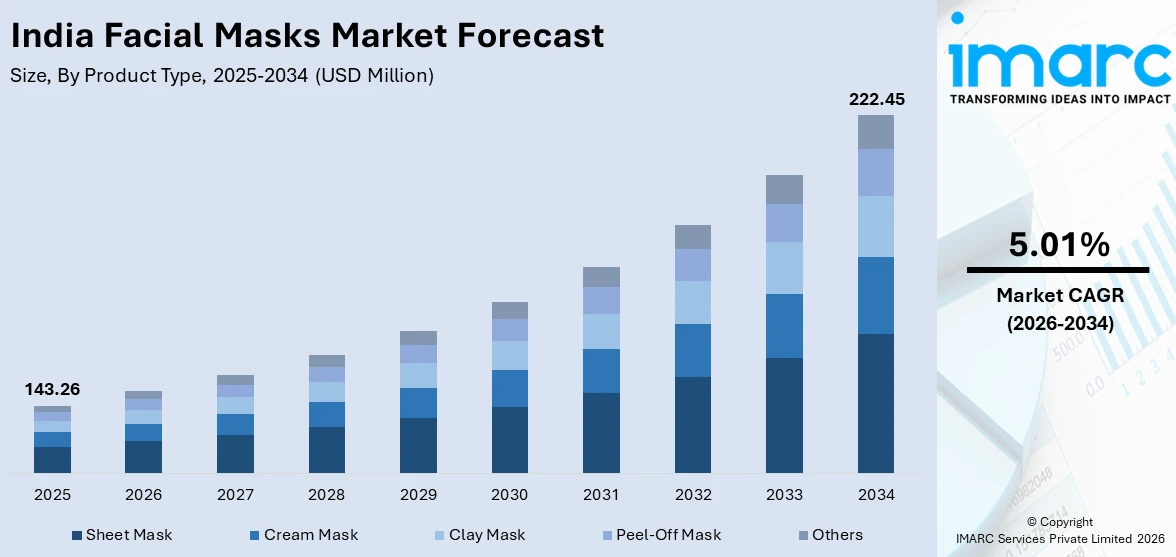
The India facial masks market grew from USD 143.26 Million in 2025 to USD 150.45 Million in 2026 and is projected to reach USD 222.45 Million by 2034, growing at a compound annual growth rate of 5.01% from 2026-2034.
The India facial masks market is gaining significant momentum as people increasingly prioritize skincare routines and self-care regimens. The growing awareness about skin health, rising disposable incomes, and the influence of social media beauty trends are accelerating product adoption across urban and semi-urban areas. Advancements in mask formulations incorporating natural, Ayurvedic, and science-backed ingredients are reshaping user preferences, while expanding e-commerce platforms and organized retail channels are improving product accessibility. The convergence of K-beauty influences, demand for personalized skincare solutions, and a youthful demographic base is creating substantial opportunities for market participants.
Key Takeaways and Insights:
- By Product Type: Sheet mask dominates the market with a share of 31% in 2025, driven by its convenience, single-use format, and effectiveness in delivering targeted skincare benefits, including hydration and brightening.
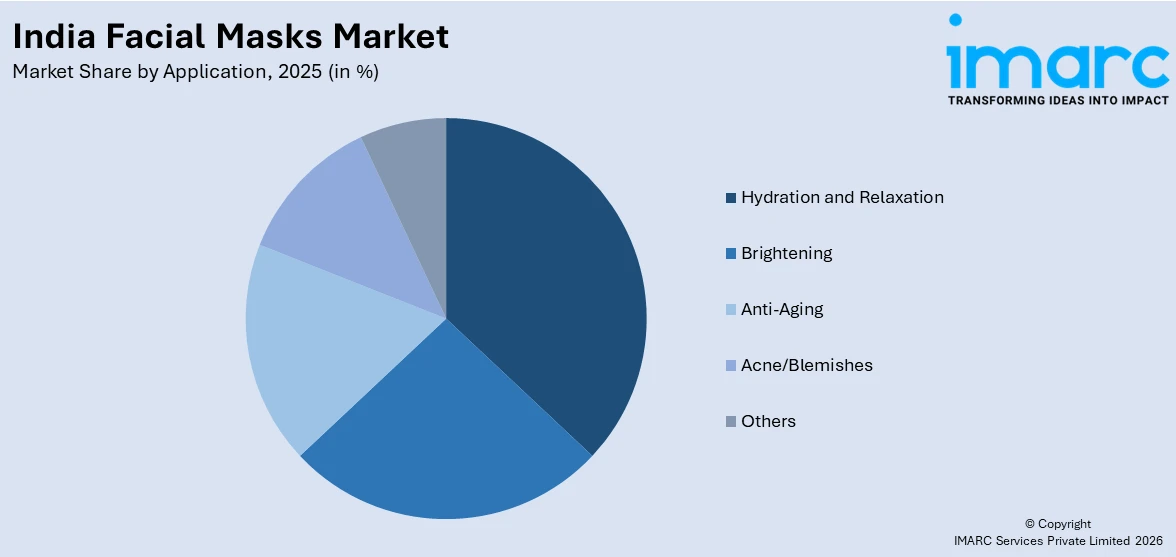
- By Application: Hydration and relaxation lead the market with a share of 28% in 2025, owing to the rising user focus on moisture retention, stress relief, and daily skin nourishment.
- By Price Range: Economical represents the largest segment with a market share of 40% in 2025, supported by the price sensitivity of buyers in India and widespread availability of affordable mask options across mass retail channels.
- By Sales Channel: Cosmetic stores dominate the market with a share of 31% in 2025. This leadership is because of curated product assortments, in-store consultations, and user trust in specialized beauty retail environments.
- By Region: North India leads the market with a share of 29% in 2025, influenced by high urbanization rates, greater disposable incomes, and concentration of beauty-conscious individuals in metropolitan areas like Delhi-NCR.
- Key Players: The India facial masks market exhibits a moderately fragmented competitive landscape, with both domestic and international skincare brands competing through product innovation, ingredient transparency, and omnichannel distribution strategies.
To get more information on this market Request Sample
The India facial masks market is advancing as skincare awareness deepens among young, digitally connected individuals who view facial masks as essential components of their beauty routines rather than occasional indulgences. The influence of Korean beauty (K-beauty) trends has been particularly transformative, popularizing multi-step skincare regimens and sheet mask adoption across Indian metropolitan and tier-two cities. For instance, in 2024, Nykaa exclusively launched South Korea’s skincare label Numbuzin in India with a 30-item range, offering targeted K-beauty routines through its platform. Besides this, the expanding e-commerce ecosystem, supported by platforms offering vernacular interfaces and cash-on-delivery (COD) options, is democratizing access to premium and international facial mask brands beyond metropolitan areas. The growing demand for natural, Ayurvedic, and clean-label formulations aligns with cultural preferences and is encouraging both domestic and international brands to innovate with plant-based and toxin-free mask products, further strengthening the market growth.
India Facial Masks Market Trends:
Rising Influence of K-Beauty and Global Skincare Philosophies
The Indian skincare landscape is witnessing a significant shift as Korean beauty philosophies reshape individual expectations around facial mask efficacy and routine-based skincare. Multi-step regimens featuring sheet masks, hydrogel masks, and sleeping masks are gaining mainstream popularity, particularly among millennials and Gen Z. For instance, in 2024, Reliance Retail’s Tira launched the premium Korean skincare brand Mixsoon in India, available across online and offline channels, reflecting the deepening penetration of K-beauty products in the Indian market. This trend is accelerating product diversification and ingredient innovation across the facial masks category.
Increasing Disposable Income and Premium Personal Care Spending
Rising disposable income among India’s middle-class population is supporting increased expenditure on personal care and skincare products, including specialized facial masks with premium formulations and advanced ingredients. People are demonstrating greater willingness to invest in branded products that promise visible and long-lasting results, reflecting a broader premiumization trend within the beauty segment. This shift aligns with national income projections, as the State Bank of India has indicated that the country is expected to transition into the upper-middle-income category by the end of the decade, with per capita income projected to approach $4,000 by 2030. Such economic progression is reinforcing the demand for higher-value skincare offerings.
Expansion of E-Commerce and Digital Beauty Retail Channels
The rapid expansion of e-commerce platforms is significantly transforming the distribution landscape for facial masks in India. Online retail provides buyers with extensive product variety, detailed reviews, and convenient doorstep delivery, improving accessibility across urban and emerging markets. This shift aligns with the broader digital commerce surge, as per IBEF, India’s e-commerce industry was valued at INR 10,82,875 crore (USD 125 billion) in 2024 and is projected to reach INR 29,88,735 crore (USD 345 billion) by 2030, growing at a CAGR of 15%. Such strong digital growth is enabling deeper penetration into tier-two and tier-three cities, accelerating adoption and increasing purchase frequency for facial masks nationwide.
Market Outlook 2026-2034:
The India facial masks market is positioned for notable growth, supported by increasing skincare awareness, rising disposable incomes, and evolving beauty routines among a predominantly young population. The market generated a revenue of USD 143.26 Million in 2025, which is expected to reach USD 150.45 Million in 2026 and further grow to USD 222.45 Million by 2034, at a compound annual growth rate of 5.01% from 2026-2034. Increasing product innovation featuring natural ingredients, expansion of organized retail and e-commerce distribution networks, and the growing influence of global beauty trends are expected to drive higher revenue streams and foster a more competitive and mature facial masks landscape across the country.
India Facial Masks Market Report Segmentation:
|
Segment Category |
Leading Segment |
Market Share |
|
Product Type |
Sheet Mask |
31% |
|
Application |
Hydration and Relaxation |
28% |
|
Price Range |
Economical |
40% |
|
Sales Channel |
Cosmetic Stores |
31% |
|
Region |
North India |
29% |
Product Type Insights:
- Sheet Mask
- Cream Mask
- Clay Mask
- Peel-Off Mask
- Others
Sheet mask dominates with a market share of 31% of the total India facial masks market in 2025.
Sheet mask is emerging as the preferred product type among users in India due to its convenience, affordability, and the growing popularity among urban users. This mask is easy to use, require no preparation, and deliver instant hydration and skin-brightening benefits. With increasing awareness about skincare routines influenced by social media and beauty trends, sheet mask is becoming a preferred choice, especially among younger demographics. Its wide availability across retail stores and e-commerce platforms further supports strong adoption across metropolitan and tier-1 cities.
Another factor influencing the dominance of the segment is the variety of formulations offered, including anti-aging, moisturizing, acne-control, and brightening options. Brands continue to launch innovative sheet masks infused with natural extracts, vitamins, and active ingredients tailored to Indian skin needs. The rise of premium beauty products and self-care culture is also boosting the market demand. Compared to traditional facial packs, sheet mask provides a mess-free experience and quick results, reinforcing its position as the leading product type in the market.
Application Insights:
Access the comprehensive market breakdown Request Sample
- Hydration and Relaxation
- Brightening
- Anti-Aging
- Acne/Blemishes
- Others
Hydration and relaxation exhibit a clear dominance with a 28% share of the total India facial masks market in 2025.
The hydration and relaxation application segment holds the largest share in the market, driven by the fundamental user need for moisture replenishment in a country characterized by diverse climatic conditions, ranging from tropical humidity to arid heat. People in India increasingly recognize hydration as the cornerstone of effective skincare, with facial masks serving as intensive moisture-delivery systems that complement daily moisturizing routines. The growing wellness culture, influenced by Ayurvedic traditions emphasizing skin nourishment and relaxation, is further normalizing facial masking as a self-care ritual.
The growing awareness about self-care practices and at-home beauty treatments further supports the demand for hydration and relaxation masks. Many brands offer formulations enriched with ingredients, such as aloe vera, hyaluronic acid, and botanical extracts, that calm and nourish the skin. Social media influence and beauty influencers are also encouraging routine masking as part of weekly skincare habits. Affordable pricing and wide availability across online and offline channels continue to drive adoption, reinforcing hydration and relaxation as the leading segment in the market.
Price Range Insights:
- Economical
- Medium
- Premium
Economical leads with a market share of 40% of the total India facial masks market in 2025.
Economical represents the largest segment owing to strong price sensitivity among individuals and the broad middle-income population. Affordable facial masks are widely accessible across supermarkets, pharmacies, and online platforms, making them attractive to students and young professionals. Many domestic and international brands offer single-use sheet masks and sachet packs at low prices, encouraging impulse purchases and repeat buying. The availability of budget-friendly options allows people to experiment with different variants without significant financial commitment.
Another factor driving dominance of the segment is the growing influence of mass-market beauty brands that focus on high-volume sales through competitive pricing. Promotional discounts, combo packs, and festive offers further catalyze the demand in the economical segment. Individuals often prefer low-cost masks for regular weekly use, reserving premium products for occasional treatments. Expansion of e-commerce platforms and quick commerce delivery services is also improving access to affordable skincare products. These factors collectively position the economical price range as the leading segment in the market.
Sales Channel Insights:
- Beauty Parlors/Salons
- Cosmetic Stores
- Online
- Supermarkets/Hypermarkets
- Others
Cosmetic stores dominate with a market share of 31% of the total India facial masks market in 2025.
Cosmetic stores have established themselves as the leading sales channel for facial masks in India, benefiting from curated product assortments, knowledgeable staff, and immersive shopping experiences that specialized beauty retailers offer. These stores, including both national chains and independent beauty boutiques, provide buyers with opportunities to explore diverse product ranges, receive personalized skincare recommendations, and physically evaluate products before purchase. The tactile shopping experience is particularly valued in the facial masks category, where people seek guidance on ingredients and suitability for specific skin concerns.
The channel’s strength is further bolstered by the aggressive retail expansion of beauty platforms across India. The growth of organized beauty retail in tier-two and tier-three cities is democratizing access to premium facial mask products, while in-store promotions and loyalty programs continue to drive repeat purchases. Cosmetic stores also benefit from impulse buying behavior, as facial masks are often purchased alongside other beauty essentials. Their strong offline reach, combined with rising beauty consciousness, continues to reinforce cosmetic stores as the leading sales channel in the market.
Regional Insights:
- North India
- South India
- East India
- West India
North India exhibits a clear dominance with a 29% share of the total India facial masks market in 2025.
North India’s leadership in the market is underpinned by the concentration of beauty-conscious individuals in major metropolitan areas, including Delhi-NCR, Chandigarh, Jaipur, and Lucknow. The region benefits from higher urbanization rates, greater disposable income levels, and advanced retail infrastructure that facilitates wider product availability across both organized and unorganized channels. Delhi-NCR alone represents a significant share of the regional market, supported by a dense network of cosmetic stores, shopping malls, and e-commerce penetration that enables consumers to access both domestic and international facial mask brands with ease.
The region’s market dominance is further supported by the active expansion of beauty retail networks and the growing influence of social media-driven skincare trends among North India’s young, aspirational user base. This retail momentum is reflected in 2026, when British beauty brand Lush opened its first physical store in India at Nexus Select Citywalk in New Delhi. The store introduces Indian users to Lush’s immersive retail experience, featuring products like fresh face masks, solid shampoo bars, bath bombs, and ethical skincare ranges. The launch follows its online debut in November 2025, with plans to expand to Mumbai and Bengaluru as part of its omni-channel growth strategy.
Market Dynamics:
Growth Drivers:
Why is the India Facial Masks Market Growing?
Increasing Pollution-Related Skin Concerns
Rapid urbanization and increasing pollution levels are significantly shaping the demand for facial masks in India. Urban concentration intensifies these concerns, and according to World Bank data, approximately 36.87% of India’s total population resided in urban areas in 2024, highlighting the scale of exposure to environmental stressors. Greater exposure to dust, ultraviolet (UV) radiation, and airborne pollutants is contributing to acne, pigmentation, and premature skin aging, encouraging individuals to seek protective and restorative skincare solutions. As a result, facial masks are increasingly perceived as effective tools for detoxification, deep cleansing, and skin repair, supporting the market growth across metropolitan regions.
Rising Youth Population and Beauty Conscious Demographics
The growth of India facial masks market is strongly supported by the country’s large youth population, which increasingly considers skincare an important aspect of personal grooming and social presentation. This demographic demonstrates strong brand awareness and openness to experimenting with innovative formats, such as sheet masks and clay-based treatments. According to the National Youth Policy, which defines youth as individuals aged 15 to 29, India's youth population stood at approximately 420 million in 2024, accounting for roughly 29% of the total populace. Influenced by digital media and global beauty trends, this segment continues to drive sustained demand across diverse markets.
Growing Male Grooming and Gender-Neutral Skincare Adoption
The Indian facial masks market is expanding as skincare increasingly includes male and gender-neutral users alongside traditional female segments. Changing social norms now position personal grooming as essential for hygiene and professional presentation across genders. This shift aligns with strong industry growth, as the Indian male grooming products market reached USD 2.3 billion in 2024, indicating rising participation in specialized skincare categories. Brands are introducing formulations tailored to concerns, such as oil control and enlarged pores, while gender-neutral positioning reduces barriers to adoption. As inclusive beauty standards strengthen, the market is benefiting from broader reach and diversified product offerings.

Market Restraints:
What Challenges the India Facial Masks Market is Facing?
Price Sensitivity Constraining Premium Segment Penetration
Despite the rising incomes, a significant portion of India’s user base remains highly price-sensitive, limiting the adoption of mid-range and premium facial masks. Many people perceive facial masks as discretionary purchases rather than skincare essentials, restricting repeat purchase frequency and constraining the overall market growth beyond urban centers and higher-income demographics.
Limited Awareness in Rural and Semi-Urban Areas
Facial mask awareness and adoption remain concentrated in metropolitan and tier-one cities, with significant knowledge gaps persisting in the rural and semi-urban regions in the country. Limited access to beauty education, sparse organized retail infrastructure, and lower digital connectivity in these areas are hindering broader market penetration and leaving substantial user segments underserved.
Intense Competition from Alternative Skincare Products
The facial masks market faces competitive pressure from alternative skincare formats, including serums, moisturizers, and multi-purpose creams, that people may prefer for their versatility and perceived cost efficiency. The proliferation of multifunctional skincare products offering hydration, brightening, and anti-aging benefits in single formulations challenges the incremental value proposition of dedicated facial masks within individual routines.
Competitive Landscape:
The India facial masks market exhibits a moderately fragmented competitive structure characterized by the presence of both established multinational beauty corporations and emerging domestic skincare brands competing across diverse price segments and distribution channels. Market dynamics reflect strategic positioning, ranging from premium, innovation-driven offerings emphasizing advanced formulations and international brand appeal to value-oriented products targeting the mass user segment. The competitive landscape is increasingly shaped by ingredient transparency, digital marketing effectiveness, influencer partnerships, and omnichannel distribution capabilities. Sustainability initiatives, clean beauty certifications, and the integration of Ayurvedic heritage with modern cosmetic science are becoming key differentiators as brands seek to capture the evolving preferences of India’s young, digitally engaged consumer base.
Recent Developments:
- June 2025: HYPHEN launched its Ice Dunk Cooling Face Mask, inspired by the viral ice facial trend popular on social media. The gel-based, fragrance-free mask contains 31% cooling actives and 3% caffeine to hydrate, depuff, tighten, and soothe skin without the irritation linked to ice-water immersion. Designed as a safer alternative to traditional ice dunking, the product delivered a cryotherapy-like effect and was available across major e-commerce platforms in India.
- May 2025: DR.Rashel unveiled India’s first 100% vegan Bio-Collagen Deep Facial Mask under its new Proboost skincare range. Made with plant-based ocean collagen and enriched with soya fiber, the mask targeted hydration, elasticity, fine lines, and skin repair. Available in variants like salicylic acid, niacinamide, and kojic acid, the launch reflected the rising demand for clean, cruelty-free, and ethical beauty solutions in India.
India Facial Masks Market Report Coverage:
| Report Features | Details |
|---|---|
| Base Year of the Analysis | 2025 |
| Historical Period | 2020-2025 |
| Forecast Period | 2026-2034 |
| Units | Million USD |
| Scope of the Report |
Exploration of Historical Trends and Market Outlook, Industry Catalysts and Challenges, Segment-Wise Historical and Future Market Assessment:
|
| Product Types Covered | Sheet Mask, Cream Mask, Clay Mask, Peel-Off Mask, Others |
| Applications Covered | Hydration and Relaxation, Brightening, Anti-Ageing, Acne/Blemishes, Others |
| Price Ranges Covered | Economical, Medium, Premium |
| Sales Channels Covered | Beauty Parlors/Salons, Cosmetic Stores, Online, Supermarkets/Hypermarkets, Others |
| Regions Covered | North India, South India, East India, West India |
| Customization Scope | 10% Free Customization |
| Post-Sale Analyst Support | 10-12 Weeks |
| Delivery Format | PDF and Excel through Email (We can also provide the editable version of the report in PPT/Word format on special request) |
Frequently Asked Questions About the India Facial Masks Market Report
The India facial masks market size increased from USD 143.26 Million in 2025 to USD 150.45 Million in 2026.
The India facial masks market is expected to grow at a compound annual growth rate of 5.01% from 2026-2034 to reach USD 222.45 Million by 2034.
Sheet mask holds the largest revenue share of 31% in the 2025 due to its convenience, single-use format, targeted skincare delivery, and strong alignment with K-beauty trends popular among Indian users.
Key factors driving the India facial masks market include the rapid expansion of e-commerce platforms, which are improving product accessibility and consumer reach. As per IBEF, India’s e-commerce industry was valued at INR 10,82,875 crore (USD 125 billion) in 2024 and is projected to reach INR 29,88,735 crore (USD 345 billion) by 2030, supporting deeper market penetration nationwide.
Major challenges include high price sensitivity limiting premium adoption, limited skincare awareness in rural and semi-urban areas, intense competition from alternative skincare products, fragmented distribution in smaller cities, and consumer perception of facial masks as discretionary rather than essential skincare items.
Need more help?
- Speak to our experienced analysts for insights on the current market scenarios.
- Include additional segments and countries to customize the report as per your requirement.
- Gain an unparalleled competitive advantage in your domain by understanding how to utilize the report and positively impacting your operations and revenue.
- For further assistance, please connect with our analysts.
 Request Customization
 Speak to an Analyst
 Request Brochure
 Inquire Before Buying
Benefits of Customization
- Personalize this research
- Triangulate with your data
- Get data as per your format and definition
- Gain a deeper dive into a specific application, geography, customer, or competitor
- Any level of personalization
Get in Touch With Us
UNITED STATES
Phone: +1-201-971-6302
INDIA
Phone: +91-120-433-0800
UNITED KINGDOM
Phone: +44-753-714-6104
Email: [email protected]
Client Testimonials




.webp)




.webp)













Related Reports

Choose your plan
*Please note that the prices mentioned below are starting prices for each bundle type. Kindly contact our team for further details.*
Single User License
- 1 User License, Access on 2 Devices
- PDF Report + Excel Dataset (Password Protected)
- Lifetime Access
- No Printing Rights
- 10% Free Report Customization
- 10–12 Weeks of Analyst Support
Five User License
- Access for 5 Users, 2 Devices per User
- PDF Report + Excel Dataset (Password Protected)
- Lifetime Access
- Dedicated Account Manager
- 12–14 Weeks of Analyst Support
- No Printing Rights
- 15% Free Report Customization
- 25% Discount on Your Next Purchase
Corporate User License
- Unlimited User Access (Within Your Organization)
- PDF Report + Excel Dataset
- Lifetime Access
- Dedicated Account Manager
- 14–20 Weeks of Analyst Support
- No Printing Rights
- 20% Free Report Customization
- 30% Discount on Your Next Purchase
Essential Insights
What's included:
3 reports
- Lifetime Access
- PDF Reports
- Excel Datasets
- 2 Weeks of Free Analyst Support
- 2 User Licenses
- Access on 2 Devices
- Printing Rights
- Complimentary PowerPoint (PPT) Version
- Complimentary License Upgrade
Professional Access
What's included:
5 reports
- Lifetime Access
- PDF Reports
- Excel Datasets
- 8 Weeks of Free Analyst Support
- 2 User Licenses
- Access on 2 Devices
- Printing Rights
- Complimentary PowerPoint (PPT) Version
- Complimentary License Upgrade
Business Advantage
What's included:
8 reports
- Lifetime Access
- PDF Reports
- Excel Datasets
- 14 Weeks of Free Analyst Support
- 2 User Licenses
- Access on 2 Devices
- Printing Rights
- Complimentary PowerPoint (PPT) Version
- Complimentary License Upgrade
Enterprise Intelligence
What's included:
10 reports
- Lifetime Access
- PDF Reports
- Excel Datasets
- 20 Weeks of Free Analyst Support
- 2 User Licenses
- Access on 2 Devices
- Printing Rights
- Complimentary PowerPoint (PPT) Version
- Complimentary License Upgrade