
India Fitness Equipment Market Size, Share, Trends and Forecast by Type, Price Point, End User, and Region, 2026-2034
India Fitness Equipment Market Size, Share, Trends & Forecast (2026-2034)
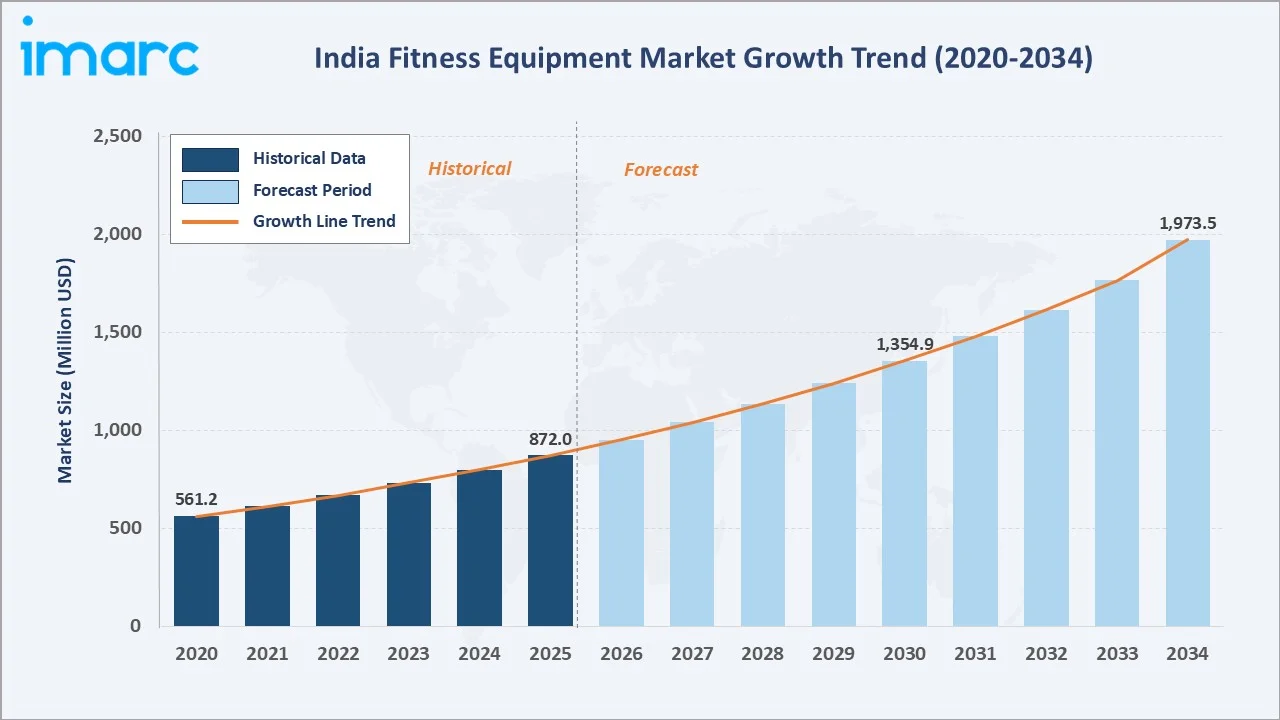
The fitness equipment market size in India reached USD 872.0 Million in 2025 and is projected to reach USD 1,973.5 Million by 2034, exhibiting a CAGR of 9.22% during 2026-2034. Rising health awareness, expanding gym chains, digital fitness integration, and home fitness adoption are the main drivers of this high-growth market.
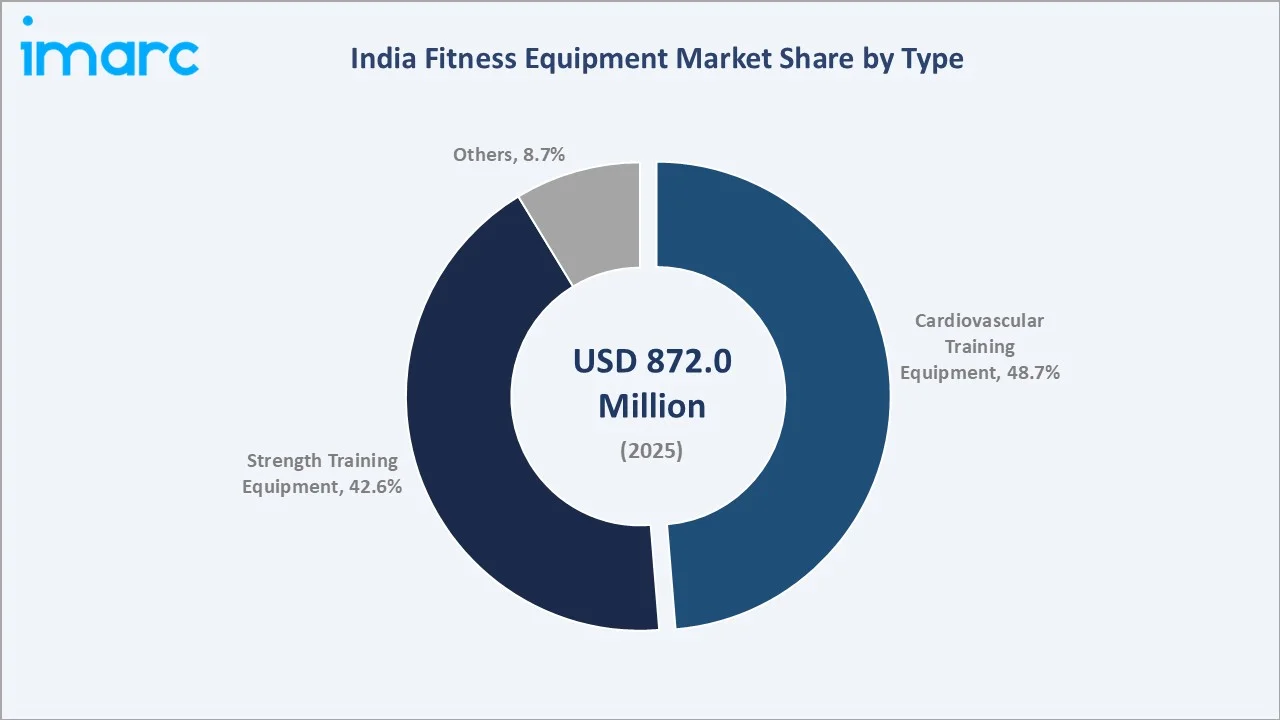
Cardiovascular Training Equipment dominates by type at 48.7% in 2025, driven by strong demand for treadmills, stationary cycles, and ellipticals. Standard price-point equipment leads at 68.4%, while West India leads regionally at 32.7%, anchored by the commercial fitness density of Mumbai, Pune, and Ahmedabad.
Market Snapshot
|
Metric |
Value |
|
Market Size (2025) |
USD 872.0 Million |
|
Forecast Market Size (2034) |
USD 1,973.5 Million |
|
CAGR (2026-2034) |
9.22% |
|
Base Year |
2025 |
|
Historical Period |
2020-2025 |
|
Forecast Period |
2026-2034 |
|
Dominant Type |
Cardiovascular Training Equipment (48.7%, 2025) |
|
Dominant Price Point |
Standard (68.4%, 2025) |
|
Leading Region |
West India (32.7%, 2025) |
Market size expanded from an estimated USD 561.2 Million in 2020 to USD 872.0 Million in 2025 on gym reopenings and home fitness adoption. The market is estimated at USD 1,354.9 Million in 2030 and forecast to reach USD 1,973.5 Million by 2034, compounding on rising health consciousness and institutional fitness investments.
To get more information on this market, Request Sample
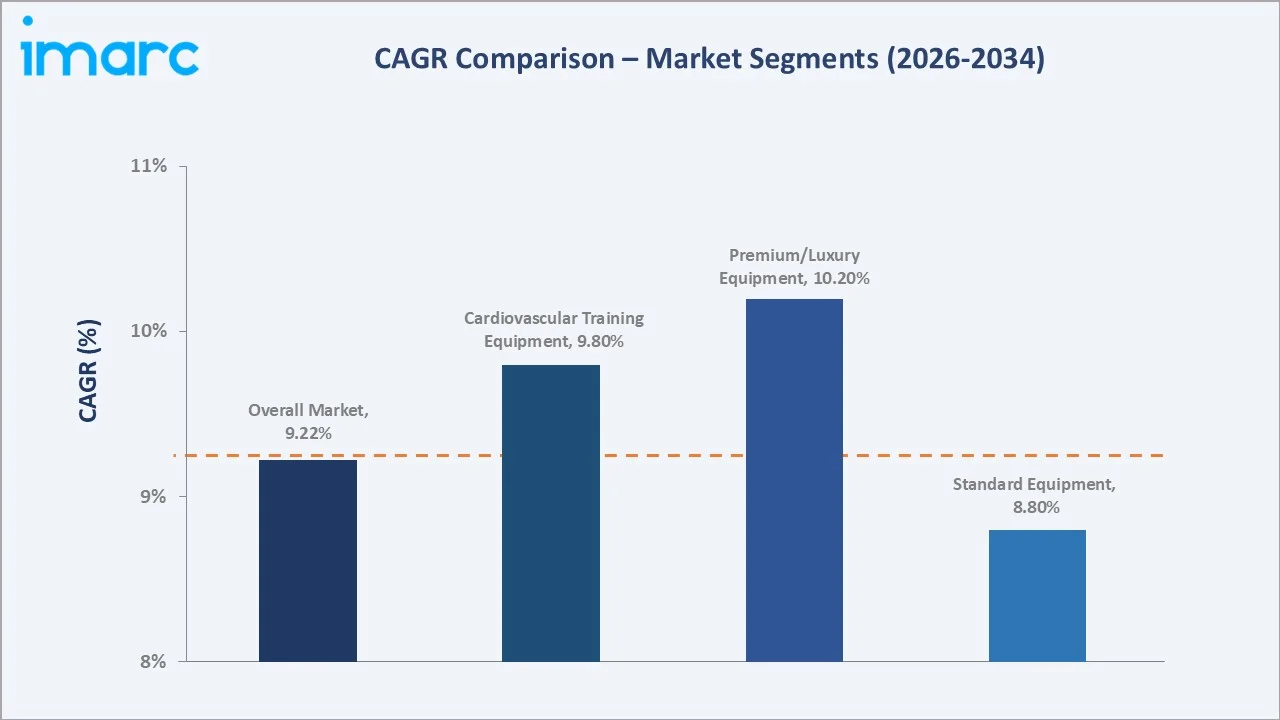
Premium/Luxury equipment and connected digital fitness solutions are set to outpace the overall CAGR through 2034, as urban consumers and health club operators invest in AI-driven, app-integrated equipment. Cardiovascular training equipment maintains the highest absolute demand across both commercial and home consumer segments throughout the forecast period.
Executive Summary
The India fitness equipment market reached USD 872.0 Million in 2025, positioning India among Asia's fastest-growing fitness markets, underpinned by expanding gym chains, rising disposable incomes, and deepening digital fitness adoption. The market is projected to reach USD 1,973.5 Million by 2034 at a sustained CAGR of 9.22%.
Cardiovascular Training Equipment at 48.7% dominates through strong treadmill, cycle, and elliptical demand across commercial gyms and home consumers. Standard equipment at 68.4% leads through mass-market accessibility and e-commerce reach. West India at 32.7% leads regionally through Mumbai, Pune, and Ahmedabad commercial fitness infrastructure.
Key Market Insights
|
Insight |
Data |
|
Dominant Type |
Cardiovascular Training Equipment (48.7%, 2025) |
|
Dominant Price Point |
Standard – 68.4% share (2025) |
|
Leading Region |
West India – 32.7% share (2025) |
|
Market Opportunity |
Smart/connected equipment; premium fitness; tier-2 city expansion |
Key Analytical Observations Supporting the Above Data:
- Cardiovascular Training Equipment at 48.7%: This segment dominates as urban consumers prioritize cardio-based routines for weight management and cardiovascular health. Its strong representation across health clubs, boutique studios, and home gyms reinforces demand for treadmills and cycles, with the segment's ~9.80% CAGR reflecting deepening cardio-fitness culture.
- Standard Price Point at 68.4%: Standard equipment dominates through competitive domestic manufacturing, broad e-commerce distribution, and affordability for middle-income urban consumers. The segment captures the highest volume of institutional gym procurement and home fitness purchases, underpinned by pricing accessibility on major online platforms.
- West India at 32.7%: West India's regional leadership reflects the commercial fitness density of Mumbai, Pune, and Ahmedabad, hosting high concentrations of premium health clubs, boutique studios, and corporate wellness facilities. Its strong purchasing capacity and retail infrastructure sustain demand, further reinforced by global fitness brand entry and expanding franchise gym networks.
India Fitness Equipment Market Overview
The India fitness equipment market encompasses the design, manufacturing, and distribution of cardiovascular training machines, strength training equipment, and fitness accessories for home consumers, health clubs, gyms, and corporate wellness facilities, ranging from mass-market treadmills to premium AI-enabled smart fitness systems.
The ecosystem integrates equipment manufacturers, component suppliers, distributors, e-commerce platforms, gym franchise operators, and service providers, all operating under BIS quality frameworks. Rising disposable incomes, urbanization, and government wellness initiatives are key macroeconomic demand drivers.
Market Dynamics
To evaluate market opportunities, Request Sample
Market Drivers
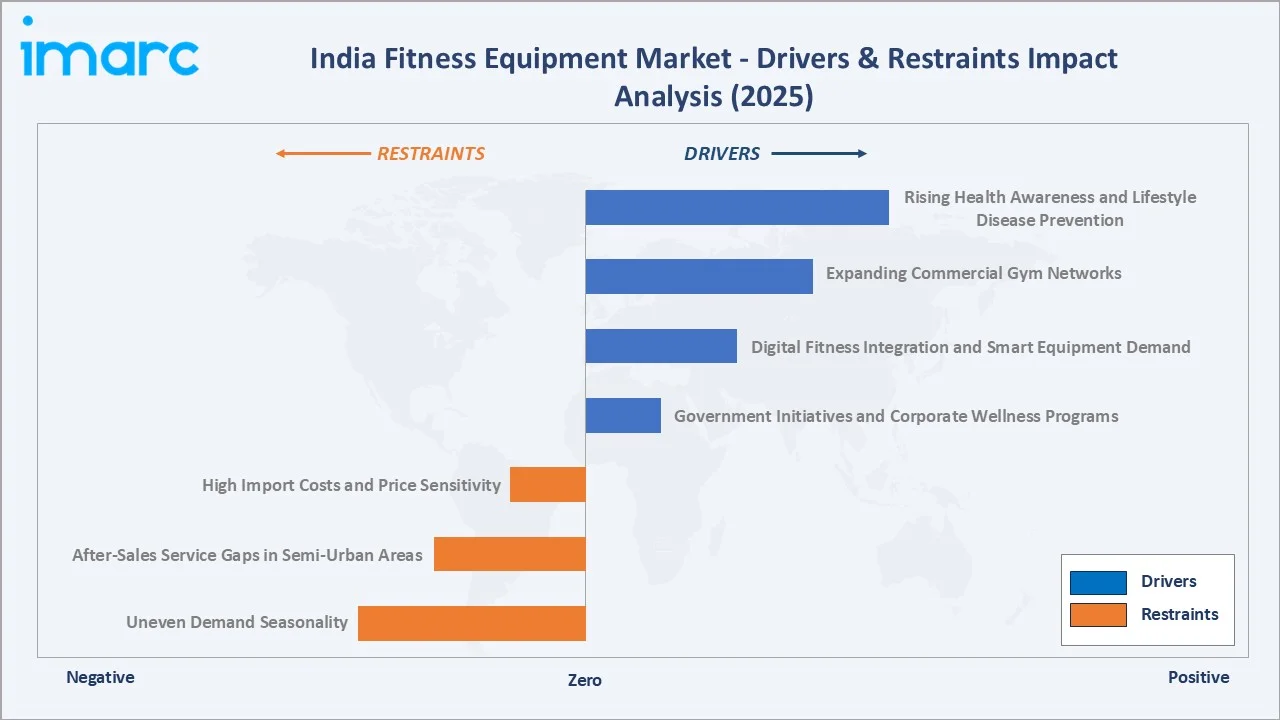
- Rising Health Awareness and Lifestyle Disease Prevention: Rising health consciousness post-pandemic, driven by awareness of lifestyle diseases such as type-2 diabetes and cardiovascular conditions, is expanding India's addressable fitness equipment market. Urban consumers are adopting structured fitness routines as preventive healthcare, directly boosting equipment demand. Growing influencer-led health advocacy is reinforcing exercise adoption among younger demographics.
- Expanding Commercial Gym Networks: Rapid expansion of gym chains across tier-1 and tier-2 cities is generating high-volume institutional demand for cardiovascular machines and strength training systems. In March 2025, Anytime Fitness opened its 150th Indian gym in Greater Noida, reflecting sustained organized fitness infrastructure investment. Franchise-led rollouts into tier-2 cities are unlocking significant demand for mid-range equipment manufacturers.
- Digital Fitness Integration and Smart Equipment Demand: The increasing adoption of connected fitness technologies, including smart treadmills, app-enabled exercise bikes, connected strength equipment, and wearable-integrated machines, is driving demand for technologically advanced fitness equipment. Consumers are increasingly seeking personalized workouts, performance tracking, remote coaching, and interactive training experiences. The growing use of smartphones, fitness applications, and AI-based training platforms is further encouraging manufacturers to integrate digital features into equipment. This trend is particularly supporting demand for premium and connected fitness products across home and commercial fitness settings.
- Government Initiatives and Corporate Wellness Programs: Government-led initiatives promoting physical activity, sports participation, and healthier lifestyles are contributing to greater awareness of fitness and exercise across India. At the same time, companies are increasingly incorporating wellness initiatives such as gym memberships, fitness activities, health programs, and workplace exercise facilities into employee benefit packages. These initiatives are expanding consumer exposure to organized fitness and supporting demand for gym and exercise equipment across residential, corporate, and commercial facilities.
Market Restraints
- High Import Costs and Price Sensitivity: High import duties and logistics costs for premium fitness equipment inflate retail prices, constraining adoption among price-sensitive consumers and smaller gym operators in semi-urban markets. Currency fluctuations further compound cost volatility for importers of premium cardiovascular and strength training equipment from global brands.
- After-Sales Service Gaps in Semi-Urban Areas: Limited access to reliable after-sales service and spare parts for imported premium equipment creates maintenance uncertainties for commercial gym operators outside major metropolitan centers. Absent authorized service networks in tier-2 and tier-3 cities discourage gym franchises from investing in high-end equipment, reducing consumer confidence in premium purchases in emerging urban markets.
- Uneven Demand Seasonality: Seasonal demand fluctuations driven by New Year resolutions, festival gifting cycles, and post-summer gym enrollments create uneven revenue distribution, complicating inventory planning and supply chain management for manufacturers and retailers. Managing working capital during off-peak periods remains a consistent operational challenge across the India fitness equipment distribution chain.
Market Opportunities
- Tier-2 and Tier-3 City Expansion: The rapid expansion of organized fitness centers and boutique gyms into tier-2 and tier-3 cities presents a significant growth frontier for mid-range equipment manufacturers. In February 2025, Crunch Fitness signed a master franchise agreement to open 75+ gym locations across India, marking its first South Asian presence. Domestic manufacturers with established distribution networks are well-positioned to capture this institutional demand.
- E-Commerce and Digital Retail Penetration: Proliferation of e-commerce platforms enabling online research and purchase, combined with improved last-mile logistics, is unlocking a broader addressable consumer base beyond metro cities.
Market Challenges
- Competitive Pricing Pressure from Imports: Competitive pressure from low-cost imported fitness equipment from China and Southeast Asia creates sustained pricing erosion for domestic manufacturers in standard cardiovascular and strength segments. Global multinationals with large-scale production efficiencies further intensify pricing competition, requiring domestic players to invest continuously in cost efficiency and differentiation.
- Evolving Consumer Preferences and Product Complexity: Consumer preference for multi-functional, space-saving, and technology-integrated equipment places increasing R&D demands on manufacturers. Rapid technological innovation in connected fitness shortens product lifecycles, requiring sustained investment in software and hardware. Meeting simultaneously rising expectations for compact form factors, premium aesthetics, and digital functionality creates significant product development complexity.
Emerging Market Trends
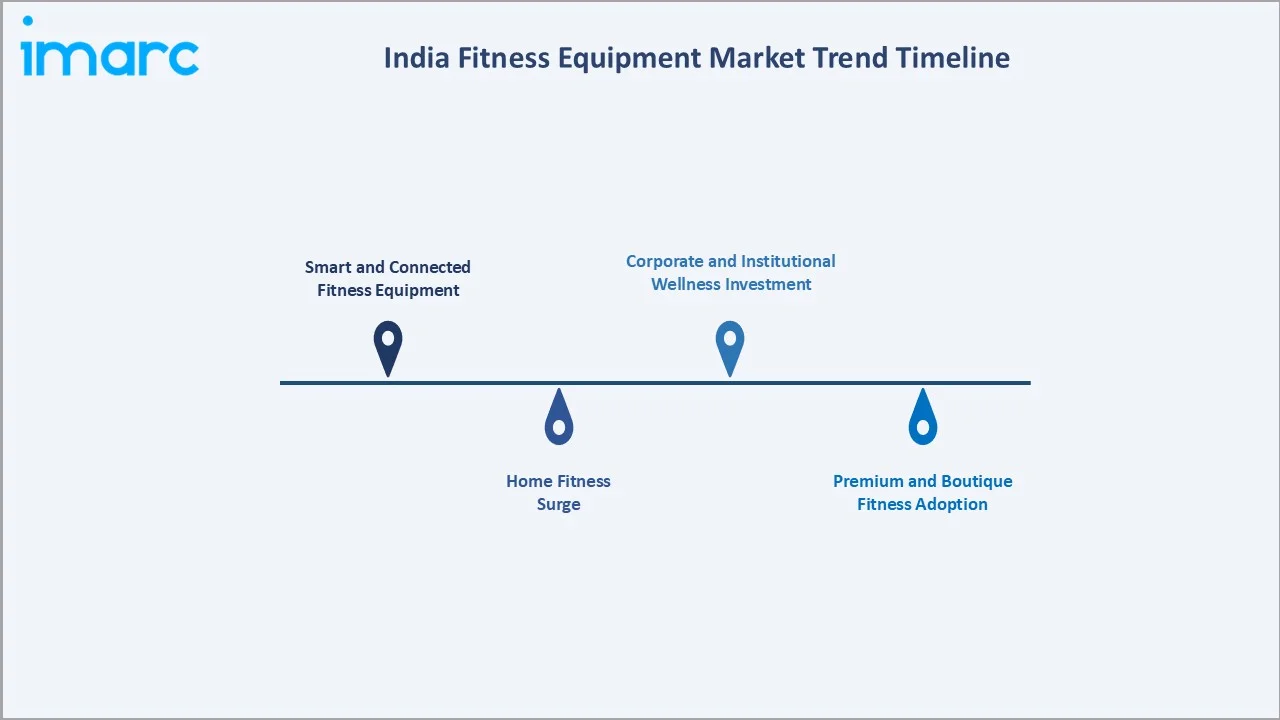
1. Smart and Connected Fitness Equipment
AI-powered treadmills, app-integrated stationary bikes, and IoT-enabled strength machines are reshaping consumer expectations across commercial and home fitness segments. This shift toward connected equipment is broadening product roadmaps as brands capture recurring digital engagement.
2. Home Fitness Surge
The growing preference for convenient and flexible workout options is supporting demand for home fitness equipment in India. Hybrid and remote working arrangements, rising health awareness, and increasing interest in personalized exercise routines are encouraging urban households to create dedicated workout spaces at home. The expansion of e-commerce platforms, wider product availability, digital payments, and consumer financing options is further improving accessibility and supporting household adoption.
3. Premium and Boutique Fitness Adoption
The expansion of premium gyms, boutique fitness studios, and franchise-led fitness formats is increasing demand for high-quality cardiovascular and strength-training equipment in India's major urban markets. Consumers in metropolitan and affluent Tier-1 cities are increasingly prioritizing equipment quality, advanced features, personalized training, and overall fitness experience. Boutique concepts focused on specialized workouts such as functional training, cycling, and strength conditioning are also encouraging fitness operators to invest in differentiated and technologically advanced equipment, supporting growth in the premium segment.
4. Corporate and Institutional Wellness Investment
Increasing emphasis on employee health, workplace productivity, and employee engagement is encouraging companies to invest in corporate wellness initiatives. Fitness-related benefits, gym memberships, workplace exercise facilities, and organized wellness programs are gradually becoming part of broader employee benefit strategies, creating an additional demand channel for fitness equipment.
Industry Value Chain Analysis
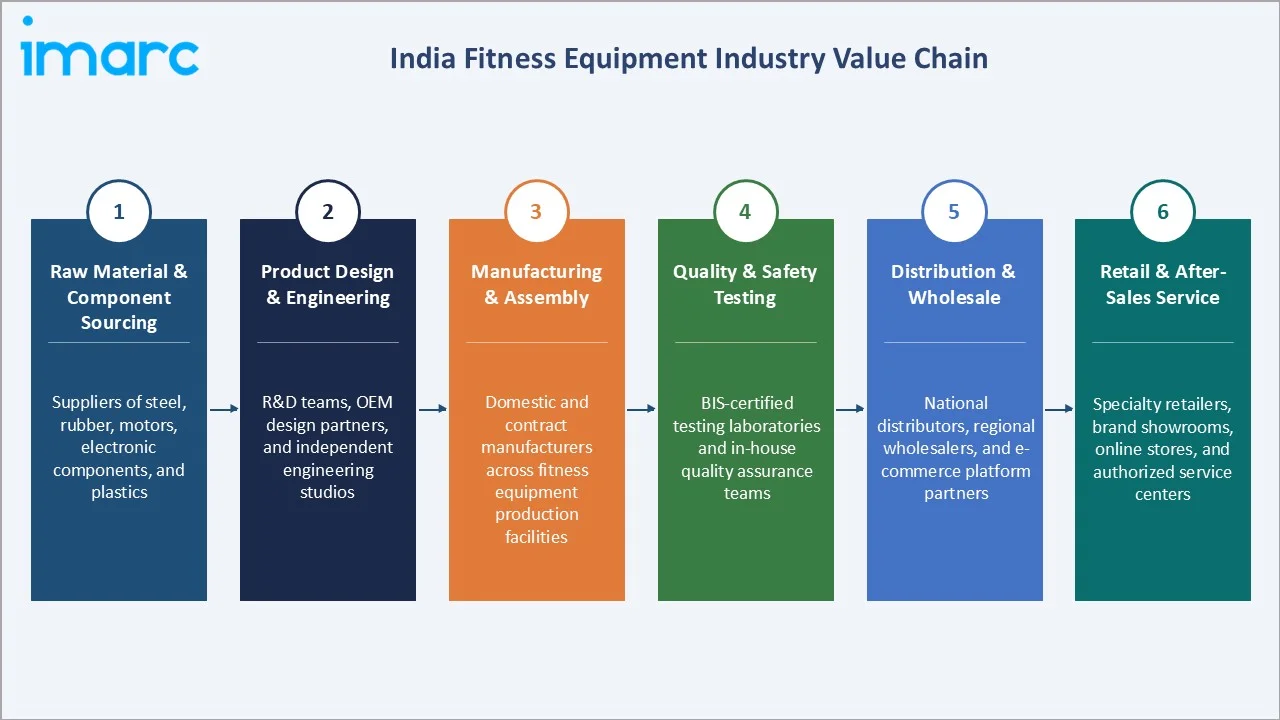
The India fitness equipment value chain spans raw material sourcing, product design and engineering, manufacturing and assembly, quality testing, distribution, and retail and after-sales service. Domestic manufacturing is concentrated in mid-range equipment, while premium smart fitness systems remain substantially import-dependent.
|
Stage |
Key Participants |
|
Raw Material & Component Sourcing |
Suppliers of steel, rubber, motors, electronic components, and plastics |
|
Product Design & Engineering |
R&D teams, OEM design partners, and independent engineering studios |
|
Manufacturing & Assembly |
Domestic and contract manufacturers across fitness equipment production facilities |
|
Quality & Safety Testing |
BIS-certified testing laboratories and in-house quality assurance teams |
|
Distribution & Wholesale |
National distributors, regional wholesalers, and e-commerce platform partners |
|
Retail & After-Sales Service |
Specialty retailers, brand showrooms, online stores, and authorized service centers |
The distribution and retail stage is commercially critical, as e-commerce channels are reshaping procurement across home consumers and commercial gym operators. The quality and safety testing stage is central to consumer trust, particularly for imported premium equipment where BIS certification visibility directly influences online purchase confidence.
Technology Landscape in the India Fitness Equipment Industry
AI and Smart Training Systems
Artificial intelligence-powered coaching modules embedded in treadmills, stationary bikes, and rowing machines provide real-time, personalized training guidance based on live performance data. These systems are rapidly becoming standard in premium health club environments where member experience differentiation and retention are commercially essential drivers of gym operator profitability.
IoT Connectivity and App Integration
Bluetooth and Wi-Fi-connected fitness equipment enables seamless synchronization with health tracking apps and wearables, supporting continuous performance monitoring. IoT connectivity is expanding the addressable consumer base beyond core urban enthusiasts to broader demographics seeking guided, monitored workouts.
Compact and Multi-Functional Equipment Design
Engineering advances enabling high-performance, multi-functional fitness systems in compact footprints address the space constraints of India's urban apartment consumers. The December 2024 launch of Portl's UltraGym—a 2.4 sq. ft. resistance training system priced at ₹59,990—demonstrates how technology is democratizing home strength training across India's urban middle-income segment.
Market Segmentation Analysis
The report covers the following segments:
|
Segment Category |
Leading Segment |
Market Share |
Year |
|
Type |
Cardiovascular Training Equipment |
48.7% |
2025 |
|
Price Point |
Standard |
68.4% |
2025 |
|
End User |
🔒 |
🔒 |
2025 |
|
Region |
West India |
32.7% |
2025 |

By Type
Cardiovascular Training Equipment leads at 48.7% in 2025, encompassing treadmills, stationary cycles, ellipticals, and rowing machines that form the core of both commercial gym and home fitness market demand in India. This segment's above-market CAGR of ~9.80% reflects deepening cardio-fitness culture across Indian urban demographics.
To access detailed market analysis, Request Sample
Strength Training Equipment follows at 42.6%, driven by growing popularity of resistance and free-weight training among fitness enthusiasts and commercial gym operators. Others, including yoga accessories and functional training equipment, account for the remaining 8.7%.
By Price Point
Standard price-point equipment dominates at 68.4% in 2025, capturing mass-market demand from home consumers and mid-tier gym operators who benefit from competitive domestic manufacturing and broad e-commerce accessibility. This segment sustains the largest share of both unit volume and institutional procurement contracts.
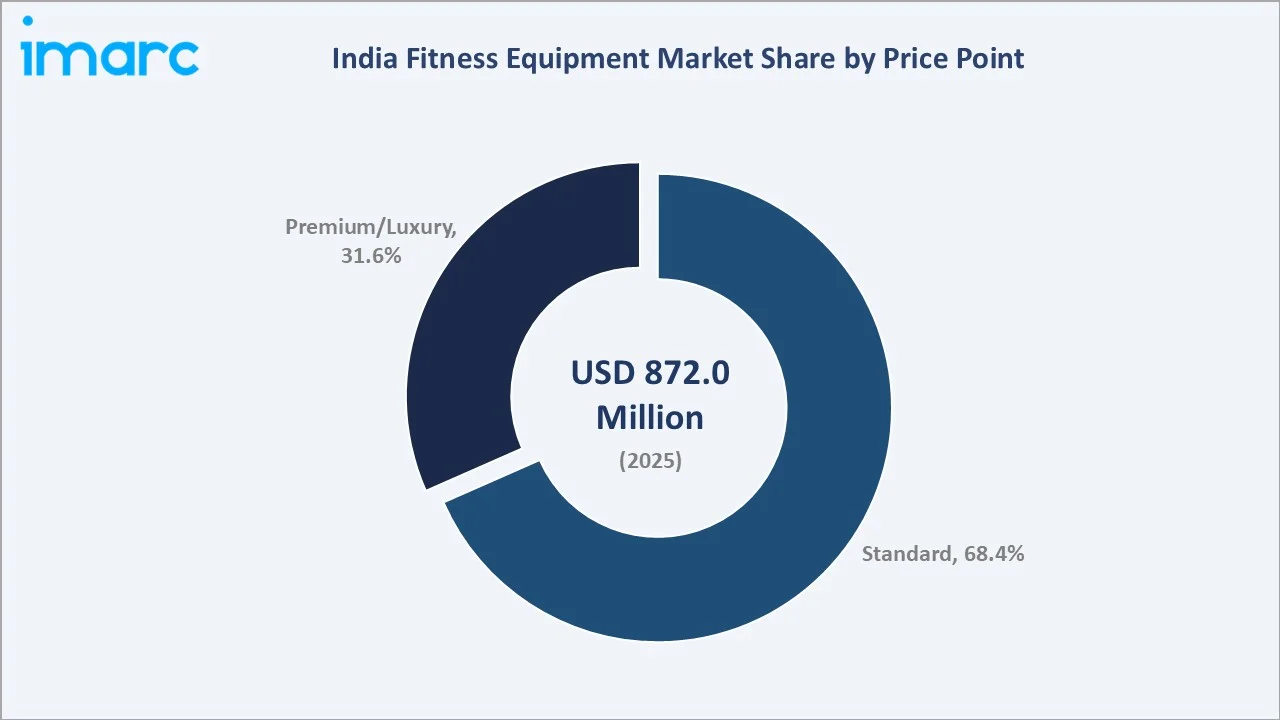
Premium/Luxury equipment holds a 31.6% share, driven by growing demand from upscale health clubs, boutique studios, luxury hotel fitness centers, and affluent home consumers seeking AI-enabled connected equipment. This segment grows fastest at approximately 10.20% CAGR through 2034 as premium fitness culture expands.
Regional Market Insights
|
Region |
Share (2025) |
Key Characteristics |
|
West India |
32.7% |
Driven by commercial gym density and corporate wellness investment in Mumbai, Pune, and Ahmedabad |
|
South India |
27.8% |
Supported by expanding gym chains, IT-sector wellness programs, and home fitness adoption in Bengaluru and Hyderabad |
|
North India |
25.1% |
Anchored by Delhi NCR's large consumer base, rising sports culture, and growing organized gym networks |
|
East India |
14.4% |
Supported by growing fitness awareness in Kolkata and expanding organized retail in emerging urban centers |
West India, at 32.7%, leads through the commercial and financial density of Mumbai, Pune, and Ahmedabad, supporting a high concentration of premium fitness facilities, boutique studios, and corporate gym contracts. South India, at 27.8%, follows on the strength of Bengaluru and Hyderabad's IT-sector wellness culture and rapidly expanding franchise gym networks.
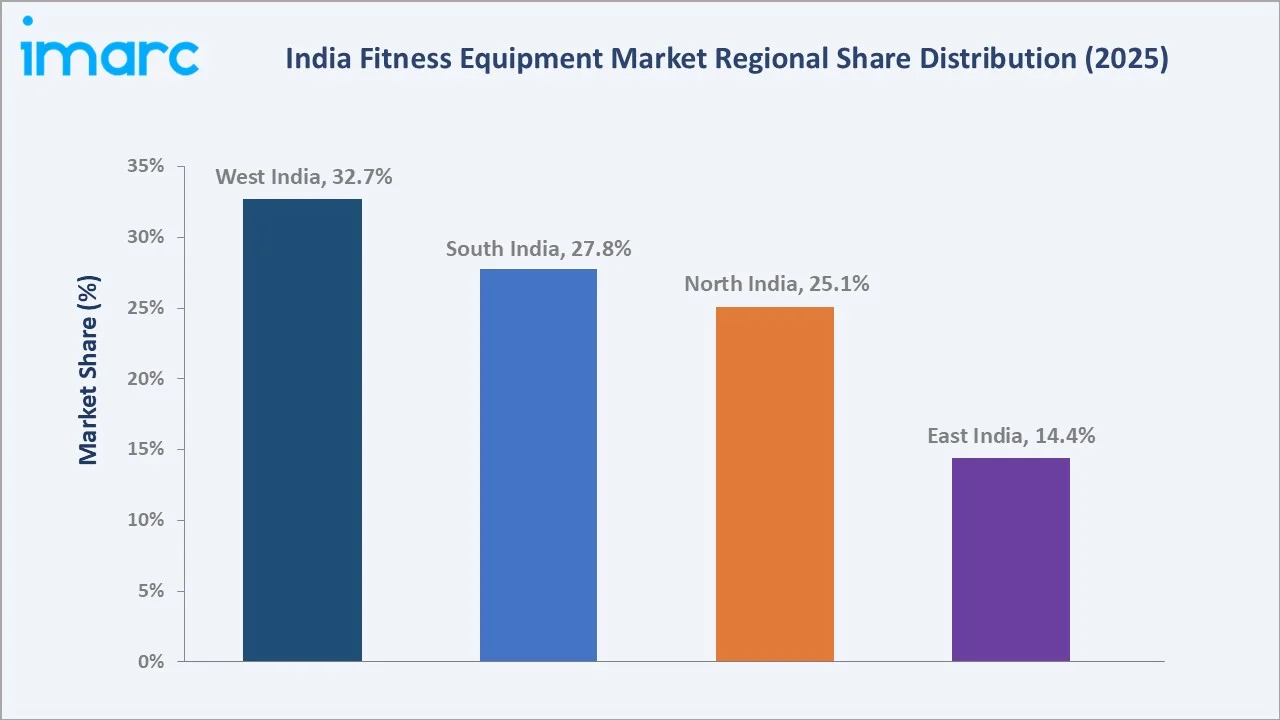
North India, at 25.1%, is driven by Delhi NCR's large consumer base, rapidly growing organized gym sector, and rising youth sports participation. East India, at 14.4%, represents a developing growth frontier as rising health consciousness and expanding organized retail drive fitness equipment market size in India's eastern region.
Competitive Landscape
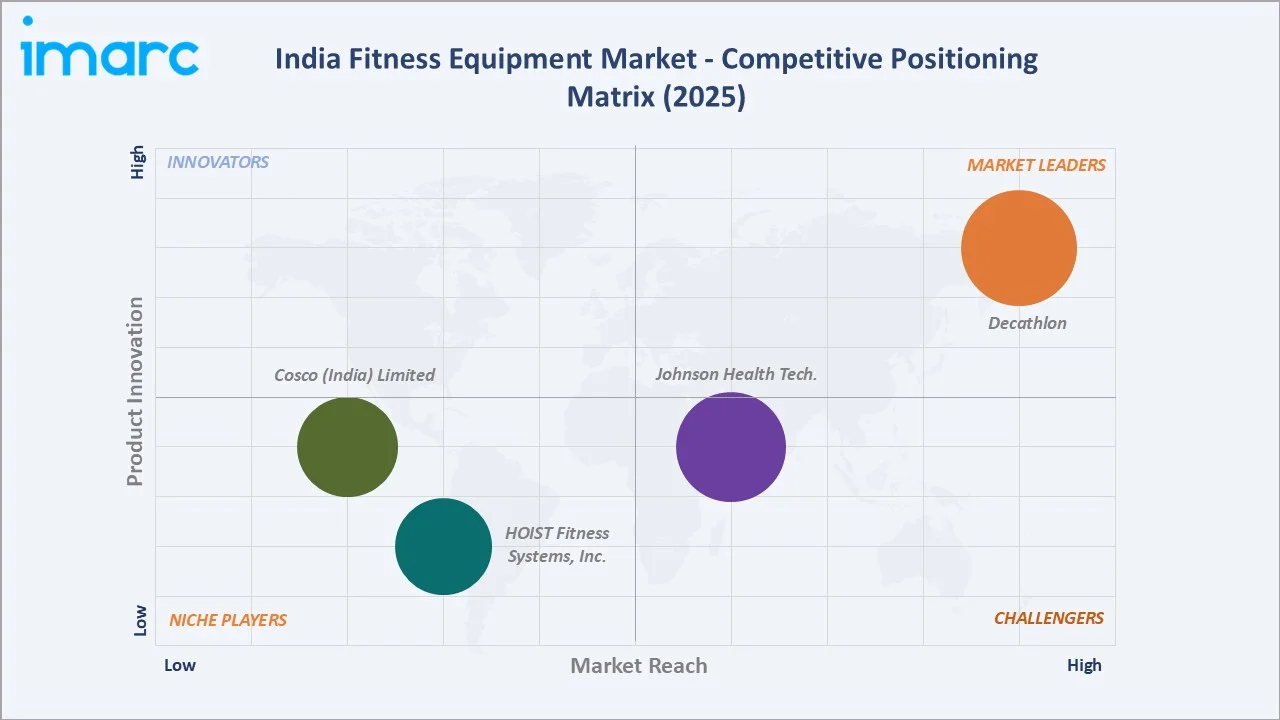
The India fitness equipment market is moderately competitive, with global multinationals, international brands, and domestic manufacturers competing across three tiers: global premium brands commanding health club segments, international mid-market players expanding store networks, and domestic manufacturers competing on pricing and service accessibility.
|
Company Name |
Key Products |
Market Position |
Core Strength |
|
Decathlon |
Treadmills, dumbbells, resistance bands, stationary cycles, fitness accessories |
Market Leader |
Decathlon combines vertical integration with rapid store expansion and competitive pricing across all fitness equipment segments. |
|
Johnson Health Tech. |
Treadmills, ellipticals, stationary bikes, commercial strength equipment |
Strong Challenger |
Johnson Health Tech combines broad product range with established OEM relationships and distribution across Indian fitness retail. |
|
HOIST Fitness Systems, Inc. |
Commercial strength training machines, cable systems, plate-loaded equipment |
Niche Leader |
Hoist leads in commercial-grade strength training equipment for premium health clubs and institutional fitness buyers. |
|
Cosco (India) Limited |
Treadmills, stationary cycles, multi-gyms, dumbbells, home fitness equipment |
Niche Player |
Cosco combines domestic manufacturing heritage with pan-India distribution and strong value-for-money market positioning. |
Key players include Decathlon, Johnson Health Tech., HOIST Fitness Systems, Inc., Cosco (India) Limited, and others.
Key Company Profiles
Decathlon
Decathlon is a France-based global sporting goods retailer operating the largest specialty fitness retail network in India.
- Key Products: Treadmills, stationary cycles, dumbbells, kettlebells, resistance bands, multi-gym systems, and a broad range of fitness accessories spanning all price points and consumer segments.
- Strategic Focus: Expanding the India store network to 190 locations while increasing sourcing of made-in-India products to improve cost competitiveness and supply chain resilience. Decathlon is simultaneously strengthening digital engagement and in-store fitness coaching services to deepen consumer loyalty and drive repeat purchases across its fitness equipment portfolio in India.
Johnson Health Tech.
Johnson Health Tech. is a Taiwan-based global fitness equipment manufacturer serving India through its Matrix Fitness and Vision Fitness brand families, supplying both commercial gym operators and home consumers with a broad portfolio of cardiovascular and strength training equipment across mid-range and premium price tiers.
- Key Products: Treadmills, ellipticals, stationary bikes, rowing machines, and commercial-grade strength training systems under the Matrix Fitness and Vision Fitness brand families, covering both institutional and home consumer requirements.
- Recent Development: In June 2022, Johnson Health Tech announced the launch of a new wholly owned subsidiary in India, strengthening its direct presence in the country's growing fitness equipment market. The expansion is intended to enhance the company's ability to serve local customers and fitness facilities while providing greater access to its portfolio of commercial and residential fitness solutions.
- Strategic Focus: Strengthening India distribution partnerships and expanding commercial gym account relationships across metropolitan and tier-2 city fitness club operators, while investing in after-sales service infrastructure to improve operator satisfaction and loyalty. Johnson Health Tech is introducing its connected Matrix Fitness equipment range to capitalize on growing smart equipment demand among premium Indian health club operators.
Market Concentration Analysis
The India fitness equipment market is moderately fragmented, with global premium brands leading in health club and upper home consumer segments while domestic players hold strength in mass-market and tier-2 city channels. Market concentration is expected to increase gradually as gym chain consolidation drives institutional procurement toward established brands with proven after-sales service and digital equipment ecosystems.
Investment & Growth Opportunities
Highest Growth Segments
Premium/Luxury equipment (~10.20% CAGR) and Cardiovascular Training Equipment (~9.80% CAGR) are the highest-growth investment vectors through 2034, outpacing the overall CAGR of 9.22% as digital fitness integration and premium gym expansion compound demand growth rates.
Emerging Investment Opportunities
AI-connected smart fitness equipment and compact home gym systems represent the highest per-unit-value emerging opportunities, supported by rising urban middle-class income and India's rapid smartphone penetration. Tier-2 and tier-3 city gym infrastructure and domestic manufacturing capacity represent structurally large, underpenetrated growth opportunities.
Investment Themes
- Domestic Manufacturing Capacity Investment: Capacity investment in domestic manufacturing of mid-range cardiovascular and strength equipment reduces import dependency, improves price competitiveness, and positions manufacturers under government Make in India incentive frameworks. Local manufacturing provides supply chain resilience against currency volatility and shipping disruptions affecting imported fitness equipment pricing.
- E-Commerce and Direct-to-Consumer Digital Platforms: Investment in direct-to-consumer digital platforms and subscription-based smart fitness ecosystems captures India's fastest-growing home fitness segment while building recurring revenue streams. These platforms also generate consumer behavioral data that manufacturers can leverage to guide product development and marketing investment across evolving equipment categories.
Future Market Outlook (2026-2034)
The India fitness equipment market is projected to grow from USD 872.0 Million in 2025 to USD 1,973.5 Million by 2034, delivering a steady CAGR of 9.22%. The market's anchor value of an estimated USD 1,354.9 Million in 2030 represents a fitness equipment industry in accelerating, structurally supported expansion, driven by gym infrastructure growth and technology-driven product premiumization.
Smart fitness technology and premium connected equipment are expected to achieve wider mainstream adoption by 2034. Three structural forces will define market growth: rising health consciousness across income groups, rapid gym chain expansion into new cities, and the growing convergence of technology with cardiovascular and strength equipment categories.
Research Methodology
Primary Research
Primary research comprised structured interviews with fitness equipment manufacturers, commercial gym operators, e-commerce managers, corporate wellness buyers, and industry association representatives across India's fitness equipment value chain.
Secondary Research
Secondary research encompassed company annual reports, BIS certification records, e-commerce sales data, government wellness publications, and industry association statistics, cross-verified across multiple independent sources to ensure data reliability.
Forecasting Models
Market revenue forecasts were developed using a bottom-up demand model incorporating India's urban population growth, per-capita income trends, gym membership penetration rates, home fitness adoption curves, and e-commerce growth rates by equipment type and price segment.
India Fitness Equipment Market Report Coverage:
| Report Features | Details |
|---|---|
| Base Year of the Analysis | 2025 |
| Historical Period | 2020-2025 |
| Forecast Period | 2026-2034 |
| Units | Million USD |
| Scope of the Report |
Exploration of Historical Trends and Market Outlook, Industry Catalysts and Challenges, Segment-Wise Historical and Future Market Assessment:
|
| Types Covered |
|
| Price Points Covered | Standard, Premium/Luxury |
| End Users Covered |
|
| Regions Covered | North India, South India, East India, West India |
| Companies Covered | Decathlon, Johnson Health Tech., HOIST Fitness Systems, Inc., Cosco (India) Limited, etc. |
| Customization Scope | 10% Free Customization |
| Post-Sale Analyst Support | 10-12 Weeks |
| Delivery Format | PDF and Excel through Email (We can also provide the editable version of the report in PPT/Word format on special request) |
Key Benefits for Stakeholders:
- IMARC’s industry report offers a comprehensive quantitative analysis of various market segments, historical and current market trends, market forecasts, and dynamics of the India fitness equipment market from 2020-2034.
- The research report provides the latest information on the market drivers, challenges, and opportunities in the India fitness equipment market.
- Porter's five forces analysis assist stakeholders in assessing the impact of new entrants, competitive rivalry, supplier power, buyer power, and the threat of substitution. It helps stakeholders to analyze the level of competition within the India fitness equipment industry and its attractiveness.
- Competitive landscape allows stakeholders to understand their competitive environment and provides an insight into the current positions of key players in the market.
Frequently Asked Questions About the India Fitness Equipment Market Report
The India fitness equipment market reached USD 872.0 Million in 2025, driven by cardiovascular training equipment dominant at 48.7%, standard price-point leadership at 68.4%, and West India's 32.7% regional leadership, underpinned by expanding gym chains, rising health consciousness, and accelerating home fitness adoption.
The India fitness equipment market grows at a 9.22% CAGR during 2026-2034, reaching USD 1,973.5 Million by 2034. This growth reflects rapid gym chain expansion, digital fitness integration, and accelerating home fitness equipment adoption across urban and semi-urban India.
Cardiovascular Training Equipment leads at 48.7%, capturing treadmill, stationary cycle, and elliptical demand from both commercial gym operators and home consumers. This segment grows at an above-market CAGR of approximately 9.80% through 2034, driven by strong cardio-focused fitness culture across urban Indian demographics.
Standard price-point equipment dominates at 68.4% through mass-market accessibility, competitive domestic manufacturing, and broad e-commerce reach. Premium/Luxury equipment grows fastest at approximately 10.20% CAGR as upscale health club and affluent home consumer demand accelerates through 2034.
West India leads at 32.7% through the commercial fitness density of Mumbai, Pune, and Ahmedabad, supporting high concentrations of premium health clubs, boutique studios, and corporate wellness programs. South India follows at 27.8%, led by Bengaluru and Hyderabad's rapidly expanding gym network.
Leading companies include Decathlon, Johnson Health Tech., HOIST Fitness Systems, Inc., Cosco (India) Limited, and others.
Three priority investment opportunities stand out: domestic manufacturing capacity for mid-range cardiovascular and strength equipment; direct-to-consumer digital platforms and connected fitness subscriptions; and tier-2 and tier-3 city gym infrastructure expansion targeting India's rapidly growing secondary urban consumer base and the accelerating fitness equipment market size in India's emerging cities.
Need more help?
- Speak to our experienced analysts for insights on the current market scenarios.
- Include additional segments and countries to customize the report as per your requirement.
- Gain an unparalleled competitive advantage in your domain by understanding how to utilize the report and positively impacting your operations and revenue.
- For further assistance, please connect with our analysts.
 Request Customization
 Speak to an Analyst
 Request Brochure
 Inquire Before Buying
Benefits of Customization
- Personalize this research
- Triangulate with your data
- Get data as per your format and definition
- Gain a deeper dive into a specific application, geography, customer, or competitor
- Any level of personalization
Get in Touch With Us
UNITED STATES
Phone: +1-201-971-6302
INDIA
Phone: +91-120-433-0800
UNITED KINGDOM
Phone: +44-753-714-6104
Email: [email protected]
Client Testimonials



.webp)



.webp)








Related Reports

Choose your plan
*Please note that the prices mentioned below are starting prices for each bundle type. Kindly contact our team for further details.*
Single User License
- 1 User License, Access on 2 Devices
- PDF Report + Excel Dataset (Password Protected)
- Lifetime Access
- No Printing Rights
- 10% Free Report Customization
- 10–12 Weeks of Analyst Support
Five User License
- Access for 5 Users, 2 Devices per User
- PDF Report + Excel Dataset (Password Protected)
- Lifetime Access
- Dedicated Account Manager
- 12–14 Weeks of Analyst Support
- No Printing Rights
- 15% Free Report Customization
- 25% Discount on Your Next Purchase
Corporate User License
- Unlimited User Access (Within Your Organization)
- PDF Report + Excel Dataset
- Lifetime Access
- Dedicated Account Manager
- 14–20 Weeks of Analyst Support
- No Printing Rights
- 20% Free Report Customization
- 30% Discount on Your Next Purchase
Essential Insights
What's included:
3 reports
- Lifetime Access
- PDF Reports
- Excel Datasets
- 2 Weeks of Free Analyst Support
- 2 User Licenses
- Access on 2 Devices
- Printing Rights
- Complimentary PowerPoint (PPT) Version
- Complimentary License Upgrade
Professional Access
What's included:
5 reports
- Lifetime Access
- PDF Reports
- Excel Datasets
- 8 Weeks of Free Analyst Support
- 2 User Licenses
- Access on 2 Devices
- Printing Rights
- Complimentary PowerPoint (PPT) Version
- Complimentary License Upgrade
Business Advantage
What's included:
8 reports
- Lifetime Access
- PDF Reports
- Excel Datasets
- 14 Weeks of Free Analyst Support
- 2 User Licenses
- Access on 2 Devices
- Printing Rights
- Complimentary PowerPoint (PPT) Version
- Complimentary License Upgrade
Enterprise Intelligence
What's included:
10 reports
- Lifetime Access
- PDF Reports
- Excel Datasets
- 20 Weeks of Free Analyst Support
- 2 User Licenses
- Access on 2 Devices
- Printing Rights
- Complimentary PowerPoint (PPT) Version
- Complimentary License Upgrade