
India Flavors and Fragrances Market Size, Share, Trends and Forecast by Product Type, Form, Application, Ingredients, and Region, 2026-2034
India Flavors and Fragrances Market Summary:
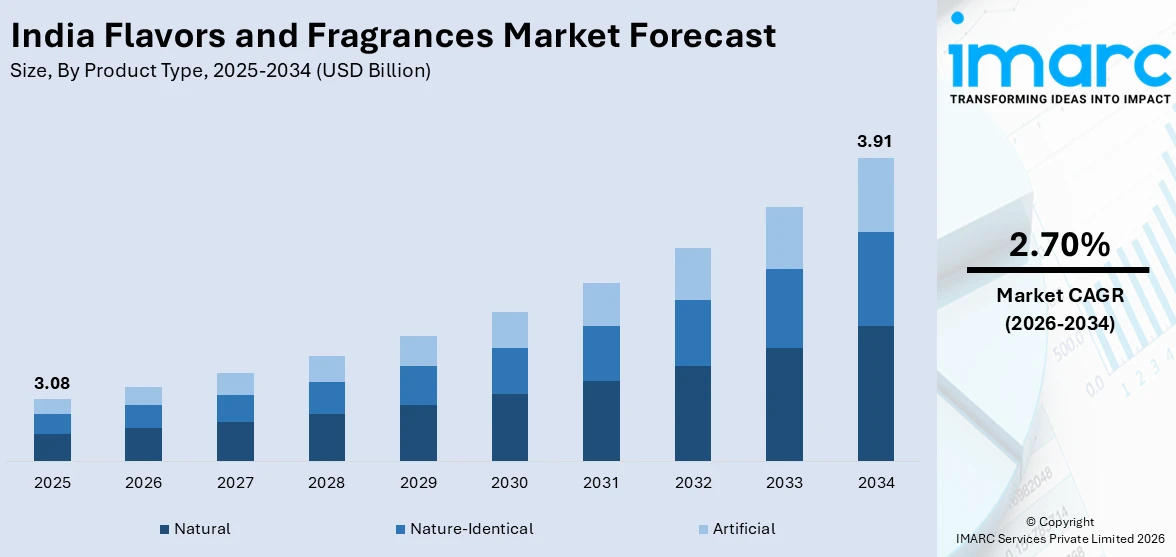
The India flavors and fragrances market size was valued at USD 3.08 Billion in 2025 and is projected to reach USD 3.91 Billion by 2034, growing at a compound annual growth rate of 2.70% from 2026-2034.
The market is fueled by the increasing consumer preference for natural and organic ingredients, the growing food and beverage processing industry, rising disposable incomes, and the increasing urbanization in India. The increasing availability of packaged food products, the rising awareness about health and wellness, and the strong cultural affinity for botanicals are some of the factors that continue to drive the market. In addition, advancements in flavor and fragrance technologies and the expansion of e-commerce channels are also adding to the increasing market share of the India flavors and fragrances market.
Key Takeaways and Insights:
- By Product Type: Natural dominates the market with a share of 45% in 2025, driven by increasing consumer demand for clean-label and plant-derived flavor and fragrance ingredients and growing regulatory support for natural formulations.
- By Form: Liquid leads the market with a share of 60% in 2025, owing to to its superior blending versatility, ease of incorporation into processed food and beverage formulations, and widespread adoption in personal care manufacturing.
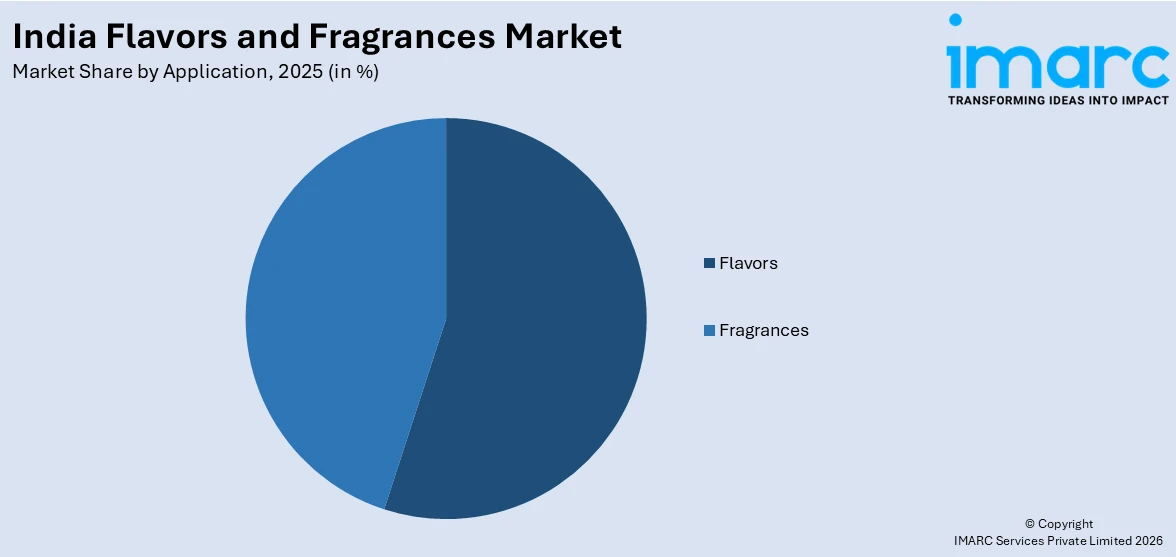
- By Application: Flavors represent the largest segment with a market share of 56% in 2025, driven by the rapidly expanding processed food and beverages industry and rising consumer preference for diverse and exotic taste profiles.
- By Ingredients: Natural dominates the market with a share of 51% in 2025, owing to rising consumer inclination toward organic and sustainably sourced ingredients and extensive availability of aromatic raw materials in India.
- Key Players: The India flavors and fragrances market exhibits a moderately fragmented competitive landscape, with established multinational corporations competing alongside regional specialty manufacturers and domestic players across diverse product segments, price tiers, and application categories.
To get more information on this market Request Sample
The India flavors and fragrances market is experiencing robust growth propelled by a confluence of socioeconomic and industrial factors. The expanding middle-class population, coupled with rising disposable incomes and accelerating urbanization, is stimulating demand for processed foods, premium personal care products, and household care items that extensively utilize flavor and fragrance ingredients. In October 2025, International Flavors & Fragrances (IFF) announced plans to open a new scent creative centre in Mumbai to strengthen its innovation footprint and better serve local customers in the burgeoning fragrance segment. India’s rich botanical heritage and abundant availability of spices, herbs, and aromatic plants provide a strong foundation for natural ingredient sourcing. The growing food processing industry, supported by favorable government initiatives and increasing foreign direct investment, is amplifying the consumption of both natural and synthetic flavoring agents. Furthermore, shifting consumer preferences toward wellness-oriented and sensory-enhanced products, alongside the rapid growth of e-commerce and modern retail channels, are broadening market accessibility and driving sustained demand across urban and semi-urban geographies.
India Flavors and Fragrances Market Trends:
Shift Toward Clean-Label and Plant-Based Formulations
Indian consumers are increasingly gravitating toward clean-label products featuring recognizable, minimally processed ingredients derived from natural sources. This shift is reshaping formulation strategies of food, beverage, and personal care manufacturers replacing synthetic additives with plant-based alternatives. In September 2024, iD Fresh Food entered India’s Rs 25,000‑crore spices market with a range of clean, preservative‑free spice products that are free from synthetic chemicals and include QR codes for full transparency on quality and pesticide testing. The demand for transparency in ingredient sourcing and product labeling is prompting flavor and fragrance producers to invest in botanical extraction techniques and sustainable supply chains.
Rising Adoption of Functional and Wellness-Infused Fragrances
The Indian market is witnessing growing demand for functional fragrances offering therapeutic and mood-enhancing benefits beyond mere olfactory appeal. Aromatherapy-inspired products incorporating essential oils and herbal infusions are gaining traction across personal care, home care, and wellness categories. In September 2025, IRIS Home Fragrances officially entered India’s aromatherapy segment with a new range of seven signature scent products designed to support relaxation, stress relief, respiratory wellness and energy, blending traditional scent benefits with modern wellness applications. Consumers are seeking fragrances that provide stress relief, promote relaxation, and contribute to overall well-being.
Digital Transformation and Personalization in Flavor and Fragrance Development
The integration of advanced digital technologies, including artificial intelligence, machine learning, and data analytics, is transforming flavor and fragrance development processes in India. Manufacturers are leveraging these technologies to analyze consumer preferences, predict emerging taste and scent trends, and accelerate product development cycles. In February 2025, International Flavors & Fragrances (IFF) launched its AI‑powered ScentChat™ app to integrate real‑time consumer feedback into fragrance creation, enabling perfumers to tailor formulations more closely to evolving preferences via chat platforms like WhatsApp and Facebook Messenger. Personalization is becoming a key differentiator, with brands offering customized flavor profiles and bespoke fragrance compositions tailored to individual preferences and regional palate variations.
Market Outlook 2026-2034:
The India flavors and fragrances market is expected to register steady revenue growth over the forecast period, driven by the growing food processing industry, increasing consumer expenditure on high-end personal care and home care products, and the rising demand for natural and organic ingredients. The growth in revenues will also be driven by the increasing focus on research and development, the entry of global companies looking to tap into the large consumer base in India, and the development of modern retail and online distribution channels. The growing focus on healthy consumption trends, premiumization, and innovation in ingredients will present a huge revenue opportunity in the market. The market generated a revenue of USD 3.08 Billion in 2025 and is projected to reach a revenue of USD 3.91 Billion by 2034, growing at a compound annual growth rate of 2.70% from 2026-2034.
India Flavors and Fragrances Market Report Segmentation:
| Segment Category | Leading Segment | Market Share |
|---|---|---|
|
Product Type |
Natural |
45% |
|
Form |
Liquid |
60% |
|
Application |
Flavors |
56% |
|
Ingredients |
Natural |
51% |
Product Type Insights:
- Nature-Identical
- Artificial
- Natural
Natural dominates with a market share of 45% of the total India flavors and fragrances market in 2025.
The natural commands the leading position in the India flavors and fragrances market, driven by the country’s deep-rooted tradition of utilizing botanical and herbal ingredients across culinary and wellness applications. India’s vast biodiversity and status as a major global producer of spices, essential oils, and aromatic herbs provide a significant competitive advantage for natural flavor and fragrance production. In May 2025, Aromatic Ingredients Pvt. Ltd. highlighted strong industry interest at the 26th FAFAI International Convention in New Delhi with over 300 customer interactions focused on natural fragrance extracts like cardamom, vanilla, and elemi oils, underlining rising demand for high‑quality botanicals.
The regulatory environment in India is increasingly supportive of natural product formulations, with food safety authorities emphasizing clean-label compliance and transparent ingredient disclosure. Manufacturers are investing in advanced extraction and encapsulation technologies to enhance the stability, shelf life, and sensory consistency of natural flavors and fragrances. The growing demand from the organic food sector, premium personal care category, and artisanal product segments continues to expand the addressable market for natural ingredients, positioning this segment for sustained leadership throughout the forecast period.
Form Insights:
- Liquid
- Dry
Liquid leads with a share of 60% of the total India flavors and fragrances market in 2025.
The liquid dominates the India flavors and fragrances market owing to its superior versatility and ease of integration into a wide range of manufacturing processes. Liquid formulations offer precise dosing capabilities, uniform dispersion characteristics, and compatibility with diverse product matrices spanning beverages, dairy products, confectionery, cosmetics, and household care items. In August 2025, Swiss‑Dutch innovator dsm‑firmenich announced a 70 mn euros expansion in India, inaugurating an expanded Kerala seasoning plant and starting a 56,000 square metre facility in Gujarat to enhance liquid compounding and flavor production for beverages and confectionery.
Technological advancements in microencapsulation and emulsification techniques are enhancing the performance attributes of liquid flavors and fragrances, including improved heat stability, controlled release properties, and extended shelf life. The growing adoption of spray-based and aerosol delivery formats in air care, personal hygiene, and surface care products is further driving demand for liquid formulations. Additionally, liquid forms facilitate easier blending and customization, enabling manufacturers to develop complex flavor and fragrance profiles that cater to India’s diverse regional taste and scent preferences.
Application Insights:
Access the comprehensive market breakdown Request Sample
- Flavors
- Beverages
- Dairy and Frozen Desserts
- Bakery and Confectionery Products
- Savories and Snacks
- Fragrances
- Soap and Detergents
- Cosmetics and Toiletries
- Fine Fragrances
- Household Cleaners and Air Fresheners
Flavors exhibit a clear dominance with a 56% share of the total India flavors and fragrances market in 2025.
The flavors hold the largest share in the India flavors and fragrances market, underpinned by the rapidly expanding processed food and beverage industry. India’s growing urban population, increasing adoption of convenience foods, and evolving dietary preferences are driving sustained demand for diverse and innovative flavor solutions. In September 2025, Ultra International showcased an extensive range of on‑trend flavors for beverages, ice creams and seasonings, including tropical, fusion, regional and health‑oriented profiles at the Fi India 2025 food ingredients exhibition, highlighting the segment’s innovation focus.
The proliferation of quick-service restaurants, organized retail chains, and online food delivery platforms is amplifying demand for consistent and appealing flavor profiles across manufactured food products. Indian consumers’ growing appetite for global cuisines alongside their preference for traditional regional flavors is creating a unique market dynamic that requires sophisticated flavor development capabilities. The increasing focus on health-oriented food products, including reduced-sugar beverages and fortified snacks, is further stimulating innovation in flavor formulation technologies that maintain taste appeal while meeting nutritional objectives.
Ingredients Insights:
- Natural
- Synthetic
Natural leads with a market share of 51% of the total India flavors and fragrances market in 2025.
The natural dominates the India flavors and fragrances market, reflecting the strong consumer preference for organically sourced and minimally processed aromatic materials. India’s position as one of the world’s largest producers and exporters of essential oils, oleoresins, and spice extracts provides a robust domestic supply base that supports the natural ingredients segment. In February 2026, the All India Spices Exporters Forum (AISEF) and the European Spice Association signed an MoU to strengthen regulatory alignment, food safety, and sustainability cooperation for spice trade between India and the EU, reinforcing the global competitiveness of Indian natural extracts and botanicals.
Manufacturers are increasingly establishing backward integration with farming communities and cooperatives to ensure traceability, quality consistency, and sustainable sourcing of natural raw materials. The development of green chemistry processes and biotechnology-based production methods is expanding the range and availability of natural flavor and fragrance ingredients while addressing supply variability concerns. The premiumization trend across consumer product categories, where natural and organic positioning commands higher price points, continues to incentivize manufacturers to invest in natural ingredient portfolios and secure long-term supply partnerships.
Regional Insights:
- North India
- South India
- East India
- West India
North India is a major contributor to the flavors and fragrances market, with a diverse consumer base, a high concentration of food processing industries, and a strong demand for traditional spice-based flavors. The growing urbanization of the region, increasing disposable incomes, and a rising demand for high-end personal care and home care products continue to fuel market demand in both flavor and fragrance segments.
South India continues to be a part of the flavors and fragrances market, with the presence of major spice-producing states, a well-established essential oil extraction industry, and a strong food processing industry. The region's strong affinity for natural and herbal ingredients, a thriving cosmetics and personal care industry, and a growing export-oriented fragrance manufacturing industry continue to drive the overall market growth.
East India represents an emerging market for flavors and fragrances, with growth stimulated by a gradual process of urbanization, rising consumer expenditure on packaged food items, and a growing personal care market. The growing food processing industry, rising awareness about branded and premium consumer products, and an improving distribution channel are also opening new avenues for growth for flavor and fragrance producers aiming to enter this untapped market.
The West India market leads the way in the flavors and fragrances market, with the presence of prominent industrial and commercial centers that house the largest manufacturing facilities and trading houses. The region enjoys favorable infrastructure, easy access to the major ports that facilitate the import and export of raw materials, a well-developed food and beverage processing industry, and a thriving personal care and cosmetics industry that fuels the demand for fragrances.

Market Dynamics:
Growth Drivers:
Why is the India Flavors and Fragrances Market Growing?
Expanding Food Processing Industry and Changing Dietary Patterns
India's food processing sector is undergoing significant expansion, driven by increasing urbanization, rising household incomes, and evolving consumer lifestyles favoring convenience and ready-to-eat food products. The shift from traditional home-cooked meals toward packaged and processed foods is generating substantial demand for flavoring ingredients that replicate authentic taste profiles at industrial scale. In 2025, PepsiCo announced plans to build its seventh potato chip factory in Tamil Nadu, a $71 million investment to meet rising snack demand and strengthen India’s processed food manufacturing base. The burgeoning snacking culture among India's predominantly young population, combined with growing exposure to international cuisines through travel and digital media, is diversifying taste preferences and creating opportunities for novel flavor innovations.
Surging Demand for Premium Personal Care and Home Care Products
The Indian personal care and home care sectors are experiencing a pronounced premiumization trend, with consumers increasingly willing to spend on products offering superior sensory experiences and perceived quality. Fragrances play a central role in product differentiation and brand positioning within these categories. In February 2026, Aureia London entered India’s ₹4,500 crore fragrance market with a premium direct‑to‑consumer expansion targeting 1,500 stores, signaling strong appetite for mid‑to‑high‑end scented products. The growing emphasis on personal grooming, driven by rising social media influence and changing lifestyle aspirations, is expanding the addressable market for fragranced products spanning deodorants, perfumes, body care, and hair care. The transition toward premium scented household formulations further accelerates fragrance consumption.
Growing Emphasis on Natural and Sustainable Ingredient Sourcing
The increasing global and domestic emphasis on sustainability and natural ingredient sourcing is creating significant growth opportunities for the India flavors and fragrances market. India's rich biodiversity, extensive agricultural heritage, and traditional expertise in herbal and botanical processing position the country as a preferred sourcing destination for natural raw materials. As per sources, specialty chemicals firm LANXESS showcased its sustainable aroma chemicals portfolio at the FAFAI International Convention & Expo in New Delhi, highlighting new ISCC PLUS‑certified, reduced‑carbon‑footprint variants to support environmentally conscious formulation in the Indian F&F industry. Rising consumer consciousness regarding environmental sustainability and chemical-free products is driving manufacturers to reformulate existing offerings centered on natural and organic ingredients. Regulatory developments promoting transparency in ingredient labeling further reinforce this transition toward sustainable production practices.
Market Restraints:
What Challenges the India Flavors and Fragrances Market is Facing?
Volatility in Raw Material Prices and Supply Chain Disruptions
The flavors and fragrances industry in India faces significant challenges related to fluctuating raw material costs, particularly for natural ingredients that are subject to seasonal availability, climate variability, and agricultural yield uncertainties. Supply chain disruptions stemming from geopolitical factors, trade policy changes, and logistics bottlenecks further compound pricing pressures, impacting production costs and profit margins for manufacturers across the value chain.
Complex and Evolving Regulatory Framework
The regulatory landscape governing flavors and fragrances in India involves multiple agencies with overlapping jurisdictions and evolving compliance requirements. Navigating food safety standards, cosmetic ingredient regulations, environmental emission norms, and labeling mandates presents operational complexities for manufacturers, particularly small and medium-sized enterprises. The increasing stringency of regulatory requirements and the lack of harmonization with international standards can delay product launches and increase compliance costs.
Prevalence of Counterfeit and Adulterated Products
The Indian market faces persistent challenges from counterfeit and adulterated flavor and fragrance products that undermine consumer trust and erode market value for legitimate manufacturers. The proliferation of substandard products, particularly in unorganized distribution channels, creates unfair price competition and poses potential health and safety risks. Combating counterfeit products requires substantial investment in quality assurance, traceability systems, and consumer education initiatives.
Competitive Landscape:
The India flavors and fragrances market features a moderately consolidated competitive landscape characterized by the presence of both multinational corporations and established domestic manufacturers. Large global players leverage extensive research and development capabilities, diversified product portfolios, and strong supply chain networks to maintain leadership positions across premium and specialty segments. Meanwhile, regional manufacturers compete effectively through localized product offerings, cost advantages, and deep understanding of India’s diverse regional taste and fragrance preferences. The competitive environment is further shaped by strategic collaborations, capacity expansion initiatives, and mergers and acquisitions aimed at strengthening market positioning. Innovation in natural and sustainable product development, investment in advanced extraction and processing technologies, and expansion of application-specific solutions represent key competitive strategies employed by market participants to capture emerging growth opportunities.
Recent Developments:
- In April 2024, Takasago International Corporation inaugurated its Mumbai Fragrance Centre, enhancing fragrance R&D, creation, and sensory evaluation for personal care, fabric care, and air care products. The expansion supports Takasago’s tenfold growth in India and reinforces continued investment in innovation and localized F&F development.
India Flavors and Fragrances Market Report Coverage:
| Report Features | Details |
|---|---|
| Base Year of the Analysis | 2025 |
| Historical Period | 2020-2025 |
| Forecast Period | 2026-2034 |
| Units | Billion USD |
| Scope of the Report |
Exploration of Historical Trends and Market Outlook, Industry Catalysts and Challenges, Segment-Wise Historical and Future Market Assessment:
|
| Product Types Covered | Nature-Identical, Artificial, Natural |
| Forms Covered | Liquid, Dry |
| Applications Covered |
|
| Ingredients Covered | Natural, Synthetic |
| Regions Covered | North India, South India, East India, West India |
| Customization Scope | 10% Free Customization |
| Post-Sale Analyst Support | 10-12 Weeks |
| Delivery Format | PDF and Excel through Email (We can also provide the editable version of the report in PPT/Word format on special request) |
Frequently Asked Questions About the India Flavors and Fragrances Market Report
The India flavors and fragrances market size was valued at USD 3.08 Billion in 2025.
The India flavors and fragrances market is expected to grow at a compound annual growth rate of 2.70% from 2026-2034 to reach USD 3.91 Billion by 2034.
Natural held the largest India flavors and fragrances market share, driven by the expanding processed food and beverage industry, evolving consumer dietary patterns, and growing demand for innovative taste solutions across bakery, dairy, beverage, and snack product categories.
Key factors driving the India flavors and fragrances market include the expanding food processing industry, rising demand for natural and organic ingredients, growing personal care and home care consumption, increasing urbanization and disposable incomes, and innovation in flavor and fragrance development technologies.
Major challenges include volatility in natural raw material prices, complex and evolving regulatory compliance requirements, supply chain disruptions, prevalence of counterfeit and adulterated products, limited standardization across unorganized segments, and the need for substantial investment in quality assurance and sustainable sourcing infrastructure.
Need more help?
- Speak to our experienced analysts for insights on the current market scenarios.
- Include additional segments and countries to customize the report as per your requirement.
- Gain an unparalleled competitive advantage in your domain by understanding how to utilize the report and positively impacting your operations and revenue.
- For further assistance, please connect with our analysts.
 Request Customization
 Speak to an Analyst
 Request Brochure
 Inquire Before Buying
Benefits of Customization
- Personalize this research
- Triangulate with your data
- Get data as per your format and definition
- Gain a deeper dive into a specific application, geography, customer, or competitor
- Any level of personalization
Get in Touch With Us
UNITED STATES
Phone: +1-201-971-6302
INDIA
Phone: +91-120-433-0800
UNITED KINGDOM
Phone: +44-753-714-6104
Email: [email protected]
Client Testimonials




.webp)




.webp)













Related Reports

Choose your plan
*Please note that the prices mentioned below are starting prices for each bundle type. Kindly contact our team for further details.*
Single User License
- 1 User License, Access on 2 Devices
- PDF Report + Excel Dataset (Password Protected)
- Lifetime Access
- No Printing Rights
- 10% Free Report Customization
- 10–12 Weeks of Analyst Support
Five User License
- Access for 5 Users, 2 Devices per User
- PDF Report + Excel Dataset (Password Protected)
- Lifetime Access
- Dedicated Account Manager
- 12–14 Weeks of Analyst Support
- No Printing Rights
- 15% Free Report Customization
- 25% Discount on Your Next Purchase
Corporate User License
- Unlimited User Access (Within Your Organization)
- PDF Report + Excel Dataset
- Lifetime Access
- Dedicated Account Manager
- 14–20 Weeks of Analyst Support
- No Printing Rights
- 20% Free Report Customization
- 30% Discount on Your Next Purchase
Essential Insights
What's included:
3 reports
- Lifetime Access
- PDF Reports
- Excel Datasets
- 2 Weeks of Free Analyst Support
- 2 User Licenses
- Access on 2 Devices
- Printing Rights
- Complimentary PowerPoint (PPT) Version
- Complimentary License Upgrade
Professional Access
What's included:
5 reports
- Lifetime Access
- PDF Reports
- Excel Datasets
- 8 Weeks of Free Analyst Support
- 2 User Licenses
- Access on 2 Devices
- Printing Rights
- Complimentary PowerPoint (PPT) Version
- Complimentary License Upgrade
Business Advantage
What's included:
8 reports
- Lifetime Access
- PDF Reports
- Excel Datasets
- 14 Weeks of Free Analyst Support
- 2 User Licenses
- Access on 2 Devices
- Printing Rights
- Complimentary PowerPoint (PPT) Version
- Complimentary License Upgrade
Enterprise Intelligence
What's included:
10 reports
- Lifetime Access
- PDF Reports
- Excel Datasets
- 20 Weeks of Free Analyst Support
- 2 User Licenses
- Access on 2 Devices
- Printing Rights
- Complimentary PowerPoint (PPT) Version
- Complimentary License Upgrade