
India Food Enzymes Market Size, Share, Trends and Forecast by Type, Source, Formulation, Application, and Region, 2026-2034
India Food Enzymes Market Summary:
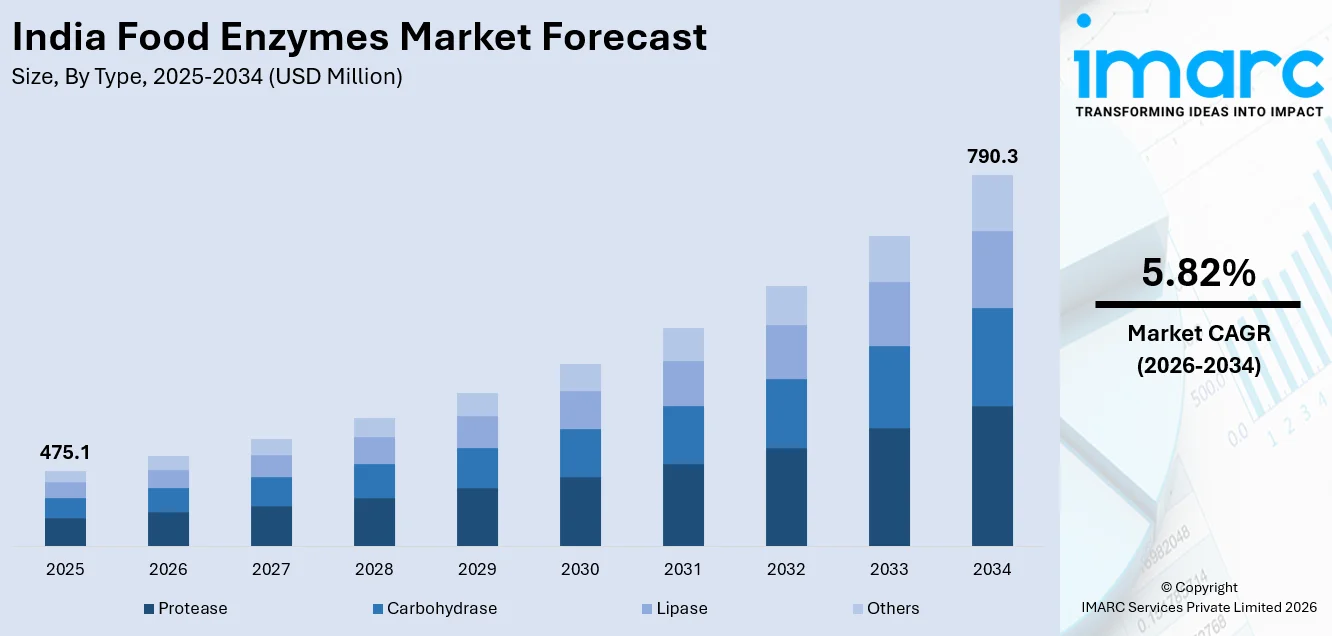
The India food enzymes market size was valued at USD 475.1 Million in 2025 and is projected to reach USD 790.3 Million by 2034, growing at a compound annual growth rate of 5.82% from 2026-2034.
The market is driven by increasing demand for processed and convenience foods, growing consumer preference for clean-label and naturally derived ingredients, and the expanding food processing industry across India. Rising health awareness and dietary shifts toward enzyme-enhanced products are further accelerating adoption. Technological advancements in enzyme production and formulation are also enabling wider application across food categories, contributing to the steady growth of the India food enzymes market share.
Key Takeaways and Insights:
- By Type: Protease dominates the market with a share of 35% in 2025, driven by its extensive application in meat tenderization, dairy processing, and protein hydrolysis across India’s rapidly expanding food manufacturing sector.
- By Source: Microorganisms lead the market with a share of 60% in 2025, owing to superior scalability, cost-effectiveness, and consistent production yields through controlled fermentation processes.
- By Formulation: Powder represents the largest segment with a market share of 55% in 2025, driven by extended shelf life, ease of storage and transportation, and superior stability across diverse food processing conditions.
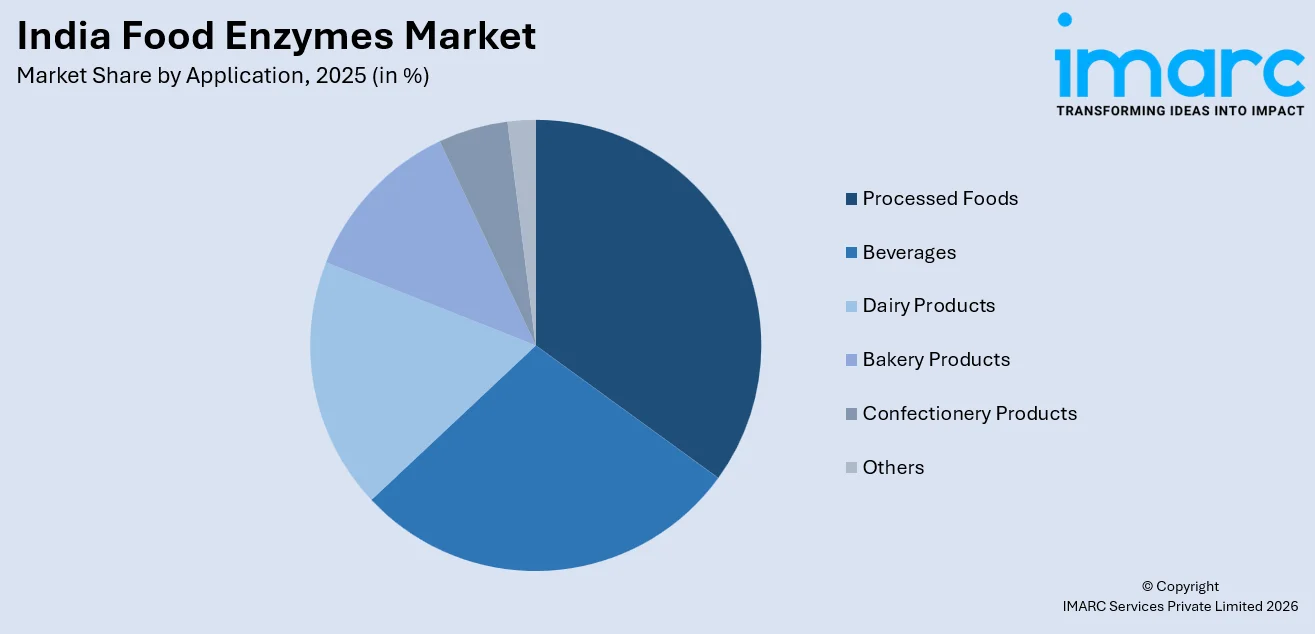
- By Application: Processed foods dominate the market with a share of 32% in 2025, owing to the rising demand for ready-to-eat (RTE) meals, packaged snacks, and convenience food products across urban and semi-urban India.
- Key Players: The India food enzymes market exhibits a moderately consolidated competitive landscape, with established multinational enzyme manufacturers competing alongside domestic producers across diverse application segments. Market participants are focusing on expanding production capacities, developing application-specific enzyme solutions, and strengthening distribution networks across the country.
To get more information on this market Request Sample
The India food enzymes market is experiencing sustained expansion, primarily fueled by the rapid growth of the country's food processing industry and evolving consumer dietary preferences. Increasing urbanization and rising disposable incomes are driving greater consumption of processed, packaged, and convenience food products, which require enzyme-based solutions for improved texture, flavor, and shelf life. In August 2025, the Indian government under its BioE3 policy announced plans to establish 16 biomanufacturing hubs to reduce dependence on imported bio‑based components, including enzymes, enhancing domestic enzyme production capabilities. Additionally, the growing consumer inclination toward clean-label and naturally derived food ingredients is encouraging manufacturers to replace synthetic additives with enzyme-based alternatives. Government initiatives supporting food processing infrastructure development, along with favorable regulatory frameworks for enzyme usage in food products, are further catalyzing market growth. The expanding dairy, bakery, and beverage sectors across India are creating significant demand for specialized enzyme formulations tailored to specific processing requirements.
India Food Enzymes Market Trends:
Rising Adoption of Clean-Label Enzyme Solutions
Indian food manufacturers are increasingly transitioning toward clean-label formulations, replacing synthetic additives and chemical processing aids with naturally derived enzyme solutions. This shift is being driven by heightened consumer awareness regarding ingredient transparency and a growing preference for minimally processed food products. As per sources, Novonesis showcased specialised enzyme technologies at Fi India 2025 to help bakers eliminate traditional emulsifiers and improve texture in high‑protein, clean‑label breads and batters, reflecting this industry focus on enzyme‑led reformulations. Enzyme-based alternatives are gaining traction across bakery, dairy, and beverage applications as they enable manufacturers to achieve desired product characteristics while maintaining simplified ingredient lists.
Expansion of Enzyme Applications in Plant-Based Food Processing
The burgeoning plant-based food segment in India is creating new avenues for enzyme application, particularly in protein extraction, texture modification, and flavor enhancement of plant-derived food products. Proteases and carbohydrases are being increasingly utilized to improve the functional properties of plant proteins sourced from soy, pea, and chickpea, enabling manufacturers to develop products with improved taste and mouthfeel. According to reports, in January 2026, 3,20,809 Indians participated in Veganuary, embracing plant-based diets, with over 30,000 accessing Hindi-language resources, highlighting growing mainstream adoption of vegan food across workplaces, cafés, and retailers. This trend is supported by the growing vegetarian and flexitarian consumer base in India, which is driving innovation in plant-based dairy alternatives, meat analogues, and protein-enriched snacks, all of which rely heavily on enzyme-assisted processing technologies.
Advancements in Microbial Fermentation Technologies
Significant progress in microbial fermentation and bioengineering techniques is transforming enzyme production capabilities in India. Advanced fermentation platforms are enabling the development of highly specific and thermostable enzyme variants that offer superior performance under diverse food processing conditions. In February 2026, the PreferCo‑Glatt Centre of Excellence for Bioprocess Scale‑Up was established in Hyderabad to support microbial precision fermentation and scale laboratory processes into commercial production, strengthening India’s biomanufacturing infrastructure. These technological improvements are allowing manufacturers to produce enzymes with enhanced substrate specificity, broader pH tolerance, and improved activity at varying temperatures.
Market Outlook 2026-2034:
The India food enzymes market is poised for sustained revenue growth over the forecast period, driven by the expanding food processing sector, increasing consumer demand for clean-label products, and rising enzyme adoption across diverse food applications. The market revenue is expected to benefit from ongoing investments in enzyme production infrastructure, favorable government policies supporting food manufacturing, and growing penetration of enzyme-based solutions in emerging application areas such as plant-based foods and functional beverages. Continued technological innovation in enzyme formulation and production methodologies is anticipated to further augment market revenue. The market generated a revenue of USD 475.1 Million in 2025 and is projected to reach a revenue of USD 790.3 Million by 2034, growing at a compound annual growth rate of 5.82% from 2026-2034.
India Food Enzymes Market Report Segmentation:
|
Segment Category |
Leading Segment |
Market Share |
|
Type |
Protease |
35% |
|
Source |
Microorganisms |
60% |
|
Formulation |
Powder |
55% |
|
Application |
Processed Foods |
32% |
Type Insights:
- Carbohydrase
- Amylase
- Cellulase
- Lactase
- Pectinase
- Others
- Protease
- Lipase
- Others
Protease dominates with a market share of 35% of the total India food enzymes market in 2025.
Protease leads the India food enzymes market by type, holding the largest revenue share. This leadership position is attributed to the widespread utilization of proteases across multiple food processing applications, including meat tenderization, dairy protein modification, and baking improvement. The growing demand for protein-rich and high-quality processed food products across India is further reinforcing the dominance of protease enzymes. Their versatile functionality in breaking down complex protein structures makes them indispensable across both organized and unorganized food manufacturing sectors.
The expanding dairy processing sector and the increasing adoption of enzyme-assisted protein hydrolysis in functional food and beverage manufacturing are key factors sustaining protease demand. Additionally, the rising popularity of protein supplements, sports nutrition products, and infant formula preparations that require precise protein breakdown is creating sustained demand. Continuous innovation in protease formulations with improved thermal stability and specificity is also broadening their application scope, enabling manufacturers to achieve superior product quality and processing efficiency across diverse food categories.
Source Insights:
- Microorganisms
- Bacteria
- Fungi
- Plants
- Animals
Microorganisms lead with a share of 60% of the total India food enzymes market in 2025.
Microorganism dominates the India food enzymes market by source, commanding the largest revenue share. This leadership is driven by the superior scalability, cost-effectiveness, and production consistency offered by microbial fermentation processes. In July 2025, India’s Food Safety and Standards Authority of India (FSSAI) updated its regulations to formally include enzymes derived from genetically modified microorganisms as permitted processing aids in food manufacturing, reflecting regulatory acceptance of microbial enzyme use. Microorganisms enable large-scale enzyme production with precisely controlled quality parameters, making them the preferred source for commercial food enzyme manufacturing.
Advanced fermentation technologies and bioengineering capabilities allow the development of highly specific enzyme variants with enhanced thermal stability and substrate selectivity. The growing investment in microbial enzyme production facilities within India, coupled with the ability to genetically optimize microbial strains for targeted enzyme yields, continues to reinforce their leading position. Research efforts focused on developing novel microbial strains with improved productivity and broader processing compatibility are further expanding the application potential of microorganism-sourced enzymes across Indian food manufacturing.
Formulation Insights:
- Powder
- Liquid
- Others
Powder exhibits a clear dominance with a 55% share of the total India food enzymes market in 2025.
Powder dominates the India food enzymes market, accounting for the largest revenue share. This leadership is facilitated by the extended shelf-life, superior storage stability, and possible ease of handling that powder formulation can give as compared to liquids. As for the bakery, confectionery, and processed food industry, highly powdered enzymes are preferred, as accurate dosages and consistent distributions are decisive for consistent product quality. Their resistance to microbial contamination and minimal cold chain requirements makes them especially suitable to India’s prevailing climatic conditions.
The logistical benefits of powder formulations, such as lower transportation costs and easier storage without the need for cold chain distribution, make them particularly well-suited to the large geographical scale of the Indian food manufacturing sector. The increasing number of small and medium-scale food processing units in semi-urban and rural India, which are favorably impacted by the easy handling properties of powdered enzymes, is further solidifying their position. In addition, continuous improvements in powder encapsulation and stabilization technologies are improving enzyme activity retention and enabling applications in a variety of food processing units.
Application Insights:
Access the comprehensive market breakdown Request Sample
- Beverages
- Processed Foods
- Dairy Products
- Bakery Products
- Confectionery Products
- Others
Processed foods dominate with a market share of 32% of the total India food enzymes market in 2025.
Processed foods lead the India food enzymes market by application, holding the largest revenue share. This leadership is driven by the rapidly expanding processed food sector in India, supported by increasing urbanization, rising disposable incomes, and changing consumer lifestyles that favor convenience food products. In January 2026, the Indian Economic Survey highlighted that ultra‑processed food sales have risen by 150% over the past 14 years, reflecting the nation’s growing appetite for packaged processed foods and related value‑added products. Enzymes play a critical role in enhancing the texture, flavor, shelf life, and nutritional profile of processed food items.
The growing demand for RTE meals, packaged snacks, instant noodles, and processed meat products across urban and semi-urban India is generating sustained demand for food enzymes. Manufacturers are increasingly incorporating enzyme-based solutions to improve production efficiency, reduce processing time, and maintain consistent product quality. Government initiatives promoting food processing infrastructure development and the establishment of dedicated food processing clusters across multiple states are further strengthening the demand for specialized enzyme solutions within this leading application segment.
Regional Insights:
- North India
- West and Central India
- South India
- East India
North India is a major contributor to the India food enzymes market, owing to the presence of large-scale food processing units in the states of Uttar Pradesh, Punjab, and Haryana. The region's thriving dairy sector, large wheat-based bakery manufacturing units, and increasing demand for processed and packaged food products are fueling the adoption of enzymes in various food manufacturing facilities.
West and Central India is a major segment in the India food enzymes market, owing to the presence of well-established food manufacturing facilities in the states of Maharashtra and Gujarat. The region is home to a thriving beverage processing industry, increasing confectionery production, and large-scale investments in modern food processing infrastructure.
South India commands a notable share in the India food enzymes market, driven by the region's flourishing dairy processing, beverage manufacturing, and rice-based food production sectors across Tamil Nadu, Karnataka, and Andhra Pradesh. The growing presence of organized food processing enterprises, coupled with increasing consumer demand for enzyme-enhanced functional foods and health-oriented products, is supporting sustained market expansion.
East India is an emerging region in the India food enzymes market, with growing food processing activities across West Bengal, Odisha, and Bihar. The region's expanding dairy sector, rising packaged food consumption, and government-supported initiatives for food processing infrastructure development are gradually driving enzyme adoption. Increasing urbanization and improving cold chain logistics are further creating opportunities for enzyme market penetration.

Market Dynamics:
Growth Drivers:
Why is the India Food Enzymes Market Growing?
Rapid Expansion of India's Food Processing Infrastructure
The accelerating development of food processing infrastructure across India is serving as a primary catalyst for the food enzymes market. Government-led initiatives promoting dedicated food processing parks, special economic zones, and industrial corridors are significantly expanding the manufacturing base that relies on enzyme-based solutions. In 2025, the Ministry of Food Processing Industries (MoFPI) approved over 1.44 lakh food processing projects under schemes including PMKSY, PMFME, and PLISFPI, covering 41 Mega Food Parks and 395 cold chain projects, strengthening India’s processing and supply‑chain infrastructure nationwide. The increasing establishment of organized food processing units across tier-two and tier-three cities is generating substantial demand for enzymes that improve processing efficiency, product consistency, and manufacturing output.
Shifting Consumer Preferences Toward Naturally Derived Food Ingredients
The increasing demand for food products with natural, recognizable, and transparent ingredient statements is fueling the shift from synthetic additives to enzyme-based alternatives. Consumers in India, especially in urban and metropolitan regions, are increasingly analyzing food product labels and preferring products that do not contain artificial preservatives or chemical processing aids. This change in consumer behavior is forcing food manufacturers to develop products with enzyme solutions that provide similar functionality, thereby allowing clean-label statements. The trend of wellness-driven dietary patterns is further fueling the demand for naturally derived enzyme solutions.
Growing Demand Across Dairy, Bakery, and Beverage Sectors
The sustained expansion of India's dairy, bakery, and beverage industries is creating significant demand for specialized food enzyme formulations. The increasing consumption of value-added dairy products, premium bakery items, and functional beverages across urban and semi-urban regions is driving manufacturers to incorporate enzyme-based processing solutions for improved texture, flavor development, and shelf-life extension. According to reports, dairy accounted for about 25% of India’s overall food and beverage sector, highlighting the strong demand for value-added products that rely on enzyme-assisted processing. Moreover, the diversification of product portfolios by food manufacturers to cater to evolving consumer taste preferences is further reinforcing the growing requirement for application-specific enzyme preparations.
Market Restraints:
What Challenges the India Food Enzymes Market is Facing?
High Cost of Specialty Enzyme Formulations
The relatively high cost associated with specialty and customized enzyme formulations presents a significant restraint for market growth. Advanced enzyme preparations requiring substantial investment in research, development, and production infrastructure create pricing barriers. This cost factor particularly impacts small and medium-sized food processing enterprises operating on thin margins, limiting their ability to adopt premium enzyme solutions.
Limited Awareness Among Small-Scale Food Processors
Insufficient awareness regarding the benefits and applications of food enzymes among small-scale and traditional food processors restricts market penetration. A significant portion of India's food manufacturing sector comprises unorganized units relying on conventional processing methods with limited exposure to enzyme-based technologies. Inadequate technical knowledge and restricted access to application support further constrain adoption among smaller operators.
Regulatory Complexity and Compliance Requirements
The evolving and complex regulatory landscape governing food enzyme usage in India presents a notable restraint. Compliance with food safety regulations, labeling requirements, and enzyme approval processes involves significant time and investment. Variation in regulatory standards across different food categories and ongoing amendments to food safety regulations create uncertainty for enzyme manufacturers and food processors alike
Competitive Landscape:
The India food enzymes market features a moderately consolidated competitive landscape characterized by the presence of established multinational enzyme producers alongside a growing number of domestic manufacturers. Market participants are actively investing in expanding their production capacities, establishing localized manufacturing facilities, and developing application-specific enzyme solutions to strengthen their market positioning. Strategic partnerships between enzyme producers and food manufacturers are becoming increasingly prevalent as companies seek to develop customized formulations tailored to India’s diverse food processing requirements. The competitive environment is further shaped by ongoing research and development activities, product innovation, and the expansion of distribution and technical support networks across key food processing regions of India.
India Food Enzymes Market Report Coverage:
| Report Features | Details |
|---|---|
| Base Year of the Analysis | 2025 |
| Historical Period | 2020-2025 |
| Forecast Period | 2026-2034 |
| Units | Million USD |
| Scope of the Report |
Exploration of Historical Trends and Market Outlook, Industry Catalysts and Challenges, Segment-Wise Historical and Future Market Assessment:
|
| Types Covered |
|
| Sources Covered | Microorganisms, Bacteria, Fungi, Plants, Animals |
| Formulations Covered | Powder, Liquid, Others |
| Applications Covered | Beverages, Processed Foods, Dairy Products, Bakery Products, Confectionery Products, Others |
| Region Covered | North India, West and Central India, South India, East India |
| Customization Scope | 10% Free Customization |
| Post-Sale Analyst Support | 10-12 Weeks |
| Delivery Format | PDF and Excel through Email (We can also provide the editable version of the report in PPT/Word format on special request) |
Frequently Asked Questions About the India Food Enzymes Market Report
The India food enzymes market size was valued at USD 475.1 Million in 2025.
The India food enzymes market is expected to grow at a compound annual growth rate of 5.82% from 2026-2034 to reach USD 790.3 Million by 2034.
Protease held the largest India food enzymes market share, driven by its extensive application in meat tenderization, dairy protein modification, and protein hydrolysis across India's expanding food manufacturing sector, along with rising demand for protein-rich processed foods and functional nutrition products nationwide.
Key factors driving the India food enzymes market include include the rapid expansion of the food processing industry, growing consumer demand for clean-label and natural ingredients, and technological advancements in enzyme production and formulation techniques.
Major challenges include the high cost of specialty enzyme formulations, limited awareness among small-scale food processors, regulatory complexity and compliance requirements, and the need for cold chain logistics for certain enzyme preparations.
Need more help?
- Speak to our experienced analysts for insights on the current market scenarios.
- Include additional segments and countries to customize the report as per your requirement.
- Gain an unparalleled competitive advantage in your domain by understanding how to utilize the report and positively impacting your operations and revenue.
- For further assistance, please connect with our analysts.
 Request Customization
 Speak to an Analyst
 Request Brochure
 Inquire Before Buying
Benefits of Customization
- Personalize this research
- Triangulate with your data
- Get data as per your format and definition
- Gain a deeper dive into a specific application, geography, customer, or competitor
- Any level of personalization
Get in Touch With Us
UNITED STATES
Phone: +1-201-971-6302
INDIA
Phone: +91-120-433-0800
UNITED KINGDOM
Phone: +44-753-714-6104
Email: [email protected]
Client Testimonials




.webp)




.webp)













Related Reports

Choose your plan
*Please note that the prices mentioned below are starting prices for each bundle type. Kindly contact our team for further details.*
Single User License
- 1 User License, Access on 2 Devices
- PDF Report + Excel Dataset (Password Protected)
- Lifetime Access
- No Printing Rights
- 10% Free Report Customization
- 10–12 Weeks of Analyst Support
Five User License
- Access for 5 Users, 2 Devices per User
- PDF Report + Excel Dataset (Password Protected)
- Lifetime Access
- Dedicated Account Manager
- 12–14 Weeks of Analyst Support
- No Printing Rights
- 15% Free Report Customization
- 25% Discount on Your Next Purchase
Corporate User License
- Unlimited User Access (Within Your Organization)
- PDF Report + Excel Dataset
- Lifetime Access
- Dedicated Account Manager
- 14–20 Weeks of Analyst Support
- No Printing Rights
- 20% Free Report Customization
- 30% Discount on Your Next Purchase
Essential Insights
What's included:
3 reports
- Lifetime Access
- PDF Reports
- Excel Datasets
- 2 Weeks of Free Analyst Support
- 2 User Licenses
- Access on 2 Devices
- Printing Rights
- Complimentary PowerPoint (PPT) Version
- Complimentary License Upgrade
Professional Access
What's included:
5 reports
- Lifetime Access
- PDF Reports
- Excel Datasets
- 8 Weeks of Free Analyst Support
- 2 User Licenses
- Access on 2 Devices
- Printing Rights
- Complimentary PowerPoint (PPT) Version
- Complimentary License Upgrade
Business Advantage
What's included:
8 reports
- Lifetime Access
- PDF Reports
- Excel Datasets
- 14 Weeks of Free Analyst Support
- 2 User Licenses
- Access on 2 Devices
- Printing Rights
- Complimentary PowerPoint (PPT) Version
- Complimentary License Upgrade
Enterprise Intelligence
What's included:
10 reports
- Lifetime Access
- PDF Reports
- Excel Datasets
- 20 Weeks of Free Analyst Support
- 2 User Licenses
- Access on 2 Devices
- Printing Rights
- Complimentary PowerPoint (PPT) Version
- Complimentary License Upgrade