
India Football Market Size, Share, Trends and Forecast by Type, Size, Distribution Channel, and Region, 2026-2034
India Football Market Size, Share, Trends & Forecast (2026-2034)
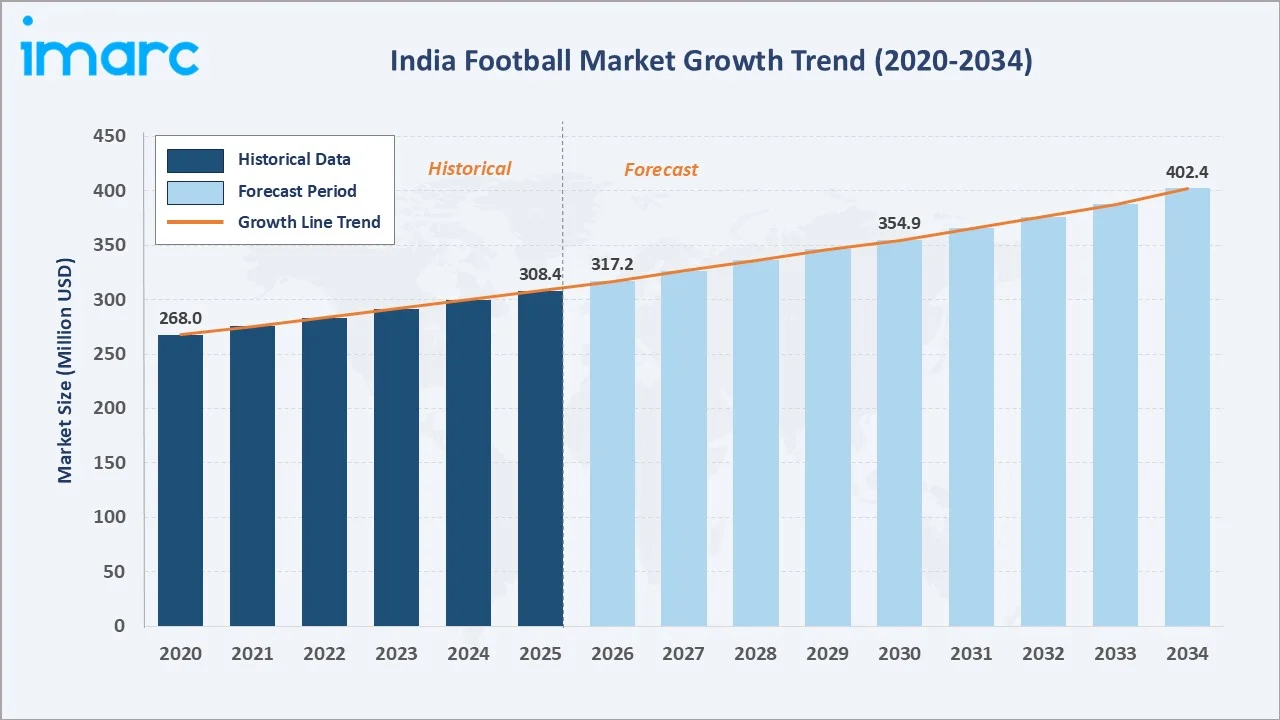
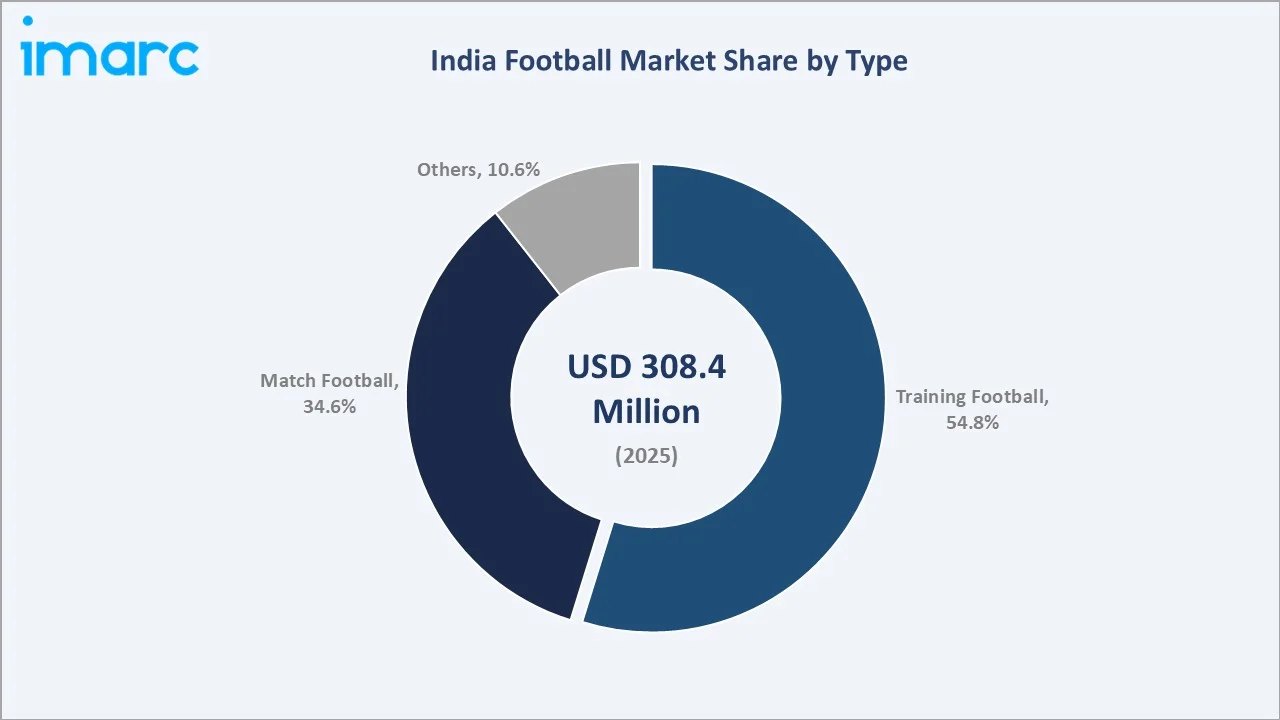
The India football market grew from USD 308.4 Million in 2025 to USD 317.2 Million in 2026 and is projected to reach USD 402.4 Million by 2034, growing at a CAGR of 2.85% during 2026-2034. The market is driven by rising ISL viewership, expanding grassroots development programs, and increasing brand sponsorships. Expanding e-commerce access, school football leagues, and youth preference for branded football equipment are further supporting market growth. Training Football dominates at 54.8%. Offline distribution leads at 69.3%. West India commands 29.8% of national market share.
Market Snapshot
|
Metric |
Value |
|
Base Year Market Size (2025) |
USD 308.4 Million |
|
Market Size (2026) |
USD 317.2 Million |
|
Forecast Market Size (2034) |
USD 402.4 Million |
|
CAGR (2026-2034) |
2.85% |
|
Base Year |
2025 |
|
Historical Period |
2020-2025 |
|
Forecast Period |
2026-2034 |
|
Dominant Type |
Training Football (54.8%, 2025) |
|
Dominant Distribution Channel |
Offline (69.3%, 2025) |
|
Leading Region |
West India (29.8%, 2025) |
The India football market size increased from USD 268.0 Million in 2020 to USD 308.4 Million in 2025 and is estimated to reach USD 317.2 Million in 2026. The market is further expected to grow to USD 354.9 Million by 2030 and USD 402.4 Million by 2034. India football market is commercially driven by the ISL's growing national viewership, the government's KHELO India program funding football at the grassroots level and rising corporate sponsorship investment in football as a youth marketing platform.
To get more information on this market, Request Sample
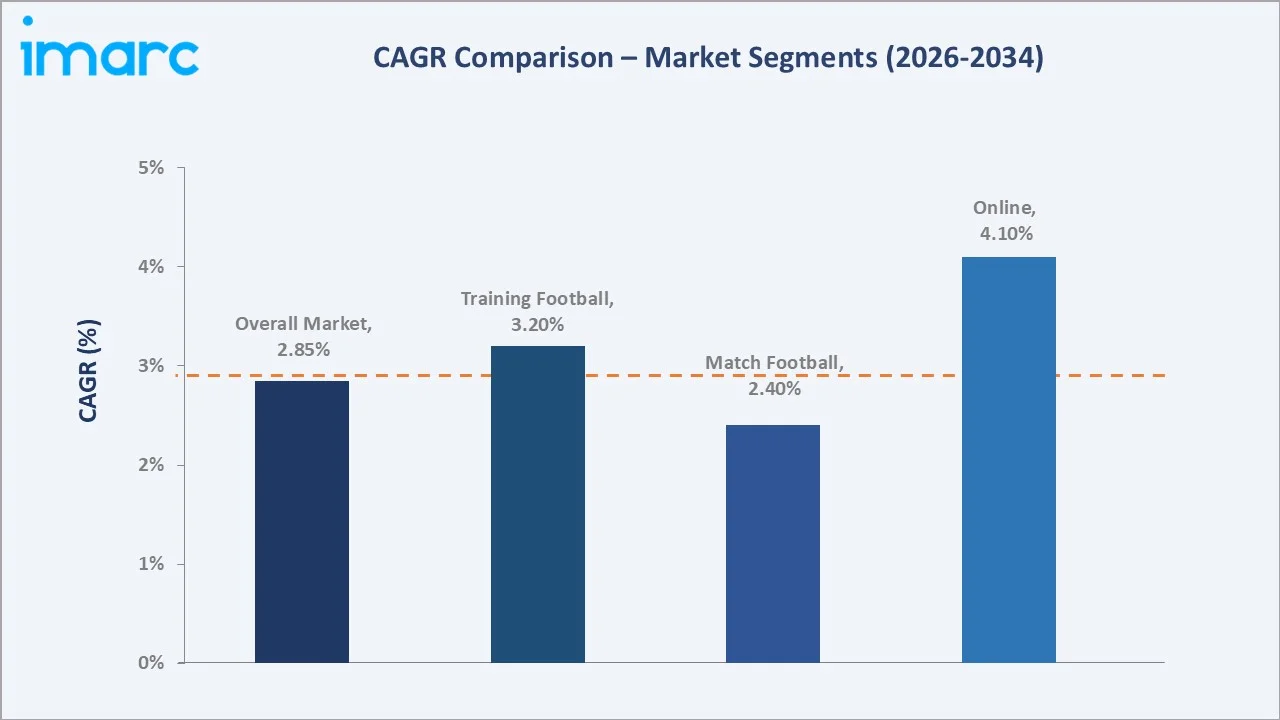
Training Football grows at approximately 3.2% CAGR through India's extensive school, college, and academy-level programs, which generate consistent demand for practice-grade footballs. Match Football grows at approximately 2.4% CAGR through ISL's rising influence and organized league expansion across states.
Executive Summary
The India football market expanded from USD 308.4 Million in 2025 to an estimated USD 317.2 Million in 2026, positioning it as one of South Asia's most commercially active sports equipment markets. The market's scale is underpinned by India's large and youthful consumer base, rising ISL viewership, and increasing corporate brand partnerships. These structural demand drivers are supporting the expansion of the match and training football segments at rates that outpace overall GDP growth.
India football market is commercially distinguished from other South Asian sports markets by its dual commercial structure, combining a large grassroots training equipment market driven by institutional demand, with an emerging premium match football segment fueled by ISL commercial expansion. The market is projected to reach USD 402.4 Million by 2034. Training Football at 54.8% leads through academy and school program demand. Offline at 69.3% reflects physical retail dominance. West India leads regionally at 29.8%.
Key Market Insights
|
Insight |
Data |
|
Dominant Type |
Training Football – 54.8% share (2025) |
|
Dominant Distribution Channel |
Offline – 69.3% market share (2025) |
|
Leading Region |
West India – 29.8% share (2025) |
|
Market Opportunity |
ISL-linked merchandising; e-commerce growth in Tier-2 cities; grassroots academy supply; school and college league equipment sponsorships |
Key Analytical Observations Supporting the Above Data:
- Training Football at 54.8%: The training segment dominates due to high-volume demand from football academies, school leagues, and grassroots programs. Its affordable price point and functional durability make it the most commercially resilient segment across urban and semi-urban markets.
- Offline Channel at 69.3%: Physical retail remains the primary purchase channel due to consumer preference for product trial before purchase, strong retailer networks in metro cities, and institutional bulk procurement by schools and sports associations.
- West India at 29.8%: West India leads due to Mumbai's strong sports retail ecosystem, Maharashtra's active football development programs, and Gujarat's growing corporate-sponsored football leagues driving equipment demand across the region.
India Football Market Overview
India football market is commercially positioned at the intersection of a growing domestic sporting culture and increasing international league influence. The ISL's expansion, AIFF's grassroots development initiatives, and European club partnerships are collectively accelerating football equipment demand across urban, semi-urban, and rural segments.
India football ecosystem integrates domestic manufacturing in hubs like Jalandhar and Meerut alongside global brand distribution networks. Macroeconomic factors such as India's rising youth demographics, increasing school sport funding, and expanding e-commerce platforms are supporting sustained market expansion through the forecast period.
Market Dynamics
To evaluate market opportunities, Request Sample
Market Drivers
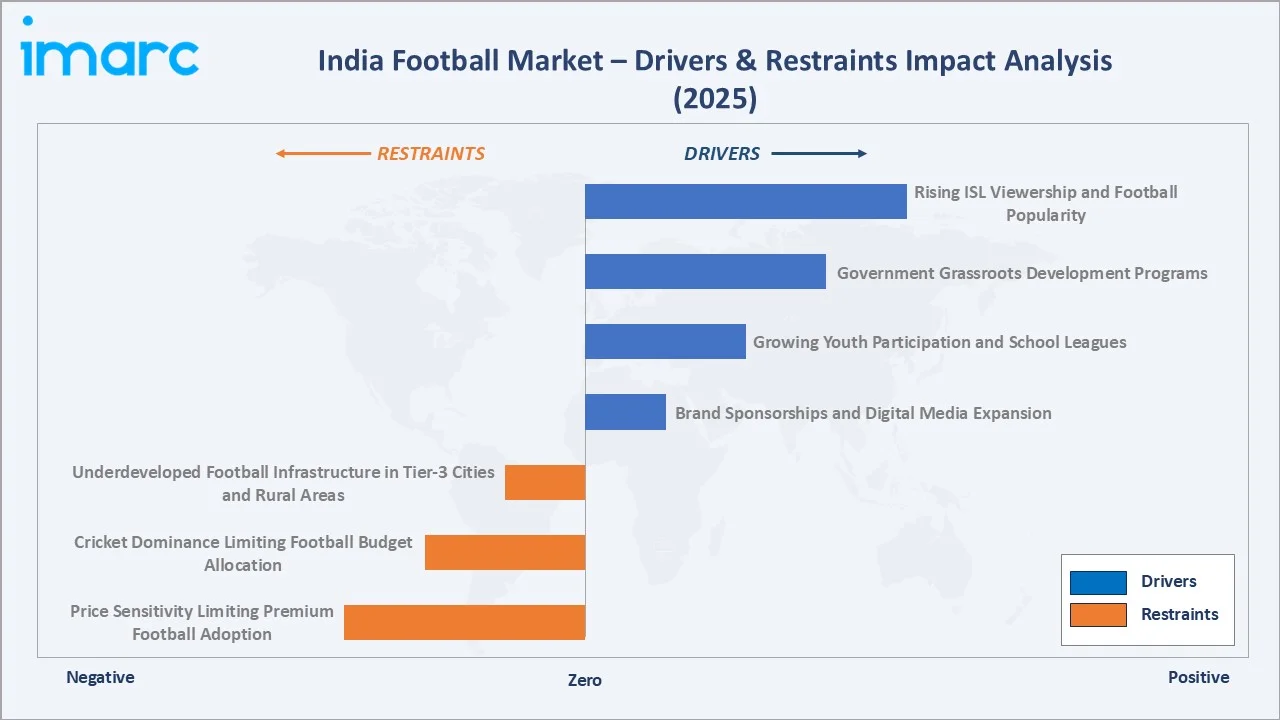
- Rising ISL Viewership and Football Popularity: The Indian Super League has significantly raised the commercial profile of football in India. Growing broadcast reach, digital streaming, and celebrity team ownership have attracted new fans and sponsors. Star Sports reported 7.1 crore viewers for the Football Premier League in the 2023-24 season, a 63% increase over the prior season, directly stimulating demand for football merchandise and equipment across all consumer segments. Rising football popularity is creating new participant cohorts who convert from viewers to active players, particularly among youth aged 12-25 in metro and Tier-2 cities. This viewership-to-participation pipeline is generating consistent and growing demand for training and match footballs across organized retail and e-commerce channels.
- Government Grassroots Development Programs: The Indian government's KHELO India program and state-level sports development initiatives are funding football infrastructure, equipment procurement, and training programs in schools and colleges. These programs drive institutional demand for training footballs, generating consistent bulk purchase volumes across government and semi-government channels. The AIFF's expanded club licensing and grassroots development framework, alongside state football association infrastructure spending, is creating structured equipment procurement pipelines. This policy-driven demand provides a stable commercial foundation for football equipment manufacturers across the affordable and mid-range training segment.
- Growing Youth Participation and School Leagues: India's young demographic profile, with over 600 million people below age 25, is generating strong demand for football participation equipment. The rapid expansion of school football leagues, district-level tournaments, and football academies is creating structured demand for training and match footballs across the affordable and mid-range segments. State school games federations are incorporating football into mandatory sports curricula, creating institutional procurement pipelines for affordable training balls. This structural youth participation demand provides a durable, policy-protected commercial foundation for the training football segment throughout the forecast period.
- Brand Sponsorships and Digital Media Expansion: Corporate sponsorship of ISL teams and players, combined with social media-driven brand campaigns, has elevated football's commercial appeal among urban youth. In September 2023, IndiGo partnered with the All-India Football Federation as official airline, reflecting growing corporate engagement with football as a premium marketing platform. Digital platforms are amplifying product awareness and driving online purchase conversions, particularly in the premium ball segment, as brands leverage OTT content, fantasy football platforms, and influencer partnerships to reach football-engaged youth demographics. This brand investment is expanding the organized market's share of total football equipment spend.
Market Restraints
- Cricket Dominance Limiting Football Budget Allocation: Cricket's overwhelming commercial dominance in India constrains the marketing and sponsorship budgets available for football. Brands with limited sports budgets consistently prioritize cricket partnerships over football, reducing the promotional investment available to football equipment manufacturers and limiting broader market awareness. This budget allocation imbalance means football equipment brands receive a structurally smaller share of sports marketing media exposure compared to cricket equipment brands. The commercial gap between cricket and football in India creates a persistent challenge for football brands attempting to build mass consumer recognition equivalent to cricket equipment counterparts.
- Underdeveloped Football Infrastructure in Tier-3 Cities and Rural Areas: The absence of quality football grounds, training facilities, and organized leagues in Tier-3 cities and rural areas suppresses potential market expansion. Without adequate infrastructure, participation rates and equipment demand remain low in these geographies, creating a structural barrier to market growth beyond the existing metro and Tier-2 city base. Rural and semi-rural markets represent India's largest unserved football equipment opportunity by population volume, but the infrastructure deficit limits near-term conversion of latent interest into organized market demand, requiring sustained public investment in sports facilities before commercial opportunity materializes at scale.
- Price Sensitivity Limiting Premium Football Adoption: A significant portion of India's football consumer base is price-sensitive, limiting adoption of match-grade FIFA-certified and premium training balls. This pricing constraint pushes demand toward low-cost unbranded products, reducing organized market revenue and compressing average selling prices. The prevalence of counterfeit and substandard balls in informal markets further undercuts premium brand pricing authority, particularly in Tier-2 and Tier-3 cities where price comparison between organized and unorganized channels is most acute. Overcoming price sensitivity requires sustained brand investment in product education and quality demonstration programs.
Market Opportunities
- E-Commerce Expansion into Tier-2 and Tier-3 Cities: Growing internet penetration and logistics infrastructure improvement are enabling football brands to reach previously underserved markets. E-commerce platforms offer price-competitive access to branded footballs, creating new revenue streams and expanding the addressable consumer base beyond traditional retail strongholds. The online channel's approximately 4.1% CAGR represents the highest growth vector in India's football distribution landscape, driven by increasing smartphone adoption among 18-30 year olds in emerging urban centers and the competitive pricing advantages digital platforms enable against traditional multi-brand sports stores.
- ISL-Linked Merchandising and Official Ball Partnerships: The Indian Super League's rising popularity creates significant commercial opportunities for official ball suppliers and licensed merchandise partners. Branded match balls associated with ISL clubs carry premium positioning and collector appeal, enabling manufacturers to capture higher-margin revenue in the organized football market. Official ISL ball supply contracts provide manufacturers with national broadcast visibility across India's 900+ million addressable digital audience, creating brand awareness and aspirational positioning that elevates entire product portfolios above the official match ball range into the broader training and recreational segments.
Market Challenges
- Counterfeit and Unbranded Product Competition: The prevalence of low-cost counterfeit and unbranded footballs in informal markets creates significant pricing pressure on organized brands. These products undercut established brands in price-sensitive segments, erode brand equity, and pose quality and safety risks, complicating brand-building efforts. Counterfeit football products are particularly prevalent in North India's wholesale sports goods markets, where lookalike products mimic premium brand aesthetics at a fraction of the price, creating consumer confusion and undermining the value proposition of genuine branded training and match balls among price-sensitive institutional buyers.
- Supply Chain Inconsistencies in Domestic Manufacturing: India's domestic football manufacturing sector, concentrated in Jalandhar and Meerut, faces challenges including raw material quality variability, skilled labor availability, and quality certification costs. These factors create inconsistency in production output, limiting domestic manufacturers' competitive position in higher-value segments. The cost and complexity of obtaining FIFA Quality Programme certification restricts many domestic manufacturers to the unbranded institutional supply market, preventing them from capturing the premium margin available in certified match ball categories and creating a persistent quality gap between domestic and international brand offerings at the organized retail level.
Emerging Market Trends
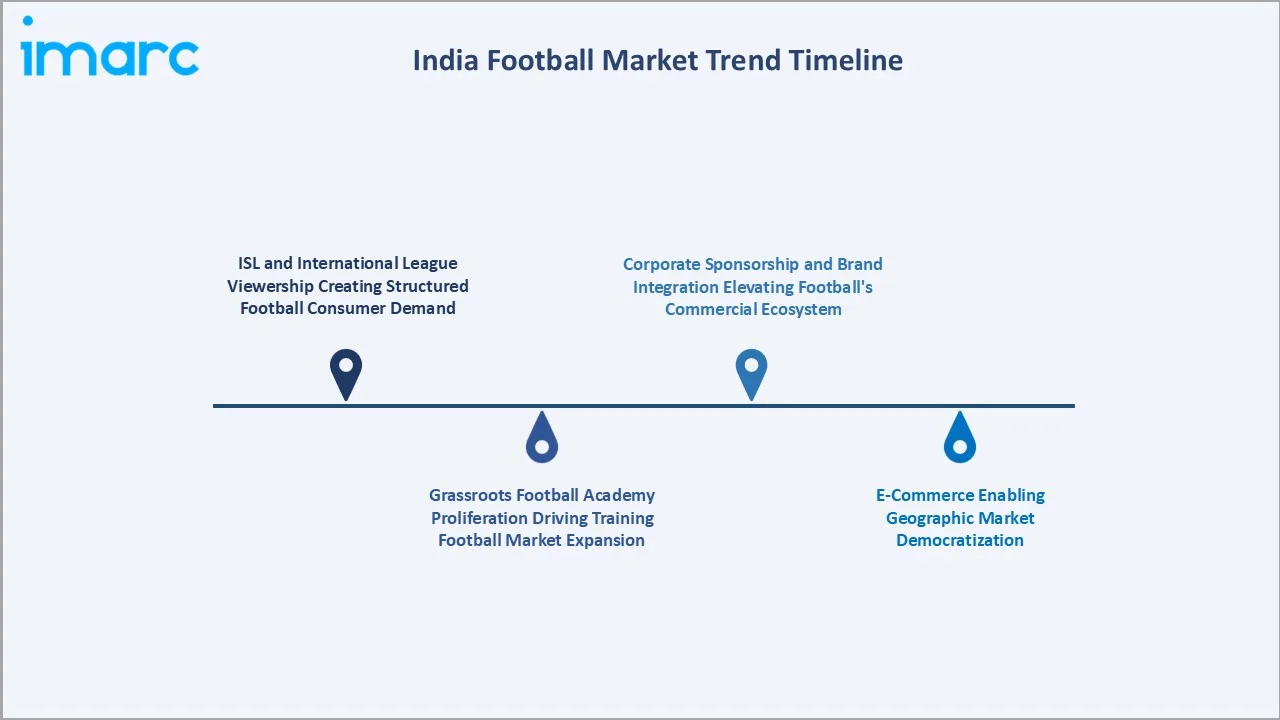
1. ISL and International League Viewership Creating Structured Football Consumer Demand
Rising viewership of the ISL and international leagues like the Premier League and UEFA Champions League is creating new cohorts of football enthusiasts who convert from viewers to active participants, generating consistent demand for football equipment across urban markets. Fan engagement events and football academies co-located in ISL-active cities are amplifying this viewership-to-participation conversion, creating a commercially self-reinforcing cycle of rising participation and rising equipment demand.
2. Grassroots Football Academy Proliferation Driving Training Football Market Expansion
The rapid proliferation of private and franchise-linked football academies across metro and Tier-2 cities is creating structured bulk-purchase demand for training footballs. In March 2025, the Brazil Legends Tour revealed its official sponsor lineup ahead of a historic exhibition match and football summit in Chennai, signaling growing commercial interest in football development events that stimulate grassroots participation. Academy proliferation is driving recurring institutional purchase cycles for training balls with 12-18 month replacement frequencies across organized academy networks.
3. E-Commerce Enabling Geographic Market Democratization
Online platforms are democratizing access to branded football equipment beyond metro city retail networks. Direct-to-consumer channels and marketplace platforms enable football brands to offer a wider product range, transparent pricing, and faster delivery to customers in Tier-2 and Tier-3 cities, expanding the organized football market's geographic footprint significantly. E-commerce is particularly transformative for the match football segment, where premium certified balls were previously accessible only through specialized metro city sports retailers, limiting brand reach in emerging football markets.
4. Corporate Sponsorship and Brand Integration Elevating Football's Commercial Ecosystem
Corporate brand integration through ISL team sponsorships, player endorsements, and official league partnerships is raising the commercial maturity of India's football market. Increasing brand investment across FMCG, fintech, and lifestyle sectors is boosting marketing budgets, driving consumer awareness, and accelerating demand for branded football equipment across urban demographic segments. This expanding corporate sponsorship ecosystem is creating a rising tide of football brand visibility that benefits equipment manufacturers through increased general consumer awareness of premium football products across all price tiers.
Industry Value Chain Analysis
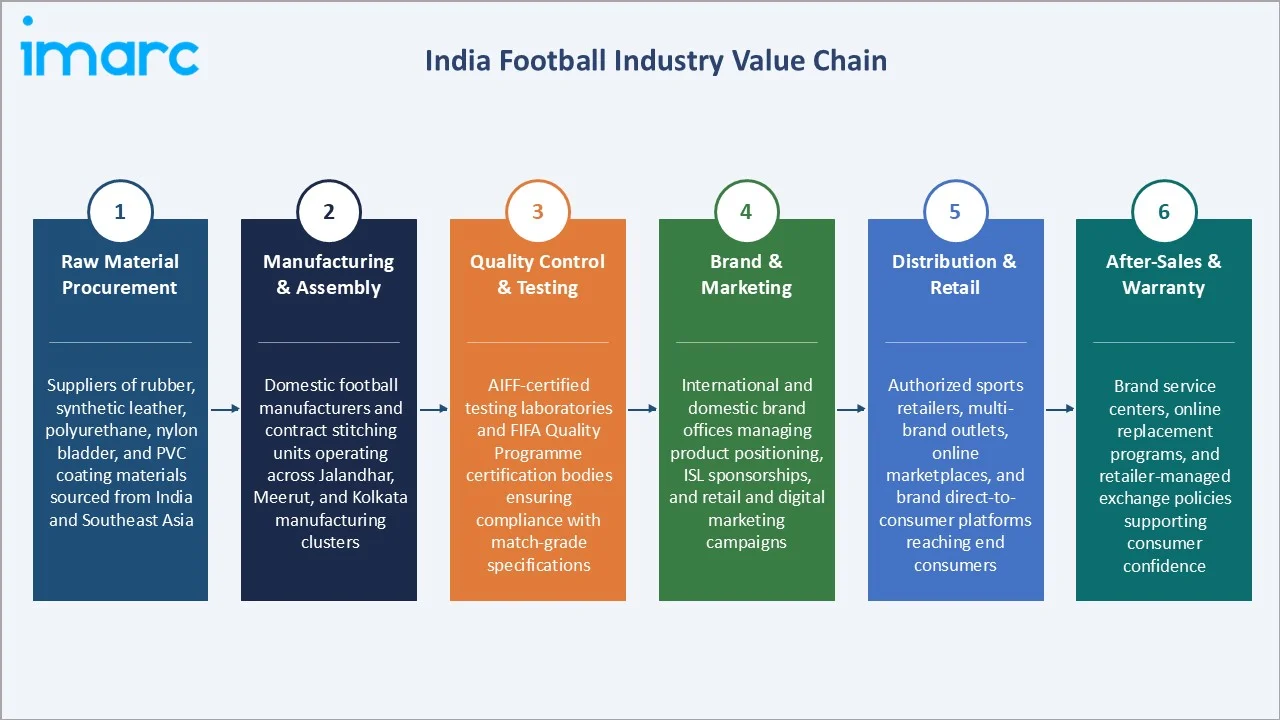
India football value chain connects raw material suppliers through domestic manufacturing clusters, quality certification bodies, brand distribution networks, and retail channels to reach India's diverse football consumer base. Jalandhar and Meerut remain India's primary football manufacturing hubs, producing the majority of domestically manufactured footballs sold across the country.
|
Stage |
Key Participants |
|
Raw Material Procurement |
Suppliers of rubber, synthetic leather, polyurethane, nylon bladder, and PVC coating materials sourced from India and Southeast Asia |
|
Manufacturing & Assembly |
Domestic football manufacturers and contract stitching units operating across Jalandhar, Meerut, and Kolkata manufacturing clusters |
|
Quality Control & Testing |
AIFF-certified testing laboratories and FIFA Quality Programme certification bodies ensuring compliance with match-grade specifications |
|
Brand & Marketing |
International and domestic brand offices managing product positioning, ISL sponsorships, and retail and digital marketing campaigns |
|
Distribution & Retail |
Authorized sports retailers, multi-brand outlets, online marketplaces, and brand direct-to-consumer platforms reaching end consumers |
|
After-Sales & Warranty |
Brand service centers, online replacement programs, and retailer-managed exchange policies supporting consumer confidence |
The quality control and certification stage is India football value chain's most commercially decisive step, where FIFA Quality Programme certification separates premium match-grade balls from the broader training and recreational ball market, enabling brands to command significant price premiums in the organized retail segment.
Technology Landscape in the India Football Industry
Synthetic Leather and Polyurethane Panel Technology
Synthetic leather panels and thermally bonded polyurethane construction are replacing traditional hand-stitched PVC covers in the premium football segment. These technologies improve ball consistency, water resistance, and aerodynamic performance, enabling manufacturers to meet FIFA Quality Pro and FIFA Quality certification standards required for match-grade applications in organized leagues. Advanced panel bonding technologies eliminate seam gaps that cause flight irregularities, directly improving ball performance for match and training applications, and providing domestic manufacturers with a technology pathway to compete in the higher-margin certified match ball segment.
Microfiber Bladder and Butyl Retention Technology
High-retention butyl and latex bladder technologies are improving air retention performance and ball consistency across the training and match segment. Microfiber bladder coatings enhance durability and consistent inflation, reducing maintenance requirements for training-use footballs deployed in academy and school settings. Improved butyl bladder formulations extend training ball service life from approximately 6 months to 12-18 months under daily academy use conditions, directly reducing per-unit equipment cost for institutional buyers and creating a compelling total-cost-of-ownership argument for premium training ball adoption in budget-conscious school and grassroots program procurement.
Smart Football and Sensor-Enabled Technology
Emerging smart football technology incorporating RFID tracking sensors, kick speed measurement, and spin analytics is creating a premium product category appealing to performance-focused academies and individual players. While still nascent in India, smart football adoption is growing among professional academies and coaching institutes driven by digital performance monitoring trends. ISL academy programs and private coaching institutes investing in data-driven performance development are the primary initial adopters of smart ball technology in India, creating a premium niche market growing at approximately 15-20% annually from a small base as sports analytics culture expands within organized Indian football.
Market Segmentation Analysis
The report covers the following segments:
|
Segment Category |
Leading Segment |
Market Share |
Year |
|
Type |
Training Football |
54.8% |
2025 |
|
Distribution Channel |
Offline |
69.3% |
2025 |
|
Size |
🔒 |
🔒 |
2025 |
|
Region |
West India |
29.8% |
2025 |

By Type
Training Football leads at 54.8% (2025). The training segment encompasses India's most commercially dominant football category, spanning grassroots academy programs, school and college leagues, and recreational use. Its price accessibility, functional durability, and high replacement frequency make it the foundation of India's organized football market volume.
To access detailed market analysis, Request Sample
Match Football at 34.6% serves the organized league, institutional, and enthusiast segments. Match-grade balls command higher average selling prices and carry FIFA quality certifications, supporting above-average margin contribution despite lower unit volumes. Others at 10.6% includes recreational, promotional, and novelty footballs serving casual consumer and gifting markets.
By Distribution Channel
Offline channel leads at 69.3% (2025). Physical retail dominates through established sports retailer networks, brand flagship stores, and institutional procurement by schools and sports associations. Consumer preference for product evaluation before purchase, combined with strong retailer influence in Tier-2 cities, sustains offline channel leadership across all football product categories.
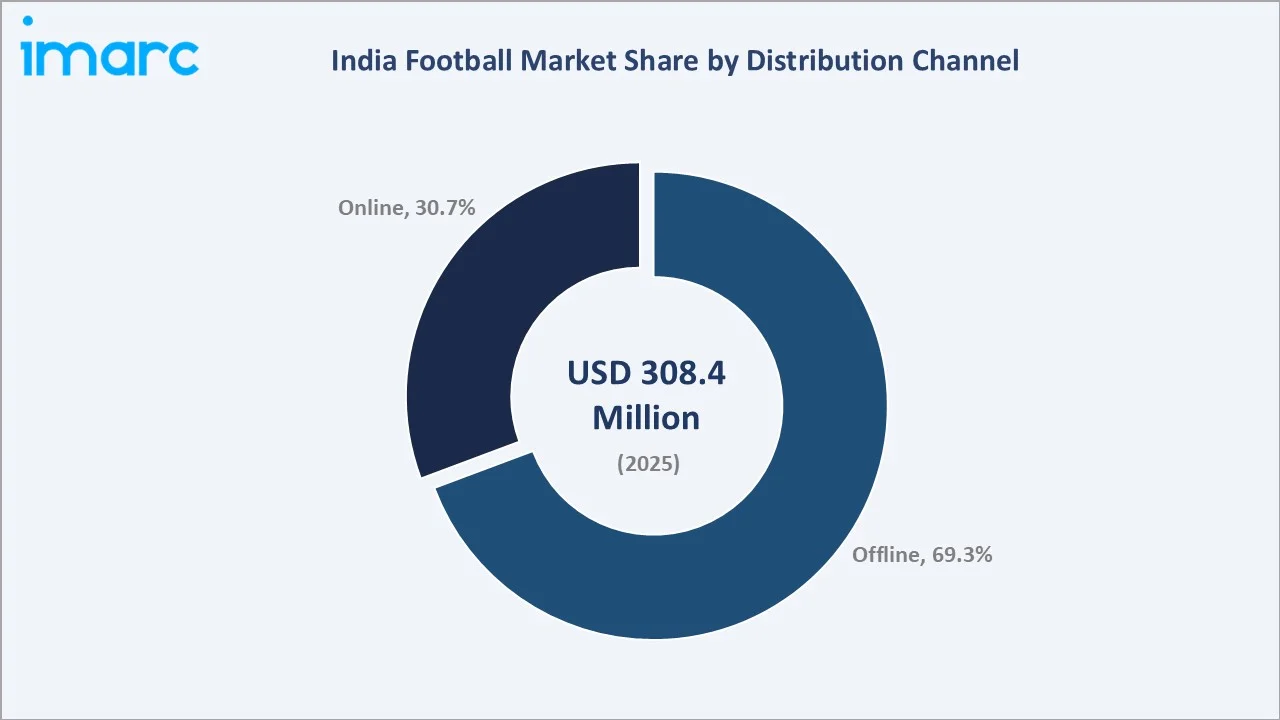
Online at 30.7% is growing at approximately 4.1% CAGR, driven by e-commerce platform expansion, increasing smartphone penetration, and competitive pricing advantages on digital platforms. Online channel growth is accelerating particularly in Tier-2 and Tier-3 cities where branded physical retail presence is limited.
Regional Market Insights
|
Region |
Share (2025) |
Key India Football Market Drivers & Characteristics |
|
West India |
29.8% |
Driven by Mumbai's sports retail ecosystem, Maharashtra's ISL team presence (Mumbai City FC), and Gujarat's growing corporate-sponsored football leagues creating structured regional demand. |
|
North India |
27.2% |
Supported by Delhi-NCR's strong sports culture, Punjab's longstanding football tradition, and expanding school football leagues across Uttar Pradesh, Haryana, and Himachal Pradesh. |
|
South India |
24.4% |
Reflects Kerala's deep-rooted football culture, Bengaluru FC's ISL presence, and growing football academy penetration in Hyderabad and Chennai driving organized equipment demand. |
|
East India |
18.6% |
Rising football tradition anchored by West Bengal's Kolkata derby heritage and expanding club infrastructure across Odisha, Jharkhand, and the Northeast states. |
West India's 29.8% market leadership reflects Mumbai's commercial sports infrastructure density, Maharashtra's AIFF-affiliated club network, and Gujarat's rapidly growing urban youth sporting culture supported by corporate-funded football development programs. North India's 27.2% captures Punjab's longstanding football heritage and Delhi-NCR's expanding football academy ecosystem across the National Capital Region.
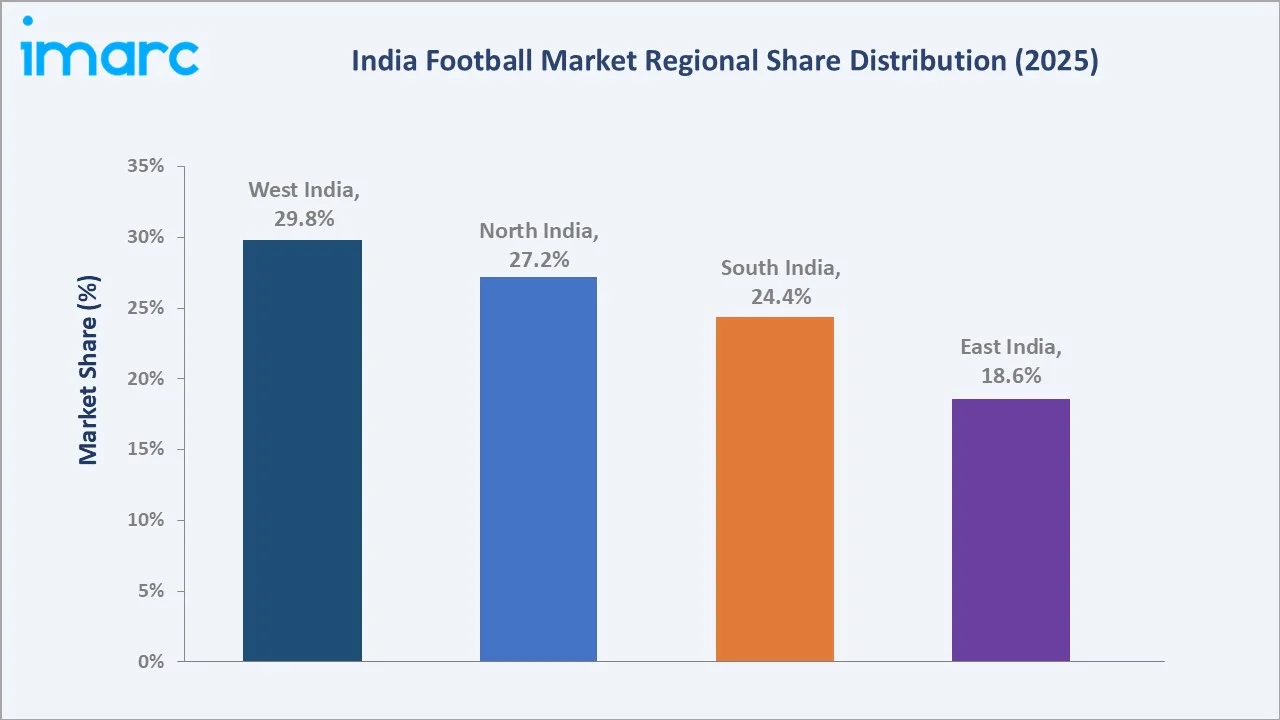
South India's 24.4% reflects Kerala's singular football intensity, historically the state with India's deepest grassroots football culture, combined with Bengaluru's ISL-driven commercial football expansion. East India's 18.6% is anchored by Kolkata's football tradition but remains commercially underdeveloped relative to its participation base, presenting the highest growth potential for organized market expansion through 2034.
Competitive Landscape
India football market competitive landscape is structured around a tension between global brand dominance in the premium and match-grade segment and domestic manufacturer strength in the affordable training and institutional supply segment. Competition is intensifying through ISL official ball partnerships, e-commerce price competition, and growing brand marketing investments.
|
Company |
Key Brands |
Market Position |
Core Strength |
|
adidas AG |
Tiro League Thermally Bonded Ball, Tiro League Football, World Cup League Ball, Messi Club Ball, Fifa World Cup 26 Trionda Usa League Ball, Messi League Ball |
Market Leader |
Leading global football brand with deep grassroots penetration in Indian academies and ISL-level match ball supply. |
|
NIKE, Inc. |
Nike Pitch |
Strong Challenger |
Strong digital-first strategy and celebrity endorsements driving youth adoption across training and match segments. |
|
PUMA SE |
PUMA Orbita Premier League Lights Mini Football, Neymar Jr Graphic Mini Football, CUP Graphic Football, ATTACANTO Football, MFA Future Football |
Strong Challenger |
Official kit and ball supplier for ISL teams, boosting brand visibility in India's top domestic football league. |
|
Cosco (India) Limited |
Cosco Football, Cosco Club |
Domestic Leader |
Affordable-segment leader with strong pan-India distribution and government institutional procurement contracts. |
|
Iconix International |
Neo Eco, Neo Swerve TB Pro, Neo X Elite |
Emerging Player |
Iconix International, operating through Umbro, is a heritage football brand with a growing online presence targeting urban youth through fashion-performance crossover positioning. |
Key players include adidas AG, NIKE, Inc., PUMA SE, Cosco (India) Limited, Iconix International, and others.
Key Company Profiles
adidas AG
adidas AG is the world's leading football equipment manufacturer and a dominant brand in India's organized football market, serving both professional and grassroots consumer segments through a comprehensive product portfolio spanning training, match, and recreational footballs.
- Key Brands: Tiro League Thermally Bonded Ball, Tiro League Football, World Cup League Ball, Messi Club Ball, Fifa World Cup 26 Trionda Usa League Ball, Messi League Ball
- Strategic Focus: Maintaining premium match-ball leadership through ISL supply partnerships while expanding training ball accessibility through e-commerce and multi-brand retailer partnerships in Tier-2 cities. Adidas is investing in digital retail capabilities and direct-to-consumer channels to capture the growing online football equipment market among India's urban youth demographic, using ISL brand association to support training segment cross-selling across its broader football product portfolio.
PUMA SE
PUMA SE is a major global sports brand with a growing football equipment presence in India, strengthened by its official kit and ball supply partnerships with ISL clubs. PUMA's India football strategy centers on youth consumer acquisition through ISL brand visibility and digital-first marketing campaigns.
- Key Brands: PUMA Orbita Premier League Lights Mini Football, Neymar Jr Graphic Mini Football, CUP Graphic Football, ATTACANTO Football, MFA Future Football
- Strategic Focus: Using ISL club association to drive premium football brand building while expanding e-commerce distribution to capture the growing online football equipment consumer base. PUMA is targeting India's urban youth demographic aged 15-28 through integrated social media campaigns linking ISL match content with product launches, creating a content-to-commerce pathway that converts football viewership engagement into training and match ball purchase intent across PUMA's India digital retail channels.
Market Concentration Analysis
The India football market is moderately concentrated in the organized branded segment, with key players commanding most of the premium match-grade ball market share. The training football segment is more fragmented, with some domestic players competing alongside international brands for institutional supply contracts.
Market concentration is evolving through two opposing forces: global brands' ISL partnership investments incrementally strengthening their premium market positions. At the same time, domestic manufacturers maintain volume dominance in the institutional training ball segment through cost leadership and established government procurement relationships across state sports bodies and school education departments.
Investment & Growth Opportunities
Highest Growth Segments
Online distribution channel (~4.1% CAGR through digital platform expansion), match football segment (~3.5% CAGR through ISL popularization), grassroots academy supply contracts (~6-8% CAGR from small base), and West India regional expansion (~3.2% CAGR through corporate-funded football league growth) represent India's highest-growth football investment vectors through 2034.
Emerging Investment Opportunities
India's smart football technology market, growing at 15-20% annually from a nascent base, represents the highest-CAGR niche within the broader football equipment market. The adoption of sensor-enabled performance analytics balls in professional academies and coaching institutes presents premium positioning opportunities for technology-integrated product launches targeting India's growing data-driven coaching community.
Investment Themes
- ISL Official Ball Partnership for Premium Brand Positioning: Official match ball supply partnerships with ISL clubs and the AIFF represent the most commercially valuable brand-building investment in India's football equipment market, providing national broadcast visibility and association with India's highest-profile football platform.
- Grassroots Academy Supply Contracts for Volume-Led Market Entry: Football academy proliferation across metro and Tier-2 cities is creating large-volume institutional procurement opportunities for training ball suppliers. Long-term supply contracts with ISL-affiliated academies and AIFF development centers represent scalable revenue entry points for domestic and international manufacturers.
Future Market Outlook (2026-2034)
The India football market is projected to grow from USD 308.4 Million in 2025 to USD 317.2 Million in 2026, reaching USD 402.4 Million by 2034, registering a CAGR of 2.85% during 2026–2034. The market's anchor value of USD 354.9 Million in 2030 represents India football industry at a structural expansion inflection point, where ISL commercial maturation, e-commerce geographic democratization, and youth demographic dividend converge to sustain accelerating market growth.
Three structural forces define India football market growth through 2034: India's rising youth demographic creating the world's largest potential new football participant base; ISL's commercial maturation driving brand investment and consumer engagement at scale; and digital commerce enabling geographic market democratization beyond traditional metro strongholds to Tier-2 and Tier-3 cities across all regions.
Research Methodology
Primary Research
Primary research comprised structured interviews with India football industry stakeholders, including Brand Managers, National Sports Retailers, AIFF-affiliated club administrators, football academy coaches, ISL franchise commercial directors, and consumer survey data from football equipment buyers across West India, North India, South India, and East India.
Secondary Research
Secondary research encompassed India sports goods import-export data, AIFF annual reports, ISL commercial partnership data, company annual reports, India sports retail market analysis, e-commerce platform data, investor presentations, and India football development reports. Over 45 secondary sources were reviewed.
Forecasting Models
Market revenue forecasts were developed using a participation-based model: India's football-playing population by skill level and segment multiplied by equipment purchase frequency and average ticket size per segment, creating total market revenue by segment aggregation. ISL viewership multiplier applied across match football and branded training football segments.
India Football Market Report Coverage:
| Report Features | Details |
|---|---|
| Base Year of the Analysis | 2025 |
| Historical Period | 2020-2025 |
| Forecast Period | 2026-2034 |
| Units | Million USD |
| Scope of the Report |
Exploration of Historical Trends and Market Outlook, Industry Catalysts and Challenges, Segment-Wise Historical and Future Market Assessment:
|
| Types Covered | Training Football, Match Football, Others |
| Sizes Covered | Size 1, Size 2, Size 3, Size 4, Size 5 |
| Distribution Channels Covered | Online, Offline |
| Regions Covered | North India, South India, East India, West India |
| Companies Covered | adidas AG, NIKE, Inc., PUMA SE, Cosco (India) Limited, Iconix International, etc |
| Customization Scope | 10% Free Customization |
| Post-Sale Analyst Support | 10-12 Weeks |
| Delivery Format | PDF and Excel through Email (We can also provide the editable version of the report in PPT/Word format on special request) |
Key Benefits for Stakeholders:
- IMARC’s industry report offers a comprehensive quantitative analysis of various market segments, historical and current market trends, market forecasts, and dynamics of the India football market from 2020-2034.
- The research report provides the latest information on the market drivers, challenges, and opportunities in the India football market.
- Porter's five forces analysis assist stakeholders in assessing the impact of new entrants, competitive rivalry, supplier power, buyer power, and the threat of substitution. It helps stakeholders to analyze the level of competition within the India football industry and its attractiveness.
- Competitive landscape allows stakeholders to understand their competitive environment and provides an insight into the current positions of key players in the market.
Frequently Asked Questions About the India Football Market Report
India football market size is estimated at USD 317.2 Million in 2026, driven by rising ISL viewership, government grassroots development programs, growing youth participation, and increasing brand sponsorship activity. Growing e-commerce adoption, school football league expansion, and corporate brand investment further support market expansion across urban and semi-urban regions.
India football market grows at 2.85% CAGR during 2026-2034, reaching USD 402.4 Million by 2034. Growth is sustained by ISL expansion, youth demographic dividend, e-commerce distribution democratization, and rising corporate sponsorship investment in football as a premium marketing platform across India.
Training Football leads at 54.8% through India's extensive school, college, and academy football programs generating consistent bulk-purchase demand for functional, durable, and price-accessible training balls across urban and semi-urban markets.
Offline channel leads at 69.3% through strong physical retail networks, institutional procurement by schools and sports associations, and consumer preference for product evaluation before purchase in established sports retail stores across metro and Tier-2 cities.
West India leads at 29.8% through Mumbai's commercial sports infrastructure, Maharashtra's ISL team presence, and growing corporate-sponsored football leagues in Gujarat creating structured regional demand for branded training and match footballs.
Leading companies include adidas AG, NIKE, Inc., PUMA SE, Cosco (India) Limited, Iconix International, and others.
India football market is projected to reach approximately USD 354.9 Million by 2030, with the online channel growing as digital platforms become primary distribution channels for branded football equipment in Tier-2 and Tier-3 cities, and ISL expansion driving match-grade ball demand across organized retail.
Three priority investment opportunities: ISL official ball partnership investment for premium brand positioning, grassroots football academy supply contracts for volume-led market entry, and smart football technology launch targeting performance-focused academy and coaching segments across India's growing organized football ecosystem.
Need more help?
- Speak to our experienced analysts for insights on the current market scenarios.
- Include additional segments and countries to customize the report as per your requirement.
- Gain an unparalleled competitive advantage in your domain by understanding how to utilize the report and positively impacting your operations and revenue.
- For further assistance, please connect with our analysts.
 Request Customization
 Speak to an Analyst
 Request Brochure
 Inquire Before Buying
Benefits of Customization
- Personalize this research
- Triangulate with your data
- Get data as per your format and definition
- Gain a deeper dive into a specific application, geography, customer, or competitor
- Any level of personalization
Get in Touch With Us
UNITED STATES
Phone: +1-201-971-6302
INDIA
Phone: +91-120-433-0800
UNITED KINGDOM
Phone: +44-753-714-6104
Email: [email protected]
Client Testimonials




.webp)




.webp)













Related Reports

Choose your plan
*Please note that the prices mentioned below are starting prices for each bundle type. Kindly contact our team for further details.*
Single User License
- 1 User License, Access on 2 Devices
- PDF Report + Excel Dataset (Password Protected)
- Lifetime Access
- No Printing Rights
- 10% Free Report Customization
- 10–12 Weeks of Analyst Support
Five User License
- Access for 5 Users, 2 Devices per User
- PDF Report + Excel Dataset (Password Protected)
- Lifetime Access
- Dedicated Account Manager
- 12–14 Weeks of Analyst Support
- No Printing Rights
- 15% Free Report Customization
- 25% Discount on Your Next Purchase
Corporate User License
- Unlimited User Access (Within Your Organization)
- PDF Report + Excel Dataset
- Lifetime Access
- Dedicated Account Manager
- 14–20 Weeks of Analyst Support
- No Printing Rights
- 20% Free Report Customization
- 30% Discount on Your Next Purchase
Essential Insights
What's included:
3 reports
- Lifetime Access
- PDF Reports
- Excel Datasets
- 2 Weeks of Free Analyst Support
- 2 User Licenses
- Access on 2 Devices
- Printing Rights
- Complimentary PowerPoint (PPT) Version
- Complimentary License Upgrade
Professional Access
What's included:
5 reports
- Lifetime Access
- PDF Reports
- Excel Datasets
- 8 Weeks of Free Analyst Support
- 2 User Licenses
- Access on 2 Devices
- Printing Rights
- Complimentary PowerPoint (PPT) Version
- Complimentary License Upgrade
Business Advantage
What's included:
8 reports
- Lifetime Access
- PDF Reports
- Excel Datasets
- 14 Weeks of Free Analyst Support
- 2 User Licenses
- Access on 2 Devices
- Printing Rights
- Complimentary PowerPoint (PPT) Version
- Complimentary License Upgrade
Enterprise Intelligence
What's included:
10 reports
- Lifetime Access
- PDF Reports
- Excel Datasets
- 20 Weeks of Free Analyst Support
- 2 User Licenses
- Access on 2 Devices
- Printing Rights
- Complimentary PowerPoint (PPT) Version
- Complimentary License Upgrade