
India Heat Exchanger Market Size, Share, Trends and Forecast by Type, Material, End Use Industry, and Region, 2026-2034
India Heat Exchanger Market Size, Share, Trends & Forecast (2026-2034)
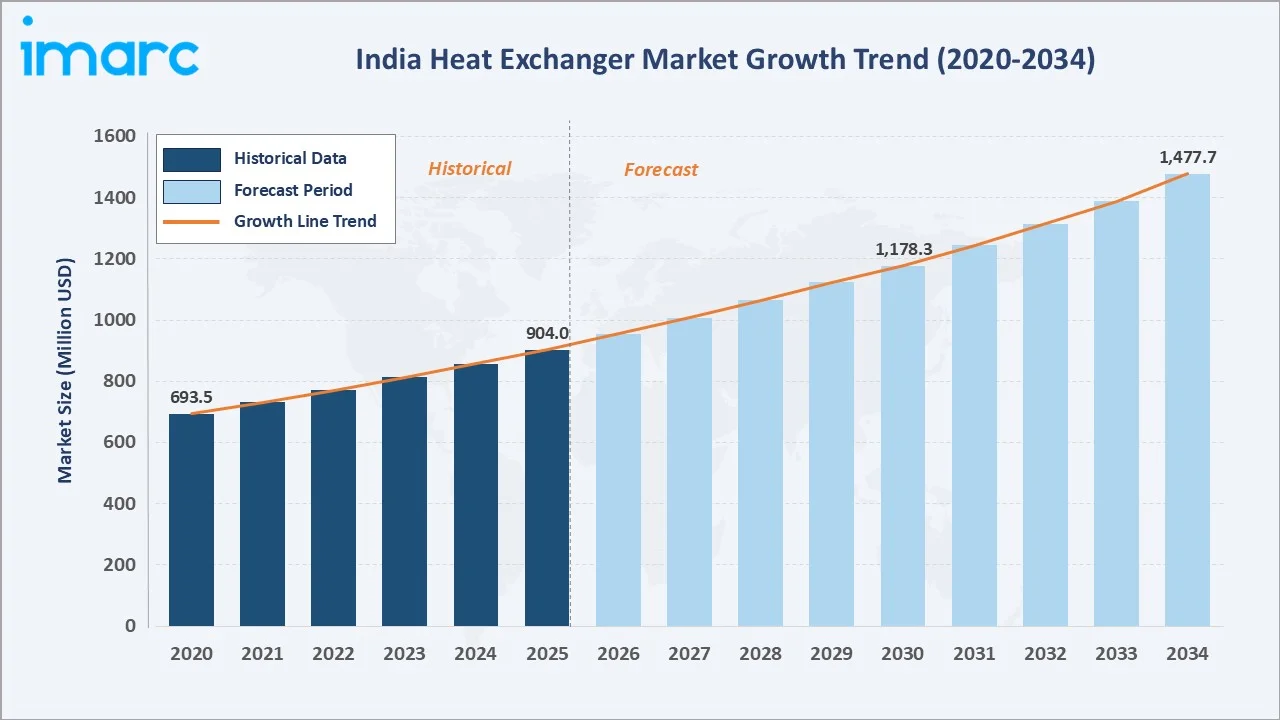
The India heat exchanger market size reached USD 904.0 Million in 2025 and is projected to reach USD 1,477.7 Million by 2034, exhibiting a CAGR of 5.44% during 2026-2034. Rapid power sector expansion, growing petrochemical and refinery capacity, energy efficiency mandates, and rising HVAC adoption across commercial and industrial sectors are the primary forces driving India heat exchanger market growth.
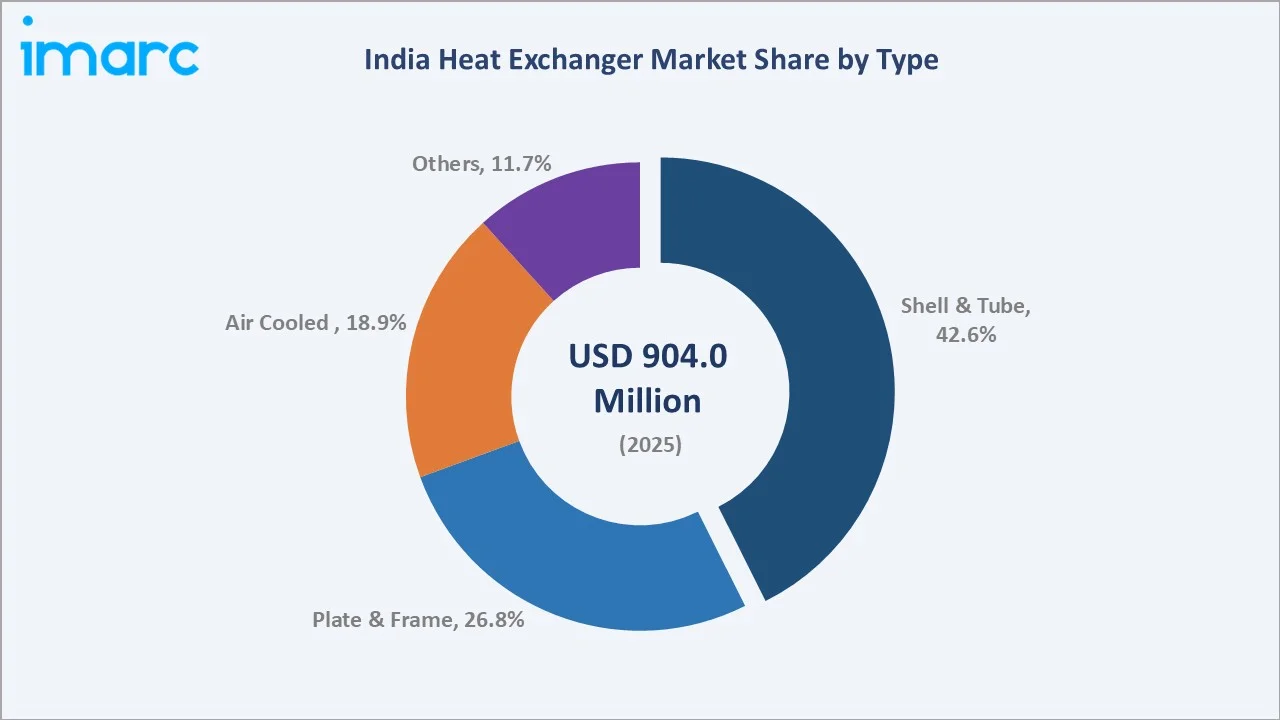
Shell & Tube type dominates at 42.6% in 2025, while Stainless Steel leads the material segment at 38.7%. South India commands the largest regional share at 34.8% in 2025, reflecting the concentration of refinery and petrochemical clusters along the southern coastline.
Market Snapshot
|
Metric |
Value |
|
Market Size (2025) |
USD 904.0 Million |
|
Forecast Market Size (2034) |
USD 1,477.7 Million |
|
CAGR (2026-2034) |
5.44% |
|
Base Year |
2025 |
|
Historical Period |
2020-2025 |
|
Forecast Period |
2026-2034 |
|
Largest Region |
South India (34.8% share, 2025) |
|
Second Largest Region |
West and Central India (27.9% share, 2025) |
|
Leading Type |
Shell & Tube (42.6%, 2025) |
|
Leading Material |
Stainless Steel (38.7%, 2025) |
The India heat exchanger market growth trajectory from 2020 through 2034, with the historical expansion to USD 904.0 Million in 2025, reflects consistent energy and industrial-driven demand, while the forecast to USD 1,477.7 Million captures accelerating refinery modernization, power sector investments, and growing HVAC adoption across commercial and residential segments.
To get more information on this market, Request Sample
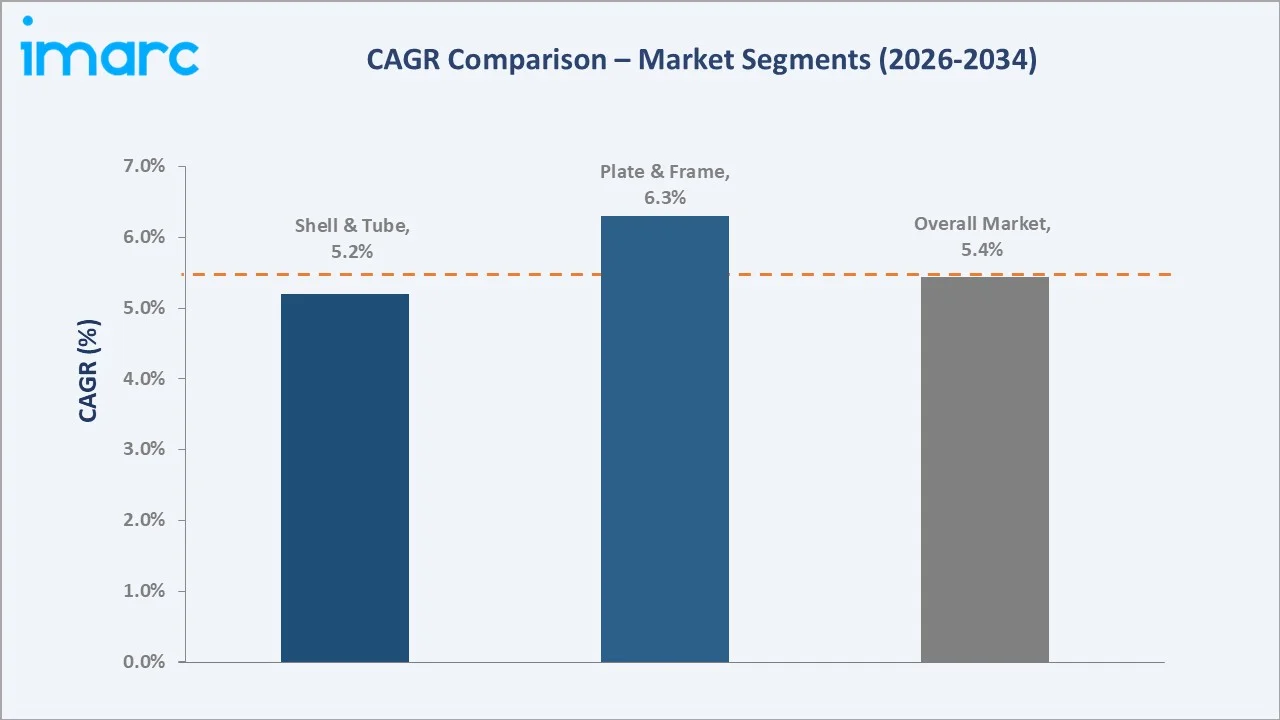
The CAGR trajectories across key type, material, and regional sub-segments, with Plate & Frame at ~6.3% CAGR and Stainless Steel at ~6.5% CAGR, are the fastest-growing categories within the India heat exchanger industry through 2034, reflecting rising demand from HVAC, pharmaceutical, and specialty chemical applications.
Executive Summary
The India heat exchanger market is on a sustained growth trajectory from USD 904.0 Million in 2025 to USD 1,477.7 Million by 2034. Heat exchangers, essential thermal management devices deployed across power generation, oil and gas, chemicals, HVAC, and food processing, benefit from non-discretionary industrial demand tied to India's infrastructure expansion.
Shell & Tube heat exchangers dominate type mix at 42.6% in 2025, owing to their structural flexibility and suitability for high-pressure, high-temperature industrial applications. Plate & Frame exchangers (26.8%) are gaining rapid traction in food processing, pharmaceutical, and HVAC applications due to compact design and ease of maintenance.
Stainless steel leads the material segment at 38.7% in 2025, driven by its corrosion resistance in chemical and pharmaceutical applications. Carbon Steel (31.5%) serves the cost-sensitive power and general industrial segments. Nickel-based alloys (17.2%) address extreme corrosion and high-temperature applications in fertilizer and petrochemical sectors.
South India dominates at 34.8% in 2025, anchored by refinery and petrochemical clusters in Tamil Nadu, Andhra Pradesh, and Karnataka. West and Central India (27.9%) benefits from the chemical-petrochemical industrial corridor and growing commercial HVAC demand in metropolitan centers.
Key Market Insights
|
Insight |
Data |
|
Largest Type |
Shell & Tube – 42.6% share (2025) |
|
Leading Material |
Stainless Steel – 38.7% share (2025) |
|
Leading Region |
South India – 34.8% share (2025) |
|
Second Largest Region |
West & Central India – 27.9% share (2025) |
|
Top Companies |
Alfa Laval, Thermax Limited, Kelvion Holding GmbH, HRS Process Systems Ltd., India |
Key Analytical Observations Expanding on the Above Data:
- Shell & Tube heat exchangers, with 42.6% in 2025, dominate because they are the most versatile, pressure-tolerant, and specification-flexible design, meeting TEMA, ASME Section VIII, and IS 4503 code requirements across most Indian power plant, refinery, and chemical facility applications.
- Stainless Steel, with 38.7% in 2025, leads material share because India's diverse industrial landscape encompassing chemical, pharmaceutical, food processing, and offshore sectors mandates corrosion-resistant materials that stainless delivers at commercially viable cost points, especially with growing domestic stainless-steel production supporting competitive local sourcing.
- South India's 34.8% dominance in 2025 reflects the concentration of India's major petroleum refining capacity along the southern coastline, where facilities require extensive heat exchanger networks for crude distillation, hydrocracking, and product cooling operations.
- West and Central India, with 27.9% in 2025, benefits from the largest concentration of petrochemical and specialty chemical manufacturing in India, generating continuous heat exchanger procurement from refineries, chemical complexes, and fertilizer plants across the industrial corridor.
India Heat Exchanger Market Overview
A heat exchanger is a device designed to transfer thermal energy between two or more fluid streams at different temperatures without allowing them to mix. Product configurations include shell and tube, plate and frame, air-cooled, spiral, double pipe, and printed circuit designs, each optimized for specific pressure, temperature, fouling, and maintenance profiles. Materials span carbon steel, stainless steel, duplex stainless, titanium, nickel alloys, and copper alloys.
The India ecosystem integrates primary steel and alloy producers, tube and plate component manufacturers, heat exchanger fabrication companies, surface treatment providers, EPC contractors, and diverse end-use industries spanning power generation, oil and gas, petrochemicals, fertilizers, pharmaceuticals, food processing, HVAC, and commercial real estate. India has emerged as a significant manufacturing base, with domestic producers serving both Indian industrial demand and export markets in Southeast Asia and the Middle East.
Market Dynamics
To evaluate market opportunities, Request Sample
Market Drivers
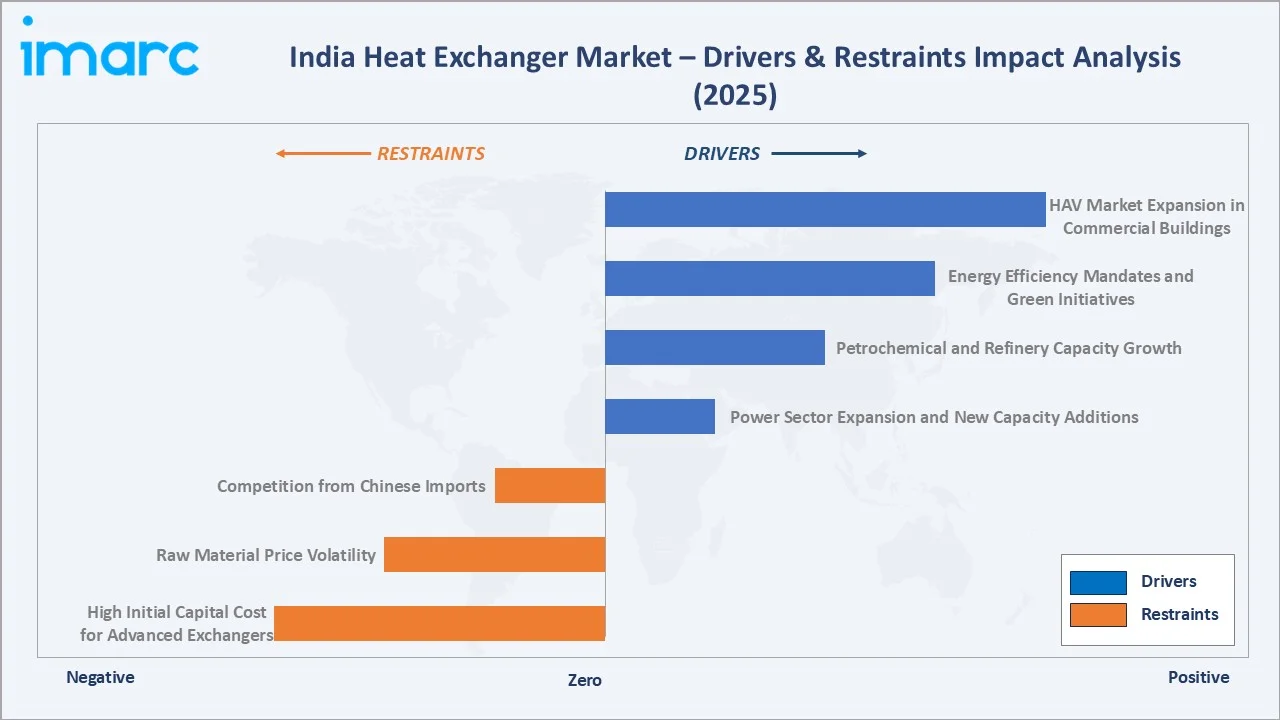
- Power Sector Expansion and New Capacity Additions: India's National Electricity Plan envisages 874 GW of total installed capacity by 2031-32, requiring continuous addition of thermal and renewable power capacity. Each new unit incorporates heat exchangers in cooling water systems, condenser networks, feed water heaters, and air preheaters, generating sustained procurement demand.
- Petrochemical and Refinery Capacity Growth: India's crude oil refining capacity reached 258.1 million tonnes per annum (MTPA) in FY25, with planned expansions across major refinery projects. Each expansion generates extensive heat exchanger procurement for crude preheat trains, distillation units, hydrocracker feed/effluent exchangers, and product cooling networks.
- Energy Efficiency Mandates and Green Initiatives: India's Bureau of Energy Efficiency and Perform Achieve Trade scheme mandate efficiency improvements across designated consumers in steel, cement, chemicals, and refineries, driving replacement of legacy exchangers with high-efficiency compact designs and heat recovery systems that reduce industrial energy consumption.
Market Restraints
- High Initial Capital Cost for Advanced Exchangers: Compact plate heat exchangers, printed circuit exchangers, and specialty alloy units command significantly higher unit prices than standard carbon steel shell and tube designs, creating procurement hurdles for cost-sensitive customers in a price-competitive market where total cost of ownership considerations are often secondary.
- Raw Material Price Volatility: International stainless steel and nickel prices exhibit significant volatility linked to global commodity markets. Price fluctuations in key input materials create significant margin pressure on nickel-alloy and stainless-steel heat exchanger manufacturers, complicating project cost estimation and contract pricing.
Market Opportunities
- Fertilizer Sector Modernization: India's urea and complex fertilizer production expansion under the National Chemical Policy requires high-alloy heat exchangers for ammonia synthesis loops, CO2 removal, and steam reforming units, generating large-block procurement opportunities for domestic manufacturers with relevant process industry certification.
- HVAC Market Expansion in Commercial Real Estate: India's commercial real estate sector, driven by IT/ITeS office expansion, retail development, and hospitality construction, is generating sustained demand for plate heat exchangers in centralized chilled water systems, district cooling, and heat recovery ventilation in green-certified buildings.
Market Challenges
- Competition from Imports: Foreign heat exchanger manufacturers offer standard shell and tube and gasketed plate designs at competitive pricing, creating pressure in cost-sensitive segments. India's customs duty structure provides partial protection, but competitive pressures persist particularly in commodity specification procurement across industrial maintenance and replacement markets.
- Skilled Engineering and Fabrication Workforce: The specialized welding and fabrication skills required for high-pressure, high-alloy heat exchanger production including ASME-certified welders, tube-to-tubesheet welding specialists, and non-destructive testing technicians are in chronic short supply across India's manufacturing centers, limiting capacity expansion.
Emerging Market Trends
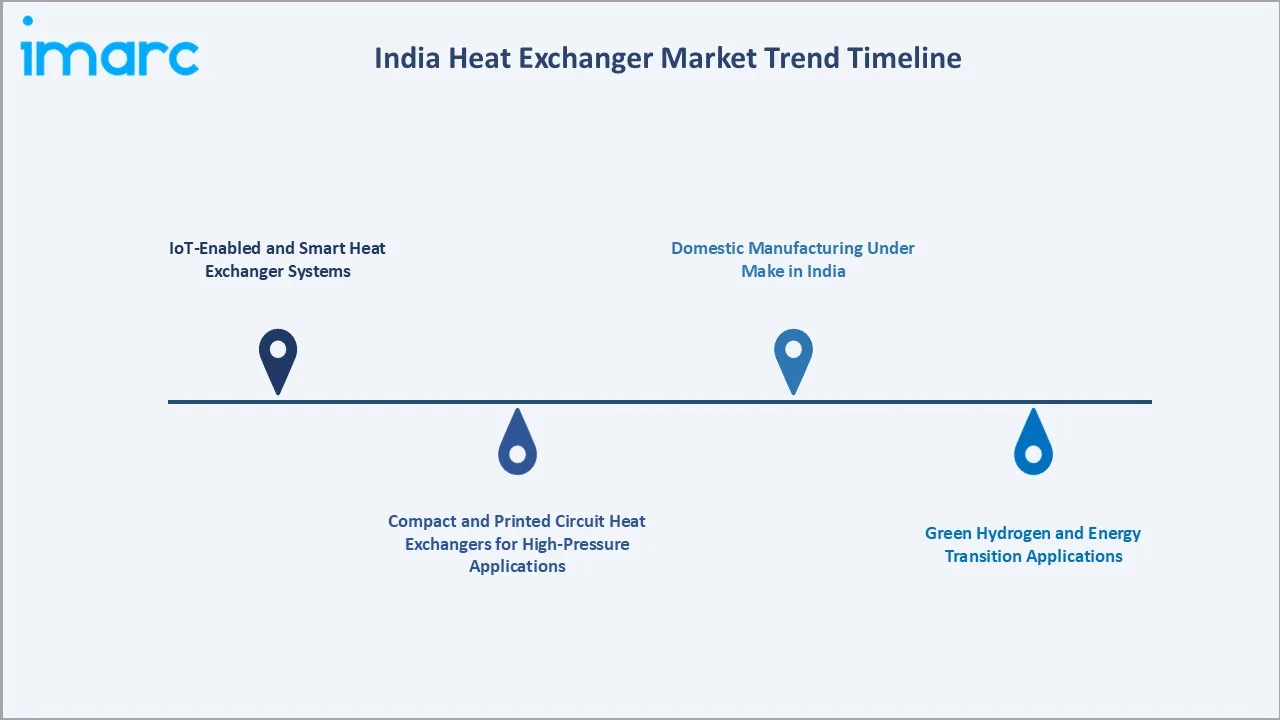
1. IoT-Enabled and Smart Heat Exchanger Systems
Integration of IoT sensors, real-time fouling monitoring, and predictive maintenance algorithms is transforming heat exchanger operations in India's major refineries and power plants. Smart HX systems reduce unplanned downtime by 35-45% and optimize cleaning schedules, cutting maintenance costs significantly for large industrial operators.
2. Compact and Printed Circuit Heat Exchangers for High-Pressure Applications
Printed circuit heat exchangers (PCHE) and diffusion-bonded microchannel designs are gaining specification in India's LNG regasification terminals, hydrogen production units, and ultra-high-pressure chemical reactors where conventional shell and tube designs face structural limitations at extreme pressure-temperature conditions.
3. Green Hydrogen and Energy Transition Applications
India's National Green Hydrogen Mission targets 5 MMTPA of green hydrogen production by 2030, requiring extensive heat exchanger networks for electrolysis cooling, hydrogen compression, and downstream processing, creating a new high-growth application segment for advanced alloy heat exchanger manufacturers across the country.
4. Domestic Manufacturing Under Make in India
Government push under Make in India and Atmanirbhar Bharat, combined with PLI scheme incentives for capital goods, is motivating domestic heat exchanger manufacturers to invest in advanced fabrication equipment, ASME certification, and quality systems to substitute imports and capture export markets in neighboring regions.
Industry Value Chain Analysis
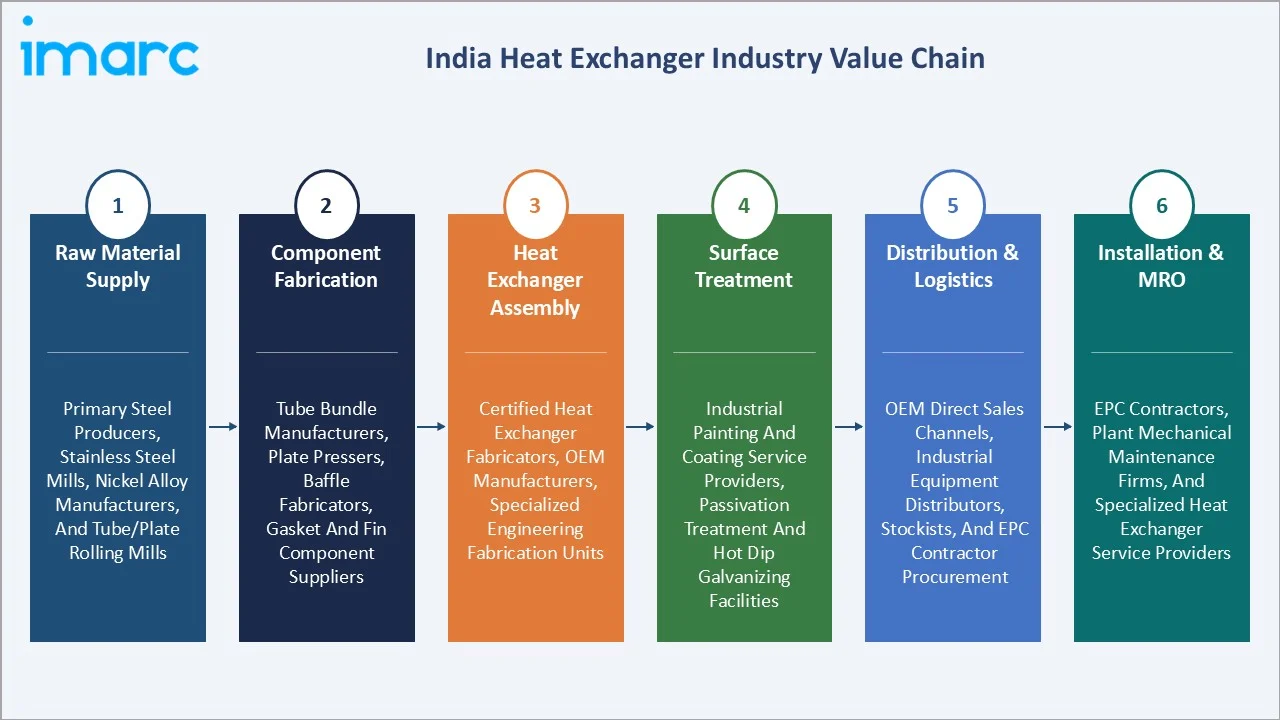
The India heat exchanger value chain spans six stages from raw material input through installation and aftermarket service. Fabrication and precision machining capture the highest value-add margins, while alloy sourcing and surface treatment generate supply chain complexity that favors vertically integrated or well-networked manufacturers over smaller regional fabricators.
|
Stage |
Key Activities / Players |
|
Raw Material Supply |
Primary steel producers, stainless steel mills, nickel alloy manufacturers, and tube/plate rolling mills |
|
Component Fabrication |
Tube bundle manufacturers, plate pressers, baffle fabricators, gasket and fin component suppliers |
|
Heat Exchanger Assembly |
Certified heat exchanger fabricators, OEM manufacturers, specialized engineering fabrication units |
|
Surface Treatment |
Industrial painting and coating service providers, passivation treatment and hot dip galvanizing facilities |
|
Distribution & Logistics |
OEM direct sales channels, industrial equipment distributors, stockists, and EPC contractor procurement |
|
Installation & MRO |
EPC contractors, plant mechanical maintenance firms, and specialized heat exchanger service providers |
Domestic manufacturers with certified ASME U-stamp and National Board NB-stamp capability command significant specification preference in power, oil and gas procurement, where code compliance is non-negotiable. This certification moat represents a durable competitive advantage for established manufacturers against both imports and new domestic entrants without equivalent quality infrastructure.
Technology Landscape in the India Heat Exchanger Industry
Shell and Tube Design: TEMA Standards and Advanced Configurations
Shell and tube heat exchangers in India are predominantly manufactured to TEMA-R (refinery), TEMA-C (commercial), and TEMA-B (chemical) standards, with IS 4503 compliances for domestic market specifications. Advanced configurations including U-tube bundles, floating head designs, and double segmental baffles address fouling management and thermal performance optimization in Indian refinery and chemical applications.
Plate Heat Exchanger Technology: Gasketed to Welded Evolution
Gasketed plate heat exchangers (GPHE), dominant in HVAC and food processing, are progressively being supplemented by fully welded and semi-welded designs in chemical and oil field applications where gasket failure risks are unacceptable. Brazed plate heat exchangers are gaining penetration in refrigeration and small industrial applications for their compact footprint and leak-free construction.
Advanced Materials: Titanium, Duplex Stainless, and Nickel Alloys
Titanium heat exchangers are gaining specification in India's coastal desalination plants, pharmaceutical API manufacturing, and chlorine production facilities. Duplex stainless steels provide superior chloride stress corrosion resistance versus standard 316L at a moderate cost premium, making them the preferred material for offshore and coastal industrial applications in India.
Digital Design and Simulation Technologies
Advanced computational fluid dynamics (CFD) simulation and thermal design software including HTRI Xchanger Suite, ASPEN HTFS, and vendor proprietary tools are enabling Indian heat exchanger manufacturers to optimize tube bundle configurations, baffle geometry, and nozzle placement. Digital twin models of installed heat exchangers are being deployed by major refinery operators to simulate fouling progression, predict cleaning intervals, and evaluate operational modifications without plant shutdown risk, reducing total lifecycle cost of heat exchanger ownership.
Market Segmentation Analysis
The report covers the following segments:
|
Segment Category |
Leading Segment |
Market Share |
Year |
|
Type |
Shell & Tube |
42.6% |
2025 |
|
Material |
Stainless Steel |
38.7% |
2025 |
|
End Use Industry |
🔒 |
🔒 |
2025 |
|
Region |
South India |
34.8% |
2025 |

By Type
Shell & Tube heat exchangers command a 42.6% majority share in 2025 owing to their unmatched flexibility across pressure, temperature, and fouling tolerance ranges that cover the majority of India's refinery, power, and chemical process applications. The broad TEMA code compliance ecosystem ensures standardized procurement and local fabrication capability across India's established industrial manufacturing belt.
To access detailed market analysis, Request Sample
Plate & Frame heat exchangers, with 26.8% in 2025, are growing fastest at approximately 6.3% CAGR, driven by rapid HVAC market expansion, food and beverage processing growth, and pharmaceutical sector demand where compact footprint, ease of cleaning, and CIP compatibility are critical requirements. Air Cooled exchangers (18.9%) are essential in water-scarce industrial locations and serve India's expanding natural gas processing and refinery sectors where cooling water conservation is a priority.
By Material
Stainless steel leads at 38.7% in 2025 driven by India's pharmaceutical, food processing, and chemical industries where corrosion resistance and sanitary compliance are non-negotiable. The substantial domestic stainless steel production capacity supports competitive local sourcing, containing landed material costs for Indian heat exchanger manufacturers serving these critical application sectors.
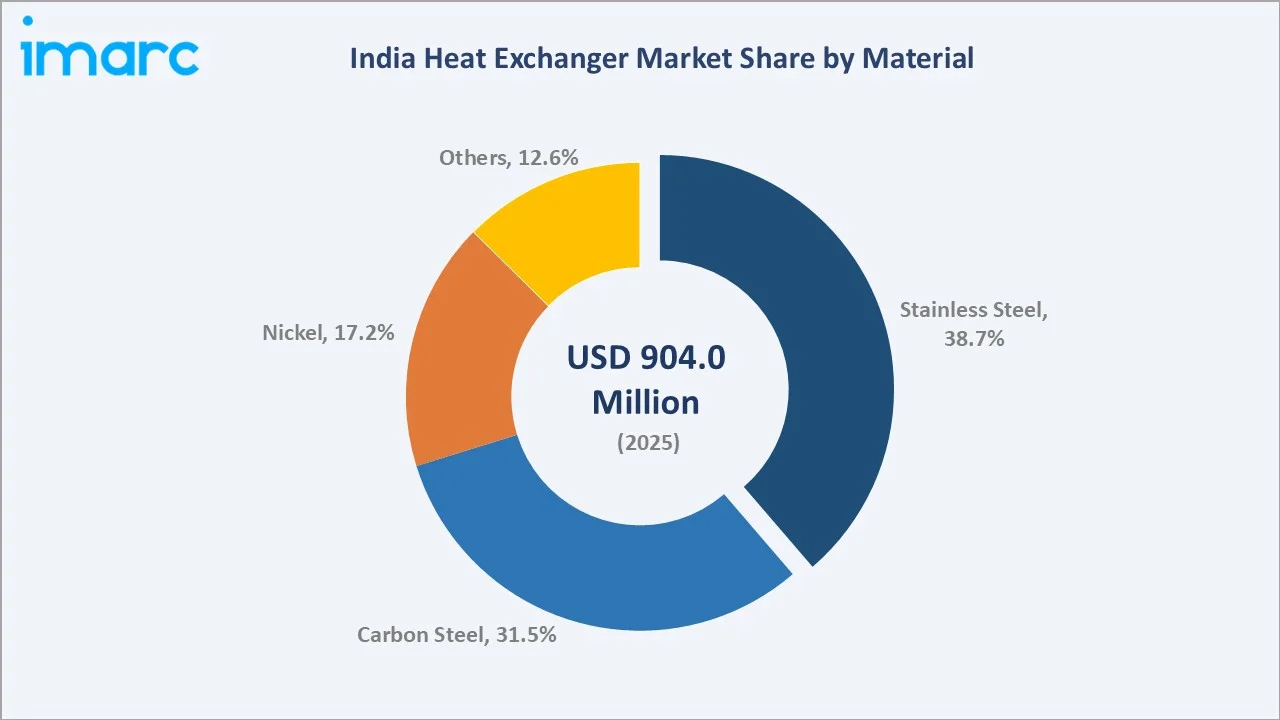
Carbon steel, with 31.5% in 2025, dominates cost-sensitive power sector and general industrial applications where service conditions are within standard carbon steel design envelope. Nickel alloy exchangers (17.2%) are irreplaceable in urea, nitric acid, and chlor-alkali facilities where extreme corrosion would compromise structural integrity within design service life. The Others category (12.6%) includes titanium, copper-nickel, and duplex stainless designs serving specialized coastal and offshore applications.
Regional Market Insights
|
Region |
Share (2025) |
Key Growth Drivers |
|
South India |
34.8% |
Largest refinery and petrochemical concentration; power plants; pharmaceutical manufacturing hubs |
|
West & Central India |
27.9% |
Chemical-petrochemical industrial corridor; fertilizer plants; growing commercial HVAC demand |
|
North India |
22.6% |
Power generation belt; fertilizer and agrochemical sector; expanding industrial and infrastructure investment |
|
East India |
14.7% |
Steel and metals processing; coal-based power plants; emerging chemical processing and industrial growth |
South India's 34.8% market dominance in 2025 is anchored by the highest concentration of petroleum refining and petrochemical capacity in India. The southern coastline hosts major refinery operations and petrochemical manufacturing zones that generate large-scale heat exchanger procurement across all product types, from standard shell and tube designs to specialty alloy units for critical process services.
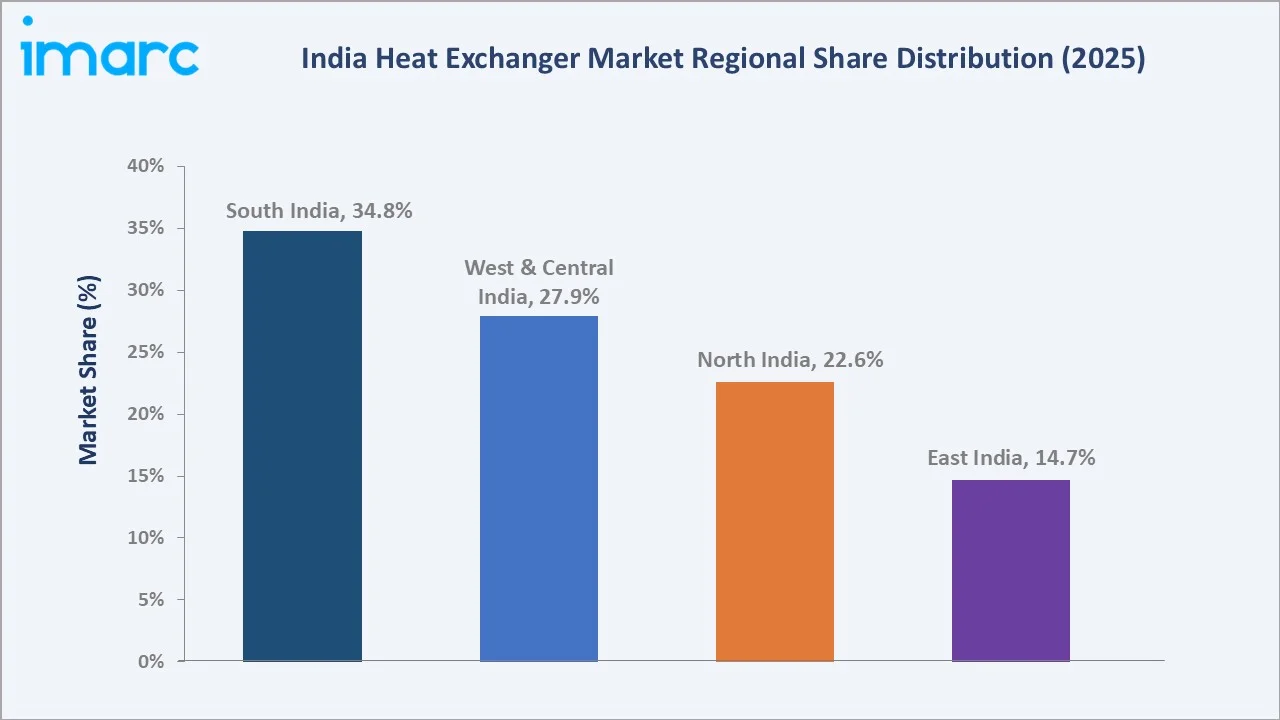
West and Central India, with 27.9% in 2025, benefits from the largest chemical and petrochemical industrial density in India. The chemical industrial corridor in western India houses a significant number of chemical manufacturing units generating consistent process heat exchanger demand. The growing commercial real estate sector in metropolitan centers is also driving plate heat exchanger demand for centralized HVAC systems in premium office and mixed-use developments.
Competitive Landscape
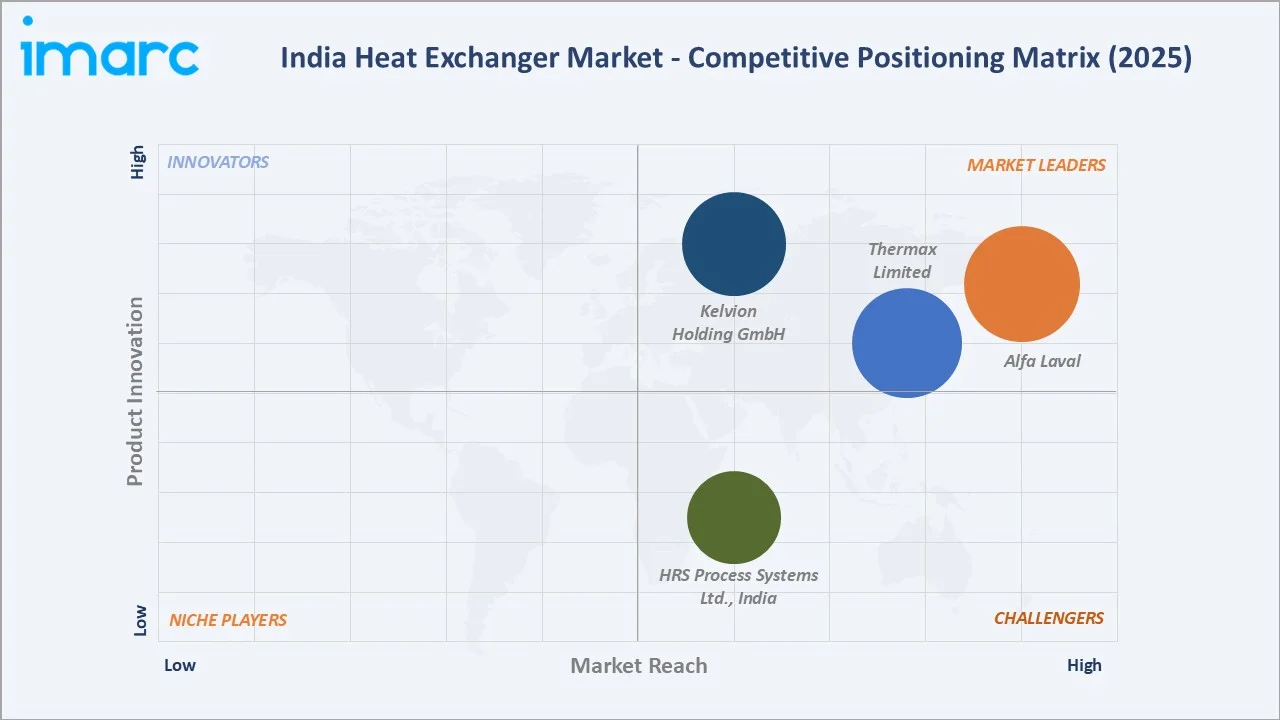
The India heat exchanger market is moderately fragmented, with global MNCs competing against strong domestic manufacturers in premium industrial segments, while a large base of regional Indian fabricators serves cost-sensitive standard-specification procurement. Market leadership is differentiated by technical certification capability, product range breadth, and application engineering depth rather than price alone.
|
Company |
Key Products |
Position |
Global Strategic Focus |
|
Alfa Laval |
Air Cooled, Plate, Scraped surface, and Tubular heat exchangers |
Leader |
Global presence; plate HX technology; oil & gas, food, HVAC |
|
Thermax Limited |
Air Cooled Heat Exchanger |
Leader |
India leader; energy & environment; power & process industries |
|
Kelvion Holding GmbH |
Brazed Plate Heat Exchanger, Gasketed Plate Heat Exchanger, Welded Plate Heat Exchanger |
Leader |
European specialist; industrial process; power generation |
|
HRS Process Systems Ltd., India |
ECOFLUX corrugated tube heat exchangers, shell and tube heat exchangers, HRS FUNKE plate heat exchangers, UNICUS scraped surface heat exchangers |
Challenger |
Niche specialty; food & pharma; hygienic applications |
Key players include Alfa Laval, Thermax Limited, Kelvion Holding GmbH, HRS Process Systems Ltd., India, and others.
Key Company Profiles
Alfa Laval
Alfa Laval is the global market leader in heat transfer, separation, and fluid handling, operating in India through Alfa Laval India Ltd. headquartered in Pune. The India operations serve refinery, pharmaceutical, food processing, marine, and HVAC segments with a broad product portfolio manufactured domestically and imported from global plants.
- Product Portfolio: Offers air cooled, plate, scraped surface, and tubular heat exchangers
- Recent Developments: In April 2025, Alfa Laval unveiled the TS25 semi-welded heat exchanger, developed to address the growing demand for scalable and energy-efficient solutions across clean energy and process industries. Designed for applications such as electrolyser cooling, industrial heat pumps, and heavy process operations, the new heat exchanger offers enhanced thermal performance, durability, and operational reliability, while its compact design enables higher capacity within a smaller footprint.
- Strategic Focus: Alfa Laval's India strategy leverages global technology leadership in plate and welded heat exchanger design, targeting premium-segment specification wins in pharmaceutical, food, and offshore applications while expanding service and MRO revenue through India's growing installed base across industrial sectors.
Thermax Limited
Thermax Limited is India's largest domestic energy and environment solutions company, headquartered in Pune, with a dedicated heat exchanger manufacturing facility. Thermax serves the power, oil and gas, chemical, fertilizer, and food processing sectors with heat exchangers certified to TEMA, ASME, and IS standards for both domestic and export markets.
- Product Portfolio: The company offers air cooled heat exchanger
- Strategic Focus: Thermax's strategy focuses on integrated energy solutions that combine heat exchangers with boilers, chillers, and control systems, offering turnkey thermal utility packages to large industrial customers that command premium pricing over standalone equipment suppliers.
Kelvion Holding GmbH
Kelvion, formerly the heat exchanger division of GEA Group, is a leading global manufacturer of plate, shell and tube, and air-cooled heat exchangers with significant sales presence in India serving power, chemical, and industrial refrigeration segments through its Indian subsidiary and authorized distributor network.
- Product Portfolio: Offers brazed plate heat exchanger, gasketed plate heat exchanger, welded plate heat exchanger
- Recent Developments: In March 2025, Kelvion announced a partnership in an ESCO project focused on advancing supercritical CO₂ systems using innovative 3D-printed heat exchangers. The collaboration aims to enhance energy efficiency, thermal performance, and system compactness in next-generation industrial and energy applications, while leveraging additive manufacturing technologies to improve design flexibility, operational reliability, and sustainability in low-carbon energy solutions.
- Strategic Focus: Kelvion's India strategy targets premium industrial and infrastructure segments where its European engineering pedigree and broad product certification portfolio command specification preference over lower-cost alternatives, particularly in power plant cooling and pharmaceutical processing applications.
Market Concentration Analysis
The India heat exchanger market is moderately fragmented at the national level, with no single company estimated to hold more than 12-15% of total domestic market revenue. Global MNCs hold disproportionate value share in premium segments, while domestic leaders dominate large custom-engineered project procurement, and hundreds of MSME fabricators serve standard-specification demand across the country.
Consolidation is occurring primarily through MNC investment in Indian manufacturing and service capability rather than through domestic M&A activity. The ASME stamp certification ecosystem creates meaningful market segmentation: certified manufacturers effectively operate in a separate, premium procurement tier from uncertified fabricators, limiting direct competition across quality tiers and protecting margins for established players.
Investment & Growth Opportunities
Fastest-Growing Segments
Plate & Frame heat exchangers at approximately 6.3% CAGR through 2034 represent the highest-growth type segment, driven by HVAC market expansion, pharmaceutical sector growth, and food processing modernization across India's rapidly urbanizing consumption centers. Stainless steel HX at approximately 6.5% CAGR through 2034 is the fastest-growing material segment, driven by specialty chemical and pharmaceutical API manufacturing expansion.
Emerging Markets
Green hydrogen production infrastructure, under India's National Green Hydrogen Mission targeting 5 MMTPA by 2030, represents an emerging high-value demand center for advanced alloy heat exchangers in electrolysis cooling, hydrogen compression, and downstream processing. Each large-scale electrolyzer installation requires multiple heat exchanger packages for thermal management and gas conditioning across the process train.
Venture & Investment Trends
Private equity interest in consolidating India's fragmented heat exchanger fabrication sector is growing. MSME fabricators with ASME certification, established EPC contractor relationships, and proven quality track records are attractive acquisition targets for building multi-product process equipment platforms. The Make in India PLI scheme for capital goods also incentivizes foreign OEMs to establish or expand domestic manufacturing joint ventures.
Future Market Outlook (2026-2034)
The India heat exchanger market is forecast to expand from USD 904.0 Million in 2025 to USD 1,477.7 Million by 2034 at a CAGR of 5.44%, adding USD 573.7 Million in incremental annual market value over the forecast period. This consistent growth reflects the market's infrastructure-linked, non-discretionary demand characteristics tied to India's industrial expansion trajectory.
The National Infrastructure Pipeline's multi-trillion-dollar investment program covering power, petrochemicals, and industrial parks will generate large-scale heat exchanger procurement that primarily benefits ASME-certified domestic manufacturers with large custom-engineering capability and deep EPC contractor relationships.
The energy transition dimension including green hydrogen, waste heat recovery, biomass cogeneration, and solar thermal industrial heat will create new high-value application segments for compact and specialty alloy heat exchangers, favoring technologically advanced players over commodity fabricators. Digital transformation through IoT monitoring and AI-driven fouling prediction will additionally create service revenue streams for OEMs investing in connected heat exchanger platforms.
Research Methodology
Primary Research
Primary research encompassed over 40 structured interviews in 2024-2025 with India heat exchanger industry stakeholders, including plant engineers, procurement managers at refineries and power plants, EPC contractor specialists, BEE-registered energy auditors, and distribution executives at industrial equipment companies. Primary data validated market sizing, type and material segment shares, regional demand estimates, and technology adoption timelines.
Secondary Research
Key secondary sources include Central Electricity Authority Annual Reports, Ministry of Petroleum and Natural Gas data on refinery capacity and expansion, Department of Chemicals and Petrochemicals annual reports, Bureau of Energy Efficiency PAT scheme publications, Bureau of Indian Standards and ASME code standards documentation, and industry publications including Chemical Engineering World and Process India.
Forecasting Models
Market size estimations and growth projections were derived using a combination of top-down and bottom-up forecasting models, incorporating India's GDP growth trajectory, industrial production index trends, capital goods sector investment data, and end-use sector expansion plans. Scenario analysis (base, optimistic, and conservative) was performed to account for macroeconomic uncertainty and policy implementation risks.
India Heat Exchanger Market Report Coverage:
| Report Features | Details |
|---|---|
| Base Year of the Analysis | 2025 |
| Historical Period | 2020-2025 |
| Forecast Period | 2026-2034 |
| Units | Million USD |
| Scope of the Report |
Exploration of Historical Trends and Market Outlook, Industry Catalysts and Challenges, Segment-Wise Historical and Future Market Assessment:
|
| Types Covered | Shell & Tube, Plate & Frame, Air Cooled, Others |
| Materials Covered | Carbon Steel, Stainless Steel, Nickel, Others |
| End Use Industries Covered | Chemical, Petrochemical and Oil & Gas, HVAC and Refrigeration, Food & Beverage, Power Generation, Paper & Pulp, Others |
| Region Covered | North India, West and Central India, South India, East India |
| Companies Covered | Alfa Laval, Thermax Limited, Kelvion Holding GmbH, HRS Process Systems Ltd., India, etc. |
| Customization Scope | 10% Free Customization |
| Post-Sale Analyst Support | 10-12 Weeks |
| Delivery Format | PDF and Excel through Email (We can also provide the editable version of the report in PPT/Word format on special request) |
Frequently Asked Questions About the India Heat Exchanger Market Report
The India heat exchanger market size reached USD 904.0 Million in 2025, reflecting consistent demand from power sector expansion, petrochemical and refinery capacity growth, and increasing HVAC adoption across commercial and industrial segments.
The India heat exchanger market is projected to reach USD 1,477.7 Million by 2034, growing at a CAGR of 5.44% during 2026-2034, driven by accelerating infrastructure investment, energy efficiency mandates, and the green hydrogen transition.
Shell & Tube heat exchangers lead the India market with a 42.6% share in 2025, reflecting their unmatched flexibility across refinery, power plant, and chemical process applications where high-pressure, high-temperature performance is required.
Stainless Steel leads the material segment at 38.7% in 2025, reflecting demand from pharmaceutical, food processing, and chemical industries across India where corrosion resistance and sanitary compliance are non-negotiable specification requirements.
South India dominates with a 34.8% regional share in 2025, anchored by the highest concentration of petroleum refining and petrochemical manufacturing capacity along the southern coastline, generating large-scale heat exchanger procurement from refineries, fertilizer plants, and chemical complexes.
The leading companies in the India heat exchanger market include Alfa Laval, Thermax Limited, Kelvion Holding GmbH, HRS Process Systems Ltd., India, and others.
Need more help?
- Speak to our experienced analysts for insights on the current market scenarios.
- Include additional segments and countries to customize the report as per your requirement.
- Gain an unparalleled competitive advantage in your domain by understanding how to utilize the report and positively impacting your operations and revenue.
- For further assistance, please connect with our analysts.
 Request Customization
 Speak to an Analyst
 Request Brochure
 Inquire Before Buying
Benefits of Customization
- Personalize this research
- Triangulate with your data
- Get data as per your format and definition
- Gain a deeper dive into a specific application, geography, customer, or competitor
- Any level of personalization
Get in Touch With Us
UNITED STATES
Phone: +1-201-971-6302
INDIA
Phone: +91-120-433-0800
UNITED KINGDOM
Phone: +44-753-714-6104
Email: [email protected]
Client Testimonials




.webp)




.webp)













Related Reports

Choose your plan
*Please note that the prices mentioned below are starting prices for each bundle type. Kindly contact our team for further details.*
Single User License
- 1 User License, Access on 2 Devices
- PDF Report + Excel Dataset (Password Protected)
- Lifetime Access
- No Printing Rights
- 10% Free Report Customization
- 10–12 Weeks of Analyst Support
Five User License
- Access for 5 Users, 2 Devices per User
- PDF Report + Excel Dataset (Password Protected)
- Lifetime Access
- Dedicated Account Manager
- 12–14 Weeks of Analyst Support
- No Printing Rights
- 15% Free Report Customization
- 25% Discount on Your Next Purchase
Corporate User License
- Unlimited User Access (Within Your Organization)
- PDF Report + Excel Dataset
- Lifetime Access
- Dedicated Account Manager
- 14–20 Weeks of Analyst Support
- No Printing Rights
- 20% Free Report Customization
- 30% Discount on Your Next Purchase
Essential Insights
What's included:
3 reports
- Lifetime Access
- PDF Reports
- Excel Datasets
- 2 Weeks of Free Analyst Support
- 2 User Licenses
- Access on 2 Devices
- Printing Rights
- Complimentary PowerPoint (PPT) Version
- Complimentary License Upgrade
Professional Access
What's included:
5 reports
- Lifetime Access
- PDF Reports
- Excel Datasets
- 8 Weeks of Free Analyst Support
- 2 User Licenses
- Access on 2 Devices
- Printing Rights
- Complimentary PowerPoint (PPT) Version
- Complimentary License Upgrade
Business Advantage
What's included:
8 reports
- Lifetime Access
- PDF Reports
- Excel Datasets
- 14 Weeks of Free Analyst Support
- 2 User Licenses
- Access on 2 Devices
- Printing Rights
- Complimentary PowerPoint (PPT) Version
- Complimentary License Upgrade
Enterprise Intelligence
What's included:
10 reports
- Lifetime Access
- PDF Reports
- Excel Datasets
- 20 Weeks of Free Analyst Support
- 2 User Licenses
- Access on 2 Devices
- Printing Rights
- Complimentary PowerPoint (PPT) Version
- Complimentary License Upgrade