
India Home Furnishings Market Size, Share, Trends and Forecast by Product, Price, Distribution Channel, and Region, 2026-2034
India Home Furnishings Market Summary:
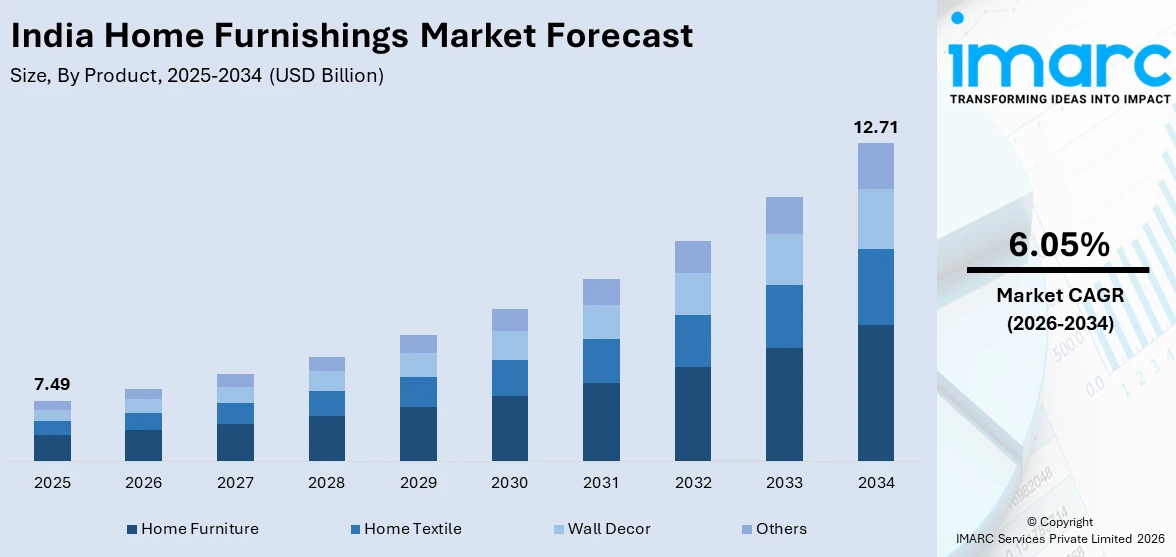
The India home furnishings market size increased from USD 7.49 Billion in 2025 to USD 7.90 Billion in 2026 and is projected to reach USD 12.71 Billion by 2034, growing at a compound annual growth rate of 6.05% from 2026-2034.
The India home furnishings market encompasses home furniture, home textiles, wall decor, and related products designed to enhance residential spaces. Rising urbanization, expanding middle-class population, and evolving consumer preferences for aesthetic and functional living spaces are propelling market expansion. The increasing penetration of organized retail channels and e-commerce platforms is transforming product accessibility, while growing real estate development and government housing initiatives continue to support sustained demand across urban and semi-urban regions.
Key Takeaways and Insights:
- By Product: Home furniture dominates the market with a share of 38% in 2025, due to the growing preference for functional and visually attractive living spaces among Indian consumers. The growing demand for modular and space-saving furniture solutions, fueled by rapid urbanization, is propelling the segment expansion.
- By Price: Mass leads the market with a share of 65% in 2025. This dominance is driven by the price-sensitive nature of the majority of Indian consumers who prioritize affordability while seeking quality home furnishing products. Rising demand from tier-two and tier-three cities is strengthening mass segment performance across distribution channels.
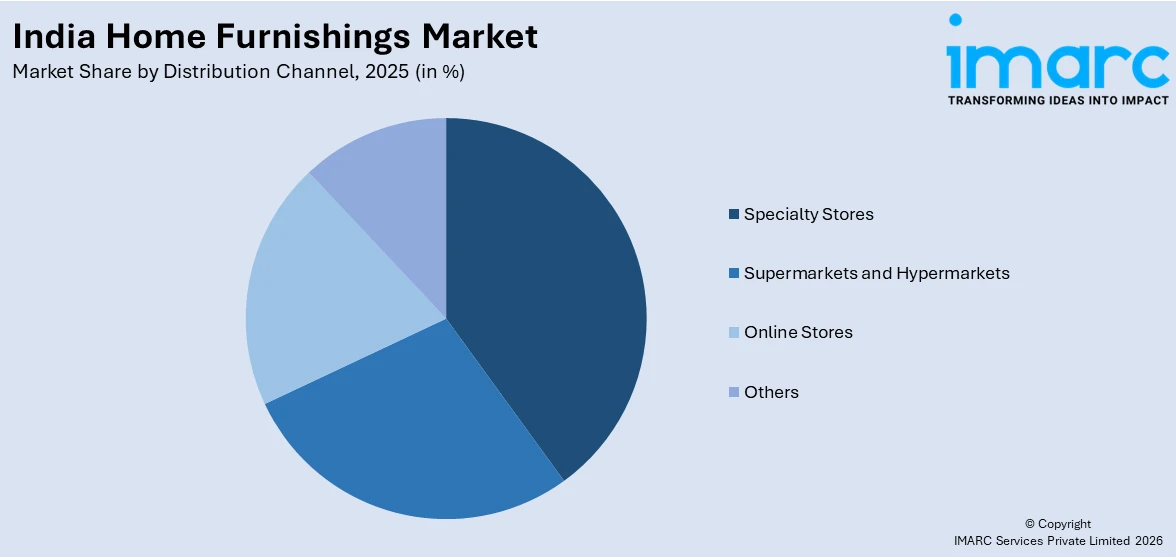
- By Distribution Channel: Specialty stores comprise the largest segment with a market share of 33% in 2025, reflecting the continued consumer preference for personalized shopping experiences and expert guidance. These outlets offer dedicated product ranges, customization options, and tactile product evaluation opportunities that online channels cannot fully replicate.
- By Region: North India represents the largest region with 30% share in 2025, driven by the substantial urban population concentration in Delhi-NCR and surrounding metropolitan areas, higher purchasing power, and accelerating real estate development activities.
- Key Players: Key players drive the India home furnishings market by expanding retail footprints, investing in manufacturing capabilities, and strengthening omnichannel distribution networks. Their strategic focus on product innovation, customization offerings, and sustainability initiatives enhances brand positioning. Partnerships with real estate developers and interior design firms accelerate market penetration across consumer segments.
Access the comprehensive market breakdown Request Sample
The India home furnishings market demonstrates robust momentum, supported by favorable demographic shifts and evolving lifestyle preferences. Rapid urbanization continues to reshape consumption patterns, as metropolitan populations increasingly demand contemporary, space-efficient furnishing solutions. According to the Economic Survey 2023-24, it is anticipated that by 2030, over 40% of India's population will reside in urban regions. The expansion of nuclear family structures across urban centers is generating sustained demand for compact, multifunctional furniture and coordinated home textile collections. Government initiatives, including the Pradhan Mantri Awas Yojana housing scheme and Smart Cities Mission, are catalyzing residential construction activities, creating substantial opportunities for furnishing product manufacturers and retailers. The proliferation of organized retail formats and e-commerce platforms has democratized access to diverse product assortments across price points, enabling consumers in tier-two and tier-three cities to access branded home furnishing products.
India Home Furnishings Market Trends:
Growing Preferences for Sustainable and Eco-Friendly Products
Environmental consciousness is fundamentally reshaping consumer purchasing decisions in the India home furnishings market. Urban consumers, particularly millennials and Generation Z demographics, increasingly prioritize products manufactured from organic, biodegradable, and responsibly sourced materials. The demand for furniture crafted from bamboo, reclaimed wood, and recycled materials continues to strengthen as environmental awareness permeates mainstream consumer culture. Manufacturers are responding by expanding product lines, featuring organic cotton textiles, natural fiber carpets, and formaldehyde-free engineered wood panels.
Expansion of E-Commerce and Digital Shopping Platforms
Digital transformation is revolutionizing home furnishing retail across India as consumers embrace online purchasing channels. E-commerce platforms are deploying advanced visualization technologies, including augmented reality (AR) applications and three-dimensional product configurators that enable customers to virtually place furniture within their living spaces. As per IMARC Group, the India e-commerce market size was valued at USD 129.72 Billion in 2025. The integration of artificial intelligence (AI)-powered recommendation engines enhances personalized shopping experiences. Enhanced logistics infrastructure and reliable last-mile delivery networks are extending e-commerce accessibility beyond metropolitan markets into smaller cities and towns.
Rising Demand for Modular and Multifunctional Designs
Space constraints in urban residential apartments are driving unprecedented demand for modular and multifunctional furniture solutions. As per IMARC Group, the India modular furniture market size reached USD 3.71 Billion in 2024. Consumers seek innovative designs that maximize utility within limited floor areas while maintaining aesthetic appeal. Convertible sofa beds, extendable dining tables, and storage-integrated seating solutions are experiencing accelerated adoption across metropolitan markets. The preference for ready-to-assemble furniture continues to strengthen, as consumers value customization flexibility and ease of relocation. Manufacturers are innovating with space-saving mechanisms and transformable configurations addressing contemporary urban living requirements.

Market Outlook 2026-2034:
The India home furnishings market outlook remains positive, supported by continued economic expansion and favorable demographic trends. Rising disposable incomes among the expanding middle-class population enable increased expenditure on home improvement and interior decoration products. The proliferation of organized retail chains and branded stores enhances consumer access to quality home furnishing products across diverse price segments. The market generated a revenue of USD 7.49 Billion in 2025, which is expected to reach USD 7.90 Billion in 2026 and further grow to USD 12.71 Billion by 2034, at a compound annual growth rate (CAGR) of 6.05% during 2026-2034. Government housing initiatives, including affordable housing programs, continue to stimulate residential construction, creating sustained demand for furnishing products. The premiumization trend across urban consumer segments is elevating average transaction values as households invest in higher-quality, longer-lasting home furnishing solutions that reflect contemporary lifestyle aspirations.
India Home Furnishings Market Report Segmentation:
|
Segment Category |
Leading Segment |
Market Share |
|
Product |
Home Furniture |
38% |
|
Price |
Mass |
65% |
|
Distribution Channel |
Specialty Stores |
33% |
|
Region |
North India |
30% |
Product Insights:
- Home Furniture
- Home Textile
- Wall Decor
- Others
Home furniture dominates with a market share of 38% of the total India home furnishings market in 2025.
Home furniture represents the largest product category within the India home furnishings market, driven by increasing consumer emphasis on creating comfortable, functional, and aesthetically appealing living environments. The segment encompasses diverse product categories, including bedroom furniture, living room furniture, dining sets, and modular kitchen solutions. Rising homeownership rates supported by government housing initiatives are stimulating demand for essential furniture products across newly constructed residential units. In 2025, a study titled ‘Beyond Bricks: The Pulse of Home Buying,’ involving 1,629 respondents from eight Indian cities, revealed that an impressive 80% of Indians favored owning a home over renting.
The home furniture segment demonstrates substantial growth potential as urbanization accelerates across Indian metropolitan areas and smaller cities. Consumer preferences are evolving towards modular and multifunctional designs that optimize space utilization within compact urban apartments. Growing disposable incomes and increased spending on interior décor are encouraging consumers to invest in higher-quality and customized home furniture solutions. Expansion of organized retail, online furniture platforms, and direct-to-consumer (D2C) brands is improving product accessibility and price transparency.
Price Insights:
- Mass
- Premium
Mass leads with a share of 65% of the total India home furnishings market in 2025.
The mass segment dominates the home furnishings market in India, reflecting the price-conscious purchasing behavior prevalent among the majority of Indian consumers. Affordability remains the primary consideration for households across diverse income levels, particularly first-time home buyers and families in tier-two and tier-three cities. In India, unorganized local vendors and regional manufacturers maintain substantial presence within this segment by offering competitive pricing and customization options tailored to local preferences.
The mass price segment benefits from expanding organized retail penetration and e-commerce accessibility that democratize product availability across geographic regions. Manufacturers are leveraging cost-efficient production techniques, including engineered wood materials and modular manufacturing processes, to deliver quality products at accessible price points. The segment experiences sustained demand from young professionals and nuclear families establishing new households who require complete home furnishing solutions within budget constraints. As per the PRICE Report, by 2047, the proportion of India's middle class is expected to nearly increase to 61% of the overall population, rising from 31% in 2020-21, representing a substantial consumer base driving continued mass segment expansion through value-oriented purchasing preferences.
Distribution Channel Insights:
Access the comprehensive market breakdown Request Sample
- Supermarkets and Hypermarkets
- Specialty Stores
- Online Stores
- Others
Specialty stores exhibit a clear dominance with a 33% share of the total India home furnishings market in 2025.
Specialty stores maintain leadership within the distribution channel segment by offering differentiated shopping experiences, characterized by dedicated product assortments, knowledgeable sales assistance, and customization capabilities. These retail formats enable consumers to physically evaluate furniture quality, test comfort levels, and visualize products within curated room settings that inspire purchase decisions. Premium and mid-range consumers demonstrate strong preference for specialty retail environments that provide personalized design consultation services and professional interior styling guidance.
The segment is experiencing modernization through technology integration, including AR applications that enable customers to visualize furniture placement within their homes using tablet-based configurators. Branded specialty retailers are expanding footprints beyond metropolitan cities into emerging urban centers with significant untapped demand potential. Omnichannel strategies combining physical showrooms with online ordering capabilities are strengthening customer engagement and conversion rates. Flexible financing options, easy installment plans, and after-sales support services are further enhancing the appeal of specialty stores among organized retail shoppers.
Region Insights:
- North India
- West and Central India
- South India
- East India
North India represents the leading segment with a 30% share of the total India home furnishings market in 2025.
North India commands the largest regional share within the India home furnishings market, supported by substantial urban population concentration, elevated purchasing power, and accelerating real estate development activities. Delhi-NCR serves as the primary demand center, hosting numerous branded retail outlets, specialty furniture showrooms, and organized home furnishing chains. High demand from nuclear households and rising expenditure on home décor upgrades are further strengthening regional consumption. Additionally, strong influence of architects and interior designers is shaping premium and customized furniture demand in the region.
North India benefits from well-established distribution infrastructure, including extensive road networks and warehousing facilities that support efficient product delivery across urban and semi-urban markets. Consumer preferences demonstrate strong affinity for both contemporary designs and traditional wooden furniture reflecting regional cultural aesthetics. Major international retailers are prioritizing North India expansion, with IKEA announcing Delhi-NCR e-commerce operations and small-format store openings commencing March 2025, supported by a 180,000 square feet distribution center in Gurugram, facilitating regional market penetration.
Market Dynamics:
Growth Drivers:
Why is the India Home Furnishings Market Growing?
Rapid Urbanization and Housing Development Expansion
Rapid urbanization represents a fundamental growth driver propelling the India home furnishings market forward as millions of individuals migrate from rural areas to metropolitan centers seeking employment opportunities and improved living standards. This demographic transition generates substantial demand for residential housing units that require comprehensive furnishing solutions, spanning furniture, textiles, and decorative products. Urban migration patterns are reshaping consumer expectations regarding living space functionality and aesthetic appeal, with metropolitan residents increasingly demanding contemporary designs that optimize limited apartment floor areas. The concentration of economic activities within major cities elevates household incomes, enabling greater expenditure on home improvement and interior decoration initiatives. Smart city development initiatives are further stimulating infrastructure investment and residential property development, expanding the addressable consumer base for home furnishing manufacturers and retailers targeting upwardly mobile urban households seeking modern, functional living environments that reflect contemporary lifestyle aspirations and aesthetic preferences. In August 2024, India’s Cabinet Committee on Economic Affairs (CCEA), headed by Prime Minister Narendra Modi, sanctioned 12 new smart city initiatives under the National Industrial Corridor Development Programme (NICDP) with a funding of INR 286.02 Billion (USD 3.41 Billion).
Rising Disposable Incomes and Middle-Class Expansion
Increasing disposable incomes among Indian households are fundamentally transforming consumption patterns within the market as consumers demonstrate greater willingness to invest in quality products that enhance living space comfort and visual appeal. Economic development and employment expansion are elevating household earnings across diverse demographic segments, enabling discretionary spending on home improvement and interior decoration beyond essential furnishing requirements. The expanding middle-class population represents a substantial consumer base demonstrating evolved purchasing preferences that prioritize product quality, brand reputation, and aesthetic design alongside traditional price considerations. Younger demographic cohorts, including millennials and Generation Z consumers, exhibit heightened interest in home personalization and interior styling, viewing furnishing investments as expressions of individual identity and lifestyle values. As per industry reports, 71% OF millennials in India aspired to own homes by 2025. Rising incomes are enabling premiumization trends across product categories as households upgrade from basic furniture to higher-quality alternatives, featuring superior materials, enhanced craftsmanship, and contemporary design elements.
E-Commerce Growth and Digital Retail Transformation
Digital commerce expansion is revolutionizing the market in India by broadening consumer access to diverse product assortments beyond geographic constraints imposed by traditional physical distribution channels. Online platforms enable manufacturers and retailers to reach customers across metropolitan, semi-urban, and rural markets through unified digital storefronts that transcend physical store location limitations. Advanced visualization technologies, including AR applications and three-dimensional product configurators, address traditional barriers to online furniture purchasing by enabling customers to virtually position products within their actual living spaces before committing to purchase decisions. Enhanced logistics infrastructure, including specialized last-mile delivery networks, capable of handling large furniture items is strengthening e-commerce fulfillment capabilities across broader geographic coverage areas. Digital marketing capabilities enable precise consumer targeting and personalized product recommendations that improve conversion rates and customer acquisition efficiency for home furnishing brands operating online channels.
Market Restraints:
High Raw Material Costs and Supply Chain Fragmentation
Elevated raw material costs, particularly for quality timber and textile inputs, constrain manufacturer profit margins and limit ability to offer competitive pricing across product categories. Supply chain fragmentation involving numerous intermediaries between raw material sources and finished goods manufacturers introduces inefficiencies and cost escalation throughout production processes. Volatile commodity pricing creates planning uncertainties that complicate inventory management and pricing strategy execution for home furnishing businesses navigating competitive market conditions.
Price Sensitivity and Unorganized Sector Competition
Substantial price sensitivity among large consumer segments constrains demand for premium-priced branded products that offer enhanced quality and design sophistication. The dominant unorganized sector, comprising local carpenters and regional manufacturers, competes aggressively on pricing while providing customization flexibility that resonates with cost-conscious consumers. Intense price competition pressures organized players to compress margins while investing in brand building and retail infrastructure development activities that require sustained capital commitment.
Changing Consumer Expectations and Demand Volatility
Rapidly evolving consumer preferences towards trendy designs, fast décor refresh cycles, and customized solutions create demand volatility for manufacturers and retailers. Shorter product life cycles increase the risk of inventory obsolescence and markdown pressures. Additionally, rising expectations for quick delivery, seamless omnichannel experiences, and responsive after-sales service require continuous investment in technology, skilled manpower, and customer engagement capabilities.
Competitive Landscape:
The India home furnishings market exhibits a fragmented competitive structure, characterized by the coexistence of organized national brands, regional manufacturers, and extensive unorganized local vendors serving diverse consumer segments across price tiers. Organized players are expanding retail footprints through company-owned stores and franchise networks while simultaneously developing e-commerce capabilities to capture digitally-enabled consumer demand. Strategic investments in manufacturing modernization, supply chain optimization, and brand building initiatives differentiate leading players seeking premium market positioning. International retailers are intensifying market presence through store expansion and omnichannel distribution strategies that combine physical showrooms with digital ordering platforms.
India Home Furnishings Market Report Coverage:
| Report Features | Details |
|---|---|
| Base Year of the Analysis | 2025 |
| Historical Period | 2020-2025 |
| Forecast Period | 2026-2034 |
| Units | Billion USD |
| Scope of the Report |
Exploration of Historical Trends and Market Outlook, Industry Catalysts and Challenges, Segment-Wise Historical and Future Market Assessment:
|
| Products Covered | Home Furniture, Home Textile, Wall Decor, Others |
| Prices Covered | Mass, Premium |
| Distribution Channels | Supermarkets and Hypermarkets, Specialty Stores, Online Stores, Others |
| Region Covered | North India, West and Central India, South India, East India |
| Customization Scope | 10% Free Customization |
| Post-Sale Analyst Support | 10-12 Weeks |
| Delivery Format | PDF and Excel through Email (We can also provide the editable version of the report in PPT/Word format on special request) |
Frequently Asked Questions About the India Home Furnishings Market Report
The India home furnishings market size increased from USD 7.49 Billion in 2025 to USD 7.90 Billion in 2026.
The India home furnishings market is expected to grow at a compound annual growth rate of 6.05% from 2026-2034 to reach USD 12.71 Billion by 2034.
Home furniture dominated the market with a share of 38%, driven by increasing consumer preferences for functional and aesthetically appealing living spaces supported by rising urbanization. Growth is further supported by rising demand for modular, space-saving designs and higher spending on home upgrades across urban households.
Key factors driving the India home furnishings market include rapid urbanization, rising disposable incomes, expanding middle-class population, government housing initiatives, and growing e-commerce penetration. Increasing focus on home décor aesthetics and comfort is further strengthening market momentum.
Major challenges include high raw material costs, fragmented supply chains, intense competition from the unorganized sector, limited rural market penetration, price sensitivity among consumers, and logistics complexities in product distribution.
Need more help?
- Speak to our experienced analysts for insights on the current market scenarios.
- Include additional segments and countries to customize the report as per your requirement.
- Gain an unparalleled competitive advantage in your domain by understanding how to utilize the report and positively impacting your operations and revenue.
- For further assistance, please connect with our analysts.
 Request Customization
 Speak to an Analyst
 Request Brochure
 Inquire Before Buying
Benefits of Customization
- Personalize this research
- Triangulate with your data
- Get data as per your format and definition
- Gain a deeper dive into a specific application, geography, customer, or competitor
- Any level of personalization
Get in Touch With Us
UNITED STATES
Phone: +1-201-971-6302
INDIA
Phone: +91-120-433-0800
UNITED KINGDOM
Phone: +44-753-714-6104
Email: [email protected]
Client Testimonials




.webp)




.webp)













Related Reports

Choose your plan
*Please note that the prices mentioned below are starting prices for each bundle type. Kindly contact our team for further details.*
Single User License
- 1 User License, Access on 2 Devices
- PDF Report + Excel Dataset (Password Protected)
- Lifetime Access
- No Printing Rights
- 10% Free Report Customization
- 10–12 Weeks of Analyst Support
Five User License
- Access for 5 Users, 2 Devices per User
- PDF Report + Excel Dataset (Password Protected)
- Lifetime Access
- Dedicated Account Manager
- 12–14 Weeks of Analyst Support
- No Printing Rights
- 15% Free Report Customization
- 25% Discount on Your Next Purchase
Corporate User License
- Unlimited User Access (Within Your Organization)
- PDF Report + Excel Dataset
- Lifetime Access
- Dedicated Account Manager
- 14–20 Weeks of Analyst Support
- No Printing Rights
- 20% Free Report Customization
- 30% Discount on Your Next Purchase
Essential Insights
What's included:
3 reports
- Lifetime Access
- PDF Reports
- Excel Datasets
- 2 Weeks of Free Analyst Support
- 2 User Licenses
- Access on 2 Devices
- Printing Rights
- Complimentary PowerPoint (PPT) Version
- Complimentary License Upgrade
Professional Access
What's included:
5 reports
- Lifetime Access
- PDF Reports
- Excel Datasets
- 8 Weeks of Free Analyst Support
- 2 User Licenses
- Access on 2 Devices
- Printing Rights
- Complimentary PowerPoint (PPT) Version
- Complimentary License Upgrade
Business Advantage
What's included:
8 reports
- Lifetime Access
- PDF Reports
- Excel Datasets
- 14 Weeks of Free Analyst Support
- 2 User Licenses
- Access on 2 Devices
- Printing Rights
- Complimentary PowerPoint (PPT) Version
- Complimentary License Upgrade
Enterprise Intelligence
What's included:
10 reports
- Lifetime Access
- PDF Reports
- Excel Datasets
- 20 Weeks of Free Analyst Support
- 2 User Licenses
- Access on 2 Devices
- Printing Rights
- Complimentary PowerPoint (PPT) Version
- Complimentary License Upgrade