
India Juicer Market Size, Share, Trends and Forecast by Product, Technology, Distribution Channel, and Region, 2026-2034
India Juicer Market Size, Share, Trends & Forecast (2026-2034)
The India juicer market grew from USD 99.71 Million in 2025 to USD 106.27 Million in 2026 and is projected to reach USD 180.02 Million by 2034, growing at a CAGR of 6.58% during 2026-2034. India's juicer market is driven by approximately 371 million young individuals aged 15–29 years, a health-aspirational urban population increasingly replacing sugary packaged beverages with home-extracted fresh fruit and vegetable juices, supported by rapidly expanding e-commerce accessibility, rising disposable incomes in Tier-2 and Tier-3 cities, and a dynamic competitive landscape featuring both established Indian brands and premium Korean cold-press specialists. Centrifugal juicers lead product share at 52.5%, electric technology dominates at 82.5%, and West India commands the largest regional share at 29.5%.
Market Snapshot
|
Metric |
Value |
|
Base Year Market Size (2025) |
USD 99.71 Million |
|
Market Size (2026) |
USD 106.27 Million |
|
Forecast Market Size (2034) |
USD 180.02 Million |
|
CAGR (2026-2034) |
6.58% |
|
Base Year |
2025 |
|
Historical Period |
2020-2025 |
|
Forecast Period |
2026-2034 |
|
Dominant Product |
Centrifugal Juicer (52.5%, 2025) |
|
Dominant Technology |
Electric (82.5%, 2025) |
|
Leading Region |
West India (29.5%, 2025) |
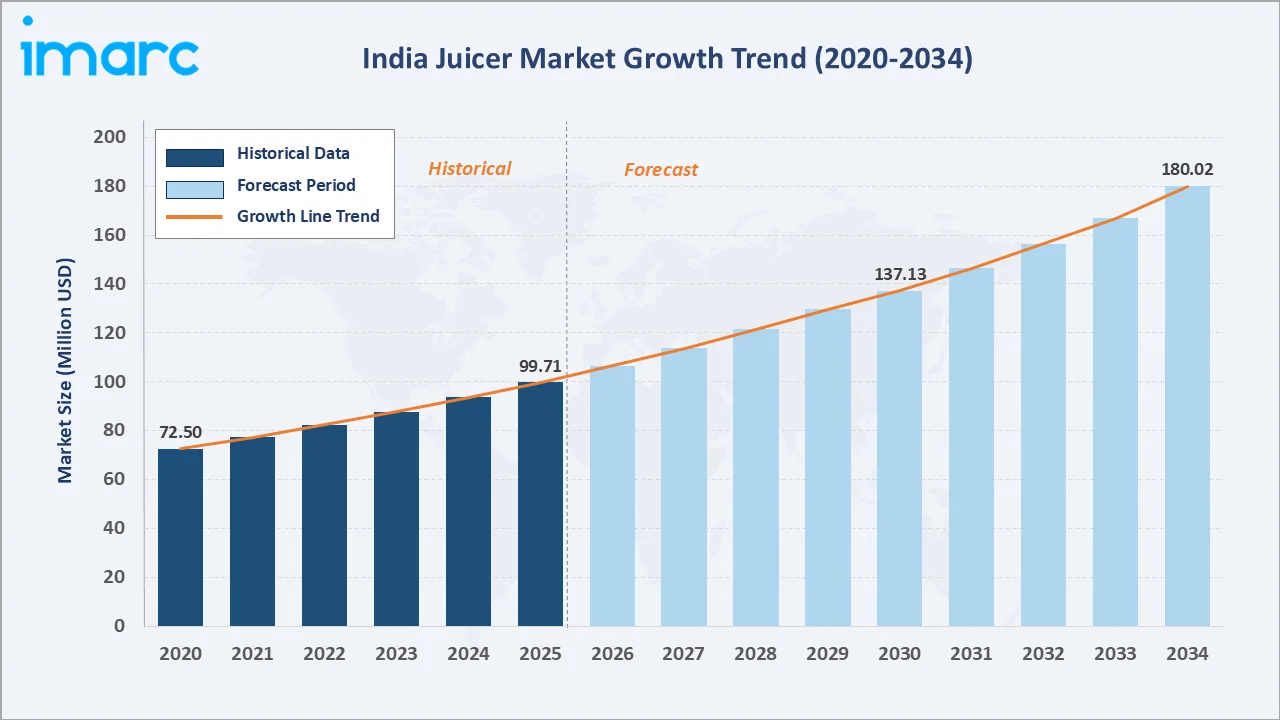
The India juicer market grew from USD 72.50 Million in 2020 to USD 99.71 Million by 2025 and is estimated to reach USD 106.27 Million in 2026. The market is projected to reach USD 137.13 Million by 2030 and USD 180.02 Million by 2034.
To get more information on this market, Request Sample
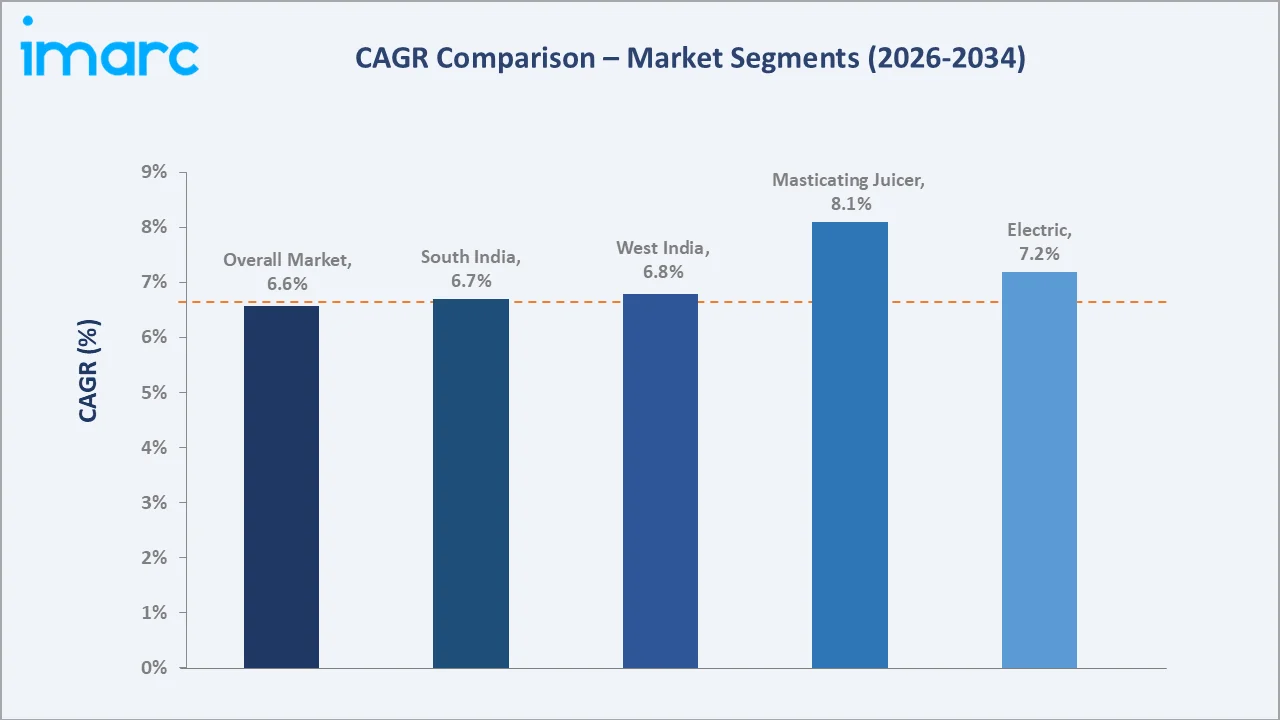
Masticating juicers grow fastest at ~8.1% CAGR through cold-press and nutrition-preservation trend adoption. Electric technology expands at ~7.2% CAGR. West India leads regional growth at ~6.8% CAGR through Maharashtra and Gujarat premium appliance adoption.
Executive Summary
The India juicer market is a high-growth segment of the domestic kitchen appliance industry, propelled by the convergence of rising health consciousness among urban Indian consumers, aggressive e-commerce penetration unlocking Tier-2 and Tier-3 city demand, and continuous product innovation from both established Indian appliance majors and premium Korean cold-press specialists.
Centrifugal juicers command 52.5% product share through their combination of affordable price points, fast extraction speed, and wide availability across online and offline retail. Electric technology dominates at 82.5%, with manual juicers serving only citrus-specific household and small juice bar applications. West India leads at 29.5% through Mumbai and Ahmedabad's premium consumer concentration.
Key Market Insights
|
Insight |
Data |
|
Dominant Product |
Centrifugal Juicer - 52.5% share (2025) |
|
Dominant Technology |
Electric - 82.5% share (2025) |
|
Leading Region |
West India - 29.5% (2025) |
|
Key Market Opportunity |
India's rapidly expanding health-conscious urban millennial population, combined with rising cold-press and slow-juicer adoption driven by social media health influencers, represents an incremental premium juicer addressable opportunity as aspirational consumers upgrade from entry-level centrifugal models to masticating and triturating juicers through organized e-commerce channels. |
Key Analytical Observations Supporting the Above Data:
- Centrifugal Juicer at 52.5%: Centrifugal juicers dominate as the entry-level and mid-market workhorse category, favored by Indian consumers for their fast extraction speed, affordable price points for mainstream models, and compatibility with India's hard vegetables and tropical fruits (sugarcane, watermelon, beetroot, carrot).
- Electric Technology at 82.5%: Electric juicers overwhelmingly dominate through the combination of convenience superiority over manual alternatives, rapidly declining entry price points as Indian and Chinese manufacturers scale domestic production, and the near-universal availability of AC power supply across urban and semi-urban India.
- West India at 29.5%: West India leads through the structural advantages of Maharashtra and Gujarat hosting India's highest concentration of premium kitchen appliance consumers. Mumbai's urban population with significantly above-average household incomes, Gujarat's vegetarian food culture generating strong fresh juice consumption habits, and the region's most developed organized retail appliance infrastructure combine to generate the highest per-household juicer spending rate of any Indian region.
India Juicer Market Overview
The India juicer market encompasses electric and manual appliances designed for extracting juice from fruits, vegetables, and leafy greens in domestic households, juice bars, small restaurants, and institutional settings. The market spans three primary product types: centrifugal juicers (high-speed spinning blade extraction), masticating juicers (slow auger-based cold-press extraction preserving maximum nutrients and enzymes), and triturating juicers (twin-gear extraction for maximum yield from leafy greens and hard vegetables).
Market Dynamics
To evaluate market opportunities, Request Sample
Market Drivers
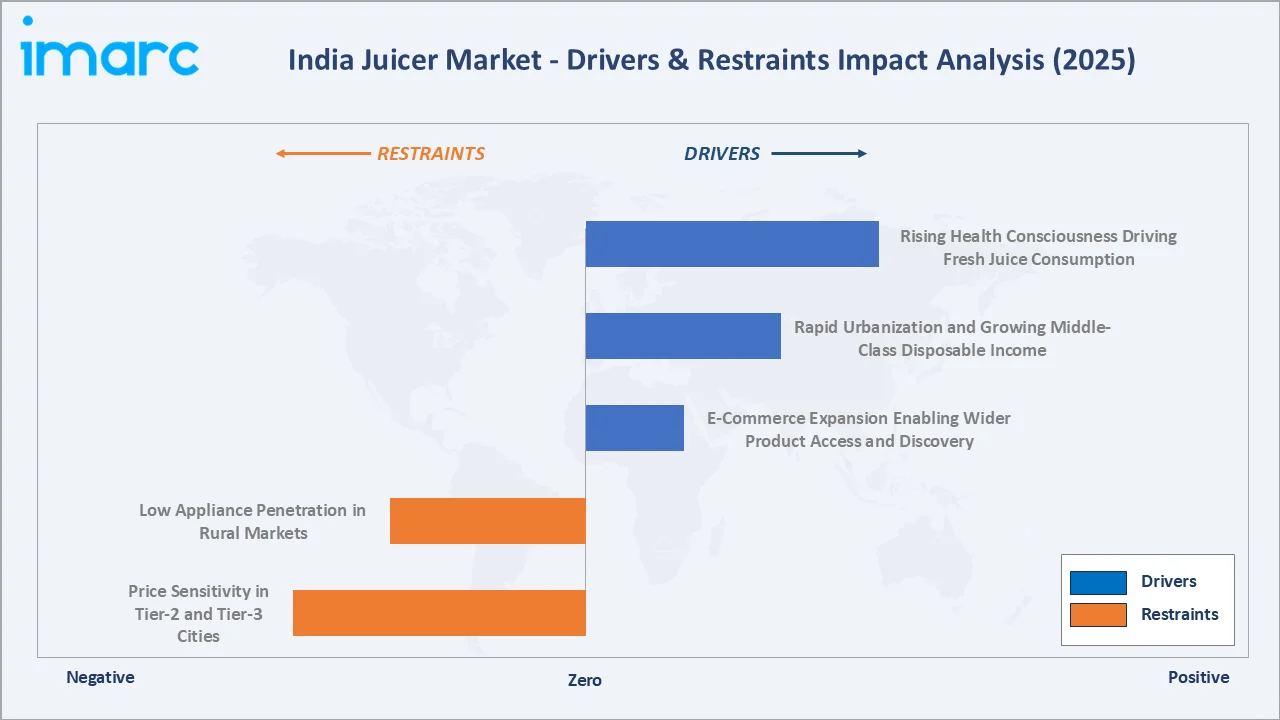
- Rising Health Consciousness Driving Fresh Juice Consumption: India's post-COVID urban health awakening, manifested through surging gym memberships, fitness app downloads, and social media wellness content consumption, has created a structurally higher baseline demand for home juicing appliances. Indian millennial and Gen-Z consumers aged 18-35, particularly in metro and Tier-1 cities, are actively replacing packaged fruit beverages with freshly extracted home juices perceived as superior in nutrition, free from preservatives, and more economical at scale.
- Rapid Urbanization and Growing Middle-Class Disposable Income: India's urban population is projected to reach 600 Million by 2031. This urbanization-driven middle-class expansion is creating a structurally growing addressable consumer base for kitchen appliances, the dominant Indian juicer market price band, with Tier-2 cities including Lucknow, Indore, Coimbatore, and Surat now generating significant juicer purchase volumes previously concentrated only in metro cities.
- E-Commerce Expansion Enabling Wider Product Access and Discovery: Flipkart and Amazon India's combined reach across various pin codes, combined with quick commerce platforms including Blinkit and Zepto now offering same-day appliance delivery in major cities, is fundamentally democratizing access to organized juicer brands beyond traditional organized retail. Amazon India's Great Indian Festival and Flipkart's Big Billion Days generate disproportionate juicer category sales volumes, making e-commerce the fastest-growing juicer distribution channel.
Market Restraints
- Price Sensitivity in Tier-2 and Tier-3 Cities: The majority of India's districts have median household incomes that position juicers priced high as aspirational rather than accessible purchases, significantly limiting the addressable market for masticating juicers and triturating juicers. Cold-press and slow-juicer category leaders effectively address only the top Indian consumer income distribution, constraining overall premium segment market size despite high per-unit revenue values.
- Low Appliance Penetration in Rural Markets: Limited disposable incomes, lower awareness of electric kitchen appliances, and the preference for traditional juice preparation methods restrict product adoption. Moreover, inadequate retail availability and inconsistent electricity access in some rural areas further constrain juicer sales, limiting manufacturers’ ability to expand beyond urban and semi-urban markets.
Market Opportunities
- Cold-Press and Masticating Juicer Premium Segment Development: India's rapidly growing premium health appliance consumer segment, driven by urban millennial health consciousness, social media cold-press juice visibility, and increasing consumer awareness of centrifugal juicer heat-oxidation limitations versus cold-press nutrient preservation, represents the highest-growth and highest-margin opportunity in the India juicer market. In March 2026, Crompton Greaves Consumer Electricals Ltd. introduced the Crompton Ameo Fresh Cold Press Juicer, designed to simplify the preparation of fresh fruit and vegetable juices at home. The product caters to health-conscious consumers seeking an easy and convenient way to incorporate fresh and nutritious beverages into their daily routines.
- Tier-2 and Tier-3 City Market Penetration Through E-Commerce and Quick Commerce: India's Tier-2 and Tier-3 cities with populations represent the India juicer market's next major growth frontier, with rising incomes, improving e-commerce logistics penetration, and social media health awareness driving the first generation of formal-brand juicer purchases in cities previously served only by unorganized local appliance shops.
Market Challenges
- Intense Competition from Unorganized and Chinese-Brand Imports: The India juicer market faces significant competitive pressure from unorganized local brands and Chinese OEM-sourced products sold under Indian private labels at price points below organized brand equivalents. Marketplaces including Meesho and Amazon India's third-party seller ecosystem list Chinese-sourced centrifugal juicers, creating consumer confusion about quality and value and compressing margins for organized brand manufacturers who maintain certification, service network, and quality assurance costs.
- After-Sales Service Infrastructure Limitations in Semi-Urban Markets: Established juicer brands' authorized service center networks remain concentrated in Tier-1 and major Tier-2 cities, leaving a significant service infrastructure gap in smaller cities and rural areas where growing e-commerce access is enabling appliance purchases that previously could not be fulfilled due to logistics constraints.
Emerging Market Trends
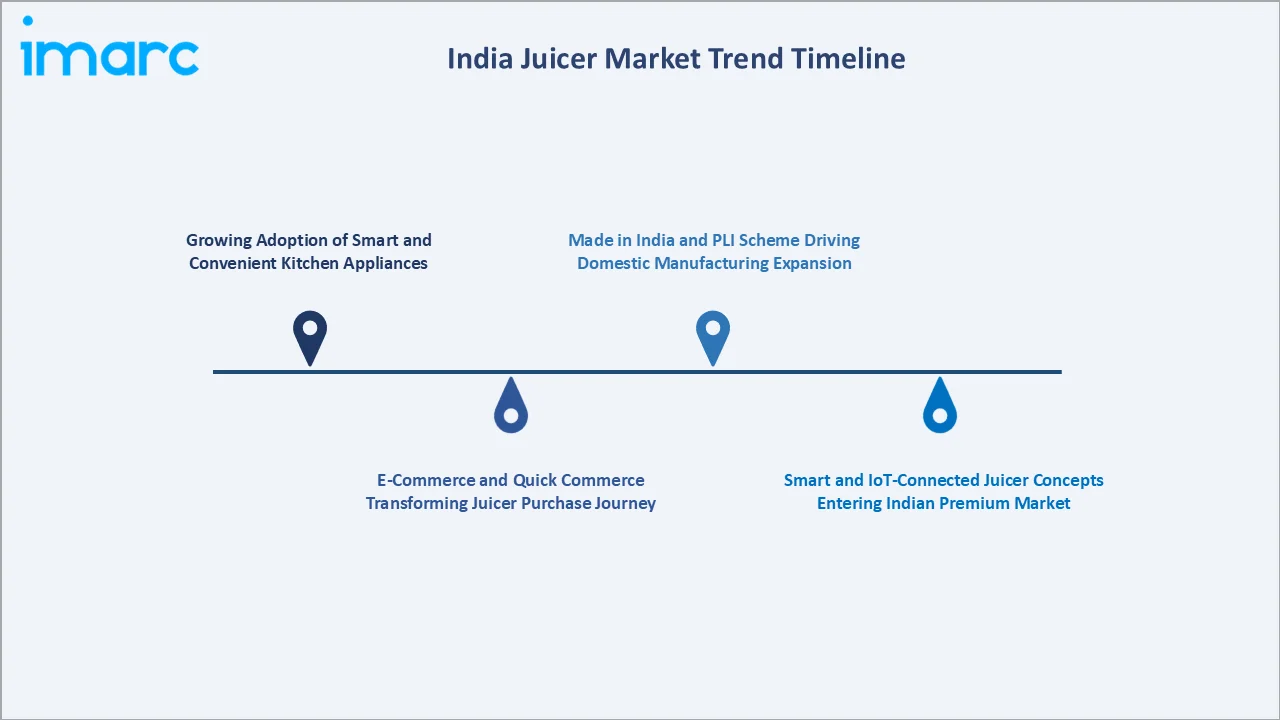
1. Growing Adoption of Smart and Convenient Kitchen Appliances
Increasingly busy lifestyles and growing health consciousness are encouraging households to adopt appliances that simplify fresh juice preparation. This trend is also prompting manufacturers to expand their portfolios with user-friendly, multifunctional, and efficient juicing solutions. In May 2026, Dylect strengthened its presence in India’s kitchen appliance segment by introducing a new range of products, including slow juicers and stand mixers. The portfolio expansion reflects the lifestyle technology brand’s focus on addressing the growing demand for smart, convenient, and user-friendly kitchen solutions. The launch also enables Dylect to cater to consumers increasingly seeking modern appliances that simplify everyday food and beverage preparation.
2. E-Commerce and Quick Commerce Transforming Juicer Purchase Journey
Amazon India and Flipkart have become the dominant juicer discovery and purchase channels for urban Indian consumers. Quick commerce penetration, with Blinkit and Zepto now offering same-day delivery on select Philips and Bajaj juicer models in major metros, is further compressing the purchase decision timeline and reducing friction for impulse and need-based juicer purchases.
3. Made in India and PLI Scheme Driving Domestic Manufacturing Expansion
The Government of India's PLI Scheme for White Goods is catalyzing a significant domestic manufacturing expansion among established Indian appliance brands, with Bajaj, Crompton, Havells, and Usha each investing in expanded domestic production capacity for kitchen appliances including juicers. This manufacturing localization trend is reducing component import dependency, improving supply chain resilience against global shipping disruptions, and enabling brands to offer more competitive pricing for the volume-segment juicer market while maintaining certification quality standards.
4. Smart and IoT-Connected Juicer Concepts Entering Indian Premium Market
Global smart kitchen appliance trends are beginning to manifest in India's premium juicer segment, with major brands testing IoT-connected juicer concepts that enable recipe guidance, juice nutrition tracking, and motor health monitoring through companion smartphone apps. While smart juicer penetration remains nascent in India, the category's development is accelerating as India's smartphone penetration rate provides the consumer technology foundation for connected appliance adoption. Premium consumers who have already purchased smart speakers and robot vacuum cleaners are the early adopter segment most receptive to smart juicer propositions.
Industry Value Chain Analysis
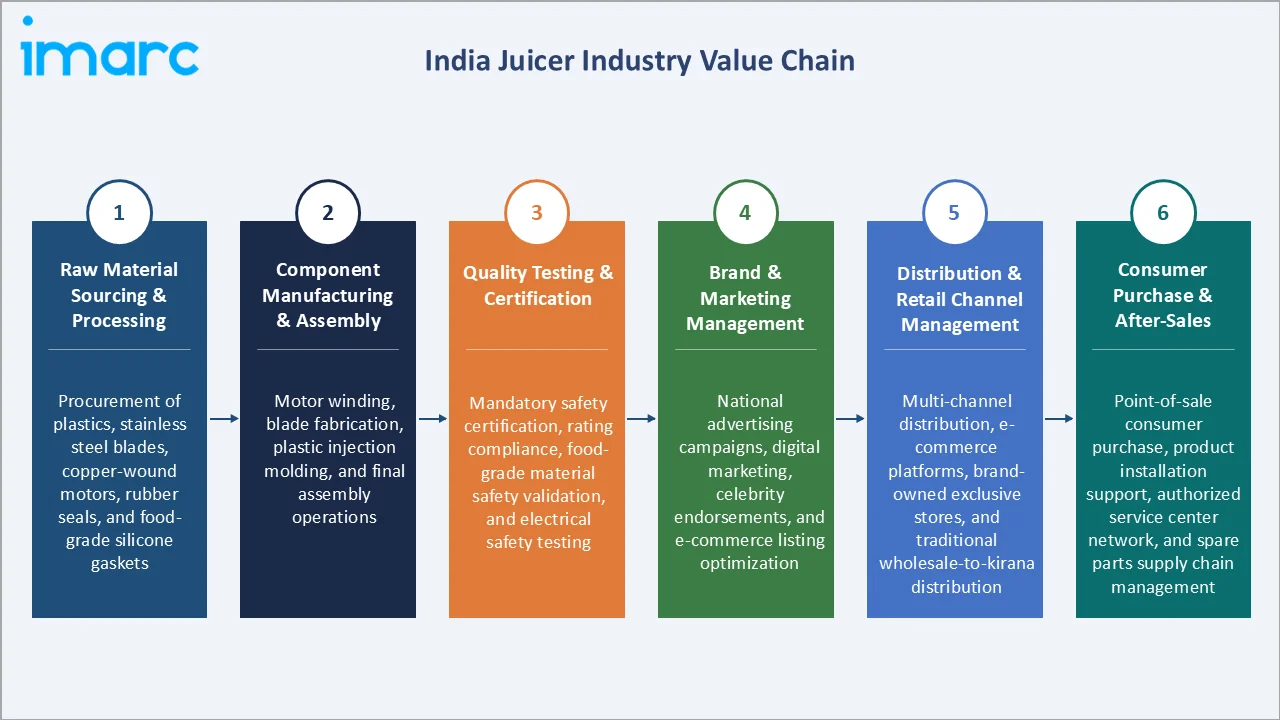
The India juicer market value chain encompasses six stages from raw material sourcing through consumer after-sales, with each stage representing distinct value creation and competitive differentiation opportunities.
|
Stage |
Description |
|
Raw Material Sourcing & Processing |
Procurement of plastics, stainless steel blades, copper-wound motors, rubber seals, and food-grade silicone gaskets. |
|
Component Manufacturing & Assembly |
Motor winding, blade fabrication, plastic injection molding, and final assembly operations. |
|
Quality Testing & Certification |
Mandatory safety certification, rating compliance, food-grade material safety validation, and electrical safety testing. |
|
Brand & Marketing Management |
National advertising campaigns, digital marketing, celebrity endorsements, and e-commerce listing optimization. |
|
Distribution & Retail Channel Management |
Multi-channel distribution, e-commerce platforms, brand-owned exclusive stores, and traditional wholesale-to-kirana distribution. |
|
Consumer Purchase & After-Sales |
Point-of-sale consumer purchase, product installation support, authorized service center network, and spare parts supply chain management. |
Brand and marketing management represents the highest value-creation stage in the India juicer market, where consumer trust building, heritage brand equity, and reputation for motor durability create consumer preference advantages that cannot be replicated through product specification matching alone.
Technology Landscape in the India Juicer Industry
Motor Technology and Power Efficiency Innovation
Juicer motor technology is the most critical product differentiation dimension in the India market, where consumers explicitly evaluate motor power as a proxy for juicing performance and durability. Indian consumer preference for high-motor-power juicers contrasts with European markets where efficiency and noise level are prioritized. Induction motor technology, increasingly replacing traditional universal motors in premium segments, offers superior longevity, lower noise, and better energy efficiency, making it the technology of choice for masticating juicers.
Cold-Press and Masticating Technology Advancement
Masticating and cold-press juicing technology has advanced significantly, with Korean innovators introducing wide-feeding-chute slow juicers that reduce juicing preparation time to near-equivalence with centrifugal juicers. Various models use upgraded slow-squeeze technology operating at 43-60 RPM to extract juice with minimum heat and oxidation, preserving heat-sensitive vitamins, enzymes, and phytonutrients at levels higher than centrifugal alternatives according to published nutritional comparison studies.
Digital and Smart Features Integration
Digital features are beginning to enter the India premium juicer segment through smartphone apps that provide recipe guidance and nutritional analysis for juices made with specific juicer models. While full IoT connectivity and cloud-connected juicer models remain at the pilot and concept stage for India in 2025, the successful adoption of smart features in adjacent kitchen appliances (smart rice cookers, smart air fryers) by Indian premium consumers provides a promising market development trajectory for connected juicer products in the 2026-2030 forecast period.
Market Segmentation Analysis
The report covers the following segments:
|
Segment Category |
Leading Segment |
Market Share |
Year |
|
Product |
Centrifugal Juicer |
52.5% |
2025 |
|
Technology |
Electric |
82.5% |
2025 |
|
Distribution Channel |
🔒 |
🔒 |
2025 |
|
Region |
West India |
29.5% |
2025 |

By Product
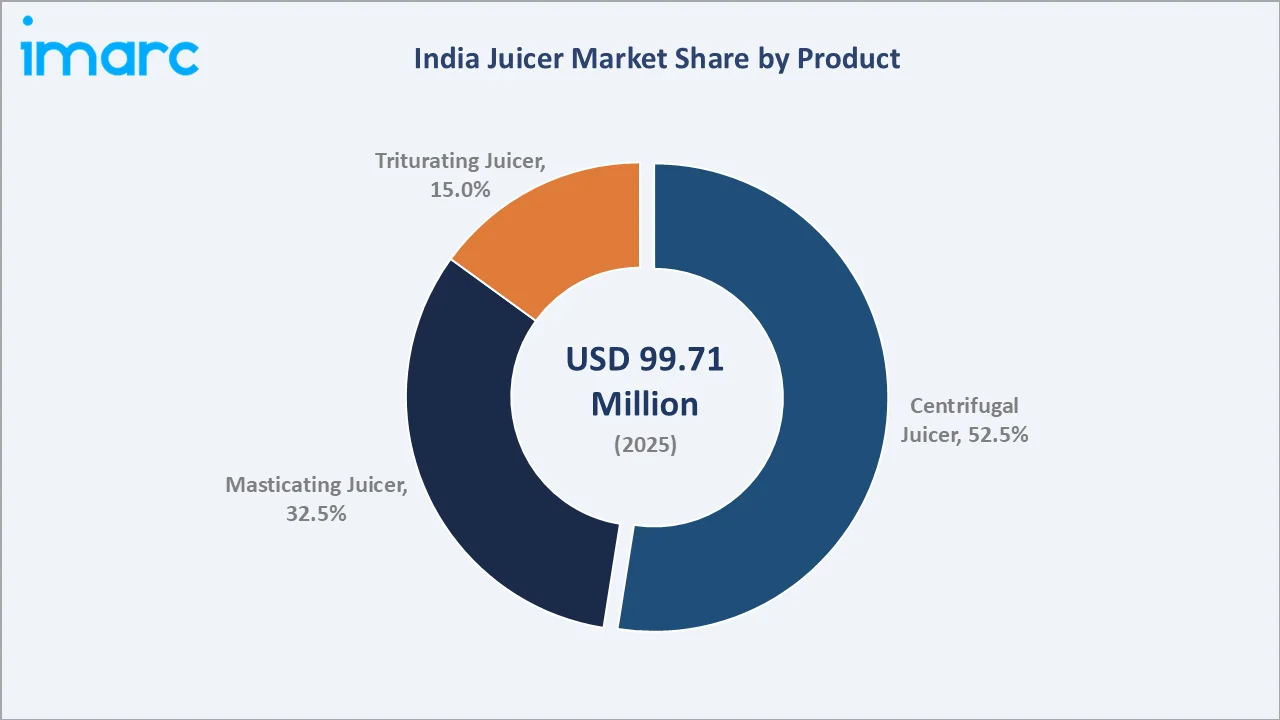
Centrifugal juicers command 52.5% in 2025, driven by their accessibility to the mass Indian consumer market through affordable pricing, fast extraction speed suited to India's household juicing occasions, wide availability across all organized retail and e-commerce channels, and strong brand support from mainstream centrifugal product ranges.
To access detailed market analysis, Request Sample
Masticating juicers at 32.5% represent the market's fastest-growing segment driven by cold-press health trend adoption, premium Korean brand marketing investment, and Indian brand participation. Triturating juicers at 15.0% serve the ultra-premium and professional segment with twin-gear extraction for maximum nutritional yield from leafy greens, wheatgrass, and hard vegetables.
By Technology
Electric juicers dominate at an 82.5% share in 2025, reflecting their convenience superiority over manual alternatives, broad availability across all price segments, and near-universal suitability for India's diverse household juicing requirements across fruits and vegetables. Electric juicers benefit from India's improving electricity supply reliability across urban and semi-urban markets, energy efficiency improvements reducing running cost concerns, and aggressive e-commerce promotion driving consumer upgrades from manual to electric alternatives.
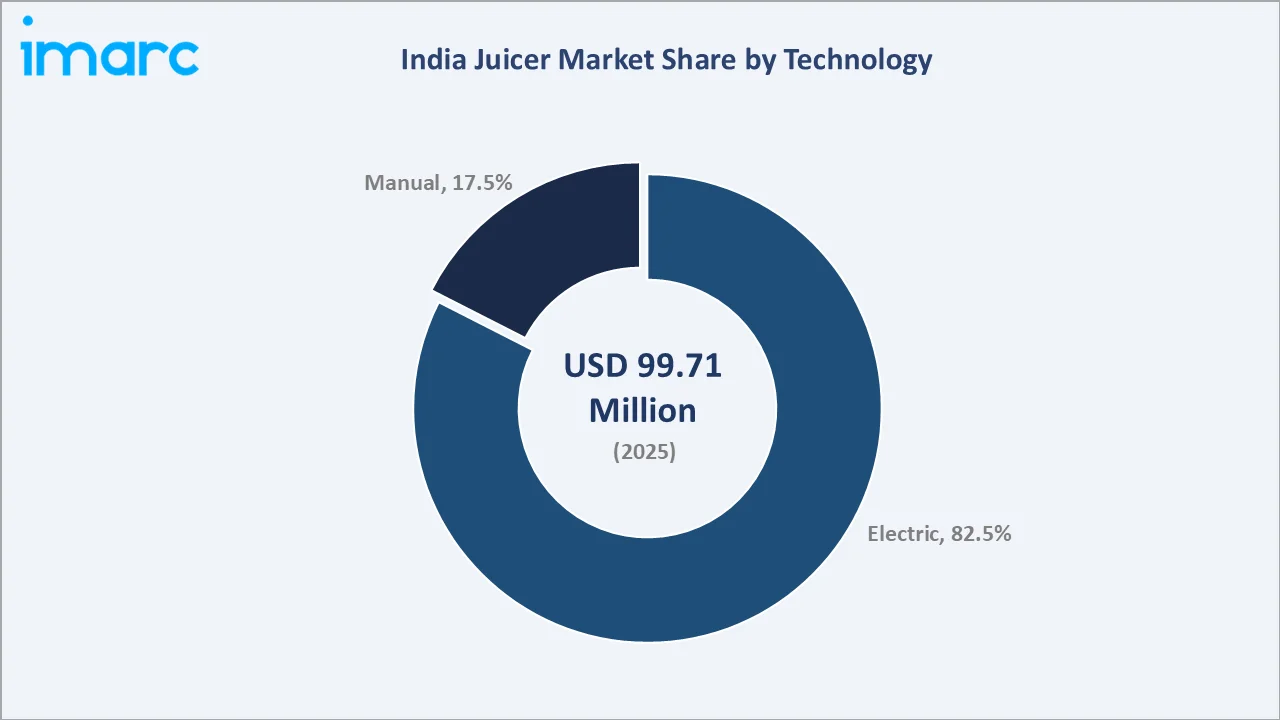
Manual juicers at 17.5% serve dedicated citrus squeezing occasions (lemon, orange, sweet lime) in Indian households, juice bars, and restaurants that value simplicity, zero electricity requirement, and easy cleaning for single-fruit applications. Manual juicers are particularly prevalent in South Indian households for daily nimbu pani (lemon water) preparation and in small juice bars handling high-volume citrus applications.
Regional Market Insights
|
Region |
Share (2025) |
Key India Juicer Market Drivers & Characteristics |
|
West India |
29.5% |
West India leads through concentration of India's highest-income urban consumer clusters, and a large community with deep vegetarian and juice culture traditions generates strong per-household juicer demand. |
|
South India |
27.5% |
South India's strong juicer market position reflects the region's deep-rooted fresh fruit and vegetable juice consumption culture combined with South India's highest kitchen appliance electrification rates among Indian regions. |
|
North India |
24.5% |
North India's juicer market reflects a large, affluent urban consumer base combined with growing organized retail penetration, concentration of health-conscious millennial consumers, modern retail stores, and an active social media food and health influencer community. |
|
East India |
18.5% |
East India's share reflects the region's relative under-penetration of organized retail and lower per-capita appliance spending compared to Western and Southern India, with dominant juicer consumption hubs through its organized retail and e-commerce ecosystem. |
West India's 29.5% leadership reflects the structural advantage of India's two wealthiest states providing the highest combined consumer appliance spending base of any Indian region. Mumbai's organized retail consumer households represent India's single largest city-level premium kitchen appliance market, while Pune's rapidly growing IT and manufacturing professional population is driving strong premium and mid-segment juicer adoption.
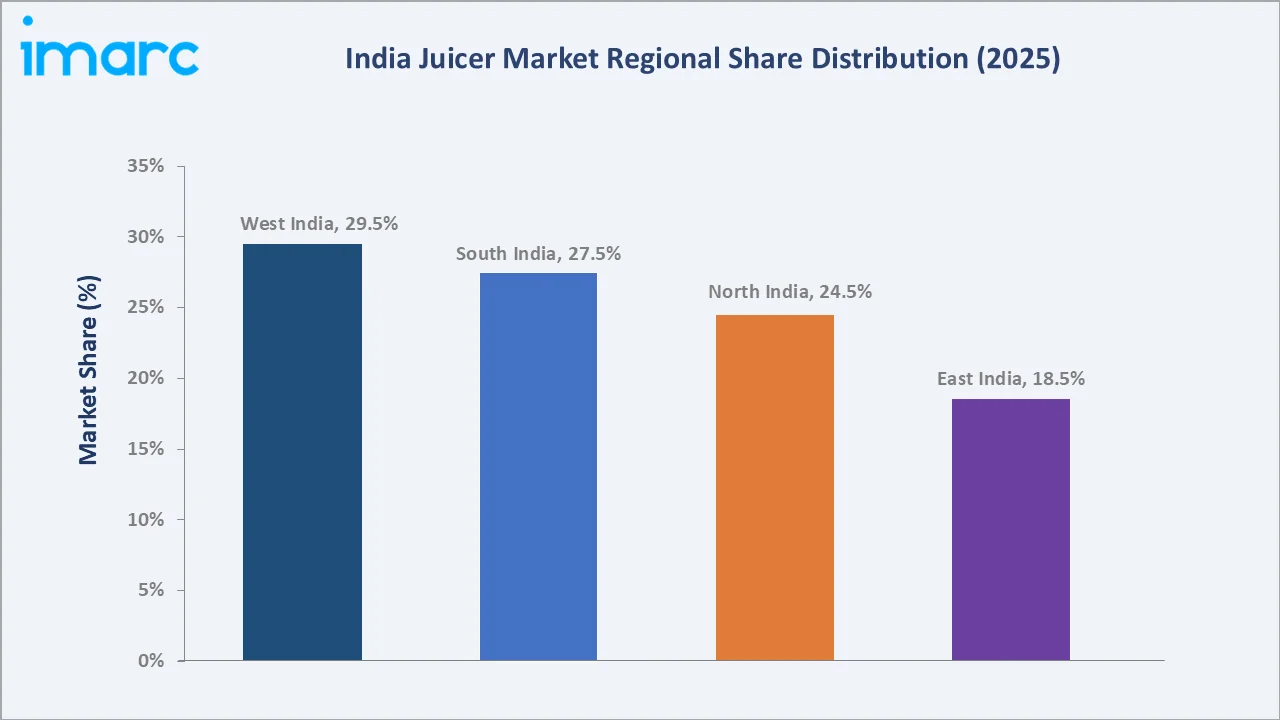
South India at 27.5% leverages Bangalore's IT-driven premium consumer base for cold-press and masticating juicer adoption, while Chennai, Hyderabad, and Kerala contribute substantial mass-market centrifugal juicer volumes. North India at 24.5% is growing through Delhi NCR's premium segment and UP's rapidly expanding e-commerce consumer base. East India at 18.5% remains the most underpenetrated region with the highest growth potential as organized retail and e-commerce infrastructure matures.
Competitive Landscape
The India juicer market features a mixed competitive landscape combining established Indian consumer appliance majors with global premium brands and Korean cold-press specialists alongside challenger Indian brands, creating a multi-tier competitive structure spanning entry-level to ultra-premium price points.
|
Company |
Key Brands |
Market Position |
Core Strength |
|
Koninklijke Philips N.V. |
Philips |
Market Leader |
Koninklijke Philips N.V. plays a major role in the Indian kitchen appliance market through its high-efficiency, user-friendly juicers and juicer-mixer-grinders designed specifically for local dietary habits. |
|
Bajaj Group |
Bajaj |
Market Leader |
The Bajaj Group plays a major role in India’s juicer and home appliance market through Bajaj Electricals Limited, offering reliable, budget-friendly, and multi-functional juicers and juicer mixer grinders. |
|
M/s Mittal Electronics |
Sujata |
Market Leader |
M/s Mittal Electronics is the original manufacturing and trademark-holding entity behind Sujata, a prominent Indian brand renowned for high-performance kitchen appliances. |
|
TTK Group |
Prestige |
Established Player |
The TTK Group, through its flagship company TTK Prestige Ltd., shapes the Indian juicer and kitchen appliance market by offering multi-functional juicer mixer grinders and centrifugal juicers. |
|
Usha International Ltd. |
Usha |
Established Player |
Usha International Ltd. plays a key role in the Indian juicer market by offering dependable, mid-priced centrifugal models and nutrient-preserving cold press juicers tailored for middle-class households. |
Competitive dynamics for juicer companies in India are being reshaped by e-commerce's growing share of organized sales, where product reviews, comparison shopping, and algorithm-driven discovery are reducing traditional brand awareness advantages and enabling challenger brands with competitive pricing and quality to gain market share rapidly.
Key Company Profiles
Koninklijke Philips N.V.
Koninklijke Philips N.V. is a global technology company with an established brand presence in India and experience across consumer-oriented product categories. In the India juicer market, the Philips brand offers juicing and food-preparation appliances designed around convenience, functionality, and ease of use. Its strong brand recognition, distribution reach, and focus on product innovation support its position in the Indian household appliance landscape.
- Key Brands: Philips
- Strategic Focus: Focuses on product innovation, consumer convenience, and efficient appliance performance to address evolving preferences in the India juicer market. The company emphasizes user-friendly designs, product quality, and broad market accessibility to strengthen its presence and cater to health-conscious consumers.
Bajaj Group
Bajaj Group is a diversified Indian business conglomerate with a well-established presence across multiple industries, including consumer electricals and household appliances. In the India juicer market, the group caters to household demand through a range of convenient and functional kitchen appliances. Its strong brand recognition, extensive distribution network, and understanding of domestic consumer preferences support its presence in the Indian juicer and kitchen appliance segment.
- Key Brands: Bajaj
- Strategic Focus: Strengthening its position through product innovation, affordability, and consumer-centric appliance designs. The group emphasizes expanding its kitchen appliance portfolio with efficient, durable, and easy-to-use products suited to diverse household requirements. It also leverages its extensive distribution network and established brand presence to improve product accessibility across urban and emerging regional markets.
Market Concentration Analysis
The India juicer market exhibits moderate-to-high concentration in the organized branded segment, with Koninklijke Philips N.V., Bajaj Group, M/s Mittal Electronics, TTK Group, and Usha International Ltd., collectively commanding an estimated 55-65% of organized market revenue. This concentration coexists with a substantial unorganized segment estimated at 20-25% of total market volume, comprising Chinese-sourced OEM products sold under local Indian private labels at entry price points on marketplace platforms.
Market dynamics are gradually fragmenting as e-commerce enables challenger brands with competitive products to gain consumer visibility without large offline distribution investments, with major brands gaining organized market share through e-commerce positioning at the expense of established brands' traditional distribution advantages.
Investment & Growth Opportunities
Highest Growth Segments
Masticating juicers (~8.1% CAGR), Tier-2 and Tier-3 city e-commerce channel expansion, cold-press juice bar commercial equipment, PLI-supported domestic motor and component manufacturing, smart IoT-connected juicer development, children's nutrition juicer accessories, and premium juicer brand building targeting India's premium household segment represent the highest-return investment opportunities in the India juicer market through 2034.
Investment Themes
- Premium Cold-Press and Masticating Juicer Brand Development: India's cold-press juicer category is in its early growth phase with strong organic consumer demand growth driven by health consciousness but limited domestic Indian brand supply. An Indian company developing a quality masticating juicer would address a significant price-accessibility gap in India's premium health appliance market.
- Tier-2 and Tier-3 City Organized Retail Expansion: India's largest Tier-2 cities represent an underserved organized kitchen appliance retail market where consumer incomes now support juicer purchases, but organized retail floor space and brand after-sales service presence remain limited. Investment in regional distributor partnerships, Tier-2 modern format retail participation, and Tier-2 city service center establishment would unlock significant incremental volume for brands with competitive mid-segment centrifugal juicer product ranges.
Future Market Outlook (2026-2034)
The India juicer market is projected to grow from USD 99.71 Million in 2025 to USD 106.27 Million in 2026, reaching USD 180.02 Million by 2034, exhibiting a CAGR of 6.58% during 2026-2034. The market is projected to reach a mid-period anchor value of USD 137.13 Million by 2030, a milestone that will coincide with masticating juicers surpassing high product share for the first time, driven by Indian brand launches in the cold-press segment, social media health content continuing to drive cold-press consumer awareness, and e-commerce channel financing options making premium juicers accessible to aspirational mid-income urban consumers for the first time.
Three transformative forces will shape the India juicer market through 2034. First, the premiumization acceleration will generate above-GDP value growth even as unit volume growth normalizes. Second, the Tier-2 and Tier-3 city market penetration expansion will add new juicer consumer households to the addressable India market by 2030. Third, the convergence of smart home technology adoption with health appliance connectivity will catalyze the development of AI-personalized juicing experiences, with smart juicers that integrate with health monitoring apps, provide personalized recipe recommendations based on nutritional goals and seasonal ingredient availability, and enable remote appliance management through voice assistants, creating the next generation of premium juicer value proposition.
Research Methodology
Primary Research
Primary research comprised structured interviews with India juicer brand product managers, category buyers from leading organized retail chains, e-commerce category managers from Amazon India and Flipkart, authorized service center operators, and independent kitchen appliance dealers across Mumbai, Delhi, Bangalore, Chennai, and Kolkata. Consumer demand pattern validation was conducted through structured surveys with urban Indian household respondents across income brackets.
Secondary Research
Secondary research incorporated certification database analysis for juicer product registrations, rating compliance data, PLI scheme participation records, IMARC Group proprietary kitchen appliance market databases, Amazon India and Flipkart product listing and review data analysis, company annual reports and investor presentations, and domestic appliance import-export data.
Forecasting Models
Market forecasting employed bottom-up product category and technology segment revenue modeling combined with top-down India appliance market macroeconomic correlation analysis. Inputs included Indian household income distribution projections, urban population growth forecasts, e-commerce penetration trajectory modeling, PLI scheme manufacturing cost reduction impact quantification, and competitive landscape pricing dynamics analysis.
India Juicer Market Report Coverage:
| Report Features | Details |
|---|---|
| Base Year of the Analysis | 2025 |
| Historical Period | 2020-2025 |
| Forecast Period | 2026-2034 |
| Units | Million USD |
| Scope of the Report | Exploration of Historical Trends and Market Outlook, Industry Catalysts and Challenges, Segment-Wise Historical and Future Market Assessment:
|
| Products Covered | Centrifugal Juicer, Masticating Juicer, Triturating Juicer |
| Technologies Covered | Electric, Manual |
| Distribution Channels Covered | Supermarkets and Hypermarkets, Specialty Stores, Online, Others |
| Regions Covered | North India, South India, East India, West India |
| Comapnies Covered | Koninklijke Philips N.V., Bajaj Group, M/s Mittal Electronics, TTK Group, Usha International Ltd., etc. |
| Customization Scope | 10% Free Customization |
| Post-Sale Analyst Support | 10-12 Weeks |
| Delivery Format | PDF and Excel through Email (We can also provide the editable version of the report in PPT/Word format on special request) |
Key Benefits for Stakeholders:
- IMARC’s industry report offers a comprehensive quantitative analysis of various market segments, historical and current market trends, market forecasts, and dynamics of the India juicer market from 2020-2034.
- The research report provides the latest information on the market drivers, challenges, and opportunities in the India juicer market.
- Porter's five forces analysis assist stakeholders in assessing the impact of new entrants, competitive rivalry, supplier power, buyer power, and the threat of substitution. It helps stakeholders to analyze the level of competition within the India juicer industry and its attractiveness.
- Competitive landscape allows stakeholders to understand their competitive environment and provides an insight into the current positions of key players in the market.
Frequently Asked Questions About the India Juicer Market Report
The India juicer market reached USD 106.27 Million in 2026, driven by rising health consciousness among urban consumers, e-commerce expansion enabling Tier-2 city access, masticating cold-press juicer category growth, and PLI scheme-supported domestic appliance manufacturing expansion.
The India juicer market is projected to grow at a CAGR of 6.58% during 2026-2034, driven by premiumization from centrifugal to masticating juicers, Tier-2 and Tier-3 city market penetration through e-commerce, electric technology adoption replacing manual alternatives, and growing urban middle-class disposable income supporting kitchen appliance upgrades.
The market is projected to reach USD 137.13 Million by 2030, the mid-period anchor milestone when masticating juicers are expected to surpass high product share for the first time as Indian brands launch competitive cold-press products and e-commerce financing options make premium juicers accessible to a broader urban consumer base.
Centrifugal juicers lead with a 52.5% share in 2025, driven by affordable pricing, fast extraction speed suited to Indian household juicing occasions, wide availability across all organized retail and e-commerce channels, and strong brand support.
Electric technology dominates with an 82.5% share in 2025, reflecting convenience superiority over manual alternatives, broad price segment availability, near-universal applicability for Indian household juicing requirements, and aggressive e-commerce promotion driving consumer upgrades from manual citrus squeezers to electric alternatives.
West India leads with a 29.5% share in 2025, driven by concentration of India's highest-income urban consumer clusters, strong juice culture traditions in vegetarian communities, and the most developed organized retail and e-commerce appliance purchase ecosystem.
Key players include Koninklijke Philips N.V., Bajaj Group, M/s Mittal Electronics, TTK Group, and Usha International Ltd., among others.
The market is projected to reach USD 180.02 Million by 2034, driven by sustained premiumization toward masticating and cold-press juicers, Tier-2 and Tier-3 city penetration through e-commerce, smart IoT-connected juicer adoption, and new juicer consumer households added through improved appliance accessibility.
Key investment opportunities include premium cold-press and masticating juicer brand development targeting the price gap below Korean specialists, PLI-supported domestic motor and component manufacturing for import substitution, Tier-2 and Tier-3 city organized retail expansion, and smart IoT-connected juicer development targeting India's growing premium smart home consumer segment.
Need more help?
- Speak to our experienced analysts for insights on the current market scenarios.
- Include additional segments and countries to customize the report as per your requirement.
- Gain an unparalleled competitive advantage in your domain by understanding how to utilize the report and positively impacting your operations and revenue.
- For further assistance, please connect with our analysts.
 Request Customization
 Speak to an Analyst
 Request Brochure
 Inquire Before Buying
Benefits of Customization
- Personalize this research
- Triangulate with your data
- Get data as per your format and definition
- Gain a deeper dive into a specific application, geography, customer, or competitor
- Any level of personalization
Get in Touch With Us
UNITED STATES
Phone: +1-201-971-6302
INDIA
Phone: +91-120-433-0800
UNITED KINGDOM
Phone: +44-753-714-6104
Email: [email protected]
Client Testimonials





















Related Reports

Choose your plan
*Please note that the prices mentioned below are starting prices for each bundle type. Kindly contact our team for further details.*
Single User License
- 1 User License, Access on 2 Devices
- PDF Report + Excel Dataset (Password Protected)
- Lifetime Access
- No Printing Rights
- 10% Free Report Customization
- 10–12 Weeks of Analyst Support
Five User License
- Access for 5 Users, 2 Devices per User
- PDF Report + Excel Dataset (Password Protected)
- Lifetime Access
- Dedicated Account Manager
- 12–14 Weeks of Analyst Support
- No Printing Rights
- 15% Free Report Customization
- 25% Discount on Your Next Purchase
Corporate User License
- Unlimited User Access (Within Your Organization)
- PDF Report + Excel Dataset
- Lifetime Access
- Dedicated Account Manager
- 14–20 Weeks of Analyst Support
- No Printing Rights
- 20% Free Report Customization
- 30% Discount on Your Next Purchase
Essential Insights
What's included:
3 reports
- Lifetime Access
- PDF Reports
- Excel Datasets
- 2 Weeks of Free Analyst Support
- 2 User Licenses
- Access on 2 Devices
- Printing Rights
- Complimentary PowerPoint (PPT) Version
- Complimentary License Upgrade
Professional Access
What's included:
5 reports
- Lifetime Access
- PDF Reports
- Excel Datasets
- 8 Weeks of Free Analyst Support
- 2 User Licenses
- Access on 2 Devices
- Printing Rights
- Complimentary PowerPoint (PPT) Version
- Complimentary License Upgrade
Business Advantage
What's included:
8 reports
- Lifetime Access
- PDF Reports
- Excel Datasets
- 14 Weeks of Free Analyst Support
- 2 User Licenses
- Access on 2 Devices
- Printing Rights
- Complimentary PowerPoint (PPT) Version
- Complimentary License Upgrade
Enterprise Intelligence
What's included:
10 reports
- Lifetime Access
- PDF Reports
- Excel Datasets
- 20 Weeks of Free Analyst Support
- 2 User Licenses
- Access on 2 Devices
- Printing Rights
- Complimentary PowerPoint (PPT) Version
- Complimentary License Upgrade