
India Machine Vision Systems Market Size, Share, Trends and Forecast by Component, Product, End-User Industry, and Region, 2026-2034
India Machine Vision Systems Market Summary:
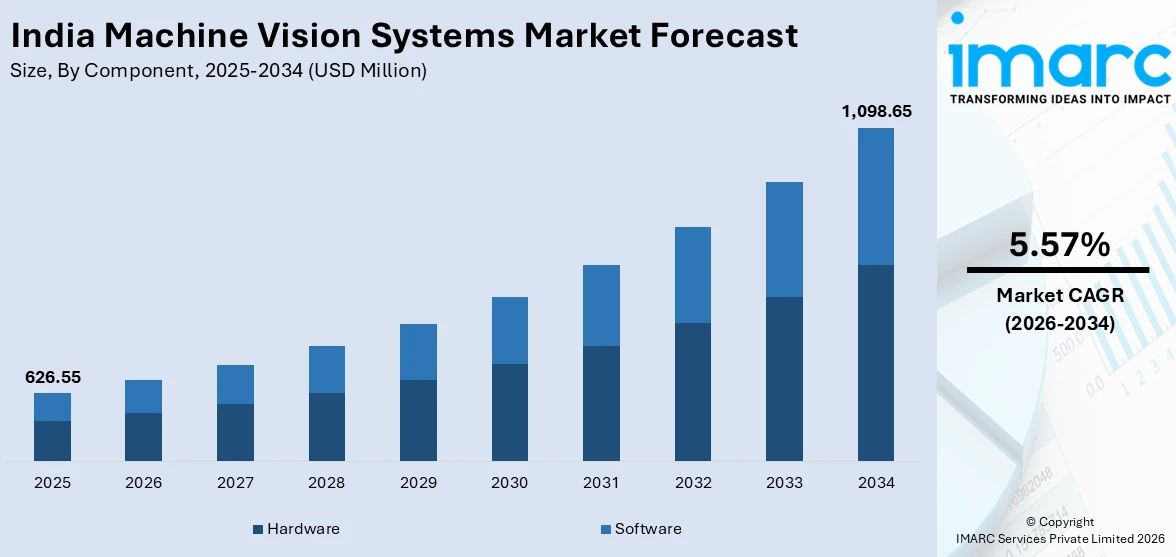
The India machine vision systems market size was valued at USD 626.55 Million in 2025 and is projected to reach USD 1,098.65 Million by 2034, growing at a compound annual growth rate of 5.57% from 2026-2034.
The India machine vision systems market is expanding rapidly as manufacturing industries embrace automation, artificial intelligence, and advanced imaging technologies to enhance quality control and operational efficiency. Government programs promoting digital transformation and smart manufacturing are creating a favorable ecosystem for technology adoption. Rising demand for precision inspection across automotive, electronics, pharmaceutical, and food processing sectors is accelerating the integration of vision-based solutions, strengthening the India machine vision systems market share.
Key Takeaways and Insights:
- By Component: Hardware dominates the market with a share of 68.0% in 2025, driven by widespread deployment of high-resolution cameras, advanced optics, and specialized illumination systems essential for precision inspection across manufacturing facilities.
- By Product: Smart camera-based leads the market with a share of 48.0% in 2025, owing to their superior processing power, flexibility in handling complex algorithms, and scalability for multi-camera configurations in demanding industrial environments.
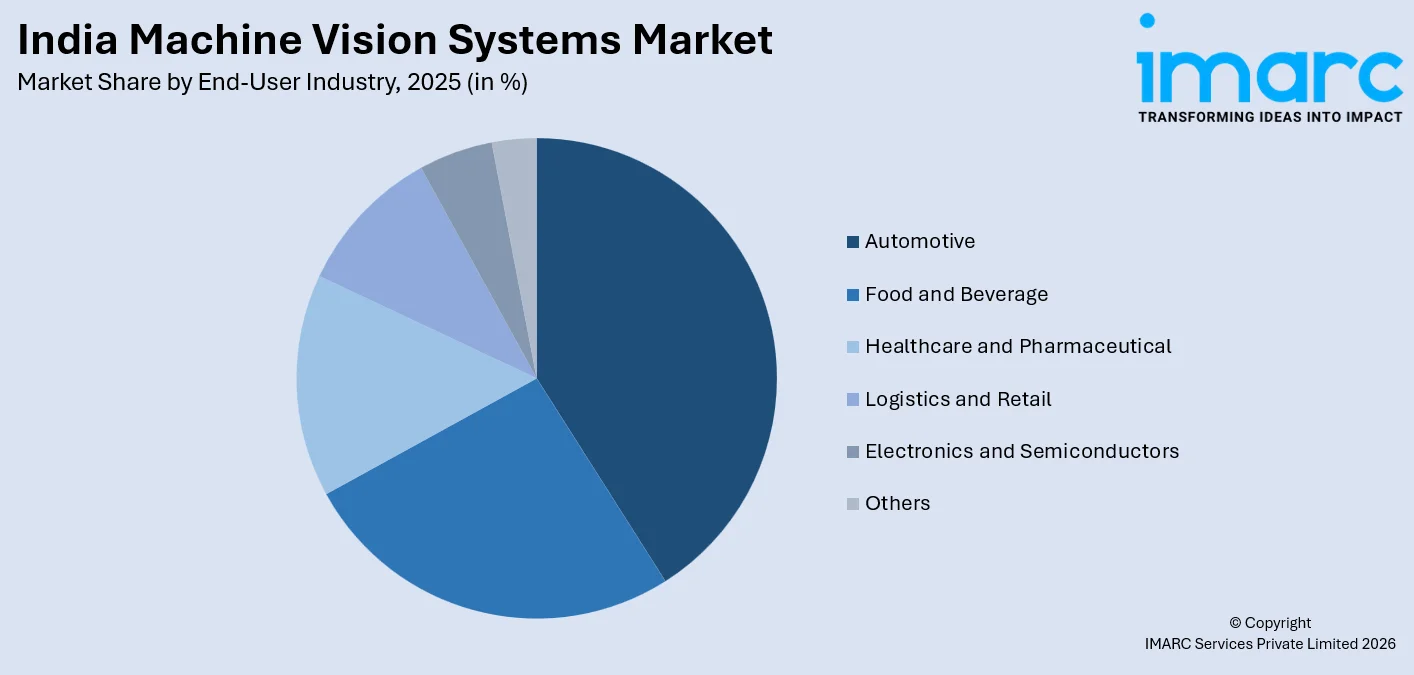
- By End-User Industry: Automotive represents the largest segment with a market share of 41.0% in 2025, reflecting stringent quality requirements for defect detection, dimensional measurement, and assembly verification across vehicle manufacturing lines.
- By Region: West India leads the market with a share of 38.0% in 2025, supported by concentrated manufacturing activity in Maharashtra and Gujarat, where robust automotive, pharmaceutical, and electronics production clusters drive demand for automated inspection solutions.
- Key Players: The India machine vision systems market features a moderately competitive landscape, with established global technology providers and emerging domestic solution integrators actively expanding their product portfolios, investing in AI-enhanced capabilities, and forging strategic partnerships to strengthen market positioning across high-growth industrial verticals.
To get more information on this market Request Sample
The India machine vision systems market is advancing as industries transition toward smart manufacturing and zero-defect production models. Increasing adoption of deep learning algorithms and AI-driven inspection platforms is enabling manufacturers to detect microscopic flaws, optimize assembly processes, and ensure regulatory compliance with greater accuracy. The convergence of machine vision with robotics and the Industrial Internet of Things is further expanding application scope across diverse sectors. India's government has committed substantial resources to advancing artificial intelligence capabilities, with the IndiaAI mission allocating INR 10,371.92 crore over five years to strengthen the national AI ecosystem, including procurement of high-performance computing infrastructure. This investment environment is bolstering the development of localized machine vision solutions, supporting academic-industry research collaborations, and enabling faster deployment of intelligent inspection technologies in manufacturing hubs across the country.
India Machine Vision Systems Market Trends:
Integration of Deep Learning and AI in Visual Inspection
The adoption of deep learning-powered machine vision systems is transforming quality inspection workflows across Indian manufacturing plants. Convolutional neural networks now enable automated defect detection at submillimeter precision, significantly reducing dependence on manual visual assessment. These AI-driven platforms adapt to complex and variable inspection environments, improving accuracy over time through continuous learning. For instance, in February 2023, Bengaluru-based deep-tech startup CynLr developed a visual object intelligence platform enabling robotic arms to recognize and handle previously unseen objects, and opened a 13,000 square-foot research and development (R&D) facility equipped with 16 robot research cells, bolstering India machine vision systems market growth.
Rising Demand for 3D Machine Vision Technologies
Three-dimensional machine vision systems are gaining significant traction as industries require advanced spatial analysis for intricate measurements and complex surface inspections. These systems generate high-resolution point clouds and depth data, enabling precise volumetric analysis and dimensional verification in applications ranging from bin picking to component alignment. The 3D segment is growing faster than the overall market, driven by the electronics, automotive, and lithium battery manufacturing sectors. For instance, in March 2025, Zebra Technologies completed its acquisition of Photoneo, a leading developer of 3D machine vision sensors utilizing parallel structured light technology, expanding its portfolio for applications in automotive manufacturing and logistics.
Expansion of Vision-Guided Robotics in Manufacturing
The integration of machine vision with industrial robotics is accelerating as manufacturers seek flexible, adaptive automation solutions that can handle variable production requirements. Vision-guided robots equipped with intelligent cameras and real-time image processing capabilities are being deployed for precision tasks including pick-and-place operations, assembly verification, and automated sorting. This trend reflects a broader shift toward universal factory concepts where single production lines can be reconfigured for multiple product types. As a result, manufacturers are achieving higher operational efficiency, improved quality control, and reduced dependency on manual inspection processes.
Market Outlook 2026-2034:
The India machine vision systems market is poised for sustained expansion as the convergence of Industry 4.0 technologies, government-backed digitalization programs, and rising quality assurance standards drives adoption across manufacturing verticals. Increasing investment in semiconductor fabrication, electronics assembly, and electric vehicle production is expected to create substantial demand for advanced inspection and guidance solutions. The proliferation of edge computing and AI-optimized hardware is enabling real-time processing at the factory floor, reducing latency and improving decision-making speed. The market generated a revenue of USD 626.55 Million in 2025 and is projected to reach a revenue of USD 1,098.65 Million by 2034, growing at a compound annual growth rate of 5.57% from 2026-2034.
India Machine Vision Systems Market Report Segmentation:
| Segment Category | Leading Segment | Market Share |
|---|---|---|
|
Component |
Hardware |
68.0% |
|
Product |
Smart Camera-Based |
48.0% |
|
End-User Industry |
Automotive |
41.0% |
|
Region |
West India |
38.0% |
Component Insights:
- Hardware
- Vision Systems
- Cameras
- Optics and Illumination Systems
- Frame Grabbers
- Others
- Software
Hardware dominates with a market share of 68.0% of the total India machine vision systems market in 2025.
The hardware segment's leadership reflects the critical role of physical imaging components in enabling accurate visual data capture for industrial inspection and automation applications. High-resolution cameras, precision optics, specialized lighting systems, and frame grabbers form the foundational infrastructure of any machine vision deployment. Indian manufacturers are investing heavily in upgrading imaging hardware to support increasingly sophisticated AI-driven analysis, with demand particularly strong in the automotive and electronics sectors, where micron-level accuracy is essential for quality assurance.
The continuous miniaturization of electronic components and increasing product complexity are intensifying the need for high-resolution imaging sensors and advanced lighting solutions. As manufacturing tolerances become tighter, industries are upgrading inspection systems to ensure greater accuracy and consistency. Major industrial clusters across India are actively modernizing production lines with sophisticated machine vision hardware to support precision-driven quality control. The introduction of advanced three-dimensional laser-based sensing technologies for non-contact inspection further reflects the growing emphasis on real-time measurement, enhanced defect detection, and improved manufacturing reliability across high-tech industries.
Product Insights:
- PC-Based
- Smart Camera-Based
Smart camera-based leads the market with a share of 48.0% of the total India machine vision systems market in 2025.
Smart camera-based systems lead the India machine vision systems market due to their compact, all-in-one architecture that integrates image sensors, processors, lighting control, and software within a single device. This design eliminates the need for complex multi-component setups, making installation faster and reducing system integration costs. Manufacturers, particularly small and mid-scale enterprises, prefer these solutions because they require minimal technical expertise and limited infrastructure. Their plug-and-play capability allows factories to quickly deploy vision inspection, barcode reading, and quality control functions without extensive customization.
Another key factor driving the adoption of smart camera-based systems is their suitability for India’s rapidly expanding automation landscape across sectors such as automotive, electronics, food processing, and pharmaceuticals. These systems provide reliable inspection, defect detection, and traceability while occupying minimal floor space, which is valuable in compact production facilities. In addition, advancements in embedded processing, artificial intelligence, and connectivity enable smart cameras to deliver real-time data analysis and integration with industrial networks, supporting manufacturers’ transition toward Industry 4.0 and smarter production environments.
End-User Industry Insights:
Access the comprehensive market breakdown Request Sample
- Food and Beverage
- Healthcare and Pharmaceutical
- Logistics and Retail
- Automotive
- Electronics and Semiconductors
- Others
Automotive represents the largest share at 41.0% of the total India machine vision systems market in 2025.
The automotive industry's leadership in machine vision adoption stems from the sector's rigorous quality standards and the need for high-speed, non-contact inspection across complex manufacturing processes. Machine vision systems are deployed for surface defect detection on vehicle bodies, dimensional measurement of engine components, paint quality verification, and automated assembly validation. As India's automotive sector expands into electric vehicle production, inspection complexity is increasing due to advanced battery systems and electronic components that require precision verification.
The growing emphasis on zero-defect manufacturing and export-quality standards is further intensifying demand for automated visual inspection in Indian automotive plants. Vision-guided robotic systems are increasingly used for tasks such as weld inspection, gasket placement verification, and component alignment. For instance, in April 2024, Mitsubishi Electric inaugurated a 15,400 square-metre factory automation systems plant in Maharashtra with a USD 2.2 billion investment, producing inverters and automation products for the automotive and industrial sectors, reinforcing the infrastructure that supports machine vision deployment.
Regional Insights:
- North India
- South India
- East India
- West India
West India represents the highest revenue with a 38.0% share of the total India machine vision systems market in 2025.
West India's market leadership is anchored in Maharashtra and Gujarat, which host some of the country's most concentrated manufacturing ecosystems spanning automotive, pharmaceutical, chemical, and electronics industries. Mumbai and Pune serve as major industrial automation hubs, with a well-established network of system integrators and technology providers facilitating machine vision adoption. The region's proximity to major ports and export processing zones further incentivizes quality assurance investments, as manufacturers serving international markets require automated inspection to meet global compliance standards.
The expanding pharmaceutical manufacturing base in western India is significantly boosting demand for machine vision systems, particularly for applications such as packaging verification, label inspection, and contamination detection. As regulatory standards become increasingly stringent, manufacturers are investing in automated inspection technologies to ensure compliance and product integrity. The region also benefits from a strong ecosystem of automation-focused trade platforms and industry bodies that promote awareness and technology adoption. Furthermore, government-backed manufacturing incentive initiatives are accelerating factory modernization, encouraging wider deployment of advanced automation and vision-based inspection solutions across key industrial sectors.

Market Dynamics:
Growth Drivers:
Why is the India Machine Vision Systems Market Growing?
Accelerating Industry 4.0 Adoption Across Manufacturing Sectors
The high usage of Industry 4.0 technologies in the Indian manufacturing industry is producing a tremendous demand for machine vision systems as a fundamental facilitator of smart factory processes. The intersection of cyber-physical systems, IoT connectivity, and big data analytics necessitates complex visual inspection ability to view real-time data, automated quality control, and process optimization based on data. Machine vision is the main linking factor between real-life production settings and online intelligent systems, making it possible to perform predictive maintenance or make autonomous decisions. The India Industry 4.0 market size reached USD 5.6 Billion in 2024. Looking forward, IMARC Group expects the market to reach USD 17.4 Billion by 2033, exhibiting a growth rate (CAGR) of 12.40% during 2025-2033, driven by growing reliance on advanced automation technologies including machine vision, robotics, and edge computing.
Government Initiatives Promoting AI and Digital Transformation
The Indian government's strategic emphasis on artificial intelligence and digital infrastructure development is creating a supportive regulatory and investment environment for machine vision technology adoption. Programs such as Digital India and Make in India have established policy frameworks that encourage manufacturing modernization and technology integration across industrial sectors. These initiatives are further strengthened by dedicated artificial intelligence programs that support machine vision development through improved computing infrastructure and expanded research capabilities. Government-led digital transformation efforts are fostering the creation of robust digital ecosystems, enabling industries to deploy advanced automation technologies more effectively. Investments in high-performance computing, data platforms, and connectivity infrastructure are enhancing the scalability and integration of machine vision systems across manufacturing, logistics, and other industrial applications, thereby accelerating the country’s transition toward intelligent and digitally enabled production environments.
Expanding Automotive and Electronics Manufacturing Base
The sustained growth of India's automotive and electronics manufacturing sectors is generating strong demand for machine vision systems to maintain product quality and production efficiency at scale. These industries require high-precision inspection for complex components, surface defect detection, and dimensional verification, making automated visual inspection essential for meeting both domestic and international quality standards. The expansion into electric vehicle production and advanced electronics assembly is further increasing the complexity of inspection requirements, driving adoption of more sophisticated vision technologies. For instance, in April 2024, Rockwell Automation announced the establishment of a 98,000 square-foot facility in Chennai, scheduled to open in the first half of 2025, enhancing local manufacturing capabilities, automation solutions, and supply chain resilience for Indian industrial customers.
Market Restraints:
What Challenges the India Machine Vision Systems Market is Facing?
High Initial Investment and Implementation Costs
The substantial upfront capital required for procuring and deploying machine vision systems presents a significant barrier, particularly for small and medium-sized enterprises. The costs encompass high-resolution cameras, precision optics, specialized lighting, processing hardware, and software licensing, along with expenses for system integration, customization, and operator training. This financial burden limits broader market penetration among price-sensitive manufacturers.
Shortage of Skilled Machine Vision Professionals
The limited availability of qualified professionals with expertise in machine vision system design, implementation, and maintenance constrains market growth. The technology demands interdisciplinary knowledge spanning optics, imaging, software programming, and industrial automation. Training and retaining skilled vision engineers remains challenging as demand outpaces the supply of trained personnel from academic institutions.
Limited Domestic Hardware Manufacturing Capabilities
India's reliance on imported machine vision hardware components, including industrial cameras, specialized sensors, and precision optics, creates supply chain vulnerabilities and increases total system costs. The absence of a robust domestic manufacturing ecosystem for core vision components means that procurement timelines and costs are subject to international trade dynamics and currency fluctuations.
Competitive Landscape:
The India machine vision systems market exhibits a moderately fragmented competitive structure, with established multinational technology companies maintaining strong positions through advanced product portfolios, extensive service networks, and deep domain expertise. These global players compete alongside a growing cohort of Indian deep-tech startups and system integrators that are developing localized, cost-effective solutions tailored to domestic manufacturing requirements. Competition is intensifying around AI-enhanced inspection capabilities, cloud-based vision platforms, and 3D imaging technologies, as companies seek to differentiate through software intelligence and application versatility. Strategic partnerships between automation vendors and end-user industries are reshaping market dynamics, while investments in research and development facilities within India are strengthening local innovation capacity.
Recent Developments:
- August 2025: Hikrobot India introduced its latest machine vision and robotics innovations at Automation Expo 2025 in Mumbai, debuting the 3D Laser Profile Sensor based on laser triangulation technology and the ID3000 Series Smart Code Reader with liquid lens technology, alongside a range of smart cameras and autonomous mobile robots for industrial applications.
- November 2024: CynLr, an Indian deep-tech robotics startup based in Bengaluru, raised USD 10 million in Series A funding to scale its CyRo visual robot platform, expand its robotics laboratory, and grow its team, with plans to achieve manufacturing capacity of one robot system per day by 2027.
India Machine Vision Systems Market Report Coverage:
| Report Features | Details |
|---|---|
| Base Year of the Analysis | 2025 |
| Historical Period | 2020-2025 |
| Forecast Period | 2026-2034 |
| Units | Million USD |
| Scope of the Report |
Exploration of Historical Trends and Market Outlook, Industry Catalysts and Challenges, Segment-Wise Historical and Future Market Assessment:
|
| Components Covered |
|
| Products Covered | PC-Based, Smart Camera-Based |
| End User Industries Covered | Food and Beverages, Healthcare and Pharmaceutical, Logistics and Retail, Automotive, Electronics and Semiconductors, Others |
| Regions Covered | North India, South India, East India, West India |
| Customization Scope | 10% Free Customization |
| Post-Sale Analyst Support | 10-12 Weeks |
| Delivery Format | PDF and Excel through Email (We can also provide the editable version of the report in PPT/Word format on special request) |
Frequently Asked Questions About the India Machine Vision Systems Market Report
The India machine vision systems market size was valued at USD 626.55 Million in 2025.
The India machine vision systems market is expected to grow at a compound annual growth rate of 5.57% from 2026-2034 to reach USD 1,098.65 Million by 2034.
Hardware, holding the largest share of 68.0% in 2025, dominates the India machine vision systems market, driven by the essential role of cameras, optics, illumination systems, and frame grabbers in enabling accurate visual data capture for industrial inspection and automation applications.
Key factors driving the India machine vision systems market include accelerating Industry 4.0 adoption, government initiatives promoting AI and digitalization, expanding automotive and electronics manufacturing, rising quality assurance standards, and increasing integration of deep learning technologies in industrial inspection.
Major challenges include high initial investment and implementation costs, shortage of skilled machine vision professionals, limited domestic hardware manufacturing capabilities, integration complexity with existing production lines, and the need for extensive customization across different industry applications.
Need more help?
- Speak to our experienced analysts for insights on the current market scenarios.
- Include additional segments and countries to customize the report as per your requirement.
- Gain an unparalleled competitive advantage in your domain by understanding how to utilize the report and positively impacting your operations and revenue.
- For further assistance, please connect with our analysts.
 Request Customization
 Speak to an Analyst
 Request Brochure
 Inquire Before Buying
Benefits of Customization
- Personalize this research
- Triangulate with your data
- Get data as per your format and definition
- Gain a deeper dive into a specific application, geography, customer, or competitor
- Any level of personalization
Get in Touch With Us
UNITED STATES
Phone: +1-201-971-6302
INDIA
Phone: +91-120-433-0800
UNITED KINGDOM
Phone: +44-753-714-6104
Email: [email protected]
Client Testimonials




.webp)




.webp)













Related Reports

Choose your plan
*Please note that the prices mentioned below are starting prices for each bundle type. Kindly contact our team for further details.*
Single User License
- 1 User License, Access on 2 Devices
- PDF Report + Excel Dataset (Password Protected)
- Lifetime Access
- No Printing Rights
- 10% Free Report Customization
- 10–12 Weeks of Analyst Support
Five User License
- Access for 5 Users, 2 Devices per User
- PDF Report + Excel Dataset (Password Protected)
- Lifetime Access
- Dedicated Account Manager
- 12–14 Weeks of Analyst Support
- No Printing Rights
- 15% Free Report Customization
- 25% Discount on Your Next Purchase
Corporate User License
- Unlimited User Access (Within Your Organization)
- PDF Report + Excel Dataset
- Lifetime Access
- Dedicated Account Manager
- 14–20 Weeks of Analyst Support
- No Printing Rights
- 20% Free Report Customization
- 30% Discount on Your Next Purchase
Essential Insights
What's included:
3 reports
- Lifetime Access
- PDF Reports
- Excel Datasets
- 2 Weeks of Free Analyst Support
- 2 User Licenses
- Access on 2 Devices
- Printing Rights
- Complimentary PowerPoint (PPT) Version
- Complimentary License Upgrade
Professional Access
What's included:
5 reports
- Lifetime Access
- PDF Reports
- Excel Datasets
- 8 Weeks of Free Analyst Support
- 2 User Licenses
- Access on 2 Devices
- Printing Rights
- Complimentary PowerPoint (PPT) Version
- Complimentary License Upgrade
Business Advantage
What's included:
8 reports
- Lifetime Access
- PDF Reports
- Excel Datasets
- 14 Weeks of Free Analyst Support
- 2 User Licenses
- Access on 2 Devices
- Printing Rights
- Complimentary PowerPoint (PPT) Version
- Complimentary License Upgrade
Enterprise Intelligence
What's included:
10 reports
- Lifetime Access
- PDF Reports
- Excel Datasets
- 20 Weeks of Free Analyst Support
- 2 User Licenses
- Access on 2 Devices
- Printing Rights
- Complimentary PowerPoint (PPT) Version
- Complimentary License Upgrade