
India Oyster Market Size, Share, Trends and Forecast by Oyster Type, End User, Packaging Form, and Region, 2026-2034
India Oyster Market Size, Share, Trends & Forecast (2026-2034)
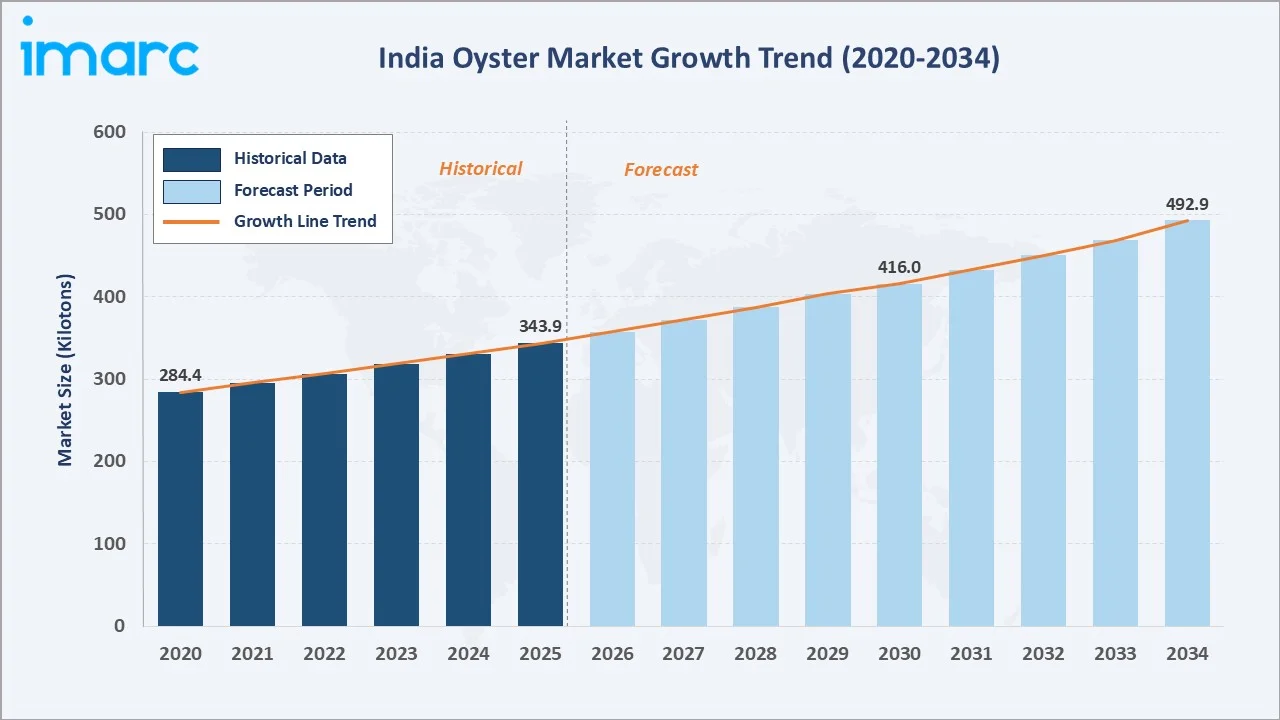
The India oyster market reached 343.9 Kilotons in 2025 and is projected to reach 492.9 Kilotons by 2034, growing at a CAGR of 3.88% during 2026-2034. The market is driven by rising seafood consumption and expanding aquaculture infrastructure. India’s per capita annual consumption of fish exceeded 13 kg in 2022–23 and is projected to rise toward 21.4 kg by 2031. This growing appetite for seafood is supporting the India oyster market, as consumers gradually shift toward premium, nutrient-rich shellfish products. Cupped oyster leads oyster type at 42.6%. Retail dominates end-user at 58.7%. South India leads regionally at 43.8%.
Market Snapshot
|
Metric |
Value |
|
Market Volume (2025) |
343.9 Kilotons |
|
Forecast Market Volume (2034) |
492.9 Kilotons |
|
CAGR (2026-2034) |
3.88% |
|
Base Year |
2025 |
|
Historical Period |
2020-2025 |
|
Forecast Period |
2026-2034 |
|
Dominant Oyster Type |
Cupped Oyster (42.6%, 2025) |
|
Dominant End-User |
Retail (58.7%, 2025) |
|
Leading Region |
South India (43.8%, 2025) |
The India oyster market has demonstrated steady volumetric growth, increasing from 284.4 Kilotons in 2020 to 343.9 Kilotons in 2025, reflecting expanding aquaculture production, growing domestic seafood consumption, and progressive modernization of India's coastal fisheries sector. The market is projected to reach 416.0 Kilotons by 2030 and further grow to 492.9 Kilotons by 2034, supported by government aquaculture development programs, rising urban consumer demand for fresh seafood, and expanding oyster export opportunities.
To get more information on this market, Request Sample
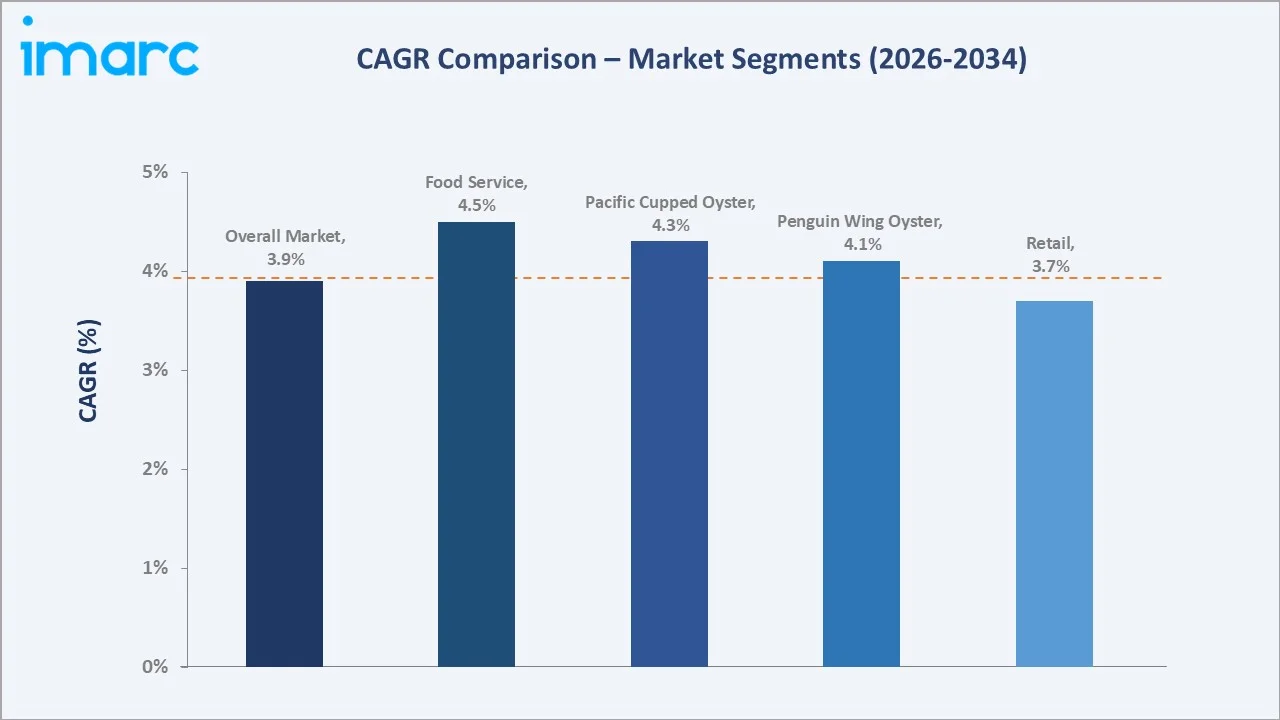
Food service leads segment CAGR at ~4.5% through expanding premium restaurant and hotel seafood menu demand. Pacific cupped oyster grows at ~4.3% CAGR through aquaculture expansion programs. Penguin wing oyster grows at ~4.1% CAGR through pearl and seafood industry diversification.
Executive Summary
The India oyster market is witnessing steady growth, supported by India's vast 7,516.6 km coastline providing extensive aquaculture potential, growing domestic demand for protein-rich seafood, and the government initiatives accelerating aquaculture development. Rising health consciousness among Indian consumers, growing awareness of oysters' nutritional benefits, including high zinc, omega-3, and protein content, and increasing adoption of oysters in premium restaurant and hotel menus are collectively expanding the market's consumer base beyond traditional coastal communities.
Cupped oyster at 42.6% leads through dominant aquaculture production volumes. Retail at 58.7% leads end-user through direct consumer purchase dominance. South India leads regionally at 43.8% through its coastal aquaculture infrastructure.
Key Market Insights
|
Insight |
Data |
|
Dominant Oyster Type |
Cupped Oyster – 42.6% share (2025) |
|
Leading End-User |
Retail – 58.7% market share (2025) |
|
Leading Region |
South India – 43.8% share (2025) |
|
Market Opportunity |
PMMSY-linked aquaculture expansion; premium oyster menus; pearl and mother-of-pearl value addition; oyster export market development; processed and packaged oyster product retail |
Key Analytical Observations Supporting the Above Data:
- Cupped Oyster at 42.6%: Cupped oysters dominate India's oyster market as the most cultivated species in Indian coastal aquaculture systems, particularly along Kerala, Goa, and Karnataka coastlines. The cupped oyster's adaptability to Indian estuarine and coastal environments, high growth rate in tropical water conditions, and suitability for both fresh consumption and processed applications make it the preferred commercial aquaculture species.
- Retail at 58.7%: Retail dominates as fresh oysters sold directly through wet markets, fish landing centers, and increasingly through urban seafood specialty stores and online seafood delivery platforms represent the primary oyster sales channel in India.
- South India at 43.8%: South India leads due to Kerala's status as one of India's leading oyster-producing states, with extensive backwater and coastal estuary systems supporting thriving cupped oyster aquaculture.
India Oyster Market Overview
The India oyster market encompasses the cultivation, harvesting, processing, distribution, and consumption of oysters across diverse species including cupped oyster, Pacific cupped oyster, American cupped oyster, penguin wing oyster, and other pearl and edible oyster species. The market covers both edible oyster production for food consumption and pearl oyster cultivation for pearl and mother-of-pearl production.
Oysters are distributed through fresh live, fresh shucked, frozen, and canned packaging channels serving retail wet markets, organized grocery retail, online seafood platforms, and food service establishments. India's coastline provides diverse estuarine, brackish, and marine aquaculture habitats supporting varied oyster cultivation systems including raft culture, longline culture, and natural bed harvesting. Government programs are progressively formalizing India's oyster sector from artisanal gathering toward organized commercial aquaculture.
Market Dynamics
To evaluate market opportunities, Request Sample
Market Drivers
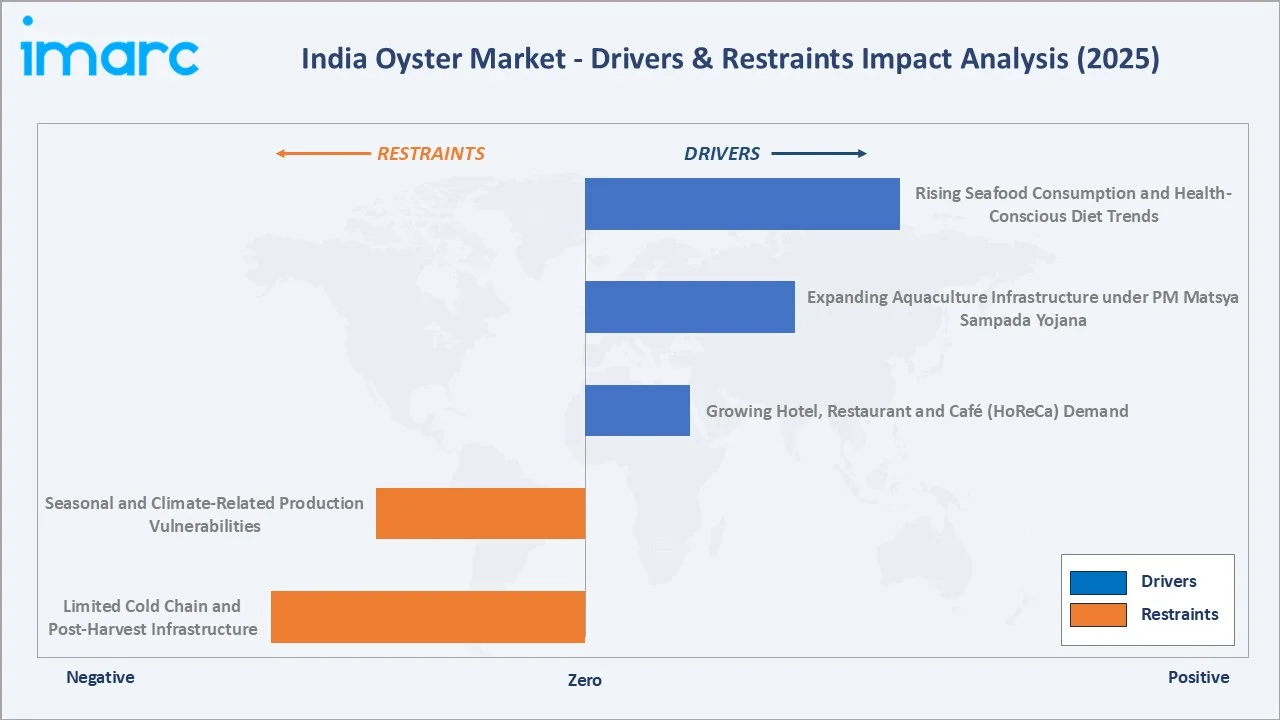
- Rising Seafood Consumption and Health-Conscious Diet Trends: India’s fish production increased substantially from 95.79 lakh tonnes in FY 2013–14 to 197.75 lakh tonnes in FY 2024–25, representing 106% growth over the period. The country’s average aquaculture productivity has risen to 4.77 tonnes per hectare. The sharp increase in fish production and improved aquaculture productivity is expanding seafood availability across India, supporting higher per capita consumption and broader access to protein-rich food options. At the same time, growing consumer preference for high-protein, omega-3-rich, and nutrient-dense diets is strengthening demand for seafood, including premium categories such as oysters.
- Expanding Aquaculture Infrastructure under PM Matsya Sampada Yojana: The Pradhan Mantri Matsya Sampada Yojana (PMMSY) scheme, with an outlay of INR 20,050 Crore for FY 2020-21 to FY 2025-26, has significantly accelerated oyster aquaculture infrastructure development across coastal states, including hatchery establishment grants, cage and raft cultivation support, cold chain infrastructure subsidies, and training programs for coastal fishing communities.
- Growing Hotel, Restaurant and Café (HoReCa) Demand: India's growing hospitality and food service sector is creating increasing demand for premium fresh oysters to serve health-conscious, affluent, and internationally traveled consumers seeking fine dining seafood experiences. Coastal resort destinations including Goa, Kerala backwaters, and Andaman Islands feature oysters prominently on menus, while urban premium restaurants in Mumbai, Delhi, Bengaluru, and Hyderabad are increasingly including oysters in their seafood offerings. Growing oyster bar culture among India's young urban professional demographic is creating new high-margin distribution channels.
Market Restraints
- Seasonal and Climate-Related Production Vulnerabilities: India's oyster production is highly sensitive to monsoon patterns, water temperature fluctuations, and cyclone events that periodically damage raft and longline cultivation infrastructure along coastal states. Climate change-driven ocean acidification poses a long-term systemic risk to oyster shell development and hatchery survival rates, representing a structural vulnerability requiring adaptive aquaculture management that many small-scale farmers are not yet equipped to implement.
- Limited Cold Chain and Post-Harvest Infrastructure: Fresh oysters are highly perishable, creating significant logistical challenges for distributing oyster production beyond coastal markets to India's large inland urban consumer base. Limited refrigerated transport capacity, insufficient cold storage facilities at landing centers, and inadequate last-mile cold chain infrastructure for fresh shellfish create substantial post-harvest losses and restrict oyster market reach to production sites without specialized logistics investment.
Market Opportunities
- Value-Added Processed Oyster Product Development: Processing oysters into smoked, canned, dried, marinated, and ready-to-eat formats dramatically extends shelf life from days to months, enabling inland market penetration and export distribution beyond fresh oyster geographic constraints. Value-added oyster processing represents a significant economic opportunity for coastal processing entrepreneurs and organized seafood companies investing in food safety-certified oyster processing infrastructure.
- Online Seafood Retail and Direct-to-Consumer Channels: The growth of online seafood retail platforms is creating new direct-to-consumer distribution channels enabling inland urban consumers to access fresh oysters previously unavailable in local wet markets. E-commerce platforms offering temperature-controlled overnight delivery are extending oysters' effective market geographic reach around production centers to all major urban centers within coastal production zones served by air and road freight.
Market Challenges
- Certification and Food Safety Compliance for Shellfish: Shellfish carry heightened food safety risks relative to finfish due to their filter-feeding biology, which can concentrate marine biotoxins, harmful bacteria (Vibrio species), and heavy metals from contaminated water. Stringent microbiological and chemical safety standards for shellfish require cultivation sites to operate in certified clean water zones and processing units to implement regulatory-compliant handling protocols.
- Market Price Volatility and Seasonal Supply Fluctuations: India's oyster wholesale prices fluctuate significantly between peak production seasons and lean seasons, creating economic uncertainty for farmers and supply inconsistency for food service buyers who require year-round reliable supply. The absence of organized price discovery mechanisms, commodity futures markets, or supply aggregation platforms for Indian oysters leaves farmers and buyers vulnerable to local supply-demand imbalances without risk management tools.
Emerging Market Trends
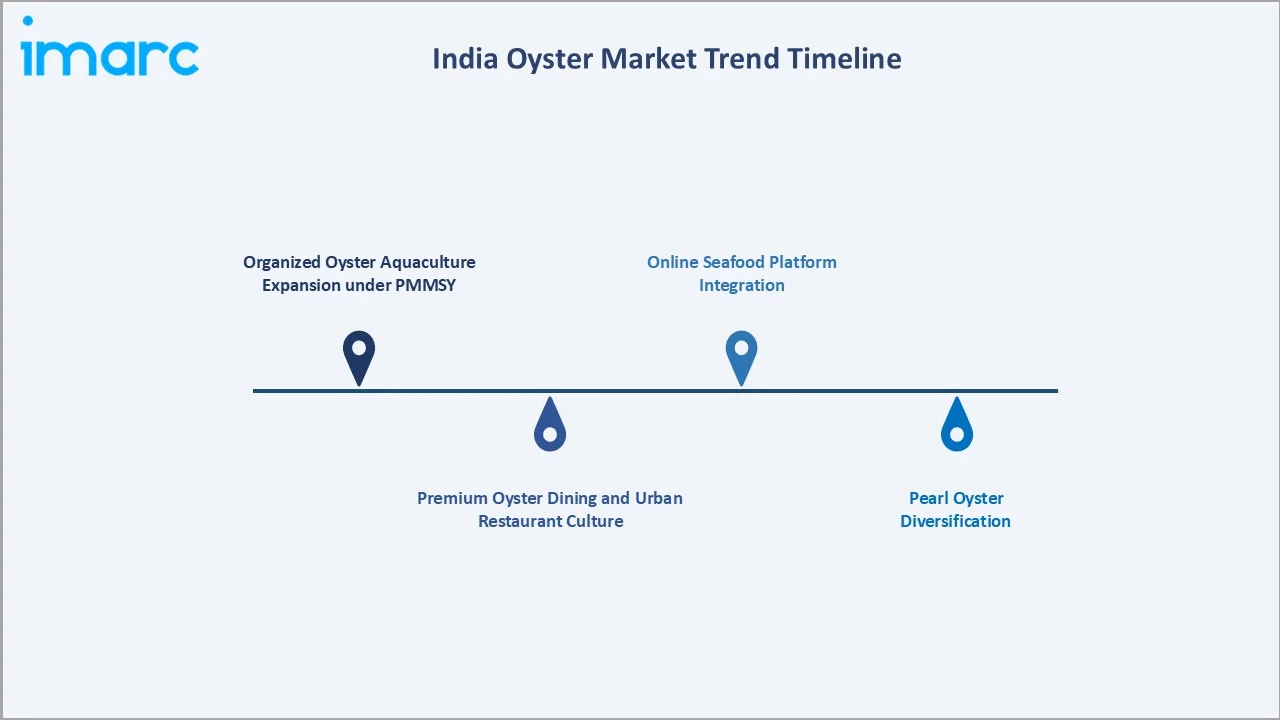
1. Organized Oyster Aquaculture Expansion under PMMSY
Government PMMSY scheme funding is accelerating the transformation of India's oyster sector from artisanal wild harvesting to organized cage and raft aquaculture systems. Kerala's model of organized oyster farming cooperatives is being replicated across Goa, Karnataka, Tamil Nadu, and Andhra Pradesh. Commercial hatchery expansion is enabling year-round spat supply, removing seasonal production bottlenecks that previously constrained oyster farming scale.
2. Premium Oyster Dining and Urban Restaurant Culture
India's growing urban affluent consumer segment is driving demand for premium fresh oyster dining experiences previously rare in Indian food culture. Specialty oyster bars, fine dining seafood restaurants, and resort destination oyster programs are creating high-value HoReCa distribution channels that command 5-10x farm-gate price premiums over wholesale market pricing. Social media-driven food culture and the aspiration economy among urban millennials and Gen Z consumers are making oyster consumption an aspirational experience associated with a coastal luxury lifestyle.
3. Online Seafood Platform Integration
Tech-enabled seafood e-commerce platforms are integrating oysters into their live and fresh seafood product portfolios, extending geographic distribution beyond coastal wet markets to major inland urban consumer centers. Improved temperature-controlled last-mile delivery logistics and consumer education about freshness validation are progressively addressing consumer hesitation around purchasing live shellfish online, creating a growing direct-to-consumer channel that bypasses traditional multi-tier middlemen and improves farmer margins.
4. Pearl Oyster Diversification
Pearl oyster diversification is emerging as a market trend as oyster farming increasingly expands beyond food consumption into pearl cultivation and livelihood generation. In March 2026, a pearl cultivation initiative based on oyster farming was launched in Kaulikura and Jalai gram panchayats under the Chandipur assembly constituency to generate sustainable livelihood opportunities for rural women and strengthen self-help group participation. The project followed a 45-day intensive training program, through which local women beneficiaries gained practical knowledge and skills in oyster-based pearl farming. Training programs and self-help group participation are encouraging rural producers to adopt pearl oyster farming, creating an additional revenue stream while improving the commercial utilization of oyster resources.
Industry Value Chain Analysis
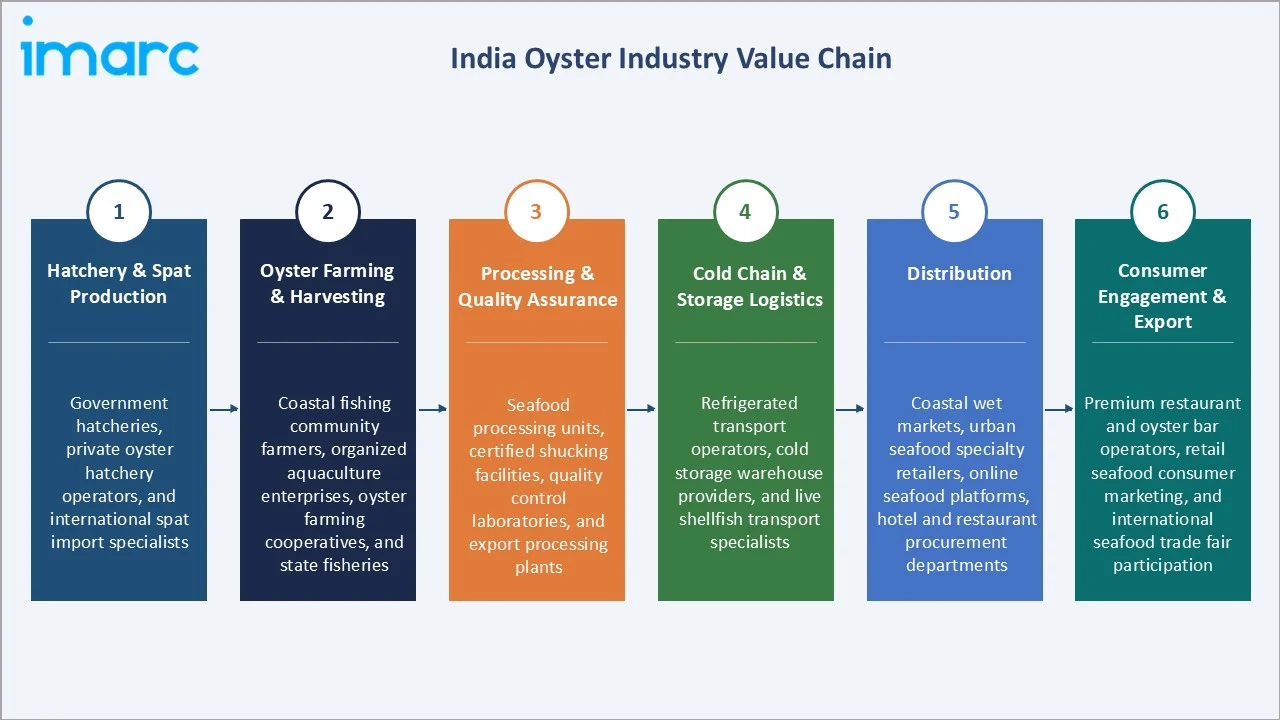
The India oyster market value chain integrates hatchery and spat production, oyster farming and harvesting, processing and quality assurance, cold chain and storage logistics, distribution through retail and food service channels, and consumer engagement and export.
|
Stage |
Key Participants |
|
Hatchery & Spat Production |
Government hatcheries, private oyster hatchery operators, and international spat import specialists. |
|
Oyster Farming & Harvesting |
Coastal fishing community farmers, organized aquaculture enterprises, oyster farming cooperatives, and state fisheries. |
|
Processing & Quality Assurance |
Seafood processing units, certified shucking facilities, quality control laboratories, and export processing plants. |
|
Cold Chain & Storage Logistics |
Refrigerated transport operators, cold storage warehouse providers, and live shellfish transport specialists. |
|
Distribution |
Coastal wet markets, urban seafood specialty retailers, online seafood platforms, hotel and restaurant procurement departments. |
|
Consumer Engagement & Export |
Premium restaurant and oyster bar operators, retail seafood consumer marketing, and international seafood trade fair participation. |
Oyster farming and harvesting represents the most volume-determinant stage in the India oyster market value chain, as it directly determines production volumes, oyster quality, species mix, and seasonal availability patterns. This phase's dependence on water quality, weather conditions, and farmer skill levels creates the primary production variability that cascades through all downstream distribution and processing stages.
Technology Landscape in the India Oyster Industry
Aquaculture Systems and Cultivation Technology
Modern oyster aquaculture in India employs raft culture, longline culture, and cage cultivation systems adapted from international best practices to India's coastal conditions. Automated grading and sorting equipment for uniform-size oyster production, critical for premium HoReCa market requirements, is being introduced at larger organized farms, improving product consistency and market value.
Food Safety and Quality Monitoring Technology
Regulatory compliance for shellfish safety requires microbiological monitoring of cultivation sites and production lots, chemical analysis for heavy metals and biotoxins, and cold chain temperature documentation throughout distribution. Rapid pathogen detection kits for Vibrio species are being introduced at processing facilities, reducing testing time from laboratory-dependent multi-day protocols to field-deployable rapid tests. IoT-enabled temperature data loggers for cold chain monitoring are being piloted by organized seafood companies to meet export market documentation requirements for shellfish temperature compliance records.
E-Commerce and Cold Chain Logistics
Live oyster delivery through temperature-controlled e-commerce platforms requires specialized packaging, including cool packs, oyster mesh bags, and instructional live oyster care materials, that organized online seafood retailers are developing in collaboration with oyster suppliers. Last-mile refrigerated delivery networks connecting coastal production zones to inland urban consumers are being built by seafood e-commerce startups, creating technology-enabled distribution infrastructure that traditional wet market channels cannot replicate for inland market penetration of fresh live oysters.
Market Segmentation Analysis
The report covers the following segments:
|
Segment Category |
Leading Segment |
Market Share |
Year |
|
Oyster Type |
Cupped Oyster |
42.6% |
2025 |
|
End User |
Retail |
58.7% |
2025 |
|
Packaging Form |
Fresh |
🔒 |
2025 |
|
Region |
South India |
43.8% |
2025 |

By Oyster Type
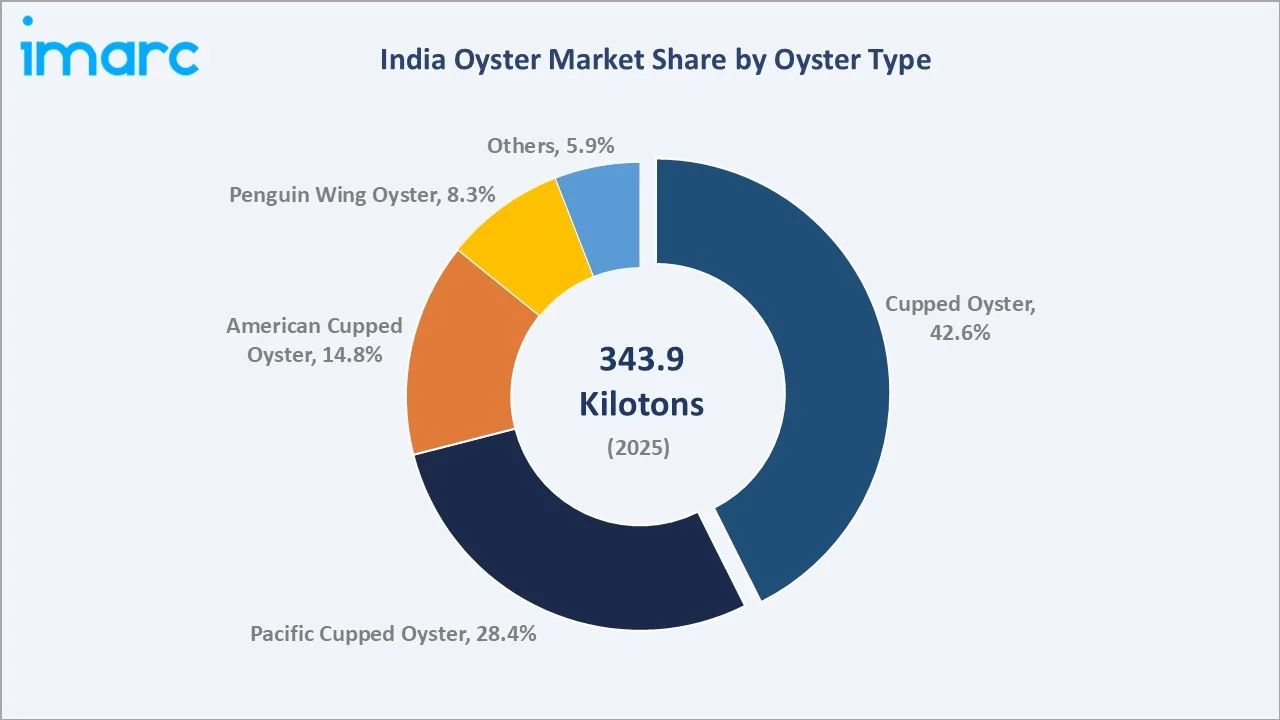
Cupped oyster leads at 42.6% (2025), reflecting its dominance in India's coastal aquaculture systems, particularly in Kerala, Goa, and Karnataka, where Crassostrea species farming is well-established with organized hatchery support and government technical assistance.
To access detailed market analysis, Request Sample
Pacific cupped oyster accounts for 28.4% (2025), representing India's growing adoption of the globally dominant aquaculture oyster species valued for its rapid growth and mild flavor suited to premium dining. American cupped oyster holds 14.8% (2025). Penguin wing oyster accounts for 8.3% (2025), cultivated primarily for pearl production. Others represent 5.9% (2025).
By End-User
Retail dominates at 58.7% (2025), encompassing direct consumer purchases through coastal wet markets, fresh seafood stalls at fish landing centers, urban seafood specialty stores, and growing online seafood delivery platforms. Retail's dominant share reflects India's cultural tradition of household seafood cooking in coastal communities, where oysters are purchased fresh for home preparation rather than consumed in food service settings.
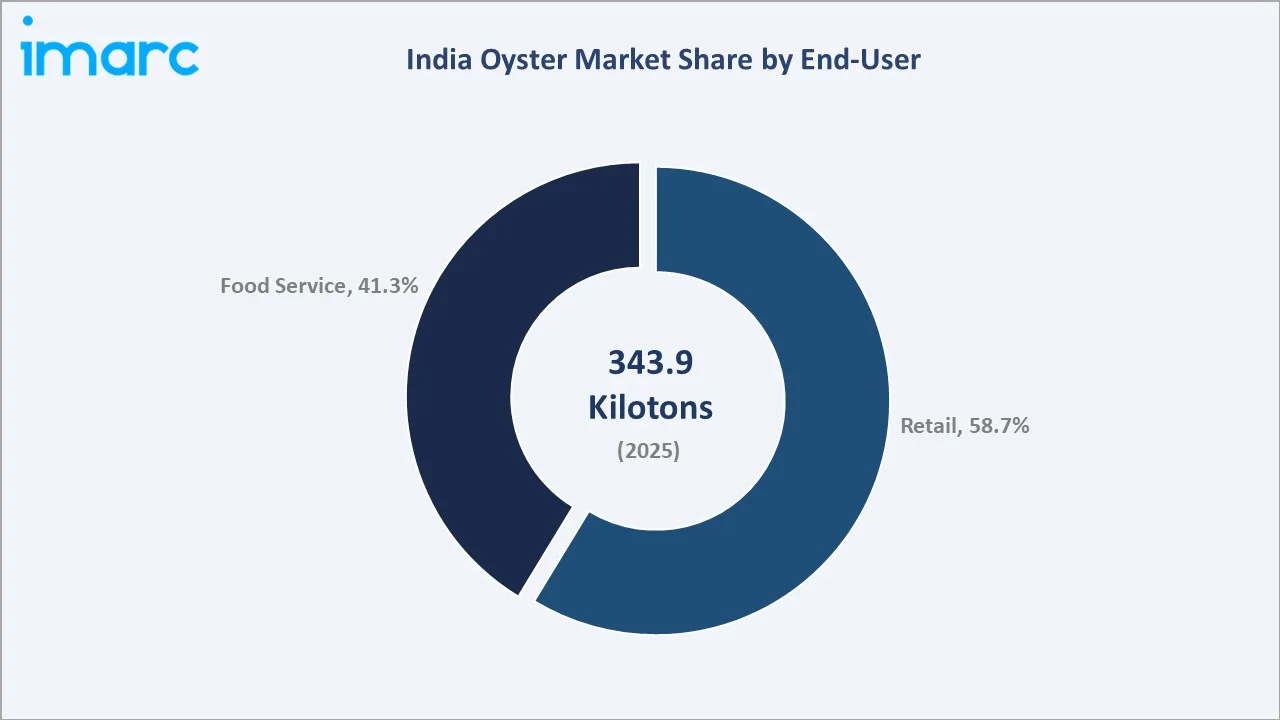
Food service accounts for 41.3% (2025), representing oyster demand from premium hotels, restaurants, resorts, and food courts. Growing HoReCa adoption of oysters in coastal tourism destinations including Goa, Kerala, and Andaman Islands, combined with urban fine dining restaurant seafood menu expansion, is driving the food service segment's above-market growth rate relative to retail.
Regional Market Insights
|
Region |
Share (2025) |
Key India Oyster Market Drivers & Characteristics |
|
South India |
43.8% |
Largest market driven by Kerala's extensive backwater and coastal estuary oyster farming infrastructure, and Tamil Nadu and Andhra Pradesh aquaculture development. |
|
West & Central India |
24.6% |
Driven by Goa's thriving oyster culture embedded in the state's coastal tourism and seafood restaurant ecosystem, Maharashtra's growing organized oyster aquaculture, and backwater oyster farming programs. |
|
North India |
18.1% |
Growing inland consumer market for imported and transported fresh and frozen oysters serving premium hotels, international restaurants, and urban seafood specialty retailers. |
|
East India |
13.5% |
Production and consumption driven by West Bengal's coastal and estuarine oyster harvesting, Odisha's expanding aquaculture sector, and traditional shellfish consumption. |
South India's 43.8% dominance reflects Kerala's unmatched position as one of India's oyster aquaculture hubs, with the state's extensive network of backwaters, coastal lagoons, and estuaries providing optimal cultivation conditions for cupped oyster species.
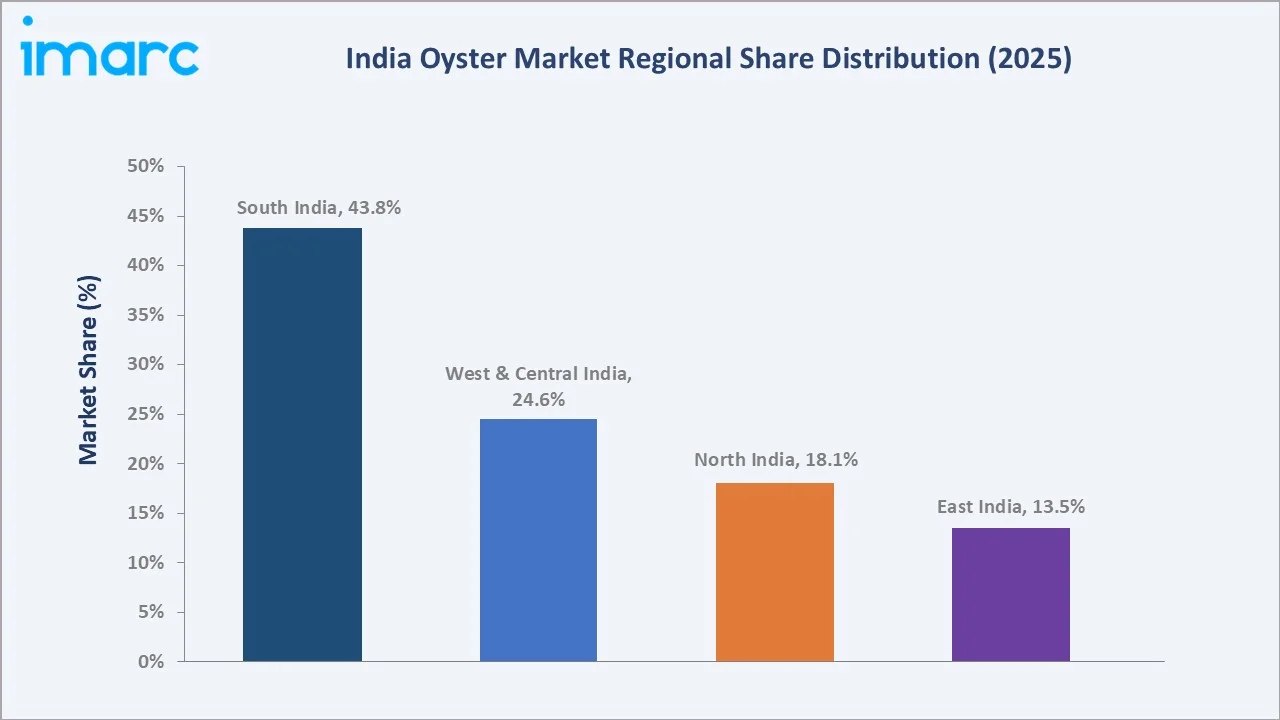
West and Central India's 24.6% is anchored by Goa's internationally recognized oyster culture combined with Maharashtra's expanding organized coastal aquaculture. North India at 18.1% and East India at 13.5% represent primarily consumption markets with growing organized oyster import and distribution, dependent on cold chain investment to expand fresh oyster market reach beyond current limitations.
Competitive Landscape
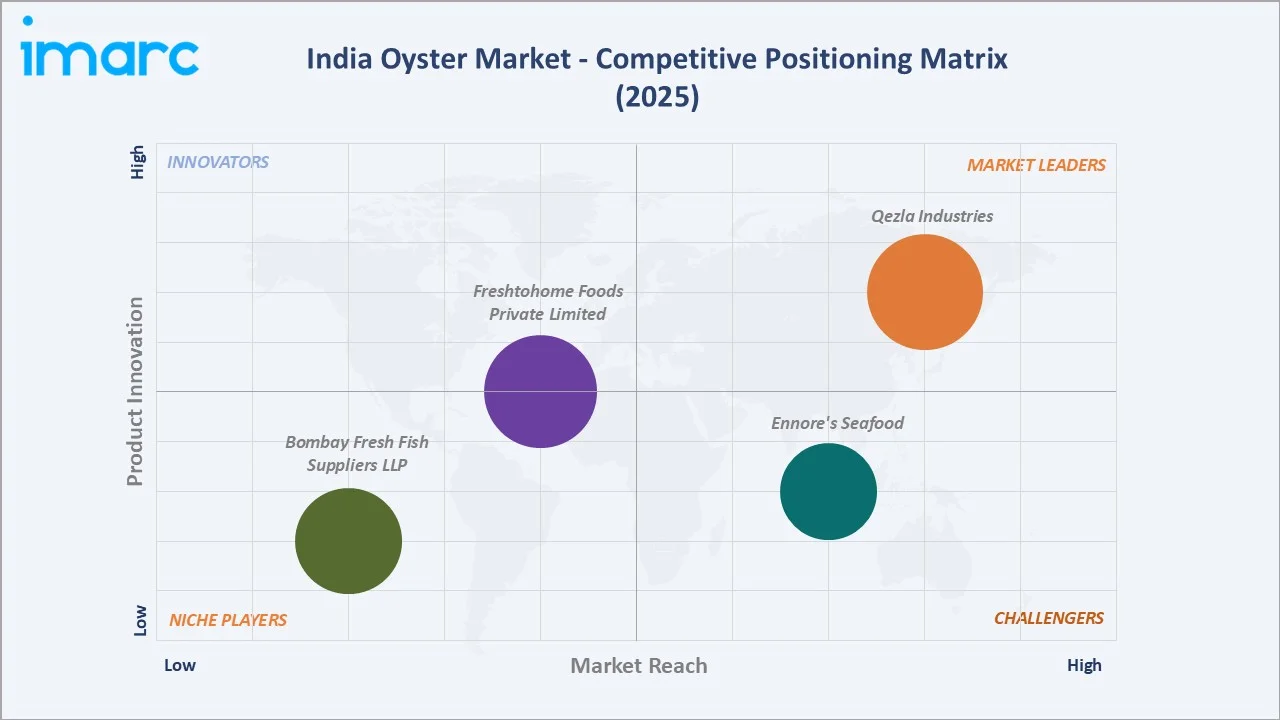
The India oyster market is highly fragmented, with a large number of artisanal fishing community producers, state fisheries corporations, organized aquaculture enterprises, and seafood processing and distribution companies operating across the value chain. Competitive differentiation is based on production volume consistency, oyster size and quality grading, food safety certification credentials, cold chain logistics capability, and established distribution channel relationships.
|
Company |
Key Offerings |
Market Position |
Core Strength |
|
Qezla Industries |
Oysters / Edible Oysters, Fresh Live Oysters |
Market Leader |
Qezla Industries is a leading supplier, wholesaler, and exporter of fresh, live, and natural edible oysters in India. |
|
Freshtohome Foods Private Limited |
Exotic Oyster Meat / Muru-irachi |
Established Player |
Freshtohome Foods Private Limited makes hard-to-find seafood, like real oyster meat, easily available and affordable for consumers across India. |
|
Bombay Fresh Fish Suppliers LLP |
Oyster meat/ Kalwa |
Niche Player |
Bombay Fresh Fish Suppliers LLP specializing in the hygienic delivery of raw, unfrozen oyster meat. |
|
Ennore's Seafood |
Oyster Meat, Shelled Oyster |
Challenger |
Ennore's Seafood (operating as Eseafoods) acts as a local retailer and supplier in the Indian seafood market. |
Companies are also investing in food safety certification, cold chain infrastructure, and premium brand development to differentiate in India's evolving oyster market. The sector is expected to see progressive consolidation among organized aquaculture enterprises as government programs continue to formalize artisanal production and create organized supply chains.
Key Company Profiles
Qezla Industries
Qezla Industries is an India-based seafood supplier engaged in providing fresh and processed marine products, including oysters, to domestic foodservice and retail channels. In the India oyster market, the company participates through sourcing, handling, and distribution of oyster products to restaurants, hotels, and seafood buyers. Its presence supports the growing demand for premium shellfish, particularly in urban and coastal consumption markets.
- Key Offerings: Oysters / Edible Oysters, Fresh Live Oysters.
- Strategic Focus: Strengthening its fresh and live oyster supply network through direct sourcing from coastal regions and hygienic handling practices. The company emphasizes bulk wholesale distribution, cold-chain logistics, consistent quality, and timely delivery to restaurants, seafood traders, processors, and other B2B buyers.
Freshtohome Foods Private Limited
Freshtohome Foods Private Limited is an India-based fresh food and seafood retail company offering a wide range of fish, shellfish, meat, and related products through its online distribution platform. In the India oyster market, the company participates through the retailing and delivery of oysters and other premium seafood products to urban consumers. Its technology-enabled sourcing, cold-chain logistics, and home-delivery network help improve accessibility to fresh seafood across major Indian cities.
- Key Offerings: Exotic Oyster Meat / Muru-irachi.
- Strategic Focus: Centers on expanding consumer access to fresh, safe, and traceable seafood, including oyster meat, through its technology-enabled direct-to-consumer platform. The company emphasizes direct sourcing from fishermen, cold-chain management, rapid shore-to-door delivery, and stringent quality checks, helping maintain freshness and food safety for highly perishable shellfish.
Market Concentration Analysis
The India oyster market is highly fragmented, with small-scale artisanal oyster farmers, fishing community cooperatives, and unorganized harvesters operating across India's coastal states accounting for the majority of production volume. Organized sector players, including government-supported aquaculture enterprises, certified processing companies, and organized seafood distributors, produce and sell through traditional artisanal channels. The market is expected to see consolidation in the processing and distribution segment as food safety compliance costs drive unorganized processors toward either certification investment or exit.
Investment & Growth Opportunities
Highest Growth Segments
Food service oyster demand (~4.5% CAGR through HoReCa expansion), Pacific cupped oyster cultivation (~4.3% CAGR through organized aquaculture programs), online seafood retail distribution (~6%+ CAGR from emerging base), South India processing infrastructure, and value-added processed oyster products represent the highest-growth investment vectors in the India oyster market through 2034.
Investment Themes
- Hatchery technology and organized oyster aquaculture: India's oyster production faces a structural hatchery capacity constraint limiting farm expansion beyond natural spat availability. Investment in commercial oyster hatchery infrastructure, capable of providing year-round certified disease-free spat supply, creates a critical input market bottleneck solution that enables organized oyster farm expansion across coastal states with strong PMMSY policy support.
- Premium brand and value-added product development: Building branded oyster product lines, smoked oysters, oyster sauce, oyster powder supplements, and live-premium GI-certified regional varieties transforms commodity oyster production into differentiated consumer products commanding 3-8x commodity price multiples. Geographical Indication certification for Kerala or Goa oysters could create lasting premium brand equity similar to successful regional seafood brand development models internationally.
Future Market Outlook (2026-2034)
The India oyster market is projected to grow from 343.9 Kilotons in 2025 to 492.9 Kilotons by 2034, delivering a 3.88% CAGR over the forecast period through organized aquaculture expansion under the PMMSY initiative, rising domestic seafood demand, growing HoReCa sector adoption, and expanding export market development. The market's anchor value of 416.0 Kilotons in 2030 represents India's oyster ecosystem at organized aquaculture mainstream adoption and cold chain-enabled inland consumer market expansion inflection.
Three structural forces are expected to define the growth of the India oyster market through 2034. First, government aquaculture policy will continue to drive organized oyster farming expansion along India's coastal states, converting artisanal harvesting communities into structured aquaculture enterprises with improved productivity, quality consistency, and market access, progressively expanding the total organized production base from current levels toward meeting growing domestic and export demand. Second, rising urban seafood consumption will create sustained volume demand growth for fresh, frozen, and value-added oyster products, supported by cold chain infrastructure investment and online seafood retail platform expansion that collectively extend market reach from coastal communities to India's large inland urban consumer base. Third, export market development will provide additional demand-side growth momentum supplementing domestic market expansion, enabling India's competitive aquaculture cost structure to capture growing global oyster consumption demand through 2034.
Research Methodology
Primary Research
Primary research comprised in-depth interviews with senior representatives from oyster aquaculture enterprises, state fisheries departments, researchers, export development specialists, seafood processing company executives, HoReCa seafood procurement managers, and seafood retail platform operators. Discussions validated production volume estimates, assessed aquaculture development trends, evaluated market distribution dynamics, and provided insights into regulatory developments, export market opportunities, and long-term growth outlook for India's oyster market.
Secondary Research
Secondary research encompassed fisheries statistics publications, export data, aquaculture production reports, state fisheries department annual reports, PMMSY scheme implementation data, shellfish regulatory publications, seafood trade association reports, and credible food industry analyst publications. These sources supported production volume analysis, regional distribution assessment, species mix data, and end-user segment analysis across India's oyster market.
Forecasting Models
Forecasting models were developed using historical production volume data, aquaculture expansion program implementation timelines, PMMSY investment disbursement trajectories, domestic seafood consumption growth rates, and export market development projections. Both supply-side and demand-side approaches were applied and validated through primary expert consultations.
India Oyster Market Report Coverage:
| Report Features | Details |
|---|---|
| Base Year of the Analysis | 2025 |
| Historical Period | 2020-2025 |
| Forecast Period | 2026-2034 |
| Units | Kilo Tons |
| Scope of the Report |
Exploration of Historical and Forecast Trends, Industry Catalysts and Challenges, Segment-Wise Historical and Predictive Market Assessment:
|
| Oyster Types Covered | Cupped Oyster, Pacific Cupped Oyster, American Cupped Oyster, Penguin Wing Oyster, Others |
| End Users Covered | Food Service, Retail |
| Packaging Forms Covered | Fresh, Frozen, Canned, Others |
| Regions Covered | South India, North India, West & Central India, East India |
| Companies Covered | Qezla Industries, Freshtohome Foods Private Limited, Bombay Fresh Fish Suppliers LLP, Ennore's Seafood, etc. |
| Customization Scope | 10% Free Customization |
| Post-Sale Analyst Support | 10-12 Weeks |
| Delivery Format | PDF and Excel through Email (We can also provide the editable version of the report in PPT/Word format on special request) |
Key Benefits for Stakeholders:
- IMARC’s report offers a comprehensive quantitative analysis of various market segments, historical and current market trends, market forecasts, and dynamics of the India oyster market from 2020-2034.
- The research study provides the latest information on the market drivers, challenges, and opportunities in the India oyster market.
- Porter's five forces analysis assist stakeholders in assessing the impact of new entrants, competitive rivalry, supplier power, buyer power, and the threat of substitution. It helps stakeholders to analyze the level of competition within the India oyster industry and its attractiveness.
- Competitive landscape allows stakeholders to understand their competitive environment and provides an insight into the current positions of key players in the market.
Frequently Asked Questions About the India Oyster Market Report
The India oyster market reached 343.9 Kilotons in 2025, driven by expanding aquaculture production under PMMSY schemes, rising domestic seafood consumption, and growing HoReCa demand. Government technical and financial support for organized oyster farming is progressively increasing production capacity across coastal states.
The India oyster market grows at 3.88% CAGR during 2026-2034, reaching 492.9 Kilotons by 2034. The CAGR reflects steady organized aquaculture expansion, growing domestic consumption and increasing export market development for processed oyster products.
Cupped oyster leads at 42.6% (2025), driven by its dominance in India's coastal aquaculture systems, particularly Kerala's backwater oyster farming, where Crassostrea species are most extensively cultivated with technical guidance and state government support. The species' suitability to Indian tropical coastal conditions and established hatchery supply chains supports its leadership.
Retail dominates at 58.7% (2025), representing direct consumer purchases through coastal wet markets, fresh seafood stalls, urban seafood specialty stores, and growing online seafood delivery platforms. Retail's dominance reflects the household cooking tradition for fresh oysters in India's coastal communities and the growing urban consumer fresh seafood retail channel.
South India leads at 43.8% (2025), anchored by Kerala's position as one of India's leading oyster-producing states with extensive backwater and coastal estuary aquaculture systems, strong technical support, and organized oyster farming cooperative networks across Vembanad and Ashtamudi lake systems.
Leading players include Qezla Industries, Freshtohome Foods Private Limited, Bombay Fresh Fish Suppliers LLP, and Ennore's Seafood, among others.
The market is projected to reach approximately 416.0 Kilotons by 2030, representing the organized aquaculture mainstream adoption and cold chain-enabled market expansion inflection. Growth will be driven by PMMSY-supported farm expansion, Pacific cupped oyster cultivation scaling, and growing HoReCa and organized retail distribution channels.
Priority investment opportunities include regulatory-compliant oyster processing and cold chain infrastructure enabling quality, premium and export access, commercial hatchery capacity development addressing India's spat supply bottleneck, and premium branded value-added oyster product development targeting urban retail and export markets with GI-certified regional variety differentiation.
Need more help?
- Speak to our experienced analysts for insights on the current market scenarios.
- Include additional segments and countries to customize the report as per your requirement.
- Gain an unparalleled competitive advantage in your domain by understanding how to utilize the report and positively impacting your operations and revenue.
- For further assistance, please connect with our analysts.
 Request Customization
 Speak to an Analyst
 Request Brochure
 Inquire Before Buying
Benefits of Customization
- Personalize this research
- Triangulate with your data
- Get data as per your format and definition
- Gain a deeper dive into a specific application, geography, customer, or competitor
- Any level of personalization
Get in Touch With Us
UNITED STATES
Phone: +1-201-971-6302
INDIA
Phone: +91-120-433-0800
UNITED KINGDOM
Phone: +44-753-714-6104
Email: [email protected]
Client Testimonials




.webp)




.webp)













Related Reports

Choose your plan
*Please note that the prices mentioned below are starting prices for each bundle type. Kindly contact our team for further details.*
Single User License
- 1 User License, Access on 2 Devices
- PDF Report + Excel Dataset (Password Protected)
- Lifetime Access
- No Printing Rights
- 10% Free Report Customization
- 10–12 Weeks of Analyst Support
Five User License
- Access for 5 Users, 2 Devices per User
- PDF Report + Excel Dataset (Password Protected)
- Lifetime Access
- Dedicated Account Manager
- 12–14 Weeks of Analyst Support
- No Printing Rights
- 15% Free Report Customization
- 25% Discount on Your Next Purchase
Corporate User License
- Unlimited User Access (Within Your Organization)
- PDF Report + Excel Dataset
- Lifetime Access
- Dedicated Account Manager
- 14–20 Weeks of Analyst Support
- No Printing Rights
- 20% Free Report Customization
- 30% Discount on Your Next Purchase
Essential Insights
What's included:
3 reports
- Lifetime Access
- PDF Reports
- Excel Datasets
- 2 Weeks of Free Analyst Support
- 2 User Licenses
- Access on 2 Devices
- Printing Rights
- Complimentary PowerPoint (PPT) Version
- Complimentary License Upgrade
Professional Access
What's included:
5 reports
- Lifetime Access
- PDF Reports
- Excel Datasets
- 8 Weeks of Free Analyst Support
- 2 User Licenses
- Access on 2 Devices
- Printing Rights
- Complimentary PowerPoint (PPT) Version
- Complimentary License Upgrade
Business Advantage
What's included:
8 reports
- Lifetime Access
- PDF Reports
- Excel Datasets
- 14 Weeks of Free Analyst Support
- 2 User Licenses
- Access on 2 Devices
- Printing Rights
- Complimentary PowerPoint (PPT) Version
- Complimentary License Upgrade
Enterprise Intelligence
What's included:
10 reports
- Lifetime Access
- PDF Reports
- Excel Datasets
- 20 Weeks of Free Analyst Support
- 2 User Licenses
- Access on 2 Devices
- Printing Rights
- Complimentary PowerPoint (PPT) Version
- Complimentary License Upgrade