
India Pressure Washer Market Size, Share, Trends and Forecast by Power Source, Output, Application, Distribution Channel, and Region, 2026-2034
India Pressure Washer Market Summary:
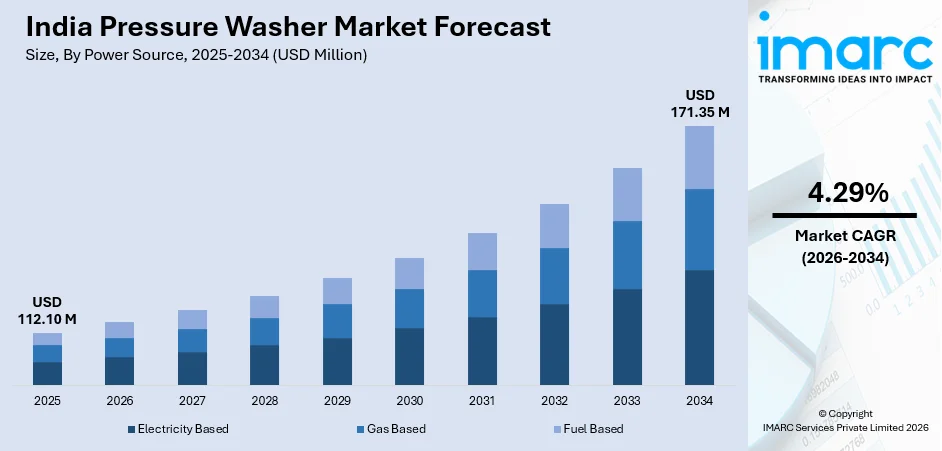
The India pressure washer market grew from USD 112.10 Million in 2025 to USD 122.43 Million in 2026 and is projected to reach USD 171.35 Million by 2034, growing at a compound annual growth rate of 4.29% from 2026-2034.
The India pressure washer market is driven by rapid urbanization, rising hygiene awareness, and growing adoption of mechanized cleaning solutions across residential, commercial, and industrial sectors. Expanding vehicle ownership, surging e-commerce penetration, and supportive government programs promoting sanitation are further fueling demand. Technological advancements toward energy-efficient, eco-friendly, and portable cleaning equipment continue to diversify the India pressure washer market share.
Key Takeaways and Insights:
- By Power Source: Electricity based dominates the market with a share of 66.5% in 2025, owing to its ease of use, low maintenance costs, and eco-friendly operation. Wider urban availability and growing residential adoption reinforce segment leadership.
- By Output: 1501 to 3000 PSI leads the market with a share of 39.0% in 2025, driven by its suitability for residential vehicle washing and light commercial cleaning. Balanced pressure output and affordability make this range the preferred choice for Indian consumers.
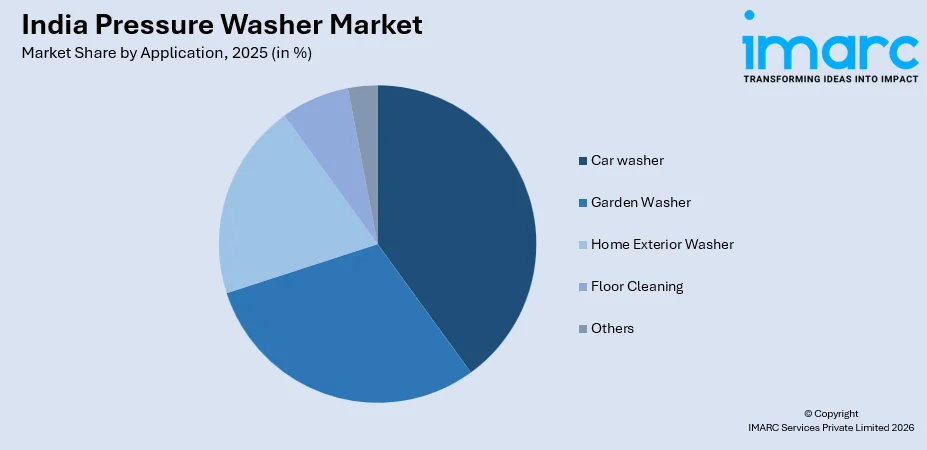
- By Application: Car washer holds the largest share of 36.0% in 2025, driven by India's growing vehicle parc, rising consumer spending on vehicle maintenance, and the widespread preference for self-service home car washing solutions.
- By Distribution Channel: Online distribution dominates the market with a share of 51.5% in 2025, reflecting the rapid growth of e-commerce platforms in India that offer wide product variety, competitive pricing, and convenient doorstep delivery to consumers nationwide.
- By Region: West India represents the largest region with 29.8% share in 2025, driven by rapid industrialization, elevated vehicle ownership rates, and growing demand for mechanized cleaning solutions across Maharashtra's and Gujarat's key metropolitan areas and industrial hubs.
- Key Players: Key players drive the India pressure washer market by launching innovative product lines, expanding distribution networks, and investing in local manufacturing. Their focus on affordable pricing strategies, digital marketing, and after-sales support accelerates product adoption across residential, commercial, and industrial cleaning segments nationwide.
To get more information on this market Request Sample
India's pressure washer market is experiencing steady expansion, driven by a convergence of urbanization, hygiene awareness, and increasing vehicle ownership across the country. India's automobile parc has expanded significantly, with two-wheelers and four-wheelers collectively numbering in the hundreds of millions, creating a robust demand for home-based vehicle washing equipment. The government's Swachh Bharat Mission, which has been instrumental in transforming sanitation practices across urban and rural areas, has further catalyzed adoption of mechanized cleaning equipment in both public and private sectors. Additionally, the Bureau of Water Use Efficiency under the National Water Mission is actively developing standards for water-efficient appliances, encouraging manufacturers to introduce low-consumption pressure washer models. Growing disposable incomes among India's urban middle class and increasing awareness of professional-grade cleaning practices have further strengthened consumer demand, shaping a dynamic and highly competitive market landscape.
India Pressure Washer Market Trends:
Rising Dominance of Electricity-Based Pressure Washers
The shift toward electricity-based pressure washers is one of the most prominent trends reshaping India's pressure washer market. Electric models are increasingly preferred for their quiet operation, ease of maintenance, and suitability for indoor and semi-indoor cleaning tasks. Rapid improvements in motor efficiency and the introduction of smart pressure control and automatic shut-off features have made these models both energy-efficient and user-friendly. As urban households seek compact and convenient cleaning solutions, electric pressure washers have emerged as the default choice across both residential and light commercial segments throughout Indian cities.
Surge in Online Sales and Digital Commerce
The proliferation of e-commerce platforms has fundamentally transformed how pressure washers are purchased and distributed in India. Consumers increasingly turn to online marketplaces for product discovery, price comparison, and convenient home delivery. Detailed product descriptions, user reviews, and competitive pricing on digital platforms have lowered the barrier to entry for first-time buyers. This trend is particularly impactful in tier-2 and tier-3 cities, where physical retail presence is limited and online access has brought a previously inaccessible range of models to a significantly broader consumer base.
Municipal and Government-Led Adoption for Public Sanitation
A growing trend in India's pressure washer market is the increasing procurement of high-pressure cleaning equipment by municipal corporations and civic bodies for public sanitation initiatives. Urban local bodies are deploying pressure washers to clean streets, public toilets, underpasses, and heritage structures as part of India's Swachh Bharat Mission. This institutional demand is creating a stable and new growth avenue, distinct from traditional residential and commercial channels, as governments at all levels prioritize mechanized cleaning to measurably improve hygiene standards across Indian cities and towns.
Market Outlook 2026-2034:
The India pressure washer market is poised for consistent and sustained growth over the forecast period, supported by a combination of structural demographic shifts, evolving consumer preferences, and a favorable policy ecosystem. Rising urbanization rates and increasing middle-class spending on home improvement and vehicle maintenance are expected to drive steady demand across both residential and commercial applications. Technological innovations in energy-efficient motors, battery-powered portable designs, and smart pressure control are anticipated to attract new consumer segments and broaden market participation. Expansion of e-commerce channels will continue to improve product accessibility in smaller cities, while government-driven sanitation mandates are expected to sustain institutional demand. Manufacturers investing in affordable, locally manufactured models aligned with India-specific cleaning needs are well-positioned to capture growth across this evolving and opportunity-rich market. The market generated a revenue of USD 112.10 Million in 2025, which is expected to reach USD 122.43 Million in 2026 and further grow to USD 171.35 Million by 2034, at a compound annual growth rate of 4.29% from 2026-2034.
India Pressure Washer Market Report Segmentation:
| Segment Category | Leading Segment | Market Share |
|---|---|---|
|
Power Source |
Electricity Based |
66.5% |
|
Output |
1501 to 3000 PSI |
39.0% |
|
Application |
Car Washer |
36.0% |
|
Distribution Channel |
Online Distribution |
51.5% |
|
Region |
West India |
29.8% |
Power Source Insights:
- Electricity Based
- Gas Based
- Fuel Based
Electricity based dominates with a market share of 66.5% of the total India pressure washer market in 2025.
Electricity-based pressure washers have emerged as the most widely adopted power source category in India, driven by their inherent advantages in urban and semi-urban environments. Unlike gas or fuel-powered alternatives, electric models operate quietly without harmful emissions, making them well-suited for use in residential complexes, parking areas, and enclosed or semi-enclosed spaces. Their compact design, plug-and-play operation, and significantly lower maintenance requirements appeal strongly to individual homeowners and small commercial establishments. The widespread availability of reliable electricity infrastructure across Indian urban centers has further accelerated adoption, as consumers benefit from convenient, cost-effective operation without the need to manage fuel procurement or engine servicing schedules.
The ongoing refinement of electric motor technology has enabled manufacturers to significantly improve the performance and energy efficiency of electricity-based pressure washers without increasing product size or weight. Modern electric models now feature digital pressure control, automatic shut-off when not in active use, and multi-nozzle systems that allow users to tailor water output for different cleaning tasks, from delicate vehicle surfaces to stubborn floor stains. Government initiatives such as the Bureau of Water Use Efficiency under the National Water Mission, which is developing standards for water-efficient appliances, are encouraging manufacturers to design electric pressure washers that deliver powerful cleaning performance while minimizing water consumption, accelerating the transition from manual cleaning methods toward mechanized electric solutions.
Output Insights:
- Up to 1500 PSI
- 1501 to 3000 PSI
- 3001 to 4000 PSI
- Above 4000 PSI
1501 to 3000 PSI holds the largest segment with a share of 39.0% of the total India pressure washer market in 2025.
The 1501 to 3000 PSI output range occupies a commanding position in India's pressure washer market, delivering sufficient cleaning power for the country's most common use cases without the complexity or safety concerns associated with higher-pressure industrial equipment. This pressure band is ideally suited for cleaning passenger cars, motorcycles, outdoor furniture, patios, balcony floors, and residential building exteriors, tasks that dominate demand in Indian urban and suburban households. The versatility of this output range enables a single unit to serve multiple cleaning purposes, offering strong value for money to cost-conscious Indian consumers. The growing culture of home-based vehicle washing, particularly in metro cities where professional car wash services can be expensive or inconvenient, has firmly established this pressure tier as the preferred choice for residential buyers.
From a commercial perspective, the 1501 to 3000 PSI pressure range also satisfies the operational requirements of small workshops, service garages, car detailing businesses, and light industrial facilities that require reliable cleaning power without large-scale industrial investment. The growing number of automobile service centers across India's rapidly expanding automotive sector has contributed meaningfully to the uptake of pressure washers within this output category. Manufacturers have responded to this dual residential and commercial demand by developing feature-rich models incorporating ergonomic designs, long hose lengths, and durable pump mechanisms suited to extended operation. India's Smart Cities Mission, which has invested significantly in modernizing urban infrastructure and public service quality, has further driven municipal procurement of pressure washers within this workable and cost-effective output range.
Application Insights:
Access the comprehensive market breakdown Request Sample
- Car Washer
- Garden Washer
- Home Exterior Washer
- Floor Cleaning
- Others
Car washer leads with a market share of 36.0% of the total India pressure washer market in 2025.
Car washing represents the most prevalent application for pressure washers in India, underpinned by the country's rapidly expanding vehicle ownership and the widespread consumer preference for self-managed vehicle care. India's automobile sector has grown substantially, with millions of two-wheelers and four-wheelers added to the roads annually, creating a continuously expanding base of potential customers for residential car-washing equipment. Pressure washers for car washing are engineered to deliver effective dirt and grime removal without damaging vehicle paintwork, typically featuring adjustable low-to-medium pressure settings and a range of specialized nozzle attachments. The affordability and convenience of owning a home pressure washer compared with recurring professional car wash costs further amplifies adoption across India's expanding middle-class urban population.
The proliferation of car detailing culture and growing awareness about vehicle aesthetics and resale value among Indian consumers has elevated the perception of pressure washing from a routine cleaning task to an essential vehicle maintenance practice. Premium car owners increasingly seek equipment capable of replicating professional-grade results at home, driving demand for capable yet user-friendly electric pressure washers within the car washer application segment. The expansion of India's two-wheeler base, which represents the largest portion of the country's vehicle parc, has also created strong demand for compact, portable, and battery-compatible models suited to motorcycle and scooter cleaning. Investments by leading cleaning technology companies in India's automotive pressure washer segment further underscore the category's growing commercial significance and its role as a primary growth engine for the overall market.
Distribution Channel Insights:
- Online Distribution
- Offline Distribution
Online distribution represents the leading segment with a 51.5% share of the total India pressure washer market in 2025.
Online distribution has emerged as the dominant channel for pressure washer sales in India, driven by the country's remarkable expansion of digital commerce infrastructure and rapidly increasing internet and smartphone penetration across urban and semi-urban centers. E-commerce platforms provide consumers with access to an extensive catalog of pressure washer models from both established international brands and emerging domestic manufacturers, presented alongside detailed specifications, customer reviews, and competitive pricing. The ability to compare products effortlessly, access exclusive online discounts, and enjoy doorstep delivery has made online purchasing the preferred route for first-time buyers and repeat customers alike. This trend has been especially significant in tier-2 and tier-3 cities, where specialized brick-and-mortar retail stores stocking pressure washers remain limited.
The growth of online distribution has enabled manufacturers to reduce reliance on traditional dealer and distributor networks, streamlining their supply chains and offering products directly to consumers at more competitive price points. The strategic decision by multiple pressure washer brands to pursue online-first product launches in India reflects the superior reach and lower customer acquisition costs that digital channels offer compared to physical retail. Favorable logistics infrastructure development across India, including expanded courier networks and faster last-mile delivery services in smaller towns, has further strengthened the viability of online distribution as the primary sales channel. Post-purchase customer support through digital platforms, easy return policies, and manufacturer warranty programs accessible online have also measurably increased consumer confidence in purchasing high-value cleaning equipment through e-commerce channels.
Regional Insights:
- North India
- South India
- East India
- West India
West India exhibits a clear dominance in the market with a 29.8% share of the total India pressure washer market in 2025.
West India holds the commanding position in the India pressure washer market, driven by the region's dense concentration of industrial activity, high levels of urbanization, and significant vehicle ownership in Maharashtra and Gujarat. Cities such as Mumbai, Pune, Ahmedabad, and Surat are home to large populations of affluent and middle-class consumers who increasingly invest in home improvement and mechanized cleaning solutions. The region's well-developed retail and digital commerce infrastructure ensures broad availability of pressure washers across price segments, supporting strong and consistent market participation from both residential and commercial buyers.
Beyond residential demand, West India's thriving manufacturing sector, automotive industry cluster in Pune and Aurangabad, and extensive network of commercial and logistics establishments generate robust institutional demand for pressure washing equipment. Maharashtra's active implementation of Swachh Bharat Mission, which has driven municipal corporations to procure professional-grade cleaning equipment for public spaces, has further reinforced the region's market leadership. The growing number of car detailing studios and professional cleaning service providers concentrated in Mumbai and Pune's expanding commercial districts underscores the strength of West India's demand base across both consumer and professional segments of the market.
Market Dynamics:
Growth Drivers:
Why is the India Pressure Washer Market Growing?
Rapid Urbanization and Rising Middle-Class Incomes
India's sustained urban expansion is one of the most powerful structural forces driving demand for pressure washers across the country. As the urban population continues to grow, an increasing number of households are residing in apartments, gated communities, and independent houses with vehicles, gardens, and exteriors requiring regular maintenance. The combination of rising disposable incomes and aspirational lifestyles among India's expanding middle class has shifted consumer preferences from labor-intensive manual cleaning to efficient, technology-driven solutions. Urban dwellers increasingly value time and are willing to invest in equipment that delivers faster and more thorough cleaning outcomes for vehicles, flooring, and building facades, driving the premiumization of the residential cleaning category. The correlation between urbanization and pressure washer adoption is further reinforced by India's rapid vehicle ownership expansion. The country's government-projected vehicle trajectory indicates that the total automobile stock will more than double between 2023 and 2050, with two-wheelers accounting for the majority of additions. This automotive growth directly translates into heightened demand for residential car and motorcycle washing equipment. India's Smart Cities Mission, which has invested in upgrading urban services across 100 cities, has also catalyzed municipal procurement of professional cleaning equipment to maintain roads, pavements, and public infrastructure, meaningfully broadening the addressable market for pressure washer manufacturers and distributors across the country.
Growing Automotive Sector and Vehicle Care Culture
India's position as one of the world's largest and fastest-growing automotive markets is a central driver of the pressure washer market's expansion. The country's rapidly expanding two-wheeler and four-wheeler fleet, which continues to grow annually as rising incomes make personal vehicle ownership increasingly accessible across urban and semi-urban households, creates a persistent and growing demand for vehicle cleaning equipment. The cultural emphasis on vehicle aesthetics and maintenance among Indian consumers, who often view their cars and motorcycles as valuable personal assets worthy of regular care, has made home-based vehicle washing one of the primary use cases for residential pressure washers. This behavior is further reinforced by the high cost of repeated visits to professional car wash facilities in major urban areas, making self-washing a practical and cost-effective alternative. The car detailing and professional vehicle care sector in India is expanding rapidly, with automotive service centers, multi-brand workshops, and dedicated detailing studios increasingly investing in pressure washing equipment to meet consumer expectations for high-quality finishes. Pressure washers with medium-output ranges are particularly well-suited to professional vehicle care operations, providing effective cleaning power without the risk of paint or surface damage. India's well-established automotive retail and aftermarket ecosystem, concentrated in metropolitan hubs such as Delhi, Mumbai, Pune, Bengaluru, and Chennai, further amplifies commercial demand for reliable and durable pressure washing equipment across all output tiers.
Government Hygiene and Sanitation Initiatives
India's sustained government commitment to promoting cleanliness, sanitation, and public hygiene through programs such as the Swachh Bharat Mission has played a meaningful role in driving both institutional and household demand for mechanized cleaning equipment, including pressure washers. Municipal corporations across India's major cities have progressively increased their adoption of high-pressure cleaning equipment to maintain public spaces, roads, government buildings, public transport terminals, and community sanitation facilities to a higher standard. In September 2024, the Trichy Corporation introduced high-pressure washers to clean public and community toilets in Zone IV of the city, with plans to expand deployment to additional zones, illustrating the scale of municipal engagement with this category. Beyond institutional procurement, the Swachh Bharat Mission's emphasis on residential and community hygiene has gradually elevated consumer attitudes toward cleanliness standards, making investment in mechanized cleaning equipment increasingly aspirational. The Bureau of Water Use Efficiency under the National Water Mission's development of standards for water-efficient cleaning appliances is also encouraging manufacturers to innovate and differentiate products based on conservation performance, adding a sustainability dimension to market competition that is expected to grow in significance over the forecast period.
Market Restraints:
What Challenges is the India Pressure Washer Market Facing?
Water Scarcity and Conservation Concerns
India's ongoing water stress presents a significant restraint to widespread pressure washer adoption, particularly across regions experiencing recurring shortages. Pressure washers, despite being more efficient than conventional garden hoses, consume substantial water volumes during operation. In water-stressed cities such as Bengaluru and Chennai, where municipal water supply is frequently interrupted and groundwater resources are overextended, consumer hesitancy to use high-consumption cleaning equipment can limit market penetration. Growing regulatory attention to water conservation and evolving public consciousness around responsible water use create additional social pressure on pressure washer adoption in affected geographies, particularly during dry seasons and periods of acute scarcity.
High Initial Purchase Cost and Consumer Price Sensitivity
Despite the long-term cost benefits of owning a pressure washer, the relatively high upfront purchase price remains a barrier for a large segment of India's price-sensitive consumer base. While entry-level electric models are available at accessible price points, performance-grade units with durable components and advanced features carry costs that deter budget-conscious buyers, particularly in tier-2 and tier-3 cities where per-capita incomes are lower. The availability of inexpensive manual cleaning labor in India further reduces perceived urgency to invest in mechanized cleaning equipment, competing directly with pressure washer adoption among cost-sensitive households and small enterprises that prioritize short-term expenditure minimization over long-term efficiency gains.
Competition from the Unorganized Sector and Traditional Cleaning Methods
The India pressure washer market faces meaningful competition from an extensive unorganized cleaning sector comprising manual laborers, roadside car washers, and small-scale service providers who offer low-cost cleaning services. In many residential areas and commercial zones across India, affordable human-labor-based cleaning services remain deeply entrenched, offering consumers a convenient and inexpensive alternative to owning and operating their own equipment. This structural competition from informal service providers suppresses autonomous household demand and slows the transition to mechanized cleaning, particularly in lower-income urban neighborhoods and smaller cities where traditional cleaning practices remain the deeply established norm.
Competitive Landscape:
The India pressure washer market is characterized by a moderately competitive environment with a blend of established multinational brands and emerging domestic players vying for market share across residential, commercial, and industrial segments. International companies with strong global brand recognition leverage extensive distribution networks, technologically advanced product portfolios, and sustained investment in local manufacturing to maintain their competitive positions. Domestic and regional players compete primarily on price and accessibility, targeting cost-sensitive segments with affordable models tailored to India-specific cleaning needs. Product innovation encompassing improvements in motor efficiency, ergonomic design, energy consumption reduction, and integration of smart control technologies remains a key competitive differentiator. Companies are increasingly prioritizing e-commerce and digital marketing strategies to capture India's rapidly expanding online consumer base. Local manufacturing initiatives aligned with the government's Make in India program are reshaping competitive dynamics, enabling brands to rationalize costs, reduce import dependencies, and respond more rapidly to evolving domestic market demands. After-sales service networks and warranty programs are emerging as additional differentiators among commercial and institutional buyers who require consistent equipment performance.
India Pressure Washer Market Report Coverage:
| Report Features | Details |
|---|---|
| Base Year of the Analysis | 2025 |
| Historical Period | 2020-2025 |
| Forecast Period | 2026-2034 |
| Units | Million USD |
| Scope of the Report |
Exploration of Historical Trends and Market Outlook, Industry Catalysts and Challenges, Segment-Wise Historical and Future Market Assessment:
|
| Power Sources Covered | Electricity Based, Gas Based, Fuel Based |
| Outputs Covered | Up to 1500 PSI, 1501 to 3000 PSI, 3001 to 4000 PSI, Above 4000 PSI |
| Applications Covered | Car Washer, Garden Washer, Home Exterior Washer, Floor Cleaning, Others |
| Distribution Channels Covered | Online Distribution, Offline Distribution |
| Regions Covered | North India, South India, East India, West India |
| Customization Scope | 10% Free Customization |
| Post-Sale Analyst Support | 10-12 Weeks |
| Delivery Format | PDF and Excel through Email (We can also provide the editable version of the report in PPT/Word format on special request) |
Frequently Asked Questions About the India Pressure Washer Market Report
The India pressure washer market size increased from USD 112.10 Million in 2025 to USD 122.43 Million in 2026.
The India pressure washer market is expected to grow at a compound annual growth rate of 4.29% from 2026-2034 to reach USD 171.35 Million by 2034.
Electricity Based dominated the market with a share of 66.5%, driven by its ease of use, eco-friendly operation, low maintenance costs, and wide availability across urban residential and commercial segments throughout India.
Key factors driving the India pressure washer market include rapid urbanization, rising vehicle ownership, growing hygiene awareness, government sanitation initiatives, e-commerce expansion, and increasing consumer preference for mechanized and efficient cleaning solutions.
Major challenges include water scarcity concerns across multiple Indian regions, high initial purchase costs for premium models, competition from inexpensive manual cleaning labor, price sensitivity among consumers, and the presence of an extensive unorganized cleaning service sector.
Need more help?
- Speak to our experienced analysts for insights on the current market scenarios.
- Include additional segments and countries to customize the report as per your requirement.
- Gain an unparalleled competitive advantage in your domain by understanding how to utilize the report and positively impacting your operations and revenue.
- For further assistance, please connect with our analysts.
 Request Customization
 Speak to an Analyst
 Request Brochure
 Inquire Before Buying
Benefits of Customization
- Personalize this research
- Triangulate with your data
- Get data as per your format and definition
- Gain a deeper dive into a specific application, geography, customer, or competitor
- Any level of personalization
Get in Touch With Us
UNITED STATES
Phone: +1-201-971-6302
INDIA
Phone: +91-120-433-0800
UNITED KINGDOM
Phone: +44-753-714-6104
Email: [email protected]
Client Testimonials




.webp)




.webp)













Related Reports

Choose your plan
*Please note that the prices mentioned below are starting prices for each bundle type. Kindly contact our team for further details.*
Single User License
- 1 User License, Access on 2 Devices
- PDF Report + Excel Dataset (Password Protected)
- Lifetime Access
- No Printing Rights
- 10% Free Report Customization
- 10–12 Weeks of Analyst Support
Five User License
- Access for 5 Users, 2 Devices per User
- PDF Report + Excel Dataset (Password Protected)
- Lifetime Access
- Dedicated Account Manager
- 12–14 Weeks of Analyst Support
- No Printing Rights
- 15% Free Report Customization
- 25% Discount on Your Next Purchase
Corporate User License
- Unlimited User Access (Within Your Organization)
- PDF Report + Excel Dataset
- Lifetime Access
- Dedicated Account Manager
- 14–20 Weeks of Analyst Support
- No Printing Rights
- 20% Free Report Customization
- 30% Discount on Your Next Purchase
Essential Insights
What's included:
3 reports
- Lifetime Access
- PDF Reports
- Excel Datasets
- 2 Weeks of Free Analyst Support
- 2 User Licenses
- Access on 2 Devices
- Printing Rights
- Complimentary PowerPoint (PPT) Version
- Complimentary License Upgrade
Professional Access
What's included:
5 reports
- Lifetime Access
- PDF Reports
- Excel Datasets
- 8 Weeks of Free Analyst Support
- 2 User Licenses
- Access on 2 Devices
- Printing Rights
- Complimentary PowerPoint (PPT) Version
- Complimentary License Upgrade
Business Advantage
What's included:
8 reports
- Lifetime Access
- PDF Reports
- Excel Datasets
- 14 Weeks of Free Analyst Support
- 2 User Licenses
- Access on 2 Devices
- Printing Rights
- Complimentary PowerPoint (PPT) Version
- Complimentary License Upgrade
Enterprise Intelligence
What's included:
10 reports
- Lifetime Access
- PDF Reports
- Excel Datasets
- 20 Weeks of Free Analyst Support
- 2 User Licenses
- Access on 2 Devices
- Printing Rights
- Complimentary PowerPoint (PPT) Version
- Complimentary License Upgrade