
India Two-Wheeler Accessories Market Size, Share, Trends and Forecast by Product Type, Vehicle Type, Distribution Channel, and Region, 2026-2034
India Two-Wheeler Accessories Market Summary:
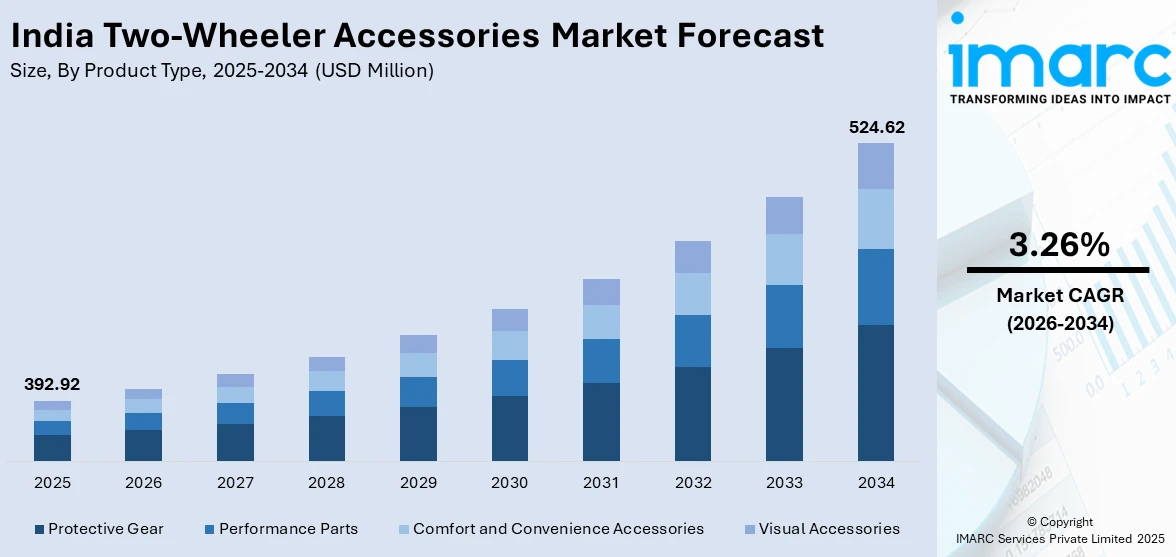
The India two-wheeler accessories market grew from USD 392.92 Million in 2025 to USD 405.87 Million in 2026 and is projected to reach USD 524.62 Million by 2034, growing at a compound annual growth rate of 3.26% from 2026-2034.
The India two-wheeler accessories market is expanding as consumer priorities shift toward enhanced rider safety, performance optimization, and vehicle personalization. Strengthening regulatory mandates for certified protective equipment and rising awareness of road safety standards are reinforcing demand for quality accessories. The proliferation of e-commerce platforms, expansion of aftermarket distribution networks, and growing participation in motorsport events are amplifying brand visibility and accessibility. Advancements in material engineering, technology-integrated products, and premiumization trends are reshaping consumer expectations, driving sustained innovation and positioning the market for steady growth across the urban and semi-urban India two-wheeler accessories market share.
Key Takeaways and Insights:
- By Product Type: Protective gear dominates the market with a share of 32% in 2025, driven by stringent helmet compliance mandates, rising road safety awareness, and increasing consumer preference for certified and technologically advanced safety equipment across India.
- By Vehicle Type: Motorcycles lead the market with a share of 60% in 2025, supported by India’s massive motorcycle ownership base, strong aftermarket culture, and growing enthusiasm for performance upgrades and visual customization among riders.
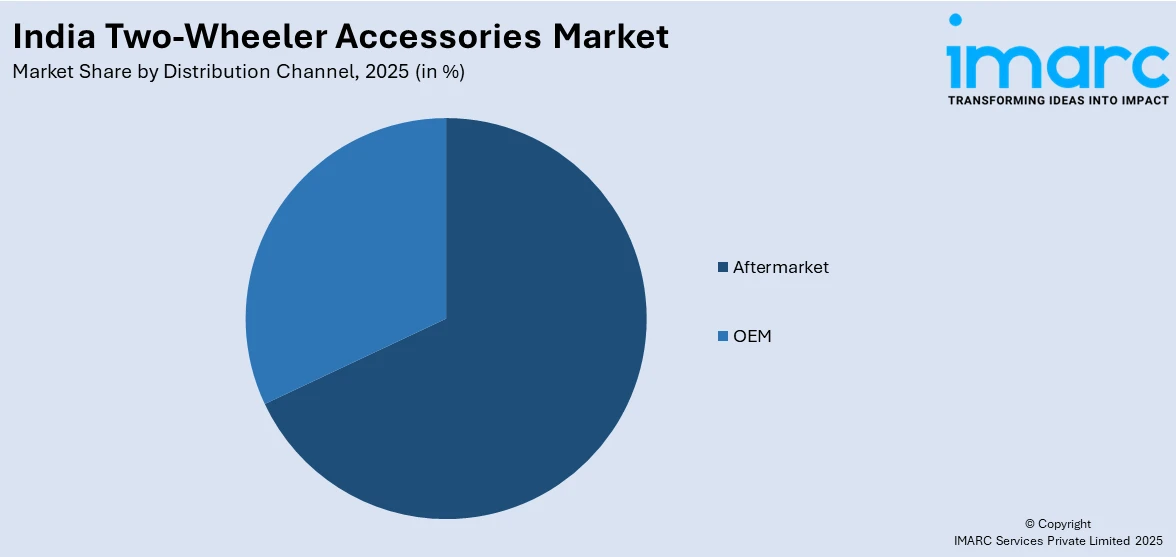
- By Distribution Channel: Aftermarket dominates the market with a share of 68% in 2025, reflecting widespread consumer reliance on independent retailers, specialty shops, and e-commerce platforms for purchasing replacement parts, upgrades, and customization accessories.
- By Region: North India represents the largest segment with a market share of 31% in 2025, attributed to high two-wheeler density in states like Uttar Pradesh and Delhi, robust urbanization trends, and stringent traffic enforcement driving accessory adoption rates.
- Key Players: The India two-wheeler accessories market exhibits moderate competitive intensity, with established domestic manufacturers competing alongside international brands across product categories. Companies are leveraging event-driven launches, motorsport partnerships, and digital retail expansion to strengthen brand positioning and capture emerging consumer segments.
To get more information on this market Request Sample
The India two-wheeler accessories market continues to demonstrate resilience as safety awareness campaigns gain momentum and regulatory frameworks strengthen across the country. With over 210 million registered two-wheelers on Indian roads and annual sales exceeding 19.6 million units in FY 2024-25, the demand for quality accessories remains robust. Manufacturers in India’s two-wheeler accessories market are placing stronger emphasis on product innovation by incorporating smart technologies such as Bluetooth connectivity, crash alerts, and advanced display features into protective gear. At the same time, companies are expanding manufacturing capabilities to meet the rising demand for high-quality and compliant safety products. The growing presence of organized aftermarket networks, along with increasing adoption of digital retail channels, is improving product availability and visibility. These developments are especially enhancing access in Tier-II and Tier-III cities, supporting broader market expansion and reinforcing long-term growth across the two-wheeler accessories landscape.
India Two-Wheeler Accessories Market Trends:
Integration of Smart Technology in Rider Safety Equipment
The Indian two-wheeler accessories market is witnessing a significant shift toward technology-integrated safety gear, particularly smart helmets featuring Bluetooth connectivity, voice navigation, and crash detection capabilities. Urban riders and younger demographics are increasingly seeking helmets that combine advanced protection with digital convenience. Manufacturers are responding by incorporating features such as integrated speakers, touch controls, and hands-free communication systems. For instance, in January 2025, HERE Technologies, a leading location data and technology platform, and Pioneer Corporation, a global vehicle electronics manufacturer, jointly unveiled their connected devices for two-wheelers in the Asia-Pacific region at India’s Bharat Mobility Global Expo 2025, held in New Delhi from January 17 to 22. This reflects the growing consumer appetite for affordable yet technologically advanced protective accessories.
Rising Demand for Performance-Based Customization
Indian riders, particularly in the premium motorcycle and scooter segment, are increasingly prioritizing performance-enhancing accessories that offer improved handling, braking efficiency, and suspension response. This shift is prompting aftermarket brands to introduce advanced, vehicle-specific components tailored to the needs of both enthusiasts and daily commuters. The participation of accessory manufacturers in motorsport events is reinforcing premium brand positioning. For instance, in December 2024, RCB showcased high-performance motorcycle accessories at India Bike Week, including brakes, suspension, and lightweight forged wheels developed in collaboration with UMA Racing for Yamaha Aerox, demonstrating the market’s transition toward durable, engineering-driven aftermarket solutions.
Expansion of E-Commerce and Digital Distribution Channels
The aftermarket accessories sector is undergoing a distribution transformation through e-commerce platforms and direct-to-consumer digital sales channels. Consumers increasingly browse, compare, and purchase two-wheeler accessories online, benefiting from wider product selection, competitive pricing, and doorstep delivery. Brands are leveraging digital marketing strategies and influencer partnerships to boost visibility and engagement. For instance, in May 2024, Hero MotoCorp collaborated with the Open Network for Digital Commerce (ONDC) to offer two-wheeler parts, accessories, and merchandise through buyer-side applications, signaling a broader industry shift toward organized digital retail that is expanding accessory accessibility across urban and semi-urban regions.
Market Outlook 2026-2034:
The India two-wheeler accessories market is poised for sustained expansion over the forecast period, driven by strengthening regulatory mandates, rising consumer sophistication, and the proliferation of organized distribution networks. Growing emphasis on rider safety, performance customization, and vehicle aesthetics is expected to sustain demand across all product categories. The expansion of e-commerce platforms and digital retail channels will broaden market accessibility, particularly in underserved semi-urban and rural regions. Increasing two-wheeler ownership, combined with premiumization trends and technology integration in accessories, positions the market for steady revenue growth. The market generated a revenue of USD 392.92 Million in 2025, which is expected to reach USD 405.87 Million in 2026 and further grow to USD 524.62 Million by 2034, at a compound annual growth rate of 3.26% from 2026-2034.
India Two-Wheeler Accessories Market Report Segmentation:
|
Segment Category |
Leading Segment |
Market Share |
|
Product Type |
Protective Gear |
32% |
|
Vehicle Type |
Motorcycles |
60% |
|
Distribution Channel |
Aftermarket |
68% |
|
Region |
North India |
31% |
Product Type Insights:
- Protective Gear
- Performance Parts
- Comfort and Convenience Accessories
- Visual Accessories
Protective gear dominates with a market share of 32% of the total India two-wheeler accessories market in 2025.
Protective gear, encompassing helmets, riding jackets, gloves, and knee guards, commands the largest share of the India two-wheeler accessories market, driven primarily by strengthening government mandates and heightened consumer safety consciousness. The implementation of the Motor Vehicles Amendment Act, combined with stricter Bureau of Indian Standards (BIS) certification requirements, has significantly elevated demand for compliant helmets. In FY 2024-25, BIS conducted over 30 search-and-seizure operations, testing more than 500 helmet samples and confiscating over 3,000 non-compliant units, demonstrating intensified regulatory oversight that is channeling consumer spending toward certified, quality protective equipment.
The segment is further bolstered by evolving consumer preferences that increasingly view protective gear as lifestyle and identity statements rather than mere compliance tools. Premium and feature-rich helmets incorporating Bluetooth connectivity, anti-fog visors, and aerodynamic designs are gaining traction, particularly among urban riders and younger demographics. For instance, in June 2024, the United Nations collaborated with India to launch the “Helmets for Hope” campaign, led by UN Special Envoy Jean Todt and Steelbird Helmets’ Managing Director Rajeev Kapur, targeting reduced road fatalities through enhanced helmet usage awareness, reinforcing the segment’s growth trajectory across both organized and e-commerce retail channels.
Vehicle Type Insights:
- Motorcycles
- Scooters
Motorcycles lead the market with a share of 60% of the total India two-wheeler accessories market in 2025.
The motorcycle segment commands the dominant position within the India two-wheeler accessories market, reflecting India’s deep-rooted motorcycle culture and the vehicle type’s versatility across urban commuting and rural transportation. Motorcycles attract a significantly higher volume of aftermarket accessory purchases, ranging from performance parts and protective gear to visual customization components. For instance, in January 2025, BMW Motorrad India launched the new S 1000 RR with advanced components including M winglets, carbon wheels, and electronic chassis systems, spurring demand for high-performance aftermarket parts and precision electronics in the premium motorcycle accessories segment.
The motorcycle-oriented accessories ecosystem is further strengthened by India’s vibrant riding community and the growing popularity of motorsport events and long-distance touring. Enthusiast-driven demand for exhaust systems, crash guards, handlebar modifications, and advanced lighting solutions continues to expand the addressable market. The proliferation of motorcycle-focused content on digital platforms and social media is amplifying awareness of customization possibilities, encouraging riders to invest in accessories that enhance both performance and aesthetic appeal, thereby sustaining the motorcycle segment’s dominance in the overall market.
Distribution Channel Insights:
Access the comprehensive market breakdown Request Sample
- OEM
- Aftermarket
Aftermarket represents the largest share at 68% of the total India two-wheeler accessories market in 2025.
The aftermarket distribution channel holds a leading position, supported by strong consumer preference for independent retailers, specialty accessory stores, and online platforms when purchasing two-wheeler accessories. India’s wide network of local workshops and multi-brand dealers ensures broad market reach, especially in Tier-II and Tier-III cities where authorized OEM outlets are less prevalent. Ongoing efforts to strengthen technical skills, improve product awareness, and enhance service quality within the aftermarket ecosystem are further reinforcing its importance and sustaining long-term growth across the two-wheeler accessories market.
The aftermarket channel is experiencing a structural transformation through the formalization of service networks and the integration of digital retail platforms. Organized multi-brand workshops offering standardized diagnostics and certified genuine parts are gradually displacing unorganized repair shops. For instance, in February 2025, ZF Aftermarket launched India’s first ZF [pro]Tech Plus workshop in New Delhi, serving as a center for training, diagnostics, and authorized repairs, marking a significant step toward aligning aftermarket service quality with OEM standards and expanding consumer access to authenticated components and accessories.
Regional Insights:
- North India
- South India
- East India
- West India
North India exhibits a clear dominance with a 31% share of the total India two-wheeler accessories market in 2025.
North India commands the largest regional share, driven by the high concentration of two-wheeler ownership in densely populated states such as Uttar Pradesh and Delhi, robust urbanization trends, and stringent traffic enforcement. The region benefits from a well-established network of original equipment and aftermarket component manufacturers catering to substantial consumer demand. For instance, in July 2024, the Uttar Pradesh government announced the extension of its Electric Vehicle Manufacturing and Mobility Policy until 2027, maintaining subsidies and incentives that support accessory demand for both conventional and electric two-wheelers across the region.
The accessories market in the region is also further facilitated by the growing middle-class population, the rise in workforces and the rural road infrastructure, which altogether contribute to the adoption of the two-wheelers and consequently the purchase of accessories. The closeness of North India to large manufacturing centers and an already existing supply chain network guarantees lower prices and wide product distribution. The rich motorcycle culture, strong existing riding communities, and high attendance at motorsport events in the region have kept the demand for performance parts, protective gears and visual customization accessories vibrant and alive.

Market Dynamics:
Growth Drivers:
Why is the India Two-Wheeler Accessories Market Growing?
Strengthening Road Safety Regulations and Helmet Compliance Mandates
The progressive reinforcement of road safety laws by the Indian government is a root cause of the accessories market, especially of protective gears. The strict helmet laws, the increased sanctions imposed by the Motor Vehicles Amendment Act, and the heightened vigilance by traffic officials are pushing consumers to buy the certified safety gear. The Bureau of Indian Standards has made certification stringent whereby only certified products reach the consumer. For instance, in October 2024, the Department of Consumer Affairs initiated a nationwide campaign against the manufacture and sale of substandard helmets, resulting in the cancellation of 162 manufacturing licenses and 27 search operations for BIS violations. These regulatory actions are effectively channeling consumer spending toward certified, quality accessories, expanding the organized market and creating sustained demand for protective gear across urban and rural India.
Expanding Two-Wheeler Ownership and Rising Disposable Incomes
India’s rapidly expanding two-wheeler ownership base, fueled by rising disposable incomes, increasing urbanization, and growing workforce participation, is directly propelling demand for accessories across all product categories. The country’s two-wheeler registrations exceeded 20 million units in 2025, driven by rural demand recovery and supportive fiscal policies. Each new two-wheeler sold generates incremental accessory demand, from mandatory protective gear to discretionary customization products. The government’s Production Linked Incentive Scheme for Automobile and Auto Components, extended by the Ministry of Heavy Industries in January 2024 with incentives applicable for five consecutive financial years, is further strengthening the domestic manufacturing ecosystem. Growing middle-class aspirations and the availability of affordable financing options are enabling consumers to allocate higher spending toward quality accessories and premium upgrades.
Growing Consumer Inclination Toward Vehicle Customization and Premiumization
A notable shift in consumer behavior toward vehicle personalization and premium accessories is driving sustained growth in the Indian two-wheeler accessories market. Young riders and enthusiasts are increasingly investing in aftermarket components that enhance performance, aesthetics, and riding comfort, transforming two-wheelers from mere transportation tools into lifestyle statements. The growing popularity of motorsport events, long-distance touring culture, and digital content creation around motorcycle customization is amplifying consumer interest. For instance, in December 2024, AXOR Helmets partnered with India Bike Week as the official safety partner and launched its 2025 series featuring Marvel-licensed helmets under the Saber range, alongside collaborations with smart helmet brands Altor and Pinlock. These lifestyle-driven product launches reflect the evolving consumer expectations for accessories that seamlessly blend safety, technology, and personal expression.
Market Restraints:
What Challenges the India Two-Wheeler Accessories Market is Facing?
Proliferation of Counterfeit and Non-Certified Products
The widespread availability of low-cost, non-certified accessories from unorganized manufacturers continues to undermine market quality and consumer safety. These counterfeit products, while economically attractive, often fail to meet essential safety standards and erode consumer trust in the broader accessories ecosystem. The dominance of unbranded products in price-sensitive rural markets limits revenue potential for organized manufacturers and poses significant challenges to establishing uniform quality benchmarks.
Price Sensitivity Among Mass-Market Consumers
A significant portion of India’s two-wheeler user base remains highly price-sensitive, prioritizing affordability over quality when purchasing accessories. This consumer behavior limits the adoption of premium and technologically advanced products, constraining revenue growth in higher-margin segments. The gap between consumer willingness to pay and the cost of certified, feature-rich accessories creates persistent challenges for manufacturers seeking to drive premiumization across mass-market segments.
Limited Awareness and Accessibility in Rural Markets
Despite growing urbanization, a substantial proportion of two-wheeler owners in rural and semi-urban India remain underserved by organized accessories distribution networks. Limited awareness about the benefits of quality accessories, combined with sparse retail infrastructure and restricted e-commerce penetration, constrains market expansion in these high-potential regions. The absence of formalized aftermarket service networks in remote areas further limits consumer access to genuine products and professional installation support.
Competitive Landscape:
The India two-wheeler accessories market features a moderately fragmented competitive landscape characterized by the coexistence of established domestic manufacturers, international aftermarket brands, and a large base of unorganized local producers. Competition is intensifying as organized players invest in product innovation, digital retail expansion, and strategic partnerships with motorsport events and technology providers to differentiate their offerings. Companies are increasingly focusing on securing safety certifications, expanding distribution networks across Tier-II and Tier-III cities, and leveraging e-commerce platforms to capture emerging consumer segments. The market’s competitive dynamics are further shaped by ongoing consolidation efforts, with leading manufacturers pursuing capacity expansion and vertical integration to strengthen their market positioning.
Recent Developments:
- August 2025: AXOR launched the X Altor Apex Smart Helmet in India at a price point under INR 7,910, featuring Bluetooth 5.0 connectivity, smart swipe touch controls for hands-free calling and music playback, and voice assistant integration for navigation. The launch represents the growing convergence of affordable pricing and advanced smart features in India’s protective gear segment.
- January 2025: SKF India launched a nationwide mobile van campaign across 100 cities to train over 8,000 two-wheeler mechanics. The initiative focused on boosting awareness about genuine parts, enhancing skill development, and strengthening India’s aftermarket ecosystem to support long-term growth in two-wheeler accessories and component reliability.
- December 2024: Steelbird Hi-tech India announced a new manufacturing facility in Hosur, Tamil Nadu, with an initial investment of INR 100 crore and a planned total investment of INR 250 crore. The facility targets a production capacity of 20,000 helmets daily to address growing domestic and export demand for quality helmets.
India Two-Wheeler Accessories Market Report Coverage:
| Report Features | Details |
|---|---|
| Base Year of the Analysis | 2025 |
| Historical Period | 2020-2025 |
| Forecast Period | 2026-2034 |
| Units | Million USD |
| Scope of the Report |
Exploration of Historical Trends and Market Outlook, Industry Catalysts and Challenges, Segment-Wise Historical and Future Market Assessment:
|
| Product Types Covered | Protective Gear, Performance Parts, Comfort and Convenience Accessories, Visual Accessories |
| Vehicle Types Covered | Motorcycles, Scooters |
| Distribution Channels Covered | OEM, Aftermarket |
| Regions Covered | North India, South India, East India, West India |
| Customization Scope | 10% Free Customization |
| Post-Sale Analyst Support | 10-12 Weeks |
| Delivery Format | PDF and Excel through Email (We can also provide the editable version of the report in PPT/Word format on special request) |
Frequently Asked Questions About the India Two-Wheeler Accessories Market Report
The India two-wheeler accessories market size increased from USD 392.92 Million in 2025 to USD 405.87 Million in 2026.
The India two-wheeler accessories market is expected to grow at a compound annual growth rate of 3.26% from 2026-2034 to reach USD 524.62 Million by 2034.
Protective gear, representing the largest revenue share of 32% in 2025, dominates the India two-wheeler accessories market, driven by mandatory helmet compliance regulations, intensified BIS certification enforcement, and growing consumer awareness regarding certified safety equipment across urban and rural regions.
Key factors driving the India two-wheeler accessories market include strengthening road safety regulations, expanding two-wheeler ownership, rising disposable incomes, growing consumer preference for vehicle customization and premiumization, and increasing digital retail penetration.
Major challenges include the proliferation of counterfeit and non-certified products, persistent price sensitivity among mass-market consumers, limited awareness and distribution infrastructure in rural areas, and the dominance of unorganized local manufacturers.
Need more help?
- Speak to our experienced analysts for insights on the current market scenarios.
- Include additional segments and countries to customize the report as per your requirement.
- Gain an unparalleled competitive advantage in your domain by understanding how to utilize the report and positively impacting your operations and revenue.
- For further assistance, please connect with our analysts.
 Request Customization
 Speak to an Analyst
 Request Brochure
 Inquire Before Buying
Benefits of Customization
- Personalize this research
- Triangulate with your data
- Get data as per your format and definition
- Gain a deeper dive into a specific application, geography, customer, or competitor
- Any level of personalization
Get in Touch With Us
UNITED STATES
Phone: +1-201-971-6302
INDIA
Phone: +91-120-433-0800
UNITED KINGDOM
Phone: +44-753-714-6104
Email: [email protected]
Client Testimonials




.webp)




.webp)













Related Reports

Choose your plan
*Please note that the prices mentioned below are starting prices for each bundle type. Kindly contact our team for further details.*
Single User License
- 1 User License, Access on 2 Devices
- PDF Report + Excel Dataset (Password Protected)
- Lifetime Access
- No Printing Rights
- 10% Free Report Customization
- 10–12 Weeks of Analyst Support
Five User License
- Access for 5 Users, 2 Devices per User
- PDF Report + Excel Dataset (Password Protected)
- Lifetime Access
- Dedicated Account Manager
- 12–14 Weeks of Analyst Support
- No Printing Rights
- 15% Free Report Customization
- 25% Discount on Your Next Purchase
Corporate User License
- Unlimited User Access (Within Your Organization)
- PDF Report + Excel Dataset
- Lifetime Access
- Dedicated Account Manager
- 14–20 Weeks of Analyst Support
- No Printing Rights
- 20% Free Report Customization
- 30% Discount on Your Next Purchase
Essential Insights
What's included:
3 reports
- Lifetime Access
- PDF Reports
- Excel Datasets
- 2 Weeks of Free Analyst Support
- 2 User Licenses
- Access on 2 Devices
- Printing Rights
- Complimentary PowerPoint (PPT) Version
- Complimentary License Upgrade
Professional Access
What's included:
5 reports
- Lifetime Access
- PDF Reports
- Excel Datasets
- 8 Weeks of Free Analyst Support
- 2 User Licenses
- Access on 2 Devices
- Printing Rights
- Complimentary PowerPoint (PPT) Version
- Complimentary License Upgrade
Business Advantage
What's included:
8 reports
- Lifetime Access
- PDF Reports
- Excel Datasets
- 14 Weeks of Free Analyst Support
- 2 User Licenses
- Access on 2 Devices
- Printing Rights
- Complimentary PowerPoint (PPT) Version
- Complimentary License Upgrade
Enterprise Intelligence
What's included:
10 reports
- Lifetime Access
- PDF Reports
- Excel Datasets
- 20 Weeks of Free Analyst Support
- 2 User Licenses
- Access on 2 Devices
- Printing Rights
- Complimentary PowerPoint (PPT) Version
- Complimentary License Upgrade