
India Water Softener Market Size, Share, Trends and Forecast by Type, Product Type, Application, and Region, 2026-2034
India Water Softener Market Size, Share, Trends & Forecast (2026-2034)
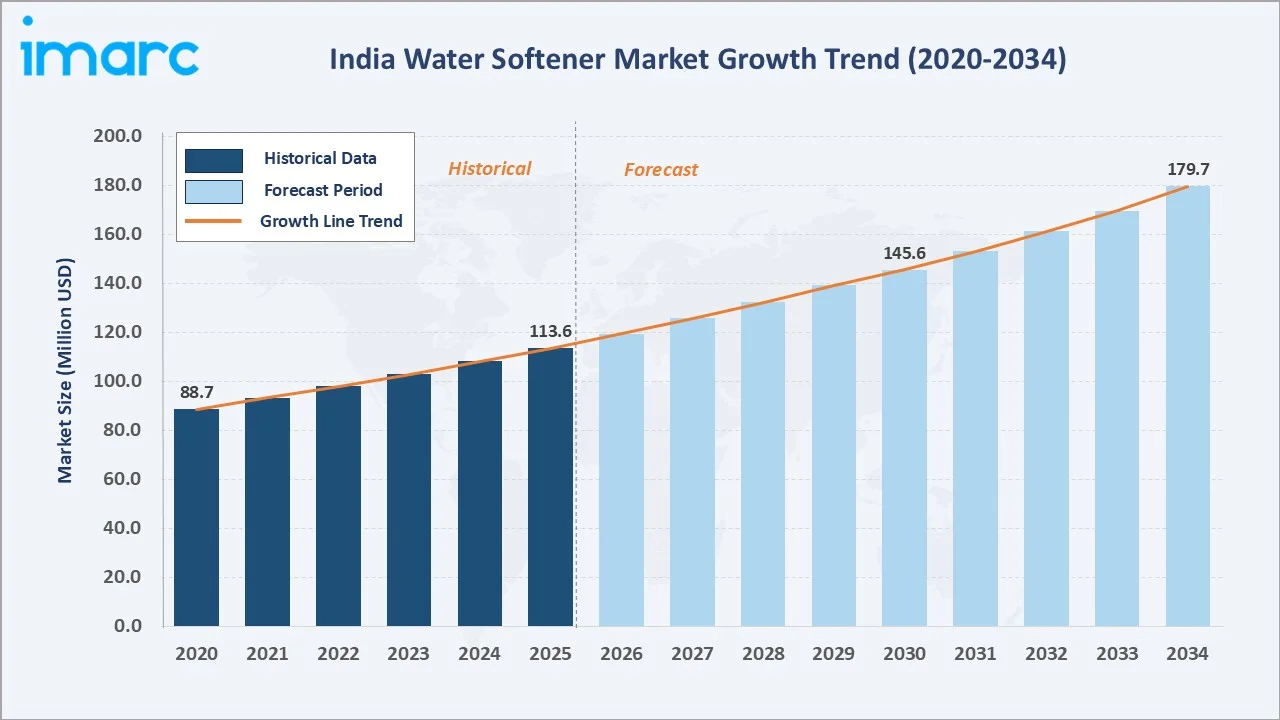
The India water softener market size increased from USD 113.6 Million in 2025 to USD 119.4 Million in 2026 and is projected to reach USD 179.7 Million by 2034, growing at a CAGR of 5.09% during 2026-2034. Rising groundwater hardness across northern and western India, rapid urban housing expansion, and increasing awareness of appliance and plumbing protection are driving adoption of water softening systems among households and industries. Salt based water softeners dominate the market at 79.2% share in 2025, supported by proven ion-exchange efficiency, while salt free systems are gaining traction among eco-conscious consumers. Residential applications lead demand at 55.6%, and South India commands the largest regional share at 32.0%, reflecting the region's acute groundwater hardness challenges.
Growing organized retail penetration, expanding e-commerce reach into Tier-2 and Tier-3 cities, and increasing bundling of softeners with RO and UV purifiers are further supporting market expansion. Salt free systems grow fastest among types, while commercial applications post the strongest application-level growth through 2034.
Market Snapshot
|
Metric |
Value |
|
Base Year Market Size (2025) |
USD 113.6 Million |
|
Market Size (2026) |
USD 119.4 Million |
|
Forecast Market Size (2034) |
USD 179.7 Million |
|
CAGR (2026-2034) |
5.09% |
|
Base Year |
2025 |
|
Historical Period |
2020-2025 |
|
Forecast Period |
2026-2034 |
|
Dominant Type |
Salt Based Water Softener (79.2%, 2025) |
|
Dominant Application |
Residential (55.6%, 2025) |
|
Leading Region |
South India (32.0%, 2025) |
India water softener market expanded from USD 88.7 Million in 2020 to USD 113.6 Million in 2025 and an estimated USD 119.4 Million in 2026, anchored at USD 145.6 Million in 2030, and projected to reach USD 179.7 Million by 2034. The market's steady expansion reflects widening groundwater hardness across Indian states, rising awareness of hard water's impact on skin, hair, and household appliances, and growing penetration of automated, low-maintenance softening systems in urban and semi-urban homes.
To get more information on this market, Request Sample
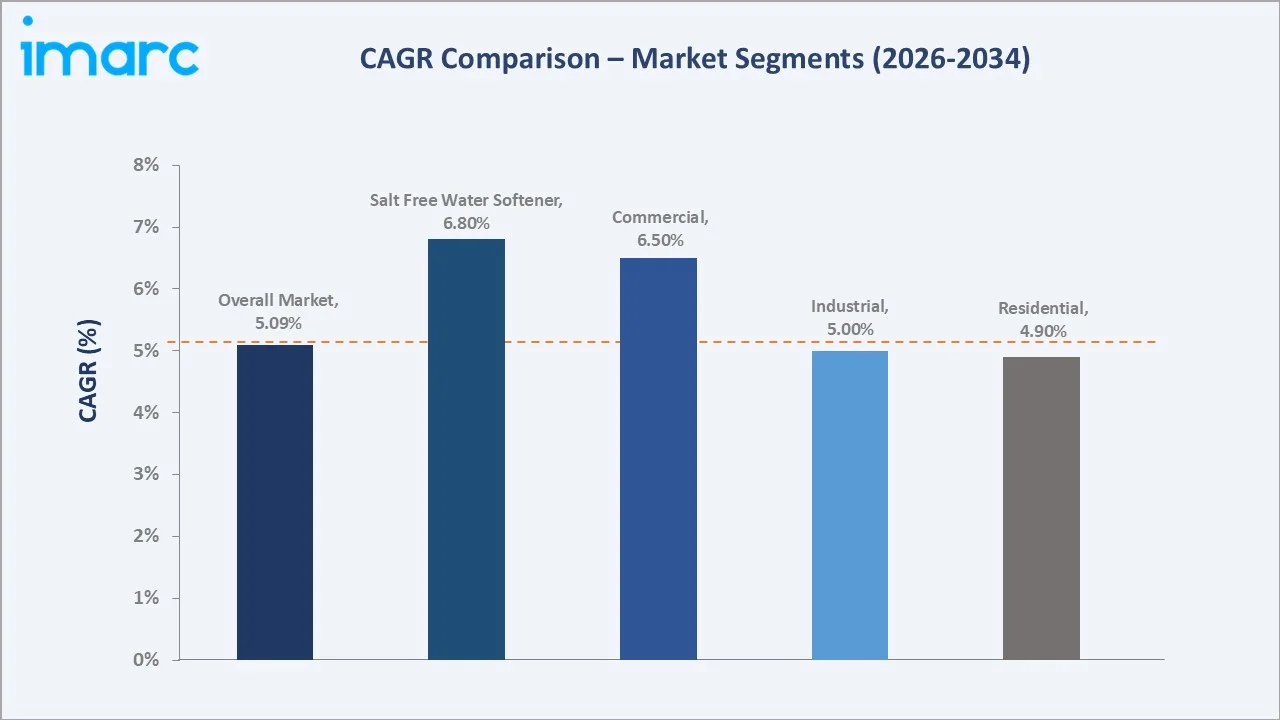
Salt free water softeners grow fastest at an estimated 6.8% CAGR through 2034, driven by consumer preference for chemical-free, low-maintenance alternatives, while the commercial application segment expands at approximately 6.5% CAGR as hotels, hospitals, and offices adopt centralized systems to protect infrastructure and lower operating costs.
Executive Summary
The India water softener market, which increased from USD 113.6 Million in 2025 to an estimated USD 119.4 Million in 2026, is a fast-emerging segment within the country's broader water treatment industry, reflecting the widespread prevalence of hard water across northern, western, and peninsular India. Rising groundwater salinity, declining water table quality, and growing consumer spending on home appliances are reshaping household water treatment priorities. The market is projected to reach USD 179.7 Million by 2034, registering a CAGR of 5.09% during 2026-2034.
Salt based water softeners lead the market with a 79.2% share in 2025, owing to proven ion-exchange technology and wide service networks, while salt free systems are gaining ground among consumers seeking chemical-free alternatives. Residential applications dominate end-use demand at 55.6%, supported by rising nuclear family formation and premium housing construction, while commercial and industrial buyers increasingly install centralized units to protect equipment.
Regionally, South India leads with 32.0% share in 2025, driven by acute groundwater hardness in states such as Tamil Nadu, Karnataka, and Telangana, followed by North India at 28.5%. As awareness deepens and organized retail and e-commerce channels expand distribution reach, the India water softener market is set to sustain healthy growth across price-sensitive and premium categories alike through the forecast period.
Key Market Insights
|
Insight |
Data |
|
Dominant Type |
Salt Based Water Softener - 79.2% share (2025) |
|
Dominant Application |
Residential - 55.6% share (2025) |
|
Leading Region |
South India - 32.0% share (2025) |
|
Market Opportunity |
Smart and IoT-enabled softener adoption; salt-free system expansion in Tier-2/3 cities; commercial bundling with RO/UV systems; subscription-based maintenance services |
Key Analytical Observations Supporting The Above Data:
- Salt based water softener at 79.2%: The segment dominates due to affordability, proven ion-exchange efficiency, and wide availability of resin and salt refills across urban and semi-urban India, making it the default choice for most households.
- Residential at 55.6%: This reflects rising nuclear family formation, premium apartment construction, and growing consumer willingness to invest in appliances that protect geysers, washing machines, and plumbing from scale buildup.
- South India at 32.0%: The region leads due to elevated groundwater hardness levels in Tamil Nadu, Karnataka, and Telangana, combined with strong plumbing-linked retail networks in Chennai, Bengaluru, and Hyderabad.
- Salt free water softener at 20.8% and rising: Salt free systems are gaining share as environmentally conscious consumers and housing societies with wastewater discharge restrictions seek low-sodium, template-assisted crystallization alternatives.
- Commercial application growing fastest: Hotels, hospitals, and commercial kitchens are adopting centralized softening systems to reduce scaling-related maintenance costs on boilers and HVAC systems.
- E-commerce and organized retail expansion: Online platforms and multi-brand retail chains are improving product accessibility and after-sales service visibility across Tier-2 and Tier-3 Indian cities.
India Water Softener Market Overview
India water softener market sits at the intersection of the country's deteriorating groundwater quality and rising household appliance ownership. The industry encompasses ion-exchange resin manufacturing, salt-free catalytic and electromagnetic systems, component assembly, and a growing network of installation and after-sales service providers. Applications span residential homes, commercial establishments such as hotels and hospitals, and industrial processes including boiler feed-water treatment.
Macroeconomic factors including rising disposable incomes, accelerating urbanization, and expanding real estate construction are increasing appliance penetration. Government programs such as the Jal Jeevan Mission, which has substantially expanded rural tap water coverage, are also raising consumer awareness of water quality issues nationwide.
Market Dynamics
To evaluate market opportunities, Request Sample
Market Drivers
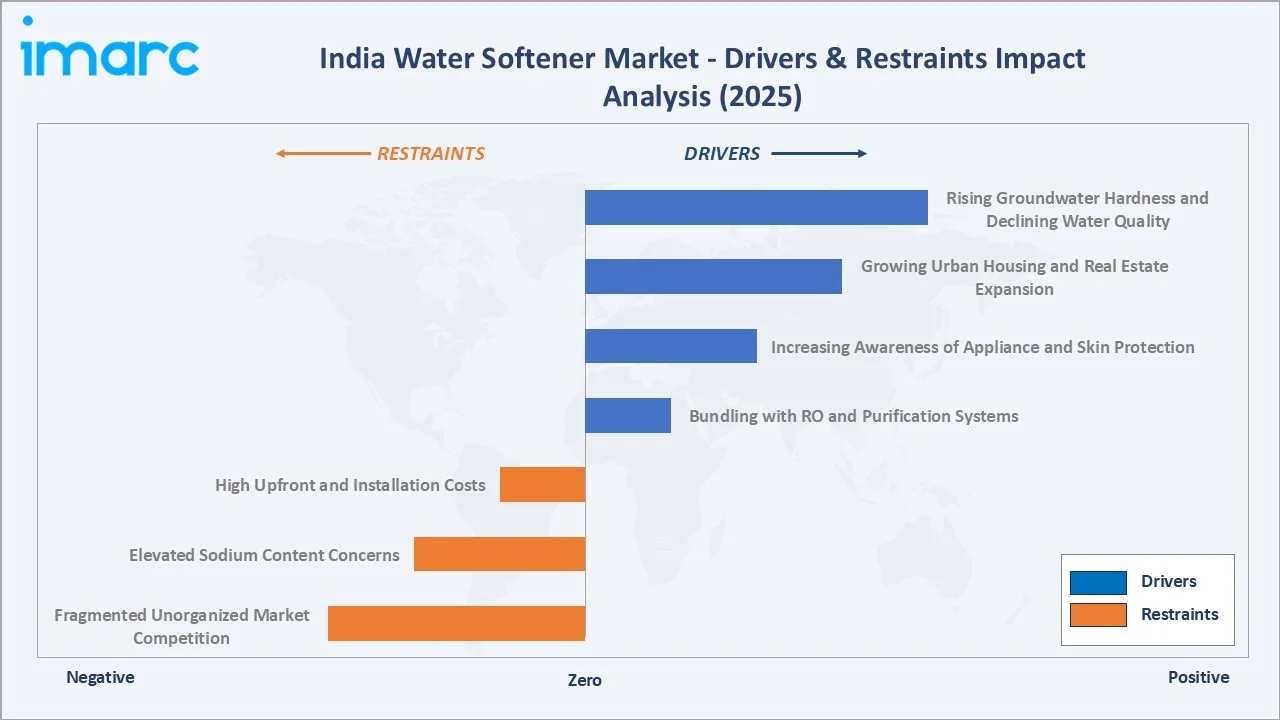
- Rising Groundwater Hardness and Declining Water Quality: A large share of India's groundwater, particularly across northern and western states, carries high calcium and magnesium concentrations. This is pushing households and industries to adopt softening systems to prevent scaling, protect appliances, and improve everyday water usability. Increasing borewell dependence in urban areas facing municipal water shortages is compounding the problem, sustaining consistent softener demand.
- Growing Urban Housing and Real Estate Expansion: India's rapid urban housing construction, particularly in high-rise apartment complexes, is driving bulk and centralized softener installations. Builders are increasingly offering pre-installed water treatment systems as a value-added amenity, expanding the addressable market across both salt based and salt free softeners.
- Increasing Awareness of Appliance and Skin Protection: Consumers are increasingly aware that hard water damages geysers, washing machines, and plumbing fixtures while also affecting skin and hair health. This awareness, amplified through digital marketing and e-commerce product reviews, is translating into higher willingness to invest in home water treatment.
- Bundling with RO and Purification Systems: Leading brands are increasingly offering softeners bundled with RO, UV, and UF purification systems as whole-home water solutions, simplifying the purchase decision for consumers and expanding softener attach rates alongside existing purifier sales channels.
Market Restraints
- High Upfront and Installation Costs: Automatic, high-capacity softening systems carry significant upfront costs plus plumbing and installation charges, limiting adoption among price-sensitive households in smaller cities and rural areas where awareness of long-term appliance savings remains limited.
- Elevated Sodium Content Concerns: Salt based softeners increase sodium levels in treated water, raising health concerns for consumers on sodium-restricted diets and creating hesitancy among health-conscious buyers, who often require additional filtration to offset this drawback.
Market Opportunities
- Salt-Free and Template-Assisted Crystallization Systems: Rising environmental awareness and housing society restrictions on saline wastewater discharge are creating opportunities for salt-free softener manufacturers to expand in urban markets with strict effluent norms.
- Tier-2 and Tier-3 City Retail Expansion: Growing awareness and rising disposable incomes in smaller cities represent a largely underpenetrated opportunity for organized softener brands to expand dealer and service networks beyond metro markets.
Market Challenges
- Fragmented Unorganized Market Competition: A large base of unbranded, locally assembled softening systems competes aggressively on price, making it difficult for organized brands to expand share among cost-sensitive buyers without compromising margins.
- Limited After-Sales Service Penetration: Effective softener operation requires periodic resin replacement, salt refilling, and maintenance, and limited service network reach beyond major cities constrains sustained product performance and repeat purchase confidence.
Emerging Market Trends
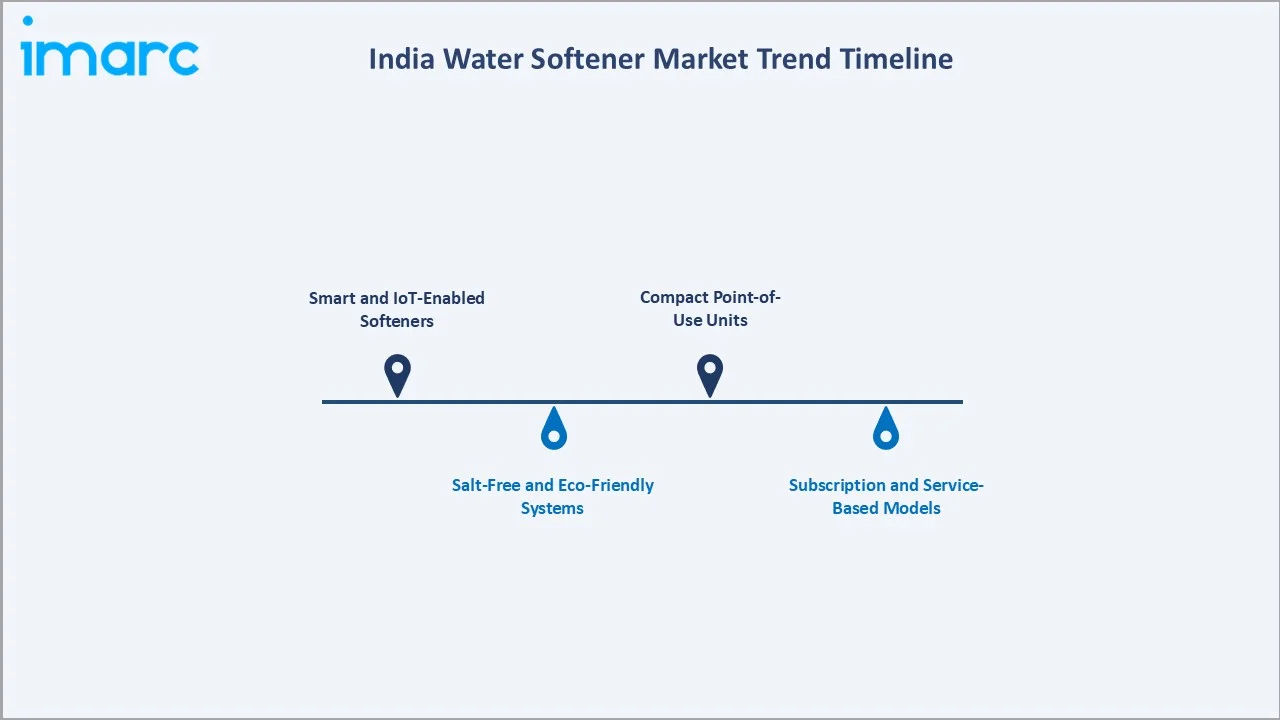
1. Smart and IoT-Enabled Softeners
Smart water softeners equipped with app-based monitoring, automatic salt-level alerts, and usage analytics are gaining traction among tech-savvy urban consumers. These systems reduce maintenance guesswork and appeal to premium buyers seeking connected home appliances integrated with broader smart-home ecosystems.
2. Salt-Free and Eco-Friendly Systems
Growing environmental consciousness and housing society restrictions on sodium-laden wastewater discharge are accelerating demand for salt-free, template-assisted crystallization and electromagnetic softeners, particularly in metro apartment complexes with shared effluent treatment systems.
3. Compact Point-of-Use Units
Space-constrained urban housing is driving demand for compact, under-sink or point-of-use softening units that treat water at a single tap or appliance rather than requiring whole-house installation, lowering the entry price point for apartment dwellers.
4. Subscription and Service-Based Models
Brands are increasingly offering subscription-based maintenance plans covering resin replacement, salt delivery, and periodic servicing, converting one-time equipment sales into recurring revenue streams while improving long-term customer retention and system performance.
Industry Value Chain Analysis
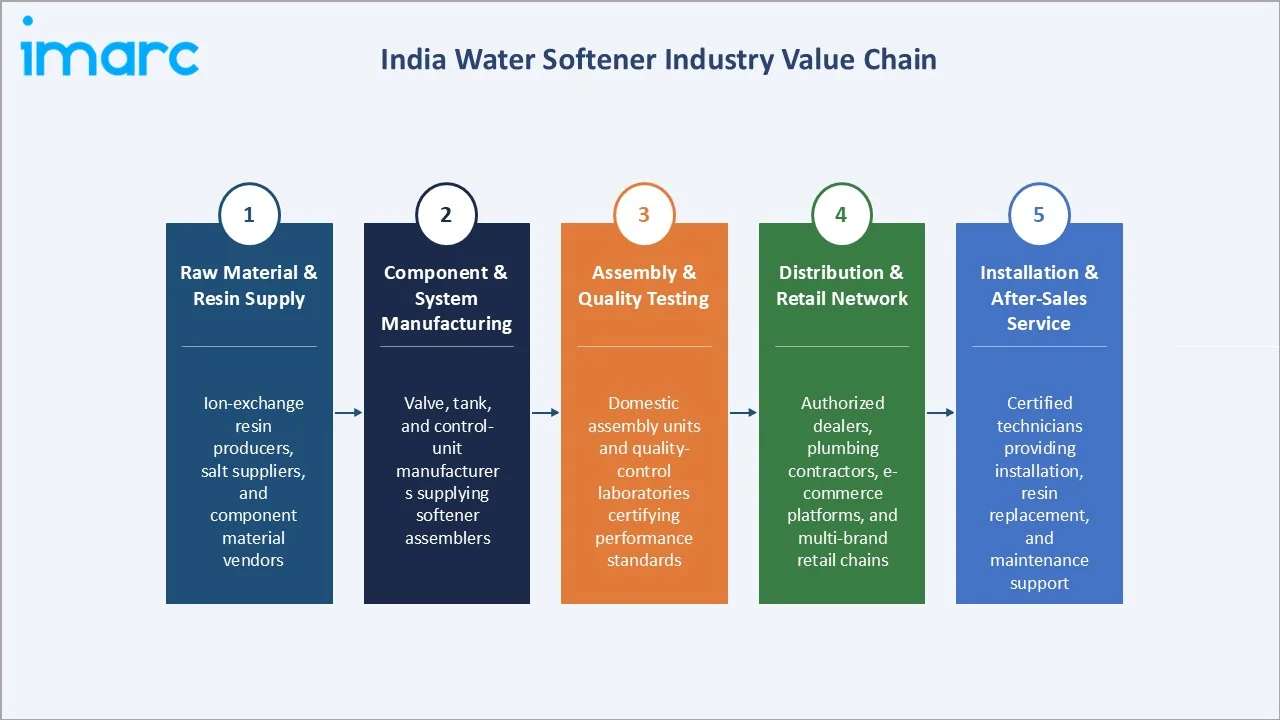
India's water softener value chain spans raw material and resin sourcing through to after-sales service, with distribution complexity shaped by the technical nature of installation and ongoing maintenance requirements. Domestic resin production competes alongside imported components, while distributors and plumbing partners play a central role in reaching end consumers across urban and semi-urban geographies.
|
Stage |
Key Participants |
|
Raw Material & Resin Supply |
Ion-exchange resin producers, salt suppliers, and component material vendors |
|
Component & System Manufacturing |
Valve, tank, and control-unit manufacturers supplying softener assemblers |
|
Assembly & Quality Testing |
Domestic assembly units and quality-control laboratories certifying performance standards |
|
Distribution & Retail Network |
Authorized dealers, plumbing contractors, e-commerce platforms, and multi-brand retail chains |
|
Installation & After-Sales Service |
Certified technicians providing installation, resin replacement, and maintenance support |
The distribution and retail stage remains the most service-intensive link in the value chain, as softener performance depends heavily on correct installation and ongoing maintenance, requiring brands to invest in dealer training and technician networks alongside product development.
Technology Landscape in the India Water Softener Industry
Ion-Exchange Resin Technology
Ion-exchange resin remains the foundational technology for salt based softeners, offering proven, cost-effective hardness removal. Continuous improvements in resin capacity and regeneration efficiency are helping manufacturers reduce salt and water consumption per regeneration cycle, improving the technology's environmental profile.
Salt-Free and Catalytic Innovation
Template-assisted crystallization and electromagnetic descaling technologies are emerging as salt-free alternatives that condition rather than remove hardness minerals, appealing to consumers concerned about sodium intake and wastewater discharge regulations in urban housing societies.
Smart Connectivity
Wi-Fi and app-enabled control panels now allow users to monitor salt levels, water usage, and regeneration cycles remotely, reducing maintenance oversight burden and supporting predictive servicing models offered by leading manufacturers.
Automation
Automatic regeneration systems that operate on demand-based sensing rather than fixed timers are becoming standard in premium products, optimizing salt and water use while minimizing manual intervention for end users.
Market Segmentation Analysis
The report covers the following segments:
|
Segment Category |
Leading Segment |
Market Share |
Year |
|
Type |
Salt Based Water Softener |
79.2% |
2025 |
|
Application |
Residential |
55.6% |
2025 |
|
Product Type |
🔒 |
🔒 |
2025 |
|
Region |
South India |
32.0% |
2025 |

By Type
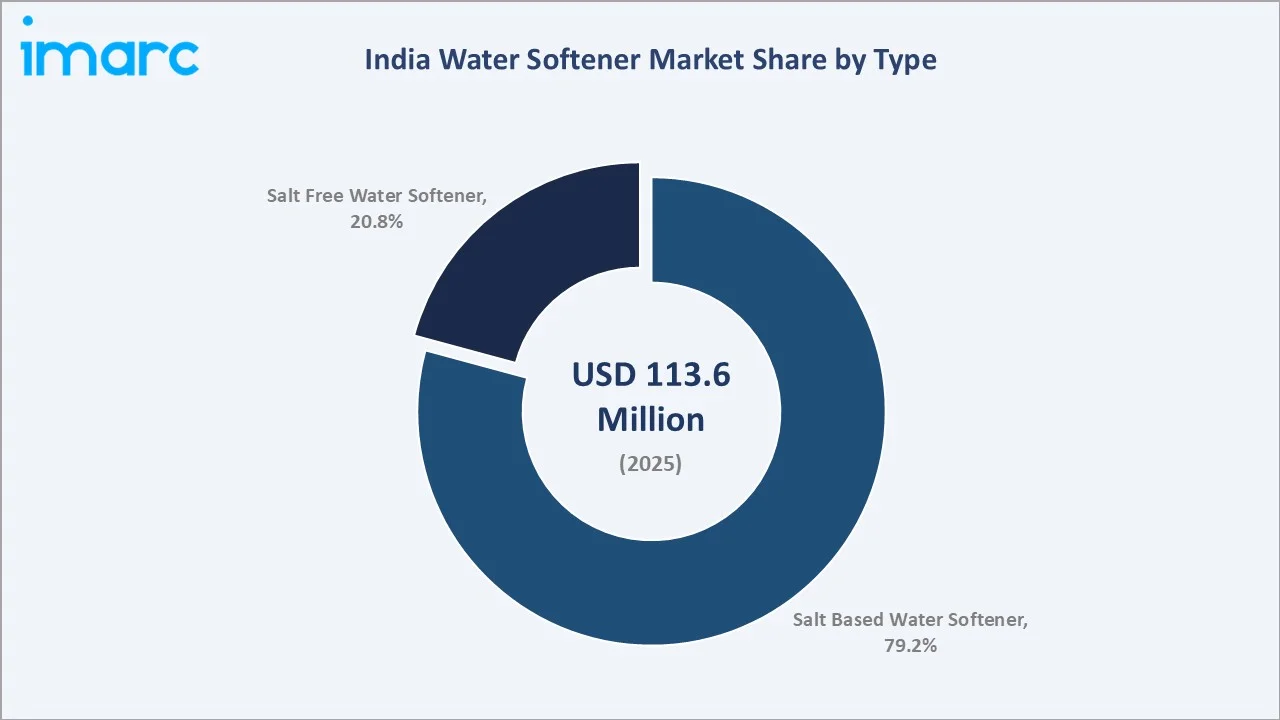
Salt based water softeners lead the market at 79.2% share in 2025. The segment's dominance rests on decades-old ion-exchange familiarity, extensive service networks, and lower upfront costs compared to salt-free alternatives, making it the default choice across residential and commercial installations nationwide.
To access detailed market analysis, Request Sample
Salt free water softeners, holding 20.8% share, are the fastest-growing type at an estimated 6.8% CAGR through 2034. Rising consumer preference for chemical-free treatment, coupled with housing society restrictions on sodium-rich wastewater discharge, is expected to sustain above-market growth for this segment through the forecast period.
By Application
Residential applications lead at 55.6% share in 2025, reflecting rising nuclear family formation, growing apartment construction, and increasing consumer spending on home water treatment as a lifestyle necessity rather than a discretionary purchase.
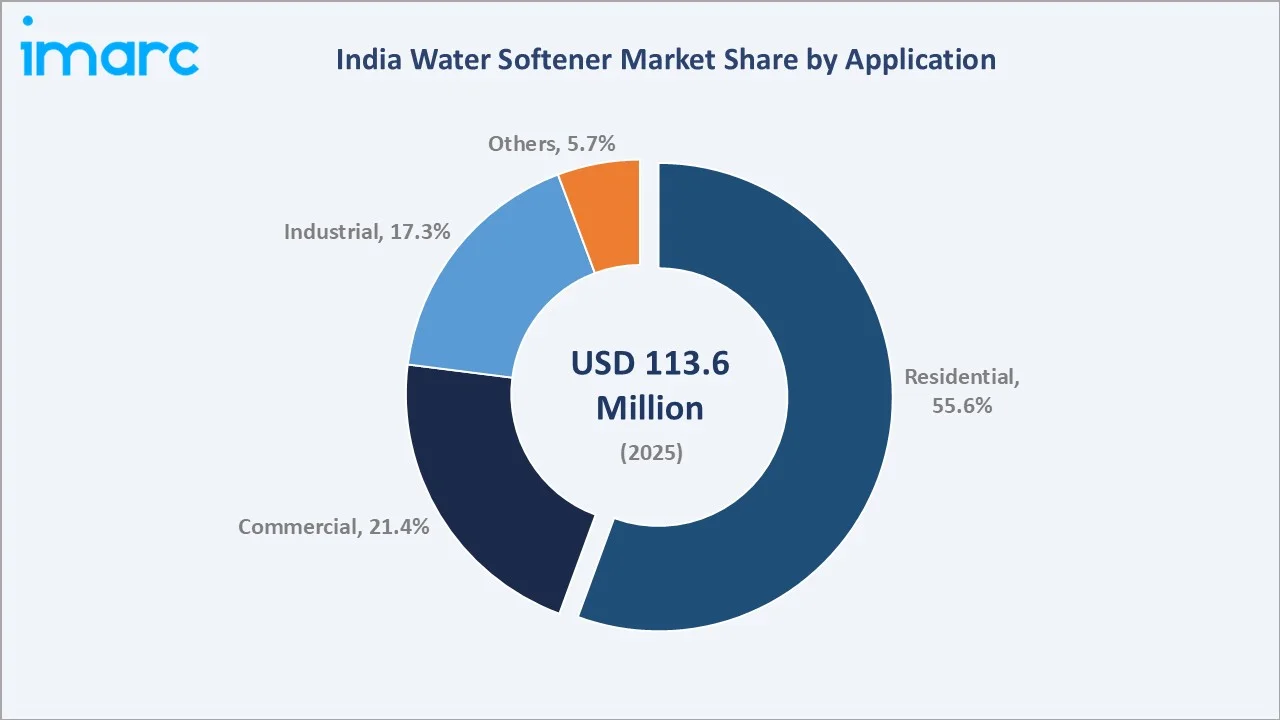
Commercial applications, at 21.4% share, are growing fastest at approximately 6.5% CAGR as hotels, hospitals, and commercial kitchens adopt centralized systems to protect boilers, HVAC equipment, and laundry infrastructure from scale-related damage. Industrial applications hold 17.3% share, driven by process water treatment needs in textiles, pharmaceuticals, and food processing, while other applications, including institutional and agricultural use, account for the remaining 5.7%.
Regional Market Insights
|
Region |
Share (2025) |
Key India Water Softener Market Drivers & Characteristics |
|
South India |
32.0% |
Elevated groundwater hardness across Tamil Nadu, Karnataka, and Telangana, supported by strong plumbing-linked retail and IT-sector driven premium housing demand. |
|
North India |
28.5% |
High borewell dependence and hard groundwater across Delhi-NCR, Punjab, and Rajasthan, sustaining strong residential and commercial softener adoption. |
|
West India |
24.7% |
Rapid urban housing growth in Maharashtra and Gujarat, along with industrial process water treatment demand from textile and chemical manufacturing hubs. |
|
East India |
14.8% |
Emerging demand supported by rising urbanization in West Bengal and Odisha, though comparatively lower awareness limits penetration versus other regions. |
South India's 32.0% market leadership reflects the region's naturally hard groundwater across Tamil Nadu, Karnataka, and Telangana, combined with Bengaluru and Chennai's IT-driven premium housing construction, which increasingly specifies water treatment systems as standard fittings. North India's 28.5% share is anchored by Delhi-NCR's dense urban population and Punjab and Haryana's agriculturally stressed, mineral-rich groundwater tables.
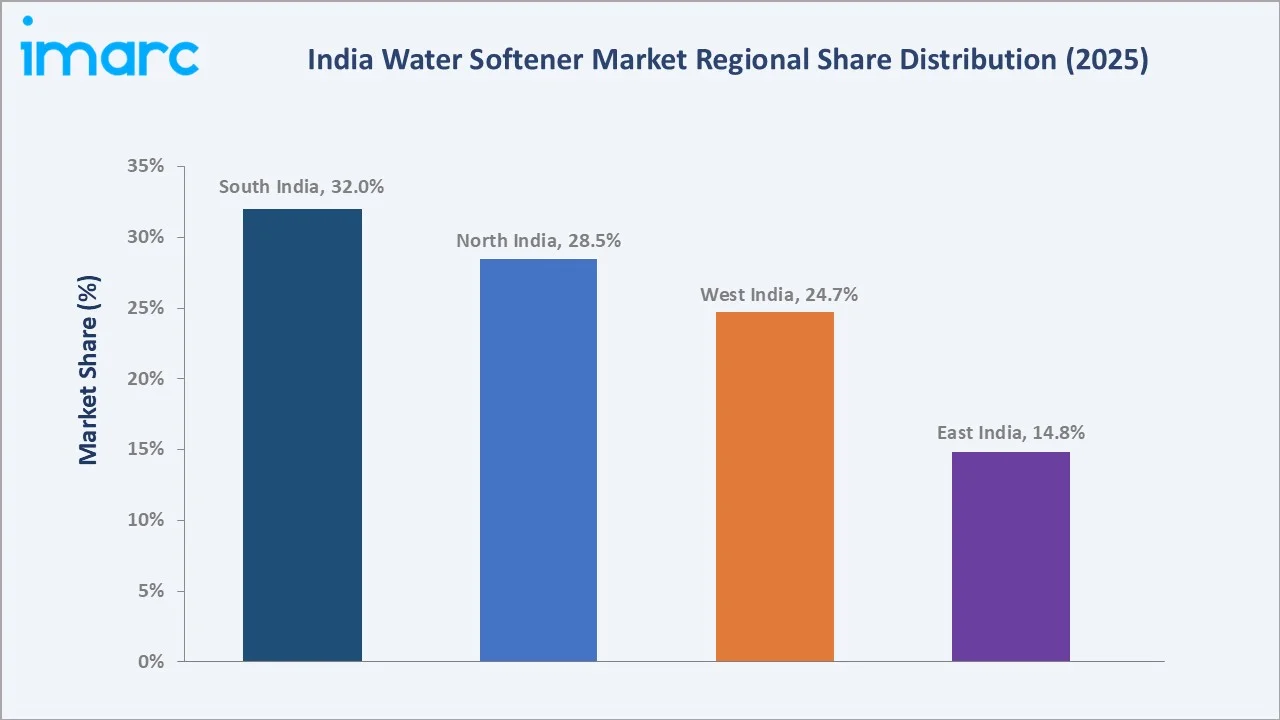
West India's 24.7% share is supported by Mumbai and Pune's expanding real estate sector alongside Gujarat's industrial process water treatment demand from textile and chemical manufacturing clusters. East India, at 14.8%, remains the most underpenetrated region, but rising urbanization in Kolkata and Bhubaneswar is gradually narrowing the awareness gap with other regions, supporting above-average growth from a smaller base.
Competitive Landscape
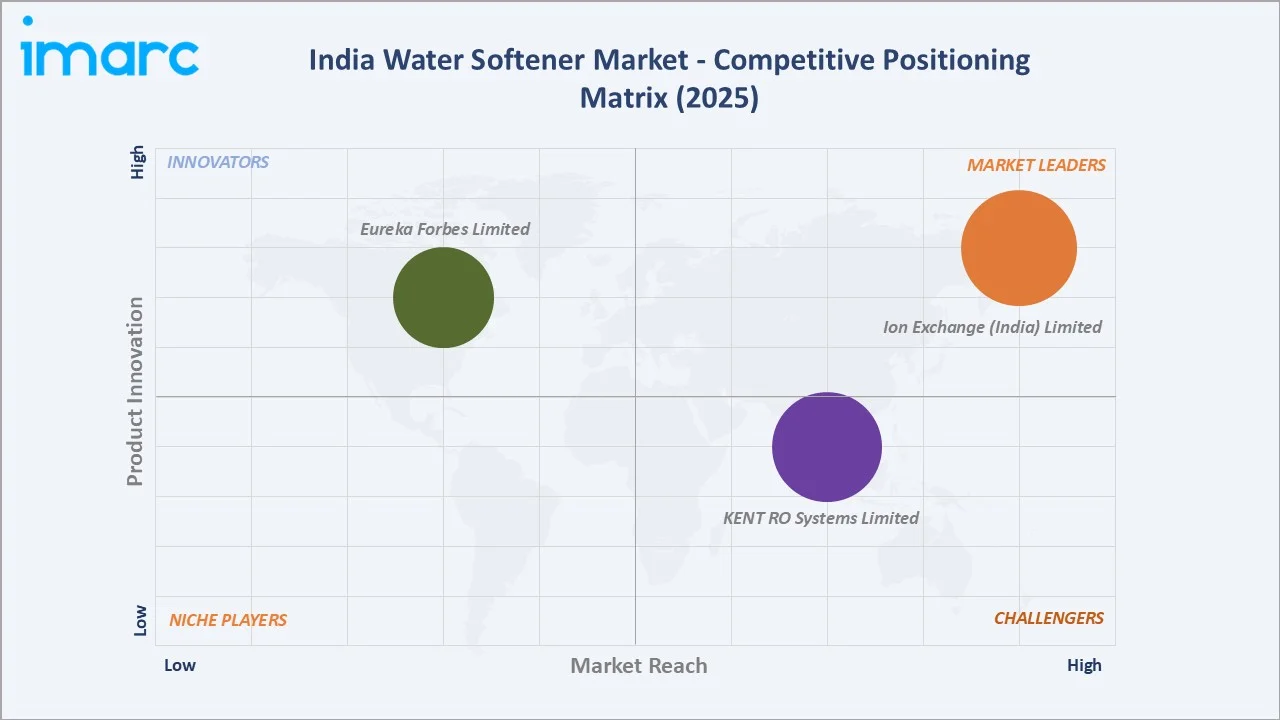
India water softener market's competitive landscape features a mix of established water-treatment conglomerates and consumer appliance brands competing across price tiers. Competition is intensifying as players expand bundled RO-softener offerings and strengthen dealer and e-commerce distribution networks.
|
Company |
Product Portfolio |
Market Position |
Core Strength |
|
Ion Exchange (India) Limited |
INDION Softeners, INDION Resins, ZeroB |
Market Leader |
Six-decade legacy in water treatment engineering with an extensive pan-India service and distribution network spanning residential, commercial, and industrial segments. |
|
KENT RO Systems Limited |
KENT Autosoft 25L, KENT Bathroom Water Softener, KENT Washing Machine Water Softener |
Strong Challenger |
Leading consumer water-appliance brand leveraging its strong RO purifier distribution network to cross-sell whole-home softening systems. |
|
Eureka Forbes Limited |
Aquaguard Select AWS C-Series, Aquaguard Select AWS I-Series, Aquaguard Select AWS 7500 |
Innovator |
Long-standing household brand equity and wide direct-sales and service network across urban and semi-urban India. |
The competitive landscape's most significant dynamic is the continued dominance of the unorganized segment, where locally assembled softening systems compete aggressively on price, pressuring organized brands to differentiate through service quality, digital monitoring features, and bundled purification offerings rather than price alone.
Key Company Profiles
Ion Exchange (India) Limited
Ion Exchange (India) Limited, established in 1964, is one of India's pioneering water and environmental management companies, offering a comprehensive range of water treatment solutions including ion-exchange resins, softeners, and process water systems for residential, commercial, and industrial customers.
- Product Portfolio: INDION Softeners, INDION Resins, and ZeroB.
- Strategic Focus: Strengthening its resin manufacturing capacity and expanding its service network to maintain leadership across India's institutional and industrial water treatment segments.
KENT RO Systems Limited
KENT RO Systems Limited, founded in 1999 and headquartered in Noida, is a leading Indian water purification and appliance brand that has expanded its portfolio to include automatic water softeners alongside its core RO purifier business.
- Product Portfolio: KENT Autosoft 25L, KENT Bathroom Water Softener, KENT Washing Machine Water Softener, and others.
- Strategic Focus: Leveraging its strong RO purifier distribution and service network to cross-sell whole-house softening systems to existing purifier customers.
Eureka Forbes Limited
Eureka Forbes Limited, headquartered in Mumbai and operating under the Aquaguard brand, is one of India's most recognized home water and hygiene appliance companies with an extensive direct-to-home sales and service network.
- Product Portfolio: Aquaguard Select AWS C-Series, Aquaguard Select AWS I-Series, Aquaguard Select AWS 7500, and others.
- Strategic Focus: Deepening penetration in Tier-2 and Tier-3 cities through its established service technician network and brand trust built over four decades.
Market Concentration Analysis
India water softener market is moderately fragmented, with organized players, such as Ion Exchange (India) Limited, KENT RO Systems Limited, and Eureka Forbes, Limited collectively holding an estimated 35-40% of the branded market, while a large base of unorganized regional assemblers accounts for the remainder, particularly in price-sensitive Tier-2 and Tier-3 cities.
Market concentration is gradually increasing as organized brands expand dealer networks and bundle softeners with existing RO purifier distribution channels, though the unorganized segment's cost advantage continues to limit consolidation, particularly in the salt based systems segment where technical barriers to entry remain comparatively low.
Investment & Growth Opportunities
Highest Growth Segments
Salt free water softeners (~6.8% CAGR through eco-conscious consumer adoption), commercial applications (~6.5% CAGR through hospitality and healthcare sector adoption), and smart IoT-enabled premium systems represent India's highest-growth water softener investment opportunities through 2034.
Emerging Investment Opportunities
India's Tier-2 and Tier-3 city retail expansion represents a significant underpenetrated opportunity, as rising disposable incomes and improving awareness create demand in cities where organized softener brands currently maintain limited dealer and service presence.
Investment Themes
- Salt-free and eco-friendly technology investment: Manufacturers investing in template-assisted crystallization and electromagnetic descaling technologies are well-positioned to capture demand from environmentally conscious urban consumers and housing societies facing wastewater discharge restrictions.
- Service network and subscription model expansion: Companies building dealer and technician networks in underserved Tier-2 and Tier-3 cities, combined with subscription-based maintenance offerings, are positioned to capture long-term recurring revenue as the market matures.
Future Market Outlook (2026-2034)
India water softener market is projected to grow from USD 113.6 Million in 2025 to USD 119.4 Million in 2026, reaching USD 179.7 Million by 2034, registering a CAGR of 5.09% during 2026-2034. The market's anchor value of USD 145.6 Million in 2030 reflects a structural mid-point in the industry's transition from a niche appliance category toward a mainstream household and commercial water treatment necessity.
Three structural forces will define market growth through 2034: continued deterioration of groundwater quality across urban India sustaining baseline demand; rising adoption of smart, connected softening systems among premium urban consumers; and expanding organized retail and e-commerce penetration bringing softening solutions to previously underserved Tier-2 and Tier-3 markets.
Research Methodology
Primary Research
Primary research comprised structured interviews with India water softener industry stakeholders, including product managers, regional distributors, plumbing and installation contractors, and consumer survey responses from softener buyers across North, South, East, and West India.
Secondary Research
Secondary research encompassed company annual reports and investor disclosures, industry association publications, government water quality and infrastructure reports, e-commerce sales data, and trade publications covering India's water treatment and home appliance sectors.
Forecasting Models
Market revenue forecasts were developed using a bottom-up consumption model incorporating household and commercial appliance penetration rates, average selling prices by segment, and regional groundwater hardness severity indices, cross-validated against top-down industry revenue benchmarks.
India Water Softener Market Report Coverage:
| Report Features | Details |
|---|---|
| Base Year of the Analysis | 2025 |
| Historical Period | 2020-2025 |
| Forecast Period | 2026-2034 |
| Units | Million USD |
| Scope of the Report |
Exploration of Historical Trends and Market Outlook, Industry Catalysts and Challenges, Segment-Wise Historical and Future Market Assessment:
|
| Types Covered | Salt Based Water Softener, Salt Free Water Softener |
| Product Types Covered | Catalytic Water Softeners, Electro-Magnetic Water Softeners |
| Applications Covered | Residential, Commercial, Industrial, Others |
| Regions Covered | North India, South India, East India, West India |
| Companies Covered | Ion Exchange (India) Limited, KENT RO Systems Limited, Eureka Forbes Limited, etc. |
| Customization Scope | 10% Free Customization |
| Post-Sale Analyst Support | 10-12 Weeks |
| Delivery Format | PDF and Excel through Email (We can also provide the editable version of the report in PPT/Word format on special request) |
Key Benefits for Stakeholders:
- IMARC’s industry report offers a comprehensive quantitative analysis of various market segments, historical and current market trends, market forecasts, and dynamics of the India water softener market from 2020-2034.
- The research report provides the latest information on the market drivers, challenges, and opportunities in the India water softener market.
- Porter's five forces analysis assist stakeholders in assessing the impact of new entrants, competitive rivalry, supplier power, buyer power, and the threat of substitution. It helps stakeholders to analyze the level of competition within the India water softener industry and its attractiveness.
- Competitive landscape allows stakeholders to understand their competitive environment and provides an insight into the current positions of key players in the market.
Frequently Asked Questions About the India Water Softener Market Report
The India water softener market size increased from USD 113.6 Million in 2025 and USD 119.4 Million in 2026, driven by rising groundwater hardness, growing urban housing construction, and increasing consumer awareness of appliance protection across Indian households and industries.
The India water softener market is projected to grow at a CAGR of 5.09% during 2026-2034, reaching USD 179.7 Million by 2034, supported by rising hard-water awareness and organized retail expansion.
Salt based water softeners lead at 79.2% share in 2025, owing to proven ion-exchange technology, lower upfront costs, and wide service network availability across urban and semi-urban India.
Residential applications lead at 55.6% share in 2025, driven by rising nuclear family formation, premium housing construction, and growing consumer spending on home water treatment systems.
South India leads at 32.0% share, driven by elevated groundwater hardness across Tamil Nadu, Karnataka, and Telangana, combined with strong plumbing-linked retail networks in major cities.
Leading companies include Ion Exchange (India) Limited, KENT RO Systems Limited, and Eureka Forbes Limited, among others.
The India water softener market is projected to reach approximately USD 145.6 Million by 2030, as rising groundwater hardness and expanding organized retail distribution sustain steady demand growth.
Key opportunities include salt-free and eco-friendly technology investment, Tier-2 and Tier-3 city retail network expansion, and subscription-based maintenance service models targeting long-term recurring revenue.
Salt free water softeners are gaining demand due to rising environmental consciousness, housing society restrictions on sodium-rich wastewater discharge, and consumer preference for chemical-free water treatment alternatives.
E-commerce platforms are improving product accessibility and price transparency, enabling organized brands to expand reach into Tier-2 and Tier-3 cities where dealer networks remain limited.
Need more help?
- Speak to our experienced analysts for insights on the current market scenarios.
- Include additional segments and countries to customize the report as per your requirement.
- Gain an unparalleled competitive advantage in your domain by understanding how to utilize the report and positively impacting your operations and revenue.
- For further assistance, please connect with our analysts.
 Request Customization
 Speak to an Analyst
 Request Brochure
 Inquire Before Buying
Benefits of Customization
- Personalize this research
- Triangulate with your data
- Get data as per your format and definition
- Gain a deeper dive into a specific application, geography, customer, or competitor
- Any level of personalization
Get in Touch With Us
UNITED STATES
Phone: +1-201-971-6302
INDIA
Phone: +91-120-433-0800
UNITED KINGDOM
Phone: +44-753-714-6104
Email: [email protected]
Client Testimonials




.webp)




.webp)













Related Reports

Choose your plan
*Please note that the prices mentioned below are starting prices for each bundle type. Kindly contact our team for further details.*
Single User License
- 1 User License, Access on 2 Devices
- PDF Report + Excel Dataset (Password Protected)
- Lifetime Access
- No Printing Rights
- 10% Free Report Customization
- 10–12 Weeks of Analyst Support
Five User License
- Access for 5 Users, 2 Devices per User
- PDF Report + Excel Dataset (Password Protected)
- Lifetime Access
- Dedicated Account Manager
- 12–14 Weeks of Analyst Support
- No Printing Rights
- 15% Free Report Customization
- 25% Discount on Your Next Purchase
Corporate User License
- Unlimited User Access (Within Your Organization)
- PDF Report + Excel Dataset
- Lifetime Access
- Dedicated Account Manager
- 14–20 Weeks of Analyst Support
- No Printing Rights
- 20% Free Report Customization
- 30% Discount on Your Next Purchase
Essential Insights
What's included:
3 reports
- Lifetime Access
- PDF Reports
- Excel Datasets
- 2 Weeks of Free Analyst Support
- 2 User Licenses
- Access on 2 Devices
- Printing Rights
- Complimentary PowerPoint (PPT) Version
- Complimentary License Upgrade
Professional Access
What's included:
5 reports
- Lifetime Access
- PDF Reports
- Excel Datasets
- 8 Weeks of Free Analyst Support
- 2 User Licenses
- Access on 2 Devices
- Printing Rights
- Complimentary PowerPoint (PPT) Version
- Complimentary License Upgrade
Business Advantage
What's included:
8 reports
- Lifetime Access
- PDF Reports
- Excel Datasets
- 14 Weeks of Free Analyst Support
- 2 User Licenses
- Access on 2 Devices
- Printing Rights
- Complimentary PowerPoint (PPT) Version
- Complimentary License Upgrade
Enterprise Intelligence
What's included:
10 reports
- Lifetime Access
- PDF Reports
- Excel Datasets
- 20 Weeks of Free Analyst Support
- 2 User Licenses
- Access on 2 Devices
- Printing Rights
- Complimentary PowerPoint (PPT) Version
- Complimentary License Upgrade