
India Poultry Market Size, Share, Trends and Forecast by End Use, Distribution Channel, and States, 2026-2034
India Poultry Market Summary:
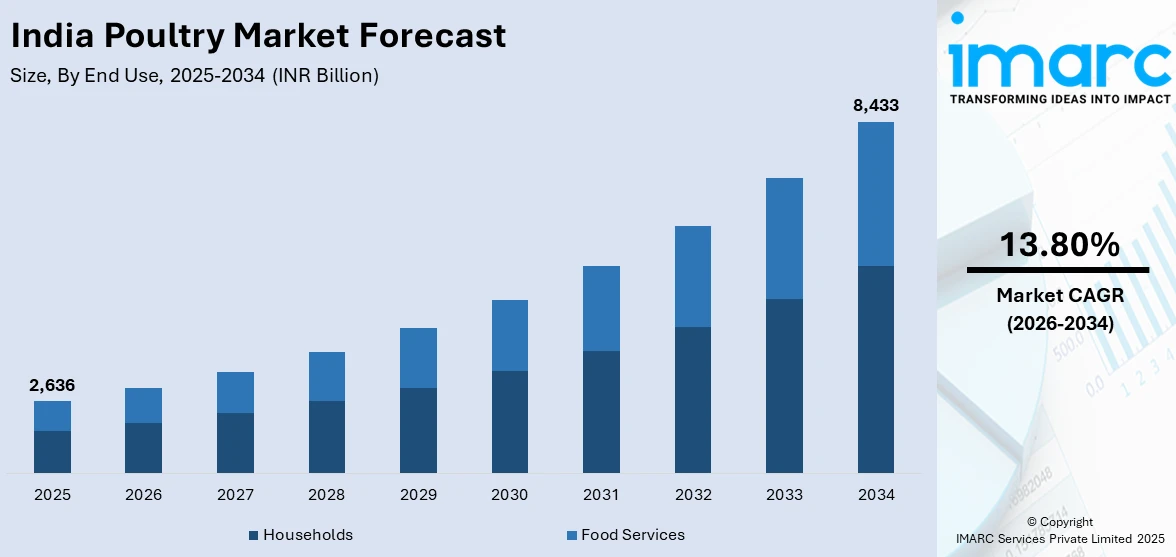
The India poultry market size was valued at INR 2,636 Billion in 2025 and is projected to reach INR 8,433 Billion by 2034, growing at a compound annual growth rate of 13.80% from 2026-2034.
The India poultry market is experiencing robust expansion as the country’s growing population and rising disposable incomes drive increased consumption of protein-rich food products. Changing dietary preferences, particularly among urban consumers shifting toward convenient and nutritious food options, are accelerating demand for poultry products. The proliferation of quick-service restaurants, the expanding organized food service sector, and the increasing penetration of e-commerce platforms for meat delivery are further strengthening the India poultry market share.
Key Takeaways and Insights:
- By End Use: Households dominate the market with a share of 58% in 2025, driven by rising health consciousness, growing preference for home-cooked protein-rich meals, and the expansion of branded online meat delivery platforms across urban and semi-urban areas.
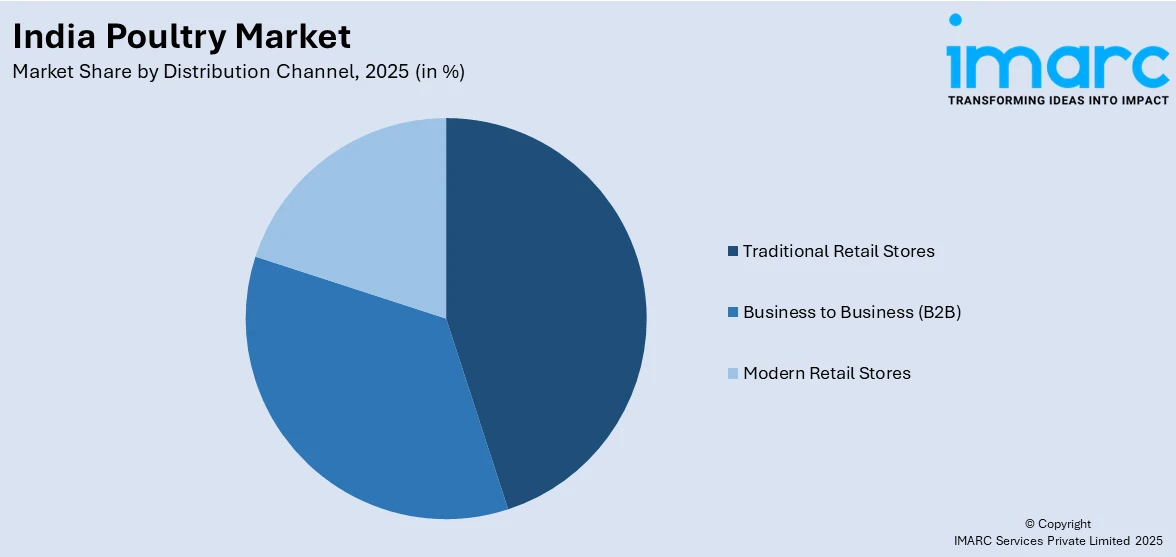
- By Distribution Channel: Traditional retail stores lead the market with a share of 45% in 2025, supported by their widespread presence across both urban and rural areas, consumer preference for physical inspection of fresh poultry, and alignment with local culinary traditions.
- By States: Maharashtra represents the largest segment with a market share of 12% in 2025, owing to its well-developed modern retail infrastructure, vibrant food service industry, strong economic growth, and high urban population density driving robust poultry demand.
- Key Players: The India poultry market features a moderately competitive landscape where large-scale vertically integrated producers compete alongside regional operators. Key players are focusing on expanding production capacities, diversifying into value-added processed products, investing in technology and automation, and forming strategic partnerships with retailers and e-commerce platforms to strengthen their market positions. Some of the major market players include Bharati Poultry Pvt. Limited, Godrej Agrovet Limited, IB Group, Mulpuri Group, RM Group, Simran Farms Limited, Skylark Group, Sneha Group, Suguna Foods Private Limited, and VH Group.
To get more information on this market Request Sample
The India poultry market is witnessing transformative growth as structural shifts in consumer behavior, urbanization patterns, and industrial modernization reshape the industry landscape. India ranks as the third-largest egg producer and the fifth-largest poultry meat producer globally, with annual production exceeding 140 billion eggs and approximately 4.5 million tonnes of broiler meat. India’s organized poultry sector is gaining traction as vertically integrated players strengthen their presence through modern farming techniques, improved cold chain systems, and expanded branded retail networks. Companies are increasingly adopting technology-driven and asset-light models to enhance efficiency, traceability, and product quality across the value chain. At the same time, supportive policy frameworks and public initiatives are encouraging investments in breeding, processing, and infrastructure development. These combined efforts are improving industry standards, reducing operational inefficiencies, and accelerating the transition toward a more structured, scalable, and competitive poultry market nationwide.
India Poultry Market Trends:
Growing Shift Toward Antibiotic-Free and Organic Poultry Production
Health-conscious consumers across India are showing a growing preference for antibiotic-free, organic, and naturally raised poultry products, driven by increased awareness of the health impacts of antibiotic residues and a broader demand for clean-label foods. In response, producers are implementing natural feed alternatives and stricter biosecurity measures to ensure safer and higher-quality products. Innovative disease management solutions, including advanced vaccines, are also being adopted to help farmers maintain strong flock health while reducing reliance on antibiotics, supporting both productivity and consumer trust in poultry products. For instance, in August 2025, the Novogen Layer breed was introduced in India, marking the start of a strategic collaboration between Easy Poultry Innovation, headed by Mr. Vaibhav Aghi under the AGHI Group, managed and founded by Mr. Baljinder Aghi, and NOVOGEN, a global leader renowned for its advanced genetic solutions for layer poultry and consistent high-performance results.
Expansion of E-Commerce and Direct-to-Consumer Poultry Distribution
The growth of digital commerce is transforming poultry distribution in India, allowing consumers to purchase fresh, hygienic, and traceable products directly from online platforms. This shift is especially evident in urban and semi-urban areas, where busy lifestyles and concerns over food safety drive demand for convenient, reliable sourcing. Online meat and poultry platforms are increasingly enabling branded, quality-assured offerings, improving transparency and efficiency across the supply chain. As a result, digital channels are becoming a key driver of market expansion and consumer adoption in India’s poultry sector. For instance, in February 2023, FreshToHome, a direct-to-consumer meat and fish startup, secured USD 104 million in a Series D funding round, led by the Amazon Smbhav Venture Fund. Existing backers, including Iron Pillar, Investcorp, Investment Corporation of Dubai, and Ascent Capital, also participated, while new investors such as E20 Investment, Mount Judi Ventures, and Dallah Albaraka joined the round. JP Morgan served as the placement agent for the fundraising, facilitating the capital raise to support FreshToHome’s expansion and growth in the digital food distribution sector.
Integration of Precision Farming and IoT-Enabled Poultry Management
Advanced technologies including artificial intelligence, computer vision, and IoT-enabled monitoring systems are transforming poultry farm management across India. These tools optimize feed scheduling, temperature control, and health monitoring, enabling real-time disease detection and reducing mortality rates. Several companies are offering poultry farm management software and AI-driven diagnostic tools to mid-sized integrators across the country. These innovations are improving feed conversion ratios, aligning operations with real-time demand forecasting, and helping producers meet the growing institutional demand for predictable supply and cost efficiency.

Market Outlook 2026-2034:
The India poultry market is poised for sustained expansion over the forecast period, underpinned by favorable demographic trends, rising protein consumption, and continued modernization of production and distribution infrastructure. Growing consumer awareness of nutrition and food safety is also driving demand for quality-assured poultry products. Government support through schemes such as the National Livestock Mission and Pradhan Mantri Kisan Sampada Yojana for cold chain development is expected to further strengthen the industry ecosystem. Additionally, the increasing adoption of technology-driven farm management and processing solutions is enhancing efficiency and productivity across the sector. The market generated a revenue of INR 2,636 Billion in 2025 and is projected to reach a revenue of INR 8,433 Billion by 2034, growing at a compound annual growth rate of 13.80% from 2026-2034.
India Poultry Market Report Segmentation:
|
Segment Category |
Leading Segment |
Market Share |
|
End Use |
Households |
58% |
|
Distribution Channel |
Traditional Retail Stores |
45% |
|
States |
Maharashtra |
12% |
End Use Insights:
- Food Services
- Households
Households dominate with a market share of 58% of the total India poultry market in 2025.
Household consumption of poultry products in India is expanding rapidly, driven by growing protein awareness, busy urban lifestyles, and the proliferation of nuclear families that are increasingly seeking convenient, ready-to-cook protein options. The rising middle class, coupled with inflating disposable incomes, has enabled a broader segment of the population to include poultry as a dietary staple. Various platforms have capitalized on this trend by offering hygienic, traceable, and ready-to-cook meat delivered directly to consumers’ doorsteps, accelerating the shift from unorganized local butcher shops to branded poultry purchasing.
The segment’s growth is further reinforced by the increasing utilization of eggs as an essential ingredient across bakery, confectionery, and processed food applications within home kitchens. Rising awareness about the nutritional benefits of poultry products, including their high protein content and essential micronutrients such as zinc, iron, and vitamin B12, is encouraging regular consumption among health-conscious households. Additionally, government-led nutritional awareness campaigns and programs promoting affordable protein sources have contributed to expanding household-level poultry intake, particularly in semi-urban and rural areas across the country.
Distribution Channel Insights:
Access the comprehensive market breakdown Request Sample
- Traditional Retail Stores
- Business to Business (B2B)
- Modern Retail Stores
Traditional retail stores lead with a share of 45% of the total India poultry market in 2025.
Traditional retail stores, including local grocery shops, wet markets, and neighborhood meat vendors, continue to dominate poultry distribution in India due to their extensive geographic reach across both urban and rural areas. Indian consumers traditionally prefer to physically inspect and select fresh poultry products before purchasing, a practice deeply embedded in the country’s culinary culture. These stores source products locally, supporting regional supply chains and offering cuts and varieties tailored to local cooking preferences. The familiarity, accessibility, and trust associated with traditional retailers make them the preferred choice for many Indian poultry consumers.
The segment’s enduring strength is also attributed to the competitive pricing structures and personalized service offered by traditional retailers, which effectively caters to price-sensitive consumers in India’s diverse market. India’s traditional retail ecosystem benefits from deep-rooted relationships between vendors and consumers, enabling repeat purchasing behavior and strong customer retention. Furthermore, the widespread presence of local outlets ensures convenient access to products, particularly in smaller towns and rural areas, reinforcing the segment’s market resilience and reach.
States Insights:
- Maharashtra
- Haryana
- West Bengal
- Tamil Nadu
- Andhra Pradesh
- Uttar Pradesh
- Telangana
- Kerala
- Karnataka
- Punjab
- Orissa
- Bihar
- Madhya Pradesh
- Gujarat
- Rajasthan
- Others
Maharashtra exhibits a clear dominance with a 12% share of the total India poultry market in 2025.
Maharashtra’s leadership in the India poultry market is driven by its well-developed modern retail infrastructure, vibrant food service industry, and strong economic growth that supports higher consumer spending on protein products. Major urban centers such as Mumbai, Pune, Nagpur, and Nashik generate substantial demand owing to their large, diverse populations and cosmopolitan food cultures. The state benefits from an established network of supermarkets, hypermarkets, and specialty stores that facilitate convenient access to poultry products, complemented by a thriving ecosystem of restaurants, hotels, and quick-service outlets.
The state’s strategic geographic positioning and advanced transportation networks facilitate the efficient distribution of poultry products across its extensive consumer base. Maharashtra also hosts significant poultry production hubs, particularly around Pune and Nashik, where large-scale integrated operations combine breeding, feed production, and processing under vertically integrated structures. For instance, in August 2024, Godrej Agrovet acquired the remaining 49% stake in Godrej Tyson Foods, strengthening its vertical integration from feed through processed poultry in Maharashtra and beyond, underscoring the state’s importance as a key hub for organized poultry operations.
Market Dynamics:
Growth Drivers:
Why is the India Poultry Market Growing?
Rising Demand for Protein-Rich Foods and Shifting Dietary Preferences
The increasing population, rising disposable incomes, and growing urbanization in India are leading to a substantial shift in eating patterns in the country. Consumers are increasingly shifting from conventional vegetarian protein sources to animal protein, with poultry being the preferred choice because of its affordability, health benefits, and ease of preparation. The growing middle-class population in urban India is driving demand for healthy and convenient protein sources, with increased awareness about health and wellness. This shift in consumption patterns is opening up substantial growth opportunities for the poultry industry in the country
Expansion of Quick-Service Restaurants and Organized Food Service Sector
The intensive growth of organized food service restaurants, such as quick-service restaurants, cloud kitchens, and casual restaurants, is generating great incremental demand for poultry products in India. The rising social changes, time constraints, and the increasingly growing preferences towards experiential dining are causing urban consumers to eat out in greater numbers or have food delivered to their doors. Chicken is a widely used staple ingredient in various cuisines of the Indian and international food service outlets. The India food service market size was valued at USD 50.99 Billion in 2024 and is projected to reach USD 123.5 Billion by 2033, exhibiting a CAGR of 10.33% from 2025-2033. Major QSR chains operating in India rely on consistent, hygienic poultry inputs to maintain their menu offerings. The wave of cloud kitchens has also intensified the demand in the post-pandemic period, and food safety laws and standards of procurement have pushed these restaurants to suppliers that guarantee quality and full traceability.
Supportive Government Initiatives and Policy Frameworks
The government of India has introduced an extensive range of programs and policies aimed at consolidating and modernizing the poultry industry. The programmes and policies like the National Livestock Mission, where subsidies of up to 50% of the project costs are offered when establishing poultry farms and rural hatcheries, have played a critical role in promoting commercial-scale poultry farming in the nation. Animal Husbandry Infrastructure Development Fund is investing in breeding technology and upgrading of infrastructure. Furthermore, the Ministry of Food Processing Industries is incentivizing cold chain development through the Pradhan Mantri Kisan Sampada Yojana, expanding storage, transport, and distribution capabilities that enable processed poultry products to reach metro and tier-two markets more effectively. For instance, in April 2025, the Department of Animal Husbandry and Dairying organized a strategic meeting to strengthen biosecurity measures, intensify surveillance, and mandate compulsory registration of poultry farms to better track and contain disease outbreaks.
Market Restraints:
What Challenges the India Poultry Market is Facing?
Vulnerability to Disease Outbreaks and Biosecurity Threats
The India poultry market remains highly susceptible to disease outbreaks, particularly avian influenza, which can cause significant direct and indirect economic losses. Outbreaks lead to mass culling, trade restrictions, and sharp declines in consumer confidence, resulting in reduced sales volumes and depressed market prices. The recurring nature of these outbreaks necessitates continuous investment in biosecurity measures, vaccinations, and surveillance systems, further straining the financial resources of producers, particularly small and medium-scale operators.
Fluctuating Feed Prices and Input Cost Volatility
Feed costs, predominantly comprising maize and soybean meal, account for approximately 65 to 70 percent of total poultry production costs. Price volatility in these key input commodities, driven by seasonal supply fluctuations, weather disruptions, and global commodity market dynamics, directly impacts producer margins and profitability. This cost unpredictability makes financial planning challenging for industry participants and can lead to periods of reduced production and market instability.
Fragmented Supply Chain and Cold Chain Infrastructure Gaps
Despite ongoing infrastructure development, India’s poultry supply chain remains largely fragmented, with inadequate cold chain facilities in many regions, particularly in rural and semi-urban areas. The high costs of transportation, product shrinkage, and elevated mortality rates during live bird movement over long distances continue to restrict market efficiency. These infrastructure limitations hinder the growth of processed and branded poultry segments and restrict market penetration in underserved geographies.
Competitive Landscape:
The India poultry market exhibits a moderately competitive landscape characterized by a mix of large-scale vertically integrated enterprises and numerous regional and small-scale operators. Leading companies are expanding their production capacities, investing in backward integration strategies encompassing breeding, feed production, and processing, and diversifying their product portfolios to include value-added and processed poultry items. The market is witnessing increasing consolidation as major players acquire smaller operators to strengthen supply chain control and expand geographic reach. Strategic investments in automation, cold chain infrastructure, branding, and e-commerce partnerships are further intensifying competition. Companies are also focusing on food safety certifications, antibiotic-free production, and sustainable farming practices to differentiate their offerings and capture premium market segments. Some major market players include:
- Bharati Poultry Pvt. Limited
- Godrej Agrovet Limited
- IB Group
- Mulpuri Group
- RM Group
- Simran Farms Limited
- Skylark Group
- Sneha Group
- Suguna Foods Private Limited
- VH Group
Recent Developments:
- In August 2025, The Indian Poultry Alliance (IPA), a subsidiary of the Allana Group, achieved a topline of around ₹800 crore in its first year of operations, marking one of the fastest scale-ups in India’s organized poultry sector. This milestone was reached less than a year after its launch at Poultry India in November 2024, following the Allana Group’s commitment of USD 120 million (approximately ₹1,000 crore) to establish a fully integrated poultry venture with nationwide presence.
- In June 2025, Indian egg producer Eggoz secured USD 20 million in a Series C funding round, led by Gaja Capital, to accelerate its growth in the rapidly expanding poultry sector. The company, which follows a tech-enabled, asset-light model, focuses on safety, traceability, and nutritional quality, aiming to address longstanding industry challenges.
- In June 2025, Boehringer Ingelheim launched a next-generation, single-dose poultry vaccine in India, offering protection against Bursal, Newcastle, and Marek’s diseases. This innovative vaccine aims to improve bird health, enhance productivity, and reduce the operational burden on poultry farms by eliminating the need for multiple vaccinations.
India Poultry Market Report Scope:
| Report Features | Details |
|---|---|
| Base Year of the Analysis | 2025 |
| Historical Period | 2020-2025 |
| Forecast Period | 2026-2034 |
| Units | INR Billion |
| Scope of the Report | Exploration of Historical and Forecast Trends, Industry Catalysts and Challenges, Segment-Wise Historical and Predictive Market Assessment:
|
| End Uses Covered | Food Services, Households |
| Distribution Channels Covered | Traditional Retail Stores, Business to Business (B2B), Modern Retail Stores |
| States Covered | Maharashtra, Haryana, West Bengal, Tamil Nadu, Andhra Pradesh, Uttar Pradesh, Telangana, Kerala, Karnataka, Punjab, Orissa, Bihar, Madhya Pradesh, Gujarat, Rajasthan, Others |
| Companies Covered | Bharati Poultry Pvt. Limited, Godrej Agrovet Limited, IB Group, Mulpuri Group, RM Group, Simran Farms Limited, Skylark Group, Sneha Group, Suguna Foods Private Limited, VH Group, etc. |
| Customization Scope | 10% Free Customization |
| Post-Sale Analyst Support | 10-12 Weeks |
| Delivery Format | PDF and Excel through Email (We can also provide the editable version of the report in PPT/Word format on special request) |
Frequently Asked Questions About the India Poultry Market Report
The India poultry market size was valued at INR 2,636 Billion in 2025.
The India poultry market is expected to grow at a compound annual growth rate of 13.80% from 2026-2034 to reach INR 8,433 Billion by 2034.
Households represent the largest end use share at 58% in 2025, driven by growing protein awareness among Indian consumers, expanding middle-class population, rising demand for convenient home-cooked protein options, and the increasing penetration of branded online meat delivery platforms.
Key factors driving the India poultry market include rising demand for protein-rich foods, expanding quick-service restaurant chains and organized food services, supportive government initiatives, increasing urbanization, and growing adoption of technology and automation in poultry farming.
Major challenges include vulnerability to disease outbreaks such as avian influenza, fluctuating feed prices and input cost volatility, fragmented supply chain infrastructure, inadequate cold chain facilities in rural areas, and the predominantly unorganized nature of the market.
Need more help?
- Speak to our experienced analysts for insights on the current market scenarios.
- Include additional segments and countries to customize the report as per your requirement.
- Gain an unparalleled competitive advantage in your domain by understanding how to utilize the report and positively impacting your operations and revenue.
- For further assistance, please connect with our analysts.
 Request Customization
 Speak to an Analyst
 Request Brochure
 Inquire Before Buying
Benefits of Customization
- Personalize this research
- Triangulate with your data
- Get data as per your format and definition
- Gain a deeper dive into a specific application, geography, customer, or competitor
- Any level of personalization
Get in Touch With Us
UNITED STATES
Phone: +1-201-971-6302
INDIA
Phone: +91-120-433-0800
UNITED KINGDOM
Phone: +44-753-714-6104
Email: [email protected]
Client Testimonials




.webp)




.webp)













Related Reports

Choose your plan
*Please note that the prices mentioned below are starting prices for each bundle type. Kindly contact our team for further details.*
Single User License
- 1 User License, Access on 2 Devices
- PDF Report + Excel Dataset (Password Protected)
- Lifetime Access
- No Printing Rights
- 10% Free Report Customization
- 10–12 Weeks of Analyst Support
Five User License
- Access for 5 Users, 2 Devices per User
- PDF Report + Excel Dataset (Password Protected)
- Lifetime Access
- Dedicated Account Manager
- 12–14 Weeks of Analyst Support
- No Printing Rights
- 15% Free Report Customization
- 25% Discount on Your Next Purchase
Corporate User License
- Unlimited User Access (Within Your Organization)
- PDF Report + Excel Dataset
- Lifetime Access
- Dedicated Account Manager
- 14–20 Weeks of Analyst Support
- No Printing Rights
- 20% Free Report Customization
- 30% Discount on Your Next Purchase
Essential Insights
What's included:
3 reports
- Lifetime Access
- PDF Reports
- Excel Datasets
- 2 Weeks of Free Analyst Support
- 2 User Licenses
- Access on 2 Devices
- Printing Rights
- Complimentary PowerPoint (PPT) Version
- Complimentary License Upgrade
Professional Access
What's included:
5 reports
- Lifetime Access
- PDF Reports
- Excel Datasets
- 8 Weeks of Free Analyst Support
- 2 User Licenses
- Access on 2 Devices
- Printing Rights
- Complimentary PowerPoint (PPT) Version
- Complimentary License Upgrade
Business Advantage
What's included:
8 reports
- Lifetime Access
- PDF Reports
- Excel Datasets
- 14 Weeks of Free Analyst Support
- 2 User Licenses
- Access on 2 Devices
- Printing Rights
- Complimentary PowerPoint (PPT) Version
- Complimentary License Upgrade
Enterprise Intelligence
What's included:
10 reports
- Lifetime Access
- PDF Reports
- Excel Datasets
- 20 Weeks of Free Analyst Support
- 2 User Licenses
- Access on 2 Devices
- Printing Rights
- Complimentary PowerPoint (PPT) Version
- Complimentary License Upgrade