
Indonesia Edtech Market Size, Share, Trends and Forecast by Sector, Type, Deployment Mode, End User, and Region, 2026-2034
Indonesia Edtech Market Size, Share, Trends & Forecast (2026-2034)
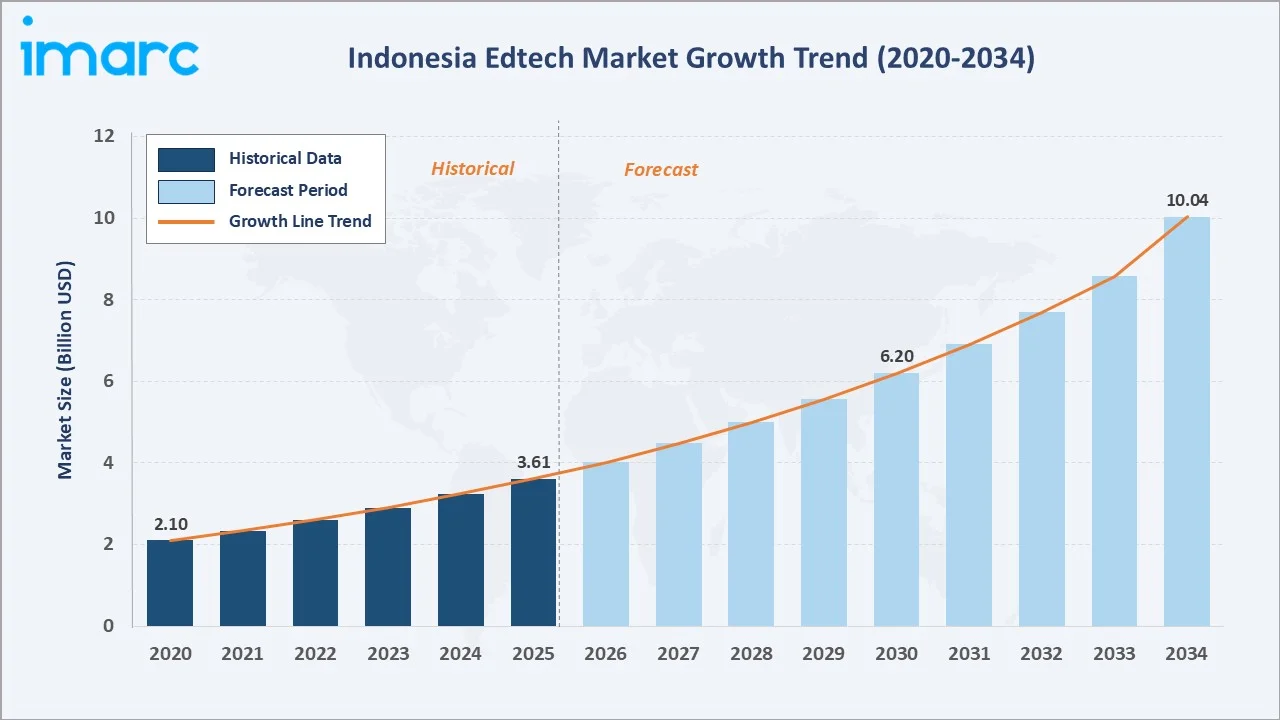
The Indonesia edtech market size increased from USD 3.61 Billion in 2025 to USD 4.23 Billion in 2026 and is projected to reach USD 10.04 Billion by 2034, exhibiting a CAGR of 11.42% during 2026-2034. The market growth is supported by rising digital learning adoption, expanding internet connectivity, and increasing demand for flexible and accessible education solutions.
K-12 leads the sector segment at 42.6%, software dominates the type segment at 45.7%, and Java commands 56.8% regional share.
Market Snapshot
|
Metric |
Value |
|
Base Year Market Size (2025) |
USD 3.61 Billion |
| Market Size (2026) | USD 4.23 Billion |
|
Forecast Market Size (2034) |
USD 10.04 Billion |
|
CAGR (2026-2034) |
11.42% |
|
Base Year |
2025 |
|
Historical Period |
2020-2025 |
|
Forecast Period |
2026-2034 |
|
Largest Region |
Java (56.8%, 2025) |
|
Second Largest Region |
Sumatra (17.6%, 2025) |
|
Leading Sector |
K-12 (42.6%, 2025) |
|
Leading Type |
Software (45.7%, 2025) |
The Indonesia edtech market expanded from USD 2.10 Billion in 2020 to USD 3.61 Billion in 2025 and an estimated USD 4.23 Billion in 2026, driven by widening digital access, growing demand for supplementary education, and rapid mobile internet penetration across urban and Tier-2 cities. Anchored at USD 6.20 Billion in 2030, the forecast to USD 10.04 Billion by 2034 is supported by accelerating AI-driven learning adoption, expanding vocational credentialing, and strengthening government-edtech procurement frameworks.
To get more information on this market, Request Sample
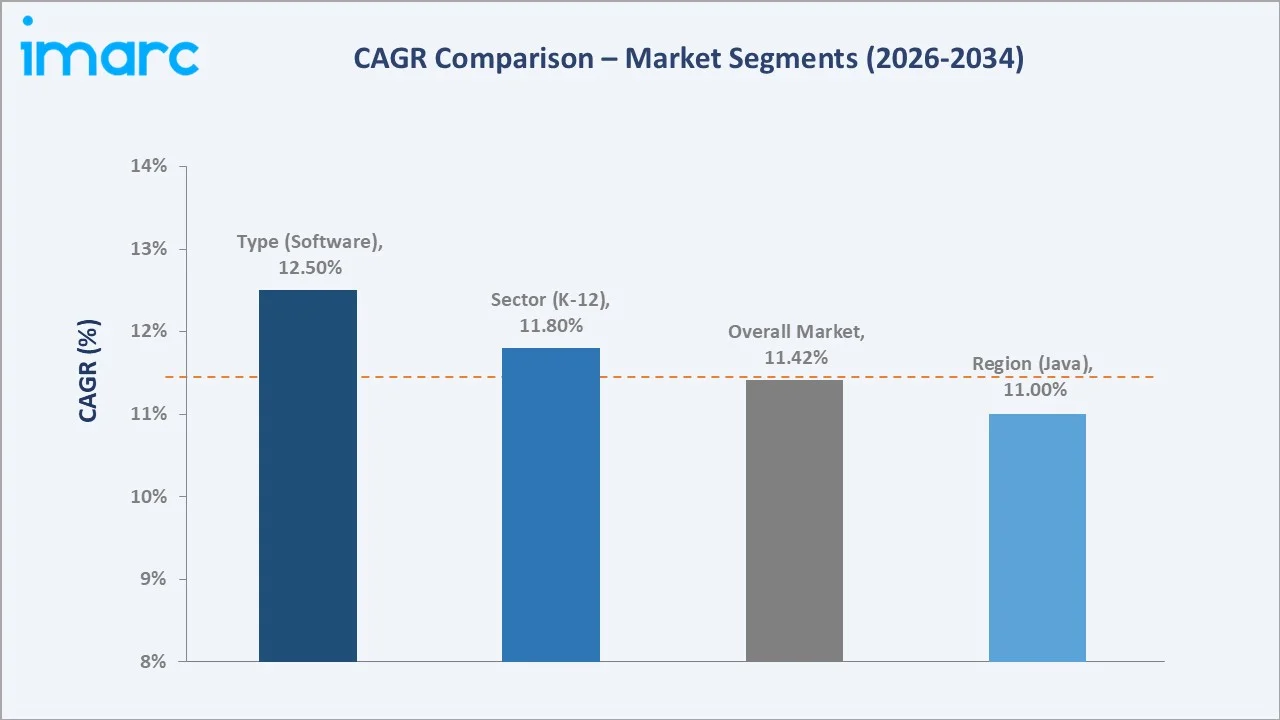
CAGR trajectories across sector and type sub-segments show software and content expanding faster than the overall 11.42% market CAGR, driven by digitally native learner cohorts and increasing B2B adoption among corporations and government institutions.
Executive Summary
The Indonesia edtech market is on a steady growth trajectory from USD 2.10 Billion in 2020 to USD 4.23 Billion in 2026 and is forecast to reach USD 10.04 Billion by 2034. The segment has evolved from informal tutoring supplements and standalone digital content to fully integrated LMS solutions, AI-driven personalization, and credentialed professional development platforms.
K-12 leads the sector segment at 42.6%, driven by increasing adoption of digital learning solutions across schools and growing demand for personalized and accessible education. Based on type, software dominates at 45.7% in 2025, supported by affordable smartphone data and increasing school device distribution under government programs. Java at 56.8% leads regional share, fueled by its high population density, stronger digital infrastructure, and concentration of educational institutions and technology-enabled learning users.
Key Market Insights
|
Insight |
Data |
|
Leading Sector |
K-12 – 42.6% share (2025) |
|
Second Largest Sector |
Higher Education – 35.4% share (2025) |
|
Leading Type |
Software – 45.7% share (2025) |
|
Second Largest Type |
Content – 34.6% share (2025) |
|
Leading Region |
Java – 56.8% share (2025) |
|
Second Largest Region |
Sumatra – 17.6% share (2025) |
|
Top Companies |
Ruangguru, Recruit Holdings Co., Ltd., PT Semesta Integrasi Digital, PINTAR |
Key Analytical Observations Expanding On the Data Above:
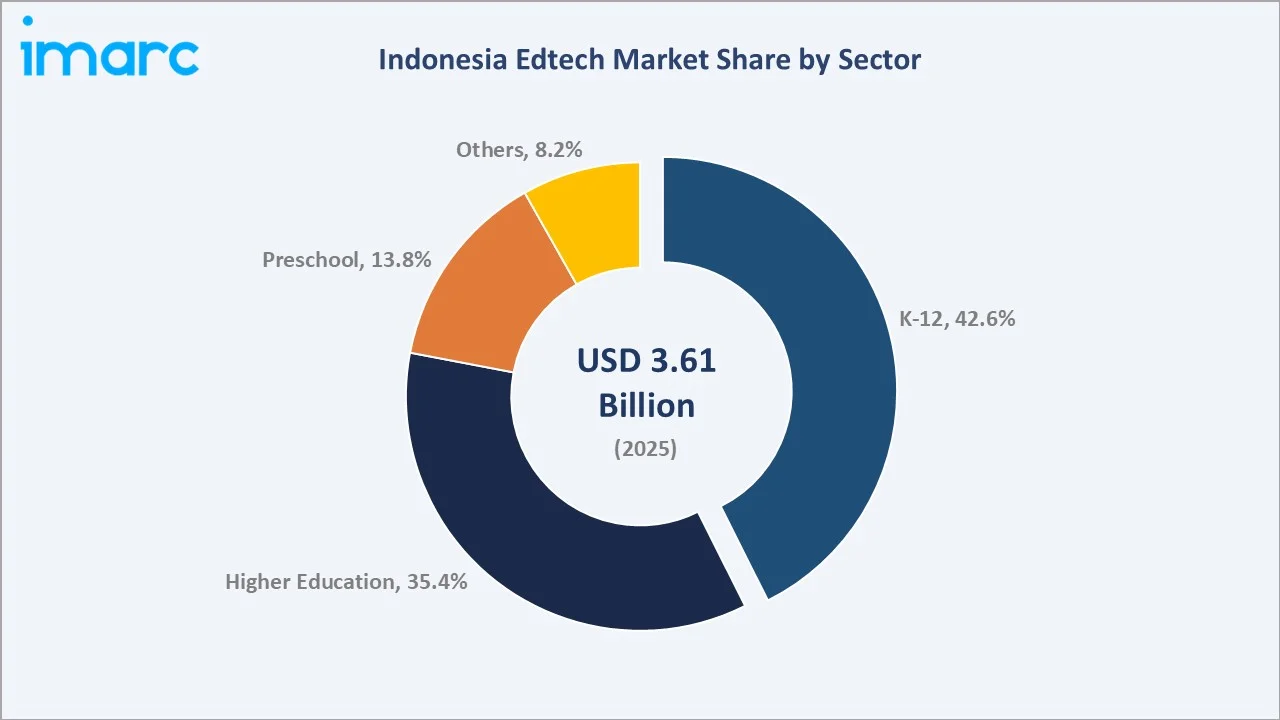
- K-12 leadership at 42.6% is underpinned by the large student population, increasing digitalization of schools, rising demand for supplemental learning platforms, and wider adoption of online tutoring and assessment tools.
- Higher education at 35.4% reflects rapid adoption of blended and fully online degree programs, driven by geographic barriers across the archipelago and a growing preference for flexible, credit-bearing professional development credentials.
- Software dominance at 45.7% is supported by cloud-based LMS deployments, subscription-based learning apps, and AI-powered adaptive learning engines that reduce content delivery costs and enable real-time personalization.
- Content at 34.6% spans curated video lectures, interactive assessments, digital textbooks, and gamified learning modules across both K-12 and vocational tracks.
- Java at 56.8% dominates due to high concentration of schools, universities, and internet infrastructure, anchored by Jakarta, Surabaya, and Bandung as primary demand centers.
Indonesia Edtech Market Overview
Edtech refers to the application of digital tools, platforms, and systems to enhance learning delivery, engagement, and assessment. In Indonesia, the edtech ecosystem encompasses school-facing LMS solutions, consumer-facing tutoring applications, corporate learning management platforms, and government-supported digital content repositories.
The market is shaped by a convergence of macroeconomic tailwinds, including a youthful demographic profile, improving rural connectivity, and active government spending on digital education infrastructure. Growing smartphone penetration and increasing digital literacy further support the adoption of online and technology-enabled learning solutions across the country.
Market Dynamics
To evaluate market opportunities, Request Sample
Market Drivers
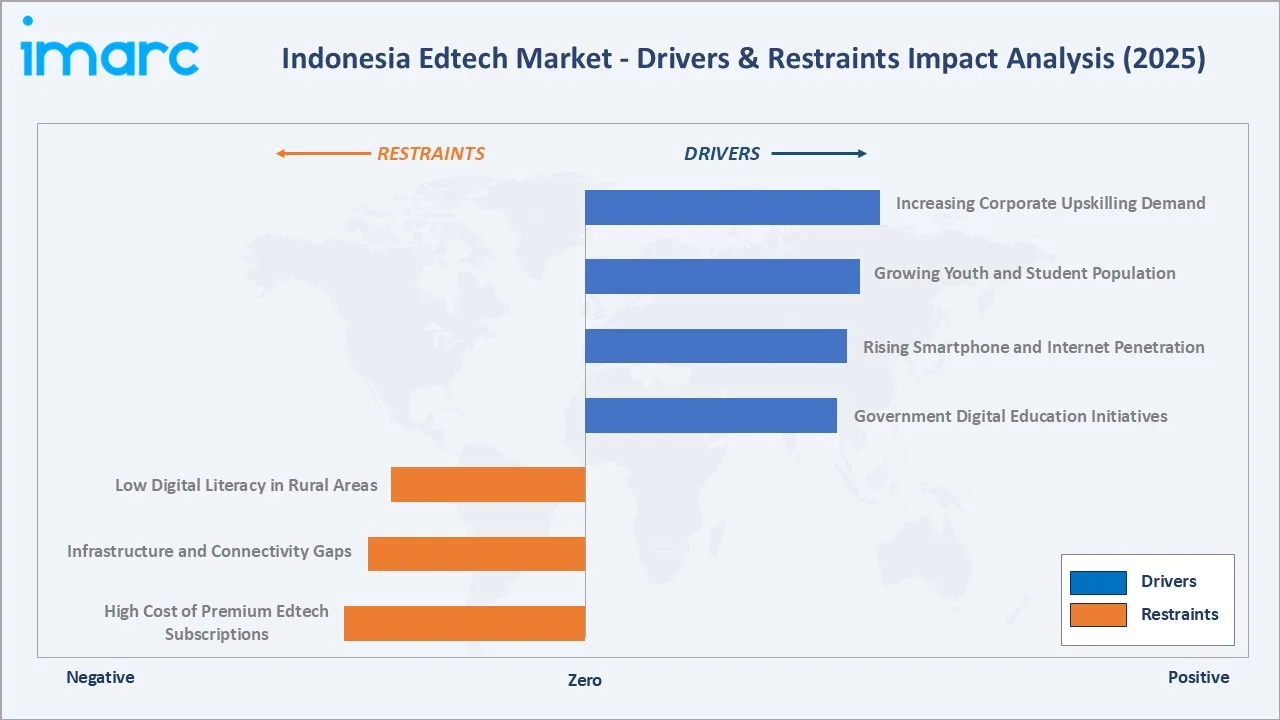
- Government Digital Education Initiatives: Government-led programs to expand digital infrastructure, improve connectivity, and promote technology-enabled learning are supporting the adoption of edtech solutions across schools and higher education institutions.
- Rising Smartphone and Internet Penetration: Rapid expansion of affordable smartphones and one of the most competitive mobile data markets in Southeast Asia is bringing first-time digital learners online. At the beginning of 2025, Indonesia had 212 Million people online, with internet penetration at 74.6%. Mobile-first edtech platforms are capturing this wave through lightweight apps and offline-capable content formats.
- Growing Youth and Student Population: Indonesia's structurally young population creates a large and expanding addressable base for K-12 and higher education digital tools, supporting sustained top-of-funnel demand for platforms targeting formal learners.
- Increasing Corporate Upskilling Demand: Enterprises across the financial services, manufacturing, and technology sectors are investing in workforce digital literacy programs, fueling demand for B2B edtech platforms with assessment, certification, and progress tracking capabilities.
Market Restraints
- Low Digital Literacy in Rural Areas: Digital literacy barriers continue to limit platform adoption in remote and rural provinces, constraining the effective addressable market despite expanding internet access.
- Infrastructure and Connectivity Gaps: While urban internet penetration is high, rural and outer-island connectivity remains inconsistent, limiting live-class participation and increasing dropout rates on streaming-reliant platforms.
- High Cost of Premium Edtech Subscriptions: Affordability remains a structural challenge given highly skewed household income distribution, restricting access among lower-income learner segments in Tier 3 and Tier 4 cities.
Market Opportunities
- Vocational and Skills-Based Education Expansion: Growing government emphasis on vocational education reform and certification programs creates significant opportunity for edtech players targeting the 15-24 age cohort with job-linked digital credentials.
- AI-Powered Personalized Learning: Platforms deploying adaptive learning algorithms, AI-driven content recommendation, and real-time assessment feedback are positioned to capture premium pricing tiers and reduce churn.
- B2B Enterprise Learning Market: Indonesia's rapid corporate digitalization is opening large-scale enterprise contracts for LMS deployments, workforce readiness platforms, and certification pathways aligned with national skills frameworks.
Market Challenges
- Content Localization and Quality Assurance: Delivering high-quality, curriculum-aligned content across Indonesia's diverse regional languages and cultural contexts demands substantial ongoing investment and editorial oversight.
- Monetization and User Retention: Converting free-tier users to paid subscribers remains challenging given competitive free alternatives and price sensitivity, requiring continuous feature and content innovation.
Emerging Market Trends
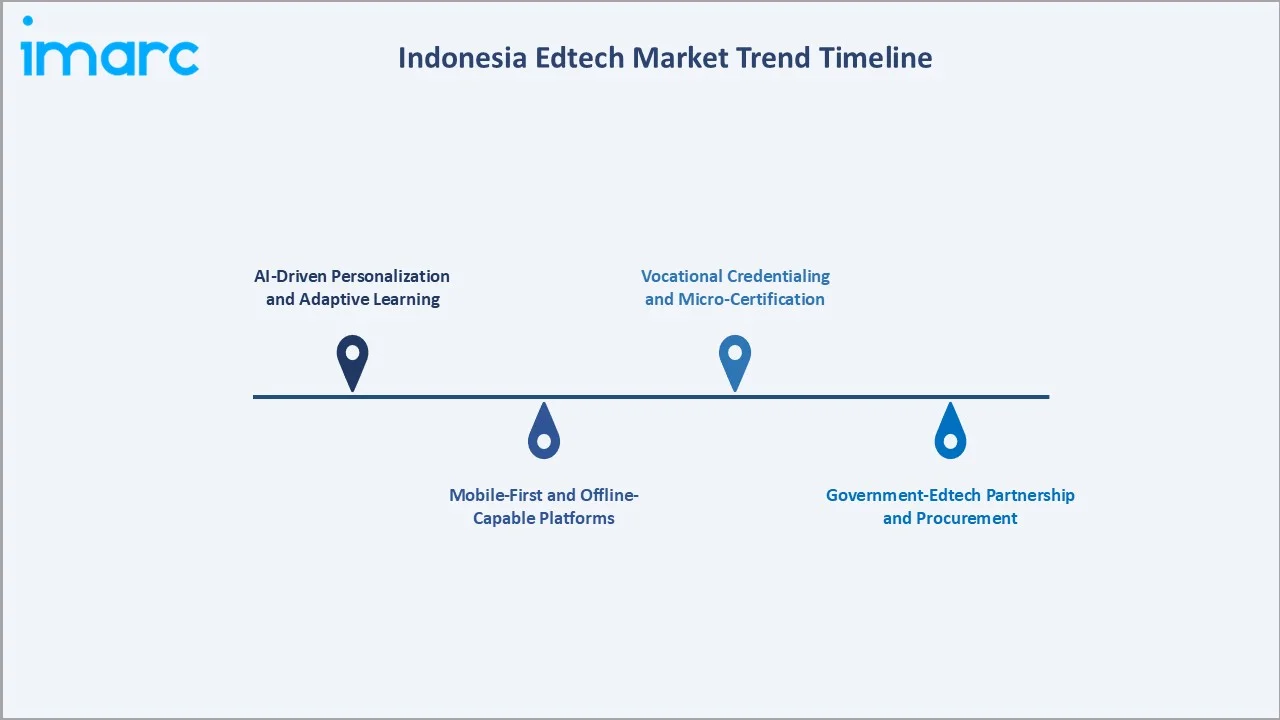
1. AI-Driven Personalization and Adaptive Learning
Edtech operators are deploying machine learning (ML) algorithms to tailor content difficulty, pacing, and format to individual learner profiles. Adaptive learning engines are being integrated into both K-12 tutoring apps and corporate training platforms, reducing remediation time and improving completion rates. This trend is accelerating platform differentiation in a competitive market.
2. Mobile-First and Offline-Capable Platforms
Given uneven connectivity across Indonesia's archipelago, leading platforms are prioritizing mobile-first architecture and downloadable content modules that function without active internet connections. This approach is expanding addressable reach beyond Java to outer islands where connectivity is intermittent.
3. Government-Edtech Partnership and Procurement
Government agencies are increasingly collaborating with edtech providers to expand digital learning access, strengthen teacher training, and support technology-enabled education programs. Public-sector procurement and institutional partnerships are creating opportunities for platforms offering curriculum-aligned content, digital assessment tools, and learning management solutions.
4. Vocational Credentialing and Micro-Certification
Short-form, credential-bearing vocational courses aligned with national job competency frameworks are among the fastest growing product categories. These programs are helping learners develop job-ready skills through flexible, targeted training pathways.
Industry Value Chain Analysis
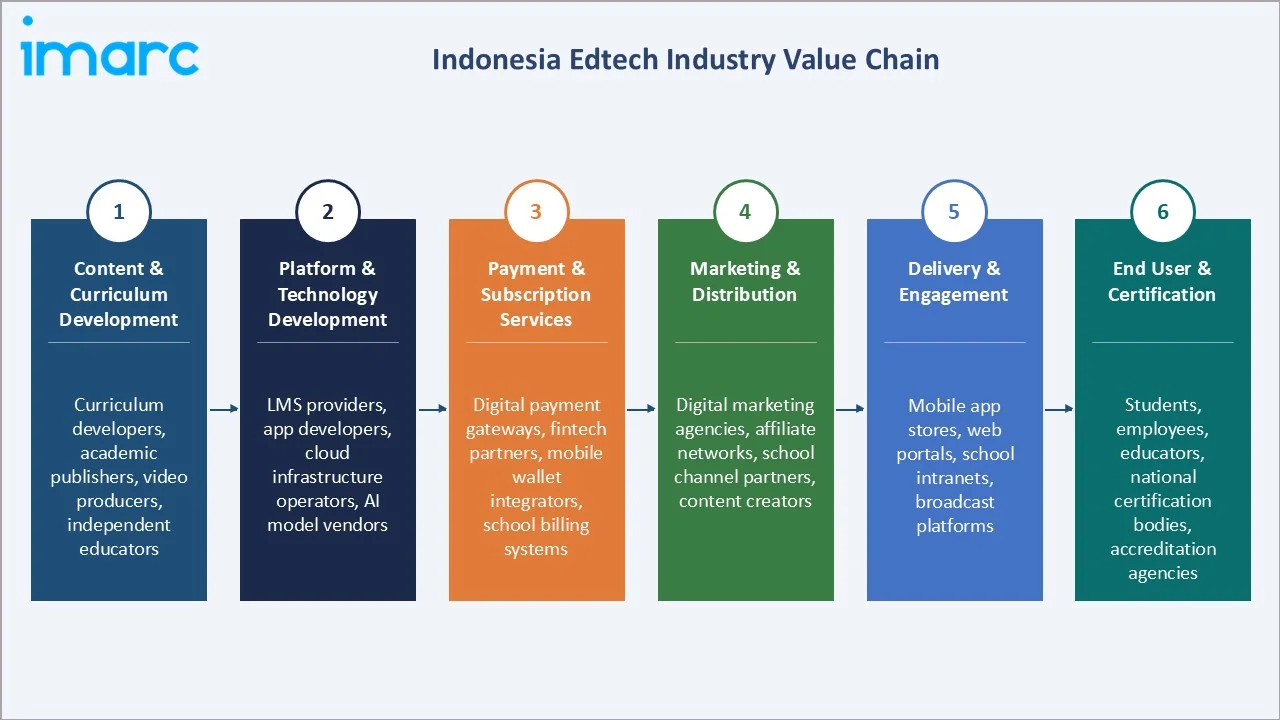
The Indonesia edtech value chain spans six stages, from content and curriculum development through end-user engagement and certification. Platform development and payment infrastructure are the most concentrated value capture stages. Operators with vertically integrated technology stacks and proprietary content libraries command greater margin retention.
|
Stage |
Key Players / Examples |
|
Content & Curriculum Development |
Curriculum developers, academic publishers, video producers, independent educators |
|
Platform & Technology Development |
LMS providers, app developers, cloud infrastructure operators, AI model vendors |
|
Payment & Subscription Services |
Digital payment gateways, fintech partners, mobile wallet integrators, school billing systems |
|
Marketing & Distribution |
Digital marketing agencies, affiliate networks, school channel partners, content creators |
|
Delivery & Engagement |
Mobile app stores, web portals, school intranets, broadcast platforms |
|
End User & Certification |
Students, employees, educators, national certification bodies, accreditation agencies |
Vertically integrated operators that own proprietary content libraries, adaptive learning platforms, and direct learner relationships capture the most value across the chain. Platform consolidation is expected to accelerate as smaller niche operators are acquired by larger ecosystem players.
Technology Landscape in the Indonesia Edtech Industry
AI and Adaptive Learning Systems
AI-driven adaptive learning engines are becoming a standard feature among premium edtech platforms. These systems analyze learner behavior data to dynamically adjust content difficulty, recommend supplementary materials, and predict dropout risk. Natural language processing is also being applied to automated essay grading and multilingual content adaptation.
Cloud-Based LMS Platforms
Cloud-native LMS platforms are enabling rapid deployment of edtech solutions for institutions of all sizes. Scalable infrastructure supports concurrent usage by large cohorts while lowering the total cost of ownership compared to legacy on-premise systems.
Mobile Application and Offline Learning Technology
Mobile application development with progressive web app capabilities and offline content caching is enabling learning continuity in low-connectivity environments. Lightweight app architectures optimized for entry-level Android devices are a critical technical requirement for platforms targeting Tier 2 and Tier 3 city learners across Indonesia.
Market Segmentation Analysis
The report covers the following segments:
|
Segment Category |
Leading Segment |
Market Share |
Year |
|
Sector |
K-12 |
42.6% |
2025 |
|
Type |
Software |
45.7% |
2025 |
|
Deployment Mode |
🔒 |
🔒 |
2025 |
|
End User |
🔒 |
🔒 |
2025 |
|
Region |
Java |
56.8% |
2025 |

By Sector
K-12 commands a 42.6% majority share in 2025, driven by rising demand for supplemental learning, exam preparation, and personalized digital education solutions among students and parents.
To access detailed market analysis, Request Sample
Higher education at 35.4% in 2025 reflects the growing adoption of blended and fully online programs by Indonesian universities, particularly for non-traditional students in outer provinces.
By Type
Software dominates with 45.7% share in 2025, reflecting the widespread adoption of subscription-based LMS platforms, AI-driven learning apps, and SaaS tools for classroom management. Cloud delivery models reduce upfront costs and enable rapid scaling across institutional and consumer segments.
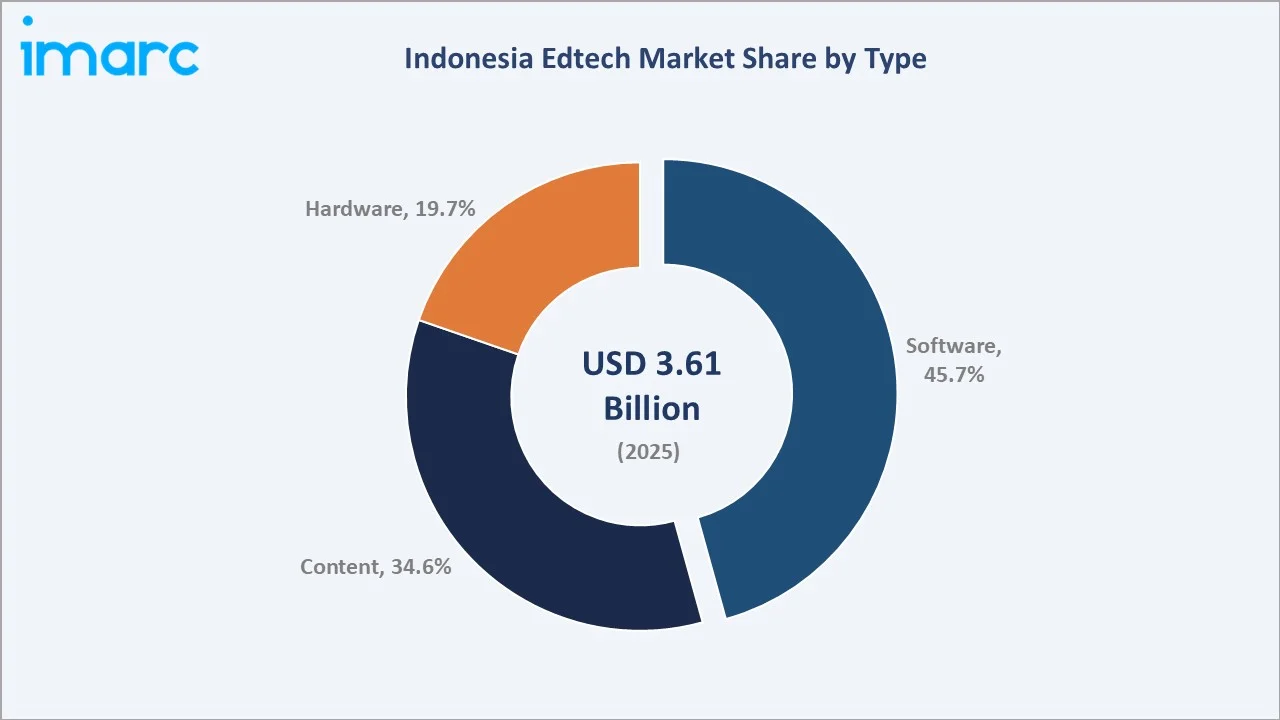
Content at 34.6% encompasses curated video lectures, interactive assessments, digital textbooks, and gamified learning modules.
Regional Market Insights
|
Region |
Share (2025) |
Key Growth Drivers |
|
Java |
56.8% |
Dense student population, advanced digital infrastructure, large corporate edtech procurement base |
|
Sumatra |
17.6% |
Rising middle-class incomes, improving broadband access, growing test prep and tutoring demand |
|
Kalimantan |
10.2% |
New capital city development, energy sector workforce upskilling, expanding mobile connectivity |
|
Sulawesi |
8.7% |
Growing university enrollment, government vocational education programs, mobile-first adoption |
|
Others |
6.7% |
Expanding government device programs, improving rural connectivity, rising digital learning awareness |
Java at 56.8% in 2025 leads the regional landscape, anchored by Jakarta, Surabaya, Bandung, and Yogyakarta. The concentration of universities, higher-income households, and well-developed internet infrastructure makes Java the primary demand center for premium edtech subscriptions and B2B corporate learning platforms.
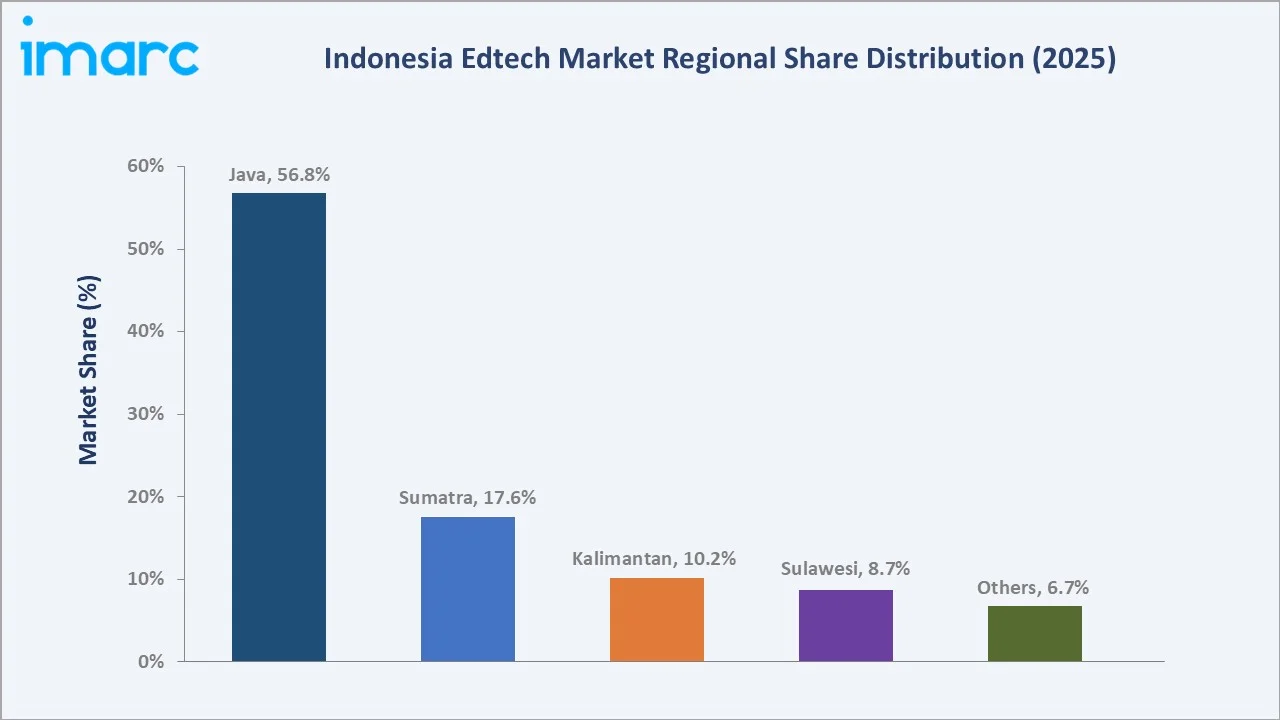
Sumatra at 17.6% is the second largest region, driven by a large population base. Rising middle-class incomes and improving mobile broadband coverage support adoption of mobile-first tutoring and test preparation platforms.
Competitive Landscape
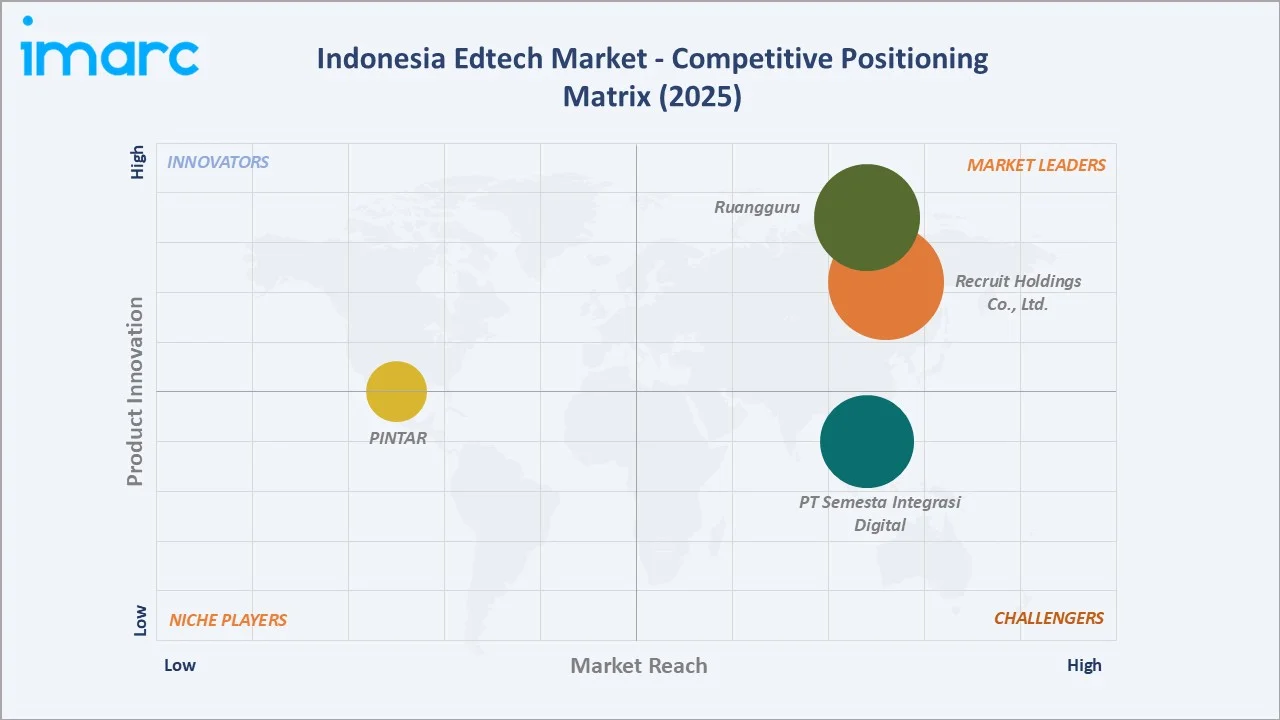
The Indonesia edtech market is moderately fragmented, with a mix of homegrown market leaders and global platform operators. Competition is intensifying across all segments, particularly in K-12 and corporate upskilling, where platform differentiation increasingly depends on AI capabilities, content quality, and institutional partnership networks.
|
Company Name |
Brand / Key Product |
Position |
Strategic Focus |
|
Ruangguru |
Ruangguru Learning Platform |
Leader |
Product expansion, institutional partnerships, and AI-driven personalization |
|
Recruit Holdings Co., Ltd. |
Quipper School |
Leader |
Geographic expansion, institutional LMS growth, and content library scaling |
|
PT Semesta Integrasi Digital |
Sekolah.mu |
Challenger |
School institution partnerships, teacher capacity building, and regional expansion |
|
PINTAR |
PINTAR |
Emerging |
Workforce development, vocational credentialing, and labor placement integration |
Key players include Ruangguru, Recruit Holdings Co., Ltd., PT Semesta Integrasi Digital, and PINTAR, among others.
Key Company Profiles
Ruangguru
Ruangguru is one of Indonesia's largest and most established edtech companies, offering a comprehensive suite of digital learning solutions for school-age learners, teachers, and professionals. The platform combines consumer-facing tutoring tools with institutional school products and a professional upskilling vertical, serving a broad learner base across Indonesia and select Southeast Asian markets.
- Product Portfolio: Ruangguru Learning Platform covering K-12 tutoring, exam preparation, live classes, private tutor marketplace, school LMS, and vocational upskilling programs.
- Recent Developments: Ruangguru has continued to expand its institutional partnerships with government bodies and private organizations, broadening access to its digital learning platform across a wider network of schools and provinces in Indonesia.
- Strategic Focus: Expanding institutional partnerships, deepening AI-driven personalization, and scaling professional upskilling offerings across consumer and B2B segments.
Recruit Holdings Co., Ltd.
Recruit Holdings Co., Ltd. is a Japan-based global human resources and media conglomerate that operates Quipper, a wholly-owned K-12 edtech subsidiary active in Indonesia.
- Product Portfolio: Quipper School (LMS for teachers and institutions).
- Recent Developments: The firm has continued the integration of adaptive assessment tools and expanded data analytics capabilities for educators across Indonesian school networks.
- Strategic Focus: Growing institutional LMS adoption across public and private schools, strengthening teacher engagement tools, and scaling curriculum-aligned video content for K-12 and university learners.
PT Semesta Integrasi Digital
PT Semesta Integrasi Digital operates Sekolah.mu, a blended learning platform. The platform provides personalized learning management for students and curriculum delivery tools for schools, focusing on integrating school-based instruction with home learning and competency-based assessment.
- Product Portfolio: Sekolah.mu platform offering blended learning management system, school curriculum delivery, student portfolio management, and teacher professional development programs.
- Recent Developments: The company continues to strengthen the Sekolah.mu platform by expanding its blended learning capabilities, enhancing curriculum-aligned digital content, and supporting schools and teachers with integrated learning and assessment solutions.
- Strategic Focus: Deepening school institution partnerships, growing teacher professional development programs, and expanding its blended learning platform into additional regions beyond Java.
Market Concentration Analysis
The Indonesia edtech market is moderately concentrated, with established platforms holding significant market positions while a growing number of specialized providers compete across K-12 education, higher education, vocational training, and corporate learning.
Barriers to entry include high content production costs for localized curriculum-aligned materials, the requirement for scalable cloud infrastructure, the complexity of institutional school procurement cycles, and the need to maintain continuous AI model improvements to stay competitive on adaptive learning quality.
Consolidation is accelerating as established players expand their service portfolios, strengthen institutional partnerships, and pursue strategic collaborations to broaden their market reach and enhance their competitive positioning.
Investment & Growth Opportunities
Fastest-Growing Segments
Software is growing fastest within the type segment, driven by AI adoption, cloud deployment economics, and recurring subscription revenue models increasingly preferred by both consumer and institutional buyers.
Emerging Markets
Kalimantan is the fastest growing region, anchored by expanding corporate campuses for energy and mining companies and improving 4G and 5G infrastructure deployment. The market offers significant whitespace for platforms targeting vocational training, professional certification, and employee upskilling.
Venture & Investment Trends
Investment is increasingly concentrated in AI-native platforms, government partnership plays, and B2B enterprise learning products with predictable recurring revenues. Capital is also flowing into micro-certification content creators and edtech infrastructure providers such as proctoring, identity verification, and learning analytics.
Future Market Outlook (2026-2034)
The Indonesia edtech market is forecast to expand from USD 3.61 Billion in 2025 to USD 4.23 Billion in 2026, reaching USD 10.04 Billion by 2034 at a CAGR of 11.42%, adding roughly USD 6.43 Billion in incremental market value over the forecast period.
Four forces will shape the market through 2034: the maturation of AI-driven adaptive learning tools; the expansion of government-edtech procurement under various programs; the rise of credentialed vocational and professional upskilling; and the geographic penetration of mobile-first platforms into Kalimantan, Sulawesi, and outer islands.
By 2034, the Indonesia edtech market is expected to be defined by AI-personalized learning delivery, blended institutional-digital models at university level, and a significant B2B corporate learning segment. Platforms that combine content quality, adaptive technology, and institutional distribution will be best positioned to capture the largest share of incremental market value.
Research Methodology
Primary Research
Primary research included structured interviews with edtech platform executives, school administrators, university officials, corporate L&D heads, government education ministry advisors, and investors active in the Indonesia edtech space. Insights were used to validate quantitative projections and calibrate qualitative assessments of competitive positioning.
Secondary Research
Secondary sources included Kemdikbudristek policy documents and program reports, Bappenas long-term development plans, APJII internet penetration surveys, GSMA Mobile Economy reports for Southeast Asia, published company financial reports, and regulatory announcements.
Forecasting Models
Market forecasts used top-down and bottom-up models combining learner population data, digital penetration rates, average revenue per user, institutional procurement pipeline estimates, and macroeconomic growth assumptions. Scenario analysis incorporated optimistic and conservative regulatory and infrastructure deployment timelines to bound the forecast range.
Indonesia Edtech Market Report Coverage:
| Report Features | Details |
|---|---|
| Base Year of the Analysis | 2025 |
| Historical Period | 2020-2025 |
| Forecast Period | 2026-2034 |
| Units | Billion USD |
| Scope of the Report |
Exploration of Historical Trends and Market Outlook, Industry Catalysts and Challenges, Segment-Wise Historical and Future Market Assessment:
|
| Sectors Covered | Preschool, K-12, Higher Education, Others |
| Types Covered | Hardware, Software, Content |
| Deployment Modes Covered | Cloud-based, On-premises |
| End-Users Covered | Individual Learners, Institutes, Enterprises |
| Regions Covered | Java, Sumatra, Kalimantan, Sulawesi, Others |
| Companies Covered | Ruangguru, Recruit Holdings Co., Ltd., PT Semesta Integrasi Digital, PINTAR, etc. |
| Customization Scope | 10% Free Customization |
| Post-Sale Analyst Support | 10-12 Weeks |
| Delivery Format | PDF and Excel through Email (We can also provide the editable version of the report in PPT/Word format on special request) |
Key Benefits for Stakeholders:
- IMARC’s industry report offers a comprehensive quantitative analysis of various market segments, historical and current market trends, market forecasts, and dynamics of the Indonesia Edtech market from 2020-2034.
- The research report provides the latest information on the market drivers, challenges, and opportunities in the Indonesia Edtech market.
- Porter's five forces analysis assist stakeholders in assessing the impact of new entrants, competitive rivalry, supplier power, buyer power, and the threat of substitution. It helps stakeholders to analyze the level of competition within the Indonesia Edtech industry and its attractiveness.
- Competitive landscape allows stakeholders to understand their competitive environment and provides an insight into the current positions of key players in the market.
Frequently Asked Questions About the Indonesia Edtech Market Report
The Indonesia edtech market size is estimated at USD 4.23 Billion in 2026, driven by growing digital penetration, government education reform initiatives, and strong demand from K-12 learners and corporate upskilling programs.
The market is projected to grow at a CAGR of 11.42% from 2026-2034, reaching USD 10.04 Billion, supported by accelerating AI adoption, expanding mobile connectivity, and institutional edtech procurement.
K-12 leads at 42.6% in 2025, driven by Indonesia's large school-age population, government digital curriculum programs, and strong parental investment in supplementary tutoring.
Software dominates at 45.7% in 2025, fueled by cloud-based LMS adoption, subscription app growth, and AI-driven adaptive learning platform deployments.
Java commands 56.8% in 2025, led by its concentration of schools, universities, high-income households, and superior digital infrastructure anchored by Jakarta, Surabaya, and Bandung.
Leading players include Ruangguru, Recruit Holdings Co., Ltd., PT Semesta Integrasi Digital, and PINTAR, among others.
AI is enabling personalized adaptive learning, automated assessment grading, and predictive dropout intervention, helping platforms improve engagement and outcomes across consumer and institutional learner segments.
Key challenges include rural digital literacy gaps, inconsistent connectivity in outer islands, content localization complexity across regional languages, and user retention and monetization on free-tier platforms.
Need more help?
- Speak to our experienced analysts for insights on the current market scenarios.
- Include additional segments and countries to customize the report as per your requirement.
- Gain an unparalleled competitive advantage in your domain by understanding how to utilize the report and positively impacting your operations and revenue.
- For further assistance, please connect with our analysts.
 Request Customization
 Speak to an Analyst
 Request Brochure
 Inquire Before Buying
Benefits of Customization
- Personalize this research
- Triangulate with your data
- Get data as per your format and definition
- Gain a deeper dive into a specific application, geography, customer, or competitor
- Any level of personalization
Get in Touch With Us
UNITED STATES
Phone: +1-201-971-6302
INDIA
Phone: +91-120-433-0800
UNITED KINGDOM
Phone: +44-753-714-6104
Email: [email protected]
Client Testimonials




.webp)




.webp)













Related Reports

Choose your plan
*Please note that the prices mentioned below are starting prices for each bundle type. Kindly contact our team for further details.*
Single User License
- 1 User License, Access on 2 Devices
- PDF Report + Excel Dataset (Password Protected)
- Lifetime Access
- No Printing Rights
- 10% Free Report Customization
- 10–12 Weeks of Analyst Support
Five User License
- Access for 5 Users, 2 Devices per User
- PDF Report + Excel Dataset (Password Protected)
- Lifetime Access
- Dedicated Account Manager
- 12–14 Weeks of Analyst Support
- No Printing Rights
- 15% Free Report Customization
- 25% Discount on Your Next Purchase
Corporate User License
- Unlimited User Access (Within Your Organization)
- PDF Report + Excel Dataset
- Lifetime Access
- Dedicated Account Manager
- 14–20 Weeks of Analyst Support
- No Printing Rights
- 20% Free Report Customization
- 30% Discount on Your Next Purchase
Essential Insights
What's included:
3 reports
- Lifetime Access
- PDF Reports
- Excel Datasets
- 2 Weeks of Free Analyst Support
- 2 User Licenses
- Access on 2 Devices
- Printing Rights
- Complimentary PowerPoint (PPT) Version
- Complimentary License Upgrade
Professional Access
What's included:
5 reports
- Lifetime Access
- PDF Reports
- Excel Datasets
- 8 Weeks of Free Analyst Support
- 2 User Licenses
- Access on 2 Devices
- Printing Rights
- Complimentary PowerPoint (PPT) Version
- Complimentary License Upgrade
Business Advantage
What's included:
8 reports
- Lifetime Access
- PDF Reports
- Excel Datasets
- 14 Weeks of Free Analyst Support
- 2 User Licenses
- Access on 2 Devices
- Printing Rights
- Complimentary PowerPoint (PPT) Version
- Complimentary License Upgrade
Enterprise Intelligence
What's included:
10 reports
- Lifetime Access
- PDF Reports
- Excel Datasets
- 20 Weeks of Free Analyst Support
- 2 User Licenses
- Access on 2 Devices
- Printing Rights
- Complimentary PowerPoint (PPT) Version
- Complimentary License Upgrade