
Japan Access Control Market Size, Share, Trends by Component, Type, End User, and Region, 2026-2034
Japan Access Control Market Size, Share, Trends & Forecast (2026-2034)
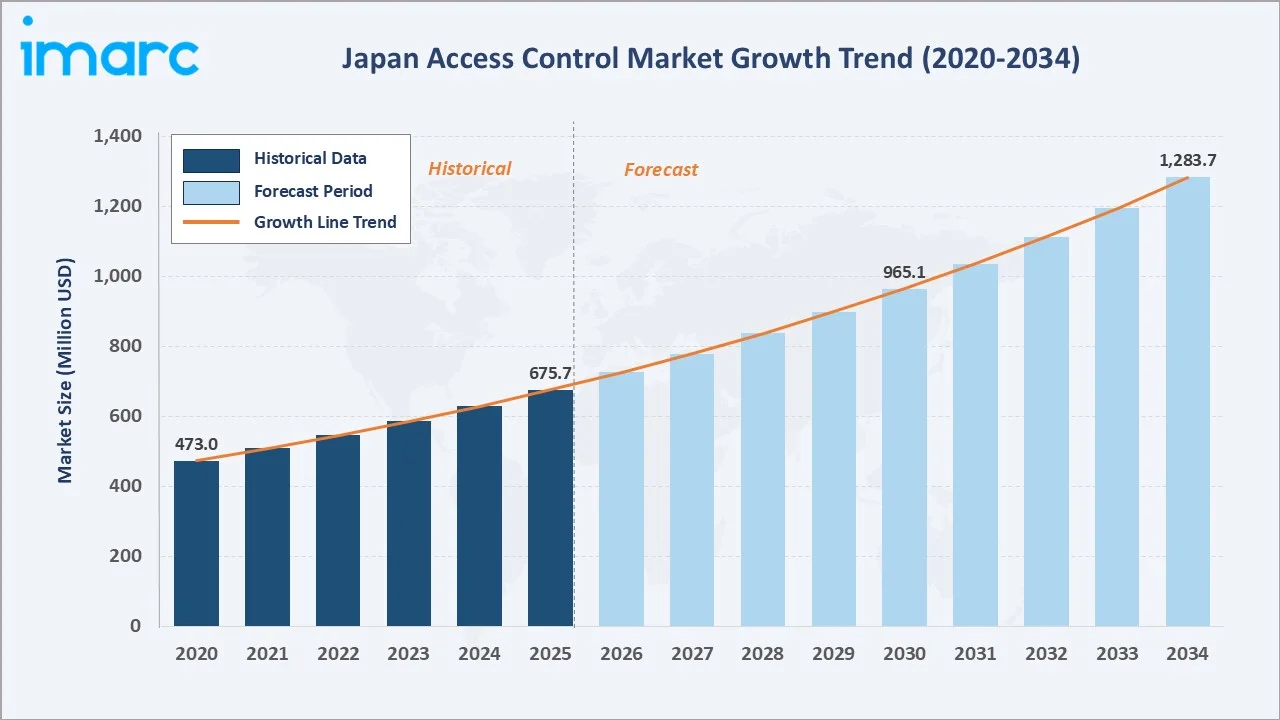
The Japan access control market reached USD 675.7 Million in 2025 and is projected to reach USD 1,283.7 Million by 2034, growing at a CAGR of 7.39% during 2026-2034. The market is driven by rising security awareness, biometric adoption, regulatory compliance pressure, and sustained smart building investment.
Japan's chronic labour shortage is accelerating automation of entry management across offices, factories, and transport hubs. Readers lead the component segment at 36.8%, card-based systems dominate by type at 61.5%, and the Kanto Region commands 35.1% of national revenue.
Market Snapshot
|
Metric |
Value |
|
Market Size (2025) |
USD 675.7 Million |
|
Forecast Market Size (2034) |
USD 1,283.7 Million |
|
CAGR (2026-2034) |
7.39% |
|
Base Year |
2025 |
|
Historical Period |
2020-2025 |
|
Forecast Period |
2026-2034 |
|
Dominant Component |
Reader (36.8%, 2025) |
|
Dominant Type |
Card-Based (61.5%, 2025) |
|
Leading Region |
Kanto Region (35.1%, 2025) |
The market expanded from USD 473.0 Million in 2020 to USD 675.7 Million in 2025, anchored at USD 965.1 Million in 2030 and forecast to reach USD 1,283.7 Million by 2034. Pandemic-era contactless retrofits accelerated an already structural upgrade cycle.
To get more information on this market, Request Sample
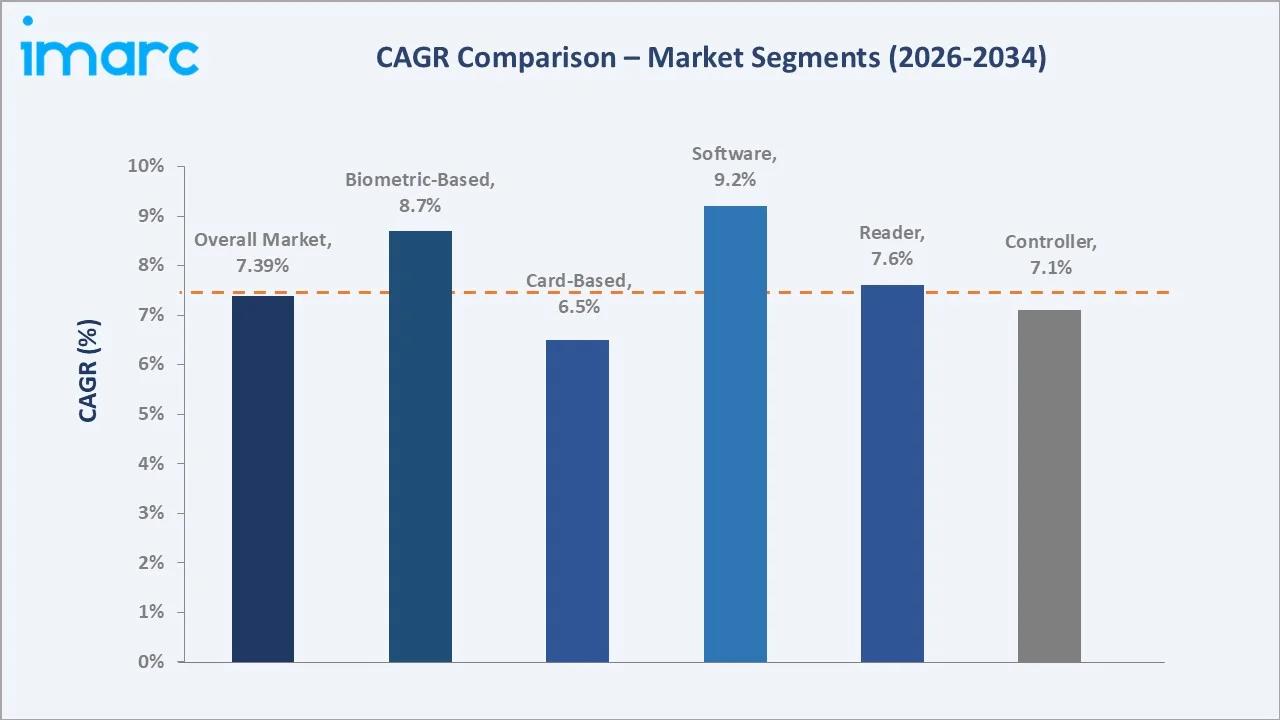
Software grows fastest at approximately 9.2% CAGR as cloud credential management and subscription licensing displace on-premise servers. Biometric-based systems expand at roughly 8.7% CAGR, supported by face recognition deployments across transport hubs, corporate headquarters, and large public venues.
Executive Summary
The Japan access control market reached USD 675.7 Million in 2025, representing one of Asia's most technologically mature physical security markets. Adoption is driven by ageing demographics, workforce contraction, and national policy emphasis on digital identity infrastructure. The market is projected to reach USD 1,283.7 Million by 2034.
Readers at 36.8% dominate through high per-door replacement volumes across commercial and transport facilities. Card-based systems at 61.5% lead because of Japan's entrenched contactless IC employee card ecosystem. The Kanto Region at 35.1% leads through its concentration of corporate headquarters and redevelopment activity.
Key Market Insights
|
Insight |
Data |
|
Dominant Component |
Reader - 36.8% share (2025) |
|
Dominant Type |
Card-Based - 61.5% market share (2025) |
|
Leading Region |
Kanto Region - 35.1% market share (2025) |
|
Market Opportunity |
Cloud-managed access platforms; mobile credentials; face recognition gates; ageing-building retrofit; multi-tenant identity services |
Key Analytical Observations Supporting the Above Data:
- Reader at 36.8%: Readers dominate because every controlled door requires at least one reader, creating the highest installed-unit density of any component. Ongoing migration from magnetic-stripe and legacy proximity readers to contactless IC and multi-technology devices sustains continuous replacement revenue.
- Card-Based at 61.5%: Card-based access leads because Japanese enterprises have standardised on contactless IC credentials combining door entry, cafeteria payment, printing, and attendance. This entrenched multi-application card infrastructure makes card systems the default corporate specification despite rising biometric interest.
- Kanto Region at 35.1%: The Kanto Region leads through its dense concentration of corporate headquarters, financial institutions, data centres, and government facilities. Large-scale urban redevelopment continues to generate high-specification access control demand within new office and mixed-use developments.
Japan Access Control Market Overview
The Japan access control market covers hardware, software, and services that authenticate and authorise physical entry to buildings, floors, rooms, and secured assets, including readers, controllers, electronic locks, and credential management software deployed across government, commercial, healthcare, manufacturing, transport, education, and residential facilities.
The ecosystem links credential chip and hardware suppliers, system manufacturers, software and cloud platform providers, security integrators, and end-user facility owners. Macroeconomic factors include workforce contraction, office redevelopment cycles, tourism infrastructure investment, data protection regulation, and corporate governance requirements for facility audit trails.
Market Dynamics
To evaluate market opportunities, Request Sample
Market Drivers
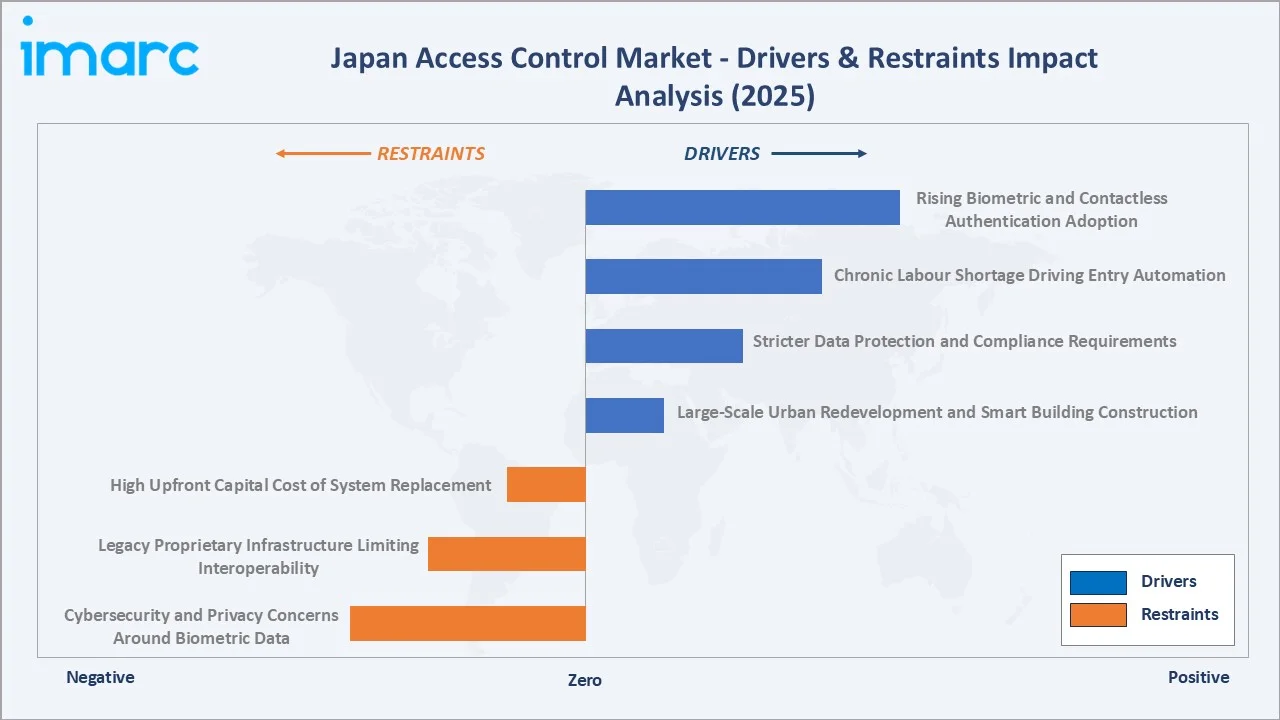
- Rising Biometric and Contactless Authentication Adoption: Japanese enterprises are replacing keys and legacy cards with face, fingerprint, and vein authentication to eliminate credential sharing and loss. In April 2025, NEC Corporation reported the highest accuracy rating in NIST 1:N identification testing, reinforcing domestic confidence in biometric entry deployments. Contactless methods additionally reduce shared physical touchpoints across high-traffic facilities. Falling sensor costs and improved algorithm performance are extending biometric adoption from high-security sites into mainstream commercial offices.
- Chronic Labour Shortage Driving Entry Automation: Japan's shrinking working-age population is pushing facility operators to automate reception, visitor registration, and gate supervision. Automated authentication reduces guard headcount at building lobbies, construction sites, and logistics facilities, allowing operators to maintain security coverage despite persistent recruitment difficulty. Automation also improves throughput during peak entry periods without expanding physical gate infrastructure. The resulting labour savings shorten payback periods and strengthen investment approval cases for system upgrades.
- Stricter Data Protection and Compliance Requirements: Amendments to Japan's Act on the Protection of Personal Information have increased obligations around securing physical locations where personal data is processed. Financial institutions, hospitals, and data centres are consequently upgrading to auditable, role-based access systems generating verifiable entry logs. Corporate governance codes and customer security audits reinforce these requirements throughout supplier networks. Demand is therefore shifting toward systems offering granular permissioning, tamper-resistant logging, and centralised policy administration.
- Large-Scale Urban Redevelopment and Smart Building Construction: Major redevelopment programmes are delivering new mixed-use towers specified with integrated building management. Access control is embedded at design stage alongside elevator destination control, tenant services, and energy systems, raising per-project system value substantially above retrofit installations. Multi-tenant buildings additionally require tenant-level credential segregation and delegated administration. This structural shift expands software licensing and recurring administration revenue for suppliers across the project lifecycle.
Market Restraints
- High Upfront Capital Cost of System Replacement: Replacing access control across ageing commercial building stock requires door hardware, cabling, controllers, and software licensing investment. Many mid-sized building owners defer upgrades because payback is difficult to quantify, slowing conversion of the large installed base of legacy systems. Occupied buildings further face disruption costs from tenant coordination and out-of-hours installation work. Constrained property maintenance budgets consequently push replacement cycles beyond the technically optimal upgrade window.
- Legacy Proprietary Infrastructure Limiting Interoperability: A substantial share of installed Japanese systems uses closed proprietary protocols tied to a single vendor. Migrating to open, standards-based platforms often requires full hardware replacement rather than incremental upgrade, discouraging modernisation and constraining competitive tendering. Integration with newer building management and identity systems is similarly restricted by limited interface availability. Facility operators therefore remain dependent on incumbent suppliers for expansion, spares, and maintenance pricing.
- Cybersecurity and Privacy Concerns Around Biometric Data: Storing facial and fingerprint templates raises employee and consumer privacy concerns, particularly in unionised workplaces and residential settings. Operators face template retention, consent, and breach-notification obligations that require formal internal governance before deployment. Networked controllers also expand the attack surface, demanding sustained firmware patching and network segmentation discipline. Some organisations consequently delay biometric rollouts pending legal review and internal security certification.
Market Opportunities
- Cloud-Managed Access Control for Multi-Site Operators: Cloud platforms allow retail chains, clinics, and logistics operators to administer credentials across dispersed sites without local servers. Subscription models lower entry cost and shift spending from capital to operating budgets, opening the underpenetrated small and mid-sized enterprise segment. Centralised dashboards additionally simplify audit reporting and policy enforcement across regional portfolios. Recurring subscription revenue also delivers materially higher customer lifetime value than one-time hardware sales.
- Mobile Credentials Replacing Physical Cards: Smartphone-based credentials leverage Japan's near-universal mobile penetration and mature contactless payment behaviour. Mobile issuance removes card printing, distribution, and reissue costs, and enables temporary visitor and contractor access provisioned remotely. Combining mobile credentials with biometric verification supports multi-factor entry at higher-security zones. The transition simultaneously drives reader replacement demand and creates a durable software revenue stream for suppliers.
Market Challenges
- Fragmented Installer Base Constraining Deployment Capacity: Deployment depends on regional integrators and electrical contractors already stretched by construction demand. Shortage of certified commissioning engineers extends project lead times, particularly for biometric and networked systems requiring configuration and integration testing. Ongoing cybersecurity maintenance across distributed sites adds a further specialist skill requirement. Vendors must therefore invest in partner training programmes to protect specified projects from schedule slippage.
- Price Pressure from International Vendors: Global and regional manufacturers are competing aggressively on hardware pricing in Japan's commercial mid-market. Domestic suppliers must defend margins through software, integration, and service differentiation rather than device economics, compressing profitability in reader and controller categories. Commoditisation is most pronounced in standard card readers and basic door controllers. Sustained differentiation therefore depends on platform capability, support quality, and integration breadth rather than hardware specification alone.
Emerging Market Trends
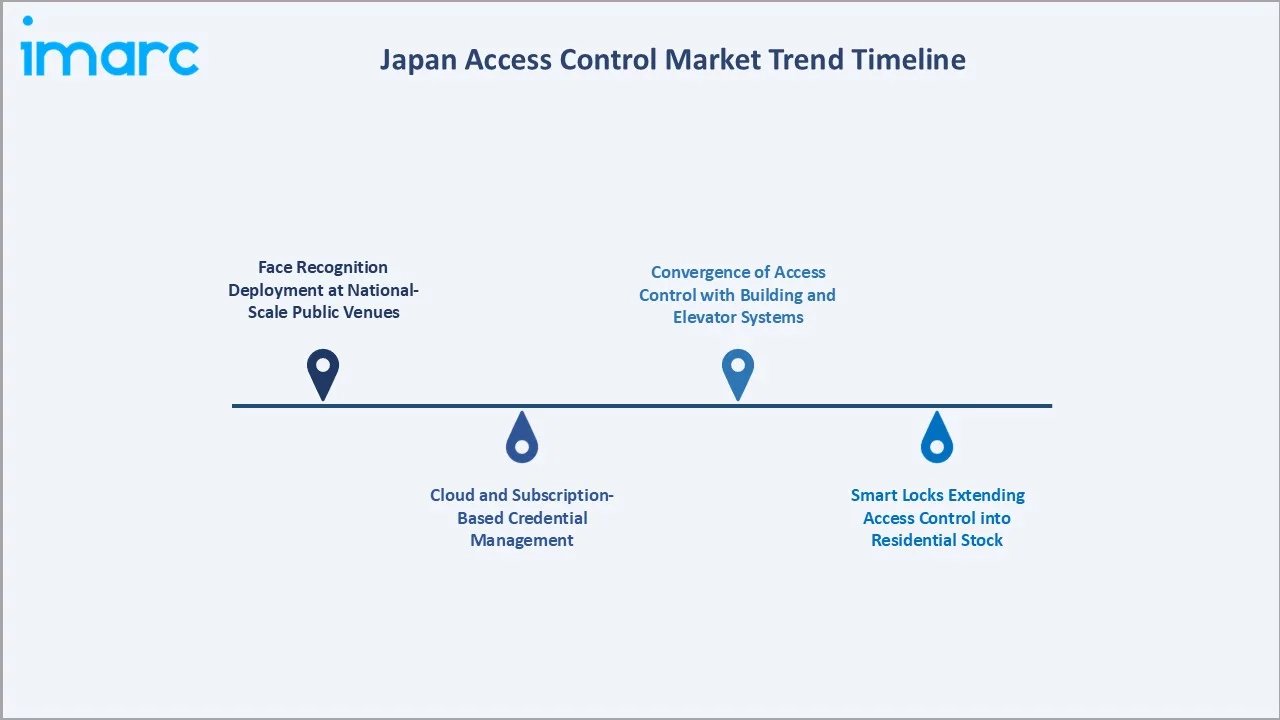
1. Face Recognition Deployment at National-Scale Public Venues
Large public events are validating biometric entry at scale. NEC Corporation supplied face recognition for admission control at more than fifty gates at Expo 2025 Osaka, Kansai, with registered users expected to reach 1.2 million, establishing a reference deployment accelerating enterprise adoption.
2. Cloud and Subscription-Based Credential Management
Operators are shifting from on-premises servers to cloud platforms billed per door or user. In 2025, Panasonic launched its KPAS Cloud Site Management Service, using face recognition to manage entry and exit for contractors, staff, and visitors across distributed work sites.
3. Convergence of Access Control with Building and Elevator Systems
Access control is increasingly integrated with elevator destination dispatch, delivery lockers, and robot navigation. Mitsubishi Electric Corporation's building solutions link facial authentication to entrances, elevators, and delivery boxes, allowing residents and staff to move through buildings without physical keys or cards.
4. Smart Locks Extending Access Control into Residential Stock
Property managers are embedding electronic locks into standard lease infrastructure to cut key handover labour. Japanese residential operators report high tenant uptake of smart-lock-equipped units, reducing leasing office visits and creating a growing adjacent demand pool for the locks component segment.
Industry Value Chain Analysis
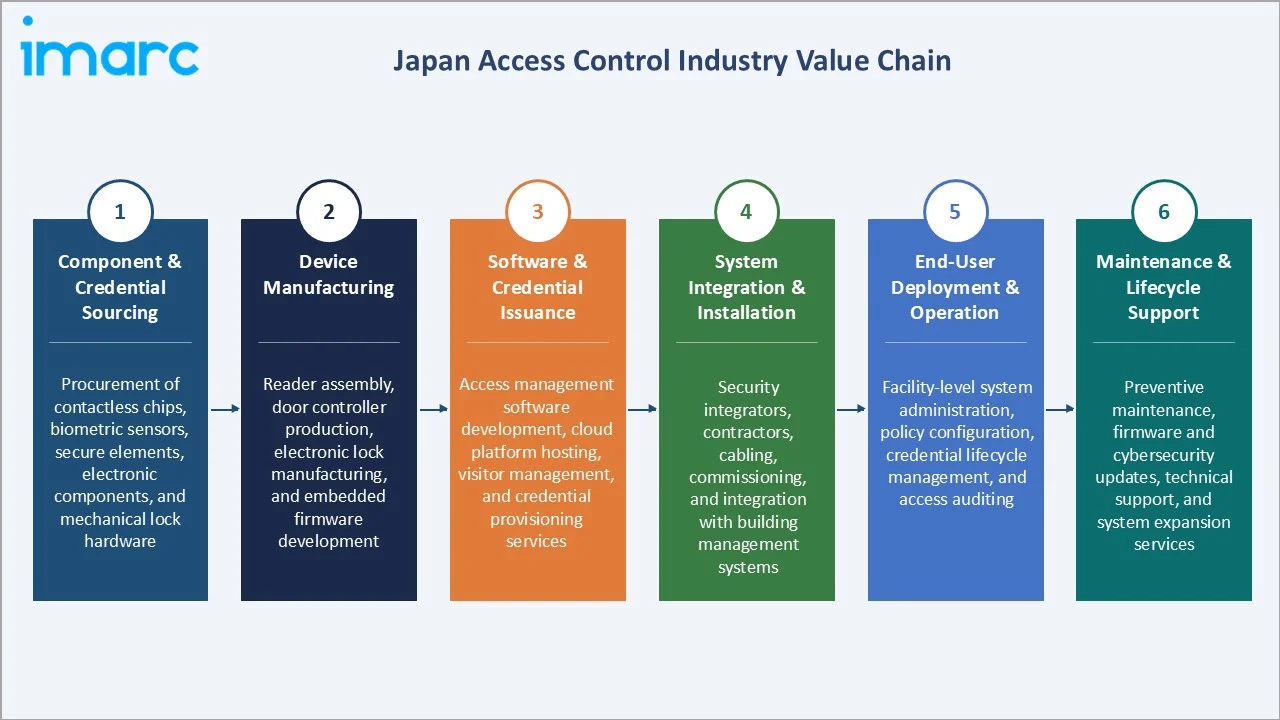
The value chain spans component sourcing, device manufacture, software platform development, system integration, end-user operation, and lifecycle maintenance. Commercial value is shifting downstream as recurring software licensing and managed services displace one-time hardware margin as the primary source of supplier profitability.
|
Stage |
Key Participants |
|
Component & Credential Sourcing |
Procurement of contactless chips, biometric sensors, secure elements, electronic components, and mechanical lock hardware |
|
Device Manufacturing |
Reader assembly, door controller production, electronic lock manufacturing, and embedded firmware development |
|
Software & Credential Issuance |
Access management software development, cloud platform hosting, visitor management, and credential provisioning services |
|
System Integration & Installation |
Security integrators, contractors, cabling, commissioning, and integration with building management systems |
|
End-User Deployment & Operation |
Facility-level system administration, policy configuration, credential lifecycle management, and access auditing |
|
Maintenance & Lifecycle Support |
Preventive maintenance, firmware and cybersecurity updates, technical support, and system expansion services |
The software and credential issuance tier is the value chain's fastest-growing stage as recurring revenue models expand. The integration tier remains the principal capacity constraint, since qualified commissioning engineers determine how quickly specified projects convert into recognised revenue.
Technology Landscape in the Japan Access Control Industry
Contactless IC Card Technology
Contactless IC cards remain Japan's dominant credential format, combining door access with attendance, payment, and printing on a single employee badge. Mature domestic standards, broad reader compatibility, and established issuance workflows keep replacement cycles predictable and sustain the card-based segment's leading revenue share.
Face Recognition Technology
Face recognition is the fastest-advancing authentication method in Japanese access control. Panasonic Connect's facial authentication managed entry for approximately 120,000 cumulative construction personnel at the Expo 2025 venue, performing around three million authentications and operating reliably where users wore masks or helmets.
Cloud and Mobile Credential Platforms
Cloud-hosted platforms with smartphone credentials are reshaping system architecture. Administrators issue, modify, and revoke access remotely, and newer workflows allow self-registration via emailed QR codes at dedicated terminals, removing the advance enrolment step that previously slowed large multi-site rollouts.
Market Segmentation Analysis
The report covers the following segments:
|
Segment Category |
Leading Segment |
Market Share |
Year |
|
Component |
Reader |
36.8% |
2025 |
|
Type |
Card-Based |
61.5% |
2025 |
|
End User |
🔒 |
🔒 |
2025 |
|
Region |
Kanto Region |
35.1% |
2025 |

By Component
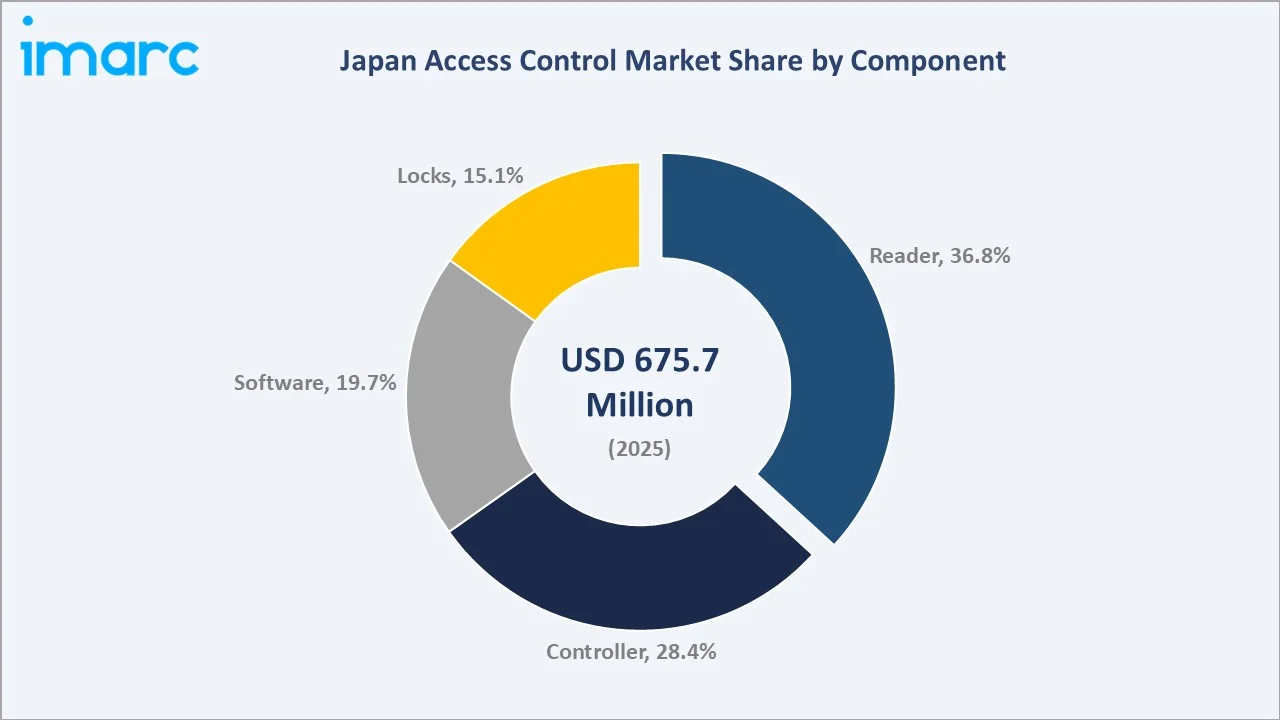
Readers lead at 36.8% in 2025, reflecting the highest installed-unit density across controlled doors and continuous migration from legacy proximity devices to contactless IC and multi-technology readers throughout Japanese commercial, industrial, and public buildings.
To access detailed market analysis, Request Sample
Controllers at 28.4% capture panel and networked door-controller value in multi-door installations. Software at 19.7% is the fastest-growing component at roughly 9.2% CAGR through cloud licensing. Locks at 15.1% benefit from electronic and smart lock adoption in residential and commercial retrofit.
By Type
Card-based systems lead at 61.5% through Japan's entrenched multi-application contactless IC employee badge ecosystem. The segment retains default corporate specification status because issuance workflows, reader infrastructure, and integration with attendance and payment systems are already standardised across most large enterprises.
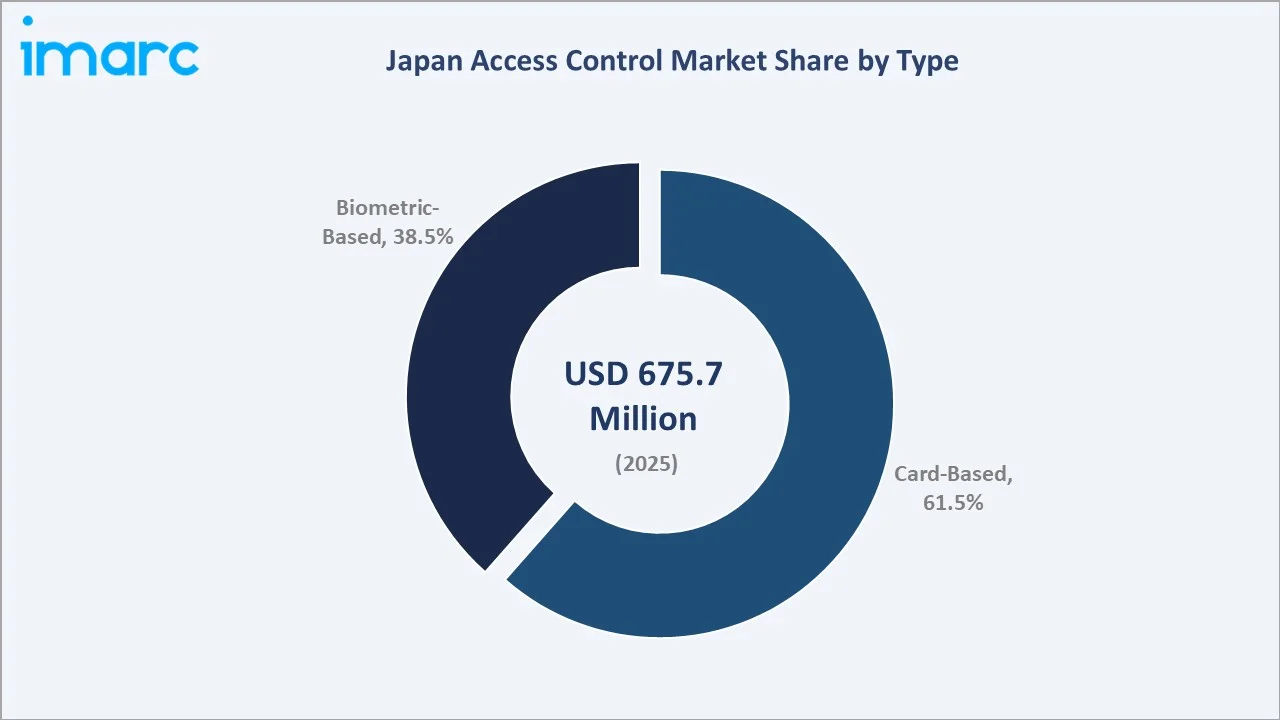
Biometric-based systems at 38.5% grow faster at approximately 8.7% CAGR, led by face recognition and vein authentication. High-security sites, data centres, and large public venues are converting first, with fingerprint and multimodal systems expanding across manufacturing and healthcare facilities.
Regional Market Insights
|
Region |
Share (2025) |
Key Market Drivers & Characteristics |
|
Kanto Region |
35.1% |
Driven by the highest concentration of corporate offices, financial institutions, data centres, and government facilities, supported by continuous urban redevelopment |
|
Kansai/Kinki Region |
17.4% |
Supported by commercial property development, manufacturing clusters, tourism infrastructure, and large public venue security investment |
|
Central/Chubu Region |
15.3% |
Driven by advanced manufacturing operations requiring controlled production zones and structured contractor entry management |
|
Kyushu-Okinawa Region |
9.2% |
Growing through semiconductor investment, logistics expansion, tourism facilities, and regional data centre development |
|
Tohoku Region |
7.8% |
Supported by public infrastructure renewal, healthcare facility upgrades, and industrial park development activity |
|
Chugoku Region |
6.4% |
Driven by heavy industry operations, port logistics facilities, and municipal facility modernisation programmes |
|
Hokkaido Region |
5.0% |
Emerging with data centre projects, tourism infrastructure, and food processing facility upgrades |
|
Shikoku Region |
3.8% |
Smallest regional market, supported by manufacturing sites, public facilities, and residential electronic lock adoption |
The Kanto Region, at 35.1%, leads through its unmatched density of high-specification commercial buildings. Kansai/Kinki, at 17.4%, reflects a broad commercial base and elevated public venue security investment following large-scale event infrastructure delivery.
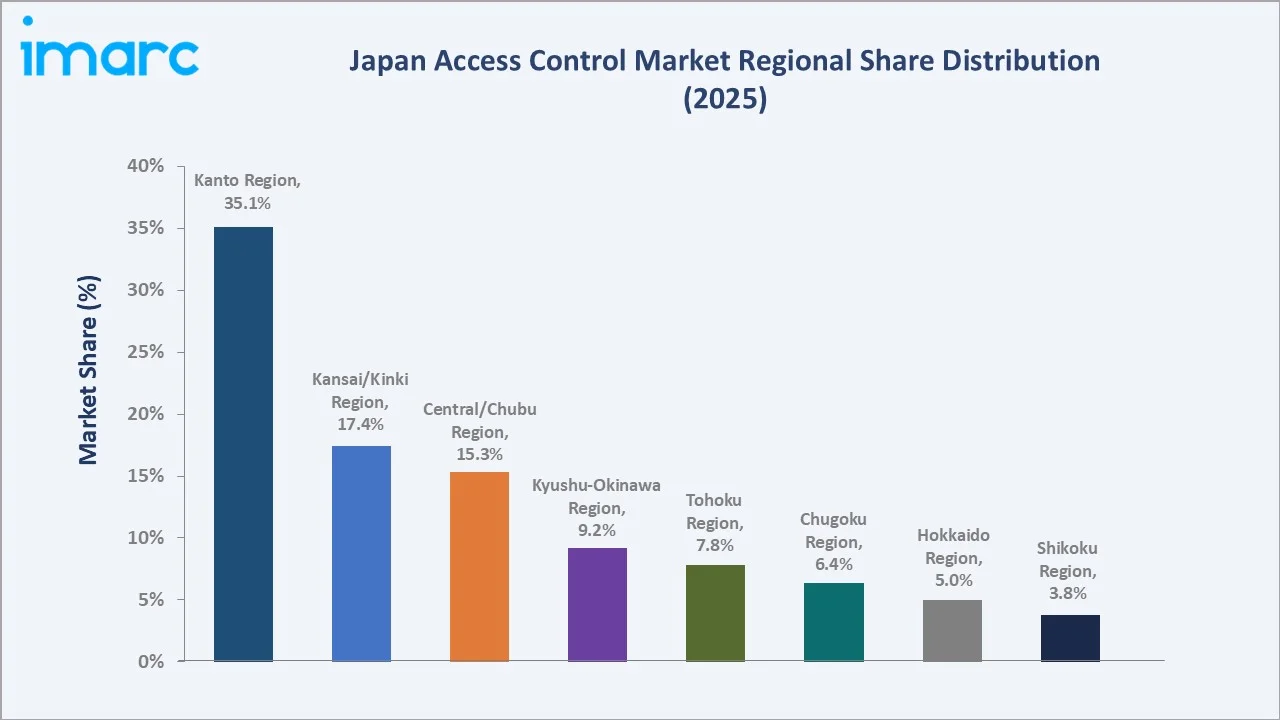
Central/Chubu, at 15.3%, is anchored by manufacturing site access requirements. Kyushu-Okinawa, at 9.2%, is the fastest-growing region on semiconductor and data centre investment, while Tohoku, Chugoku, Hokkaido, and Shikoku together represent 23.0% of national revenue.
Competitive Landscape
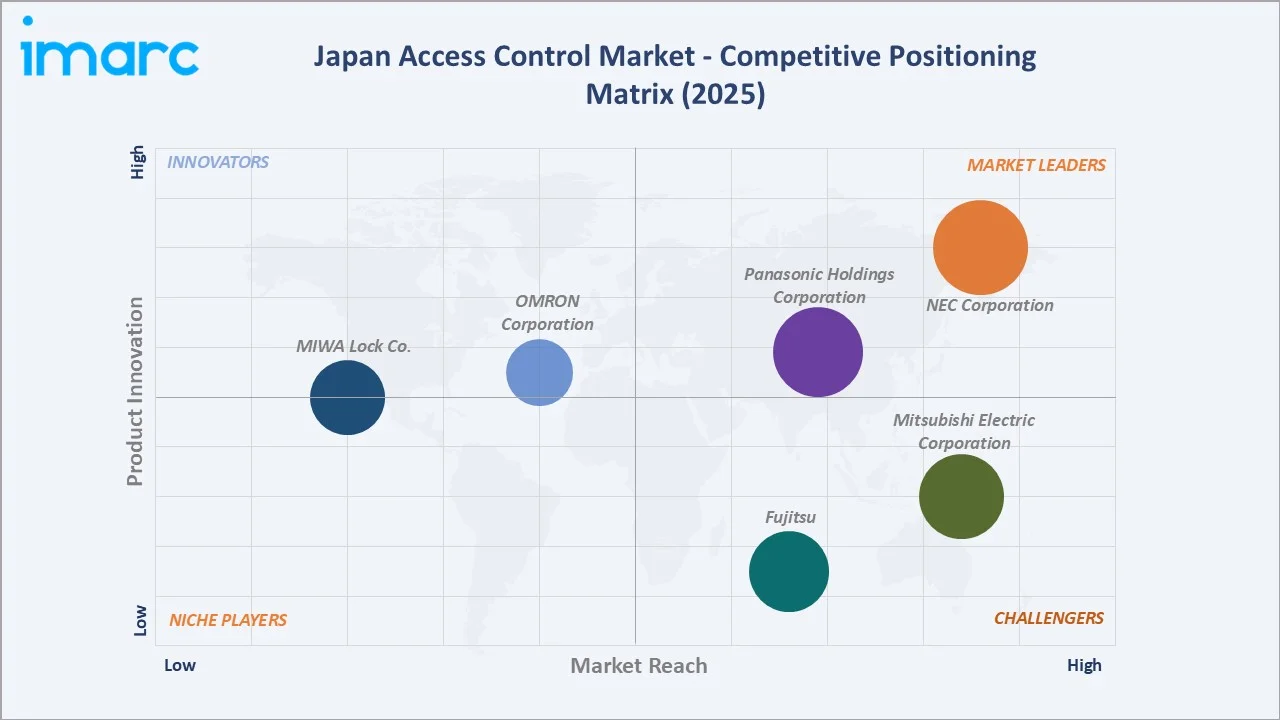
The Japan access control market competitive landscape is moderately concentrated with three distinct competitive tiers: integrated domestic technology majors, specialist lock and device manufacturers, and software-led platform challengers targeting cloud and mobile credential deployments.
|
Company Name |
Key Products |
Market Position |
Core Strength |
|
NEC Corporation |
NeoFace face recognition, biometric authentication platforms |
Market Leader |
World-leading face recognition accuracy and large-scale deployment experience |
|
Panasonic Holdings Corporation |
Biometric sensor, Communication, KPAS |
Market Leader |
Proven high-volume facial authentication across construction, event, and immigration environments |
|
Mitsubishi Electric Corporation |
Building security systems, facial recognition entrance solutions, elevator-linked access control |
Strong Challenger |
Deep integration of access control with elevators and building management systems |
|
Fujitsu |
Palm vein biometric authentication, identity and access management software |
Strong Challenger |
Contactless palm vein technology and enterprise identity management integration |
|
OMRON Corporation |
Entrance gates, sensing devices, industrial access and safety control components |
Established Player |
Sensing and automation expertise applied to gates and controlled industrial zones |
|
MIWA Lock Co. |
Electronic locks, card lock systems, door hardware and cylinder products |
Established Player |
Dominant domestic door hardware installed base and extensive lock portfolio |
Key players include NEC Corporation, Panasonic Holdings Corporation, Mitsubishi Electric Corporation, Fujitsu, OMRON Corporation, MIWA Lock Co., and others.
Key Company Profiles
NEC Corporation
NEC Corporation is a Japan-based information technology and electronics company with a leading position in biometric authentication and access control through its face recognition portfolio and large-scale public and enterprise entry management deployments.
- Key Products: NeoFace face recognition engine, biometric authentication platforms, entry and admission management systems, and digital identity solutions.
- Recent Developments: In December 2025, NEC Corporation developed a walk-through multimodal biometric authentication technology that combines facial and iris recognition to verify individuals while they are moving. Using a single compact camera, the technology enables fast and hands-free identity verification in both indoor and outdoor environments, helping facilities strengthen security while reducing congestion at entry points.
- Strategic Focus: Expanding biometric authentication from physical entry into payment, digital identity, and decentralised credential applications. The company is scaling face recognition deployments across public venues, transport hubs, and enterprise facilities. It is also developing privacy-preserving authentication methods that reduce facial data storage obligations for operators.
Panasonic Holdings Corporation
Panasonic Holdings Corporation, through Panasonic Connect Co., Ltd., is a major supplier of facial authentication and entrance management systems, with extensive deployment experience across construction sites, immigration gates, and large public venues in Japan.
- Key Products: KPAS entry management systems, cloud site management services, and automated facial recognition gates.
- Recent Developments: In April 2026, Panasonic Connect introduced a QR code-based facial registration feature for its KPAS Cloud Site Management Service, designed to simplify biometric onboarding and improve access management at factories, construction sites, warehouses, and other high-traffic facilities.
- Strategic Focus: Extending facial authentication from project-based venue deployments into recurring cloud site management subscriptions. The company is simplifying enrolment through self-registration workflows that reduce administrative effort for multi-site operators. It is also strengthening authentication reliability in industrial environments where users wear masks, helmets, or protective equipment.
Market Concentration Analysis
The market is moderately concentrated, with leading domestic technology and building systems groups collectively accounting for an estimated 45-55% of Japanese access control revenue. Specialist lock manufacturers and regional integrators hold the remainder, particularly in mid-market commercial and residential installations.
Concentration is expected to ease modestly through the forecast period as cloud-native platform providers and international hardware vendors gain share in small and mid-sized enterprise deployments, where subscription pricing lowers the barrier that previously favoured established domestic suppliers.
Investment & Growth Opportunities
Highest Growth Segments
Software (~9.2% CAGR), biometric-based systems (~8.7% CAGR), readers (~7.6% CAGR), and the Kyushu-Okinawa regional market represent the highest-growth vectors through 2034, alongside residential smart lock adoption expanding the locks component beyond its traditional commercial base.
Emerging Investment Opportunities
Cloud access control for small and mid-sized enterprises is the market's largest underpenetrated pool. Subscription platforms priced per door remove the capital barrier that has historically excluded smaller businesses, creating a recurring revenue base with materially higher lifetime value than hardware sales.
Investment Themes
- Biometric Platform Scaling: Investment in face and vein authentication platforms with proven accuracy creates durable advantage as Japanese enterprises convert from card credentials. Reference deployments at national-scale public venues have materially reduced procurement risk perception, shortening enterprise evaluation cycles for high-security facilities.
- Ageing Building Retrofit Programmes: Japan's large stock of commercial buildings constructed before networked access control represents a multi-year replacement pipeline. Suppliers offering wireless locks and low-disruption retrofit architectures can address properties where cabling cost has historically prevented modernisation.
Future Market Outlook (2026-2034)
The Japan access control market is projected to grow from USD 675.7 Million in 2025 to USD 1,283.7 Million by 2034, delivering a 7.39% CAGR. The anchor value of USD 965.1 Million in 2030 marks the point at which biometric and cloud architectures become mainstream specifications.
Three structural forces define growth through 2034. Workforce contraction sustains automation demand irrespective of economic cycle. Regulatory tightening around personal data locations continues to mandate auditable entry control. Redevelopment and retrofit pipelines convert ageing building stock into a sustained replacement market.
Research Methodology
Primary Research
Primary research comprised structured interviews with 45+ industry stakeholders (2025), including security system product managers; facility management directors; building integrator commissioning leads; biometric technology specialists; and corporate security officers across Japanese enterprise and public sector organisations.
Secondary Research
Secondary research encompassed company annual reports and press disclosures; construction and building starts statistics; personal data protection regulatory publications; public venue security deployment case studies; smart building and smart lock adoption studies; and industry association technical standards documentation. Over 55 secondary sources were reviewed.
Forecasting Models
Forecasts were developed using a bottom-up installed-base model: (i) controlled door population by building type and region; (ii) replacement and new-build installation rates; (iii) average system value per door by component and authentication type; and (iv) software and service attach-rate adjustment.
Japan Access Control Market Report Coverage:
| Report Features | Details |
|---|---|
| Base Year of the Analysis | 2025 |
| Historical Period | 2020-2025 |
| Forecast Period | 2026-2034 |
| Units | Million USD |
| Scope of the Report | Exploration of Historical Trends and Market Outlook, Industry Catalysts and Challenges, Segment-Wise Historical and Future Market Assessment:
|
| Components Covered | Controller, Reader, Locks, Software |
| Types Covered |
|
| End Users Covered | Government, Military and Defense, Commercial, Healthcare, Manufacturing, Transport, Education, Residential, Others |
| Regions Covered | Kanto Region, Kansai/Kinki Region, Central/ Chubu Region, Kyushu-Okinawa Region, Tohoku Region, Chugoku Region, Hokkaido Region, Shikoku Region |
| Companies Covered | NEC Corporation, Panasonic Holdings Corporation, Mitsubishi Electric Corporation, Fujitsu, OMRON Corporation, MIWA Lock Co., etc. |
| Customization Scope | 10% Free Customization |
| Post-Sale Analyst Support | 10-12 Weeks |
| Delivery Format | PDF and Excel through Email (We can also provide the editable version of the report in PPT/Word format on special request) |
Key Benefits for Stakeholders:
- IMARC’s industry report offers a comprehensive quantitative analysis of various market segments, historical and current market trends, market forecasts, and dynamics of the Japan access control market from 2020-2034.
- The research report provides the latest information on the market drivers, challenges, and opportunities in the Japan access control market.
- Porter's five forces analysis assist stakeholders in assessing the impact of new entrants, competitive rivalry, supplier power, buyer power, and the threat of substitution. It helps stakeholders to analyze the level of competition within the Japan access control industry and its attractiveness.
- Competitive landscape allows stakeholders to understand their competitive environment and provides an insight into the current positions of key players in the market.
Frequently Asked Questions About the Japan Access Control Market Report
The Japan access control market reached USD 675.7 Million in 2025, driven by readers dominant at 36.8%, card-based systems leading at 61.5%, the Kanto Region commanding 35.1% of national revenue, workforce contraction accelerating entry automation, and biometric adoption expanding across corporate, transport, and public venue facilities.
The Japan access control market grows at 7.39% CAGR during 2026-2034, reaching USD 1,283.7 Million by 2034. This growth reflects data protection compliance requirements, cloud platform adoption, urban redevelopment activity, mobile credential migration, and residential smart lock penetration expanding the addressable installed base.
The reader segment leads at 36.8%, reflecting the highest installed-unit density across controlled doors. This segment grows at approximately 7.6% CAGR through replacement of legacy proximity readers with contactless IC, multi-technology, and biometric-capable devices.
Card-based systems lead at 61.5% through Japan's entrenched multi-application contactless IC employee badge ecosystem. Biometric-based systems grow fastest at approximately 8.7% CAGR through face recognition and vein authentication adoption across high-security corporate, data centre, and public venue environments.
The Kanto Region leads at 35.1% through its concentration of corporate headquarters, financial institutions, data centres, and government facilities, supported by ongoing large-scale urban redevelopment.
Leading companies include NEC Corporation, Panasonic Holdings Corporation, Mitsubishi Electric Corporation, Fujitsu, OMRON Corporation, MIWA Lock Co., and others.
The Japan access control market is projected to reach approximately USD 965.1 Million by 2030, with cloud-managed platforms established as a mainstream commercial format, mobile credentials scaling across enterprises, and face recognition adopted broadly across transport, corporate, and public venue environments.
Three priority investment opportunities: cloud subscription platforms targeting small and mid-sized enterprises, biometric authentication platform scaling for high-security facilities, and low-disruption retrofit architectures addressing the large stock of ageing commercial buildings.
Need more help?
- Speak to our experienced analysts for insights on the current market scenarios.
- Include additional segments and countries to customize the report as per your requirement.
- Gain an unparalleled competitive advantage in your domain by understanding how to utilize the report and positively impacting your operations and revenue.
- For further assistance, please connect with our analysts.
 Request Customization
 Speak to an Analyst
 Request Brochure
 Inquire Before Buying
Benefits of Customization
- Personalize this research
- Triangulate with your data
- Get data as per your format and definition
- Gain a deeper dive into a specific application, geography, customer, or competitor
- Any level of personalization
Get in Touch With Us
UNITED STATES
Phone: +1-201-971-6302
INDIA
Phone: +91-120-433-0800
UNITED KINGDOM
Phone: +44-753-714-6104
Email: [email protected]
Client Testimonials




.webp)




.webp)













Related Reports

Choose your plan
*Please note that the prices mentioned below are starting prices for each bundle type. Kindly contact our team for further details.*
Single User License
- 1 User License, Access on 2 Devices
- PDF Report + Excel Dataset (Password Protected)
- Lifetime Access
- No Printing Rights
- 10% Free Report Customization
- 10–12 Weeks of Analyst Support
Five User License
- Access for 5 Users, 2 Devices per User
- PDF Report + Excel Dataset (Password Protected)
- Lifetime Access
- Dedicated Account Manager
- 12–14 Weeks of Analyst Support
- No Printing Rights
- 15% Free Report Customization
- 25% Discount on Your Next Purchase
Corporate User License
- Unlimited User Access (Within Your Organization)
- PDF Report + Excel Dataset
- Lifetime Access
- Dedicated Account Manager
- 14–20 Weeks of Analyst Support
- No Printing Rights
- 20% Free Report Customization
- 30% Discount on Your Next Purchase
Essential Insights
What's included:
3 reports
- Lifetime Access
- PDF Reports
- Excel Datasets
- 2 Weeks of Free Analyst Support
- 2 User Licenses
- Access on 2 Devices
- Printing Rights
- Complimentary PowerPoint (PPT) Version
- Complimentary License Upgrade
Professional Access
What's included:
5 reports
- Lifetime Access
- PDF Reports
- Excel Datasets
- 8 Weeks of Free Analyst Support
- 2 User Licenses
- Access on 2 Devices
- Printing Rights
- Complimentary PowerPoint (PPT) Version
- Complimentary License Upgrade
Business Advantage
What's included:
8 reports
- Lifetime Access
- PDF Reports
- Excel Datasets
- 14 Weeks of Free Analyst Support
- 2 User Licenses
- Access on 2 Devices
- Printing Rights
- Complimentary PowerPoint (PPT) Version
- Complimentary License Upgrade
Enterprise Intelligence
What's included:
10 reports
- Lifetime Access
- PDF Reports
- Excel Datasets
- 20 Weeks of Free Analyst Support
- 2 User Licenses
- Access on 2 Devices
- Printing Rights
- Complimentary PowerPoint (PPT) Version
- Complimentary License Upgrade