
Japan AI Infrastructure Market Size, Share, Trends and Forecast by Offering, Deployment, End User, and Region, 2026-2034
Japan AI Infrastructure Market Size, Share, Trends & Forecast (2026-2034)
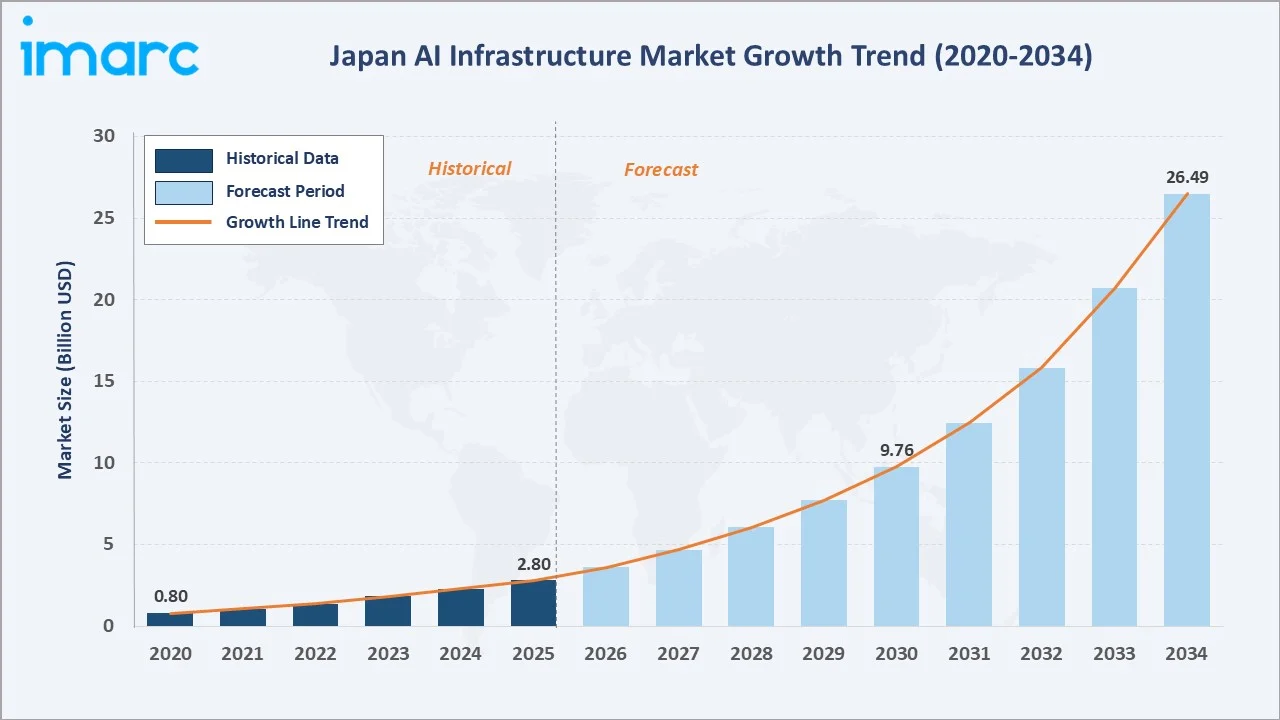
The Japan AI infrastructure market grew from USD 2.80 Billion in 2025 to USD 3.59 Billion in 2026 and is projected to reach USD 26.49 Billion by 2034, growing at a CAGR of 28.37% during 2026-2034. Growth is driven by Society 5.0 initiatives, rising hyperscale data center capacity, expanding generative AI adoption, and continuous advances in GPU and AI accelerator technology.
Hardware leads the offering segment at 57.4%, while cloud dominates deployment at 48.6%. The Kanto region commands the largest regional share at 44.8%, anchored by Tokyo's concentration of data centers, technology firms, and government-backed AI initiatives.
Market Snapshot
|
Metric |
Value |
|
Base Year Market Size (2025) |
USD 2.80 Billion |
|
Market Size (2026) |
USD 3.59 Billion |
|
Forecast Market Size (2034) |
USD 26.49 Billion |
|
CAGR (2026-2034) |
28.37% |
|
Base Year |
2025 |
|
Historical Period |
2020-2025 |
|
Forecast Period |
2026-2034 |
|
Dominant Offering |
Hardware (57.4%, 2025) |
|
Dominant Deployment |
Cloud (48.6%, 2025) |
|
Leading Region |
Kanto Region (44.8%, 2025) |
The market expanded from USD 0.80 Billion in 2020 to USD 2.80 Billion in 2025 and an estimated USD 3.59 Billion in 2026, more than tripling over five years as early pilots and government-backed compute programs established the market's foundation. The market is anchored at approximately USD 9.76 Billion in 2030 and is forecast to reach USD 26.49 Billion by 2034, as national AI strategy funding, hyperscaler investment, and generative AI enterprise rollouts converge to compress deployment timelines.
To get more information on this market, Request Sample
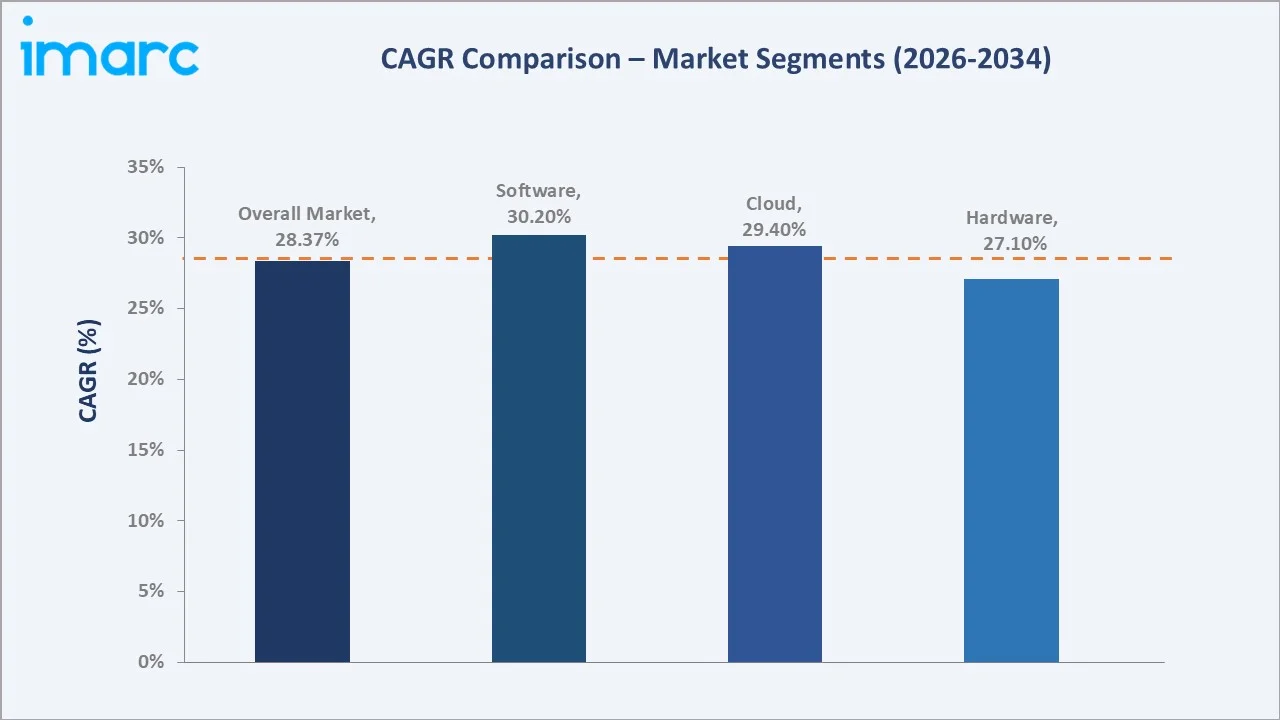
Software grows fastest among offerings at approximately 30.2% CAGR as enterprises layer AI orchestration, MLOps, and inference optimization tools atop expanding hardware capacity. Cloud deployment grows fastest among deployment modes at approximately 29.4% CAGR as enterprises favor elastic, pay-as-you-go GPU access over capital-intensive on-premises buildouts.
Executive Summary
The Japan AI infrastructure market, which increased from USD 2.80 Billion in 2025 to an estimated USD 3.59 Billion in 2026, reflecting the country's rapid transition toward data-driven, AI-enabled industrial and enterprise systems. AI infrastructure, spanning high-performance computing, GPUs, accelerators, storage, and cloud platforms, has become foundational to Japan's Society 5.0 agenda. The market is projected to reach USD 26.49 Billion by 2034.
Hardware at 57.4% dominates the offering segment, reflecting sustained capital investment in GPU clusters, AI accelerators, and data center build-outs by both domestic and international operators. Cloud at 48.6% leads deployment as enterprises prioritize scalable, flexible access to compute over capital-intensive ownership models. Kanto at 44.8% leads regionally through Tokyo's concentration of hyperscale data centers, corporate headquarters, and government AI policy infrastructure.
Key Market Insights
|
Insight |
Data |
|
Dominant Offering |
Hardware - 57.4% share (2025) |
|
Dominant Deployment |
Cloud - 48.6% market share (2025) |
|
Leading Region |
Kanto Region - 44.8% market share (2025) |
|
Market Opportunity |
Sovereign AI compute, liquid-cooled data centers, edge AI inference, domestic GPU alternatives, AI-as-a-Service platforms |
Key Analytical Observations Supporting the Above Data:
- Hardware at 57.4%: Hardware provides the physical compute backbone, including GPUs, AI accelerators, and servers, essential for training and inference workloads, and continues to command the larger share as enterprises scale infrastructure ahead of software layers. This dominance is reinforced by continuous capital expenditure cycles as operators refresh GPU fleets to keep pace with next-generation accelerator architectures. Hardware providers are also expanding local assembly and testing capacity within Japan to reduce import lead times and support faster deployment for enterprise customers.
- Cloud at 48.6%: Cloud deployment offers elastic scalability and lower upfront costs, making it the preferred route for enterprises and startups accelerating AI adoption without heavy capital commitments. Hyperscale cloud providers are expanding regional availability zones within Japan specifically to serve latency-sensitive AI workloads for domestic enterprises. The subscription-based consumption model also allows enterprises to experiment with generative AI use cases before committing to larger infrastructure investments.
- Kanto Region at 44.8%: Kanto's dominance stems from Tokyo's dense concentration of hyperscale data center campuses, corporate technology headquarters, and direct proximity to national policy and funding bodies driving AI infrastructure investment.
Japan AI Infrastructure Market Overview
The Japan AI infrastructure market encompasses the hardware and software systems that enable training, deployment, and operation of AI workloads, including GPUs, AI accelerators, high-performance computing clusters, data storage systems, networking equipment, cloud platforms, and AI-optimized software stacks. This broad category underpins nearly every enterprise and government AI initiative currently underway across the country.
The ecosystem integrates semiconductor and GPU manufacturers, data center operators, cloud hyperscalers, systems integrators, telecommunications carriers, and government bodies coordinating national AI policy. Macroeconomic drivers include Society 5.0 initiatives, national AI investment programs, rising enterprise digital transformation budgets, and Japan's strategic focus on compute sovereignty amid intensifying global competition for AI capacity.
Market Dynamics
To get more information on this market, Request Sample
Market Drivers
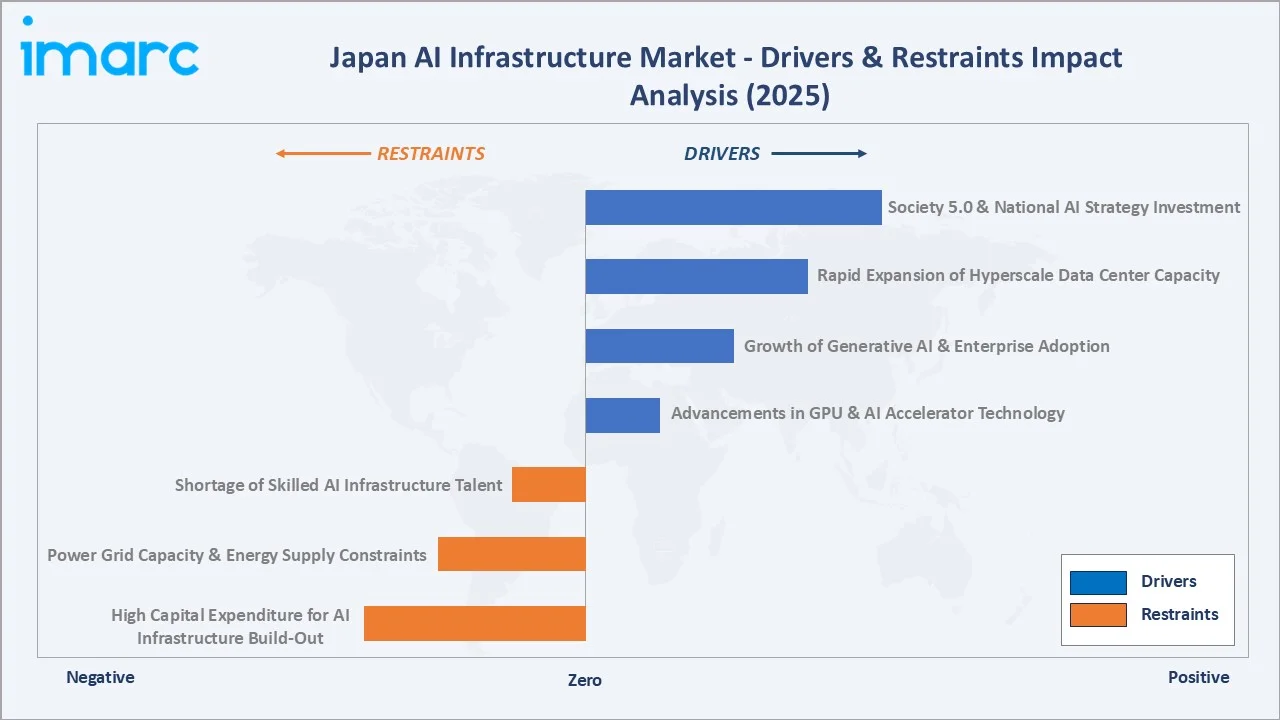
- Society 5.0 & National AI Strategy Investment: Japan's national Society 5.0 strategy channels substantial public and private investment into AI compute capacity, positioning AI infrastructure as core national economic infrastructure. Government-backed cloud and GPU procurement programs are accelerating hyperscale build-outs across the country, directly boosting demand for computer hardware and supporting software platforms. The strategy also incentivizes cross-sector collaboration between government research institutes and private technology firms, further compounding infrastructure investment.
- Rapid Expansion of Hyperscale Data Center Capacity: Hyperscalers and domestic cloud providers are rapidly expanding data center capacity across Japan to meet surging enterprise demand for AI compute. New GPU server deployments, liquid cooling systems, and high-density racks are being commissioned to support both training and inference workloads at scale. Several operators have announced multi-year capacity expansion roadmaps, signalling sustained confidence in long-term enterprise AI demand growth.
- Growth of Generative AI & Enterprise Adoption: Japanese enterprises across manufacturing, finance, and healthcare are increasingly deploying generative AI applications for productivity, customer service, and product development. This adoption wave is driving sustained demand for underlying compute and storage infrastructure to support model training and inference at scale. Enterprise IT budgets are being reallocated toward AI infrastructure at a faster pace than any other technology category over the past three fiscal years.
- Advancements in GPU & AI Accelerator Technology: Continuous improvements in GPU architecture, AI accelerator chips, and interconnect technologies are improving compute efficiency and lowering the cost per AI workload. These advancements are encouraging broader enterprise adoption and accelerating infrastructure refresh cycles across Japanese data centers. Next-generation accelerator platforms are also enabling smaller enterprises to access AI capabilities previously limited to large technology firms.
Market Restraints
- High Capital Expenditure for AI Infrastructure Build-Out: Building and scaling AI infrastructure requires substantial upfront investment in GPUs, data center facilities, and cooling systems. This creates high barriers to entry and limits the pace of expansion for smaller operators and enterprises with constrained capital budgets. Financing costs have also risen for infrastructure operators, further compressing return timelines on new data center investments.
- Power Grid Capacity & Energy Supply Constraints: AI data centers are highly power-intensive, and Japan's grid capacity in certain regions faces constraints in supporting large-scale, concentrated compute deployments. This can delay new facility commissioning and increase operating costs, particularly in dense urban areas with limited substation capacity. Operators are increasingly required to co-invest in dedicated power infrastructure upgrades to secure grid connection approval for new sites.
- Shortage of Skilled AI Infrastructure Talent: Japan faces a shortage of engineers and data center specialists skilled in AI infrastructure design, deployment, and operations. This shortage can slow project timelines and increase reliance on foreign expertise and vendor-managed services. Universities and technical institutes have begun expanding AI infrastructure curricula, though talent pipeline growth remains slower than market demand.
Market Opportunities
- Sovereign AI Compute Development: Growing government and enterprise emphasis on reducing dependency on foreign compute providers is creating opportunities for domestic AI infrastructure development. Public funding programs are increasingly targeting domestic GPU assembly, data center construction, and AI chip design initiatives. This trend is expected to open new supplier relationships between government agencies and emerging domestic hardware vendors.
- Edge AI Inference Infrastructure: Rising demand for low-latency AI applications in manufacturing, robotics, and autonomous systems is creating opportunities for distributed edge AI infrastructure deployment. Edge inference reduces reliance on centralized data centers for time-sensitive applications, opening new infrastructure investment categories. Telecommunications carriers are positioning 5G network edge nodes as natural hosting points for distributed AI inference infrastructure.
Market Challenges
- Global GPU Supply Chain Constraints Affecting Deployment Timelines: Global semiconductor supply constraints continue to affect the availability and lead times of advanced GPUs required for large-scale AI infrastructure deployment in Japan. This can delay planned data center commissioning schedules and increase procurement costs for operators dependent on imported chips. Operators are increasingly diversifying supplier relationships to mitigate single-source dependency risks in their hardware procurement strategies.
- Land & Site Availability Constraints in Core Urban Markets: Limited availability of suitable land and power-connected sites within core urban markets such as Tokyo is constraining new data center development. This is pushing new large-scale projects toward peripheral regions with less established infrastructure and connectivity. Rising land costs in prime locations are also increasing the total capital outlay required for new hyperscale facility development.
Emerging Market Trends
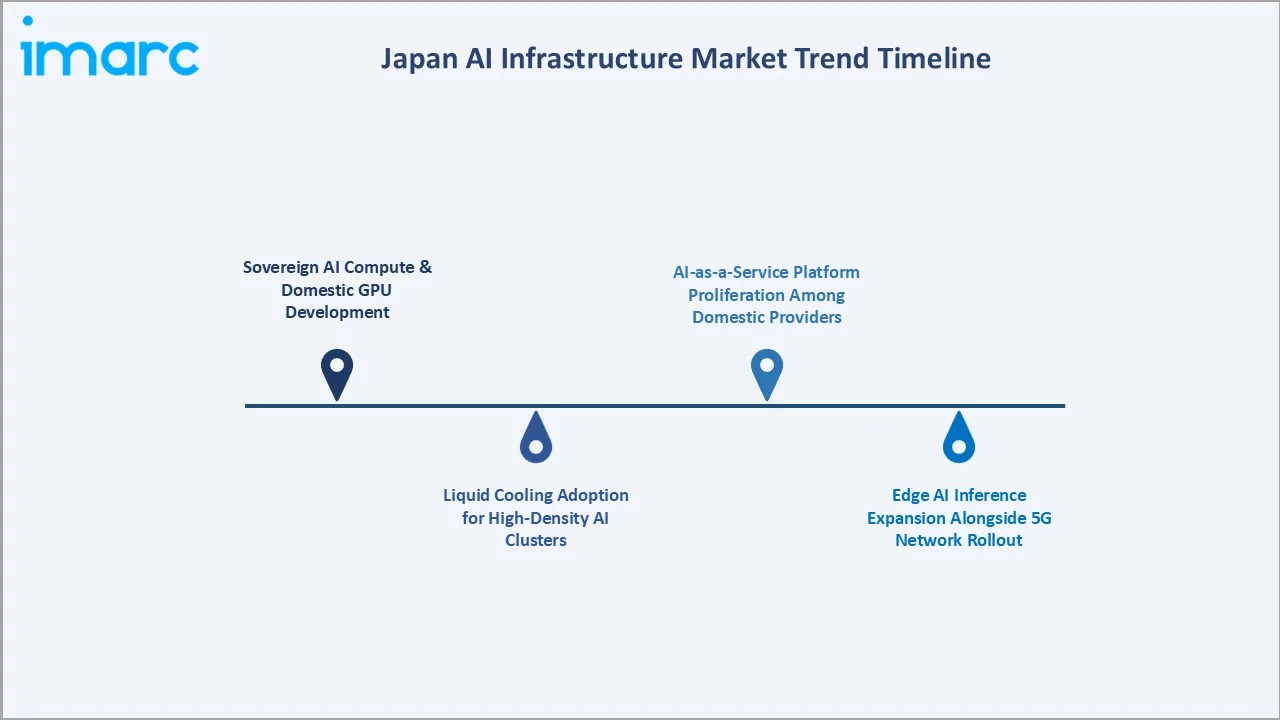
1. Sovereign AI Compute & Domestic GPU Development
Japan is increasingly prioritizing sovereign AI compute capacity to reduce reliance on foreign hardware and cloud providers. Government-backed initiatives are supporting domestic GPU assembly and data center construction to strengthen national compute independence. This shift is expected to reshape supplier relationships and accelerate investment in domestically controlled AI infrastructure over the coming decade.
2. Liquid Cooling Adoption for High-Density AI Clusters
As GPU cluster density increases, traditional air cooling is becoming insufficient to manage thermal loads efficiently. Liquid cooling technology is gaining adoption across new Japanese data center builds, improving energy efficiency and enabling higher rack density. This trend is particularly pronounced in facilities designed for next-generation AI training workloads.
3. Edge AI Inference Expansion Alongside 5G Network Rollout
Edge AI inference infrastructure is expanding alongside Japan's continued 5G network densification, enabling low-latency AI applications for manufacturing automation, robotics, and autonomous mobility. Telecommunications carriers are positioning network edge nodes as natural hosting points for distributed inference infrastructure, complementing centralized cloud AI compute.
4. AI-as-a-Service Platform Proliferation Among Domestic Providers
Domestic cloud and technology providers are increasingly launching AI-as-a-Service platforms, packaging compute, model access, and orchestration tools into consumption-based offerings. This trend is lowering the barrier to AI adoption for small and medium enterprises that lack in-house infrastructure expertise.
Industry Value Chain Analysis
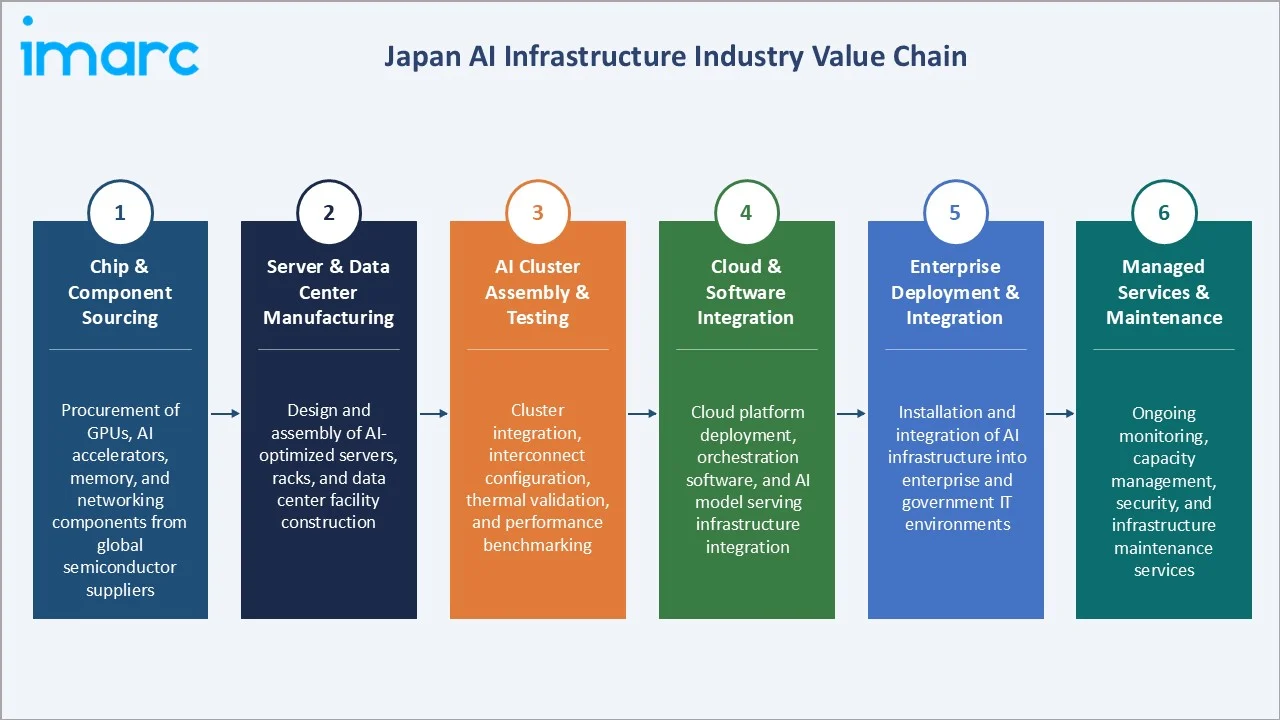
The AI infrastructure value chain integrates chip and component sourcing, server and data center manufacturing, AI cluster assembly and testing, cloud and software platform integration, enterprise deployment, and managed services and maintenance. The value chain's commercial architecture is consolidating toward integrated compute-as-a-service delivery, replacing the former separation between hardware procurement, facility construction, and software integration.
|
Stage |
Key Participants |
|
Chip & Component Sourcing |
Procurement of GPUs, AI accelerators, memory, and networking components from global semiconductor suppliers |
|
Server & Data Center Manufacturing |
Design and assembly of AI-optimized servers, racks, and data center facility construction |
|
AI Cluster Assembly & Testing |
Cluster integration, interconnect configuration, thermal validation, and performance benchmarking |
|
Cloud & Software Platform Integration |
Cloud platform deployment, orchestration software, and AI model serving infrastructure integration |
|
Enterprise Deployment & Integration |
Installation and integration of AI infrastructure into enterprise and government IT environments |
|
Managed Services & Maintenance |
Ongoing monitoring, capacity management, security, and infrastructure maintenance services |
The chip and component sourcing tier remains the value chain's most commercially critical and geopolitically sensitive stage, given Japan's reliance on imported advanced semiconductors. The cloud and software integration tier is experiencing the most rapid transformation as enterprises shift from standalone hardware procurement toward fully managed, consumption-based AI infrastructure services.
Technology Landscape in the Japan AI Infrastructure Industry
Graphics Processing Unit (GPU) Computing
Graphics processing unit computing remains the dominant technology underpinning AI training and inference workloads across Japan, offering the parallel processing capability required for large-scale model development. GPU clusters form the physical foundation of most hyperscale and enterprise AI infrastructure deployments currently underway.
AI-Optimized Accelerator Chips
AI-optimized accelerator chips, including custom silicon designed specifically for machine learning workloads, are gaining adoption as enterprises seek improved performance-per-watt efficiency compared to general-purpose GPUs. These accelerators are increasingly deployed for targeted inference workloads where energy efficiency is a primary consideration.
Liquid Cooling & High-Density Data Center Design
Liquid cooling technology is becoming a critical enabler of high-density AI cluster deployment, allowing data centers to support greater compute density per rack while managing thermal loads efficiently. This technology supports next-generation GPU cluster designs that would otherwise be constrained by traditional air-cooling limitations.
Market Segmentation Analysis
The report covers the following segments:
|
Segment Category |
Leading Segment |
Market Share |
Year |
|
Offering |
Hardware |
57.4% |
2025 |
|
Deployment |
Cloud |
48.6% |
2025 |
|
End User |
Enterprises |
52.1% |
2025 |
|
Region |
Kanto Region |
44.8% |
2025 |

By Offering
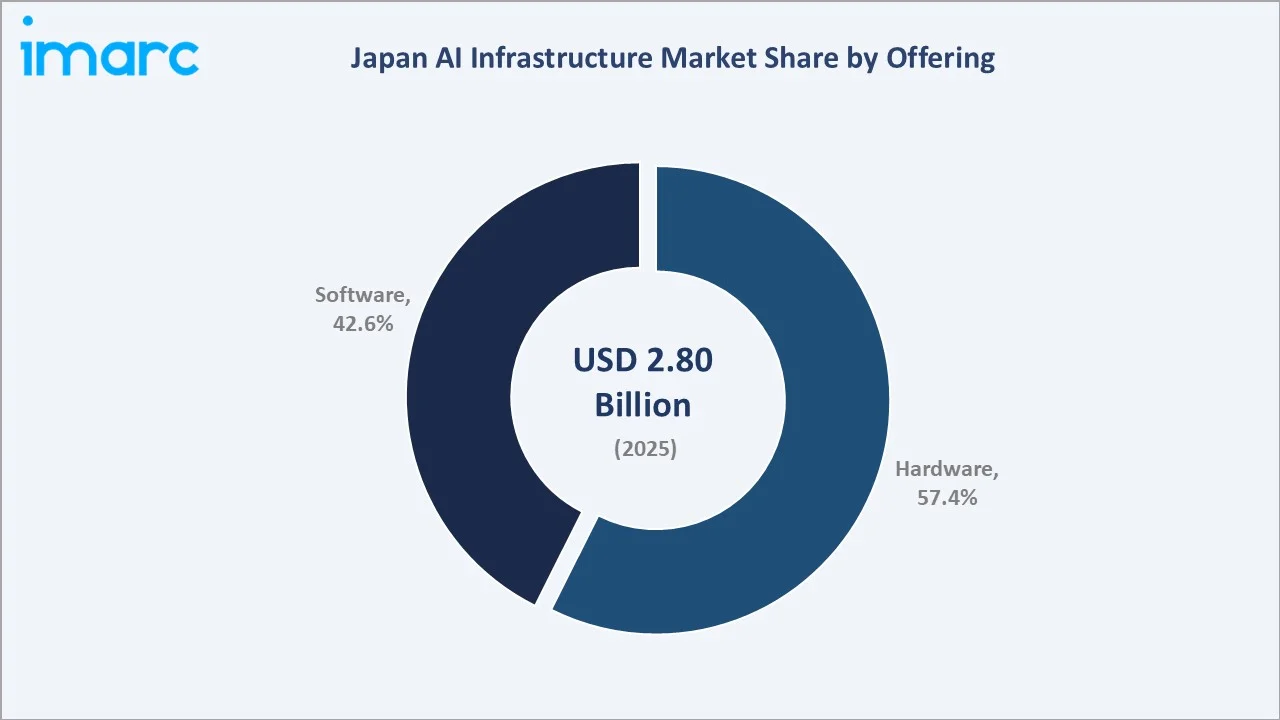
Hardware leads the Japan AI infrastructure market at 57.4% in 2025, encompassing GPUs, AI accelerators, servers, storage, and networking equipment that form the physical backbone of AI compute capacity.
To access detailed market analysis, Request Sample
Software at 42.6% captures AI orchestration platforms, MLOps tooling, and inference optimization software layered atop hardware infrastructure. This segment grows at a faster CAGR of approximately 30.2% as enterprises increasingly invest in software to maximize utilization and efficiency of underlying compute assets.
By Deployment
Cloud deployment leads at 48.6% in 2025, reflecting enterprise preference for elastic, pay-as-you-go access to AI compute without heavy upfront capital commitments.
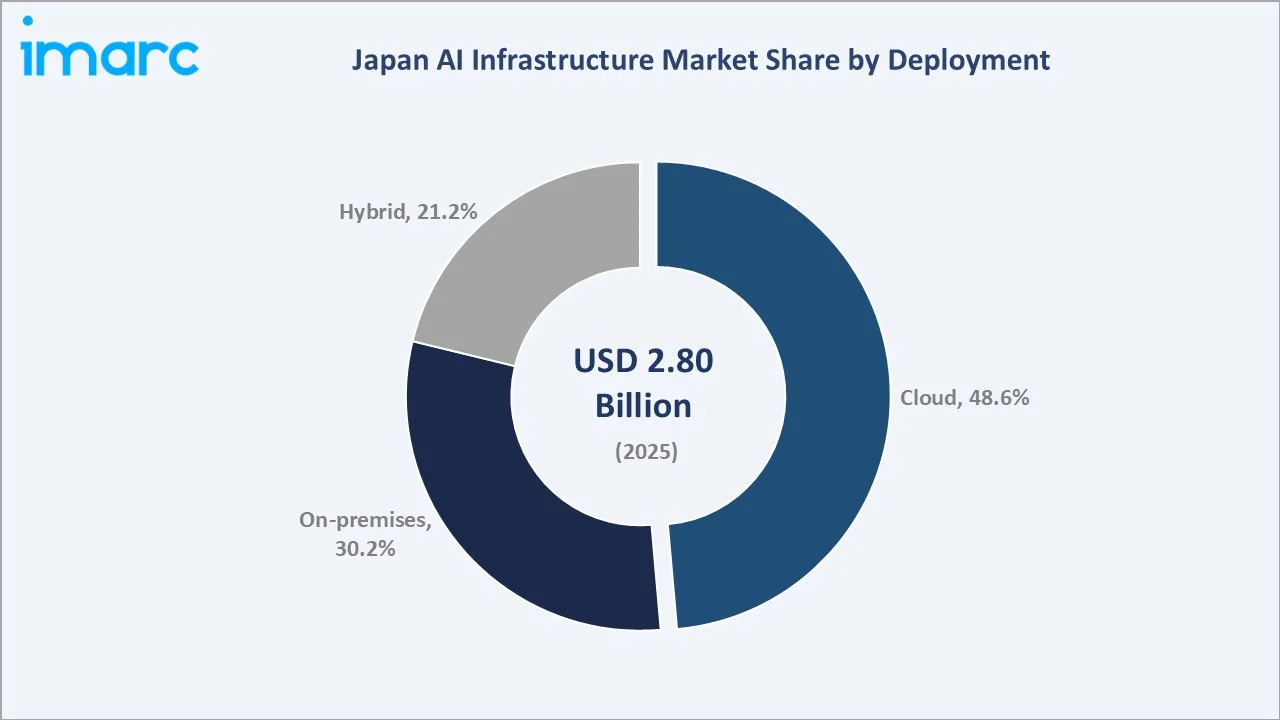
On-premises deployment at 30.2% remains significant among enterprises with strict data sovereignty and latency requirements, particularly in finance and government sectors. Hybrid deployment at 21.2% is gaining traction as enterprises balance flexibility with control, combining cloud scalability with on-premises data governance for sensitive workloads.
Regional Market Insights
|
Region |
Share (2025) |
Key Market Drivers & Characteristics |
|
Kanto Region |
44.8% |
Driven by dense urban technology infrastructure, strong institutional presence, and concentrated enterprise investment activity |
|
Kansai/Kinki Region |
19.3% |
Supported by a diversified industrial base, expanding technology sector, and growing regional infrastructure investment |
|
Central/Chubu Region |
13.7% |
Driven by manufacturing sector demand and increasing industrial automation and digitalization initiatives |
|
Kyushu-Okinawa Region |
6.4% |
Emerging with growing infrastructure investment and supportive regional development incentives |
|
Tohoku Region |
5.2% |
Growing steadily through expanding regional digital infrastructure and renewable energy-linked development projects |
|
Chugoku Region |
4.3% |
Reflects gradual technology adoption and modest infrastructure capacity expansion supporting regional industry |
|
Hokkaido Region |
3.6% |
Benefiting from favorable climate conditions for infrastructure efficiency and growing renewable-powered facility investment |
|
Shikoku Region |
2.7% |
Represents an early-stage but developing market supported by regional digitalization and modernization programs |
Kanto, at 44.8%, leads through its unmatched concentration of technology infrastructure, corporate headquarters, and proximity to national policy institutions. Kansai/Kinki, at 19.3%, reflects a diversified and expanding regional technology and industrial ecosystem.
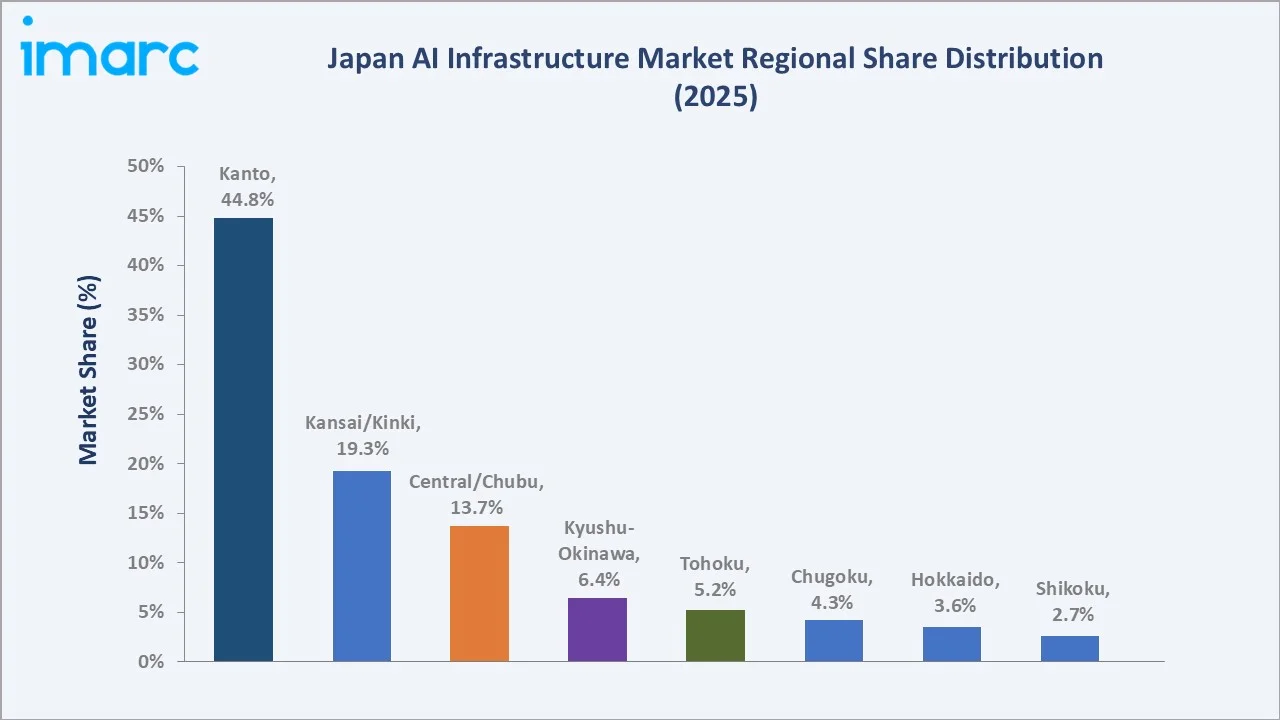
Central/Chubu, at 13.7%, is supported by the region's manufacturing sector and growing industrial automation deployment. Kyushu-Okinawa, at 6.4%, and Tohoku, at 5.2%, represent emerging markets driven by expanding infrastructure investment and supportive development incentives.
Competitive Landscape
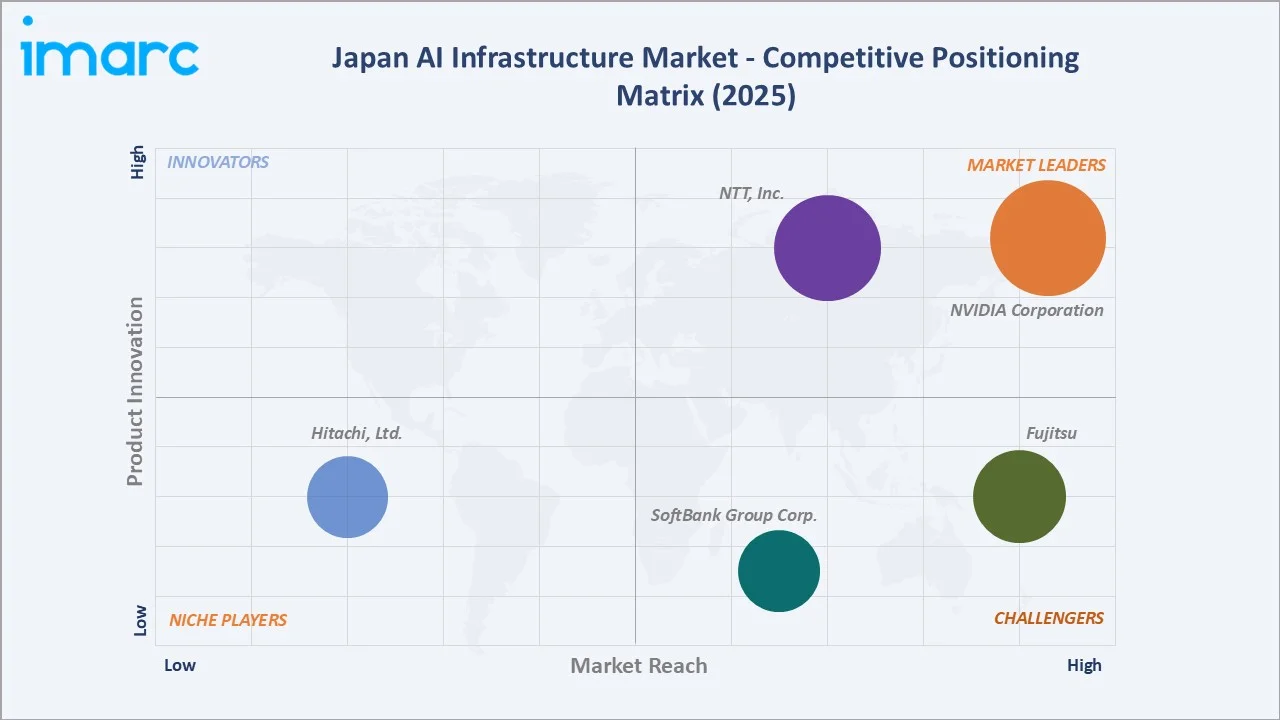
The Japan AI infrastructure market competitive landscape is moderately concentrated, comprising global hyperscale cloud and semiconductor leaders alongside major domestic technology conglomerates and telecommunications carriers investing heavily in AI compute capacity.
|
Company Name |
Key Products |
Market Position |
Core Strength |
|
NVIDIA Corporation |
GPU Accelerators, AI Computing Platforms |
Market Leader |
NVIDIA Corporation is the leading supplier of GPUs and AI accelerator platforms powering data center and enterprise AI infrastructure across Japan. |
|
NTT, Inc. |
AI Data Centers, Cloud & Network Infrastructure |
Market Leader |
NTT Corporation is Japan's largest telecommunications and infrastructure operator, driving large-scale AI data center and network infrastructure investment. |
|
Fujitsu |
AI Servers, Supercomputing Systems |
Strong Challenger |
Fujitsu Limited specializes in high-performance computing and AI server systems, supporting enterprise and government AI infrastructure deployment. |
|
SoftBank Group Corp. |
AI Data Centers, Cloud AI Platforms |
Strong Challenger |
SoftBank Corp. is expanding AI data center capacity and cloud AI platforms through strategic partnerships with leading global GPU and AI technology providers. |
|
Hitachi, Ltd. |
AI Infrastructure Solutions, Data Systems |
Niche Player |
Hitachi, Ltd. delivers AI infrastructure and data systems solutions tailored to industrial and enterprise digital transformation in Japan. |
Key players include NVIDIA Corporation, NTT, Inc., Fujitsu, SoftBank Group Corp., Hitachi, Ltd., and others.
Key Company Profiles
NVIDIA Corporation
NVIDIA Corporation is a US-based technology company and the leading global supplier of GPUs and AI accelerator platforms, with a dominant presence in Japan's AI infrastructure market through partnerships with domestic cloud providers and data center operators.
- Key Products: GPU Accelerators, AI Computing Platforms.
- Strategic Focus: Strengthening GPU supply partnerships and co-investment in Japanese hyperscale AI data center capacity. The company continues to prioritize collaboration with domestic cloud operators to expand localized GPU cluster availability across Japan. NVIDIA is also investing in developer ecosystem programs aimed at accelerating enterprise adoption of its AI software and hardware platforms nationally.
NTT, Inc.
NTT, Inc. is a Japan-based telecommunications and infrastructure conglomerate with a leading presence in the AI infrastructure market through large-scale data center and network infrastructure investment.
- Key Products: AI Data Centers, Cloud & Network Infrastructure.
- Strategic Focus: Expanding domestic AI data center capacity and next-generation network infrastructure to support sovereign compute goals. NTT is prioritizing integration of its nationwide network assets with new AI data center campuses to minimize latency for enterprise customers. The company is also pursuing renewable energy partnerships to support sustainable expansion of its power-intensive AI infrastructure portfolio.
Fujitsu
Fujitsu is a Japan-based technology company with a strong presence in the AI infrastructure market through its high-performance computing and AI server systems.
- Key Products: AI Servers, Supercomputing Systems.
- Strategic Focus: Advancing high-performance computing and AI server technology for government and enterprise AI infrastructure deployment. Fujitsu continues to deepen collaboration with national research institutions to co-develop next-generation supercomputing architectures. The company is also expanding its managed AI infrastructure services to support enterprises seeking turnkey deployment and operational support.
Market Concentration Analysis
The Japan AI infrastructure market is moderately concentrated at the computer hardware level, with the key players collectively accounting for a substantial share of domestic AI compute and data center investment. Global hyperscalers hold significant positions in cloud AI infrastructure supply, while Hitachi, Ltd. serves niche industrial AI applications. Market concentration is expected to ease moderately over the forecast period as new regional data center operators enter the market, supported by government incentives diversifying the supplier base.
Investment & Growth Opportunities
Highest Growth Segments
Software (~30.2% CAGR), Cloud deployment (~29.4% CAGR), and Hardware (~27.1% CAGR) represent the highest-growth investment vectors through 2034, driven by sustained enterprise AI adoption and expanding hyperscale compute capacity.
Emerging Investment Opportunities
Sovereign AI compute infrastructure represents Japan's highest-priority emerging opportunity, as government-backed initiatives seek to reduce dependency on foreign compute providers and build domestic GPU and data center capacity through 2034.
Investment Themes
- Liquid-Cooled Data Center Infrastructure for Energy-Efficient AI Compute: Liquid-cooled, high-density AI data center development represents a structural investment opportunity as Japanese operators seek to improve energy efficiency and support next-generation GPU cluster deployments amid power grid constraints.
- Domestic AI Accelerator & Compute Sovereignty Development: Investment in domestic GPU and AI accelerator supply chains supports Japan's national compute sovereignty strategy and reduces reliance on foreign semiconductor and hardware providers.
Future Market Outlook (2026-2034)
The Japan AI infrastructure market is projected to grow from USD 2.80 Billion in 2025 to USD 3.59 Billion in 2026 and further to USD 26.49 Billion by 2034, delivering a 28.37% CAGR over the forecast period. The market's anchor value of approximately USD 9.76 Billion in 2030 represents a critical inflection point as sovereign AI compute initiatives mature and enterprise generative AI adoption reaches scale across major sectors.
Three structural forces define AI infrastructure market growth through 2034. Society 5.0 and national AI strategy investment continue channeling sustained capital into compute capacity. Enterprise generative AI adoption compounds demand for hardware and software infrastructure as use cases mature from pilots to production-scale deployment. Sovereign compute initiatives progressively shift market share toward domestic providers, reshaping the competitive landscape over the long term.
Research Methodology
Primary Research
Primary research comprised structured interviews with data center operators, cloud infrastructure leads, GPU and hardware vendor representatives, and enterprise AI infrastructure decision-makers across Japan's AI infrastructure ecosystem.
Secondary Research
Secondary research encompassed company annual reports, Japan's Ministry of Internal Affairs and Communications digital infrastructure data, IDC AI infrastructure spending trackers, and industry conference proceedings.
Forecasting Models
Market revenue forecasts developed using a bottom-up model incorporating data center capacity expansion, GPU shipment trends, cloud AI service revenue growth, and enterprise adoption rates across key industry verticals.
Japan AI Infrastructure Market Report Coverage:
|
Report Features |
Details |
|
Base Year of the Analysis |
2025 |
|
Historical Period |
2020-2025 |
|
Forecast Period |
2026-2034 |
|
Units |
Billion USD |
|
Scope of the Report |
Exploration of Historical Trends and Market Outlook, Industry Catalysts and Challenges, Segment-Wise Historical and Future Market Assessment:
|
|
Offerings Covered |
|
|
Deployments Covered |
On-premises, Cloud, Hybrid |
|
End Users Covered |
Enterprises, Government Organizations, Cloud Service Providers |
|
Regions Covered |
Kanto Region, Kansai/Kinki Region, Central/Chubu Region, Kyushu-Okinawa Region, Tohoku Region, Chugoku Region, Hokkaido Region, Shikoku Region |
| Companies Covered | NVIDIA Corporation, NTT, Inc., Fujitsu, SoftBank Group Corp., Hitachi, Ltd., etc. |
|
Customization Scope |
10% Free Customization |
|
Post-Sale Analyst Support |
10-12 Weeks |
|
Delivery Format |
PDF and Excel through Email (We can also provide the editable version of the report in PPT/Word format on special request) |
Frequently Asked Questions About the Japan AI Infrastructure Market Report
The Japan AI infrastructure market size is estimated at USD 3.59 Billion in 2026, driven by hardware dominance at 57.4%, cloud deployment leading at 48.6%, and Kanto region commanding 44.8% market share through Tokyo's data center and technology concentration.
The market grows at 28.37% CAGR during 2026-2034, reaching USD 26.49 Billion by 2034, reflecting sustained enterprise AI adoption, national AI strategy investment, and expanding hyperscale data center capacity.
Hardware leads at 57.4%, encompassing GPUs, AI accelerators, and data center equipment forming the physical compute backbone.
Cloud deployment leads at 48.6% through enterprise preference for elastic, scalable compute access without heavy capital investment.
Kanto Region leads at 44.8% through Tokyo's concentration of hyperscale data centers and technology headquarters.
Leading companies include include NVIDIA Corporation, NTT, Inc., Fujitsu, SoftBank Group Corp., Hitachi, Ltd., and others.
The market is projected to reach approximately USD 9.76 Billion by 2030, driven by continued hyperscale capacity expansion and enterprise AI adoption.
Priority opportunities include liquid-cooled data center infrastructure, domestic AI accelerator and compute sovereignty development, and sovereign AI compute initiatives.
Need more help?
- Speak to our experienced analysts for insights on the current market scenarios.
- Include additional segments and countries to customize the report as per your requirement.
- Gain an unparalleled competitive advantage in your domain by understanding how to utilize the report and positively impacting your operations and revenue.
- For further assistance, please connect with our analysts.
 Request Customization
 Speak to an Analyst
 Request Brochure
 Inquire Before Buying
Benefits of Customization
- Personalize this research
- Triangulate with your data
- Get data as per your format and definition
- Gain a deeper dive into a specific application, geography, customer, or competitor
- Any level of personalization
Get in Touch With Us
UNITED STATES
Phone: +1-201-971-6302
INDIA
Phone: +91-120-433-0800
UNITED KINGDOM
Phone: +44-753-714-6104
Email: [email protected]
Client Testimonials




.webp)




.webp)













Related Reports

Choose your plan
*Please note that the prices mentioned below are starting prices for each bundle type. Kindly contact our team for further details.*
Single User License
- 1 User License, Access on 2 Devices
- PDF Report + Excel Dataset (Password Protected)
- Lifetime Access
- No Printing Rights
- 10% Free Report Customization
- 10–12 Weeks of Analyst Support
Five User License
- Access for 5 Users, 2 Devices per User
- PDF Report + Excel Dataset (Password Protected)
- Lifetime Access
- Dedicated Account Manager
- 12–14 Weeks of Analyst Support
- No Printing Rights
- 15% Free Report Customization
- 25% Discount on Your Next Purchase
Corporate User License
- Unlimited User Access (Within Your Organization)
- PDF Report + Excel Dataset
- Lifetime Access
- Dedicated Account Manager
- 14–20 Weeks of Analyst Support
- No Printing Rights
- 20% Free Report Customization
- 30% Discount on Your Next Purchase
Essential Insights
What's included:
3 reports
- Lifetime Access
- PDF Reports
- Excel Datasets
- 2 Weeks of Free Analyst Support
- 2 User Licenses
- Access on 2 Devices
- Printing Rights
- Complimentary PowerPoint (PPT) Version
- Complimentary License Upgrade
Professional Access
What's included:
5 reports
- Lifetime Access
- PDF Reports
- Excel Datasets
- 8 Weeks of Free Analyst Support
- 2 User Licenses
- Access on 2 Devices
- Printing Rights
- Complimentary PowerPoint (PPT) Version
- Complimentary License Upgrade
Business Advantage
What's included:
8 reports
- Lifetime Access
- PDF Reports
- Excel Datasets
- 14 Weeks of Free Analyst Support
- 2 User Licenses
- Access on 2 Devices
- Printing Rights
- Complimentary PowerPoint (PPT) Version
- Complimentary License Upgrade
Enterprise Intelligence
What's included:
10 reports
- Lifetime Access
- PDF Reports
- Excel Datasets
- 20 Weeks of Free Analyst Support
- 2 User Licenses
- Access on 2 Devices
- Printing Rights
- Complimentary PowerPoint (PPT) Version
- Complimentary License Upgrade