
Japan Bancassurance Market Size, Share, Trends and Forecast by Product Type, Model Type, and Region, 2026-2034
Japan Bancassurance Market Size, Share, Trends & Forecast (2026-2034)
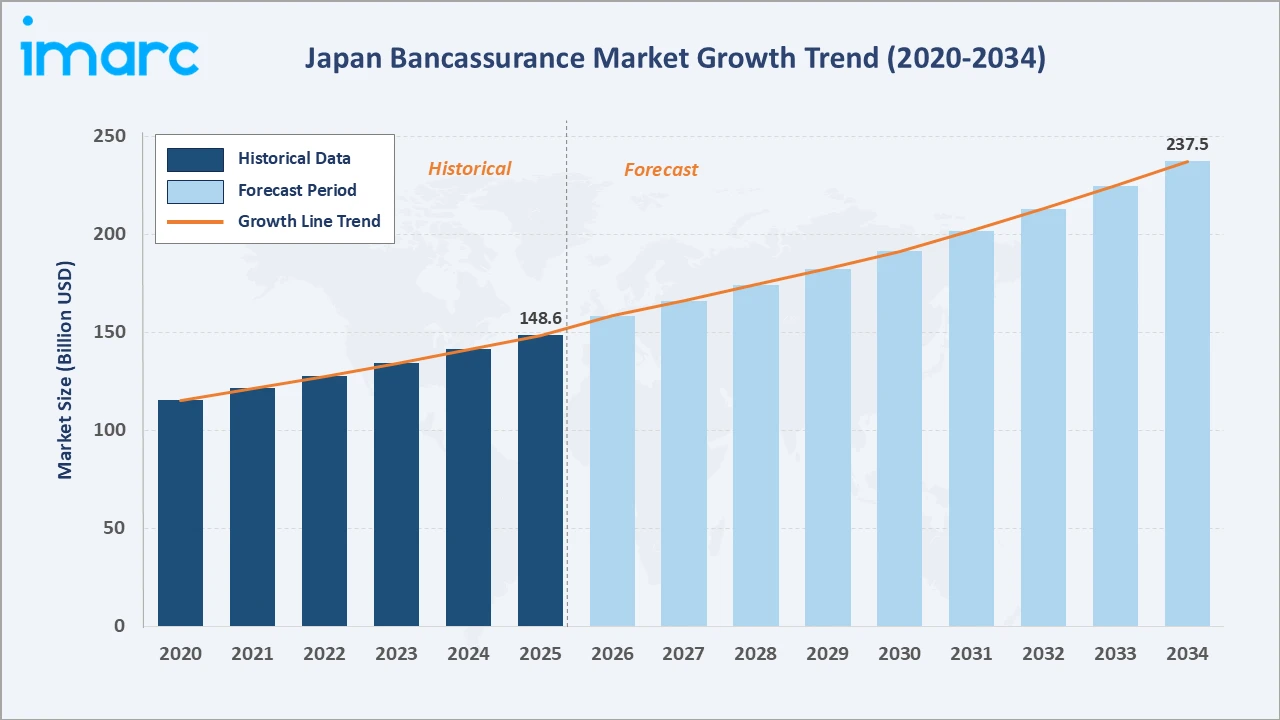
The Japan bancassurance market grew from USD 148.6 Billion in 2025 to USD 158.5 Billion in 2026 and is projected to reach USD 237.5 Billion by 2034, exhibiting a CAGR of 5.19% during 2026-2034. Japan’s aging demographic structure, deregulation of bank-insurance cross-selling, and rising demand for savings-linked insurance products distributed through bank networks are the primary forces shaping market growth.
Life bancassurance leads the product type segment at 65.0%, pure distributor commands the model type segment at 40.0%, and Central/ Chubu Region accounts for 35.0% of regional share.
Market Snapshot
| Metric | Value |
|---|---|
| Base Year Market Size (2025) | USD 148.6 Billion |
| Market Size (2026) | USD 158.5 Billion |
| Forecast Market Size (2034) | USD 237.5 Billion |
| CAGR (2026-2034) | 5.19% |
| Base Year | 2025 |
| Historical Period | 2020-2025 |
| Forecast Period | 2026-2034 |
| Largest Region | Central/ Chubu Region (35.0%, 2025) |
| Second Largest Region | Kanto Region (20.0%, 2025) |
| Leading Product Type | Life Bancassurance (65.0%, 2025) |
| Leading Model Type | Pure Distributor (40.0%, 2025) |
The Japan bancassurance market size increased from USD 115.4 Billion in 2020 to USD 148.6 Billion in 2025 and is estimated to reach USD 158.5 Billion in 2026. The market is further expected to grow to USD 191.4 Billion by 2030 and USD 237.5 Billion by 2034. The market is structurally distinct among major Asian bancassurance markets, anchored by one of the world’s largest banking networks, a mature product ecosystem spanning life insurance, annuities, and non-life insurance, and a high-trust distribution model enabled by Japan’s extensive branch infrastructure.
To get more information on this market, Request Sample
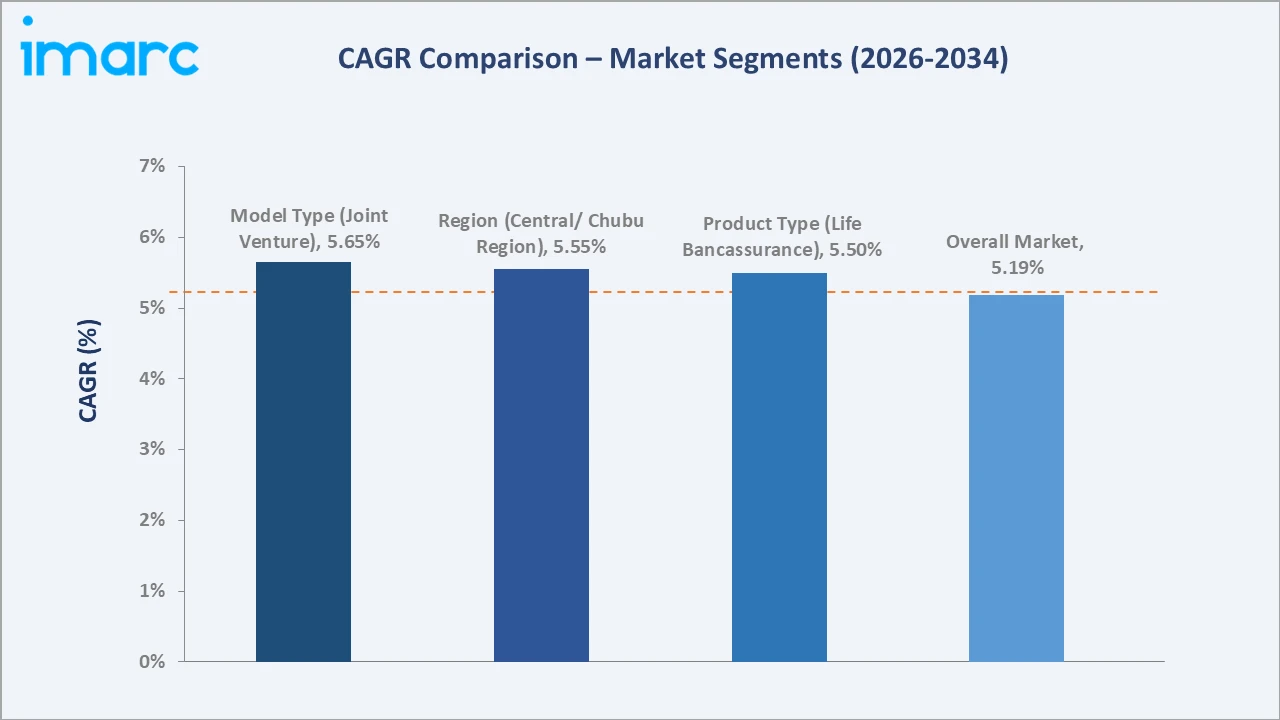
CAGR trajectories across product type, model type, and regional sub-segments show joint venture and Central/ Chubu Region expanding faster than the overall 5.19% market CAGR, driven by increasing bancassurance partnerships, expanding insurance distribution networks, and rising demand for integrated financial and insurance services.
Executive Summary
The Japan bancassurance market expanded from USD 148.6 Billion in 2025 to an estimated USD 158.5 Billion in 2026, positioning it as one of Asia’s largest bancassurance markets by premium volume. The market’s scale is supported by Japan’s extensive banking network, the increasing distribution of savings and protection products through bank branches, and growing integration of digital platforms in bancassurance sales.
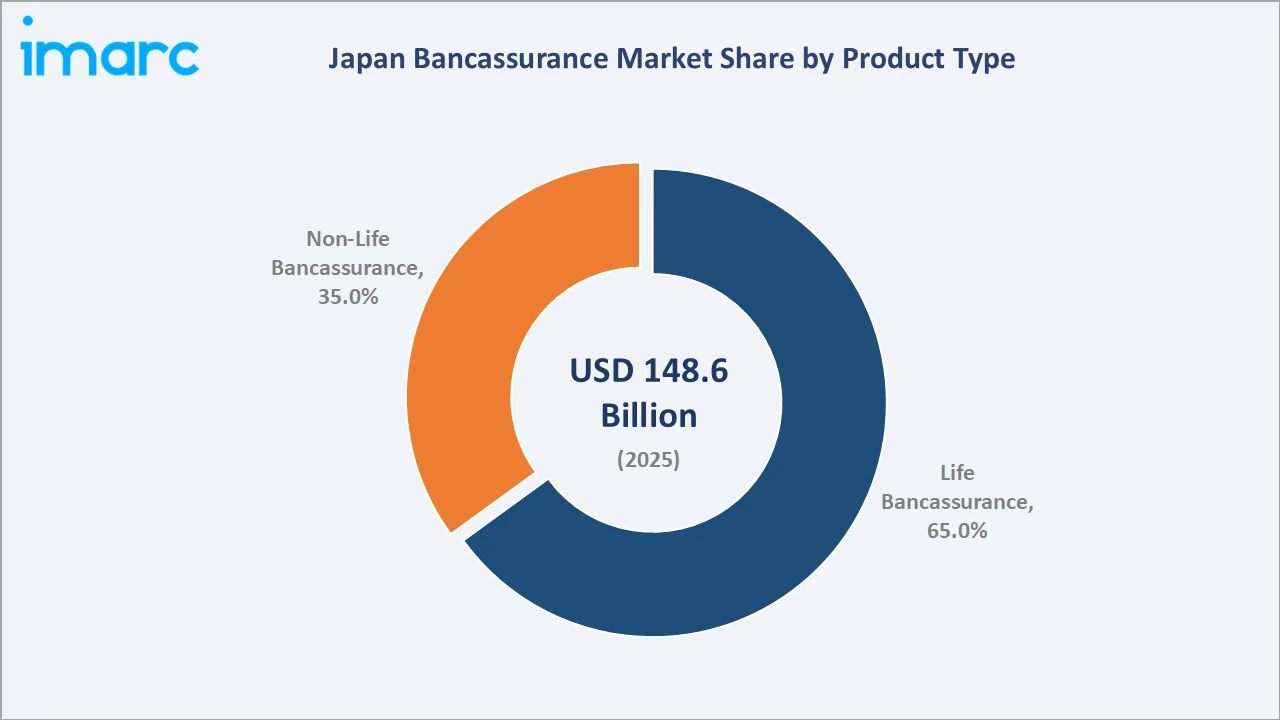
Life bancassurance commands 65.0% of product type share in 2025, reflecting strong consumer demand for savings-type and long-term protection products distributed through bank channels. Pure distributor accounts for 40.0% of model type share, as Japanese banks favor low-commitment distribution arrangements that preserve operational flexibility. Central/ Chubu Region leads at 35.0%, underpinned by high banking density and large industrial population base.
Key Market Insights
| Insight | Data |
|---|---|
| Leading Product Type | Life Bancassurance – 65.0% share (2025) |
| Second Largest Product Type | Non-Life Bancassurance – 35.0% share (2025) |
| Leading Model Type | Pure Distributor – 40.0% share (2025) |
| Second Largest Model Type | Exclusive Partnership – 25.0% share (2025) |
| Leading Region | Central/ Chubu Region – 35.0% share (2025) |
| Second Largest Region | Kanto Region – 20.0% share (2025) |
| Top Companies | Japan Post Holdings Co., Ltd., Daiichi Life Group, Inc., MS&AD Insurance Group Holdings, Inc., Nippon Life Insurance Company |
Key Analytical Observations Expanding On the Data Above:
- Life bancassurance dominance at 65.0% reflects Japan’s aging demographic profile and strong consumer preference for savings-type and endowment insurance distributed through trusted bank branch relationships.
- Non-life bancassurance at 35.0% is supported by growing bank-led distribution of fire, accident, and travel insurance, as banks expand product portfolios beyond traditional savings-linked life products.
- Pure distributor leadership at 40.0% reflects Japanese banks’ preference for distribution-only arrangements that minimize capital commitment while enabling insurance revenue diversification through fee income.
- Exclusive partnership at 25.0% represents banks seeking preferred insurer relationships for deeper product alignment and co-developed offerings tailored for specific customer segments within their networks.
- Central/ Chubu Region at 35.0% leads regional share due to its large population base, industrial economy, high banking density, and concentration of corporate and retail clients generating substantial insurance demand.
Japan Bancassurance Market Overview
Bancassurance refers to the integrated distribution of insurance products through banking channels, enabling financial institutions to offer life, annuity, savings-type, and non-life insurance products to their existing customer base. In Japan, bancassurance encompasses a broad product ecosystem spanning whole life, term, endowment, annuity, and non-life policies sold through bank branches, online banking platforms, and bank-affiliated insurance distribution entities.
The Japan bancassurance ecosystem integrates insurance carriers, banking groups, reinsurance partners, regulatory bodies, and technology providers within a mature distribution framework. Government regulation through the Financial Services Agency governs product approval and cross-selling practices, shaping the competitive and operational boundaries of bancassurance across Japan’s national and regional banks.
Market Dynamics
To evaluate market opportunities, Request Sample
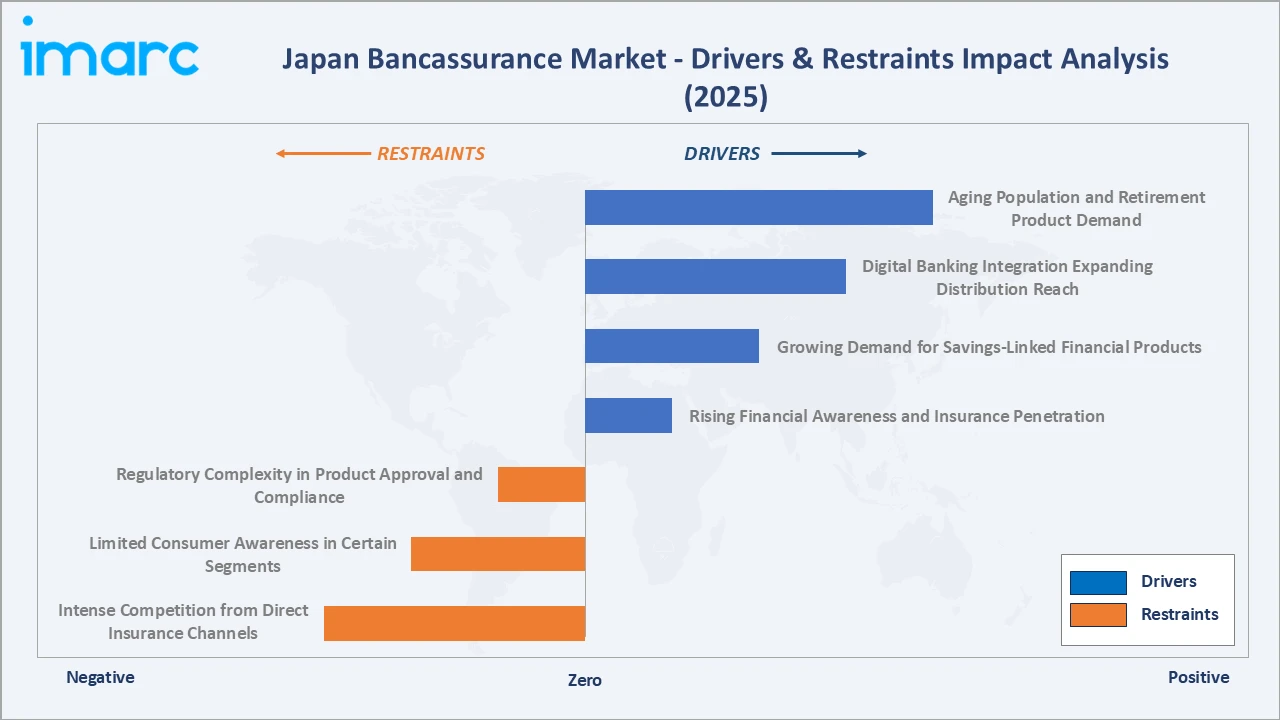
Market Drivers
- Aging Population and Retirement Product Demand: As of September 2026, Japan’s population aged 65 and above accounted for 29.6% of the total population, making it one of the world’s oldest societies and driving sustained demand for retirement savings, annuity, and long-term protection insurance products distributed through bancassurance channels.
- Digital Banking Integration Expanding Distribution Reach: Banks are embedding insurance product discovery and purchase capabilities within mobile banking applications and online portals, enabling bancassurance distribution beyond traditional branch networks and increasing product visibility among digitally active younger customer segments.
- Growing Demand for Savings-Linked Financial Products: Low interest rates in Japan’s prolonged low-yield environment have increased consumer appetite for savings-type insurance products offering guaranteed returns and capital protection, reinforcing demand for bancassurance offerings distributed through bank relationship manager networks.
- Rising Financial Awareness and Insurance Penetration: Growing awareness of financial planning and household risk management is encouraging Japanese consumers to explore insurance products through established banking relationships. Banks are leveraging their extensive customer networks and advisory services to promote life insurance, annuity, and wealth protection products, supporting broader bancassurance adoption.
Market Restraints
- Regulatory Complexity in Product Approval and Compliance: Stringent product approval requirements from the Financial Services Agency and detailed cross-selling disclosure obligations create operational complexity for banks distributing insurance products, increasing compliance costs and slowing new product rollout timelines.
- Limited Consumer Awareness in Certain Segments: Fragmented financial literacy levels, varying consumer familiarity with bancassurance products, and limited awareness of available insurance offerings among younger demographic groups complicate bank-led insurance distribution, constraining penetration rates within the broader Japan bancassurance market.
- Intense Competition from Direct Insurance Channels: Direct-to-consumer digital insurance platforms, corporate group insurance schemes, and agent-led distribution networks compete for the same customer segments, limiting banks’ ability to capture the full potential share of insurance premium income through bancassurance channels.
Market Opportunities
- Digitalization of Bancassurance Sales and Service Platforms: Developing end-to-end digital bancassurance journeys within bank mobile applications and online portals enables insurers and banking partners to reach underserved customer segments and improve policy sales efficiency through automated recommendation engines.
- Growth in Retirement and Wealth Management Product Demand: Japan’s expanding retirement-aged population and growing demand for long-term wealth accumulation solutions create a substantial opportunity for bancassurance providers to develop specialized savings, annuity, and investment-linked products for bank-channel distribution.
Market Challenges
- Balancing Compliance and Sales Efficiency in Cross-Selling: Strict disclosure requirements and suitability assessment obligations for bancassurance product sales add friction to the customer journey, challenging banks to maintain sales efficiency while meeting regulatory compliance standards in their insurance distribution activities.
- Sustaining Policy Persistency Across Aging Bancassurance Portfolios: As The Japan bancassurance market matures, maintaining high policy persistency among existing customers requires ongoing relationship management investment and product relevance, presenting a sustained operational challenge for banking and insurance partners.
Emerging Market Trends
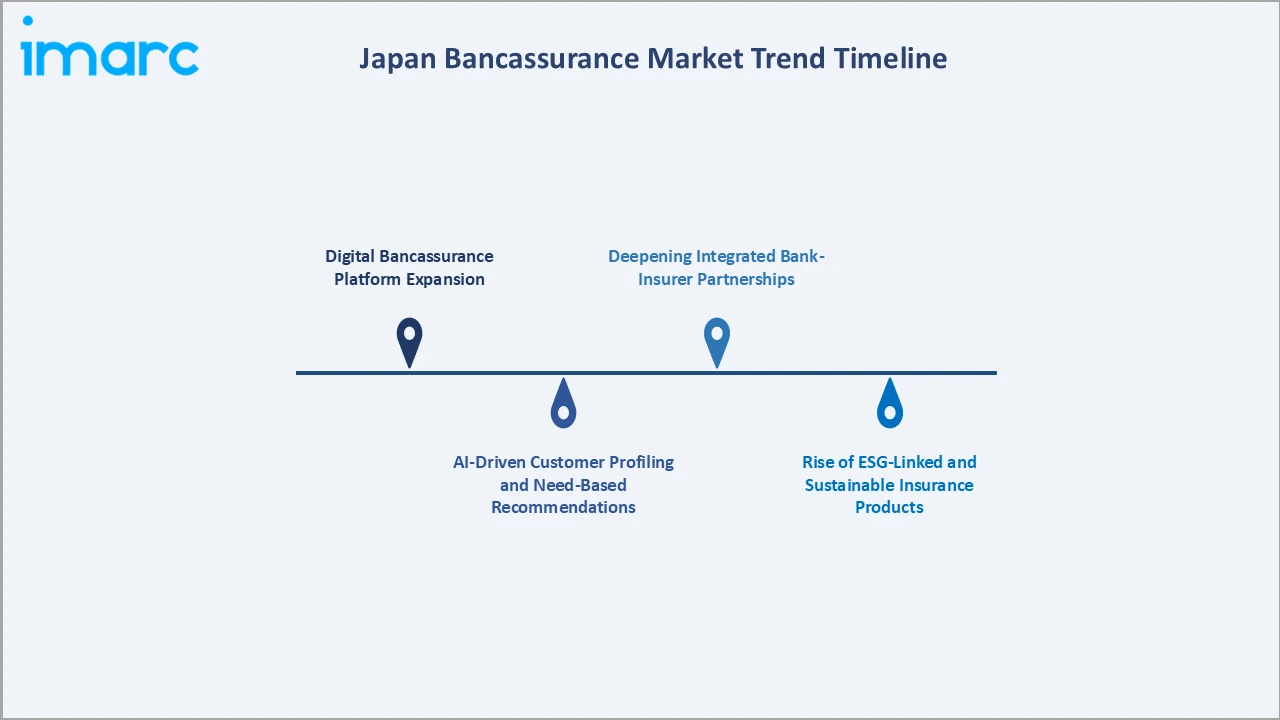
1. Digital Bancassurance Platform Expansion
Japanese banks are accelerating investment in digital bancassurance capabilities, embedding insurance product discovery and purchase flows within mobile and online banking interfaces. Digital channels account for a growing share of new policy sales across Japan’s major banking groups, with mobile banking insurance purchases rising steadily, broadening market reach beyond traditional branch-dependent distribution models.
2. AI-Driven Customer Profiling and Need-Based Recommendations
Advanced analytics and machine learning (ML) are enabling bancassurance providers to develop predictive customer profiling models that identify optimal moments for insurance product recommendations within banking interactions. These tools improve relevance and conversion, supporting growth in policy sales volumes from existing bank customer relationships.
3. Deepening Integrated Bank-Insurer Partnerships
Financial institutions, insurance carriers, and technology providers are forming integrated partnerships to establish streamlined bancassurance distribution frameworks. Agreements enabling insurers to co-develop product portfolios tailored for bank-led sales channels are expanding, supporting both premium volume growth and customer retention objectives for participating entities. Such collaborations are strengthening distribution efficiency and creating new opportunities across the Japan bancassurance market.
4. Rise of ESG-Linked and Sustainable Insurance Products
Growing consumer and regulatory focus on environmental, social, and governance principles is driving bancassurance product development toward sustainability-linked insurance offerings. Banks are partnering with insurers to distribute green investment-linked insurance and socially responsible savings products, catering to Japan’s environmentally conscious consumer base.
Industry Value Chain Analysis
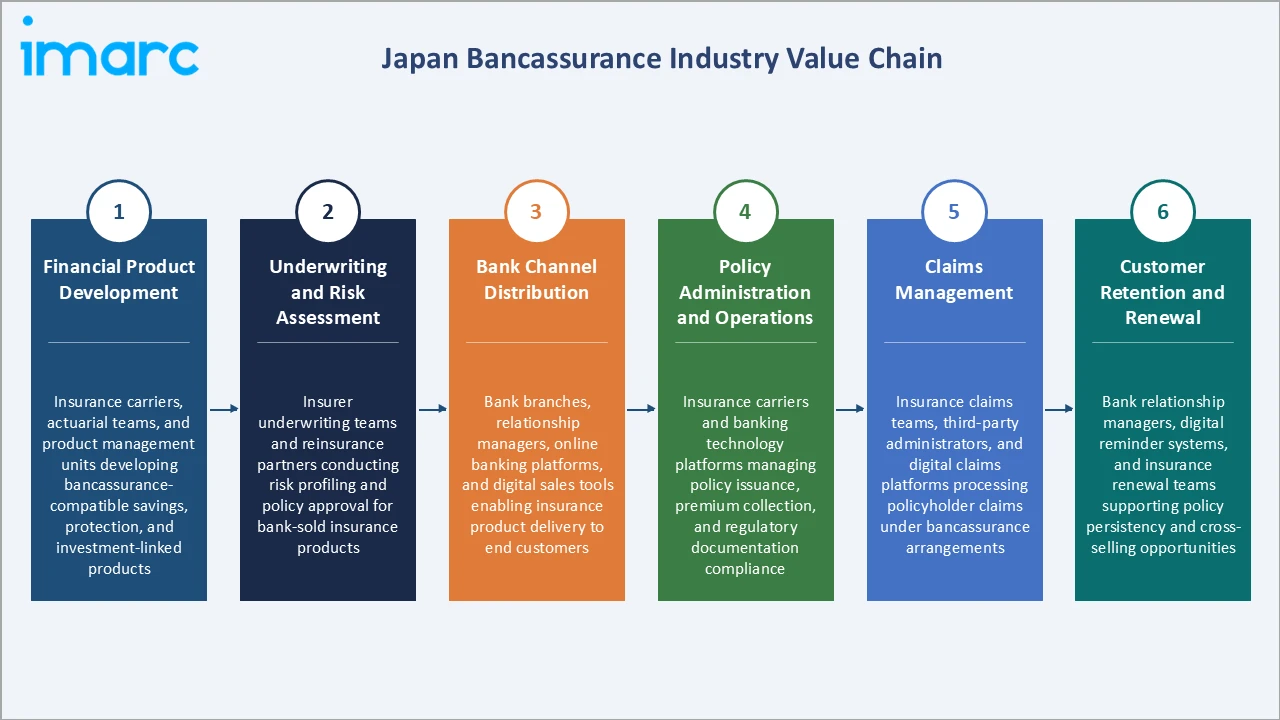
The Japan bancassurance value chain spans six stages, from financial product development through policy issuance, distribution, claims management, and customer renewal. Distribution and policy administration stages capture the highest interaction intensity, while product development and underwriting stages determine the quality and competitiveness of bancassurance offerings across Japan’s banking network.
| Stage | Key Players / Examples |
|---|---|
| Financial Product Development | Insurance carriers, actuarial teams, and product management units developing bancassurance-compatible savings, protection, and investment-linked products |
| Underwriting and Risk Assessment | Insurer underwriting teams and reinsurance partners conducting risk profiling and policy approval for bank-sold insurance products |
| Bank Channel Distribution | Bank branches, relationship managers, online banking platforms, and digital sales tools enabling insurance product delivery to end customers |
| Policy Administration and Operations | Insurance carriers and banking technology platforms managing policy issuance, premium collection, and regulatory documentation compliance |
| Claims Management | Insurance claims teams, third-party administrators, and digital claims platforms processing policyholder claims under bancassurance arrangements |
| Customer Retention and Renewal | Bank relationship managers, digital reminder systems, and insurance renewal teams supporting policy persistency and cross-selling opportunities |
Vertically integrated operators controlling product development, distribution, and policy servicing within a single banking group are positioned to capture greater value than single-stage distributors reliant on third-party insurance carriers for product supply.
Technology Landscape in the Japan Bancassurance Industry
Digital Banking Integration
Banks are embedding insurance product discovery and purchase capabilities directly within mobile banking applications and internet portals. This integration removes friction from the customer journey, enabling bancassurance sales at key financial moments such as home loan approvals, salary deposits, and investment product reviews.
AI and Data Analytics
Advanced analytics platforms enable bancassurance providers to segment customers by life stage, risk profile, and financial need. Predictive models identify optimal timing for insurance product recommendations within banking interactions, improving product relevance and supporting growth in cross-selling conversion rates.
Process Automation and Straight-Through Processing
The top bancassurance companies in Japan are deploying AI-driven customer profiling systems, automated policy issuance platforms, and integrated digital advisory tools across their bank branch networks. Digital integration improves sales conversion consistency, reduces processing time, and enhances compliance management in bancassurance distribution operations.
Open Banking and API Integration
Open banking frameworks and standardized API architectures are enabling insurers to connect underwriting, policy administration, and customer service systems directly with banking platforms. This interoperability supports real-time policy comparison, instant coverage activation, and seamless data sharing between bank and insurance systems.
Market Segmentation Analysis
The report covers the following segments:
| Segment Category | Leading Segment | Market Share | Year |
|---|---|---|---|
| Product Type | Life Bancassurance | 65.0% | 2025 |
| Model Type | Pure Distributor | 40.0% | 2025 |
| Region | Central/ Chubu Region | 35.0% | 2025 |

By Product Type
Life bancassurance commands a 65.0% majority share in 2025, driven by high consumer demand for savings-type and long-term protection insurance products in Japan. The segment benefits from strong alignment between life insurance product characteristics and Japanese consumers’ preference for guaranteed savings and retirement security, making it the dominant product type category in bank-led insurance distribution.
To access detailed market analysis, Request Sample
Non-life bancassurance represents 35.0% of the product type segment in 2025, supported by growing bank-led distribution of fire, accident, auto, and travel insurance. Regulatory deregulation enabling banks to sell all non-life products has expanded the addressable product range, contributing to steady growth in non-life bancassurance revenue.
By Model Type
Pure distributor accounts for 40.0% of model type share in 2025, as Japanese banks favor distribution-only arrangements that generate fee income without requiring capital investment in insurance subsidiaries. This model preserves operational flexibility and enables banks to partner with multiple insurance carriers across product categories.
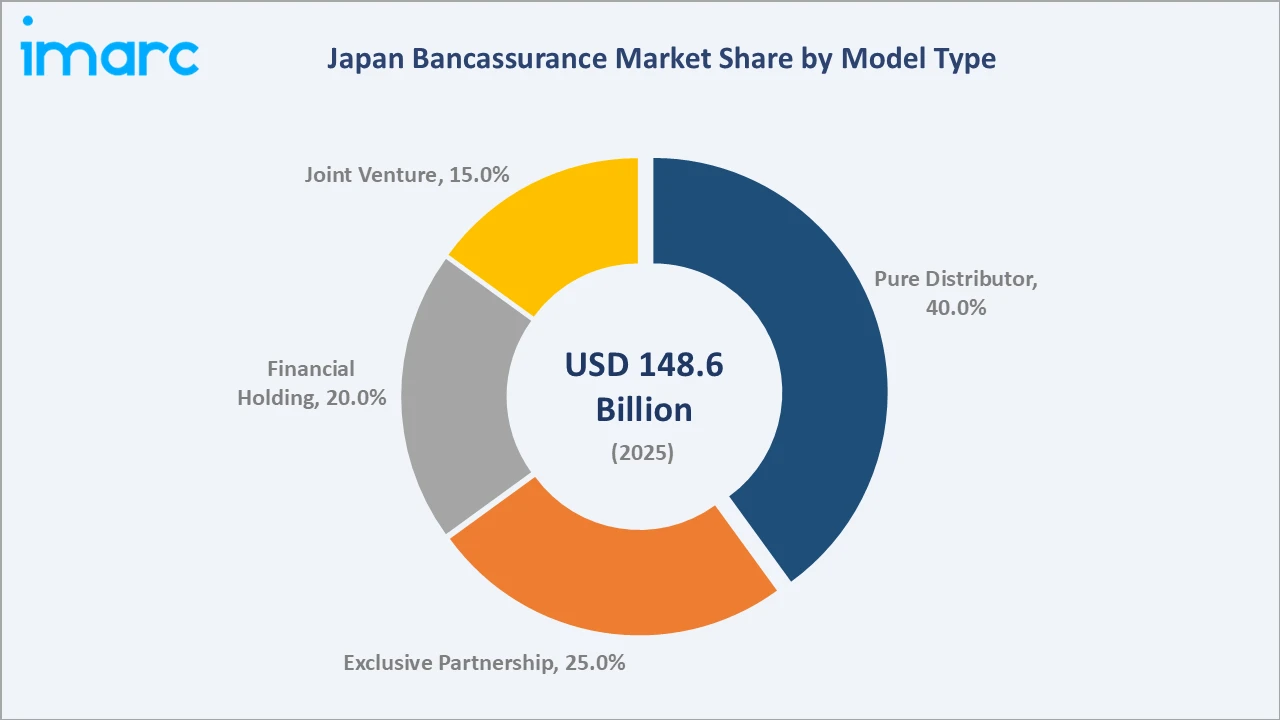
Exclusive partnership accounts for 25.0%, enabling deeper product co-development and preferential distribution terms between banks and selected insurer partners.
Regional Market Insights
| Region | Share (2025) | Key Growth Drivers |
|---|---|---|
| Central/ Chubu Region | 35.0% | Largest regional share driven by industrial economy, high disposable income, and extensive banking infrastructure supporting insurance distribution |
| Kanto Region | 20.0% | Large urban population, financial services concentration, and high banking density in Tokyo metropolitan area supporting strong bancassurance demand |
| Kansai/Kinki Region | 15.0% | Established banking infrastructure in Osaka, Kyoto, and Kobe, with strong demand for retirement planning and savings insurance products |
| Kyushu-Okinawa Region | 8.0% | Growing bancassurance penetration through regional banks, expanding aging population, and increasing financial product awareness |
| Tohoku Region | 7.0% | Regional banking network expansion and government-backed financial inclusion initiatives supporting bancassurance product reach |
| Chugoku Region | 6.0% | Stable regional banking sector with steady demand for long-term savings products among the region’s aging demographic base |
| Hokkaido Region | 5.0% | Regional cooperative banks and agricultural banking networks serving dispersed population, with growing bancassurance product penetration |
| Shikoku Region | 4.0% | Smaller regional banking market with moderate bancassurance penetration through cooperative and credit bank networks |
Central/ Chubu Region at 35.0% in 2025 leads the regional landscape, anchored by its large industrial economy, high banking density, and strong consumer demand for savings and retirement insurance products through well-established bank branch networks.
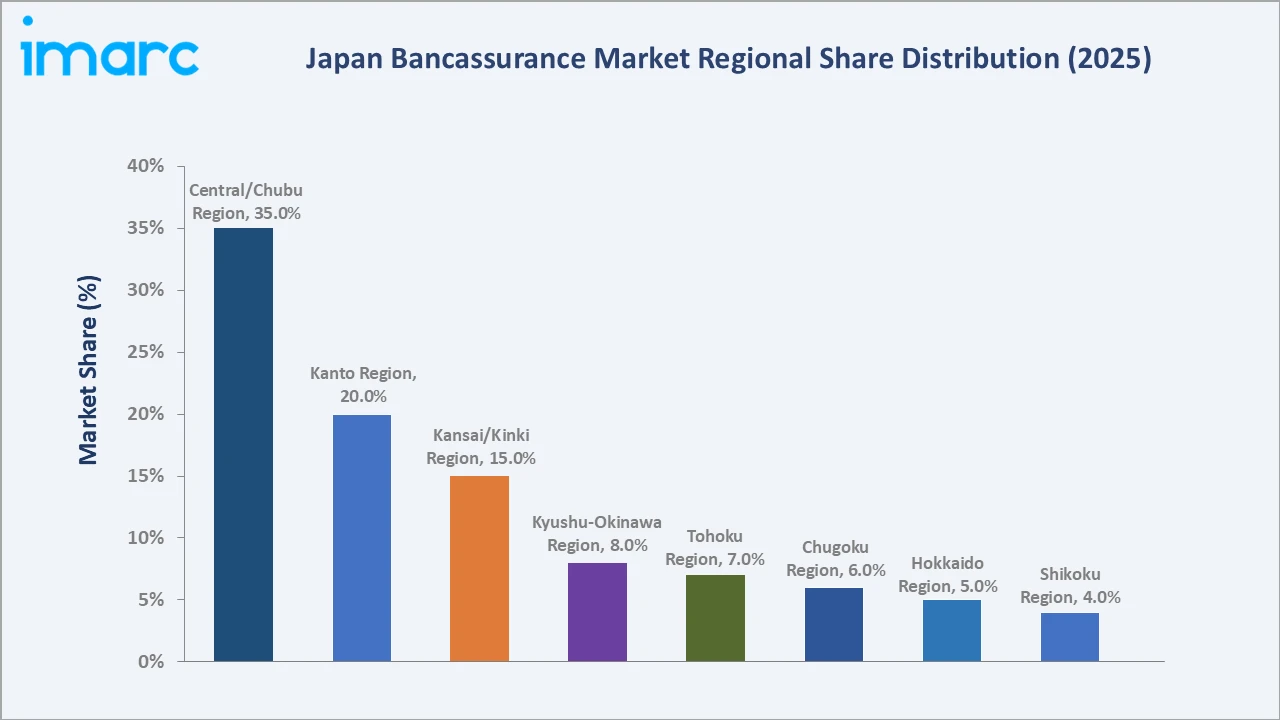
Kanto Region at 20.0% follows, driven by Tokyo’s large financial services concentration, high professional population, and headquarters of Japan’s largest banks.
Competitive Landscape
The Japan bancassurance market is moderately concentrated, with major insurance holding groups and banking conglomerates competing on product breadth, distribution network scale, and digital platform capabilities.
| Company Name | Brand / Key Product | Position | Strategic Focus |
|---|---|---|---|
| Japan Post Holdings Co., Ltd. | Japan Post Insurance (Kampo) | Leader | Leveraging Japan’s large postal banking network to distribute savings and protection insurance across urban and rural Japan |
| Daiichi Life Group, Inc. | Daiichi Life | Leader | Expanding savings-type and protection product distribution through strategic bank-channel partnerships |
| MS&AD Insurance Group Holdings, Inc. | Mitsui Sumitomo Insurance | Challenger | Growing bancassurance product distribution through bank partnerships across life and non-life segments |
| Nippon Life Insurance Company | Nissay | Challenger | Strengthening bank-channel distribution of savings and annuity products for retirement-oriented customers |
Key players include Japan Post Holdings Co., Ltd., Daiichi Life Group, Inc., MS&AD Insurance Group Holdings, Inc., and Nippon Life Insurance Company, among others.
Key Company Profiles
Japan Post Holdings Co., Ltd.
Japan Post Holdings Co., Ltd. is a Japanese holding company headquartered in Chiyoda, Tokyo, operating through Japan Post Insurance (Kampo). The company manages one of the largest postal and banking networks in Japan.
- Product Portfolio: Life insurance, annuity, and savings-type protection products distributed through Japan Post Insurance (Kampo) via the country’s extensive post office and banking network.
- Recent Developments: The company continues to expand digital bancassurance capabilities, enhancing online insurance product access through mobile and internet platforms while maintaining its broad physical network.
- Strategic Focus: Strengthening bancassurance distribution through Japan Post Bank’s extensive network while advancing digital channel capabilities to reach younger demographic segments.
Daiichi Life Group, Inc.
Daiichi Life Group, Inc. is a Japanese holding company headquartered in Tokyo. The company has established extensive bancassurance partnerships with major Japanese banks and regional financial institutions.
- Product Portfolio: Life insurance, savings-type endowment products, annuities, and protection insurance distributed through bancassurance agreements with Japanese banking partners.
- Recent Developments: The company continues to advance its bank-channel distribution strategy, expanding product offerings and deepening insurer-bank partnerships to grow premium income.
- Strategic Focus: Deepening bancassurance partnerships to grow premium income from savings-type and protection products while leveraging digital capabilities to improve sales efficiency.
MS&AD Insurance Group Holdings, Inc.
MS&AD Insurance Group Holdings, Inc. is a Japanese insurance holding company headquartered in Tokyo, operating through Mitsui Sumitomo Insurance. The group distributes both life and non-life insurance products through bank-led channels.
- Product Portfolio: Non-life insurance and life insurance; savings-type products distributed via bancassurance agreements with major Japanese banks.
- Recent Developments: The group continues to strengthen its bancassurance product portfolio, expanding savings and protection product distribution through bank partner networks.
- Strategic Focus: Growing non-life and life bancassurance revenue through expanded bank distribution agreements while developing savings-type products tailored for bank-channel customer profiles.
Market Concentration Analysis
The Japan bancassurance market is moderately concentrated, with leading domestic banking groups and established life insurance companies accounting for a significant share of distribution activity. Major financial institutions leverage extensive branch networks, strong customer relationships, and established partnerships with insurance providers to maintain their market positions.
Barriers to entry include capital requirements for insurance product licensing, compliance infrastructure for FSA-regulated cross-selling, access to large bank distribution partnerships, and the established brand trust required to compete effectively in Japan’s conservative insurance consumer market. These factors favor established holding groups and mutual insurers over new entrants.
Consolidation is ongoing, with major holding groups pursuing deeper exclusive and financial holding arrangements with banking partners to strengthen market position. Strategic partnerships between insurers and banking groups for co-developed product offerings and shared digital infrastructure are emerging as a key structure for sustaining competitive position.
Investment & Growth Opportunities
Fastest-Growing Segments
Joint venture is expanding fastest among model type sub-segments, driven by deepening bank-insurer integration and growing preference for shared risk and revenue structures. This model also enables financial institutions to combine distribution capabilities, product expertise, and customer networks to strengthen market penetration and operational efficiency.
Emerging Markets
Central/ Chubu Region is the fastest-growing region, supported by expanding banking networks, rising insurance awareness, and increasing demand for life and retirement insurance products. Growing collaboration between regional financial institutions and insurance providers is further strengthening bancassurance penetration across the region.
Venture & Investment Trends
Investment is concentrated in digital bancassurance platform development, AI-enabled customer profiling tools, and open banking infrastructure enabling insurance integration within bank mobile applications. Capital is also directed toward compliance and policy administration automation, reducing operational costs and improving servicing quality in bancassurance distribution.
Future Market Outlook (2026-2034)
The Japan bancassurance market is projected to grow from USD 148.6 Billion in 2025 to USD 158.5 Billion in 2026, reaching USD 237.5 Billion by 2034, registering a CAGR of 5.19% during 2026-2034.
Four forces will shape the market through 2034 continued demographic aging driving sustained demand for retirement, savings, and protection products; accelerating digital platform integration enabling bancassurance sales through mobile and online banking channels; regulatory evolution supporting broader product ranges and deeper bank-insurer partnerships; and growing adoption of AI and data analytics for customer segmentation and need-based product recommendations.
By 2034, the Japan bancassurance market is expected to feature a mix of technology-differentiated insurance holding groups, bank-owned insurance subsidiaries, and digital-first bancassurance platforms. Continued demographic aging and growing retirement product demand will sustain premium volume growth through the forecast period.
Research Methodology
Primary Research
Primary research included structured discussions with bancassurance distribution managers, bank channel heads, insurance product development teams, and financial regulatory officials in Japan, validating market sizing, segment mix, and regional demand patterns across the Japan bancassurance ecosystem.
Secondary Research
Secondary sources included Japan Financial Services Agency publications, Japan Institute of Life Insurance data, General Insurance Association of Japan reports, and public disclosures from listed insurance holding companies and banking groups operating bancassurance channels in Japan.
Forecasting Models
Market forecasts used top-down and bottom-up models combining bancassurance penetration rate estimates, insurance product sales data, regulatory evolution scenarios, and demographic trend projections. Scenario analysis addressed digital adoption rates, regulatory implementation pace, and consumer preference shifts in insurance purchasing.
Report Coverage:
| Report Features | Details |
|---|---|
| Base Year of the Analysis | 2025 |
| Historical Period | 2020-2025 |
| Forecast Period | 2026-2034 |
| Units | Billion USD |
| Scope of the Report | Exploration of Historical and Forecast Trends, Industry Catalysts and Challenges, Segment-Wise Historical and Predictive Market Assessment:
|
| Product Types Covered | Life Bancassurance, Non-Life Bancassurance |
| Model Types Covered | Pure Distributor, Exclusive Partnership, Financial Holding, Joint Venture |
| Regions Covered | Kanto Region, Kinki Region, Central/ Chubu Region, Kyushu-Okinawa Region, Tohoku Region, Chugoku Region, Hokkaido Region, Shikoku Region |
| Companies Covered | Japan Post Holdings Co., Ltd., Daiichi Life Group, Inc., MS&AD Insurance Group Holdings, Inc., Nippon Life Insurance Company, etc. |
| Customization Scope | 10% Free Customization |
| Post-Sale Analyst Support | 10-12 Weeks |
| Delivery Format | PDF and Excel through Email (We can also provide the editable version of the report in PPT/Word format on special request) |
Frequently Asked Questions About the Japan Bancassurance Market Report
The Japan bancassurance market size is estimated at USD 158.5 Billion in 2026, driven by Japan’s aging population, expanding bank-insurance partnerships, and growing demand for savings-linked and protection insurance products distributed through banking networks.
The market is projected to grow at a CAGR of 5.19% from 2026-2034, reaching USD 237.5 Billion, supported by demographic aging, digital channel integration, and expanding bank-insurer partnerships across Japan.
Life bancassurance dominates the market at 65.0% product type share in 2025, driven by strong consumer demand for savings-type and long-term protection products distributed through Japan’s extensive bank branch networks.
Pure distributor accounts for 40.0% of the model type segment in 2025, reflecting Japanese banks’ preference for distribution-only arrangements that preserve operational flexibility while enabling insurance revenue diversification.
Central/ Chubu Region commands 35.0% share in 2025, supported by its strong industrial economy, high banking density across Aichi and Shizuoka prefectures, and large population base generating substantial insurance product demand.
Key players include Japan Post Holdings Co., Ltd., Daiichi Life Group, Inc., MS&AD Insurance Group Holdings, Inc., and Nippon Life Insurance Company, among others.
Key drivers include Japan’s aging population increasing savings and protection product demand, bank-insurance deregulation, digital platform integration, and rising consumer demand for long-term financial planning solutions.
Key challenges include regulatory compliance complexity in cross-selling, varying consumer awareness levels across demographic segments, and intense competition from direct insurance and agent-led distribution channels.
AI-driven customer profiling, open banking API integration, and digital bancassurance platforms are enabling banks to offer personalized insurance products through mobile apps, improving penetration and operational sales efficiency.
Need more help?
- Speak to our experienced analysts for insights on the current market scenarios.
- Include additional segments and countries to customize the report as per your requirement.
- Gain an unparalleled competitive advantage in your domain by understanding how to utilize the report and positively impacting your operations and revenue.
- For further assistance, please connect with our analysts.
 Request Customization
 Speak to an Analyst
 Request Brochure
 Inquire Before Buying
Benefits of Customization
- Personalize this research
- Triangulate with your data
- Get data as per your format and definition
- Gain a deeper dive into a specific application, geography, customer, or competitor
- Any level of personalization
Get in Touch With Us
UNITED STATES
Phone: +1-201-971-6302
INDIA
Phone: +91-120-433-0800
UNITED KINGDOM
Phone: +44-753-714-6104
Email: [email protected]
Client Testimonials























Related Reports

Choose your plan
*Please note that the prices mentioned below are starting prices for each bundle type. Kindly contact our team for further details.*
Single User License
- 1 User License, Access on 2 Devices
- PDF Report + Excel Dataset (Password Protected)
- Lifetime Access
- No Printing Rights
- 10% Free Report Customization
- 10–12 Weeks of Analyst Support
Five User License
- Access for 5 Users, 2 Devices per User
- PDF Report + Excel Dataset (Password Protected)
- Lifetime Access
- Dedicated Account Manager
- 12–14 Weeks of Analyst Support
- No Printing Rights
- 15% Free Report Customization
- 25% Discount on Your Next Purchase
Corporate User License
- Unlimited User Access (Within Your Organization)
- PDF Report + Excel Dataset
- Lifetime Access
- Dedicated Account Manager
- 14–20 Weeks of Analyst Support
- No Printing Rights
- 20% Free Report Customization
- 30% Discount on Your Next Purchase
Essential Insights
What's included:
3 reports
- Lifetime Access
- PDF Reports
- Excel Datasets
- 2 Weeks of Free Analyst Support
- 2 User Licenses
- Access on 2 Devices
- Printing Rights
- Complimentary PowerPoint (PPT) Version
- Complimentary License Upgrade
Professional Access
What's included:
5 reports
- Lifetime Access
- PDF Reports
- Excel Datasets
- 8 Weeks of Free Analyst Support
- 2 User Licenses
- Access on 2 Devices
- Printing Rights
- Complimentary PowerPoint (PPT) Version
- Complimentary License Upgrade
Business Advantage
What's included:
8 reports
- Lifetime Access
- PDF Reports
- Excel Datasets
- 14 Weeks of Free Analyst Support
- 2 User Licenses
- Access on 2 Devices
- Printing Rights
- Complimentary PowerPoint (PPT) Version
- Complimentary License Upgrade
Enterprise Intelligence
What's included:
10 reports
- Lifetime Access
- PDF Reports
- Excel Datasets
- 20 Weeks of Free Analyst Support
- 2 User Licenses
- Access on 2 Devices
- Printing Rights
- Complimentary PowerPoint (PPT) Version
- Complimentary License Upgrade