
Japan Cold Chain Logistics Market Size, Share, Trends and Forecast by Service, Temperature Type, Application, and Region, 2026-2034
Japan Cold Chain Logistics Market Size, Share, Trends & Forecast (2026-2034)
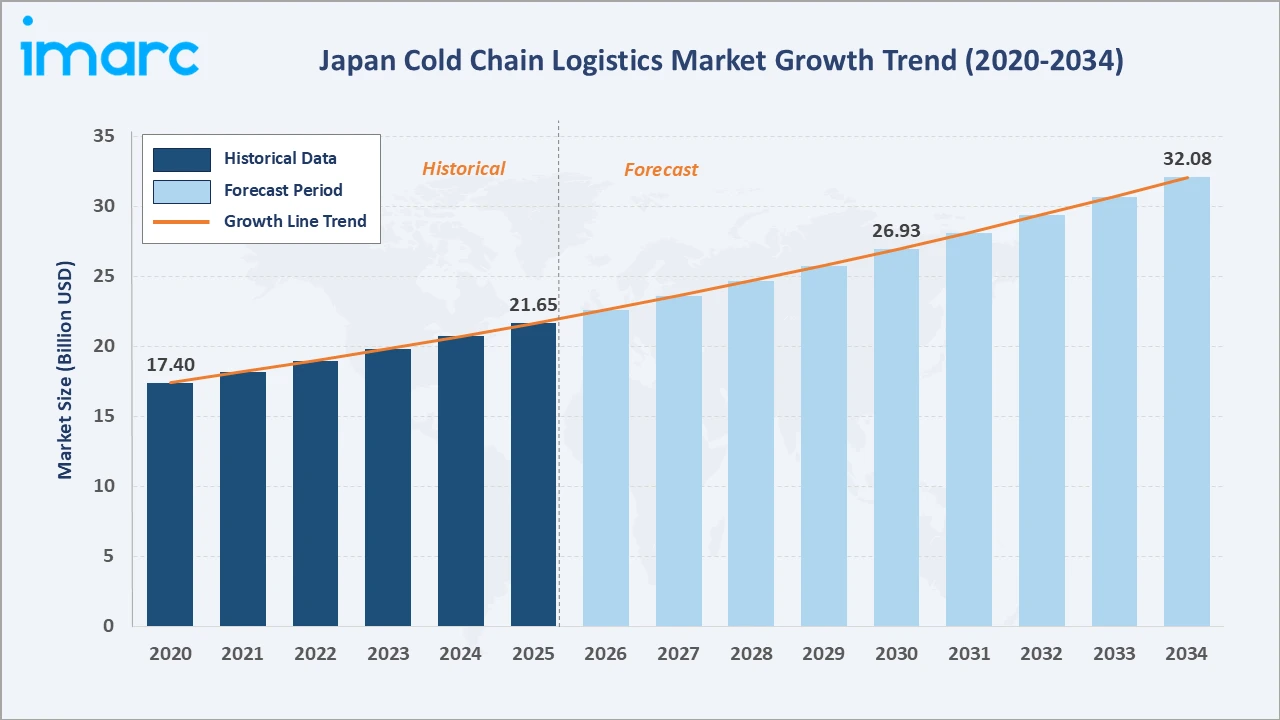
The Japan cold chain logistics market reached USD 21.65 Billion in 2025 and is projected to reach USD 32.08 Billion by 2034, exhibiting a CAGR of 4.47% during 2026-2034. The market is driven by rising demand for fresh and frozen foods, growth in pharmaceutical distribution, expansion of e-commerce grocery delivery, and strict requirements for temperature-controlled storage and transportation. Japan is promoting its cold chain logistics standards across Southeast Asia to strengthen the competitiveness of domestic shipping companies and food exporters. Their adoption as ISO 31512, covering real-time temperature monitoring, controls to prevent temperature fluctuations, and limits on outside-air exposure, is encouraging logistics providers to invest in advanced refrigerated transport, digital tracking, and compliant storage infrastructure, thereby supporting growth in Japan’s cold chain logistics market. Transportation leads service at 47.8%, frozen dominates temperature type at 58.4%, and the Kanto region accounts for the largest regional share at 35.2%.
Market Snapshot
|
Metric |
Value |
|
Market Size (2025) |
USD 21.65 Billion |
|
Forecast Market Size (2034) |
USD 32.08 Billion |
|
CAGR (2026-2034) |
4.47% |
|
Base Year |
2025 |
|
Historical Period |
2020-2025 |
|
Forecast Period |
2026-2034 |
|
Dominant Service |
Transportation (47.8%, 2025) |
|
Dominant Temperature Type |
Frozen (58.4%, 2025) |
|
Leading Region |
Kanto Region (35.2%, 2025) |
The Japan cold chain logistics market grew from USD 17.40 Billion in 2020 to USD 21.65 Billion in 2025, driven by COVID-19-accelerated pharmaceutical cold chain demand for vaccine logistics and e-commerce grocery adoption compressing delivery timelines that require dense refrigerated distribution infrastructure. The market is projected to reach USD 26.93 Billion by 2030 and USD 32.08 Billion by 2034.
To get more information on this market, Request Sample
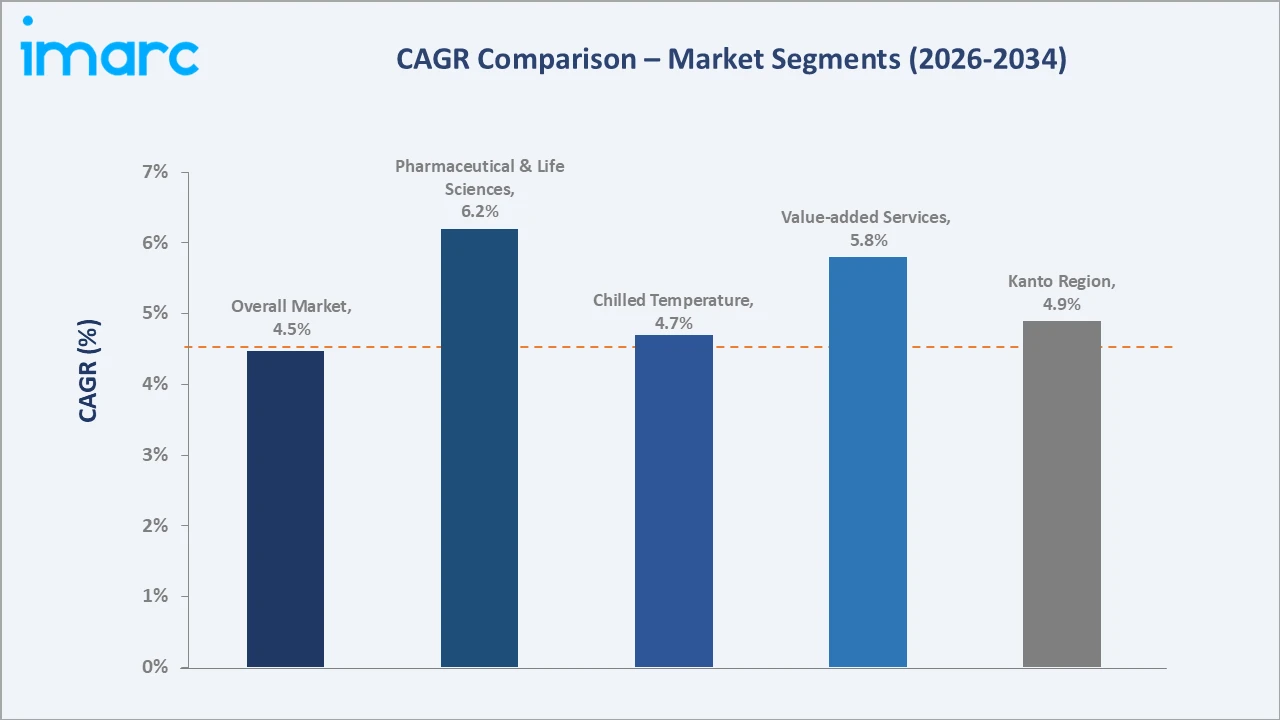
Value-added service grows at ~5.8% CAGR through AI-driven route optimization, blockchain traceability, and IoT temperature monitoring that generate premium service revenues. Pharmaceutical and life sciences application grows at ~6.2% CAGR as Japan's biopharmaceutical export and domestic cold chain GDP compliance requirements expand. Kanto region leads at ~4.9% CAGR through Greater Tokyo's e-commerce grocery expansion and pharmaceutical manufacturing concentration.
Executive Summary
Japan cold chain logistics market occupies a structurally critical position in the national supply chain ecosystem, serving as the temperature-controlled infrastructure backbone for Japan's highly demanding food quality standards, leading seafood consumption, growing pharmaceutical biologics and vaccine logistics requirements, and increasingly dense e-commerce grocery delivery networks. Japan cold chain is distinguished by its exceptionally high service quality standards. Market value stood at USD 21.65 Billion in 2025 and is forecast to reach USD 32.08 Billion by 2034, driven by infrastructure investment, technology adoption, and structural demand growth from pharmaceutical and e-commerce applications.
Transportation leads service at 47.8% (2025), reflecting Japan's geographically distributed food production system creating large, refrigerated trucking demand as the market's primary revenue service. Frozen dominates temperature type at 58.4% (2025), reflecting Japan's deep frozen food culture anchored by the highest per-capita frozen food consumption rate, the dominance of convenience stores and supermarket frozen food sections, and the structural requirements of Japan's seafood supply chain. Kanto region commands 35.2% (2025) as Japan's largest consumption market, most densely concentrated food retail network, and primary pharmaceutical manufacturing hub.
Key Market Insights
|
Insight |
Data |
|
Dominant Service |
Transportation – 47.8% share (2025) |
|
Dominant Temperature Type |
Frozen – 58.4% share (2025) |
|
Leading Region |
Kanto Region – 35.2% share (2025) |
|
Market Opportunities |
Expanding automated cold storage, IoT-based temperature monitoring, pharmaceutical logistics, and cross-border refrigerated transportation across Southeast Asia. |
Key Analytical Observations:
- Transportation at 47.8% (2025): Temperature-controlled transportation, encompassing refrigerated truck fleets, intermodal reefer container services linking Hokkaido and island prefectures, and pharmaceutical-grade GDP (Good Distribution Practice) compliant transport, commands the largest service category share because Japan's geography and food production distribution pattern require extensive long-haul cold transportation from producing regions to consuming markets.
- Frozen at 58.4% (2025): Frozen temperature requirements dominate Japan's cold chain market through multiple structural demand pillars: Japan's leading per-capita frozen food consumption, the nationwide convenience store frozen food infrastructure, Japan's seafood supply chain, and growing demand for frozen ready meals aligned with Japan's time-pressed dual-income households and aging population.
- Kanto Region at 35.2% (2025): The Kanto region leads due to its dense population, high concentration of food and pharmaceutical demand, major ports and airports, and extensive temperature-controlled warehousing and distribution infrastructure.
Japan Cold Chain Logistics Market Overview
The Japan cold chain logistics market encompasses the complete temperature-controlled supply chain infrastructure and services required to maintain the safety, quality, and regulatory compliance of perishable food products, pharmaceutical and biological medicines, and other temperature-sensitive goods from production origin through distribution to end consumer or patient. Japan's cold chain operates within a distinctive regulatory framework that requires all food businesses, including logistics operators handling food, to implement systematic hazard analysis and critical control point management, elevating the operational standard baseline for all market participants. Macroeconomic factors include strong consumer spending on fresh and frozen foods, expanding pharmaceutical and healthcare distribution, and continued investment in logistics and transportation infrastructure.
Market Dynamics
To evaluate market opportunities, Request Sample
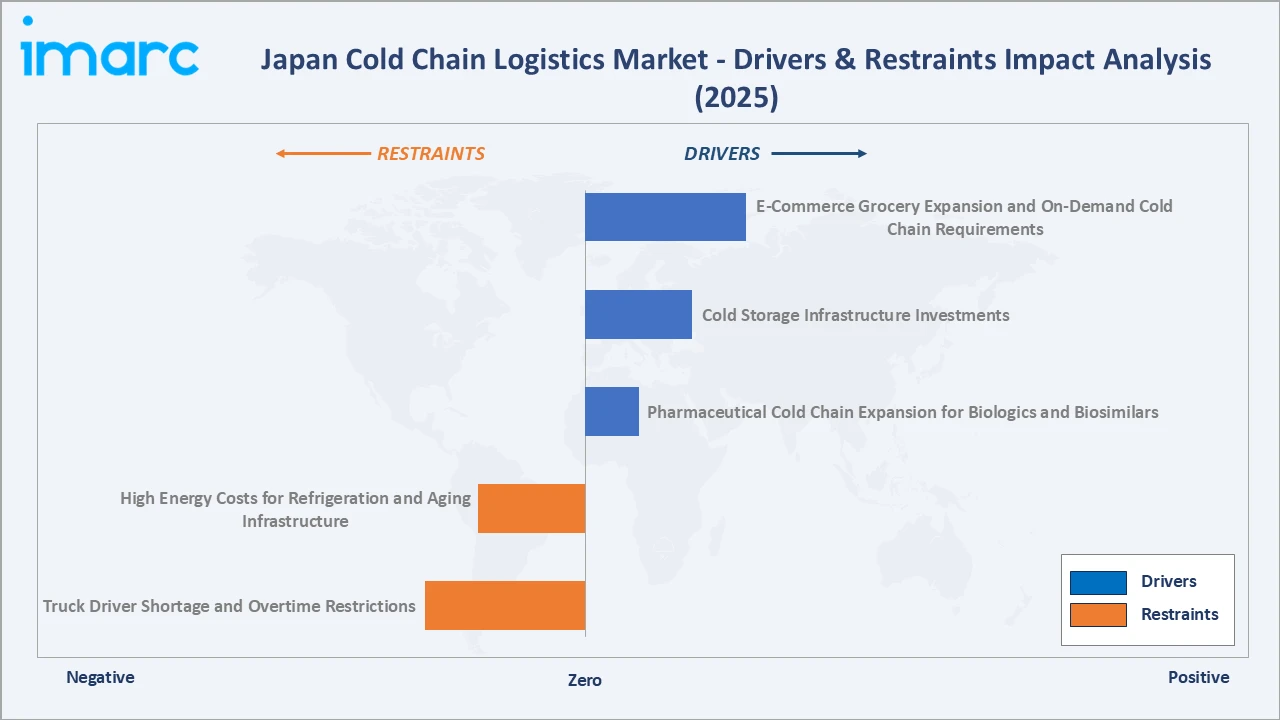
Market Drivers
- E-Commerce Grocery Expansion and On-Demand Cold Chain Requirements: Japan's rapid e-commerce grocery adoption is creating structurally new cold chain demand in urban micro-fulfillment networks that require multi-temperature storage in densely urban locations. Rakuten Mart processes 70,000+ chilled and frozen daily orders across Tokyo and Kansai, supported by micro-fulfillment centers with goods-to-person robotics and three-zone temperature modules. This e-commerce cold chain model demands a fundamentally different cold storage real estate footprint than traditional cold chain, driving urban cold storage facility development investment.
- Cold Storage Infrastructure Investments: The September 2024 announcement by Mitsui Fudosan, GLP Japan, and other Japanese companies of JPY 500 billion ($3.5 billion) in new cold storage facility development across Japan by 2030 represents the most significant single infrastructure commitment in Japan's cold chain history, signaling both the confidence of institutional real estate and logistics investors in Japan's cold chain growth trajectory and the urgency of replacing Japan's aging cold storage facility stock with modern, energy-efficient, automated facilities. These new facilities will deliver operating efficiency improvements that improve cold chain economics while reducing carbon emissions, enabling sustainable growth in cold chain capacity concurrent with Japan's carbon neutrality 2050 commitments.
- Pharmaceutical Cold Chain Expansion for Biologics and Biosimilars: Japan's pharmaceutical industry is experiencing a structural shift toward biopharmaceuticals (monoclonal antibodies, vaccines, cell and gene therapies) that require strict cold chain management and strict GDP compliance documentation absent from traditional small-molecule pharmaceutical distribution. Japan's growing biopharmaceutical export program requires export-grade pharmaceutical cold chain from Japanese manufacturing facilities.
Market Restraints
- Truck Driver Shortage and Overtime Restrictions: Truck driver shortages and stricter overtime limits are reducing available delivery capacity across Japan’s cold chain network. Temperature-sensitive products require reliable and time-bound transportation, making labor constraints particularly disruptive. These restrictions are increasing freight costs, causing delivery delays, and limiting route coverage, while forcing logistics providers to invest in additional warehouses, automation, and route optimization.
- High Energy Costs for Refrigeration and Aging Infrastructure: Refrigerated warehousing is one of Japan's most energy-intensive commercial activities, with electricity costs representing 25-40% of cold storage facility operating costs depending on facility temperature and refrigeration system technology. Japan's cold storage facility stock uses older HFC refrigerant-based systems with lower energy efficiency than modern NH3 and CO2 natural refrigerant systems, making the aging infrastructure both an operating cost and regulatory liability.
Market Opportunities
- Shared Cold Chain Networks Addressing Driver Shortage: Collaborative logistics models, where multiple food manufacturers, retailers, or pharmaceutical companies share cold chain transportation and storage capacity rather than operating competing proprietary networks, represent the industry's most sustainable structural response to driver shortages and facility costs.
- Natural Refrigerant Technology Modernization: The transition from HFC-based refrigeration systems to natural refrigerant alternatives in new and modernized cold storage facilities creates technology investment demand that benefits refrigeration equipment manufacturers, engineering contractors, and cold chain facility operators willing to make early sustainability-oriented capital investment. New facilities feature CO2 natural refrigerants, positioning early adapters to capture tenant demand from food manufacturers and retailers with strict scope 3 emissions reduction commitments.
Market Challenges
- Last-Mile Cold Chain Density in Urban Areas: E-commerce grocery's growth in dense urban environments requires cold chain distribution points in proximity to residential consumers, but prime urban real estate for refrigerated micro-fulfillment is scarce, expensive, and challenging to permit in Japanese cities where zoning and noise regulations may restrict 24-hour refrigerated facility operations.
- Digital Integration and Interoperability: Japan's cold chain market is served by multiple competing operators using proprietary temperature monitoring platforms, tracking systems, and documentation formats that create interoperability challenges when multi-modal cold chain journeys require handoffs between different providers. Developing industry-standard data exchange protocols that enable seamless temperature history sharing across cold chain handoff points would improve cold chain integrity assurance while reducing compliance documentation burden but requires industry coordination that has historically been difficult given competitive sensitivities.
Emerging Market Trends
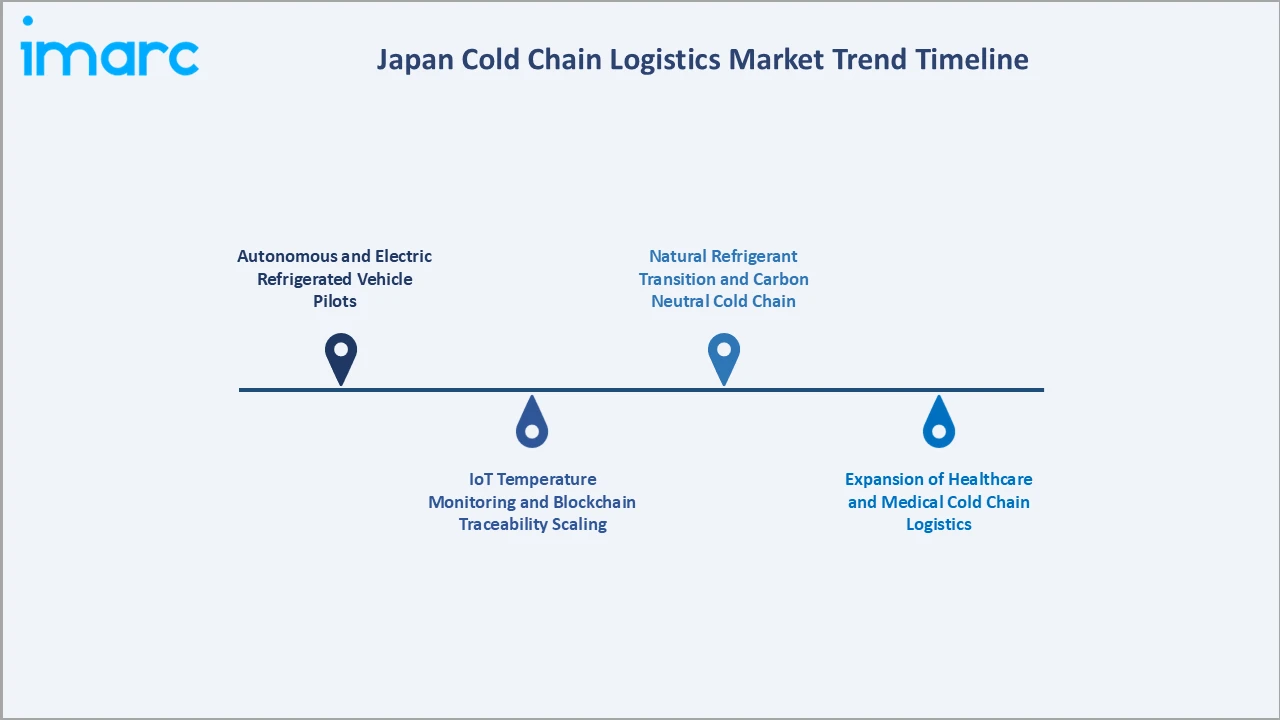
1. Autonomous and Electric Refrigerated Vehicle Pilots
Autonomous and electric refrigerated vehicle pilots are emerging as companies address labor shortages, rising fuel costs, and carbon reduction targets. Logistics providers are testing autonomous delivery trucks and battery-electric refrigerated vehicles to improve delivery efficiency while maintaining strict temperature control. These technologies help lower emissions, reduce operating costs, and support sustainable last-mile and urban cold chain distribution.
2. IoT Temperature Monitoring and Blockchain Traceability Scaling
IoT temperature monitoring and blockchain traceability are gaining traction as cold chain operators seek continuous visibility and stronger product accountability. Connected sensors provide real-time alerts on temperature, humidity, location, and equipment performance, helping prevent spoilage and compliance failures. Blockchain platforms create tamper-resistant records across suppliers, warehouses, and transport providers, improving recall management and consumer trust. Together, these technologies support more transparent, efficient, and data-driven cold chain operations.
3. Expansion of Healthcare and Medical Cold Chain Logistics
The expansion of healthcare and medical cold chain logistics is emerging as demand for temperature-sensitive pharmaceuticals, medical devices, and kidney care products continues to grow. Logistics providers are investing in multi-temperature warehouses, GDP-compliant handling, and specialized distribution networks to ensure product integrity and regulatory compliance. In November 2025, DHL Supply Chain Japan began managing logistics operations for kidney-care technology provider Mozarc Medical Japan at its Sagamihara Logistics Center in Kanagawa Prefecture. The facility provides specialized medical-device expertise and temperature-controlled storage at -20°C (frozen), 2°C to 8°C (refrigerated), and 15°C to 25°C (ambient) ranges to protect product quality.
4. Natural Refrigerant Transition and Carbon Neutral Cold Chain
The transition to natural refrigerants and carbon-neutral cold chain operations is emerging as companies work to reduce greenhouse gas emissions and comply with stricter environmental regulations. Logistics providers are replacing conventional refrigerants with low-global-warming-potential alternatives such as CO₂ and ammonia while adopting energy-efficient refrigeration systems. Combined with renewable energy, electric refrigerated vehicles, and smart energy management, these solutions help build more sustainable and low-carbon cold chain networks.
Industry Value Chain Analysis
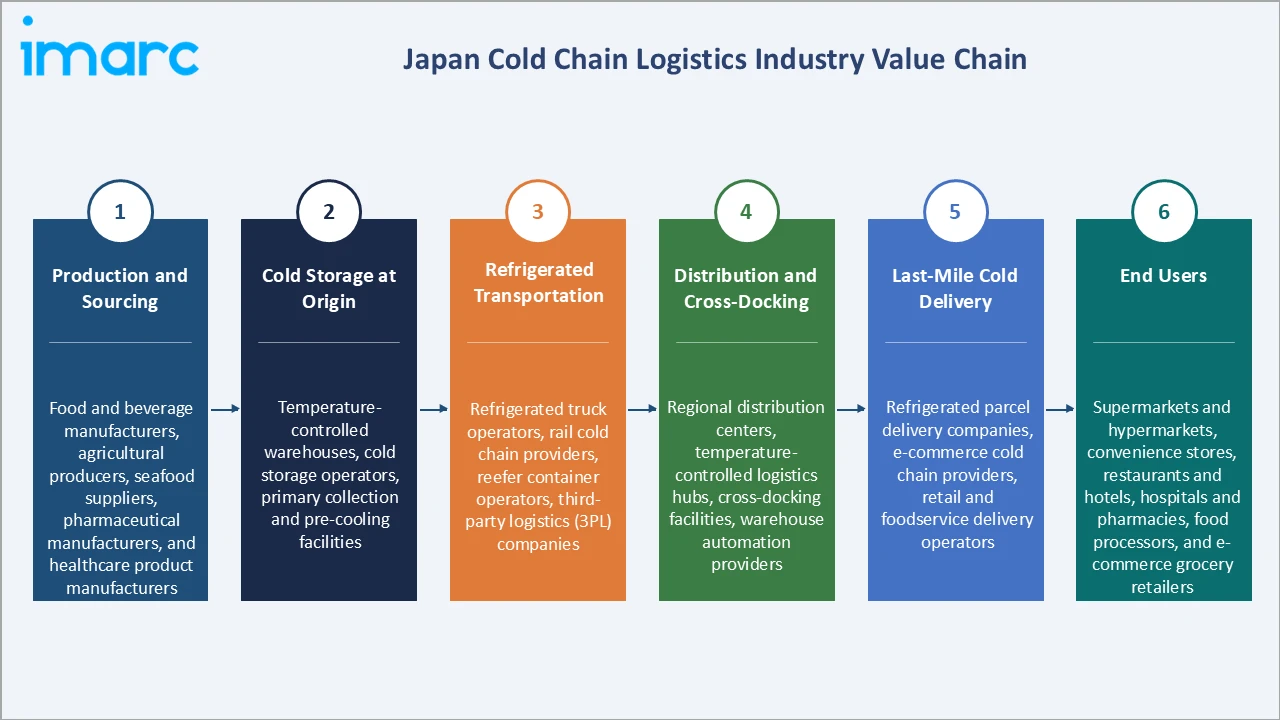
The Japan cold chain logistics value chain integrates production and sourcing, primary cold storage at production origin, refrigerated transportation across distribution tiers, urban micro-fulfillment and cross-docking, last-mile cold delivery, and end-use consumption or patient dispensing.
|
Stage |
Key Participants |
|
Production and Sourcing |
Food and beverage manufacturers, agricultural producers, seafood suppliers, pharmaceutical manufacturers, and healthcare product manufacturers. |
|
Cold Storage at Origin |
Temperature-controlled warehouses, cold storage operators, primary collection and pre-cooling facilities. |
|
Refrigerated Transportation |
Refrigerated truck operators, rail cold chain providers, reefer container operators, third-party logistics (3PL) companies. |
|
Distribution and Cross-Docking |
Regional distribution centers, temperature-controlled logistics hubs, cross-docking facilities, warehouse automation providers. |
|
Last-Mile Cold Delivery |
Refrigerated parcel delivery companies, e-commerce cold chain providers, retail and foodservice delivery operators. |
|
End Users |
Supermarkets and hypermarkets, convenience stores, restaurants and hotels, hospitals and pharmacies, food processors, and e-commerce grocery retailers. |
Distribution and cross-docking are the most value-added stage in the Japan cold chain logistics market. It integrates temperature-controlled storage, inventory management, order fulfillment, automated sorting, and real-time monitoring to preserve product quality and improve delivery efficiency. This stage plays a critical role in minimizing spoilage, ensuring regulatory compliance, and optimizing supply chain performance.
Technology Landscape in the Japan Cold Chain Logistics Industry
IoT Temperature Monitoring and Real-Time Visibility
IoT-enabled temperature monitoring is the most commercially mature technology investment in Japan's cold chain, delivering the continuous temperature history documentation required for regulatory compliance (food) and GDP compliance (pharmaceutical). Modern refrigerated vehicles now incorporate cab-mounted temperature displays, cellular-connected dataloggers with geo-location, and driver alert systems for temperature excursion, providing shippers with real-time cargo condition visibility throughout transportation. Advanced cold storage facilities use distributed wireless sensor networks that create three-dimensional temperature mapping of storage zones, identifying thermal gradients that affect specific product storage locations.
Automated Cold Storage and Goods-to-Person Robotics
Automated cold storage, using automated stacker cranes, conveyor systems, and goods-to-person robotic picking in temperature-controlled environments, is expanding rapidly as new cold storage facility development incorporates automation from commissioning rather than retrofitting automation into existing manual facilities. Japan's fulfillment centers use similar multi-temperature automation supporting same-day grocery delivery across Tokyo and Osaka.
Autonomous and Electric Refrigerated Transport
Autonomous and electric refrigerated transport is improving delivery efficiency while addressing labor shortages and decarbonization goals. AI-enabled autonomous driving systems and advanced telematics optimize route planning, vehicle utilization, and temperature control throughout transit. Battery-electric refrigerated trucks equipped with energy-efficient cooling systems reduce fuel consumption and greenhouse gas emissions. These innovations are enabling smarter, safer, and more sustainable temperature-controlled logistics operations.
Market Segmentation Analysis
The report covers the following segments:
|
Segment Category |
Leading Segment |
Market Share |
Year |
|
Service |
Transportation |
47.8% |
2025 |
|
Temperature Type |
Frozen |
58.4% |
2025 |
|
Application |
🔒 |
🔒 |
2025 |
|
Region |
Kanto Region |
35.2% |
2025 |

By Service
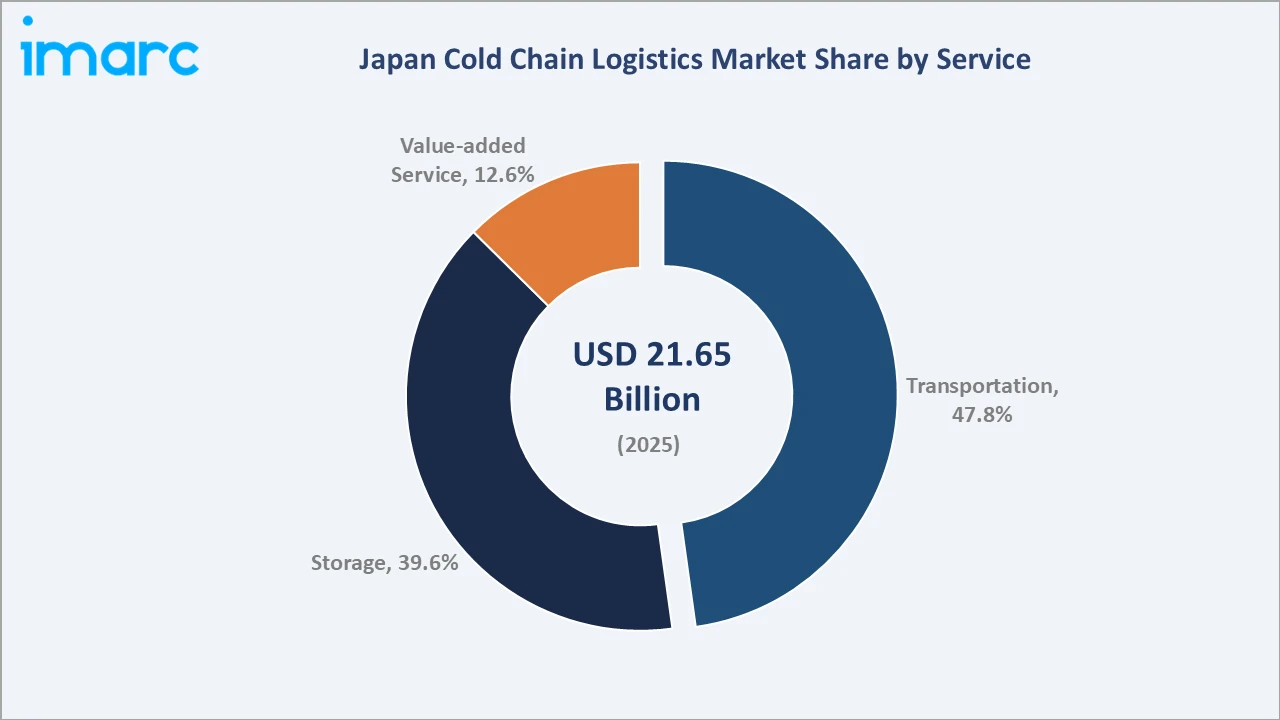
Transportation leads at 47.8% (2025), anchored by Japan's extensive refrigerated road transport network serving food production regions to consumption centers. Major refrigerated transport operators collectively operate tens of thousands of refrigerated trucks covering all Japan prefectures.
To access detailed market analysis, Request Sample
Storage at 39.6% serves the cold storage warehousing demand from food manufacturers, retailers, and pharmaceutical companies. Value-added Service at 12.6%, growing at ~5.8% CAGR, encompasses IoT monitoring, AI route optimization, blockchain traceability, and pharmaceutical GDP compliance services that command premium margins.
By Temperature Type
Frozen dominates at 58.4% (2025), driven by Japan's leading frozen food consumption culture, the extensive convenience store frozen food supply chain serving stores nationally, the seafood cold chain, and the growing frozen ready meal delivery market aligned with Japan's aging population and time-poor households. Frozen storage facilities require the highest energy input and capital investment per unit capacity, commanding premium storage rates versus chilled facilities and sustaining higher revenue share relative to volume share.
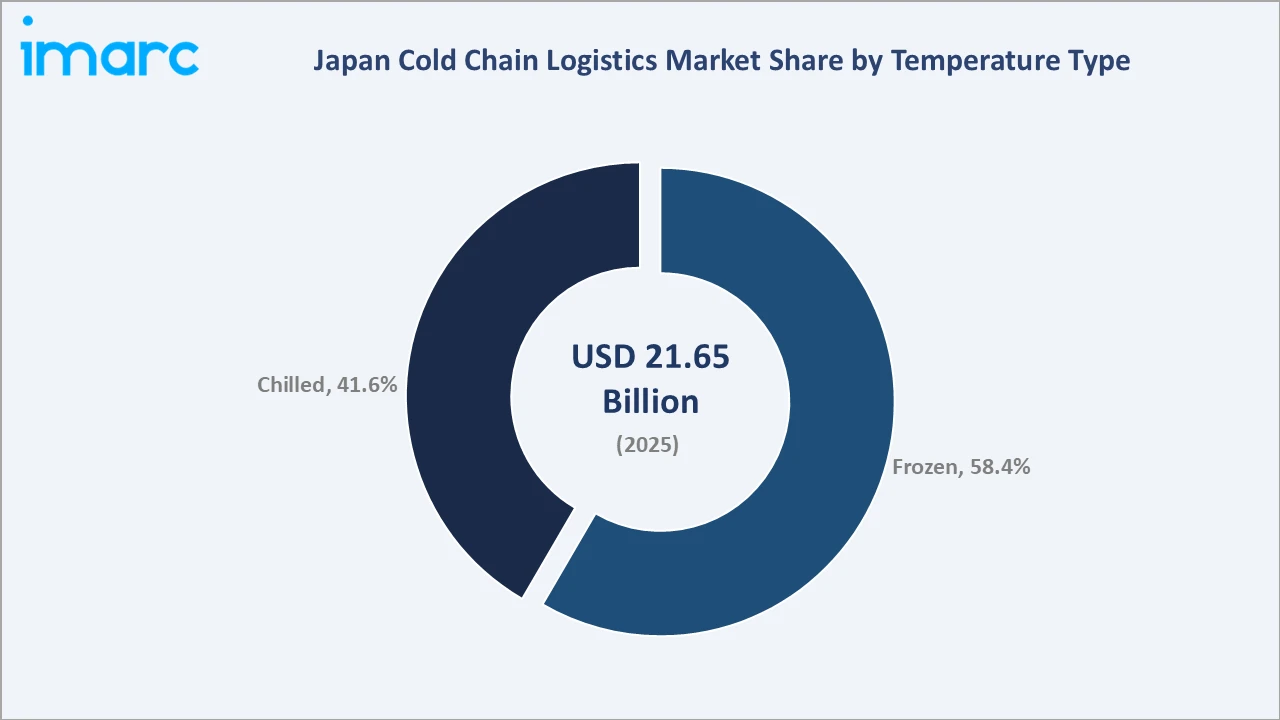
Chilled at 41.6%, growing at ~4.7% CAGR, serves fresh produce, dairy products, chilled ready meals, pharmaceutical products, and the expanding e-commerce fresh grocery delivery segment. Chilled cold chain growth is supported by Japan's increasing fresh food consumption trend, e-commerce grocery platforms requiring chilled micro-fulfillment, and pharmaceutical GDP cold chain expansion for biopharmaceuticals requiring 2-8°C temperature maintenance throughout the supply chain.
Regional Market Insights
|
Region |
Share (2025) |
Key Japan Cold Chain Logistics Market Drivers & Characteristics |
|
Kanto Region |
35.2% |
Largest consumer base, strong food, pharmaceutical, retail, and e-commerce demand, and extensive cold storage and distribution infrastructure. |
|
Kansai/Kinki Region |
18.4% |
Major urban and industrial centers, strong food processing, healthcare logistics, and port-based distribution activities. |
|
Central/Chubu Region |
15.7% |
Manufacturing and logistics hub with growing demand for refrigerated transport, warehousing, and regional distribution services. |
|
Kyushu-Okinawa Region |
9.2% |
Strong agricultural and seafood production, rising need for export-oriented cold storage and temperature-controlled transport. |
|
Hokkaido Region |
8.0% |
Major dairy, seafood, and agricultural production base supported by origin-based cold storage and long-distance distribution. |
|
Tohoku Region |
5.6% |
Strong seafood and agricultural output, demand concentrated in regional cold storage and interregional refrigerated transport. |
|
Chugoku Region |
4.5% |
Growing food processing and port logistics activities, moderate demand for refrigerated warehousing and distribution. |
|
Shikoku Region |
3.4% |
Smaller market driven by fisheries, agriculture, local food processing, and regional cold delivery requirements. |
Kanto region's 35.2% dominance reflects its large population, dense retail network, strong pharmaceutical demand, and concentration of major distribution centers. Kansai/Kinki region at 18.4% is supported by major cities, food processing activity, healthcare logistics, and port connectivity. Central/Chubu region’s 15.7% serves as an important manufacturing and transportation hub with growing demand for refrigerated warehousing and regional distribution. Kyushu-Okinawa region’s 9.2% benefits from strong agricultural, seafood, and export-oriented cold chain requirements.
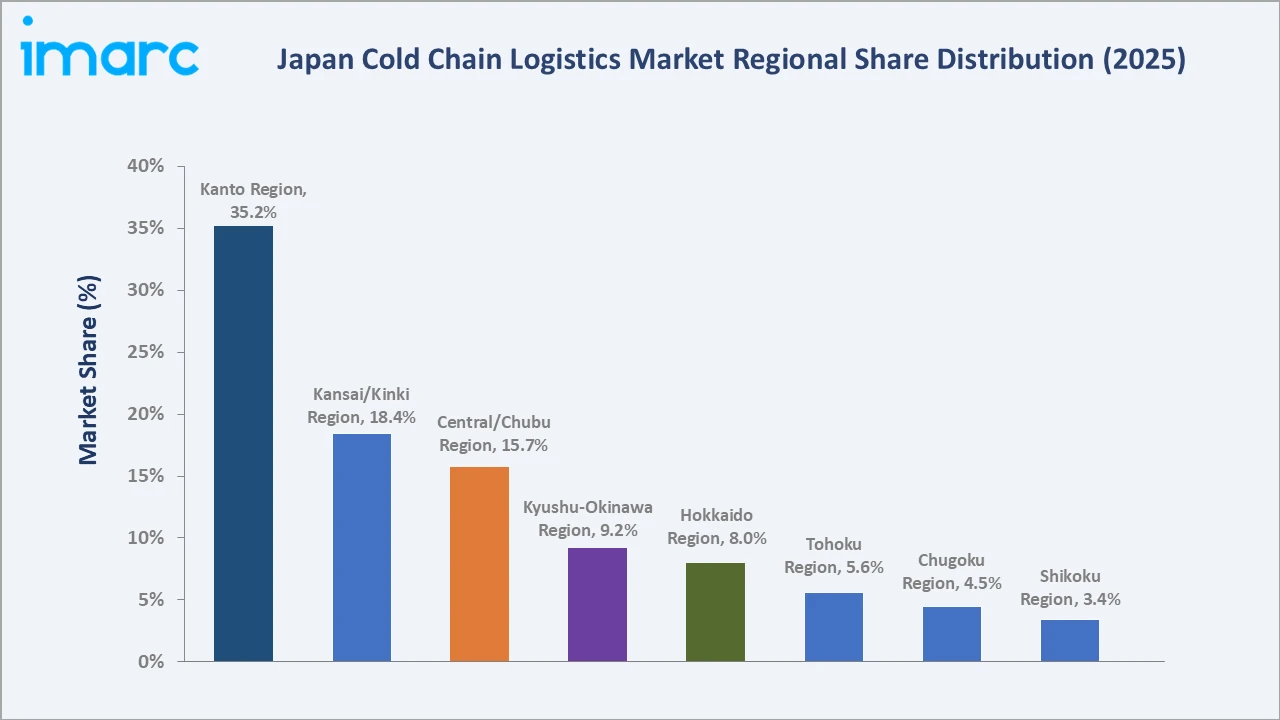
Hokkaido region’s 8.0% remains significant due to its large dairy, seafood, and agricultural production base. Tohoku region’s 5.6% also relies heavily on cold storage and refrigerated transport for seafood and farm products. Chugoku region’s 4.5% is supported by food processing, port logistics, and regional distribution activity. Shikoku region’s 3.4% has a smaller share but maintains steady demand from fisheries, agriculture, and local food industries.
Competitive Landscape
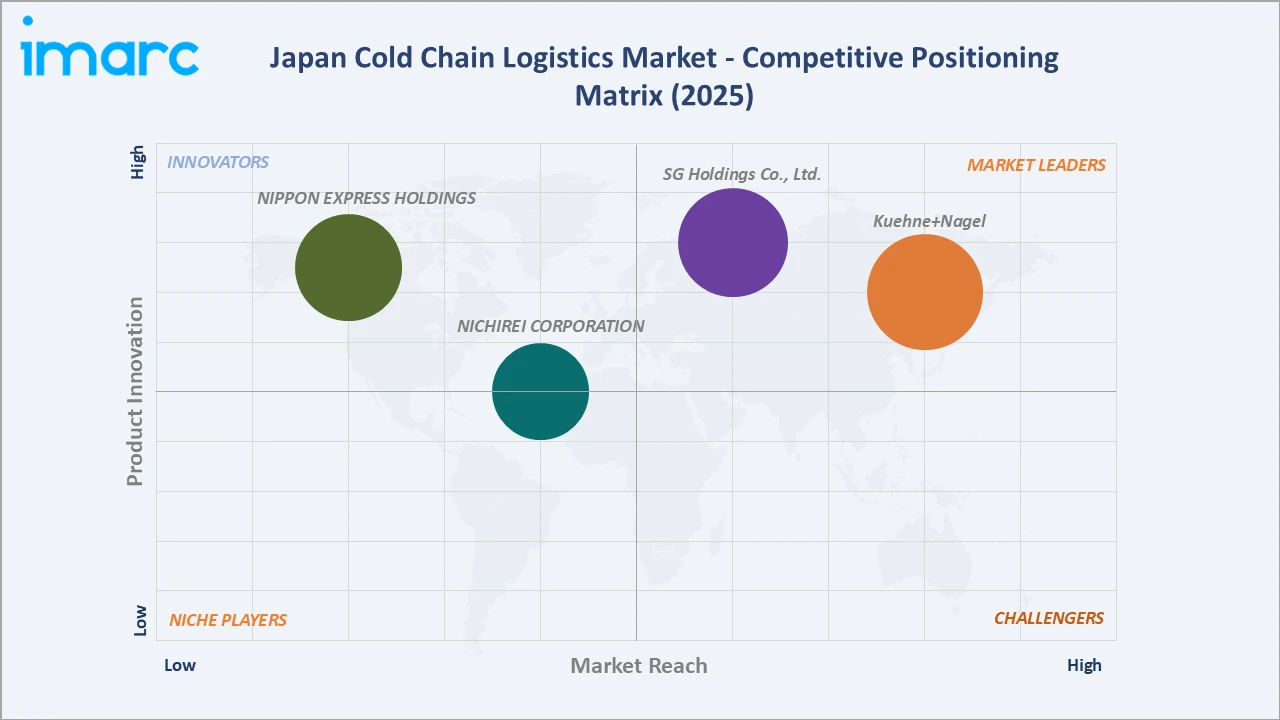
Japan cold chain logistics market is served by a competitive structure combining integrated domestic logistics majors with cold chain specialists, trading company logistics subsidiaries, international 3PLs, and regional specialists. The logistics crisis is accelerating competitive differentiation; operators with greater automation capability, digital platform services, and shared logistics networks hold growing competitive advantages over capacity-constrained operators dependent on manual driver resources.
|
Company |
Key Services |
Market Position |
Core Strength |
|
Kuehne+Nagel |
Reefer Logistics |
Market Leader |
Kuehne+Nagel facilitates Japan’s cold chain by managing temperature-sensitive air, sea, and land freight. |
|
SG Holdings Co., Ltd. |
Temperature-controlled Transportation, E-commerce of Frozen and Refrigerated Goods |
Market Leader |
SG Holdings Co., Ltd., through its core subsidiary Sagawa Express Co., Ltd., plays a foundational role in Japan’s cold chain logistics network. |
|
NIPPON EXPRESS HOLDINGS |
Integrated Logistics Solutions for Pharmaceuticals and Biotechnology Products, Sustainable Temperature Control Solutions |
Innovator |
NIPPON EXPRESS HOLDINGS is a vital pillar of Japan’s cold chain, providing seamless, end-to-end temperature-controlled logistics. |
|
NICHIREI CORPORATION |
Temperature-controlled Transportation, Temperature-controlled Storage |
Established Player |
NICHIREI CORPORATION dominates the Japanese cold chain through its subsidiary, Nichirei Logistics Group Inc. |
The logistics crisis is reshaping Japan's cold chain competitive landscape in ways that favor capital-intensive automation-capable operators over volume-dependent driver-reliant networks. The market players are demonstrating the technology investment strategies that will determine competitive positioning through 2034 as driver availability remains structurally constrained.
Key Company Profiles
Kuehne+Nagel
Kuehne+Nagel is a logistics provider offering integrated cold chain solutions across air freight, sea freight, contract logistics, and road transportation. In Japan, the company supports pharmaceutical, healthcare, food, and perishable goods supply chains through temperature-controlled warehousing, GDP-compliant logistics, and end-to-end distribution services. Its network leverages advanced digital visibility, real-time shipment monitoring, and multimodal transportation to ensure the safe and efficient handling of temperature-sensitive products across domestic and international markets.
- Key Services: Reefer Logistics.
- Strategic Focus: Expanding compliant, end-to-end temperature-controlled logistics for Japan’s pharmaceutical, medical-device, and perishable-goods sectors. The company emphasizes its healthcare network, specialized packaging, trained handling teams, and proactive shipment monitoring to minimize temperature excursions.
SG Holdings Co., Ltd.
SG Holdings Co., Ltd. is a Japan-based comprehensive logistics group offering parcel delivery, third-party logistics, warehousing, transportation management, and international logistics services. In the cold chain market, the group provides refrigerated and frozen storage and transportation for temperature-sensitive products, including chilled foods, frozen foods, and vaccines. Its capabilities were strengthened through its subsidiary Sagawa Express Co., Ltd. The group combines these operations with Sagawa Express’s nationwide delivery network to provide integrated, end-to-end logistics solutions across Japan.
- Key Services: Temperature-controlled Transportation, E-commerce of Frozen and Refrigerated Goods.
- Strategic Focus: Building one of Japan’s leading cold chains by integrating food network and frozen-food infrastructure with Sagawa Express’s nationwide last-mile capabilities. Its strategy emphasizes expanding low-temperature logistics solutions, cross-selling services to existing customers, and providing integrated coverage from storage to final delivery.
Market Concentration Analysis
Japan cold chain logistics market is moderately concentrated. The market features significant multi-tier competition: integrated giants at the top tier competing on nationwide network coverage and digital platform capability; cold chain specialists competing on technical cold chain expertise and facility quality; trading company logistics subsidiaries competing on supply chain integration capability for their trading group customers; and regional specialists competing on regional depth and competitive pricing. Concentration is expected to increase modestly through 2034 as automation investment scale requirements and digital platform development costs create economic advantages for larger operators that smaller regional players cannot easily match.
Investment & Growth Opportunities
Highest Growth Segments
Value-added service (~5.8% CAGR), pharmaceutical and life sciences application (~6.2% CAGR), Kanto region (~4.9% CAGR), chilled temperature (~4.7% CAGR), and e-commerce cold micro-fulfillment sub-segment represent Japan cold chain logistics market's highest-growth investment vectors through 2034.
Investment Themes
- Cold storage facility development for modern natural refrigerant-equipped facilities: Investment in modern cold storage facilities using natural refrigerants such as ammonia and carbon dioxide supports lower emissions, improved energy efficiency, and compliance with tightening environmental regulations. Opportunities include automated, multi-temperature warehouses serving food, retail, and e-commerce supply chains.
- Pharmaceutical GDP cold chain service infrastructure for biologics and cell therapy: Investment is rising in GDP-compliant storage, validated packaging, real-time monitoring, and specialized transportation for highly temperature-sensitive biologics and cell therapies. These services require strict traceability, backup systems, and controlled conditions ranging from refrigerated to ultra-low temperatures.
Future Market Outlook (2026-2034)
The Japan cold chain logistics market is projected to grow from USD 21.65 Billion in 2025 to USD 32.08 Billion by 2034, delivering a 4.47% CAGR, reflecting structural demand drivers that are insensitive to economic cycles and are compounding through the forecast period. The anchor value of USD 26.93 Billion in 2030, driven primarily by the JPY 500 billion cold storage investment program generating new capacity that attracts volume from aging facilities, pharmaceutical cold chain expansion creating a new premium-value service tier, and e-commerce grocery cold chain densification creating urban micro-fulfillment cold infrastructure demand.
Three structural forces will define Japan cold chain logistics market trajectory through 2034. First, the JPY 500 billion cold storage investment wave will transform Japan's cold storage landscape from aging, energy-inefficient HFC-refrigerant facilities toward modern, automated, natural-refrigerant facilities that achieve energy efficiency improvements, accommodate goods-to-person robotic picking for e-commerce order fulfillment, and meet the documentation requirements that older facilities cannot satisfy with legacy manual record-keeping. Second, Japan's structural truck driver shortage will paradoxically become a growth driver for cold chain market value through 2034 by forcing automation investment that improves cold chain productivity, accelerating shared cold logistics network development that expands the cold chain outsourcing market, and elevating cold chain service pricing as supply capacity constraints persist in the transition period before autonomous vehicles achieve commercial scale deployment. Third, Japan's pharmaceutical cold chain expansion, driven by the global biologics’ revolution creating injectable biopharmaceuticals, cell and gene therapies, and mRNA medicines that all require cold chain, will add a structurally new, structurally growing, and structurally premium cold chain market.
Research Methodology
Primary Research
Primary research comprised in-depth interviews with cold chain logistics operator executives and operations managers, food manufacturer supply chain directors, pharmaceutical cold chain procurement specialists, cold storage real estate developers, regulatory affairs specialists, and independent Japan logistics and supply chain market analysts. These discussions validated market size estimates, assessed service and temperature type demand trends, evaluated infrastructure investment timelines, and provided insights into the logistics crisis impacts, pharmaceutical cold chain expansion trajectories, and regional market development characteristics.
Secondary Research
Secondary research encompassed logistics industry statistics, cold storage capacity data, JPY 500 billion investment announcement (September 2024), AI autonomous truck pilot documentation, and credible market intelligence sources.
Forecasting Models
Forecasting models were developed using historical Japan cold chain logistics market data, compliance-driven cold chain upgrade demand projections, pharmaceutical GDP cold chain volume growth from Japan biopharmaceutical export trends, e-commerce grocery delivery platform expansion plans, cold storage capacity investment timelines from announced development programs, and regional market growth differential analysis. Both top-down and bottom-up approaches were validated through primary research incorporating cold chain capacity and throughput data.
Japan Cold Chain Logistics Market Report Scope:
| Report Features | Details |
|---|---|
| Base Year of the Analysis | 2025 |
| Historical Period | 2020-2025 |
| Forecast Period | 2026-2034 |
| Units | Billion USD |
| Scope of the Report |
Exploration of Historical Trends and Market Outlook, Industry Catalysts and Challenges, Segment-Wise Historical and Future Market Assessment:
|
| Services Covered | Storage, Transportation, Value-added Services |
| Temperature Types Covered | Chilled, Frozen |
| Applications Covered | Horticulture, Dairy Products, Meats, Fish and Poultry, Processed Food Products, Pharma, Life Sciences and Chemicals, Others |
| Regions Covered | Kanto Region, Kansai/Kinki Region, Central/ Chubu Region, Kyushu-Okinawa Region, Tohoku Region, Chugoku Region, Hokkaido Region, Shikoku Region |
| Companies Covered | Kuehne+Nagel, SG Holdings Co. Ltd., NIPPON EXPRESS HOLDINGS, NICHIREI CORPORATION, etc. |
| Customization Scope | 10% Free Customization |
| Post-Sale Analyst Support | 10-12 Weeks |
| Delivery Format | PDF and Excel through Email (We can also provide the editable version of the report in PPT/Word format on special request) |
Key Benefits for Stakeholders:
- IMARC’s report offers a comprehensive quantitative analysis of various market segments, historical and current market trends, market forecasts, and dynamics of the Japan cold chain logistics market from 2020-2034.
- The research study provides the latest information on the market drivers, challenges, and opportunities in the Japan cold chain logistics market.
- Porter's Five Forces analysis assists stakeholders in assessing the impact of new entrants, competitive rivalry, supplier power, buyer power, and the threat of substitution. It helps stakeholders to analyze the level of competition within the Japan cold chain logistics industry and its attractiveness.
- Competitive landscape allows stakeholders to understand their competitive environment and provides an insight into the current positions of key players in the market.
Frequently Asked Questions About the Japan Cold Chain Logistics Market Report
The Japan cold chain logistics market reached USD 21.65 Billion in 2025, driven by regulatory compliance elevating cold chain standards, JPY 500 billion cold storage investment, and e-commerce grocery cold chain expansion.
The market grows at 4.47% CAGR during 2026-2034, reaching USD 32.08 Billion by 2034. The CAGR reflects value-added services growing at ~5.8% CAGR, e-commerce grocery cold chain densification, and JPY 500 billion infrastructure investment creating new capacity and value-added service revenue.
Transportation leads at 47.8% (2025) through Japan's extensive refrigerated road transport network serving food production regions to consumption centers.
Frozen dominates at 58.4% (2025) through Japan's leading frozen food consumption, convenience store frozen restocking cold chain, seafood ultra-low temperature supply chain, and frozen ready meal delivery market growth.
Kanto region leads at 35.2% (2025), growing at ~4.9% CAGR, driven by Greater Tokyo's consumer population, e-commerce grocery expansion, pharmaceutical cold chain from Kawasaki-Yokohama manufacturing, and cold storage investment concentration in Kanto.
Leading companies include Kuehne+Nagel, SG Holdings Co., Ltd., NIPPON EXPRESS HOLDINGS, and NICHIREI CORPORATION, among others.
The market is projected to reach approximately USD 26.93 Billion by 2030, driven by JPY 500 billion cold storage investment completion creating modern automated facilities, pharmaceutical GDP cold chain expansion for Japan biopharmaceutical exports, Level 4 autonomous highway truck enabling commercial cold chain autonomous transport, e-commerce grocery micro-fulfillment cold network densification, and cold chain quality standard elevation across all food operators.
Top opportunities include cold storage facility development with natural refrigerants near major e-commerce and food distribution corridors, pharmaceutical GDP cold chain infrastructure for Japan biologics export market, autonomous refrigerated transport technology development aligning with Level 4 highway framework, IoT cold chain monitoring platforms, and shared cold logistics platform development.
Need more help?
- Speak to our experienced analysts for insights on the current market scenarios.
- Include additional segments and countries to customize the report as per your requirement.
- Gain an unparalleled competitive advantage in your domain by understanding how to utilize the report and positively impacting your operations and revenue.
- For further assistance, please connect with our analysts.
 Request Customization
 Speak to an Analyst
 Request Brochure
 Inquire Before Buying
Benefits of Customization
- Personalize this research
- Triangulate with your data
- Get data as per your format and definition
- Gain a deeper dive into a specific application, geography, customer, or competitor
- Any level of personalization
Get in Touch With Us
UNITED STATES
Phone: +1-201-971-6302
INDIA
Phone: +91-120-433-0800
UNITED KINGDOM
Phone: +44-753-714-6104
Email: [email protected]
Client Testimonials




.webp)




.webp)













Related Reports

Choose your plan
*Please note that the prices mentioned below are starting prices for each bundle type. Kindly contact our team for further details.*
Single User License
- 1 User License, Access on 2 Devices
- PDF Report + Excel Dataset (Password Protected)
- Lifetime Access
- No Printing Rights
- 10% Free Report Customization
- 10–12 Weeks of Analyst Support
Five User License
- Access for 5 Users, 2 Devices per User
- PDF Report + Excel Dataset (Password Protected)
- Lifetime Access
- Dedicated Account Manager
- 12–14 Weeks of Analyst Support
- No Printing Rights
- 15% Free Report Customization
- 25% Discount on Your Next Purchase
Corporate User License
- Unlimited User Access (Within Your Organization)
- PDF Report + Excel Dataset
- Lifetime Access
- Dedicated Account Manager
- 14–20 Weeks of Analyst Support
- No Printing Rights
- 20% Free Report Customization
- 30% Discount on Your Next Purchase
Essential Insights
What's included:
3 reports
- Lifetime Access
- PDF Reports
- Excel Datasets
- 2 Weeks of Free Analyst Support
- 2 User Licenses
- Access on 2 Devices
- Printing Rights
- Complimentary PowerPoint (PPT) Version
- Complimentary License Upgrade
Professional Access
What's included:
5 reports
- Lifetime Access
- PDF Reports
- Excel Datasets
- 8 Weeks of Free Analyst Support
- 2 User Licenses
- Access on 2 Devices
- Printing Rights
- Complimentary PowerPoint (PPT) Version
- Complimentary License Upgrade
Business Advantage
What's included:
8 reports
- Lifetime Access
- PDF Reports
- Excel Datasets
- 14 Weeks of Free Analyst Support
- 2 User Licenses
- Access on 2 Devices
- Printing Rights
- Complimentary PowerPoint (PPT) Version
- Complimentary License Upgrade
Enterprise Intelligence
What's included:
10 reports
- Lifetime Access
- PDF Reports
- Excel Datasets
- 20 Weeks of Free Analyst Support
- 2 User Licenses
- Access on 2 Devices
- Printing Rights
- Complimentary PowerPoint (PPT) Version
- Complimentary License Upgrade