
Japan Commercial Insurance Market Size, Share, Trends and Forecast by Type, Enterprise Size, Distribution Channel, Industry Vertical, and Region, 2026-2034
Japan Commercial Insurance Market Size, Share, Trends & Forecast (2026-2034)
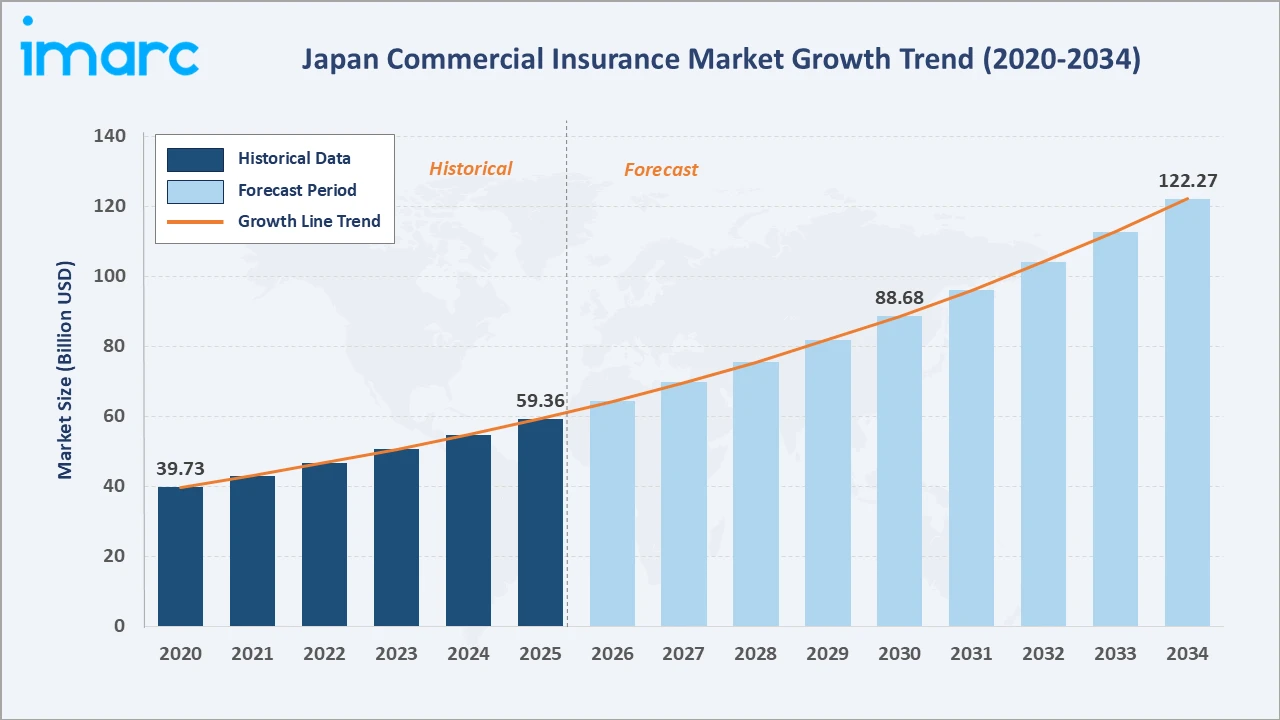
The Japan commercial insurance market reached USD 59.36 Billion in 2025 and is projected to reach USD 122.27 Billion by 2034, growing at a CAGR of 8.36% during 2026-2034. Growth is driven by heightened business-risk awareness, evolving regulatory demands, technology-driven risk assessment, rising natural-disaster exposure, and increasing cyber threats. Commercial Property Insurance leads by type at 31.6%, Large Enterprises dominate enterprise size at 62.4%, and the Kanto Region leads regionally at 36.4%.
Market Snapshot
|
Metric |
Value |
|
Market Size (2025) |
USD 59.36 Billion |
|
Forecast Market Size (2034) |
USD 122.27 Billion |
|
CAGR (2026-2034) |
8.36% |
|
Base Year |
2025 |
|
Historical Period |
2020-2025 |
|
Forecast Period |
2026-2034 |
|
Dominant Type |
Commercial Property Insurance (31.6%, 2025) |
|
Dominant Enterprise Size |
Large Enterprises (62.4%, 2025) |
|
Leading Region |
Kanto Region (36.4%, 2025) |
The Japan commercial insurance market expanded from USD 39.73 Billion in 2020 to USD 59.36 Billion in 2025, anchored at USD 88.68 Billion in 2030, and forecast to reach USD 122.27 Billion by 2034. Post-pandemic risk-management investment and regulatory reform sustained above-trend growth through 2022-2025.
To get more information on this market, Request Sample
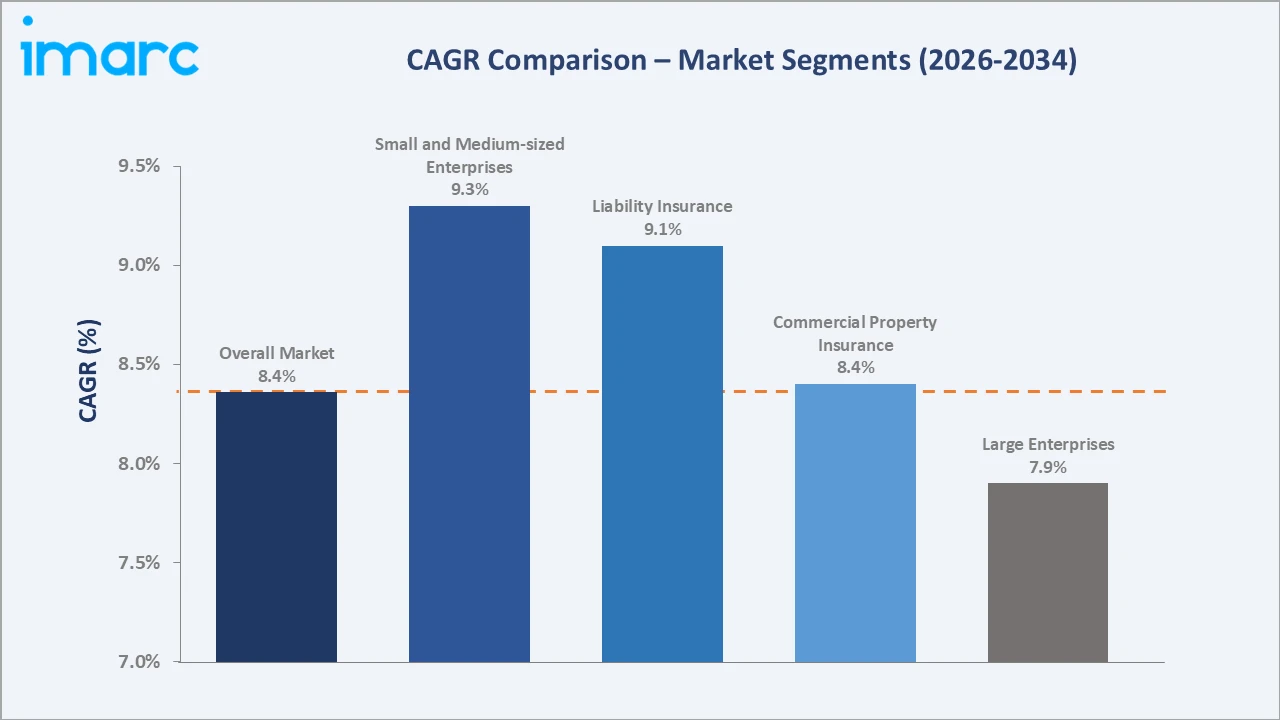
Against the overall market CAGR of 8.36%, Liability Insurance and Others grow fastest among type segments through rising litigation exposure and demand for cyber and specialty covers, while Small and Medium-sized Enterprises outpace Large Enterprises as SME risk-transfer adoption accelerates.
Executive Summary
The Japan commercial insurance market reached USD 59.36 Billion in 2025, reflecting one of Asia-Pacific's most mature risk-transfer industries. The market spans property, liability, motor, and marine coverage, alongside underwriting technology, claims automation, and distribution platforms that convert traditional policies into data-driven risk-management solutions.
Commercial Property Insurance at 31.6% dominates through Japan's high exposure to earthquakes, typhoons, and flooding. Large Enterprises at 62.4% lead enterprise size through complex multi-line risk programs. The Kanto Region, at 36.4%, leads through Tokyo's concentration of corporate headquarters and industrial assets.
Key Market Insights
|
Insight |
Data |
|
Dominant Type |
Commercial Property Insurance - 31.6% share (2025) |
|
Dominant Enterprise Size |
Large Enterprises - 62.4% market share (2025) |
|
Leading Region |
Kanto Region - 36.4% market share |
|
Market Opportunity |
Cyber insurance; parametric disaster cover; SME embedded insurance; AI underwriting; insurtech distribution; industry-specific liability products |
Key Analytical Observations Supporting The Above Data:
- Commercial Property Insurance at 31.6%: Property insurance dominates due to Japan's exposure to earthquakes, typhoons, and flooding, prompting mandatory and voluntary asset-protection coverage across manufacturing, real estate, and logistics sectors.
- Large Enterprises at 62.4%: Large enterprises dominate through complex multi-site operations, higher insured-asset values, and mandatory directors' and officers', liability, and property programs required by lenders and regulators.
- Kanto Region at 36.4%: Kanto leads through Tokyo's concentration of corporate headquarters, financial institutions, and industrial parks, sustaining the highest density of commercial risk-transfer demand nationally.
Japan Commercial Insurance Market Overview
The Japan commercial insurance market encompasses underwriting, distribution, and claims administration for businesses across property, liability, motor, and marine risk categories. The market integrates actuarial pricing, reinsurance placement, digital policy administration, and post-loss claims and risk-engineering services.
Macroeconomic factors include steady corporate capital investment, an aging workforce, and rising compliance obligations. Climate change, seismic risk, and cyber-threat escalation are accelerating demand for specialised and parametric commercial coverage across Japanese industry.
Market Dynamics
To evaluate market opportunities, Request Sample
Market Drivers
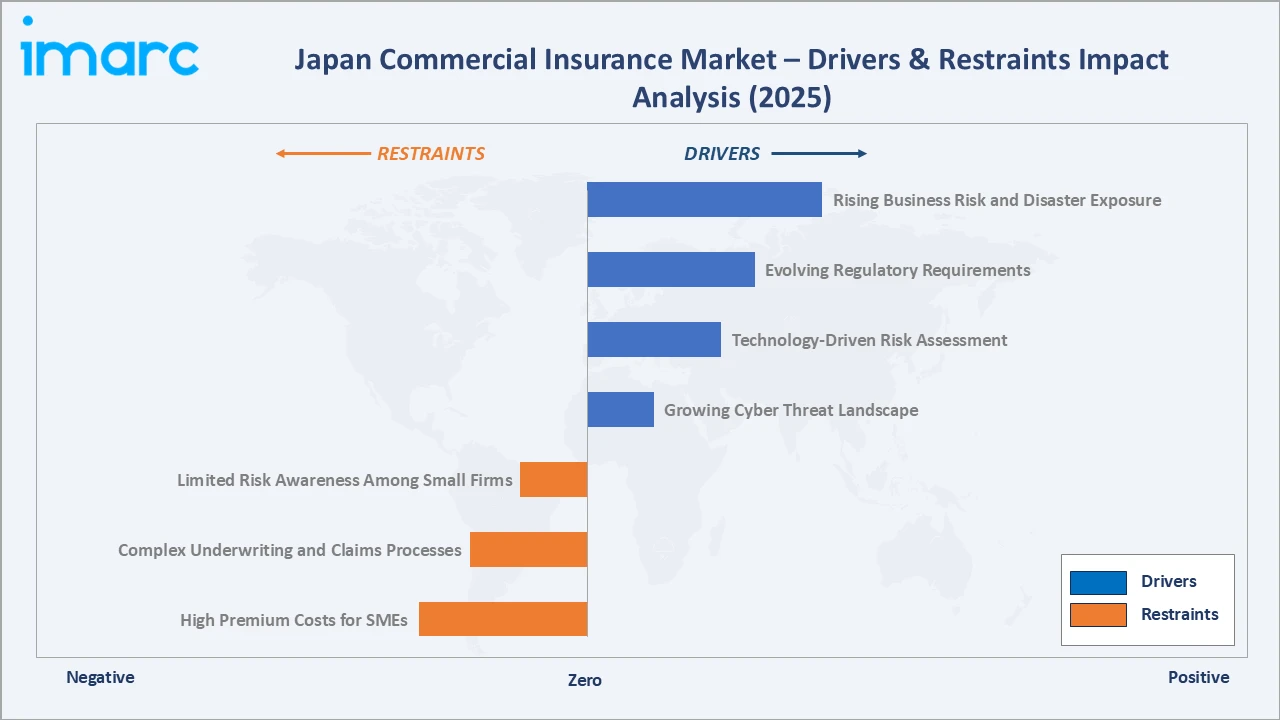
- Rising Business Risk and Disaster Exposure: Frequent earthquakes, typhoons, and flooding are increasing enterprise demand for property and business-interruption coverage. Companies are expanding insured-asset limits to protect operations against escalating climate-related and seismic loss events.
- Evolving Regulatory Requirements: Japan's Financial Services Agency introduced its economic value-based solvency regime (J-ICS/ESR) from March 2026 and revised brokerage-fee guidelines for commercial lines in 2025, prompting insurers to strengthen capital reserves and reprice risk transfer across all industry verticals.
- Technology-Driven Risk Assessment: AI-based underwriting, telematics, and IoT sensors are enabling insurers to price risk more precisely and offer usage-based commercial policies, improving affordability and encouraging broader adoption among small and medium-sized enterprises.
- Growing Cyber Threat Landscape: Escalating ransomware and data-breach incidents are driving enterprises across finance, manufacturing, and healthcare to purchase standalone or bundled cyber-liability coverage, creating a fast-growing specialty segment within commercial insurance.
Market Restraints
- High Premium Costs for SMEs: Elevated premiums for property and liability coverage, driven by catastrophe risk-loading, discourage smaller enterprises from purchasing comprehensive commercial insurance, limiting penetration among micro and small-scale businesses.
- Complex Underwriting and Claims Processes: Multi-layered documentation, manual inspection requirements, and lengthy claims settlement timelines increase administrative burden for policyholders, occasionally discouraging renewal and reducing overall customer satisfaction with commercial insurers.
- Limited Risk Awareness Among Small Firms: Many small and medium-sized enterprises underestimate exposure to liability, cyber, and business-interruption risk, resulting in underinsurance and slower adoption of comprehensive commercial coverage relative to large corporations.
Market Opportunities
- Parametric and Climate-Linked Insurance: Parametric disaster products that pay out against predefined triggers are gaining traction, offering faster claims settlement for earthquake and typhoon exposure and reducing insurers' loss-adjustment costs.
- SME-Focused Embedded Insurance: Digital platforms bundling commercial coverage into banking, leasing, and e-commerce services are expanding insurance access among small and medium-sized enterprises, lowering distribution costs and broadening market reach.
Market Challenges
- Aging Workforce and Talent Shortage: A shrinking pool of experienced underwriters and claims adjusters is straining insurers' capacity to process complex commercial risk, increasing reliance on automation and outsourced risk-engineering services.
- Reinsurance Cost Volatility: Rising global reinsurance rates following catastrophe losses are increasing primary insurers' cost base, pressuring margins and complicating long-term pricing stability for Japanese commercial insurance providers.
Emerging Market Trends
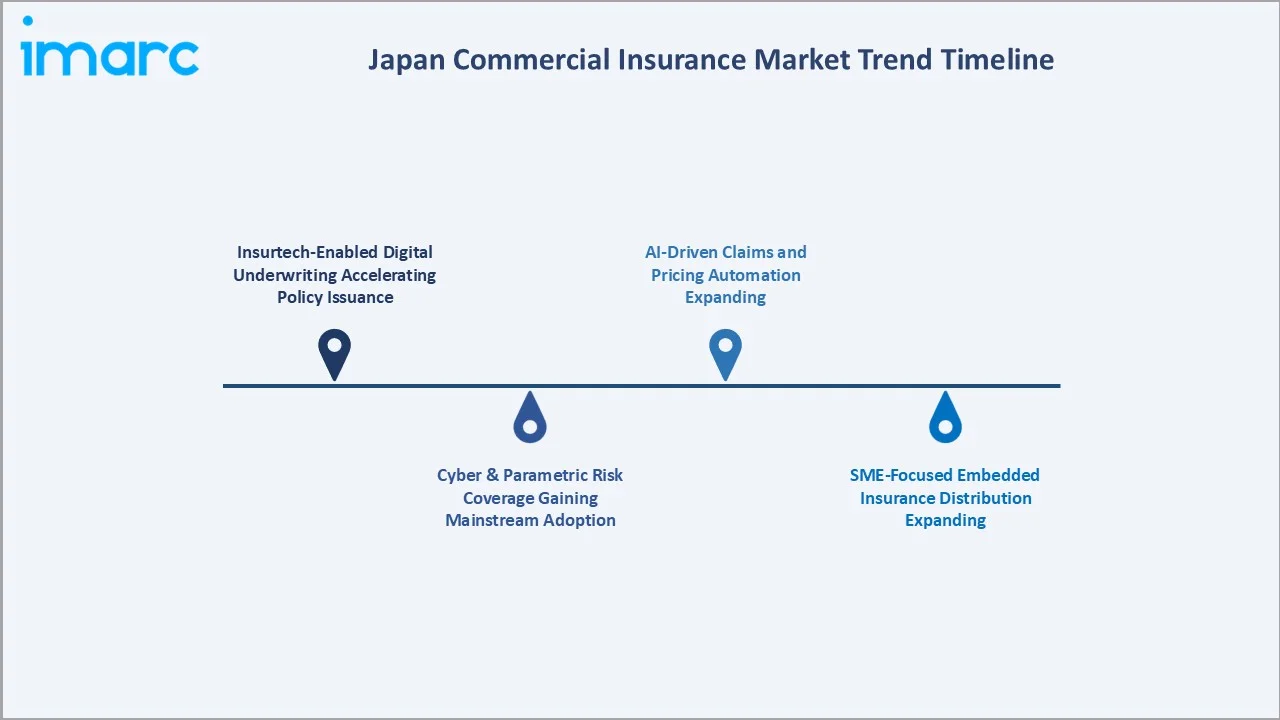
1. Insurtech-Enabled Digital Underwriting Accelerating Policy Issuance
Insurtech platforms are digitising application, pricing, and issuance workflows, cutting turnaround from weeks to days. Insurers are partnering with technology providers to launch application programming interface-based underwriting for SME property and liability policies.
2. Cyber and Parametric Risk Coverage Gaining Mainstream Adoption
Insurers are broadening cyber-liability and parametric catastrophe products, combining sensor-based triggers with rapid payout structures. This is reducing claims-settlement time and appealing to manufacturing and logistics firms exposed to supply-chain disruption.
3. AI-Driven Claims and Pricing Automation Expanding
Machine-learning models are automating claims triage, fraud detection, and dynamic pricing. Insurers report faster settlement cycles and improved loss-ratio accuracy, encouraging continued investment in artificial-intelligence-based underwriting infrastructure.
4. SME-Focused Embedded Insurance Distribution Expanding
Banks, leasing companies, and e-commerce platforms are embedding commercial insurance at the point of transaction, simplifying purchase for small businesses and creating new low-cost distribution channels for insurers nationwide.
Industry Value Chain Analysis
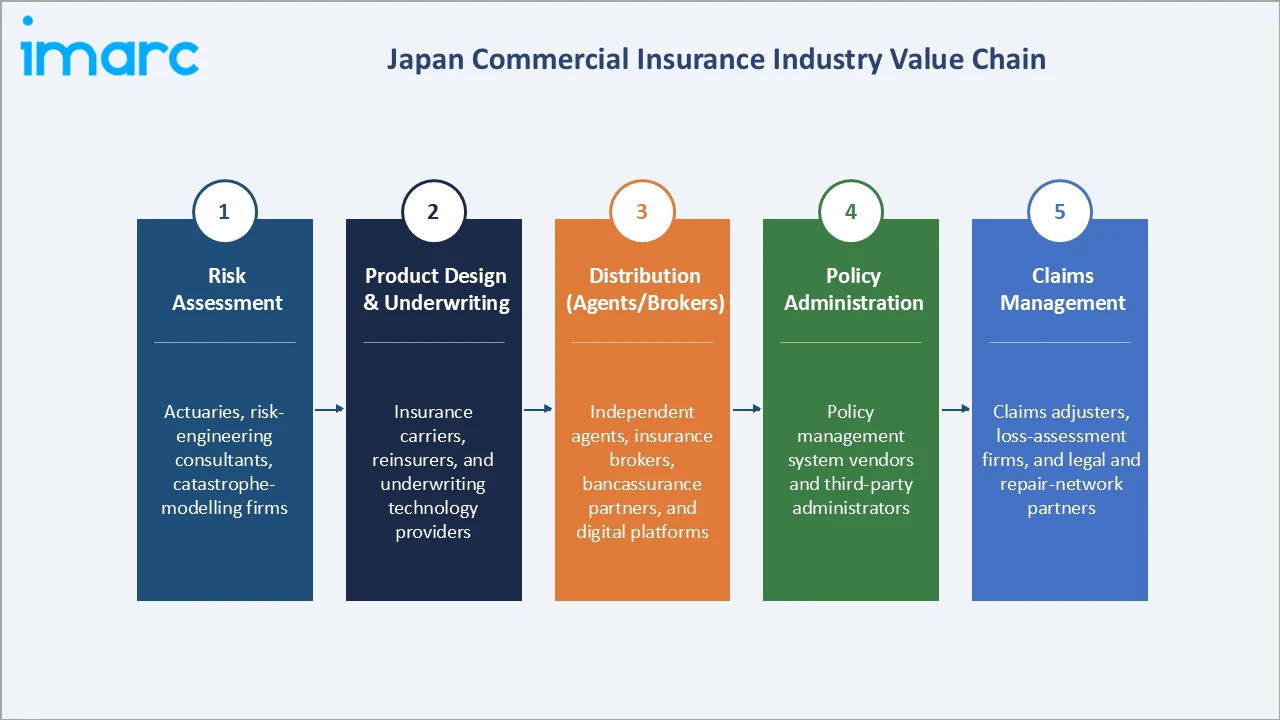
The Japan commercial insurance value chain integrates risk assessment, product design and underwriting, distribution through agents and brokers, policy administration, and claims management.
|
Stage |
Key Participants |
|
Risk Assessment |
Actuaries, risk-engineering consultants, catastrophe-modelling firms |
|
Product Design & Underwriting |
Insurance carriers, reinsurers, underwriting technology providers |
|
Distribution (Agents/Brokers) |
Independent agents, insurance brokers, bancassurance partners, digital platforms |
|
Policy Administration |
Policy management system vendors, third-party administrators |
|
Claims Management |
Claims adjusters, loss-assessment firms, legal and repair-network partners |
The underwriting and product design stage is the value chain's most technically complex and commercially differentiated phase, where actuarial pricing models and catastrophe risk modelling determine risk-adjusted profitability. Claims management technology sustains the policyholder trust and renewal retention that Japanese commercial insurers depend on for recurring premium revenue.
Technology Landscape in the Japan Commercial Insurance Industry
AI-Based Underwriting and Risk Pricing
AI-based underwriting platforms analyse historical loss data, satellite imagery, and IoT sensor feeds to price commercial risk more precisely, enabling insurers to offer usage-based and dynamically priced policies.
Telematics and IoT Risk Monitoring
Telematics devices and IoT sensors installed in commercial fleets and facilities provide real-time risk data, helping insurers reduce loss frequency and reward policyholders with proactive risk-management practices.
Parametric and Blockchain-Based Claims Settlement
Parametric triggers combined with blockchain-based smart contracts are enabling instant, transparent claims payouts for catastrophe events, reducing administrative overhead and improving policyholder trust.
Market Segmentation Analysis
The report covers the following segments:
|
Segment Category |
Leading Segment |
Market Share |
Year |
|
Type |
Commercial Property Insurance |
31.6% |
2025 |
|
Enterprise Size |
Large Enterprises |
62.4% |
2025 |
|
Distribution Channel |
🔒 |
🔒 |
2025 |
|
Industry Vertical |
🔒 |
🔒 |
2025 |
|
Region |
Kanto Region |
36.4% |
2025 |

By Type
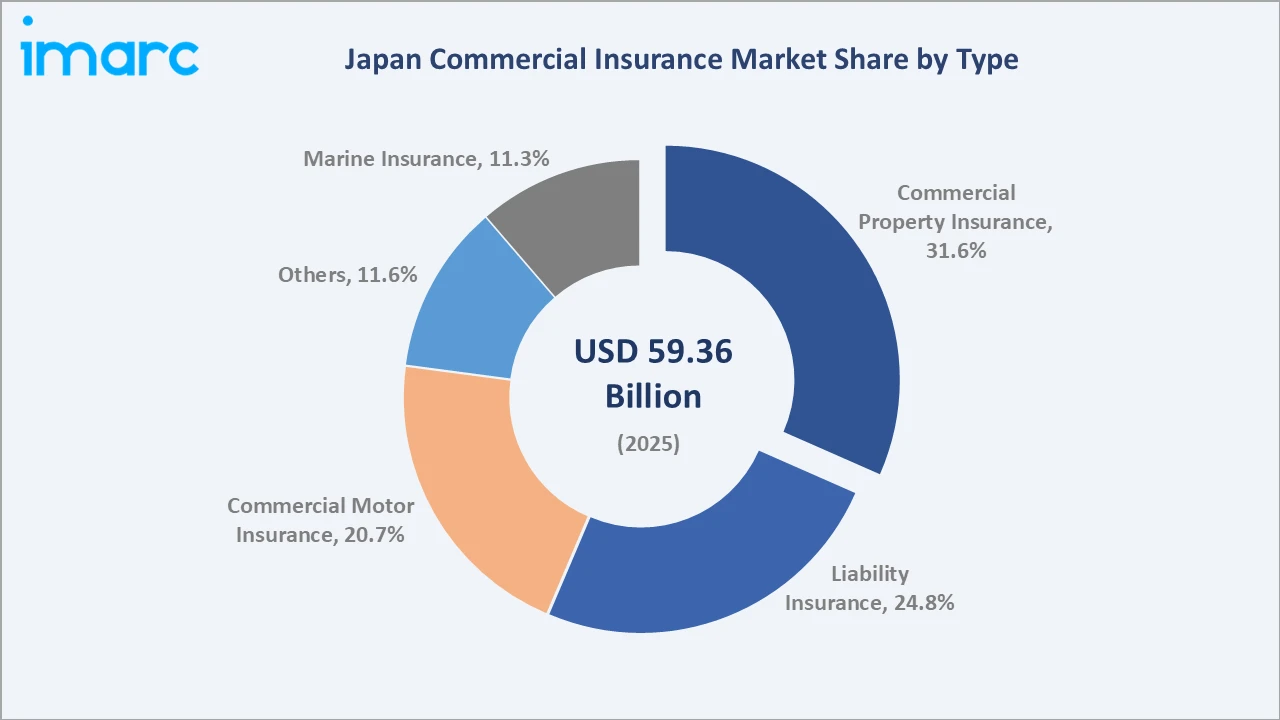
Commercial Property Insurance leads at 31.6% (2025). The commercial property insurance segment encompasses fire and allied-perils cover, earthquake and catastrophe insurance, machinery breakdown insurance, and business-interruption insurance protecting buildings, inventory, and equipment. Commercial Property Insurance's ~8.4% CAGR reflects sustained investment in catastrophe-risk protection amid rising natural-disaster exposure.
To access detailed market analysis, Request Sample
Liability Insurance at 24.8% grows at ~9.1% CAGR through rising litigation exposure and expanding product-liability and directors'-and-officers' coverage demand among exporters and listed companies.
Commercial Motor Insurance at 20.7% grows at ~6.8% CAGR through fleet and logistics-sector expansion nationwide.
Marine Insurance at 11.3% grows at ~7.5% CAGR, supported by Japan's export-oriented shipping and cargo trade. Others at 11.6% grows fastest at ~10.5% CAGR, encompassing cyber-liability, trade-credit, and specialty engineering insurance products.
By Enterprise Size
Large Enterprises lead at 62.4% (2025). The large-enterprise segment encompasses multinational corporations, listed companies, and industrial conglomerates purchasing multi-line property, liability, and directors'-and-officers' insurance programs.
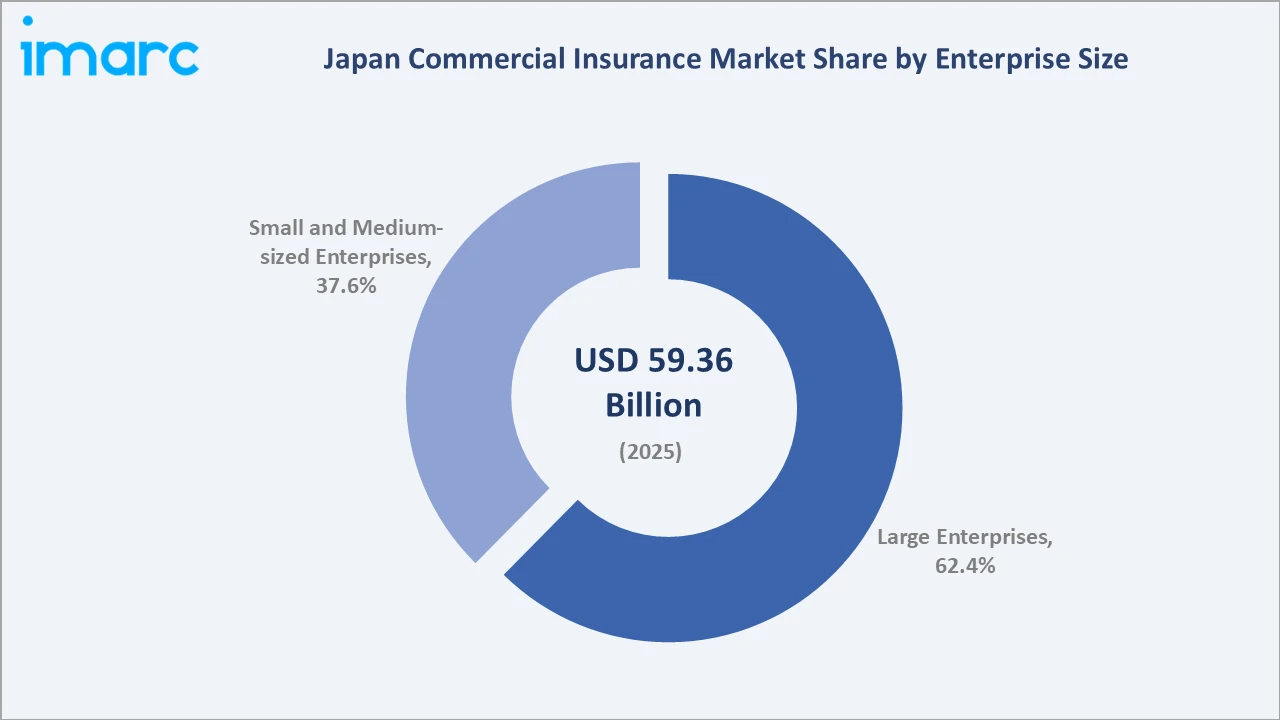
Small and Medium-sized Enterprises at 37.6% grow at ~9.3% CAGR, above the overall market rate, through embedded-insurance distribution and digital underwriting platforms that are simplifying policy purchase for smaller commercial policyholders nationwide.
Regional Market Insights
|
Region |
Share (2025) |
Key Commercial Insurance Market Drivers & Characteristics |
|
Kanto Region |
36.4% |
Driven by Tokyo's concentration of corporate headquarters, financial institutions, and industrial parks requiring multi-line commercial coverage. |
|
Kansai/Kinki Region |
18.2% |
Supported by Osaka's manufacturing and trading hubs and rising demand for property and marine cargo insurance. |
|
Central/Chubu Region |
15.1% |
Anchored by Nagoya's automotive and machinery manufacturing base, driving liability and commercial motor insurance demand. |
|
Kyushu-Okinawa Region |
8.7% |
Growing through semiconductor and agricultural manufacturing investment, increasing property and business-interruption coverage needs. |
|
Hokkaido Region |
7.1% |
Driven by agriculture, tourism, and food-processing industries requiring property and liability protection. |
|
Tohoku Region |
5.8% |
Supported by post-disaster reconstruction investment sustaining demand for property and catastrophe insurance. |
|
Chugoku Region |
4.9% |
Backed by shipbuilding and heavy-industry clusters driving marine and commercial property insurance uptake. |
|
Shikoku Region |
3.8% |
Smallest regional share, supported by paper, chemical, and marine-transport industry insurance demand. |
Kanto's 36.4% leadership is anchored by Tokyo's dual role as Japan's corporate and financial capital. Kansai/Kinki's 18.2% reflects Osaka's manufacturing and trading concentration and export-oriented marine insurance demand.
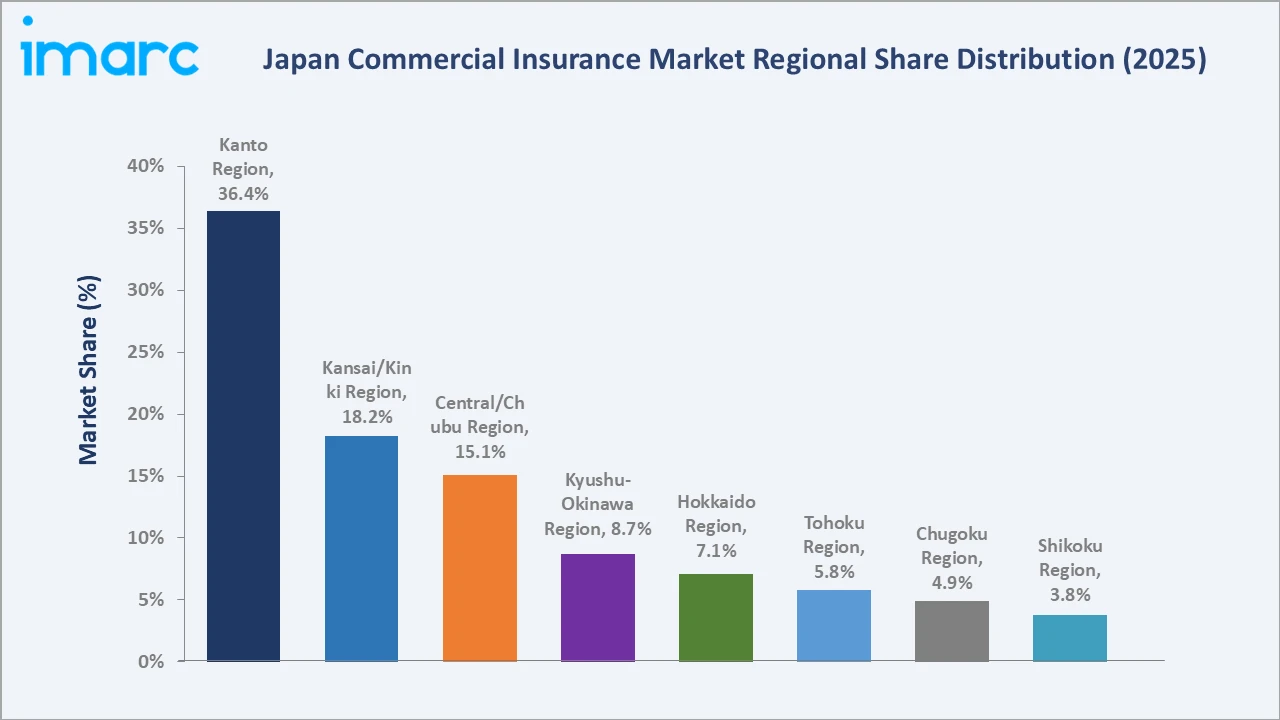
Central/Chubu's 15.1% is underpinned by Nagoya's automotive manufacturing cluster, while Kyushu-Okinawa, at 8.7%, is the most dynamic growth region through expanding semiconductor and logistics investment.
Competitive Landscape
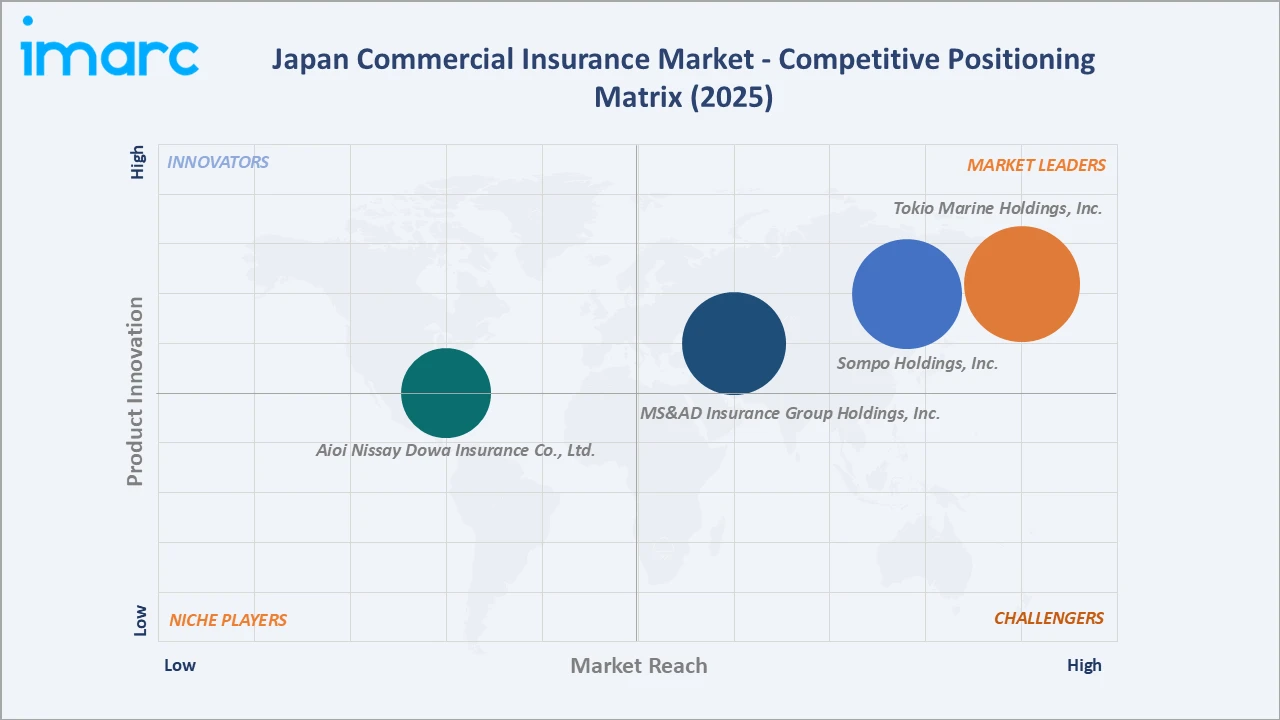
The Japan commercial insurance market competitive landscape encompasses distinct tiers: domestic insurance conglomerates, international specialty carriers, and digitally-focused insurtech-partnered underwriters competing across property, liability, motor, and marine lines.
|
Company Name |
Key Products |
Market Position |
Core Strength |
|
Tokio Marine Holdings, Inc. |
Commercial property, marine cargo and hull |
Market Leader |
Broad multi-line commercial coverage, strong reinsurance capacity, and advanced catastrophe-risk modelling capabilities. |
|
MS&AD Insurance Group Holdings, Inc. |
Commercial property, marine insurance |
Market Leader |
Extensive agent and broker network with integrated risk-consulting and international commercial insurance services. |
|
Sompo Holdings, Inc. |
Commercial property, Cyber and Network Risk |
Market Leader |
Strong digital underwriting platform and diversified property, liability, and specialty insurance portfolio. |
|
Aioi Nissay Dowa Insurance Co., Ltd. |
Automobile insurance/ |
Established Player |
Deep expertise in commercial motor and fleet insurance supported by telematics-based risk assessment. |
Domestic conglomerate concentration sustains competitive advantage through nationwide branch networks and long-standing corporate relationships. Consolidation reflects customer preference for integrated multi-line insurers reducing coordination complexity across risk categories.
Key Company Profiles
Tokio Marine Holdings, Inc.
Tokio Marine Holdings is a leading provider of commercial property, liability, and specialty insurance in Japan, offering integrated risk-consulting and multinational corporate insurance programs.
- Key Products: Commercial property, general liability, marine cargo, and specialty cyber-liability insurance.
- Recent Developments: In 2026, Tokio Marine agreed a strategic partnership with Berkshire Hathaway, which plans to acquire a 2.5% equity stake for approximately USD 1.8 billion; the insurer also partnered with OpenAI to build AI agents for product planning and customer service, and completed its USD 970 million acquisition of Commodity & Ingredient Hedging LLC in February 2026.
- Strategic Focus: Centred on catastrophe-risk modelling, digital underwriting, and international expansion of commercial insurance capacity.
MS&AD Insurance Group Holdings, Inc.
MS&AD Insurance Group is a prominent commercial insurer offering property, liability, and motor coverage through an extensive nationwide agent and broker distribution network.
- Key Products: Commercial property insurance, liability insurance, fleet and commercial motor insurance.
- Recent Developments: In February 2026, MS&AD announced it will merge its two main domestic non-life insurers, Mitsui Sumitomo Insurance and Aioi Nissay Dowa Insurance, into a single entity effective around April 2027, with the holding company renamed Mitsui Sumitomo Insurance Group; the group also adopted IFRS reporting for the year ended March 2026, alongside record adjusted profit.
- Strategic Focus: Focused on digital distribution, SME-tailored products, and integrated risk-consulting services.
Sompo Holdings, Inc.
Sompo Holdings provides diversified commercial insurance solutions, combining property, liability, and specialty coverage with data-driven underwriting and claims-automation capabilities.
- Key Products: Commercial property, liability, cyber-liability, and business-interruption insurance.
- Recent Developments: In February 2026, Sompo completed its USD 3.5 billion acquisition of Aspen Insurance Holdings, taking the specialty reinsurer private and expanding Sompo's global underwriting and Lloyd's syndicate access; the group also reported record full-year net income in May 2026 alongside a new share buyback programme.
- Strategic Focus: Centred on digital transformation, specialty-line expansion, and data-driven risk pricing.
Market Concentration Analysis
The Japan commercial insurance market is moderately concentrated, with the top three domestic conglomerates collectively holding a substantial share of total premium volume. International specialty carriers compete in niche liability and cyber segments, while consolidation among mid-tier insurers continues through partnership and technology-driven distribution agreements.
Investment & Growth Opportunities
Highest Growth Segments
Cyber and specialty liability insurance (~10.5% CAGR), SME-focused commercial insurance (~9.3% CAGR), and parametric catastrophe products represent the highest-growth investment vectors in the Japan commercial insurance market through 2034.
Emerging Investment Opportunities
Insurtech partnerships enabling embedded SME insurance distribution represent the largest near-term opportunity. Insurers establishing digital underwriting and API-based distribution capability are positioned for above-market premium growth as SME adoption accelerates.
Investment Themes
- Parametric Disaster Insurance Platform Development: Insurers investing in sensor-based parametric triggers for earthquake and typhoon coverage can capture faster-growing catastrophe-insurance demand while reducing claims-processing costs.
- AI-Driven Underwriting for SME Segments: Cloud-based AI underwriting platforms enable insurers to profitably serve small and medium-sized enterprises, creating scalable, recurring premium revenue as SME adoption expands.
Future Market Outlook (2026-2034)
The Japan commercial insurance market is projected to grow from USD 59.36 Billion in 2025 to USD 122.27 Billion by 2034, delivering an 8.36% CAGR. The market's anchor value of USD 88.68 Billion in 2030 reflects sustained regulatory-driven and technology-enabled expansion.
Three structural forces define growth through 2034: escalating natural-disaster and cyber risk sustaining demand-side momentum, regulatory reform strengthening solvency and disclosure standards, and insurtech-enabled underwriting making commercial coverage increasingly accessible to SMEs nationwide.
Research Methodology
Primary Research
Primary research comprised structured interviews with 45+ industry stakeholders, including underwriting directors, risk-management heads, insurtech executives, and regional insurance brokers across Japan.
Secondary Research
Secondary research encompassed regulatory filings, insurer annual reports, Financial Services Agency publications, and industry association statistics. Over 55 secondary sources were reviewed.
Forecasting Models
Market revenue forecasts were developed using a segment bottom-up model covering type, enterprise size, distribution channel, and industry vertical components.
Japan Commercial Insurance Market Report Coverage:
| Report Features | Details |
|---|---|
| Base Year of the Analysis | 2025 |
| Historical Period | 2020-2025 |
| Forecast Period | 2026-2034 |
| Units | Billion USD |
| Scope of the Report | Exploration of Historical and Forecast Trends, Industry Catalysts and Challenges, Segment-Wise Historical and Predictive Market Assessment:
|
| Types Covered | Liability Insurance, Commercial Motor Insurance, Commercial Property Insurance, Marine Insurance, Others |
| Enterprise Sizes Covered | Large Enterprises, Small and Medium-sized Enterprises |
| Distribution Channels Covered | Agents and Brokers, Direct Response, Others |
| Industry Verticals Covered | Transportation and Logistics, Manufacturing, Construction, IT and Telecom, Healthcare, Energy and Utilities, Others |
| Regions Covered | Kanto Region, Kansai/Kinki Region, Central/ Chubu Region, Kyushu-Okinawa Region, Tohoku Region, Chugoku Region, Hokkaido Region, Shikoku Region |
| Companies Covered | Tokio Marine Holdings Inc., MS&AD Insurance Group Holdings Inc., Sompo Holdings Inc., Aioi Nissay Dowa Insurance Co. Ltd., etc. |
| Customization Scope | 10% Free Customization |
| Post-Sale Analyst Support | 10-12 Weeks |
| Delivery Format | PDF and Excel through Email (We can also provide the editable version of the report in PPT/Word format on special request |
Key Benefits for Stakeholders:
- IMARC’s industry report offers a comprehensive quantitative analysis of various market segments, historical and current market trends, market forecasts, and dynamics of the Japan commercial insurance market from 2020-2034.
- The research report provides the latest information on the market drivers, challenges, and opportunities in the Japan commercial insurance market.
- Porter's five forces analysis assist stakeholders in assessing the impact of new entrants, competitive rivalry, supplier power, buyer power, and the threat of substitution. It helps stakeholders to analyze the level of competition within the Japan commercial insurance industry and its attractiveness.
- Competitive landscape allows stakeholders to understand their competitive environment and provides an insight into the current positions of key players in the market.
Frequently Asked Questions About the Japan Commercial Insurance Market Report
The Japan commercial insurance market reached USD 59.36 Billion in 2025, driven by rising business-risk awareness, regulatory reform, and technology-driven underwriting.
The market is projected to grow at a CAGR of 8.36% during 2026-2034, reaching USD 122.27 Billion by 2034.
Commercial Property Insurance leads at 31.6% through Japan's exposure to earthquakes, typhoons, and flooding, driving strong asset-protection demand.
Large Enterprises lead at 62.4% through complex multi-site operations and mandatory liability and property insurance programs.
The Kanto Region leads at 36.4% through Tokyo's concentration of corporate headquarters and financial institutions.
Leading companies include Tokio Marine Holdings, Inc., MS&AD Insurance Group Holdings, Inc., Sompo Holdings, Inc. and Aioi Nissay Dowa Insurance Co., Ltd. among others.
The market is projected to reach approximately USD 88.68 Billion by 2030, supported by continued regulatory and technology-driven growth.
Need more help?
- Speak to our experienced analysts for insights on the current market scenarios.
- Include additional segments and countries to customize the report as per your requirement.
- Gain an unparalleled competitive advantage in your domain by understanding how to utilize the report and positively impacting your operations and revenue.
- For further assistance, please connect with our analysts.
 Request Customization
 Speak to an Analyst
 Request Brochure
 Inquire Before Buying
Benefits of Customization
- Personalize this research
- Triangulate with your data
- Get data as per your format and definition
- Gain a deeper dive into a specific application, geography, customer, or competitor
- Any level of personalization
Get in Touch With Us
UNITED STATES
Phone: +1-201-971-6302
INDIA
Phone: +91-120-433-0800
UNITED KINGDOM
Phone: +44-753-714-6104
Email: [email protected]
Client Testimonials




.webp)




.webp)













Related Reports

Choose your plan
*Please note that the prices mentioned below are starting prices for each bundle type. Kindly contact our team for further details.*
Single User License
- 1 User License, Access on 2 Devices
- PDF Report + Excel Dataset (Password Protected)
- Lifetime Access
- No Printing Rights
- 10% Free Report Customization
- 10–12 Weeks of Analyst Support
Five User License
- Access for 5 Users, 2 Devices per User
- PDF Report + Excel Dataset (Password Protected)
- Lifetime Access
- Dedicated Account Manager
- 12–14 Weeks of Analyst Support
- No Printing Rights
- 15% Free Report Customization
- 25% Discount on Your Next Purchase
Corporate User License
- Unlimited User Access (Within Your Organization)
- PDF Report + Excel Dataset
- Lifetime Access
- Dedicated Account Manager
- 14–20 Weeks of Analyst Support
- No Printing Rights
- 20% Free Report Customization
- 30% Discount on Your Next Purchase
Essential Insights
What's included:
3 reports
- Lifetime Access
- PDF Reports
- Excel Datasets
- 2 Weeks of Free Analyst Support
- 2 User Licenses
- Access on 2 Devices
- Printing Rights
- Complimentary PowerPoint (PPT) Version
- Complimentary License Upgrade
Professional Access
What's included:
5 reports
- Lifetime Access
- PDF Reports
- Excel Datasets
- 8 Weeks of Free Analyst Support
- 2 User Licenses
- Access on 2 Devices
- Printing Rights
- Complimentary PowerPoint (PPT) Version
- Complimentary License Upgrade
Business Advantage
What's included:
8 reports
- Lifetime Access
- PDF Reports
- Excel Datasets
- 14 Weeks of Free Analyst Support
- 2 User Licenses
- Access on 2 Devices
- Printing Rights
- Complimentary PowerPoint (PPT) Version
- Complimentary License Upgrade
Enterprise Intelligence
What's included:
10 reports
- Lifetime Access
- PDF Reports
- Excel Datasets
- 20 Weeks of Free Analyst Support
- 2 User Licenses
- Access on 2 Devices
- Printing Rights
- Complimentary PowerPoint (PPT) Version
- Complimentary License Upgrade