
Japan Digital OOH Advertising Market Size, Share, Trends and Forecast by Format Type, Application, End Use Industry, and Region, 2026-2034
Japan Digital OOH Advertising Market Size, Share, Trends & Forecast (2026-2034)
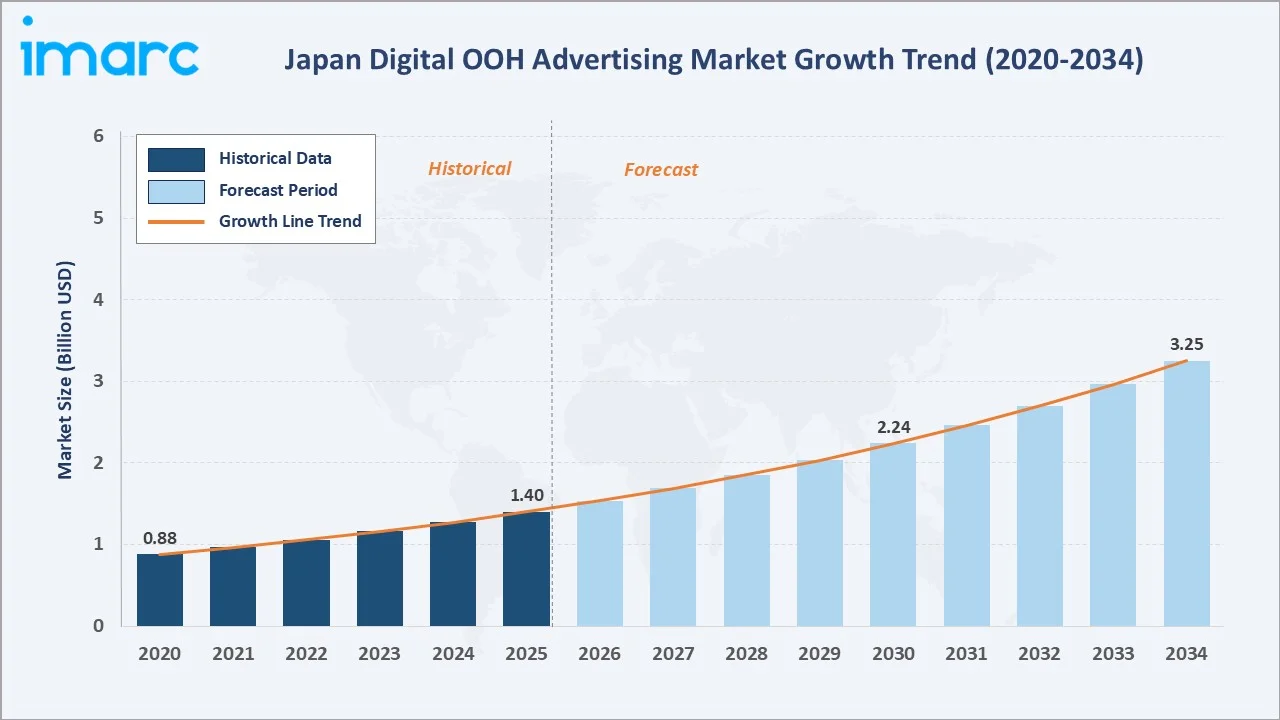
The Japan digital OOH advertising market was valued at USD 1.40 Billion in 2025 and is projected to reach USD 3.25 Billion by 2034, exhibiting a CAGR of 9.79% during 2026-2034. Japan's accelerating smart city programs and widespread rollout of high-resolution digital display infrastructure across transit hubs, retail environments, and urban landmarks are the primary drivers shaping the market.
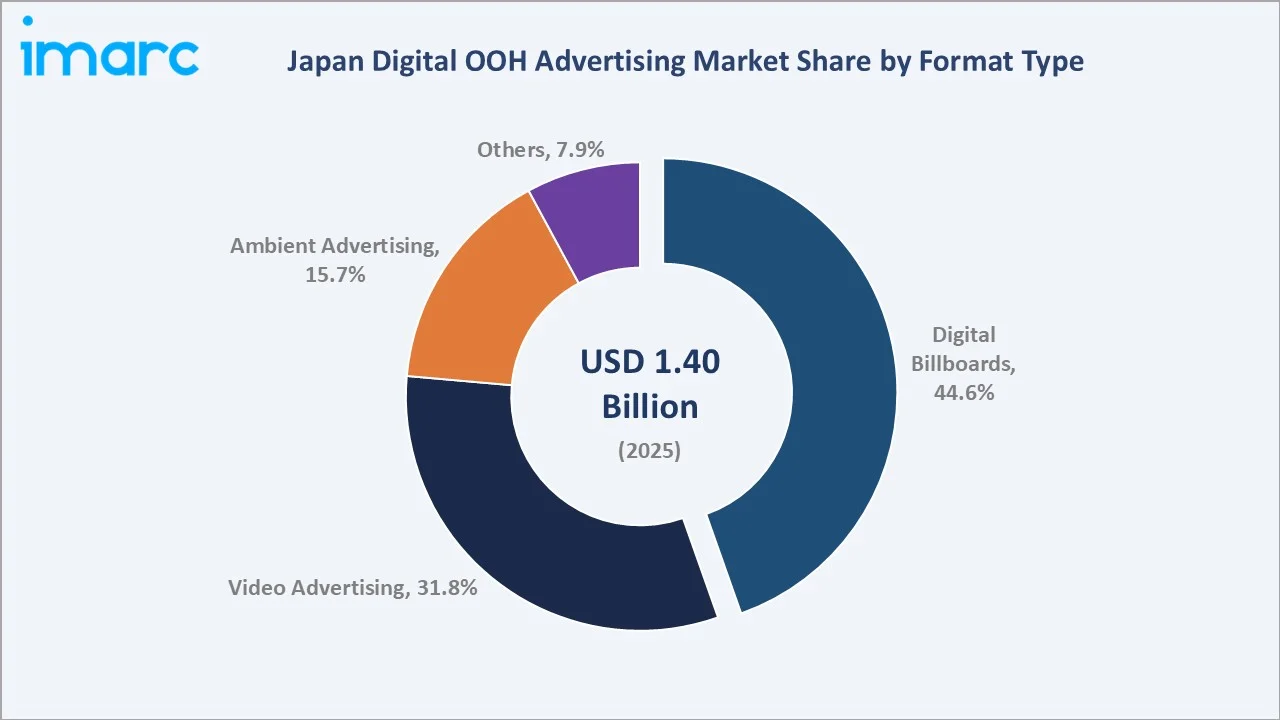
Digital billboards lead the format type segment at 44.6%, outdoor commands 63.4% of the application segment, and Kanto Region dominates at 39.5% regional share.
Market Snapshot
|
Metric |
Value |
|
Market Size (2025) |
USD 1.40 Billion |
|
Forecast Market Size (2034) |
USD 3.25 Billion |
|
CAGR (2026-2034) |
9.79% |
|
Base Year |
2025 |
|
Historical Period |
2020-2025 |
|
Forecast Period |
2026-2034 |
|
Largest Region |
Kanto Region (39.5%, 2025) |
|
Second Largest Region |
Kansai/Kinki Region (18.6%, 2025) |
|
Leading Format Type |
Digital Billboards (44.6%, 2025) |
|
Leading Application |
Outdoor (63.4%, 2025) |
The Japan digital OOH advertising market grew from USD 0.88 Billion in 2020 to USD 1.40 Billion in 2025. Rising government investment in smart city digital infrastructure, expanding transit network modernization, and deepening adoption of programmatic digital OOH platforms by major advertisers have collectively sustained this growth trajectory. Anchored at USD 2.24 Billion in 2030, the forecast to USD 3.25 Billion by 2034 reflects continued expansion in data-driven audience targeting, interactive display technology, and cross-channel media integration.
To get more information on this market, Request Sample
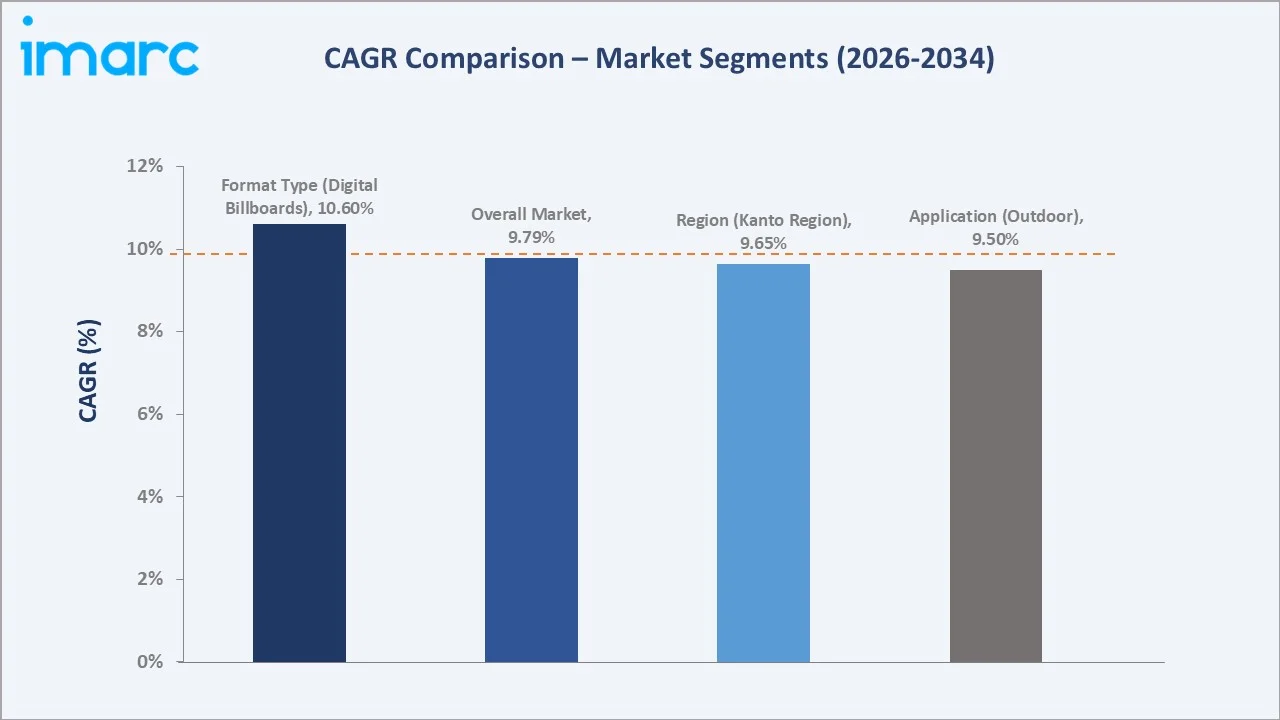
CAGR trajectories across format type, application, and regional sub-segments show video advertising and indoor expanding well above the overall 9.79% market CAGR. Kyushu-Okinawa Region records the fastest regional growth, driven by rising tourism-led demand, expanding retail digital display networks, and increasing adoption of digital OOH advertising.
Executive Summary
The Japan digital OOH advertising market is on a sustained growth trajectory from USD 0.88 Billion in 2020 to USD 3.25 Billion by 2034. The sector has evolved from static display infrastructure to a fully networked, programmatically enabled ecosystem. Advanced LED technologies and real-time audience analytics are enabling advertisers to deliver location-relevant, contextually dynamic campaigns across Japan's dense urban transit, retail, and entertainment environments.
Digital billboards command 44.6% format type share in 2025, driven by high visibility, real-time content switching capabilities, and premium placement across major transit hubs and commercial thoroughfares. Based on application, outdoor leads at 63.4%, supported by the extensive deployment of large-format digital displays across expressways, train stations, and urban commercial zones. Kanto Region maintains 39.5% of the total regional market share, anchored by Tokyo's world-class transit infrastructure and a high concentration of premium digital OOH inventory in the country.
Key Market Insights
|
Insight |
Data |
|
Leading Format Type |
Digital Billboards – 44.6% share (2025) |
|
Second Largest Format Type |
Video Advertising – 31.8% share (2025) |
|
Leading Application |
Outdoor – 63.4% share (2025) |
|
Second Largest Application |
Indoor – 36.6% share (2025) |
|
Leading Region |
Kanto Region – 39.5% share (2025) |
|
Second Largest Region |
Kansai/Kinki Region – 18.6% share (2025) |
|
Top Companies |
Dentsu Group Inc., Hakuhodo DY Holdings Inc., East Japan Railway Company, Tokyo Metro Co., Ltd., JCDecaux SE |
Key Analytical Observations Expanding On The Data Above:
- Digital billboards at 44.6% lead the format type segment, supported by rapid modernization of transit and urban commercial zones, where high-brightness LED boards enable 24/7 dynamic content delivery across Japan's densely trafficked infrastructure corridors.
- Video advertising at 31.8% is expanding rapidly as brands invest in high-definition motion content for premium placements in transit concourses, retail malls, and entertainment precincts, leveraging improved streaming infrastructure and lower display operating costs.
- Outdoor at 63.4% dominates given the deep penetration of digital OOH formats across expressways, railway stations, and public plazas, where high footfall density and dwell time deliver superior audience engagement metrics compared to indoor equivalents.
- Indoor share at 36.6% is growing steadily, driven by the expansion of digital display networks within shopping centers, airports, hospitals, and corporate environments, where targeted audience profiles enable precision advertising for retail and service-sector brands.
- Kanto Region at 39.5% maintains market leadership, driven by dense commercial activity, extensive transit networks, and strong advertiser demand across premium digital OOH locations.
Japan Digital OOH Advertising Market Overview
Digital OOH advertising refers to digitally enabled display advertising placed in public environments outside the home, including transit stations, roadside billboards, retail malls, airports, sports venues, and entertainment precincts. Unlike traditional static OOH, digital formats enable dynamic, real-time content management, audience-triggered contextual messaging, and programmatic buying through demand-side platforms.
Japan's advanced urban infrastructure, widespread 5G connectivity, and government-led smart city programs are creating a structurally favorable environment for digital OOH expansion. Macro factors including rising tourism, high urban population density, and a technologically sophisticated consumer base further reinforce the sector's growth potential through 2034.
Market Dynamics
To evaluate market opportunities, Request Sample
Market Drivers
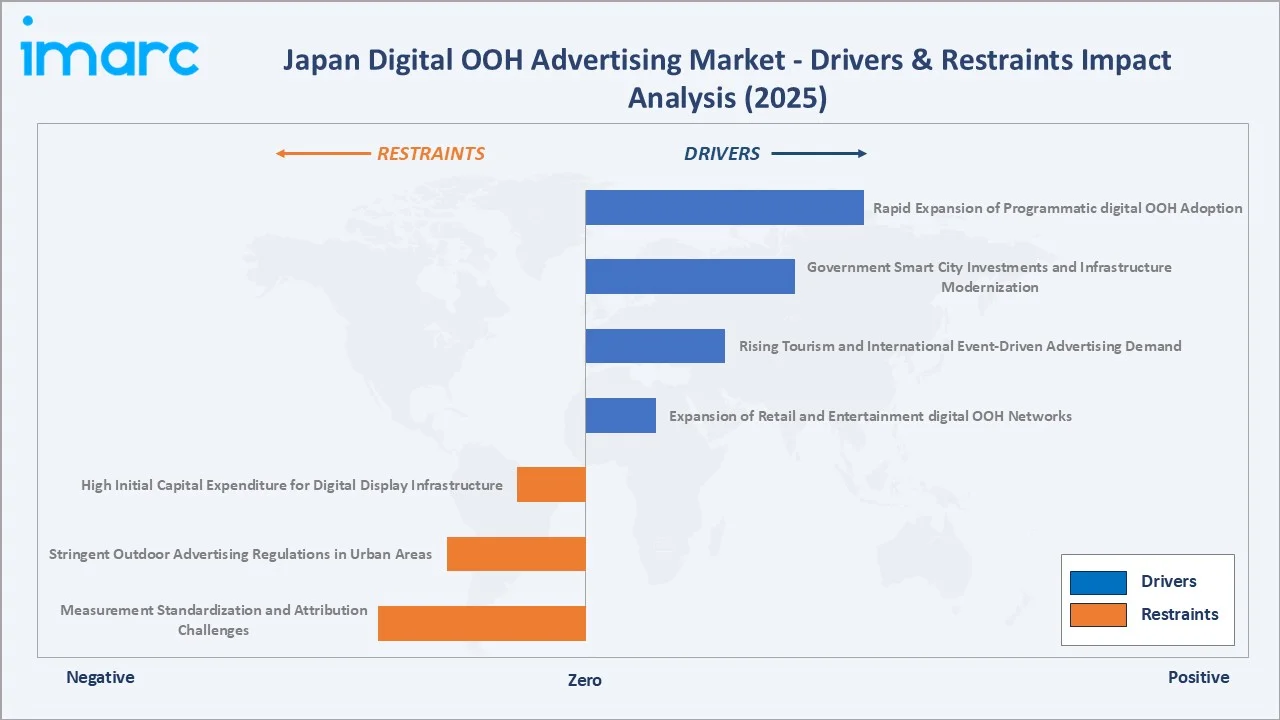
- Rapid Expansion of Programmatic Digital OOH Adoption: The shift to programmatic buying is fundamentally reshaping how digital OOH inventory is transacted in Japan. Advertisers are increasingly using demand-side platforms to buy audience-targeted digital OOH placements in real time, enabling dynamic creative optimization, audience-segment targeting, and cross-channel campaign integration.
- Government Smart City Investments and Infrastructure Modernization: Japan's national smart city agenda and Digital Transformation strategy are directly funding the modernization of public digital display infrastructure across municipalities. As per IMARC Group, the Japan smart cities market size reached USD 96.4 Billion in 2025. Transit network operators, airport authorities, and urban development bodies are systematically replacing static signage with networked digital displays, expanding the total available digital OOH inventory.
- Rising Tourism and International Event-Driven Advertising Demand: Japan's record-breaking inbound tourism recovery, with visitor arrivals exceeding 36.9 Million in 2024, is generating sustained demand for multilingual, location-specific digital OOH campaigns targeting international travelers at airports, train stations, tourist destinations, and hospitality zones.
- Expansion of Retail and Entertainment Digital OOH Networks: The expansion of indoor digital OOH in department stores, shopping malls, theme parks, and sports arenas is broadening the addressable inventory base and enabling precision targeting for consumer goods, fashion, and entertainment advertisers.
Market Restraints
- High Initial Capital Expenditure for Digital Display Infrastructure: The capital-intensive nature of digital OOH infrastructure deployment remains a meaningful barrier for smaller media owners and municipal operators. The high cost of large-format LED displays, digital content management systems, and ongoing maintenance creates significant upfront investment requirements that can constrain network expansion timelines.
- Stringent Outdoor Advertising Regulations in Urban Areas: Japan's municipal and prefectural governments maintain strict regulations governing outdoor advertising, including restrictions on display brightness, content standards, and permitted locations. This limits addressable inventory expansion in premium urban locations.
- Measurement Standardization and Attribution Challenges: Despite advances in sensor-based audience measurement, the absence of unified, cross-platform digital OOH audience measurement standards creates challenges for advertisers comparing digital OOH with digital and broadcast media on common metrics.
Market Opportunities
- AI-Driven Dynamic Content and Personalized Audience Targeting: Advances in AI, computer vision, and real-time data integration are enabling digital OOH operators to deliver dynamically personalized content based on audience demographics, behavioral profiles, weather conditions, and time-of-day signals.
- Cross-Channel Integration with Mobile and Social Media: The integration of digital OOH with mobile advertising platforms, social media campaigns, and connected TV ecosystems is enabling advertisers to create seamless multi-channel brand experiences.
Market Challenges
- Rising Energy Costs and Sustainability Compliance: Rising electricity costs and stricter sustainability requirements are increasing operating expenses and creating challenges for digital OOH advertising network operators.
- Content Piracy and Digital Security Risks: As digital OOH networks become increasingly networked and IP-connected, the risk of content hijacking, unauthorized access, and cybersecurity breaches becomes a material operational concern for media owners and operators.
Emerging Market Trends
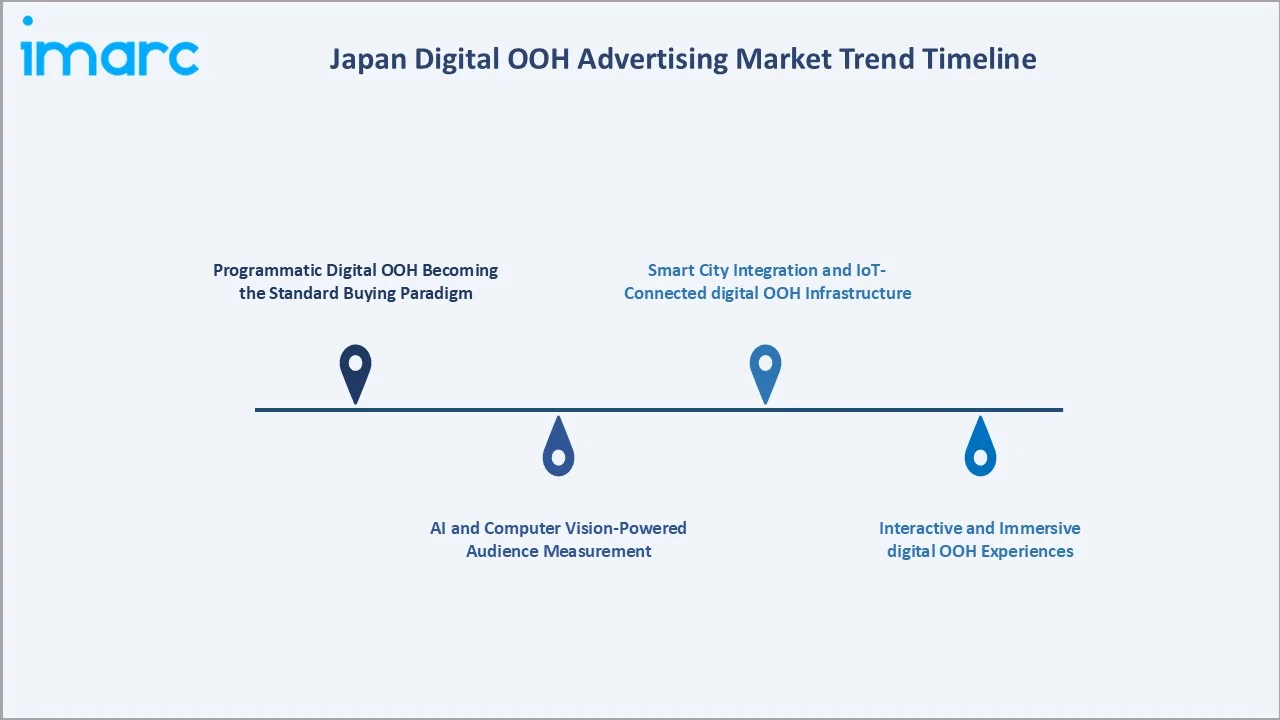
1. Programmatic Digital OOH Becoming the Standard Buying Paradigm
Programmatic buying is rapidly transitioning from a niche execution method to the default transaction model for premium digital OOH inventory in Japan. Real-time bidding, audience-data integration, and cross-channel campaign management through unified demand-side platforms are enabling advertisers to apply digital media buying precision to digital OOH placements.
2. AI and Computer Vision-Powered Audience Measurement
AI-powered computer vision systems embedded in digital OOH displays are enabling real-time, privacy-compliant audience counting, demographic profiling, and attention measurement without requiring individual identification. These technologies are enabling digital OOH operators to provide advertisers with verified audience delivery metrics comparable to digital media.
3. Interactive and Immersive Digital OOH Experiences
Japan's leadership in display technology innovation is accelerating the deployment of interactive, multi-sensory digital OOH installations in premium retail, transit, and entertainment environments. Augmented reality (AR) integrations, touch-responsive displays, and large-format 3D anamorphic LED installations are generating viral social media amplification alongside their direct audience engagement, extending the effective reach of individual digital OOH campaigns beyond their physical locations.
4. Smart City Integration and IoT-Connected Digital OOH Infrastructure
Digital OOH networks are increasingly being integrated into broader smart city IoT ecosystems, enabling real-time content adaptation based on live traffic conditions, public transport schedules, air quality data, and emergency alert systems.
Industry Value Chain Analysis
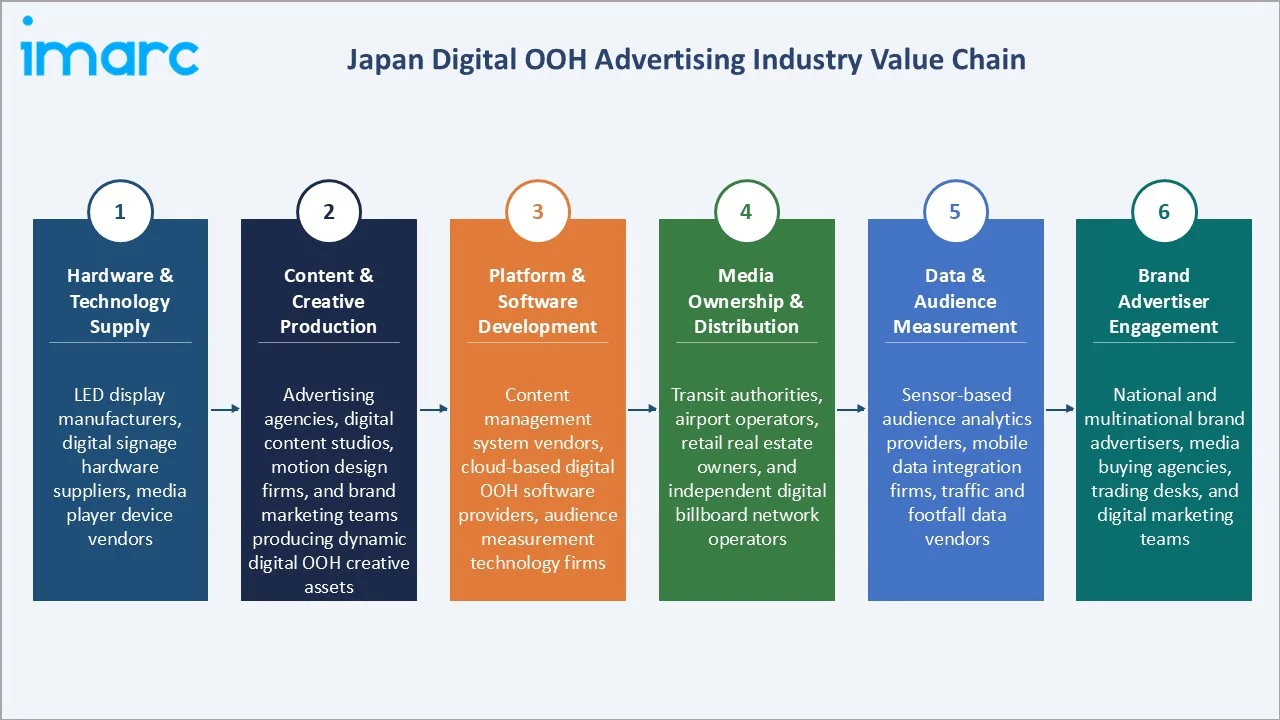
The Japan digital OOH advertising value chain spans six integrated stages from display hardware supply through end-user brand advertiser engagement. Platform software, programmatic technology, and data analytics capabilities capture the highest value-add in the current market environment, while media ownership and premium location control continue to determine fundamental competitive positioning for integrated operators.
|
Stage |
Key Players / Examples |
|
Hardware & Technology Supply |
LED display manufacturers, digital signage hardware suppliers, media player device vendors, and connectivity infrastructure providers enabling display network deployment |
|
Content & Creative Production |
Advertising agencies, digital content studios, motion design firms, and brand marketing teams producing dynamic digital OOH creative assets and campaign materials |
|
Platform & Software Development |
Content management system vendors, cloud-based digital OOH software providers, audience measurement technology firms, and programmatic DSP/SSP platform operators |
|
Media Ownership & Distribution |
Transit authorities, airport operators, retail real estate owners, outdoor media concession holders, and independent digital billboard network operators |
|
Data & Audience Measurement |
Sensor-based audience analytics providers, mobile data integration firms, traffic and footfall data vendors, and third-party audience verification and attribution specialists |
|
Brand Advertiser Engagement |
National and multinational brand advertisers, media buying agencies, trading desks, and digital marketing teams allocating digital OOH within integrated cross-channel campaign budgets |
Vertically integrated players, especially those owning proprietary technology stacks, original content management systems, and direct user relationships, are positioned to capture greater value than partners reliant on third-party infrastructure.
Technology Landscape in the Japan Digital OOH Advertising Industry
Advanced LED and Display Hardware Innovation
Japan's domestic display manufacturing ecosystem, supported by global leaders in LED and fine-pitch display technology, is enabling the deployment of higher-resolution, lower-power, and more weather-resistant digital outdoor displays. Micro-LED and mini-LED display panels are increasingly being adopted for premium indoor digital OOH installations, delivering superior color accuracy and energy efficiency.
AI, Computer Vision, and Sensor-Based Audience Analytics
Privacy-compliant AI computer vision systems embedded in or adjacent to digital OOH displays are enabling real-time audience counting, demographic attribute estimation, dwell time measurement, and attention-tracking analytics without individual identification.
5G Connectivity and Edge Computing for Real-Time Content Management
Japan's advanced 5G network rollout is enabling high-bandwidth, low-latency content delivery and management across geographically distributed digital OOH networks. Edge computing deployments are reducing content refresh latency for real-time contextual digital OOH campaigns.
Market Segmentation Analysis
The report covers the following segments:
|
Segment Category |
Leading Segment |
Market Share |
Year |
|
Format Type |
Digital Billboards |
44.6% |
2025 |
|
Application |
Outdoor |
63.4% |
2025 |
|
End Use Industry |
🔒 |
🔒 |
2025 |
|
Region |
Kanto Region |
39.5% |
2025 |

By Format Type
Digital billboards command 44.6% majority share in 2025, driven by their dominant presence across Japan's major transit corridors, expressways, and urban commercial zones. High-brightness LED technology, real-time content switching, and premium location positioning make digital billboards the preferred format for high-impact brand campaigns and time-sensitive promotional messaging.
To access detailed market analysis, Request Sample
Video advertising at 31.8% is the fastest-growing format type sub-segment, supported by expanding broadband infrastructure and falling video display production costs.
By Application
Outdoor leads at 63.4% in 2025, reflecting the extensive deployment of large-format digital displays across Japan's road and rail infrastructure, commercial real estate, and public spaces. High footfall density, long dwell times, and premium visibility across Japan's densely populated urban corridors deliver superior audience reach and frequency metrics for outdoor digital OOH formats.
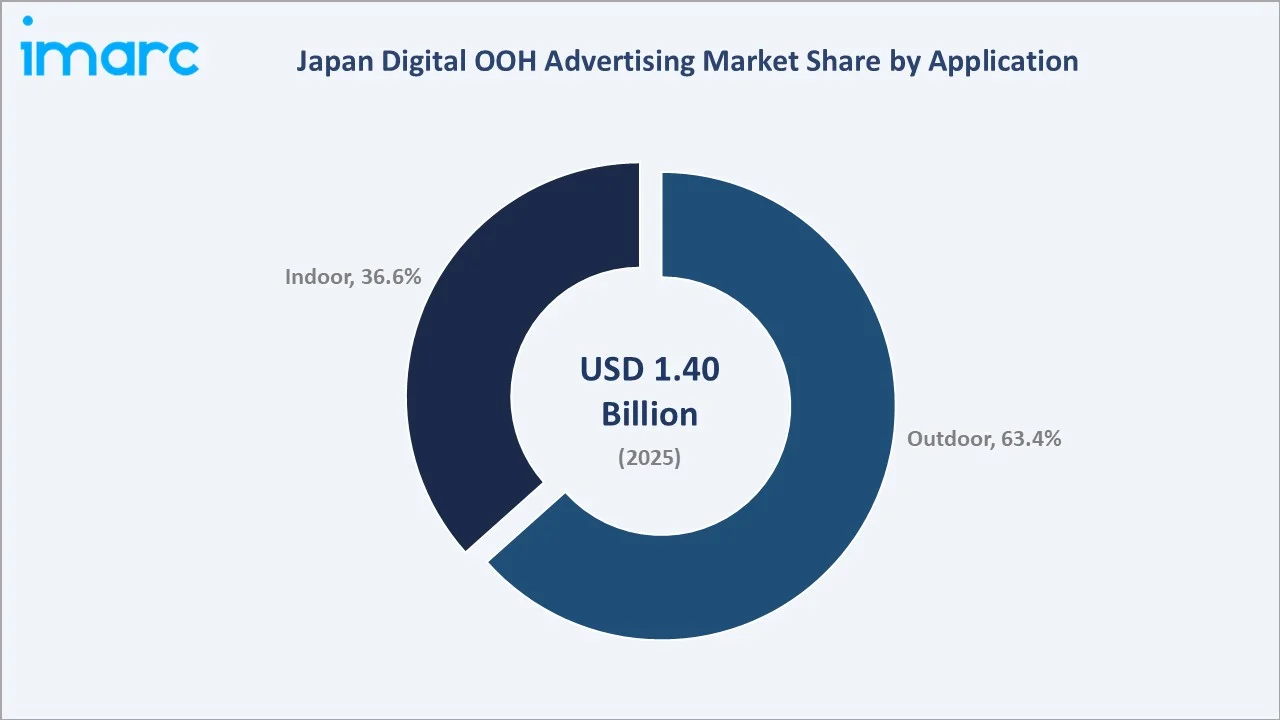
Indoor at 36.6% is growing at an above-average rate, driven by the systematic expansion of digital display networks within shopping malls, department stores, airports, hotels, hospitals, and corporate campuses.
Regional Market Insights
|
Region |
Share (2025) |
Key Growth Drivers |
|
Kanto Region |
39.5% |
High population density, Tokyo metro digital infrastructure, and dominant retail and transit advertising spend |
|
Kansai/Kinki Region |
18.6% |
Strong commercial activity in Osaka and Kyoto, expanding smart city initiatives, and high footfall in retail and entertainment zones |
|
Central/Chubu Region |
14.7% |
Manufacturing hub transit advertising, Nagoya urban expansion, and growing investment in programmatic outdoor displays |
|
Kyushu-Okinawa Region |
8.5% |
Rising tourism-linked outdoor advertising, infrastructure development, and expanding retail digital display networks |
|
Tohoku Region |
6.9% |
Post-disaster reconstruction driving infrastructure investment and gradual adoption of digital outdoor formats |
|
Chugoku Region |
5.1% |
Growing commercial development in Hiroshima, expanding transit advertising, and increasing digital billboard installations |
|
Hokkaido Region |
4.0% |
Tourism-driven seasonal advertising, expanding winter sports event promotions, and increasing retail digital display adoption |
|
Shikoku Region |
2.7% |
Emerging digital transformation in retail and transport, and rising investment in urban digital signage infrastructure |
Kanto Region at 39.5% in 2025 leads the regional landscape, anchored by Tokyo's dense commercial districts, extensive transit infrastructure, and a high concentration of premium digital OOH advertising locations.
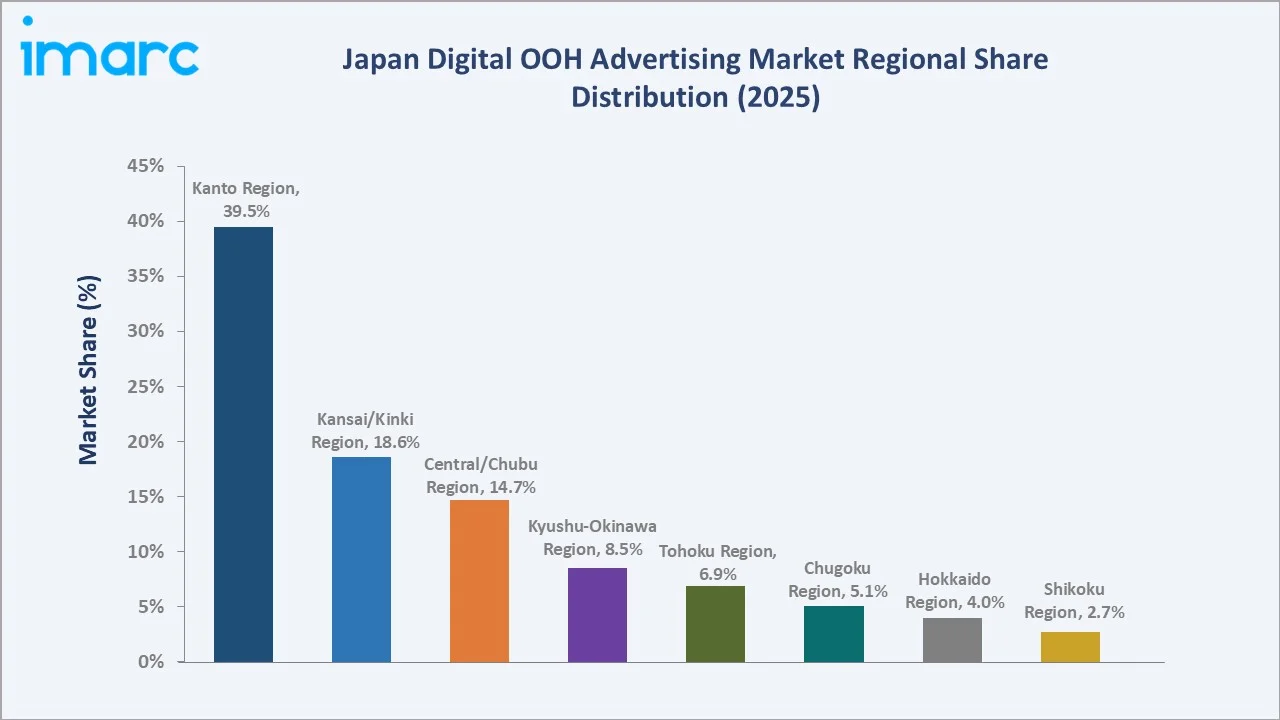
Kansai/Kinki Region at 18.6% is the second-largest regional market, supported by strong tourism activity, major commercial centers, and extensive deployment of digital advertising across transit and retail locations.
Competitive Landscape
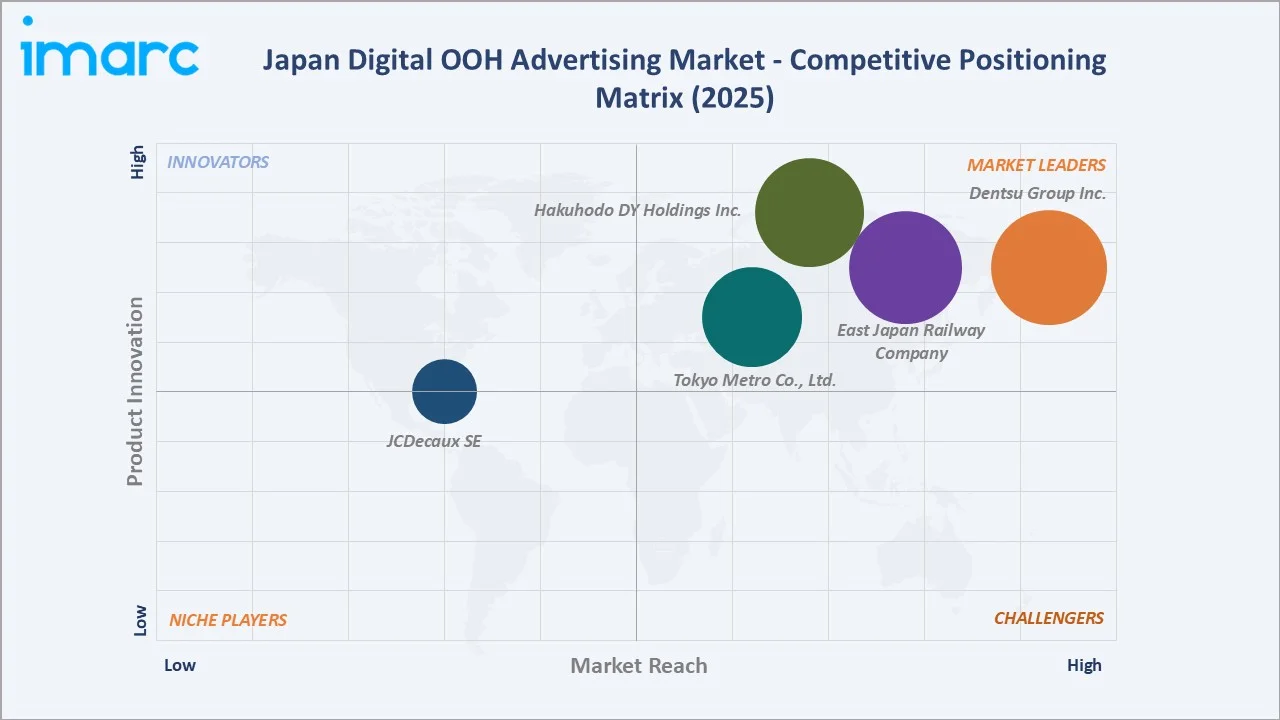
The Japan digital OOH advertising market is moderately concentrated, with established media groups, transit operators, and programmatic platform operators controlling the majority of premium digital OOH inventory and buying infrastructure. Brand strength, premium inventory ownership, programmatic technology integration, and audience measurement capability form the key competitive moats in this market.
|
Company Name |
Brand / Key Product |
Position |
Strategic Focus |
|
Dentsu Group Inc. |
Dentsu |
Leader |
Integrated media buying, audience targeting, and cross-channel OOH campaign solutions |
|
Hakuhodo DY Holdings Inc. |
WISE Ads |
Leader |
Programmatic OOH delivery, multi-channel campaign integration, and audience analytics |
|
East Japan Railway Company |
jeki, MASTRUM |
Leader |
Transit OOH inventory management, programmatic marketplace, and screen network expansion |
|
Tokyo Metro Co., Ltd. |
Tokyo Metro Vision |
Leader |
In-train digital signage network, commuter audience targeting, and inventory expansion |
|
JCDecaux SE |
MCDecaux |
Emerging |
Airport and street furniture OOH expansion, programmatic buying, and urban network growth |
Key players include Dentsu Group Inc., Hakuhodo DY Holdings Inc., East Japan Railway Company, Tokyo Metro Co., Ltd., and JCDecaux SE, among others.
Key Company Profiles
Dentsu Group Inc.
Dentsu Group Inc. is Japan's largest advertising and communications group, headquartered in Tokyo. It operates a dedicated OOH business function, integrating outdoor advertising within broader cross-channel brand communication strategies for its roster of domestic and multinational clients.
- Product Portfolio: Full-service OOH media planning and buying across digital billboards, transit signage, retail digital displays, and video advertising formats; integrated programmatic OOH buying through data-driven media platforms.
- Recent Developments: The company continues to strengthen its digital OOH capabilities through data-driven advertising solutions, programmatic media buying, and integrated cross-channel campaign execution.
- Strategic Focus: Expanding integrated OOH planning capabilities, deepening data-driven audience targeting, and growing cross-channel campaign integration across outdoor, digital, and broadcast media environments.
Hakuhodo DY Holdings Inc.
Hakuhodo DY Holdings Inc. is a leading advertising group, headquartered in Tokyo. The firm provides OOH media planning, media buying, and programmatic outdoor advertising solutions through its integrated advertising network across the country.
- Product Portfolio: WISE Ads — a programmatic OOH advertising service covering large outdoor screens, transit environments, retail venues, and other public-facing display formats.
- Recent Developments: The company has continued to expand its programmatic OOH capabilities through technology partnerships and platform development, strengthening data-driven audience measurement and dynamic creative optimization for outdoor campaigns across Japan's transit, retail, and urban commercial environments.
- Strategic Focus: Expanding programmatic OOH delivery through the WISE Ads platform, deepening audience measurement and cross-channel attribution, and growing integrated outdoor campaign capabilities across Japan's transit, retail, and urban environments.
Tokyo Metro Co., Ltd.
Tokyo Metro Co., Ltd. is a transportation company that provides transit infrastructure and advertising solutions across Japan. The company offers a range of digital and static advertising formats through its transportation network.
- Product Portfolio: Tokyo Metro Vision in-train digital OOH advertising network, station digital signage, and transit advertising solutions targeting urban commuter audiences across key commercial and transportation hubs.
- Recent Developments: The company has expanded its programmatic digital OOH advertising capabilities while continuing to strengthen its premium digital display portfolio and transit advertising offerings.
- Strategic Focus: Expanding the Tokyo Metro Vision programmatic digital OOH network, developing premium large-format LED display inventory at key station locations, and enabling data-driven audience targeting for transit advertisers across the Tokyo Metro system.
Market Concentration Analysis
The Japan digital OOH advertising market exhibits moderate concentration, with established media owners and advertising operators competing through premium display locations, network scale, technological capabilities, and long-term advertiser relationships.
Barriers to entry are significant and primarily infrastructure-based. Premium digital OOH inventory ownership requires long-term concession agreements with transit authorities, retail real estate operators, and airport authorities, which are difficult to replicate for new market entrants.
Consolidation dynamics are being driven by the capital requirements for digital display network modernization and the competitive advantage of scale in programmatic buying and audience data aggregation. Strategic partnerships between media owners, technology providers, and advertising agencies are increasingly defining the competitive structure of the Japan digital OOH market.
Investment & Growth Opportunities
Fastest-Growing Segments
Video advertising is expanding the fastest within the format type segment, driven by falling production costs for high-quality video creative and expanding video display infrastructure across transit and retail environments. Indoor is growing above the overall market CAGR, supported by systematic digital display network expansion within shopping malls, airports, and corporate campuses.
Emerging Markets
Kyushu-Okinawa Region is the fastest-growing regional market, anchored by rising tourism, infrastructure development, and expanding retail digital display networks in Fukuoka. The region is attracting increasing investment in digital advertising infrastructure and smart city initiatives.
Venture & Investment Trends
Investment is concentrated in programmatic digital OOH technology platforms, AI-powered audience measurement systems, and energy-efficient display technology. Smart city digital signage infrastructure projects are attracting municipal and central government co-investment alongside private media owner capital.
Future Market Outlook (2026-2034)
The Japan digital OOH advertising market is forecast to expand from USD 1.40 Billion in 2025 to USD 3.25 Billion by 2034 at a CAGR of 9.79%, adding approximately USD 1.85 Billion in incremental market value over the forecast period.
Four forces will shape the market through 2034: the continued rollout of Japan's smart city and digital infrastructure programs; the maturation of programmatic digital OOH as the standard buying model; accelerating AI-driven personalization and audience measurement capability; and the deepening integration of digital OOH within omnichannel brand communication strategies.
By 2034, the Japan digital OOH market is expected to be characterized by ubiquitous networked display infrastructure, real-time audience-responsive content delivery, and fully measurable, outcome-linked advertising performance metrics.
Research Methodology
Primary Research
Primary research included structured interviews with digital OOH media owners, transit authority commercial teams, programmatic technology providers, advertising agency media directors, and brand marketing executives.
Secondary Research
Secondary sources included Ministry of Land, Infrastructure, Transport and Tourism publications on smart city infrastructure investment, Japan Tourism Agency visitor arrival statistics, annual reports and investor presentations from listed advertising groups and transit operators, and academic research on digital OOH technology adoption and audience measurement.
Forecasting Models
Market forecasts used combined top-down and bottom-up modeling approaches, incorporating digital OOH inventory expansion trajectories, average revenue per display unit trends, programmatic adoption curves, segment mix evolution, regional growth differentials, and macroeconomic variables.
Japan Digital OOH Advertising Market Report Coverage:
| Report Features | Details |
|---|---|
| Base Year of the Analysis | 2025 |
| Historical Period | 2020-2025 |
| Forecast Period | 2026-2034 |
| Units | Billion USD |
| Scope of the Report |
Exploration of Historical Trends and Market Outlook, Industry Catalysts and Challenges, Segment-Wise Historical and Future Market Assessment:
|
| Format Types Covered | Digital Billboards, Video Advertising, Ambient Advertising, Others |
| Applications Covered | Outdoor, Indoor |
| End Use Industries Covered | Retail, Recreation, Banking, Transportation, Education, Others |
| Regions Covered | Kanto Region, Kansai/Kinki Region, Central/ Chubu Region, Kyushu-Okinawa Region, Tohoku Region, Chugoku Region, Hokkaido Region, Shikoku Region |
| Companies Covered | Dentsu Group Inc., Hakuhodo DY Holdings Inc., East Japan Railway Company, Tokyo Metro Co. Ltd., JCDecaux SE, etc. |
| Customization Scope | 10% Free Customization |
| Post-Sale Analyst Support | 10-12 Weeks |
| Delivery Format | PDF and Excel through Email (We can also provide the editable version of the report in PPT/Word format on special request) |
Key Benefits for Stakeholders:
- IMARC’s industry report offers a comprehensive quantitative analysis of various market segments, historical and current market trends, market forecasts, and dynamics of the Japan digital OOH advertising market from 2020-2034.
- The research report provides the latest information on the market drivers, challenges, and opportunities in the Japan digital OOH advertising market.
- Porter's five forces analysis assist stakeholders in assessing the impact of new entrants, competitive rivalry, supplier power, buyer power, and the threat of substitution. It helps stakeholders to analyze the level of competition within the Japan digital OOH advertising industry and its attractiveness.
- Competitive landscape allows stakeholders to understand their competitive environment and provides an insight into the current positions of key players in the market.
Frequently Asked Questions About the Japan Digital OOH Advertising Market Report
The Japan digital OOH advertising market was valued at USD 1.40 Billion in 2025, supported by smart city investments and expanding programmatic digital OOH adoption across major urban markets.
The market is projected to grow at a CAGR of 9.79% from 2026-2034, reaching USD 3.25 Billion, driven by programmatic digital OOH maturation, AI-powered audience targeting, and deepening smart city digital infrastructure.
Digital billboards lead at 44.6% share in 2025, driven by premium transit and commercial zone placements and real-time dynamic content switching capabilities.
Outdoor leads at 63.4% in 2025, supported by extensive digital display deployment across expressways, railway stations, and commercial real estate with high footfall and visibility.
Kanto Region leads at 39.5% in 2025, anchored by Tokyo's dense commercial activity, extensive transit networks, and strong advertiser demand.
Key players include Dentsu Group Inc., Hakuhodo DY Holdings Inc., East Japan Railway Company, Tokyo Metro Co., Ltd., and JCDecaux SE, among others.
Government-led smart city programs are directly funding digital signage infrastructure across municipalities, expanding addressable digital OOH inventory and accelerating adoption of networked, IoT-connected display systems through 2034.
Key opportunities include AI-driven content personalization, cross-channel digital OOH integration with mobile and social media, interactive and immersive digital OOH formats, and sustainable energy-efficient display technology adoption.
Need more help?
- Speak to our experienced analysts for insights on the current market scenarios.
- Include additional segments and countries to customize the report as per your requirement.
- Gain an unparalleled competitive advantage in your domain by understanding how to utilize the report and positively impacting your operations and revenue.
- For further assistance, please connect with our analysts.
 Request Customization
 Speak to an Analyst
 Request Brochure
 Inquire Before Buying
Benefits of Customization
- Personalize this research
- Triangulate with your data
- Get data as per your format and definition
- Gain a deeper dive into a specific application, geography, customer, or competitor
- Any level of personalization
Get in Touch With Us
UNITED STATES
Phone: +1-201-971-6302
INDIA
Phone: +91-120-433-0800
UNITED KINGDOM
Phone: +44-753-714-6104
Email: [email protected]
Client Testimonials




.webp)




.webp)













Related Reports

Choose your plan
*Please note that the prices mentioned below are starting prices for each bundle type. Kindly contact our team for further details.*
Single User License
- 1 User License, Access on 2 Devices
- PDF Report + Excel Dataset (Password Protected)
- Lifetime Access
- No Printing Rights
- 10% Free Report Customization
- 10–12 Weeks of Analyst Support
Five User License
- Access for 5 Users, 2 Devices per User
- PDF Report + Excel Dataset (Password Protected)
- Lifetime Access
- Dedicated Account Manager
- 12–14 Weeks of Analyst Support
- No Printing Rights
- 15% Free Report Customization
- 25% Discount on Your Next Purchase
Corporate User License
- Unlimited User Access (Within Your Organization)
- PDF Report + Excel Dataset
- Lifetime Access
- Dedicated Account Manager
- 14–20 Weeks of Analyst Support
- No Printing Rights
- 20% Free Report Customization
- 30% Discount on Your Next Purchase
Essential Insights
What's included:
3 reports
- Lifetime Access
- PDF Reports
- Excel Datasets
- 2 Weeks of Free Analyst Support
- 2 User Licenses
- Access on 2 Devices
- Printing Rights
- Complimentary PowerPoint (PPT) Version
- Complimentary License Upgrade
Professional Access
What's included:
5 reports
- Lifetime Access
- PDF Reports
- Excel Datasets
- 8 Weeks of Free Analyst Support
- 2 User Licenses
- Access on 2 Devices
- Printing Rights
- Complimentary PowerPoint (PPT) Version
- Complimentary License Upgrade
Business Advantage
What's included:
8 reports
- Lifetime Access
- PDF Reports
- Excel Datasets
- 14 Weeks of Free Analyst Support
- 2 User Licenses
- Access on 2 Devices
- Printing Rights
- Complimentary PowerPoint (PPT) Version
- Complimentary License Upgrade
Enterprise Intelligence
What's included:
10 reports
- Lifetime Access
- PDF Reports
- Excel Datasets
- 20 Weeks of Free Analyst Support
- 2 User Licenses
- Access on 2 Devices
- Printing Rights
- Complimentary PowerPoint (PPT) Version
- Complimentary License Upgrade