
Japan Ecotourism Market Size, Share, Trends and Forecast by Traveler Type, Age Group, Sales Channel, and Region, 2026-2034
Japan Ecotourism Market Size, Share, Trends & Forecast (2026-2034)
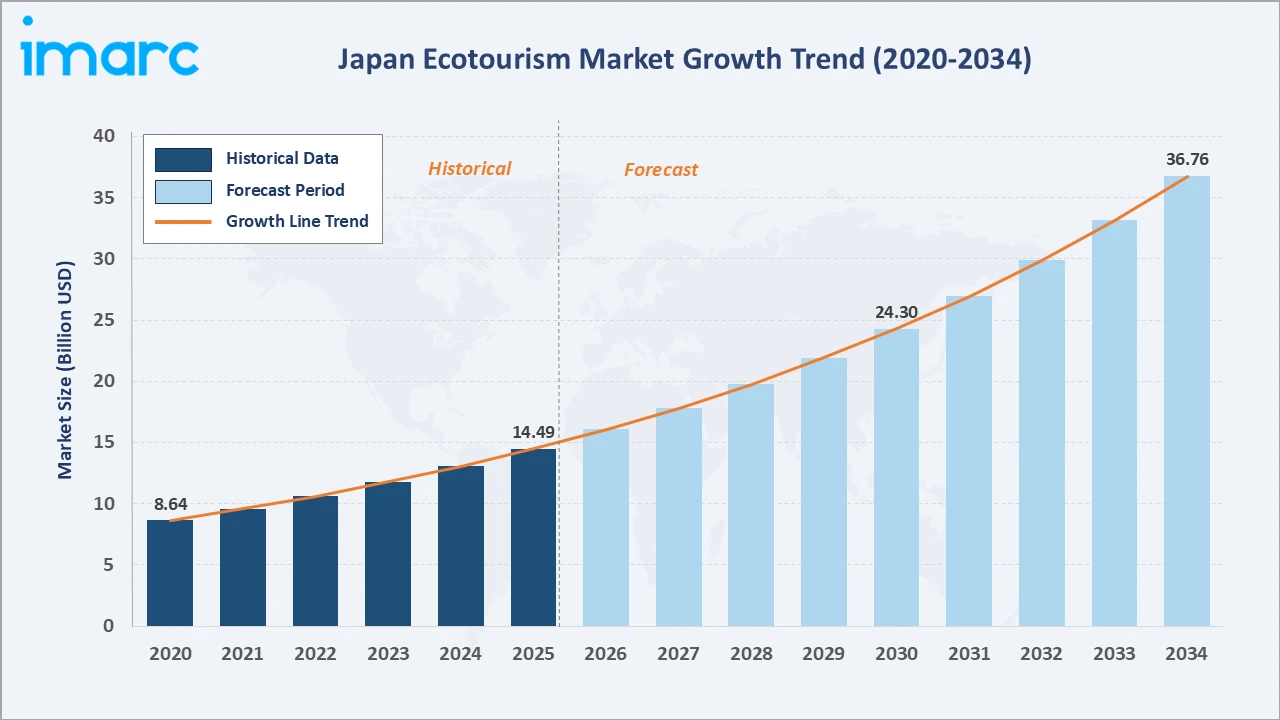
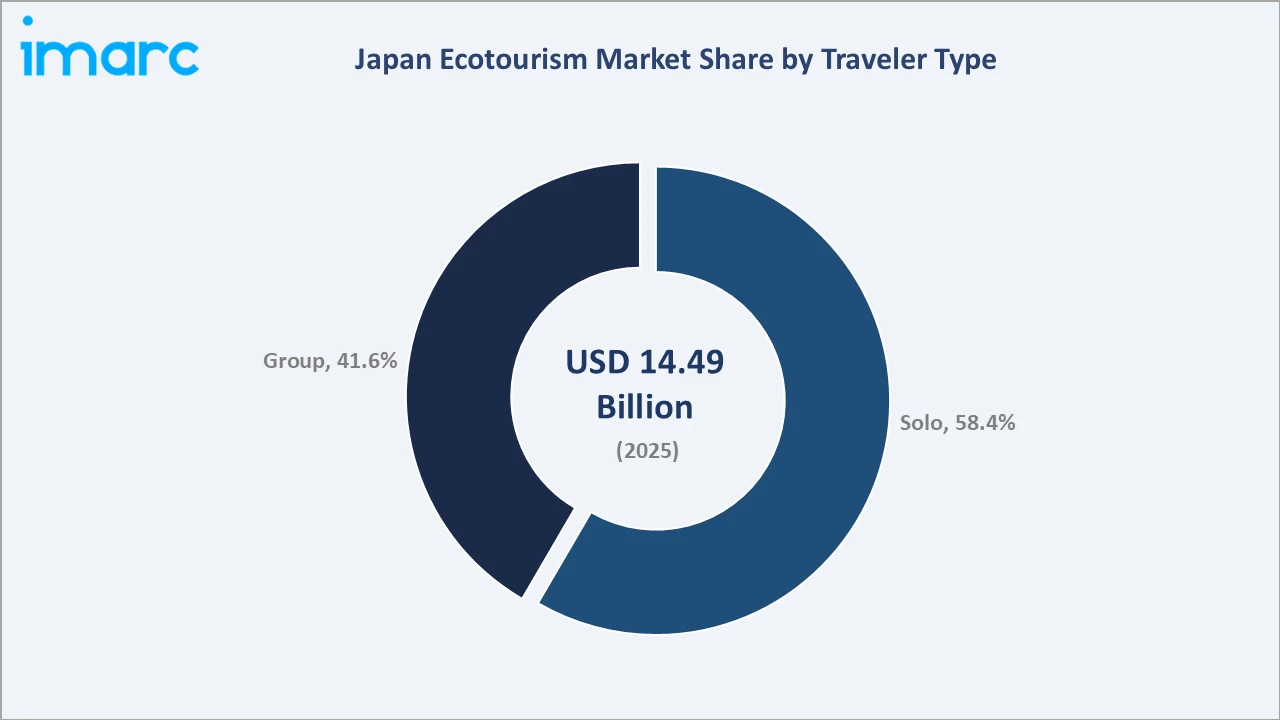
The Japan ecotourism market reached USD 14.49 Billion in 2025 and is projected to reach USD 36.76 Billion by 2034, exhibiting a CAGR of 10.90% during 2026-2034. Japan welcomed a record 42.7 million international visitors in 2025. This strong growth in inbound tourism is increasing demand for nature-based and environmentally responsible travel, including national park visits, wildlife experiences, forest tourism, and rural stays. It is also encouraging investment in sustainable accommodations, conservation-focused tours, and improved infrastructure across Japan’s emerging ecotourism destinations. Solo travelers lead at 58.4%, Generation Y dominates at 43.8%, and the Kanto region accounts for the largest regional share at 33.2%.
Market Snapshot
|
Metric |
Value |
|
Market Size (2025) |
USD 14.49 Billion |
|
Forecast Market Size (2034) |
USD 36.76 Billion |
|
CAGR (2026-2034) |
10.90% |
|
Base Year |
2025 |
|
Historical Period |
2020-2025 |
|
Forecast Period |
2026-2034 |
|
Dominant Traveler Type |
Solo (58.4%, 2025) |
|
Dominant Age Group |
Generation Y (43.8%, 2025) |
|
Leading Region |
Kanto Region (33.2%, 2025) |
The Japan ecotourism market grew from USD 8.64 Billion in 2020 to USD 14.49 Billion in 2025, driven by COVID-19 pandemic recovery redirecting domestic travel toward nature-immersive rural experiences, Japan's inbound visitors increasingly seeking eco-authentic rural destinations beyond the conventional Tokyo-Kyoto urban trail, and a new generation of strategic industry partnerships transforming Japan's ecotourism supply infrastructure. The market is projected to reach USD 24.30 Billion by 2030 and USD 36.76 Billion by 2034.
To get more information on this market, Request Sample
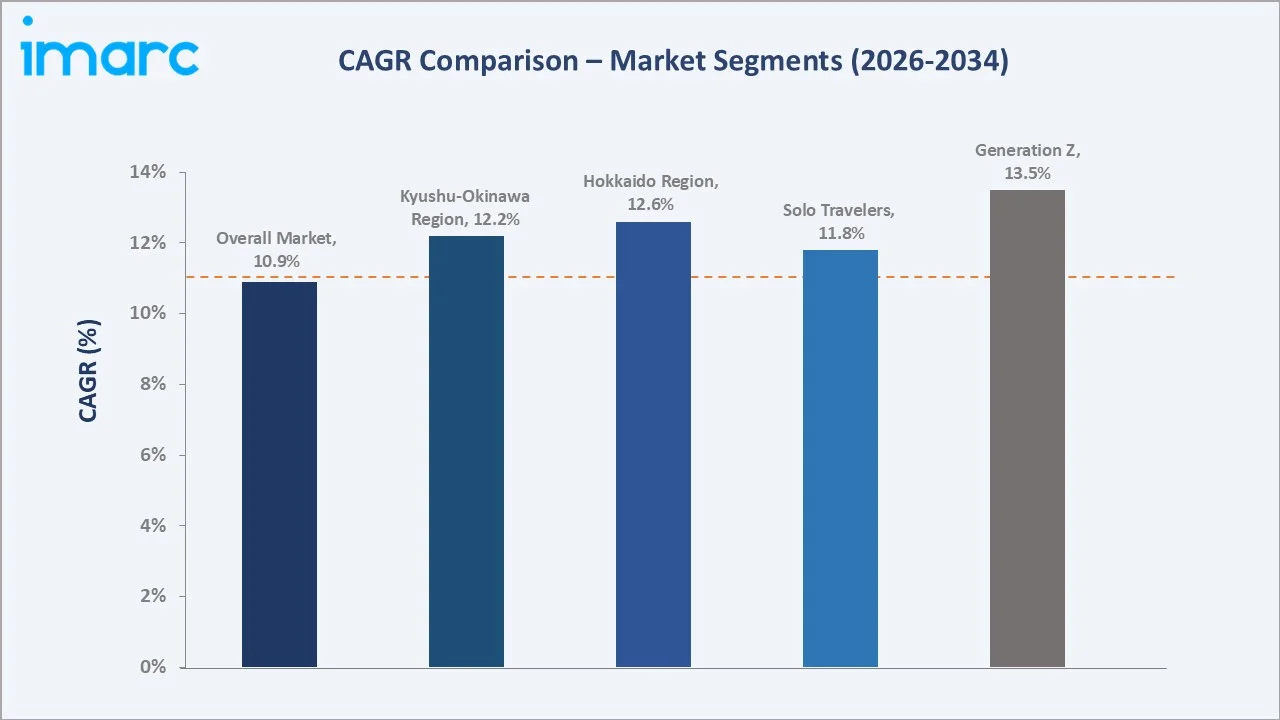
Generation Z grows at ~13.5% CAGR through social media-driven eco-destination discovery, climate anxiety-motivated responsible travel adoption, and Carbon Neutral Tourism certification appeal among Japan's Gen Z consumers. Solo travelers grow at ~11.8% CAGR through Japan's world-leading solo travel infrastructure. Hokkaido region grows at ~12.6% CAGR through international eco-destination recognition and direct international flight access from China, South Korea, and Taiwan via Chitose Airport.
Executive Summary
The Japan ecotourism market occupies a globally distinctive position as the most technologically advanced eco-destination country, combining extraordinary biodiversity, a deeply embedded nature-reverence cultural tradition, and institutional commitment to sustainable tourism governance. Japan's ecotourism market is structurally differentiated from global competitors by the quality of its protected natural assets that provide ecotourism product inputs of extraordinary rarity and cultural significance. Market value reached USD 14.49 Billion in 2025, forecast at USD 36.76 Billion by 2034.
Solo travelers lead at 58.4% (2025) through Japan's exceptional solo travel infrastructure. Generation Y leads at 43.8% (2025) through their established status as Japan's primary discretionary travel spenders, their documented preference for experience-over-material spending patterns, and their early adoption of sustainable consumption behaviors that align with ecotourism's conservation and community contribution principles. The Kanto region's 33.2% dominance reflects Greater Tokyo's role as Japan's largest origin population for domestic ecotourism and the greatest concentration of eco-themed tour operators, OTA platforms, and nature-experience aggregators serving ecotourists departing from Tokyo, Yokohama, Saitama, and Chiba.
Key Market Insights
|
Insight |
Data |
|
Dominant Traveler Type |
Solo – 58.4% share (2025) |
|
Dominant Age Group |
Generation Y – 43.8% share (2025) |
|
Leading Region |
Kanto Region – 33.2% share (2025) |
|
Market Opportunity |
Rural eco-lodge network expansion; Gen Z carbon-neutral travel products; multilingual eco-experience digital platforms; international island eco-packages |
Key Analytical Observations Supporting the Above Data:
- Solo Travelers at 58.4% (2025): Japan's solo ecotourism dominance reflects the country's unique structural advantage in the solo travel marketplace, where Japan's virtually universal personal safety environment, the hospitality tradition's inherent solo-friendliness, and the cultural acceptance of solo recreational nature pursuits collectively create an ecotourism environment that solo travelers from markets where solo female travel carries safety concerns find particularly liberating.
- Generation Y at 43.8% (2025): Generation Y (millennials, born 1981-1996) represents Japan's ecotourism market's dominant age segment through their combination of established career earning capacity, documented experience-over-possession spending philosophy, and their status as the founding demographic of sustainable consumption practices, having grown up with climate change awareness as a foundational concern that translates into willingness to pay premiums for certified sustainable and eco-positive travel products.
- Kanto Region at 33.2% (2025): The Kanto region leads Japan’s ecotourism market due to its strong transport infrastructure, proximity to Tokyo, and easy access to destinations. High domestic and international visitor volumes further support demand for nature-based and sustainable travel experiences.
Japan Ecotourism Market Overview
The Japan ecotourism market encompasses nature-based tourism activities that combine environmental education, conservation contribution, and community benefit at certified or recognized eco-destinations across Japan's national parks, quasi-national parks, natural sites, and traditional agricultural-natural interface landscapes that constitute Japan's irreplaceable ecological heritage. Macroeconomic factors, including rising disposable incomes, expanding inbound tourism, and government investment in regional revitalization are strengthening demand for ecotourism.
Market Dynamics
To evaluate market opportunities, Request Sample
Market Drivers
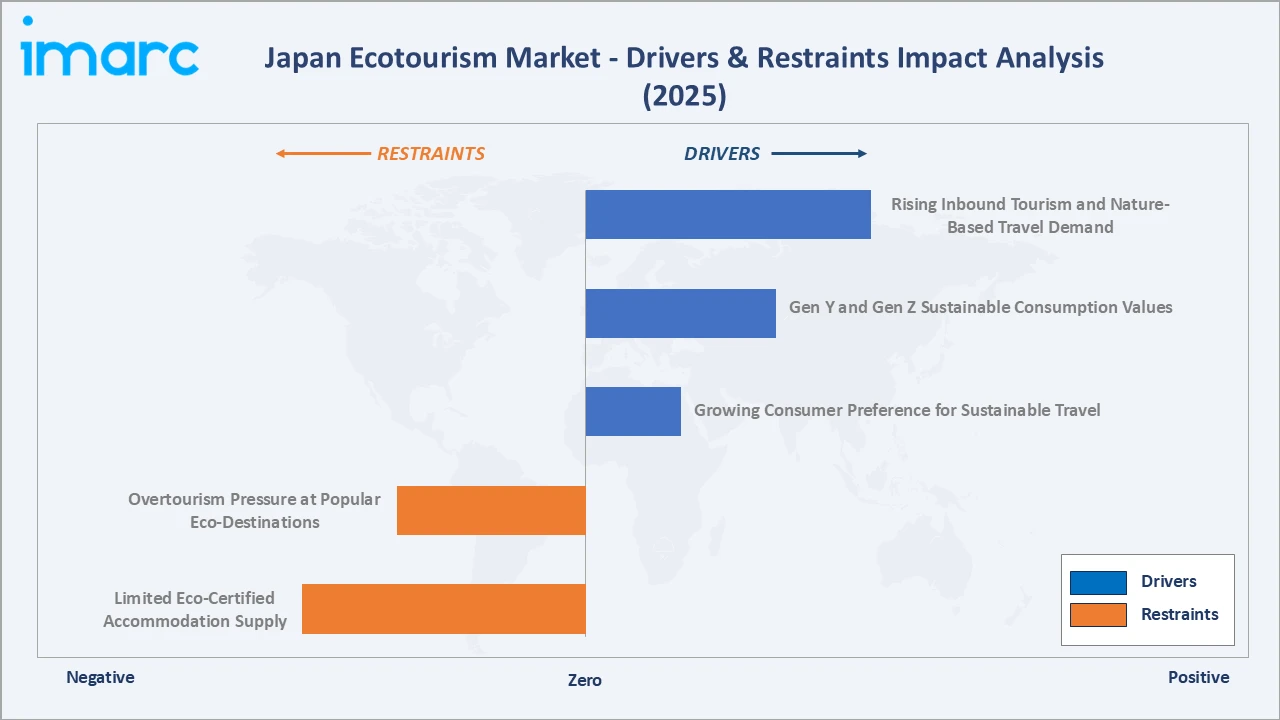
- Rising Inbound Tourism and Nature-Based Travel Demand: Japan’s record of 42.7 million international visitors in 2025, representing a 15.8% increase from the previous peak of 36.9 million recorded in 2024. Japan's record growth in international visitor arrivals is increasing demand for authentic outdoor and nature-focused experiences beyond major cities. Travelers are increasingly seeking national parks, hiking trails, wildlife viewing, and rural landscapes that promote sustainable tourism. This shift is encouraging investments in ecotourism infrastructure, guided eco-tours, and environmentally responsible accommodations across the country
- Gen Y and Gen Z Sustainable Consumption Values: In 2024, Japan’s Generation Z numbered around 20.8 million and represented approximately 16.3% of the country’s total population. Japan's dominant ecotourism consumer demographics, Generation Y and Generation Z, are both characterized by sustainability values that create structural demand for certified eco-tourism products rather than merely nature-adjacent conventional tourism. This demographic values-driven demand creates a premium pricing environment where eco-certified operators can command price premiums over uncertified nature tourism alternatives, improving market economics while rewarding genuine sustainability investment.
- Growing Consumer Preference for Sustainable Travel: Increasing environmental awareness among domestic and international travelers is driving demand for low-impact tourism experiences. Visitors are choosing eco-lodges, responsible tour operators, and conservation-focused activities that minimize environmental footprints. This trend is encouraging tourism businesses to adopt sustainable practices and obtain eco-certifications to meet evolving consumer expectations.
Market Restraints
- Overtourism Pressure at Popular Eco-Destinations: Japan's most iconic eco-destinations are experiencing visitor pressure that threatens the ecological quality and experiential exclusivity that defines their ecotourism value. The concentration of international ecotourism demand at already-popular destinations reflects the marketing advantage that established destinations with prior social media content assets hold over genuinely undiscovered but equally valuable eco-destinations in Tohoku, Chugoku, and Shikoku regions.
- Limited Eco-Certified Accommodation Supply: While Japan's ecotourism demand is growing, the supply of certified eco-accommodation remains concentrated in the established ecotourism premium tier and significantly underdeveloped in the potential eco-destination regions of Tohoku, Chugoku, Shikoku, and rural Chubu where natural assets are of high quality but hospitality infrastructure has not yet been developed to meet international ecotourist expectations.
Market Opportunities
- Improved Transportation and Digital Tourism Infrastructure: Continuous investments in high-speed rail, regional airports, road connectivity, and digital travel platforms are making remote ecotourism destinations more accessible. Online booking systems, multilingual travel information, and mobile navigation tools simplify trip planning for both domestic and international visitors. Improved accessibility is expanding visitor flows to lesser-known natural a
- Carbon Neutral Ecotourism Product Certification and Grettractions while supporting sustainable regional tourism development.en Transport Integration: Japan aims to achieve carbon neutrality by 2050. Japan's planned national carbon labeling and tracking system will create a carbon-neutral ecotourism product certification opportunity where tour operators can verify and communicate lifecycle carbon neutrality to environmentally motivated consumers. Green transport integration enables tour operators to deliver quantifiably low-emission ecotourism experiences that justify carbon-neutral premium pricing.
Market Challenges
- Multilingual Guide Shortage: Japan's ecotourism sector's international growth is constrained by a shortage of certified nature guides with both ecological expertise and English language proficiency, where Japan's national nature guide certification systems have historically operated primarily in Japanese, limiting internationally capable guide supply. The shortage of certified multilingual eco-guides is most acute at Japan's highest-value international eco-destinations where the experience quality and safety management requirements are the highest, creating a service quality bottleneck that prevents Japan's premium eco-destinations from fully monetizing the international visitor demand.
- Seasonality Concentration Creating Capacity-Revenue Volatility: Japan's nature-based ecotourism demand is highly concentrated in three peak periods, spring, summer, and autumn, with winter periods generating substantially lower ecotourism revenue in most regions except Hokkaido. Off-season programming innovation, winter forest bathing programs, indoor ecology interpretation experiences at closed-season nature destinations, and off-peak conservation volunteer tourism products demonstrate the strategic response to seasonality that the best-resourced operators are implementing to sustain year-round eco-lodge occupancy.
Emerging Market Trends
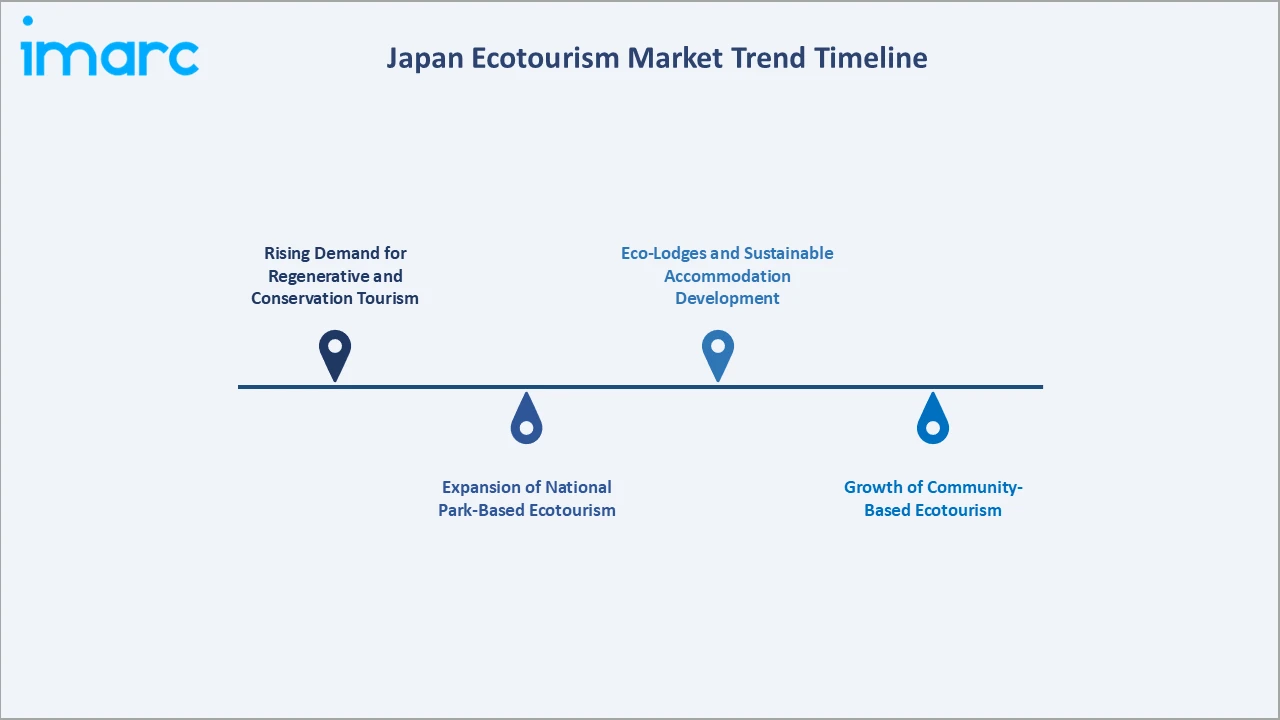
1. Rising Demand for Regenerative and Conservation Tourism
Travelers are increasingly seeking experiences that contribute to environmental conservation rather than simply minimizing environmental impact. Guided forest walks, wildlife conservation programs, habitat restoration activities, and eco-volunteering are gaining popularity across Japan. In March 2025, Rosewood Hotels & Resorts opened Rosewood Miyakojima, representing the brand’s first property in Japan. Designed around regenerative tourism principles, the property aims to minimise environmental impact, support the local community, and establish a new benchmark for sustainable luxury accommodation in the region. This trend is encouraging destinations to integrate biodiversity protection with tourism while generating sustainable income for local communities.
2. Expansion of National Park-Based Ecotourism
Japan is investing in upgrading visitor facilities, trails, and interpretation centers across its national parks to attract both domestic and international travelers. Japan has designated 35 National Parks, 57 Quasi-National Parks, and more than 300 Prefectural Natural Parks. The National Parks cover approximately 2.44 million hectares, representing about 6.5% of the country’s total land area, and collectively attract nearly 300 million visitors each year. Enhanced accessibility and sustainable park management are supporting year-round ecotourism growth.
3. Growth of Community-Based Ecotourism
Local communities are playing a greater role in developing and managing ecotourism experiences that showcase regional culture, traditional lifestyles, and natural resources. Community-led guided tours, local conservation initiatives, and cultural exchange programs provide authentic experiences while creating employment opportunities. This approach also supports rural revitalization and encourages long-term environmental stewardship.
4. Eco-Lodges and Sustainable Accommodation Development
Growing environmental awareness is driving demand for accommodations designed around energy efficiency, renewable energy, waste reduction, and responsible resource management. Eco-lodges, forest retreats, and nature resorts are increasingly incorporating locally sourced materials and sustainable operating practices. These developments appeal to environmentally conscious travelers seeking immersive nature experiences.
Industry Value Chain Analysis
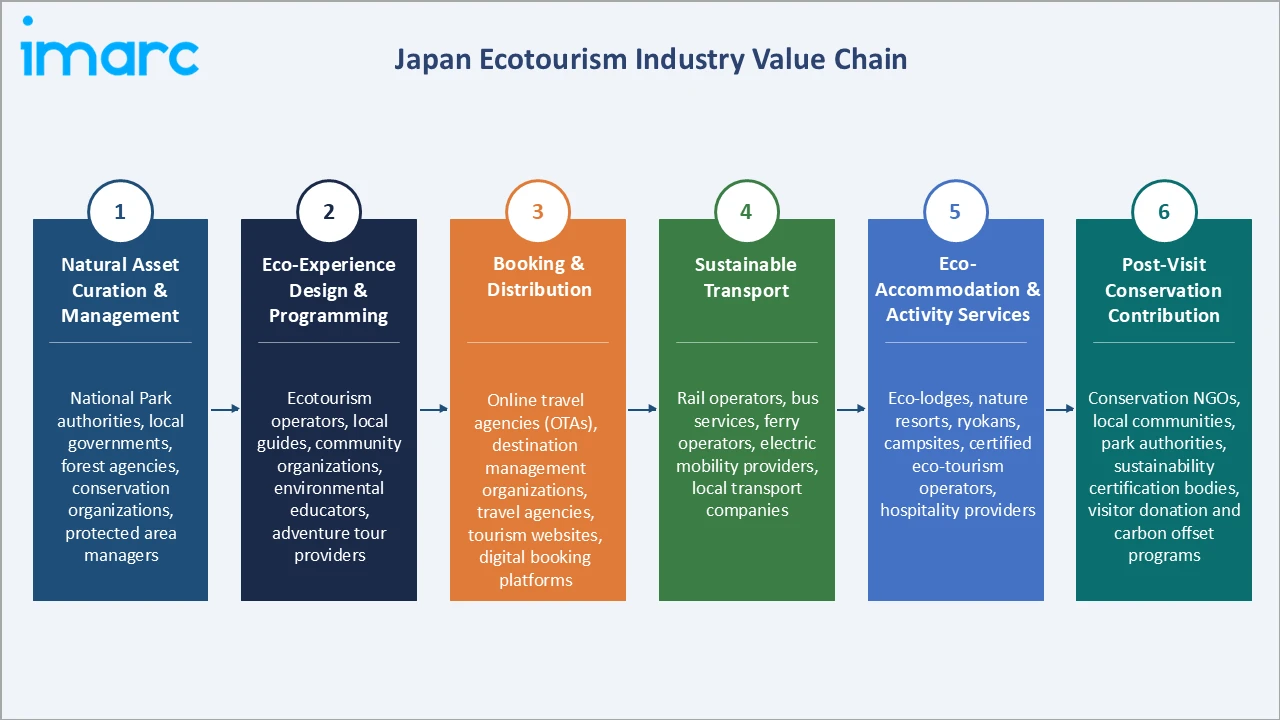
The Japan ecotourism value chain integrates natural asset curation & management, eco-experience design & programming, booking & distribution, sustainable transport, eco-accommodation & activity services, and post-visit conservation contribution.
|
Stage |
Key Participants |
|
Natural Asset Curation & Management |
National Park authorities, local governments, forest agencies, conservation organizations, protected area managers. |
|
Eco-Experience Design & Programming |
Ecotourism operators, local guides, community organizations, environmental educators, adventure tour providers. |
|
Booking & Distribution |
Online travel agencies (OTAs), destination management organizations, travel agencies, tourism websites, digital booking platforms. |
|
Sustainable Transport |
Rail operators, bus services, ferry operators, electric mobility providers, local transport companies. |
|
Eco-Accommodation & Activity Services |
Eco-lodges, nature resorts, ryokans, campsites, certified eco-tourism operators, hospitality providers. |
|
Post-Visit Conservation Contribution |
Conservation NGOs, local communities, park authorities, sustainability certification bodies, visitor donation and carbon offset programs. |
Eco-experience design & programming is the most value-added stage in the Japan ecotourism value chain. It transforms natural assets into unique, guided, and educational experiences that differentiate destinations, enhance visitor satisfaction, and generate higher tourism revenue while promoting environmental conservation and community participation.
Technology Landscape in the Japan Ecotourism Industry
AI-Powered Visitor Management Systems
Artificial intelligence is being used to forecast visitor demand, optimize park capacity, and reduce congestion at popular ecotourism destinations. AI analyzes visitor flows, weather conditions, and seasonal trends to improve resource allocation and protect sensitive ecosystems. This enables a better visitor experience while supporting sustainable destination management.
Drone-Based Ecosystem Monitoring
Drones are widely used for aerial mapping, forest monitoring, biodiversity surveys, wildlife observation, and disaster assessment. They provide accurate environmental data while minimizing disturbance to protected habitats. Tourism authorities also use drone imagery to support conservation planning and promote natural attractions.
Cashless Payments and QR-Based Digital Services
Cashless payment systems, QR-code ticketing, and digital visitor passes are becoming standard across Japan's ecotourism destinations. These technologies streamline admissions, transportation, and accommodation services while reducing paper consumption. They also enhance convenience for international travelers and improve operational efficiency for tourism providers.
Market Segmentation Analysis
The report covers the following segments:
|
Segment Category |
Leading Segment |
Market Share |
Year |
|
Traveler Type |
Solo |
58.4% |
2025 |
|
Age Group |
Generation Y |
43.8% |
2025 |
|
Sales Channel |
🔒 |
🔒 |
2025 |
|
Region |
Kanto Region |
33.2% |
2025 |

By Traveler Type
Solo travelers lead at 58.4% (2025) through Japan's exceptional solo travel ecosystem. The solo traveler segment's per-capita spending advantage over group travelers reflects the solo traveler's premium accommodation selection, unburdened by group budget negotiation, solo travelers consistently upgrade to higher-specification eco-accommodations that deliver superior privacy, personalized service, and ecological immersion.
To access detailed market analysis, Request Sample
Group travelers at 41.6% serve family eco-education, corporate wellness retreat, friend-group seasonal nature experience, and organized international tour markets.
By Age Group
Generation Y leads at 43.8% (2025) through established earning capacity, documented experience-economy spending philosophy, and sustainability value alignment with ecotourism's conservation contribution positioning.
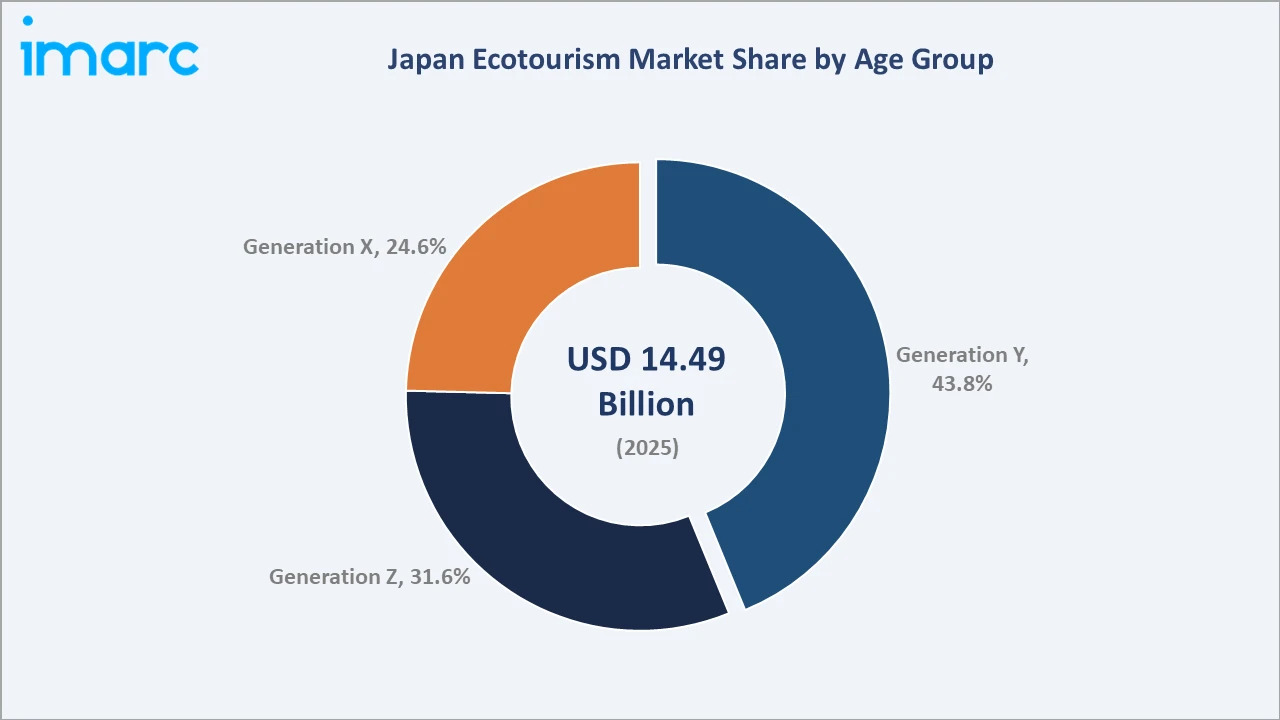
Generation Z at 31.6%, growing at ~13.5% CAGR, drives digital eco-discovery through social media platforms where Japan's photogenic natural assets achieve viral engagement levels that convert content viewers into travel intention and bookings. Generation X at 24.6% commands Japan's highest per-visit ecotourism spending with extended stays at premium eco-lodges and a particular preference for endemic wildlife specialist experiences that command an exclusive private guide.
Regional Market Insights
|
Region |
Share (2025) |
Key Japan Ecotourism Market Drivers & Characteristics |
|
Kanto Region |
33.2% |
Strong tourism infrastructure, proximity to Tokyo, and easy access to national parks and nature reserves support high visitor volumes. |
|
Kansai/Kinki Region |
18.4% |
Combines cultural heritage with mountain landscapes, forests, and sustainable nature experiences, attracting both domestic and international tourists. |
|
Central/Chubu Region |
14.7% |
Home to the Japanese Alps, alpine parks, and outdoor recreation destinations, making it a leading region for hiking and adventure ecotourism. |
|
Kyushu-Okinawa Region |
10.6% |
Rich biodiversity, volcanic landscapes, coral reefs, and marine ecosystems drive demand for nature-based and coastal ecotourism activities. |
|
Hokkaido Region |
8.5% |
Known for its national parks, wildlife, wetlands, and winter ecotourism, attracting visitors seeking pristine natural environments. |
|
Tohoku Region |
5.7% |
Expanding rural and forest-based tourism supported by scenic mountains, hot springs, and regional revitalization initiatives. |
|
Chugoku Region |
4.9% |
Offers coastal landscapes, geoparks, forests, and protected natural areas, supporting steady growth in sustainable tourism. |
|
Shikoku Region |
4.0% |
Growing ecotourism destination featuring pilgrimage trails, rivers, mountains, and community-based nature tourism experiences. |
Kanto region's 33.2% market dominance is supported by its excellent transportation network, proximity to Tokyo, and easy access to protected natural areas. Kansai/Kinki region’s 18.4% follows with a strong mix of cultural heritage sites, forests, and mountain landscapes that appeal to eco-conscious travelers. Central/Chubu region’s 14.7% is a major destination for alpine tourism, hiking, and outdoor recreation due to the presence of the Japanese Alps and national parks.
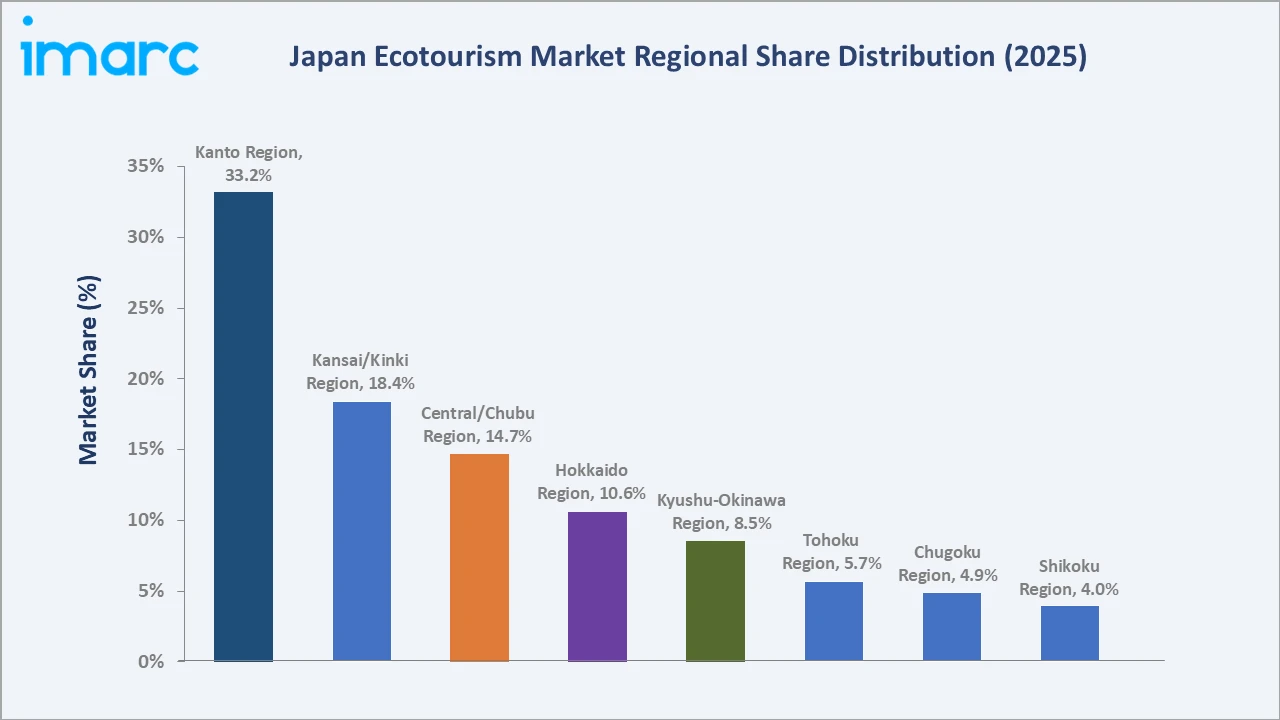
Kyushu-Okinawa region’s 10.6% benefits from its rich biodiversity, volcanic landscapes, and marine ecosystems, making it a leading destination for nature-based tourism. Hokkaido region’s 8.5% attracts visitors with its pristine wilderness, wildlife, wetlands, and year-round outdoor activities. Tohoku region’s 5.7% is steadily expanding through rural tourism, forest experiences, and government-led regional revitalization efforts. Chugoku region’s 4.9% leverages its geoparks, coastal scenery, and protected forests to support sustainable tourism growth. Shikoku region’s 4.0% continues to gain recognition through community-based ecotourism, pilgrimage trails, and river-based outdoor activities.
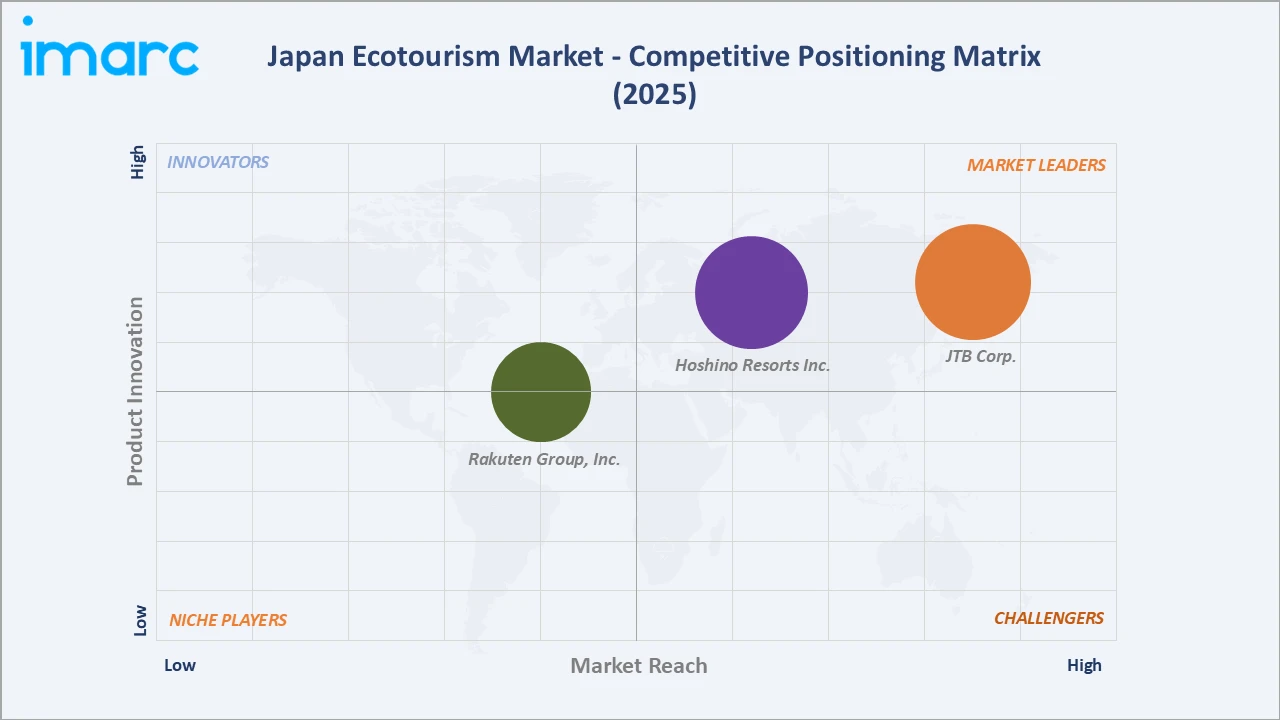
Competitive Landscape
Japan ecotourism market features a diverse competitive structure spanning national travel agency conglomerates with broad eco-package distribution and booking capability, luxury eco-hospitality specialists commanding the premium immersive eco-accommodation segment, digital platform innovators transforming eco-accommodation discovery and booking, infrastructure airlines creating integrated eco-travel access, sustainability-focused NGO tour operators delivering conservation-authenticated experiences, and specialty eco-operators serving niche eco-interest communities with high-expertise-depth products.
|
Company |
Key Offerings |
Market Position |
Core Strength |
|
JTB Corp. |
Sunrise Tours |
Market Leader |
JTB Corp. acts as a driving force in Japan’s ecotourism, partnering with the Global Sustainable Tourism Council (GSTC) to establish sustainable tour standards. |
|
Hoshino Resorts Inc. |
HOSHINOYA properties |
Market Leader |
Hoshino Resorts Inc. has pioneered sustainable tourism in Japan, operating Japan's first eco-resort and establishing models that optimize both environmental protection and profitability. |
|
Rakuten Group, Inc. |
Rakuten Travel |
Established Player |
Rakuten Group drives Japanese ecotourism by integrating sustainable travel options into Rakuten Travel and offering eco-friendly stays in Japan. |
Competitive dynamics are increasingly defined by the race to achieve verifiable eco-certification, where major players create a credibility hierarchy that drives commercial differentiation through genuine sustainability investment rather than eco-marketing claims alone.
Key Company Profiles
JTB Corp.
JTB Corp. is one of Japan's largest travel and tourism companies, offering domestic and international travel services through an extensive distribution network. In the Japan ecotourism market, the company develops and promotes sustainable travel experiences by partnering with national parks, local governments, and regional communities. Its portfolio includes nature-based tours, wildlife experiences, hiking programs, rural stays, and environmentally responsible travel packages that support conservation and regional tourism development.
- Key Offerings: Sunrise Tours.
- Strategic Focus: Expanding sustainable and nature-based tourism through partnerships with national parks, local governments, and regional communities. The company develops eco-friendly travel packages featuring hiking, wildlife observation, forest therapy, and rural experiences while promoting responsible tourism practices.
Hoshino Resorts Inc.
Hoshino Resorts Inc. is a leading Japanese hospitality company operating luxury resorts, boutique hotels, and traditional ryokans across Japan. In the Japan ecotourism market, the company incorporates nature-based experiences into its hospitality offerings through forest retreats, national park destinations, outdoor recreation, and locally inspired wellness programs. By emphasizing sustainable operations, environmental stewardship, and collaboration with local communities, Hoshino Resorts supports responsible tourism while enhancing the appeal of Japan's natural destinations.
- Key Offerings: HOSHINOYA properties.
- Strategic Focus: Developing environmentally responsible hospitality experiences that integrate luxury accommodation with Japan's natural landscapes and local culture. The company emphasizes sustainable resort operations, nature-based wellness programs, forest retreats, and low-impact outdoor activities while collaborating with local communities to support biodiversity conservation and regional tourism development.
Market Concentration Analysis
Japan ecotourism market is moderately fragmented at the experience operator level, with thousands of certified eco-guide operators, specialty nature tour companies, and eco-lodge operators collectively providing the diversity of ecotourism experiences that Japan's extraordinary natural diversity requires, while distribution is moderately concentrated among dominant platforms and agencies whose booking infrastructure enables national-scale consumer access. Hoshino Resorts holds a unique premium accommodation market leadership position with the HOSHINOYA eco-portfolio's and certified standards setting the commercial benchmark that the broader eco-accommodation sector is progressively emulating through independent eco-lodge certification program adoption.
Investment & Growth Opportunities
Highest Growth Segments
Generation Z traveler segment (~13.5% CAGR), solo traveler type (~11.8% CAGR), Hokkaido region (~12.6% CAGR), Kyushu-Okinawa region (~12.2% CAGR), and premium eco-certified accommodation represent Japan's highest-growth ecotourism investment vectors through 2034.
Investment Themes
- Rural eco-accommodation network development: Investment is increasing in eco-lodges, nature resorts, farm stays, and sustainable rural accommodations that minimize environmental impact while supporting local communities. These developments strengthen regional tourism infrastructure, extend visitor stays, and promote balanced economic growth in Japan's rural destinations.
- Gen Z carbon-neutral ecotourism digital platform: Investment is focused on digital platforms that offer carbon footprint tracking, eco-certified accommodations, and sustainable travel planning tailored to environmentally conscious Gen Z travelers. AI-powered itinerary planning, digital payments, and reward-based green travel features further enhance user engagement and encourage responsible tourism.
Future Market Outlook (2026-2034)
The Japan ecotourism market is projected to grow from USD 14.49 Billion in 2025 to USD 36.76 Billion by 2034, delivering a 10.90% CAGR that reflects Japan's structural advantages as the most diverse developed-country ecotourism destination combined with an accelerating institutional investment in sustainable tourism infrastructure that is progressively removing the supply-side constraints that have historically limited market growth below demand potential. The anchor value of USD 24.30 Billion in 2030 is driven by three structural forces that will define Japan's ecotourism market through the forecast period.
First, Japan's annual international visitors driven by the persistent yen depreciation making Japan 30-40% more affordable for international travelers and Hokkaido and Kyushu's direct international air route expansion connecting East Asian eco-destination demand directly with Japan's premier ecotourism landscapes, creates a structural international visitor volume expansion that will progressively convert a growing share of inbound tourism into ecotourism spending as returning visitors migrate from urban sightseeing to rural ecological immersion. Second, Japan's two dominant ecotourism consumer cohorts will sustain above-market ecotourism demand growth through the 2026-2034 period through lifecycle stages that progressively enhance their ecotourism spending capacity and frequency. Third, Japan's ecotourism supply infrastructure is undergoing the most significant expansion in its history, with the Green Destination certification progressively improving destination-level sustainability management standards and the conservation fee model establishing market-based sustainable visitor management that will be replicated at other high-pressure eco-destinations through 2026-2030.
Research Methodology
Primary Research
Primary research comprised in-depth interviews with sustainable tourism program officers, eco-product management team members, certified eco-guide operators, nature travel specialists, prefectural ecotourism promotion bureau directors, national park management representatives, and independent Japanese ecotourism consultants. Discussions validated market size estimates, segment dynamics, competitive positioning, regional growth patterns, and key infrastructure investment timelines.
Secondary Research
Secondary research encompassed inbound tourism statistics and sustainable tourism promotion program reports, Japan ecotourism policy documentation, collaboration agreement announcements, and company annual reports.
Forecasting Models
Forecasting models were developed using historical Japan ecotourism market data, Japan inbound visitor trajectory projections, Generation Y and Z demographic lifecycle spending escalation modeling, solo traveler segment growth rate analysis, eco-accommodation supply expansion modeling, high-pressure destination conservation fee revenue and visitor management impact scenarios, regional market CAGR differential analysis across Japan's eight ecotourism regions, and eco-route access impact on remote eco-destination demand. Both top-down and bottom-up approaches were validated through primary research.
Japan Ecotourism Market Report Coverage:
| Report Features | Details |
|---|---|
| Base Year of the Analysis | 2025 |
| Historical Period | 2020-2025 |
| Forecast Period | 2026-2034 |
| Units | Billion USD |
| Scope of the Report |
Exploration of Historical Trends and Market Outlook, Industry Catalysts and Challenges, Segment-Wise Historical and Future Market Assessment:
|
| Traveler Types Covered | Solo, Group |
| Age Groups Covered | Generation X, Generation Y, Generation Z |
| Sales Channels Covered | Travel Agent, Direct |
| Regions Covered | Kanto Region, Kansai/Kinki Region, Central/ Chubu Region, Kyushu-Okinawa Region, Tohoku Region, Chugoku Region, Hokkaido Region, Shikoku Region |
| Companies Covered | JTB Corp., Hoshino Resorts Inc., Rakuten Group, Inc., etc. |
| Customization Scope | 10% Free Customization |
| Post-Sale Analyst Support | 10-12 Weeks |
| Delivery Format | PDF and Excel through Email (We can also provide the editable version of the report in PPT/Word format on special request) |
Key Benefits for Stakeholders:
- IMARC’s industry report offers a comprehensive quantitative analysis of various market segments, historical and current market trends, market forecasts, and dynamics of the Japan ecotourism market from 2020-2034.
- The research report provides the latest information on the market drivers, challenges, and opportunities in the Japan ecotourism market.
- Porter's five forces analysis assist stakeholders in assessing the impact of new entrants, competitive rivalry, supplier power, buyer power, and the threat of substitution. It helps stakeholders to analyze the level of competition within the Japan ecotourism industry and its attractiveness.
- Competitive landscape allows stakeholders to understand their competitive environment and provides an insight into the current positions of key players in the market.
Frequently Asked Questions About the Japan Ecotourism Market Report
The Japan ecotourism market reached USD 14.49 Billion in 2025, driven by Japan's record inbound visitors, eco-partnerships promoting lesser-known eco-regions, and Generation Y and Z sustainable travel demand growth.
The market grows at 10.90% CAGR during 2026-2034, reaching USD 36.76 Billion by 2034, driven by rising demand for sustainable nature-based travel, increasing international visitor arrivals, and continued government support for regional tourism and environmental conservation.
Solo travelers lead at 58.4% (2025) through Japan's distinctive solo travel safety advantage, single-occupancy hospitality tradition, solo-friendly certified nature guide experiences, and above-average per-capita eco-spend.
Generation Y leads at 43.8% (2025) through peak career earning capacity, documented experience-economy spending philosophy, and sustainability value alignment with ecotourism's conservation contribution principles.
Kanto region leads at 33.2% (2025) through Greater Tokyo's residents with day-trip access to multiple national parks.
Key players include JTB Corp., Hoshino Resorts Inc., and Rakuten Group, Inc., among others.
The market is projected to reach approximately USD 24.30 Billion by 2030, driven by Japan visitor target, a mature eco-package ecosystem, eco-lodging network, Generation Z entering peak travel spending years, and the Hokkaido Shinkansen Sapporo extension improving eco-destination rail accessibility.
Top opportunities include rural eco-lodging conversion investment building, Gen Z carbon-neutral ecotourism digital platform, multilingual eco-guide training and certification investment addressing the most critical service quality bottleneck at Japan's premium international eco-destinations, and Japan endemic species specialist wildlife tourism product development.
Need more help?
- Speak to our experienced analysts for insights on the current market scenarios.
- Include additional segments and countries to customize the report as per your requirement.
- Gain an unparalleled competitive advantage in your domain by understanding how to utilize the report and positively impacting your operations and revenue.
- For further assistance, please connect with our analysts.
 Request Customization
 Speak to an Analyst
 Request Brochure
 Inquire Before Buying
Benefits of Customization
- Personalize this research
- Triangulate with your data
- Get data as per your format and definition
- Gain a deeper dive into a specific application, geography, customer, or competitor
- Any level of personalization
Get in Touch With Us
UNITED STATES
Phone: +1-201-971-6302
INDIA
Phone: +91-120-433-0800
UNITED KINGDOM
Phone: +44-753-714-6104
Email: [email protected]
Client Testimonials




.webp)




.webp)













Related Reports

Choose your plan
*Please note that the prices mentioned below are starting prices for each bundle type. Kindly contact our team for further details.*
Single User License
- 1 User License, Access on 2 Devices
- PDF Report + Excel Dataset (Password Protected)
- Lifetime Access
- No Printing Rights
- 10% Free Report Customization
- 10–12 Weeks of Analyst Support
Five User License
- Access for 5 Users, 2 Devices per User
- PDF Report + Excel Dataset (Password Protected)
- Lifetime Access
- Dedicated Account Manager
- 12–14 Weeks of Analyst Support
- No Printing Rights
- 15% Free Report Customization
- 25% Discount on Your Next Purchase
Corporate User License
- Unlimited User Access (Within Your Organization)
- PDF Report + Excel Dataset
- Lifetime Access
- Dedicated Account Manager
- 14–20 Weeks of Analyst Support
- No Printing Rights
- 20% Free Report Customization
- 30% Discount on Your Next Purchase
Essential Insights
What's included:
3 reports
- Lifetime Access
- PDF Reports
- Excel Datasets
- 2 Weeks of Free Analyst Support
- 2 User Licenses
- Access on 2 Devices
- Printing Rights
- Complimentary PowerPoint (PPT) Version
- Complimentary License Upgrade
Professional Access
What's included:
5 reports
- Lifetime Access
- PDF Reports
- Excel Datasets
- 8 Weeks of Free Analyst Support
- 2 User Licenses
- Access on 2 Devices
- Printing Rights
- Complimentary PowerPoint (PPT) Version
- Complimentary License Upgrade
Business Advantage
What's included:
8 reports
- Lifetime Access
- PDF Reports
- Excel Datasets
- 14 Weeks of Free Analyst Support
- 2 User Licenses
- Access on 2 Devices
- Printing Rights
- Complimentary PowerPoint (PPT) Version
- Complimentary License Upgrade
Enterprise Intelligence
What's included:
10 reports
- Lifetime Access
- PDF Reports
- Excel Datasets
- 20 Weeks of Free Analyst Support
- 2 User Licenses
- Access on 2 Devices
- Printing Rights
- Complimentary PowerPoint (PPT) Version
- Complimentary License Upgrade