
Japan Facility Management Market Size, Share, Trends and Forecast by Type, Offering, End User, and Region, 2026-2034
Japan Facility Management Market Size, Share, Trends & Forecast (2026-2034)
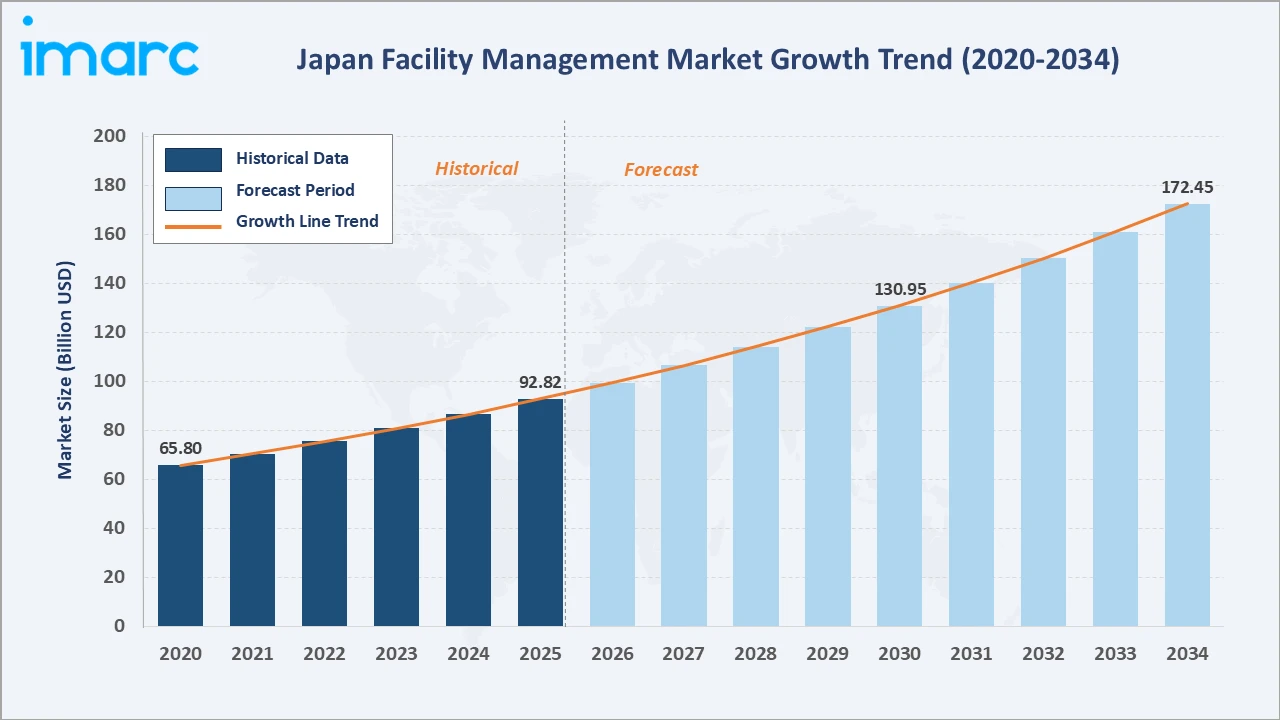
The Japan facility management market grew from USD 92.82 Billion in 2025 to USD 99.44 Billion in 2026 and is projected to reach USD 172.45 Billion by 2034, exhibiting a CAGR of 7.13% during 2026-2034. Rising outsourcing of building operations, expanding hard FM adoption, and steady commercial construction activity are the primary drivers shaping the market growth.
Outsourced facility management leads the type segment at 57.8%, hard FM dominates the offering segment at 61.4%, and Kanto Region commands 39.6% regional share.
Market Snapshot
|
Metric |
Value |
|
Base Year Market Size (2025) |
USD 92.82 Billion |
| Market Size (2026) | USD 99.44 Billion |
|
Forecast Market Size (2034) |
USD 172.45 Billion |
|
CAGR (2026-2034) |
7.13% |
|
Base Year |
2025 |
|
Historical Period |
2020-2025 |
|
Forecast Period |
2026-2034 |
|
Largest Region |
Kanto Region (39.6%, 2025) |
|
Second Largest Region |
Kansai/Kinki Region (18.4%, 2025) |
|
Leading Type |
Outsourced Facility Management (57.8%, 2025) |
|
Leading Offering |
Hard FM (61.4%, 2025) |
The Japan facility management market expanded from USD 65.80 Billion in 2020 to USD 92.82 Billion in 2025 and an estimated USD 99.44 Billion in 2026, driven by widening outsourcing adoption and steady hard FM demand growth. Anchored at USD 130.95 Billion in 2030, the forecast to USD 172.45 Billion by 2034 is supported by accelerating smart building adoption and deepening penetration of integrated FM contracts.
To get more information on this market, Request Sample
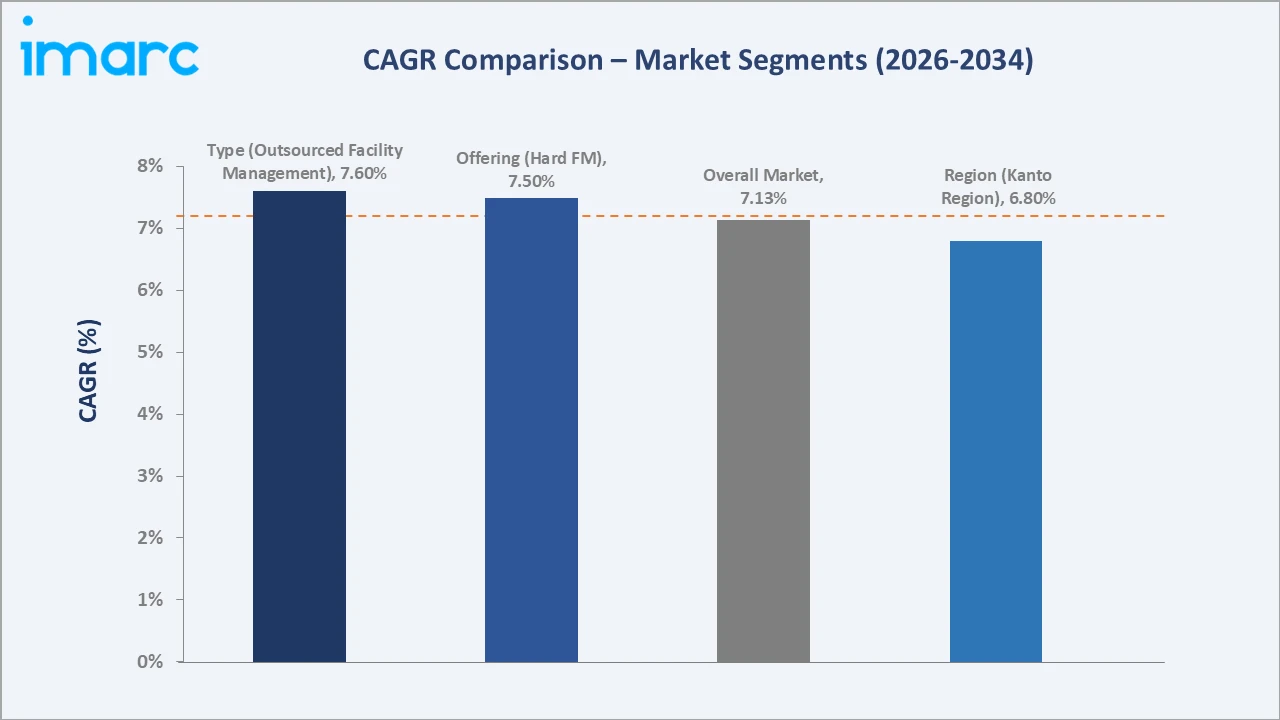
CAGR trajectories across type, offering, and regional sub-segments show Kyushu-Okinawa Region and outsourced facility management expanding faster than the overall 7.13% market CAGR, driven by tourism-linked construction and rising preference for specialized service providers.
Executive Summary
The Japan facility management market is on a steady growth trajectory from USD 65.80 Billion in 2020 to an estimated USD 99.44 Billion in 2026, to USD 172.45 Billion by 2034. The industry has moved from fragmented, inhouse-managed operations toward professionally outsourced, technology-enabled service delivery across offices, retail, healthcare, and public infrastructure. Rising commercial construction, together with an aging building stock, is encouraging facility owners to engage specialized outsourced providers.
Outsourced facility management leads the type segment at 57.8% in 2025, supported by cost efficiency and rising preference for single-vendor contracts. Hard FM leads the offering segment at 61.4%, fueled by demand for mechanical, electrical, and plumbing upkeep across commercial buildings. Kanto Region commands 39.6% of the regional share, led by Tokyo's dense commercial base and continuous urban redevelopment.
Key Market Insights
|
Insight |
Data |
|
Leading Type |
Outsourced Facility Management - 57.8% share (2025) |
|
Second Largest Type |
Inhouse Facility Management - 42.2% share (2025) |
|
Leading Offering |
Hard FM - 61.4% share (2025) |
|
Second Largest Offering |
Soft FM - 38.6% share (2025) |
|
Leading Region |
Kanto Region - 39.6% share (2025) |
|
Second Largest Region |
Kansai/Kinki Region - 18.4% share (2025) |
|
Top Companies |
CBRE Group, Inc., Jones Lang LaSalle Incorporated, Mitsubishi Estate Co., Ltd., SECOM Co., Ltd. |
Key Analytical Observations Supporting the Above Data:
- Outsourced facility management dominance at 57.8% is supported by rising preference among corporates for single-vendor integrated contracts, specialized technical capability, and cost predictability across multi-site portfolios.
- Inhouse facility management share at 42.2% remains relevant among manufacturers, government bodies, and large conglomerates that retain direct operational control over critical facilities and proprietary infrastructure.
- Hard FM leadership at 61.4% reflects continuous demand for mechanical, electrical, plumbing, and structural upkeep across Japan's dense commercial and industrial building stock.
- Soft FM at 38.6% is expanding as building owners increasingly bundle cleaning, security, and workplace hospitality services into integrated FM contracts.
- Kanto Region at 39.6% dominates regional share, anchored by Tokyo, Yokohama, and Saitama, supported by dense commercial development and continuous urban redevelopment activity.
Japan Facility Management Market Overview
Facility management refers to the coordinated services that keep buildings and infrastructure operational, safe, and efficient, spanning maintenance, cleaning, security, energy management, and workplace support. Increasing adoption of digital building technologies and sustainability-focused facility practices is further reshaping service delivery across Japan's commercial, industrial, and public infrastructure sectors.
The Japanese ecosystem integrates technology and equipment suppliers, FM operators and consultants, regulatory bodies including the Ministry of Land, Infrastructure, Transport and Tourism, and end users spanning commercial, industrial, and residential facilities, supporting Japan's extensive building base amid an aging stock and evolving energy compliance requirements.
Market Dynamics
To evaluate market opportunities, Request Sample
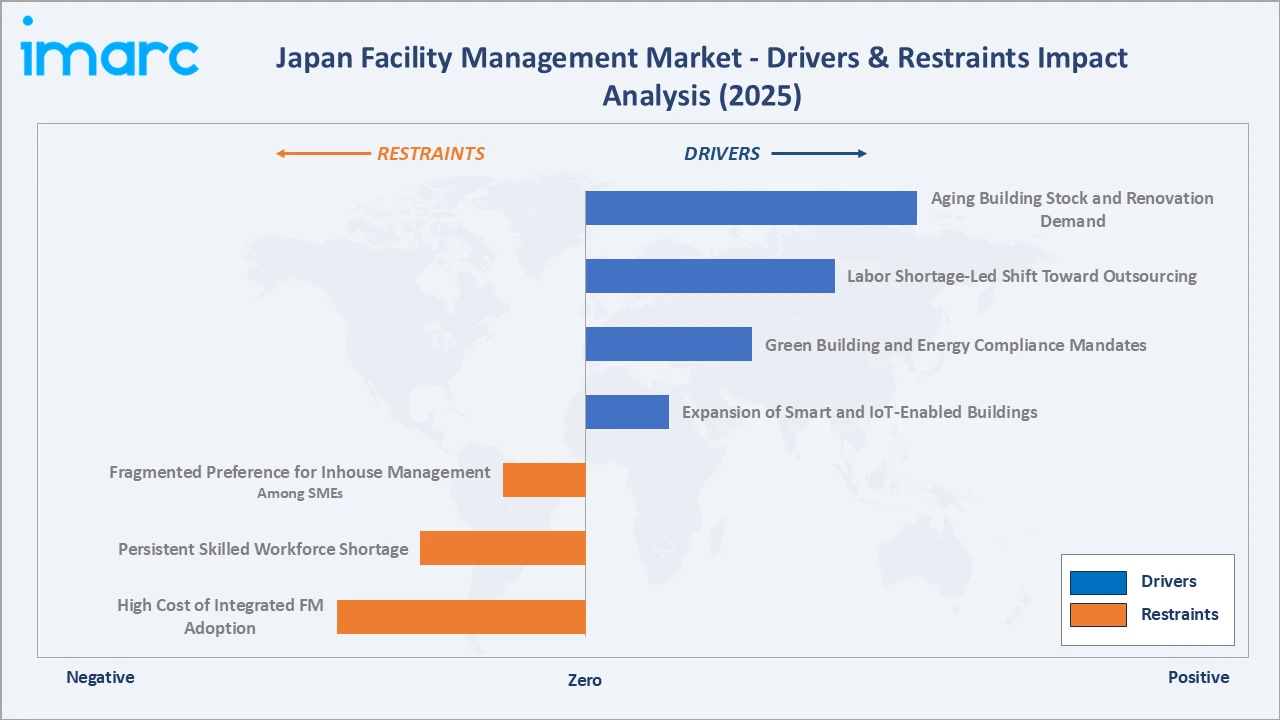
Market Drivers
- Aging Building Stock and Renovation Demand: A large share of Japan's commercial and residential buildings date to the postwar and bubble-era construction booms, requiring sustained mechanical, electrical, and structural upkeep that favors specialized FM providers over informal maintenance.
- Labor Shortage-Led Shift Toward Outsourcing: As of October 2025, foreign workers in Japan reached a record 2.57 Million, up 11.7% year-on-year per the Health Ministry, with building cleaning management formally designated a labor-shortage sector, reinforcing demand for professionally staffed outsourced FM providers.
- Green Building and Energy Compliance Mandates: Stricter energy conservation requirements are pushing building owners to engage FM providers with expertise in monitoring, retrofitting, and reporting on building energy performance.
- Expansion of Smart and IoT-Enabled Buildings: Growing deployment of building management systems and sensor-based monitoring is enabling predictive maintenance and creating new service opportunities for technology-capable FM operators.
Market Restraints
- High Cost of Integrated FM Adoption: Comprehensive outsourced contracts covering hard and soft services carry premium pricing that can deter small and mid-sized building owners from informal maintenance arrangements.
- Persistent Skilled Workforce Shortage: A shrinking working-age population constrains the availability of qualified technicians, particularly for specialized mechanical and electrical maintenance roles.
- Fragmented Preference for Inhouse Management Among SMEs: Many small and mid-sized enterprises retain facility operations inhouse due to cost sensitivity and limited awareness of outsourced service benefits.
Market Opportunities
- Smart Building Retrofits Across Aging Stock: Extensive renovation of older buildings lets FM providers bundle energy-efficiency retrofits with ongoing maintenance contracts.
- Regional Expansion Beyond Major Metros: Rising infrastructure investment in Kyushu-Okinawa, Hokkaido, and Tohoku Regions creates opportunities beyond the Kanto and Kansai/Kinki hubs.
Market Challenges
- Integration Complexity Across Legacy Buildings: Retrofitting older buildings with modern building management systems often requires custom engineering, raising project costs and timelines.
- Rising Client Expectations for Sustainability Reporting: Building owners increasingly expect detailed energy and emissions reporting, requiring continued investment in digital monitoring capability.
Emerging Market Trends
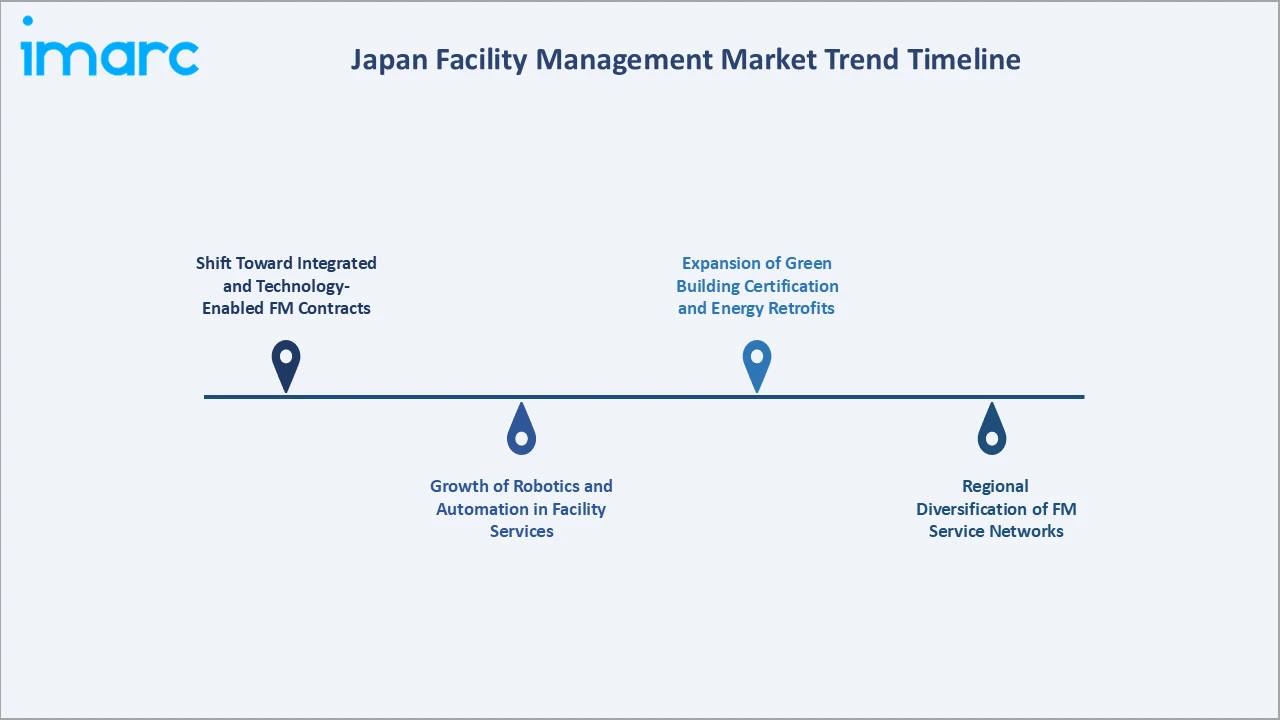
1. Shift Toward Integrated and Technology-Enabled FM Contracts
Building owners are increasingly consolidating hard and soft FM services under single integrated contracts supported by centralized building management platforms. The shift favors large, technology-capable operators over fragmented single-service vendors and is gradually reshaping how facility contracts are structured across Japan's commercial real estate sector.
2. Growth of Robotics and Automation in Facility Services
Persistent workforce constraints are accelerating deployment of cleaning robots, inspection drones, and robotic security patrols across offices, airports, and retail facilities. Integration with AI-powered predictive maintenance and IoT-enabled monitoring systems is further improving operational efficiency while reducing labor dependence and unplanned maintenance costs.
3. Expansion of Green Building Certification and Energy Retrofits
Growing regulatory emphasis on decarbonization is prompting building owners to pursue energy-efficiency retrofits and recognized sustainability certifications, creating new service lines for FM providers with dedicated energy management capabilities.
4. Regional Diversification of FM Service Networks
FM operators are extending branch networks into the Kyushu-Okinawa, Hokkaido, and Tohoku Regions to support tourism-linked hospitality construction and regional infrastructure renewal, gradually reducing the historical concentration of service capacity around the Kanto and Kansai/Kinki hubs.
Industry Value Chain Analysis
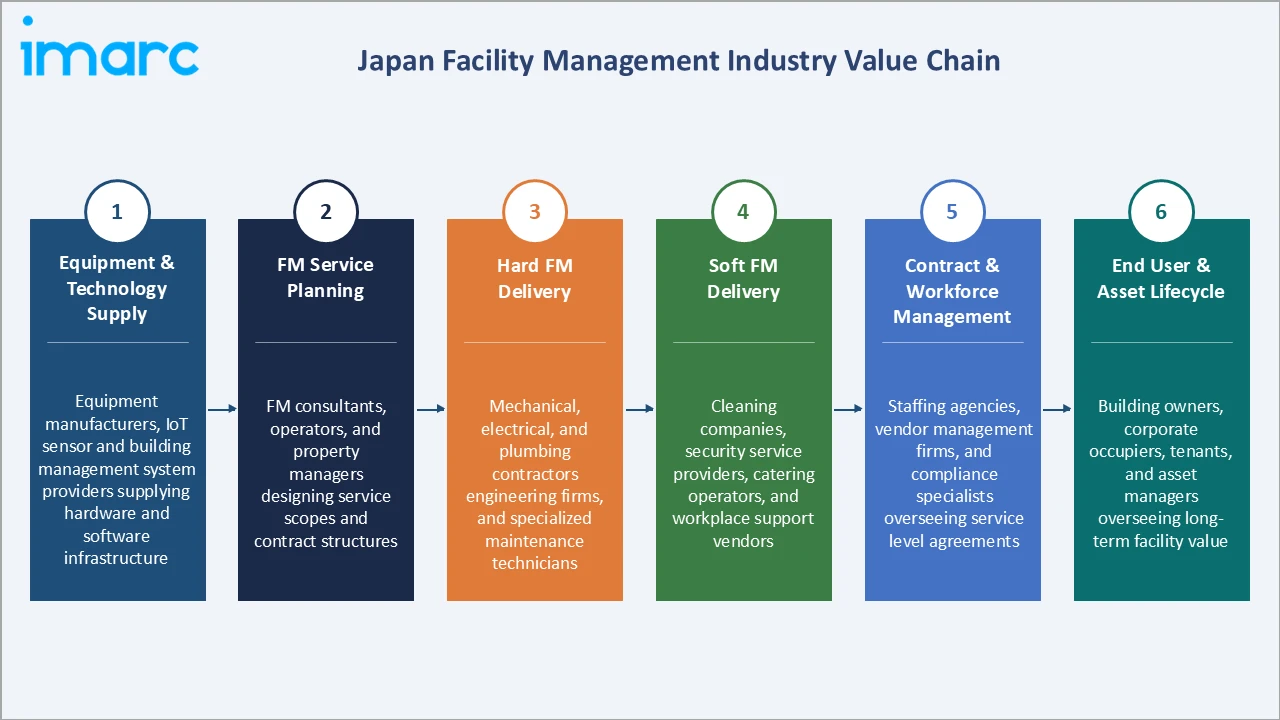
The Japan facility management value chain spans six stages, from technology and equipment supply through end-user and asset lifecycle management. Hard FM delivery and contract management capture significant value-add, while workforce availability increasingly determines competitive position.
|
Stage |
Key Players / Examples |
|
Equipment & Technology Supply |
Building equipment manufacturers, IoT sensor vendors, and building management system providers supplying hardware and software infrastructure |
|
FM Service Planning |
Facility management consultants, operators, and property managers designing service scopes and contract structures |
|
Hard FM Delivery |
Mechanical, electrical, and plumbing contractors, engineering firms, and specialized maintenance technicians |
|
Soft FM Delivery |
Cleaning companies, security service providers, catering operators, and workplace support vendors |
|
Contract & Workforce Management |
Staffing agencies, vendor management firms, and compliance specialists overseeing service level agreements |
|
End User & Asset Lifecycle |
Building owners, corporate occupiers, tenants, and asset managers overseeing long-term facility value |
Vertically integrated operators with proprietary technology platforms and direct workforce control capture greater value than providers reliant on subcontracted labor.
Technology Landscape in the Japan Facility Management Industry
Building Management Systems and IoT Integration
Facility operators are increasingly deploying sensor-based building management systems that monitor energy consumption, air quality, and equipment performance in real time, enabling predictive maintenance and reducing unplanned downtime.
Robotics and Automation
Cleaning robots, inspection drones, and robotic security systems are gaining traction across offices, airports, and retail facilities as operators respond to workforce constraints and rising demand for consistent service quality.
Data Analytics and Energy Management
Analytics platforms help FM providers track energy performance against regulatory benchmarks, supporting compliance with revised conservation standards while identifying retrofit-driven cost savings.
Digital Workplace and Space Management Tools
Growing adoption of digital space-booking and workplace management platforms is helping corporate occupiers optimize office utilization, supporting the shift toward flexible, technology-enabled workplace models.
Market Segmentation Analysis
The report covers the following segments:
|
Segment Category |
Leading Segment |
Market Share |
Year |
|
Type |
Outsourced Facility Management |
57.8% |
2025 |
|
Offering |
Hard FM |
61.4% |
2025 |
|
End User |
🔒 |
🔒 |
2025 |
|
Region |
Kanto Region |
39.6% |
2025 |

By Type
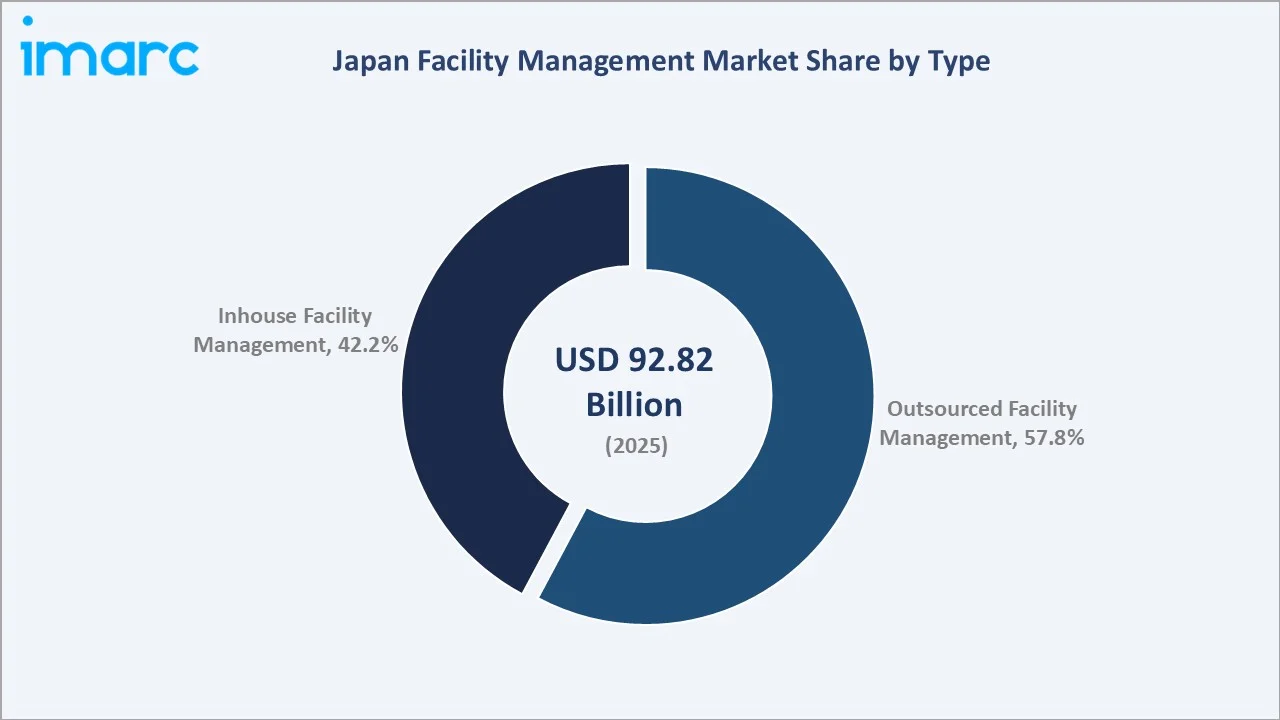
Outsourced facility management commands a 57.8% majority share in 2025, driven by rising preference for single-vendor integrated contracts, specialized technical expertise, and cost predictability across multi-site commercial portfolios. The segment benefits from growing corporate emphasis on core-business focus and structured service level agreements.
To access detailed market analysis, Request Sample
Inhouse facility management at 42.2% in 2025 remains prevalent among manufacturers, government bodies, and large conglomerates that retain direct operational control over critical infrastructure and proprietary facilities, particularly where security or process sensitivity limits third-party involvement.
By Offering
Hard FM dominates with 61.4% share in 2025, reflecting sustained demand for mechanical, electrical, plumbing, and structural maintenance across Japan's dense and aging commercial building stock. The segment remains the primary entry point for long-term maintenance contracts due to its recurring, compliance-linked nature.
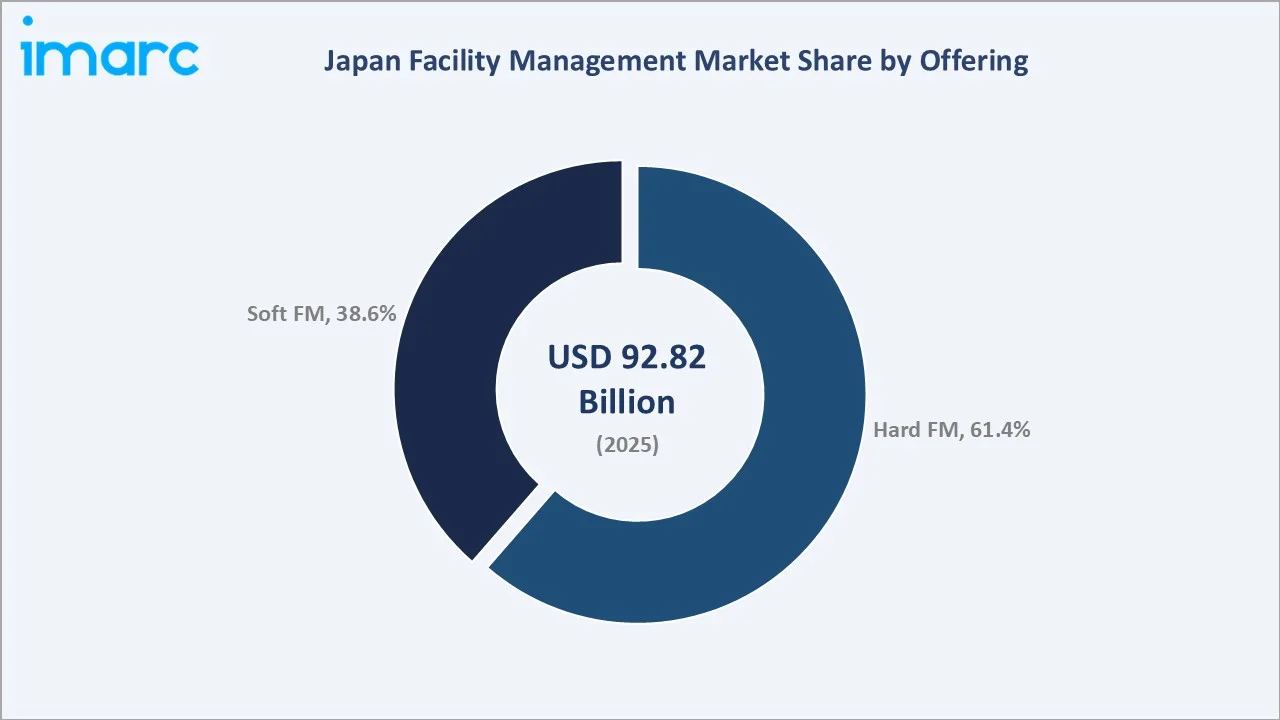
Soft FM at 38.6% is expanding as building owners increasingly bundle cleaning, security, catering, and workplace hospitality services into integrated contracts, supported by rising expectations around tenant experience and hygiene standards.
Regional Market Insights
|
Region |
Share (2025) |
Key Growth Drivers |
|
Kanto Region |
39.6% |
Dense commercial development, corporate headquarters concentration, and continuous urban redevelopment |
|
Kansai/Kinki Region |
18.4% |
Established commercial and industrial base, growing tourism-linked construction, and logistics expansion |
|
Central/Chubu Region |
14.2% |
Strong manufacturing and industrial presence supporting sustained hard FM demand |
|
Kyushu-Okinawa Region |
8.7% |
Rising tourism-linked hospitality construction and regional infrastructure investment |
|
Tohoku Region |
6.4% |
Ongoing reconstruction and infrastructure renewal supporting steady upkeep demand |
|
Chugoku Region |
5.3% |
Established industrial base and gradual commercial building modernization |
|
Hokkaido Region |
4.2% |
Growing tourism infrastructure and expanding data center investment |
|
Shikoku Region |
3.2% |
Steady demand from regional public infrastructure upkeep |
Kanto Region at 39.6% in 2025 leads the regional landscape, anchored by Tokyo, Yokohama, and Saitama. Dense commercial concentration, continuous redevelopment activity, and a large base of corporate occupiers support sustained leadership across both outsourced and inhouse channels.
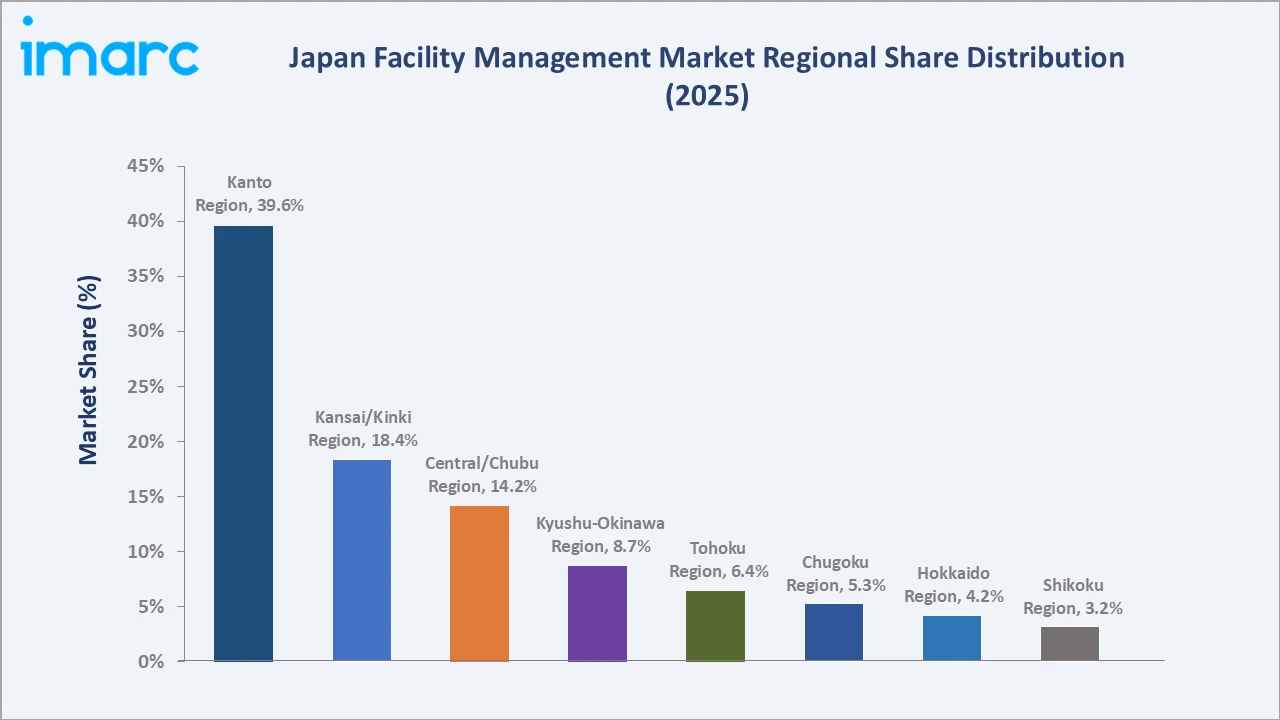
Kyushu-Okinawa Region, at 8.7% market share, is the fastest growing region. Expanding tourism-linked hospitality construction, rising inbound infrastructure investment, and regional logistics development are accelerating regional expansion through 2034.
Competitive Landscape
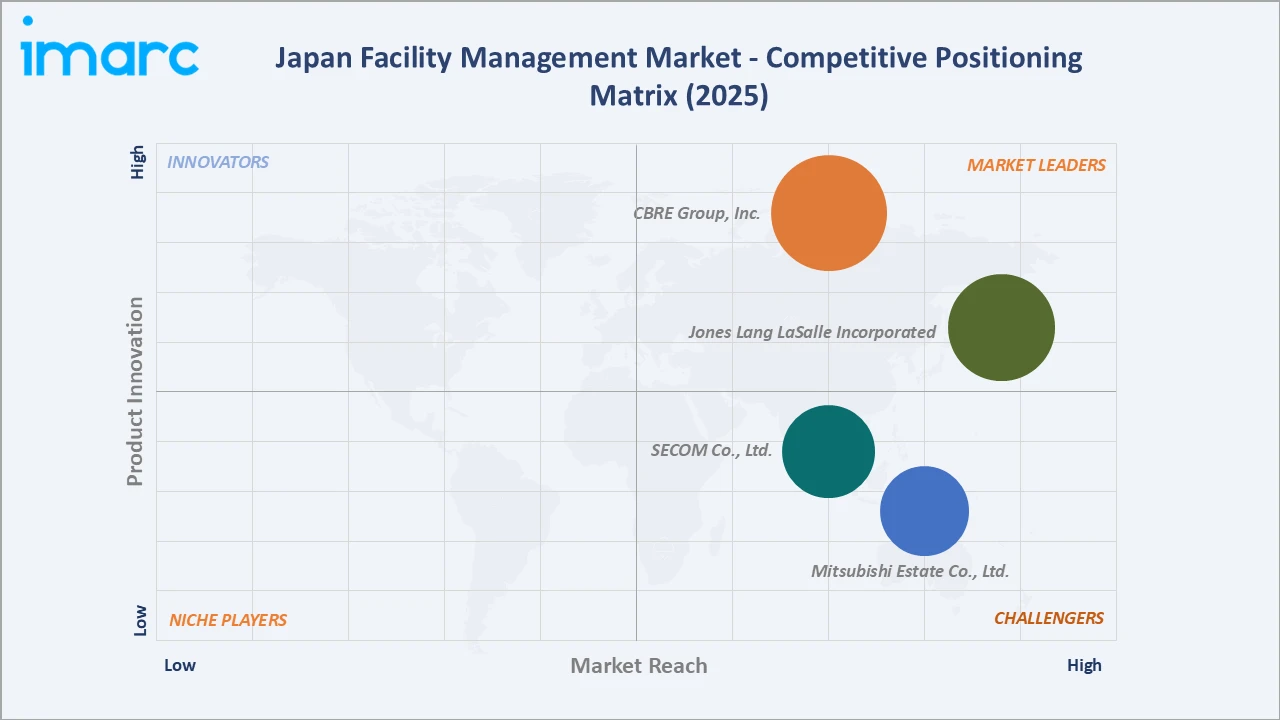
The Japan facility management market is moderately fragmented, with global integrated FM providers competing alongside established domestic security, real estate, and building management groups. Technology capability, workforce scale, and breadth of service offering form the key competitive differentiators across the sector.
|
Company Name |
Brand / Key Product |
Position |
Strategic Focus |
|
CBRE Group, Inc. |
Building Operations & Experience (BOE) |
Leader |
Technology-driven integrated facilities management with global platform and multi-regional presence |
|
Jones Lang LaSalle Incorporated |
JLL Integrated Facilities Management |
Leader |
Global real estate services operator with integrated workplace and facilities solutions |
|
Mitsubishi Estate Co., Ltd. |
Mitsubishi Jisho Property Management |
Challenger |
Domestic real estate group with large-scale commercial building management portfolio |
|
SECOM Co., Ltd. |
SECOM CX |
Challenger |
Security-led operator extending into integrated building management services |
Key players include CBRE Group, Inc., Jones Lang LaSalle Incorporated, Mitsubishi Estate Co., Ltd., and SECOM Co., Ltd., among others.
Key Company Profiles
CBRE Group, Inc.
CBRE Group, Inc. is a global commercial real estate services and investment firm, with a longstanding presence in Japan delivering integrated facilities and workplace services.
- Product Portfolio: Building Operations & Experience (BOE) covering hard FM and soft FM, property management, and workplace experience solutions for corporate occupiers and property owners across Japan.
- Recent Developments: The firm continues to strengthen its integrated facilities management capabilities in Japan by expanding technology-enabled workplace services, sustainability solutions, and smart building management offerings for corporate clients.
- Strategic Focus: Growing its integrated facilities management footprint in Japan through technology-enabled service delivery and expansion across corporate real estate portfolios.
Jones Lang LaSalle Incorporated
Jones Lang LaSalle Incorporated is a global commercial real estate and investment management company, operating in Japan through a full-service platform spanning leasing, property management, and facilities services.
- Product Portfolio: JLL Integrated Facilities Management covering hard FM and soft FM, energy management, and workplace experience solutions for clients in Japan.
- Recent Developments: The firm has continued building its integrated facilities management and workplace strategy capabilities in Japan, supporting occupiers navigating hybrid work and sustainability requirements.
- Strategic Focus: Expanding integrated facilities management contracts among multinational and domestic corporates while strengthening energy management advisory capabilities.
Mitsubishi Estate Co., Ltd.
Mitsubishi Estate Co., Ltd. is a major Japanese real estate developer headquartered in Tokyo, with a large portfolio of owned and managed commercial buildings.
- Product Portfolio: Mitsubishi Jisho Property Management offering building operations, tenant services, and facility upkeep across the group's office and commercial portfolio.
- Recent Developments: The company has continued investing in redevelopment and modernization of its urban commercial holdings, incorporating updated energy efficiency systems.
- Strategic Focus: Strengthening building management capabilities across its owned portfolio while extending property management services to third-party owners.
Market Concentration Analysis
The Japan facility management market is moderately fragmented, with a mix of global integrated FM providers, domestic security-led operators, and real estate group affiliates competing for large commercial and institutional contracts. The leading players together account for a meaningful but non-dominant share of total outsourced FM activity, with the remainder spread across regional and single-service providers.
Barriers to entry include the need for a nationwide skilled workforce, established relationships with large corporate occupiers, and the technology infrastructure required to deliver integrated hard and soft FM contracts, favoring well-capitalized incumbents with diversified portfolios.
Consolidation is gradually advancing as larger operators acquire regional maintenance firms, while partnerships between global FM providers and domestic real estate groups continue to reshape competitive positioning.
Investment & Growth Opportunities
Fastest-Growing Segments
Outsourced facility management expands fastest among type categories, driven by rising preference for single-vendor contracts. Hard FM is the next-fastest offering category, supported by sustained maintenance demand across Japan's aging commercial building stock.
Emerging Markets
Kyushu-Okinawa Region is the fastest growing regional market, anchored by tourism-linked hospitality construction and expanding infrastructure investment. Hokkaido Region represents a similar opportunity for operators targeting smart building management, energy-efficient facility services, and maintenance solutions across commercial, tourism, and public infrastructure assets.
Venture & Investment Trends
Investment activity is concentrated in building management software platforms, IoT-enabled monitoring systems, and robotics-focused facility service providers. Capital is also flowing into energy management and retrofit-focused ventures that align with Japan's tightening building energy compliance requirements.
Future Market Outlook (2026-2034)
The Japan facility management market is forecast to expand from USD 92.82 Billion in 2025 to USD 99.44 Billion in 2026 and is forecast to reach USD 172.45 Billion by 2034 at a CAGR of 7.13%, adding roughly USD 79.63 Billion in incremental market value over the forecast period.
Four forces will shape the market through 2034: tightening building energy compliance requirements; the rise of integrated, technology-enabled FM contracts; deeper robotics and automation adoption amid persistent workforce constraints; and gradual regional diversification of FM service networks.
By 2034, facility management in Japan is expected to be defined by outsourced, technology-enabled service delivery, with hard FM and integrated contracts accounting for a higher share of overall activity.
Research Methodology
Primary Research
Primary research included structured interviews with facility management operators, corporate real estate and workplace executives, building equipment suppliers, and regulatory specialists, validating market sizing, segment mix, and regional demand patterns.
Secondary Research
Secondary sources included publications from Japan's Ministry of Land, Infrastructure, Transport and Tourism, the Japan National Tourism Organization, and annual reports, press releases, and investor presentations from listed facility management and real estate operators.
Forecasting Models
Market forecasts used top-down and bottom-up models combining building stock data, outsourcing penetration trends, segment mix evolution, and macroeconomic variables. Scenario analysis addressed regulatory pace, workforce availability, and construction investment cycles.
Japan Facility Management Market Report Coverage:
| Report Features | Details |
|---|---|
| Base Year of the Analysis | 2025 |
| Historical Period | 2020-2025 |
| Forecast Period | 2026-2034 |
| Units | Billion USD |
| Scope of the Report | Exploration of Historical and Forecast Trends, Industry Catalysts and Challenges, Segment-Wise Historical and Predictive Market Assessment:
|
| Types Covered |
|
| Offerings Covered | Hard FM, Soft FM |
| End Users Covered | Healthcare, Government, Education, Military and Defense, Real Estate, Others |
| Regions Covered | Kanto Region, Kansai/Kinki Region, Central/ Chubu Region, Kyushu-Okinawa Region, Tohoku Region, Chugoku Region, Hokkaido Region, Shikoku Region |
| Companies Covered | CBRE Group, Inc., Jones Lang LaSalle Incorporated, Mitsubishi Estate Co., Ltd., SECOM Co., Ltd., etc. |
| Customization Scope | 10% Free Customization |
| Post-Sale Analyst Support | 10-12 Weeks |
| Delivery Format | PDF and Excel through Email (We can also provide the editable version of the report in PPT/Word format on special request) |
Key Benefits for Stakeholders:
- IMARC’s industry report offers a comprehensive quantitative analysis of various market segments, historical and current market trends, market forecasts, and dynamics of the Japan facility management market from 2020-2034.
- The research report provides the latest information on the market drivers, challenges, and opportunities in the Japan facility management market.
- Porter's five forces analysis assist stakeholders in assessing the impact of new entrants, competitive rivalry, supplier power, buyer power, and the threat of substitution. It helps stakeholders to analyze the level of competition within the Japan facility management industry and its attractiveness.
- Competitive landscape allows stakeholders to understand their competitive environment and provides an insight into the current positions of key players in the market.
Frequently Asked Questions About the Japan Facility Management Market Report
The Japan facility management market size is estimated at USD 99.44 Billion in 2026, driven by rising outsourcing adoption and an aging building stock.
The market is projected to grow at a CAGR of 7.13% from 2026-2034, reaching USD 172.45 Billion, supported by smart building adoption and regulatory-led renovation demand.
Outsourced facility management leads the type segment at 57.8% in 2025, driven by cost efficiency, specialized technical expertise, and rising preference for single-vendor contracts.
Hard FM dominates the offering segment at 61.4% in 2025, fueled by sustained demand for mechanical, electrical, and plumbing maintenance across Japan's commercial building stock.
Kanto Region commands 39.6% in 2025, led by dense commercial development across Tokyo, Yokohama, and Saitama.
Kyushu-Okinawa Region is the fastest growing region, supported by tourism-linked hospitality construction and infrastructure investment.
Leading players include CBRE Group, Inc., Jones Lang LaSalle Incorporated, Mitsubishi Estate Co., Ltd., and SECOM Co., Ltd., among others.
A shrinking working-age population is pushing building owners toward outsourced FM providers and accelerating robotics adoption in cleaning and maintenance.
Building management systems, IoT sensors, and robotics are enabling predictive maintenance and automation-led service delivery across facilities.
Need more help?
- Speak to our experienced analysts for insights on the current market scenarios.
- Include additional segments and countries to customize the report as per your requirement.
- Gain an unparalleled competitive advantage in your domain by understanding how to utilize the report and positively impacting your operations and revenue.
- For further assistance, please connect with our analysts.
 Request Customization
 Speak to an Analyst
 Request Brochure
 Inquire Before Buying
Benefits of Customization
- Personalize this research
- Triangulate with your data
- Get data as per your format and definition
- Gain a deeper dive into a specific application, geography, customer, or competitor
- Any level of personalization
Get in Touch With Us
UNITED STATES
Phone: +1-201-971-6302
INDIA
Phone: +91-120-433-0800
UNITED KINGDOM
Phone: +44-753-714-6104
Email: [email protected]
Client Testimonials




.webp)




.webp)













Related Reports

Choose your plan
*Please note that the prices mentioned below are starting prices for each bundle type. Kindly contact our team for further details.*
Single User License
- 1 User License, Access on 2 Devices
- PDF Report + Excel Dataset (Password Protected)
- Lifetime Access
- No Printing Rights
- 10% Free Report Customization
- 10–12 Weeks of Analyst Support
Five User License
- Access for 5 Users, 2 Devices per User
- PDF Report + Excel Dataset (Password Protected)
- Lifetime Access
- Dedicated Account Manager
- 12–14 Weeks of Analyst Support
- No Printing Rights
- 15% Free Report Customization
- 25% Discount on Your Next Purchase
Corporate User License
- Unlimited User Access (Within Your Organization)
- PDF Report + Excel Dataset
- Lifetime Access
- Dedicated Account Manager
- 14–20 Weeks of Analyst Support
- No Printing Rights
- 20% Free Report Customization
- 30% Discount on Your Next Purchase
Essential Insights
What's included:
3 reports
- Lifetime Access
- PDF Reports
- Excel Datasets
- 2 Weeks of Free Analyst Support
- 2 User Licenses
- Access on 2 Devices
- Printing Rights
- Complimentary PowerPoint (PPT) Version
- Complimentary License Upgrade
Professional Access
What's included:
5 reports
- Lifetime Access
- PDF Reports
- Excel Datasets
- 8 Weeks of Free Analyst Support
- 2 User Licenses
- Access on 2 Devices
- Printing Rights
- Complimentary PowerPoint (PPT) Version
- Complimentary License Upgrade
Business Advantage
What's included:
8 reports
- Lifetime Access
- PDF Reports
- Excel Datasets
- 14 Weeks of Free Analyst Support
- 2 User Licenses
- Access on 2 Devices
- Printing Rights
- Complimentary PowerPoint (PPT) Version
- Complimentary License Upgrade
Enterprise Intelligence
What's included:
10 reports
- Lifetime Access
- PDF Reports
- Excel Datasets
- 20 Weeks of Free Analyst Support
- 2 User Licenses
- Access on 2 Devices
- Printing Rights
- Complimentary PowerPoint (PPT) Version
- Complimentary License Upgrade