
Japan Food Service Market Size, Share, Trends and Forecast by Foodservice Type, Outlet, Location, and Region, 2026-2034
Japan Food Service Market Size, Share, Trends & Forecast (2026-2034)
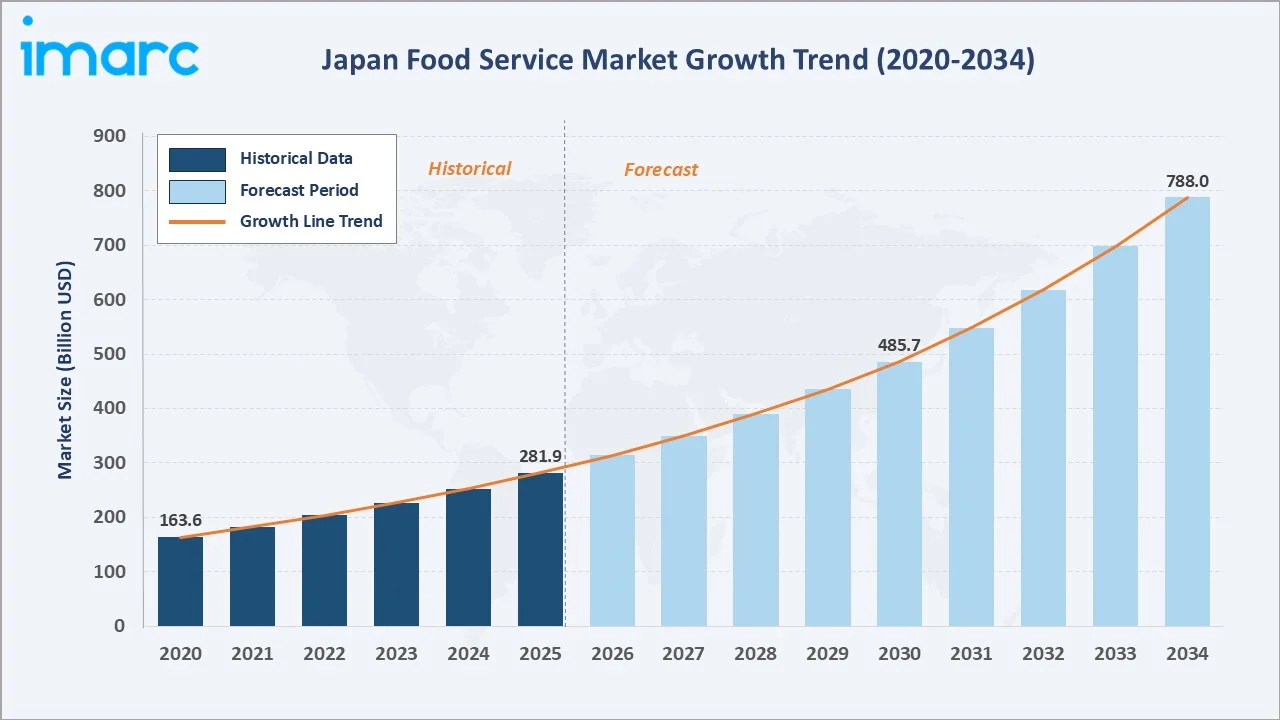
The Japan food service market size increased from USD 281.9 Billion in 2025 to USD 330.0 Billion in 2026 and is projected to reach USD 788.0 Billion by 2034, exhibiting a CAGR of 11.50% during 2026-2034. Japan welcomed a record 36.9 Million international visitors in 2024. This surge in inbound tourism, alongside an aging population's shift toward convenient dining and rapid cloud kitchen expansion, is primarily driving the market growth.
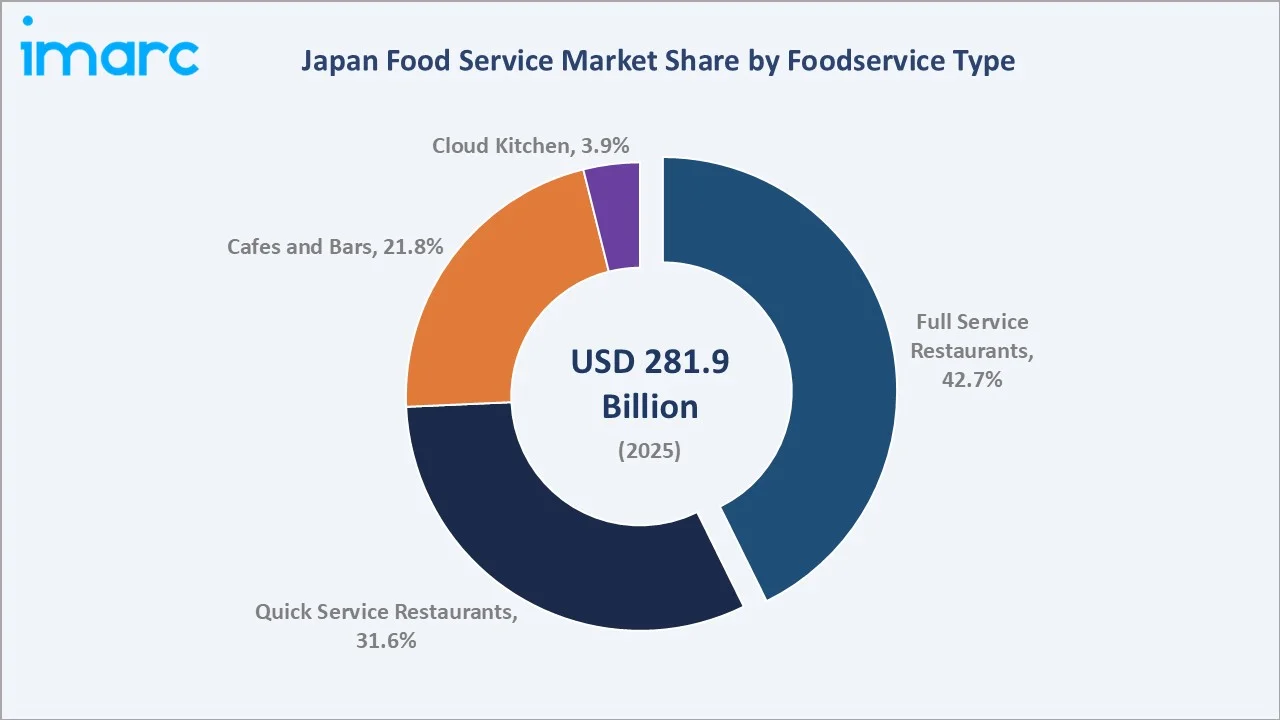
Full service restaurants lead the foodservice type segment at 42.7%, independent outlets dominate the outlet segment at 62.4%, and Kanto Region commands 36.4% regional share.
Market Snapshot
|
Metric |
Value |
|
Base Year Market Size (2025) |
USD 281.9 Billion |
| Market Size (2026) | USD 330.0 Billion |
|
Forecast Market Size (2034) |
USD 788.0 Billion |
|
CAGR (2026-2034) |
11.50% |
|
Base Year |
2025 |
|
Historical Period |
2020-2025 |
|
Forecast Period |
2026-2034 |
|
Largest Region |
Kanto Region (36.4%, 2025) |
|
Second Largest Region |
Kansai/Kinki Region (18.7%, 2025) |
|
Leading Foodservice Type |
Full Service Restaurants (42.7%, 2025) |
|
Leading Outlet |
Independent Outlets (62.4%, 2025) |
The Japan food service market expanded from USD 163.6 Billion in 2020 to USD 281.9 Billion in 2025 and an estimated USD 330.0 Billion in 2026, driven by tourism-led demand and steady menu price increases across urban restaurant chains. Anchored at USD 485.7 Billion in 2030, the forecast to USD 788.0 Billion by 2034 is supported by accelerating cloud kitchen adoption, automation-led labor efficiency, and sustained inbound travel momentum.
To get more information on this market, Request Sample
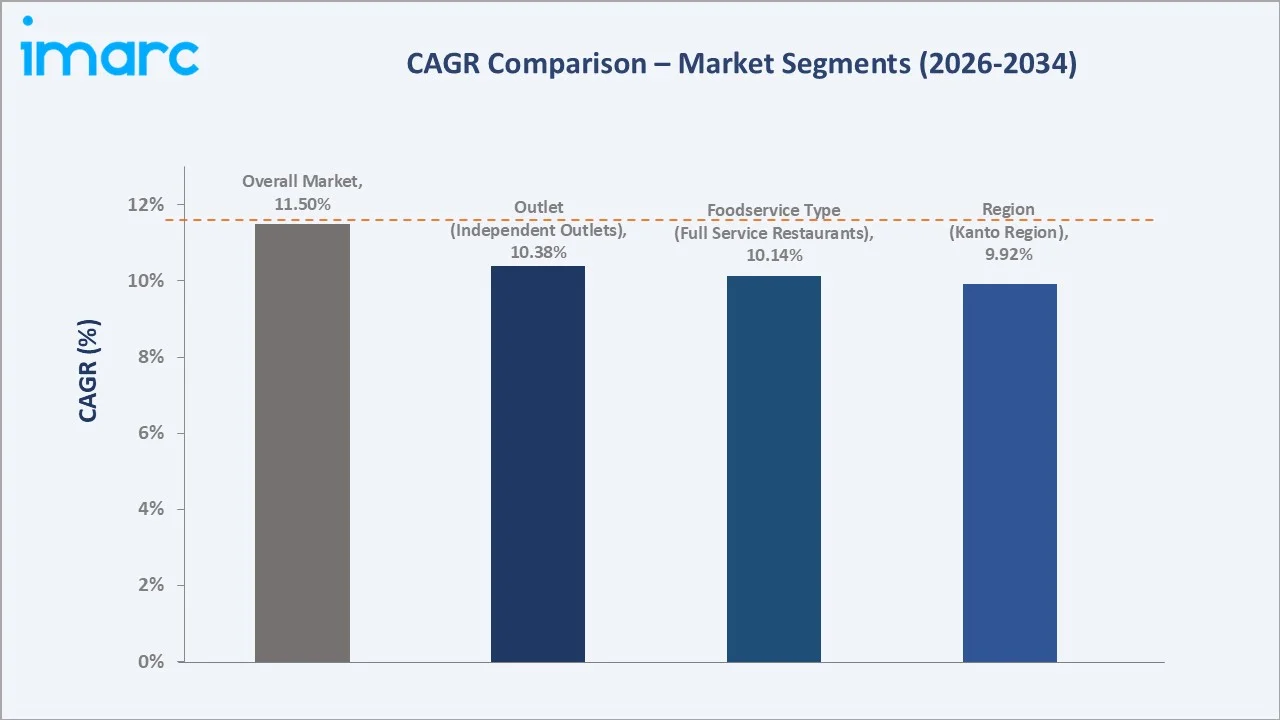
CAGR trajectories across foodservice type, outlet, and regional sub-segments show cloud kitchen and Kyushu-Okinawa Region expanding well above the overall 11.50% market CAGR, driven by delivery platform integration, tourism-led demand, and surging urban demand for convenient meal formats.
Executive Summary
The Japan food service market is on a sustained growth trajectory from USD 163.6 Billion in 2020 and USD 330.0 Billion in 2026 and is projected to reach USD 788.0 Billion by 2034. The industry has shifted from traditional dine-in formats toward a more diversified mix of quick service, cafe, and delivery-first concepts across the country's dense urban centers. Rising inbound tourism, an aging workforce, and growing automation adoption are reshaping how restaurants operate and compete.
Full service restaurants lead the foodservice type segment at 42.7% in 2025, supported by strong dinner and social dining occasions. Independent outlets command 62.4% of the outlet segment, reflecting Japan’s deep culture of owner-operated restaurants. Kanto Region commands 36.4% of the regional share, fueled by dense urban population, corporate dining demand, and high tourist footfall.
Key Market Insights
|
Insight |
Data |
|
Leading Foodservice Type |
Full Service Restaurants - 42.7% share (2025) |
|
Second Largest Foodservice Type |
Quick Service Restaurants - 31.6% share (2025) |
|
Leading Outlet |
Independent Outlets - 62.4% share (2025) |
|
Second Largest Outlet |
Chained Outlets - 37.6% share (2025) |
|
Leading Region |
Kanto Region - 36.4% share (2025) |
|
Second Largest Region |
Kansai/Kinki Region - 18.7% share (2025) |
|
Top Companies |
Zensho Holdings Co., Ltd., Skylark Group, Yoshinoya Holdings Co., Ltd., Colowide Co., Ltd., Royal Holdings Co., Ltd. |
Key Analytical Observations Expanding On The Data Above:
- Full service restaurants at 42.7% lead the foodservice type segment, supported by strong dinner and social dining occasions, extensive menu variety, and continued demand for table-service dining among both domestic and international diners.
- Quick service restaurants share at 31.6% benefits from value pricing, rapid table turnover, and dense store networks across train stations and commercial districts, appealing to time-constrained urban workers.
- Independent outlets dominance at 62.4% is driven by their widespread presence across local neighborhoods, strong focus on regional cuisine, and ability to adapt menus to local consumer preferences.
- Chained outlets at 37.6% benefit from standardized operations, consistent food quality, strong brand recognition, and continued network expansion across high-footfall urban locations.
- Kanto Region at 36.4% dominates regional share, anchored by Tokyo, Kanagawa, and Saitama, supported by dense urban population and a large concentration of dining establishments nationwide.
Japan Food Service Market Overview
Food service refers to the preparation and sale of meals and beverages for immediate consumption through restaurants, cafes, bars, and delivery-only cloud kitchens across dine-in, takeaway, and online formats. The Japan market consists of a wide variety of foodservice formats, supported by evolving dining habits, high urbanization, and growing demand for convenience and quality.
Japan's food service ecosystem integrates ingredient suppliers, central kitchens, restaurant operators and franchise chains, cloud kitchen and delivery platforms, point-of-sale and automation technology vendors, and logistics partners. Together, they support a mature, densely networked dining industry shaped by evolving consumer preferences, labor constraints, and macroeconomic factors including currency movements and tourism inflows.
Market Dynamics
To evaluate market opportunities, Request Sample
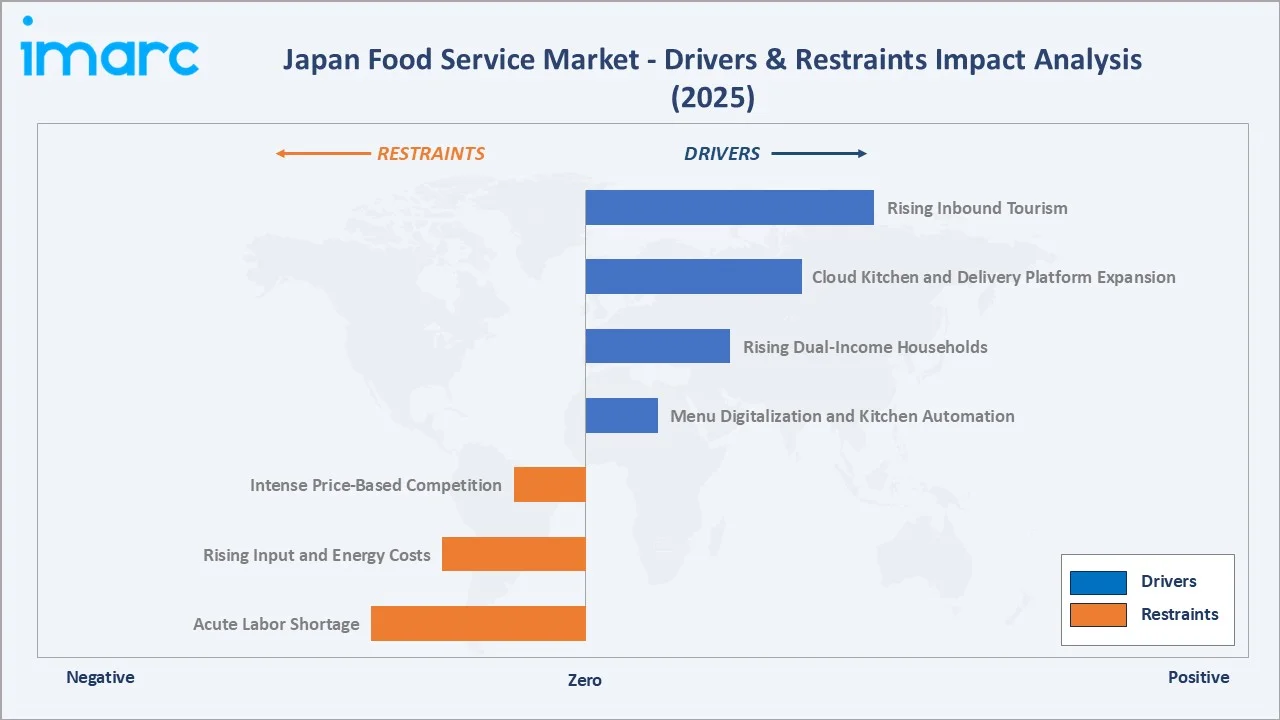
Market Drivers
- Rising Inbound Tourism: Japan's tourism-led dining demand continues to climb as international arrivals reach record levels, encouraging restaurant operators to expand multilingual menus, cashless payment options, and tourist-friendly dining formats near major transit hubs.
- Cloud Kitchen and Delivery Platform Expansion: As per IMARC Group, the Japan cloud kitchen market size reached USD 4.7 Billion in 2025. Growing partnerships between restaurant chains and delivery aggregators are lowering barriers to entry for delivery-first concepts, enabling operators to reach suburban and residential demand without the cost of full dine-in outlets.
- Rising Dual-Income Households: The increasing number of dual-income households is driving demand for convenient dining and ready-to-eat meal options, supporting higher spending across quick-service restaurants, takeaway outlets, and food delivery platforms.
- Menu Digitalization and Kitchen Automation: Growing adoption of self-order kiosks, tableside tablets, and semi-automated kitchen equipment is helping operators sustain service quality despite a shrinking working-age population.
Market Restraints
- Acute Labor Shortage: A shrinking working-age population and low unemployment are making it increasingly difficult for restaurant operators to staff kitchens and service floors, particularly in regional and suburban locations.
- Rising Input and Energy Costs: Higher prices for food ingredients, utilities, and logistics are increasing operating expenses for food service operators, putting pressure on profit margins and limiting their ability to absorb additional costs.
- Intense Price-Based Competition: Dense restaurant clustering in urban districts is intensifying price competition among quick service and casual dining operators, limiting pricing power even as costs rise.
Market Opportunities
- Menu Localization for International Tourists: Growing inbound tourism creates opportunities for operators to develop halal, vegetarian, and multilingual menu offerings tailored to diverse visitor segments.
- Growth of Premium and Experiential Dining: Increasing consumer willingness to spend on unique culinary experiences, chef-led concepts, and themed restaurants is creating opportunities for operators to differentiate their offerings and attract higher-value customers.
Market Challenges
- Persistent Labor Shortage and Rising Wage Costs: Operators face ongoing difficulty recruiting and retaining kitchen and service staff, pushing wage costs higher across both urban and regional markets.
- Supply Chain and Weather-Related Disruptions: Extreme weather events and reliance on imported ingredients continue to create periodic supply volatility, complicating menu planning and cost control for operators.
Emerging Market Trends
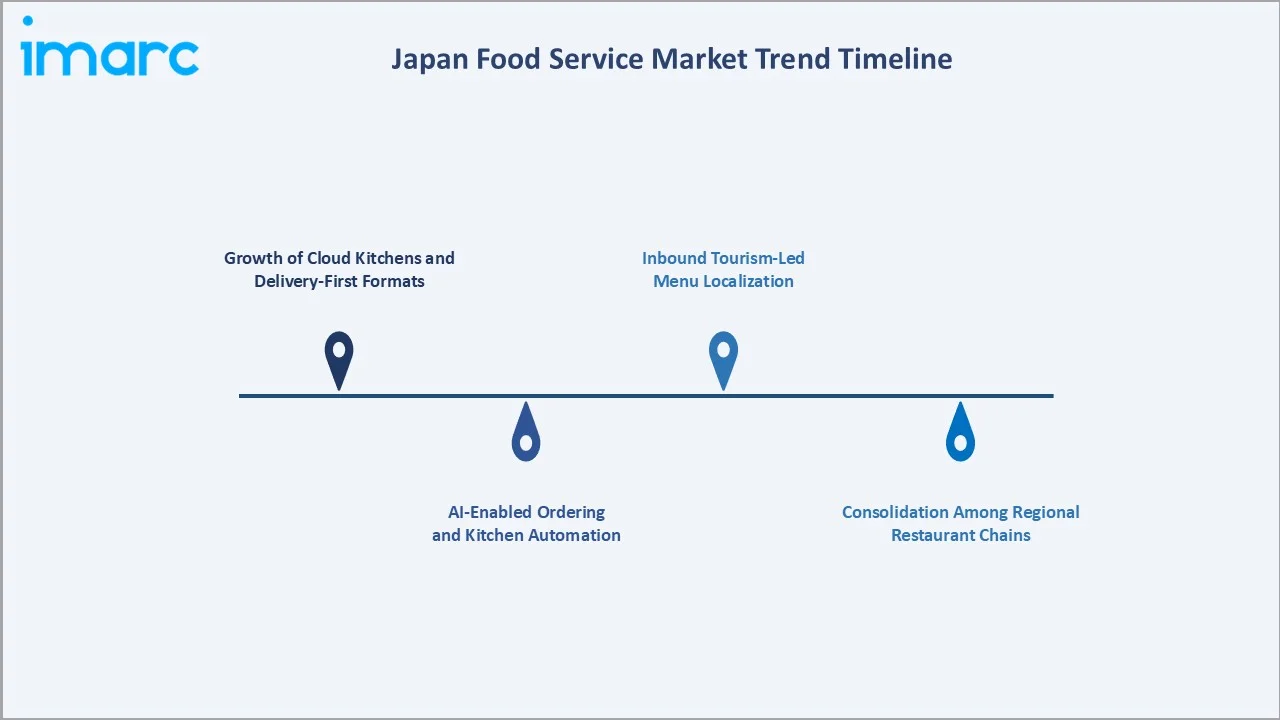
1. Growth of Cloud Kitchens and Delivery-First Formats
Restaurant operators are expanding cloud kitchens and delivery-only brands to meet rising demand for online food ordering while reducing real estate and front-of-house operating costs. Partnerships with delivery platforms are also enabling businesses to expand their reach into residential and suburban markets.
2. AI-Enabled Ordering and Kitchen Automation
Restaurant chains are deploying AI-based demand forecasting, self-order kiosks, and semi-automated cooking equipment to offset labor shortages. These systems are also improving order accuracy and reducing wait times during peak dining hours.
3. Inbound Tourism-Led Menu Localization
Rising visitor arrivals are prompting operators to introduce multilingual menus, digital translation tools, and region-specific tasting formats, particularly in Kanto Region and Kansai/Kinki Region, which serve as major tourist corridors.
4. Consolidation Among Regional Restaurant Chains
Larger chained operators are acquiring smaller regional brands to gain kitchen efficiency, purchasing scale, and broader geographic coverage, a trend expected to continue as labor and input costs rise through the forecast period.
Industry Value Chain Analysis
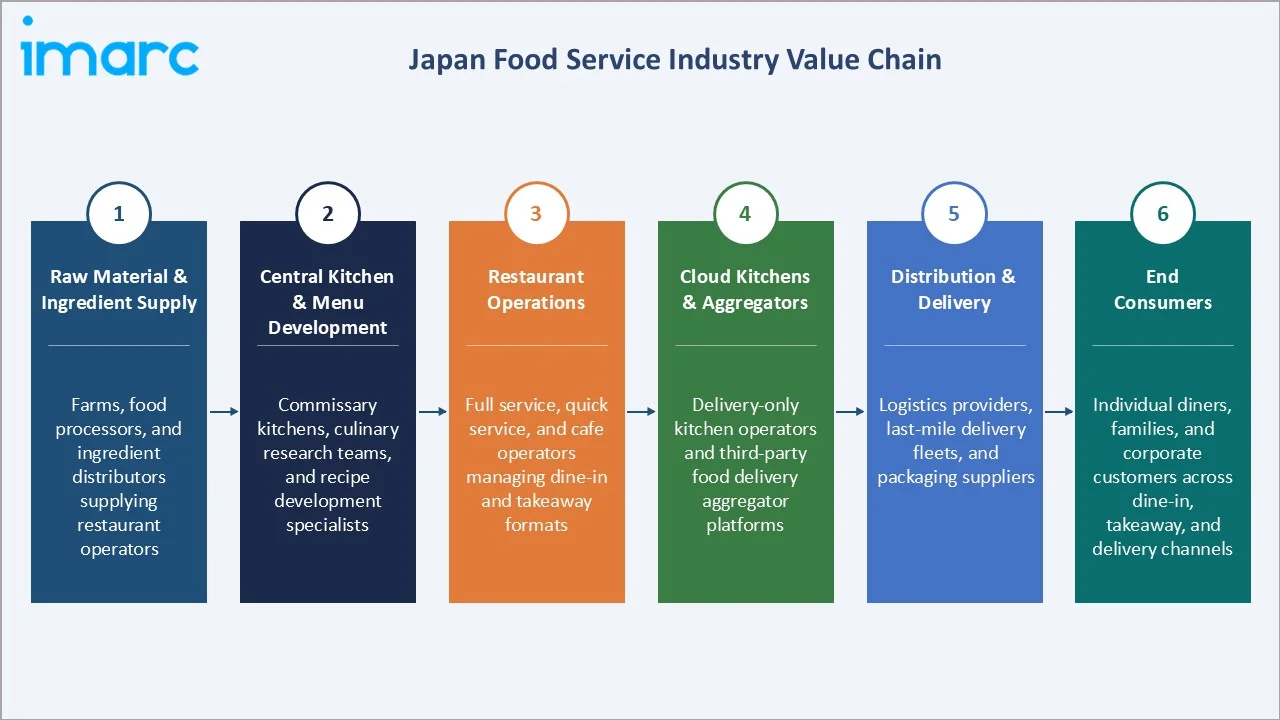
The Japan food service value chain spans six stages, from ingredient supply through end-consumer delivery. Restaurant operations, cloud kitchens, and distribution capture the highest value-add, while central kitchen efficiency and technology adoption increasingly determine competitive position across formats.
|
Stage |
Key Players / Examples |
|
Raw Material & Ingredient Supply |
Farms, food processors, and ingredient distributors supplying restaurant operators |
|
Central Kitchen & Menu Development |
Commissary kitchens, culinary research teams, and recipe development specialists |
|
Restaurant Operations |
Full service, quick service, and cafe operators managing dine-in and takeaway formats |
|
Cloud Kitchens & Aggregators |
Delivery-only kitchen operators and third-party food delivery aggregator platforms |
|
Distribution & Delivery |
Logistics providers, last-mile delivery fleets, and packaging suppliers |
|
End Consumers |
Individual diners, families, and corporate customers across dine-in, takeaway, and delivery channels |
Vertically integrated operators, especially those with proprietary central kitchens and direct delivery capabilities, are positioned to capture greater value than independent restaurants reliant on third-party logistics and aggregator platforms.
Technology Landscape in the Japan Food Service Industry
Kitchen Automation and Robotics
Restaurant operators are deploying semi-automated cooking equipment, robotic food preparation arms, and conveyor-based delivery systems to offset chronic staffing shortages while maintaining consistent food quality across high-volume locations.
Point-of-Sale and Cashless Payment Systems
Integrated point-of-sale platforms with cashless and QR-based payment support are streamlining checkout, reducing labor requirements at the register, and enabling operators to capture richer customer transaction data.
AI-Driven Demand Forecasting
AI and machine learning (ML) models are helping operators forecast footfall, optimize staff scheduling, and minimize food waste through more accurate ingredient ordering and inventory management. The technology is also enabling faster operational decisions, improving resource utilization, and enhancing overall restaurant efficiency.
Mobile Ordering and Delivery Technology
Native mobile apps integrated with delivery aggregators, loyalty programs, and self-order kiosks are becoming standard across chained outlets, supporting faster service and higher average order values.
Market Segmentation Analysis
The report covers the following segments:
|
Segment Category |
Leading Segment |
Market Share |
Year |
|
Foodservice Type |
Full Service Restaurants |
42.7% |
2025 |
|
Outlet |
Independent Outlets |
62.4% |
2025 |
|
Location |
🔒 |
🔒 |
2025 |
|
Region |
Kanto Region |
36.4% |
2025 |

By Foodservice Type
Full service restaurants command a 42.7% majority share in 2025, driven by strong dinner and social dining occasions, extensive menu variety, and continued preference for table-service experiences among domestic diners and tourists alike. The segment benefits from higher average check values and repeat corporate dining demand.
To access detailed market analysis, Request Sample
Quick service restaurants follow at 31.6%, supported by value pricing, fast turnaround, and dense store networks near train stations and commercial districts.
By Outlet
Independent outlets lead the outlet segment with 62.4% share in 2025, reflecting Japan's deep culture of owner-operated restaurants, specialty cuisine establishments, and neighborhood dining venues that remain central to the country's food culture.
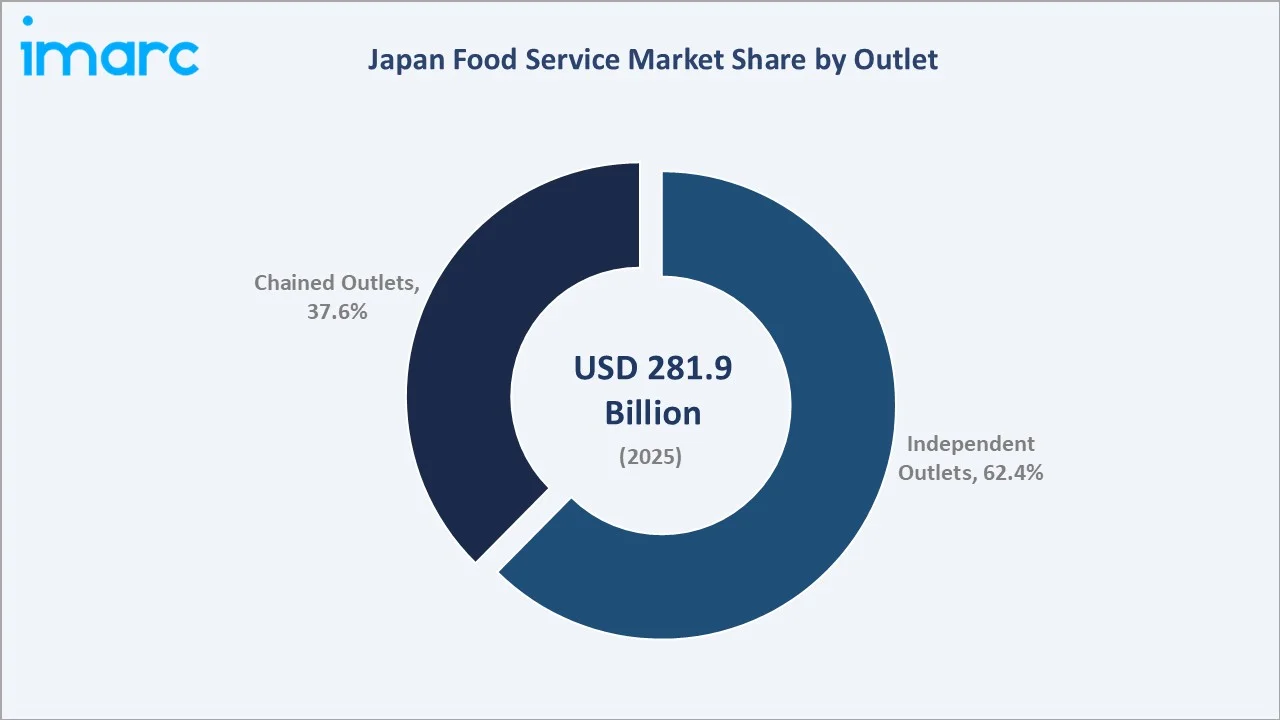
Chained outlets account for the remaining 37.6%, expanding through standardized operations, central kitchen efficiency, and franchise-led growth, particularly in suburban and regional markets where labor efficiency and brand consistency drive scale.
Regional Market Insights
|
Region |
Share (2025) |
Key Growth Drivers |
|
Kanto Region |
36.4% |
Large urban population, strong corporate dining demand, dense transit-linked restaurant networks, and high tourist footfall |
|
Kansai/Kinki Region |
18.7% |
Established culinary tradition, strong tourism inflows, and dense concentration of independent dining establishments |
|
Central/Chubu Region |
15.3% |
Growing manufacturing workforce, expanding suburban dining formats, and rising franchise chain penetration |
|
Kyushu-Okinawa Region |
9.2% |
Rising inbound tourism, expanding resort and hospitality dining, and growing regional cuisine promotion |
|
Tohoku Region |
7.1% |
Gradual urban redevelopment, regional specialty dining demand, and improving transport connectivity |
|
Chugoku Region |
5.4% |
Steady local dining demand, moderate franchise expansion, and stable regional consumption patterns |
|
Hokkaido Region |
4.5% |
Strong seasonal tourism, seafood and regional cuisine appeal, and growing resort-linked dining formats |
|
Shikoku Region |
3.4% |
Small but stable local dining base, gradual tourism growth, and limited but steady chain outlet expansion |
Kanto Region at 36.4% in 2025 leads the regional landscape, anchored by Tokyo, Kanagawa, and Saitama. Dense urban population, strong corporate dining demand, and a large concentration of dining establishments support sustained leadership across both independent and chained outlets.
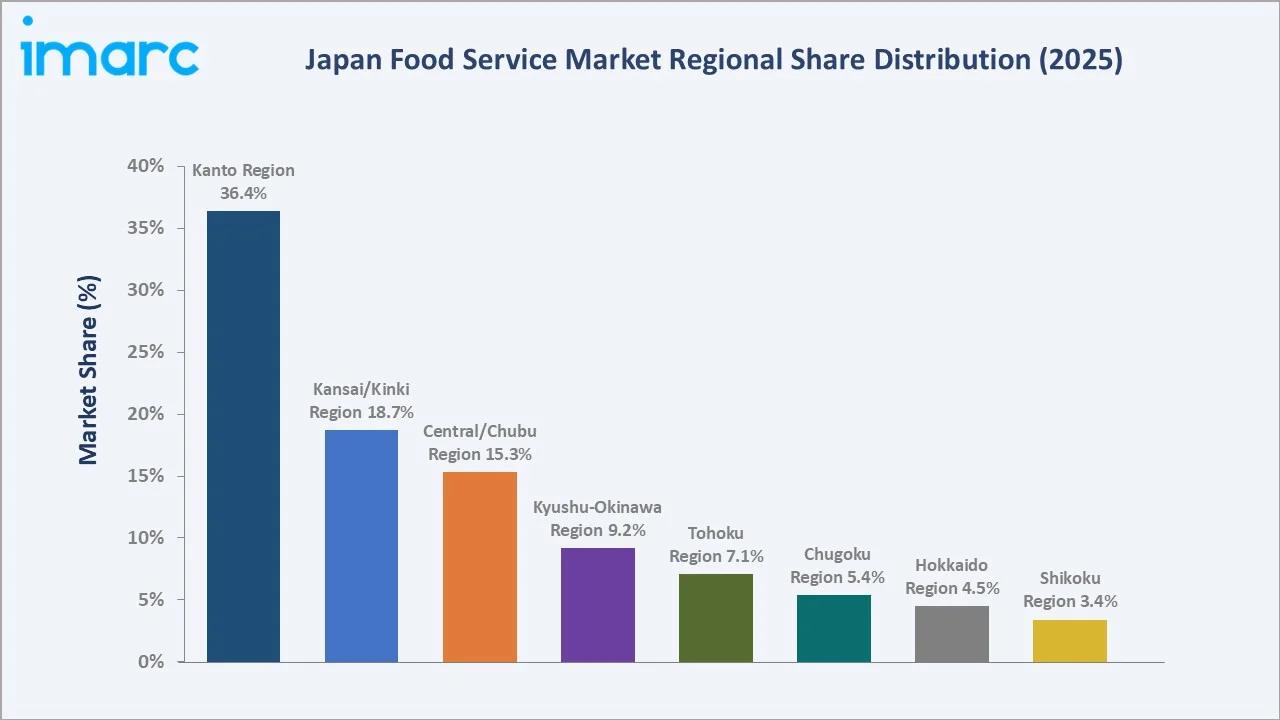
Kansai/Kinki Region at 18.7% is the second largest area, supported by major tourism hubs, such as Osaka, Kyoto, and Kobe, a strong concentration of restaurants, and sustained demand from both domestic travelers and international visitors.
Competitive Landscape
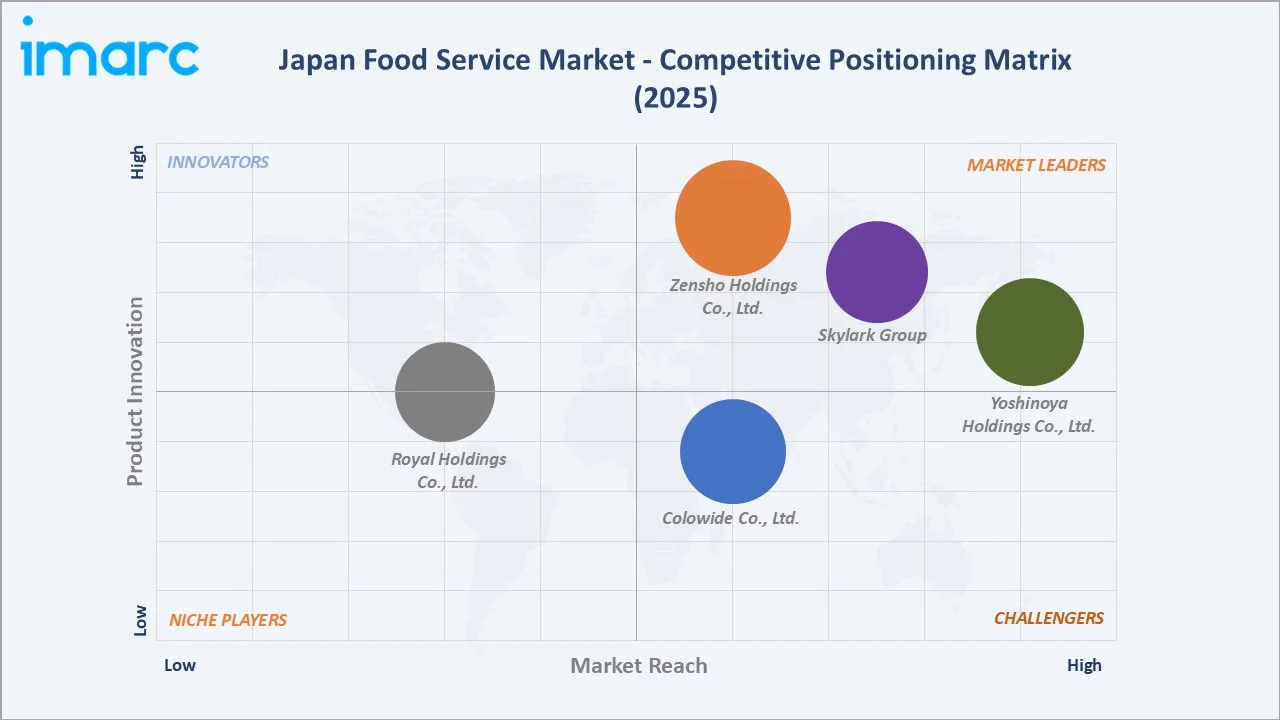
The Japan food service market is moderately fragmented, with large chain operators competing alongside a vast base of independent restaurants. Brand strength, central kitchen efficiency, delivery integration, and menu innovation form the key competitive differentiators across formats.
|
Company Name |
Brand / Key Product |
Position |
Strategic Focus |
|
Zensho Holdings Co., Ltd. |
Sukiya |
Leader |
Multi-brand restaurant portfolio expansion with central kitchen efficiency |
|
Skylark Group |
Gusto |
Leader |
Family restaurant chain scaling through digital ordering and automation |
|
Yoshinoya Holdings Co., Ltd. |
Yoshinoya |
Leader |
Quick service beef bowl chain expansion with menu diversification |
|
Colowide Co., Ltd. |
Kappa Sushi |
Challenger |
Multi-format restaurant group growth through franchise and M&A activity |
|
Royal Holdings Co., Ltd. |
Royal Host |
Emerging |
Diversified dining and contract food service portfolio management |
Key players include Zensho Holdings Co., Ltd., Skylark Group, Yoshinoya Holdings Co., Ltd., Colowide Co., Ltd., and Royal Holdings Co., Ltd., among others.
Key Company Profiles
Zensho Holdings Co., Ltd.
Zensho Holdings is one of Japan's largest restaurant operators, headquartered in Tokyo, and best known for its Sukiya chain along with a diversified portfolio spanning quick service and family dining formats across the country and select overseas markets.
- Product Portfolio: Sukiya quick service beef bowl restaurants alongside additional dining and food retail brands under the group's multi-format portfolio.
- Recent Developments: The company continues to expand its restaurant network while investing in digital ordering systems, self-service technologies, and operational automation to improve customer experience and enhance operational efficiency.
- Strategic Focus: Expanding its multi-brand restaurant portfolio, deepening central kitchen efficiency, and scaling automation to address labor constraints across formats.
Skylark Group
Skylark Group is a leading family restaurant operator in Japan, with a broad portfolio of dine-in restaurant brands led by Gusto, alongside several other casual dining concepts serving consumers across the country.
- Product Portfolio: Gusto family restaurants offering diverse Japanese and Western menus, complemented by additional casual dining brands within the group.
- Recent Developments: The company has been expanding digital ordering, self-checkout kiosks, and delivery partnerships to improve service efficiency and customer convenience.
- Strategic Focus: Scaling digital ordering and automation across its restaurant network while maintaining value-priced, family-oriented dining positioning.
Yoshinoya Holdings Co., Ltd.
Yoshinoya Holdings is a well-established quick service restaurant operator headquartered in Tokyo, recognized for its flagship Yoshinoya chain with an extensive network of locations across urban and suburban Japan.
- Product Portfolio: Yoshinoya quick service beef bowl restaurants alongside noodle and other quick-format dining brands within the group's portfolio.
- Recent Developments: The company has been broadening its menu offerings and expanding takeaway and delivery channels to capture growing demand for convenient dining formats.
- Strategic Focus: Strengthening its quick service leadership through menu innovation, delivery channel expansion, and continued store network optimization.
Market Concentration Analysis
The Japan food service market is moderately fragmented, with the top players accounting for a meaningful but non-dominant share of total industry revenue given the large base of independent, owner-operated restaurants across the country.
Barriers to entry include rising labor and input costs, the need for scalable central kitchen infrastructure, and increasing consumer expectations around digital ordering and delivery convenience. These factors favor established chain operators with diversified brand portfolios and efficient supply chains.
Consolidation is gradually accelerating as larger chain operators acquire regional brands to gain kitchen efficiency, purchasing scale, and broader geographic coverage. Strategic partnerships with delivery platforms and technology vendors are further reinforcing competitive positioning across the structured segments of the market.
Investment & Growth Opportunities
Fastest-Growing Segments
Cloud kitchen is expanding the fastest within the foodservice type segment, driven by delivery platform integration, lower fixed costs, and rising urban demand for convenient meal formats. Quick service restaurants remain the next-fastest format, supported by value pricing and dense transit-linked store networks.
Emerging Markets
Kyushu-Okinawa Region is the fastest growing area, anchored by rising inbound tourism, expanding resort and hospitality dining, and growing promotion of regional cuisine. The region represents meaningful untapped opportunity for operators able to deliver region-specific and tourist-oriented dining experiences.
Venture & Investment Trends
Investment is concentrated in cloud kitchen infrastructure, kitchen automation technology, and delivery platform integration. Capital is also flowing into central kitchen expansion and franchise-led growth models that align with Japan's evolving labor and cost environment.
Future Market Outlook (2026-2034)
The Japan food service market is forecast to expand from USD 281.9 Billion in 2025 to an estimated USD 330.0 Billion in 2026 and further to USD 788.0 Billion by 2034 at a CAGR of 11.50%, adding substantial incremental annual market value over the forecast period.
Four forces will shape the market through 2034: sustained inbound tourism growth; the rise of cloud kitchen and delivery-first formats; deeper integration of kitchen automation and AI-driven forecasting; and continued consolidation among regional restaurant chains.
By 2034, the Japan food service industry is expected to be defined by technology-enabled, labor-efficient operations, with cloud kitchens and quick service formats collectively accounting for a meaningfully higher share of overall activity. Automation, digital payments, and tourism-driven demand are expected to further accelerate the evolution of the dining ecosystem.
Research Methodology
Primary Research
Primary research included structured interviews with restaurant operators, franchise executives, delivery platform representatives, and industry association contacts, validating market sizing, segment mix, and regional demand patterns.
Secondary Research
Secondary sources included Japan's Ministry of Internal Affairs and Communications publications, Ministry of Health, Labour and Welfare labor statistics, Japan National Tourism Organization visitor data, and annual reports and investor presentations from listed restaurant operators.
Forecasting Models
Market forecasts used top-down and bottom-up models combining restaurant establishment counts, average spend per visit, foodservice type mix evolution, and macroeconomic variables. Scenario analysis addressed labor cost trends, tourism inflows, and automation adoption pace.
Japan Food Service Market Report Coverage:
| Report Features | Details |
|---|---|
| Base Year of the Analysis | 2025 |
| Historical Period | 2020-2025 |
| Forecast Period | 2026-2034 |
| Units | Billion USD |
| Scope of the Report |
Exploration of Historical and Forecast Trends, Industry Catalysts and Challenges, Segment-Wise Historical and Predictive Market Assessment:
|
| Foodservice Types Covered |
|
| Outlets Covered | Chained Outlets, Independent Outlets |
| Locations Covered | Leisure, Lodging, Retail, Standalone, Travel |
| Regions Covered | Kanto Region, Kansai/Kinki Region, Central/ Chubu Region, Kyushu-Okinawa Region, Tohoku Region, Chugoku Region, Hokkaido Region, Shikoku Region |
| Companies Covered | Zensho Holdings Co. Ltd., Skylark Group, Yoshinoya Holdings Co. Ltd., Colowide Co. Ltd., Royal Holdings Co. Ltd., etc, |
| Customization Scope | 10% Free Customization |
| Post-Sale Analyst Support | 10-12 Weeks |
| Delivery Format | PDF and Excel through Email (We can also provide the editable version of the report in PPT/Word format on special request) |
Key Benefits for Stakeholders:
- IMARC’s industry report offers a comprehensive quantitative analysis of various market segments, historical and current market trends, market forecasts, and dynamics of the Japan food service market from 2020-2034.
- The research report provides the latest information on the market drivers, challenges, and opportunities in the Japan food service market.
- Porter's five forces analysis assist stakeholders in assessing the impact of new entrants, competitive rivalry, supplier power, buyer power, and the threat of substitution. It helps stakeholders to analyze the level of competition within the Japan food service industry and its attractiveness.
- Competitive landscape allows stakeholders to understand their competitive environment and provides an insight into the current positions of key players in the market.
Frequently Asked Questions About the Japan Food Service Market Report
The Japan food service market size is estimated at USD 330.0 Billion in 2026, driven by inbound tourism, rising dual-income households, and expanding cloud kitchen adoption.
The market is projected to grow at a CAGR of 11.50% from 2026-2034, reaching USD 788.0 Billion, supported by automation adoption and tourism-led demand.
Full service restaurants lead at 42.7% in 2025, driven by dinner and social dining occasions. The segment also benefits from strong demand for premium and family dining experiences.
Independent outlets dominate at 62.4% in 2025, reflecting Japan's deep culture of owner-operated restaurants. Their strong local presence and regional specialization continue to support market leadership.
Kanto Region commands 36.4% in 2025, anchored by Tokyo, supported by dense urban population and high corporate and tourist dining demand.
Kyushu-Okinawa Region is the fastest growing area, supported by rising inbound tourism and expanding resort and hospitality dining formats.
Leading players include Zensho Holdings Co., Ltd., Skylark Group, Yoshinoya Holdings Co., Ltd., Colowide Co., Ltd., and Royal Holdings Co., Ltd., among others.
An aging workforce and low unemployment are pushing operators toward kitchen automation, self-order kiosks, and digital ordering to sustain service levels.
AI-driven demand forecasting, kitchen automation, and mobile ordering are helping operators reduce costs, improve accuracy, and address labor constraints.
Need more help?
- Speak to our experienced analysts for insights on the current market scenarios.
- Include additional segments and countries to customize the report as per your requirement.
- Gain an unparalleled competitive advantage in your domain by understanding how to utilize the report and positively impacting your operations and revenue.
- For further assistance, please connect with our analysts.
 Request Customization
 Speak to an Analyst
 Request Brochure
 Inquire Before Buying
Benefits of Customization
- Personalize this research
- Triangulate with your data
- Get data as per your format and definition
- Gain a deeper dive into a specific application, geography, customer, or competitor
- Any level of personalization
Get in Touch With Us
UNITED STATES
Phone: +1-201-971-6302
INDIA
Phone: +91-120-433-0800
UNITED KINGDOM
Phone: +44-753-714-6104
Email: [email protected]
Client Testimonials




.webp)




.webp)













Related Reports

Choose your plan
*Please note that the prices mentioned below are starting prices for each bundle type. Kindly contact our team for further details.*
Single User License
- 1 User License, Access on 2 Devices
- PDF Report + Excel Dataset (Password Protected)
- Lifetime Access
- No Printing Rights
- 10% Free Report Customization
- 10–12 Weeks of Analyst Support
Five User License
- Access for 5 Users, 2 Devices per User
- PDF Report + Excel Dataset (Password Protected)
- Lifetime Access
- Dedicated Account Manager
- 12–14 Weeks of Analyst Support
- No Printing Rights
- 15% Free Report Customization
- 25% Discount on Your Next Purchase
Corporate User License
- Unlimited User Access (Within Your Organization)
- PDF Report + Excel Dataset
- Lifetime Access
- Dedicated Account Manager
- 14–20 Weeks of Analyst Support
- No Printing Rights
- 20% Free Report Customization
- 30% Discount on Your Next Purchase
Essential Insights
What's included:
3 reports
- Lifetime Access
- PDF Reports
- Excel Datasets
- 2 Weeks of Free Analyst Support
- 2 User Licenses
- Access on 2 Devices
- Printing Rights
- Complimentary PowerPoint (PPT) Version
- Complimentary License Upgrade
Professional Access
What's included:
5 reports
- Lifetime Access
- PDF Reports
- Excel Datasets
- 8 Weeks of Free Analyst Support
- 2 User Licenses
- Access on 2 Devices
- Printing Rights
- Complimentary PowerPoint (PPT) Version
- Complimentary License Upgrade
Business Advantage
What's included:
8 reports
- Lifetime Access
- PDF Reports
- Excel Datasets
- 14 Weeks of Free Analyst Support
- 2 User Licenses
- Access on 2 Devices
- Printing Rights
- Complimentary PowerPoint (PPT) Version
- Complimentary License Upgrade
Enterprise Intelligence
What's included:
10 reports
- Lifetime Access
- PDF Reports
- Excel Datasets
- 20 Weeks of Free Analyst Support
- 2 User Licenses
- Access on 2 Devices
- Printing Rights
- Complimentary PowerPoint (PPT) Version
- Complimentary License Upgrade