
Japan Glamping Market Size, Share, Trends and Forecast by Type, Age Group, Size, and Region, 2027-2035
Japan Glamping Market Size & Forecast 2027-2035
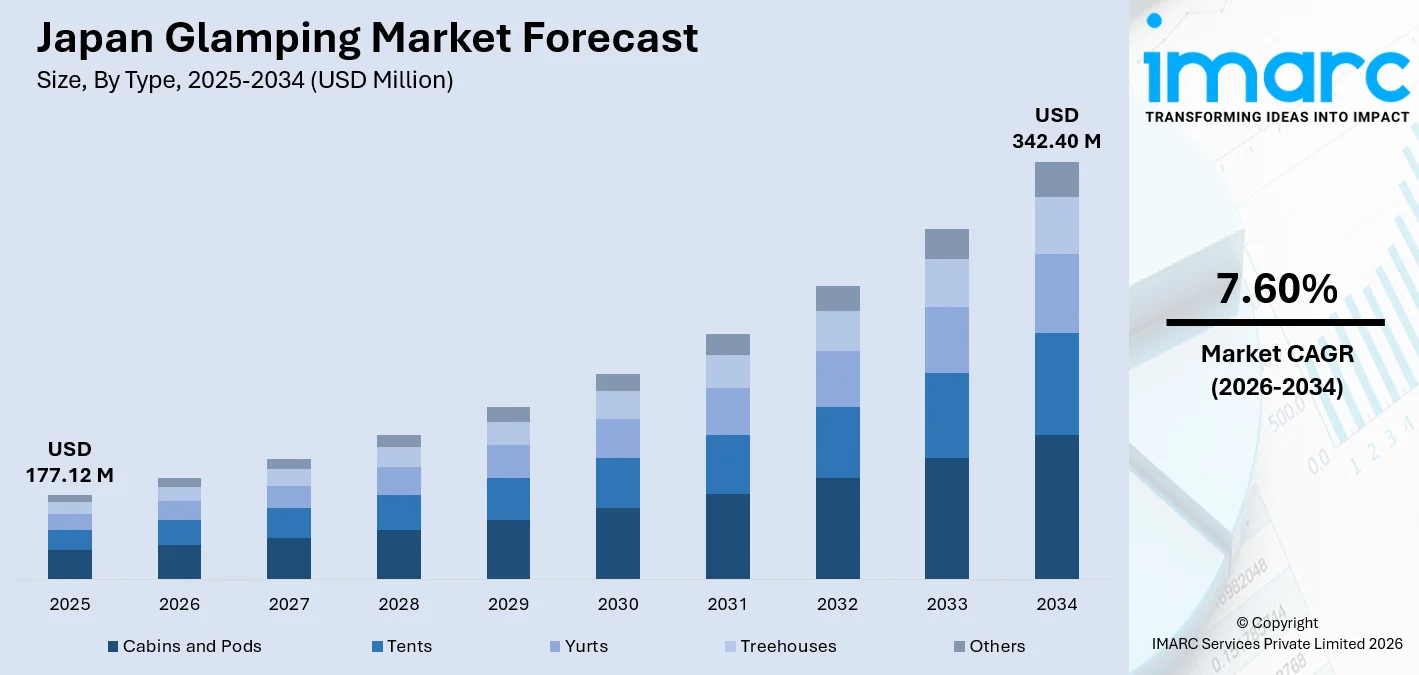
The Japan glamping market size increased from USD 4.8 Million in 2026 to USD 5.1 Million in 2027 and is projected to reach USD 7.4 Million by 2035, growing at a CAGR of 4.7% from 2027-2035, driven by surging demand for unique nature-based luxury experiences amid record inbound tourism. Japan welcomed 36.9 million foreign visitors in 2024, a record high confirmed by the Japan National Tourism Organization. This amplifying demand for immersive outdoor accommodations beyond conventional hotel stays. Growing domestic wellness travel and active government rural tourism promotion further strengthen the Japan glamping market share.
To get more information on this market Request Sample
Japan Glamping Industry Analysis - Key Insights
- Cabins and pods lead type at 41% in 2026, showing a strong preference for fixed and weather-resistant structures. Japanese glampers tend to favor outdoor experiences combined with hotel-level privacy and comfort rather than traditional tent setups.
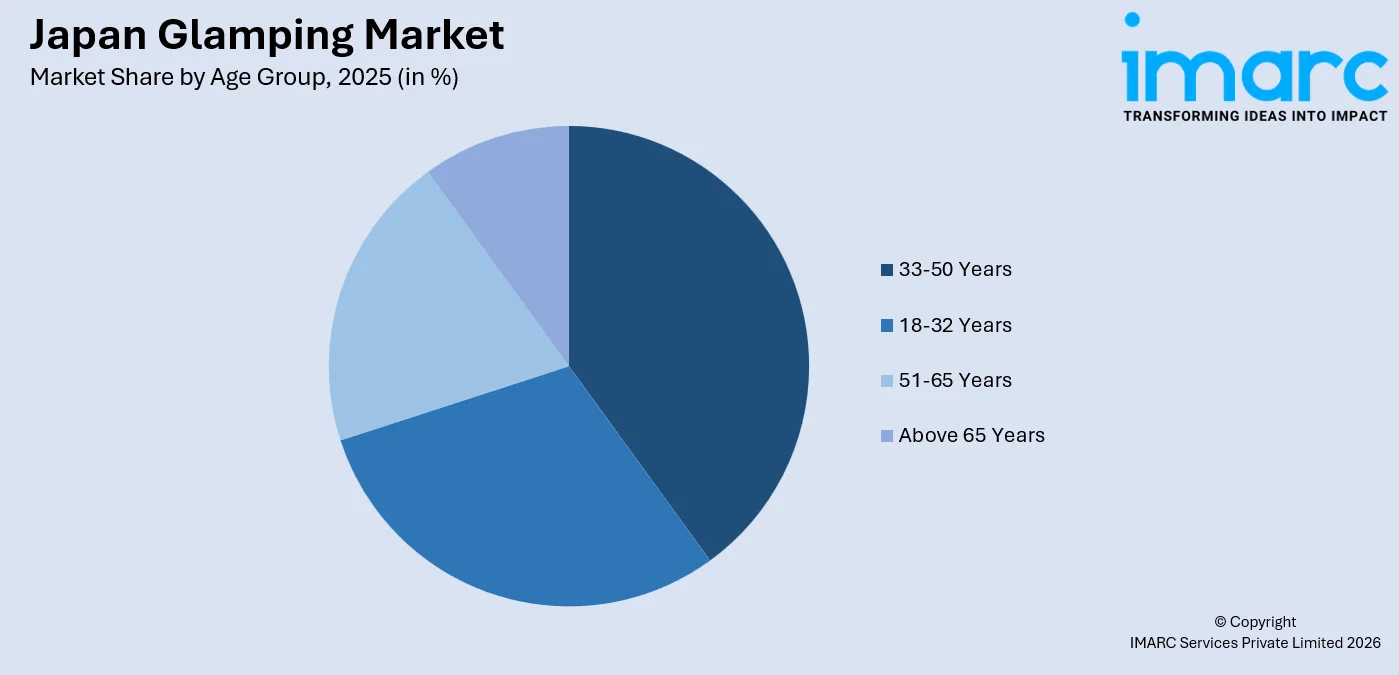
- 33-50 years commands 39% of the age group in 2026, driven mainly by mid-career individuals with stable incomes and family responsibilities. This group prefers nature-based getaways that still provide convenience and comfort, making experiential travel highly appealing.
- 4-person owns size at 51% in 2026, indicating that demand is largely centered on family stays. This highlights that glamping in Japan functions primarily as a family leisure activity rather than a market focused on solo travelers or couples.
- Kanto Region leads regionally at 35% in 2026, supported by its accessibility from Tokyo and proximity to destinations such as Mt. Fuji and the Fuji Five Lakes, giving the region a strong geographic advantage over others.
Japan Glamping Market Trends and Dynamic 2026
Market Trends
Rise of Premium Outdoor Hospitality Concepts
Japan's glamping industry is quickly evolving into hotel-caliber experiences set in the natural world, changing outdoor lodging for budget-conscious tourists. With 40 simple concrete cabins overlooking Lake Kawaguchi, HOSHINOYA Fuji, Japan's first luxury glamping resort run by Hoshino Resorts, has established the standard for upscale outdoor vacations throughout Asia and will remain mostly full until 2025. A structural shift toward full-service outdoor hospitality in Japan is indicated by the convergence of gourmet eating, onsen access, and carefully chosen outdoor activities.
Inbound Tourism Surge Expanding Glamping Demand
The glamping market's addressable audience is directly growing due to Japan's burgeoning inbound tourism. More than 1.33 million guest-nights were spent by foreign visitors at Hoshino Resorts' 68 hotels in 2025. RISONARE Kohamajima in Okinawa saw a 404% increase in foreign visitors as a result of new direct flights from Seoul and Taipei. The desire for culturally distinctive products is increased by this diverse global basis.
Eco-Tourism and Sustainable Design Integration
New glamping initiatives are increasingly characterized by eco-conscious design. JTB Corporation and Airbnb Japan partnered in January 2025 to transform abandoned rural estates into environmentally friendly guest accommodations, lowering the demand for building while increasing the availability of natural housing throughout regional Japan. In order to match glamping with the tastes of Japan's expanding sustainable travel market, operators are progressively integrating solar panels, rainwater harvesting, and locally sourced products.
- Digital Booking Platforms Driving Accessibility: Mobile-first OTAs and direct booking platforms make Japan’s rural glamping sites discoverable and bookable by both domestic and international guests with minimal friction.
- Glamping–Onsen Integration: New sites in Izu, Hakone, and Kyushu pair glamping cabins with private or communal hot spring baths, creating a distinctly Japanese premium outdoor product that competitors abroad cannot easily replicate.
- Themed and Niche Concept Sites: Wellness retreats, pet-friendly glamping facilities, and stargazing-focused resorts in rural Nagano and Okinawa are capturing differentiated demand segments beyond general leisure.
- Social Media–Driven Discovery: Instagrammable settings near Mt. Fuji and scenic coastlines continuously generate organic guest acquisition through influencer content, sustaining brand awareness without major paid marketing spend.
Growth Drivers
Record Tourism Fueling Demand Beyond Urban Centers
Japan’s record-breaking tourism performance is fueling japan glamping market growth. According to the Japan National Tourism Organization, foreign arrivals reached 21.5 million in the first half of 2025, exceeding the same period in 2024 by over 3.7 million. JTB projected total international arrivals of 40.2 million for full-year 2025, expanding the glamping consumer base as international visitors increasingly seek nature-immersive stays outside crowded urban corridors.
Government-Backed Rural Tourism and Regional Revitalization
Japan’s national and local governments are actively using glamping as a rural economic revitalization tool. The Japan Tourism Agency’s Sustainable Tourism Promotion Project, launched in fiscal 2024, allocates grants of up to JPY 80 million per prefectural tourism dispersion plan, directly supporting experiential accommodation in under-visited regions. The government’s Fourth Tourism Nation Promotion Basic Plan also designates 14 model destinations nationally for luxury experiential tourism investment, creating a structured policy environment for glamping expansion.
Rising Disposable Income and Experience-Led Spending
Japan’s domestic tourism expenditure reached JPY 25.1 trillion in 2024, reflecting broad consumer willingness to invest in quality leisure. The 33–50 age cohort driving glamping demand represents economically established households prioritizing private, multi-amenity nature experiences. This demographic’s preferences align precisely with the premium pricing and experience depth that glamping operators offer, supporting above-average revenue per booking relative to conventional hotel stays.
- Proximity to Major Urban Centers: Most leading glamping destinations in Kanto, Chubu, and Kansai are within 60–120 minutes of major cities, making them ideal for weekend getaways and reducing the planning barrier for spontaneous bookings.
- Family and Multi-Generational Travel Growth: Glamping’s all-in-one family proposition accommodates multiple generations without separate amenity coordination, converting families from conventional resort stays.
- Platform Partnerships and Influencer Marketing: Agoda’s October 2025 partnership with Hoshino Resorts expanded global booking access to all six premium outdoor brands, broadening discovery for international glamping travelers.
- Expansion of Luxury Outdoor Accommodation Formats: Investment in geodesic domes, A-frame cabins, and waterfront private villas raises glamping’s service standard and average guest spend, supporting overall market revenue growth.
Market Restraints
High Capital Requirements and Operating Cost Pressures: Developing and operating glamping sites at luxury standards requires significant upfront investment in land acquisition, durable accommodation structures, utility infrastructure, and continuous staffing. These high costs create barriers for smaller or independent operators and slow expansion plans even for established companies, limiting overall supply growth despite rising demand.
Seasonal Demand Volatility and Weather Dependency: Demand in Japan’s glamping market fluctuates strongly due to cold winters in inland and northern regions, the tsuyu rainy season, and periodic typhoon activity in coastal areas. Such seasonality affects occupancy levels and places pressure on operator revenues, making stable year-round earnings challenging without diversified offerings and infrastructure suited for multiple seasons.
Regulatory and Zoning Complexity in Rural Settings: Glamping projects located in scenic or environmentally sensitive areas must comply with complex zoning policies, national park regulations, and environmental requirements that differ across prefectures. Variations in local rules often result in long approval processes, which can discourage new developments in some of Japan’s most attractive rural and coastal destinations.
Japan Glamping Market Segmentation Analysis
| Segment Category | Leading Segment | Market Share | Year |
|---|---|---|---|
| Type | Cabins and Pods | 41% | 2025 |
| Age Group | 33-50 Years | 39% | 2025 |
| Size | 4-Person | 51% | 2025 |
| Region | Kanto Region | 35% | 2025 |
Type Insights
Cabins and Pods - 41% Market Share (2026) | Leading Type
Cabins and pods dominate Japan’s glamping market, satisfying the need for private, all-weather shelters that combine outdoor proximity with hotel-grade comfort. In April 2025, Grande Auberge Resort Fuji Oshino opened in Oshino Village, Yamanashi - the prefecture’s first pet-friendly cabin glamping resort at the foot of Mt. Fuji ,offering fully enclosed private cabins with seasonal cuisine and spring-water surroundings. The structural durability of cabin formats against Japan’s seasonal extremes further reinforces their preference among families and couples.
Japan’s cabin glamping is increasingly integrating onsen and private sauna features, elevating these structures beyond outdoor shelters into full wellness destinations. New facilities in Ito City (Shizuoka) and Lake Shinji (Shimane) incorporate in-room natural hot spring baths within cabin-type units, directly fusing traditional Japanese wellness culture with luxury outdoor experiences and justifying premium nightly rates that strengthen operator revenue models.
|
Segment Breakdown Cabins and Pods (41%) · Tents · Yurts · Treehouses · Others |
Age Group Insights
Access the comprehensive market breakdown Request Sample
33-50 Years - 39% Market Share (2026) | Leading Age Group
The 33–50 cohort leads Japan’s glamping market as the primary family leisure demographic, combining high disposable income with demand for private, fully amenitized outdoor stays. Japan’s domestic tourism expenditure reached JPY 25.1 trillion in 2024, with a significant share directed toward premium leisure and recreation by mid-career households. This age group’s preference for multi-night, resort-quality glamping drives average booking values higher than any other demographic, particularly across Yamanashi, Nagano, and the Izu Peninsula.
Operators' product offerings are being shaped by this demographic's growing interest in wellness-oriented glamping, which combines local cuisine, spa treatments, and nature immersion. According to Hoshino Resorts' inbound report, over 28% of its overall transaction volume in 2025 was made up of luxury outdoor accommodations, with the 33–50 foreign visitor segment increasingly reflecting domestic preferences for these kinds of experiencing stays.
|
Segment Breakdown 33-50 Years (39%) · 18-32 Years · 51-65 Years · Above 65 Years |
Size Insights
4-Person - 51% Market Share (2026) | Leading Size
4-person units account for the majority of Japan’s glamping demand, clearly reflecting family bookings as the structural backbone of the market. Japan’s Leisure Japan trade exhibition at Tokyo Big Sight - which drew 21,107 industry professionals in its most recent edition, identified family glamping as the fastest-growing product category, with developers responding by proliferating 4-person dome tents, private cabin suites, and villa-glamping combinations across the Kanto, Chubu, and Kansai regions.
|
Segment Breakdown 4-Person (51%) · 2-Person · Others |
Regional Insights
Kanto Region - 35% Market Share (2026) | Leading Region
The Kanto Region leads Japan’s glamping market, anchored by the Mt. Fuji and Fuji Five Lakes glamping cluster in Yamanashi Prefecture. Glamping Village Fuji Kawaguchiko accessible within 90 minutes from central Tokyo consistently draws urban households seeking short-drive premium outdoor escapes, illustrating the structural advantage of Kanto’s dense high-income urban catchment. The region’s concentration of Mt. Fuji-view glamping properties and ease of Tokyo rail connectivity make it Japan’s most commercially mature glamping geography.
Kanto’s glamping landscape further expanded during 2024-2025, with new site openings in Chichibu (Saitama), Zushi Marina (Kanagawa), and Yamanakako Village (Yamanashi) adding private-pool cabins, ocean-view domes, and onsen glamping villas to the region’s already diverse product offering. Resort Glamping.com’s portal- Japan’s primary glamping booking aggregator covering mainly Kanto, Kansai, Tokai, and Chugoku, listed multiple Kanto-area properties among its most searched and booked facilities through 2025.
|
Metric
|
Details
|
|---|---|
|
Market Share in 2025
|
35%
|
|
Major Growth Drivers
|
Tokyo urban catchment, Mt. Fuji proximity, high disposable income, premium short-trip culture |
|
Outlook
|
Sustained regional leadership through continued premium site expansion |
|
Regional Breakdown Kanto Region (35%) · Kansai/Kinki Region · Central/Chubu Region · Kyushu-Okinawa Region · Tohoku Region · Chugoku Region · Hokkaido Region · Shikoku Region |
Kansai/Kinki Region:
The Kansai/Kinki Region is experiencing accelerated glamping growth on the back of Osaka’s Expo 2025 tourism lift and expansion of nature-based accommodation near Kyoto’s rural hinterland. GRAX Rurikei - a premium camp resort approximately one hour from Kyoto city center - offers cabins, bungalows, and tipis with mountain onsen access, serving as a flagship example of Kansai’s growing lifestyle-outdoor accommodation segment. Kansai received its highest-ever international visitor count in 2025 according to Hoshino Resorts’ annual report, benefiting adjacent glamping destinations that share the region’s tourism uplift and supporting a positive japan glamping market forecast.
|
Metric
|
Details
|
|---|---|
|
Major Growth Drivers
|
Expo 2025 Osaka tourism momentum, Kyoto cultural appeal, mountain and coastal nature access |
|
Outlook
|
High-growth trajectory sustained by inbound tourism surge |
Central/Chubu Region:
The Central/Chubu Region benefits from its position as the geographic corridor between Tokyo and Osaka, with strong glamping demand concentrated in Nagano, Shizuoka, and Gifu prefectures. Mökki Stardust Glamping in Achi Village, Nagano- Japan’s most celebrated stargazing destination , opened a new Suite Villa in August 2025, enabling guests to view Japan’s finest night skies from the living room. Glam Aira Izu-kogen in Ito City, Shizuoka, launched a new cabin-glamping product with in-room natural hot springs, combining two of Japan’s most powerful leisure draws into a single premium offering.
|
Metric
|
Details
|
|---|---|
|
Major Growth Drivers
|
Natural hot springs, alpine scenery, stargazing destinations, Chuo Expressway accessibility |
|
Outlook
|
Strong four-season demand from urban and international travelers |
Kyushu-Okinawa Region:
Kyushu-Okinawa is emerging as a high-potential glamping growth corridor, combining Japan’s warmest climate with internationally recognized natural landscapes. Nordisk Village Goto Islands, a Scandinavian-inspired premium glamping resort on Nagasaki’s remote Goto Islands offers Hygge-style cotton tents alongside marine activities including scuba diving and stand-up paddleboarding. RISONARE Kohamajima in Okinawa recorded a 404% surge in international guests in 2025 following new direct flight routes from Seoul and Taipei, reflecting the region’s growing international glamping audience and shaping a positive japan glamping market outlook.
|
Metric
|
Details
|
|---|---|
|
Major Growth Drivers
|
Warm year-round climate, marine biodiversity, new international flight routes, island-nature appeal |
|
Outlook
|
Fastest-growing region for international glamping visitors |
Tohoku Region:
Tohoku is gaining recognition as an underexplored glamping frontier, supported by Japan’s active tourism dispersion strategy. The Japan Tourism Agency allocated JPY 15.82 billion in fiscal 2024 supplementary budget for overtourism mitigation measures, including grants targeting under-visited prefectures such as those in Tohoku. The region’s forests, coastlines, and traditional onsen towns provide abundant natural settings for glamping development, while low land costs relative to Kanto offer favorable economics for new site investment.
|
Metric
|
Details
|
|---|---|
|
Major Growth Drivers
|
Government rural dispersion grants, pristine forest and coastal landscapes, low development cost base |
|
Outlook
|
Emerging high-potential destination for eco-glamping investment |
Chugoku Region:
Chugoku’s glamping development is centered on its Seto Inland Sea coastline, with REST GLAMPING operating the largest glamping group in the Chugoku–Shikoku corridor across three Hiroshima-area sites including Shimanami Kaido and Mihara City. The region’s scenic coastal setting and accessibility from Osaka and Hiroshima are drawing leisure travelers seeking oceanfront outdoor experiences. Local rural revitalization incentives in underpopulated Chugoku towns are also creating favorable investment environments for new glamping site development.
|
Metric
|
Details
|
|---|---|
|
Major Growth Drivers
|
Seto Inland Sea coastal scenery, Hiroshima tourism corridor, rural revitalization incentive programs |
|
Outlook
|
Steady coastal glamping supply and demand expansion underway |
Hokkaido Region:
Hokkaido’s wilderness, spanning 35 national parks and world-class ski destinations drives year-round glamping interest from domestic and international travelers. In September 2025, Hoshino Resorts opened the LUCY Ozehatomachi mountain hotel in Oze National Park, which sold out its entire September–December season within three days of reservations opening, demonstrating intense unmet demand for premium nature accommodation in Japan’s national park network. Hokkaido’s international appeal - especially among skiers from South Korea, Taiwan, and Australia - steadily expands the glamping demand base year-on-year.
|
Metric
|
Details
|
|---|---|
|
Major Growth Drivers
|
National park density, ski tourism appeal, strong international nature travel interest, four-season outdoor activity portfolio |
|
Outlook
|
Growing year-round premium outdoor destination attracting international visitors |
Shikoku Region:
Shikoku recorded the highest international growth rate among all Hoshino Resorts regions in 2025, a four-fold increase in international guests, driven by international discovery of Kochi’s Sunday morning market, fresh regional cuisine, and authentic local hospitality. Aqua Village Kyoto Amanohashidate in Miyazu Bay operates an all-inclusive coastal family glamping model with marine activities and communal onsen, illustrating how Shikoku’s scenic coast and cultural richness can anchor differentiated glamping propositions beyond conventional accommodation.
|
Metric
|
Details
|
|---|---|
|
Major Growth Drivers
|
International discovery of lesser-known regions, authentic cultural experiences, coastal and forest landscape diversity |
|
Outlook
|
Highest international growth rate in 2025 among all Japan regions |
Market Outlook 2027-2035
What is the future outlook of the Japan glamping market?
The Japan glamping market is expected to sustain steady revenue growth through 2034.
Sustained by record-breaking inbound tourism, deepening domestic wellness travel culture, and proactive government investment in rural experiential tourism, the market is positioned for consistent compound expansion over the forecast period. Increasing operator sophistication in multi-season product design including heated winter cabins, onsen integration, and themed nature experiences, will progressively reduce seasonal revenue gaps. The convergence of eco-tourism mandates, rising premium accommodation standards, and growing international familiarity with Japan’s natural landscape destinations positions the market for durable, quality-led growth through 2034.
Japan Glamping Market - Leading Key Players
The Japan glamping market is shaped by a blend of large hospitality groups and specialized outdoor operators, competing on premium experience design, natural setting quality, and multi-amenity offerings. Leading players are actively expanding property networks, forging travel platform partnerships, and integrating wellness, gastronomy, and eco-tourism elements to strengthen guest loyalty and sustain premium positioning across Japan’s rapidly evolving glamping landscape.
| Company | Leading Brands | Highlights |
|---|---|---|
| Hoshino Resorts Co., Ltd. | HOSHINOYA Fuji, RISONARE, LUCY | Pioneer of Japan’s luxury glamping; HOSHINOYA Fuji, Japan’s first glamping resort, maintained near-capacity rates through 2025; hosted 1.33 million international guest-nights across 68 properties in 2025 |
| Fujita Kanko Inc. | Fujino Kirameki, Nordisk Village Goto Islands | Operates Scandinavian-style glamping in collaboration with Danish brand Nordisk at Goto Islands, Nagasaki; Mt. Fuji panorama glamping resort for domestic and inbound premium guests |
| Kyoeisha Co., Ltd. (GRAX) | GRAX Premium Camp Resort, GRAX Rurikei | Multiple premium glamping sites across Kyoto and Kansai; cabins, tipis, and bungalows with mountain onsen and BBQ; flagship operator for western Japan outdoor hospitality |
Major key players in the Japan glamping market are Resort Glamping Japan, Revillas Park Co., Ltd., etc.
Latest Development & News
- In November 2025, Hoshino Resorts expanded its partnership with Agoda, making all six of its premium brands including HOSHINOYA Fuji, Japan’s flagship glamping resort -available across Agoda’s global platform. The announcement coincided with Agoda reporting a 35% rise in Japan inbound search activity during the first half of 2025, significantly broadening international access to Hoshino’s nature-based outdoor accommodation portfolio.
- In August 2025, mökki STARDUST GLAMPING achi village in Nagano Prefecture opened a new Suite Villa concept allowing guests to view Achi Village’s award-winning starry skies directly from the living room. Located 90 minutes from Nagoya at the border of Nagano and Gifu, the new suite villa added a high-end product tier to a luxury stargazing resort already recognized as one of Japan’s most unique outdoor accommodation experiences.
- In April 2025, The first dog-friendly glamping auberge in Yamanashi Prefecture, Grande Auberge Resort Fuji Oshino, opened in Oshino Village at the base of Mount Fuji. In addition to catering to Japan's growing pet-inclusive glamping market and capitalizing on Oshino Village's reputation as one of the country's most renowned spring-water locations, the private cabin facility is situated alongside a natural spring-water stream and offers seasonal cuisine and well chosen wine pairings.
Japan Glamping Market Report Coverage:
| Report Features | Details |
|---|---|
| Base Year of the Analysis | 2026 |
| Historical Period | 2021-2026 |
| Forecast Period | 2027-2035 |
| Units | USD Million |
| Scope of the Report | Exploration of Historical and Forecast Trends, Industry Catalysts and Challenges, Segment-Wise Historical and Predictive Market Assessment:
|
| Types Covered | Cabins and Pods, Tents, Yurts, Treehouses, Others |
| Age Groups Covered | 18-32 years, 33-50 years, 51-65 years, Above 65 years |
| Sizes Covered | 4-Person, 2-Person, Others |
| Regions Covered | Kanto Region, Kansai/Kinki Region, Central/ Chubu Region, Kyushu-Okinawa Region, Tohoku Region, Chugoku Region, Hokkaido Region, Shikoku Region |
| Customization Scope | 10% Free Customization |
| Post-Sale Analyst Support | 10-12 Weeks |
| Delivery Format | PDF and Excel through Email (We can also provide the editable version of the report in PPT/Word format on special request) |
Key Benefits for Stakeholders:
- IMARC’s industry report offers a comprehensive quantitative analysis of various market segments, historical and current market trends, market forecasts, and dynamics of the Japan glamping market from 2021-2035.
- The research report provides the latest information on the market drivers, challenges, and opportunities in the Japan glamping market.
- Porter's five forces analysis assist stakeholders in assessing the impact of new entrants, competitive rivalry, supplier power, buyer power, and the threat of substitution. It helps stakeholders to analyze the level of competition within the Japan glamping industry and its attractiveness.
- Competitive landscape allows stakeholders to understand their competitive environment and provides an insight into the current positions of key players in the market.
Frequently Asked Questions About the Japan Glamping Market Report
The Japan glamping market size is estimated at USD 5.1 Million in 2027.
The market is projected to grow at a CAGR of 4.7% during 2027-2035, reaching USD 7.4 Million by 2035.
Key growth drivers include tourism expansion, social media influence, luxury outdoor experiences, government incentives, eco-consciousness, and city dwellers' demand for nature-based comfort.
The report covers segmentation by type, age group, size, and region. Each segment includes detailed market size and forecast analysis.
Key trends include usage of online booking platforms, government rural tourism support, international visitor growth, and blending Japanese culture with luxury outdoor accommodations.
Need more help?
- Speak to our experienced analysts for insights on the current market scenarios.
- Include additional segments and countries to customize the report as per your requirement.
- Gain an unparalleled competitive advantage in your domain by understanding how to utilize the report and positively impacting your operations and revenue.
- For further assistance, please connect with our analysts.
 Request Customization
 Speak to an Analyst
 Request Brochure
 Inquire Before Buying
Benefits of Customization
- Personalize this research
- Triangulate with your data
- Get data as per your format and definition
- Gain a deeper dive into a specific application, geography, customer, or competitor
- Any level of personalization
Get in Touch With Us
UNITED STATES
Phone: +1-201-971-6302
INDIA
Phone: +91-120-433-0800
UNITED KINGDOM
Phone: +44-753-714-6104
Email: [email protected]
Client Testimonials




.webp)




.webp)













Related Reports

Choose your plan
*Please note that the prices mentioned below are starting prices for each bundle type. Kindly contact our team for further details.*
Single User License
- 1 User License, Access on 2 Devices
- PDF Report + Excel Dataset (Password Protected)
- Lifetime Access
- No Printing Rights
- 10% Free Report Customization
- 10–12 Weeks of Analyst Support
Five User License
- Access for 5 Users, 2 Devices per User
- PDF Report + Excel Dataset (Password Protected)
- Lifetime Access
- Dedicated Account Manager
- 12–14 Weeks of Analyst Support
- No Printing Rights
- 15% Free Report Customization
- 25% Discount on Your Next Purchase
Corporate User License
- Unlimited User Access (Within Your Organization)
- PDF Report + Excel Dataset
- Lifetime Access
- Dedicated Account Manager
- 14–20 Weeks of Analyst Support
- No Printing Rights
- 20% Free Report Customization
- 30% Discount on Your Next Purchase
Essential Insights
What's included:
3 reports
- Lifetime Access
- PDF Reports
- Excel Datasets
- 2 Weeks of Free Analyst Support
- 2 User Licenses
- Access on 2 Devices
- Printing Rights
- Complimentary PowerPoint (PPT) Version
- Complimentary License Upgrade
Professional Access
What's included:
5 reports
- Lifetime Access
- PDF Reports
- Excel Datasets
- 8 Weeks of Free Analyst Support
- 2 User Licenses
- Access on 2 Devices
- Printing Rights
- Complimentary PowerPoint (PPT) Version
- Complimentary License Upgrade
Business Advantage
What's included:
8 reports
- Lifetime Access
- PDF Reports
- Excel Datasets
- 14 Weeks of Free Analyst Support
- 2 User Licenses
- Access on 2 Devices
- Printing Rights
- Complimentary PowerPoint (PPT) Version
- Complimentary License Upgrade
Enterprise Intelligence
What's included:
10 reports
- Lifetime Access
- PDF Reports
- Excel Datasets
- 20 Weeks of Free Analyst Support
- 2 User Licenses
- Access on 2 Devices
- Printing Rights
- Complimentary PowerPoint (PPT) Version
- Complimentary License Upgrade