
Laser Diode Market Size, Share, Trends and Forecast by Product Type, Application, and Region, 2026-2034
Laser Diode Market Size, Share, Trends & Forecast (2026-2034)
The global laser diode market reached USD 14.09 Billion in 2025 and is projected to reach USD 32.76 Billion by 2034, exhibiting a CAGR of 9.53% during 2026-2034. Growth is driven by rising healthcare adoption, expanding material processing use, continuous product innovation, and growing deployment in automotive headlamps and ADAS platforms.
Fiber optic communication expansion, rising defense and instrumentation use, and increasing integration into consumer electronics and sensing systems further support demand. Injection Laser Diode (ILD) leads product types at 76.8%, industrial applications dominate use cases at 30.4%, and Asia Pacific commands 41.8% of global share in 2025.
Market Snapshot
|
Metric |
Value |
|
Market Size (2025) |
USD 14.09 Billion |
|
Forecast Market Size (2034) |
USD 32.76 Billion |
|
CAGR (2026-2034) |
9.53% |
|
Base Year |
2025 |
|
Historical Period |
2020-2025 |
|
Forecast Period |
2026-2034 |
|
Dominant Product Type |
Injection Laser Diode - ILD (76.8%, 2025) |
|
Dominant Application |
Industrial Applications (30.4%, 2025) |
|
Leading Region |
Asia Pacific (41.8%, 2025) |
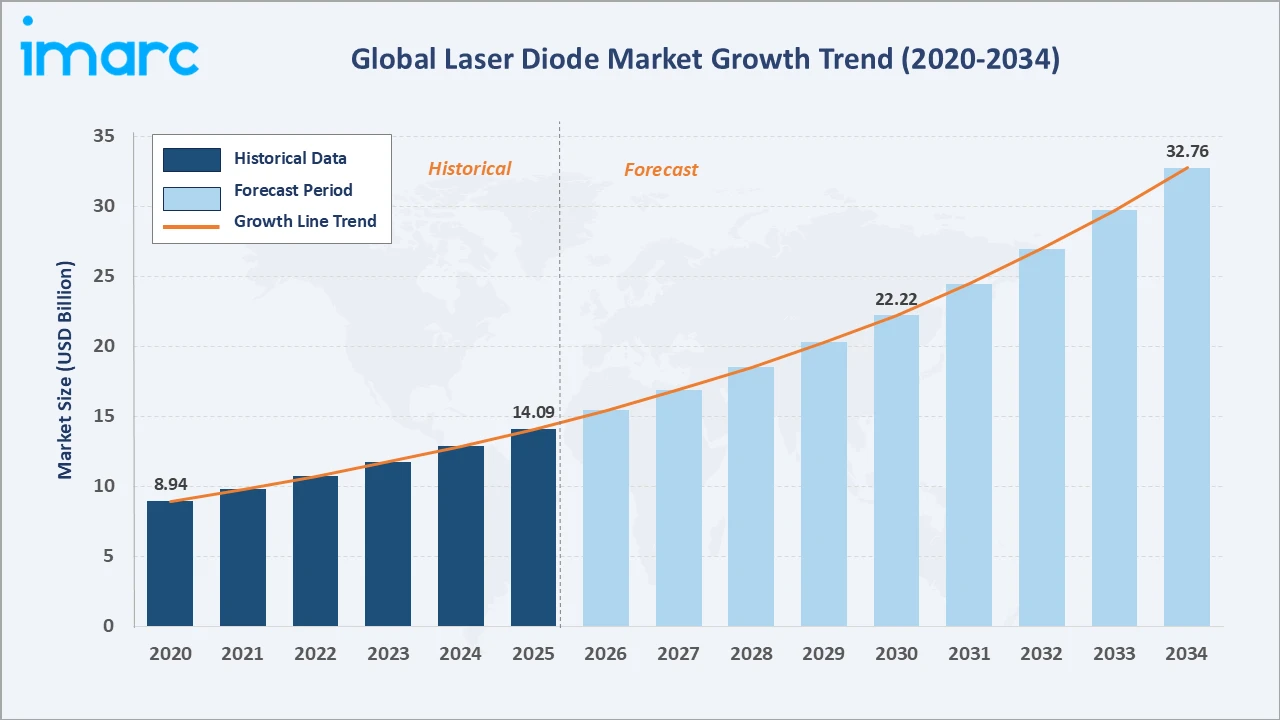
The market expanded from USD 8.94 Billion in 2020 to USD 14.09 Billion in 2025, anchored at USD 22.22 Billion in 2030 and forecast to reach USD 32.76 Billion by 2034, reflecting steady demand for compact, energy-efficient coherent light sources across telecommunications, healthcare, and industrial processing.
To get more information on this market, Request Sample
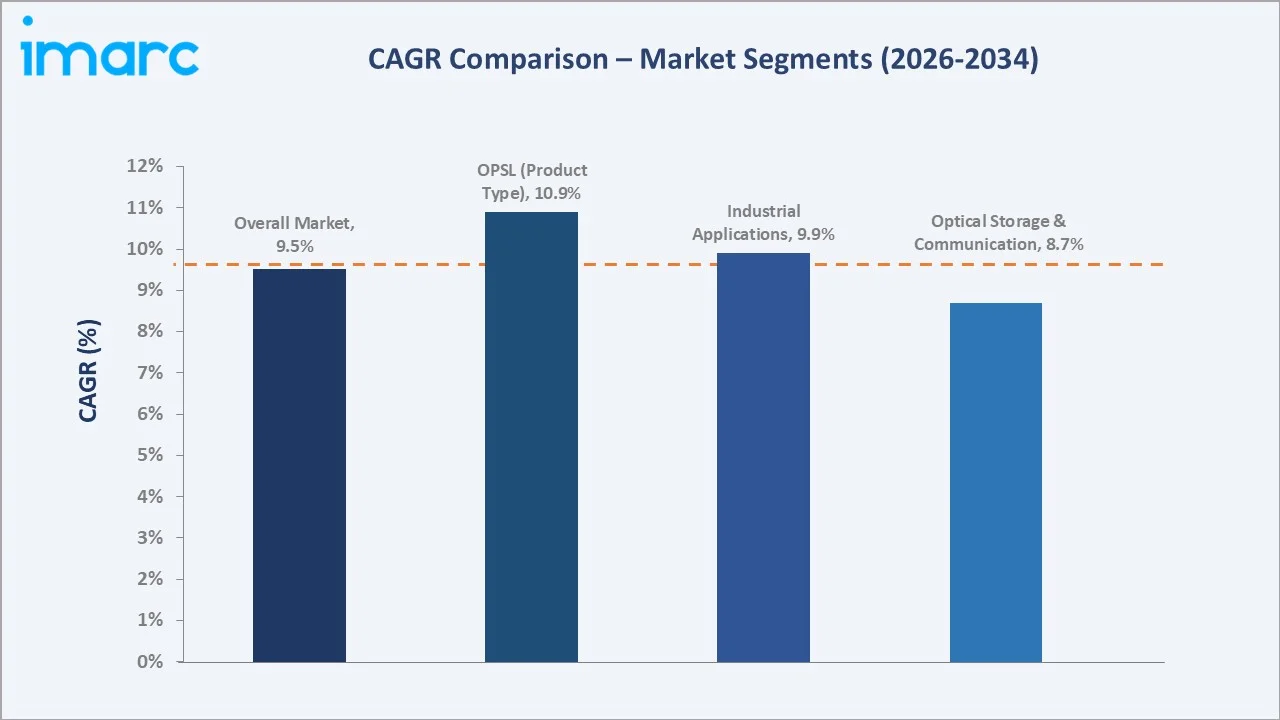
Injection Laser Diode products are forecast to grow near the market average, while Optically Pumped Semiconductor Laser (OPSL) products and industrial-use applications are expected to outpace the overall CAGR through 2034, reflecting their expanding role in precision and high-power use cases.
Executive Summary
The global laser diode market reached USD 14.09 Billion in 2025, reflecting sustained demand for compact, high-efficiency coherent light sources across communication, healthcare, and industrial end uses. The market is projected to reach USD 32.76 Billion by 2034, supported by continuous technology innovation and broadening application coverage.
Injection Laser Diode (ILD) leads the product type category at 76.8%, benefiting from wide use in fiber optic communication and industrial processing, while Optically Pumped Semiconductor Laser (OPSL) is gaining share in precision and instrumentation use cases. Industrial applications lead usage at 30.4%, driven by cutting, welding, and material processing demand, followed by optical storage and communication at 26.1%. Asia Pacific leads regionally at 41.8%, supported by its concentrated electronics and industrial manufacturing base.
Key Market Insights
|
Insight |
Data |
|
Dominant Product Type |
Injection Laser Diode (ILD) - 76.8% share (2025) |
|
Dominant Application |
Industrial Applications - 30.4% share (2025) |
|
Leading Region |
Asia Pacific - 41.8% share (2025) |
|
Market Opportunity |
Miniaturized modules; energy and power sector integration; fiber optic network expansion; automotive lighting and ADAS; LiDAR sensing |
Key Analytical Observations Supporting the Above Data:
- Injection Laser Diode (ILD) at 76.8%: The ILD segment dominates due to its established role in fiber optic communication and industrial laser systems, supported by continuous efficiency, output power, and reliability improvements from leading manufacturers.
- Industrial Applications at 30.4%: Industrial applications lead through widespread use in laser cutting, welding, marking, and material processing, where laser diodes offer precise, energy-efficient, and repeatable performance across manufacturing environments.
- Asia Pacific at 41.8%: Asia Pacific's dominance stems from its large-scale electronics manufacturing base, expanding automotive production, and growing industrial automation investment across China, Japan, and South Korea.
Laser Diode Market Overview
The global laser diode market encompasses the design, manufacture, and supply of semiconductor laser sources used across communication, healthcare, industrial, automotive, defense, and consumer electronics applications worldwide.
A laser diode is a compact semiconductor device that emits coherent light through stimulated emission, typically built around a gallium arsenide or indium phosphide p-n junction. When forward voltage is applied, electron-hole recombination releases photons, which optical feedback amplifies into a narrow, focused, high-intensity beam.
The market ecosystem spans raw material and substrate suppliers, chip fabrication and packaging specialists, module and system integrators, and end-use industries including telecommunications, healthcare, industrial manufacturing, automotive, defense, and consumer electronics, connected through distribution and after-sales support channels.
Macroeconomic factors shaping the industry include expanding broadband and 5G infrastructure investment, rising healthcare spending on minimally invasive procedures, growing industrial automation, and government support for domestic semiconductor and photonics manufacturing capacity across key regions.
Market Dynamics
To evaluate market opportunities, Request Sample
Market Drivers
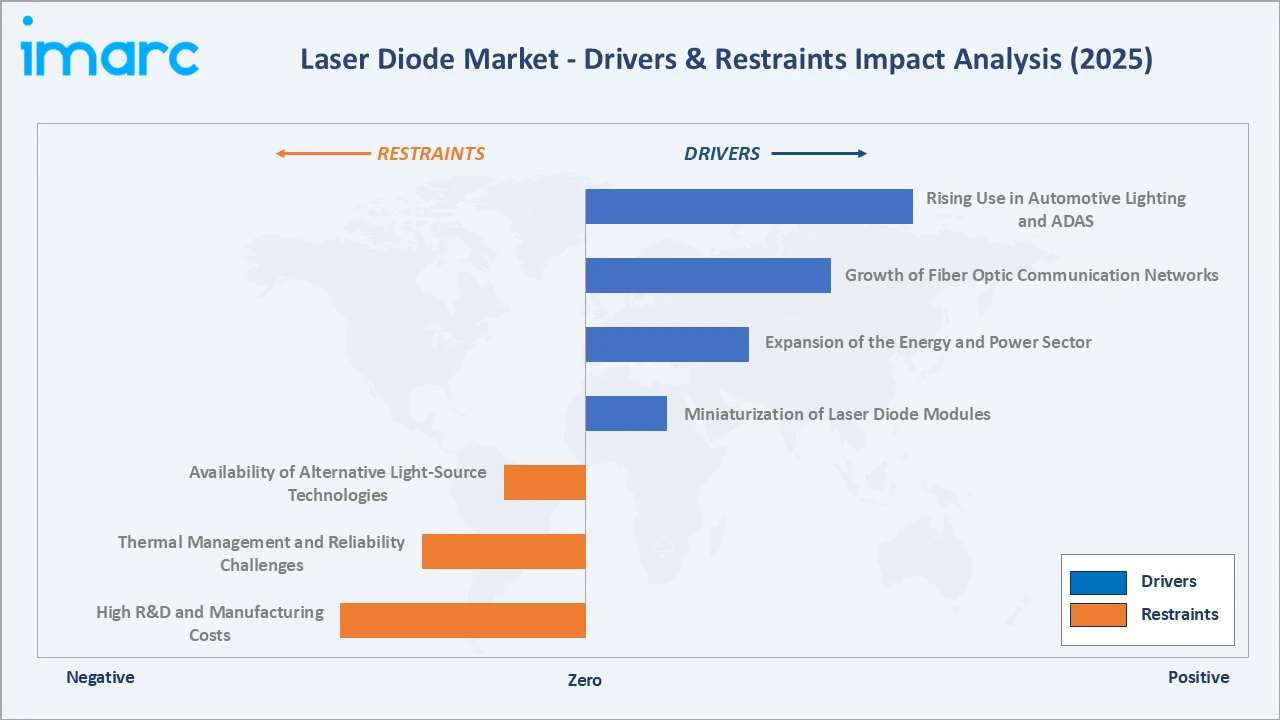
- Miniaturization of Laser Diode Modules: Growing demand for compact laser diodes suitable for smartphones, wearables, and portable medical devices is expanding integration opportunities without compromising performance or efficiency.
- Expansion of the Energy and Power Sector: Rising use of laser diodes in solar cell manufacturing, testing, and laser-based power transmission is supporting adoption as renewable energy investment accelerates globally.
- Growth of Fiber Optic Communication Networks: Increasing fiber optic infrastructure investment, driven by cloud computing and streaming demand, is boosting laser diode consumption for high-speed, high-bandwidth data transmission.
- Rising Use in Automotive Lighting and ADAS: Expanding use of laser diodes in automotive headlamps and advanced driver-assistance systems (ADAS) is increasing procurement volumes as vehicle electrification and safety features scale up.
Market Restraints
- High R&D and Manufacturing Costs: Developing high-power, high-precision laser diodes requires substantial investment in specialized materials, testing infrastructure, and skilled engineering talent, raising barriers for smaller manufacturers.
- Thermal Management and Reliability Challenges: Sustained high-power operation generates heat that can degrade beam quality and shorten device lifespan, requiring advanced cooling systems that add cost and design complexity.
- Availability of Alternative Light-Source Technologies: Competing coherent and non-coherent light-source technologies, including fiber lasers and high-intensity LEDs, create pricing pressure in select industrial and consumer applications.
Market Opportunities
- Laser-Based Energy Applications: Wider deployment of laser-based wireless power transfer and precision solar manufacturing tools is opening new revenue streams beyond traditional communication and industrial uses.
- LiDAR and Autonomous Sensing Integration: Increasing integration of laser diodes into LiDAR and sensing systems for autonomous vehicles and robotics is creating a fast-growing adjacent demand pool.
Market Challenges
- Fast Product Innovation Cycles: Rapid technology cycles require continuous R&D reinvestment, and manufacturers slow to adopt next-generation wavelengths or packaging risk losing share to more agile competitors.
- Raw Material and Supply Chain Sensitivity: Dependence on specialty semiconductor substrates exposes manufacturers to supply and price volatility, particularly during periods of constrained global chip production capacity.
Emerging Market Trends
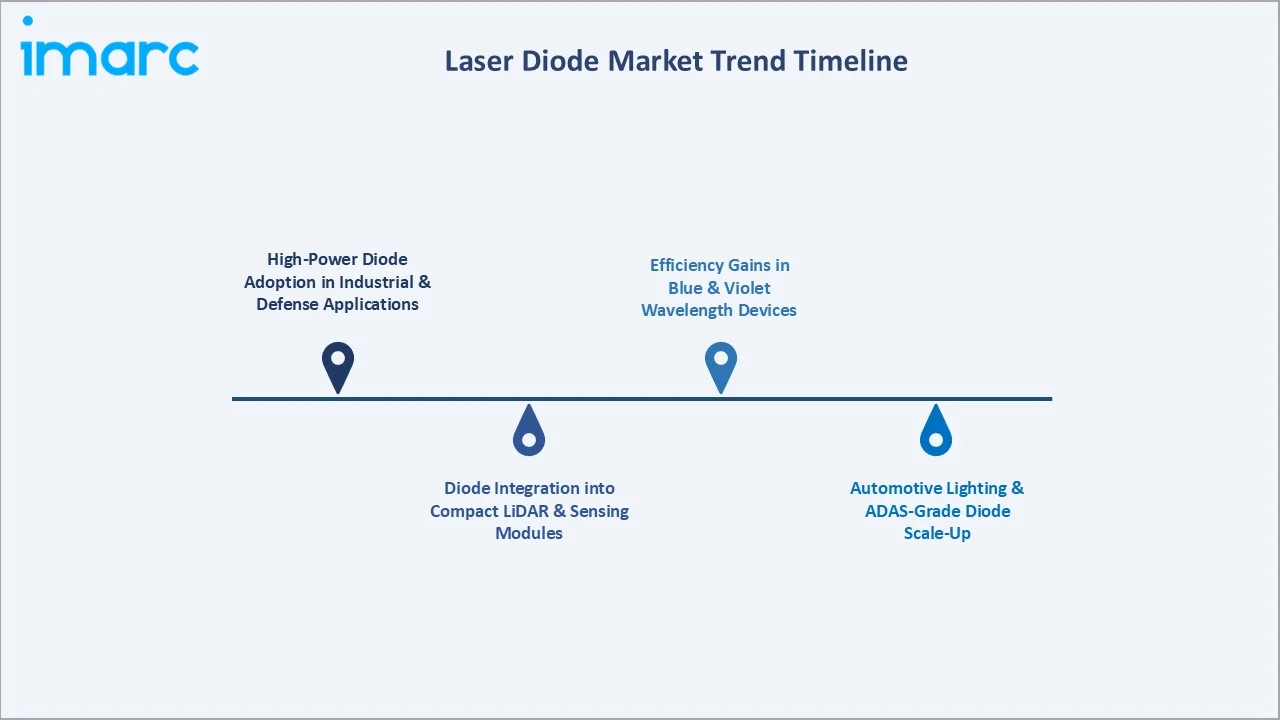
1. High-Power Diode Adoption in Industrial and Defense Applications
Rising demand for higher-power laser diodes is supporting advanced cutting, welding, and rangefinding applications, as industrial and defense users seek greater precision, speed, and energy efficiency from next-generation diode platforms. Manufacturers are responding with improved thermal architectures that sustain higher output without compromising beam stability.
2. Diode Integration into Compact LiDAR and Sensing Modules
Laser diodes are increasingly embedded within compact LiDAR and sensing modules for autonomous vehicles and robotics, as manufacturers prioritize smaller form factors and lower power consumption without sacrificing detection range, accuracy, or reliability under variable environmental conditions.
3. Efficiency Gains in Blue and Violet Wavelength Devices
Continued improvement in blue and violet laser diode efficiency is expanding their use in high-density optical storage, precision material processing, and advanced display and lighting systems, as manufacturers push output power higher while maintaining compact packaging.
4. Automotive Lighting and ADAS-Grade Diode Scale-Up
Automakers are scaling adoption of laser diodes for adaptive headlamp systems and ADAS sensing, supporting higher per-vehicle diode content as advanced safety and lighting features become standard across mainstream and premium vehicle platforms alike.
Industry Value Chain Analysis
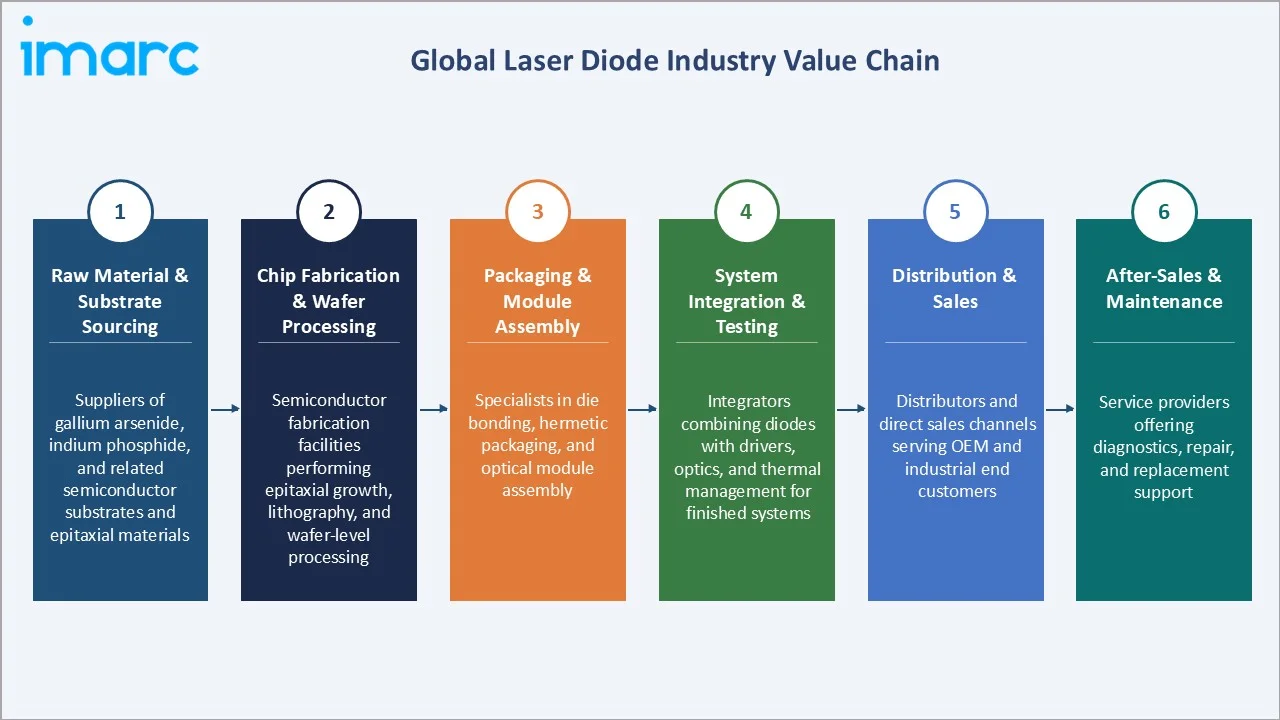
The laser diode value chain integrates raw material and substrate sourcing, chip fabrication and wafer processing, packaging and module assembly, system integration and testing, and distribution through to after-sales support and maintenance for end-use customers.
|
Stage |
Key Participants |
|
Raw Material & Substrate Sourcing |
Suppliers of gallium arsenide, indium phosphide, and related semiconductor substrates and epitaxial materials |
|
Chip Fabrication & Wafer Processing |
Semiconductor fabrication facilities performing epitaxial growth, lithography, and wafer-level processing |
|
Packaging & Module Assembly |
Specialists in die bonding, hermetic packaging, and optical module assembly |
|
System Integration & Testing |
Integrators combining diodes with drivers, optics, and thermal management for finished systems |
|
Distribution & Sales |
Distributors and direct sales channels serving OEM and industrial end customers |
|
After-Sales & Maintenance |
Service providers offering diagnostics, repair, and replacement support |
The chip fabrication and packaging stage remains the value chain's most technically demanding tier, given its dependence on precision epitaxial growth and hermetic sealing to ensure device reliability and output consistency. System integration is also gaining commercial importance as OEMs increasingly favor ready-to-install diode modules over standalone components, shortening development cycles and simplifying downstream assembly.
Technology Landscape in the Laser Diode Industry
Injection Laser Diode (ILD) Technology
Injection Laser Diode technology offers high efficiency, compact form factors, and strong output power, making it the preferred choice for fiber optic communication, industrial processing, and consumer electronics applications. Continuous refinement of chip design and packaging is further improving thermal performance and operating lifespan.
Optically Pumped Semiconductor Laser (OPSL) Technology
OPSL technology delivers superior beam quality and wavelength flexibility, supporting precision requirements in medical, scientific, and instrumentation applications where output stability is critical, and its adoption is expanding as manufacturers seek tighter spectral control.
High-Power and Wavelength-Specific Diode Technology
Ongoing advances in high-power and wavelength-specific diode design are broadening use across defense, automotive lighting, and next-generation sensing applications, supporting demand for tailored diode configurations engineered for specific power, wavelength, and packaging requirements.
Market Segmentation Analysis
The report covers the following segments:
|
Segment Category |
Leading Segment |
Market Share |
Year |
|
Product Type |
Injection Laser Diode (ILD) |
76.8% |
2025 |
|
Application |
Industrial Applications |
30.4% |
2025 |
|
Region |
Asia Pacific |
41.8% |
2025 |

By Product Type
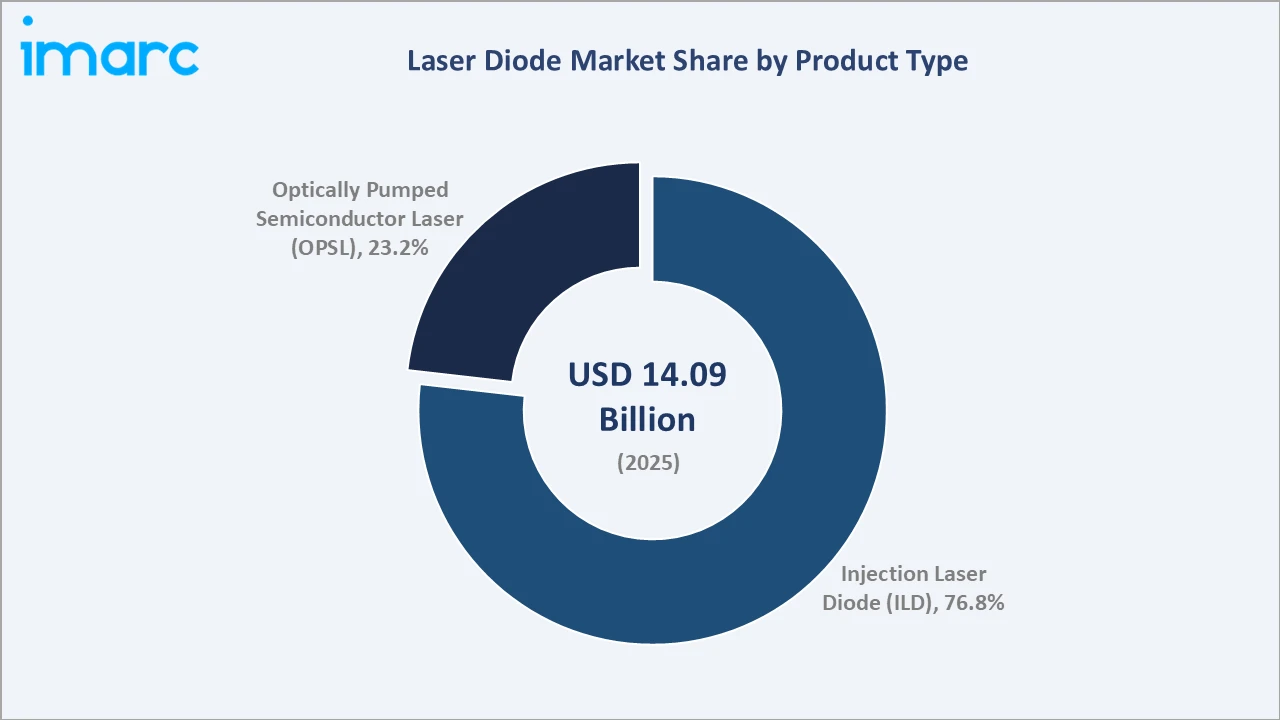
Injection Laser Diode (ILD) led the product type category at 76.8% in 2025, reflecting its established role in fiber optic communication, industrial processing, and consumer electronics, supported by continuous gains in output power and efficiency.
To access detailed market analysis, Request Sample
Optically Pumped Semiconductor Laser (OPSL) held 23.2% share in 2025, valued for superior beam quality and wavelength flexibility in precision medical, scientific, and instrumentation applications, and is forecast to grow faster than the overall market average through 2034. Its adoption is expected to strengthen further as scientific research and advanced instrumentation budgets expand across both developed and emerging markets.
By Application
Industrial applications led at 30.4% in 2025, driven by laser cutting, welding, marking, and material processing needs across automotive and general manufacturing. Optical storage and communication followed at 26.1%, supported by continued fiber network expansion.
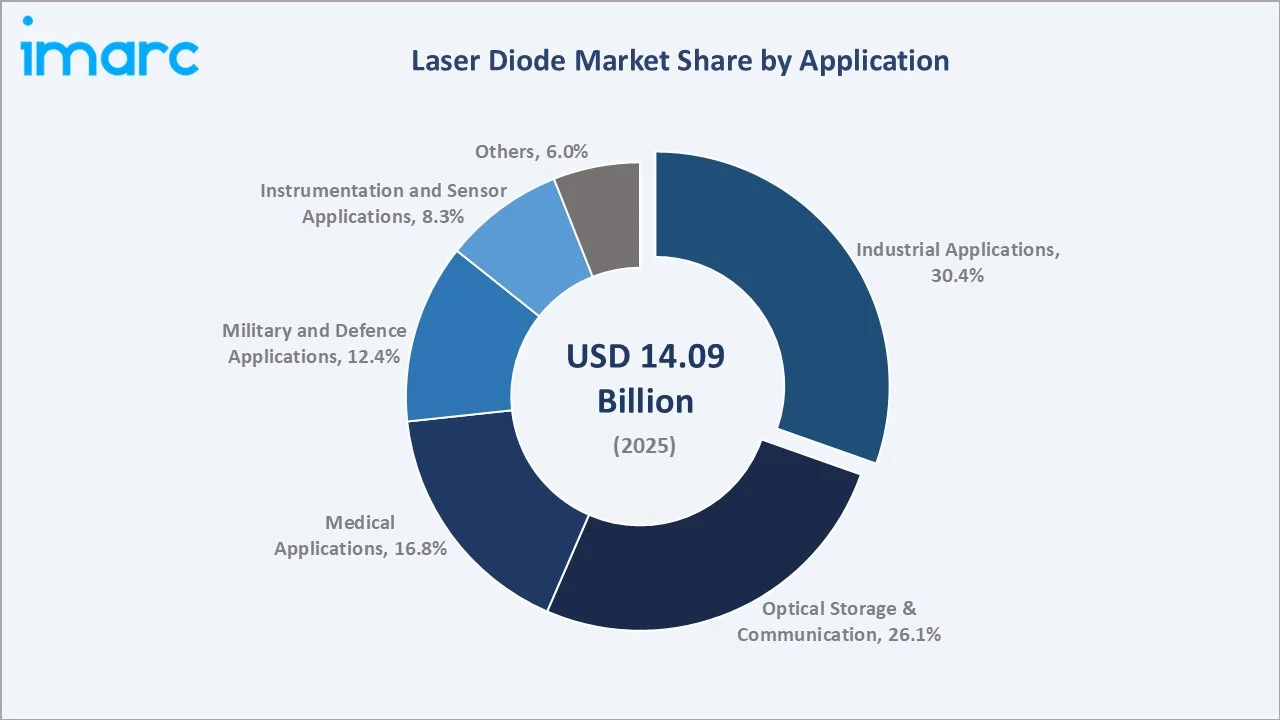
Medical applications held 16.8% share, reflecting rising use in surgery, ophthalmology, and diagnostics, while military and defence applications (12.4%) and instrumentation and sensor applications (8.3%) rounded out the remaining category mix, alongside other applications at 6.0%. Instrumentation and sensor applications are expected to post above-average growth as industrial automation and precision measurement needs continue to expand.
Regional Market Insights
|
Region |
Share (2025) |
Key Regional Characteristics |
|
Asia Pacific |
41.8% |
Leading region supported by strong manufacturing capacity, expanding end-use industries, and favorable government initiatives |
|
North America |
24.3% |
Driven by advanced technology infrastructure, strong R&D investment, and established end-use industry demand |
|
Europe |
20.6% |
Supported by a mature industrial base, strict quality and safety standards, and steady technology adoption |
|
Latin America |
7.1% |
Reflects gradual industrial modernization and expanding infrastructure investment across key economies |
|
Middle East and Africa |
6.2% |
Emerging region supported by infrastructure development and rising industrial and healthcare investment |
Asia Pacific, at 41.8%, leads through its scaled electronics and industrial manufacturing base, while North America, at 24.3%, benefits from telecommunications, defense, and medical device demand. Europe follows at 20.6%, underpinned by automotive lighting standards and an established industrial laser base.
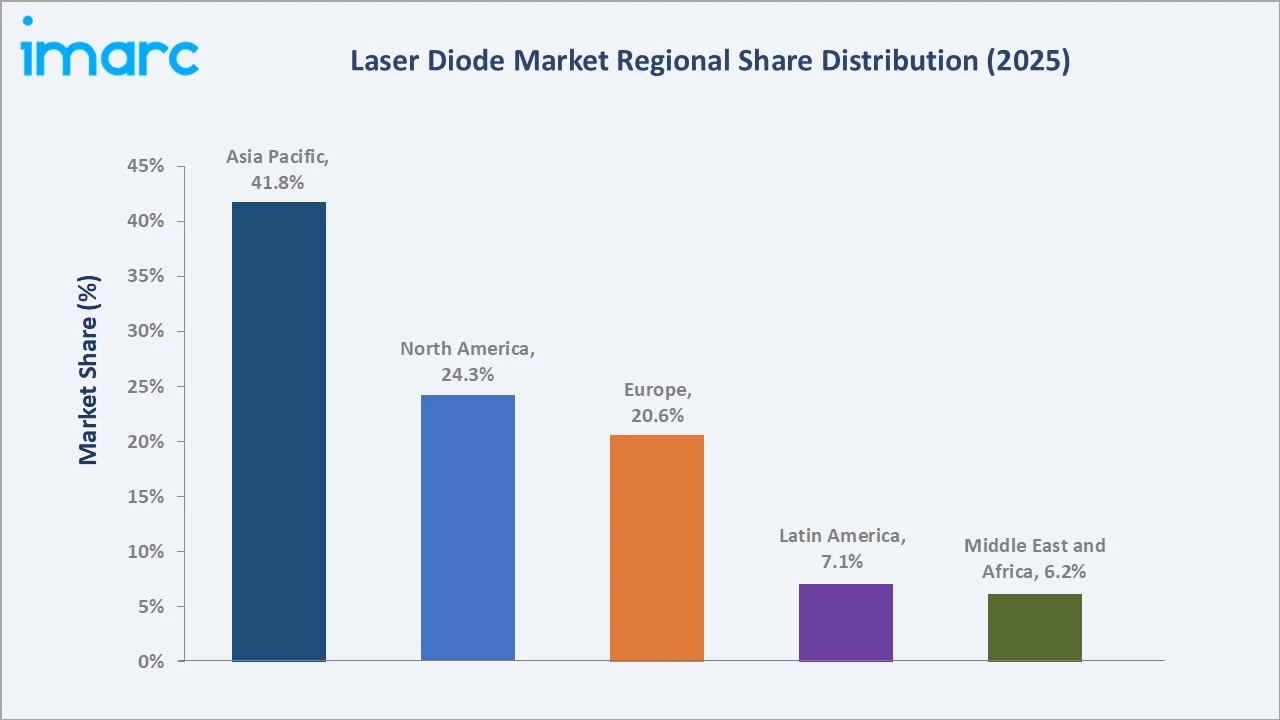
Latin America, at 7.1%, and the Middle East and Africa, at 6.2%, represent early-stage but steadily growing laser diode markets, supported by gradual industrial modernization and expanding infrastructure investment across their respective regions. Both regions are expected to see gradually increasing shares over the forecast period as local manufacturing and healthcare infrastructure mature.
Competitive Landscape
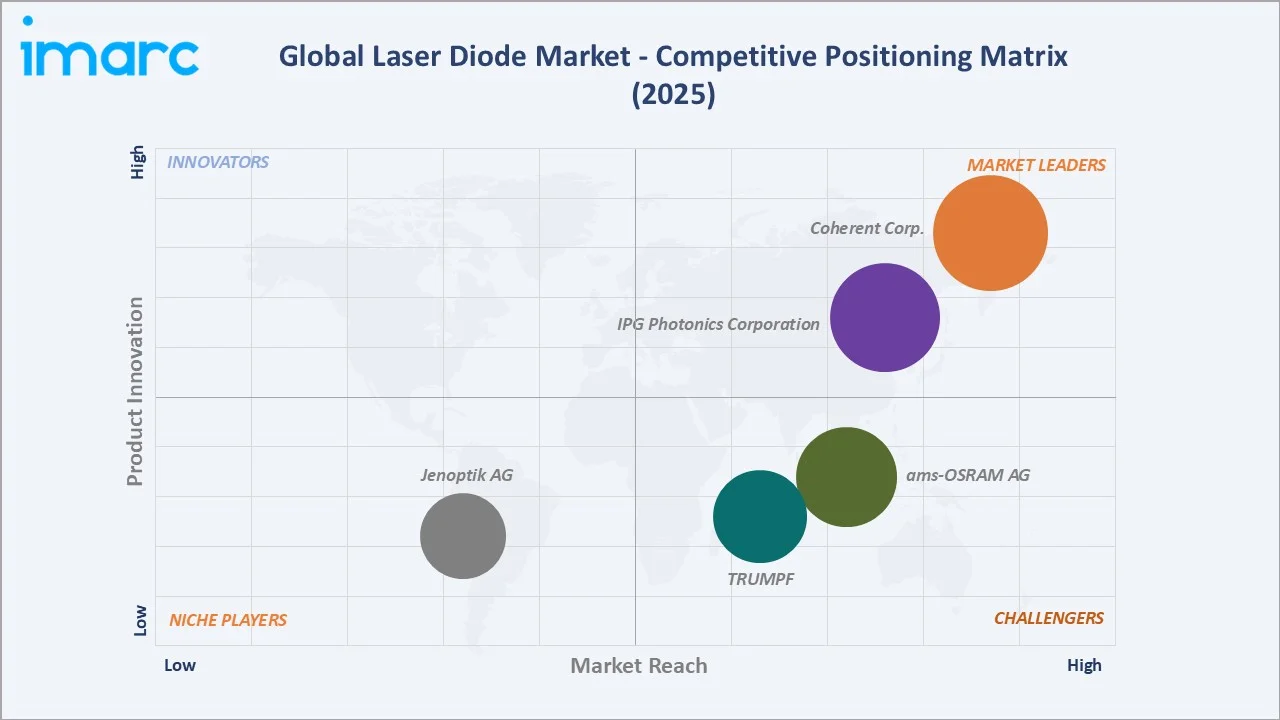
The global laser diode market features a moderately concentrated competitive landscape, with established photonics and laser technology companies competing on power output, beam quality, efficiency, and application-specific customization.
|
Company Name |
Key Products |
Market Position |
Core Strength |
|
Coherent Corp. |
Laser Diode Modules, Laser Systems, Optical Components |
Market Leader |
Coherent Corp. is a global leader in networking, lasers, and materials across industrial, communications, and instrumentation verticals. |
|
IPG Photonics Corporation |
High-Efficiency Diode Laser Systems, Fiber Lasers |
Market Leader |
IPG Photonics Corporation specializes in high-efficiency fiber and diode laser solutions for industrial and materials-processing applications. |
|
ams-OSRAM AG |
Edge-Emitting Laser Diodes, VCSELs |
Strong Challenger |
OSRAM Licht AG operating under the parent company ams-OSRAM AG is a leading supplier of semiconductor light sources, including edge-emitting laser diodes for consumer and industrial use. |
|
TRUMPF |
Industrial Laser Systems, Diode Laser Modules |
Strong Challenger |
TRUMPF is a prominent developer of industrial laser systems and laser diode components for precision manufacturing. |
|
Jenoptik AG |
Photonics Solutions, Laser Diode Components |
Niche Player |
Jenoptik AG provides photonics and laser technology solutions serving industrial, medical, and defense markets. |
Key players include Coherent Corp., IPG Photonics Corporation, ams-OSRAM AG, TRUMPF, Jenoptik AG, and others.
Key Company Profiles
Coherent Corp.
Coherent Corp. is a global leader in networking, lasers, and advanced materials, serving industrial, communications, electronics, and instrumentation customers worldwide. The company maintains a broad laser diode and optics portfolio supporting scientific research and industrial manufacturing customers.
- Key Products: High-power and precision laser diode modules for industrial and communications applications.
- Strategic Focus: Strengthening its laser diode and photonic component portfolio across industrial and communications end markets.
IPG Photonics Corporation
IPG Photonics Corporation is a leading developer of high-performance fiber and diode laser solutions for industrial, medical, and communications applications, with a strong emphasis on in-house vertical integration.
- Key Products: High-efficiency diode laser solutions for material processing and industrial heating applications.
- Strategic Focus: Expanding its diode and fiber laser portfolio to strengthen its position in industrial and materials-processing markets.
Market Concentration Analysis
The laser diode market is moderately concentrated, with leading photonics companies competing on power output, beam quality, and application-specific engineering. Ongoing R&D investment and strategic partnerships across telecommunications, healthcare, and automotive sectors continue to shape competitive positioning through the forecast period, while smaller specialists maintain relevance through niche wavelength and packaging expertise. Market concentration is expected to remain broadly stable, as high capital and technical barriers limit the pace of new entrant activity relative to overall market growth.
Investment & Growth Opportunities
Highest Growth Segments
Optically Pumped Semiconductor Laser (OPSL) products and industrial-use applications represent the fastest-growing categories through 2034, supported by rising precision manufacturing demand and expanding instrumentation and sensing use cases. Medical and defense-related applications are also expected to post above-average growth as diagnostic and rangefinding technologies continue to advance.
Emerging Investment Opportunities
LiDAR and autonomous sensing integration represents a high-value emerging opportunity, as compact, efficient laser diodes become essential components of next-generation mobility and robotics platforms, creating a structurally growing demand pool through 2034. Renewable energy applications, including laser-based solar cell processing, also present a growing avenue for diversified revenue generation.
Investment Themes
- Vertical Integration in Fabrication and Packaging: Vertical integration across chip fabrication and module packaging offers manufacturers a durable cost and quality advantage as demand for high-power, high-reliability diodes continues to scale.
- Automotive-Grade Diode Manufacturing Capacity: Investment in automotive-grade laser diode manufacturing capacity positions suppliers to capture rising demand from adaptive lighting and ADAS platforms as vehicle safety content expands.
Future Market Outlook (2026-2034)
The global laser diode market is projected to grow from USD 14.09 Billion in 2025 to USD 32.76 Billion by 2034, delivering a 9.53% CAGR over the forecast period. The market's anchor value of USD 22.22 Billion in 2030 reflects a laser diode industry at a significant commercial inflection point.
Continued adoption of miniaturized and high-power laser diode modules, expanding integration into automotive lighting and ADAS platforms, and rising use in LiDAR and sensing systems are expected to shape the market's growth trajectory through 2034, alongside steady gains in industrial and medical application demand.
Three structural forces support the market's growth outlook with strong confidence: the compounding expansion of fiber optic and data infrastructure, the broadening role of laser diodes in vehicle safety and lighting systems, and the steady rise of precision applications across healthcare, defense, and industrial automation.
Research Methodology
Primary Research
Primary research included structured interviews with industry stakeholders, including product engineers, procurement leads, and technology specialists across the laser diode value chain, supplemented by consultations with distributors and end-use customers.
Secondary Research
Secondary research encompassed company annual reports, industry association data, patent filings, and technical conference proceedings covering laser diode technology and applications, alongside regulatory and trade publication review.
Forecasting Models
Market revenue forecasts were developed using a bottom-up approach incorporating historical shipment trends, application-level demand drivers, and technology adoption curves across product types and regions, validated against top-down industry benchmarks.
Laser Diode Market Report Scope:
| Report Features | Details |
|---|---|
| Base Year of the Analysis | 2025 |
| Historical Period | 2020-2025 |
| Forecast Period | 2026-2034 |
| Units | Billion USD |
| Scope of the Report | Exploration of Historical and Forecast Trends, Industry Catalysts and Challenges, Segment-Wise Historical and Predictive Market Assessment:
|
| Product Types Covered | Injection Laser Diode (ILD), Optically Pumped Semiconductor Laser (OPSL) |
| Applications Covered | Optical Storage and Communication, Industrial Applications, Medical Applications, Military and Defence Applications, Instrumentation and Sensor Applications, Others |
| Regions Covered | Asia Pacific, Europe, North America, Latin America, Middle East and Africa |
| Companies Covered | Coherent Corp., IPG Photonics Corporation, ams-OSRAM AG, TRUMPF, Jenoptik AG, etc. |
| Customization Scope | 10% Free Customization |
| Post-Sale Analyst Support | 10-12 Weeks |
| Delivery Format | PDF and Excel through Email (We can also provide the editable version of the report in PPT/Word format on special request) |
Key Benefits for Stakeholders:
- IMARC’s report offers a comprehensive quantitative analysis of various market segments, historical and current market trends, market forecasts, and dynamics of the laser diode market from 2020-2034.
- The research study provides the latest information on the market drivers, challenges, and opportunities in the global laser diode market.
- The study maps the leading, as well as the fastest-growing, regional markets. It further enables stakeholders to identify the key country-level markets within each region.
- Porter's five forces analysis assists stakeholders in assessing the impact of new entrants, competitive rivalry, supplier power, buyer power, and the threat of substitution. It helps stakeholders to analyze the level of competition within the laser diode industry and its attractiveness.
- Competitive landscape allows stakeholders to understand their competitive environment and provides an insight into the current positions of key players in the market.
Frequently Asked Questions About the Laser Diode Market Report
The laser diode market was valued at USD 14.09 Billion in 2025, reflecting steady demand across communication, healthcare, and industrial processing applications worldwide.
We expect the global laser diode market to exhibit a CAGR of 9.53% during 2026-2034, reaching USD 32.76 Billion by 2034, with an anchor value of USD 22.22 Billion projected for 2030.
The increasing adoption of laser diodes across industries such as healthcare, industrial processing, and automotive, owing to their high monochromaticity, coherence, and directionality compared to ordinary light sources, is primarily driving the global laser diode market, alongside continued miniaturization and efficiency gains.
Based on the product type, the global laser diode market has been divided into Injection Laser Diode (ILD) and Optically Pumped Semiconductor Laser (OPSL). Among these, Injection Laser Diode (ILD) currently exhibits a clear dominance in the market, accounting for 76.8% of total share in 2025.
Based on the application, the global laser diode market can be segmented into optical storage and communication, industrial applications, medical applications, military and defence applications, instrumentation and sensor applications, and others. Currently, industrial applications hold the majority of the total market share at 30.4%.
On a regional level, the market has been classified into North America, Europe, Asia Pacific, Latin America, and Middle East and Africa, where Asia Pacific currently dominates the global market with a 41.8% share, supported by its concentrated manufacturing base.
Some of the major players in the global laser diode market include Coherent Corp., IPG Photonics Corporation, ams-OSRAM AG, TRUMPF, Jenoptik AG, and others.
The laser diode market is projected to reach approximately USD 22.22 Billion by 2030, supported by continued industrial, communications, and healthcare demand, as well as expanding automotive and sensing applications.
Need more help?
- Speak to our experienced analysts for insights on the current market scenarios.
- Include additional segments and countries to customize the report as per your requirement.
- Gain an unparalleled competitive advantage in your domain by understanding how to utilize the report and positively impacting your operations and revenue.
- For further assistance, please connect with our analysts.
 Request Customization
 Speak to an Analyst
 Request Brochure
 Inquire Before Buying
Benefits of Customization
- Personalize this research
- Triangulate with your data
- Get data as per your format and definition
- Gain a deeper dive into a specific application, geography, customer, or competitor
- Any level of personalization
Get in Touch With Us
UNITED STATES
Phone: +1-201-971-6302
INDIA
Phone: +91-120-433-0800
UNITED KINGDOM
Phone: +44-753-714-6104
Email: [email protected]
Client Testimonials




.webp)




.webp)













Related Reports

Choose your plan
*Please note that the prices mentioned below are starting prices for each bundle type. Kindly contact our team for further details.*
Single User License
- 1 User License, Access on 2 Devices
- PDF Report + Excel Dataset (Password Protected)
- Lifetime Access
- No Printing Rights
- 10% Free Report Customization
- 10–12 Weeks of Analyst Support
Five User License
- Access for 5 Users, 2 Devices per User
- PDF Report + Excel Dataset (Password Protected)
- Lifetime Access
- Dedicated Account Manager
- 12–14 Weeks of Analyst Support
- No Printing Rights
- 15% Free Report Customization
- 25% Discount on Your Next Purchase
Corporate User License
- Unlimited User Access (Within Your Organization)
- PDF Report + Excel Dataset
- Lifetime Access
- Dedicated Account Manager
- 14–20 Weeks of Analyst Support
- No Printing Rights
- 20% Free Report Customization
- 30% Discount on Your Next Purchase
Essential Insights
What's included:
3 reports
- Lifetime Access
- PDF Reports
- Excel Datasets
- 2 Weeks of Free Analyst Support
- 2 User Licenses
- Access on 2 Devices
- Printing Rights
- Complimentary PowerPoint (PPT) Version
- Complimentary License Upgrade
Professional Access
What's included:
5 reports
- Lifetime Access
- PDF Reports
- Excel Datasets
- 8 Weeks of Free Analyst Support
- 2 User Licenses
- Access on 2 Devices
- Printing Rights
- Complimentary PowerPoint (PPT) Version
- Complimentary License Upgrade
Business Advantage
What's included:
8 reports
- Lifetime Access
- PDF Reports
- Excel Datasets
- 14 Weeks of Free Analyst Support
- 2 User Licenses
- Access on 2 Devices
- Printing Rights
- Complimentary PowerPoint (PPT) Version
- Complimentary License Upgrade
Enterprise Intelligence
What's included:
10 reports
- Lifetime Access
- PDF Reports
- Excel Datasets
- 20 Weeks of Free Analyst Support
- 2 User Licenses
- Access on 2 Devices
- Printing Rights
- Complimentary PowerPoint (PPT) Version
- Complimentary License Upgrade