
Medium Voltage Motors Market Size, Share, Trends and Forecast by Product, End User, and Region, 2026-2034
Medium Voltage Motors Market Size, Share, Trends & Forecast (2026-2034)
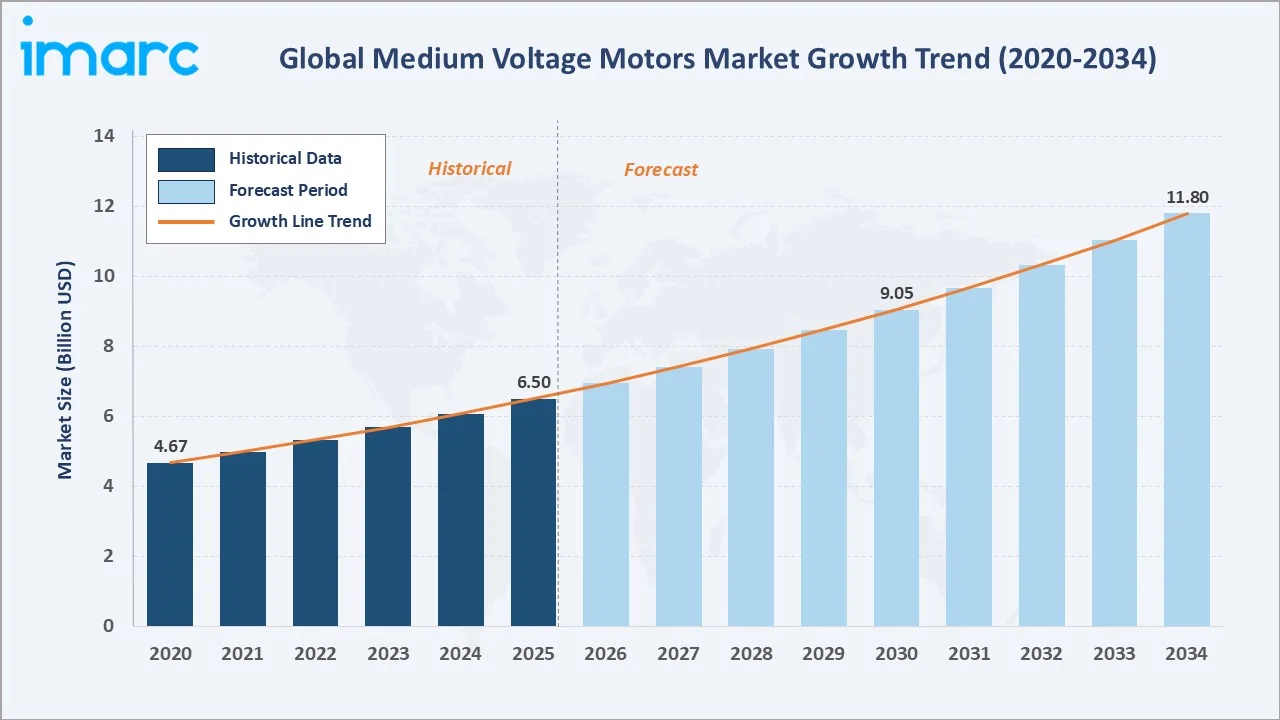
The global medium voltage motors market reached USD 6.50 Billion in 2025 and is projected to reach USD 11.80 Billion by 2034, growing at a CAGR of 6.84% during 2026-2034. The market is driven by rising demand for energy-efficient motors, widespread product utilization in heating, ventilation, and air conditioning (HVAC) systems, and the growing integration of Internet of Things (IoT) technology for real-time condition monitoring. AC-Motors dominate the product landscape at 62.0%. Process Industries lead end-user demand at 45.0%. North America commands 28.0% of the global market share.
Market Snapshot
|
Metric |
Value |
|
Market Size (2025) |
USD 6.50 Billion |
|
Forecast Market Size (2034) |
USD 11.80 Billion |
|
CAGR (2026-2034) |
6.84% |
|
Base Year |
2025 |
|
Historical Period |
2020-2025 |
|
Forecast Period |
2026-2034 |
|
Dominant Product |
AC-Motors (62.0%, 2025) |
|
Dominant End User |
Process Industries (45.0%, 2025) |
|
Leading Region |
North America (28.0%, 2025) |
The global medium voltage motors market expanded from USD 4.67 Billion in 2020 to USD 6.50 Billion in 2025, anchored at USD 9.05 Billion in 2030, and forecast to reach USD 11.80 Billion by 2034. Post-pandemic industrial recovery and accelerating automation investment restored motor order volumes through 2022-2023, while tightening energy-efficiency regulations sustained above-trend market growth through 2024-2025.
To get more information on this market, Request Sample
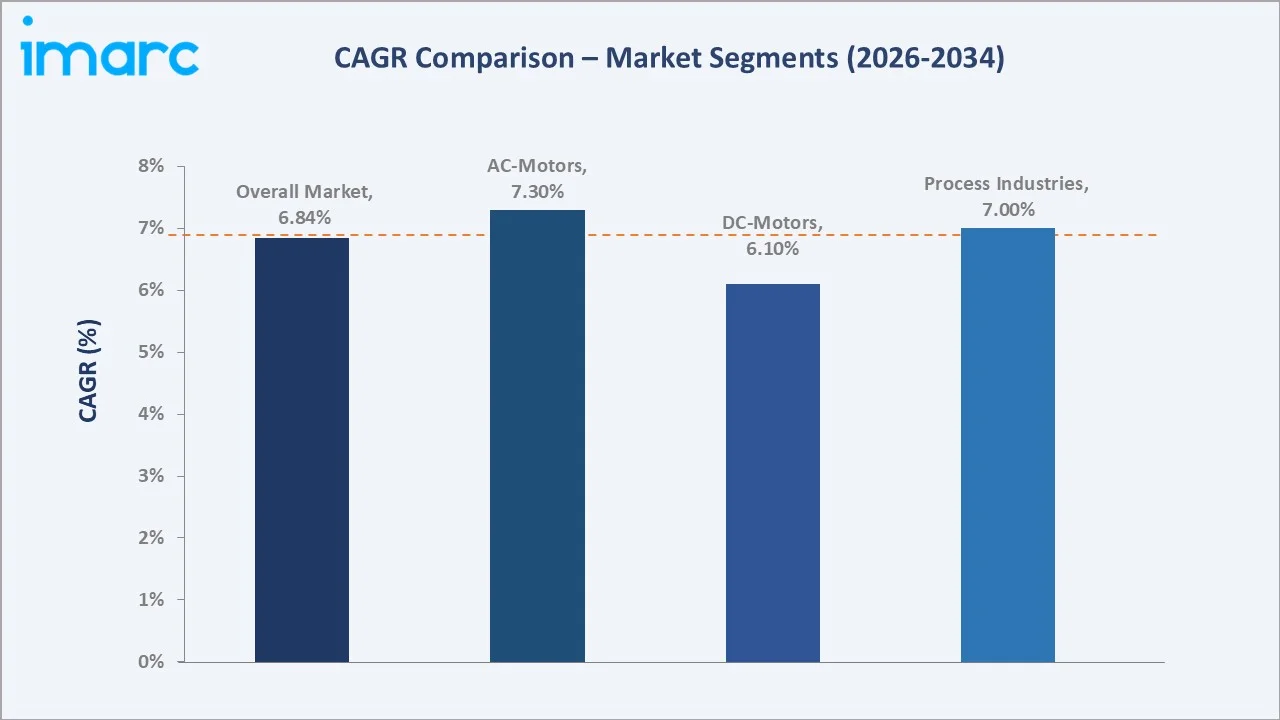
DC-Motors grow fastest at ~6.1% CAGR as precision speed-control applications expand across process automation. AC-Motors grow at ~7.3% CAGR through continued dominance in heavy-duty industrial drive applications.
Executive Summary
The global medium voltage motors market reached USD 6.50 Billion in 2025, reflecting the critical role these machines play across process industries, discrete manufacturing, and building infrastructure. The market encompasses motor design and engineering, precision manufacturing, testing and certification, and integration with modern drive and automation systems that convert a standard electrical machine into a connected, monitorable industrial asset.
AC-Motors at 62.0% dominate through cost-efficiency and broad compatibility with industrial power systems. Process Industries at 45.0% lead end-user demand through continuous-duty applications in pumps, compressors, and conveyors. North America, at 28.0%, leads through sustained industrial automation investment and early adoption of energy-efficiency mandates.
Key Market Insights
|
Insight |
Data |
|
Dominant Product |
AC-Motors - 62.0% share (2025) |
|
Dominant End User |
Process Industries - 45.0% market share (2025) |
|
Leading Region |
North America - 28.0% market share |
|
Market Opportunity |
IoT-enabled condition monitoring; IE4/IE5 efficiency upgrade cycle; smart drive integration; renewable and grid infrastructure investment |
Key Analytical Observations Supporting The Above Data:
- AC-Motors at 62.0%: AC-motors dominate due to their robust design, lower maintenance requirements, and direct compatibility with industrial power systems, which simplifies integration and reduces overall lifecycle cost for large-scale operators.
- Process Industries at 45.0%: Process industries dominate because continuous-duty pumps, compressors, and conveyors require reliable, high-torque motors that can withstand demanding operating conditions while minimizing unplanned downtime.
- North America at 28.0%: North America dominates through early regulatory adoption of premium-efficiency motor standards, sustained capital investment in industrial automation, and a mature installed base requiring periodic replacement and upgrade.
- Market Opportunity: IoT-enabled condition monitoring and the shift toward IE4/IE5 efficiency classes are opening new upgrade and retrofit revenue streams for manufacturers and system integrators alike.
Medium Voltage Motors Market Overview
The global medium voltage motors market encompasses the design, manufacturing, testing, and integration of electrical machines engineered to operate at medium voltage levels, typically between 1 kV and 35 kV. The market spans motor components, control and drive technology, condition-monitoring systems, and aftermarket service.
Macroeconomic factors include rising industrial output, expanding infrastructure investment, and increasing emphasis on energy-efficient equipment. In addition, tightening efficiency regulations, growing automation adoption, and government support for industrial modernization are accelerating medium voltage motor deployment worldwide.
Market Dynamics
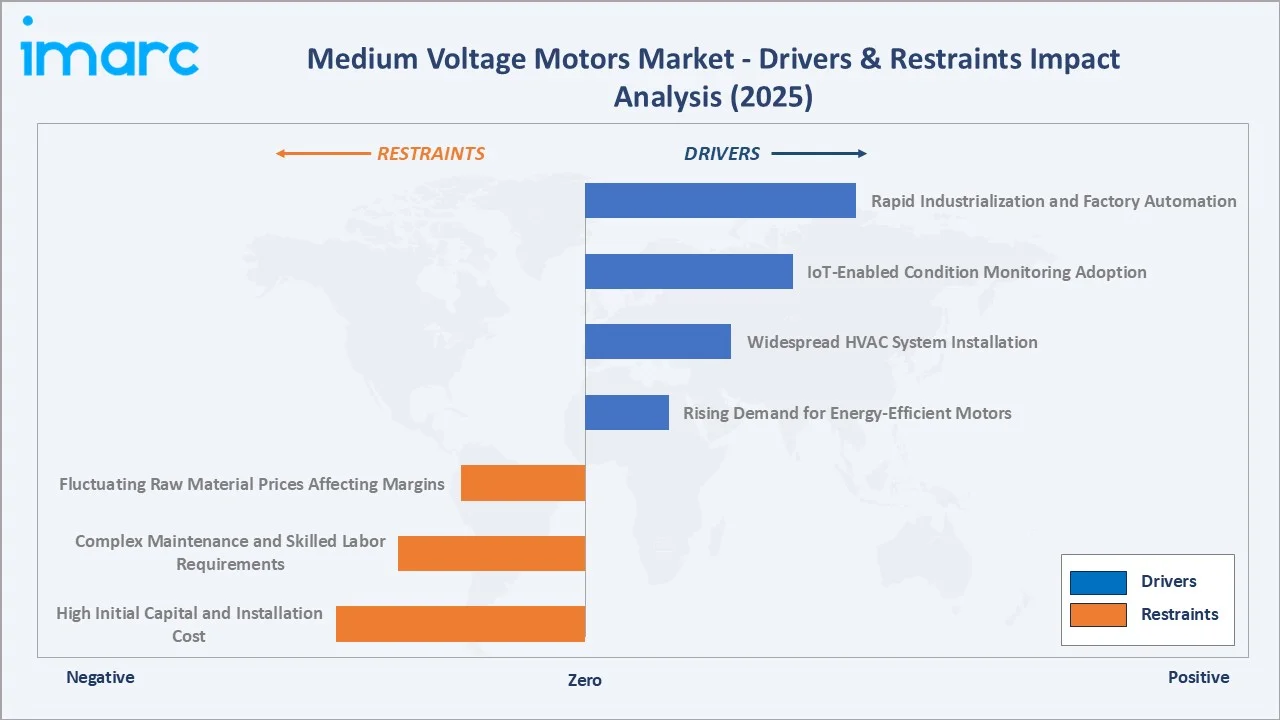
The medium voltage motors market is shaped by a combination of regulatory, technological, and industrial demand forces that together determine the pace of equipment replacement and new capacity investment. Efficiency mandates and automation adoption are expanding the addressable base for premium motor platforms, while cost and skilled-labor constraints continue to temper adoption among smaller operators. The interaction between these forces defines the competitive opportunity available to manufacturers and system integrators across regions.
To evaluate market opportunities, Request Sample
Market Drivers
- Rising Demand for Energy-Efficient Motors: Growing emphasis on operational cost reduction and regulatory compliance is driving industrial operators to replace legacy motors with high-efficiency alternatives, supporting sustained equipment upgrade demand across manufacturing and process facilities.
- Widespread HVAC System Installation: The rapid installation of HVAC systems across commercial and industrial spaces, including office buildings, data centers, and manufacturing facilities, is expanding the addressable base for medium voltage motors used in pumps, fans, and compressors.
- IoT-Enabled Condition Monitoring Adoption: The integration of IoT technology allows real-time monitoring of temperature, vibration, current, and speed, improving performance and reliability while reducing unplanned downtime, encouraging operators to adopt connected motor platforms.
- Rapid Industrialization and Factory Automation: Expanding industrial output and growing investment in factory automation across emerging economies are increasing demand for reliable, high-torque medium voltage motors that can support continuous-duty production lines.
Market Restraints
- High Initial Capital and Installation Cost: The high upfront cost of medium voltage motors, associated switchgear, and installation labor makes adoption difficult for small and medium-scale operators, slowing uptake in price-sensitive and developing markets.
- Complex Maintenance and Skilled Labor Requirements: Medium voltage motor systems require specialized technicians for installation, calibration, and maintenance, and a shortage of skilled labor in several regions increases operational risk and total cost of ownership.
- Fluctuating Raw Material Prices: Volatility in copper, steel, and specialty alloy prices directly affects manufacturing costs and margins, creating pricing uncertainty for both manufacturers and end users.
Market Opportunities
- IE4/IE5 Efficiency Upgrade Cycle: Tightening global efficiency standards are creating a multi-year replacement cycle as operators upgrade legacy IE2/IE3 motors to premium-efficiency IE4 and IE5 platforms.
- Smart Drive and Automation Integration: Bundling motors with variable-frequency drives and automation software creates higher-margin, subscription-oriented revenue opportunities for manufacturers and system integrators.
Market Challenges
- Grid Reliability Dependence: Consistent motor performance depends on stable power supply, and regions with unreliable grid infrastructure face higher backup and maintenance costs that reduce operational efficiency.
- Retrofit Complexity in Legacy Facilities: Integrating modern motor and monitoring systems into aging industrial facilities often requires costly infrastructure upgrades, slowing modernization timelines for some operators.
Emerging Market Trends
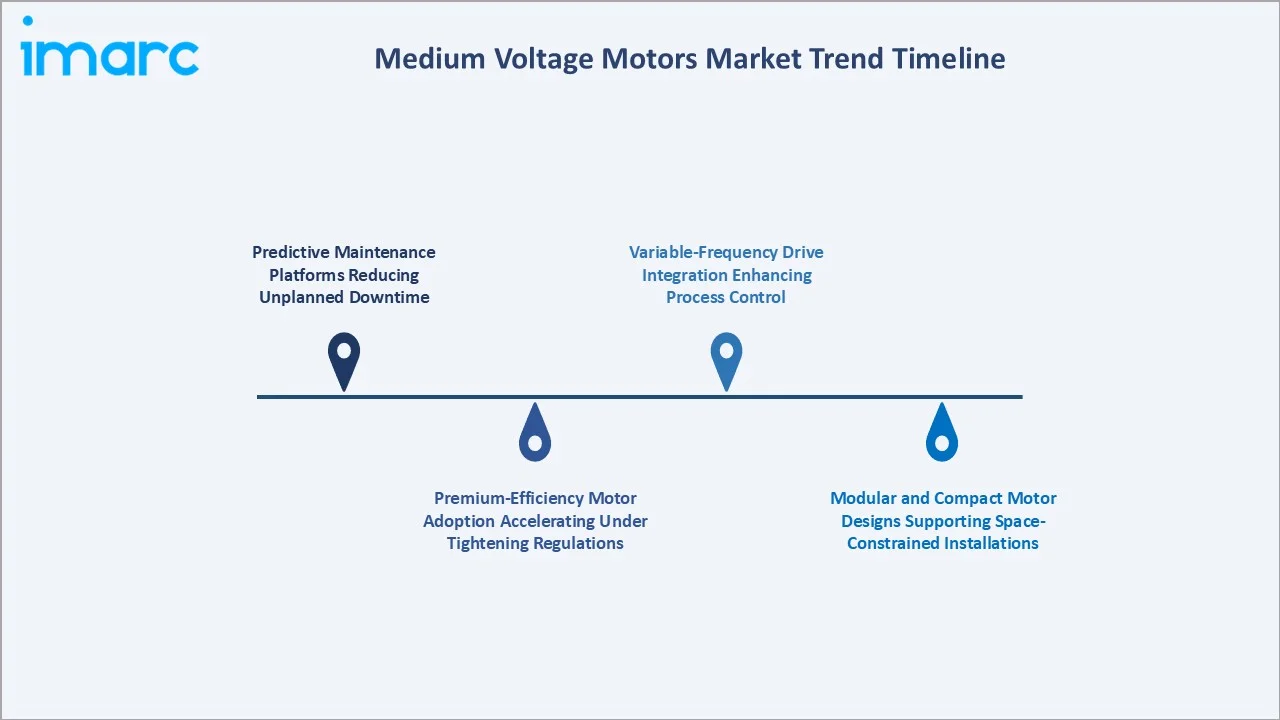
1. Predictive Maintenance Platforms Reducing Unplanned Downtime
IoT-enabled sensors and predictive analytics are enabling operators to monitor motor health in real time, tracking variables such as vibration signature, winding temperature, bearing wear, and current draw to flag developing faults before they cause failure. This shift from reactive to predictive maintenance is reducing unplanned downtime, extending equipment life, and lowering total maintenance spend across large industrial fleets. Manufacturers are responding by bundling connected monitoring software and cloud-based analytics dashboards with new motor installations, and by offering retrofit sensor kits that bring older motor fleets into the same monitoring ecosystem, creating a recurring software and service revenue stream alongside traditional equipment sales.
2. Premium-Efficiency Motor Adoption Accelerating Under Tightening Regulations
Governments across major industrial economies, including the United States, the European Union, China, and India, are tightening minimum energy-performance standards for industrial motors, prompting accelerated replacement of older IE2 and IE3 fleets with premium IE4 and IE5-class platforms. These higher-efficiency designs use improved core materials, optimized winding geometry, and tighter manufacturing tolerances to reduce energy losses, which lowers lifecycle operating costs even though upfront equipment prices are higher. The resulting multi-year replacement cycle is becoming a dependable demand driver for manufacturers, independent of broader industrial capital-expenditure cycles, as compliance deadlines create fixed replacement timelines for regulated facilities.
3. Variable-Frequency Drive Integration Enhancing Process Control
Pairing medium voltage motors with variable-frequency drives allows operators to precisely control motor speed and torque rather than running equipment at fixed full-load speed, improving process efficiency and significantly reducing mechanical wear on connected pumps, compressors, and conveyor systems. This approach also reduces peak electrical demand charges and mechanical stress during startup, extending the service life of both the motor and the driven equipment. Drive-integrated motor packages are increasingly specified as a default configuration in new industrial projects, particularly in process industries where variable flow and pressure requirements make fixed-speed operation inefficient.
4. Modular and Compact Motor Designs Supporting Space-Constrained Installations
Manufacturers are developing lighter, more compact motor designs using improved materials and optimized frame geometry that simplify installation and retrofit projects in space-constrained industrial and commercial facilities. These modular platforms reduce foundation and structural requirements, shorten installation timelines, and lower transportation and handling costs, which is particularly valuable for brownfield retrofit projects where available floor space and structural load capacity are limited. The trend is also supporting faster deployment of temporary or modular production facilities, where compact, quickly installable motor platforms reduce overall project commissioning time.
Industry Value Chain Analysis
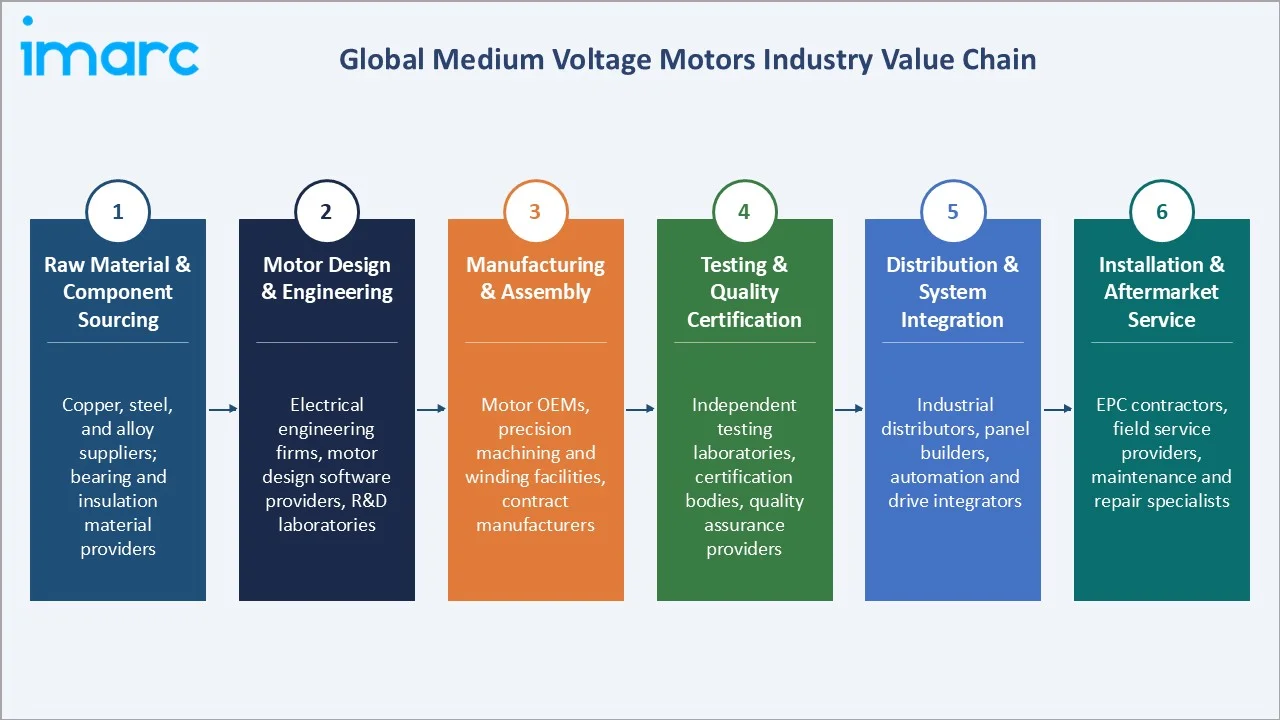
The medium voltage motors value chain integrates raw material and component sourcing, motor design and engineering, manufacturing and assembly, testing and quality certification, distribution and system integration, and installation and aftermarket service.
|
Stage |
Key Participants |
|
Raw Material & Component Sourcing |
Copper, steel, and alloy suppliers; bearing and insulation material providers |
|
Motor Design & Engineering |
Electrical engineering firms, motor design software providers, R&D laboratories |
|
Manufacturing & Assembly |
Motor OEMs, precision machining and winding facilities, contract manufacturers |
|
Testing & Quality Certification |
Independent testing laboratories, certification bodies, quality assurance providers |
|
Distribution & System Integration |
Industrial distributors, panel builders, automation and drive integrators |
|
Installation & Aftermarket Service |
EPC contractors, field service providers, maintenance and repair specialists |
The manufacturing and assembly stage is the value chain's most capital-intensive and quality-critical phase. Testing and certification sustain the reliability premium that medium voltage motors command in mission-critical industrial applications. Aftermarket service increasingly represents a growing share of total lifecycle revenue.
Technology Landscape in the Medium Voltage Motors Industry
Premium-Efficiency (IE4/IE5) Motor Technology
Premium-efficiency motor technology reduces energy losses through optimized winding design, improved lamination and core materials, reduced air-gap tolerances, and precision manufacturing processes that minimize friction and electromagnetic losses. These platforms are increasingly specified in new industrial projects and large-scale retrofit programs seeking to minimize lifecycle energy costs and comply with tightening national and regional efficiency mandates. As material science and manufacturing precision continue to improve, the cost premium for IE4 and IE5-class motors relative to standard-efficiency platforms is gradually narrowing, further supporting adoption.
IoT-Enabled Condition Monitoring Technology
IoT-enabled sensors and cloud-connected monitoring platforms allow continuous tracking of temperature, vibration, current draw, and rotational speed, feeding data into analytics engines that flag developing faults before they cause unplanned downtime. Adoption is expanding fastest among large industrial operators with centralized asset-management programs and dedicated reliability-engineering teams, though retrofit sensor kits are gradually extending this capability to smaller facilities and older motor fleets, broadening the addressable market for connected monitoring solutions.
Variable-Frequency Drive and Automation Integration
Variable-frequency drives paired with medium voltage motors enable precise speed and torque control, improving process efficiency, reducing mechanical stress on connected equipment, and lowering peak electrical demand charges. Integration with plant-wide automation and distributed control systems is becoming a standard specification for new industrial installations, allowing centralized operators to coordinate motor performance across entire production lines rather than managing individual assets in isolation.
Advanced Insulation and Winding Materials
Advances in insulation systems and winding materials are improving motor durability under high-temperature, high-vibration, and high-humidity operating conditions common in heavy industrial and marine applications. New resin and varnish formulations extend insulation life and improve resistance to voltage transients, reducing premature winding failure and supporting longer service intervals, which is particularly valuable for motors operating in continuous-duty process industry applications where unplanned replacement is costly.
Market Segmentation Analysis
The report covers the following segments:
|
Segment Category |
Leading Segment |
Market Share |
Year |
|
Product |
AC-Motors |
62.0% |
2025 |
|
End User |
Process Industries |
45.0% |
2025 |
|
Region |
North America |
28.0% |
2025 |

By Product
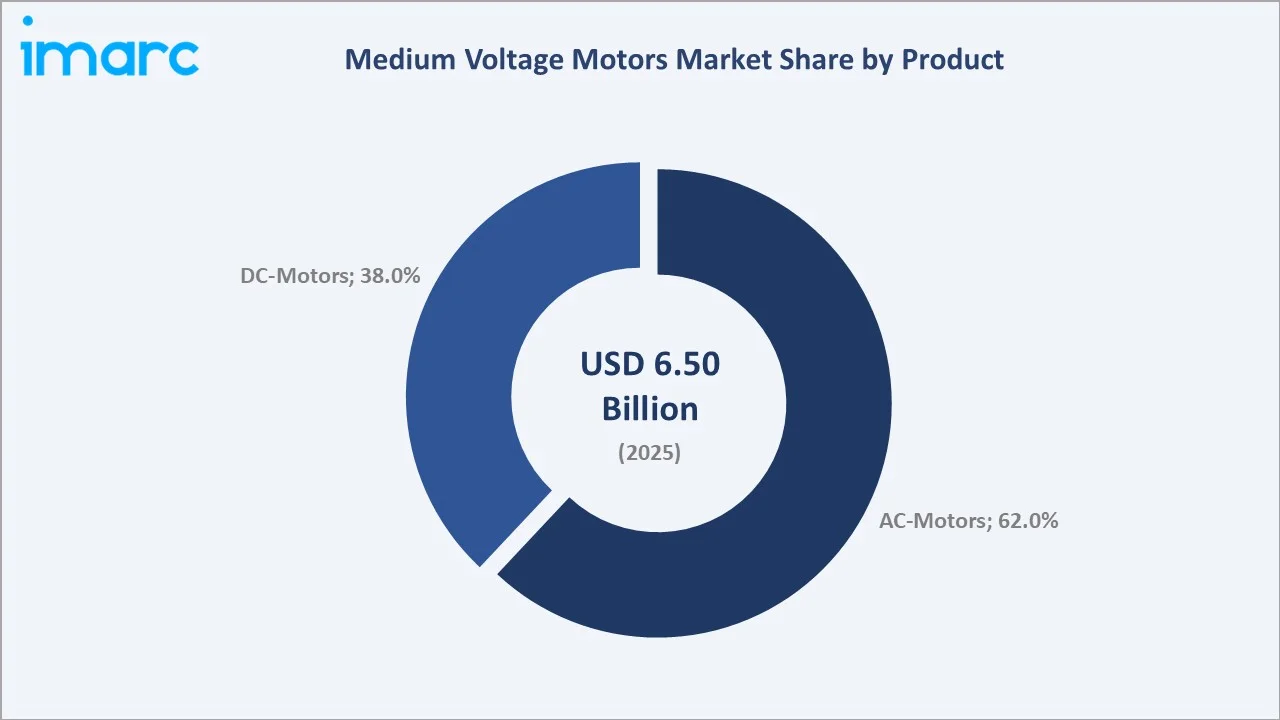
AC-Motors lead at 62.0% (2025). The AC-Motors segment encompasses induction and synchronous motor platforms widely used across pumps, fans, compressors, and conveyors for their reliability, lower maintenance requirements, and direct compatibility with industrial power systems.
To access detailed market analysis, Request Sample
DC-Motors at 38.0% are favored in applications requiring precise speed control, such as rolling mills, marine propulsion, and specialty drive systems. DC-Motors' 6.1% CAGR is above the overall market rate through growing demand in precision process automation.
By End User
Process Industries lead at 45.0% (2025). The Process Industries segment encompasses oil and gas, chemicals, water treatment, and mining applications requiring continuous-duty pumps, compressors, and conveyors. Process Industries' ~7.0% CAGR reflects sustained capital investment in production capacity.
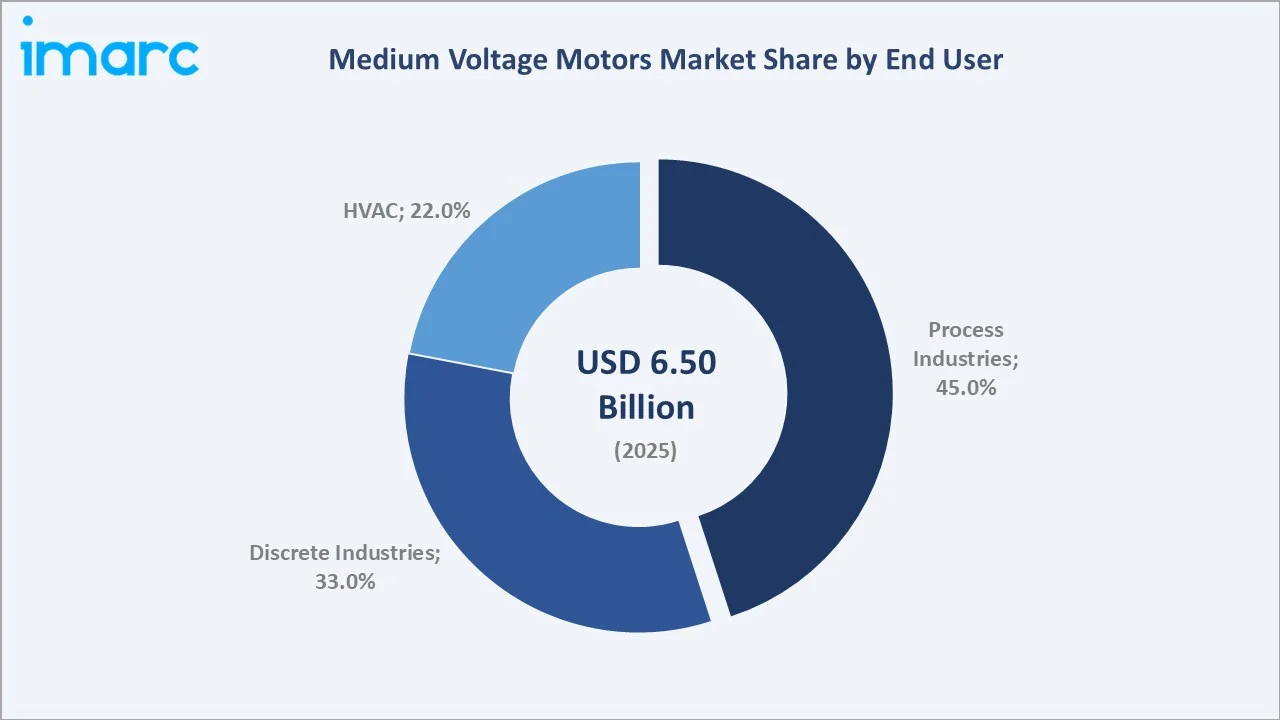
Discrete Industries at 33.0% encompass automotive, metals, and general manufacturing applications using medium voltage motors for machine tools and material-handling systems. HVAC at 22.0% grows fastest at ~7.6% CAGR through rapid commercial and industrial building system installation.
Regional Market Insights
|
Region |
Share (2025) |
Key Medium Voltage Motors Market Drivers & Characteristics |
|
North America |
28.0% |
Driven by early adoption of premium-efficiency motor standards, sustained industrial automation investment, and a mature installed base requiring periodic replacement. |
|
Asia-Pacific |
27.0% |
Driven by rapid industrialization, expanding manufacturing capacity, and government support for energy-efficient industrial equipment. |
|
Europe |
25.0% |
Supported by stringent energy-efficiency regulations, strong process-industry demand, and advanced automation technology adoption. |
|
Latin America |
11.0% |
Supported by growing mining, oil and gas, and water treatment infrastructure investment across the region. |
|
Middle East and Africa |
9.0% |
Driven by expanding oil and gas, petrochemical, and utility infrastructure development in the region. |
North America's 28.0% market leadership is anchored by early regulatory adoption of premium-efficiency motor standards and sustained capital investment across process and discrete manufacturing industries.
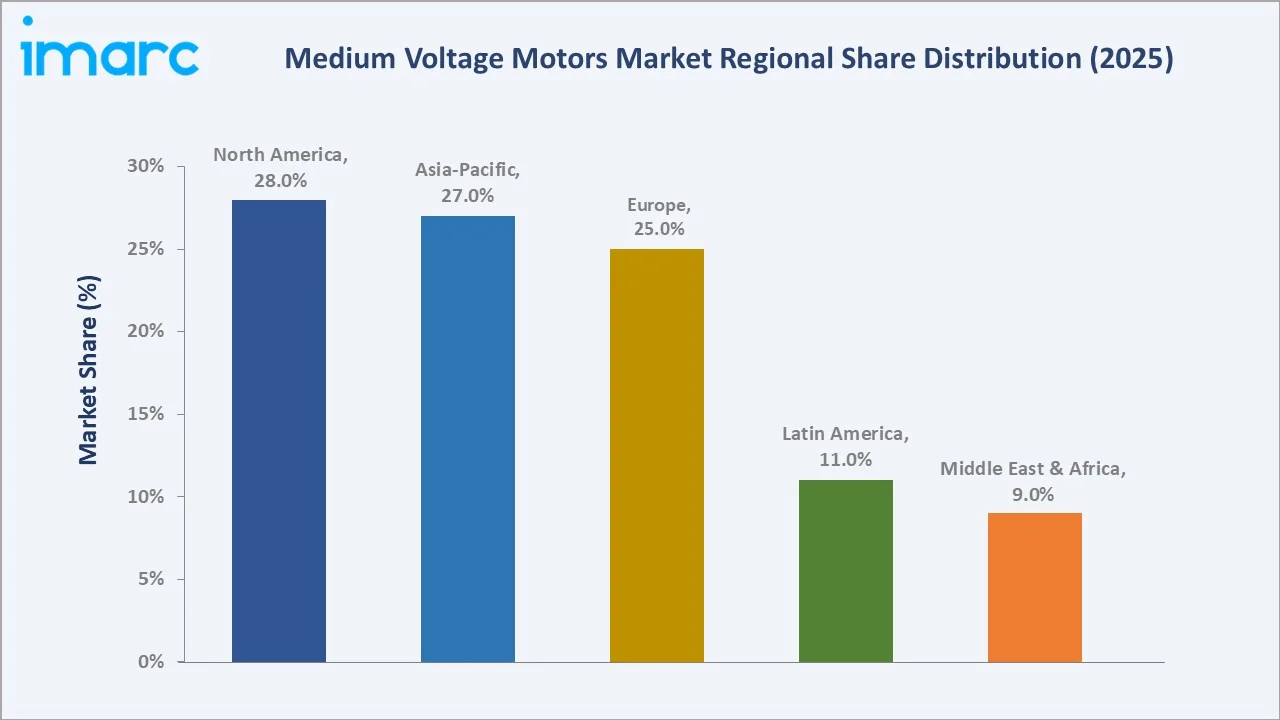
Asia-Pacific's 27.0% reflects rapid industrialization and expanding manufacturing capacity across China, India, and Southeast Asia. The Middle East and Africa, at 9.0%, is the most commercially dynamic growth region by CAGR, supported by expanding energy infrastructure investment.
Competitive Landscape
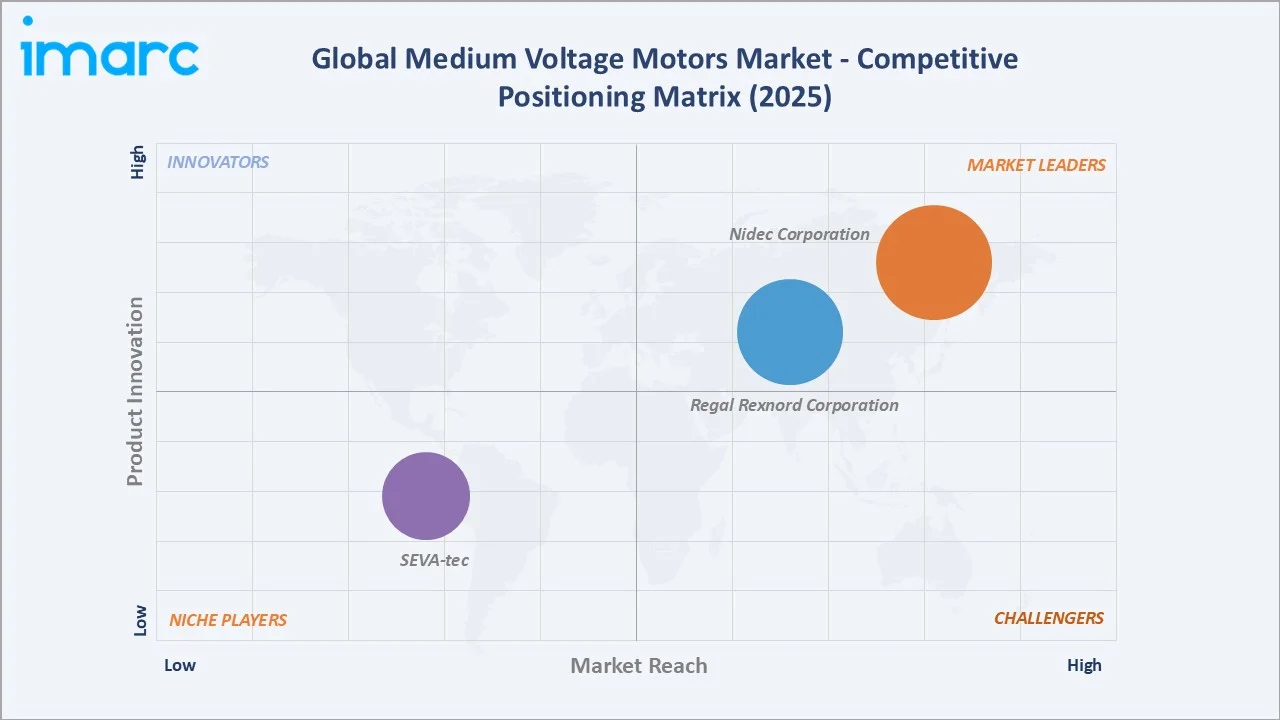
The global medium voltage motors market competitive landscape encompasses distinct tiers: diversified industrial conglomerates, specialized motor manufacturers, and regional automation solution providers.
|
Company Name |
Key Products |
Market Position |
Core Strength |
|
Nidec Corporation |
Medium voltage induction and synchronous motors, drive systems |
Market Leader |
Nidec plays a central role in the market by providing a broad portfolio of high-efficiency motors and integrated drive solutions for industrial applications. |
|
Regal Rexnord Corporation |
Industrial AC and DC motor platforms, power transmission components |
Market Leader |
Regal Rexnord plays a central role by offering reliable, energy-efficient motor systems supported by a global manufacturing and distribution network. |
|
SEVA-tec |
Custom medium and high voltage motors |
Niche Player |
SEVA-tec plays a central role by delivering custom-engineered motor solutions for specialized industrial and marine applications. |
Consolidation reflects industrial customers' preference for integrated motor and automation system suppliers, reducing coordination complexity across large-scale projects. Manufacturing scale and global service networks sustain leading companies' competitive advantage in project-based procurement.
Key Company Profiles
Nidec Corporation
Nidec Corporation is a leading provider of medium voltage motors and integrated drive systems for the global industrial market. The company specializes in high-efficiency motor platforms and connected monitoring solutions.
- Key Products: Medium voltage induction motors, synchronous motors, integrated drive systems.
- Recent Developments: In May 2026, Nidec Motor Corporation announced that it would showcase its expanded portfolio of high-efficiency industrial motors at EASA 2026, including the expansion of its TITAN® motor line for high-power industrial applications such as data centers, water treatment, petrochemical facilities, and commercial infrastructure. The company highlighted new NEMA Premium 4 efficiency motors, additional high-power frame sizes, and inverter-duty motors designed to improve energy efficiency and reliability in demanding industrial environments.
- Strategic Focus: Focused on energy-efficient motor technology, digital condition-monitoring integration, and expanding global manufacturing capacity.
Regal Rexnord Corporation
Regal Rexnord Corporation is a prominent manufacturer of industrial motors and power transmission components, specializing in reliable, efficient solutions for process and discrete manufacturing industries.
- Key Products: Industrial AC and DC motors, power transmission components, drive systems.
- Recent Developments: In July 2025, Regal Rexnord Corporation announced that it would showcase its integrated motion control portfolio at Automation Expo India 2025. The company featured Kollmorgen™ servo motors and drives, Portescap™ precision motors, and Thomson™ linear motion technologies, demonstrating solutions designed to improve performance, energy efficiency, and precision across industrial automation, robotics, and manufacturing applications. Although focused on motion control, the announcement reinforces Regal Rexnord's strategy of expanding its industrial motor technologies and automation offerings for demanding industrial environments.
- Strategic Focus: Centered on manufacturing scale, energy-efficiency innovation, and global distribution network expansion.
Market Concentration Analysis
The global medium voltage motors market is moderately concentrated, with a mix of diversified industrial conglomerates and specialized regional manufacturers competing across project-based procurement cycles. Leading companies collectively hold a meaningful share of large-scale industrial contracts, while numerous regional players serve localized and custom-engineered demand. Market concentration is increasing at the technology and automation-integration tier through strategic partnerships and capacity expansion.
Investment & Growth Opportunities
Highest Growth Segments
DC-Motors (~6.1% CAGR), HVAC end-use applications (~7.6% CAGR), IoT-enabled condition monitoring platforms (~12% CAGR from a growing base), and premium-efficiency IE4/IE5 motor upgrades (~10% CAGR) represent the highest-growth medium voltage motors investment vectors through 2034.
Emerging Investment Opportunities
The Middle East and Africa's expanding energy and utility infrastructure investment represent the most commercially dynamic near-term growth opportunity. Manufacturers and system integrators establishing preferred supplier relationships with regional infrastructure procurement programs are positioned for above-market revenue growth.
Investment Themes
- Connected motor platform development for recurring service revenue: Bundling IoT-enabled monitoring software with motor hardware sales creates a subscription-oriented revenue stream that sustains margins beyond the initial equipment sale.
- Premium-efficiency retrofit program development: Companies investing in structured IE4/IE5 retrofit programs for existing industrial facilities are positioned to capture the multi-year regulatory-driven replacement cycle.
Future Market Outlook (2026-2034)
The global medium voltage motors market is projected to grow from USD 6.50 Billion in 2025 to USD 11.80 Billion by 2034, delivering a 6.84% CAGR over the forecast period. The market's anchor value of USD 9.05 Billion in 2030 represents a medium voltage motors industry in the midst of a structural transition toward connected, premium-efficiency platforms, as IoT-enabled predictive maintenance becomes standard practice and IE4/IE5 efficiency classes achieve mainstream commercial deployment.
Three structural forces define medium voltage motors market growth through 2034 with strong confidence. Energy-efficiency regulation across major industrial economies creates policy-mandated, multi-year replacement demand independent of broader economic conditions. Industrial automation investment continues to expand the addressable base for connected motor and drive systems. Manufacturing cost reduction is making premium-efficiency and IoT-enabled motor technology increasingly accessible to mid-sized industrial operators.
Research Methodology
Primary Research
Primary research comprised structured interviews with industry stakeholders, including plant engineering directors, procurement executives, motor manufacturer product managers, and regional distribution partners.
Secondary Research
Secondary research encompassed industrial motor technology publications, energy-efficiency regulatory filings, company annual reports, and trade association data. Multiple secondary sources were reviewed to validate market estimates.
Forecasting Models
Market revenue forecasts were developed using a segment bottom-up model: (i) product component; (ii) end-user component; (iii) regional component.
Report Coverage:
| Report Features | Details |
|---|---|
| Base Year of the Analysis | 2025 |
| Historical Period | 2020-2025 |
| Forecast Period | 2026-2034 |
| Units | Billion USD |
| Scope of the Report | Exploration of Historical Trends and Market Outlook, Industry Catalysts and Challenges, Segment-Wise Historical and Predictive Market Assessment:
|
| Products Covered | AC-Motors, DC-Motors |
| End Users Covered | Process Industries, Discrete Industries, HVAC |
| Regions Covered | Asia Pacific, Europe, North America, Latin America, Middle East and Africa |
| Countries Covered | United States, Canada, Germany, France, United Kingdom, Italy, Spain, Russia, China, Japan, India, South Korea, Australia, Indonesia, Brazil, Mexico |
| Companies Covered | Nidec Corporation, Regal Rexnord Corporation, SEVA-tec, etc. |
| Customization Scope | 10% Free Customization |
| Post-Sale Analyst Support | 10-12 Weeks |
| Delivery Format | PDF and Excel through Email (We can also provide the editable version of the report in PPT/Word format on special request) |
Key Benefits for Stakeholders:
- IMARC’s report offers a comprehensive quantitative analysis of various market segments, historical and current market trends, market forecasts, and dynamics of the medium voltage motors market from 2020-2034.
- The research study provides the latest information on the market drivers, challenges, and opportunities in the global medium voltage motors market.
- The study maps the leading, as well as the fastest-growing, regional markets. It further enables stakeholders to identify the key country-level markets within each region.
- Porter's five forces analysis assist stakeholders in assessing the impact of new entrants, competitive rivalry, supplier power, buyer power, and the threat of substitution. It helps stakeholders to analyze the level of competition within the medium voltage motors industry and its attractiveness.
- Competitive landscape allows stakeholders to understand their competitive environment and provides an insight into the current positions of key players in the market.
Frequently Asked Questions About the Medium Voltage Motors Market Report
The global medium voltage motors market reached USD 6.50 Billion in 2025. The market is driven by rising demand for energy-efficient motors, widespread HVAC system installation, and growing adoption of IoT-enabled condition-monitoring technologies.
The market grows at a 6.84% CAGR during 2026-2034, reaching USD 11.80 Billion by 2034. DC-Motors grow fastest at ~6.1% CAGR through expanding precision process-automation demand.
AC-Motors lead at 62.0% through cost-efficiency, lower maintenance requirements, and direct compatibility with industrial power systems.
Process Industries lead at 45.0% through continuous-duty applications in pumps, compressors, and conveyors across oil and gas, chemicals, and water treatment.
North America leads at 28.0% through early adoption of premium-efficiency motor standards and sustained industrial automation investment.
Leading companies include Nidec Corporation, Regal Rexnord Corporation, and SEVA-tec GmbH, among others.
The market is projected to reach approximately USD 9.05 Billion by 2030, with IoT-enabled condition monitoring and premium-efficiency motor adoption continuing to scale across major industrial economies.
IoT technology enables real-time monitoring of temperature, vibration, current, and speed, improving motor performance, reliability, and maintenance planning, which is encouraging operators to adopt connected motor platforms across process and discrete industries.
Need more help?
- Speak to our experienced analysts for insights on the current market scenarios.
- Include additional segments and countries to customize the report as per your requirement.
- Gain an unparalleled competitive advantage in your domain by understanding how to utilize the report and positively impacting your operations and revenue.
- For further assistance, please connect with our analysts.
 Request Customization
 Speak to an Analyst
 Request Brochure
 Inquire Before Buying
Benefits of Customization
- Personalize this research
- Triangulate with your data
- Get data as per your format and definition
- Gain a deeper dive into a specific application, geography, customer, or competitor
- Any level of personalization
Get in Touch With Us
UNITED STATES
Phone: +1-201-971-6302
INDIA
Phone: +91-120-433-0800
UNITED KINGDOM
Phone: +44-753-714-6104
Email: [email protected]
Client Testimonials




.webp)




.webp)













Related Reports

Choose your plan
*Please note that the prices mentioned below are starting prices for each bundle type. Kindly contact our team for further details.*
Single User License
- 1 User License, Access on 2 Devices
- PDF Report + Excel Dataset (Password Protected)
- Lifetime Access
- No Printing Rights
- 10% Free Report Customization
- 10–12 Weeks of Analyst Support
Five User License
- Access for 5 Users, 2 Devices per User
- PDF Report + Excel Dataset (Password Protected)
- Lifetime Access
- Dedicated Account Manager
- 12–14 Weeks of Analyst Support
- No Printing Rights
- 15% Free Report Customization
- 25% Discount on Your Next Purchase
Corporate User License
- Unlimited User Access (Within Your Organization)
- PDF Report + Excel Dataset
- Lifetime Access
- Dedicated Account Manager
- 14–20 Weeks of Analyst Support
- No Printing Rights
- 20% Free Report Customization
- 30% Discount on Your Next Purchase
Essential Insights
What's included:
3 reports
- Lifetime Access
- PDF Reports
- Excel Datasets
- 2 Weeks of Free Analyst Support
- 2 User Licenses
- Access on 2 Devices
- Printing Rights
- Complimentary PowerPoint (PPT) Version
- Complimentary License Upgrade
Professional Access
What's included:
5 reports
- Lifetime Access
- PDF Reports
- Excel Datasets
- 8 Weeks of Free Analyst Support
- 2 User Licenses
- Access on 2 Devices
- Printing Rights
- Complimentary PowerPoint (PPT) Version
- Complimentary License Upgrade
Business Advantage
What's included:
8 reports
- Lifetime Access
- PDF Reports
- Excel Datasets
- 14 Weeks of Free Analyst Support
- 2 User Licenses
- Access on 2 Devices
- Printing Rights
- Complimentary PowerPoint (PPT) Version
- Complimentary License Upgrade
Enterprise Intelligence
What's included:
10 reports
- Lifetime Access
- PDF Reports
- Excel Datasets
- 20 Weeks of Free Analyst Support
- 2 User Licenses
- Access on 2 Devices
- Printing Rights
- Complimentary PowerPoint (PPT) Version
- Complimentary License Upgrade