
Mexico Bicycle Market Size, Share, Trends and Forecast by Type, Technology, Price, Distribution Channel, End User, and Region, 2026-2034
Mexico Bicycle Market Size, Share, Trends & Forecast (2026-2034)
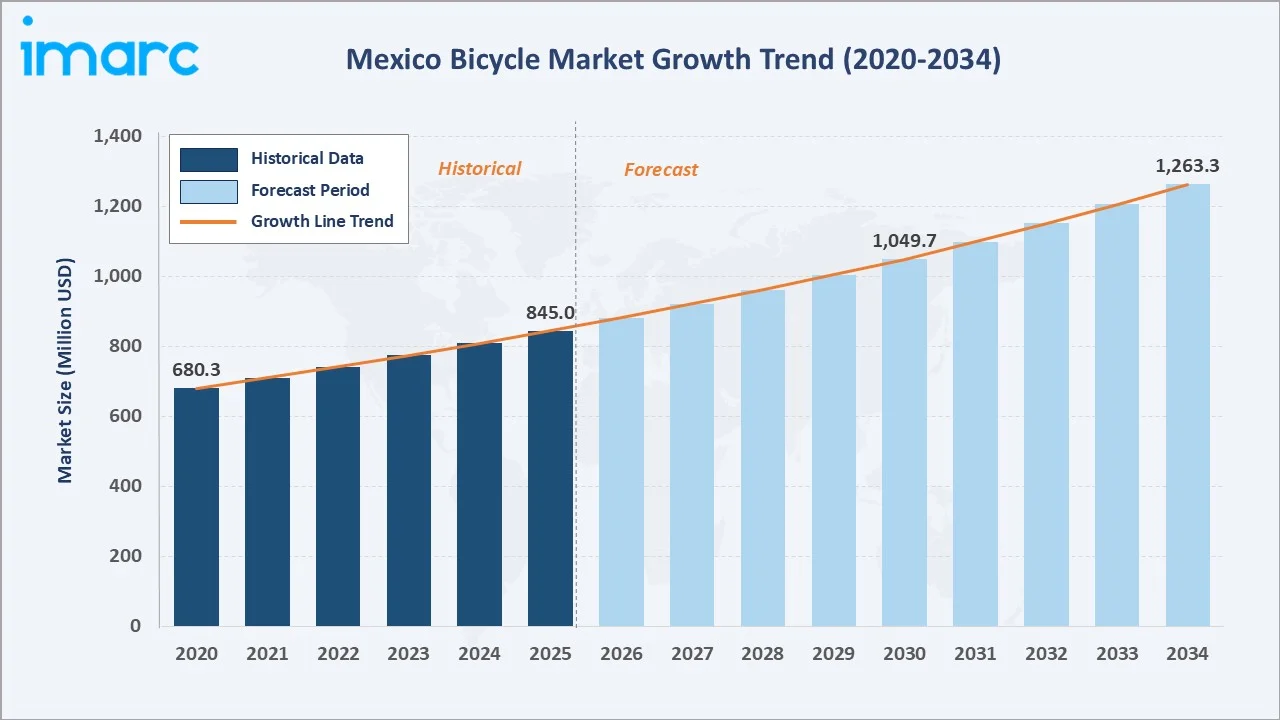
The Mexico bicycle market reached USD 845.0 Million in 2025 and is projected to reach USD 1,263.3 Million by 2034, growing at a CAGR of 4.43% during 2026-2034. Growth is driven by rising urbanization, worsening urban traffic congestion, and expanding bike-sharing programmes.
Increasing health consciousness and government-backed cycling infrastructure investments further support demand. Mountain bicycles lead the type segment at 41.8% in 2025, while conventional bicycles dominate the technology segment at 82.4%. Central Mexico commands the largest regional share at 42.1%.
Market Snapshot
|
Metric |
Value |
|
Market Size (2025) |
USD 845.0 Million |
|
Forecast Market Size (2034) |
USD 1,263.3 Million |
|
CAGR (2026-2034) |
4.43% |
|
Base Year |
2025 |
|
Historical Period |
2020-2025 |
|
Forecast Period |
2026-2034 |
|
Dominant Type |
Mountain Bicycle (41.8%, 2025) |
|
Dominant Technology |
Conventional (82.4%, 2025) |
|
Leading Region |
Central Mexico (42.1%, 2025) |
The market expanded from an estimated USD 680.3 Million in 2020 to USD 845.0 Million in 2025, supported by steady urban commuting demand despite pandemic-related disruptions in the early historical period. It is anchored at USD 1,049.7 Million in 2030 and forecast to reach USD 1,263.3 Million by 2034 on sustained infrastructure investment and rising consumer adoption.
To get more information on this market, Request Sample
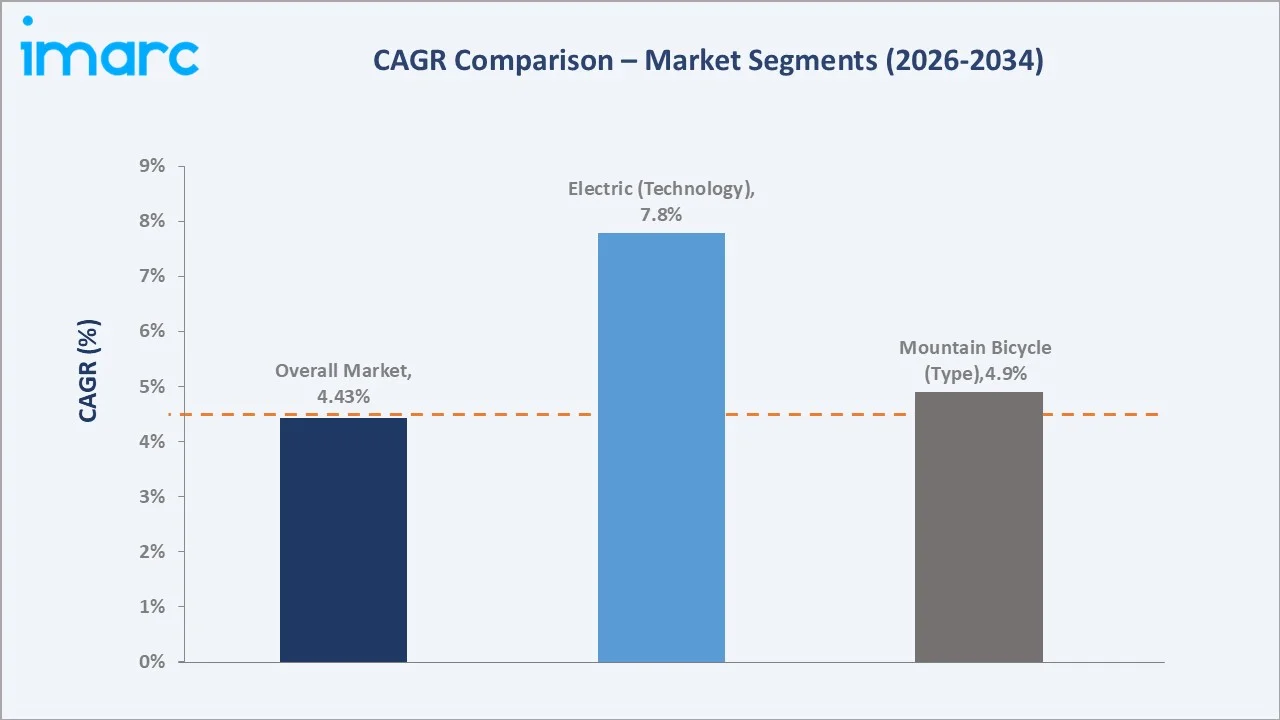
Mountain bicycles, the leading type segment, are estimated to grow at approximately 4.9% CAGR through 2034 on rising outdoor recreation demand. Electric bicycles grow fastest among technology types at nearly 7.8% CAGR as urban commuters and delivery riders increasingly adopt electric-assist models over conventional alternatives for longer commuting distances.
Executive Summary
The Mexico bicycle market reached USD 845.0 Million in 2025, reflecting steady demand across urban and recreational cycling segments. The market is projected to reach USD 1,263.3 Million by 2034, growing at a CAGR of 4.43%, driven by urbanization, health awareness, and bike-sharing expansion. This report presents a comprehensive assessment of demand drivers, segmentation, regional dynamics, and the competitive landscape shaping the market through the forecast period.
Mountain bicycles lead the type segment at 41.8%, reflecting strong demand for recreational and off-road riding. Conventional bicycles dominate technology at 82.4%, though electric bicycles are gaining share rapidly. Central Mexico leads regionally at 42.1%, anchored by Mexico City's dense population and commuting needs.
Key Market Insights
|
Insight |
Data |
|
Dominant Type |
Mountain Bicycle - 41.8% share (2025) |
|
Dominant Technology |
Conventional - 82.4% share (2025) |
|
Leading Region |
Central Mexico - 42.1% share (2025) |
|
Market Opportunity |
Electric bicycle adoption; bike-sharing fleet expansion; last-mile delivery bicycles |
Key Analytical Observations Supporting The Above Data:
- Mountain Bicycle at 41.8%: Rugged terrain riding, recreational cycling clubs, and rising outdoor tourism sustain strong demand for mountain bicycles among urban and semi-urban consumers nationwide, particularly in regions with varied topography suited to off-road trails.
- Conventional at 82.4%: Lower upfront cost and minimal maintenance make conventional bicycles the preferred choice for daily commuting and recreational use across most income groups in Mexico, particularly outside the largest metropolitan retail markets.
- Central Mexico at 42.1%: Dense urban population, worsening traffic congestion, and established bike-sharing infrastructure in Mexico City anchor Central Mexico's leading regional market position, supported by continued government investment in cycling infrastructure.
Mexico Bicycle Market Overview
The Mexico bicycle market encompasses the manufacturing, distribution, and retail of road, mountain, hybrid, and electric bicycles across commuting, recreational, and fitness use cases. It integrates frame and component manufacturers, assembly plants, and retail and online sales channels serving both domestic consumers and export markets across the Americas.
Government-backed infrastructure programmes, bike-sharing systems like Mexico City's Ecobici, and rising health consciousness are reshaping consumer behaviour. Urban traffic congestion, fuel costs, and environmental concerns are increasingly favouring bicycles as a practical mobility alternative.
The market spans a broad range of consumer segments, from budget-conscious daily commuters to recreational and competitive cyclists seeking premium equipment. This diversity is encouraging manufacturers to maintain wide product portfolios spanning entry-level, mid-range, and premium price tiers, supported by increasingly sophisticated retail financing options.
Market Dynamics
To evaluate market opportunities, Request Sample
Market Drivers
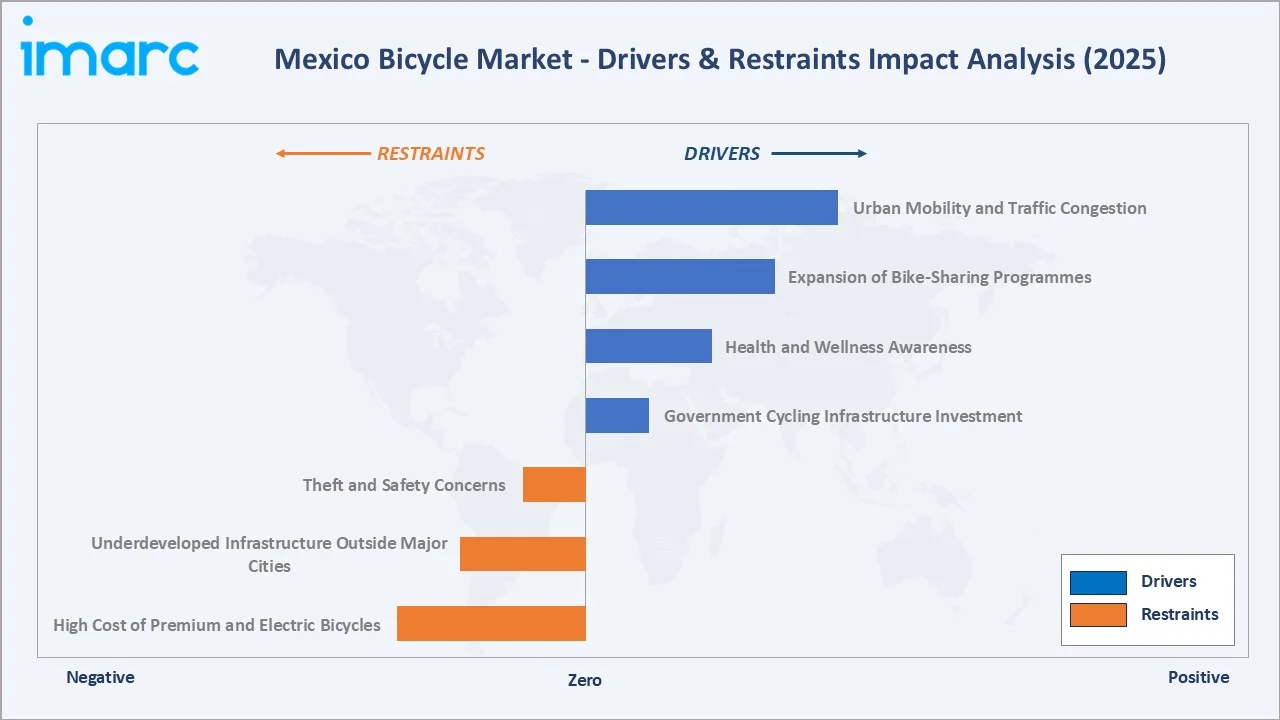
- Urban Mobility and Traffic Congestion: Worsening traffic congestion in Mexico City, Guadalajara, and Monterrey is pushing commuters toward bicycles as a faster, low-cost alternative. Expanding protected bike lanes and cyclist-friendly municipal policies are reducing travel time uncertainty for daily riders. As metropolitan populations grow and road networks reach capacity, bicycles are increasingly viewed as a practical first- and last-mile solution complementing public transit systems.
- Expansion of Bike-Sharing Programmes: Systems like Ecobici are expanding bicycle accessibility through affordable, app-based rentals. In 2024, Ecobici users completed over 22 million trips, an 83% increase over 2023. Municipal authorities are replicating this model in secondary cities, introducing new riders to cycling without requiring upfront ownership, gradually converting habitual renters into personal bicycle buyers.
- Health and Wellness Awareness: Growing consumer focus on physical fitness and cardiovascular health is driving cycling adoption as a daily exercise routine. Post-pandemic preference for outdoor, socially distanced activity over crowded gyms continues to support sustained bicycle purchase demand. Employers and community groups are also organizing group rides and cycling challenges, further normalizing cycling as a wellness habit.
- Government Cycling Infrastructure Investment: Municipal governments are expanding protected bike lanes, secure parking stations, and multimodal integration allowing bicycles on metros and buses. These infrastructure investments are lowering barriers to daily cycling and expanding the addressable consumer base. Federal urban mobility guidelines are also encouraging state governments to allocate dedicated cycling infrastructure budgets through 2034.
Market Restraints
- High Cost of Premium and Electric Bicycles: Premium mountain, road, and electric bicycles carry high upfront costs relative to average incomes, restricting the electric technology segment's penetration beyond urban middle- and upper-income households. Financing options remain limited outside major retail chains and import duties on certain components keep landed costs elevated for higher-specification models.
- Underdeveloped Infrastructure Outside Major Cities: Cycling infrastructure remains concentrated in major metropolitan areas, with limited bike lanes and parking facilities in smaller cities and rural regions. This constrains bicycle adoption and safety perceptions outside Mexico's primary urban centres, where riders must share narrow roads with motor vehicle traffic and inconsistent enforcement of cyclist right-of-way rules.
- Theft and Safety Concerns: Bicycle theft and road safety risks from motor vehicle traffic discourage some consumers from cycling or investing in higher-value bicycles, particularly in areas lacking secure parking infrastructure. Limited insurance product availability for bicycles also raises the effective cost of ownership, discouraging some prospective buyers from upgrading to premium models.
Market Opportunities
- Electric Bicycle Penetration Growth: Rising fuel costs and growing acceptance of electric-assist mobility create significant headroom for electric bicycle adoption. Manufacturers introducing lower-cost entry-level electric models could accelerate mainstream adoption among price-sensitive urban commuters as battery costs continue to decline over the coming years.
- Last-Mile Delivery Fleet Expansion: Growing e-commerce and food delivery services are creating fleet procurement opportunities for durable, cost-efficient bicycles, opening a commercial demand channel beyond individual consumer purchases. Delivery platform operators are increasingly standardizing fleet specifications, creating recurring replacement and maintenance revenue streams for manufacturers and retailers alike.
Market Challenges
- Price Competition from Imported Bicycles: Low-cost bicycle imports create pricing pressure on domestic manufacturers, requiring continuous investment in production efficiency and product differentiation to defend margins and market share. Smaller domestic assemblers face difficulty competing on price against large-scale Asian manufacturing operations with lower per-unit costs.
- Component Supply Chain Dependence: Reliance on imported components, including drivetrains and electric motor systems, exposes manufacturers to currency fluctuations and global supply disruptions that can affect production costs and delivery timelines. Building resilient domestic component supply chains remains a multi-year undertaking requiring sustained capital investment and technical expertise.
Emerging Market Trends
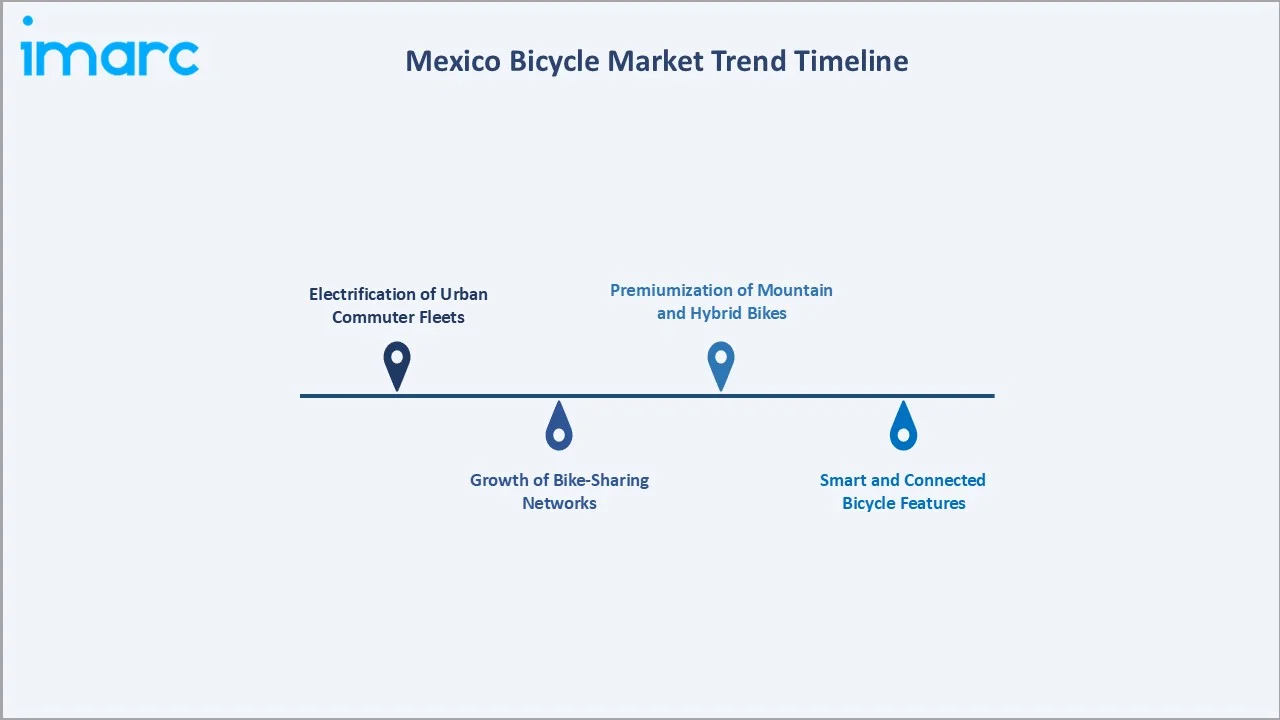
1. Electrification of Urban Commuter Fleets
Rising adoption of electric-assist bicycles among urban commuters is reshaping product portfolios. Manufacturers are introducing mid-drive and hub-motor electric models tailored to Mexico's commuting distances, positioning electric technology for continued share gains. Retailers are also expanding financing and trial programmes to lower the adoption barrier for first-time electric bicycle buyers.
2. Growth of Bike-Sharing Networks
Expansion of bike-sharing systems beyond Mexico City into Puebla, León, and other metropolitan areas is normalizing cycling as a daily transportation habit, supporting both shared-fleet procurement and personal bicycle ownership. Municipal partnerships with private operators are accelerating station density and expanding coverage into secondary neighbourhoods.
3. Smart and Connected Bicycle Features
Integration of GPS tracking, anti-theft connectivity, and app-based ride tracking is emerging as a differentiator, particularly for premium and electric bicycle models targeting security-conscious urban consumers. These features also enable usage analytics that manufacturers and fleet operators use to optimize maintenance scheduling and product design.
4. Premiumization of Mountain and Hybrid Bikes
Rising disposable incomes and outdoor recreation interest are driving demand for higher-specification mountain and hybrid bicycles with advanced suspension, lightweight frames, and multi-terrain versatility. Specialty retailers are expanding premium product lines and after-sales customization services to capture this growing consumer segment.
Industry Value Chain Analysis
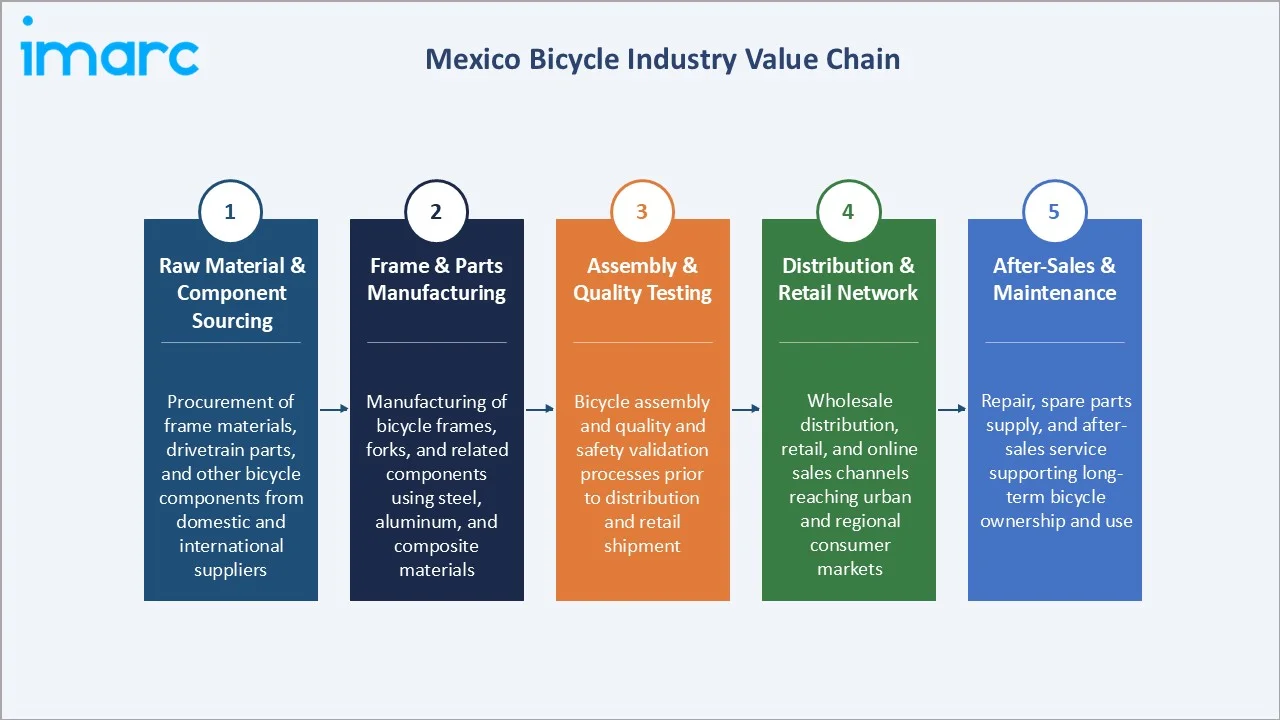
The Mexico bicycle value chain integrates raw material and component sourcing, frame and parts manufacturing, assembly and quality testing, distribution and retail networks, and after-sales maintenance services across domestic and export-oriented producers. Integration across these stages varies by manufacturer scale, with larger domestic producers controlling more of the chain in-house.
|
Stage |
Key Participants |
|
Raw Material & Component Sourcing |
Procurement of frame materials, drivetrain parts, and other bicycle components from domestic and international suppliers |
|
Frame & Parts Manufacturing |
Manufacturing of bicycle frames, forks, and related components using steel, aluminum, and composite materials |
|
Assembly & Quality Testing |
Bicycle assembly and quality and safety validation processes prior to distribution and retail shipment |
|
Distribution & Retail Network |
Wholesale distribution, retail, and online sales channels reaching urban and regional consumer markets |
|
After-Sales & Maintenance |
Repair, spare parts supply, and after-sales service supporting long-term bicycle ownership and use |
The frame and parts manufacturing stage is the value chain's most commercially significant tier, anchored by established domestic producers. Distribution is shifting toward omnichannel models as online stores complement traditional offline retail. Manufacturers are also strengthening after-sales service networks to improve customer retention and support higher-value product sales.
Technology Landscape in the Mexico Bicycle Industry
Conventional Drivetrain Technology
Conventional mechanical drivetrain technology remains the market standard, offering low cost, minimal maintenance, and broad service availability. Its simplicity and affordability make it the preferred choice for daily commuting, recreational riding, and entry-level bicycles across most Mexican consumer segments. Widespread mechanic availability nationwide further reinforces its dominant position.
Electric-Assist (Pedelec) Technology
Electric-assist technology, using hub or mid-drive motors paired with lithium-ion batteries, is gaining traction among urban commuters seeking longer range and reduced physical effort. Declining battery costs and expanding charging accessibility are gradually improving the value proposition of electric-assist bicycles relative to conventional models, particularly for longer commuting distances.
Smart and Connected Bicycle Technology
Integration of GPS tracking, app-based ride analytics, and anti-theft connectivity is emerging across premium and electric bicycle models. These features enhance rider security and usage tracking, supporting differentiation for manufacturers targeting security-conscious and tech-savvy urban consumers seeking greater confidence in higher-value bicycle purchases.
Market Segmentation Analysis
The report covers the following segments:
|
Segment Category |
Leading Segment |
Market Share |
Year |
|
Type |
Mountain Bicycle |
41.8% |
2025 |
|
Technology |
Conventional |
82.4% |
2025 |
|
Price |
🔒 |
🔒 |
2025 |
|
Distribution Channel |
🔒 |
🔒 |
2025 |
|
End User |
🔒 |
🔒 |
2025 |
|
Region |
Central Mexico |
42.1% |
2025 |

By Type
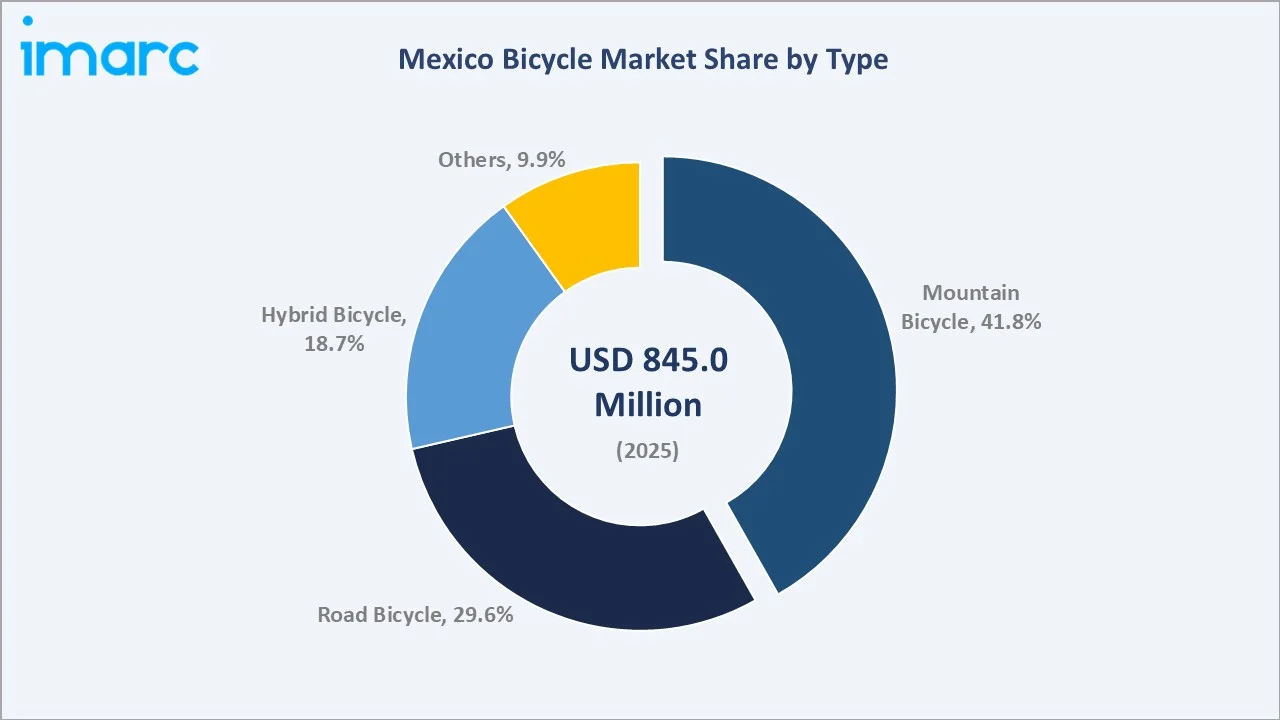
Mountain bicycles lead the type segment at 41.8% in 2025, reflecting Mexico's strong outdoor recreation culture and varied terrain suited to off-road riding. Their versatility for recreational and daily commuting use supports sustained demand across both established and emerging urban markets nationwide.
To access detailed market analysis, Request Sample
Road bicycles hold 29.6% share, driven by competitive cycling culture and fitness-focused consumers who prioritize lightweight frames and speed. Hybrid bicycles account for 18.7%, appealing to commuters seeking versatility between road and off-road use. Others, including BMX and children's bicycles, represent the remaining 9.9%.
By Technology
Conventional bicycles dominate the technology segment at 82.4% in 2025, reflecting lower upfront cost and minimal maintenance requirements. They remain the preferred choice for daily commuting and recreational riding across most income groups, particularly outside major metropolitan retail centres.
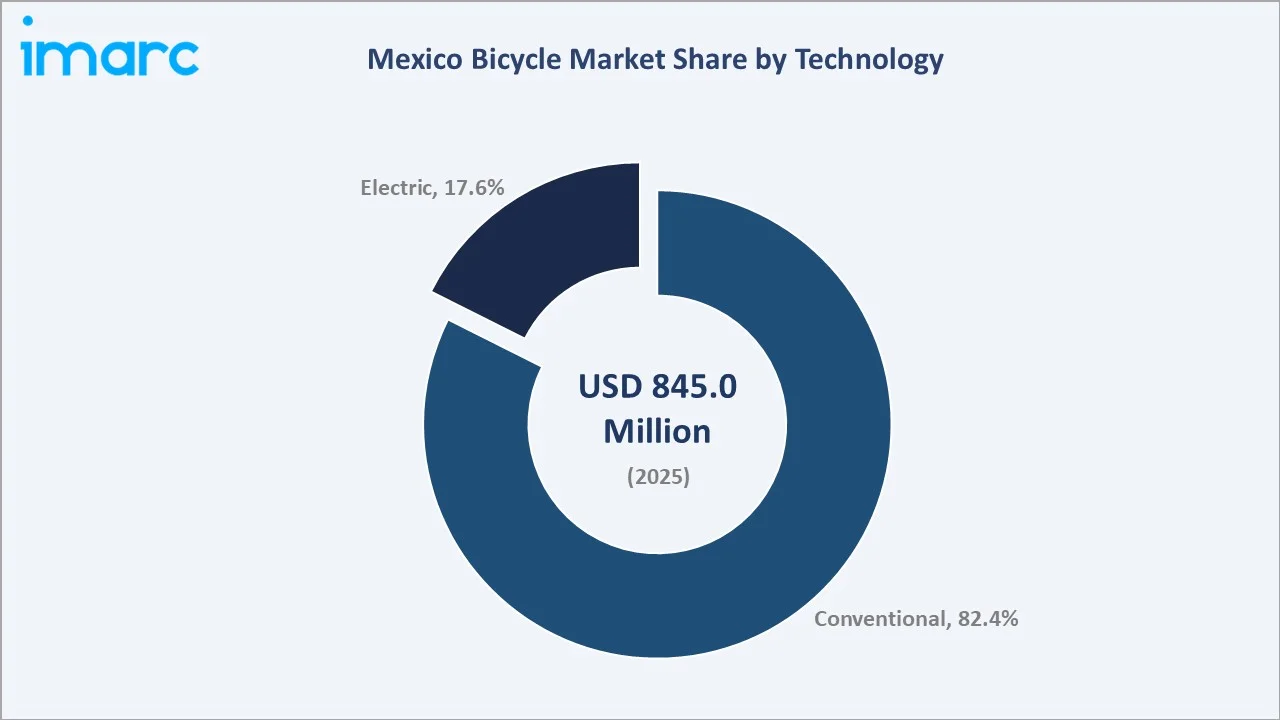
Electric bicycles account for 17.6% of the segment but are growing fastest, at nearly 7.8% CAGR, as urban commuters and delivery riders increasingly adopt electric-assist models for longer distances and reduced physical effort. Declining battery costs are expected to narrow the price gap with conventional models over time.
Regional Market Insights
Regional demand patterns across Mexico reflect differences in urbanization, disposable income, and cycling infrastructure maturity, with Central Mexico's metropolitan density anchoring the largest share of national bicycle demand.
|
Region |
Share (2025) |
Key Market Drivers & Characteristics |
|
Central Mexico |
42.1% |
Driven by dense urban population, established bike-sharing infrastructure, and strong government investment |
|
Northern Mexico |
31.4% |
Driven by growing urban centres, rising disposable incomes, and expanding cycling adoption |
|
Southern Mexico |
19.2% |
Emerging market supported by tourism-driven recreational riding and gradual infrastructure development |
|
Others |
7.3% |
Smaller regional markets with early-stage infrastructure and growing consumer awareness |
Central Mexico, at 42.1%, leads through Mexico City's dense population, established Ecobici bike-sharing network, and sustained government investment in protected bike lanes. Northern Mexico, at 31.4%, reflects Monterrey's growing urban cycling culture and rising middle-class disposable incomes supporting bicycle purchases.
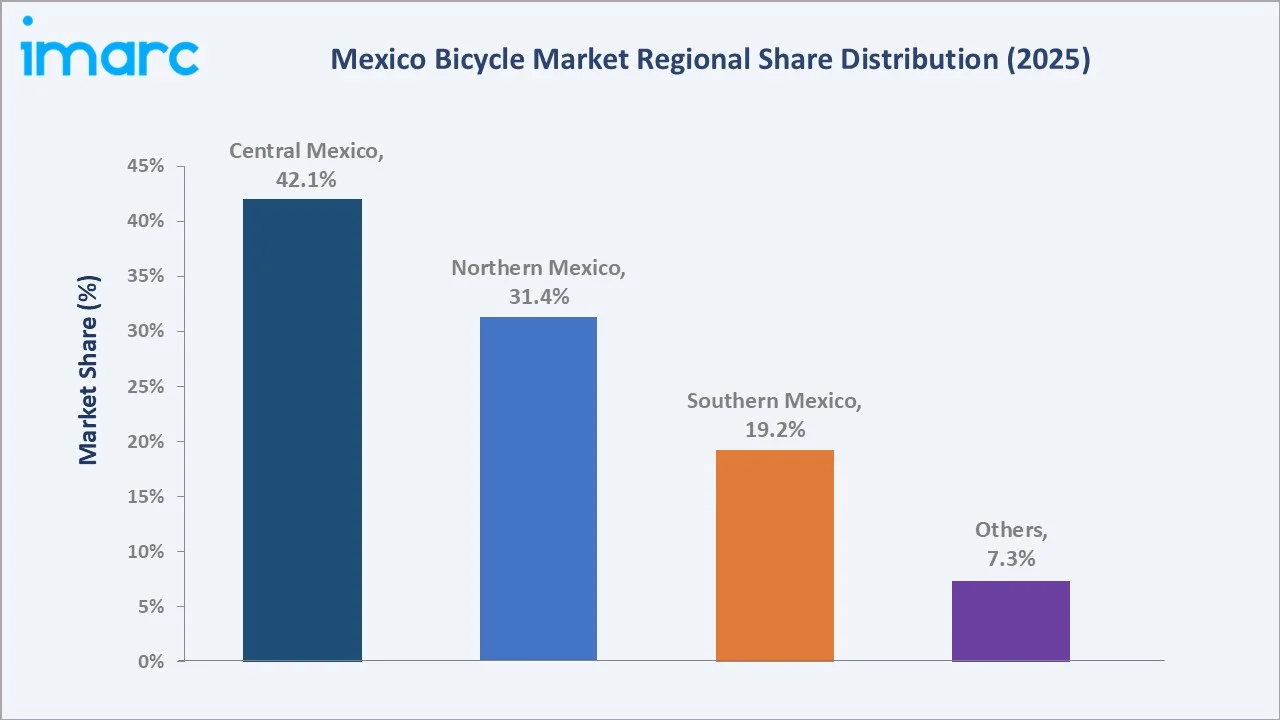
Southern Mexico, at 19.2%, is an emerging market supported by tourism-driven recreational cycling and gradual infrastructure development. Others, at 7.3%, represent smaller regional markets growing steadily alongside rising urban development and increasing consumer exposure to cycling as a mobility option.
Competitive Landscape
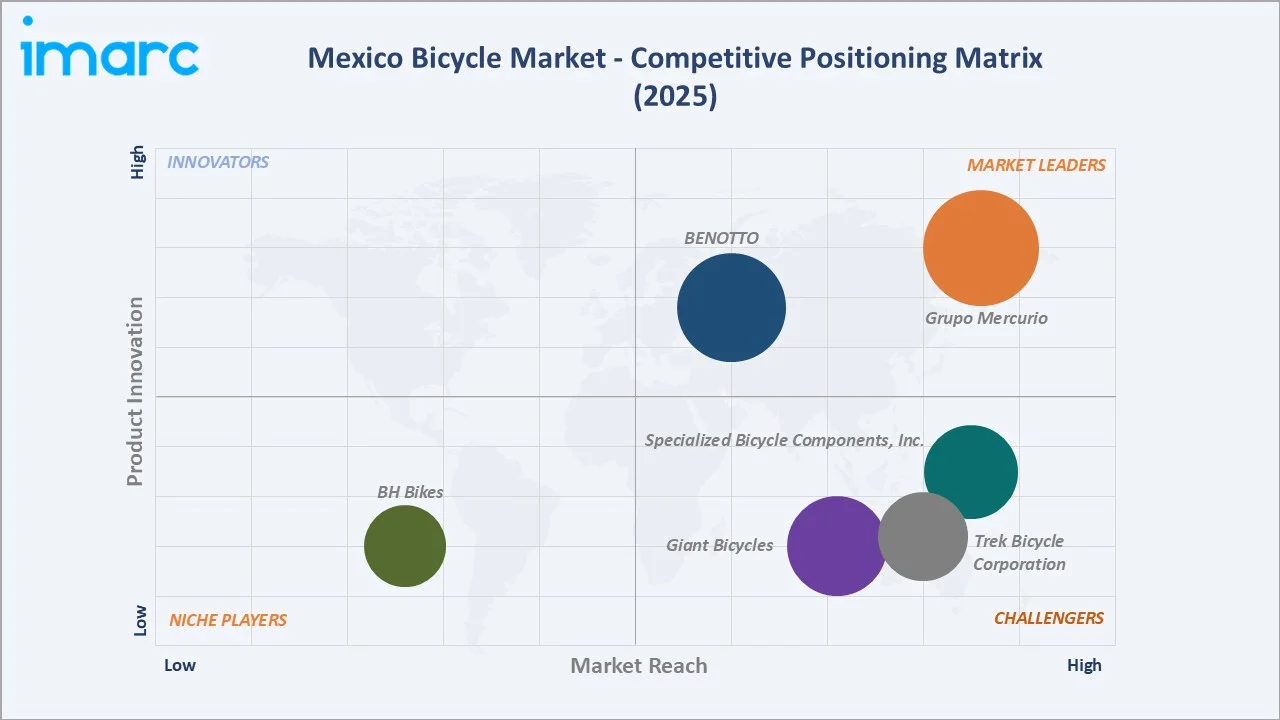
The Mexico bicycle market competitive landscape is moderately fragmented, featuring established domestic manufacturers alongside global bicycle brands. Domestic producers leverage local manufacturing scale and nationwide distribution reach, while international brands compete primarily through premium product positioning, technology-driven differentiation, and expanding authorized dealer and online retail networks.
|
Company Name |
Key Products |
Market Position |
Core Strength |
|
Grupo Mercurio |
BMX F4 MAGNUM R20, BMX HARLEM 20, SUPER BRONCCO R20, SEVEN R24, DS ZTX 24, KAIZER R26, RANGER 29, COMFORT COUNTRY R24 |
Market Leader |
Mexico's largest domestic bicycle manufacturer with extensive nationwide distribution |
|
BENOTTO |
City Bicycles, Electric Bicycles, Children's Bicycles, Mountain Bicycles, Route Bicycles |
Market Leader |
Long-established Mexican brand with strong retail presence and growing electric lineup |
|
Giant Bicycles |
Electric Bikes, Road Bikes, Mountain Bikes, Cyclocross and Gravel Bikes, Urban Bikes, Bikes for children |
Strong Challenger |
Global manufacturer with extensive product range and dealer network in Mexico |
|
Trek Bicycle Corporation |
Road, mountain, and hybrid bicycle lines |
Strong Challenger |
International brand offering premium bicycles through authorized dealers and online channels |
|
Specialized Bicycle Components, Inc. |
Electric bicycles, MTB Bikes, Road Bikes, Gravel Bikes, City Bikes |
Strong Challenger |
Premium global brand with active online sales channel and authorized distributors |
|
BH Bikes |
Road, mountain bicycles, electric bicycles, Hybrid and city bicycles |
Niche Player |
Spanish manufacturer with established presence across specialty bicycle retail |
Key players include Grupo Mercurio, BENOTTO, Giant Bicycles, Trek Bicycle Corporation, Specialized Bicycle Components, Inc., BH Bikes, and others.
Key Company Profiles
BENOTTO
BENOTTO is a long-established Mexican bicycle brand with strong nationwide retail presence and a growing focus on electric-assist commuter and trail bicycles. The brand consistently ranks among the most recognized and preferred bicycle names among Mexican consumers.
- Key Products: City Bicycles, Electric Bicycles, Children's Bicycles, Mountain Bicycles, Route Bicycles, and others
- Strategic Focus: Strengthening battery and charger safety documentation at point of sale to build fleet buyer confidence and reduce product returns.
Specialized Bicycle Components, Inc.
Specialized Bicycle Components is a globally recognized premium bicycle brand offering a diverse electric and conventional bicycle range through authorized Mexican distributors and online channels. Its product strategy spans high-performance road and mountain bicycles alongside urban commuter-focused electric models.
- Key Products: Electric bicycles, MTB Bikes, Road Bikes, Gravel Bikes, City Bikes
- Strategic Focus: Growing premium and electric bicycle penetration in Mexico through digital sales channels and authorized distributor partnerships.
Market Concentration Analysis
The Mexico bicycle market is moderately concentrated, with the top two key players collectively accounting for a substantial share of domestic production. Global brands compete primarily in premium and electric segments. Market concentration is expected to gradually ease as niche and regional players expand distribution reach through online retail channels, supported by lower barriers to digital market entry.
Investment & Growth Opportunities
Highest Growth Segments
Electric bicycles (~7.8% CAGR), mountain bicycles (~4.9% CAGR), and last-mile delivery fleet procurement represent the highest-growth investment vectors through 2034, driven by urban electrification and expanding commercial delivery demand. Premium hybrid bicycles are also gaining investor interest as a mid-tier growth category.
Emerging Investment Opportunities
Bike-sharing fleet expansion beyond Mexico City represents a significant emerging opportunity, as municipal governments in Puebla and León pursue shared mobility programmes, creating fleet procurement demand for durable bicycles. Component localization investment also presents a longer-term opportunity as manufacturers pursue USMCA-aligned supply chains.
Investment Themes
- Domestic Component Manufacturing Investment: Building domestic drivetrain and electric motor component supply capacity can reduce import dependence, support USMCA compliance, and create a structural cost advantage for manufacturers targeting both Mexican and export markets.
- Electric Bicycle Distribution Network Expansion: Investment in specialty retail and service infrastructure for electric bicycles can capture rising urban commuter demand, positioning early movers to build brand loyalty as the technology segment's share continues expanding.
- Bike-Sharing Fleet Procurement Partnerships: Long-term supply agreements with municipal bike-sharing operators can provide manufacturers with stable, recurring order volumes while building brand visibility among new and first-time cyclists.
Future Market Outlook (2026-2034)
The Mexico bicycle market is projected to grow from USD 845.0 Million in 2025 to USD 1,263.3 Million by 2034, delivering a 4.43% CAGR. Electric bicycle adoption, bike-sharing expansion, and government infrastructure investment will anchor sustained growth across both established and emerging regional markets.
Urbanization and worsening traffic congestion will continue driving structural demand for bicycles as a practical mobility alternative. Premiumization of mountain and hybrid bicycles, combined with growing electric-assist adoption, will shape product portfolios through 2034. Manufacturers that invest early in domestic supply chains and omnichannel distribution are best positioned to capture this sustained growth.
Research Methodology
Primary Research
Primary research comprised structured interviews with industry stakeholders, including bicycle manufacturers, distributors, retailers, bike-sharing programme operators, and cycling infrastructure policy experts across Mexico's major metropolitan markets. These interviews validated demand trends and competitive positioning across the type and technology segments.
Secondary Research
Secondary research encompassed company reports, government transportation and infrastructure data, industry association publications, bike-sharing programme statistics, and international bicycle trade and manufacturing data sources. Data points were cross-verified across multiple sources to ensure consistency and accuracy.
Forecasting Models
Market revenue forecasts were developed using a bottom-up model incorporating bicycle production and sales volumes by type and technology, average unit pricing, and regional demand patterns across the historical and forecast periods. Sensitivity checks were applied against macroeconomic and infrastructure investment assumptions.
Mexico Bicycle Market Report Coverage:
| Report Features | Details |
|---|---|
| Base Year of the Analysis | 2025 |
| Historical Period | 2020-2025 |
| Forecast Period | 2026-2034 |
| Units | Million USD |
| Scope of the Report |
Exploration of Historical Trends and Market Outlook, Industry Catalysts and Challenges, Segment-Wise Historical and Future Market Assessment:
|
| Types Covered | Road Bicycle, Mountain Bicycle, Hybrid Bicycle, Others |
| Technologies Covered | Electric, Conventional |
| Prices Covered | Premium, Mid-Range, Low-Range |
| Distribution Channels Covered | Online Stores, Offline Stores |
| End Users Covered | Men, Women, Kids |
| Regions Covered | Northern Mexico, Central Mexico, Southern Mexico, Others |
| Companies Covered | Grupo Mercurio, BENOTTO, Giant Bicycles, Trek Bicycle Corporation, Specialized Bicycle Components Inc., BH Bikes, etc. |
| Customization Scope | 10% Free Customization |
| Post-Sale Analyst Support | 10-12 Weeks |
| Delivery Format | PDF and Excel through Email (We can also provide the editable version of the report in PPT/Word format on special request) |
Key Benefits for Stakeholders:
- IMARC’s industry report offers a comprehensive quantitative analysis of various market segments, historical and current market trends, market forecasts, and dynamics of the Mexico bicycle market from 2020-2034.
- The research report provides the latest information on the market drivers, challenges, and opportunities in the Mexico bicycle market.
- Porter's five forces analysis assist stakeholders in assessing the impact of new entrants, competitive rivalry, supplier power, buyer power, and the threat of substitution. It helps stakeholders to analyze the level of competition within the Mexico bicycle industry and its attractiveness.
- Competitive landscape allows stakeholders to understand their competitive environment and provides an insight into the current positions of key players in the market.
Frequently Asked Questions About the Mexico Bicycle Market Report
The Mexico bicycle market reached USD 845.0 Million in 2025, driven by mountain bicycles leading the type segment at 41.8%, conventional bicycles dominating technology at 82.4%, and Central Mexico commanding 42.1% regional share, anchored by Mexico City's dense commuter population.
The Mexico bicycle market grows at a 4.43% CAGR during 2026-2034, reaching USD 1,263.3 Million by 2034, reflecting rising urbanization, bike-sharing expansion, increasing electric bicycle adoption, and sustained government cycling infrastructure investment.
Mountain bicycles lead at 41.8% share in 2025, reflecting Mexico's outdoor recreation culture and terrain suited to off-road riding, supported by versatility for recreational and daily commuting use across urban and semi-urban markets.
Conventional bicycles lead at 82.4% share in 2025 due to lower upfront cost and minimal maintenance, though electric bicycles are the fastest-growing segment at nearly 7.8% CAGR through 2034.
Central Mexico leads at 42.1% share, anchored by Mexico City's dense population, established Ecobici bike-sharing network, and sustained investment in protected cycling infrastructure across the metropolitan area.
Leading companies include Grupo Mercurio, BENOTTO, Giant Bicycles, Trek Bicycle Corporation, Specialized Bicycle Components, Inc., BH Bikes, and others.
The Mexico bicycle market is projected to reach approximately USD 1,049.7 Million by 2030, supported by continued bike-sharing expansion, growing electric bicycle adoption, and expanding cycling infrastructure investment.
Priority opportunities include electric bicycle distribution network expansion, domestic component manufacturing investment, and bike-sharing fleet procurement partnerships beyond Mexico City's established programmes.
Need more help?
- Speak to our experienced analysts for insights on the current market scenarios.
- Include additional segments and countries to customize the report as per your requirement.
- Gain an unparalleled competitive advantage in your domain by understanding how to utilize the report and positively impacting your operations and revenue.
- For further assistance, please connect with our analysts.
 Request Customization
 Speak to an Analyst
 Request Brochure
 Inquire Before Buying
Benefits of Customization
- Personalize this research
- Triangulate with your data
- Get data as per your format and definition
- Gain a deeper dive into a specific application, geography, customer, or competitor
- Any level of personalization
Get in Touch With Us
UNITED STATES
Phone: +1-201-971-6302
INDIA
Phone: +91-120-433-0800
UNITED KINGDOM
Phone: +44-753-714-6104
Email: [email protected]
Client Testimonials




.webp)




.webp)













Related Reports

Choose your plan
*Please note that the prices mentioned below are starting prices for each bundle type. Kindly contact our team for further details.*
Single User License
- 1 User License, Access on 2 Devices
- PDF Report + Excel Dataset (Password Protected)
- Lifetime Access
- No Printing Rights
- 10% Free Report Customization
- 10–12 Weeks of Analyst Support
Five User License
- Access for 5 Users, 2 Devices per User
- PDF Report + Excel Dataset (Password Protected)
- Lifetime Access
- Dedicated Account Manager
- 12–14 Weeks of Analyst Support
- No Printing Rights
- 15% Free Report Customization
- 25% Discount on Your Next Purchase
Corporate User License
- Unlimited User Access (Within Your Organization)
- PDF Report + Excel Dataset
- Lifetime Access
- Dedicated Account Manager
- 14–20 Weeks of Analyst Support
- No Printing Rights
- 20% Free Report Customization
- 30% Discount on Your Next Purchase
Essential Insights
What's included:
3 reports
- Lifetime Access
- PDF Reports
- Excel Datasets
- 2 Weeks of Free Analyst Support
- 2 User Licenses
- Access on 2 Devices
- Printing Rights
- Complimentary PowerPoint (PPT) Version
- Complimentary License Upgrade
Professional Access
What's included:
5 reports
- Lifetime Access
- PDF Reports
- Excel Datasets
- 8 Weeks of Free Analyst Support
- 2 User Licenses
- Access on 2 Devices
- Printing Rights
- Complimentary PowerPoint (PPT) Version
- Complimentary License Upgrade
Business Advantage
What's included:
8 reports
- Lifetime Access
- PDF Reports
- Excel Datasets
- 14 Weeks of Free Analyst Support
- 2 User Licenses
- Access on 2 Devices
- Printing Rights
- Complimentary PowerPoint (PPT) Version
- Complimentary License Upgrade
Enterprise Intelligence
What's included:
10 reports
- Lifetime Access
- PDF Reports
- Excel Datasets
- 20 Weeks of Free Analyst Support
- 2 User Licenses
- Access on 2 Devices
- Printing Rights
- Complimentary PowerPoint (PPT) Version
- Complimentary License Upgrade