
Mexico Cigarette Lighter Market Size, Share, Trends and Forecast by Product Type, Material Type, Distribution Channel, and Region, 2026-2034
Mexico Cigarette Lighter Market Summary:
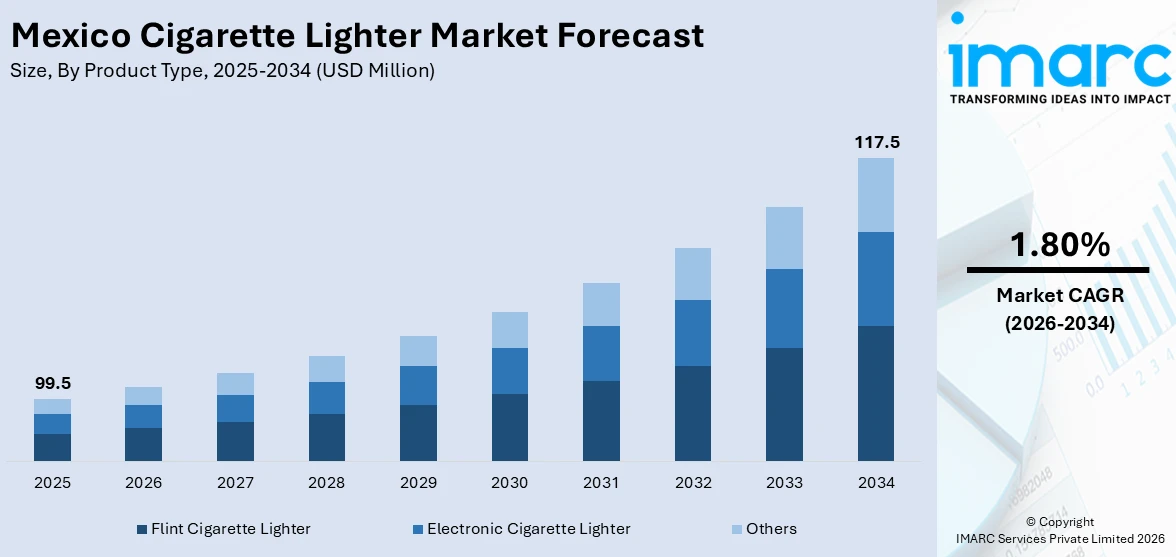
The Mexico cigarette lighter market grew from USD 99.5 Million in 2025 to USD 101.9 Million in 2026 and is projected to reach USD 117.5 Million by 2034, growing at a compound annual growth rate of 1.80% from 2026-2034.
The Mexico cigarette lighter market is supported by an enduring smoking culture, rapid urbanization, and the growing popularity of outdoor recreational activities. Rising consumer interest in eco-friendly and reusable lighter alternatives, along with expanding modern retail infrastructure, is driving sustained product demand. Technological innovation in safety features and multi-purpose designs is attracting new consumer segments, while intensifying competition among manufacturers continues to reshape the Mexico cigarette lighter market share.
Key Takeaways and Insights:
- By Product Type: Flint cigarette lighter dominates the market with a share of 62.9% in 2025, owing to its affordability, widespread retail availability, and strong consumer familiarity across income groups in Mexico.
- By Material Type: Plastic leads the market with a share of 58.5% in 2025, reflecting its cost efficiency, versatility in design, and suitability for mass-scale lighter production for price-sensitive consumers.
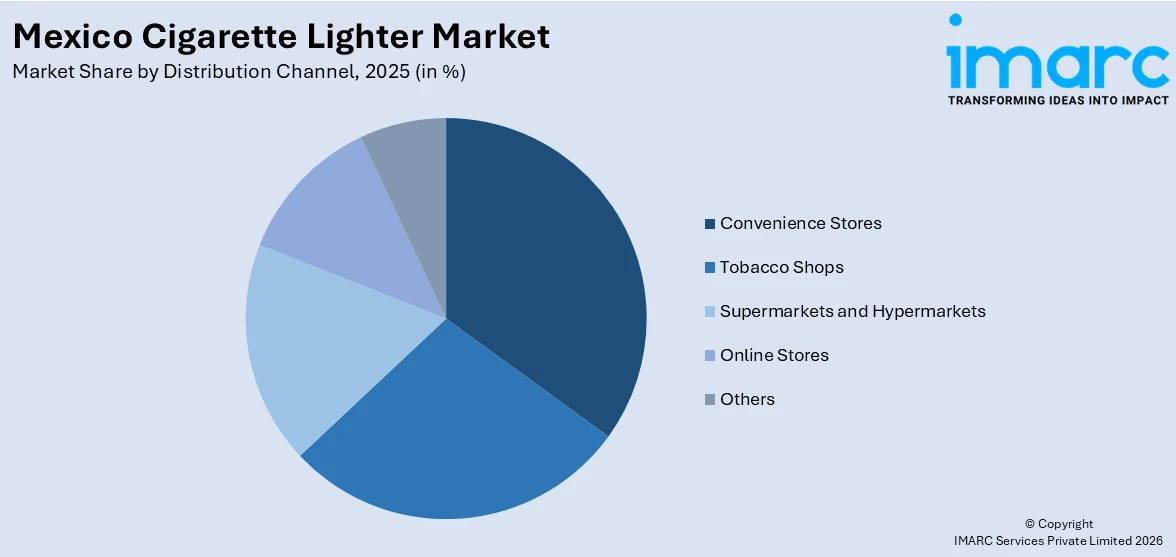
- By Distribution Channel: Convenience stores hold the largest segment with a market share of 34.2% in 2025, driven by Mexico's dense and rapidly expanding convenience retail network, which ensures high product visibility and impulse-purchase accessibility.
- By Region: Central Mexico represents the largest region with a 45.5% share in 2025, driven by the concentration of Mexico's population, economic activity, and retail infrastructure in Mexico City and surrounding urban centers.
- Key Players: Key players drive the Mexico cigarette lighter market by expanding product portfolios, investing in safety and design innovations, and strengthening distribution networks. Their marketing strategies, affordability initiatives, and partnerships with retail chains boost consumer awareness, accelerate product adoption, and ensure consistent availability across diverse retail and informal trade channels throughout the country.
To get more information on this market Request Sample
The Mexico cigarette lighter market is advancing steadily as persistent smoking prevalence, growing urban consumer populations, and expanding modern retail channels sustain robust product demand. An enduring tobacco consumer base provides a durable foundation for lighter demand across urban and rural geographies alike. Concurrently, a market-level shift toward multi-use and outdoor lifestyle products is broadening the consumer base beyond traditional tobacco users, introducing new demand drivers independent of smoking trends. The convergence of rising health-conscious consumer segments with continued reliance on functional ignition accessories is reshaping product development priorities across the industry. Rising investment in branded, feature-rich lighter designs is supporting premiumization alongside ongoing demand for value-oriented disposable models. This dual-growth dynamic, anchored by both traditional and emerging consumer segments, reflects the Mexico cigarette lighter market's resilient and evolving commercial landscape.
Mexico Cigarette Lighter Market Trends:
Rising Demand for Eco-Friendly and Refillable Lighters
Growing environmental awareness among Mexican consumers is accelerating the shift away from single-use disposable lighters toward refillable and sustainable alternatives. Regulatory momentum against single-use plastics is encouraging manufacturers to develop biodegradable casing materials and energy-efficient designs, prompting a fundamental rethinking of product construction and lifecycle impact. Brands are increasingly emphasizing durability, long-term value, and reduced environmental footprint in their lighter offerings. This trend is reshaping competitive product portfolios and positioning sustainability as an emerging differentiator within Mexico's cigarette lighter market.
Growing Popularity of Decorative and Personalized Lighters
Consumer preference for customized and branded lighter designs is emerging as a notable trend in Mexico. Manufacturers are introducing limited-edition collections tied to cultural events, sports franchises, and lifestyle themes to capture emotionally engaged consumers. Illustrating this trend, BIC Mexico launched a limited-edition lighter collection as the official lighter partner of the Mexico National Soccer Team, incorporating interactive QR codes that unlock digital experiences for consumers. This strategy demonstrates how product personalization is becoming a competitive differentiator, supporting the Mexico cigarette lighter market growth beyond functional utility.
Expansion of Convenience Retail as the Primary Purchase Channel
The rapid proliferation of convenience stores across Mexico is reinforcing the channel's role as the dominant point of purchase for cigarette lighters. The country's dense urban retail landscape and consumers' frequent small-basket purchasing behavior create structurally favorable conditions for impulse-buy products such as cigarette lighters. Extended operating hours, proximity to residential and commercial zones, and consistent co-location with tobacco products amplify product visibility and purchase frequency, cementing convenience stores as the most commercially significant distribution channel within Mexico's cigarette lighter market.
Market Outlook 2026-2034:
The Mexico cigarette lighter market is expected to continue its steady growth during the forecast period, supported by stable tobacco consumption, increasing retail infrastructure, and continuous innovation in the product segment. The increasing interest of consumers in reusable, decorative, and utility-based lighters is creating new revenue pockets for the traditional segment of the market. The increasing rate of urbanization in Central and Northern Mexico, modern trade infrastructure, and increasing competitive intensity among local and international brands will keep the dynamism of the market high during the forecast period. The market generated a revenue of USD 99.5 Million in 2025, which is expected to reach USD 101.9 Million in 2026 and further grow to USD 117.5 Million by 2034, at a compound annual growth rate of 1.80% during 2026-2034.
Mexico Cigarette Lighter Market Report Segmentation:
| Segment Category | Leading Segment | Market Share |
|---|---|---|
|
Product Type |
Flint Cigarette Lighter |
62.9% |
|
Material Type |
Plastic |
58.5% |
|
Distribution Channel |
Convenience Stores |
34.2% |
|
Region |
Central Mexico |
45.5% |
Product Type Insights:
- Flint Cigarette Lighter
- Electronic Cigarette Lighter
- Others
Flint cigarette lighter dominates with a market share of 62.9% of the total Mexico cigarette lighter market in 2025.
Flint cigarette lighters hold a commanding position in the Mexico market owing to their unmatched affordability, operational simplicity, and near-universal consumer familiarity. These lighters are widely available through informal retail channels, convenience stores, and tobacco shops, making them the product of choice for budget-conscious consumers across diverse income levels and regions. Their resistance to market disruption stems from deeply embedded purchase habits and minimal reliance on electricity or charging infrastructure, which is particularly advantageous in rural and semi-urban areas of Mexico.
The dominance of flint lighters is further reinforced by high-volume production capabilities that keep unit prices competitive. Major manufacturers continue to invest in color variety, ergonomic designs, and safety lock mechanisms to sustain consumer appeal within this segment. The widespread preference for flint lighters is also supported by Mexico's large informal retail economy, where small convenience vendors and tianguis markets remain critical distribution touchpoints. This structural entrenchment ensures that flint lighters will retain their leading share throughout the forecast period, even as electronic alternatives gradually gain visibility among urban consumers.
Material Type Insights:
- Metal
- Plastic
- Others
Plastic leads with a share of 58.5% of the total Mexico cigarette lighter market in 2025.
Plastic remains the dominant material in Mexico's cigarette lighter market due to its cost effectiveness, design versatility, and suitability for high-volume mass manufacturing. Plastic-bodied lighters align with the price sensitivity of the Mexican consumer base, where value-for-money considerations drive the majority of purchasing decisions. The material's light weight, moldability into diverse shapes and colors, and compatibility with both flint and electronic ignition systems make it the preferred choice for manufacturers targeting both mass-market and branded product categories.
The prevalence of plastic lighters is also linked to Mexico's large informal trade sector, where low-cost disposable models dominate shelf space in tianguis, street markets, and small convenience outlets. Despite growing regulatory attention to single-use plastic waste in Mexico, the lighter industry continues to rely heavily on plastic given consumer demand for affordable products. Manufacturers are beginning to address sustainability concerns by experimenting with recycled plastic content in lighter casings and promoting refillable plastic models, gradually repositioning plastic as a material compatible with emerging circular economy objectives in Mexico.
Distribution Channel Insights:
Access the comprehensive market breakdown Request Sample
- Tobacco Shops
- Supermarkets and Hypermarkets
- Convenience Stores
- Online Stores
- Others
Convenience stores hold the largest segment with a market share of 34.2% of the total Mexico cigarette lighter market in 2025.
Convenience stores have established themselves as the preeminent channel for cigarette lighter sales in Mexico, driven by the country's exceptionally dense and rapidly expanding convenience retail network. The co-location of lighters with tobacco products and everyday essentials creates favorable impulse-purchasing conditions that significantly amplify product visibility and consumer purchase frequency. Extended operating hours and widespread presence across urban, suburban, and transit corridors ensure consistent product accessibility for Mexico's broad base of lighter consumers.
The strategic importance of convenience stores is further underscored by their deep integration into daily consumer routines throughout Mexico. The channel's commercial scale enables broad product distribution at accessible price points, reinforcing its structural advantage over competing retail formats. High footfall from tobacco consumers, proximity to residential and commercial zones, and the convenience format's continued geographic expansion collectively position this channel to retain its leading distribution share throughout the forecast period.
Regional Insights:
- Northern Mexico
- Central Mexico
- Southern Mexico
- Others
Central Mexico exhibits a clear dominance with a 45.5% share of the total Mexico cigarette lighter market in 2025.
Central Mexico's market leadership can be attributed to a number of factors, including its status as the country's most populous and economically productive region. The concentration of modern retail infrastructure, including convenience stores, supermarkets, and tobacco specialty stores, provides unmatched distribution density for cigarette lighter brands. The high levels of consumer spend and purchasing power across the metropolitan region of Mexico City, Guadalajara, and other urban centers create a robust market base for both premium and value product tiers, cementing Central Mexico's market leadership position in the country's cigarette lighter market.
Central Mexico's commanding market share can also be attributed to a large and urban smoking population across Mexico, which is concentrated in Central Mexico's densely populated metropolitan regions. The region's well-developed logistics and supply chain infrastructure allows for efficient product replenishment cycles across high-volume retail formats. Finally, Central Mexico's retail formalization trend, which has seen a rapid proliferation of branded convenience store chains, modern supermarkets, and e-commerce penetration, presents a promising market opportunity for cigarette lighter brands to establish a strong presence and entrench Central Mexico's market leadership position in the country's cigarette lighter market.
Market Dynamics:
Growth Drivers:
Why is the Mexico Cigarette Lighter Market Growing?
Persistent Tobacco Consumption Sustaining Lighter Demand
Mexico's substantial smoking population continues to be the primary structural driver of demand for cigarette lighters. The country maintains a large and enduring tobacco consumer base, with smoking prevalence remaining notable across both urban and rural geographies. Despite a progressively strengthened regulatory framework, including comprehensive smoke-free laws and advertising restrictions, overall smoking rates have remained resilient, sustaining consistent demand for ignition accessories. Ongoing cigarette sales through convenience stores, tobacco shops, and informal retail channels perpetuate the need for functional lighters. This durable consumption foundation ensures sustained baseline demand for both disposable and refillable lighter categories throughout Mexico's diverse geographic and demographic landscape.
Rapid Urbanization and Growth of Modern Retail Channels
Mexico's accelerating urbanization is expanding the addressable retail market for cigarette lighters by increasing consumer density in commercially developed areas and enabling faster distribution through modern trade formats. The country's retail landscape is experiencing robust expansion across convenience, specialty, and self-service formats, progressively increasing the density of outlets through which cigarette lighters reach consumers. The near-universal co-location of lighters with tobacco products in convenience stores, combined with extended operating hours and high consumer footfall, creates structurally favorable conditions for sustained sales volume growth. Rising retail formalization across Central and Northern Mexico is further strengthening branded lighter distribution, ensuring consistent product availability and heightened consumer touchpoints throughout the country's most commercially dynamic urban corridors.
Growing Consumer Preference for Specialized and Branded Lighter Designs
An emerging preference for branded, decorative, and feature-enriched lighters is providing manufacturers with opportunities to capture higher revenue per unit and attract younger consumer segments in Mexico. The trend toward product premiumization and personalization, evidenced by BIC Mexico's official lighter partnership with the Mexico National Soccer Team and the associated launch of limited-edition collectible designs, illustrates the market's evolution beyond purely functional commodity products. Consumers are increasingly receptive to lighter products that combine utility with personal expression, brand loyalty, or cultural identity. Additionally, rising interest in outdoor recreational activities such as camping, hiking, and grilling is broadening the use-case appeal of windproof, refillable, and multi-purpose lighter models among non-tobacco consumer segments. This diversification of the consumer base beyond traditional smokers is expanding the Mexico cigarette lighter market's total addressable opportunity and supporting steady revenue growth independent of tobacco consumption trends.
Market Restraints:
What Challenges the Mexico Cigarette Lighter Market is Facing?
Stringent Anti-Tobacco Regulations Limiting Consumer Base Growth
Mexico has progressively strengthened its tobacco control framework, imposing comprehensive restrictions on tobacco advertising and smoking across public and outdoor spaces. These regulatory measures are designed to reduce long-term smoking prevalence, which may gradually erode the core consumer base for cigarette lighters over time. Declining smoking initiation rates among younger demographics, combined with intensifying public health awareness campaigns and stricter enforcement of smoke-free legislation, pose a structural headwind to sustained demand growth in the medium-to-long term, constraining the market's overall expansion potential.
Intense Competition from Low-Cost Imported Lighters
The Mexico cigarette lighter market faces significant competitive pressure from an influx of low-cost lighter imports that compete aggressively on price at the lower end of the market. This dynamic constrains the pricing power of established brands and compresses manufacturer margins, particularly in the high-volume disposable segment. The prevalence of informal distribution channels through which unbranded imports reach consumers makes market regulation and brand differentiation particularly challenging for established manufacturers, limiting the ability of premium players to capture incremental market share across price-sensitive consumer segments.
Environmental Regulations Targeting Single-Use Plastic Products
Growing regulatory momentum against single-use plastic products in Mexico represents an emerging constraint for the cigarette lighter industry, where plastic-bodied disposable models account for a majority of sales volume. Ongoing efforts to consolidate and strengthen federal and state environmental legislation are increasing pressure on manufacturers to reformulate product materials and adopt more sustainable construction approaches. Transitioning to biodegradable or recyclable alternatives involves significant additional manufacturing costs that may be difficult to pass on to price-sensitive consumers, potentially compressing margins and complicating the product development roadmap for lighter manufacturers operating in Mexico's market.
Competitive Landscape:
The Mexico cigarette lighters market is characterized by a moderately consolidated competitive environment, where international firms enjoy a high level of brand equity in addition to a substantial presence of low-cost imported and local products. The international players in the market are using their existing brand equity and extensive distribution networks in addition to continued investments in product innovation to sustain their competitive advantage. Some of the key strategies implemented in the Mexico cigarette lighters market include creating special edition products and decorated products, expanding utility lighters for non-smoking products, and enhancing relationships with key convenience store groups. The competitive environment in the Mexico cigarette lighters market is increased by the rising availability of unbranded imported products available through informal trade channels, which is exerting a downward price pressure on branded product pricing and margin attainment in the convenience store and mass retail channels.
Recent Developments:
- In 2024, BIC Mexico announced its official lighter partnership with the Mexico National Soccer Team, launching a limited-edition collection of four exclusive lighter designs inspired by the national team's colors and symbols. Each lighter was equipped with an interactive QR code enabling consumers to access digital experiences, reflecting the growing brand engagement strategy for lighter products in Mexico.
Mexico Cigarette Lighter Market Report Coverage:
| Report Features | Details |
|---|---|
| Base Year of the Analysis | 2025 |
| Historical Period | 2020-2025 |
| Forecast Period | 2026-2034 |
| Units | Million USD |
| Scope of the Report |
Exploration of Historical Trends and Market Outlook, Industry Catalysts and Challenges, Segment-Wise Historical and Future Market Assessment:
|
| Product Types Covered | Flint Cigarette Lighter, Electronic Cigarette Lighter, Others |
| Material Types Covered | Metal, Plastic, Others |
| Distribution Channels Covered | Tobacco Shops, Supermarkets and Hypermarkets, Convenience Stores, Online Stores, Others |
| Regions Covered | Northern Mexico, Central Mexico, Southern Mexico, Others |
| Customization Scope | 10% Free Customization |
| Post-Sale Analyst Support | 10-12 Weeks |
| Delivery Format | PDF and Excel through Email (We can also provide the editable version of the report in PPT/Word format on special request) |
Frequently Asked Questions About the Mexico Cigarette Lighter Market Report
The Mexico cigarette lighter market size increased from USD 99.5 Million in 2025 to USD 101.9 Million in 2026.
The Mexico cigarette lighter market is expected to grow at a compound annual growth rate of 1.80% from 2026-2034 to reach USD 117.5 Million by 2034.
Flint cigarette lighter dominated the market with a share of 62.9%, reflecting widespread consumer preference for affordable, easy-to-use, and broadly available ignition products across Mexico's diverse retail channels.
Key factors driving the Mexico cigarette lighter market include a large and persistent smoking consumer base, rapid expansion of convenience retail networks, growing consumer interest in branded and decorative lighter designs, and increasing adoption of lighters for outdoor and multi-purpose uses.
Major challenges include stringent anti-tobacco regulations that may suppress long-term consumer base growth, intense competition from low-cost imported lighter products through informal trade channels, and growing regulatory pressure targeting single-use plastic products, which constitute the dominant material category in Mexico's lighter market.
Need more help?
- Speak to our experienced analysts for insights on the current market scenarios.
- Include additional segments and countries to customize the report as per your requirement.
- Gain an unparalleled competitive advantage in your domain by understanding how to utilize the report and positively impacting your operations and revenue.
- For further assistance, please connect with our analysts.
 Request Customization
 Speak to an Analyst
 Request Brochure
 Inquire Before Buying
Benefits of Customization
- Personalize this research
- Triangulate with your data
- Get data as per your format and definition
- Gain a deeper dive into a specific application, geography, customer, or competitor
- Any level of personalization
Get in Touch With Us
UNITED STATES
Phone: +1-201-971-6302
INDIA
Phone: +91-120-433-0800
UNITED KINGDOM
Phone: +44-753-714-6104
Email: [email protected]
Client Testimonials




.webp)




.webp)













Related Reports

Choose your plan
*Please note that the prices mentioned below are starting prices for each bundle type. Kindly contact our team for further details.*
Single User License
- 1 User License, Access on 2 Devices
- PDF Report + Excel Dataset (Password Protected)
- Lifetime Access
- No Printing Rights
- 10% Free Report Customization
- 10–12 Weeks of Analyst Support
Five User License
- Access for 5 Users, 2 Devices per User
- PDF Report + Excel Dataset (Password Protected)
- Lifetime Access
- Dedicated Account Manager
- 12–14 Weeks of Analyst Support
- No Printing Rights
- 15% Free Report Customization
- 25% Discount on Your Next Purchase
Corporate User License
- Unlimited User Access (Within Your Organization)
- PDF Report + Excel Dataset
- Lifetime Access
- Dedicated Account Manager
- 14–20 Weeks of Analyst Support
- No Printing Rights
- 20% Free Report Customization
- 30% Discount on Your Next Purchase
Essential Insights
What's included:
3 reports
- Lifetime Access
- PDF Reports
- Excel Datasets
- 2 Weeks of Free Analyst Support
- 2 User Licenses
- Access on 2 Devices
- Printing Rights
- Complimentary PowerPoint (PPT) Version
- Complimentary License Upgrade
Professional Access
What's included:
5 reports
- Lifetime Access
- PDF Reports
- Excel Datasets
- 8 Weeks of Free Analyst Support
- 2 User Licenses
- Access on 2 Devices
- Printing Rights
- Complimentary PowerPoint (PPT) Version
- Complimentary License Upgrade
Business Advantage
What's included:
8 reports
- Lifetime Access
- PDF Reports
- Excel Datasets
- 14 Weeks of Free Analyst Support
- 2 User Licenses
- Access on 2 Devices
- Printing Rights
- Complimentary PowerPoint (PPT) Version
- Complimentary License Upgrade
Enterprise Intelligence
What's included:
10 reports
- Lifetime Access
- PDF Reports
- Excel Datasets
- 20 Weeks of Free Analyst Support
- 2 User Licenses
- Access on 2 Devices
- Printing Rights
- Complimentary PowerPoint (PPT) Version
- Complimentary License Upgrade