
Mexico Hair Curler Market Size, Share, Trends and Forecast by Product Type, Technology, Distribution Channel, Application, and Region, 2026-2034
Mexico Hair Curler Market Size, Share, Trends & Forecast (2026-2034)
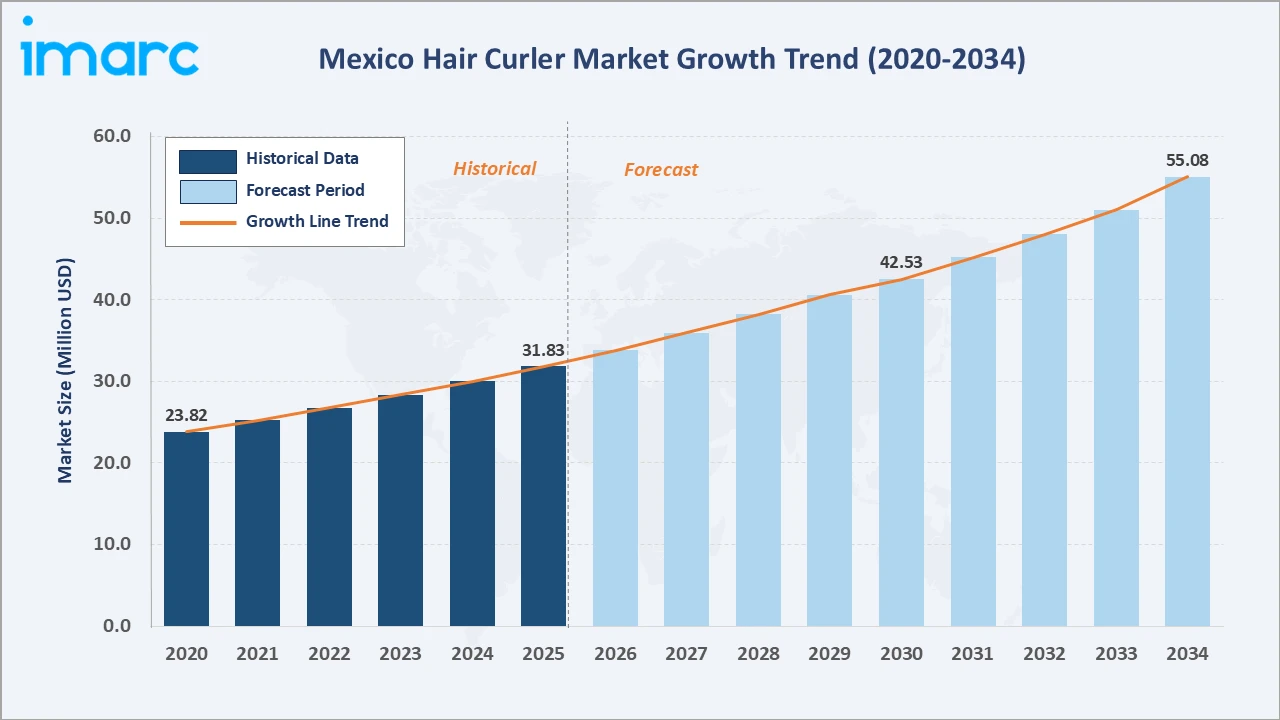
The Mexico hair curler market reached USD 31.83 Million in 2025 and is projected to reach USD 55.08 Million by 2034, growing at a CAGR of 5.97% during 2026-2034. Growth is driven by rising personal grooming spend, expanding social-media-led styling trends, and wider retail and e-commerce access to styling appliances. Electric hair curlers lead the product type at 52.8%, supported by faster styling and consistent heat control. Manual technology leads at 44.3%, while Central Mexico dominates regionally at 42.6%, anchored by Mexico City's dense retail and salon network.
Market Snapshot
|
Metric |
Value |
|
Market Size (2025) |
USD 31.83 Million |
|
Forecast Market Size (2034) |
USD 55.08 Million |
|
CAGR (2026-2034) |
5.97% |
|
Base Year |
2025 |
|
Historical Period |
2020-2025 |
|
Forecast Period |
2026-2034 |
| Dominant Product Type | Electric Hair Curlers (52.8%, 2025) |
| Dominant Technology | Manual (44.3%, 2025) |
|
Leading Region |
Central Mexico (42.6%, 2025) |
The Mexico hair curler market grew from USD 23.82 Million in 2020 to USD 31.83 Million in 2025, supported by steady demand from household users and salon professionals. It is expected to reach USD 42.53 Million by 2030, aided by growing adoption of ceramic and cordless curling devices. By 2034, the market is forecast to reach USD 55.08 Million, driven by rising disposable income, premiumization, and expanding beauty retail infrastructure across the country.
To get more information on this market, Request Sample
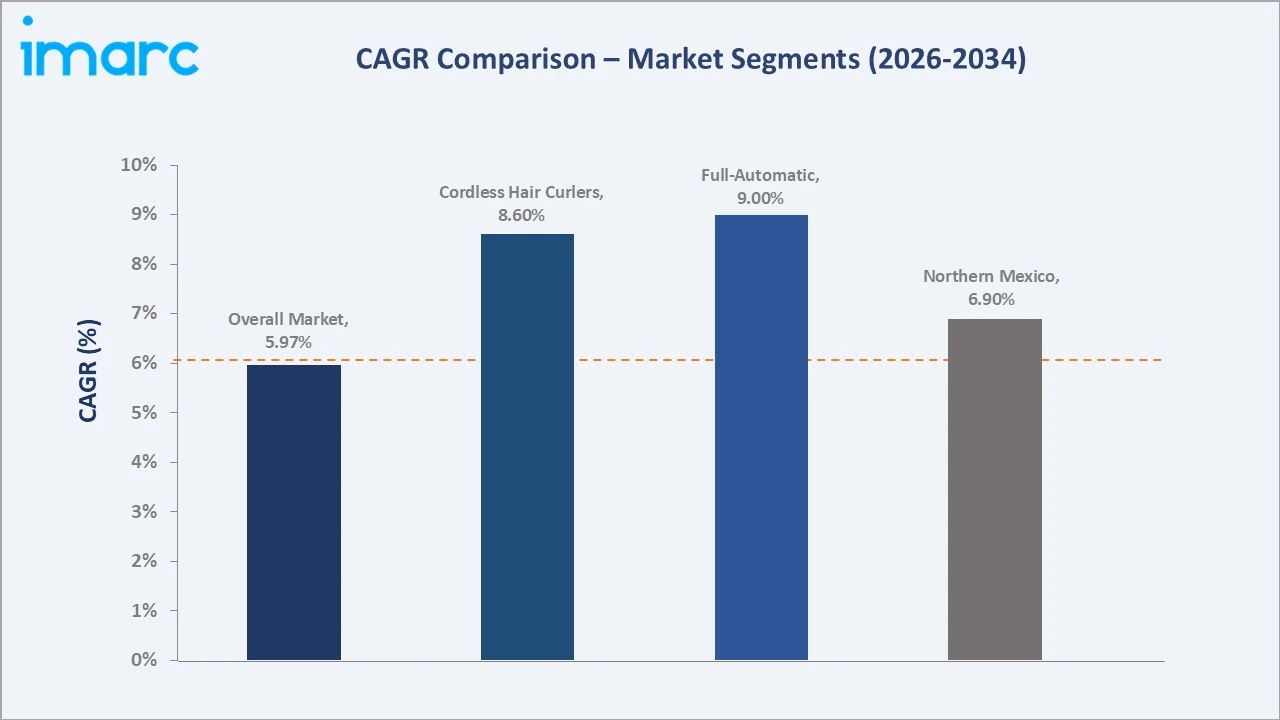
Cordless hair curlers grow fastest at ~8.6% CAGR through rechargeable, travel-friendly designs. Full-automatic technology grows at ~9.0% CAGR as auto-rotating curlers gain traction. Northern Mexico grows at ~6.9% CAGR through cross-border retail and rising urban incomes.
Executive Summary
The Mexico hair curler market is expanding steadily, supported by rising personal grooming spend and a fast-growing beauty and personal care sector that generated close to USD 11.17 Billion in 2025. Growing exposure to styling tutorials on social media is encouraging both household and salon-based demand for curling irons, wands, and hot rollers. Consumers are increasingly favoring electric and ceramic-coated devices over traditional heated tools for faster, more consistent results.
Retail modernization is also shaping the market, with supermarkets, specialty beauty retailers, and online platforms widening product access across urban and semi-urban areas. International beauty retailers have been expanding their physical footprint in the country, reinforcing distribution for personal care appliances alongside cosmetics. Electric hair curlers at 52.8% lead by product type through convenience and styling consistency. Manual technology at 44.3% leads through affordability and wide availability.
Central Mexico leads regionally at 42.6%, supported by dense urban population and retail infrastructure. Looking ahead, the market's outlook remains positive as premiumization, cordless innovation, and expanding e-commerce penetration continue to widen consumer access to advanced hair styling appliances through 2034.
Key Market Insights
|
Insight |
Data |
| Dominant Product Type | Electric Hair Curlers - 52.8% share (2025) |
| Dominant Technology | Manual - 44.3% market share (2025) |
|
Leading Region |
Central Mexico - 42.6% share (2025) |
| Market Opportunities | Cordless rechargeable curlers; full-automatic auto-curl devices; specialty and online retail expansion; salon-grade ceramic technology; travel-friendly compact styling tools; app-connected smart curlers |
Key Analytical Observations Supporting the Above Data:
- Electric Hair Curlers at 52.8%: Electric curlers dominate due to faster heat-up, consistent barrel temperature, and reliable curl retention. Their ease of use across hair types makes them the preferred choice for both household and professional styling.
- Manual Technology at 44.3%: Manual devices lead due to lower price points and broad availability across supermarkets and general retail. Many entry-level electric curlers still rely on manual heat-setting controls, keeping this segment dominant in 2025.
- Central Mexico at 42.6%: Central Mexico dominates through its dense urban population, concentration of beauty retailers, and strong salon culture in Mexico City and surrounding states. The region's developed logistics network further supports appliance distribution.
Mexico Hair Curler Market Overview
The Mexico hair curler market encompasses electric, traditional, and cordless styling devices used to create curls, waves, and volume across household and professional salon settings. It includes curling irons, curling wands, hot rollers, and automatic rotating curlers built on manual, semi-automatic, and full-automatic technologies. Growth is supported by rising grooming spend, expanding beauty retail infrastructure, and the influence of social media on styling habits. Macroeconomic factors include rising disposable income, minimum wage increases, and continued growth of Mexico's e-commerce and beauty retail ecosystem.
Market Dynamics
To evaluate market opportunities, Request Sample
Market Drivers
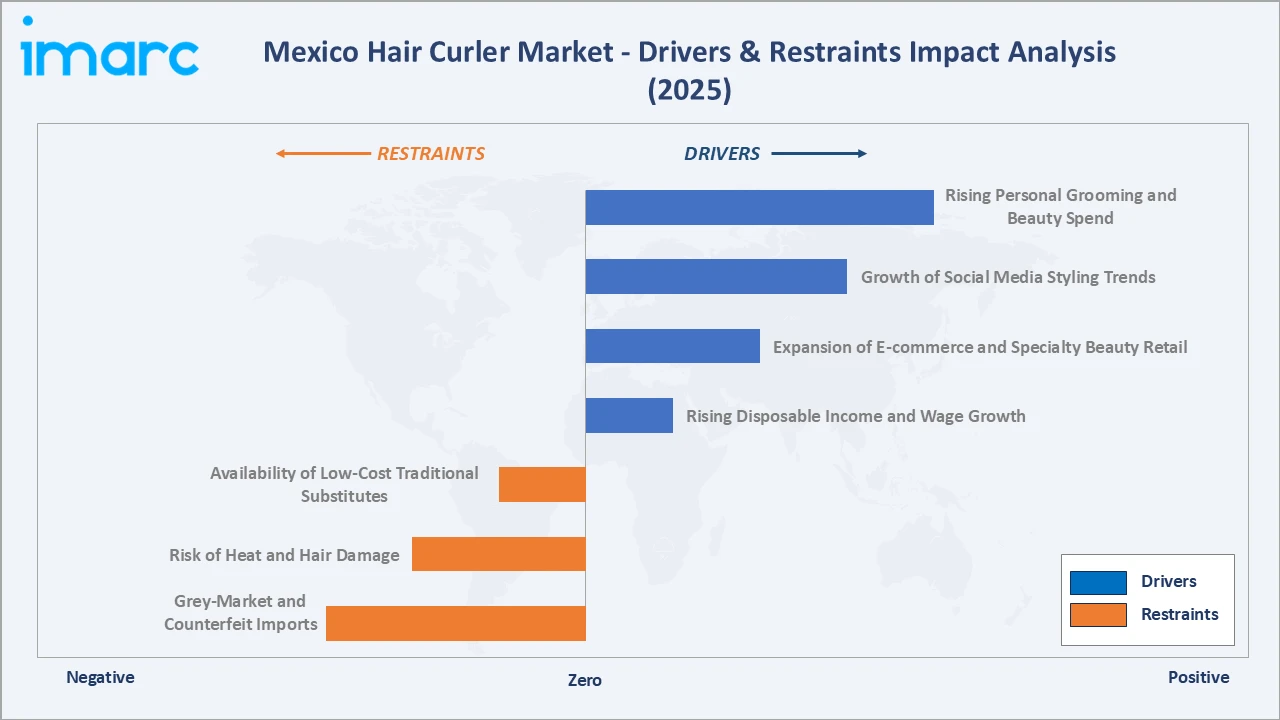
- Rising Personal Grooming and Beauty Spend: Mexico's beauty and personal care market reached close to USD 11.17 Billion in 2025, with rising disposable incomes among urban households supporting higher spend on styling appliances. Growing focus on personal appearance is increasing household ownership of curling irons and wands.
- Growth of Social Media Styling Trends: Widespread use of platforms such as Instagram and TikTok for styling tutorials is driving demand for at-home curling devices. Consumers increasingly replicate salon-style curls at home, boosting sales of electric and automatic curlers.
- Expansion of E-commerce and Specialty Beauty Retail: International beauty retailers have been expanding their store networks in Mexico, widening access to global and domestic styling appliance brands. Online retail is also gaining share, supported by growing mobile commerce adoption among younger consumers.
- Rising Disposable Income and Wage Growth: Periodic increases to Mexico's minimum wage have supported household purchasing power, encouraging discretionary spending on personal care appliances including hair curlers, particularly in urban and industrial regions.
Market Restraints
- Availability of Low-Cost Traditional Substitutes: Inexpensive heated rollers and manual curling tools remain widely available, limiting the pace of migration toward premium electric and automatic devices among price-sensitive consumers.
- Risk of Heat and Hair Damage: Consumer concerns over heat-related hair damage from frequent curling can restrain usage frequency, prompting some buyers to favor lower-heat manual alternatives or reduce styling frequency.
Market Opportunities
- Growing Adoption of Cordless and Rechargeable Curlers: Rising demand for portable, travel-friendly styling tools is creating opportunities for battery-powered and USB-rechargeable curling devices, particularly among younger, mobile consumers.
- Expansion of Salon-Grade Ceramic and Tourmaline Technology: Increasing consumer preference for gentler, damage-reducing heat technology is opening opportunities for premium ceramic and tourmaline-coated curling barrels across mass and specialty retail.
Market Challenges
- Grey-Market and Counterfeit Imports: Unregistered and counterfeit appliances entering through informal retail channels create safety risks and pricing pressure for authorized brands, challenging consumer trust and regulatory enforcement.
- Price Sensitivity Among Mass-Market Consumers: A large share of Mexican consumers remain price-conscious, requiring manufacturers to balance innovation with affordability to sustain volume growth across mass retail channels.
Emerging Market Trends
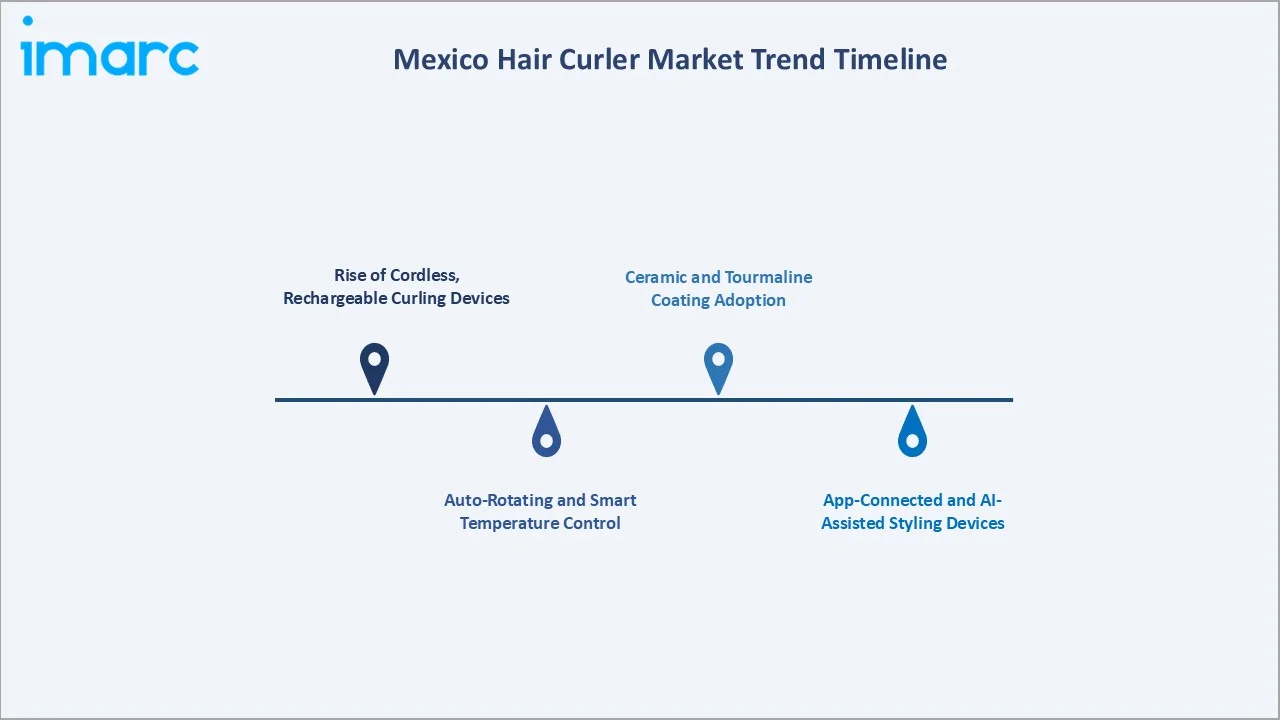
1. Rise of Cordless, Rechargeable Curling Devices
Cordless curlers are gaining traction as consumers seek portable devices for travel and on-the-go styling. Battery and USB-rechargeable models are expanding across specialty and online retail, appealing to younger, mobile consumers seeking flexibility without sacrificing styling quality.
2. Auto-Rotating and Smart Temperature Control
Full-automatic curlers with auto-rotating barrels and programmable temperature settings are emerging as premium options that reduce styling time and risk of heat damage. These devices appeal to consumers seeking salon-quality results with minimal manual effort.
3. Ceramic and Tourmaline Coating Adoption
Growing awareness of heat damage is driving adoption of ceramic and tourmaline-coated barrels that distribute heat more evenly and reduce frizz. This trend is expanding across both electric and cordless product categories as brands compete on hair-health positioning.
4. App-Connected and AI-Assisted Styling Devices
Early-stage innovation in app-connected styling tools is emerging among premium brands, offering personalized heat and curl settings. While still a small segment, this trend reflects the broader digitalization of personal care appliances through 2034.
Industry Value Chain Analysis
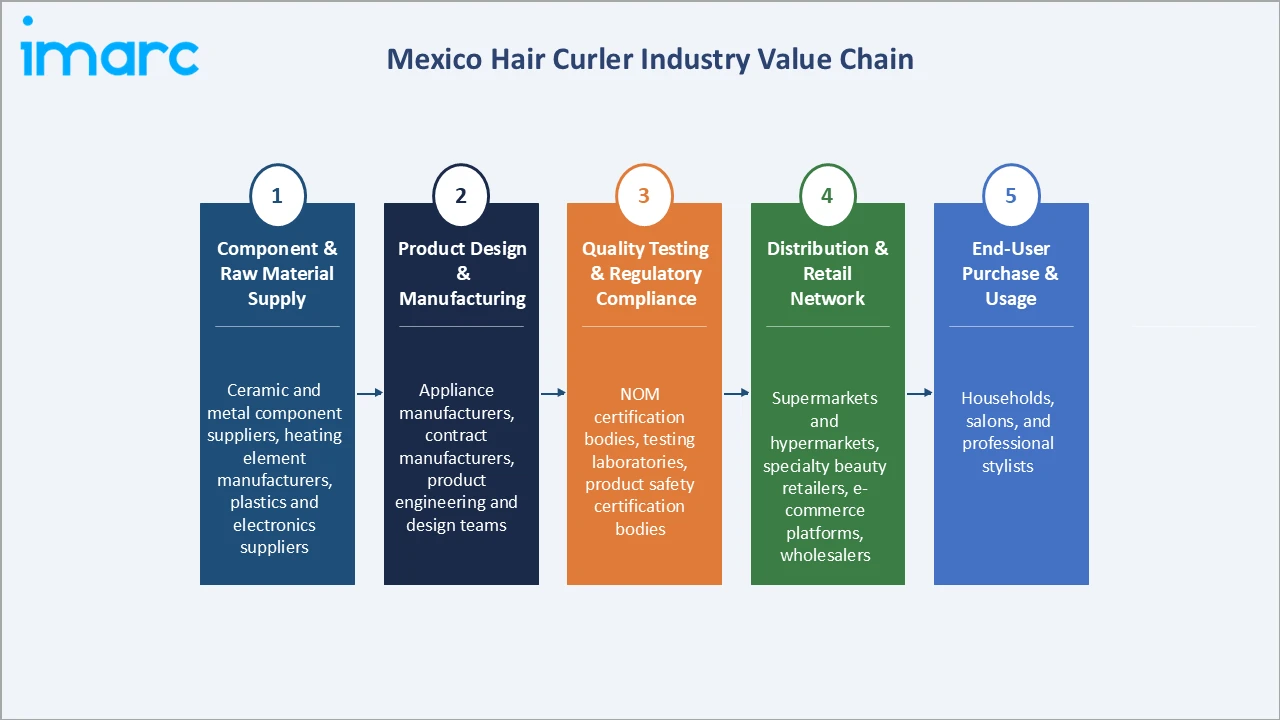
The Mexico hair curler value chain integrates component and raw material supply, product design and manufacturing, quality testing and regulatory compliance, distribution and retail, and end-user purchase and usage.
|
Stage |
Key Participants |
| Component & Raw Material Supply | Ceramic and metal component suppliers, heating element manufacturers, plastics and electronics suppliers |
| Product Design & Manufacturing | Appliance manufacturers, contract manufacturers, product engineering and design teams |
| Quality Testing & Regulatory Compliance | NOM certification bodies, testing laboratories, product safety certification bodies |
| Distribution & Retail Network | Supermarkets and hypermarkets, specialty beauty retailers, e-commerce platforms, wholesalers |
| End-User Purchase & Usage | Households, salons, and professional stylists |
Product design and manufacturing represents the most value-added stage in the Mexico hair curler value chain. This stage determines device performance, heat technology, and safety features that differentiate premium products from mass-market alternatives. Innovation in ceramic coatings, automatic rotation, and cordless power systems allows manufacturers to command higher margins and strengthen brand positioning across retail channels.
Technology Landscape in the Mexico Hair Curler Industry
Heating Element and Barrel Technology
Ceramic and tourmaline-coated barrels are becoming standard in mid-range and premium curlers, offering even heat distribution and reduced frizz. These coatings help minimize direct metal-to-hair contact, supporting healthier styling outcomes for frequent users.
Materials Innovation
Lightweight, heat-resistant plastics and improved insulation are enabling more compact, ergonomic device designs. Manufacturers are also exploring anti-scald housings and cool-tip features to improve safety during handheld use.
Smart Connectivity and Automation
Automatic rotating barrels, programmable temperature settings, and early app-connected features are expanding within the full-automatic technology segment. These innovations reduce the skill required to achieve salon-style curls, widening the appeal of premium devices among first-time users.
Market Segmentation Analysis
The report covers the following segments:
|
Segment Category |
Leading Segment |
Market Share |
Year |
| Product Type | Electric Hair Curlers | 52.8% |
2025 |
| Technology | Manual | 44.3% |
2025 |
| Distribution Channel | 🔒 | 🔒 |
2025 |
|
Application |
🔒 | 🔒 |
2025 |
|
Region |
Central Mexico | 42.6% |
2025 |

By Product Type
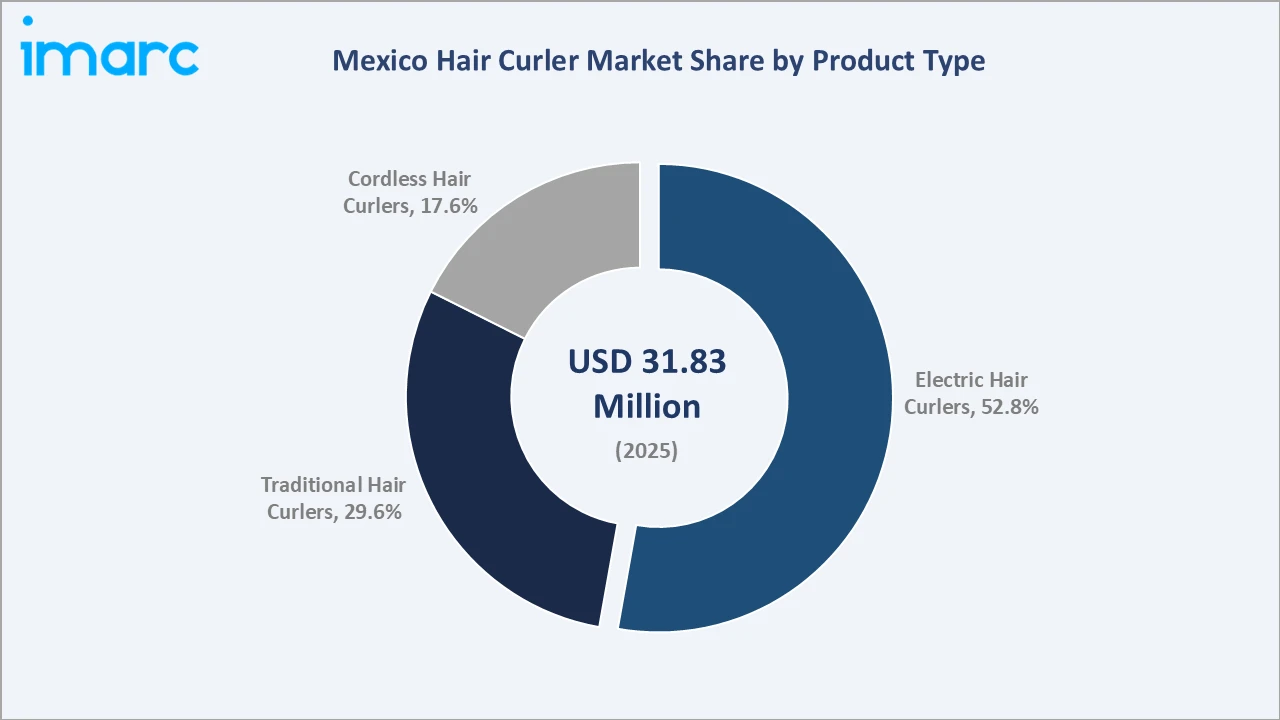
Electric hair curlers lead at 52.8% (2025), through consistent heat control, faster styling time, and broad availability across ceramic and tourmaline-coated barrel options.
To access detailed market analysis, Request Sample
Cordless hair curlers at 17.6% grow fastest at ~8.6% CAGR through rechargeable, portable designs suited for travel and quick styling. Traditional hair curlers at 29.6% continue to serve price-sensitive households through low-cost heated rollers and manual tools.
By Technology
Manual technology leads at 44.3% (2025), through affordability and broad distribution across mass retail, appealing to price-conscious consumers seeking simple, reliable devices.
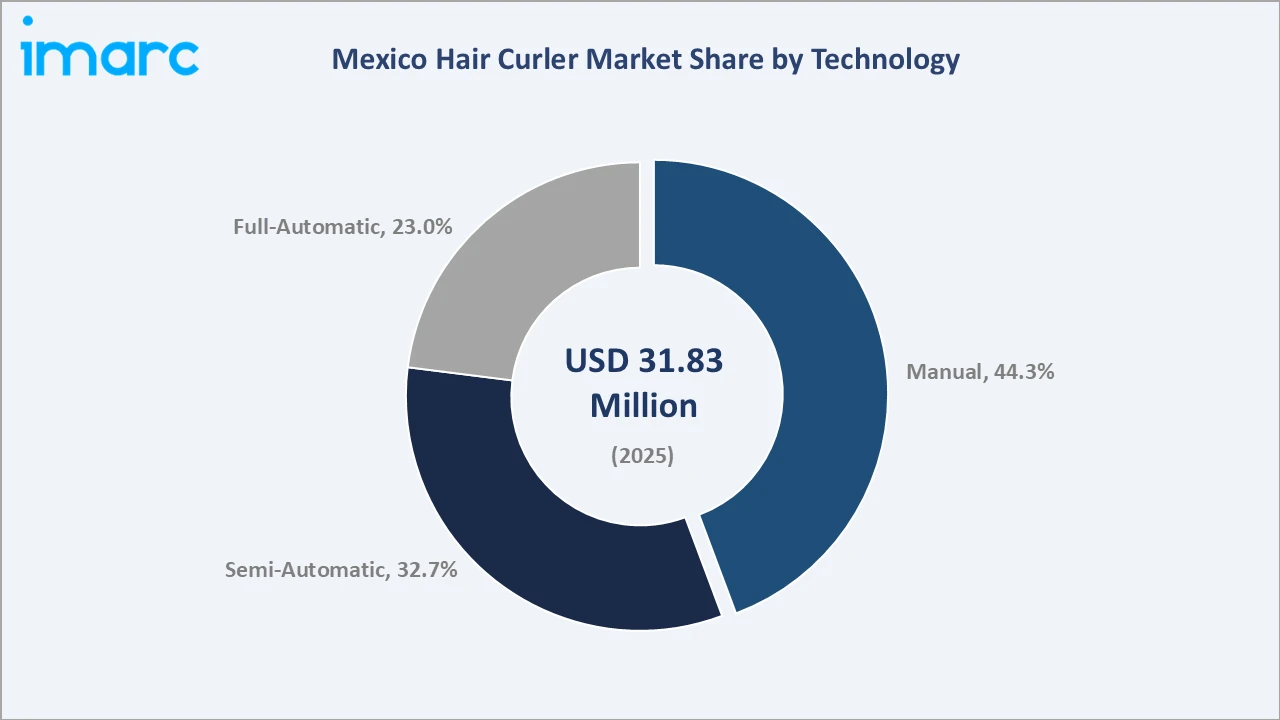
Semi-automatic technology at 32.7% supports consumers seeking a balance of control and convenience. Full-automatic technology at 23.0% grows fastest at ~9.0% CAGR as auto-rotating curlers gain popularity among consumers seeking salon-quality results at home.
Regional Market Insights
|
Region |
Share (2025) |
Key Mexico Hair Curler Market Drivers & Characteristics |
| Central Mexico | 42.6% | Reflects dense urban population, strong salon culture, and concentration of beauty and specialty retail across Mexico City and surrounding states. |
| Northern Mexico | 30.9% | Reflects proximity to cross-border retail, industrial employment growth, and rising household incomes supporting appliance purchases. |
| Southern Mexico | 16.4% | Supported by expanding retail infrastructure and gradual growth of organized beauty and personal care distribution in emerging urban centers. |
| Others | 10.1% | Other regions, including coastal and tourism-driven areas, contribute through salon demand and seasonal retail activity. |
Central Mexico's 42.6% dominance is supported by dense urban population, strong salon culture, and concentration of beauty retail in and around Mexico City. Northern Mexico's 30.9% follows with rising household incomes and expanding cross-border retail access to international appliance brands.
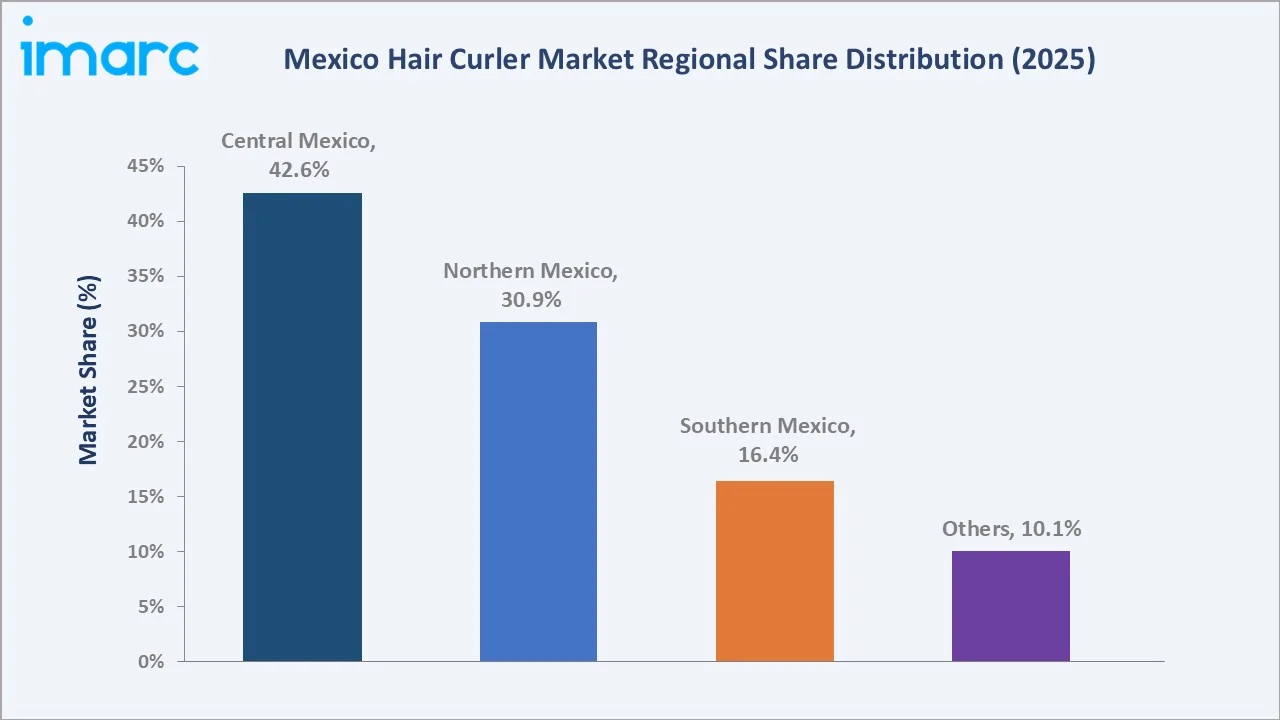
Southern Mexico's 16.4% reflects steady growth of organized retail and salon services across expanding urban centers. Others at 10.1%, including coastal and tourism-oriented regions, contribute through seasonal demand and gradually widening specialty retail presence.
Competitive Landscape
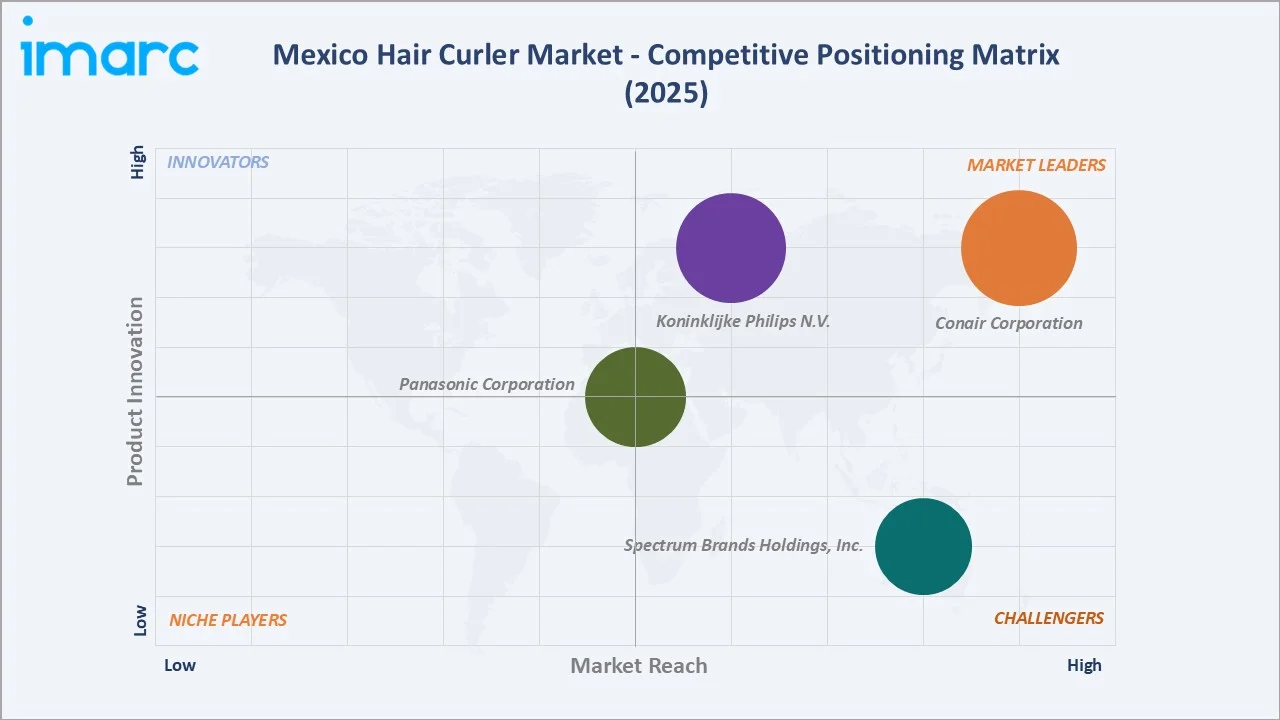
The Mexico hair curler market is moderately competitive, with multinational personal care appliance companies competing alongside regional distributors and emerging cordless device brands. Key firms focus on ceramic heat technology, automatic curling systems, and expanding retail partnerships. Competition is shaped by brand recognition, product innovation, pricing, and distribution reach across supermarkets, specialty stores, and e-commerce.
|
Company Name |
Key Products |
Market Position |
Core Strength |
|
Conair Corporation |
InfinitiPro by Conair |
Market Leader |
Conair holds a broad presence in Mexico's personal care appliance market through its regional office and distribution network, offering a wide range of ceramic and automatic curling devices. |
|
Koninklijke Philips N.V. |
StyleCare, WavePro |
Market Leader |
Philips leverages its global personal care division to offer premium automatic curling technology, supported by strong brand recognition and retail presence across Mexico. |
|
Spectrum Brands Holdings, Inc. |
PROluxe, Keratin Therapy, Twist 'n Curl / Shea Soft |
Strong Challenger |
Operates through Remington which offers a broad portfolio of ceramic and ionic curling tools, competing on affordability and wide retail availability across Mexican mass-market channels. |
|
Panasonic Corporation |
Ionity, Nanoe |
Established Player |
Panasonic differentiates through nanoe moisture technology aimed at reducing heat damage, appealing to consumers seeking hair-health-focused styling appliances. |
Companies are increasingly investing in cordless technology, ceramic coatings, and automatic curling systems to address rising consumer demand for convenience and reduced heat damage. The market is also seeing growing participation from value-focused regional brands targeting price-sensitive segments.
Key Company Profiles
Conair Corporation
Conair Corporation is a leading personal care appliance company operating in the Mexico hair curler market. The company offers a broad range of ceramic, automatic, and travel-friendly curling devices under its core brand.
- Key Brands: INFINITIPRO by Conair
- Strategic Focus: Expanding automatic and cordless curling technology while strengthening distribution across Mexican retail and e-commerce channels.
Koninklijke Philips N.V.
Koninklijke Philips N.V. is a major personal care appliance company with a strong presence in the Mexico hair curler market through its global Personal Health division. The company offers premium automatic curling devices under its StyleCare range, supported by proprietary moisture-protection heat technology.
- Key Brands: StyleCare, WavePro
- Strategic Focus: Strengthening premium automatic curling technology while expanding retail visibility across department stores and specialty beauty retailers.
Panasonic Corporation
Panasonic Corporation offers styling irons under its nanoe technology platform, which infuses moisture into hair during styling to reduce heat damage. The company competes on hair-health positioning within the premium segment of the Mexico hair curler market.
- Key Brands: Ionity, Nanoe
- Strategic Focus: Differentiating through moisture-infusing heat technology aimed at health-conscious consumers seeking reduced styling damage.
Market Concentration Analysis
The Mexico hair curler market shows moderate concentration, with multinational personal care appliance companies holding strong positions in electric and automatic curling devices. Large players benefit from established brand recognition, retail partnerships, and investment in heat-technology innovation. However, the market remains fragmented at the value end, where regional distributors and lower-cost manual curling tools continue to hold meaningful share. Rising demand for cordless and automatic devices is also opening space for specialized appliance brands. Overall, competition is shifting from price-based selling toward differentiated heat technology, safety features, and styling convenience.
Investment & Growth Opportunities
Highest Growth Segments
Full-automatic technology (~9.0% CAGR), cordless hair curlers (~8.6% CAGR), Northern Mexico (~6.9% CAGR), and semi-automatic technology (~6.3% CAGR) represent the Mexico hair curler market's highest-growth investment vectors through 2034.
Investment Themes
- Cordless and Rechargeable Device Innovation: Growing consumer demand for portable, travel-friendly curling devices is creating opportunities for battery and USB-rechargeable product lines targeting younger, mobile consumers.
- Premium Ceramic and Automatic Technology: Rising preference for salon-quality, damage-reducing styling tools is creating investment opportunities in ceramic-coated and auto-rotating curling devices across specialty and online retail channels.
Future Market Outlook (2026-2034)
The Mexico hair curler market is projected to grow from USD 31.83 Million in 2025 to USD 55.08 Million by 2034, delivering a 5.97% CAGR over the forecast period through rising grooming spend, cordless device adoption, and expanding beauty retail infrastructure. The market's anchor value of USD 42.53 Million in 2030 represents a mid-point shift toward premium electric and automatic curling technology.
Three structural forces define Mexico hair curler market growth through 2034. First, continued expansion of organized beauty retail and e-commerce is widening consumer access to premium styling appliances. Second, rising influence of social media styling trends is sustaining demand for at-home curling devices. Third, ongoing innovation in cordless and automatic technology is supporting premiumization across both household and salon applications.
Research Methodology
Primary Research
Primary research comprised interviews with hair curler manufacturers, distributors, specialty beauty retailers, and salon professionals across Mexico. Discussions also covered e-commerce platform managers and appliance importers. Inputs were gathered on product demand, pricing, distribution practices, and adoption of cordless and automatic technology. Feedback from industry participants helped validate market size, regional trends, and competitive positioning.
Secondary Research
Secondary research encompassed government trade and retail statistics, industry publications, company reports, and e-commerce market databases. It also included reviews of beauty and personal care spending trends, minimum wage data, and regulatory updates from NOM electrical safety, labeling, import compliance, and consumer product standards. Public sources on retail expansion and appliance imports were assessed to map regional demand patterns.
Forecasting Models
Forecasting models combined historical market performance, retail expansion trends, and macroeconomic indicators to project future demand. The analysis incorporated expected growth in cordless and automatic technology, e-commerce penetration, and beauty retail infrastructure. Market estimates were validated through triangulation of primary insights, secondary research, and segment-level demand analysis to ensure robust long-term projections through 2034.
Mexico Hair Curler Market Report Coverage:
| Report Features | Details |
|---|---|
| Base Year of the Analysis | 2025 |
| Historical Period | 2020-2025 |
| Forecast Period | 2026-2034 |
| Units | Million USD |
| Scope of the Report |
Exploration of Historical Trends and Market Outlook, Industry Catalysts and Challenges, Segment-Wise Historical and Future Market Assessment:
|
| Product Types Covered | Traditional Hair Curlers, Electric Hair Curlers, Cordless Hair Curlers |
| Technologies Covered | Manual, Semi-Automatic, Full-Automatic |
| Distribution Channels Covered | Supermarkets and Hypermarkets, Specialty Stores, Convenience Stores, Online |
| Applications Covered | Household, Commercial |
| Regions Covered | Northern Mexico, Central Mexico, Southern Mexico, Others |
| Companies Covered | Conair Corporation, Koninklijke Philips N.V., Spectrum Brands Holdings, Inc., Panasonic Corporation, etc. |
| Customization Scope | 10% Free Customization |
| Post-Sale Analyst Support | 10-12 Weeks |
| Delivery Format | PDF and Excel through Email (We can also provide the editable version of the report in PPT/Word format on special request) |
Key Benefits for Stakeholders:
- IMARC’s industry report offers a comprehensive quantitative analysis of various market segments, historical and current market trends, market forecasts, and dynamics of the Mexico hair curler market from 2020-2034.
- The research report provides the latest information on the market drivers, challenges, and opportunities in the Mexico hair curler market.
- Porter's five forces analysis assist stakeholders in assessing the impact of new entrants, competitive rivalry, supplier power, buyer power, and the threat of substitution. It helps stakeholders to analyze the level of competition within the Mexico hair curler industry and its attractiveness.
- Competitive landscape allows stakeholders to understand their competitive environment and provides an insight into the current positions of key players in the market.
Frequently Asked Questions About the Mexico Hair Curler Market Report
The Mexico hair curler market reached USD 31.83 Million in 2025, driven by rising personal grooming spend, expanding beauty retail infrastructure, and growing social-media-led demand for at-home styling appliances.
The Mexico hair curler market grows at a 5.97% CAGR during 2026-2034, reaching USD 55.08 Million by 2034. The CAGR reflects rising disposable income and cordless technology adoption.
Electric hair curlers lead at 52.8% due to faster styling, consistent heat control, and wide availability. Their reliability across hair types makes them the preferred choice for household and professional use alike.
Manual technology leads at 44.3% due to affordability and broad retail availability. Full-automatic technology is growing fastest as auto-rotating curlers gain popularity among convenience-seeking consumers.
Central Mexico leads at 42.6% due to its dense urban population, strong salon culture, and concentration of beauty retail across Mexico City and surrounding states.
Leading companies include Conair Corporation, Koninklijke Philips N.V., Spectrum Brands Holdings, Inc., and Panasonic Corporation, among other regional distributors and emerging cordless device brands.
The market is projected to reach approximately USD 42.53 Million by 2030, supported by rising adoption of ceramic and cordless curling devices and expanding specialty and online retail access.
Cordless and rechargeable curling devices offer strong growth potential as consumers seek portable styling tools. Premium ceramic and full-automatic curling technology also present opportunities as demand rises for salon-quality, damage-reducing appliances.
Ceramic and tourmaline barrel coatings, automatic rotation systems, and early-stage app-connected features are shaping product innovation, supporting premiumization across the industry through 2034.
Growing mobile commerce adoption and expanding online beauty retail are widening consumer access to both mass-market and premium curling devices, supporting steady market growth across urban and semi-urban areas.
Need more help?
- Speak to our experienced analysts for insights on the current market scenarios.
- Include additional segments and countries to customize the report as per your requirement.
- Gain an unparalleled competitive advantage in your domain by understanding how to utilize the report and positively impacting your operations and revenue.
- For further assistance, please connect with our analysts.
 Request Customization
 Speak to an Analyst
 Request Brochure
 Inquire Before Buying
Benefits of Customization
- Personalize this research
- Triangulate with your data
- Get data as per your format and definition
- Gain a deeper dive into a specific application, geography, customer, or competitor
- Any level of personalization
Get in Touch With Us
UNITED STATES
Phone: +1-201-971-6302
INDIA
Phone: +91-120-433-0800
UNITED KINGDOM
Phone: +44-753-714-6104
Email: [email protected]
Client Testimonials




.webp)




.webp)













Related Reports

Choose your plan
*Please note that the prices mentioned below are starting prices for each bundle type. Kindly contact our team for further details.*
Single User License
- 1 User License, Access on 2 Devices
- PDF Report + Excel Dataset (Password Protected)
- Lifetime Access
- No Printing Rights
- 10% Free Report Customization
- 10–12 Weeks of Analyst Support
Five User License
- Access for 5 Users, 2 Devices per User
- PDF Report + Excel Dataset (Password Protected)
- Lifetime Access
- Dedicated Account Manager
- 12–14 Weeks of Analyst Support
- No Printing Rights
- 15% Free Report Customization
- 25% Discount on Your Next Purchase
Corporate User License
- Unlimited User Access (Within Your Organization)
- PDF Report + Excel Dataset
- Lifetime Access
- Dedicated Account Manager
- 14–20 Weeks of Analyst Support
- No Printing Rights
- 20% Free Report Customization
- 30% Discount on Your Next Purchase
Essential Insights
What's included:
3 reports
- Lifetime Access
- PDF Reports
- Excel Datasets
- 2 Weeks of Free Analyst Support
- 2 User Licenses
- Access on 2 Devices
- Printing Rights
- Complimentary PowerPoint (PPT) Version
- Complimentary License Upgrade
Professional Access
What's included:
5 reports
- Lifetime Access
- PDF Reports
- Excel Datasets
- 8 Weeks of Free Analyst Support
- 2 User Licenses
- Access on 2 Devices
- Printing Rights
- Complimentary PowerPoint (PPT) Version
- Complimentary License Upgrade
Business Advantage
What's included:
8 reports
- Lifetime Access
- PDF Reports
- Excel Datasets
- 14 Weeks of Free Analyst Support
- 2 User Licenses
- Access on 2 Devices
- Printing Rights
- Complimentary PowerPoint (PPT) Version
- Complimentary License Upgrade
Enterprise Intelligence
What's included:
10 reports
- Lifetime Access
- PDF Reports
- Excel Datasets
- 20 Weeks of Free Analyst Support
- 2 User Licenses
- Access on 2 Devices
- Printing Rights
- Complimentary PowerPoint (PPT) Version
- Complimentary License Upgrade