
Mexico Instant Noodles Market Size, Share, Trends and Forecast by Type, Distribution Channel, and Region, 2026-2034
Mexico Instant Noodles Market Size, Share, Trends & Forecast (2026-2034)
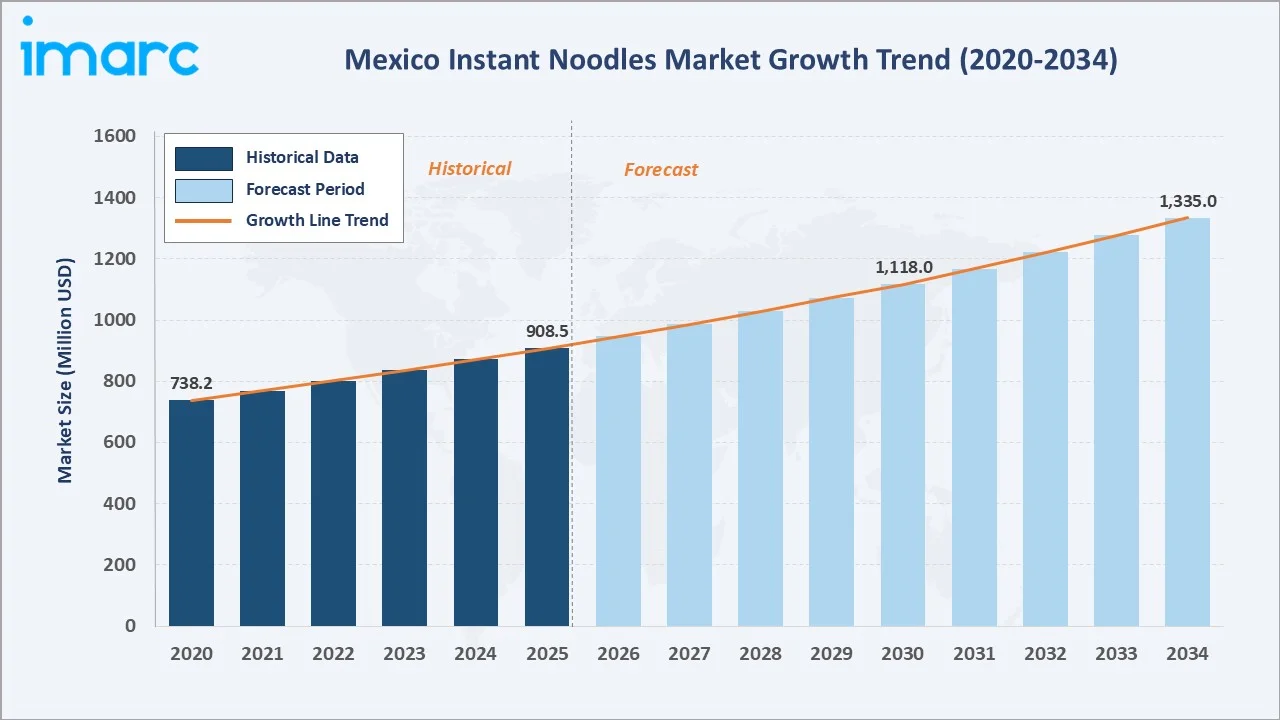
The Mexico instant noodles market reached USD 908.5 Million in 2025 and is projected to reach USD 1,335.0 Million by 2034, growing at a CAGR of 4.24% during 2026-2034. The market is driven by rising demand for affordable, convenient, and quick-to-prepare meal options among urban consumers, students, and working professionals. Between November 1, 2024, and October 31, 2025, Mexico registered 332 import shipments of instant noodles. During this period, 28 active Mexican companies sourced products from 17 international suppliers, indicating a well-established and active import network for instant noodles. The strong import activity also reflects rising consumer demand for affordable, convenient, and quick-to-prepare meal options. Fried leads type at 72.8%. Supermarkets/hypermarkets lead the distribution channel at 34.6%. Central Mexico leads regionally at 41.3%.
Market Snapshot
|
Metric |
Value |
|
Market Size (2025) |
USD 908.5 Million |
|
Forecast Market Size (2034) |
USD 1,335.0 Million |
|
CAGR (2026-2034) |
4.24% |
|
Base Year |
2025 |
|
Historical Period |
2020-2025 |
|
Forecast Period |
2026-2034 |
|
Dominant Type |
Fried (72.8%, 2025) |
|
Dominant Distribution Channel |
Supermarkets/Hypermarkets (34.6%, 2025) |
|
Leading Region |
Central Mexico (41.3%, 2025) |
The Mexico instant noodles market has recorded steady expansion, rising from USD 738.2 Million in 2020 to USD 908.5 Million in 2025. The market is further expected to grow to USD 1,118.0 Million by 2030, reflecting sustained demand for affordable, convenient, and quick-to-prepare food products. By 2034, the market is forecast to reach USD 1,335.0 Million, supported by urbanization, busy lifestyles, and wider retail availability. Increasing flavor innovation, import activity, and growing consumer acceptance of ready-to-cook meals are expected to strengthen long-term market growth.
To get more information on this market, Request Sample
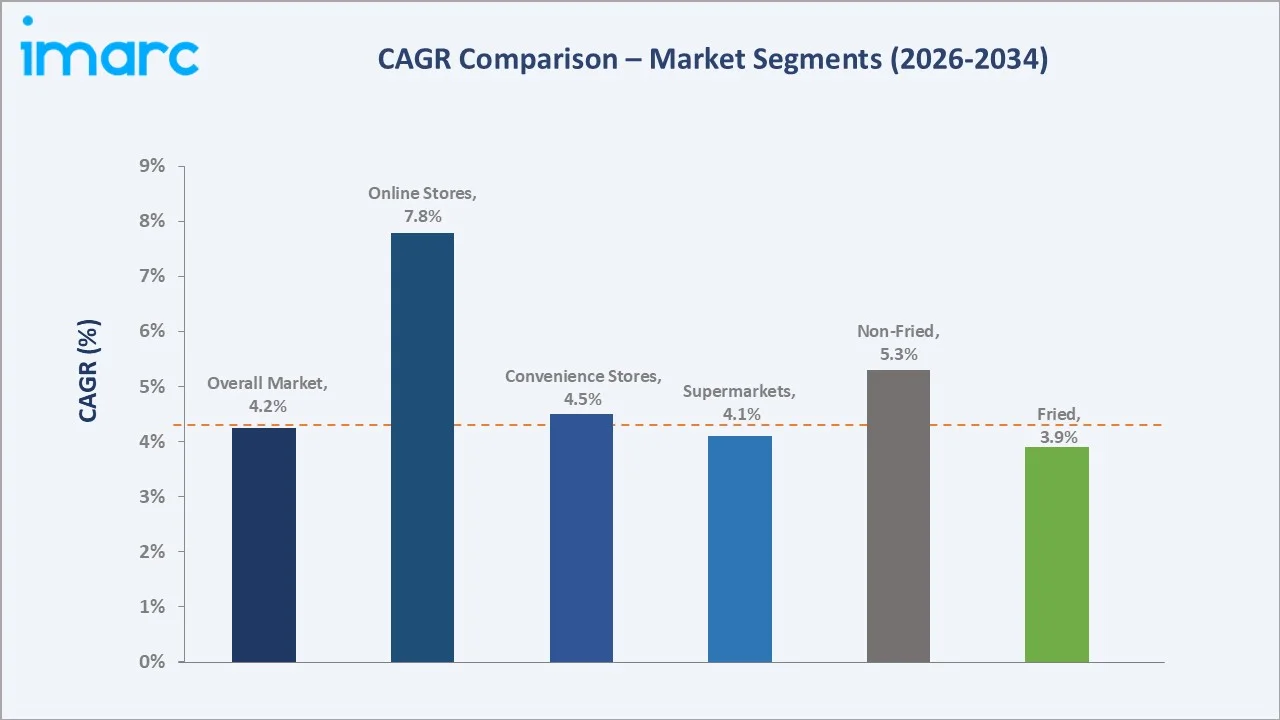
Non-fried grows fastest at ~5.3% CAGR through health-conscious premium Korean ramen. Online grows fastest at ~7.8% CAGR through Amazon Mexico grocery. Convenience stores grow at ~4.5% CAGR through impulse purchase.
Executive Summary
The Mexico instant noodles market is witnessing steady growth, supported by changing eating habits, rising demand for affordable convenience foods, and the increasing preference for quick meal solutions among urban households, students, and working professionals. Expanding retail networks, supermarkets, convenience stores, and online grocery platforms are improving product accessibility across the country. Import activity and the presence of multiple overseas suppliers are widening flavor choices and strengthening product availability. Manufacturers are also benefiting from consumer interest in spicy, ethnic, and value-added noodle variants. With the market projected to reach USD 1,335.0 Million by 2034, growth is expected to remain supported by lifestyle shifts, brand innovation, and the rising penetration of ready-to-cook packaged foods in Mexico. Fried at 72.8% leads through value mass-market. Supermarkets/hypermarkets at 34.6% lead through Walmart and Soriana. Central Mexico leads regionally at 41.3%.
Key Market Insights
|
Insight |
Data |
|
Dominant Type |
Fried - 72.8% share (2025) |
|
Dominant Distribution Channel |
Supermarkets/Hypermarkets - 34.6% market share (2025) |
|
Leading Region |
Central Mexico - 41.3% share (2025) |
|
Market Opportunity |
Non-fried health segment; convenience channel expansion; plant-based noodle innovation; rural low-income Southern Mexico penetration |
Key Analytical Observations Supporting The Above Data:
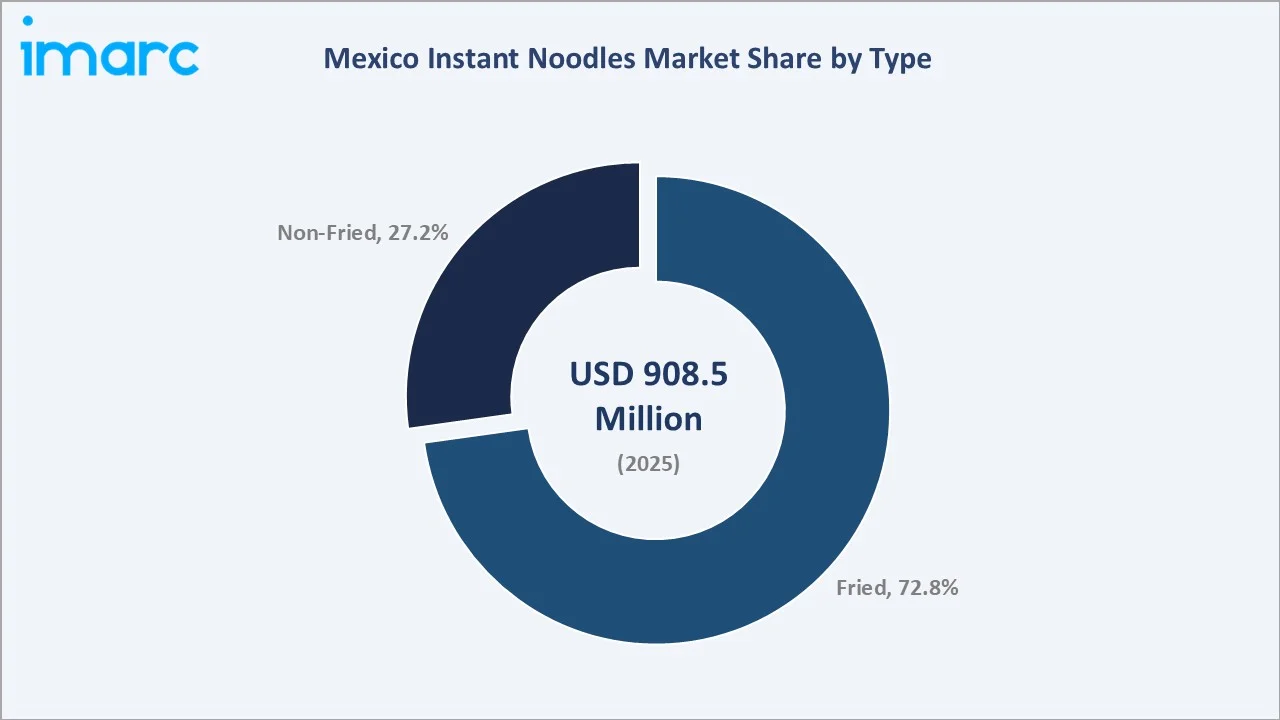
- Fried at 72.8%: The fried noodles dominate the market due to their longer shelf life, lower production cost, and stronger taste/texture appeal compared to non-fried variants. Its affordability and wide availability across convenience stores, supermarkets, and small retail outlets further support high consumer adoption.
- Supermarkets/Hypermarkets at 34.6%: The supermarkets/hypermarkets dominate as these stores offer wide brand visibility, bulk purchase options, frequent discounts, and easy access to multiple flavors and pack sizes. Their strong presence in urban areas also supports higher impulse purchases and regular household stocking.
- Central Mexico at 41.3%: Central Mexico dominates regionally due to its high population density, strong urban consumption base, and concentration of modern retail outlets. Better distribution networks and higher demand for convenient packaged foods further support regional leadership.
Mexico Instant Noodles Market Overview
The Mexico instant noodles market encompasses fried and non-fried noodle products sold through supermarkets/hypermarkets, convenience stores, online channels, and traditional retail outlets. It includes domestic and imported brands offering cup, packet, and bowl formats across various flavors and price points. The market serves urban households, students, working professionals, and consumers seeking affordable, convenient, and quick meal options. Growth is supported by changing lifestyles, wider retail availability, flavor innovation, and rising demand for ready-to-cook packaged foods. Macroeconomic factors include rising urbanization, growth in disposable incomes, and changing work patterns that increase demand for affordable and convenient packaged meals.
Market Dynamics
To evaluate market opportunities, Request Sample
Market Drivers
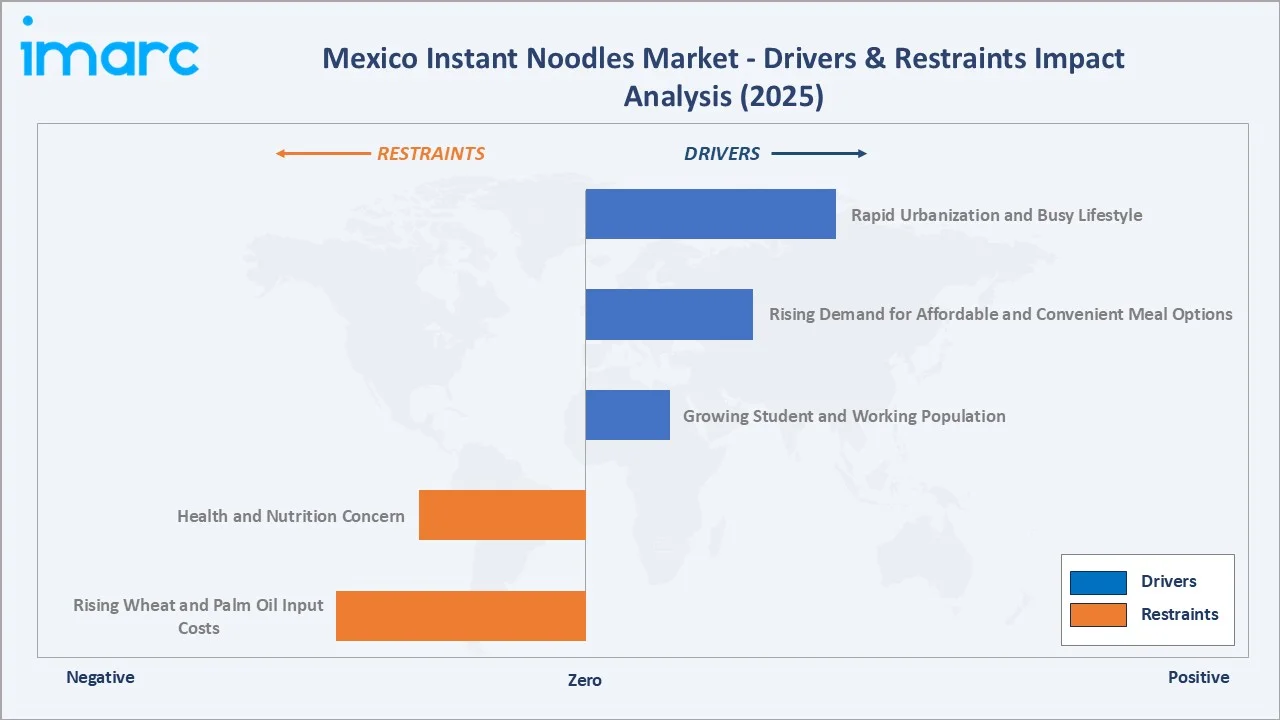
- Rapid Urbanization and Busy Lifestyle: Mexico is one of the most populous countries globally. The urbanisation trend is expected to continue, with approximately 88% of Mexicans projected to live in cities by 2050. Rapid urbanization and busy lifestyles are increasing the demand for quick, affordable, and easy-to-prepare meals among working professionals, students, and urban households. As more consumers face longer work hours, commuting time, and compact living patterns, instant noodles offer a practical meal solution with minimal cooking effort. Urban retail expansion through supermarkets, convenience stores, and online grocery platforms is also improving product accessibility.
- Rising Demand for Affordable and Convenient Meal Options: Rising demand for affordable and convenient meal options is driving the market as consumers increasingly seek low-cost foods that require minimal preparation time. Instant noodles offer an economical alternative to restaurant meals and more time-consuming home-cooked dishes, making them attractive for students, working professionals, and budget-conscious households. Their long shelf life, easy storage, and availability in single-serve packs further support frequent purchases. This affordability-convenience combination is strengthening everyday consumption and expanding the product’s appeal across urban and semi-urban consumers.
- Growing Student and Working Population: In the first quarter of 2025, Mexico’s economically active population stood at 60.5 million. The employed workforce reached 59 million people, comprising 40.7% women and 59.3% men. This growing student and working population is creating strong demand for quick, low-cost, and easy-to-prepare meals. Students and employees often prefer instant noodles due to limited cooking time, tight budgets, and the need for convenient food during study, work, or late hours. Single-serve cups and packets are especially popular for on-the-go consumption and small households.
Market Restraints
- Health and Nutrition Concern: Health and nutrition concerns are hampering the market as consumers become more cautious about high sodium, refined carbohydrates, preservatives, and fried food content. Growing awareness of obesity, heart health, and balanced diets is encouraging some shoppers to reduce consumption of highly processed convenience foods. Parents and health-conscious consumers may also prefer fresher or more nutritious meal alternatives. This is pressuring brands to introduce healthier variants with lower sodium, non-fried noodles, added protein, or fortified ingredients.
- Rising Wheat and Palm Oil Input Costs: Rising wheat and palm oil input costs are increasing production expenses for noodles, seasoning, and fried variants. Since instant noodles are highly price-sensitive, manufacturers may find it difficult to fully pass higher costs on to consumers without affecting demand. This can compress profit margins, reduce promotional flexibility, and limit price competitiveness. Cost volatility may also push brands to reformulate products, adjust pack sizes, or delay expansion plans.
Market Opportunities
- Fortified Noodles with Protein, Fibre, or Added Vegetables: Fortified noodles with protein, fibre, or added vegetables represent a significant opportunity as consumers increasingly seek healthier convenience foods without sacrificing affordability or ease of preparation. Nutrient-enhanced products can help address concerns about the nutritional profile of traditional instant noodles while attracting health-conscious consumers, parents, and younger professionals. Manufacturers can differentiate their brands through functional ingredients, improved nutrition claims, and premium positioning. As awareness of balanced diets continues to grow, fortified noodle offerings can expand the category’s appeal and support higher-value market growth.
- Premium, Spicy, Ethnic, and Fusion Flavor Innovation: Premium, spicy, ethnic, and fusion flavor innovation is an opportunity as consumers increasingly seek bold, differentiated, and restaurant-style taste experiences at affordable prices. Mexican consumers’ preference for spicy flavors can support demand for chilli-based, regional, and Asian-Mexican fusion variants. Premium flavors also allow brands to attract younger consumers and command higher margins.
Market Challenges
- Strong Competition from Other Convenient Packaged Foods: Strong competition from other convenient packaged foods is challenging, as consumers have several quick-meal alternatives, including frozen foods, ready-to-eat meals, canned soups, snacks, and bakery products. These substitutes often compete on convenience, taste, nutrition, and price, limiting instant noodles’ share of household food spending. Healthier or more filling packaged meal options may also attract consumers seeking better nutrition.
- Dependence on Imported Ingredients and Overseas Brands: Dependence on imported ingredients and overseas brands exposes companies to currency fluctuations, shipping delays, import duties, and global supply chain disruptions. Reliance on foreign suppliers can affect product availability and raise costs, especially for wheat-based inputs, palm oil, seasonings, and branded finished goods. This can make pricing less stable in a price-sensitive market. It also limits local manufacturers’ control over supply continuity, margins, and product customization.
Emerging Market Trends
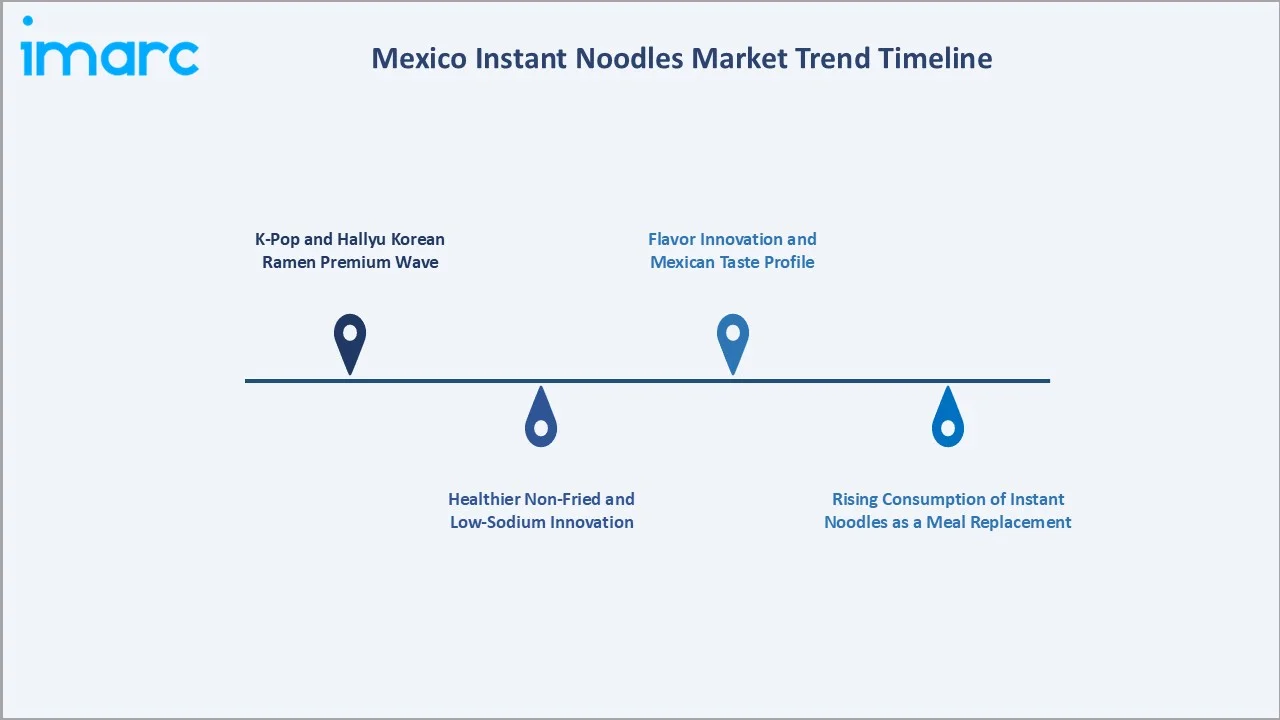
1. K-Pop and Hallyu Korean Ramen Premium Wave
K-Pop and Hallyu Korean ramen premium wave is emerging as Korean pop culture, dramas, and social media food content increase consumer curiosity for authentic Korean ramen. Spicy ramen challenges, mukbang videos, and Korean convenience-store culture are encouraging younger consumers to try premium imported noodle brands. This trend supports higher-value purchases, especially for bold flavors such as buldak, kimchi, seafood, and cheese ramen. As a result, Korean-style instant noodles are helping expand the category beyond basic convenience into an aspirational, experience-led food segment.
2. Healthier Non-Fried and Low-Sodium Innovation
Healthier non-fried and low-sodium innovations are emerging as consumers become more aware of nutrition, obesity, and heart-health concerns. Brands are responding by introducing baked or air-dried noodles, reduced-sodium seasoning, and cleaner-label formulations. These variants help attract health-conscious consumers who want convenience without excessive salt or oil content. This trend also supports premium positioning and allows manufacturers to differentiate themselves from traditional fried instant noodles.
3. Rising Consumption of Instant Noodles as a Meal Replacement
Mexico recorded 1,609 million servings of instant noodles in 2024. Rising consumption of instant noodles as a meal replacement is emerging as consumers increasingly use noodles for quick lunches, dinners, and late-night meals rather than only as snacks. Busy work schedules, student lifestyles, and urban commuting patterns are encouraging demand for filling, low-cost, and easy-to-prepare meal options. Cup and bowl formats further support this trend by enabling convenient consumption at offices, campuses, and small households. This shift is expanding usage occasions and strengthening repeat purchases across retail channels.
4. Flavor Innovation and Mexican Taste Profile
Flavor innovation and Mexican taste profile are emerging as brands adapt products to local preferences for spicy, tangy, and bold flavors. Variants inspired by chili, lime, tomato, cheese, birria, taco, and salsa-style seasonings can increase consumer appeal and encourage repeat purchases. This localization helps instant noodles compete with familiar Mexican snack and meal flavors. It also enables brands to differentiate products, attract younger consumers, and expand beyond basic convenience-led consumption.
Industry Value Chain Analysis
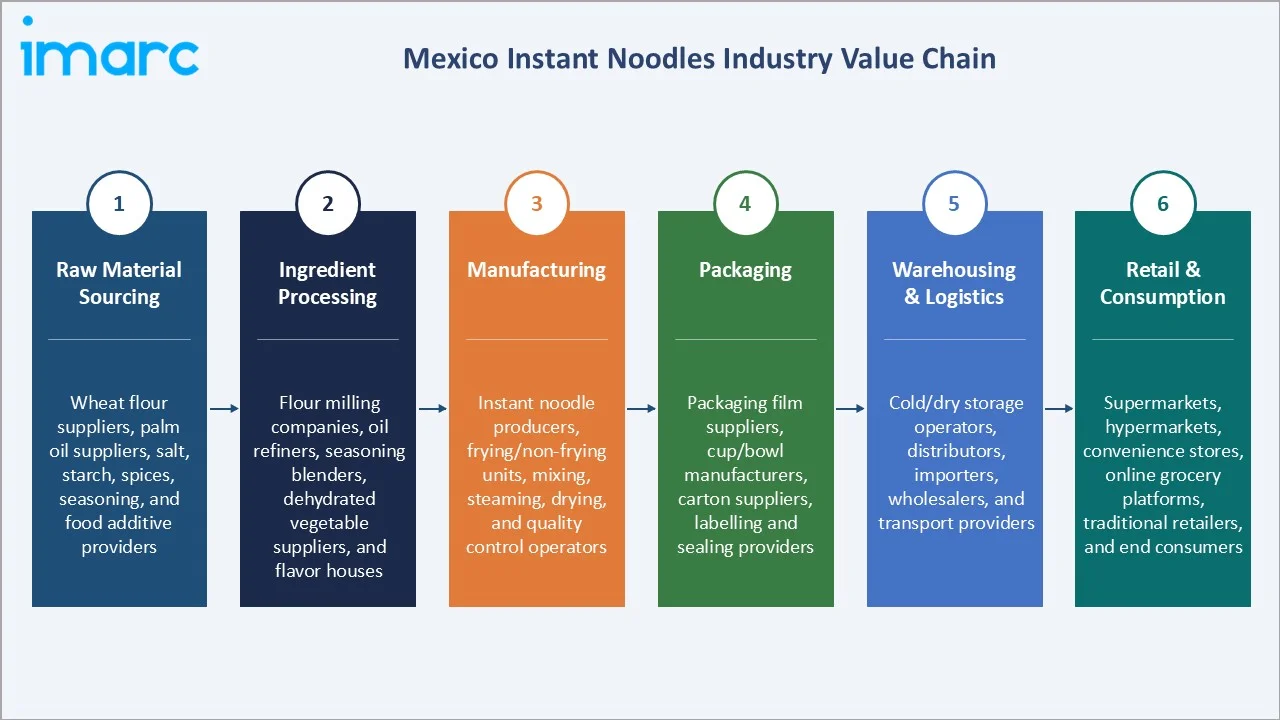
Mexico instant noodles value chain integrates raw material sourcing, ingredient processing, manufacturing, packaging, warehousing & logistics, and retail & consumption.
|
Stage |
Key Participants |
|
Raw Material Sourcing |
Wheat flour suppliers, palm oil suppliers, salt, starch, spices, seasoning, and food additive providers |
|
Ingredient Processing |
Flour milling companies, oil refiners, seasoning blenders, dehydrated vegetable suppliers, and flavor houses |
|
Manufacturing |
Instant noodle producers, frying/non-frying units, mixing, steaming, drying, and quality control operators |
|
Packaging |
Packaging film suppliers, cup/bowl manufacturers, carton suppliers, labelling and sealing providers |
|
Warehousing & Logistics |
Cold/dry storage operators, distributors, importers, wholesalers, and transport providers |
|
Retail & Consumption |
Supermarkets, hypermarkets, convenience stores, online grocery platforms, traditional retailers, and end consumers |
The manufacturing stage is typically the most value-added stage in the Mexico instant noodles value chain. This is where companies create product differentiation through recipe formulation, flavor innovation, seasoning development, processing technology, quality control, and brand positioning, enabling them to command higher margins and build consumer loyalty.
Technology Landscape in the Mexico Instant Noodles Industry
Continuous Steaming and Noodle Forming Technology
Continuous steaming and noodle forming technology enables uniform noodle texture, consistent cooking quality, and large-scale production efficiency. Automated forming systems help control noodle thickness, shape, and portion size, reducing product defects and improving standardization. Continuous steaming also enhances starch gelatinization, which supports better rehydration and mouthfeel after preparation. This technology helps manufacturers improve output, reduce processing time, and maintain consistent quality across high-volume retail products.
In-booth Product Sampling Technology
In-booth product sampling technology allows brands to create direct tasting experiences at festivals, malls, supermarkets, and cultural events. Through on-site cooking machines, controlled preparation systems, and live demonstrations, companies can showcase product taste, aroma, convenience, and preparation speed. Thousands of visitors in Mexico City are sampling Korea’s popular spicy noodles as Nongshim strengthens its international marketing efforts. The company is running a Shin Ramyun promotional booth at Campo Marte 26, a major Mexico City festival held from June 11 to July 19, 2026. The event features Mexican food, cultural activities, art exhibitions, concerts, and fan engagements, attracting both local and international crowds. At the booth, visitors can taste Shin Ramyun prepared through instant noodle cooking machines installed at the festival site. This technology helps convert consumer curiosity into trial, especially for premium or imported ramen brands.
Sustainable and Recyclable Packaging Technology
Sustainable and recyclable packaging technology is shaping the market as brands seek to reduce plastic waste and improve environmental positioning. Companies are exploring recyclable films, paper-based cups, lighter packaging, and mono-material structures that support easier recovery and recycling. These solutions help brands respond to consumer and retailer pressure for more sustainable packaged foods. Packaging innovation also supports better shelf appeal, product protection, and differentiation in supermarkets, convenience stores, and online channels.
Market Segmentation Analysis
The report covers the following segments:
|
Segment Category |
Leading Segment |
Market Share |
Year |
|
Type |
Fried |
72.8% |
2025 |
|
Distribution Channel |
Supermarkets/Hypermarkets |
34.6% |
2025 |
|
Region |
Central Mexico |
41.3% |
2025 |

By Type
Fried leads at 72.8% (2025), due to its strong taste appeal, quick rehydration, longer shelf life, and cost-efficient production. Its affordable pricing and wide availability make it the preferred choice among mass-market consumers.
To access detailed market analysis, Request Sample
Non-fried at 27.2% grows fastest at ~5.3% CAGR through health-conscious consumers as it offers lower oil content and supports demand for cleaner, better-for-you instant noodle options. Its appeal is rising through air-dried and baked formats, reduced-fat positioning, and premium product innovation.
By Distribution Channel
Supermarkets/hypermarkets lead at 34.6% (2025), due to their wide product assortment, strong brand visibility, and frequent promotional offers. These outlets support bulk buying, household stocking, and easy comparison across flavors, pack sizes, and imported brands.
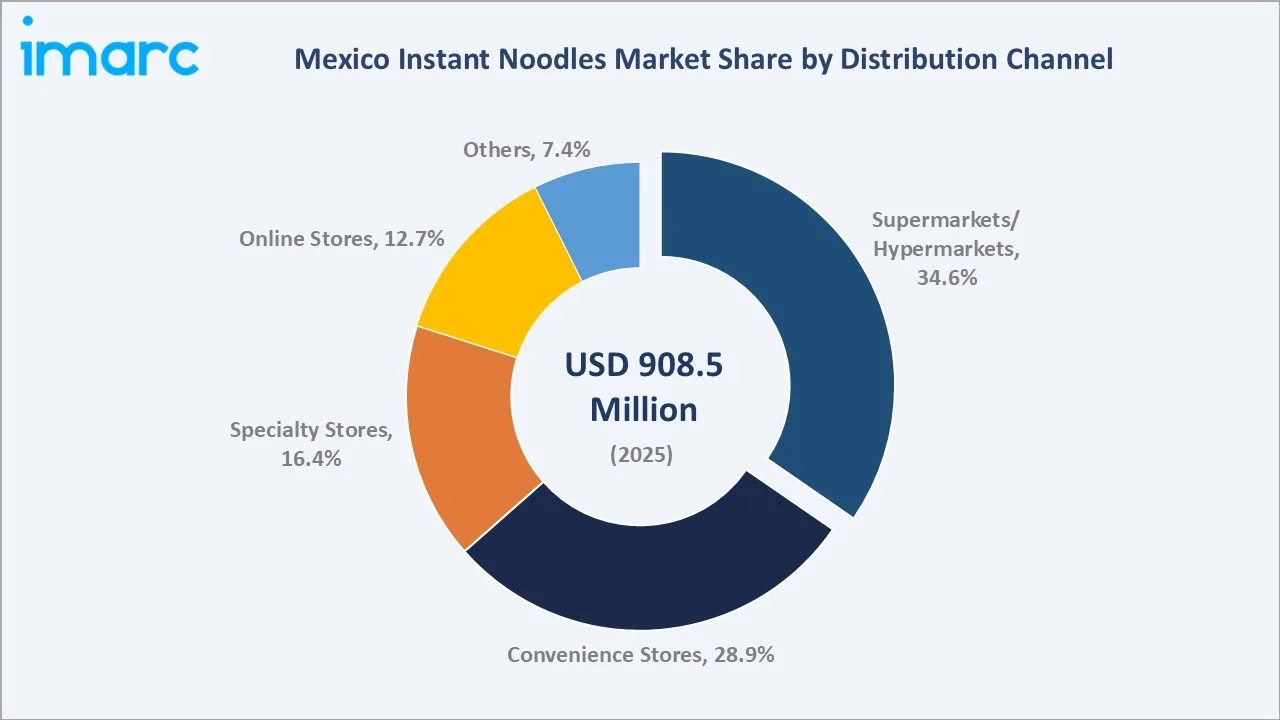
Convenience stores at 28.9% through impulse purchase. Specialty stores at 16.4%. Online at 12.7% grows fastest at ~7.8% CAGR through Amazon Mexico. Others at 7.4% include food service, school cafeteria, and vending.
Regional Market Insights
|
Region |
Share (2025) |
Key Mexico Instant Noodles Market Drivers & Characteristics |
|
Central Mexico |
41.3% |
Driven by high population density, strong urbanization, extensive supermarket and convenience store networks, and a large concentration of students and working professionals seeking convenient meal solutions. |
|
Northern Mexico |
32.8% |
Reflects higher disposable incomes, strong modern retail penetration, proximity to international food trends, and growing demand for premium, imported, and Korean-style instant noodles. |
|
Southern Mexico |
17.1% |
Supported by increasing urbanization, rising affordability of packaged foods, expanding retail access, and growing adoption of convenient meal options among younger consumers. |
|
Others |
8.8% |
Other regions, including the Bajío, Gulf Coast, Yucatán Peninsula, and Pacific Coast, contribute through improving retail infrastructure, expanding convenience-store presence, tourism-driven consumption, and increasing awareness of branded packaged foods. |
Central Mexico's 41.3% dominance is supported by high population density, strong urban lifestyles, and wider access to supermarkets, convenience stores, and online grocery platforms. Northern Mexico's 32.8% due to higher disposable incomes, modern retail penetration, and exposure to imported food trends.
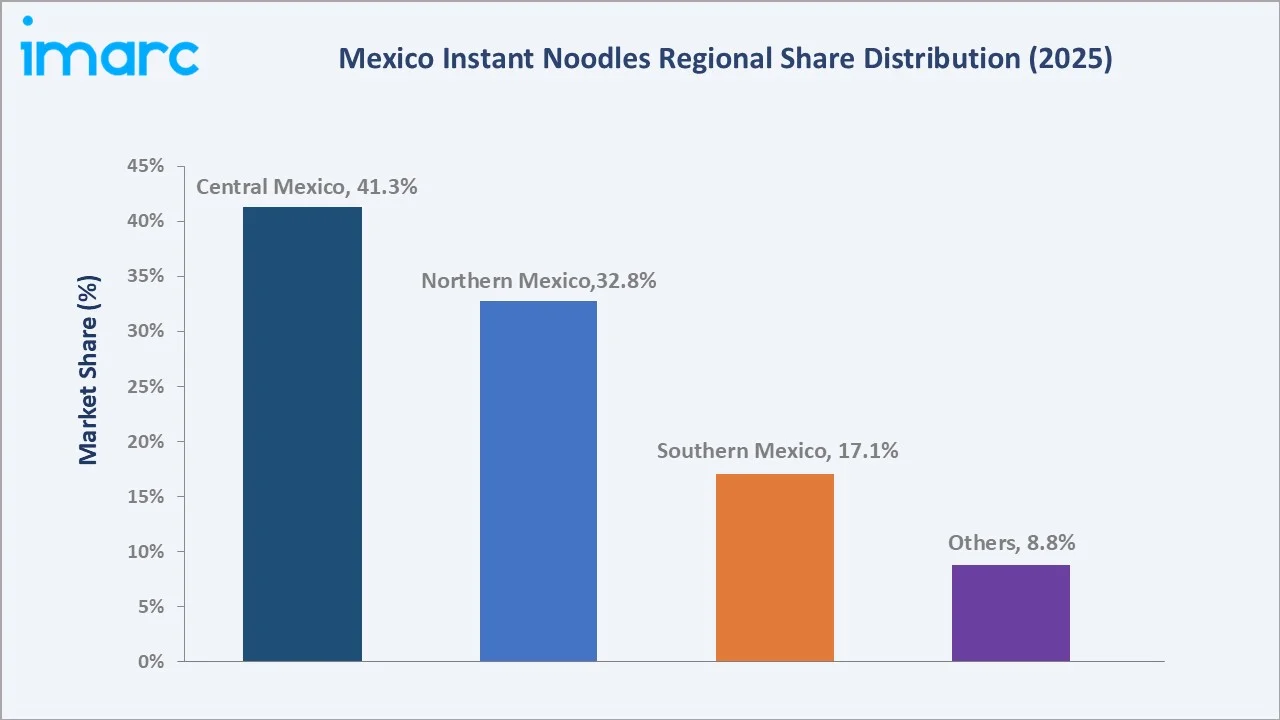
Southern Mexico's 17.1% gaining traction as packaged food affordability improves and urban consumption expands. Others at 8.8%, including the Bajío, Gulf Coast, Yucatán Peninsula, and Pacific Coast, contribute through tourism, improving retail infrastructure, and rising demand for quick meal options.
Competitive Landscape
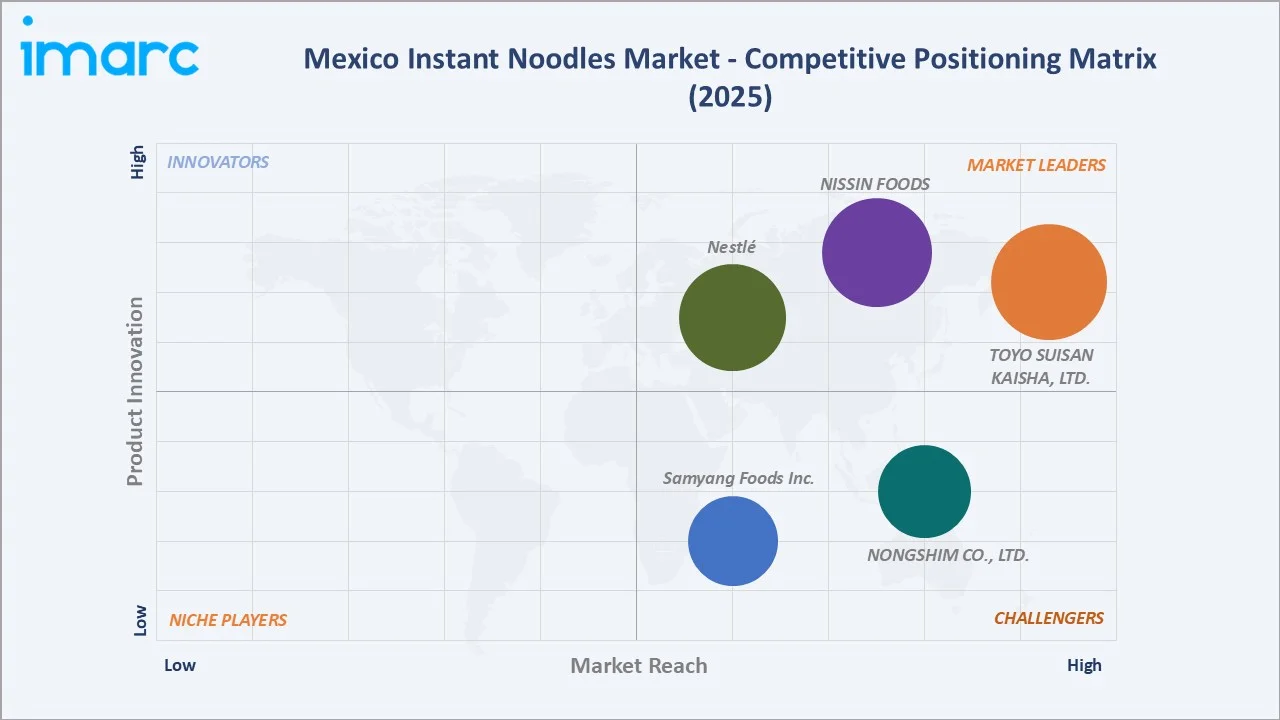
The Mexico instant noodles market is moderately competitive, with both international ramen brands and domestic packaged food players competing across price, flavor, and distribution reach. Leading companies focus on spicy, ethnic, Korean-style, and Mexican taste-inspired variants to attract younger and urban consumers. Supermarkets, hypermarkets, convenience stores, and online grocery platforms remain key battlegrounds for shelf visibility and promotions.
|
Company |
Key Brands |
Market Position |
Core Strength |
|
TOYO SUISAN KAISHA, LTD. |
Maruchan |
Market Leader |
TOYO SUISAN KAISHA, LTD. is a Japanese food manufacturer that dominates the Mexican instant noodle market through its flagship Maruchan brand. By localizing flavors, establishing regional manufacturing, and capitalizing on consumer demand for convenient meals, the company commands a massive portion of Mexico's instant food industry. |
|
NISSIN FOODS |
Cup Noodles, Top Ramen |
Market Leader |
NISSIN FOODS acts as a pioneering market leader in the Mexican instant noodle industry, driving local production, product localization, and market expansion. |
|
Nestlé |
MAGGI |
Market Leader |
Nestlé shapes the Mexican instant noodles market primarily through its recognized brand, Maggi. By capitalizing on consumer trends like urbanization and the demand for affordable, convenient meals, Nestlé provides a variety of quick-preparation noodle products and savory seasonings that are staples in Mexican households. |
|
NONGSHIM CO., LTD. |
Shin Ramyun |
Strong Challenger |
NONGSHIM CO., LTD. is the primary driver of premium, spicy Korean instant noodles in Mexico. While the Mexican market is historically dominated by budget-friendly, value-led bag noodles, Nongshim acts as the premier pioneer, popularizing authentic, thick-noodled broths like its flagship Shin Ramyun. |
|
Samyang Foods Inc. |
Buldak |
Strong Challenger |
Samyang Foods Inc. has transformed the instant noodle market in Mexico by introducing extreme spicy flavor profiles, viral social media trends and creating localized products. Their Buldak Ramen serves as the industry standard for fiery stir-fried instant noodles in the country. |
Imported Asian brands are strengthening premium positioning, while mass-market brands compete through affordability and multipack formats. Competition is also increasing around healthier, non-fried, low-sodium, and fortified products. Overall, brand differentiation, flavor innovation, retail access, and pricing strategy define the competitive landscape.
Key Company Profiles
TOYO SUISAN KAISHA, LTD.
TOYO SUISAN KAISHA, LTD. is a leading Japanese food manufacturer best known globally for its Maruchan brand of instant noodles. The company has established a strong presence across North America and Latin America through a broad portfolio of instant ramen, cup noodles, and packaged convenience foods. In Mexico, Maruchan is one of the most recognized instant noodle brands, benefiting from extensive distribution across supermarkets, hypermarkets, convenience stores, and traditional retail outlets.
- Key Brands: Maruchan.
- Strategic Focus: Strengthening the Maruchan brand through affordability, mass-market reach, and strong retail penetration. The company focuses on expanding flavor varieties suited to Mexican taste preferences, including spicy and savoury options that support repeat consumption.
NISSIN FOODS
NISSIN FOODS is a major instant noodle company known for Cup Noodles and Top Ramen. In Mexico, the company competes in the instant noodles market through convenient cup and packet formats targeting urban consumers, students, and working professionals. Its strength lies in product innovation, international brand recognition, and wide flavor variety.
- Key Brands: Cup Noodles, Top Ramen.
- Strategic Focus: Centered on expanding its cup and packet noodle portfolio through convenience, flavor variety, and global brand recognition. The company targets urban consumers, students, and working professionals with quick, affordable, and easy-to-prepare meal options.
Market Concentration Analysis
The Mexico instant noodles market is moderately concentrated, with a few leading international brands holding strong shelf presence across supermarkets, hypermarkets, and convenience stores. Maruchan maintains high consumer recognition and mass-market reach, while Nissin and Korean ramen brands compete through cup formats, premium positioning, and flavor innovation. Smaller imported and private-label players are expanding through online retail and ethnic food channels. Competition is strongest in fried noodles, cup noodles, spicy flavors, and value packs. Overall, brand recall, distribution depth, pricing, and localized flavor development remain the main concentration drivers.
Investment & Growth Opportunities
Highest Growth Segments
Online stores (~7.8% CAGR), non-fried (~5.3% CAGR through health), convenience stores (~4.5% CAGR), Korean premium (~8-10% CAGR from growing base), and plant-based noodle (~10-12% CAGR from emerging base) represent Mexico instant noodles highest-growth investment vectors through 2034.
Investment Themes
- Korean premium ramen: Rising interest in Korean culture, K-pop, and spicy Asian cuisine is driving demand for premium Korean ramen, creating opportunities for imported brands, specialty flavors, and higher-margin product segments.
- Non-fried health and low-sodium: Growing health awareness is increasing demand for non-fried, reduced-fat, and low-sodium instant noodles, encouraging investment in healthier formulations, air-dried processing technologies, and premium wellness-oriented products.
Future Market Outlook (2026-2034)
Mexico instant noodles market is projected to grow from USD 908.5 Million in 2025 to USD 1,335.0 Million by 2034, delivering a 4.24% CAGR over the forecast period through value affordability, structural demand, convenience channel expansion, Korean K-Pop premium disruption, non-fried health segment growth, and online e-commerce Korean grocery. The market's anchor value of USD 1,118.0 Million in 2030 represents Mexico instant noodles at the K-Pop mainstream and online inflection.
Three structural forces define Mexico instant noodles growth through 2034. First, continued urbanization and increasingly busy lifestyles are driving demand for quick, convenient meal solutions among students, professionals, and smaller households. Second, affordability remains a key advantage, with instant noodles offering a low-cost food option amid ongoing cost-of-living pressures. Third, product innovation, including Korean-style ramen, spicy flavors, healthier non-fried variants, and fortified formulations, is expanding consumer appeal beyond traditional users.
Research Methodology
Primary Research
Primary research comprised interviews with instant noodle manufacturers, distributors, retailers, importers, and foodservice participants across Mexico. It also included discussions with supermarket buyers, convenience-store operators, and industry experts to assess demand patterns, pricing, product preferences, and regional consumption trends. Consumer-level inputs were used to understand flavor preferences, purchase frequency, health concerns, and adoption of premium or Korean-style ramen products.
Secondary Research
Secondary research encompassed company websites, annual reports, trade databases, import shipment records, retail listings, and industry publications. It also reviewed macroeconomic indicators, urbanization data, food consumption trends, and packaged food market reports. Public sources, news articles, and product launch updates were used to validate competitive activity, innovation trends, and regional market dynamics.
Forecasting Models
Forecasting models combined historical market performance, consumption trends, retail sales patterns, and pricing dynamics to estimate future demand for instant noodles in Mexico. The analysis incorporated macroeconomic indicators such as population growth, urbanization, disposable income, and workforce expansion. Market forecasts also considered product innovation, distribution channel development, and evolving consumer preferences toward convenience and premium noodle products.
Mexico Instant Noodles Market Report Coverage:
| Report Features | Details |
|---|---|
| Base Year of the Analysis | 2025 |
| Historical Period | 2020-2025 |
| Forecast Period | 2026-2034 |
| Units | Million USD |
| Scope of the Report |
Exploration of Historical Trends and Market Outlook, Industry Catalysts and Challenges, Segment-Wise Historical and Future Market Assessment:
|
| Types Covered | Fried, Non-Fried |
| Distribution Channels Covered | Supermarkets/Hypermarkets, Specialty Stores, Convenience Stores, Online Stores, Others |
| Regions Covered | Northern Mexico, Central Mexico, Southern Mexico, others |
| Companies Covered | TOYO SUISAN KAISHA LTD., NISSIN FOODS, Nestlé, NONGSHIM CO. LTD., Samyang Foods Inc., etc. |
| Customization Scope | 10% Free Customization |
| Post-Sale Analyst Support | 10-12 Weeks |
| Delivery Format | PDF and Excel through Email (We can also provide the editable version of the report in PPT/Word format on special request) |
Key Benefits for Stakeholders:
- IMARC’s industry report offers a comprehensive quantitative analysis of various market segments, historical and current market trends, market forecasts, and dynamics of the Mexico instant noodles market from 2020-2034.
- The research report provides the latest information on the market drivers, challenges, and opportunities in the Mexico instant noodles market.
- Porter's five forces analysis assist stakeholders in assessing the impact of new entrants, competitive rivalry, supplier power, buyer power, and the threat of substitution. It helps stakeholders to analyze the level of competition within the Mexico instant noodles industry and its attractiveness.
- Competitive landscape allows stakeholders to understand their competitive environment and provides an insight into the current positions of key players in the market.
Frequently Asked Questions About the Mexico Instant Noodles Market Report
The Mexico instant noodles market reached USD 908.5 Million in 2025, driven by rising demand for affordable, quick, and easy-to-prepare meal options among urban consumers, students, and working professionals. Growth is also supported by expanding supermarket and convenience-store networks, increasing popularity of spicy and Korean-style ramen, and product innovation in cup noodles, non-fried variants, and localized flavors.
The Mexico instant noodles market grows at 4.24% CAGR during 2026-2034, reaching USD 1,335.0 Million by 2034. The CAGR reflects value affordability, structural demand, convenience scale, Korean K-Pop premium disruption, non-fried health, and online growth.
Fried leads at 72.8% as it offers strong taste, familiar texture, quick rehydration, and longer shelf life. Its cost-efficient production also supports affordable pricing, making it popular among mass-market consumers.
Supermarkets/hypermarkets lead at 34.6% due to their extensive product assortment, strong brand visibility, and frequent promotional campaigns. These channels offer consumers access to a wide range of local and imported noodle brands, encouraging higher-volume purchases and repeat consumption.
Central Mexico leads at 41.3% due to its dense urban population, strong concentration of students and working professionals, and high demand for convenient meal options. The region also benefits from extensive supermarket, hypermarket, convenience-store, and online grocery networks that support wider product availability and frequent purchases.
Leading companies include TOYO SUISAN KAISHA, LTD., NISSIN FOODS, Nestlé, NONGSHIM CO., LTD., and Samyang Foods Inc., among others.
The market is projected to reach approximately USD 1,118.0 Million by 2030, supported by rising demand for affordable and convenient meal options. Growth will be driven by urban lifestyles, flavor innovation, expanding retail channels, and increasing consumption of cup and premium ramen formats.
Three priority investment opportunities are emerging in the Mexico instant noodles market. First, premium Korean ramen and international flavor offerings are benefiting from growing consumer interest in Asian cuisine and K-culture. Second, non-fried, low-sodium, and fortified noodles present opportunities as health-conscious consumers seek better-for-you convenience foods. Third, flavor innovation tailored to Mexican tastes, including spicy, chili-lime, and fusion variants, offers strong potential for product differentiation and premiumization.
Need more help?
- Speak to our experienced analysts for insights on the current market scenarios.
- Include additional segments and countries to customize the report as per your requirement.
- Gain an unparalleled competitive advantage in your domain by understanding how to utilize the report and positively impacting your operations and revenue.
- For further assistance, please connect with our analysts.
 Request Customization
 Speak to an Analyst
 Request Brochure
 Inquire Before Buying
Benefits of Customization
- Personalize this research
- Triangulate with your data
- Get data as per your format and definition
- Gain a deeper dive into a specific application, geography, customer, or competitor
- Any level of personalization
Get in Touch With Us
UNITED STATES
Phone: +1-201-971-6302
INDIA
Phone: +91-120-433-0800
UNITED KINGDOM
Phone: +44-753-714-6104
Email: [email protected]
Client Testimonials




.webp)




.webp)













Related Reports

Choose your plan
*Please note that the prices mentioned below are starting prices for each bundle type. Kindly contact our team for further details.*
Single User License
- 1 User License, Access on 2 Devices
- PDF Report + Excel Dataset (Password Protected)
- Lifetime Access
- No Printing Rights
- 10% Free Report Customization
- 10–12 Weeks of Analyst Support
Five User License
- Access for 5 Users, 2 Devices per User
- PDF Report + Excel Dataset (Password Protected)
- Lifetime Access
- Dedicated Account Manager
- 12–14 Weeks of Analyst Support
- No Printing Rights
- 15% Free Report Customization
- 25% Discount on Your Next Purchase
Corporate User License
- Unlimited User Access (Within Your Organization)
- PDF Report + Excel Dataset
- Lifetime Access
- Dedicated Account Manager
- 14–20 Weeks of Analyst Support
- No Printing Rights
- 20% Free Report Customization
- 30% Discount on Your Next Purchase
Essential Insights
What's included:
3 reports
- Lifetime Access
- PDF Reports
- Excel Datasets
- 2 Weeks of Free Analyst Support
- 2 User Licenses
- Access on 2 Devices
- Printing Rights
- Complimentary PowerPoint (PPT) Version
- Complimentary License Upgrade
Professional Access
What's included:
5 reports
- Lifetime Access
- PDF Reports
- Excel Datasets
- 8 Weeks of Free Analyst Support
- 2 User Licenses
- Access on 2 Devices
- Printing Rights
- Complimentary PowerPoint (PPT) Version
- Complimentary License Upgrade
Business Advantage
What's included:
8 reports
- Lifetime Access
- PDF Reports
- Excel Datasets
- 14 Weeks of Free Analyst Support
- 2 User Licenses
- Access on 2 Devices
- Printing Rights
- Complimentary PowerPoint (PPT) Version
- Complimentary License Upgrade
Enterprise Intelligence
What's included:
10 reports
- Lifetime Access
- PDF Reports
- Excel Datasets
- 20 Weeks of Free Analyst Support
- 2 User Licenses
- Access on 2 Devices
- Printing Rights
- Complimentary PowerPoint (PPT) Version
- Complimentary License Upgrade