
Mexico Out-of-Home (OOH) Advertising Market Size, Share, Trends and Forecast by Type, Product, Application, End User, and Region, 2026-2034
Mexico Out-of-Home (OOH) Advertising Market Summary:
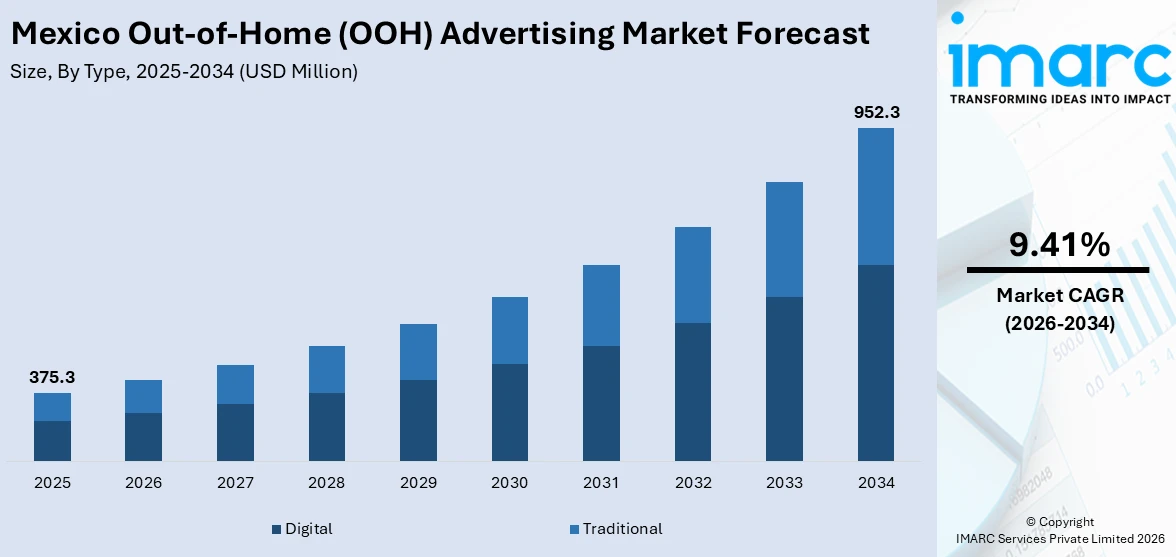
The Mexico out-of-home (OOH) advertising market grew from USD 375.3 Million in 2025 to USD 463.9 Million in 2026 and is projected to reach USD 952.3 Million by 2034, growing at a compound annual growth rate of 9.41% from 2026-2034.
The market is expanding rapidly, driven by accelerating digital transformation of outdoor formats, rising urbanization, and growing demand for programmatic and data-driven campaigns. Retail brands, telecoms, and entertainment companies are intensifying investments across high-footfall locations. Expanding smart city infrastructure, a thriving tourism sector, and deepening consumer mobility further reinforce the market share. Advancements in real-time analytics and audience measurement technologies are also enabling advertisers to optimize campaign effectiveness and maximize return on investment (ROI).
Key Takeaways and Insights:
- By Type: Digital dominates the market with a share of 69.0% in 2025, owing to its dynamic content capabilities, enhanced audience targeting through data analytics, and growing adoption of programmatic advertising across high-traffic urban locations.
- By Product: Billboard advertising prevails the market with a share of 44.2% in 2025, propelled by extensive roadside visibility, urban traffic exposure, consistent impressions, and advertiser preference for impactful large-format displays.
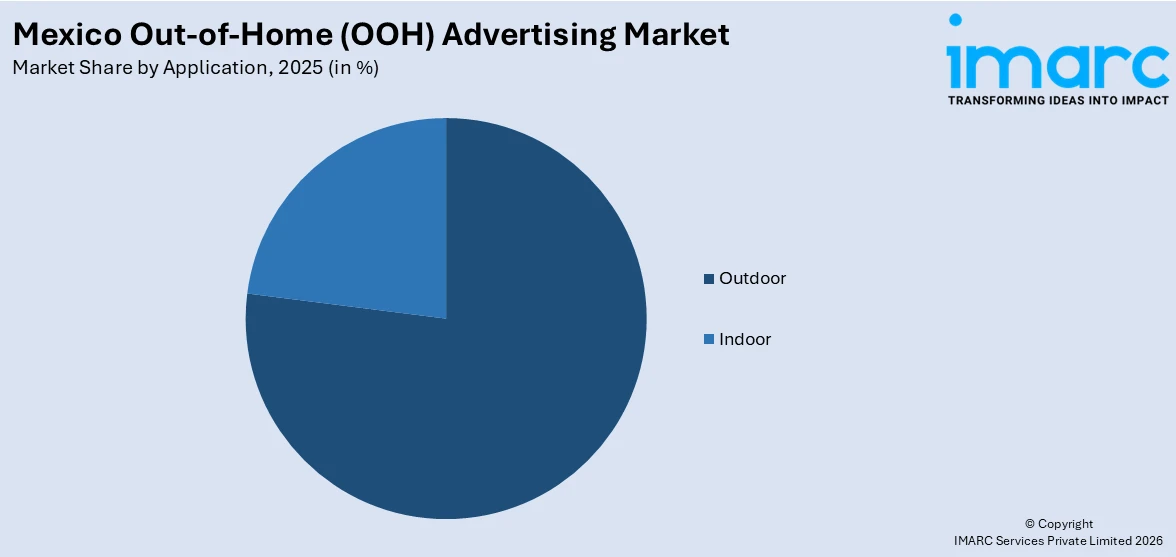
- By Application: Outdoor leads the market with a share of 76.5% in 2025. This dominance reflects the broad reach of roadside, transit, and street-level placements across Mexico's high-density urban corridors that deliver consistent consumer exposure.
- By End User: Retail represents the largest segment with a market share of 32.5% in 2025, reflecting the sector's reliance on high-visibility proximity advertising to drive foot traffic, promote seasonal offers, and build brand recognition near commercial hubs.
- By Region: Central Mexico comprises the largest region with 54.5% share in 2025, driven by the concentration of Mexico's economic activity, consumer population, and premium digital OOH inventory in Mexico City, Guadalajara, and surrounding metropolitan areas.
- Key Players: Key players drive the market by expanding digital inventory, investing in programmatic platforms, and forming strategic partnerships. Their focus on real-time content delivery, data-driven targeting, and national coverage expansion enhances advertiser ROI and accelerates market adoption across diverse end user verticals.
To get more information on this market Request Sample
The market is undergoing a structural transformation, with digital formats displacing traditional static inventory at an accelerating pace across major metropolitan areas. Urbanization is a defining force, with Mexico's urban population continuing to expand, creating denser audience environments that amplify the reach and impact of outdoor placements. Retail corridors, transit hubs, and commercial districts are becoming premium real estate for advertisers seeking consistent, unavoidable brand exposure. The adoption of programmatic buying platforms is enabling more precise targeting, allowing brands to optimize campaigns based on location, time of day, and audience demographics. This shift is attracting advertising spend from sectors, including retail, financial services, telecom, and entertainment, which are leveraging OOH to complement their digital strategies. According to the National Institute of Statistics and Geography (INEGI), Mexico received 45.04 Million international tourists in 2024, representing a 7.4% annual increase, further amplifying demand for premium airport and transit OOH formats.
Mexico Out-of-Home (OOH) Advertising Market Trends:
Rapid Expansion of Digital Out-of-Home (DOOH) Formats
Digital out-of-home formats are proliferating across Mexico's urban landscape, with light emitting diode (LED) screens and programmatic displays replacing static billboards at transit hubs, retail centers, and high-traffic corridors. This digital shift enables real-time content updates, dayparting, and dynamic messaging tied to weather, location, or audience context. The growing availability of automated buying platforms has made DOOH inventory accessible to a broader range of advertisers, significantly increasing the format's contribution to total OOH revenues and transforming campaign planning methodologies nationwide.
Integration of Programmatic Advertising and Data Analytics
The market is rapidly embracing programmatic buying, powered by real-time data integration and automated auction-based inventory management. In April 2024, Vistar Media partnered with PRODOOH to introduce programmatic DOOH advertising in Latin America, beginning operations in Mexico, providing advertisers with advanced targeting tools and demand-side platform access. This integration enables brands to reach specific demographic profiles with contextually relevant messaging, measure campaign attribution more accurately, and allocate media budgets with greater efficiency across geographically dispersed outdoor placements.
Tourism-Driven Demand for Premium OOH Placements
Mexico's thriving tourism sector is generating sustained demand for premium OOH placements at airports, hotel corridors, and destination-adjacent commercial zones. Josefina Rodríguez Zamora, the Secretary of Tourism for the Government of Mexico, announced that January 2026 saw the highest figures, with 8.84 Million visitors arriving in the country, creating a large, captive audience for advertisers across key travel touchpoints. Airport screens, transit media, and destination billboards in cities, such as Cancún, Mexico City, and Los Cabos, are commanding premium rates, with brands in hospitality, consumer goods, and financial services competing for high-visibility placements along tourism corridors.
Market Outlook 2026-2034:
The Mexico out-of-home (OOH) advertising market is positioned for sustained and broad-based growth over the forecast period, underpinned by the continued digitization of outdoor inventory, programmatic adoption, and the expanding role of data analytics in campaign planning. Urbanization trends will continue to drive audience density in major metropolitan areas, supporting higher advertiser demand for impactful placements. The market generated a revenue of USD 375.3 Million in 2025, which is expected to reach USD 463.9 Million in 2026 and further grow to USD 952.3 Million by 2034, at a compound annual growth rate of 9.41% from 2026-2034. Retail, entertainment, and financial services sectors are expected to remain dominant advertisers, while telecom and e-commerce brands will increasingly leverage DOOH for performance-driven campaigns.
Mexico Out-of-Home (OOH) Advertising Market Report Segmentation:
| Segment Category | Leading Segment | Market Share |
|---|---|---|
|
Type |
Digital |
69.0% |
|
Product |
Billboard Advertising |
44.2% |
|
Application |
Outdoor |
76.5% |
|
End User |
Retail |
32.5% |
|
Region |
Central Mexico |
54.5% |
Type Insights:
- Traditional
- Digital
Digital dominates with a market share of 69.0% of the total Mexico out-of-home (OOH) advertising market in 2025.
Digital has become the leading force in Mexico's outdoor advertising environment, generating the majority of market revenue. This domination can be attributed to the format's intrinsic advantages over traditional static media, such as the capacity to optimize delivery in real time, refresh material instantly, and display several creatives on a single screen. The quick expansion of DOOH inventory has been made possible by Mexico's expanding digital infrastructure, which includes enhanced telecom access and the installation of LED displays across upscale metropolitan areas.
The transition to digital formats has been expedited by programmatic buying, which gives marketers access to real-time audience measuring tools and allows them to acquire inventory through automated platforms at reasonable prices. Among Mexico's most active DOOH adopters are retail, financial services, and consumer goods firms, which use dynamic content to match messaging with audience location-based data and purchase activity. The adoption of digital OOH is becoming the main driver of the market growth, due to the integration of digital displays into smart city projects and transit infrastructure, which has increased DOOH's reach beyond traditional billboard forms.
Product Insights:
- Billboard Advertising
- Transport Advertising
- Street Furniture Advertising
- Others
Billboard advertising leads with a market share of 44.2% of the total Mexico out-of-home (OOH) advertising market in 2025.
Billboards maintain dominance, due to their unmatched visibility across high-traffic urban corridors and highways, ensuring repeated exposure to large audiences. Their large-format displays create strong visual impact, making them highly effective for brand-building campaigns. Advertisers value their ability to deliver consistent impressions without reliance on user engagement or digital access. In densely populated cities, billboards act as constant brand reminders, reinforcing recall among commuters. Additionally, their strategic placement near commercial hubs, transit routes, and busy intersections enhances audience reach and strengthens their role as a core advertising medium.
Another key factor is their cost efficiency relative to the scale of exposure they provide. Compared to other formats, billboards offer a lower cost per impression over extended durations, making them attractive for both large brands and regional advertisers. Their flexibility in creative design allows impactful messaging with minimal complexity. Furthermore, advancements, such as digital billboards and programmatic buying, have improved targeting and content rotation, increasing effectiveness. Despite the rise of online channels, billboards remain resilient as a dependable, high-reach medium that complements integrated advertising strategies.
Application Insights:
Access the comprehensive market breakdown Request Sample
- Outdoor
- Indoor
Outdoor prevails the market with a 76.5% share of the total Mexico out-of-home (OOH) advertising market in 2025.
Outdoor commands the largest application share, encompassing billboards, roadside displays, transport media, and street furniture placements across Mexico's expansive urban and semi-urban geographies. The format's dominance reflects the country's high commuter volumes, dense retail corridors, and widespread dependence on road-based mobility, which collectively ensure consistent and repeated audience exposure throughout the day. Mexico City, Monterrey, and Guadalajara, which are the country's three largest metropolitan areas, account for a disproportionate share of outdoor OOH revenue due to their elevated population density and premium inventory availability, with roadside and transit placements along major urban arteries commanding the highest advertiser demand.
In addition, outdoor formats continue to capture a larger portion of advertising investments as brands focus on maximizing reach and maintaining visibility across diverse consumer touchpoints. The presence of well-established inventory networks across both primary and secondary cities supports wider campaign coverage. Growing adoption of digital billboards is also improving flexibility, enabling advertisers to rotate creatives and tailor messaging by time of day. This combination of scale, adaptability, and consistent exposure reinforces outdoor’s strong position within Mexico’s OOH landscape.
End User Insights:
- Retail
- Entertainment and Leisure
- Banking
- Telecom
- Food and Beverage
- Transportation
- Healthcare
- Others
Retail represents the leading segment with a 32.5% share of the total Mexico out-of-home (OOH) advertising market in 2025.
Retail commands the largest share of end user OOH expenditure in Mexico, driven by the category's acute dependence on high-visibility proximity marketing to convert consumer awareness into store visits and transactions. Supermarkets, fashion chains, electronics retailers, and shopping center operators leverage billboard, digital, and street furniture formats to announce promotions, new store openings, and seasonal offers in close geographic proximity to their commercial locations. This approach enables retailers to influence purchase decisions at critical moments near points of sale, strengthening immediate consumer response.
In addition, retailers are increasingly aligning OOH campaigns with broader omnichannel strategies, using outdoor formats to reinforce online promotions and in-store experiences. High-frequency placements near malls, high streets, and transit hubs help maintain constant brand visibility among target consumers. The growing use of digital screens also allows retailers to update offers in real time, synchronize messaging with peak shopping hours, and tailor campaigns based on location-specific demand patterns, further enhancing engagement and conversion potential.
Regional Insights:
- Northern Mexico
- Central Mexico
- Southern Mexico
- Others
Central Mexico exhibits a clear dominance with a 54.5% share of the total Mexico out-of-home (OOH) advertising market in 2025.
Central Mexico's outsized market share reflects its role as the country's economic, commercial, and media hub. Mexico City, the country's capital and most populous metropolitan area, concentrates the majority of premium OOH inventory, including large-format digital billboards, transit media, and street furniture across its high-density urban corridors. As per the World Population Review, the population of Mexico City in 2026 is projected to be 23,016,800. The city's extensive public transportation network, covering metro, bus rapid transit, and pedestrian thoroughfares, provides advertisers with unparalleled daily reach. Guadalajara, the second-largest city, further amplifies the region's advertising base with its thriving technology, retail, and services economy.
In addition, Central Mexico benefits from continuous infrastructure development, expanding road networks, and increasing urbanization, which collectively support higher advertising inventory density. Advertisers are also drawn to the region’s concentration of corporate headquarters, retail hubs, and entertainment districts, enabling efficient multi-location campaign execution. The rising adoption of digital OOH formats across key city zones is further enhancing campaign flexibility, allowing brands to deliver time-sensitive and location-specific messaging at scale.
Market Dynamics:
Growth Drivers:
Why is the Mexico Out-of-Home (OOH) Advertising Market Growing?
Accelerating Digitization of Outdoor Advertising Inventory
The wholesale transition from static to digital OOH formats is the most significant structural driver of the market growth. Digital displays offer advertisers capabilities that traditional print media fundamentally cannot replicate, including multi-creative rotation, dayparting, real-time content adaptation, and remotely managed updates. This flexibility dramatically improves the cost efficiency and creative relevance of OOH campaigns, making the format competitive with digital media in terms of targeting precision and campaign agility. Media owners across Mexico are accelerating capital investments in LED infrastructure, particularly across high-traffic arterial routes, transit environments, and commercial retail zones in Mexico City, Monterrey, and Guadalajara. The convergence of digital inventory with programmatic buying platforms is enabling automated, data-driven media transactions that reduce friction for advertisers and increase yield for publishers. As more advertisers recognize the measurability and scalability of digital OOH, budget allocations are shifting meaningfully from static to digital formats, sustaining upward revenue pressure across the market's technology segment and cementing digitization as the primary growth engine of the market.
Rising Urbanization and Consumer Mobility
Mexico's ongoing urbanization trajectory is creating increasingly dense audience environments that amplify the commercial value of outdoor advertising placements. As more citizens relocate to metropolitan areas in pursuit of employment and services, commuter volumes along key urban routes continue to escalate, delivering higher daily impressions per OOH installation. The country's population, which reached 132 Million in 2024, combined with high urban density in cities, such as Mexico City, Guadalajara, and Monterrey, provides advertisers with unmatched aggregate reach through strategically positioned outdoor media. The shift towards hybrid work schedules has also altered mobility patterns, with consumers spending more time outside their homes during flexible hours, expanding the daily window for effective OOH exposure. Increased public transportation usage, driven by traffic congestion and infrastructure investment in metro and bus rapid transit networks, creates sustained captive audiences in transit environments.
Expansion of the Retail Sector and Tourism Activities
The sustained expansion of Mexico's retail sector is generating consistent growth in OOH advertising demand, as brands seek high-visibility placements in proximity to commercial destinations. As new shopping centers, standalone retail outlets, and brand flagships continue to proliferate across urban and semi-urban areas, the need for outdoor advertising to attract foot traffic and drive consumer awareness is intensifying. Concurrently, Mexico's booming tourism industry represents a powerful amplifier of OOH revenues, particularly across airport, transit, and destination-adjacent placements. Airports in Cancún, Mexico City, and Los Cabos have become among the most premium OOH environments in the country, attracting spend from airlines, hospitality brands, financial services companies, and luxury retailers targeting high-income international travelers. The anticipated co-hosting of the FIFA World Cup 2026 is expected to further amplify tourism-driven OOH demand, creating a near-term catalyst for elevated investment in experiential and large-format digital placements across host cities.
Market Restraints:
What Challenges the Mexico Out-of-Home (OOH) Advertising Market is Facing?
Complex and Fragmented Regulatory Environment
Mexico's out-of-home (OOH) advertising landscape is governed by a patchwork of municipal regulations that vary significantly across cities, creating operational complexity for national advertisers and media owners. Mexico City, in particular, enforces strict controls on motion-based creative in certain environments. The absence of a unified national regulatory framework increases planning timelines, raises compliance costs, and limits the ability of operators to execute standardized national campaigns efficiently, constraining market scalability and advertiser confidence in consistent message delivery across multiple geographic markets.
Intense Competition from Digital and Social Media Advertising
OOH advertising faces persistent competitive pressure from digital and social media platforms, which offer advertisers granular targeting capabilities, real-time performance measurement, and lower minimum entry costs. As a growing share of total advertising budgets flows toward performance-oriented digital channels, OOH operators must continually demonstrate superior reach and complementary ROI to retain and grow advertiser allocations. This competitive dynamic intensifies for traditional static OOH formats, which lack the measurability and adaptability of digital alternatives, placing ongoing pressure on pricing and inventory utilization rates across non-digital outdoor placements within the market.
High Capital Investment Requirements for Digital Infrastructure
The transition from traditional to digital OOH formats demands substantial upfront capital investment in LED display hardware, connectivity infrastructure, and content management software systems. For smaller regional operators and new market entrants, these capital requirements present a significant barrier to participation in the high-growth digital OOH segment. Ongoing maintenance costs, energy expenditure, and the need for frequent technology upgrades further increase the operational burden on media owners seeking to remain competitive, limiting the pace of digital inventory expansion in secondary and tertiary markets where ROI timelines are less certain.
Competitive Landscape:
The Mexico out-of-home (OOH) advertising market is characterized by a moderately concentrated structure, with established operators maintaining significant traditional inventory while technology-driven programmatic platforms are reshaping competitive dynamics. Global and regional media owners are actively expanding digital inventory through infrastructure investments, strategic mergers, and technology partnerships to capture growing DOOH demand. Simultaneously, programmatic-focused players and demand-side technology providers are increasing competitive fragmentation in the digital segment, enabling more advertisers to access premium DOOH inventory through automated platforms. Key players differentiate through portfolio breadth, data analytics capabilities, and programmatic integration, competing for dominant positioning across Mexico's premium metropolitan advertising environments. This evolving landscape is encouraging continuous innovation in measurement standards and audience targeting, further intensifying competition among both traditional operators and digital-first entrants.
Recent Developments:
- In February 2025, JCDecaux México and VIOOH announced the results of a programmatic DOOH campaign launched for the Mazda CX-70 SUV in Mexico City. The campaign utilized strategically placed digital billboards and high-traffic shopping mall screens, leveraging real-time optimization to target consumers aged 45 to 64. The initiative delivered a 17% increase in dealership foot traffic, demonstrating the measurable effectiveness of programmatic DOOH for automotive brand campaigns in Mexico.
Mexico Out-of-Home (OOH) Advertising Market Report Coverage:
| Report Features | Details |
|---|---|
| Base Year of the Analysis | 2025 |
| Historical Period | 2020-2025 |
| Forecast Period | 2026-2034 |
| Units | Million USD |
| Scope of the Report |
Exploration of Historical Trends and Market Outlook, Industry Catalysts and Challenges, Segment-Wise Historical and Future Market Assessment:
|
| Types Covered | Traditional, Digital |
| Products Covered | Billboard Advertising, Transport Advertising, Street Furniture Advertising, Others |
| Applications Covered | Outdoor, Indoor |
| End Users Covered | Retail, Entertainment and Leisure, Banking, Telecom, Food and Beverage, Transportation, Healthcare, Others |
| Regions Covered | Northern Mexico, Central Mexico, Southern Mexico, Others |
| Customization Scope | 10% Free Customization |
| Post-Sale Analyst Support | 10-12 Weeks |
| Delivery Format | PDF and Excel through Email (We can also provide the editable version of the report in PPT/Word format on special request) |
Frequently Asked Questions About the Mexico Out-of-Home (OOH) Advertising Market Report
The Mexico out-of-home (OOH) advertising market size increased from USD 375.3 Million in 2025 to USD 463.9 Million in 2026.
The Mexico out-of-home (OOH) advertising market is expected to grow at a compound annual growth rate of 9.41% from 2026-2034 to reach USD 952.3 Million by 2034.
Digital dominated the market with a share of 69.0%, reflecting strong advertiser preference for programmatic capabilities, real-time content delivery, and superior targeting flexibility across high-traffic urban environments in Mexico.
Key factors driving the Mexico out-of-home (OOH) advertising market include accelerating digitization of outdoor inventory, rapid urbanization, rising tourism activities, retail sector expansion, programmatic buying adoption, and smart city infrastructure development.
Major challenges include a fragmented municipal regulatory environment, intense competition from digital and social media advertising platforms, and high capital investment requirements for transitioning traditional inventory to digital OOH formats across secondary markets.
Need more help?
- Speak to our experienced analysts for insights on the current market scenarios.
- Include additional segments and countries to customize the report as per your requirement.
- Gain an unparalleled competitive advantage in your domain by understanding how to utilize the report and positively impacting your operations and revenue.
- For further assistance, please connect with our analysts.
 Request Customization
 Speak to an Analyst
 Request Brochure
 Inquire Before Buying
Benefits of Customization
- Personalize this research
- Triangulate with your data
- Get data as per your format and definition
- Gain a deeper dive into a specific application, geography, customer, or competitor
- Any level of personalization
Get in Touch With Us
UNITED STATES
Phone: +1-201-971-6302
INDIA
Phone: +91-120-433-0800
UNITED KINGDOM
Phone: +44-753-714-6104
Email: [email protected]
Client Testimonials




.webp)




.webp)













Related Reports

Choose your plan
*Please note that the prices mentioned below are starting prices for each bundle type. Kindly contact our team for further details.*
Single User License
- 1 User License, Access on 2 Devices
- PDF Report + Excel Dataset (Password Protected)
- Lifetime Access
- No Printing Rights
- 10% Free Report Customization
- 10–12 Weeks of Analyst Support
Five User License
- Access for 5 Users, 2 Devices per User
- PDF Report + Excel Dataset (Password Protected)
- Lifetime Access
- Dedicated Account Manager
- 12–14 Weeks of Analyst Support
- No Printing Rights
- 15% Free Report Customization
- 25% Discount on Your Next Purchase
Corporate User License
- Unlimited User Access (Within Your Organization)
- PDF Report + Excel Dataset
- Lifetime Access
- Dedicated Account Manager
- 14–20 Weeks of Analyst Support
- No Printing Rights
- 20% Free Report Customization
- 30% Discount on Your Next Purchase
Essential Insights
What's included:
3 reports
- Lifetime Access
- PDF Reports
- Excel Datasets
- 2 Weeks of Free Analyst Support
- 2 User Licenses
- Access on 2 Devices
- Printing Rights
- Complimentary PowerPoint (PPT) Version
- Complimentary License Upgrade
Professional Access
What's included:
5 reports
- Lifetime Access
- PDF Reports
- Excel Datasets
- 8 Weeks of Free Analyst Support
- 2 User Licenses
- Access on 2 Devices
- Printing Rights
- Complimentary PowerPoint (PPT) Version
- Complimentary License Upgrade
Business Advantage
What's included:
8 reports
- Lifetime Access
- PDF Reports
- Excel Datasets
- 14 Weeks of Free Analyst Support
- 2 User Licenses
- Access on 2 Devices
- Printing Rights
- Complimentary PowerPoint (PPT) Version
- Complimentary License Upgrade
Enterprise Intelligence
What's included:
10 reports
- Lifetime Access
- PDF Reports
- Excel Datasets
- 20 Weeks of Free Analyst Support
- 2 User Licenses
- Access on 2 Devices
- Printing Rights
- Complimentary PowerPoint (PPT) Version
- Complimentary License Upgrade