
Mexico Pesticides Market Size, Share, Trends and Forecast by Product Type, Segment, Formulation, Crop Type, and Region, 2026-2034
Mexico Pesticides Market Size, Share, Trends & Forecast (2026-2034)
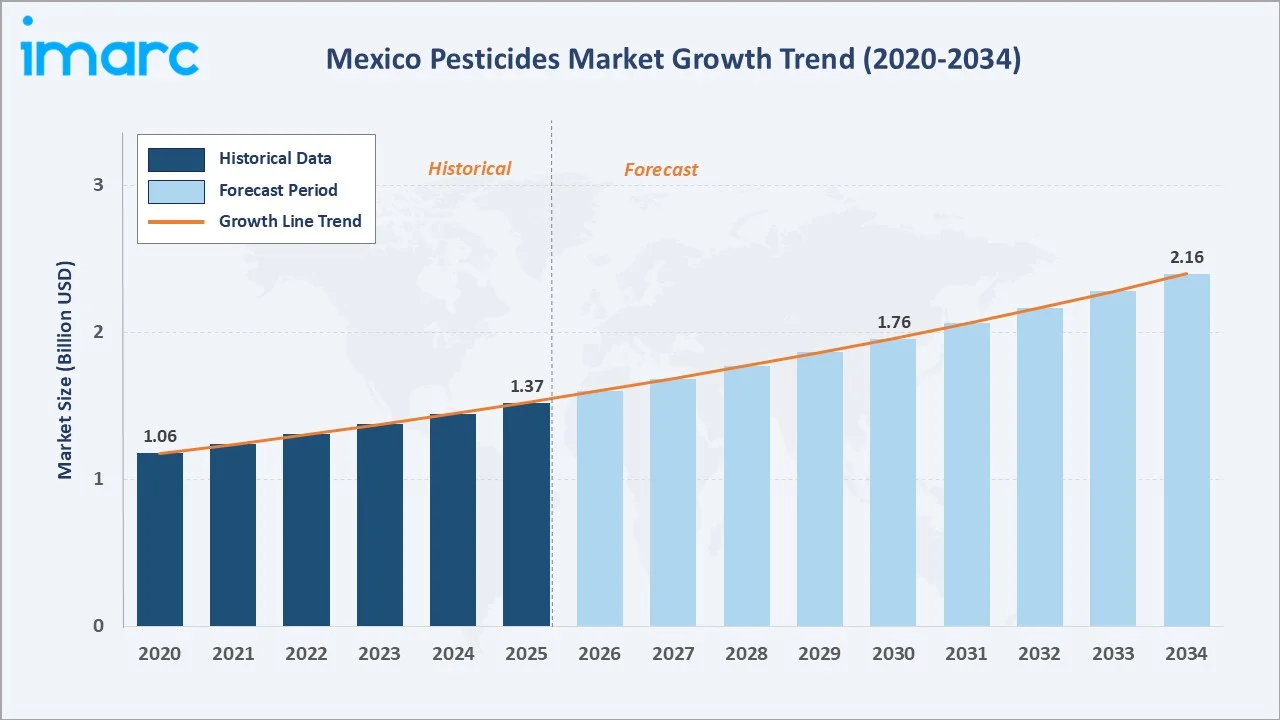
The Mexico pesticides market size increased from USD 1.37 Billion in 2025 to USD 1.44 Billion in 2026 and is projected to reach USD 2.16 Billion by 2034, growing at a CAGR of 5.21% during 2026-2034. The market is driven by rising agricultural production, increasing demand for higher crop yields, and the need to protect crops from pests, diseases, and weeds. Mexico is a major agricultural producer and importer, with agribusiness contributing around 3.5% to GDP and employing more than 12% of the workforce in 2024. The sector is valued at about USD 65 Billion in 2025, supported by Mexico’s position as the world’s 7th-largest agricultural exporter, with key exports including avocados, berries, tomatoes, and tequila. This is driving the market as large-scale crop production and export-oriented farming require effective pest, disease, and weed management. Synthetic pesticides lead the product type at 84.6%. Insecticides lead segment at 38.7%. Central Mexico leads regionally at 39.5%.
Market Snapshot
|
Metric |
Value |
|
Base Year Market Size (2025) |
USD 1.37 Billion |
|
Market Size (2026) |
USD 1.44 Billion |
|
Forecast Market Size (2034) |
USD 2.16 Billion |
|
CAGR (2026-2034) |
5.21% |
|
Base Year |
2025 |
|
Historical Period |
2020-2025 |
|
Forecast Period |
2026-2034 |
|
Dominant Product Type |
Synthetic Pesticides (84.6%, 2025) |
|
Dominant Segment |
Insecticides (38.7%, 2025) |
|
Leading Region |
Central Mexico (39.5%, 2025) |
The Mexico pesticides market grew from USD 1.06 Billion in 2020 to USD 1.37 Billion in 2025, reaching an estimated USD 1.44 Billion in 2026. reflecting steady demand from commercial farming, crop protection, and export-oriented agriculture. It is expected to reach USD 1.76 Billion by 2030, supported by the rising use of herbicides, fungicides, and insecticides to improve crop yield and quality. By 2034, the market is forecast to reach USD 2.16 Billion, driven by high-value crop cultivation, pest pressure, and the adoption of modern farming practices. Overall, the market shows consistent long-term growth as Mexico strengthens its position as a major agricultural producer and exporter.
To get more information on this market, Request Sample
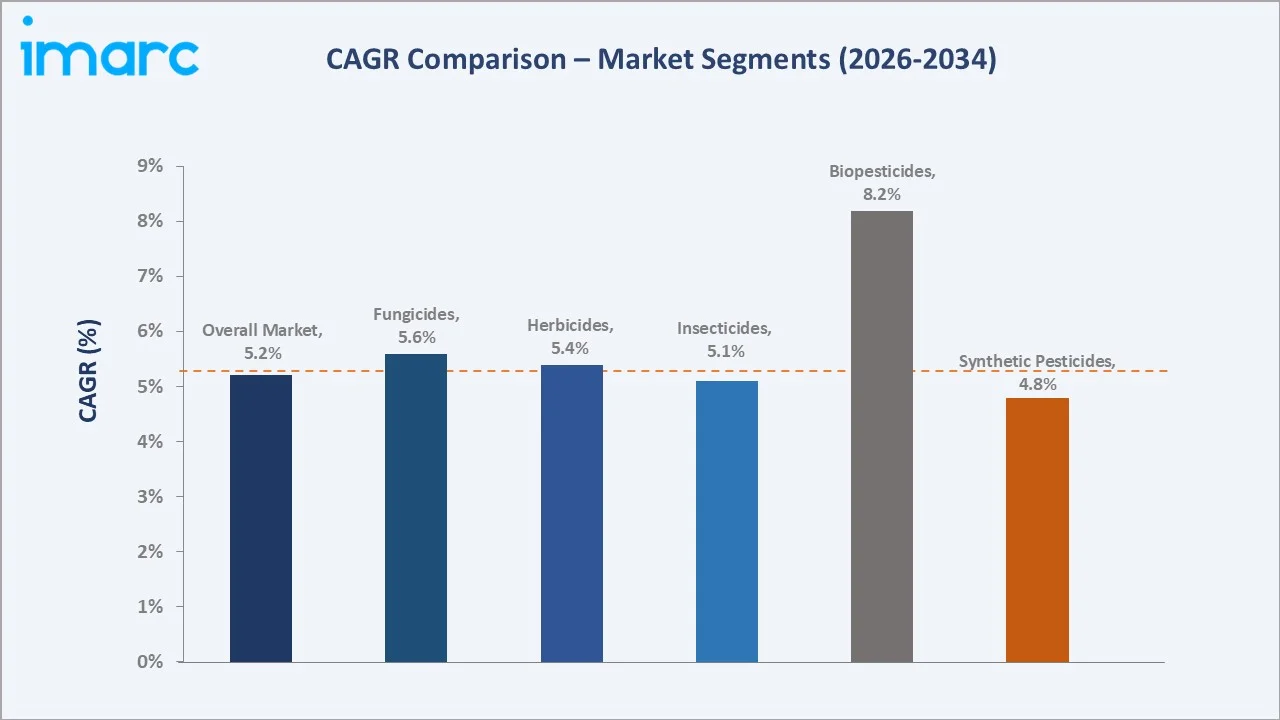
Biopesticides grow fastest at ~8.2% CAGR through organic export requirements and IPM adoption. Fungicides grow at ~5.6% CAGR through avocado Phytophthora and tomato late blight. Herbicides grow at ~5.4% CAGR as glyphosate alternatives replace conventional herbicides.
Executive Summary
The Mexico pesticides market is growing steadily, supported by the country’s large agricultural base and strong export-oriented crop production. Rising cultivation of high-value crops such as avocados, berries, tomatoes, and cereals is increasing the need for effective pest, weed, and disease control. Farmers are adopting herbicides, fungicides, and insecticides to improve yield, crop quality, and farm productivity. Market growth is also supported by modern farming practices, expanding commercial agriculture, and demand for food security. However, regulatory pressure and environmental concerns are encouraging a gradual shift toward safer and more sustainable crop protection solutions. Synthetic pesticides at 84.6% leads through conventional chemistry. Insecticides at 38.7% leads through avocado and vegetable pest control. Central Mexico leads regionally at 39.5%.
Key Market Insights
|
Insight |
Data |
|
Dominant Product Type |
Synthetic Pesticides - 84.6% share (2025) |
|
Dominant Segment |
Insecticides - 38.7% market share (2025) |
|
Leading Region |
Central Mexico - 39.5% share (2025) |
|
Market Opportunities |
Biopesticide avocado and berry export compliance; fungicide avocado Phytophthora; fresh produce residue compliance; glyphosate replacement herbicides; precision application drone spraying; organic Mexico certification |
Key Analytical Observations Supporting the Above Data:
- Synthetic Pesticides at 84.6%: Synthetic pesticides dominate due to their high effectiveness, fast action, broad availability, and established use across major crops. Their cost efficiency and reliable pest, weed, and disease control make them the preferred choice for large-scale commercial farming.
- Insecticides at 38.7%: Insecticides dominate due to the high prevalence of insect pests affecting key crops such as fruits, vegetables, maize, and cotton. Their widespread use helps farmers minimize crop losses, maintain quality standards, and protect yields in both domestic and export-oriented agriculture.
- Central Mexico at 39.5%: Central Mexico dominates regionally due to its strong agricultural base, high concentration of commercial farms, and cultivation of key crops such as maize, vegetables, and fruits. The region’s developed distribution network and access to agrochemical suppliers further support higher pesticide consumption.
Mexico Pesticides Market Overview
The Mexico pesticide market encompasses crop protection products used to control insects, weeds, fungi, and other pests across agricultural and non-agricultural applications. It includes synthetic pesticides, bio-based pesticides, insecticides, herbicides, fungicides, seed treatments, and specialty formulations. The market serves major crops such as maize, fruits, vegetables, berries, avocados, sugarcane, and cereals. Growth is supported by commercial farming, export-oriented agriculture, food security needs, and the adoption of modern pest management practices. Macroeconomic factors include Mexico’s large agricultural base, expanding export-oriented crop production, and rising demand for food security and higher farm productivity.
Market Dynamics
To evaluate market opportunities, Request Sample
Market Drivers
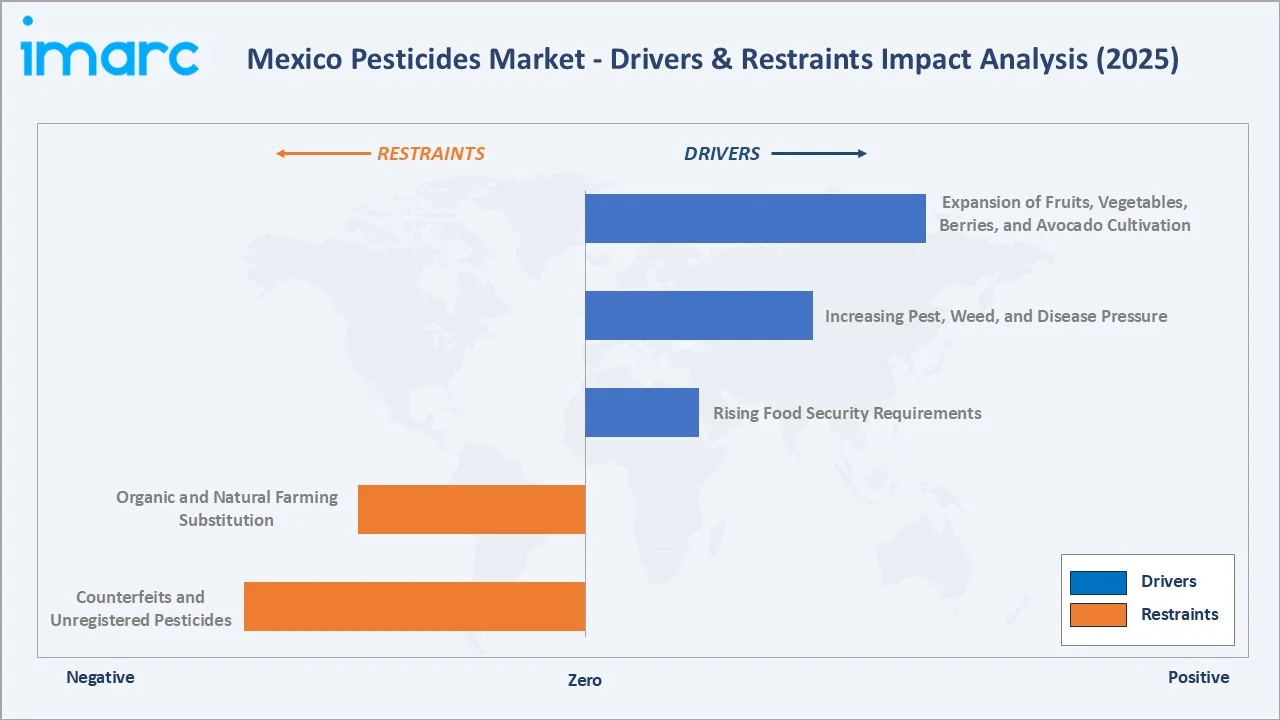
- Expansion of Fruits, Vegetables, Berries, and Avocado Cultivation: Mexico is a major producer and importer of agricultural products, with agribusiness contributing around 3.5% of GDP and supporting over 12% of employment in 2024. Valued at approximately USD 65 Billion. Mexico also ranks as the world’s 7th-largest agricultural exporter, with major exports including avocados, berries, tomatoes, and tequila. Expansion of fruits, vegetables, berries, and avocado cultivation requires intensive protection from insects, fungal diseases, and weeds. Export-oriented produce must meet strict quality, appearance, and residue standards, increasing demand for effective crop protection programs. Farmers use insecticides, fungicides, and herbicides to reduce crop losses and improve yield consistency.
- Increasing Pest, Weed, and Disease Pressure: Increasing pest, weed, and disease pressure is driving the market as farmers need reliable crop protection to reduce yield losses and maintain productivity. Changing weather patterns, intensive farming, and expanding crop cultivation can increase pest outbreaks and fungal infections. This raises demand for insecticides, herbicides, and fungicides across fruits, vegetables, cereals, and export crops. Effective pesticide use helps protect crop quality, ensure stable output, and meet market standards.
- Rising Food Security Requirements: Rising food security requirements are driving the market as farmers need to increase crop output while minimizing losses from pests, weeds, and diseases. Pesticides help protect staple and high-value crops, ensuring a stable supply for domestic consumption and exports. As population demand and food quality expectations rise, growers rely on crop protection products to maintain productivity. This supports continued demand for insecticides, herbicides, fungicides, and integrated pest management solutions.
Market Restraints
- Organic and Natural Farming Substitution: More growers shift toward bio-based inputs, organic pest control, and residue-free cultivation practices. Rising consumer preference for chemical-free food and export-market residue requirements are reducing dependence on conventional synthetic pesticides. Organic farms often use biological controls, neem-based products, microbial pesticides, and integrated pest management instead of broad-spectrum chemicals. This shift limits growth for traditional pesticide products while increasing competition from safer and sustainable crop protection alternatives.
- Counterfeits and Unregistered Pesticides: Counterfeit and unregistered pesticides weaken demand for legitimate branded products and create price pressure for authorized suppliers. These products often bypass quality, safety, and efficacy standards, leading to poor crop protection results and farmer distrust. Their use can also increase risks of crop damage, residue violations, and regulatory penalties, especially for export-oriented growers. This discourages formal market growth and pushes companies to invest more in compliance, traceability, and farmer awareness programs.
Market Opportunities
- Expansion of Pesticide Packaging Waste Collection and Recycling Infrastructure: Expansion of pesticide packaging waste collection and recycling infrastructure supports safer and more sustainable agrochemical use. In June 2026, Geocycle, a Holcim Mexico subsidiary, partnered with Amocali A.C. to expand Mexico’s capacity for handling agricultural chemical packaging waste under the National Strategy for the Management of Empty Pesticide Containers. The initiative aims to strengthen collection and treatment infrastructure, as only 51 out of every 100 agrochemical packages are currently recovered in the country. Through the alliance, up to 2,600 tons per year of triple-washed empty pesticide containers will be processed, helping reduce soil and groundwater contamination and supporting cleanup in highly polluted river basins. It also opens opportunities for partnerships among pesticide companies, recyclers, distributors, and farmer groups.
- Growing Adoption of Biopesticides and Bio-Based Crop Protection Solutions: Growing adoption of biopesticides and bio-based crop protection solutions is an opportunity as farmers increasingly seek safer, low-residue, and environmentally friendly alternatives. These products support organic farming, export compliance, and integrated pest management programs. Rising demand for sustainable agriculture is encouraging companies to develop microbial, botanical, and naturally derived formulations. Biopesticides can also help manage resistance and create premium product segments alongside conventional pesticides.
Market Challenges
- Rising Concerns Over Pesticide Residues in Food Products: Rising concerns over pesticide residues in food products are challenging as consumers, retailers, and export buyers demand safer and lower-residue produce. Growers must follow stricter application limits, pre-harvest intervals, and residue monitoring requirements, which can reduce excessive pesticide use. Export-oriented crops such as berries, avocados, and vegetables face higher compliance pressure from international markets. This pushes manufacturers to develop safer formulations, low-residue products, and biopesticide alternatives.
- Climate Change Affecting Pest Patterns and Application Effectiveness: Climate change affecting pest patterns and application effectiveness is challenging as shifting temperatures, rainfall variability, and extreme weather can alter pest lifecycles and disease outbreaks. Farmers may face new or more frequent infestations, requiring changes in pesticide selection and application timing. Heavy rains can reduce spray effectiveness through runoff or wash-off, while drought conditions may limit product performance. This increases uncertainty for growers and raises the need for adaptive formulations, monitoring tools, and integrated pest management strategies.
Emerging Market Trends
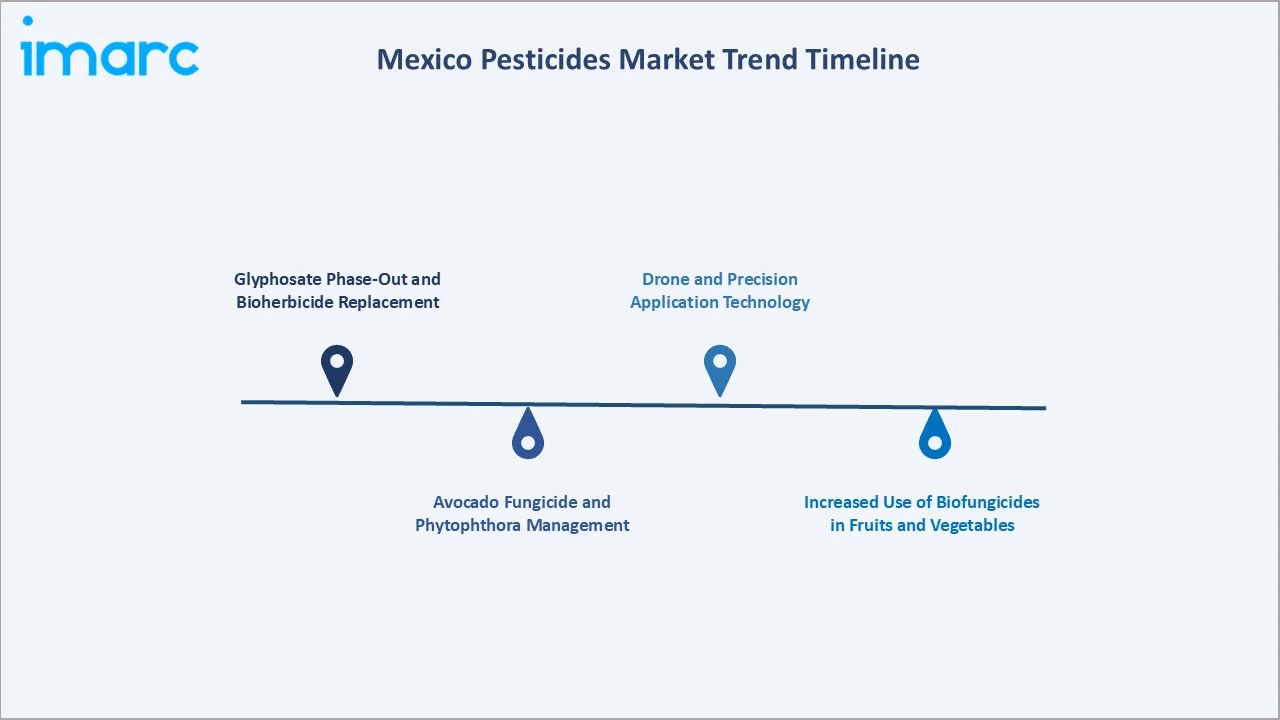
1. Glyphosate Phase-Out and Bioherbicide Replacement
Glyphosate phase-out and bioherbicide replacement are emerging as regulatory pressure and sustainability concerns push farmers to reduce dependence on conventional chemical herbicides. Growers are increasingly exploring bioherbicides, botanical extracts, microbial products, and integrated weed management practices. This shift is creating demand for safer, low-residue alternatives that support organic and export-oriented farming. It also encourages pesticide companies to invest in new formulations, biologically active ingredients, and crop-specific weed control solutions.
2. Avocado Fungicide and Phytophthora Management
Avocado fungicide and Phytophthora management is emerging due to the country’s large avocado production and export base. Avocado orchards require strong disease-control programs, especially against root rot and other fungal infections that affect yield and fruit quality. This is increasing demand for specialized fungicides, soil-health solutions, and integrated disease management products. Export quality requirements are also encouraging growers to adopt targeted, low-residue fungicide programs and preventive crop protection practices.
3. Increased Use of Biofungicides in Fruits and Vegetables
Increased use of biofungicides in fruits and vegetables is emerging as growers seek low-residue solutions for export-oriented crops. Biofungicides help control fungal diseases while supporting organic, sustainable, and integrated pest management practices. In February 2024, Biotor Labs introduced Trichomax and Klamic in Mexico. The products are designed to manage soilborne diseases and nematodes across multiple crops. Trichomax is a biofungicide formulated with Trichoderma asperellum, while Klamic is a bionematicide containing Pochonia chlamydosporia. This trend is creating opportunities for microbial and botanical fungicide formulations tailored to high-value crops.
4. Drone and Precision Application Technology
Drone and precision application technology are emerging as growers seek more accurate, efficient, and cost-effective crop protection methods. Drones, GPS-guided sprayers, and variable-rate application systems help reduce pesticide wastage, improve coverage, and target pest-affected zones more precisely. These technologies are especially useful for large farms, orchards, and high-value crops such as berries, avocados, and vegetables. They also support lower residue levels, better compliance, and improved sustainability in pesticide use.
Industry Value Chain Analysis
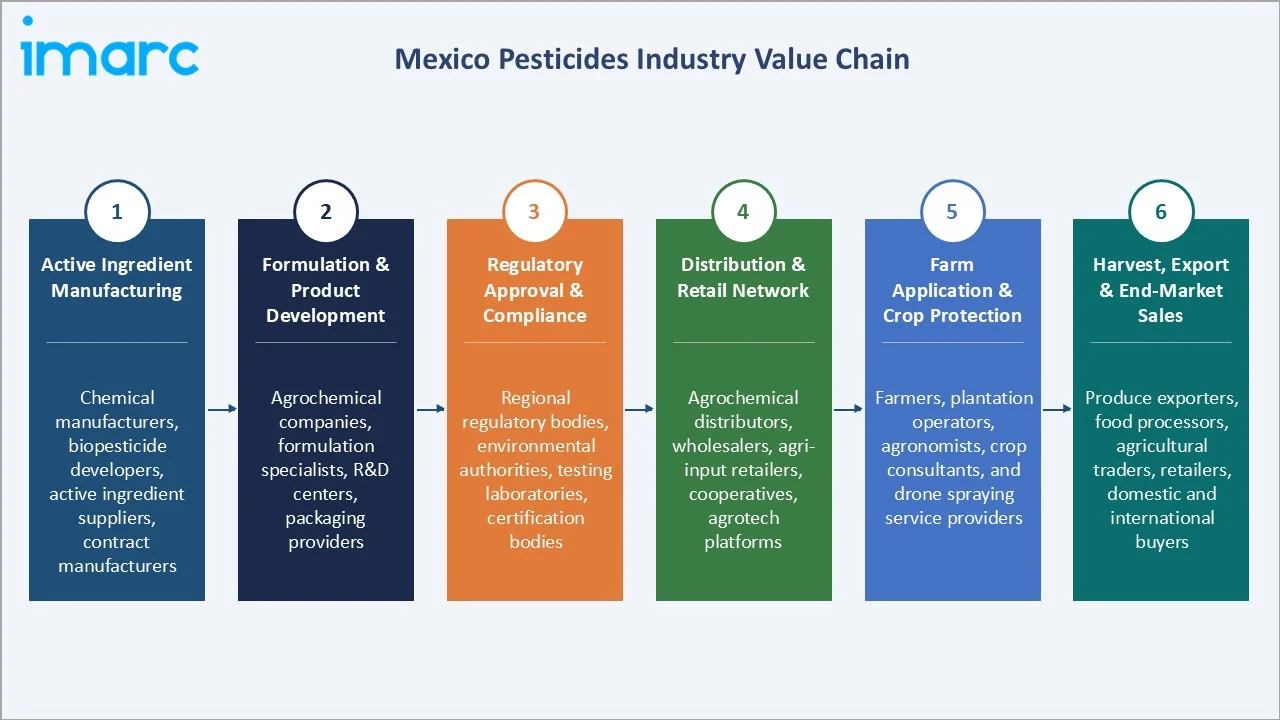
Mexico pesticides value chain integrates active ingredient manufacturing, formulation & product development, regulatory approval & compliance, distribution & retail network, farm application & crop protection, and harvest, export & end-market sales.
|
Stage |
Key Participants |
|
Active Ingredient Manufacturing |
Chemical manufacturers, biopesticide developers, active ingredient suppliers, contract manufacturers |
|
Formulation & Product Development |
Agrochemical companies, formulation specialists, R&D centers, packaging providers |
|
Regulatory Approval & Compliance |
Regional regulatory bodies, environmental authorities, testing laboratories, certification bodies |
|
Distribution & Retail Network |
Agrochemical distributors, wholesalers, agri-input retailers, cooperatives, agrotech platforms |
|
Farm Application & Crop Protection |
Farmers, plantation operators, agronomists, crop consultants, and drone spraying service providers |
|
Harvest, Export & End-Market Sales |
Produce exporters, food processors, agricultural traders, retailers, domestic and international buyers |
The formulation & product development stage is the most value-added stage in the Mexico pesticide value chain. This stage transforms active ingredients into differentiated products with specific efficacy, safety, shelf-life, and crop-targeting characteristics. Innovation in formulations, biopesticides, delivery systems, and low-residue solutions enables companies to command premium pricing and strengthen competitive positioning. Product performance, regulatory compliance, and intellectual property are largely created at this stage, making it the primary source of value creation.
Technology Landscape in the Mexico Pesticides Industry
Precision Agriculture Technology
Precision agriculture technology enables farmers to apply crop protection products more accurately and efficiently. GPS-guided sprayers, sensors, drones, and field mapping tools help identify pest-affected zones and reduce unnecessary pesticide use. This improves cost efficiency, lowers residue risks, and supports sustainable farming practices. The technology is especially valuable for high-value crops such as berries, avocados, vegetables, and greenhouse produce.
Controlled-Release and Encapsulation Formulation Technology
Controlled-release and encapsulation formulation technology improves how active ingredients are delivered to crops and soil. These formulations release pesticides gradually, helping extend product effectiveness and reduce repeated applications. They also support better targeting, lower drift, reduced leaching, and improved environmental performance. This technology is especially relevant for high-value crops, soil treatments, and sustainable crop protection programs where efficiency and residue control are important.
Pest and Disease Management Technologies
Pest and disease management technologies are improving how farmers detect, monitor, and control crop threats. Tools such as pest surveillance systems, disease forecasting models, digital advisory platforms, and targeted pesticide applications help reduce crop losses and improve treatment timing. In February 2026, Veganic launched three biosolutions, BACILO-X LC, ABLE WP, and NEEMAZAD 1% EC, in Mexico with immediate commercial availability. These products are designed to support integrated pest and disease management across agricultural applications. These technologies support more efficient use of insecticides, fungicides, herbicides, and biological products.
Market Segmentation Analysis
The report covers the following segments:
|
Segment Category |
Leading Segment |
Market Share |
Year |
|
Product Type |
Synthetic Pesticides |
84.6% |
2025 |
|
Segment |
Insecticides |
38.7% |
2025 |
|
Formulation |
🔒 |
🔒 |
2025 |
|
Crop Type |
🔒 |
🔒 |
2025 |
|
Region |
Central Mexico |
39.5% |
2025 |

By Product Type
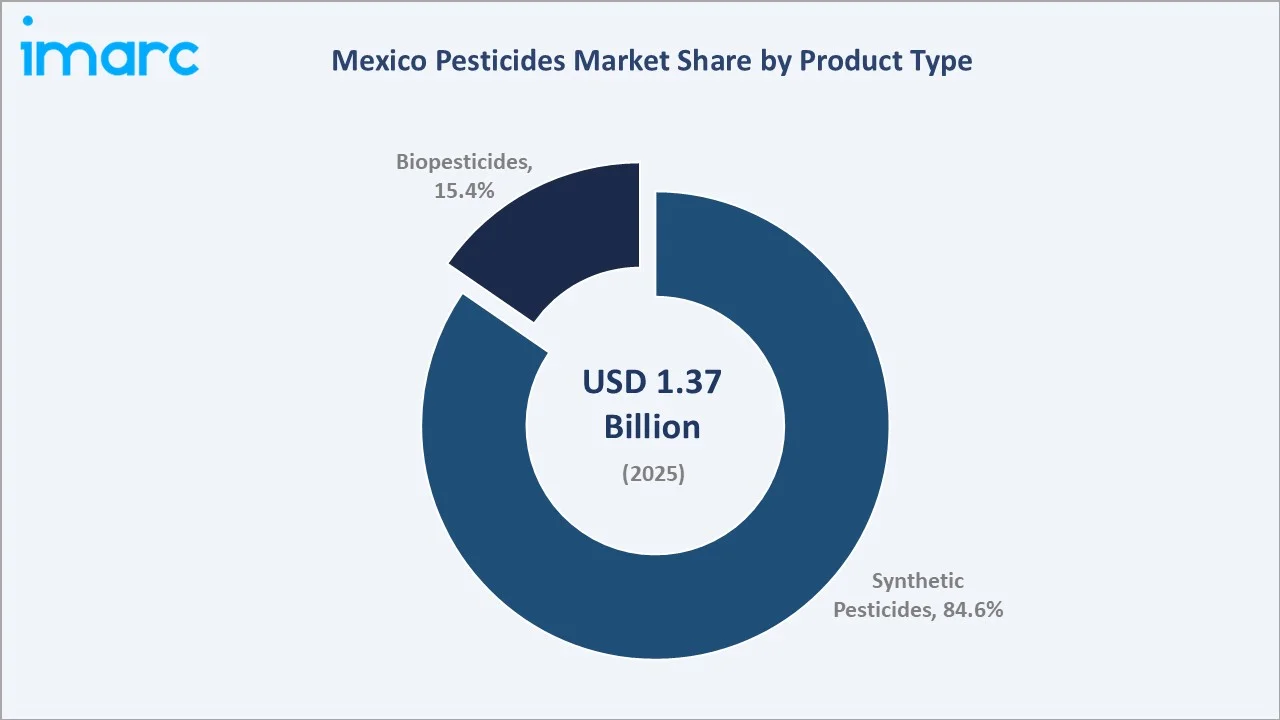
Synthetic pesticides lead at 84.6% (2025), through organophosphate insecticides, pyrethroid insecticides, atrazine herbicides for corn, strobilurin and SDHI fungicides for avocado and tomato.
To access detailed market analysis, Request Sample
Biopesticides at 15.4% grow fastest at ~8.2% CAGR through Bacillus thuringiensis (Bt) bioinsecticides for fall armyworm and vegetable pests, Beauveria bassiana and Metarhizium for avocado thrips, Trichoderma harzianum biofungicide for soil-borne diseases, and bio-herbicide alternatives.
By Segment
Insecticides lead at 38.7% (2025), through pyrethroid and organophosphate replacement insecticides for fall armyworm on Mexico corn, avocado thrips and mites in Michoacán, whitefly and aphid on Sinaloa vegetables, and diamide for premium crop protection.
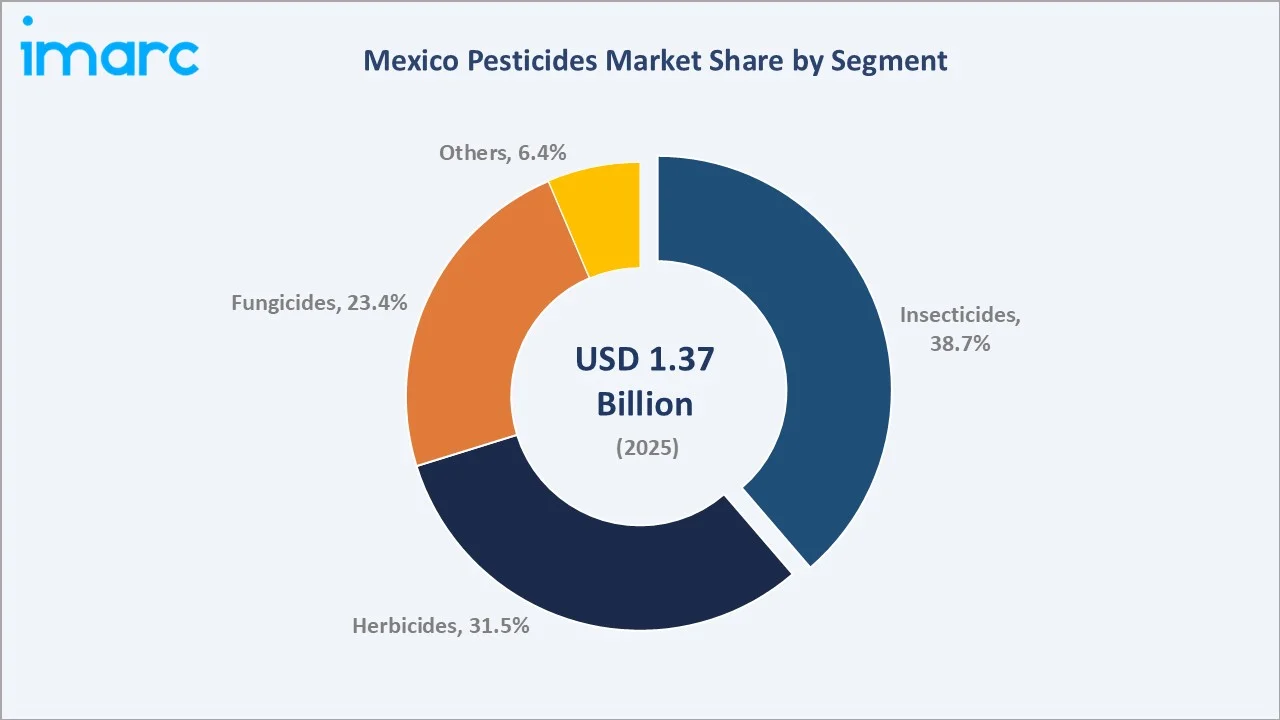
Herbicides at 31.5% reflect atrazine for corn, glyphosate alternatives, and post-emergent herbicides for grain and sorghum. Fungicides at 23.4% grow fastest at ~5.6% CAGR through avocado Phytophthora cinnamomi, tomato late blight, wheat Septoria, and berry Botrytis. Others at 6.4% include nematicides, rodenticides, and plant growth regulators.
Regional Market Insights
|
Region |
Share (2025) |
Key Mexico Pesticides Market Drivers & Characteristics |
|
Central Mexico |
39.5% |
Reflecting a strong cultivation of maize, vegetables, fruits, and export-oriented crops, supported by established agrochemical distribution networks. |
|
Northern Mexico |
31.7% |
Reflects large-scale commercial farming, greenhouse production, irrigation-based agriculture, and strong demand for crop protection in vegetables, grains, and high-value export crops. |
|
Southern Mexico |
20.4% |
Supported by tropical crop cultivation, fruits, sugarcane, coffee, and the expanding use of insecticides and fungicides to manage pest and disease pressure. |
|
Others |
8.4% |
Other regions, including the Yucatán Peninsula, Gulf Coast, and North Pacific Coast, were supported through diversified farming, plantation crops, horticulture, and regional pesticide demand for localized pest control. |
Central Mexico's 39.5% dominance is supported by the strong cultivation of maize, vegetables, fruits, and other commercial crops. Northern Mexico's 31.7% follows with large-scale farming, greenhouse production, irrigated agriculture, and strong demand from export-oriented crops.
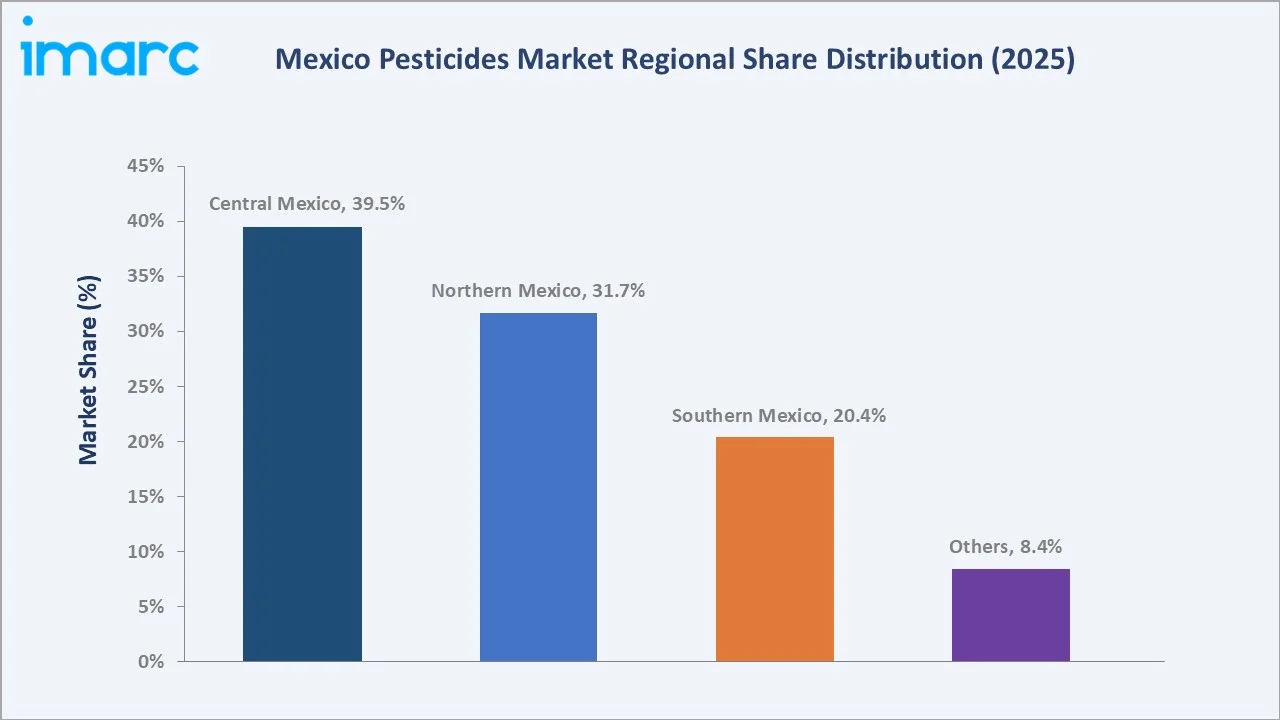
Southern Mexico's 20.4% shows steady pesticide use across tropical crops, sugarcane, coffee, fruits, and plantation agriculture. Others at 8.4%, including the Yucatán Peninsula, Gulf Coast, and North Pacific Coast, contribute through diversified horticulture and localized pest-control needs.
Competitive Landscape
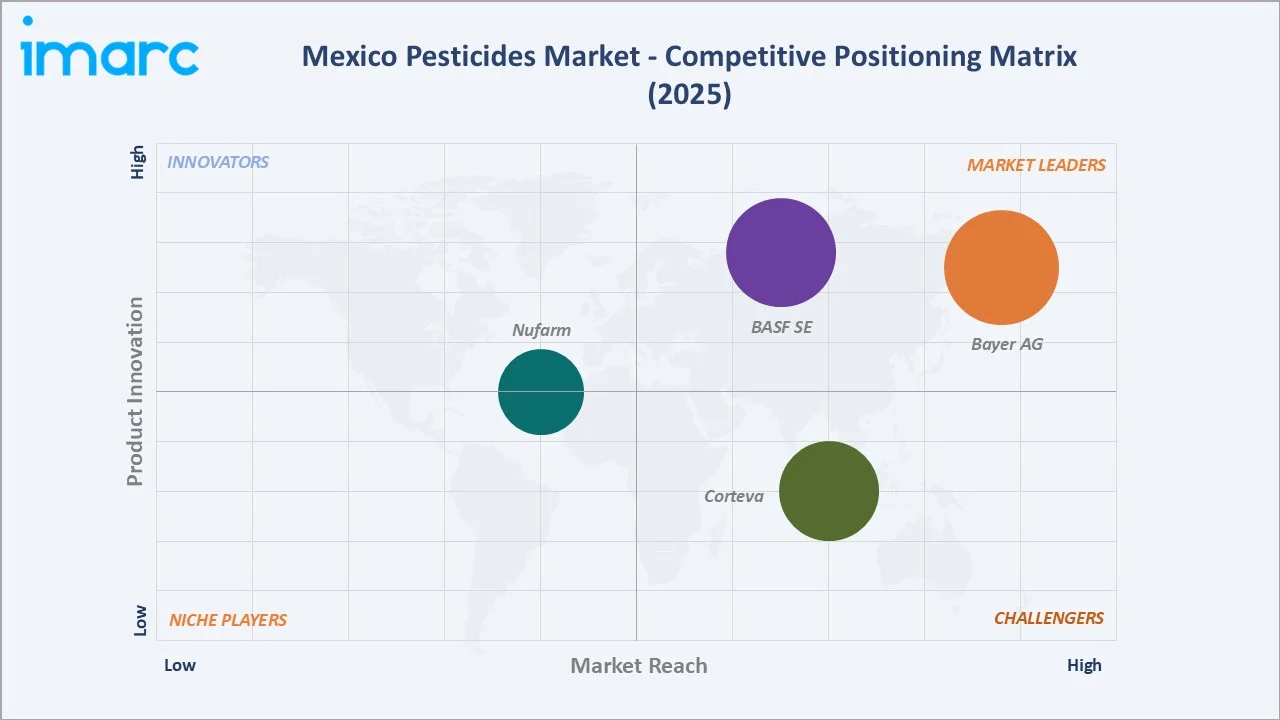
The Mexico pesticides market is moderately competitive, with multinational agrochemical companies competing alongside regional formulators, distributors, and emerging biopesticide players. Key firms focus on synthetic pesticides, biological crop protection, seed treatment, and integrated pest management solutions. Competition is shaped by product efficacy, regulatory approvals, farmer relationships, distribution reach, and crop-specific formulations.
|
Company |
Key Products |
Market Position |
Core Strength |
|
Bayer AG |
Adengo, Curbix, Decis, Fox Xpro, Laudis, Luna, Movento |
Market Leader |
Bayer AG is a dominant player in Mexico's agricultural market, providing a wide array of herbicides, insecticides, and seed treatments. Its role spans commercial agricultural supply and production. |
|
BASF SE |
Basagran, Basta, Kifix, Acrisio, Acrobat, Cabrio Top, Merivon, Efficon, Exponus |
Market Leader |
BASF SE is a key player in Mexico's agricultural and professional pest management sectors, supplying a wide range of fungicides, insecticides, herbicides, and seed treatments. |
|
Corteva |
Almix, Coreon, Curzate M8, Delegate, Engage, Galileo sensa, Loyant |
Strong Challenger |
Corteva plays a major role in Mexico’s agricultural sector by supplying an extensive range of seed and crop protection solutions tailored to Mexican farmers. Its portfolio of herbicides, insecticides, and fungicides helps protect vital crops like corn, soybeans, and fruits and vegetables from diseases, weeds, and insects. |
|
Nufarm |
Oxbow, Carnadine |
Established Player |
Nufarm is a major manufacturer of crop protection products that plays a key role in the Mexican agricultural sector. It supplies a wide portfolio of herbicides, insecticides, fungicides, and specialized adjuvants designed to improve crop yields and tackle resistant weeds. |
Companies are increasingly investing in bio-based products, low-residue solutions, and precision application support to address sustainability and export requirements. The market is also seeing stronger participation from biosolution providers as demand rises for safer and environmentally responsible pest and disease management products.
Key Company Profiles
Bayer AG
Bayer AG is one of the leading crop science companies operating in the Mexico pesticides market, offering a broad portfolio of herbicides, fungicides, insecticides, seed treatments, and biological crop protection products. Through its Crop Science division, Bayer serves major agricultural segments including grains, fruits, vegetables, berries, and other high-value export crops.
- Key Products: Adengo, Curbix, Decis, Fox Xpro, Laudis, Luna, Movento.
- Strategic Focus: Strengthening its crop protection portfolio across herbicides, fungicides, insecticides, and seed treatment solutions. The company emphasizes integrated crop management, combining chemical products with biological solutions, digital farming tools, and agronomic advisory services.
BASF SE
BASF SE is a major agrochemical company with a strong presence in the Mexico pesticides market through its Agricultural Solutions business. The company offers a wide portfolio of fungicides, herbicides, insecticides, seed treatment products, and crop management solutions for grains, fruits, vegetables, and other commercial crops. BASF supports Mexican growers with science-based formulations, agronomic expertise, and solutions aimed at improving crop yield, quality, and resilience. Its presence is strengthened by distribution partnerships, technical support, and a focus on sustainable crop protection for both domestic and export-oriented agriculture.
- Key Products: Basagran, Basta, Kifix, Acrisio, Acrobat, Cabrio Top, Merivon, Efficon, Exponus.
- Strategic Focus: Delivering innovative and sustainable crop protection solutions for commercial and export-oriented agriculture. The company emphasizes advanced fungicides, herbicides, insecticides, and seed treatments that improve crop productivity and disease resistance.
Market Concentration Analysis
The Mexico pesticides market shows moderate concentration, with global agrochemical leaders competing with domestic distributors and regional formulators. Large players hold stronger positions in patented molecules, branded crop protection products, seed treatments, and export-oriented crop segments. However, the market remains fragmented at the distribution and retail level due to numerous local dealers, cooperatives, and generic pesticide suppliers. Rising demand for biopesticides and biosolutions is also opening space for specialized biological crop protection companies. Overall, competition is shifting from price-based selling toward differentiated formulations, technical support, residue compliance, and sustainable pest management solutions.
Investment & Growth Opportunities
Highest Growth Segments
Biopesticides (~8.2% CAGR), fungicides (~5.6% CAGR), herbicides (~5.4% CAGR), Central Mexico (~6% CAGR), and precision application drone (~10% CAGR from growing base) represent Mexico pesticides highest-growth investment vectors through 2034.
Investment Themes
- Biopesticide avocado and berry export compliance: Growing export requirements for avocados, berries, and fresh produce are increasing demand for biopesticides that help growers meet strict residue limits and sustainability standards in international markets, creating opportunities for biological crop protection suppliers.
- Precision drone application: The adoption of drone-based pesticide spraying is creating investment opportunities in precision agriculture by improving application accuracy, reducing chemical wastage, lowering labor costs, and enhancing crop protection efficiency across large farms and high-value crops.
Future Market Outlook (2026-2034)
Mexico pesticides market expanded from USD 1.37 Billion in 2025 to an estimated USD 1.44 Billion in 2026 and is projected to reach USD 2.16 Billion by 2034, delivering a 5.21% CAGR over the forecast period through Mexico agricultural export growth, fresh produce demand, biopesticide adoption acceleration, avocado and berry export crop protection, and regulatory transition. The market's anchor value of USD 1.76 Billion in 2030 represents Mexico pesticides at the biopesticide mainstream and glyphosate phase-out completion.
Three structural forces define Mexico pesticides market growth through 2034. First, the continued expansion of high-value crops such as avocados, berries, fruits, and vegetables is increasing demand for effective crop protection solutions. Second, rising pest, weed, and disease pressure driven by climate variability is encouraging greater use of fungicides, insecticides, and integrated pest management products. Third, the modernization of agriculture through precision farming, drone-based spraying, and biological crop protection is supporting higher pesticide adoption while improving application efficiency and sustainability.
Research Methodology
Primary Research
Primary research comprised interviews with pesticide manufacturers, distributors, agrochemical retailers, agronomists, and crop consultants across Mexico. Discussions also covered farmers and greenhouse operators involved in fruits, vegetables, berries, avocados, maize, and other key crops. Inputs were gathered on pesticide demand, product preference, pricing, application practices, and adoption of biopesticides. Feedback from industry participants helped validate market size, regional trends, competitive positioning, and future growth opportunities.
Secondary Research
Secondary research encompassed government agricultural statistics, pesticide registration data, trade publications, company reports, and industry databases. It also included reviews of crop production trends, export data, regulatory updates, and agrochemical demand patterns. Public sources on fruits, vegetables, berries, avocados, maize, and greenhouse farming were assessed to map regional pesticide usage. These inputs helped validate market estimates, competitive landscape, technology trends, and long-term growth assumptions.
Forecasting Models
Forecasting models combined historical market performance, crop acreage trends, pesticide consumption patterns, and macroeconomic indicators to project future demand. The analysis incorporated expected growth in high-value crops, pest pressure, agricultural exports, and adoption of advanced crop protection technologies. Scenario-based forecasting was used to assess the impact of regulatory changes, biopesticide penetration, and climate-related risks. Market estimates were validated through triangulation of primary insights, secondary research, and segment-level demand analysis to ensure robust long-term projections through 2034.
Mexico Pesticides Market Report Coverage:
| Report Features | Details |
|---|---|
| Base Year of the Analysis | 2025 |
| Historical Period | 2020-2025 |
| Forecast Period | 2026-2034 |
| Units | Billion USD |
| Scope of the Report |
Exploration of Historical Trends and Market Outlook, Industry Catalysts and Challenges, Segment-Wise Historical and Future Market Assessment:
|
| Product Types Covered | Synthetic Pesticides, Biopesticides |
| Segments Covered | Insecticides, Fungicides, Herbicides, Others |
| Formulations Covered | Liquid, Dry |
| Crop Types Covered | Cereals, Fruits, Vegetables, Plantation Crops, Others |
| Regions Covered | Northern Mexico, Central Mexico, Southern Mexico, Others |
| Companies Covered | Bayer AG, BASF SE, Corteva, Nufarm, etc. |
| Customization Scope | 10% Free Customization |
| Post-Sale Analyst Support | 10-12 Weeks |
| Delivery Format | PDF and Excel through Email (We can also provide the editable version of the report in PPT/Word format on special request) |
Key Benefits for Stakeholders:
- IMARC’s industry report offers a comprehensive quantitative analysis of various market segments, historical and current market trends, market forecasts, and dynamics of the Mexico pesticides market from 2020-2034.
- The research report provides the latest information on the market drivers, challenges, and opportunities in the Mexico pesticides market.
- Porter's five forces analysis assist stakeholders in assessing the impact of new entrants, competitive rivalry, supplier power, buyer power, and the threat of substitution. It helps stakeholders to analyze the level of competition within the Mexico pesticides industry and its attractiveness.
- Competitive landscape allows stakeholders to understand their competitive environment and provides an insight into the current positions of key players in the market.
Frequently Asked Questions About the Mexico Pesticides Market Report
The Mexico pesticides market size is estimated at USD 1.44 Billion in 2026, driven by the expansion of high-value crops such as avocados, berries, fruits, and vegetables, along with rising pest, weed, and disease pressure across major agricultural regions. Growth is further supported by export-quality requirements, food security needs, greenhouse farming, and increasing adoption of biopesticides and precision application technologies.
The Mexico pesticides market grows at 5.21% CAGR during 2026-2034, reaching USD 2.16 Billion by 2034. The CAGR reflects export crop expansion, regulatory transition, and biopesticide adoption.
Synthetic pesticides lead at 84.6% due to their strong efficacy, wide availability, and established use across major crops such as maize, fruits, vegetables, berries, and avocados. Their cost-effectiveness, fast action, and broad-spectrum pest, weed, and disease control make them preferred among commercial growers despite rising interest in biopesticides.
Insecticides lead at 38.7% due to the high prevalence of insect pests affecting key crops such as maize, fruits, vegetables, berries, and avocados. Growing pest pressure driven by climate variability and the need to protect crop yields and export quality continue to support strong demand for insecticide products across the country's agricultural sector.
Central Mexico leads at 39.5% due to its strong concentration of commercial farming, including maize, vegetables, fruits, and other high-value crops. The region benefits from established agrochemical distribution networks, intensive cultivation practices, and consistent demand for insecticides, fungicides, and herbicides to protect crop yield and quality.
Leading companies include Bayer AG, BASF SE, Corteva, and Nufarm, among others.
The market is projected to reach approximately USD 1.76 Billion by 2030, supported by expanding high-value crop cultivation and rising pest and disease pressure. Growth will also be driven by export-oriented farming, greenhouse agriculture, and increasing adoption of biopesticides and precision application technologies.
Three priority investment opportunities stand out in the Mexico pesticides market. Biopesticide solutions for avocado, berry, and vegetable exports offer strong growth potential as growers seek residue-compliant crop protection products. Precision agriculture and drone-based pesticide application technologies are attracting investment by improving spraying efficiency, reducing input costs, and supporting sustainable farming. Another key opportunity lies in pesticide packaging waste collection and recycling infrastructure, driven by environmental regulations and industry initiatives promoting responsible agrochemical waste management.
Need more help?
- Speak to our experienced analysts for insights on the current market scenarios.
- Include additional segments and countries to customize the report as per your requirement.
- Gain an unparalleled competitive advantage in your domain by understanding how to utilize the report and positively impacting your operations and revenue.
- For further assistance, please connect with our analysts.
 Request Customization
 Speak to an Analyst
 Request Brochure
 Inquire Before Buying
Benefits of Customization
- Personalize this research
- Triangulate with your data
- Get data as per your format and definition
- Gain a deeper dive into a specific application, geography, customer, or competitor
- Any level of personalization
Get in Touch With Us
UNITED STATES
Phone: +1-201-971-6302
INDIA
Phone: +91-120-433-0800
UNITED KINGDOM
Phone: +44-753-714-6104
Email: [email protected]
Client Testimonials




.webp)




.webp)













Related Reports

Choose your plan
*Please note that the prices mentioned below are starting prices for each bundle type. Kindly contact our team for further details.*
Single User License
- 1 User License, Access on 2 Devices
- PDF Report + Excel Dataset (Password Protected)
- Lifetime Access
- No Printing Rights
- 10% Free Report Customization
- 10–12 Weeks of Analyst Support
Five User License
- Access for 5 Users, 2 Devices per User
- PDF Report + Excel Dataset (Password Protected)
- Lifetime Access
- Dedicated Account Manager
- 12–14 Weeks of Analyst Support
- No Printing Rights
- 15% Free Report Customization
- 25% Discount on Your Next Purchase
Corporate User License
- Unlimited User Access (Within Your Organization)
- PDF Report + Excel Dataset
- Lifetime Access
- Dedicated Account Manager
- 14–20 Weeks of Analyst Support
- No Printing Rights
- 20% Free Report Customization
- 30% Discount on Your Next Purchase
Essential Insights
What's included:
3 reports
- Lifetime Access
- PDF Reports
- Excel Datasets
- 2 Weeks of Free Analyst Support
- 2 User Licenses
- Access on 2 Devices
- Printing Rights
- Complimentary PowerPoint (PPT) Version
- Complimentary License Upgrade
Professional Access
What's included:
5 reports
- Lifetime Access
- PDF Reports
- Excel Datasets
- 8 Weeks of Free Analyst Support
- 2 User Licenses
- Access on 2 Devices
- Printing Rights
- Complimentary PowerPoint (PPT) Version
- Complimentary License Upgrade
Business Advantage
What's included:
8 reports
- Lifetime Access
- PDF Reports
- Excel Datasets
- 14 Weeks of Free Analyst Support
- 2 User Licenses
- Access on 2 Devices
- Printing Rights
- Complimentary PowerPoint (PPT) Version
- Complimentary License Upgrade
Enterprise Intelligence
What's included:
10 reports
- Lifetime Access
- PDF Reports
- Excel Datasets
- 20 Weeks of Free Analyst Support
- 2 User Licenses
- Access on 2 Devices
- Printing Rights
- Complimentary PowerPoint (PPT) Version
- Complimentary License Upgrade