
Mexico Shrimp Market Size, Share, Trends and Forecast by Environment, Species, Shrimp Size, Distribution Channel, and Region, 2026-2034
Mexico Shrimp Market Size, Share, Trends & Forecast (2026-2034)
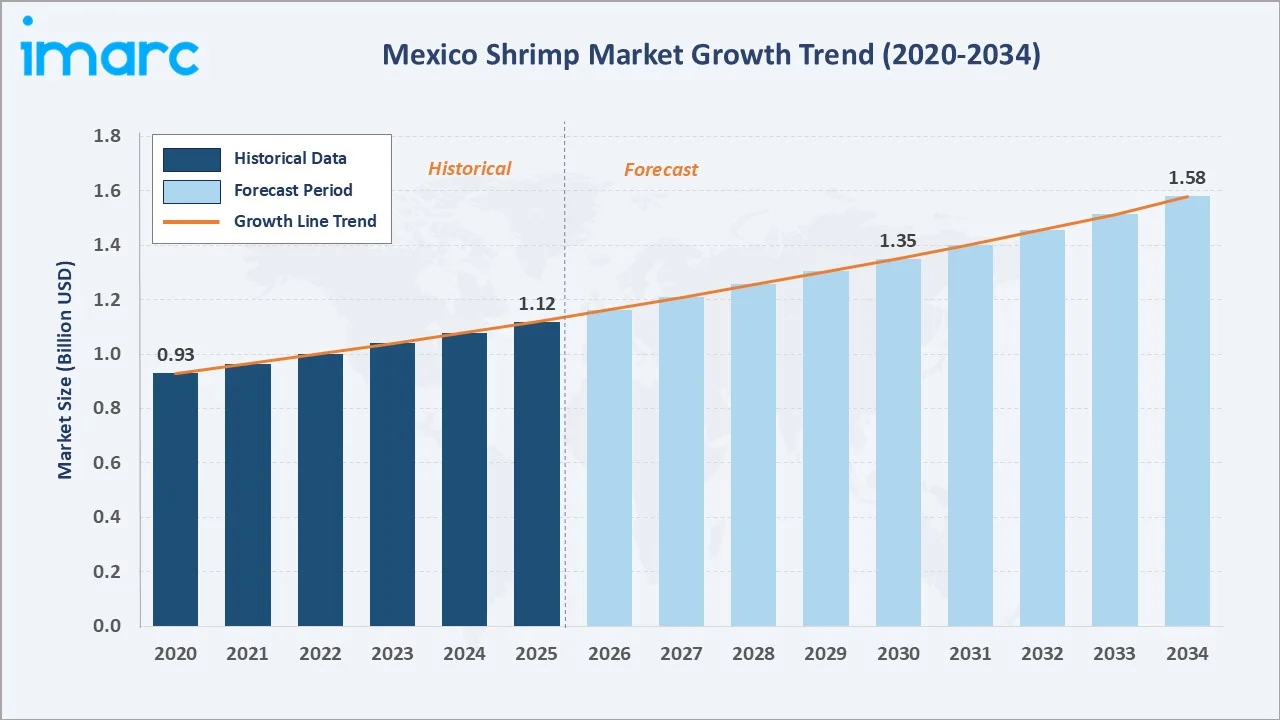
The Mexico shrimp market reached USD 1.12 Billion in 2025 and is projected to reach USD 1.58 Billion by 2034, growing at a CAGR of 3.75% during 2026-2034. The market is driven by rising export demand, sustainable aquaculture expansion, and technological advancements in shrimp farming.
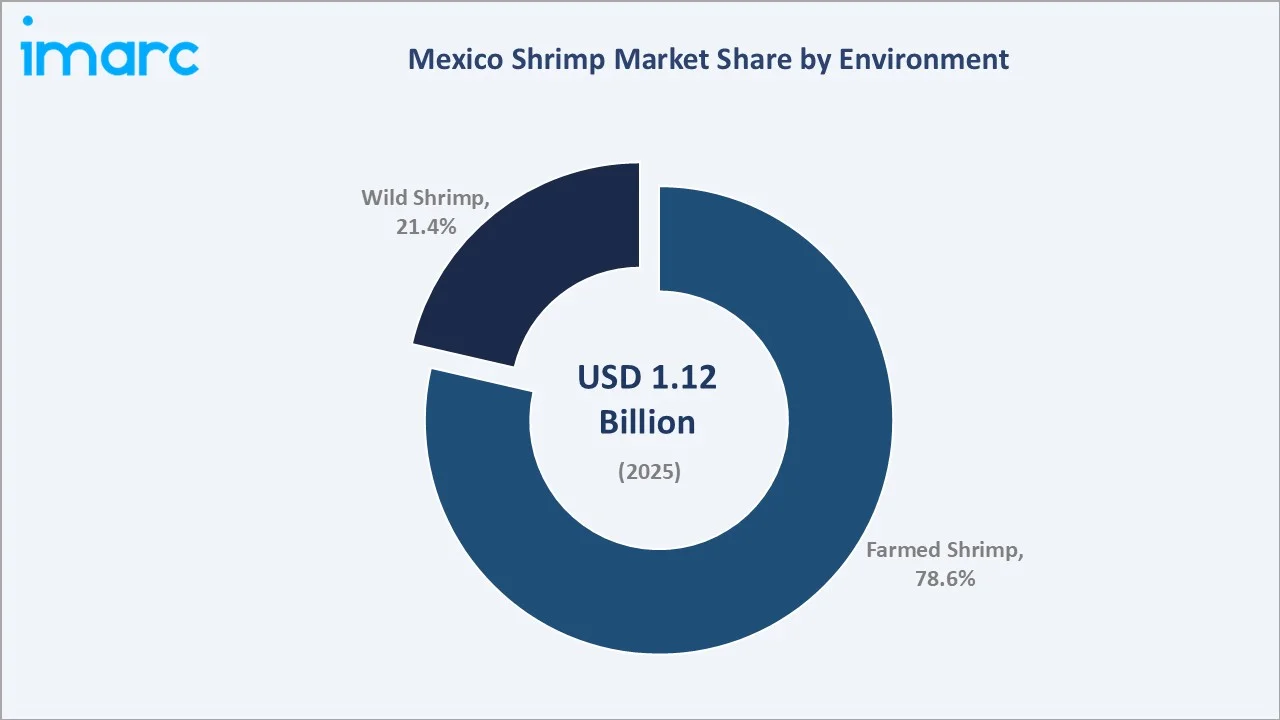
Farmed shrimp dominates at 78.6%, with Penaeus Vannamei leading species at 86.7%. Northern Mexico commands 43.7% of the national market share.
Market Snapshot
|
Metric |
Value |
|
Market Size (2025) |
USD 1.12 Billion |
|
Forecast Market Size (2034) |
USD 1.58 Billion |
|
CAGR (2026-2034) |
3.75% |
|
Base Year |
2025 |
|
Historical Period |
2020-2025 |
|
Forecast Period |
2026-2034 |
|
Dominant Environment |
Farmed Shrimp (78.6%, 2025) |
|
Dominant Species |
Penaeus Vannamei (86.7%, 2025) |
|
Leading Region |
Northern Mexico (43.7%, 2025) |
The market expanded from USD 0.93 Billion in 2020 to USD 1.12 Billion in 2025, anchored by aquaculture intensification along Mexico's Pacific coast and expanding US export demand. The forecast trajectory reaches USD 1.35 Billion in 2030 and USD 1.58 Billion by 2034, driven by value-added processing expansion, sustainability certification adoption, and emerging market diversification.
To get more information on this market, Request Sample
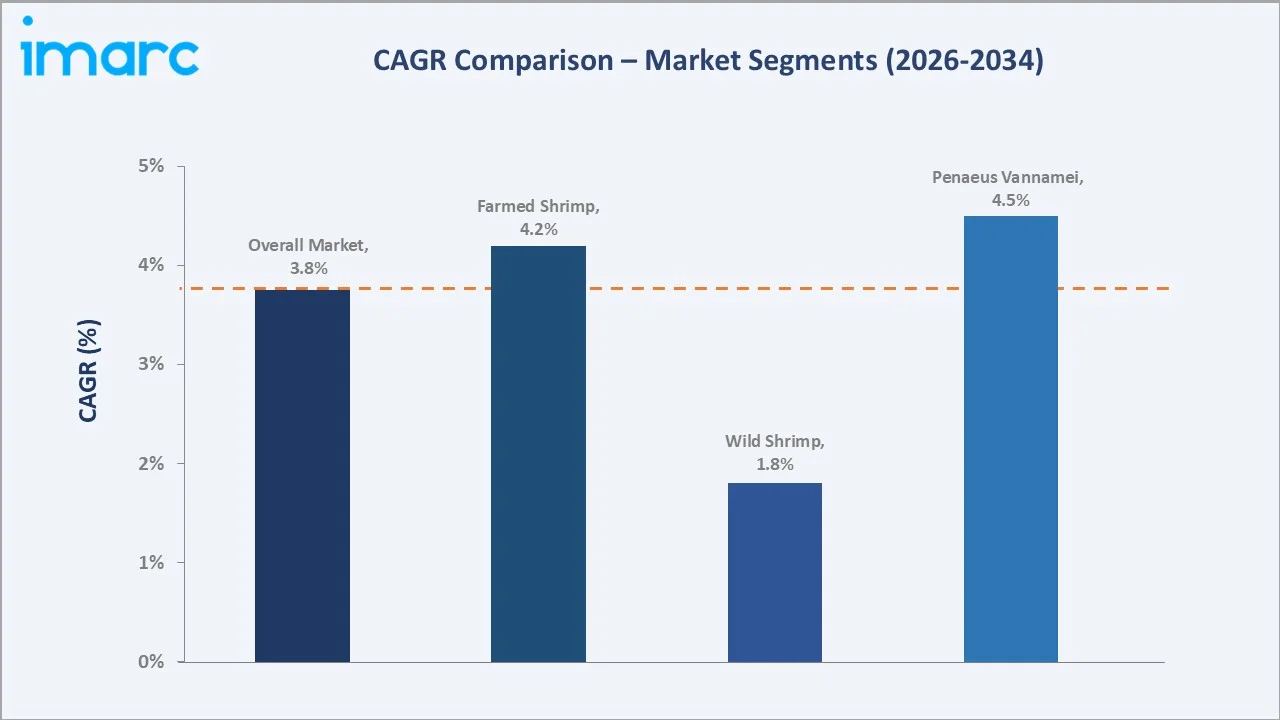
Farmed shrimp grows fastest as intensive pond systems expand across Sinaloa and Sonora, reducing dependence on volatile wild-catch supply. Penaeus Vannamei at 86.7% leads through its high yield, disease resistance, and global trade preference among US, Japanese, and European import markets.
Executive Summary
The Mexico shrimp market reached USD 1.12 Billion in 2025, representing a strategically significant seafood commodity anchoring Mexico's Pacific aquaculture export economy. Shrimp is Mexico's most valuable aquaculture product, with production concentrated in Sinaloa, Sonora, and Nayarit. The market is projected to reach USD 1.58 Billion by 2034.
Farmed shrimp at 78.6% dominates by capturing the mainstream commercial Vannamei production from Mexico's Pacific-coast intensive and semi-intensive pond systems. Penaeus Vannamei at 86.7% leads species through its adaptability, high stocking density suitability, and international preference. Northern Mexico at 43.7% leads regionally through its concentration of large-scale aquaculture infrastructure and processing capacity for export.
Key Market Insights
|
Insight |
Data |
|
Dominant Environment |
Farmed Shrimp - 78.6% share (2025) |
|
Dominant Species |
Penaeus Vannamei - 86.7% market share (2025) |
|
Leading Region |
Northern Mexico - 43.7% market share (2025) |
|
Market Opportunity |
Sustainable aquaculture expansion; value-added processed shrimp; export diversification to Middle East and Asia |
Key Analytical Observations Supporting The Above Data:
- Farmed Shrimp at 78.6%: Farmed shrimp dominates as pond-based Vannamei aquaculture offers superior production predictability, certified sustainability pathways, and lower per-unit cost versus wild catch, making it the preferred commercial format for export and retail buyers globally.
- Penaeus Vannamei at 86.7%: Vannamei dominates Mexico's shrimp species mix due to its fast grow-out cycles, high pond density tolerance, and established international demand from US, Japanese, and European markets, ensuring premium export pricing and supply consistency.
- Northern Mexico at 43.7%: Northern Mexico leads through Sinaloa and Sonora's established aquaculture infrastructure, post-larvae hatcheries, cold-chain processing plants, and proximity to US border trade routes, giving it a sustained first-mover advantage in export markets.
Mexico Shrimp Market Overview
The Mexico shrimp market encompasses the farming, harvesting, processing, and distribution of shrimp across farmed (pond aquaculture) and wild-caught (trawl and artisanal fishing) production systems. Mexico ranks among Latin America's top shrimp producers, with production concentrated in Pacific-coast states including Sinaloa, Sonora, and Nayarit, and Gulf-coast wild-catch operations in Campeche, Tabasco, and Veracruz.
The ecosystem integrates post-larvae hatcheries, shrimp feed manufacturers, pond aquaculture operators, wild-catch fishing cooperatives, cold-chain processing plants, exporters, domestic distributors, retail chains, and foodservice buyers. Macroeconomic factors include the Mexican Peso exchange rate, US seafood import demand, CONAPESCA regulatory policy, global farmed shrimp price benchmarks, and sustainability certification requirements from international retailers.
Market Dynamics
To evaluate market opportunities, Request Sample
Market Drivers
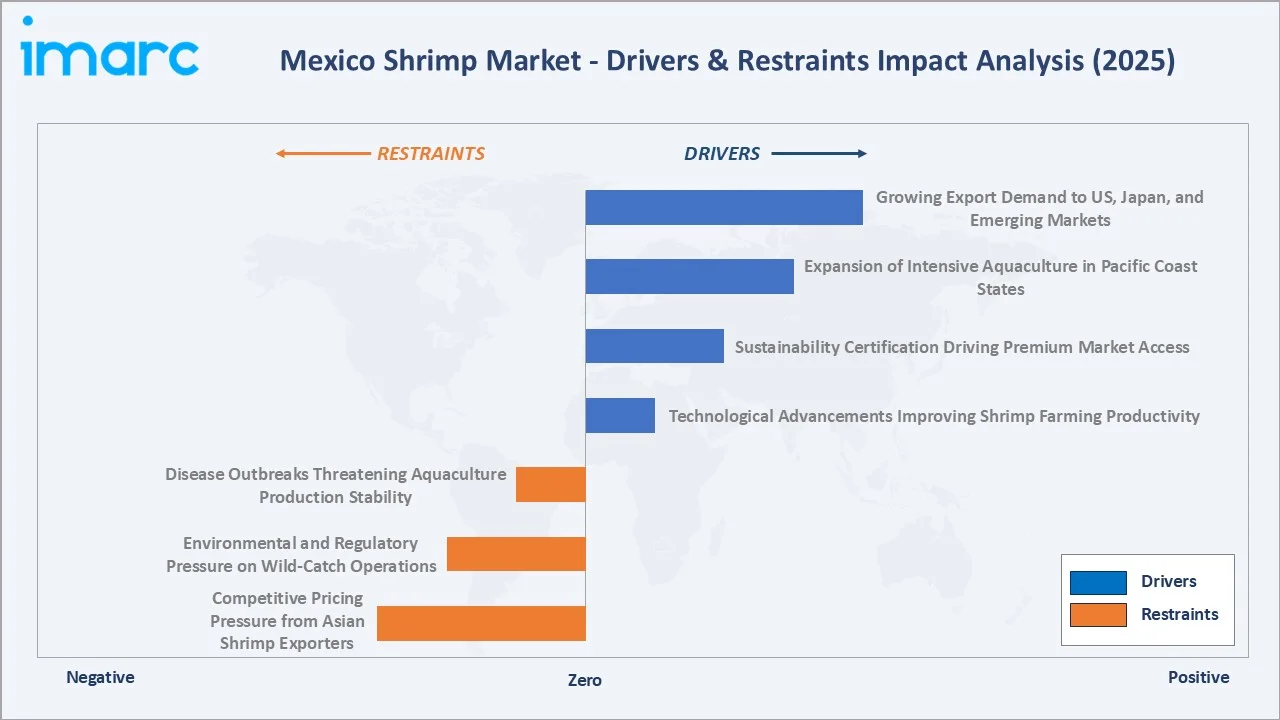
- Growing Export Demand to US, Japan, and Emerging Markets: Mexico's shrimp exports, valued at over USD 314 million in 2021, are expanding through diversification to Asia, the Middle East, and Latin America. Rising international demand for certified, traceable Mexican shrimp creates direct revenue growth for farmed and wild-catch operations, increasing investment in production capacity, processing facilities, and cold-chain infrastructure.
- Expansion of Intensive Aquaculture in Pacific Coast States: The shift from semi-intensive to high-density intensive pond systems in Sinaloa and Sonora is increasing yield per hectare, reducing unit costs, and enabling year-round production. Larger commercial operators invest in biofloc and recirculating water technologies, driving output volume growth and supporting sustained market revenue expansion through the forecast period.
- Sustainability Certification Driving Premium Market Access: Aquaculture Stewardship Council (ASC) and Best Aquaculture Practices (BAP) certifications are increasingly required for access to US and European retail buyers. Mexican farms earning these certifications gain premium pricing power and preferential shelf placement, incentivising wider adoption of responsible production practices and driving higher per-unit revenue.
- Technological Advancements Improving Shrimp Farming Productivity: Automated feeding systems, sophisticated water filtration, genetic selection for disease-resistant Vannamei lines, and integrated pest management are improving yield consistency. These technologies reduce mortality rates, optimise feed conversion ratios, and increase profitability per production cycle, supporting long-term sustainable market growth.
Market Restraints
- Disease Outbreaks Threatening Aquaculture Production Stability: Viral and bacterial diseases, particularly Early Mortality Syndrome (EMS) and White Spot Syndrome Virus (WSSV), create significant production losses in intensive farming operations. Disease-related crop failures increase production costs, reduce supply predictability, and undermine investor confidence in expanding aquaculture capacity across Mexico's key production states.
- Environmental and Regulatory Pressure on Wild-Catch Operations: Overfishing concerns, habitat degradation in coastal mangroves, and CONAPESCA fishing quota restrictions limit the expansion of wild-catch shrimp volumes. Stricter environmental regulations increase compliance costs for fishing cooperatives, constraining the wild shrimp segment's growth contribution to the overall market through the forecast period.
- Competitive Pricing Pressure from Asian Shrimp Exporters: Large-scale farmed shrimp exports from India, Ecuador, and Vietnam - with significantly lower production costs - create pricing pressure for Mexican shrimp in international markets. Mexico's higher labour and infrastructure costs require sustained quality and certification differentiation strategies to maintain export market positioning.
Market Opportunities
- Value-Added Processed Shrimp Product Development: Expanding beyond frozen raw shrimp into value-added formats such as peeled, deveined, breaded, cooked, and ready-to-eat products enables higher per-unit revenue generation. Growing US and domestic foodservice demand for convenience-oriented shrimp products creates significant incremental revenue opportunities for Mexico's processing sector.
- Emerging Market Export Diversification to Asia and Middle East: Mexico is targeting new shrimp export markets in Gulf Cooperation Council countries, South Korea, and emerging Asian economies. Rising middle-class seafood consumption, combined with Mexico's quality reputation, provides a strategic growth avenue to reduce dependence on the US market.
Market Challenges
- Climate Change Impact on Coastal Aquaculture Infrastructure: Rising sea surface temperatures, irregular precipitation patterns, and increased hurricane intensity threaten coastal shrimp pond infrastructure and wild-catch fishing seasons in the Gulf of Mexico. Climate variability increases production cost unpredictability and supply disruption risk across Mexico's key shrimp-producing coastal regions.
- Fragmented Artisanal Fishing Sector Limiting Quality Standardisation: Mexico's wild-catch shrimp sector includes thousands of small-scale fishing cooperatives with inconsistent cold-chain handling, variable quality standards, and limited access to certification programmes. This fragmentation constrains the wild shrimp segment's ability to access premium export markets and achieve consistent pricing required for sustainable growth.
Emerging Market Trends
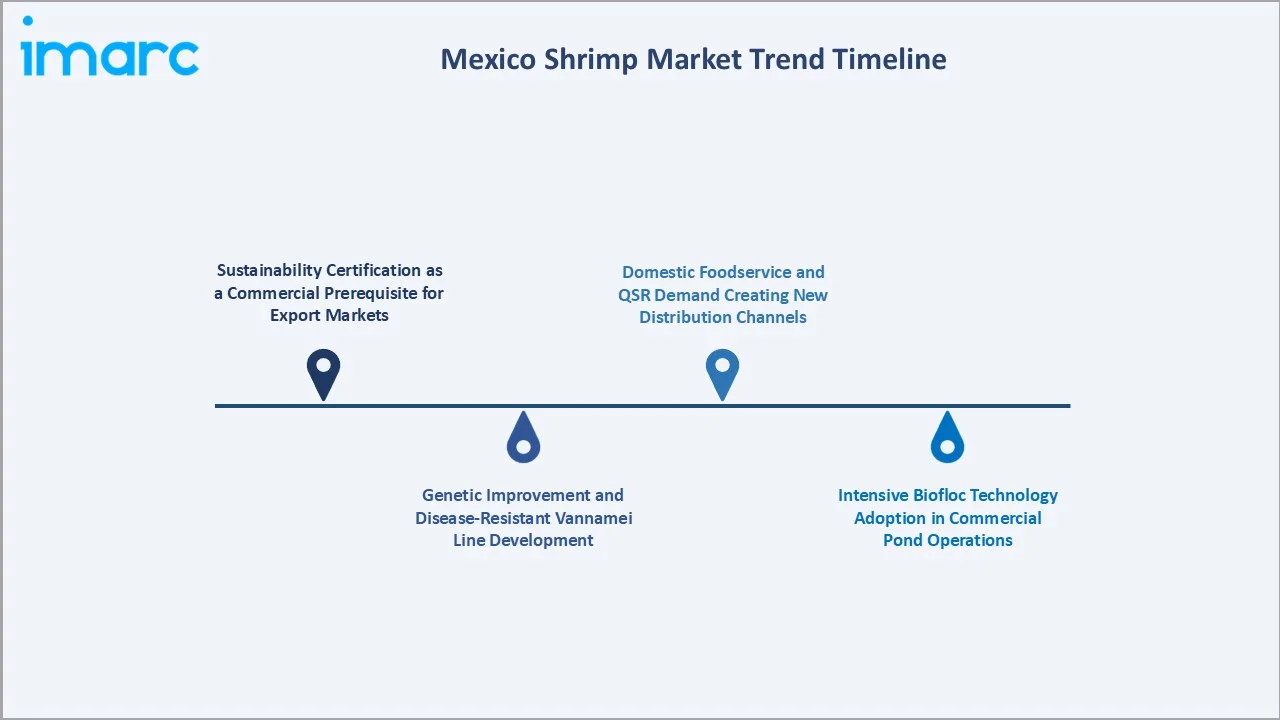
1. Sustainability Certification as a Commercial Prerequisite for Export Markets
ASC and BAP certifications are transitioning from market differentiators to prerequisites for accessing US, European, and Japanese retail buyers. Mexican aquaculture operators are investing in certified sustainability practices at scale, with certification programmes gaining traction across Sinaloa and Sonora commercial farm operations.
2. Genetic Improvement and Disease-Resistant Vannamei Line Development
Leading hatcheries, notably Maricultura del Pacifico, deploy 17-plus years of genetic selection programmes to produce high-performance, disease-resistant Vannamei broodstock. Improved genetic lines reduce EMS and WSSV vulnerability, increase growth rates, and provide a competitive advantage to Mexican producers through superior yield efficiency versus unimproved imported lines.
3. Intensive Biofloc Technology Adoption in Commercial Pond Operations
Biofloc technology is expanding in Sinaloa and Sonora commercial farms, enabling zero-water-exchange high-density pond systems that reduce biosecurity risks, lower water consumption, and improve feed conversion efficiency. This technology shift supports sustainable intensification aligned with export certification requirements.
4. Domestic Foodservice and QSR Demand Creating New Distribution Channels
Mexico's expanding quick-service restaurant sector and premium seafood foodservice segment are creating new domestic demand channels for processed shrimp products. Domestic shrimp consumption growth reduces Mexico's export dependence and provides a higher-margin alternative channel for value-added processed products targeting urban consumers.
Industry Value Chain Analysis
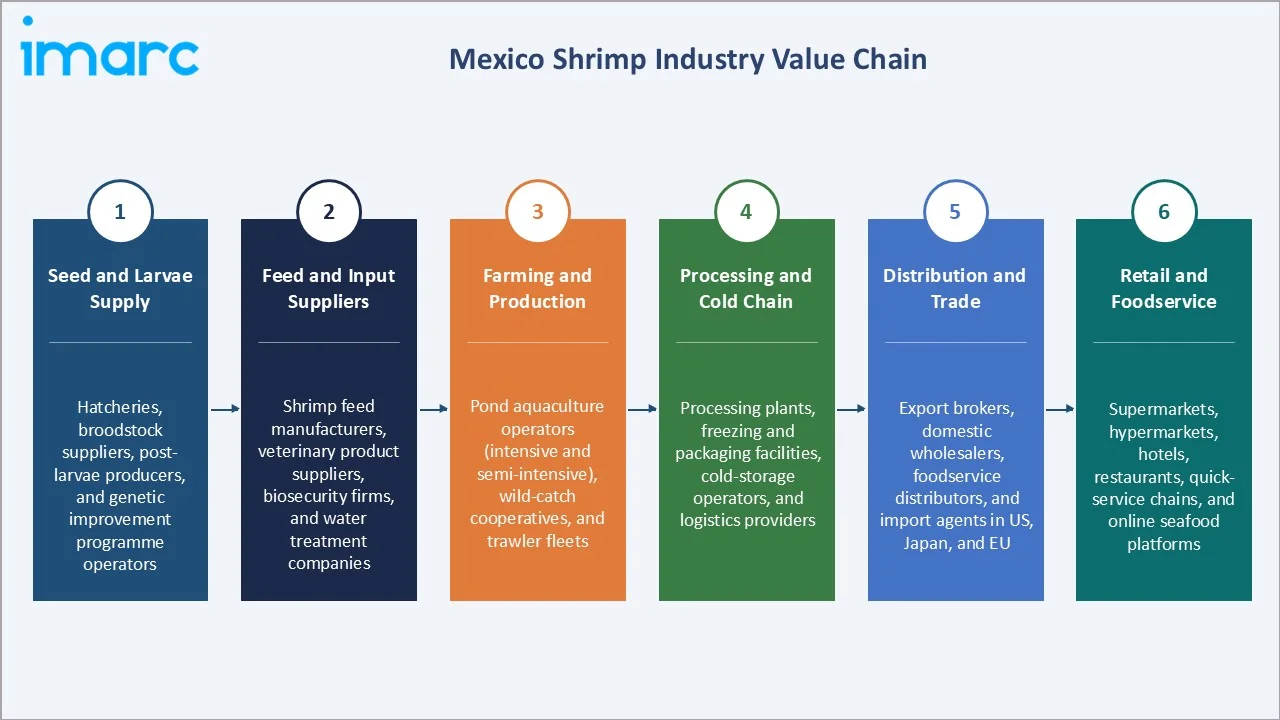
The Mexico shrimp value chain integrates post-larvae hatchery operations, grow-out pond farming or wild-catch fishing, processing and cold-chain packaging, domestic and export distribution, and retail or foodservice end markets. The chain's commercial architecture is progressively consolidating as integrated operators controlling hatchery, farming, processing, and distribution capture greater margin share versus fragmented artisanal cooperatives.
|
Stage |
Key Participants |
|
Seed and Larvae Supply |
Hatcheries, broodstock suppliers, post-larvae producers, and genetic improvement programme operators |
|
Feed and Input Suppliers |
Shrimp feed manufacturers, veterinary product suppliers, biosecurity firms, and water treatment companies |
|
Farming and Production |
Pond aquaculture operators (intensive and semi-intensive), wild-catch cooperatives, and trawler fleets |
|
Processing and Cold Chain |
Processing plants, freezing and packaging facilities, cold-storage operators, and logistics providers |
|
Distribution and Trade |
Export brokers, domestic wholesalers, foodservice distributors, and import agents in US, Japan, and EU |
|
Retail and Foodservice |
Supermarkets, hypermarkets, hotels, restaurants, quick-service chains, and online seafood platforms |
The farming and production stage is the value chain's largest economic contributor and primary differentiation point, with Sinaloa and Sonora intensive operations commanding the highest per-unit profitability. The processing and cold-chain stage is experiencing the most rapid quality-standard upgrading as export certification requirements drive investment in HACCP-compliant processing infrastructure.
Technology Landscape in the Mexico Shrimp Industry
Recirculating Aquaculture Systems (RAS) Technology
RAS technology enables high-density shrimp production in controlled indoor environments, eliminating weather dependency and disease transmission risk from open water sources. While capital-intensive, RAS adoption is advancing among premium Mexican producers targeting year-round certified supply for export buyers requiring consistent quality and biosecurity assurance.
Biofloc System Technology
Biofloc pond systems use microbial communities to convert waste nitrogen into protein-rich biomass consumed by shrimp, improving feed conversion ratios and reducing water exchange requirements. Adoption is expanding rapidly across Sinaloa and Sonora intensive operations as a cost-effective sustainability solution compatible with ASC and BAP certification standards.
Genetic Selection and Broodstock Improvement Technology
Advanced genetic selection programmes, operated by firms including Maricultura del Pacifico, produce Vannamei broodstock with improved disease resistance, growth rates, and feed conversion efficiency. Proprietary genetic lines represent a significant competitive moat for leading Mexican shrimp hatcheries, enabling superior production performance for commercial grow-out operators.
Market Segmentation Analysis
The report covers the following segments:
|
Segment Category |
Leading Segment |
Market Share |
Year |
|
Environment |
Farmed Shrimp |
78.6% |
2025 |
|
Species |
Penaeus Vannamei |
86.7% |
2025 |
|
Shrimp Size |
🔒 |
🔒 |
2025 |
|
Distribution Channel |
🔒 |
🔒 |
2025 |
|
Region |
Northern Mexico |
43.7% |
2025 |

By Environment
Farmed shrimp leads at 78.6% in 2025, capturing the mainstream commercial Vannamei production from Mexico's Pacific-coast intensive and semi-intensive pond systems, the most commercially dominant and highest-revenue production category in the national shrimp market.
To access detailed market analysis, Request Sample
Wild shrimp at 21.4% captures Gulf of Mexico and Pacific artisanal and trawl catches of White Shrimp, Brown Shrimp, and Rock Shrimp. While declining proportionally as farmed production expands, wild catch commands premium pricing in domestic seafood markets and niche export channels valuing the wild-caught identity and distinct flavour profile.
By Species
Penaeus Vannamei leads at 86.7% in 2025, through its dominance of farmed production, high yield credentials, international market acceptance, and adaptability to intensive pond systems along Mexico's Pacific coast. This segment grows at an above-market CAGR through ongoing aquaculture expansion and widening export market access across multiple geographies.
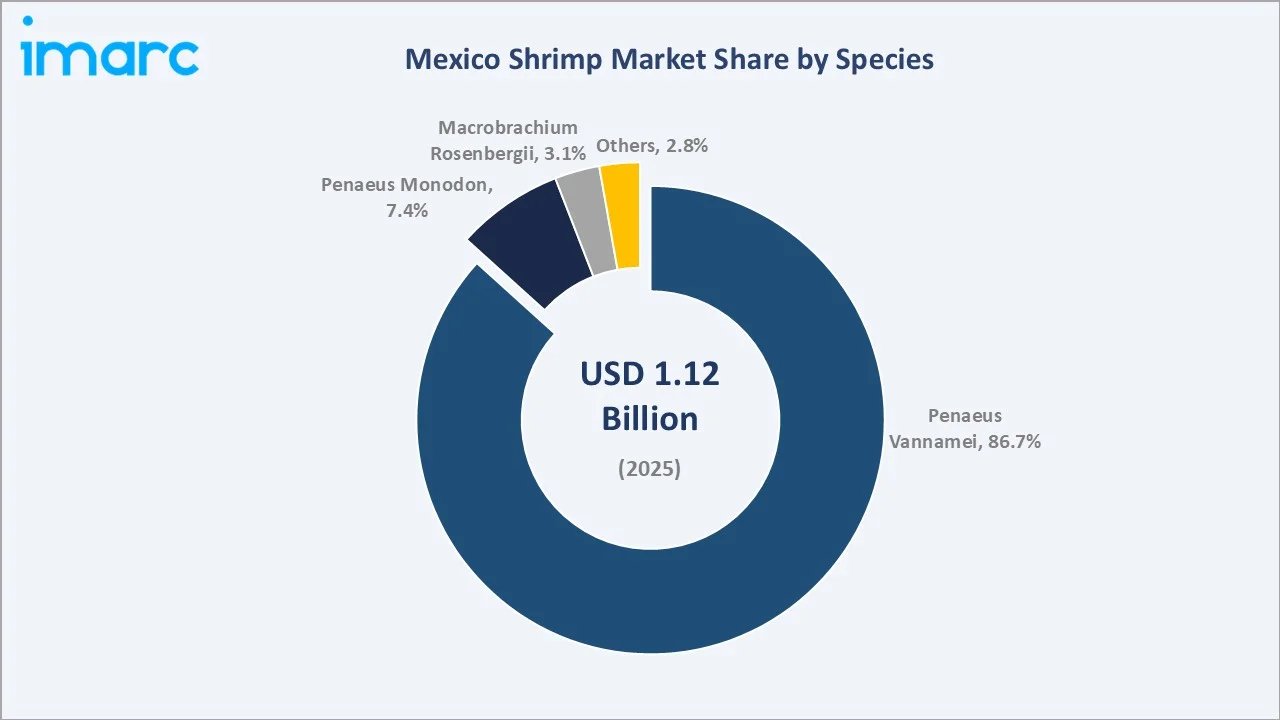
Penaeus Monodon at 7.4% serves premium export and domestic restaurant channels commanding higher per-unit price points. Macrobrachium Rosenbergii (freshwater prawn) at 3.1% supplies inland aquaculture operations in central and southern Mexico. Others at 2.8% include regional wild-catch species from Gulf of Mexico artisanal fisheries contributing niche supply to local markets.
Regional Market Insights
|
Region |
Share (2025) |
Key Market Drivers and Characteristics |
|
Northern Mexico |
43.7% |
Pacific coast aquaculture hub with large-scale farmed Vannamei operations, export processing infrastructure, and hatchery facilities |
|
Central Mexico |
31.4% |
Key domestic consumption centre with growing foodservice demand, expanding retail distribution networks, and rising urban seafood consumption |
|
Southern Mexico |
18.2% |
Gulf of Mexico wild-catch fisheries, artisanal fishing cooperatives, and coastal aquaculture operations contributing regional shrimp supply |
|
Others |
6.7% |
Baja California Peninsula specialty producers and minor coastal states contributing niche and premium shrimp supply to domestic and export channels |
Northern Mexico, at 43.7%, leads through Sinaloa's concentrated commercial shrimp pond infrastructure - the country's single largest aquaculture production zone - and Sonora's integrated hatchery, farming, and processing clusters serving the US export corridor. Central Mexico, at 31.4%, reflects Jalisco, Nayarit, and metropolitan demand centres driving foodservice, retail, and distribution hub activity.
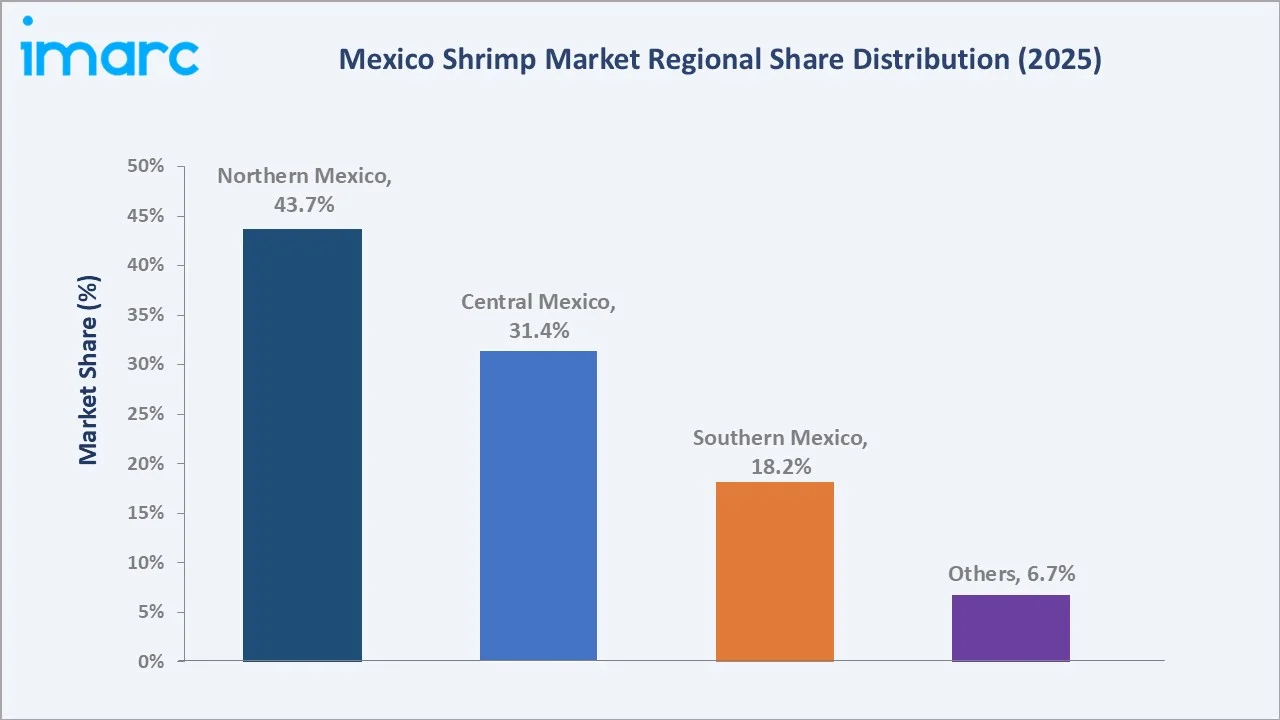
Southern Mexico, at 18.2%, represents the Gulf of Mexico's wild-catch fishing cooperatives in Tabasco, Campeche, and Veracruz contributing artisanal and trawl-caught shrimp supply to domestic and export channels. Others, at 6.7%, include Baja California Peninsula specialty production and minor Pacific coastal states delivering niche and premium shrimp supply.
Competitive Landscape
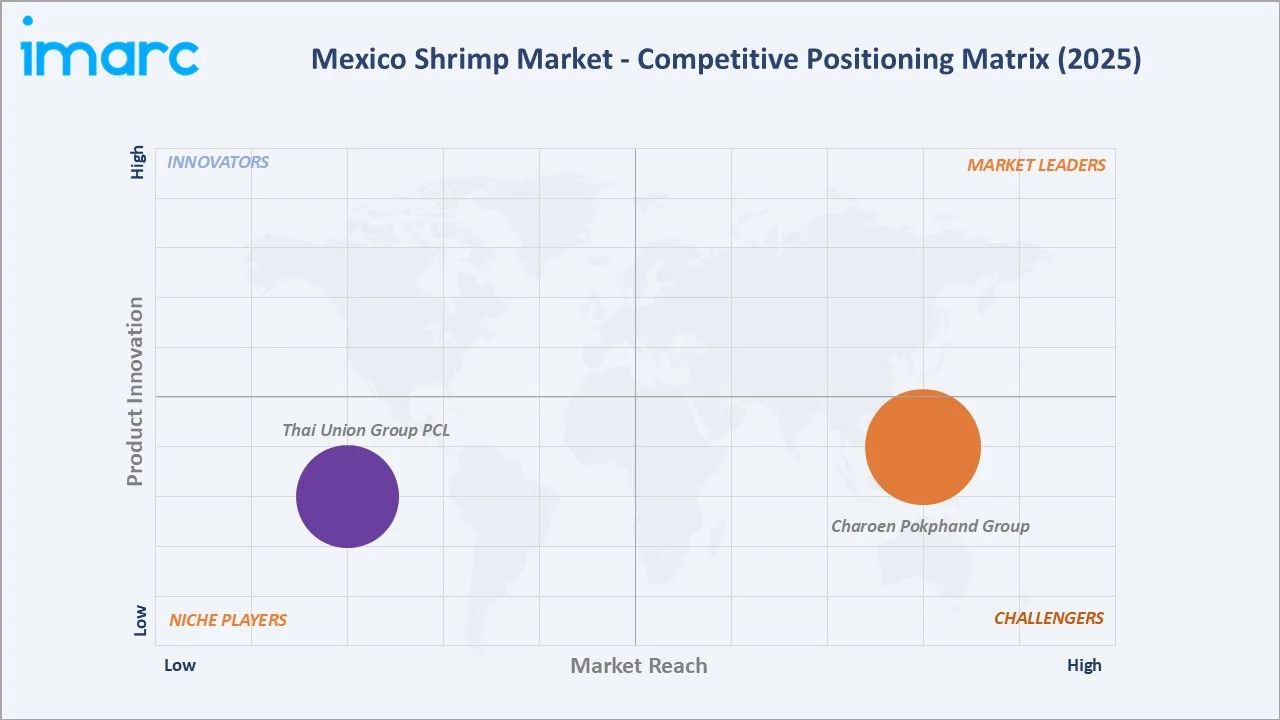
The Mexico shrimp market competitive landscape is moderately fragmented, combining large integrated commercial aquaculture operators, specialised hatchery and genetics companies, artisanal fishing cooperative networks, and international seafood multinationals with procurement and processing interests in Mexico across multiple value chain stages.
|
Company Name |
Key Products |
Market Position |
Core Strength |
|
Charoen Pokphand Group |
Farmed Pacific white shrimp; processed and frozen shrimp |
Strong Challenger |
One of the world's largest vertically integrated agro-food conglomerates; operates across the full shrimp value chain from feed production and farming |
|
Thai Union Group PCL |
Frozen shrimp |
Niche Player |
Seafood conglomerate with procurement and processing operations linked to Mexico shrimp supply chains |
Key players include Charoen Pokphand Group, Thai Union Group PCL, and Others.
Key Company Profiles
Charoen Pokphand Group
Charoen Pokphand Group is a global Bangkok, Thailand-based agro-industrial conglomerate with significant involvement in the shrimp market through its listed subsidiary Charoen Pokphand Foods PCL (CP Foods), operating across the full value chain from feed production and aquaculture farming through processing and distribution of shrimp products to retail and foodservice buyers across North America, Europe, and Asia.
- Key Products: Farmed Pacific white shrimp; processed and frozen shrimp; shrimp feed and aquaculture inputs; ready-to-eat and value-added shrimp products
- Strategic Focus: Expanding vertically integrated shrimp operations across global markets through sustainable aquaculture innovation, including recirculating aquaculture systems (RAS) and biofloc technology, while strengthening procurement and distribution linkages across Latin American shrimp supply chains to meet growing North American and international retailer demand for certified, traceable shrimp products.
Thai Union Group PCL
Thai Union Group PCL is a global Bangkok, Thailand-based seafood company with significant procurement involvement in Mexico's shrimp market through supply chain partnerships, value-added processing, and global distribution of Mexican-origin shrimp products to retail and foodservice buyers across the US, Europe, and Asia.
- Key Products: Processed shrimp products, value-added frozen shrimp, retail and foodservice shrimp SKUs sourced from Mexican and other global supply chains for international markets.
- Strategic Focus: Integrating sustainability and traceability standards across global shrimp sourcing, including Mexican aquaculture and wild-catch supply chains, to meet international retailer certification requirements.
Market Concentration Analysis
The Mexico shrimp market is moderately fragmented at the commercial farming level, with integrated operators collectively accounting for an estimated 25 to 35 percent of farmed output. Wild-catch fishing cooperatives accounting for approximately 20 percent of total supply remains highly fragmented across thousands of small artisanal operators across Gulf and Pacific coastal states. International seafood multinationals account for an estimated 15 to 20 percent of processing and distribution revenue.
Market concentration is gradually increasing as vertically integrated commercial operators expand capacity and sustainability-certified producers gain disproportionate export market access and pricing power over commodity-focused competitors.
Investment & Growth Opportunities
Highest Growth Segments
Farmed Vannamei production expansion at approximately 4.2% CAGR, value-added processed shrimp product development at 5.0 to 6.0% CAGR, sustainability-certified premium export supply at approximately 5.0% CAGR, domestic foodservice shrimp supply at approximately 4.5% CAGR, and emerging market export diversification to Middle East and Asia at above 6.0% CAGR represent the highest-growth investment vectors through the 2034 forecast horizon.
Emerging Investment Opportunities
Value-added shrimp processing plants targeting US foodservice buyers represent Mexico's highest per-unit-value emerging investment opportunity. Processed ready-to-eat and ready-to-cook shrimp at USD 8 to 15 per kg generates 2 to 3 times the per-unit revenue of bulk frozen raw shrimp, with growing US foodservice demand creating a structurally expanding demand pool for premium processed Mexican shrimp products through 2034.
Investment Themes
- Integrated aquaculture-to-processing vertical investment for export-grade certified supply: Vertically integrating hatchery genetics, pond operations, and HACCP-compliant processing creates a sustainable cost and quality advantage that cannot be replicated by fragmented cooperative-dependent competitors in sustainability-premium export markets commanding above-average per-unit pricing.
- Biofloc and RAS technology adoption for high-density low-biosecurity-risk operations: Technology-intensive aquaculture systems reduce disease risk, lower water consumption, and improve yield predictability, creating a production cost advantage and enabling year-round certified sustainable supply to export-grade buyers with stringent quality requirements.
Future Market Outlook (2026-2034)
The Mexico shrimp market is projected to grow from USD 1.12 Billion in 2025 to USD 1.58 Billion by 2034, delivering a 3.75% CAGR over the forecast period. The market's anchor value of USD 1.35 Billion in 2030 represents a maturing commercial aquaculture industry at its sustainability-integration inflection, where ASC and BAP-certified supply becomes the baseline for export market access rather than a premium differentiator separating leading producers from commodity competitors.
Three structural forces define Mexico shrimp market growth through 2034. The farmed Vannamei production intensification trend creates a self-reinforcing investment cycle where technology adoption begets yield improvement, which begets further pond expansion investment. The sustainability certification adoption wave multiplies per-unit revenue capture above simple volume growth as certified operators access premium market segments. The value-added processing shift creates an additive revenue layer above raw shrimp commodity growth by targeting higher-margin domestic and international foodservice channels.
Research Methodology
Primary Research
Primary research comprised structured interviews with 40-plus industry stakeholders conducted in 2025, including aquaculture operation managers, shrimp hatchery specialists, export and trade brokers, CONAPESCA regulatory officials, seafood processing plant managers, sustainability certification auditors, and domestic retail and foodservice buyers across Mexico's key shrimp-producing regions.
Secondary Research
Secondary research encompassed CONAPESCA annual fisheries and aquaculture production statistics; FAO aquaculture production data; Mexico SADER agricultural policy documents; US NOAA seafood import trade data; industry association reports from CANAINPESCA; Aquaculture Stewardship Council certification databases; company annual reports and press releases; and over 50 secondary industry and trade sources reviewed for comprehensive market coverage.
Forecasting Models
Market revenue forecasts were developed using an aquaculture production-based bottom-up model encompassing: farmed shrimp production volume forecast by state and system type; wild-catch volume forecast by species and fishing region; average export and domestic price per tonne by segment; and value-added processing premium adjustment for processed versus raw shrimp product mix evolution through 2034.
Mexico Shrimp Market Report Coverage:
| Report Features | Details |
|---|---|
| Base Year of the Analysis | 2025 |
| Historical Period | 2020-2025 |
| Forecast Period | 2026-2034 |
| Units | Billion USD |
| Scope of the Report |
Exploration of Historical Trends and Market Outlook, Industry Catalysts and Challenges, Segment-Wise Historical and Future Market Assessment:
|
| Environments Covered | Farmed Shrimp, Wild Shrimp |
| Species Covered | Penaeus Vannamei, Penaeus Monodon, Macrobrachium Rosenbergii, Others |
| Shrimp Sizes Covered | <21, 21-25, 26-30, 31-40, 41-50, 51-60, 61-70, >70 |
| Distribution Channels Covered | Hypermarkets and Supermarkets, Convenience Stores, Hotels and Restaurants, Online Sales, Others |
| Regions Covered | Northern Mexico, Central Mexico, Southern Mexico, Others |
| Companies Covered | Charoen Pokphand Group, Thai Union Group PCL, etc. |
| Customization Scope | 10% Free Customization |
| Post-Sale Analyst Support | 10-12 Weeks |
| Delivery Format | PDF and Excel through Email (We can also provide the editable version of the report in PPT/Word format on special request) |
Key Benefits for Stakeholders:
- IMARC’s industry report offers a comprehensive quantitative analysis of various market segments, historical and current market trends, market forecasts, and dynamics of the Mexico shrimp market from 2020-2034.
- The research report provides the latest information on the market drivers, challenges, and opportunities in the Mexico shrimp market.
- Porter's five forces analysis assist stakeholders in assessing the impact of new entrants, competitive rivalry, supplier power, buyer power, and the threat of substitution. It helps stakeholders to analyze the level of competition within the Mexico shrimp industry and its attractiveness.
- Competitive landscape allows stakeholders to understand their competitive environment and provides an insight into the current positions of key players in the market.
Frequently Asked Questions About the Mexico Shrimp Market Report
The Mexico shrimp market reached USD 1.12 Billion in 2025, driven by Farmed Shrimp dominating at 78.6%, Penaeus Vannamei species leading at 86.7%, Northern Mexico commanding 43.7% market share through Sinaloa and Sonora's commercial aquaculture concentration, and strong US export demand sustaining production investment across Mexico's Pacific coast.
The Mexico shrimp market grows at 3.75% CAGR during 2026-2034, reaching USD 1.58 Billion by 2034. This growth reflects farmed production expansion, sustainability-certified premium export supply growth, value-added processing adoption, domestic foodservice demand growth, and emerging market export diversification to new international buyer geographies.
Farmed Shrimp leads at 78.6%, capturing the mainstream commercial Vannamei pond aquaculture production in Sinaloa and Sonora. This segment grows at above-market CAGR through ongoing aquaculture intensification, technology adoption, and sustainability certification investment enabling premium export market access.
Penaeus Vannamei leads at 86.7% through its dominance of farmed production, international trade preference, high yield credentials, and adaptability to intensive aquaculture systems. Vannamei grows fastest through dual-driver support from expanded pond farming operations and widening export market access to diversified international buyers.
Northern Mexico leads at 43.7% through Sinaloa's concentrated commercial shrimp aquaculture infrastructure and Sonora's integrated hatchery-farming-processing cluster, supported by US border proximity, established export logistics, and a long history of commercial aquaculture investment and development.
Leading companies include Charoen Pokphand Group, Thai Union Group PCL, and Others.
The Mexico shrimp market is projected to reach approximately USD 1.35 Billion by 2030, with sustainability-certified farmed Vannamei supply becoming the export baseline, value-added processing expansion accelerating, domestic foodservice demand growing, and initial penetration of Middle East and emerging Asian export markets providing incremental revenue contribution.
Three priority investment opportunities: vertically integrated aquaculture-to-processing for export-grade certified supply commanding premium pricing, biofloc and RAS technology adoption for disease-resilient high-yield operations, and value-added processed shrimp product development targeting US foodservice and retail premium segments with above-market revenue per unit.
Need more help?
- Speak to our experienced analysts for insights on the current market scenarios.
- Include additional segments and countries to customize the report as per your requirement.
- Gain an unparalleled competitive advantage in your domain by understanding how to utilize the report and positively impacting your operations and revenue.
- For further assistance, please connect with our analysts.
 Request Customization
 Speak to an Analyst
 Request Brochure
 Inquire Before Buying
Benefits of Customization
- Personalize this research
- Triangulate with your data
- Get data as per your format and definition
- Gain a deeper dive into a specific application, geography, customer, or competitor
- Any level of personalization
Get in Touch With Us
UNITED STATES
Phone: +1-201-971-6302
INDIA
Phone: +91-120-433-0800
UNITED KINGDOM
Phone: +44-753-714-6104
Email: [email protected]
Client Testimonials




.webp)




.webp)













Related Reports

Choose your plan
*Please note that the prices mentioned below are starting prices for each bundle type. Kindly contact our team for further details.*
Single User License
- 1 User License, Access on 2 Devices
- PDF Report + Excel Dataset (Password Protected)
- Lifetime Access
- No Printing Rights
- 10% Free Report Customization
- 10–12 Weeks of Analyst Support
Five User License
- Access for 5 Users, 2 Devices per User
- PDF Report + Excel Dataset (Password Protected)
- Lifetime Access
- Dedicated Account Manager
- 12–14 Weeks of Analyst Support
- No Printing Rights
- 15% Free Report Customization
- 25% Discount on Your Next Purchase
Corporate User License
- Unlimited User Access (Within Your Organization)
- PDF Report + Excel Dataset
- Lifetime Access
- Dedicated Account Manager
- 14–20 Weeks of Analyst Support
- No Printing Rights
- 20% Free Report Customization
- 30% Discount on Your Next Purchase
Essential Insights
What's included:
3 reports
- Lifetime Access
- PDF Reports
- Excel Datasets
- 2 Weeks of Free Analyst Support
- 2 User Licenses
- Access on 2 Devices
- Printing Rights
- Complimentary PowerPoint (PPT) Version
- Complimentary License Upgrade
Professional Access
What's included:
5 reports
- Lifetime Access
- PDF Reports
- Excel Datasets
- 8 Weeks of Free Analyst Support
- 2 User Licenses
- Access on 2 Devices
- Printing Rights
- Complimentary PowerPoint (PPT) Version
- Complimentary License Upgrade
Business Advantage
What's included:
8 reports
- Lifetime Access
- PDF Reports
- Excel Datasets
- 14 Weeks of Free Analyst Support
- 2 User Licenses
- Access on 2 Devices
- Printing Rights
- Complimentary PowerPoint (PPT) Version
- Complimentary License Upgrade
Enterprise Intelligence
What's included:
10 reports
- Lifetime Access
- PDF Reports
- Excel Datasets
- 20 Weeks of Free Analyst Support
- 2 User Licenses
- Access on 2 Devices
- Printing Rights
- Complimentary PowerPoint (PPT) Version
- Complimentary License Upgrade