Barium Chloride Price Update: Sustained Growth Across Key Markets in Q1 2026
01-Jun-2026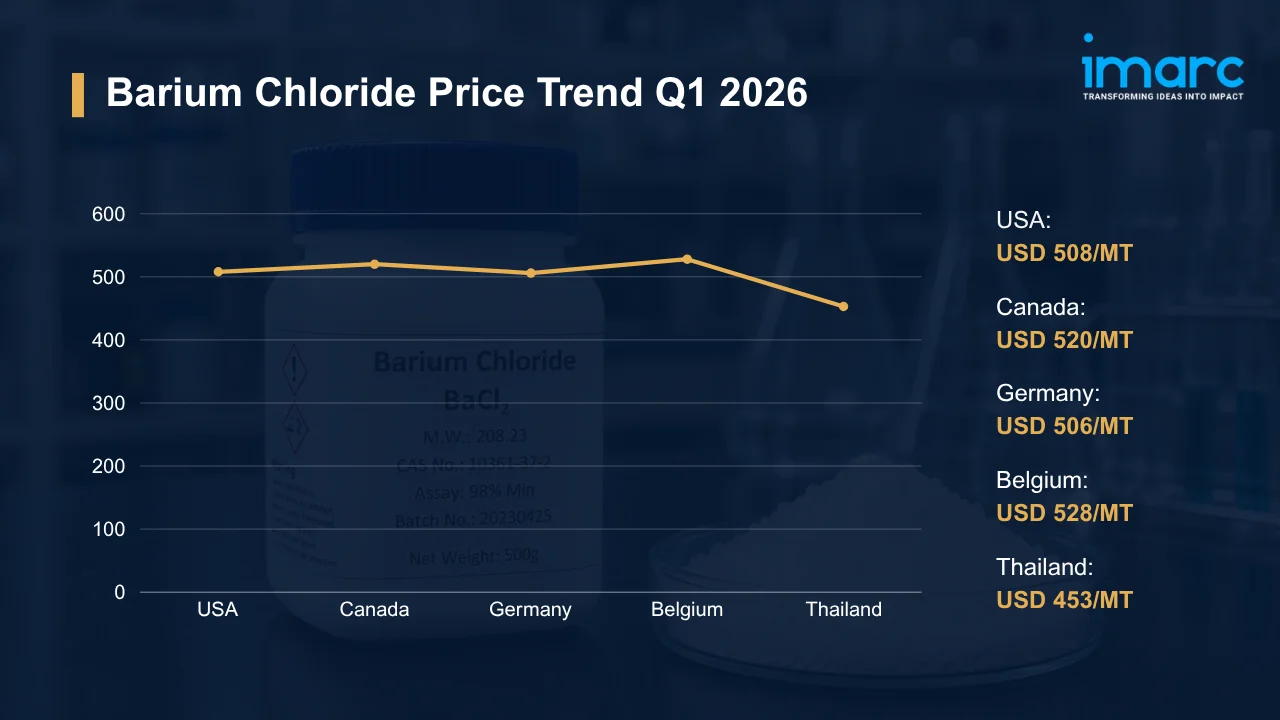
Characterized by high water solubility and full ionic dissociation in aqueous solution, barium chloride is a white crystalline inorganic solid deployed extensively across industrial chemistry. Across water treatment, chemical processing, pigment manufacturing, and metallurgical operations, the compound fulfills essential purification and precipitation functions. Barium chloride prices respond to upstream barite ore and hydrochloric acid cost shifts, energy expenditure during thermal processing, freight economics on intercontinental corridors, and cyclical demand patterns within principal end-use sectors.
Global Market Overview:
Globally, the barium chloride industry was valued at USD 3.48 Billion in 2025. Market projections indicate steady growth, with the industry expected to reach USD 5.36 Billion by 2034, with a compound annual growth rate (CAGR) of 4.90% during 2026-2034. Driven by expanding water treatment infrastructure and accelerating specialty chemical consumption, the barium chloride price trend reflects broadening metallurgical and pigment sector applications that continue diversifying end use demand globally.
Barium Chloride Price Trend Q1 2026:
Regional prices (USD per MT) and QoQ changes Q1 2026 vs Q4 2025:
| Region | Price (USD/MT) | QoQ Change | Direction |
|---|---|---|---|
| USA | 508 | +1.89% | ↑ |
| Canada | 520 | +2.11% | ↑ |
| Germany | 506 | +2.87% | ↑ |
| Belgium | 528 | +3.21% | ↑ |
| Thailand | 453 | +3.51% | ↑ |
To access real-time prices Request Sample
What Moved Prices:
USA:
- At USD 508/MT, barium chloride prices in the USA marked a 1.89% QoQ advance in Q1 2026. Steady procurement from water treatment, chemical processing, and metal treatment facilities sustained upward momentum, as buyers locked in volumes for sulfate removal and brine purification needs without waiting for spot discounts.
- Constrained by rising barite extraction expenditures, domestic producers offered limited pricing flexibility on new contract negotiations through the period. Oilfield services and industrial purification demand kept order books firm, and the barium chloride price chart through the quarter traced a consistent upward trajectory as converters drew steadily on scheduled volumes.
Canada:
- In Q1 2026, barium chloride prices in Canada reached USD 520/MT on the back of a 2.11% QoQ increase. Industrial water treatment and chemical manufacturing end users drove consistent procurement, while tight producer inventory management left few spot discounts available and pushed buyers toward accelerated restocking to fill purification supply gaps.
- Across Canada’s import-dependent barium chloride market, cross-border freight and warehousing charges amplified delivered cost sensitivity at key distribution terminals. Contract volumes from barium compound manufacturers stayed elevated, preventing aggressive price competition as sellers kept inventories disciplined and resisted downward renegotiation pressure through the period.
Germany:
- Advancing to USD 506/MT in Q1 2026, barium chloride prices in Germany reflected a 2.87% QoQ gain. Steady consumption from chemical processing, brine purification, and pigment manufacturing segments drove procurement volumes higher, as specialty chemical end users moved to secure material before anticipated upstream cost increases took effect.
- Through regional supply chains, higher production and distribution costs filtered down as energy-intensive processing stages continued squeezing margins for European producers. Sellers passed elevated operating expenditures directly to downstream buyers, though stable import flows from Asian origins prevented sharp supply-side tightening across the German market.
Belgium:
- During Q1 2026, barium chloride prices in Belgium increased to USD 528/MT, recording the highest assessed value among tracked regions. Chemical distribution, water treatment, and pigment-related sector demand held firm, while port-linked logistics costs and regional handling charges pushed delivered prices upward against a backdrop of disciplined supplier inventory management.
- Across Belgian distribution hubs, order books stayed active on consistent purchasing for sulfate removal and barium compound production throughout the period. Elevated freight surcharges on inbound Asian shipments tilted pricing in favor of sellers, as competitive tendering among regional traders could not fully offset tighter warehousing capacity constraints.
Thailand:
- In Q1 2026, barium chloride prices in Thailand rose to USD 453/MT, posting a 3.51% QoQ gain on improved demand from water treatment, ceramics, and chemical processing sectors. Sellers resisted lower offers on firm operating costs, while domestic and nearby Asian buyers maintained regular procurement volumes across key consumption centers.
- Without excess spot availability, supply conditions stayed balanced as producers calibrated output to match contracted volumes and guard against margin erosion on uncommitted tonnage. Firm intra-Asian freight costs added support to delivered prices at destination terminals, and Thai baht currency movements introduced additional variability into landed cost calculations for regional importers.
Drivers Influencing the Market:
Several factors continue to shape barium chloride pricing and market behavior:
- Water Treatment and Chemical Processing Demand: Baseline procurement volumes for barium chloride rest on sustained consumption from industrial water treatment, brine purification, and chemical manufacturing operations worldwide. Across emerging economies, expanding wastewater management programs generate consistent orders for sulfate removal reagents. Contract-based procurement in mature markets stabilizes quarterly demand flows, even as seasonal production cycles in pigment and specialty chemical plants introduce periodic purchasing variability.
- Upstream Barite Ore and Hydrochloric Acid Costs: Barite ore extraction economics and hydrochloric acid procurement costs directly shape barium chloride production expenses. Concentrated in a handful of producing countries, mining activity amplifies supply-chain vulnerability to permitting delays and precursor delivery gaps. When these bottlenecks coincide with firm downstream order activity, manufacturers adjust finished product valuations upward, compressing converter margins in principal consumption regions.
- Energy Expenditure in Thermal Processing: Electricity and natural gas costs critically influence barium chloride production economics, particularly during energy-intensive calcination and drying stages. Per the IEA’s Electricity 2026 report, EU electricity prices for energy-intensive industries in 2025 averaged more than double US levels and roughly 50% above those in China, compounding competitive pressure on European chemical producers. These regional cost disparities shape plant-level margin structures and influence global trade flow patterns for thermally processed inorganic chemicals.
- Ocean Freight and Logistics Economics: Landed costs for imported barium chloride shift directly with container shipping rate movements on major Asia-to-Europe and transpacific corridors. According to Drewry, the composite World Container Index rose 16% to USD 2,557 per 40-foot container in early January 2026, driven by carrier surcharges and capacity adjustments on key eastbound routes. This increased shipping cost gradually impacts delivered prices across bulk inorganic chemical markets.
- Environmental and Regulatory Compliance: Tightening regulations on barium compound handling, storage, and disposal raise compliance expenditures for producers and distributors across multiple jurisdictions. Under chemical safety frameworks, registration and evaluation requirements impose additional administrative and testing costs that filter into the barium chloride price index over successive reporting periods. Producers in regions with stringent enforcement absorb proportionally higher per-unit charges, which progressively narrow operational margins.
- Trade Policy and Currency Dynamics: Cross-border pricing for barium chloride shifts with tariff adjustments and trade policy changes on Asian-origin imports. Between the US dollar and Chinese yuan, currency volatility across major procurement corridors compounds landed cost unpredictability for importing economies. To protect margins, procurement teams must actively manage hedging gaps and exchange rate timing mismatches that introduce quarterly pricing asymmetries across key markets.
Recent Highlights & Strategic Developments:
Recent strategic moves within the industry further illustrate evolving dynamics:
- In September 2025, researchers at the University of Rajasthan, India, published findings showing that low-dose barium chloride dihydrate application in soil enhanced wheat growth, chlorophyll content, and seed weight at concentrations below 10 µg/g. Doses at or above 100 µg/g proved toxic, reducing leaf area and productivity, and offering new insight into the dose-dependent behavior of barium compounds in plant physiology.
Outlook & Strategic Takeaways:
Looking ahead, the barium chloride market is expected to sustain gradual expansion through 2034, driven by rising water treatment infrastructure spending and broadening metallurgical, pigment, and specialty chemical applications across emerging and mature economies. Upstream barite ore cost trajectories and regional energy pricing dynamics will remain the pivotal variables shaping the barium chloride price forecast, while shifting trade policies compound procurement complexity for major importing regions.
To navigate this complex landscape, stakeholders should:
- Monitor Regional Price Differentials: Track quarterly pricing variations across key supply regions to pinpoint cost-saving procurement windows. Benchmarking landed costs against prevailing contract rates enables more precise sourcing decisions and tighter budget control.
- Assess Freight Market Developments: Evaluate container shipping rate trends on major Asia-to-North America and Asia-to-Europe corridors for early signals of landed cost shifts. Flexible logistics contracts with rate adjustment clauses tied to spot market conditions can mitigate unexpected freight surcharges.
- Evaluate Downstream Demand Indicators: Correlate end-use sector activity indices and order books with procurement planning cycles across principal water treatment and chemical processing markets. Aligning inventory positioning to demand signals helps avoid overstocking during soft consumption periods.
- Review Regulatory Compliance Expenditures: Audit current costs tied to barium compound handling, storage, and environmental discharge requirements to identify efficiency gains. Reducing regulatory burden without compromising chemical safety obligations strengthens margin structures across operating jurisdictions.
- Strengthen Currency Exposure Management: Implement hedging instruments for procurement denominated in volatile currencies to stabilize landed cost projections. Coordinating treasury and procurement timelines ensures foreign exchange coverage aligns with anticipated import payment schedules.
- Explore Emerging Application Segments: Investigate growth potential within novel end-use applications, benchmarking barium chloride price per MT against regional contract rates to gauge commercial viability. Engaging with research partners can reveal demand opportunities beyond traditional consumption sectors.
Subscription Plans & Customization:
IMARC offers flexible subscription models to suit varying needs:
- Monthly Updates: 12 deliverables/year
- Quarterly Updates: 4 deliverables/year
- Biannual Updates: 2 deliverables/year
Each includes detailed datasets (Excel + PDF) and post-report analyst support.

Get in Touch With Us
UNITED STATES
Phone: +1-201-971-6302
INDIA
Phone: +91-120-433-0800
UNITED KINGDOM
Phone: +44-753-714-6104
Email: [email protected]
Client Testimonials




.webp)




.webp)












