Bulk Helium Price Update: Sustained Growth Across Key Markets in Q1 2026
20-May-2026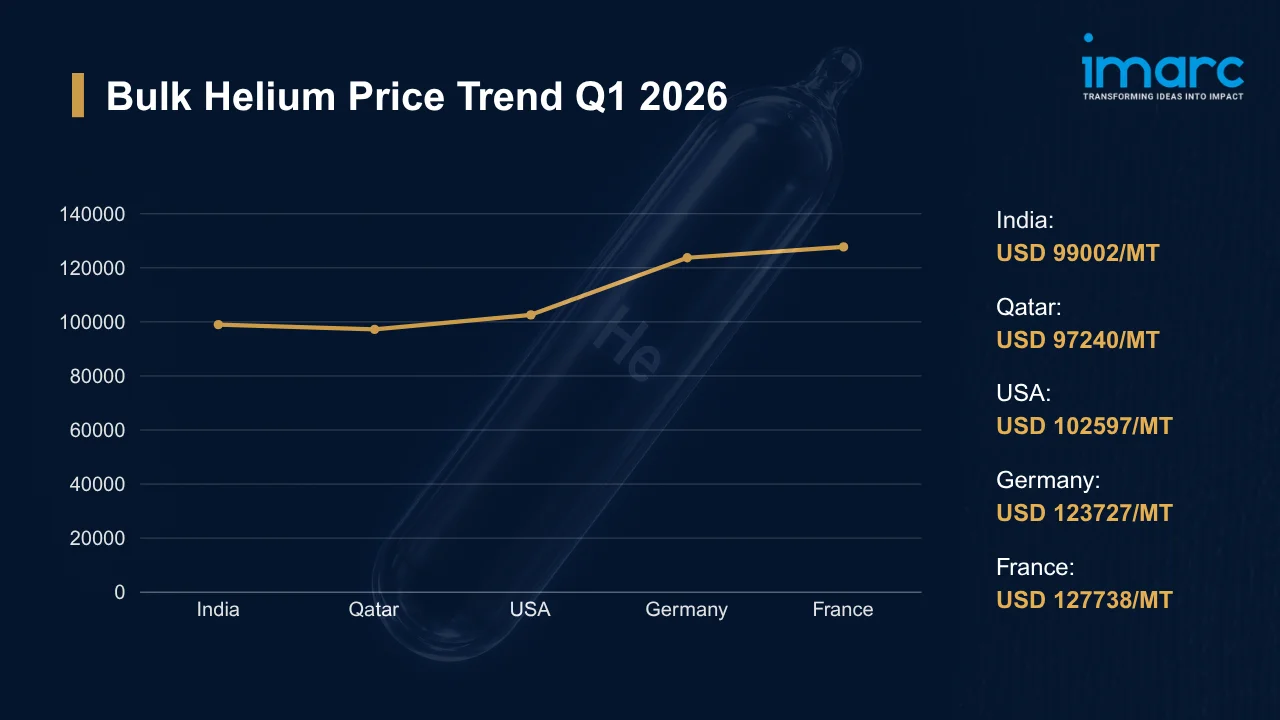
Bulk helium is a colorless, odorless inert noble gas with the lowest boiling point in nature. Across global commerce, bulk helium prices track feedstock natural gas economics, liquefaction throughput, cryogenic freight rates, and demand cycles within healthcare and electronics manufacturing. Production at industrial scale is technically demanding. Across downstream industries, applications span MRI diagnostics, semiconductor fabrication, aerospace leak detection, and scientific research.
Global Market Overview:
Globally, the bulk helium industry reached a volume of 7.22 Million Tons in 2025. Market projections indicate steady growth, with the industry expected to reach 12.08 Million Tons by 2034, with a compound annual growth rate (CAGR) of 5.88% during 2026-2034. Anchoring downstream pull are semiconductor fabrication and MRI installations across healthcare. Against this backdrop, the bulk helium price trend reflects supply tightness and tight allocation discipline among producers.
Bulk Helium Price Trend Q1 2026:
Regional prices (USD per MT) and QoQ changes Q1 2026 vs Q4 2025:
| Region | Price (USD/MT) | QoQ Change | Direction |
|---|---|---|---|
| India | 99002 | +0.56% | ↑ |
| Qatar | 97240 | +1.24% | ↑ |
| USA | 102597 | +0.34% | ↑ |
| Germany | 123727 | +1.13% | ↑ |
| France | 127738 | +0.88% | ↑ |
To access real-time prices Request Sample
What Moved Prices:
India:
- During Q1 2026, Indian bulk helium quotations rose to USD 99002/MT, a 0.56% QoQ uptick. Three sectors did the heavy lifting. Across MRI clinics, semiconductor fabs in Tamil Nadu and Gujarat, and electronics assembly lines, procurement strengthened, while controlled supply inflows tied to logistical constraints capped inventory cushioning.
- Across the period, the bulk helium price chart drifted upward as Chinese-origin and Qatari volumes both arrived with steady-but-not-loose availability through the year. Through the quarter, monsoon-season transport surcharges and elevated insurance premiums added friction to landed cost calculations. Among procurement teams, long-standing contracts shielded buyers from spot premiums.
Qatar:
- During Q1 2026, Qatari bulk helium offers advanced to USD 97240/MT, a 1.24% QoQ gain — the steepest move across the five tracked markets. Liquefaction throughput held to plan. Yet steady production did not translate into looser spot offers, as Asian semiconductor hubs absorbed incremental shipments and medical end users locked in contractual volumes.
- Buyers aligned purchases with allocation frameworks rather than gambling on spot. At Ras Laffan, port operations held steady. Across the quarter, cryogenic ISO container availability remained reliable, while competing demand from MRI installations and semiconductor fabs absorbed surplus capacity from late 2025.
USA:
- During the first quarter of 2026, US bulk helium quotations edged to USD 102597/MT, a 0.34% QoQ gain. Federal Reserve allocation strategies and contract pricing frameworks mitigated most of the upward pressure, whereas healthcare diagnostics and aerospace demand remained within defined limits.
- Across the supply network, federal distribution protocols and reserve allocation mechanisms shaped market access. Industrial gas distributors managed inventory carefully under strategic stockpile considerations. Adding to this, cryogenic transport tariffs ticked higher on rising fuel charges. Advanced node semiconductor fabricators in Arizona and Texas lifted offtake as new wafer capacity came online, supporting firmer bulk pricing.
Germany:
- During the first quarter of 2026, German bulk helium assessments climbed to USD 123727/MT, a 1.13% QoQ move backed by steady demand from industrial gas distributors and Fraunhofer research institutes. Supply chains operated under controlled conditions. Across the region, limited surplus volumes for spot transactions met cautious downstream buying, leaving little price relief for buyers.
- Through heavy reliance on imported volumes, procurement decisions emphasized operational continuity over short-term cost optimization. Distributor contracts framed the bulk of activity at established benchmarks. Across cryogenic research, automotive testing, and semiconductor fabrication hubs in Saxony, structured agreements absorbed available surplus, leaving spot buyers with thin alternatives.
France:
- During the first quarter of 2026, French bulk helium values advanced to USD 127738/MT, supported by consistent draw from medical institutions, Airbus aerospace operations, and CNRS-affiliated research centers. Regulated supply allocation systems guided sourcing. Across the quarter, logistics coordination through Le Havre and Marseille ensured steady delivery into industrial and healthcare segments.
- Across imported supply chains, dependence on Qatari and Russian volumes elevated landed costs, with cryogenic container chartering rates and port handling fees absorbing additional pressure through the quarter. MRI installations across hospitals sustained reliable baseline demand. Among aerospace contractors and CNRS-affiliated laboratories, contractual offtake remained firm as long-term supply agreements shaped price formation.
Drivers Influencing the Market:
Several factors continue to shape bulk helium pricing and market behavior:
- Semiconductor and Healthcare Sector Demand: Semiconductor fabrication and MRI installations drive most of global helium drawdown. Per the SIA, global chip sales hit USD 791.7 Billion in 2025, up 25.6% YoY, lifting helium use for advanced-node lithography cooling and leak detection. Hospital networks added MRI capacity in parallel, pushing structural demand higher across developed and emerging markets.
- Upstream Natural Gas Feedstock Economics: Helium does not exist as a standalone resource. Extracted from natural gas fields where concentrations are commercially viable, it occupies a narrow geological niche. Across producing regions, feedstock gas pricing and the share of helium-rich plays versus dry gas plays directly influence upstream extraction margins through the year. Producer decisions on helium recovery investment shift with gas market economics, capacity utilization, and long-term offtake commitments.
- Energy Expenditure in Cryogenic Liquefaction: Cryogenic distillation runs hot on energy. Per the EIA, US Henry Hub gas averaged USD 3.52 per MMBtu in 2025, up 56% from 2024, sharpening cost structures for North American helium producers. Across global liquefaction operators, regional gas pricing disparities shape competitive positioning between Gulf Coast facilities and Russian or Algerian counterparts.
- Cryogenic Logistics and Ocean Freight Economics: Helium moves in specialized cryogenic ISO containers, not standard freight units. Globally, the certified container fleet is small. When demand spikes, chartering rates climb fast, with the squeeze felt sharpest on long-haul Asia-to-Europe and Gulf-to-Asia routes through peak shipping seasons. Port handling complexity for regulated gases and elevated insurance premiums on high-value cryogenic cargo add further layers of cost that producers ultimately pass through to downstream buyers.
- Environmental and Regulatory Compliance: Across major markets, tightening safety frameworks govern helium handling. Compliance budgets climb under registration requirements, certification protocols, and emissions monitoring obligations. Across cross-border shipments, additional layers stack up: documentation burdens, customs verification, and audit overhead filter into market pricing across jurisdictions with stringent enforcement.
- Trade Policy and Currency Dynamics: Helium supply remains concentrated among a limited group of producing nations, making bilateral trade policy and tariff regimes significant pricing levers for importers across the global market. Currency movements between the US dollar, the euro, and Asian buyer currencies feed directly into the bulk helium price index across regional markets throughout the year. Within producing countries, export licensing rules and strategic reserve policies further shape global allocation.
Recent Highlights & Strategic Developments:
Recent strategic moves within the industry further illustrate evolving dynamics:
- In November 2025, Mendell Helium confirmed that helium production began at M3 Helium Corporation's Rost 1-26 well in Fort Dodge, Kansas. Start-up procedures had wrapped weeks earlier. Across the central USA, the milestone reflects momentum in the company's broader helium development pipeline, signaling fresh domestic capacity additions and supply diversification through 2026.
Outlook & Strategic Takeaways:
Looking ahead, the bulk helium market is expected to expand steadily through 2034, anchored by semiconductor fabrication, expanded MRI deployment, aerospace operations, and emerging quantum computing applications. Feedstock gas economics and liquefaction capacity will shape the bulk helium price forecast.
To navigate this complex landscape, stakeholders should:
- Monitor Regional Price Differentials: Track quarterly spreads across India, Qatar, the USA, Germany, and France to surface arbitrage windows. Use the data to time contract renewals and concentrate volume where landed costs run leanest.
- Assess Freight Market Developments: Track cryogenic ISO container charter rates and ocean freight tariffs on Asia-Europe and Gulf-Asia lanes. Build rate sensitivities into landed cost models to anticipate quarter-end pricing shifts ahead of contract negotiation cycles.
- Evaluate Downstream Demand Indicators: Track SIA monthly sales releases, MRI installation pipelines, and aerospace order books to map forward consumption. Align inventory build-ups with sectoral cycles to limit exposure to mid-quarter spot price swings.
- Review Regulatory Compliance Expenditures: Audit current handling, storage, and cross-border documentation costs across producing and importing jurisdictions. Identify efficiencies in certification, customs clearance, and emissions monitoring workflows that can offset rising compliance overhead.
- Strengthen Currency Exposure Management: Implement forward hedging on US dollar exposure for euro-zone and Asian buyers exposed to persistent FX swings. Match payment terms with delivery cycles to limit translation risk against the bulk helium price per MT.
- Explore Emerging Application Segments: Investigate growth potential in quantum computing, next-gen MRI systems, fiber-optic cooling, and superconductor research. Build supplier relationships in these niches early to secure allocation as demand scales through the decade.
Subscription Plans & Customization:
IMARC offers flexible subscription models to suit varying needs:
- Monthly Updates — 12 deliverables/year
- Quarterly Updates — 4 deliverables/year
- Biannual Updates — 2 deliverables/year
Each includes detailed datasets (Excel + PDF) and post-report analyst support.

Get in Touch With Us
UNITED STATES
Phone: +1-201-971-6302
INDIA
Phone: +91-120-433-0800
UNITED KINGDOM
Phone: +44-753-714-6104
Email: [email protected]
Client Testimonials




.webp)




.webp)












